Close Banner
Section Free  - Video Lectures

05. Postpartum Depression Pharmacotherapy: Antidepressants and Brexanolone

Published on December 5, 2019 Expired on April 1, 2023

Marlene P. Freeman, M.D.

Associate Professor of Psychiatry - Harvard Medical School

Key Points

  • There have been a number of trials of antidepressants for PPD. Some have been small and/or open label, but there are no data that would support antidepressants being less effective in the postpartum than during other times of life.
  • Serotonergic antidepressants may be especially helpful in women with comorbid anxiety.
  • For the first time, the FDA has recognized postpartum depression as a treatment indication, and brexanolone—an intravenously delivered therapy—is now approved for PPD.

Free Downloads for Offline Access

  • Free Download Video (MP4)
  • Free Download Audio File (MP3)
  • Free Download Presentation File (PPTX)

Slides and Transcript

Slide 1 of 8

Okay. So next, we’ll talk about postpartum depression and pharmacotherapy including antidepressants and a new treatment called brexanolone.

Slide 2 of 8

So in general, antidepressants are thought to be efficacious for postpartum depression, as efficacious for postpartum depression as outside the postpartum when used for major depressive episodes. Because anxiety is often comorbid with postpartum depression, serotonergic antidepressants are usually the first line treatments including SSRI antidepressants. And SSRIs are among the best studied specifically for the treatment of postpartum depression but also during breastfeeding.
Free Files
Success!
Check your inbox, we sent you all the materials there.

Slide 3 of 8

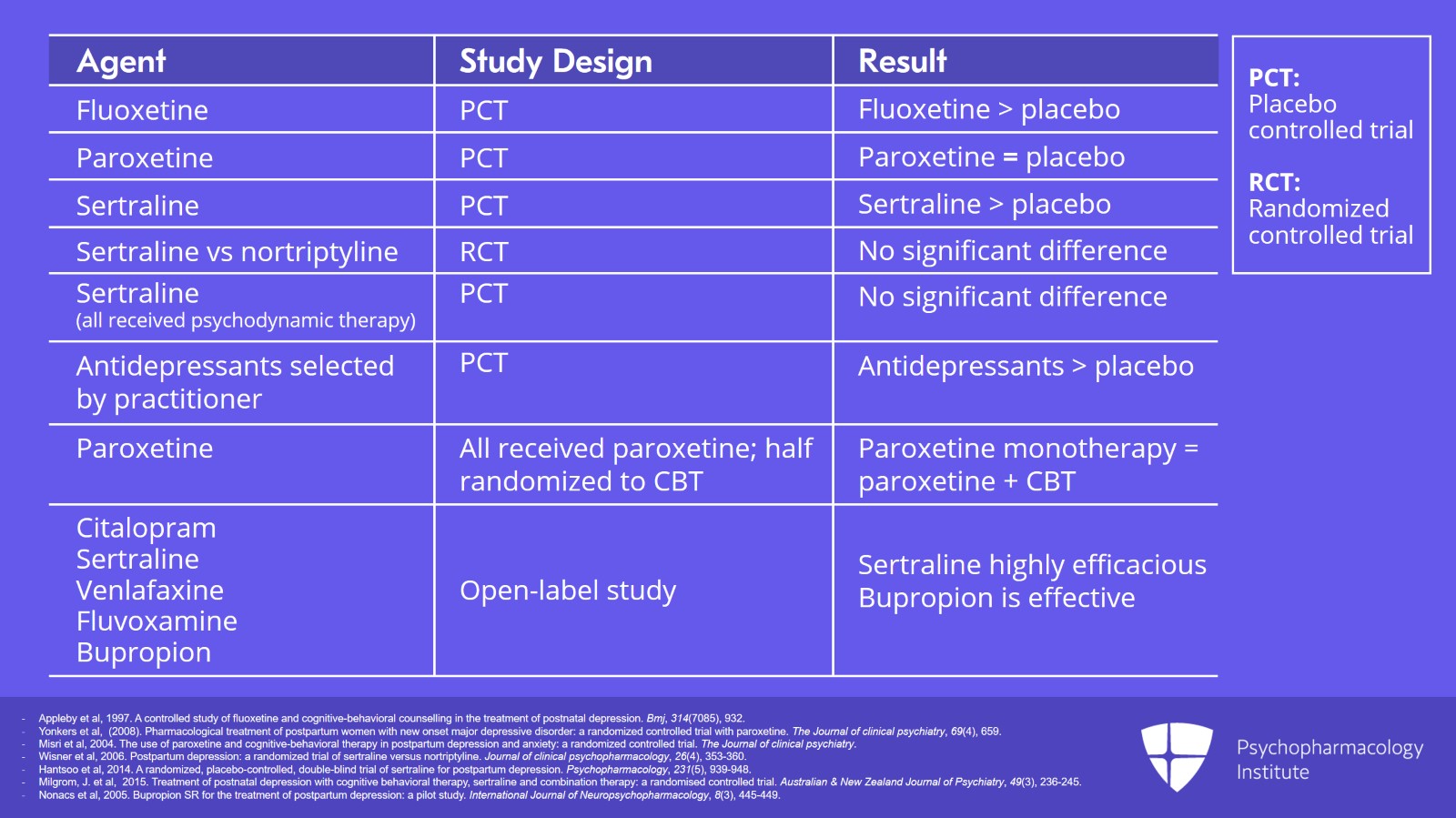
So the table that I include here includes some of the studies for postpartum depression, specifically treatment with antidepressants. And as you can see, there are not a lot of controlled trials for this yet we do not discount the efficacy of antidepressants in the treatment of postpartum depression because by definition, postpartum depression is the occurrence of a major depressive episode occurring in the postpartum and no reason to believe that antidepressants don’t work well for that. So we would consider especially if a woman has had a particularly good response in the past to an antidepressant consider using that again so that she doesn’t have to go through a long period of time before she experiences response to treatment.
References:
  • Appleby et al, 1997. A controlled study of fluoxetine and cognitive-behavioral counselling in the treatment of postnatal depression. Bmj, 314(7085), 932.
  • Yonkers et al, (2008). Pharmacological treatment of postpartum women with new onset major depressive disorder: a randomized controlled trial with paroxetine. The Journal of clinical psychiatry, 69(4), 659.
  • Misri et al, 2004. The use of paroxetine and cognitive-behavioral therapy in postpartum depression and anxiety: a randomized controlled trial. The Journal of clinical psychiatry.
  • Wisner et al, 2006. Postpartum depression: a randomized trial of sertraline versus nortriptyline. Journal of clinical psychopharmacology, 26(4), 353-360.
  • Hantsoo et al, 2014. A randomized, placebo-controlled, double-blind trial of sertraline for postpartum depression. Psychopharmacology, 231(5), 939-948.
  • Milgrom, J. et al, 2015. Treatment of postnatal depression with cognitive behavioral therapy, sertraline and combination therapy: a randomised controlled trial. Australian & New Zealand Journal of Psychiatry, 49(3), 236-245.
  • Nonacs et al, 2005. Bupropion SR for the treatment of postpartum depression: a pilot study. International Journal of Neuropsychopharmacology, 8(3), 445-449.

Slide 4 of 8

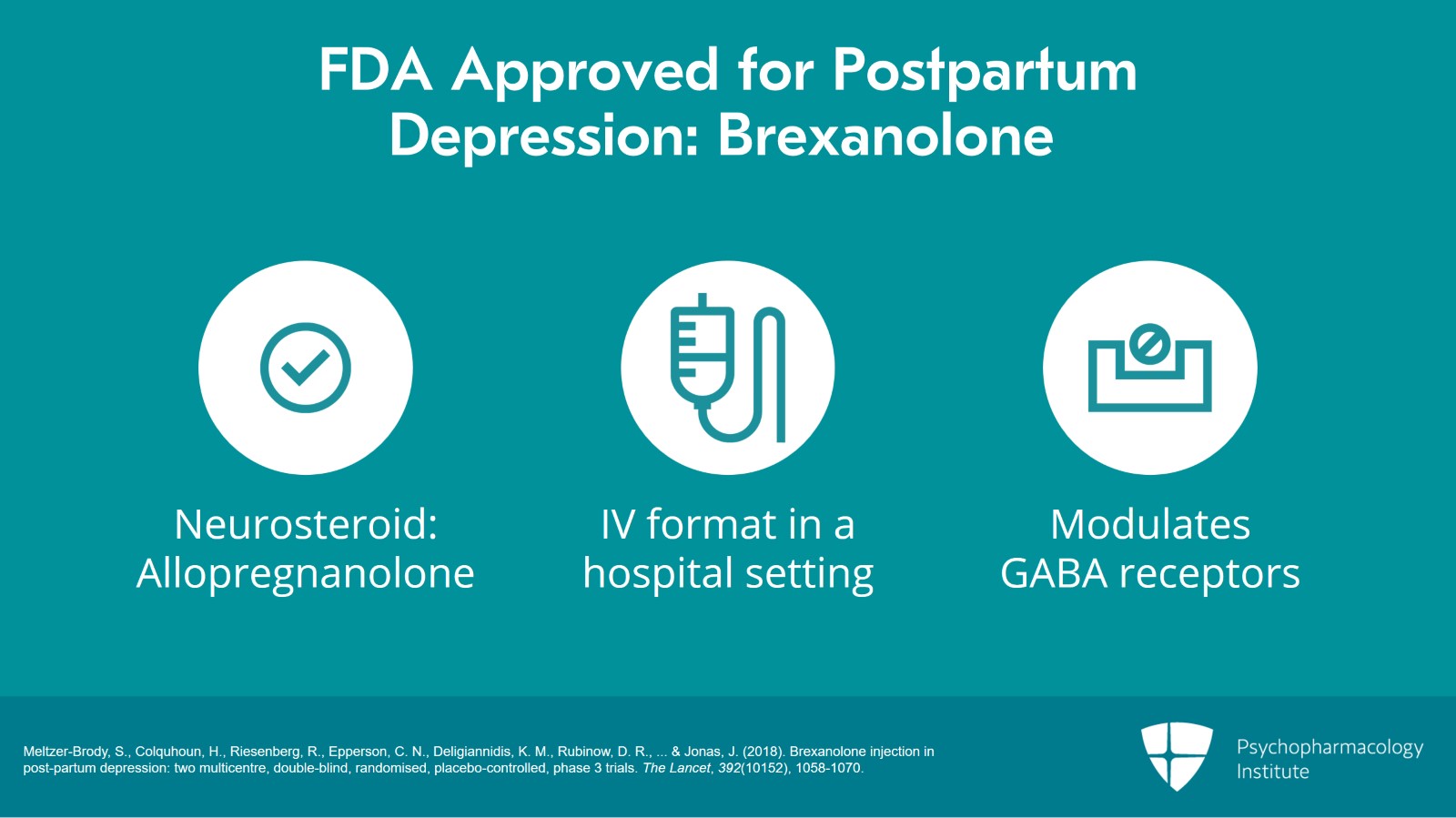
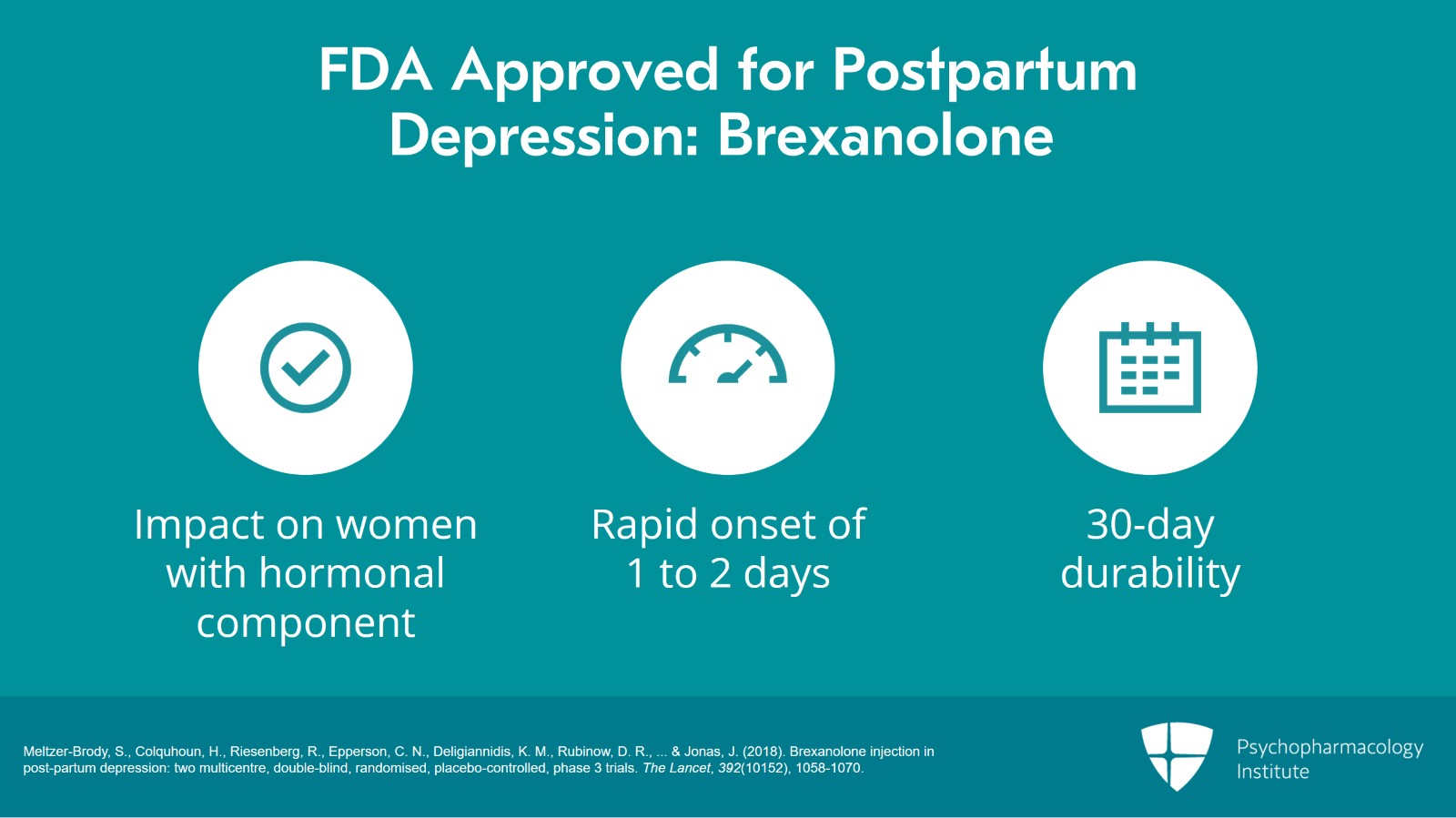
So just to mention, there also has been a new treatment for postpartum depression approved by the FDA. What’s really remarkable is this is the first time the US FDA has noted postpartum depression as an indication for the treatment of a new medication. And the new medication which was approved in 2019 is brexanolone which is a neurosteroid, allopregnanolone, which is used in an IV form to treat postpartum depression. So it needs to be delivered in an IV format in a hospital setting. And so there are some barriers to its treatment because women need to be in the hospital to receive it. So it’s thought to work by modulating GABA receptors
References:
  • Meltzer-Brody, S., Colquhoun, H., Riesenberg, R., Epperson, C. N., Deligiannidis, K. M., Rubinow, D. R., … & Jonas, J. (2018). Brexanolone injection in post-partum depression: two multicentre, double-blind, randomised, placebo-controlled, phase 3 trials. The Lancet, 392(10152), 1058-1070.
Free Files
Success!
Check your inbox, we sent you all the materials there.

Slide 5 of 8

and also being a neurosteroid has potentially an impact on women who may have a hormonal component to postpartum depression. What’s really novel about it is that it has a rapid onset of effect. And the studies showed effect specifically during the first day or two of treatment with durability out to 30 days of treatment. So it’s not studied long term but really is an acute treatment for postpartum depression. So at this point, because it’s recently approved, we have not yet seen how it’ll be implemented in the community. But it is exciting because it’s a first in class, new antidepressant. And we will see other types of neurosteroid antidepressants follow along this course.
References:
  • Meltzer-Brody, S., Colquhoun, H., Riesenberg, R., Epperson, C. N., Deligiannidis, K. M., Rubinow, D. R., … & Jonas, J. (2018). Brexanolone injection in post-partum depression: two multicentre, double-blind, randomised, placebo-controlled, phase 3 trials. The Lancet, 392(10152), 1058-1070.

Slide 6 of 8

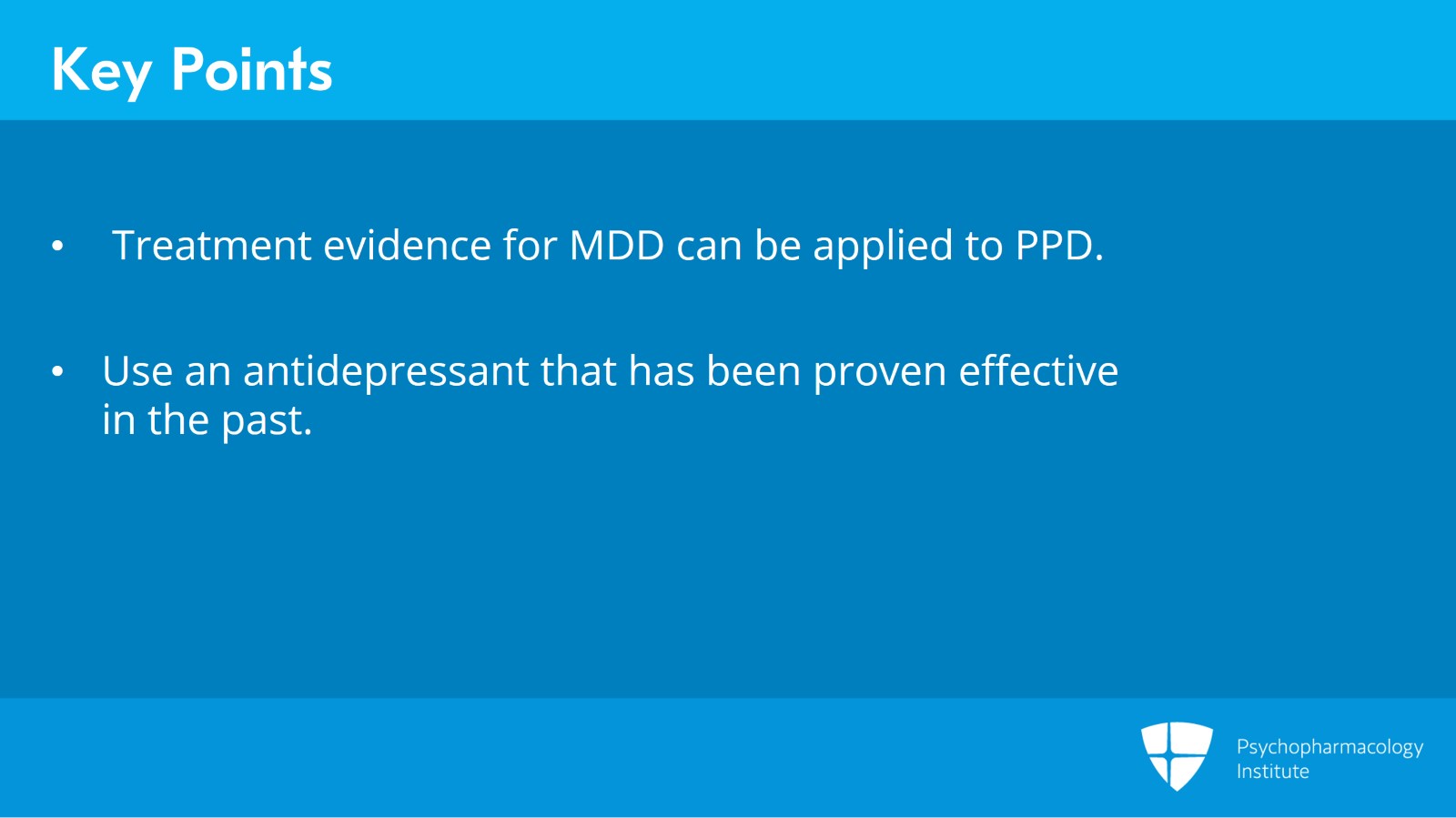
So the key points really with antidepressants in terms of the treatment of postpartum depression is that although there have been a number of trials specifically of antidepressants for postpartum depression, we can really lean on all the trials of antidepressants for major depressive disorder because postpartum depression is a form of major depressive disorder. So especially if a woman has had a good response to an antidepressant in the past, that may indicate that that would be a good choice for her in the postpartum.
Free Files
Success!
Check your inbox, we sent you all the materials there.

Slide 7 of 8

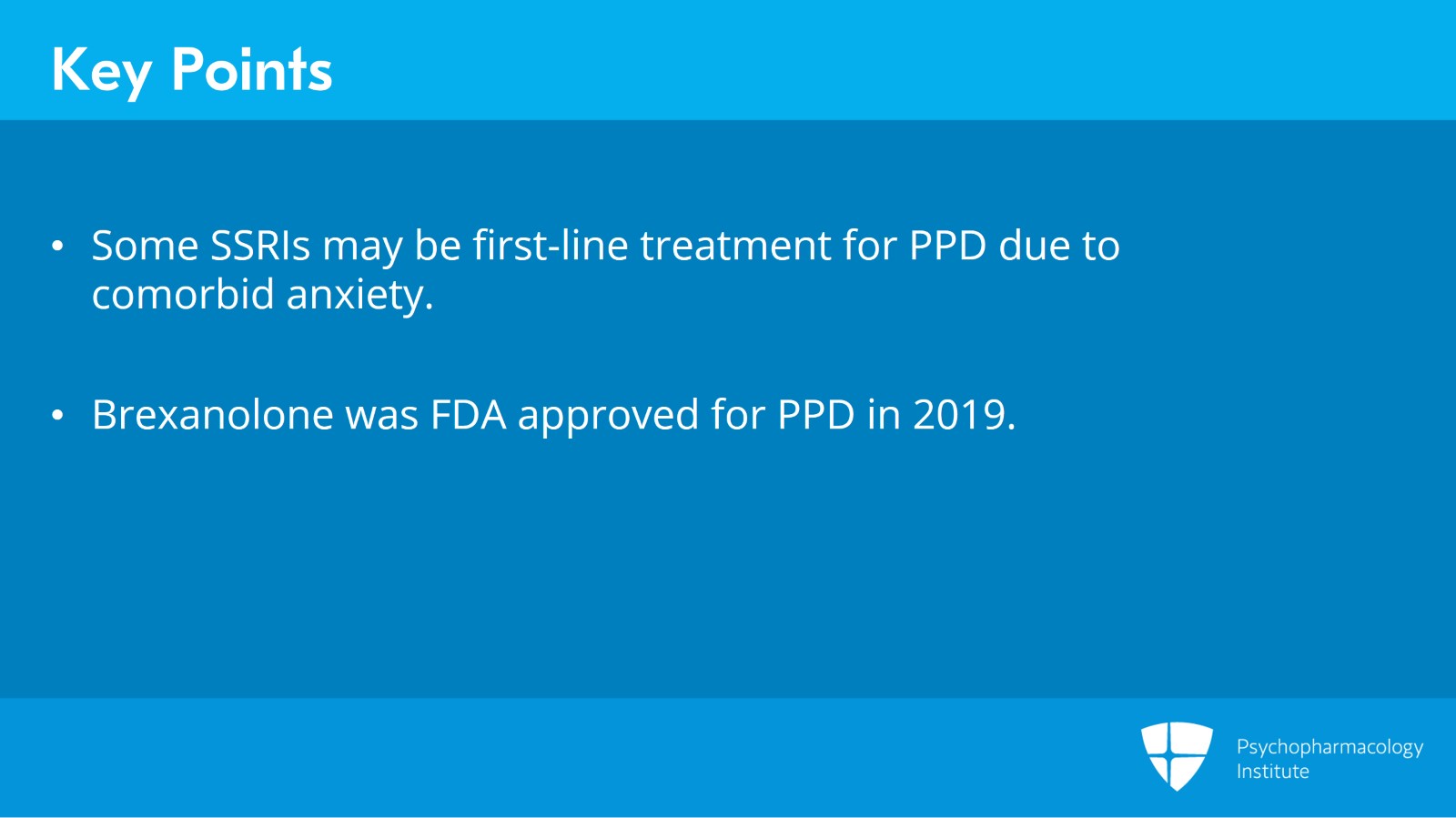
Because anxiety is often comorbid, some of the serotonergic antidepressants may be the first choice for many women who have postpartum depression. And we also for the first time have a treatment that’s specifically now approved for postpartum depression which is brexanolone.

Slide 8 of 8

Free Files
Success!
Check your inbox, we sent you all the materials there.

Learning Objectives:

After completing this activity, the learner will be able to:

  1. Identify women at risk for postpartum mood disorders so as to offer the best possible treatment.
  2. Describe treatment strategies for postpartum mood disorders and apply them accordingly.

Original Release Date: December 5, 2019

Review and Re-release Date: March 1, 2023

Expiration Date: April 1, 2023

Relevant Financial Disclosures: 

Marlene Freeman declares the following interests:

- JayMac, Sage:  Investigator

- Otsuka, Alkermes, Sunovion:  Advisory boards

- Janssen:  Independent Data Safety and Monitoring Committee

- Medscape:  Steering Committee for Educational Activities

All of the relevant financial relationships listed for these individuals have been mitigated.

Contact Information: For questions regarding the content or access to this activity, contact us at support@psychopharmacologyinstitute.com

Instructions for Participation and Credit:

Participants must complete the activity online during the valid credit period that is noted above.

Follow these steps to earn CME credit:

  1. View the required educational content provided on this course page.

  2. Answer the quiz for promoting retention of knowledge.

  3. Complete the Post Activity Evaluation for providing the necessary feedback for continuing accreditation purposes and for the development of future activities. NOTE: Completing the Post Activity Evaluation after the quiz is required to receive the earned credit.

  4. Download your certificate.

Accreditation Statement

This activity has been planned and implemented in accordance with the accreditation requirements and policies of the Accreditation Council for Continuing Medical Education through the joint providership of Medical Academy LLC and the Psychopharmacology Institute. Medical Academy is accredited by the ACCME to provide continuing medical education for physicians.

Credit Designation Statement

Medical Academy designates this enduring activity for a maximum of 1.25 AMA PRA Category 1 credit(s)™. Physicians should claim only the credit commensurate with the extent of their participation in the activity.


Free Files
Success!
Check your inbox, we sent you all the materials there.
Continue in the website
Instant access modal

Become a Bronze, Silver, Gold, Bronze extended, Silver extended or Gold extended Member.

2025–26 Psychopharmacology CME Program

Unlock up to 155 CME Credits, including 40 SA CME Credits.