Close Banner
Section Free  - Video Lectures

10. Pharmacogenomics in Clinical Practice: Recommendations and Communicating with Patients

Published on March 18, 2019 Expired on March 31, 2022

Simon Kung, M.D.

Associate Professor of Psychiatry - Mayo Clinic

Key Points

  • The US FDA provides genotype-guided medication dose adjustments.
  • In general, CPIC guidelines recommend no changes for normal or intermediate metabolizers.
  • There is good evidence for CYP2D6 and CYP2C19 and, to a lesser extent, SLC6A4.

Free Downloads for Offline Access

  • Free Download Video (MP4)
  • Free Download Audio File (MP3)
  • Free Download Presentation File (PPTX)

Slides and Transcript
Slide 1 of 12

Let’s look at pharmacogenomics in clinical practice and what our recommendations might be to our patients.

Slide 2 of 12

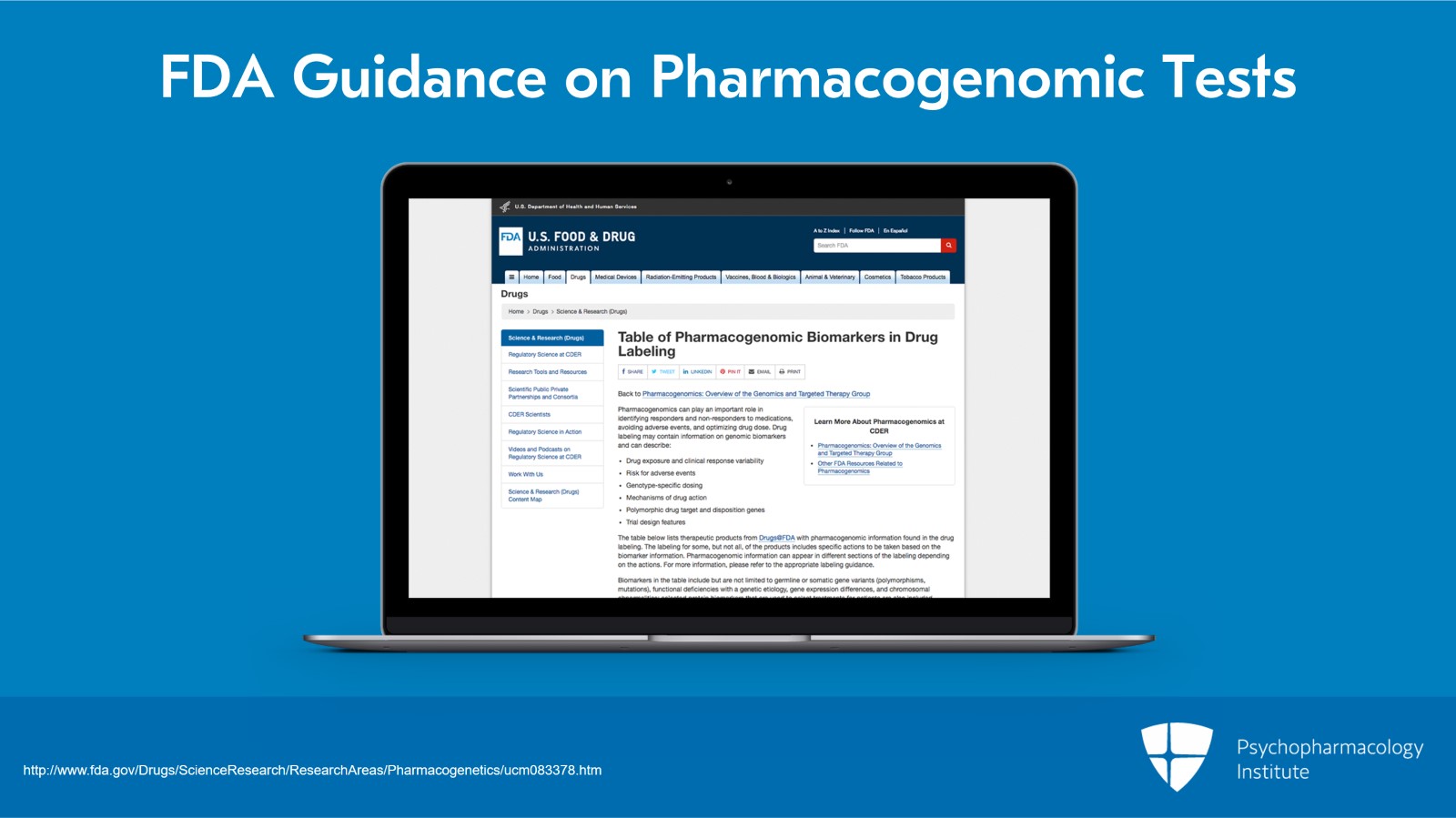
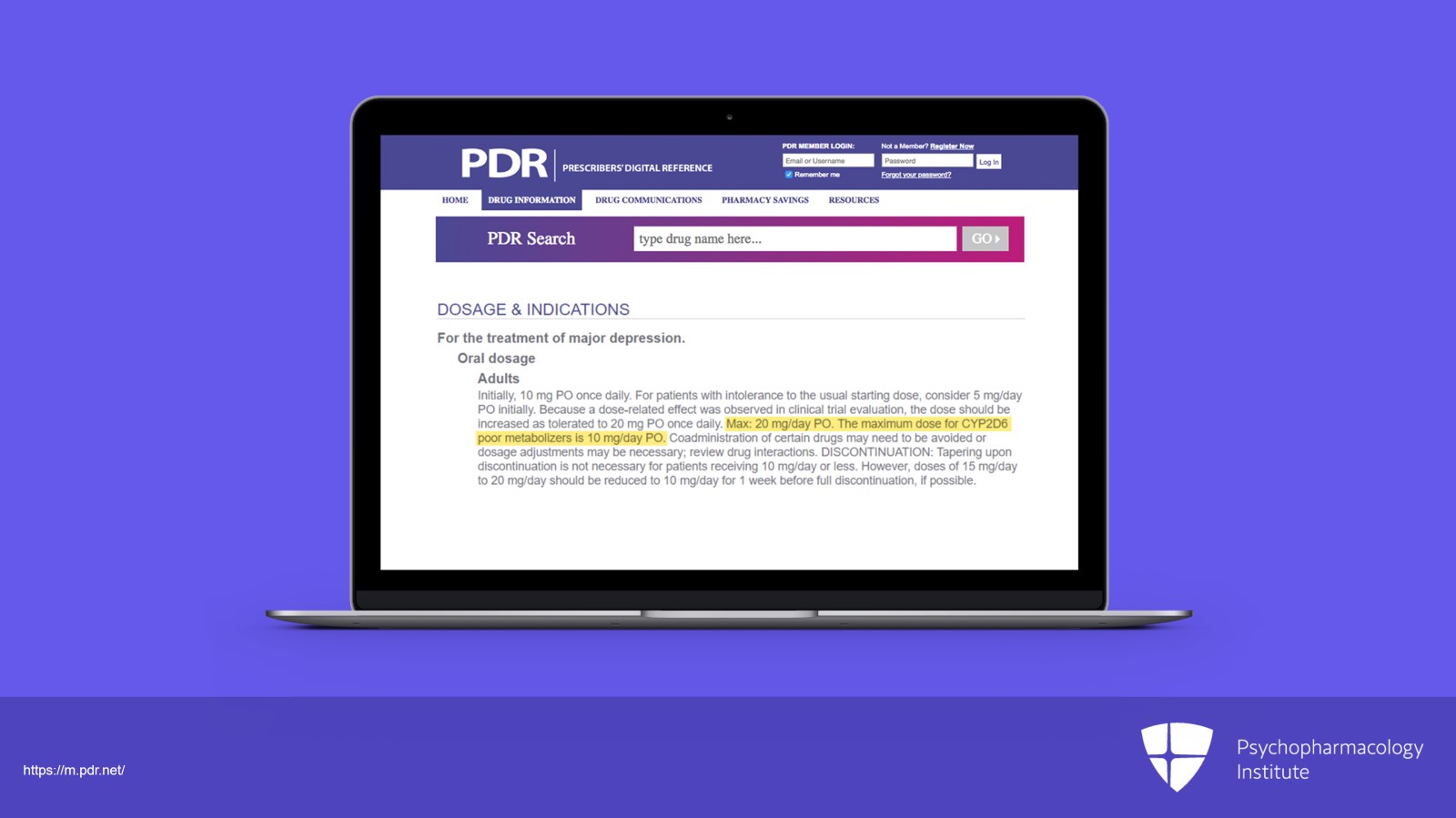
So the FDA does have a lot of guidance on these pharmacogenomic tests for certain medications and I’m showing you a link where you can find these.
Free Files
Success!
Check your inbox, we sent you all the materials there.
Slide 3 of 12

And if you go to the PDR and just look at the PDR information, that will also show, for example, on Trintellix which is vortioxetine, it will say right there that P450 2D6 poor metabolizers should take only half of the dose of Trintellix.

Slide 4 of 12

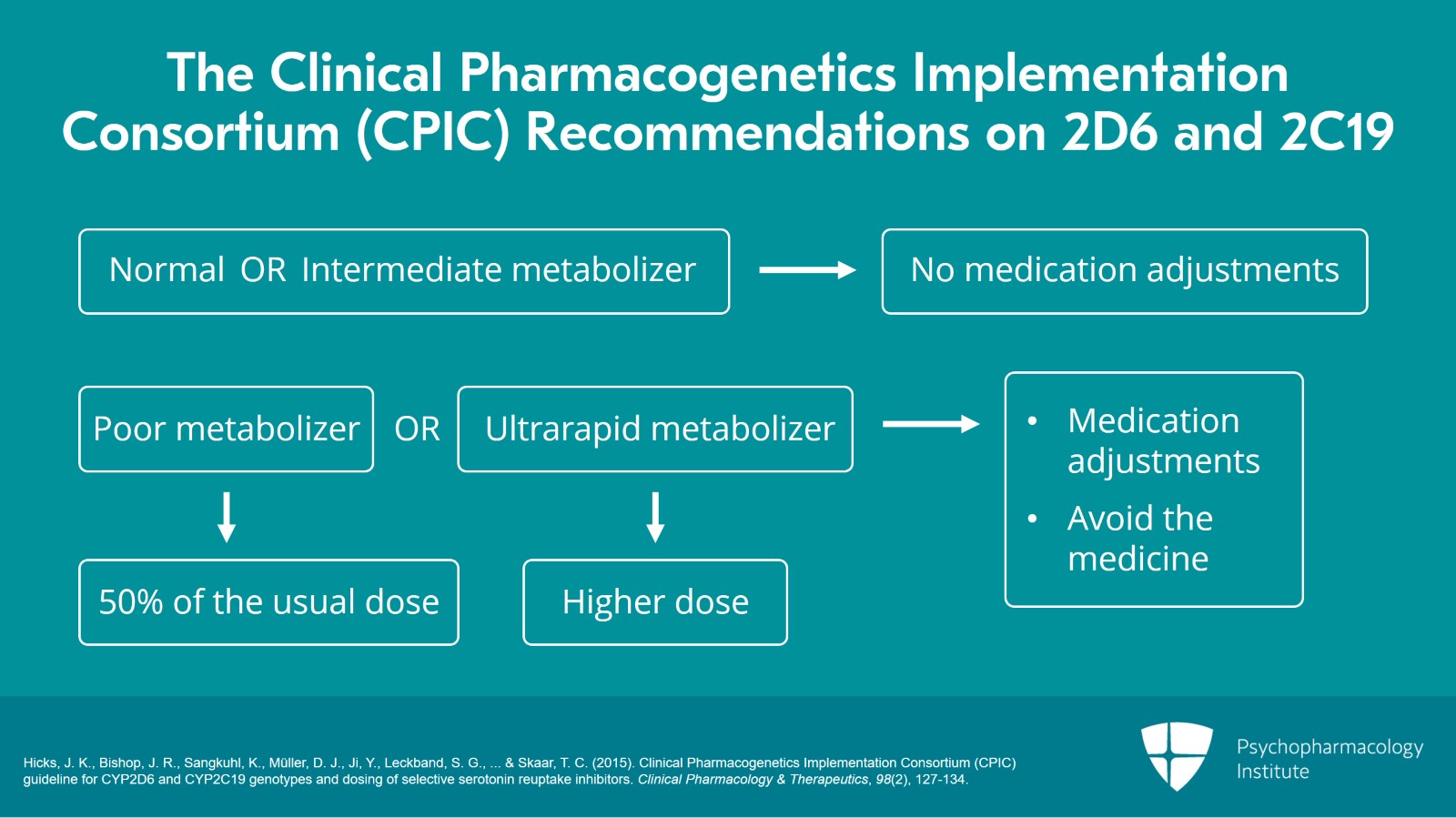
There are some general clinical recommendations that I use and these are really based on what the CPIC which is the Clinical Pharmacogenetics Implementation Consortium recommends for their guidelines on 2D6 and 2C19. Those recommendations consist of if the individual is a normal or intermediate metabolizer, then usually there’s no need to make any medication adjustments. Typically, we make the medication adjustments only if the person is a poor or ultra-rapid metabolizer. Sometimes, we’ll try to avoid the medicine if it’s a poor or ultra-rapid metabolizer. If we don’t want to avoid that medicine, a lot of times for poor metabolizers, we’ll just target 50% of the usual dose. And for ultra-rapid metabolizers, you might need a higher dose.
Free Files
Success!
Check your inbox, we sent you all the materials there.
Slide 5 of 12

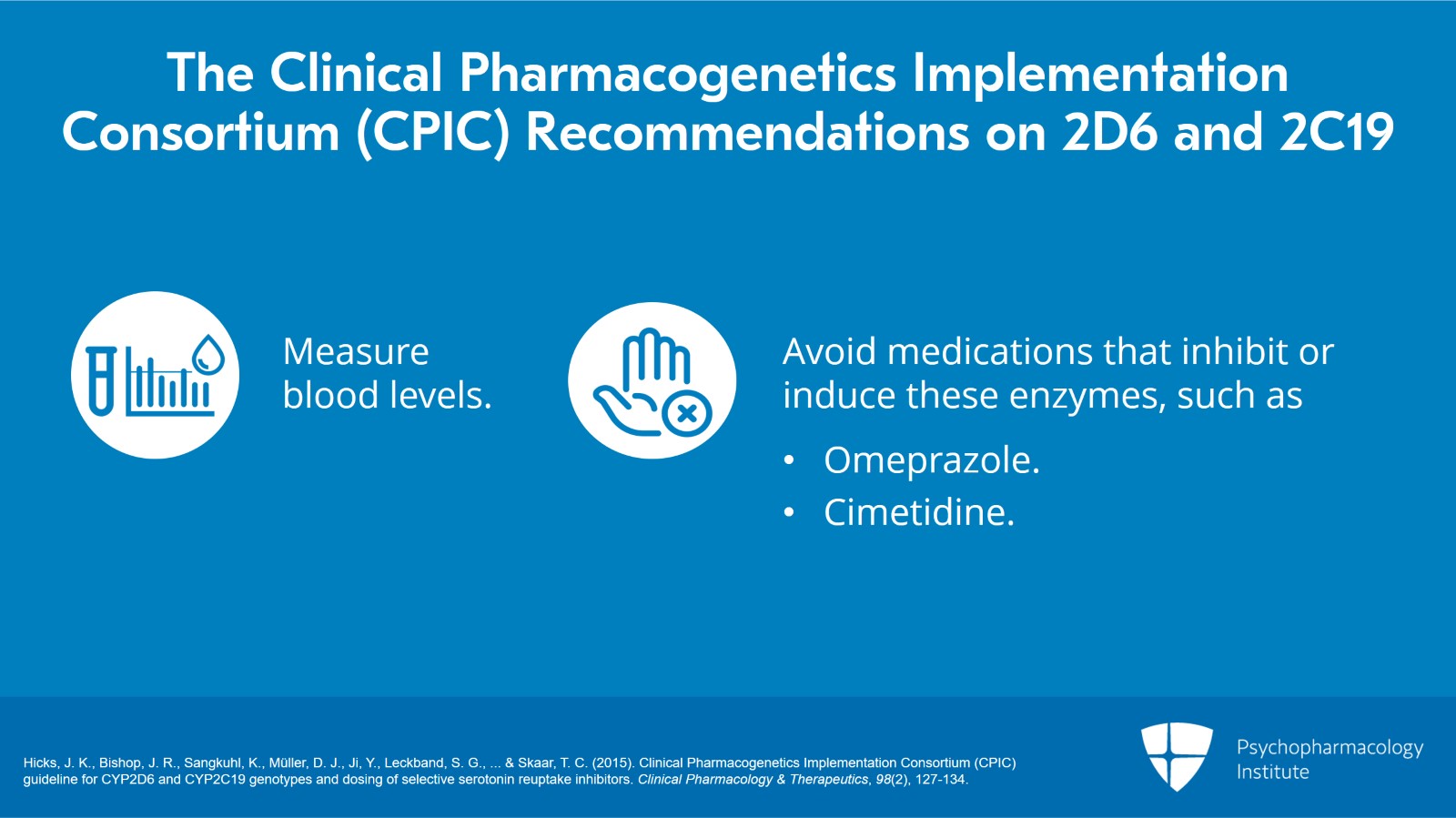
Of course, if the medicine is a tricyclic and you can measure blood levels, that’s another way to see how much dose you can give to the patient based on the drug level in the bloodstream. And another thought is to avoid using medications which might inhibit or induce some of these enzymes so medicines such as omeprazole or cimetidine.

Slide 6 of 12

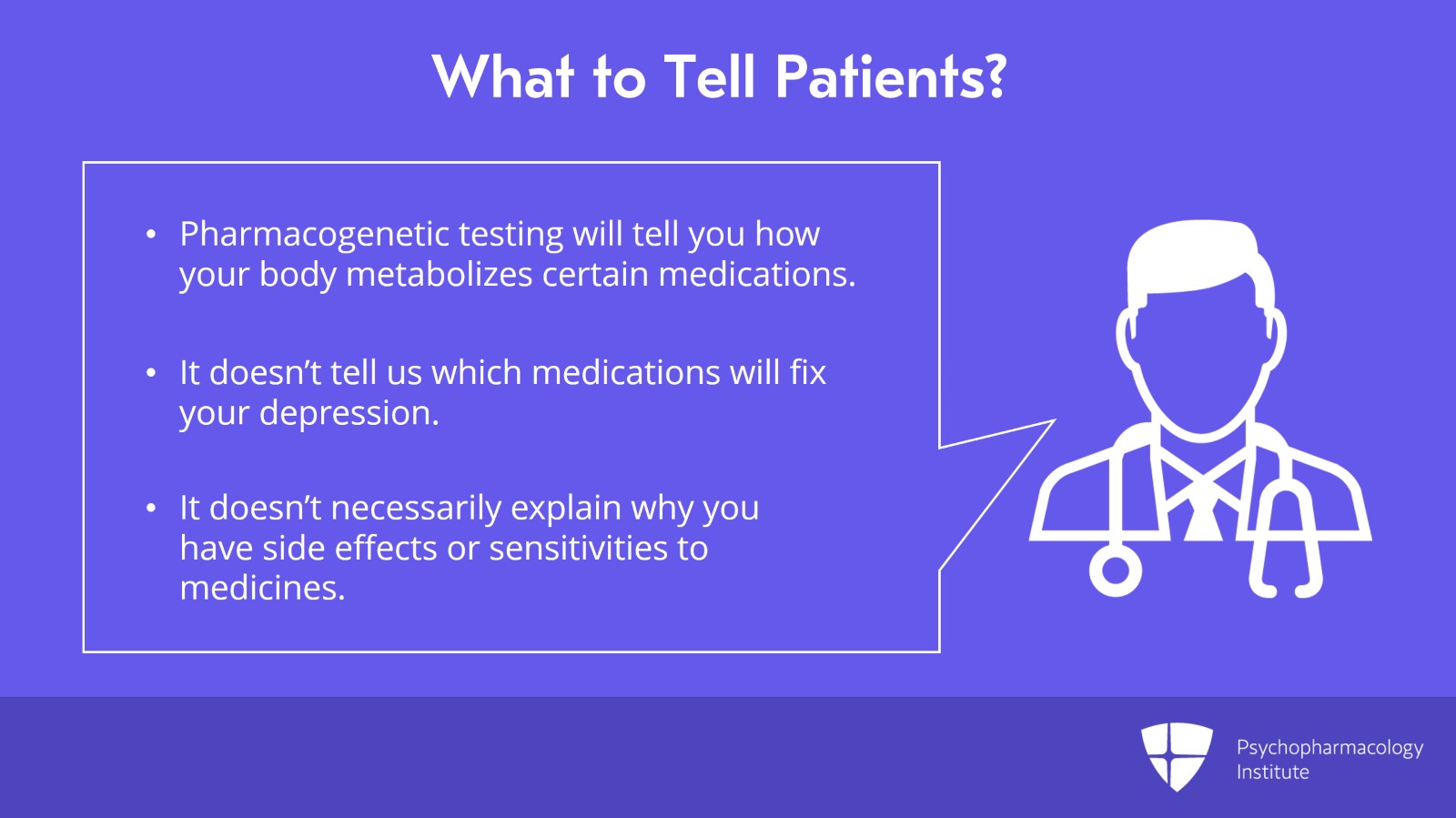
What seems reasonable to tell patients? And this is what I usually tell patients. So I tell them that pharmacogenetic testing will tell you theoretically how your body metabolizes certain medications. It doesn’t tell us which medications will fix your depression and it doesn’t necessarily explain why you have side effects or sensitivities to medicines. I’ve had many patients come in convinced that they are a different metabolizer type because of all the side effects and when I do the pharmacogenetic testing, a lot of times they come back a normal metabolizer.
Free Files
Success!
Check your inbox, we sent you all the materials there.
Slide 7 of 12

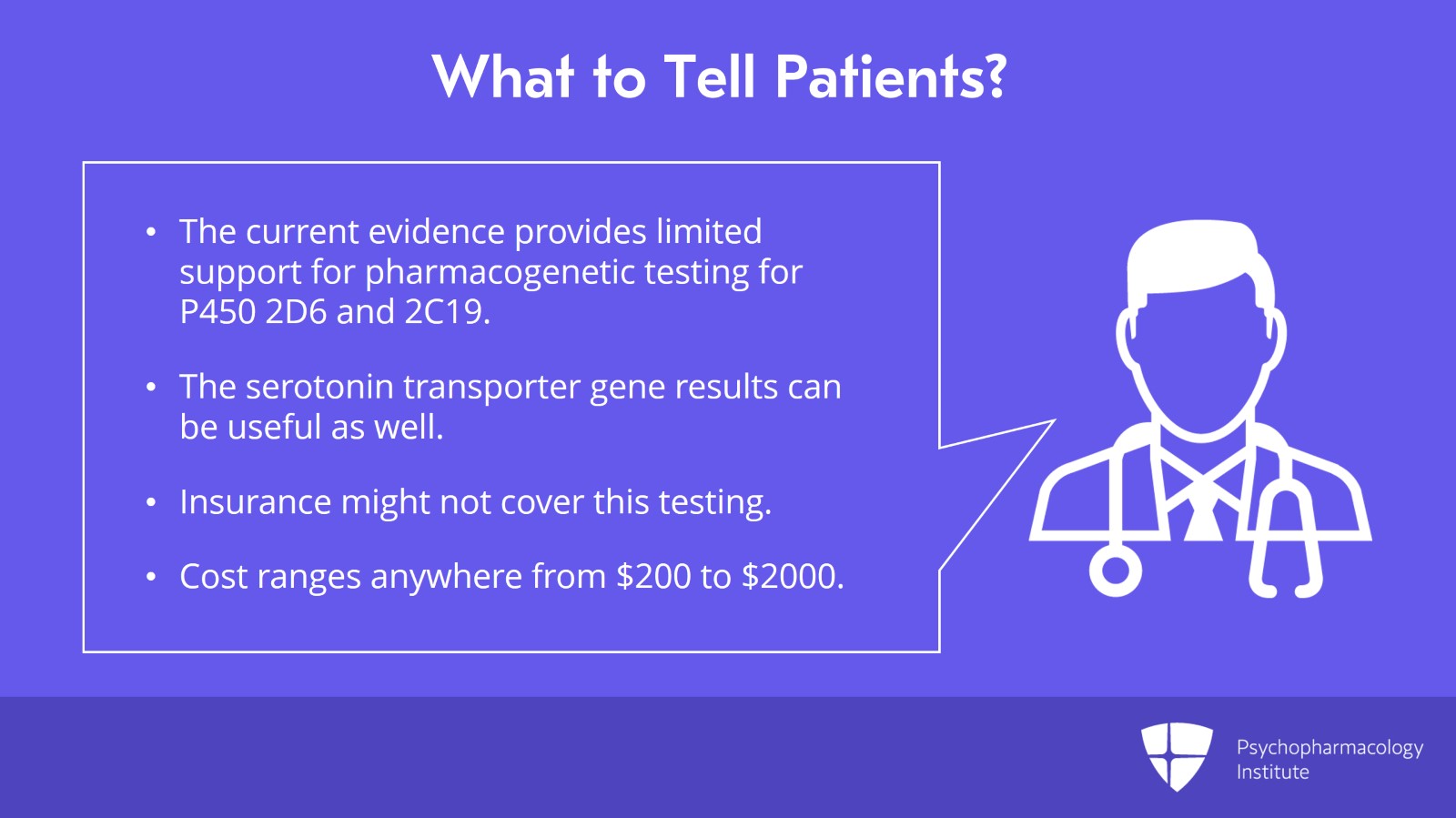
I’ll also tell patients that the current evidence provides limited support for pharmacogenetic testing for P450 2D6 and 2C19 primarily because there are those CPIC Guidelines and a lot of evidence backing that up and that the serotonin transporter gene results can be useful as well. I always make sure I tell them that insurances might not cover this testing. And certainly, some insurance companies write on their website if you Google their website and say pharmacogenetic testing, they will say that they do not cover this test. And the out-of-pocket cost ranges anywhere from $200 to $2000.

Slide 8 of 12

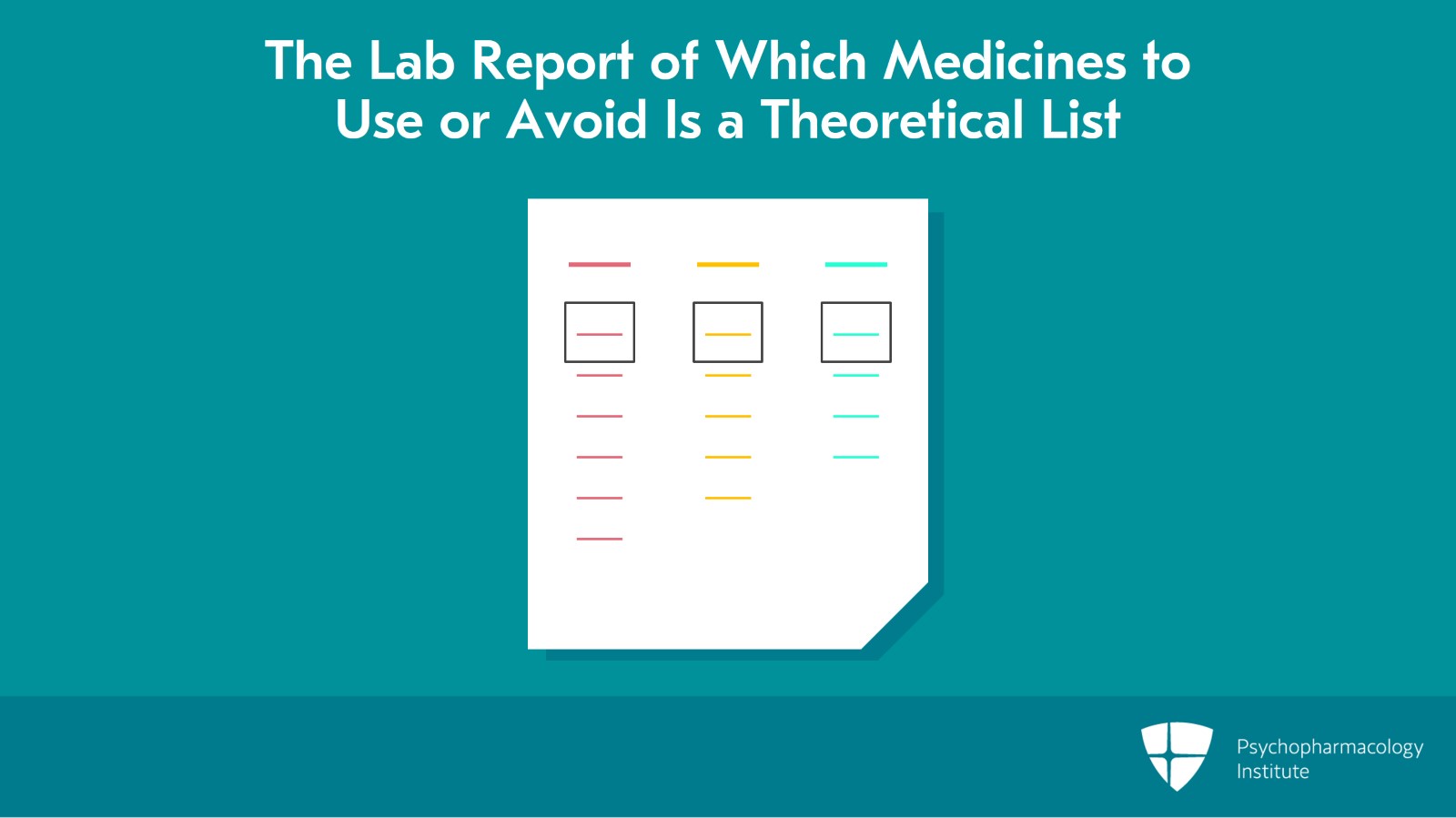
Other thing I tell patients is if a lab gives you a report of what medicines to use or avoid, remember that that’s a theoretical list and it’s mostly pharmacokinetic based. So sometimes, patients are very whetted, and they get this test and there might be some colored columns like red, yellow and green and the patient is so convinced that they should not be taking a medicine that’s in the red category when in fact a medicine in the red category would be reasonable to use and might really help.
Free Files
Success!
Check your inbox, we sent you all the materials there.
Slide 9 of 12

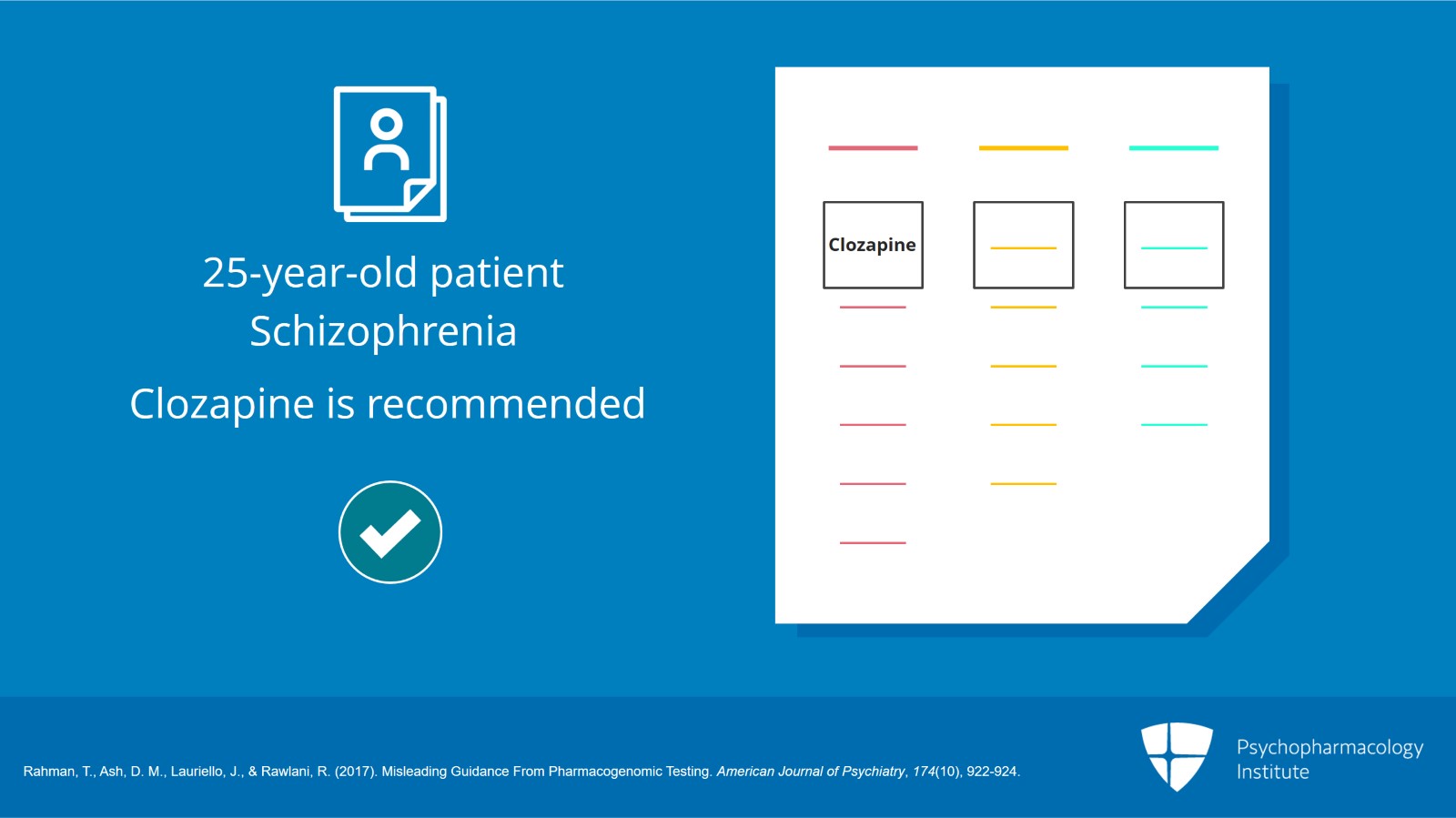
So this was a subject of a case report that was presented in the American Journal of Psychiatry in 2017 in which there was a 25-year-old patient with schizophrenia and clozapine is what was recommended. But the family and the patient’s psychiatrist said look, you know, this clozapine is in the red column. We’re not going to use it. And in the end, the patient did use clozapine and did get better. So remember that those lab reports are not always an indication of we must follow this down to the very letter.

Slide 10 of 12

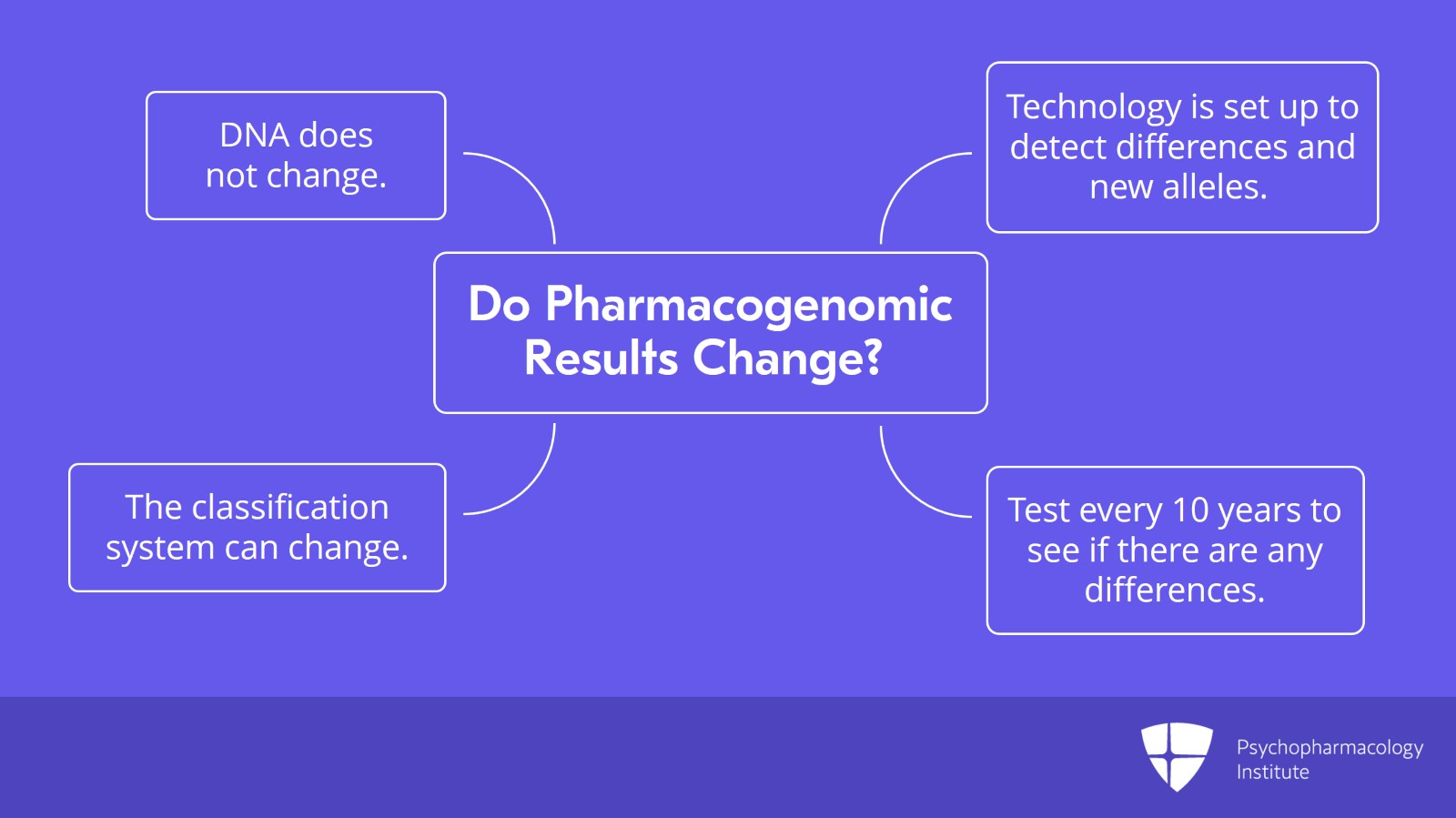
One thought about pharmacogenomics is do the results change? Because when you think about it, DNA doesn’t change. So if I do this test on a patient, do I need to repeat it in five or 10 years? Well, it turns out even though DNA doesn’t change the way our technology is set up to detect differences and new alleles so that’s always changing and the new alleles are being discovered all the time. And sometimes, we change our classification system of whether this allele causes fast or slow activity. I’ve seen two different labs with the same genotype reported that they classified the patient in two different categories. One was classified as normal and the other was classified as intermediate. So sometimes, these changes will make it so that it is reasonable every 10 years, let’s say, to do the testing just to see if there are any differences.
Free Files
Success!
Check your inbox, we sent you all the materials there.
Slide 11 of 12

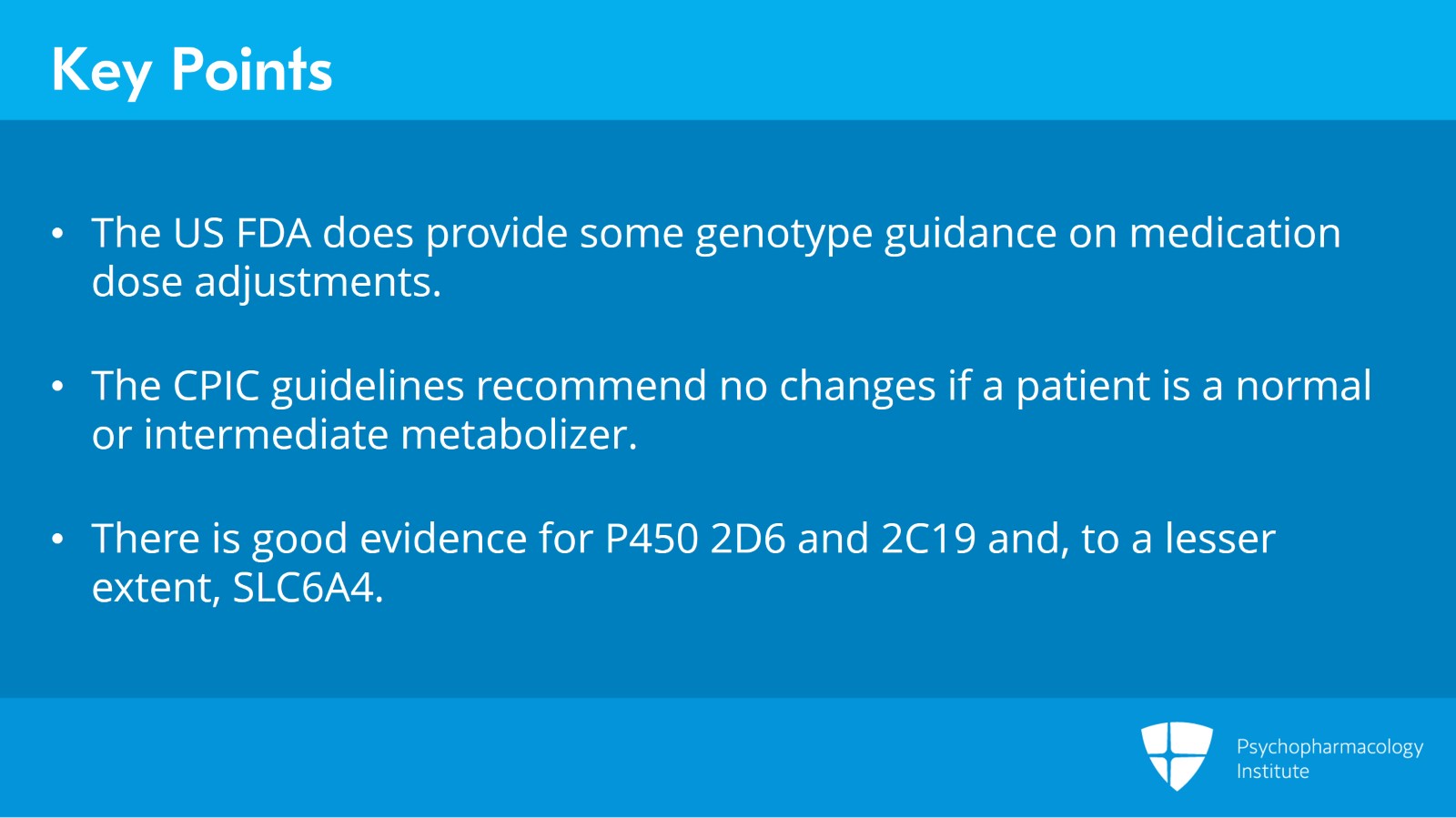
The key points in this section are that the US FDA does provide some genotype guidance on medication dose adjustments. In general, the CPIC Guidelines recommend no changes if a patient is a normal or intermediate metabolizer. There’s good evidence for P450 2D6 and 2C19 and to a lesser extent SLC6A4.

Slide 12 of 12

Free Files
Success!
Check your inbox, we sent you all the materials there.
Learning Objectives:

After completing this activity, the learner will be able to:

  1. Understand the basic pharmacogenomic factors that affect plasma levels of drugs.
  2. Weigh out the benefits of pharmacogenomic testing and how it needs to develop further.

Original Release Date: March 18, 2019

Expiration Date: March 31, 2022

Relevant Financial Disclosures: 

Simon Kung declares the following interests:

- Psychopharmacology Institute:  preparing CME presentation

All of the relevant financial relationships listed above have been mitigated by Medical Academy and the Psychopharmacology Institute.

Contact Information: For questions regarding the content or access to this activity, contact us at support@psychopharmacologyinstitute.com

Free Files
Success!
Check your inbox, we sent you all the materials there.
Continue in the website
Instant access modal

Become a Bronze, Silver, Gold, Bronze extended, Silver extended or Gold extended Member.

2025–26 Psychopharmacology CME Program

Unlock up to 155 CME Credits, including 40 SA CME Credits.