Close Banner
Section Free  - Video Lectures

07. Overview of Pharmacologic Treatment for BPSD

Published on April 1, 2022 Certification expiration date: April 1, 2028

Lauren B. Gerlach, D.O., M.S.

Health Services Researcher - University of Michigan Department of Psychiatry

Key Points

  • There is no FDA-approved pharmacotherapy for dementia-related behaviors.
  • Medication choices generally target the symptom cluster that is most problematic.
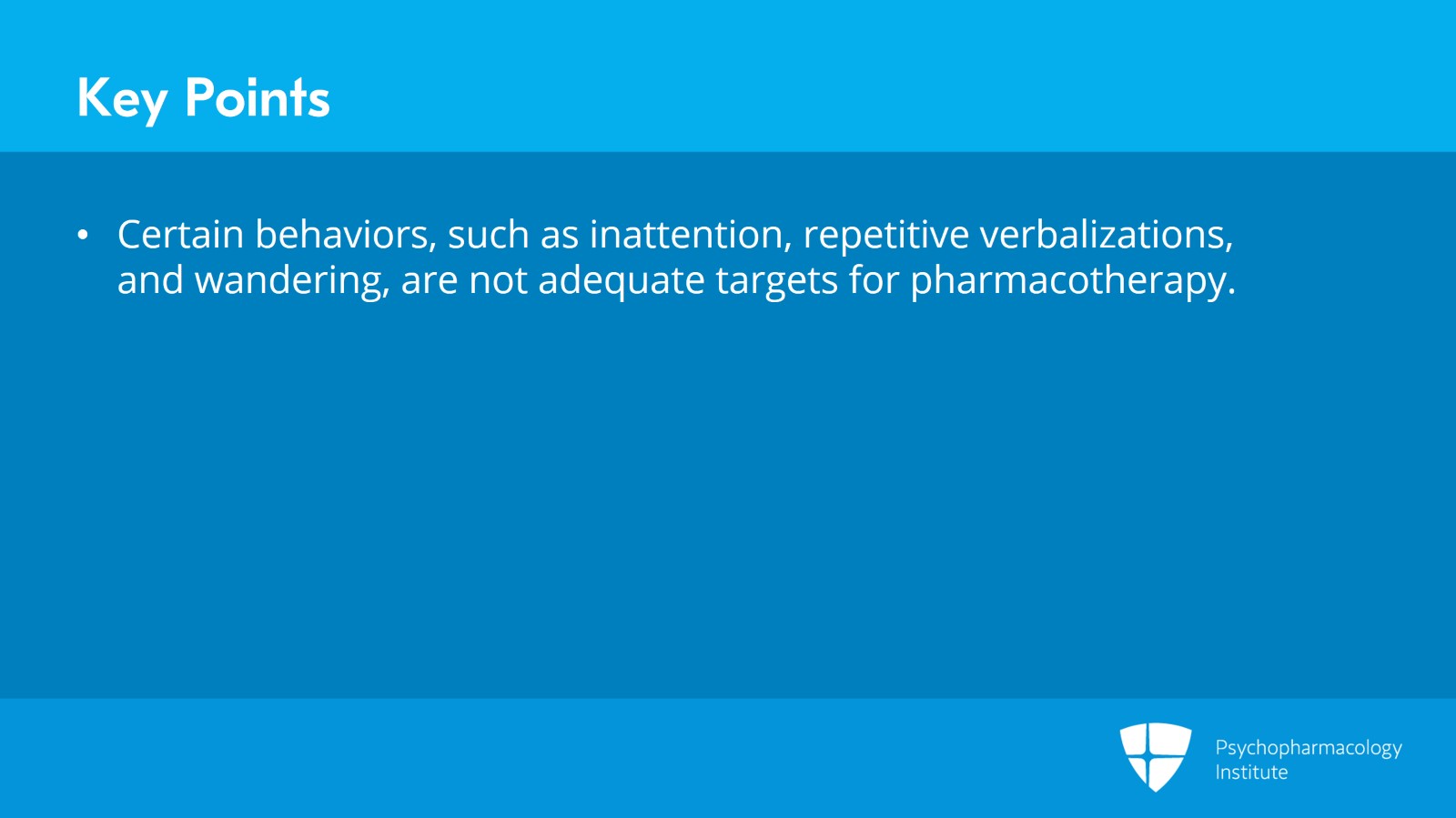
  • Certain behaviors, such as inattention, repetitive verbalizations, and wandering, are not adequate targets for pharmacotherapy.

Free Downloads for Offline Access

  • Free Download Video (MP4)
  • Free Download Audio File (MP3)
  • Free Download Presentation File (PPTX)

Slides and Transcript

Slide 1 of 12

All right.   So folks might be asking, where’s the place for psychotropic medications in the DICE Approach? And there definitely is.

Slide 2 of 12

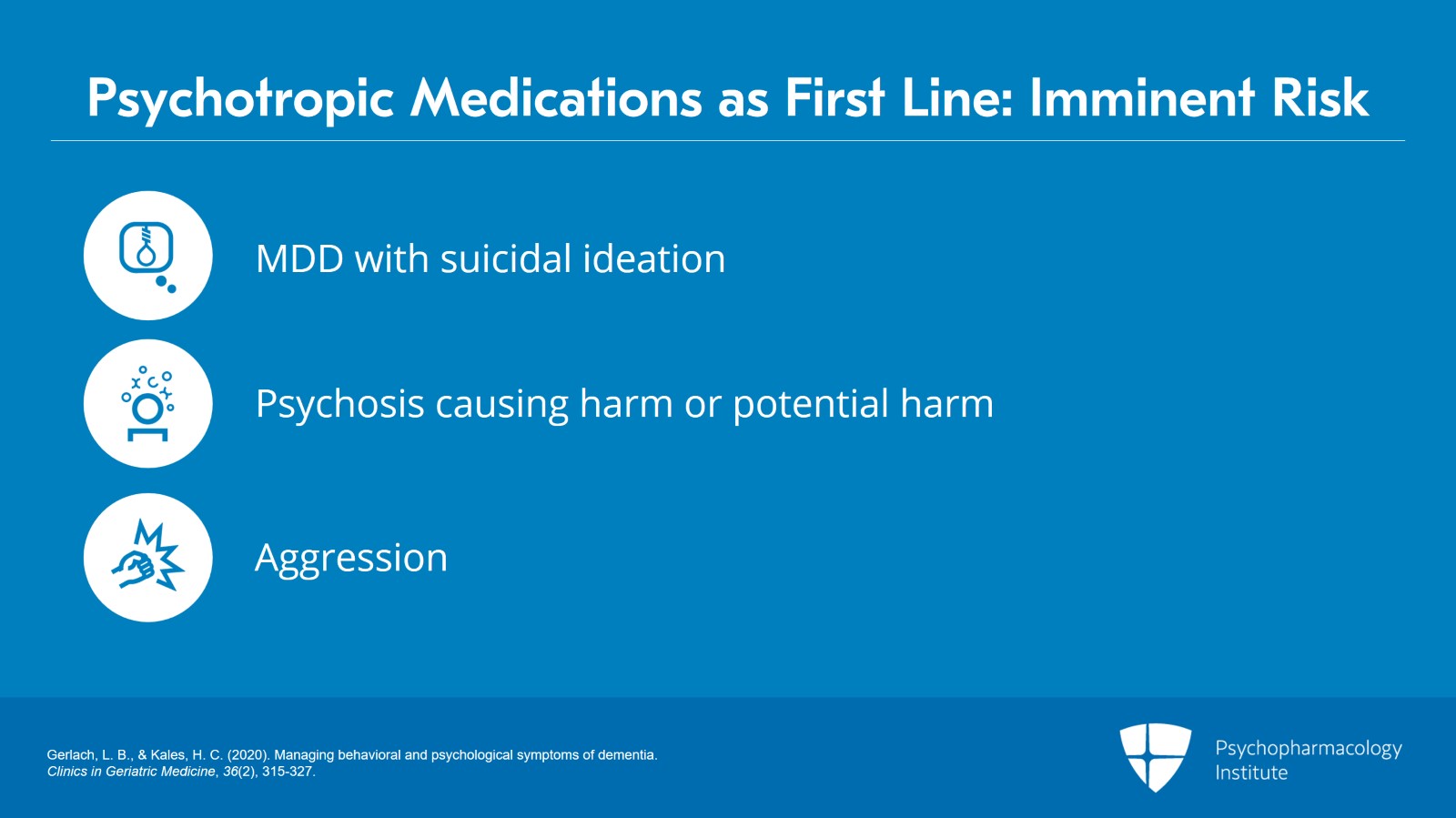
And often, we’ll think about using psychotropic medications first line if there’s imminent risk and that can include major depression with suicidal ideation, psychosis that is causing harm or potential harm to others or the person, as well as aggression with risk to self or others.  
References:
  • Gerlach, L. B., & Kales, H. C. (2020). Managing behavioral and psychological symptoms of dementia. Clinics in Geriatric Medicine, 36(2), 315-327.
Free Files
Success!
Check your inbox, we sent you all the materials there.

Slide 3 of 12

Currently, there are no FDA approved pharmacotherapy for dementia-related behaviors. However, many classes of medications are used off-label in real world settings.
References:
  • Gerlach, L. B., & Kales, H. C. (2020). Managing behavioral and psychological symptoms of dementia. Clinics in Geriatric Medicine, 36(2), 315-327.

Slide 4 of 12

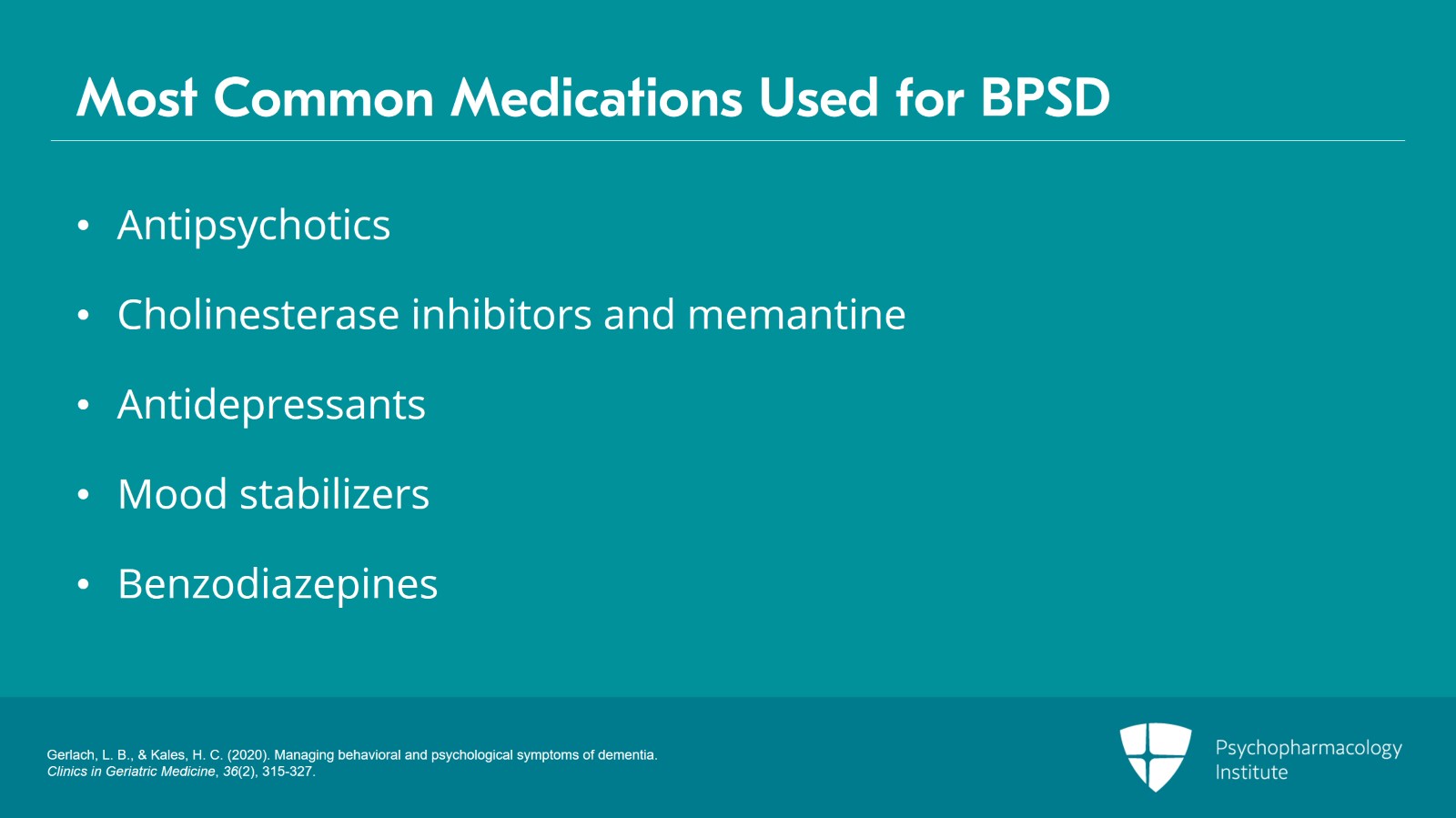
The most common medication classes that are used to address behavioral and psychological symptoms of dementia include antipsychotics, cholinesterase inhibitors and memantine, antidepressants, mood stabilizers, and benzodiazepines.
References:
  • Gerlach, L. B., & Kales, H. C. (2020). Managing behavioral and psychological symptoms of dementia. Clinics in Geriatric Medicine, 36(2), 315-327.
Free Files
Success!
Check your inbox, we sent you all the materials there.

Slide 5 of 12

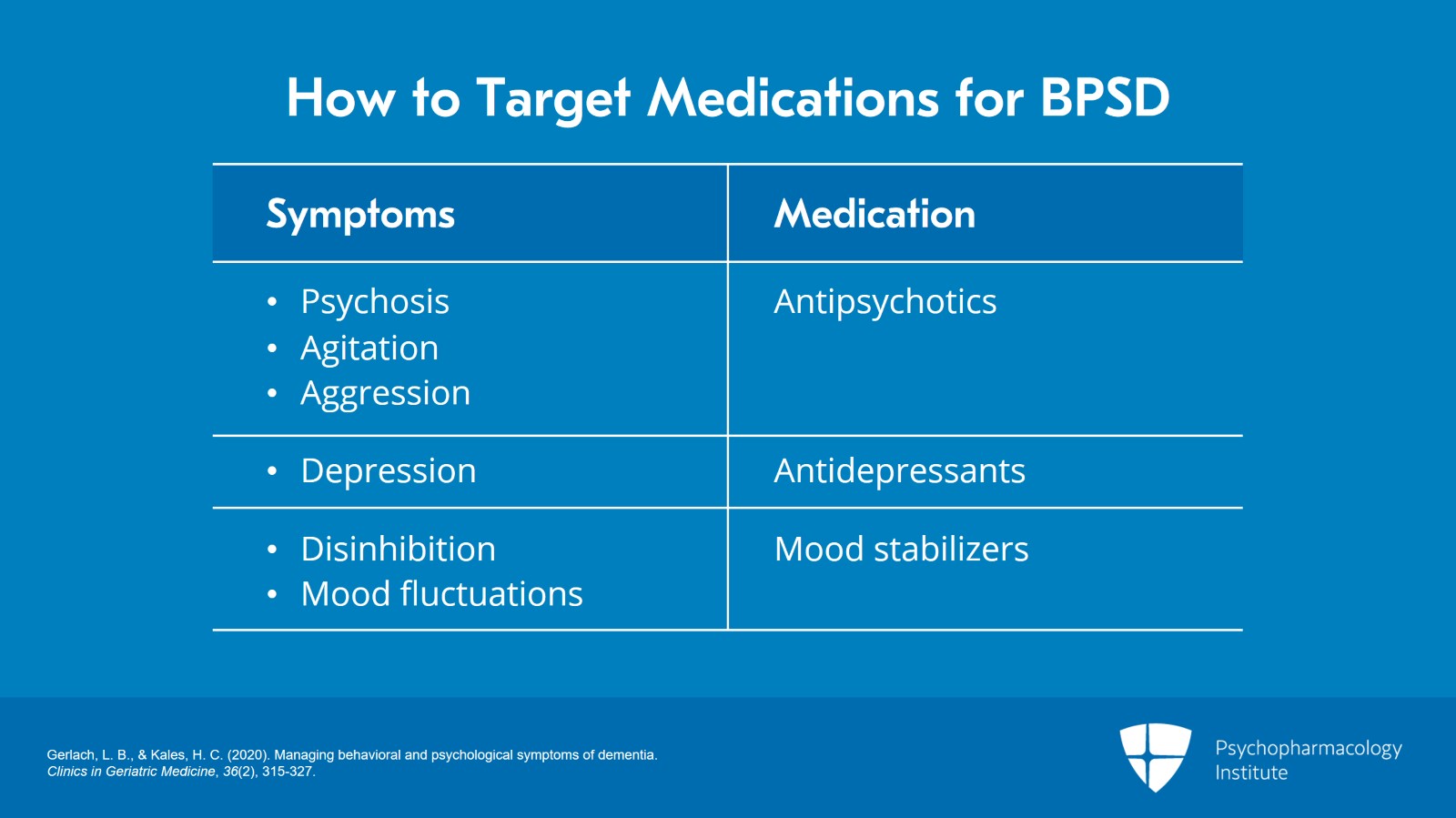
And when we think about how to best target medications to the behavioral disturbances that are occurring, we generally think about the symptom cluster approach. Meaning, for symptoms of, say, psychosis, or agitation, or aggression, generally we’ll think about using an antipsychotic medication. For patients who are experiencing depression, we’ll think about using antidepressant medications. For patients who are experiencing disinhibition, significant mood fluctuations, thinking about using mood stabilizers. Unfortunately, this approach is not necessarily evidence based but it’s our best way to try to best match the problematic behavior with the medication class that’s most likely to help.
References:
  • Gerlach, L. B., & Kales, H. C. (2020). Managing behavioral and psychological symptoms of dementia. Clinics in Geriatric Medicine, 36(2), 315-327.

Slide 6 of 12

It’s important to remember that there are certain behaviors where psychotropic medications rarely help. So for instance, unfriendliness, poor self-care, memory problems, inattention, repetitive verbalizations, and wandering these don’t tend to be great medication targets. And as we’ve mentioned before, other than sedating someone, there sometimes is not a great way to stop someone from asking a question. And so really trying to think about which symptoms are going to best respond to medications.
References:
  • Gerlach, L. B., & Kales, H. C. (2020). Managing behavioral and psychological symptoms of dementia. Clinics in Geriatric Medicine, 36(2), 315-327.
Free Files
Success!
Check your inbox, we sent you all the materials there.

Slide 7 of 12

Medications can be used as a temporizing measure for harmful behaviors while working up and treating the underlying causes.
References:
  • Gerlach, L. B., & Kales, H. C. (2020). Managing behavioral and psychological symptoms of dementia. Clinics in Geriatric Medicine, 36(2), 315-327.

Slide 8 of 12

For instance, for a patient who has significant aggression, psychosis in the setting of urinary tract infections, antipsychotics could be used for a time-limited fashion for sedation and treatment of psychosis.
References:
  • Gerlach, L. B., & Kales, H. C. (2020). Managing behavioral and psychological symptoms of dementia. Clinics in Geriatric Medicine, 36(2), 315-327.
Free Files
Success!
Check your inbox, we sent you all the materials there.

Slide 9 of 12

It’s important though to remember that patients with premorbid psychiatric diagnoses like bipolar disorder and schizophrenia can still develop dementia. And for these patients, we don’t recommend taking them off of these medications once they develop dementia especially if they’re still exhibiting symptoms of their underlying psychotic disorder or mood disorder. We recommend continuation especially if it’s improving patient quality of life as well as patient safety. Barring that folks are on medications that can cause additional problems in dementia like highly anticholinergic medications, often we’ll keep people on similar treatment regimens and try to lower the dose if we can. Gerlach, L. B., & Kales, H. C. (2020). Managing behavioral and psychological symptoms of dementia. Clinics in Geriatric Medicine, 36(2), 315-327.

Slide 10 of 12

So some key points. So there’s currently no US FDA approved pharmacotherapy for dementia-related behaviors. And medication choices generally target the symptom cluster that’s most problematic, so for instance, use of antipsychotics for treatment of agitation or psychosis, use of anticonvulsants or mood stabilizers for treating disinhibition, antidepressants for treatment of depression.
Free Files
Success!
Check your inbox, we sent you all the materials there.

Slide 11 of 12

Certain behaviors such as inattention, repetitive verbalizations, and wandering are not generally great targets for pharmacotherapy and behavioral interventions should be prioritized.

Slide 12 of 12

Free Files
Success!
Check your inbox, we sent you all the materials there.

Learning Objectives:

After completing this activity, the learner will be able to:

  1. Assess and recognize the underlying factors that contribute to the development of behavioral and psychological symptoms of dementia.
  2. Utilize nonpharmacologic approaches to investigate and treat behavioral disturbances.
  3. Identify the clinical scenarios where medications should be considered as first-line treatment and prescribe them accordingly.

Original Release Date: April 1, 2022

Review and Re-release Date: April 1, 2025

Expiration Date: April 1, 2028

Expert: Lauren Gerlach, M.D.

Medical Editor: Paz Badía, M.D.

Relevant Financial Disclosures: 

None of the faculty, planners, and reviewers for this educational activity have relevant financial relationships to disclose during the last 24 months with ineligible companies whose primary business is producing, marketing, selling, re-selling, or distributing healthcare products used by or on patients.

Contact Information: For questions regarding the content or access to this activity, contact us at support@psychopharmacologyinstitute.com

Instructions for Participation and Credit:

Participants must complete the activity online during the valid credit period that is noted above.

Follow these steps to earn CME credit:

  1. View the required educational content provided on this course page.
  2. Complete the Post Activity Evaluation for providing the necessary feedback for continuing accreditation purposes and for the development of future activities. NOTE: Completing the Post Activity Evaluation after the quiz is required to receive the earned credit.
  3. Download your certificate.

Accreditation Statement

This activity has been planned and implemented in accordance with the accreditation requirements and policies of the Accreditation Council for Continuing Medical Education through the joint providership of Medical Academy LLC and the Psychopharmacology Institute. Medical Academy is accredited by the ACCME to provide continuing medical education for physicians.

Credit Designation Statement

Medical Academy designates this enduring activity for a maximum of 1.00 AMA PRA Category 1 credit(s). Physicians should claim only the credit commensurate with the extent of their participation in the activity.


Free Files
Success!
Check your inbox, we sent you all the materials there.
Continue in the website
Instant access modal

Become a Bronze, Silver, Gold, Bronze extended, Silver extended or Gold extended Member.

2025–26 Psychopharmacology CME Program

Unlock up to 155 CME Credits, including 40 SA CME Credits.