Close Banner
Free Section  - Video Lectures

08. Node 5: Lithium Augmentation

Published on September 1, 2021 Expired on April 1, 2024

David Osser, M.D.

Associate Professor of Psychiatry - Harvard Medical School

Key Points

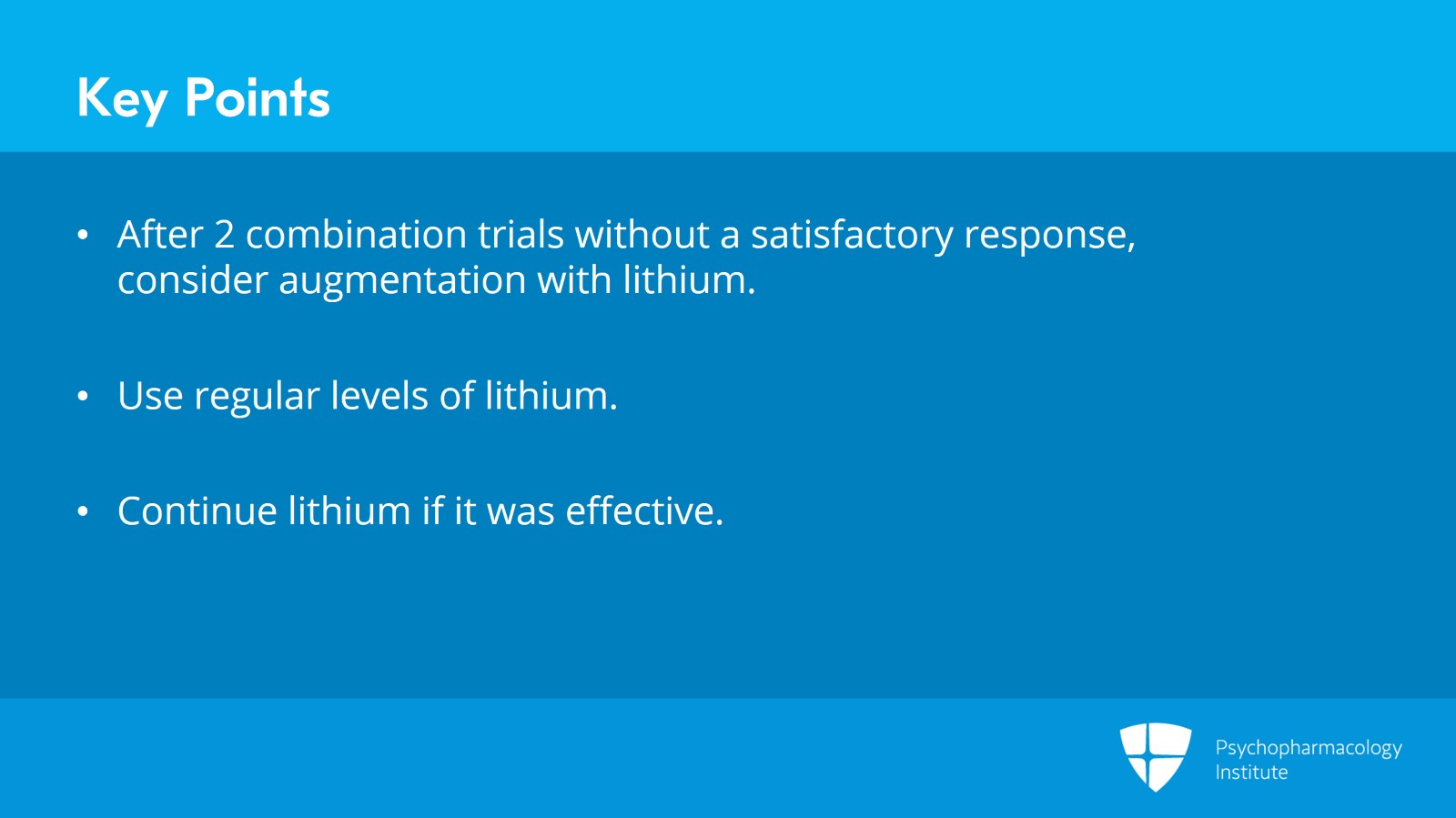
  • After 2 combination trials without a satisfactory response, consider augmentation with lithium. 
  • Use regular levels of lithium.
  • Continue lithium if it was effective.

Free Downloads for Offline Access

  • Free Download Presentation File (PPTX)
  • Free Download Video (MP4)
  • Free Download Audio File (MP3)

Slides and Transcript
Slide 1 of 10

Hi again everybody. This is Dr. David Osser and I am presenting the algorithm for the psychopharmacology of psychotic depression or major depression with psychotic features. We are on video 8. And in this video, we're going to discuss lithium augmentation of combination therapy, of combination with an antipsychotic and antidepressant for psychotic depression.

Slide 2 of 10

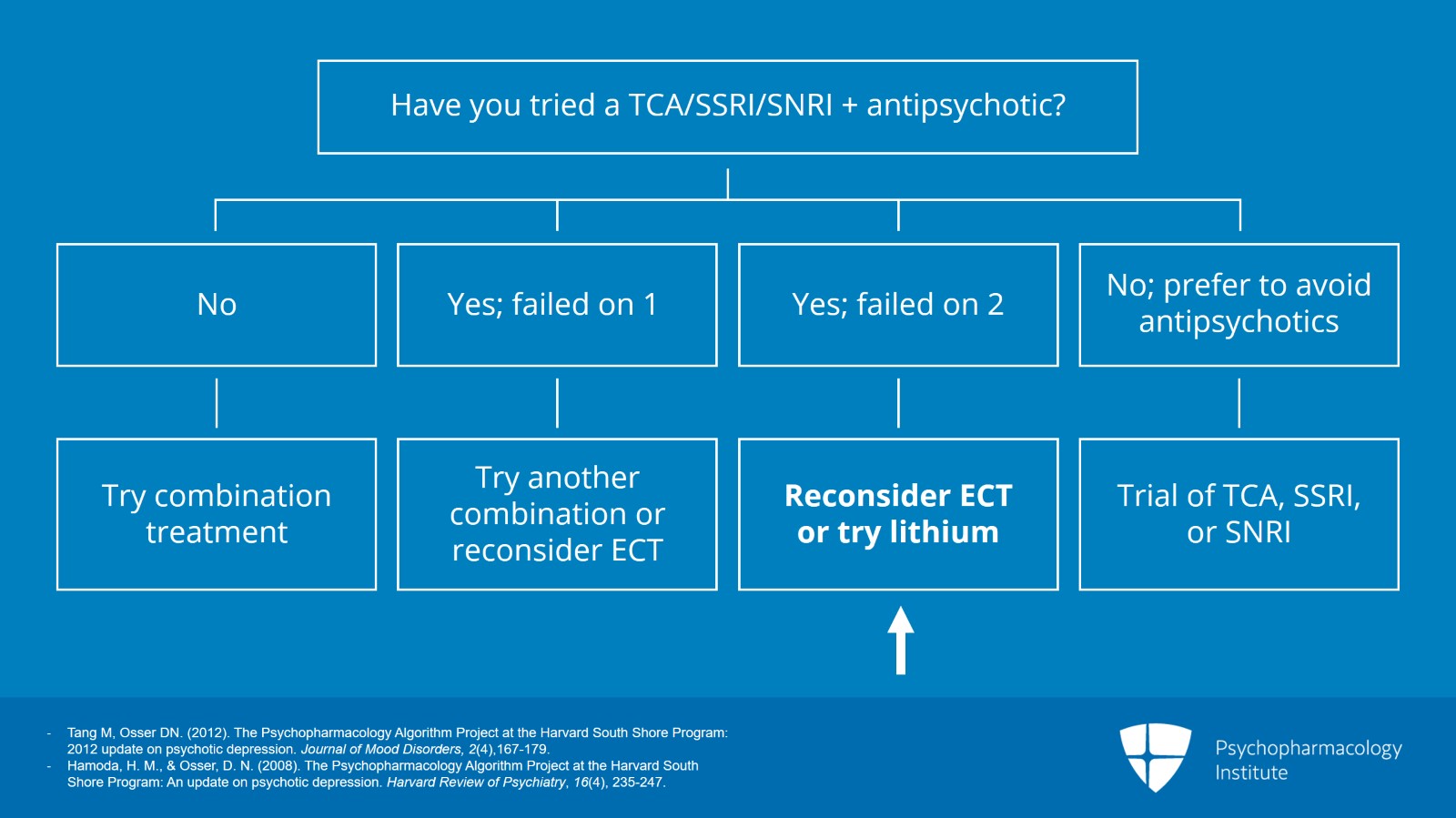
The previous videos have taken you through the evidence on the various possible combinations, which antidepressant to choose, which antipsychotic to choose and which to choose second depending on what you chose first. But if you've had 2 trials and you've had an unsatisfactory response and you're not doing ECT, which we strongly suggest, and you want to keep with pharmacotherapy… We're at node 5 — have you tried adding lithium?
References:
  • Tang M, Osser DN. (2012). The Psychopharmacology Algorithm Project at the Harvard South Shore Program: 2012 update on psychotic depression. Journal of Mood Disorders, 2(4),167-179.
  • Hamoda, H. M., & Osser, D. N. (2008). The Psychopharmacology Algorithm Project at the Harvard South Shore Program: An update on psychotic depression. Harvard Review of Psychiatry, 16(4), 235-247.
Free Files
Success!
Check your inbox, we sent you all the materials there.
Slide 3 of 10

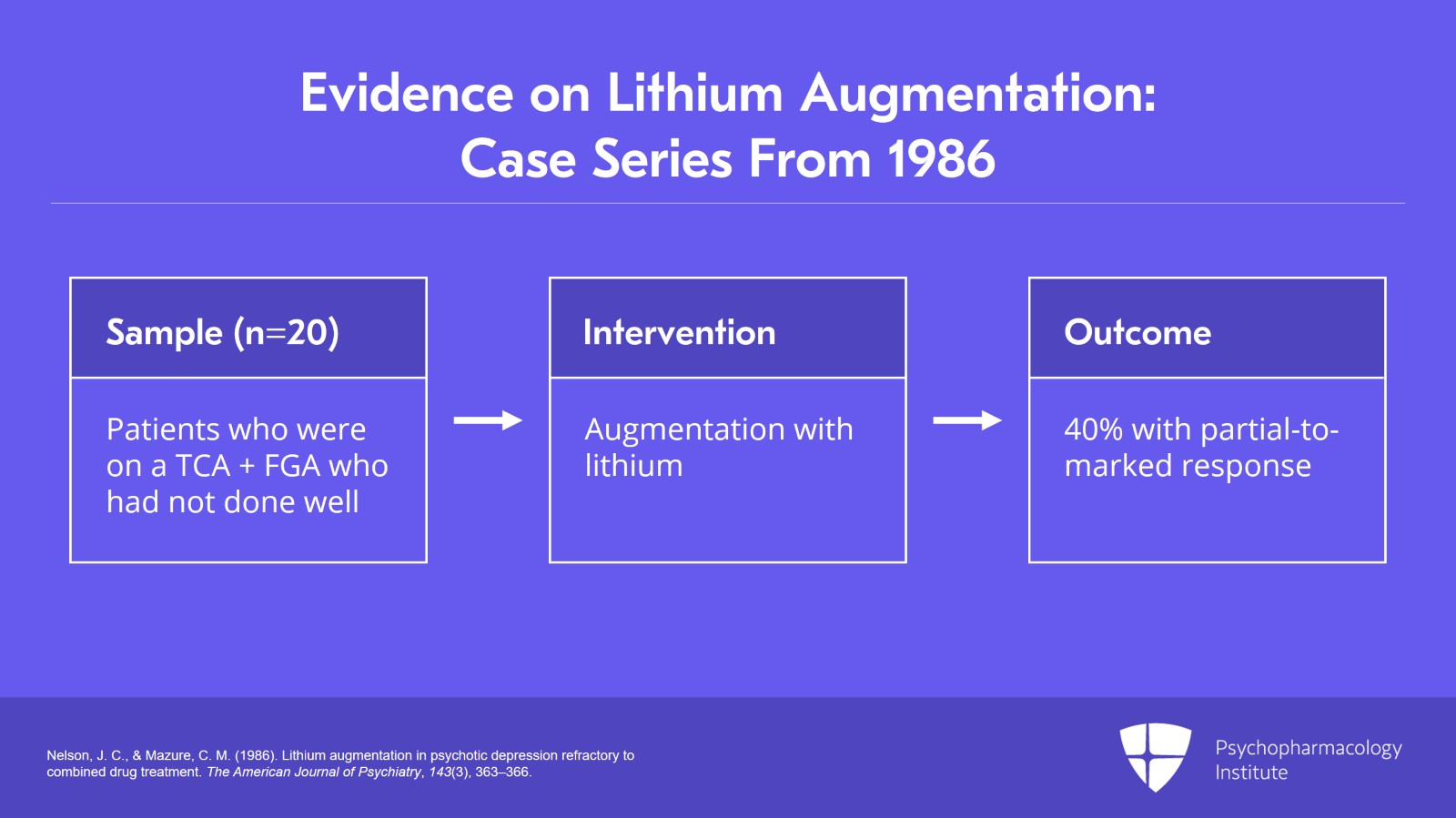
So what evidence do we have on that? Well, not a whole lot. There was a case series of 20 patients that was published in 1986. These were people who were on a tricyclic plus a first-generation antipsychotic and had not done well and they were augmented with lithium. Forty percent had at least a partial, ranging from a partial to a marked response. So, we're not talking about a robust additional response, but a significant number did proceed to further improvement with addition of lithium.
References:
  • Nelson, J. C., & Mazure, C. M. (1986). Lithium augmentation in psychotic depression refractory to combined drug treatment. The American Journal of Psychiatry, 143(3), 363–366.

Slide 4 of 10

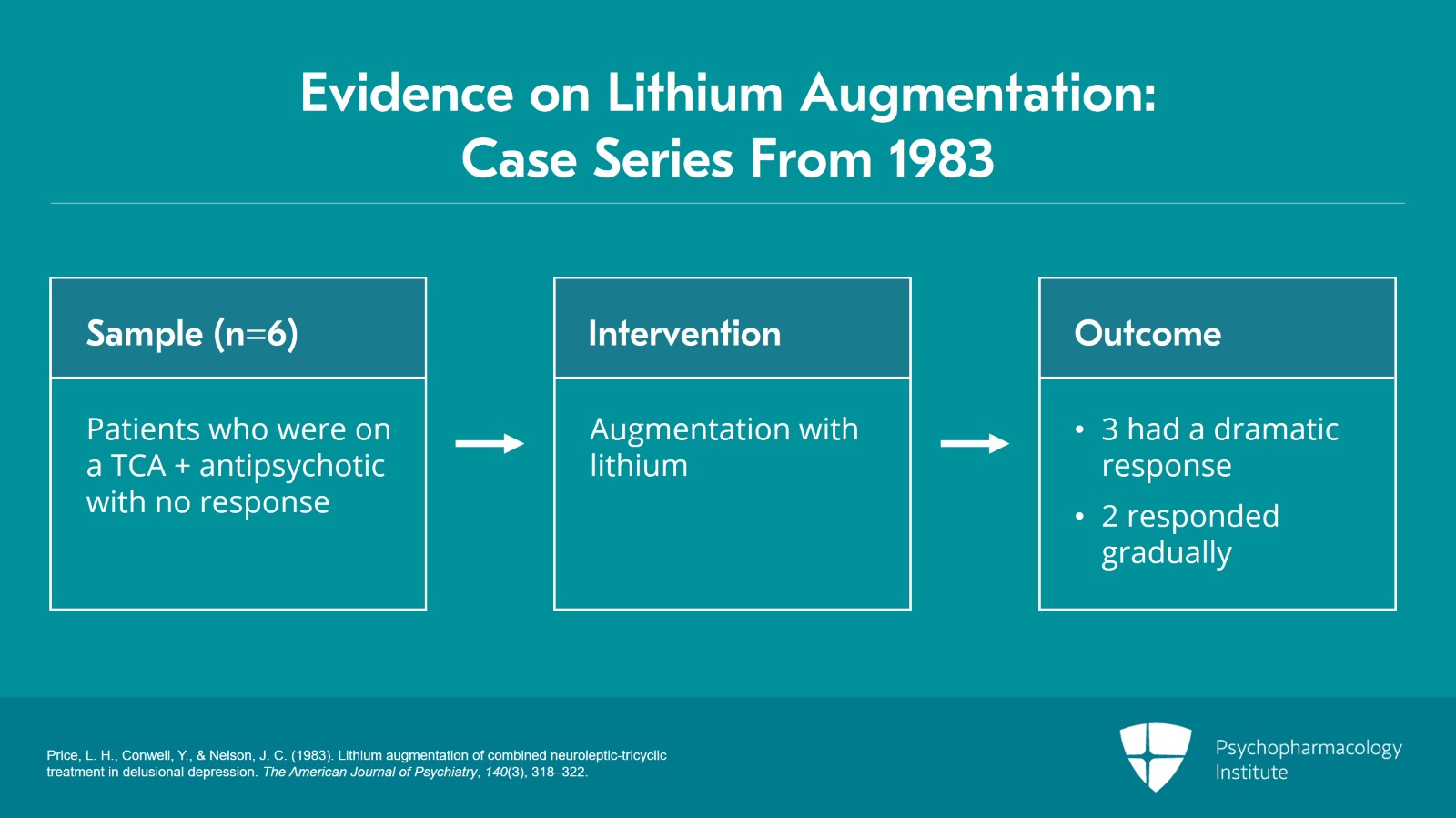
Beyond that, we just have some more case series. Here's one, also old, this one from 1983. Six unresponsive patients to a tricyclic plus antipsychotic got lithium. Three had a dramatic response, so that would be half of them, and 2 more responded gradually.
References:
  • Price, L. H., Conwell, Y., & Nelson, J. C. (1983). Lithium augmentation of combined neuroleptic-tricyclic treatment in delusional depression. The American Journal of Psychiatry, 140(3), 318–322.
Free Files
Success!
Check your inbox, we sent you all the materials there.
Slide 5 of 10

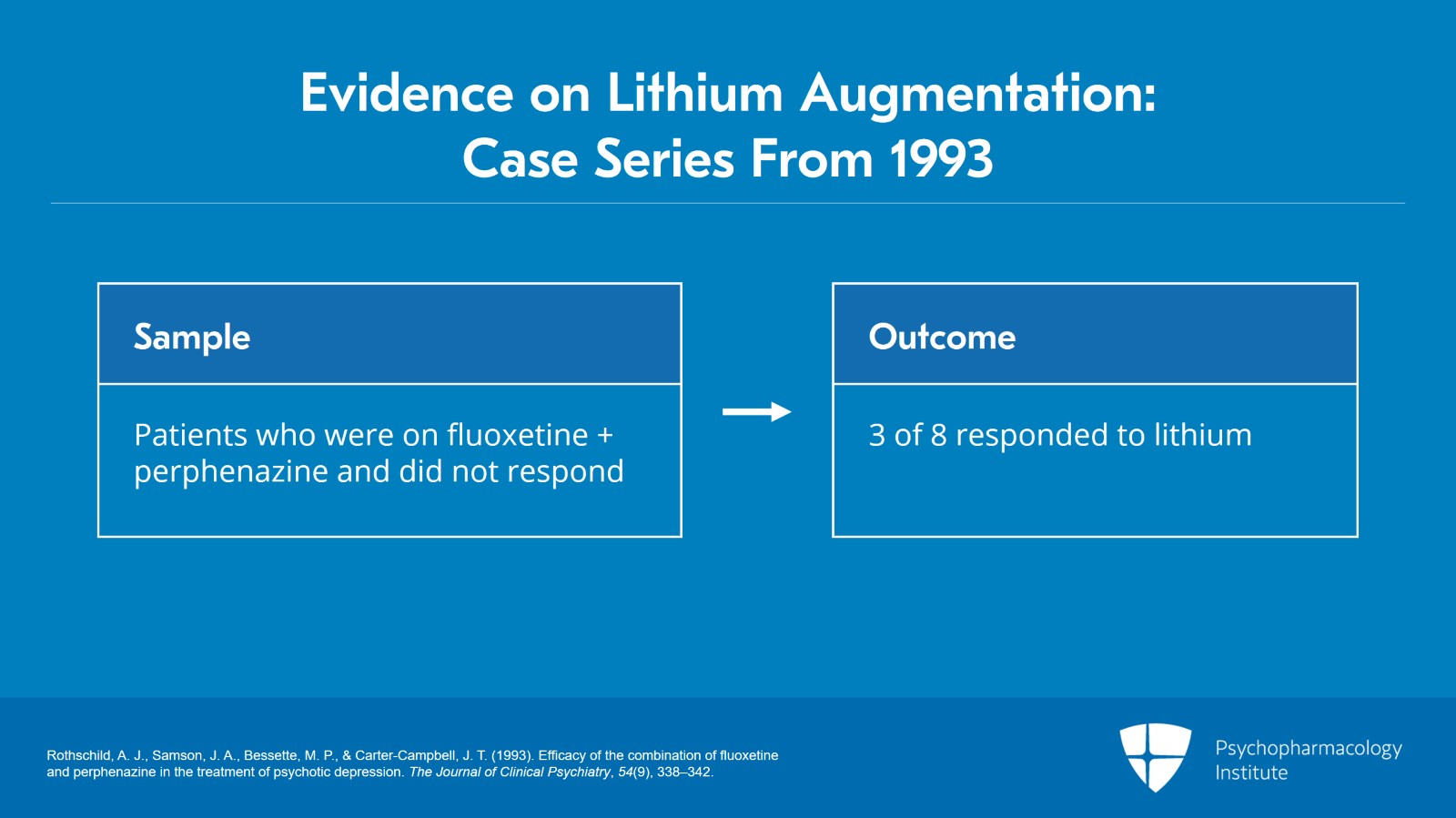
And then there is a small Rothschild series from 1993. These were people that he was treating then with fluoxetine plus perphenazine. He was using an SSRI and a first-generation antipsychotic.   There were 8 left in his trial that didn't respond. Three of them responded to lithium. So that's also in the 40% area.
References:
  • Rothschild, A. J., Samson, J. A., Bessette, M. P., & Carter-Campbell, J. T. (1993). Efficacy of the combination of fluoxetine and perphenazine in the treatment of psychotic depression. The Journal of Clinical Psychiatry, 54(9), 338–342.

Slide 6 of 10

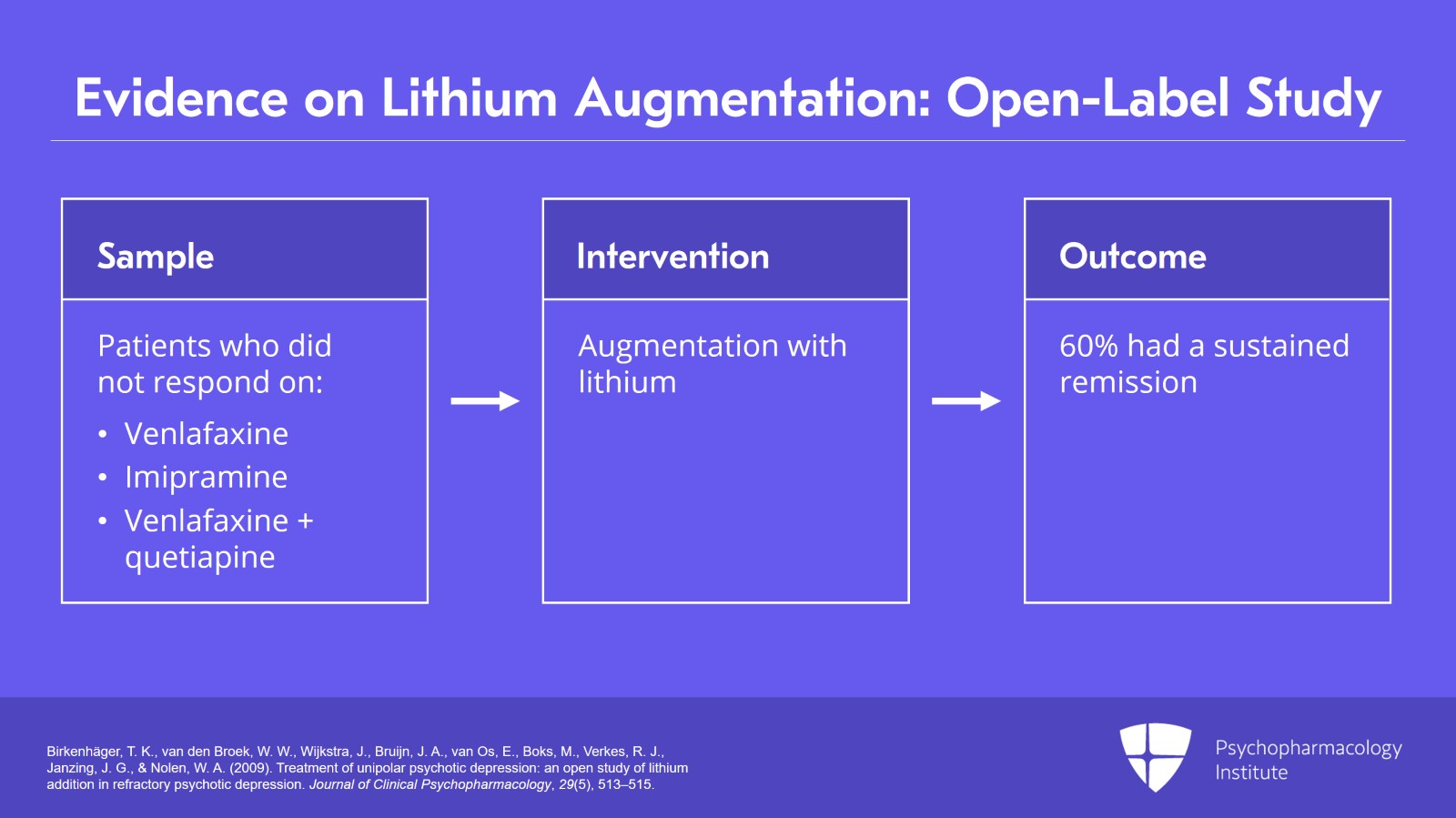
Then in 2009, Birkenhager to his big study with venlafaxine, imipramine and venlafaxine-quetiapine, added open-label lithium for 4 weeks to 15 non-responding patients. Remember that? I talked about that a few sessions ago. So, they were finished with that study of those 3 possible treatments. He kept them on their blinded initial medications and started lithium and he adjusted to bring their levels from 0.6 to 1. Nine patients, 60%, had a sustained remission. Remission, not improvement.
References:
  • Birkenhäger, T. K., van den Broek, W. W., Wijkstra, J., Bruijn, J. A., van Os, E., Boks, M., Verkes, R. J., Janzing, J. G., & Nolen, W. A. (2009). Treatment of unipolar psychotic depression: an open study of lithium addition in refractory psychotic depression. Journal of Clinical Psychopharmacology, 29(5), 513–515.
Free Files
Success!
Check your inbox, we sent you all the materials there.
Slide 7 of 10

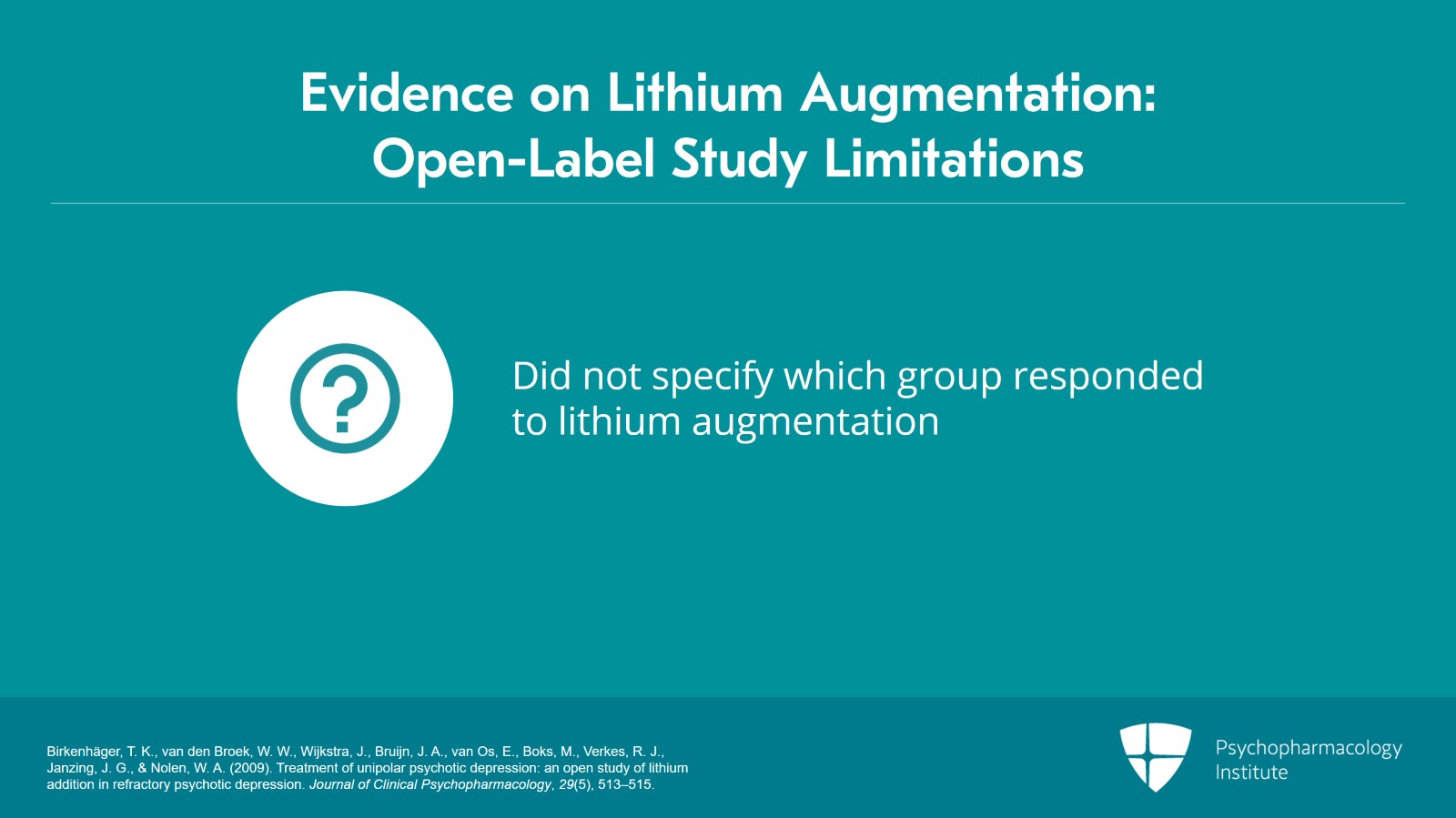
Now, 5 of the 15 were on combination therapy because 2 of those groups were monotherapy and 5 of the 15 were combination. Unfortunately, Dr. Birkenhager did not specify separately whether it was the combination people that responded. These 5 combination people, did they respond to the lithium or was it the monotherapy people that responded? We can't know that from their published data. Still, they had a pretty decent result from adding lithium. It makes you wonder if you could add lithium to monotherapy to get some improvers.
References:
  • Birkenhäger, T. K., van den Broek, W. W., Wijkstra, J., Bruijn, J. A., van Os, E., Boks, M., Verkes, R. J., Janzing, J. G., & Nolen, W. A. (2009). Treatment of unipolar psychotic depression: an open study of lithium addition in refractory psychotic depression. Journal of Clinical Psychopharmacology, 29(5), 513–515.

Slide 8 of 10

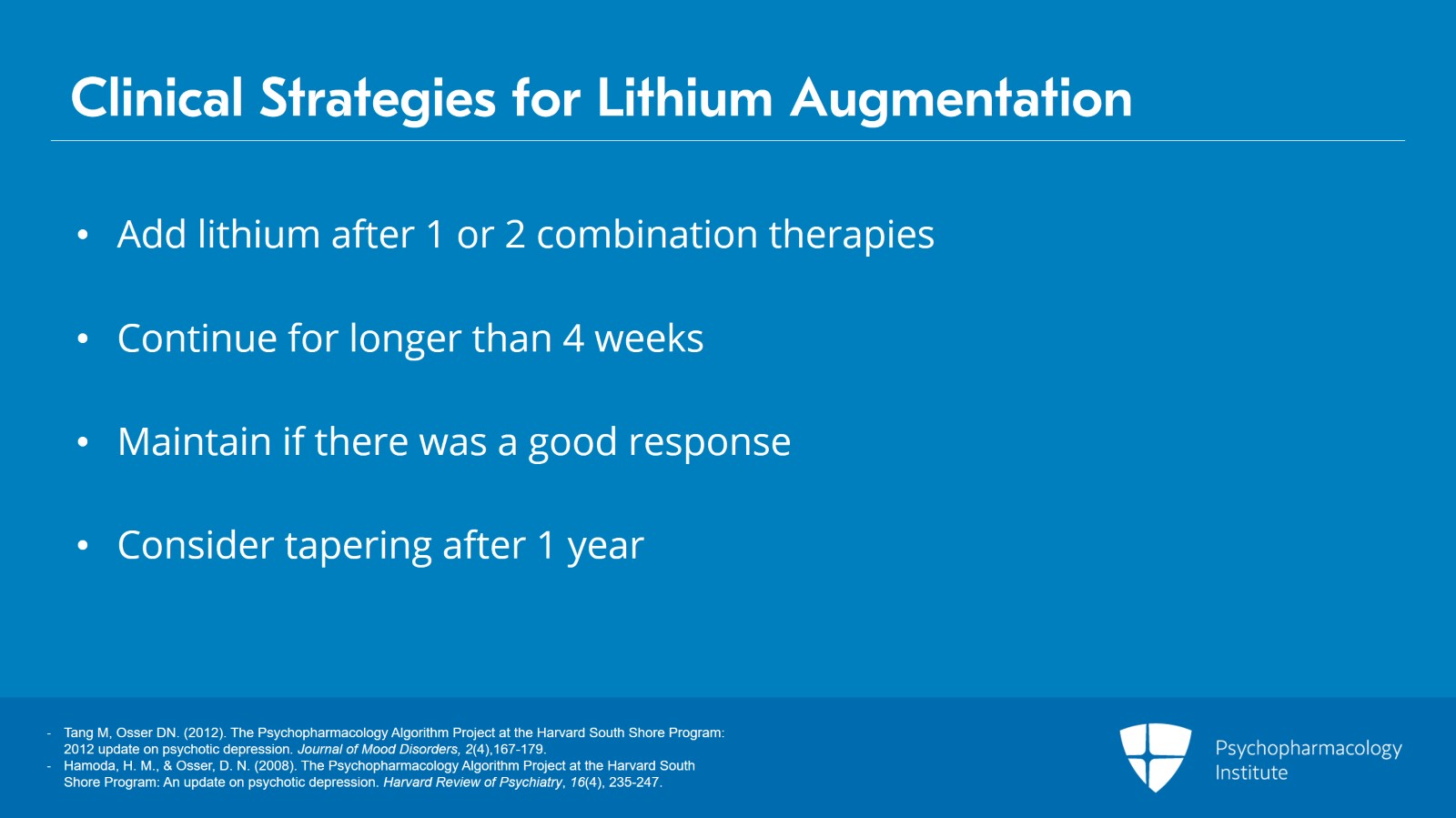
So in short, from this really minimal evidence, we think it's reasonable to add lithium after at least 1 or probably 2 combination therapies of the ones that we've suggested and if ECT is not a serious consideration and you might as well use typical blood levels of lithium. And you might as well continue for longer than 4 weeks and maintain them on it if you do get a good response because we don't have much else in terms of evidence on augmentation strategies. Maybe after a year, you could consider tapering it and see what happens. But if you are fortunate enough to get this long-sought improvement, you might as well keep everything going that you were initiating.
References:
  • Tang M, Osser DN. (2012). The Psychopharmacology Algorithm Project at the Harvard South Shore Program: 2012 update on psychotic depression. Journal of Mood Disorders, 2(4),167-179.
  • Hamoda, H. M., & Osser, D. N. (2008). The Psychopharmacology Algorithm Project at the Harvard South Shore Program: An update on psychotic depression. Harvard Review of Psychiatry, 16(4), 235-247.
Free Files
Success!
Check your inbox, we sent you all the materials there.
Slide 9 of 10

So in conclusion about lithium augmentation, if the patient has had a couple of antipsychotic plus antidepressant trials and still has not responded satisfactorily and ECT is not an option, consider augmentation with lithium. The data are very limited, but it seems you can use regular levels, that is to say, over 0.6 mEq/L at trough. If it was effective, you probably want to continue it since this has been a difficult case of psychotic depression.

Slide 10 of 10

Free Files
Success!
Check your inbox, we sent you all the materials there.
Learning Objectives:

After completing this activity, the learner will be able to:

  1. Identify the recommended treatment options for patients with psychotic depression and prescribe them accordingly.
  2. Recognize the role of electroconvulsive therapy as a first-line, highly effective treatment option for psychotic depression.

Original Release Date: 09/01/2021

Review Date: 03/01/2024

Expiration Date: 04/01/2024

Expert: David Osser, M.D.

Medical Editor: Melissa Mariano, M.D

Relevant Financial Disclosures:

None of the faculty, planners, and reviewers for this educational activity have relevant financial relationship(s) to disclose during the last 24 months with ineligible companies whose primary business is producing, marketing, selling, re-selling, or distributing healthcare products used by or on patients.

Contact Information: For questions regarding the content or access to this activity, contact us at support@psychopharmacologyinstitute.com

Instructions for Participation and Credit:

Participants must complete the activity online during the valid credit period that is noted above.

Follow these steps to earn CME credit:

  1. View the required educational content provided on this course page.
  2. Complete the Post Activity Evaluation for providing the necessary feedback for continuing accreditation purposes and for the development of future activities. NOTE: Completing the Post Activity Evaluation after the quiz is required to receive the earned credit.
  3. Download your certificate.
Free Files
Success!
Check your inbox, we sent you all the materials there.
Continue in the website
Instant access modal

Become a Bronze, Silver, Gold, Bronze extended, Silver extended or Gold extended Member.

2025–26 Psychopharmacology CME Program

Unlock up to 155 CME Credits, including 40 SA CME Credits.