Close Banner
Section Free  - Video Lectures

02. Node 1: ECT for Severely Ill Patients

Published on September 1, 2021 Expired on April 1, 2024

David Osser, M.D.

Associate Professor of Psychiatry - Harvard Medical School

Key Points

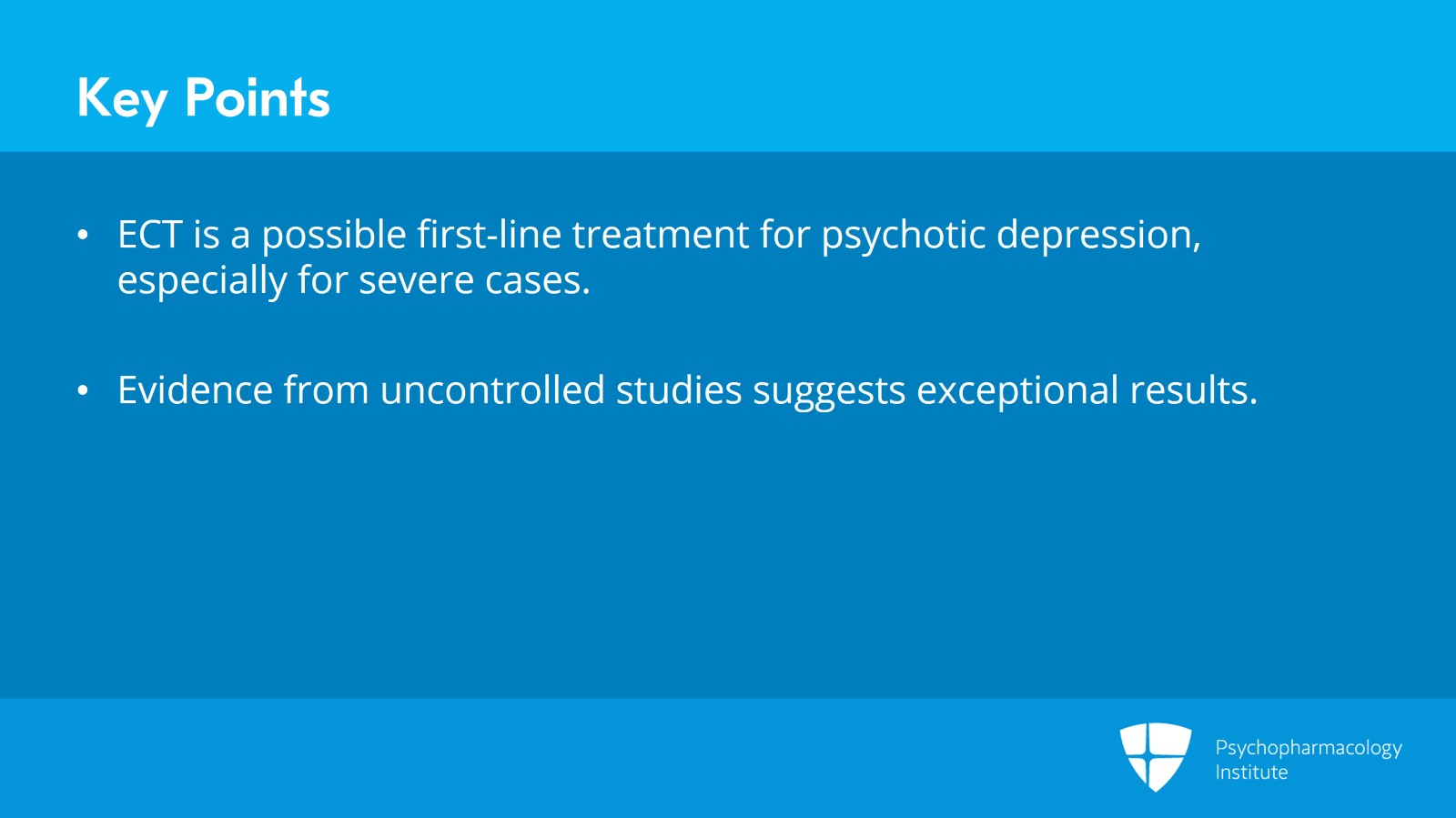
  • ECT is a possible first-line treatment for psychotic depression, especially for severe cases.
  • Evidence from uncontrolled studies suggests exceptional results.
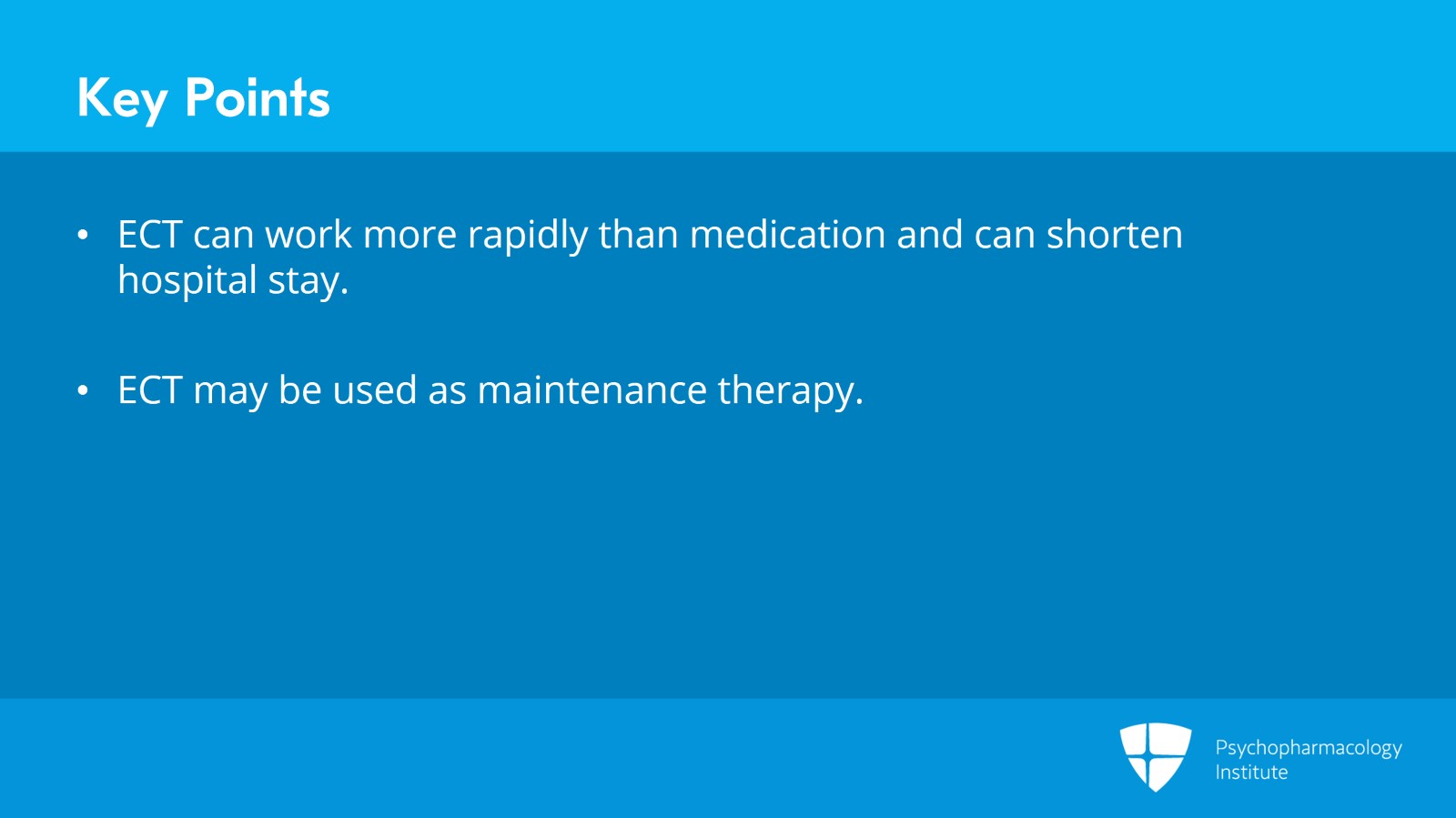
  • ECT can work more rapidly than medication and can shorten hospital stay.
  • ECT may be used as maintenance therapy.

Free Downloads for Offline Access

  • Free Download Video (MP4)
  • Free Download Audio File (MP3)
  • Free Download Presentation File (PPTX)

Slides and Transcript
Slide 1 of 12

This is Dr. David Osser continuing the presentations on major depression with psychotic features or psychotic depression. This is video number 2. And in this video, we're going to discuss node 1 of the algorithm which is a presentation on ECT for severely ill patients with psychotic depression.

Slide 2 of 12

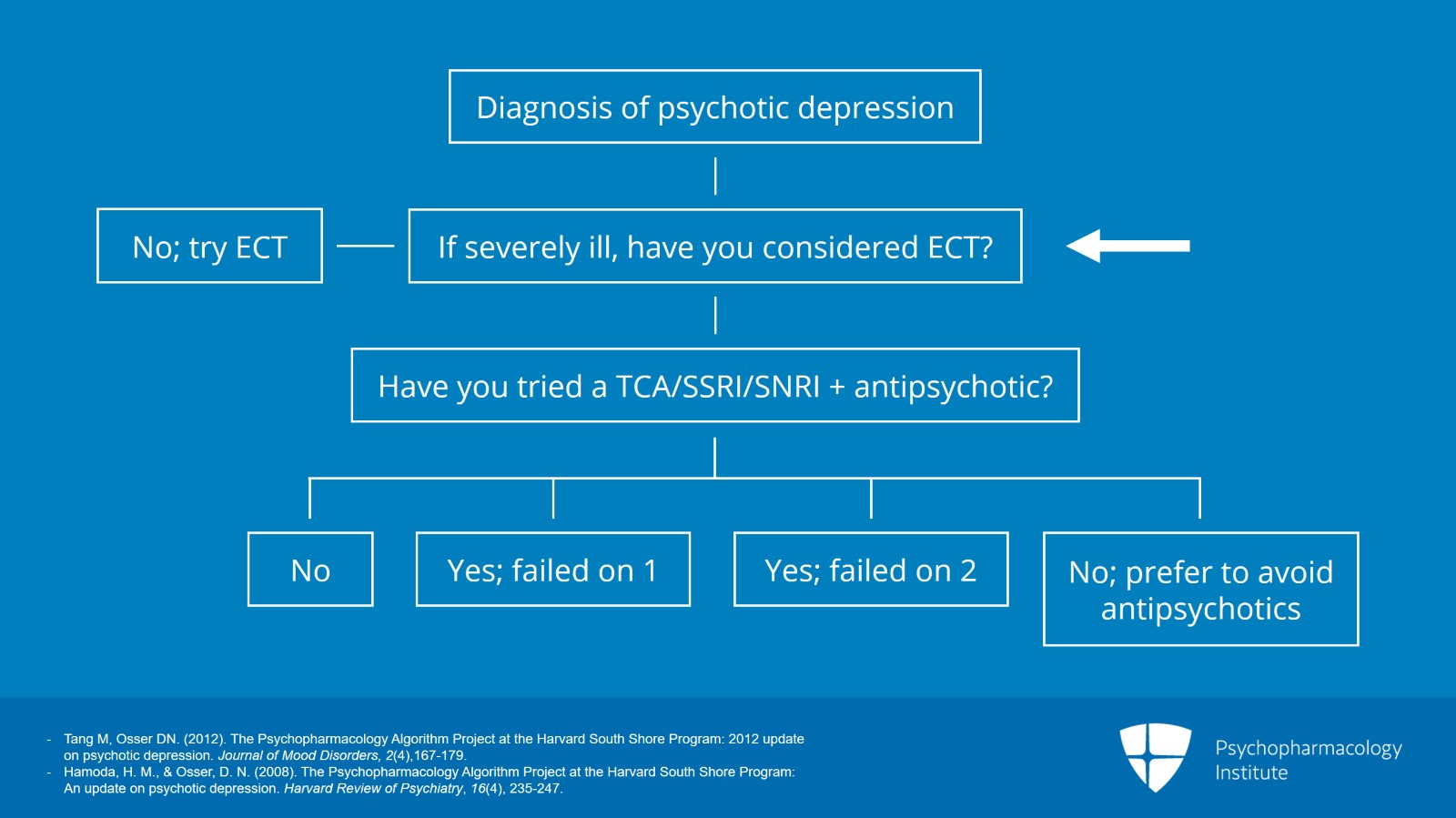
The next slide shows the algorithm. It starts with diagnosis which I discussed in the first unit. And now, we're in the first block which is the first question we ask about this patient once they have been diagnosed with major depression with psychotic features. And that question is, if this is a severely ill patient, have you considered ECT? 
References:
  • Tang M, Osser DN. (2012). The Psychopharmacology Algorithm Project at the Harvard South Shore Program: 2012 update on psychotic depression. Journal of Mood Disorders, 2(4),167-179.
  • Hamoda, H. M., & Osser, D. N. (2008). The Psychopharmacology Algorithm Project at the Harvard South Shore Program: An update on psychotic depression. Harvard Review of Psychiatry, 16(4), 235-247.
Free Files
Success!
Check your inbox, we sent you all the materials there.
Slide 3 of 12

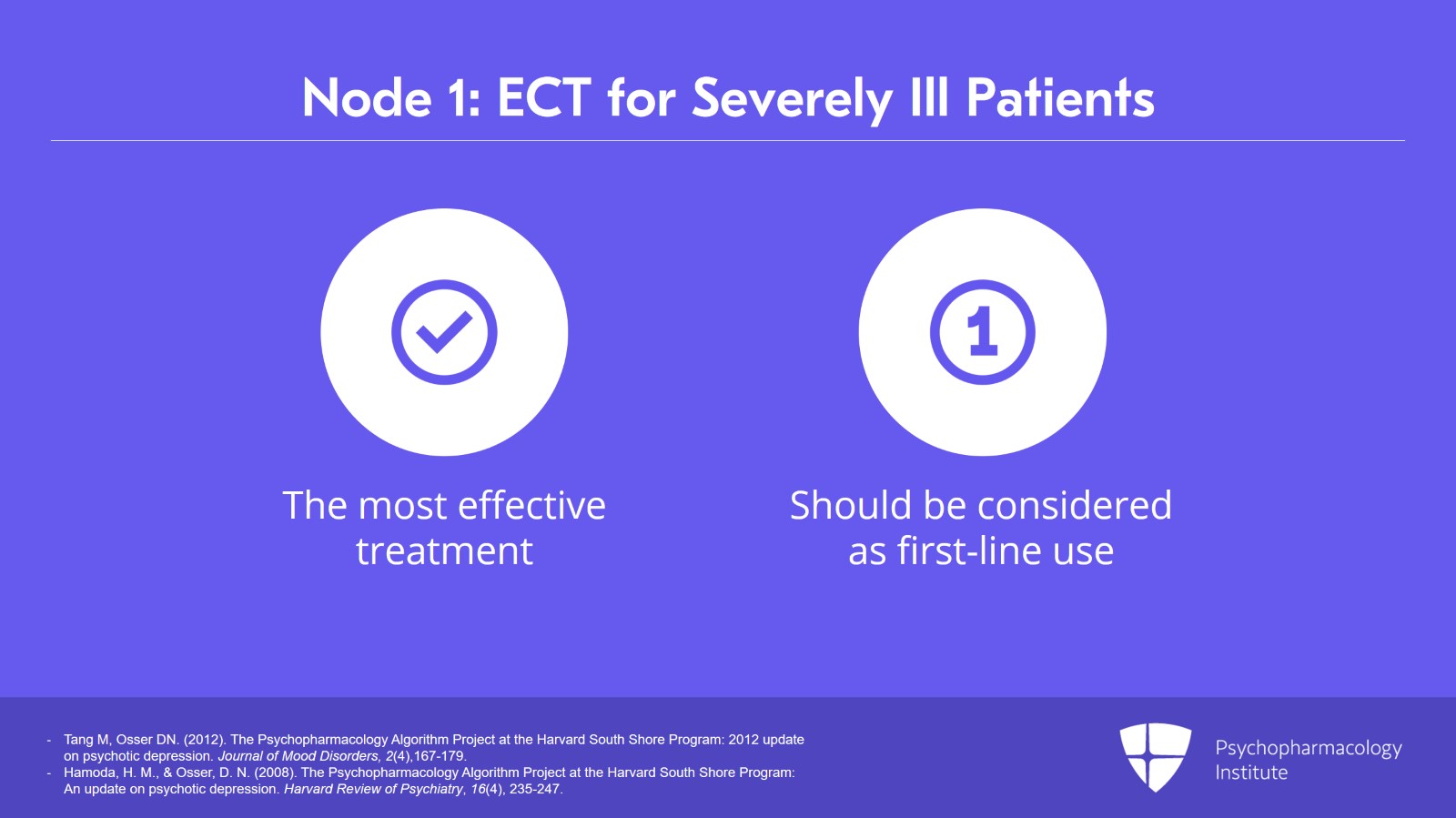
That's the first node in the algorithm. We want to see if this person is a candidate for ECT. Why do we consider that right away? Because it may be the most effective treatment we have for severe psychotic depression. I make that assertion but the data are mostly from uncontrolled studies. But I'm going to review those studies to show why we think ECT should be at least considered for first-line use for the more severe case. 
References:
  • Tang M, Osser DN. (2012). The Psychopharmacology Algorithm Project at the Harvard South Shore Program: 2012 update on psychotic depression. Journal of Mood Disorders, 2(4),167-179.
  • Hamoda, H. M., & Osser, D. N. (2008). The Psychopharmacology Algorithm Project at the Harvard South Shore Program: An update on psychotic depression. Harvard Review of Psychiatry, 16(4), 235-247.

Slide 4 of 12

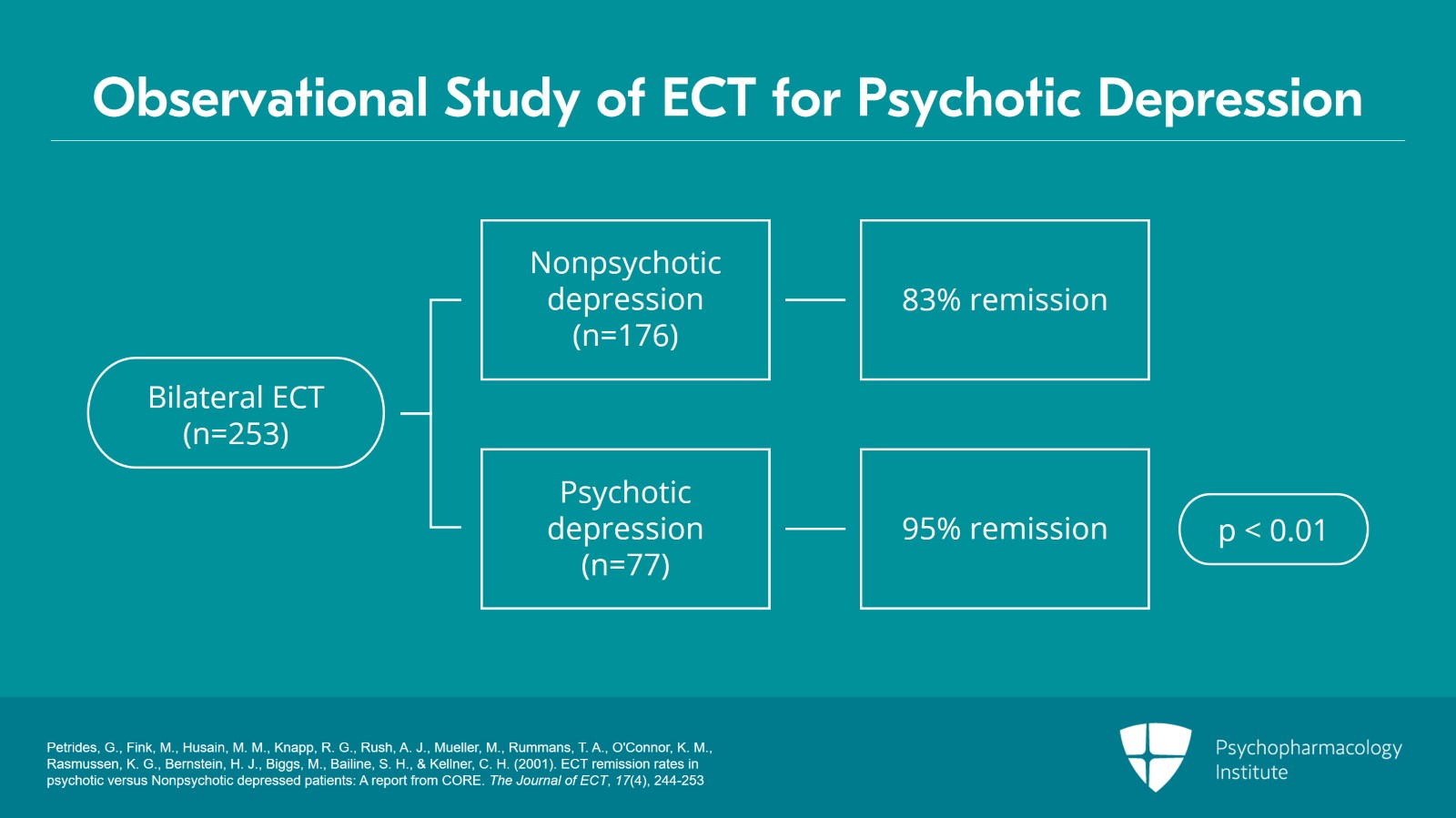
First, I'll talk about an observational study by Petrides in 2001, a large study where they examined the outcome of bilateral ECT in 253 patients with nonpsychotic versus psychotic depression using the Hamilton-D 24 Scale. There were 176 nonpsychotic patients getting the ECT and 77 psychotic depression cases. The remission rate was 95% in the psychotic depression group. A score of less than 10 on the 24-question Hamilton is considered remission. So 95% remission in the psychotic depression versus 83% in the nonpsychotic patients which is still quite good, but it was statistically significant for the psychotic depression at the p 0.01 level being more responsive. So this is a line of evidence for our preference for ECT. 
References:
  • Petrides, G., Fink, M., Husain, M. M., Knapp, R. G., Rush, A. J., Mueller, M., Rummans, T. A., O'Connor, K. M., Rasmussen, K. G., Bernstein, H. J., Biggs, M., Bailine, S. H., & Kellner, C. H. (2001). ECT remission rates in psychotic versus Nonpsychotic depressed patients: A report from CORE. The Journal of ECT, 17(4), 244-253
Free Files
Success!
Check your inbox, we sent you all the materials there.
Slide 5 of 12

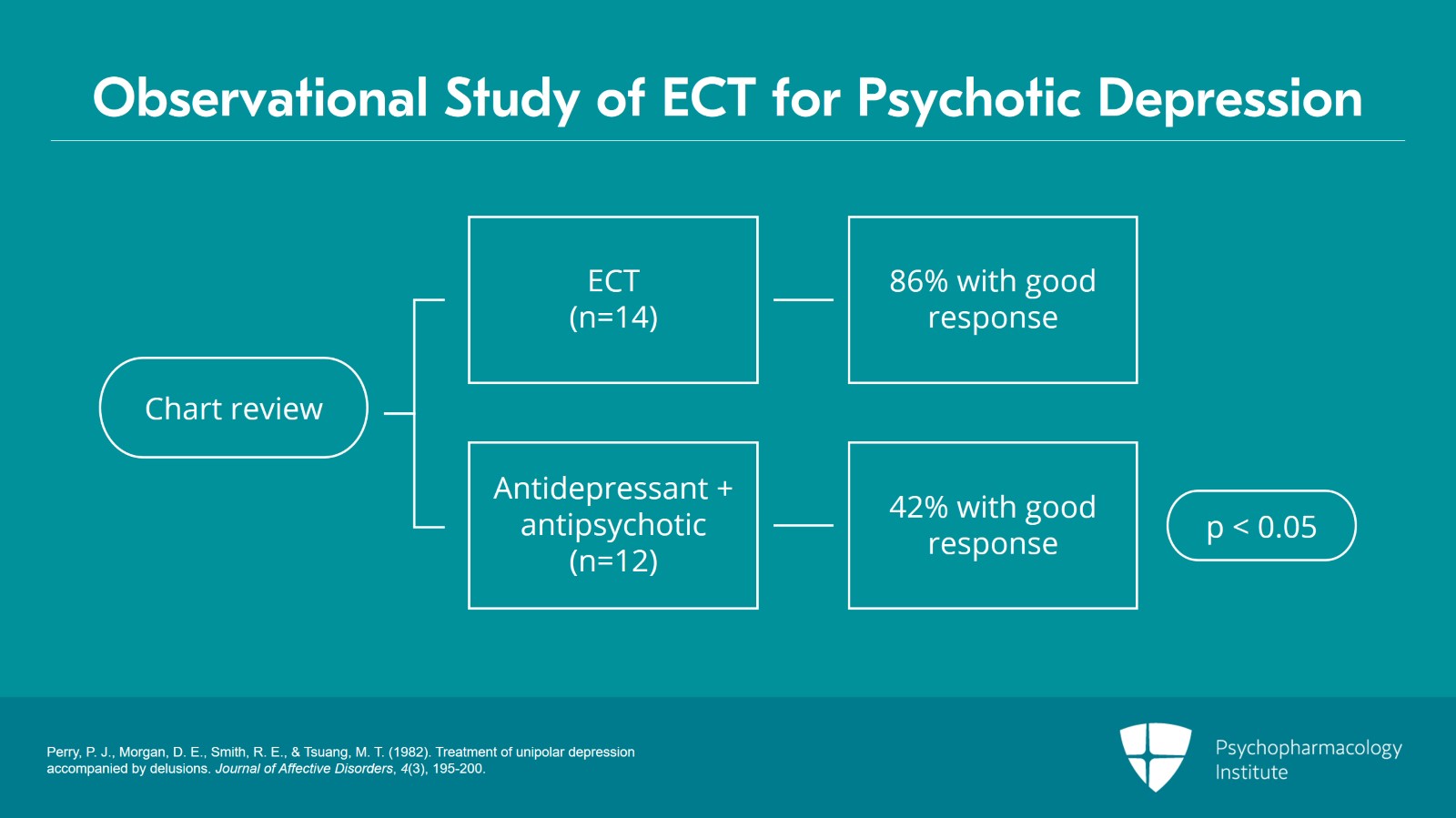
The other evidence included other observational studies. Perry et al. did a chart review of 14 patients receiving ECT and 12 unmatched patients receiving antidepressants and antipsychotics in combination. But in this comparison, 86% getting the ECT had a good response versus 42% getting the combination therapy. And again, that was statistically significant at the p 0.05 level. 
References:
  • Perry, P. J., Morgan, D. E., Smith, R. E., & Tsuang, M. T. (1982). Treatment of unipolar depression accompanied by delusions. Journal of Affective Disorders, 4(3), 195-200. 

Slide 6 of 12

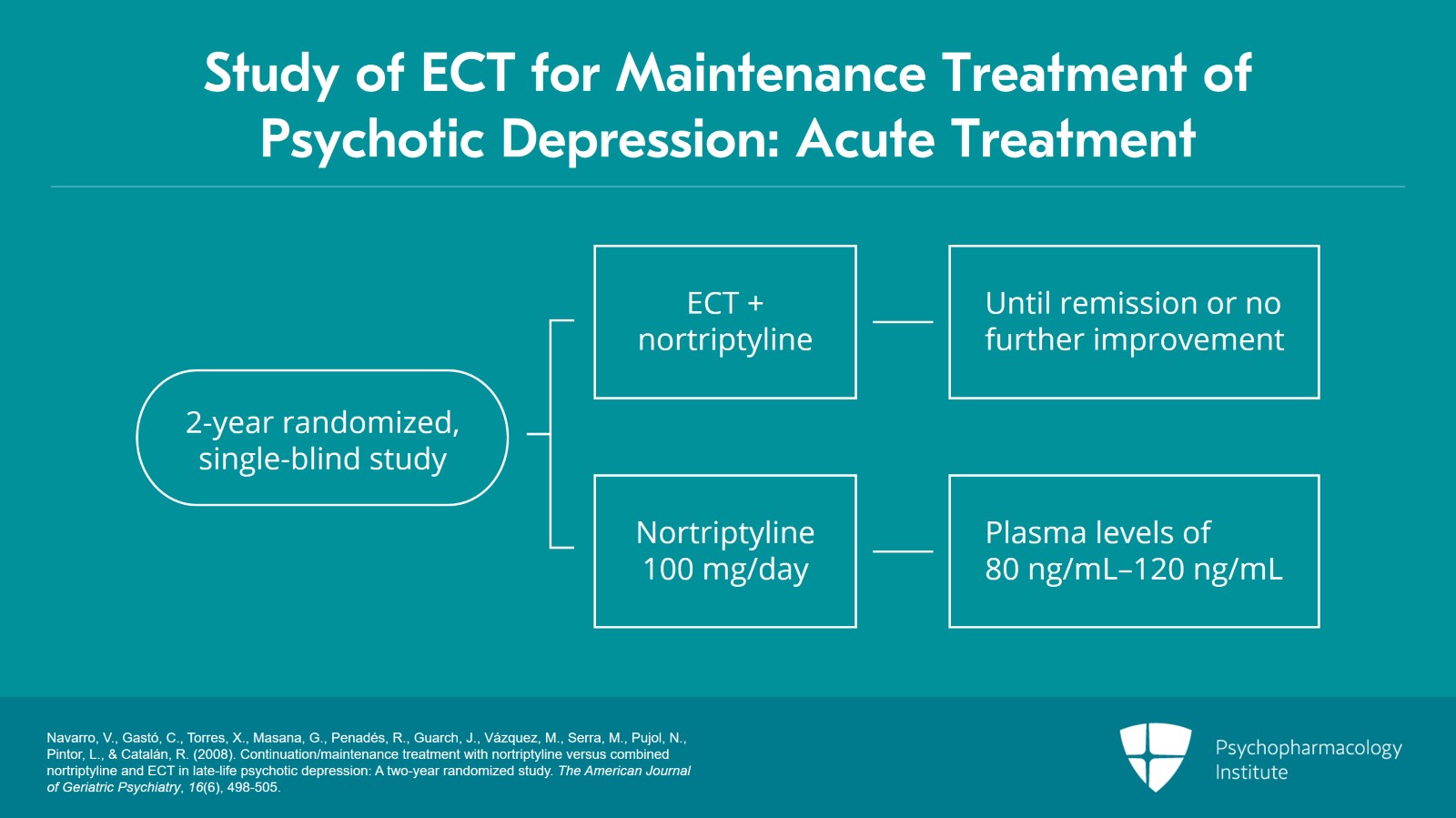
Olfson found ECT is more rapidly effective than pharmacotherapy and shortens hospital stay and reduces treatment costs for inpatients but only if the ECT is initiated within five days of admission. If you're spending more time than that trying to decide about the ECT or trying other things, then it doesn't shorten the length of stay. But if you get it going right away, it seems to have quite a bit of comprehensive benefit. One study showed that those with psychotic depression had lower relapse rates than those with nonpsychotic depression when treated with ECT.
References:
  • Olfson, M., Marcus, S., Sackeim, H. A., Thompson, J., & Pincus, H. A. (1998). Use of ECT for the inpatient treatment of recurrent major depression. American Journal of Psychiatry, 155(1), 22-29.
  • Birkenhäger, T. K., Renes, J., & Pluijms, E. M. (2004). One-year follow-up after successful ECT. The Journal of Clinical Psychiatry, 65(1), 87-91.
Free Files
Success!
Check your inbox, we sent you all the materials there.
Slide 7 of 12

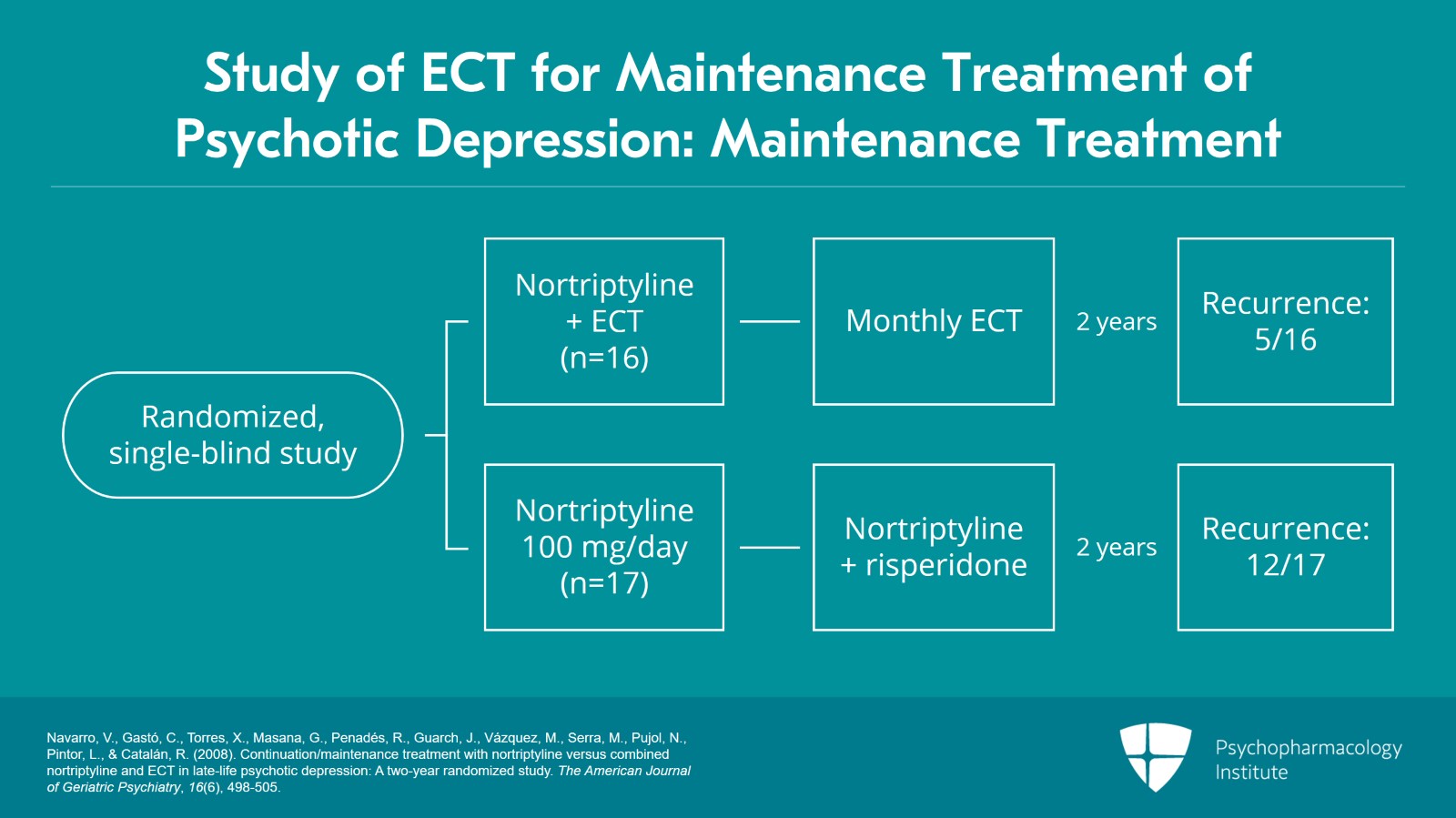
The limitations of ECT are well known, memory impairments and also availability. Many places don't offer ECT or it may involve having to transfer them elsewhere or there are various barriers put up to getting it or the patient may not want to have it. 
References:
  • Sackeim, H. A. (2017). Modern electroconvulsive therapy. JAMA Psychiatry, 74(8), 779.

Slide 8 of 12

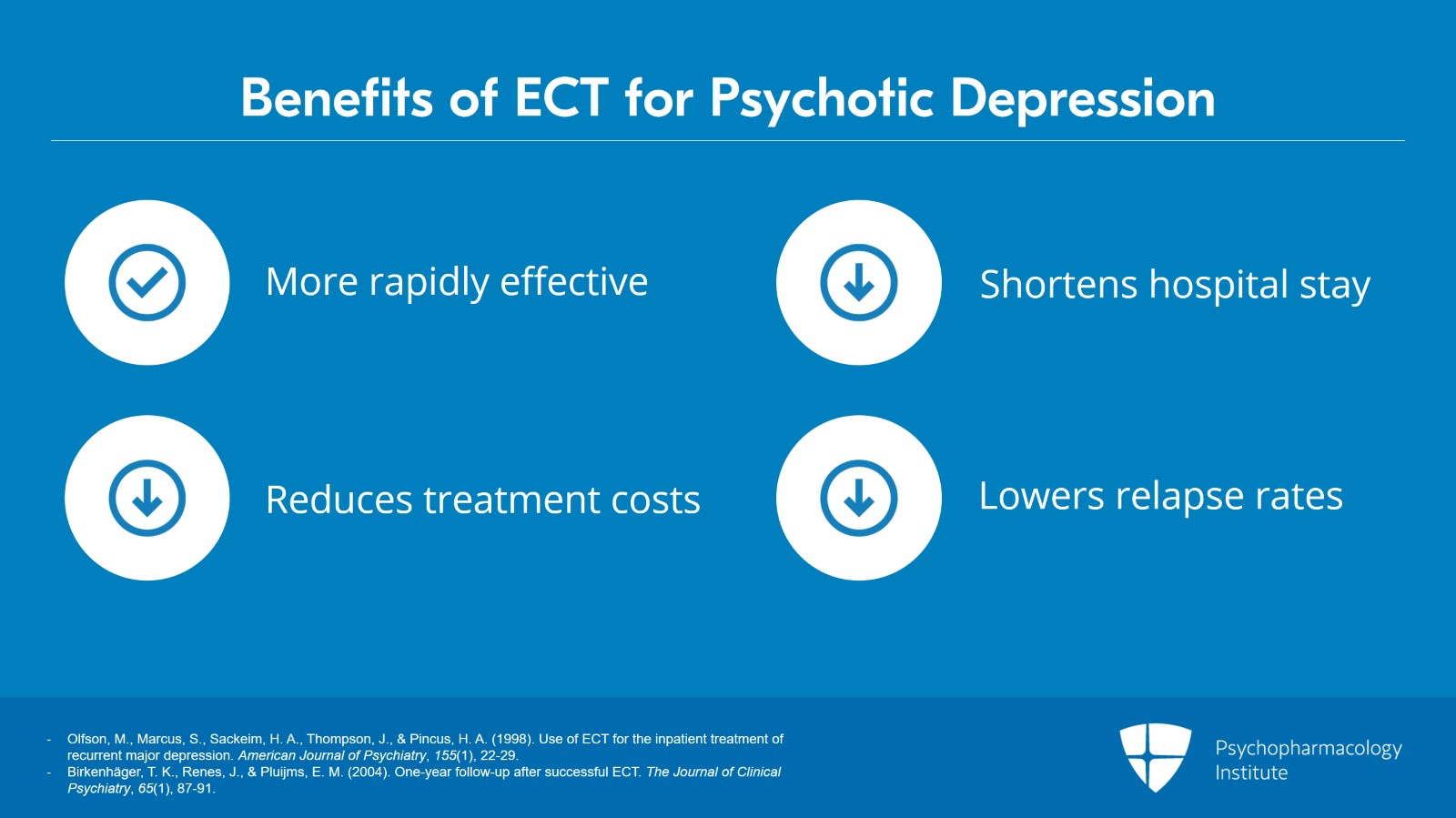
There's also some work as ECT for maintenance treatment of psychotic depression which provides further support for thinking of ECT. Navarro did a two-year randomized, single-blind study of patients. They were older patients, all over age 60, and they were initially treated with ECT and nortriptyline. So, for the acute treatment, they got ECT bifrontotemporal three times a week, continued until they either remitted or made no further improvement over three consecutive treatments. And then the comparison group, single blind, got nortriptyline and that was dosed to get plasma levels of 80 to 120. The dose typically was 100 mg daily. That was the acute treatment. 
References:
  • Navarro, V., Gastó, C., Torres, X., Masana, G., Penadés, R., Guarch, J., Vázquez, M., Serra, M., Pujol, N., Pintor, L., & Catalán, R. (2008). Continuation/maintenance treatment with nortriptyline versus combined nortriptyline and ECT in late-life psychotic depression: A two-year randomized study. The American Journal of Geriatric Psychiatry, 16(6), 498-505.
Free Files
Success!
Check your inbox, we sent you all the materials there.
Slide 9 of 12

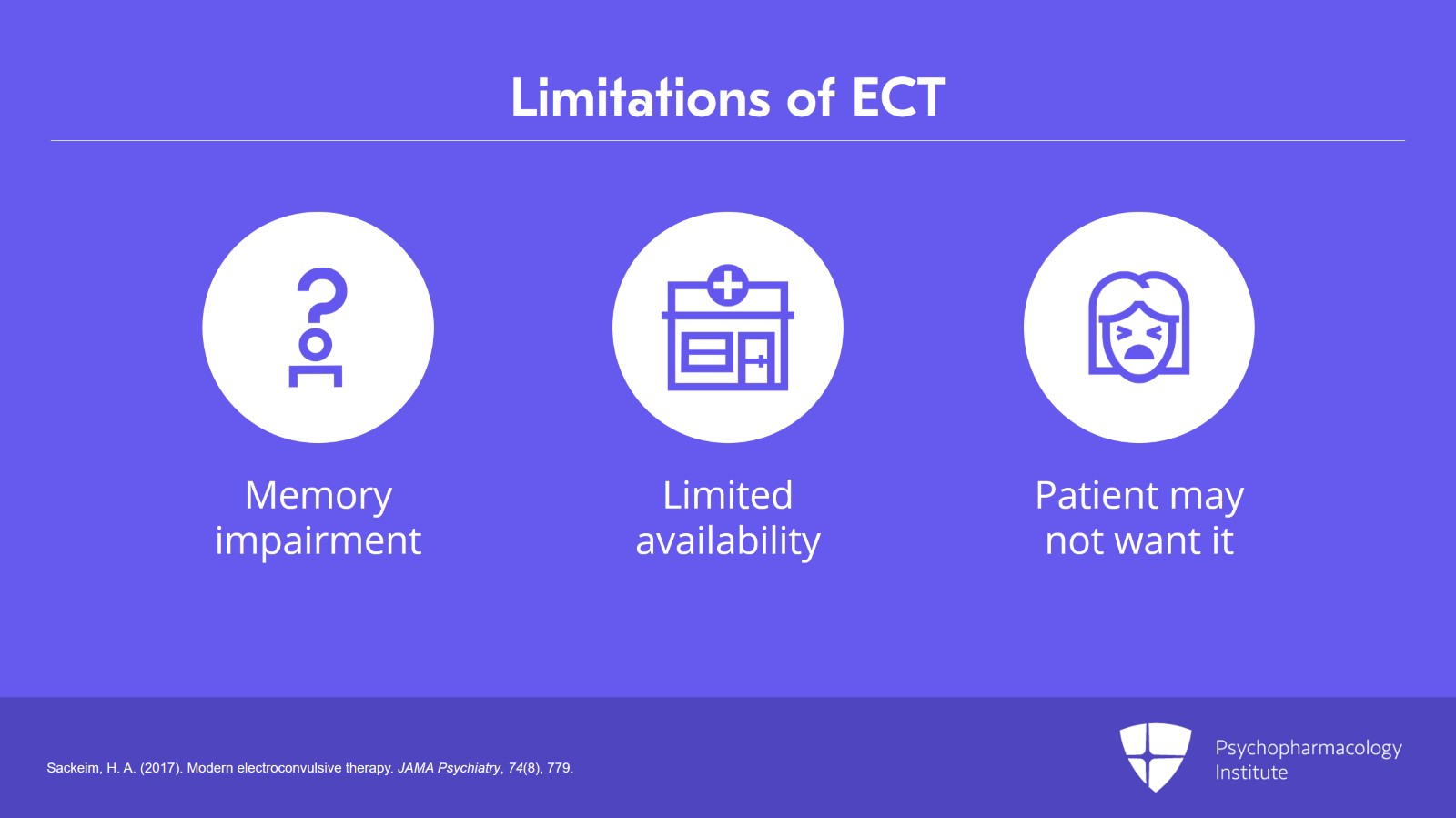
And in maintenance, following them for two years, 16 in the nortriptyline group plus ECT, 17 in the nortriptyline alone group. The ECT group had maintenance treatment once a month eventually and the nortriptyline group was continued on their nortriptyline but they had risperidone added to their nortriptyline to give them an extra benefit. And they had at least six weeks of risperidone up to 2 mg a day. So what happened? So after two years, 5 of the 16 getting the ECT had a recurrence. And 12 of 17 had a recurrence on the nortriptyline and risperidone. That was significant difference at a p 0.009 level. 
References:
  • Navarro, V., Gastó, C., Torres, X., Masana, G., Penadés, R., Guarch, J., Vázquez, M., Serra, M., Pujol, N., Pintor, L., & Catalán, R. (2008). Continuation/maintenance treatment with nortriptyline versus combined nortriptyline and ECT in late-life psychotic depression: A two-year randomized study. The American Journal of Geriatric Psychiatry, 16(6), 498-505.

Slide 10 of 12

So in conclusion, the key points from this section on the ECT is that ECT is a possible first-line treatment for psychotic depression for severe cases especially. The evidence is from uncontrolled studies though for the most part but it seems to suggest exceptional results.
Free Files
Success!
Check your inbox, we sent you all the materials there.
Slide 11 of 12

One large sample found a 95% remission rate and it can work more rapidly than medication and shorten hospital stay if started quickly in the admission and it may be used as a maintenance therapy and work better than maintaining them on medication.

Slide 12 of 12

Free Files
Success!
Check your inbox, we sent you all the materials there.
Learning Objectives:

After completing this activity, the learner will be able to:

  1. Identify the recommended treatment options for patients with psychotic depression and prescribe them accordingly.
  2. Recognize the role of electroconvulsive therapy as a first-line, highly effective treatment option for psychotic depression.

Original Release Date: 09/01/2021

Review Date: 03/01/2024

Expiration Date: 04/01/2024

Expert: David Osser, M.D.

Medical Editor: Melissa Mariano, M.D

Relevant Financial Disclosures:

None of the faculty, planners, and reviewers for this educational activity have relevant financial relationship(s) to disclose during the last 24 months with ineligible companies whose primary business is producing, marketing, selling, re-selling, or distributing healthcare products used by or on patients.

Contact Information: For questions regarding the content or access to this activity, contact us at support@psychopharmacologyinstitute.com

Instructions for Participation and Credit:

Participants must complete the activity online during the valid credit period that is noted above.

Follow these steps to earn CME credit:

  1. View the required educational content provided on this course page.
  2. Complete the Post Activity Evaluation for providing the necessary feedback for continuing accreditation purposes and for the development of future activities. NOTE: Completing the Post Activity Evaluation after the quiz is required to receive the earned credit.
  3. Download your certificate.
Free Files
Success!
Check your inbox, we sent you all the materials there.
Continue in the website
Instant access modal

Become a Bronze, Silver, Gold, Bronze extended, Silver extended or Gold extended Member.

2025–26 Psychopharmacology CME Program

Unlock up to 155 CME Credits, including 40 SA CME Credits.