Close Banner
Section Free  - Video Lectures

03. Medication-Induced SRED, Sleepwalking, and Sleepdriving

Published on March 1, 2023 Certification expiration date: March 1, 2026

Carlos H. Schenck, M.D.

Professor & Senior Staff Psychiatrist at the Hennepin County Medical Center (HCMC) - University of Minnesota

Key Points

  • Atypical antipsychotics have been reported to induce secondary SRED.
  • Mirtazapine has also been reported to induce secondary SRED.
  • Sedative-hypnotic medications can induce sleepwalking, SRED, and sleep driving.
  • Zolpidem is the most commonly reported hypnotic medication to induce non-REM sleep parasomnias.

Free Downloads for Offline Access

  • Free Download Presentation File (PPTX)
  • Free Download Video (MP4)
  • Free Download Audio File (MP3)

Slides and Transcript

Slide 1 of 13

I now want to mention that sleep-related eating disorder can be induced by various psychotropic medications.

Slide 2 of 13

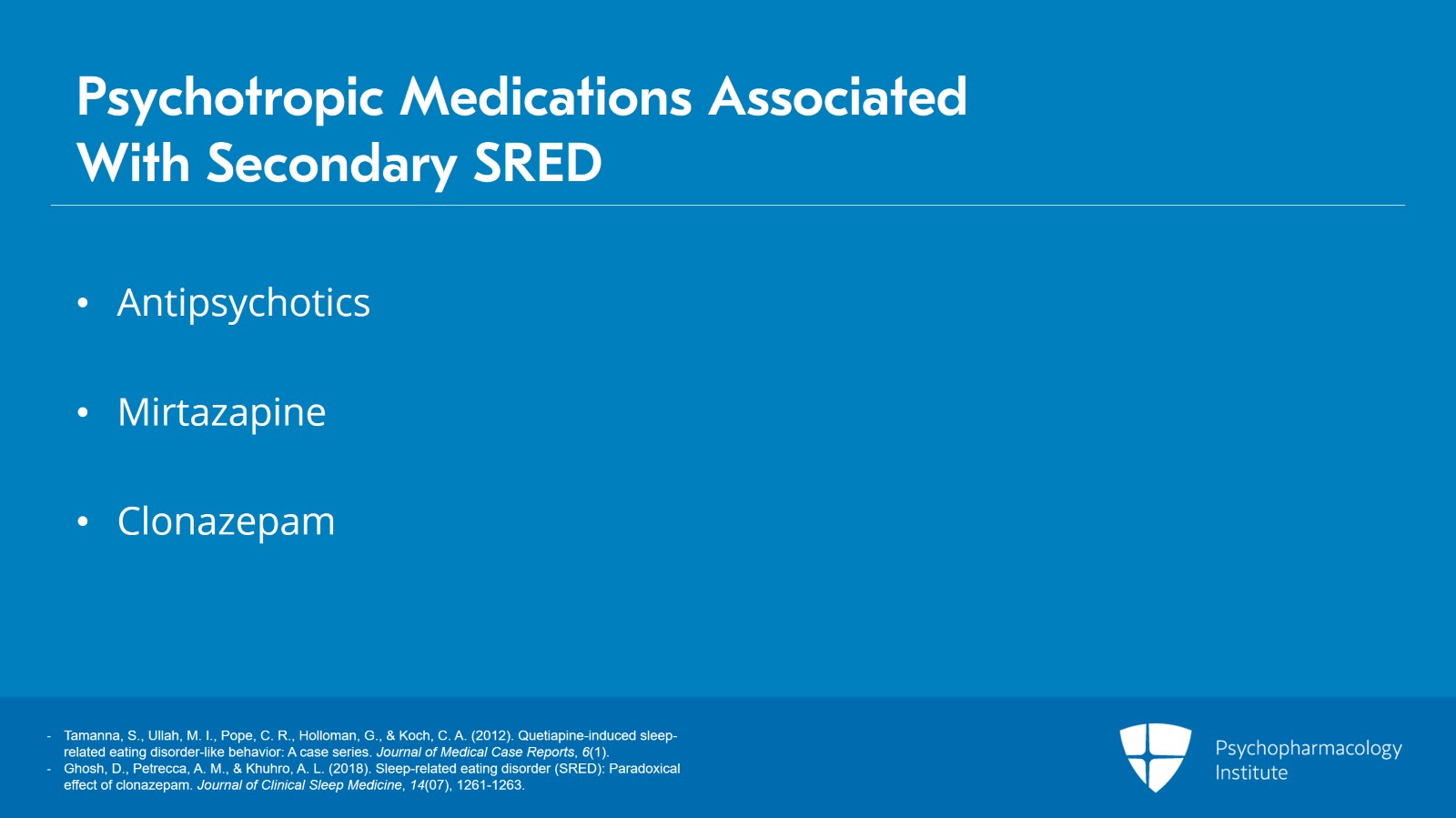
There's a long list now, a growing list of medications that can induce secondary sleep-related eating disorder, including olanzapine, risperidone, quetiapine, aripiprazole, mirtazapine, and even a rare case of clonazepam, since clonazepam is on the list of medications to treat idiopathic sleep-related eating disorder, but it's really down the list.
References:
  • Tamanna, S., Ullah, M. I., Pope, C. R., Holloman, G., & Koch, C. A. (2012). Quetiapine-induced sleep-related eating disorder-like behavior: A case series. Journal of Medical Case Reports, 6(1).
  • Ghosh, D., Petrecca, A. M., & Khuhro, A. L. (2018). Sleep-related eating disorder (SRED): Paradoxical effect of clonazepam. Journal of Clinical Sleep Medicine, 14(07), 1261-1263.
Free Files
Success!
Check your inbox, we sent you all the materials there.

Slide 3 of 13

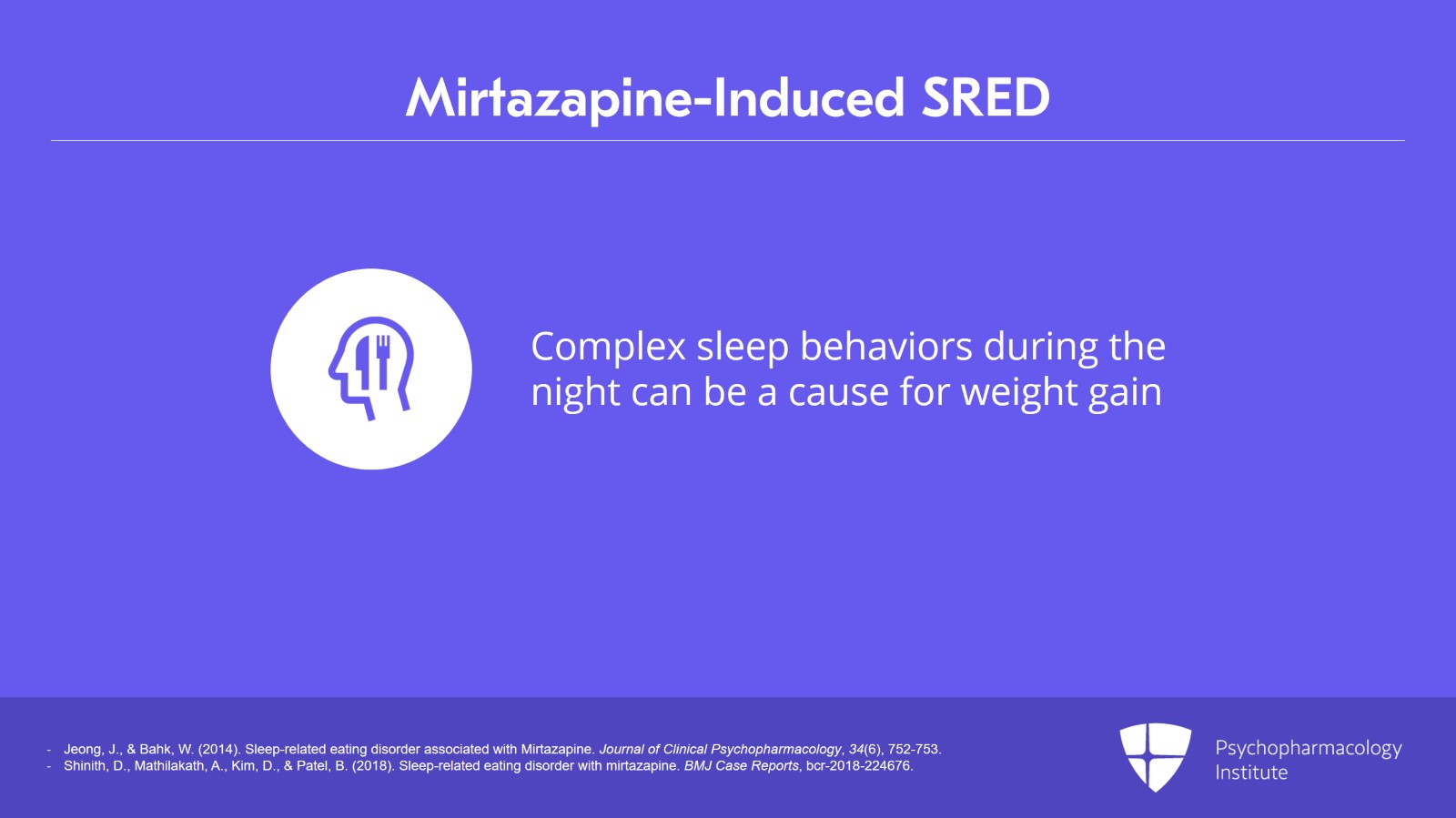
I know that most psychiatrists are aware that mirtazapine can cause weight gain and they need to be aware that one of the possible mechanisms for the weight gain induced by mirtazapine is via the mechanism of mirtazapine-induced sleep-related eating disorder. So, you need to talk to the patient, have them talk to the bed partner or roommate about any type of complex sleep behaviors during the night as the possible cause for the weight gain associated with mirtazapine.
References:
  • Jeong, J., & Bahk, W. (2014). Sleep-related eating disorder associated with Mirtazapine. Journal of Clinical Psychopharmacology, 34(6), 752-753.
  • Shinith, D., Mathilakath, A., Kim, D., & Patel, B. (2018). Sleep-related eating disorder with mirtazapine. BMJ Case Reports, bcr-2018-224676.

Slide 4 of 13

There is a related condition called night eating syndrome that actually is related in terms of abnormal eating in the evening or at night, but these patients are awake and they know what they are doing. They just cannot control their eating. And that's very different from sleep-related eating disorder where the patient is asleep, with partial or complete amnesia.
References:
  • American Psychiatric Association. DSM-5 Task Force. (2017). Diagnostic and statistical manual of mental disorders: DSM-5.
  • American Academy of Sleep Medicine. (2014). International classification of sleep disorders (3rd ed.).
Free Files
Success!
Check your inbox, we sent you all the materials there.

Slide 5 of 13

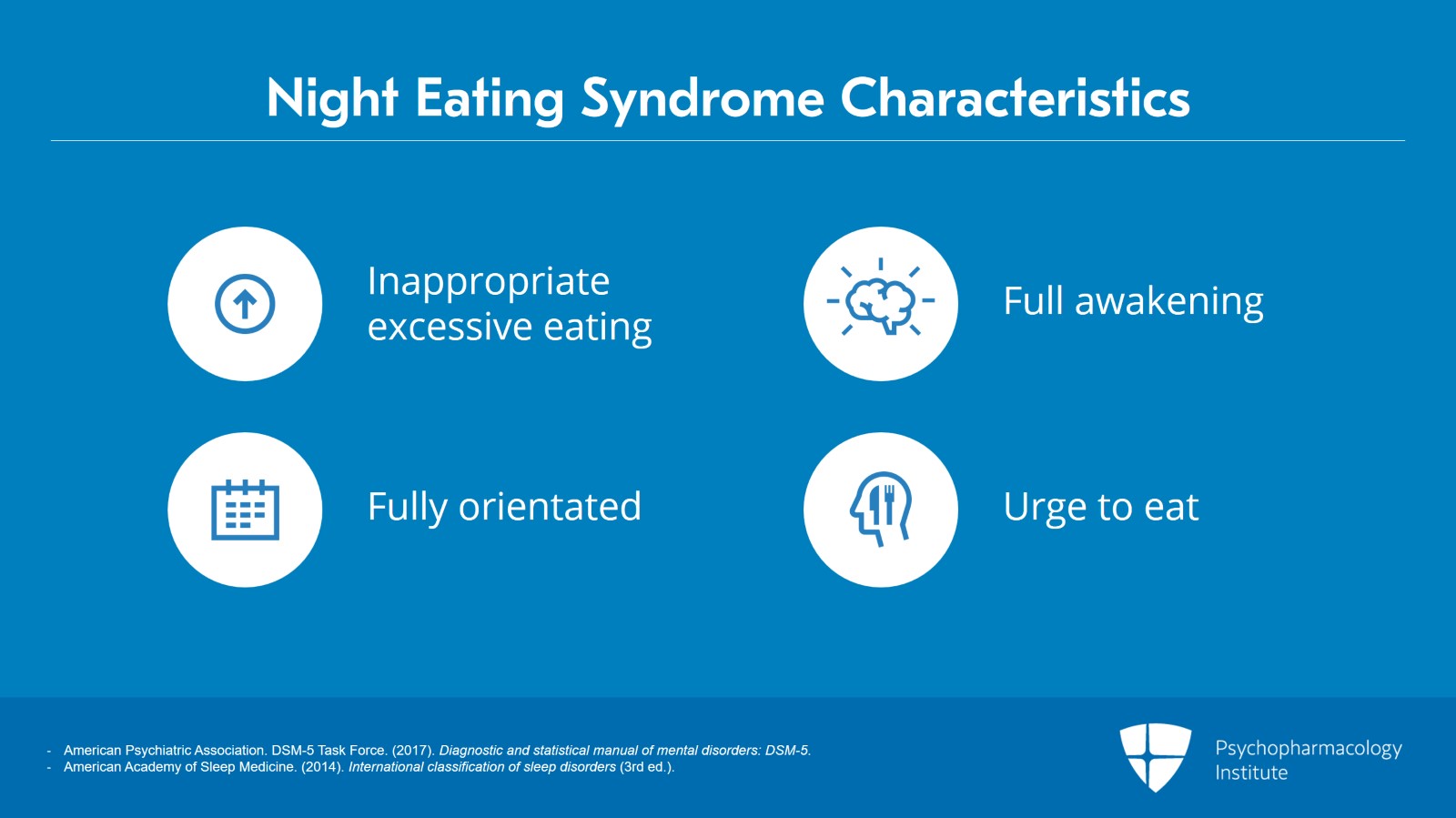
So, with night eating syndrome there is inappropriate excessive eating in the evening, either before falling asleep, in other words, between dinner and bedtime, or after an awakening during sleep, a full awakening being fully oriented, aware of what you're doing and then you have the urge to eat. Very different from sleep-related eating disorder where the person is not aware of what he or she is doing.
References:
  • American Psychiatric Association. DSM-5 Task Force. (2017). Diagnostic and statistical manual of mental disorders: DSM-5.
  • American Academy of Sleep Medicine. (2014). International classification of sleep disorders (3rd ed.).

Slide 6 of 13

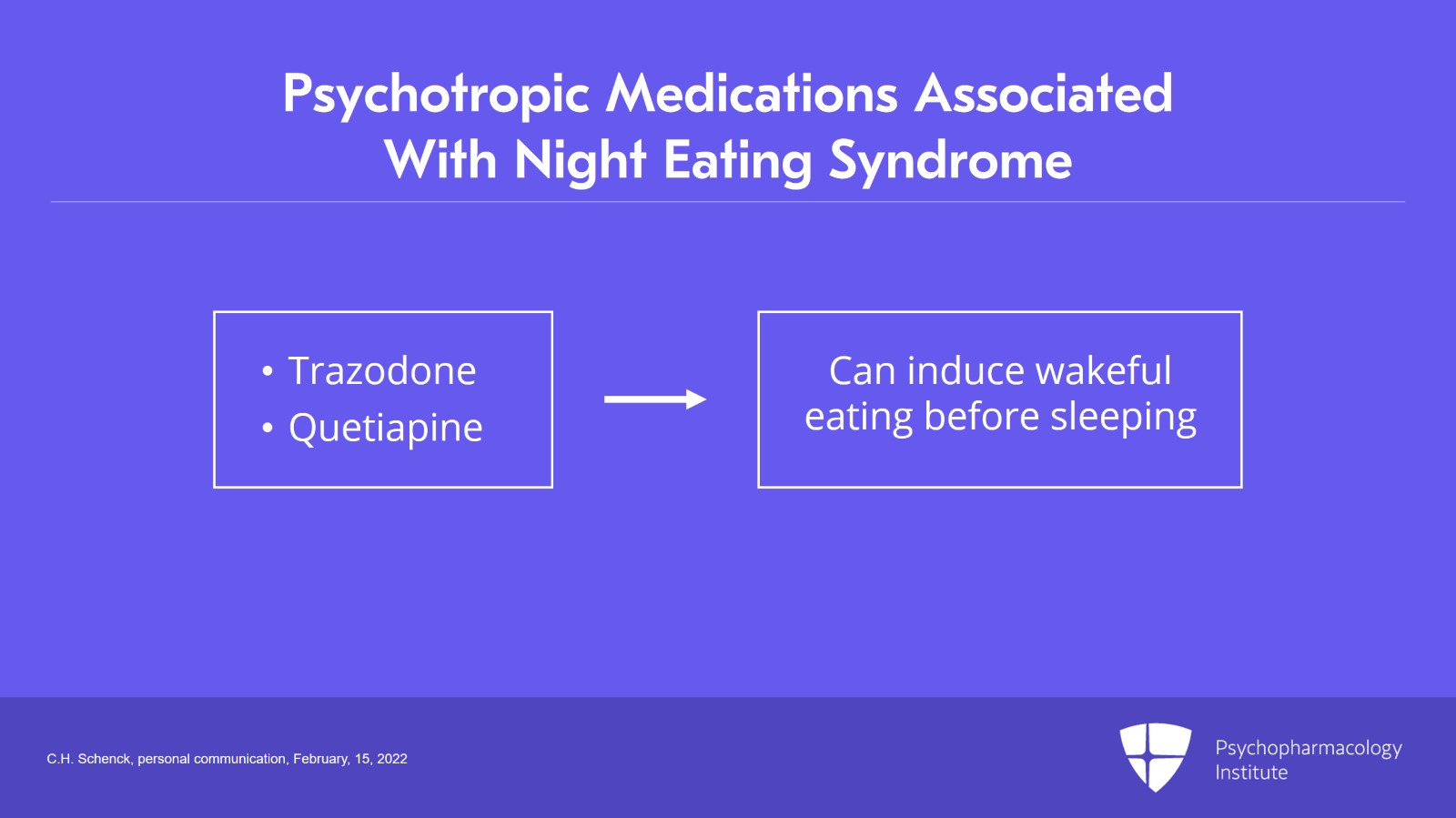
So, with night eating syndrome, certainly, various psychotropic medications such as trazodone or quetiapine can induce wakeful eating with weight gain before going to sleep.
References:
  • C.H. Schenck, personal communication, February, 15, 2022
Free Files
Success!
Check your inbox, we sent you all the materials there.

Slide 7 of 13

But sleep-related eating disorder is a condition that occurs after someone has fallen asleep, either idiopathically or associated with zolpidem or other hypnotic medication.
References:
  • Tamanna, S., Ullah, M. I., Pope, C. R., Holloman, G., & Koch, C. A. (2012). Quetiapine-induced sleep-related eating disorder-like behavior: A case series. Journal of Medical Case Reports, 6(1).

Slide 8 of 13

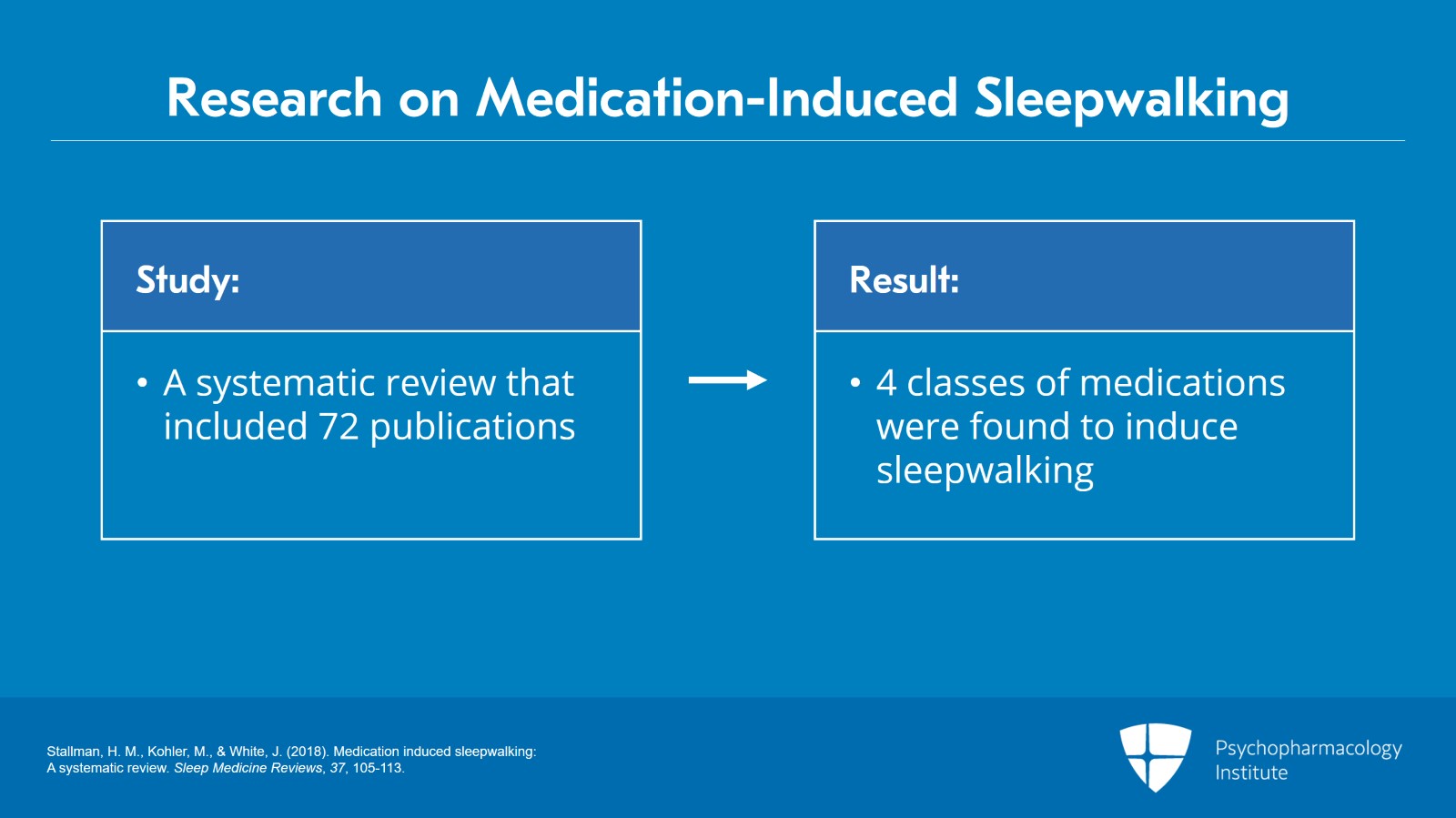
I will now address the issue of medication-induced sleepwalking. Helen Stallman from Australia and her colleagues published an article in Sleep Medicine Reviews 2018, entitled Medication-induced Sleepwalking: A Systematic Review. They did a very extensive database search using the keyword sleepwalking and somnambulism. Seventy-two publications met the inclusion criteria. The results show that there were primarily four classes of medications that induce sleepwalking.
References:
  • Stallman, H. M., Kohler, M., & White, J. (2018). Medication induced sleepwalking: A systematic review. Sleep Medicine Reviews, 37, 105-113.
Free Files
Success!
Check your inbox, we sent you all the materials there.

Slide 9 of 13

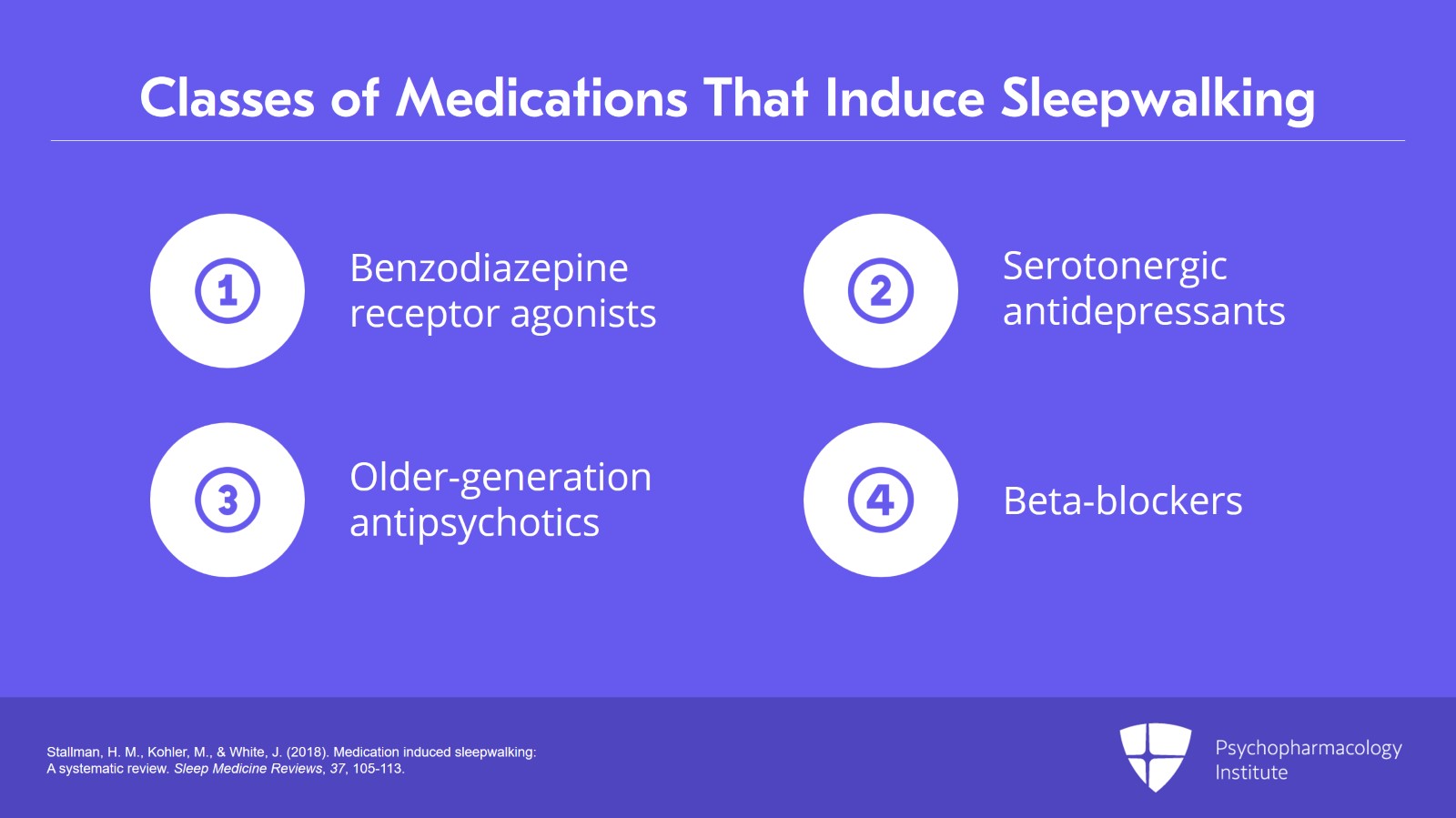
First of all, benzodiazepine receptor agonists and other GABA modulators with zolpidem being identified in 26 studies and other drugs in 10 studies. Second, serotonergic antidepressants and also bupropion. Third, older generation antipsychotics. And fourth, beta-blockers.
References:
  • Stallman, H. M., Kohler, M., & White, J. (2018). Medication induced sleepwalking: A systematic review. Sleep Medicine Reviews, 37, 105-113.

Slide 10 of 13

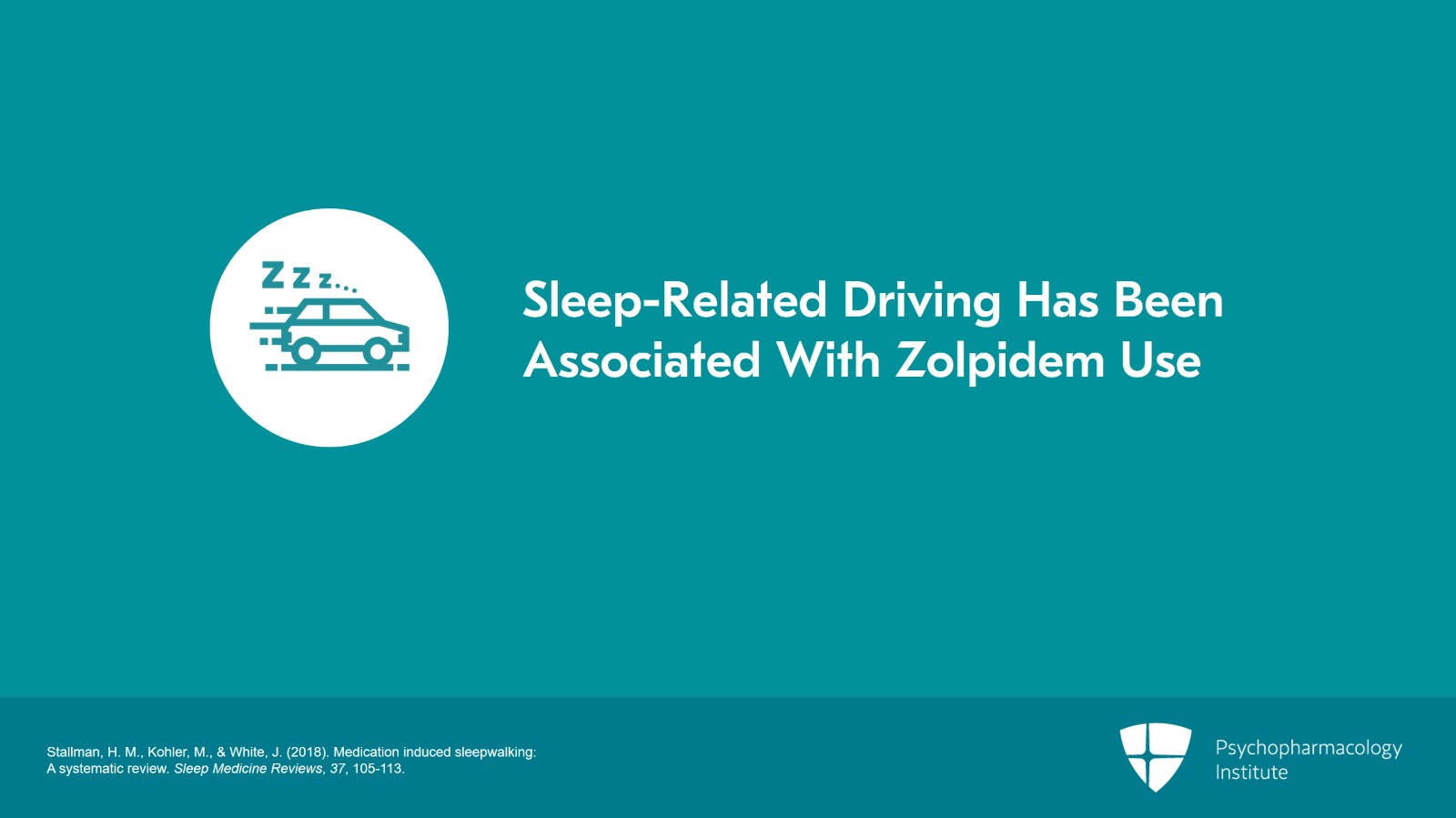
And they identified four cases of sleep-related driving with zolpidem.
References:
  • Stallman, H. M., Kohler, M., & White, J. (2018). Medication induced sleepwalking: A systematic review. Sleep Medicine Reviews, 37, 105-113.
Free Files
Success!
Check your inbox, we sent you all the materials there.

Slide 11 of 13

And my key points here are that: There's a broad array of atypical antipsychotics that have been reported to induce secondary sleep-related eating disorder. Also, the antidepressant mirtazapine has also been reported to induce secondary sleep-related eating disorder.

Slide 12 of 13

Sedative-hypnotic medications can induce various non-REM sleep parasomnias, including sleepwalking, sleep-related eating, and sleep driving. Also, zolpidem is the most commonly reported hypnotic medication to induce non-REM parasomnias, which I will elaborate on further during my talk.
Free Files
Success!
Check your inbox, we sent you all the materials there.

Slide 13 of 13

Learning Objectives:

After completing this activity, the learner will be able to:

  1. Recognize and analyze abnormal non-REM sleep behaviors.
  2. Correlate sedative-hypnotics use patterns with the occurrence of parasomnias.
  3. Confidently diagnose sleep-related eating disorder and sleepwalking.

Original Release Date: March 1, 2023

Review and Re-release Date: March 1, 2024

Expiration Date: March 1, 2026

Expert: Carlos Schenck, M.D.

Medical Editor: Horia Batranu, M.D.

Relevant Financial Disclosures: 

Carlos H. Schenck, M.D. declares the following interests:

- Eisai, Inc.:  One time lecture on REM sleep behavior disorder, without any product promotion.

All of the relevant financial relationships listed above have been mitigated by Medical Academy and the Psychopharmacology Institute.

Contact Information: For questions regarding the content or access to this activity, contact us at support@psychopharmacologyinstitute.com

Instructions for Participation and Credit:

Participants must complete the activity online during the valid credit period that is noted above.

Follow these steps to earn CME credit:

  1. View the required educational content provided on this course page.

  2. Complete the Post Activity Evaluation for providing the necessary feedback for continuing accreditation purposes and for the development of future activities. NOTE: Completing the Post Activity Evaluation after the quiz is required to receive the earned credit.

  3. Download your certificate.

Accreditation Statement

This activity has been planned and implemented in accordance with the accreditation requirements and policies of the Accreditation Council for Continuing Medical Education through the joint providership of Medical Academy LLC and the Psychopharmacology Institute. Medical Academy is accredited by the ACCME to provide continuing medical education for physicians.

Credit Designation Statement

Medical Academy designates this enduring activity for a maximum of 0.5 AMA PRA Category 1 credit(s)™. Physicians should claim only the credit commensurate with the extent of their participation in the activity.


Free Files
Success!
Check your inbox, we sent you all the materials there.
Continue in the website
Instant access modal

Become a Bronze, Silver, Gold, Bronze extended, Silver extended or Gold extended Member.

2025–26 Psychopharmacology CME Program

Unlock up to 155 CME Credits, including 40 SA CME Credits.