Close Banner
Section Free  - Video Lectures

04. Managing Clozapine-Related Orthostasis

Published on November 1, 2022 Certification expiration date: November 1, 2028

Jonathan M. Meyer, M.D.

Assistant Clinical Professor - University of California San Diego

Key Points

  • Titrate clozapine as slow as possible.
  • Encourage fluid intake.
  • Remove or change medications that contribute to orthostasis risk as clozapine is titrated.
  • If the previous measures are not effective, use fludrocortisone for volume expansion.

Free Downloads for Offline Access

  • Free Download Presentation File (PPTX)
  • Free Download Video (MP4)
  • Free Download Audio File (MP3)

Slides and Transcript
Slide 1 of 16

What are the orthostasis management strategies?

Slide 2 of 16

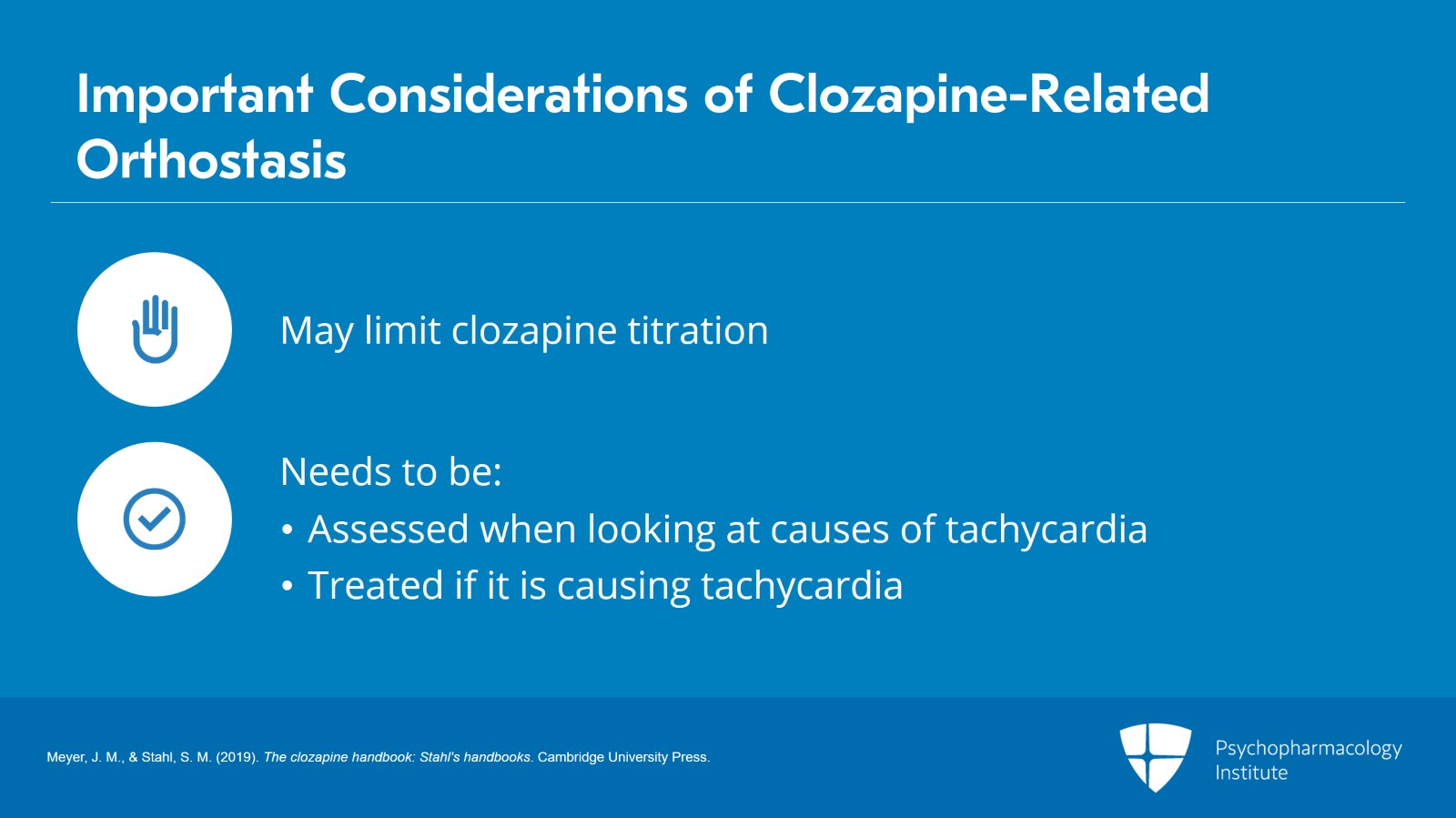
Orthostasis represents an important issue partly because of the fact that patients will complain about it, and it may limit clozapine titration but also, it’s something that needs to be assessed when you’re looking at causes of tachycardia. And it’s something that has to be treated if it is causing the tachycardia.
References:
  • Meyer, J. M., & Stahl, S. M. (2019). The clozapine handbook: Stahl's handbooks. Cambridge University Press.
Free Files
Success!
Check your inbox, we sent you all the materials there.
Slide 3 of 16

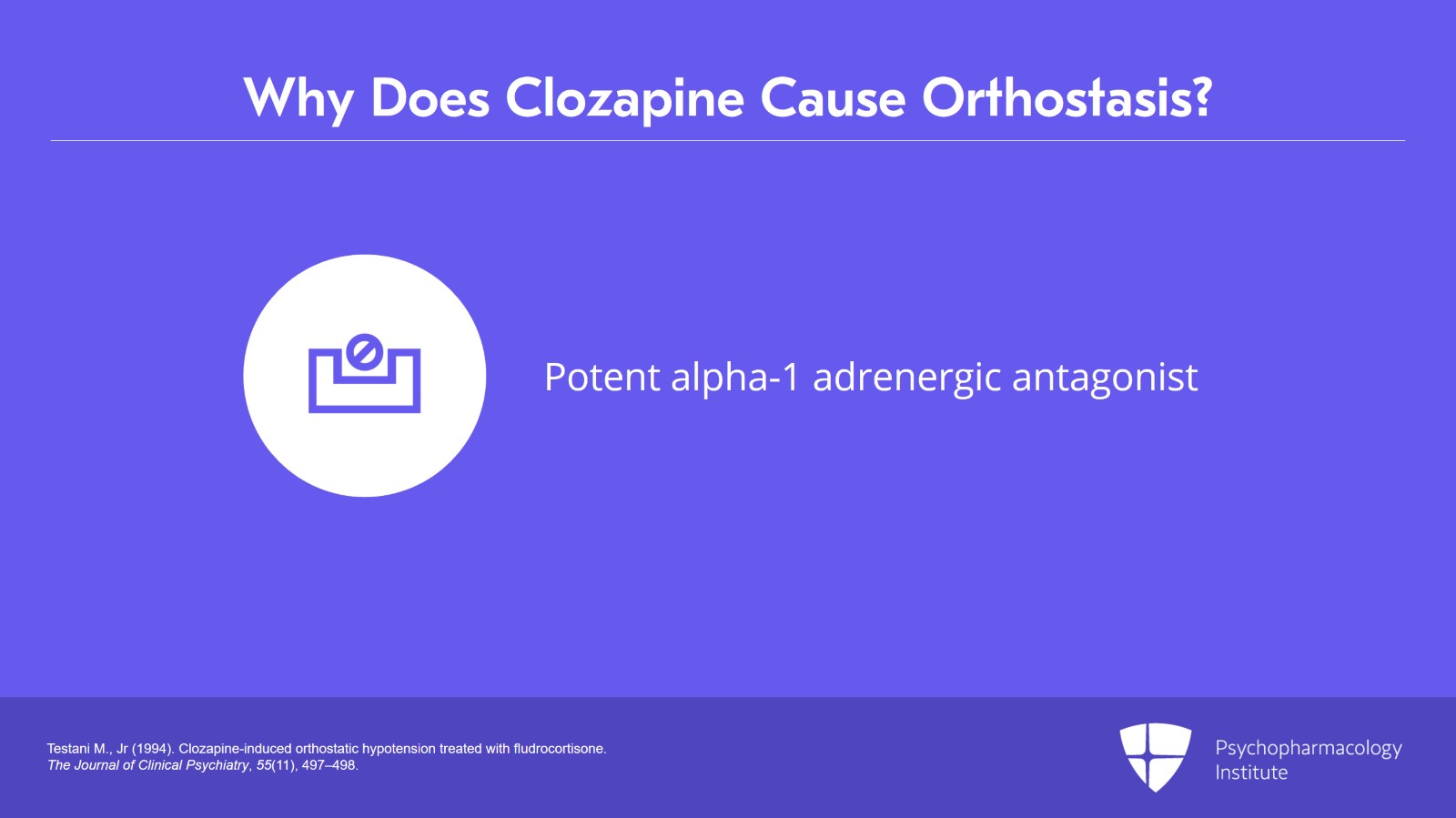
Why does clozapine cause orthostasis? Well, the same reason that most drugs do, because it has a lot of affinity for alpha-1 adrenergic receptors. It’s a fairly potent alpha-1 adrenergic antagonist and we give a lot of it.
References:
  • Testani M., Jr (1994). Clozapine-induced orthostatic hypotension treated with fludrocortisone. The Journal of Clinical Psychiatry, 55(11), 497–498.

Slide 4 of 16

The incidence is up to 20%. Some might develop tolerance but it can limit titration and that may be a big problem in getting your patient to the plasma level at which they might actually respond to clozapine if they really will respond.
References:
  • Testani M., Jr (1994). Clozapine-induced orthostatic hypotension treated with fludrocortisone. The Journal of Clinical Psychiatry, 55(11), 497–498.
Free Files
Success!
Check your inbox, we sent you all the materials there.
Slide 5 of 16

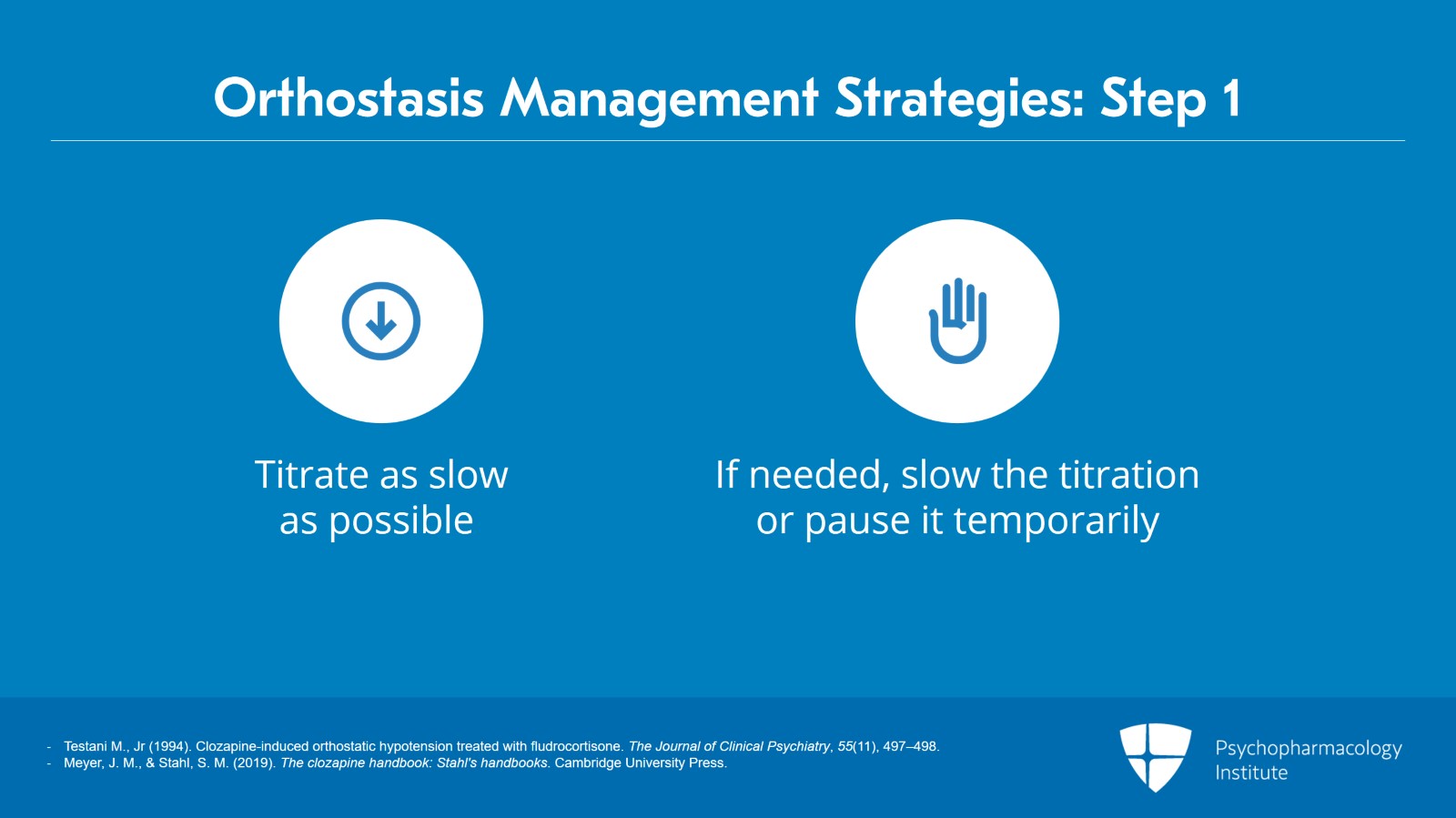
So what are the orthostasis management strategies? Well, number one, use the slowest titration that seems reasonable. If needed, slow the titration or even pause it temporarily. If the patient says, I don’t want to take this medicine anymore, you have very little else to offer them if they’re treatment resistant. Don’t be in a hurry. There are studies of fast titrations done in inpatient settings. Certainly, you cannot do that as an outpatient and even many inpatients will not tolerate that either.
References:
  • Testani M., Jr (1994). Clozapine-induced orthostatic hypotension treated with fludrocortisone. The Journal of Clinical Psychiatry, 55(11), 497–498.
  • Meyer, J. M., & Stahl, S. M. (2019). The clozapine handbook: Stahl's handbooks. Cambridge University Press.

Slide 6 of 16

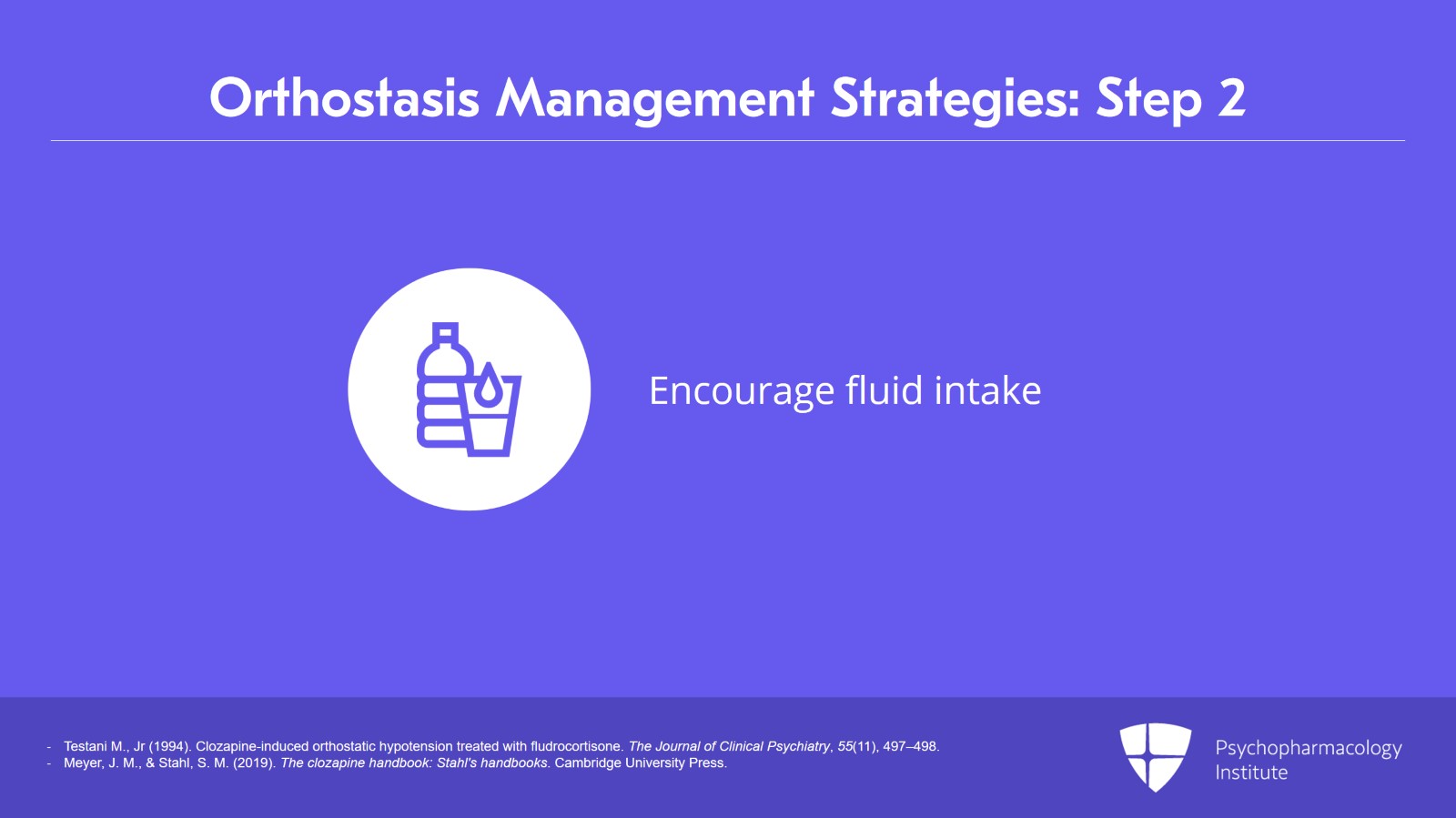
Number two, always encourage fluid intake.
References:
  • Testani M., Jr (1994). Clozapine-induced orthostatic hypotension treated with fludrocortisone. The Journal of Clinical Psychiatry, 55(11), 497–498.
  • Meyer, J. M., & Stahl, S. M. (2019). The clozapine handbook: Stahl's handbooks. Cambridge University Press.
Free Files
Success!
Check your inbox, we sent you all the materials there.
Slide 7 of 16

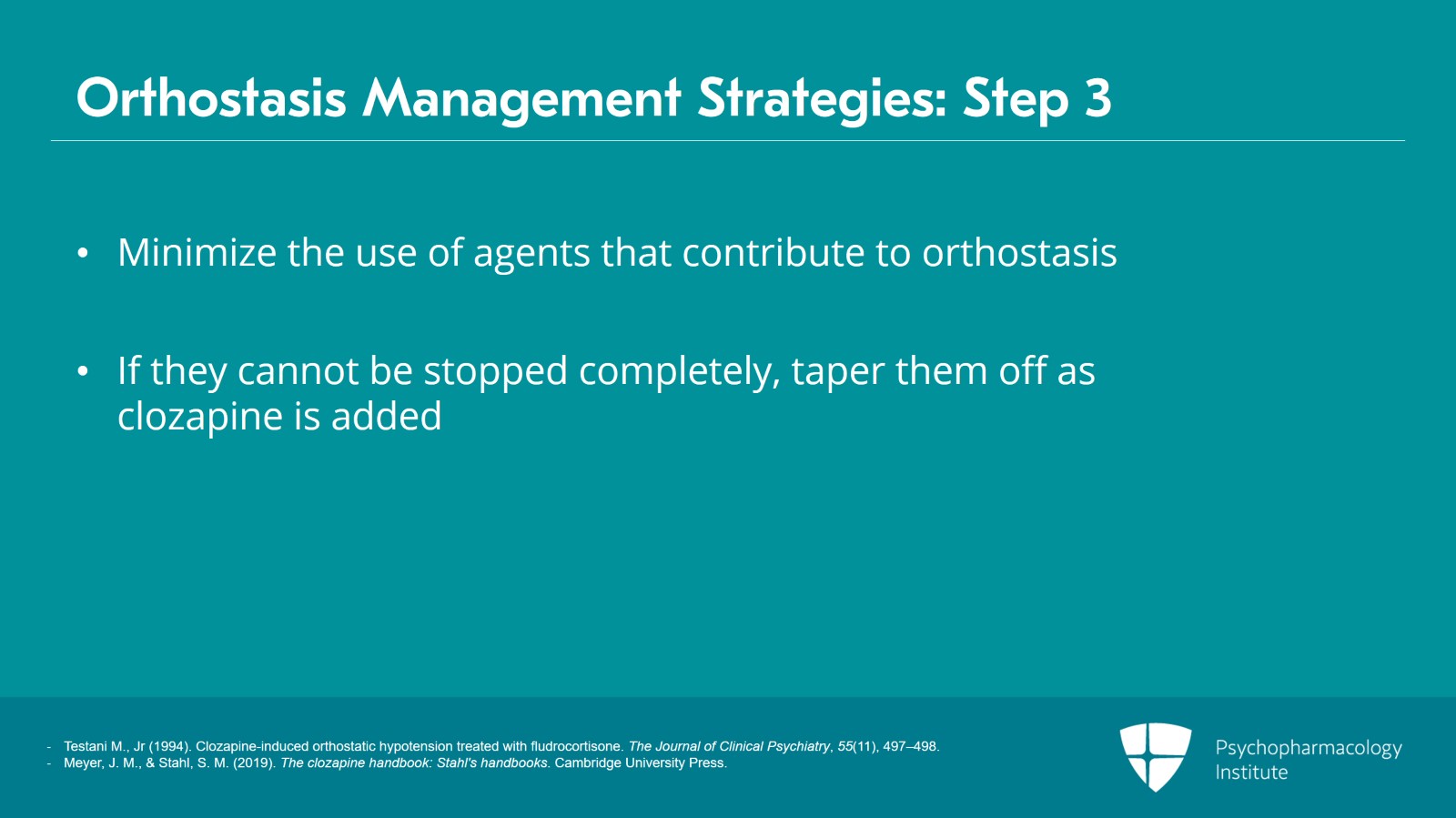
And most importantly, minimize other agents that contribute to orthostasis risk especially other alpha-1 antagonists and benzodiazepines. Try to taper these off as much as possible before starting treatment. If they can’t be stopped completely, then taper them off as clozapine is added over the first month.
References:
  • Testani M., Jr (1994). Clozapine-induced orthostatic hypotension treated with fludrocortisone. The Journal of Clinical Psychiatry, 55(11), 497–498.
  • Meyer, J. M., & Stahl, S. M. (2019). The clozapine handbook: Stahl's handbooks. Cambridge University Press.

Slide 8 of 16

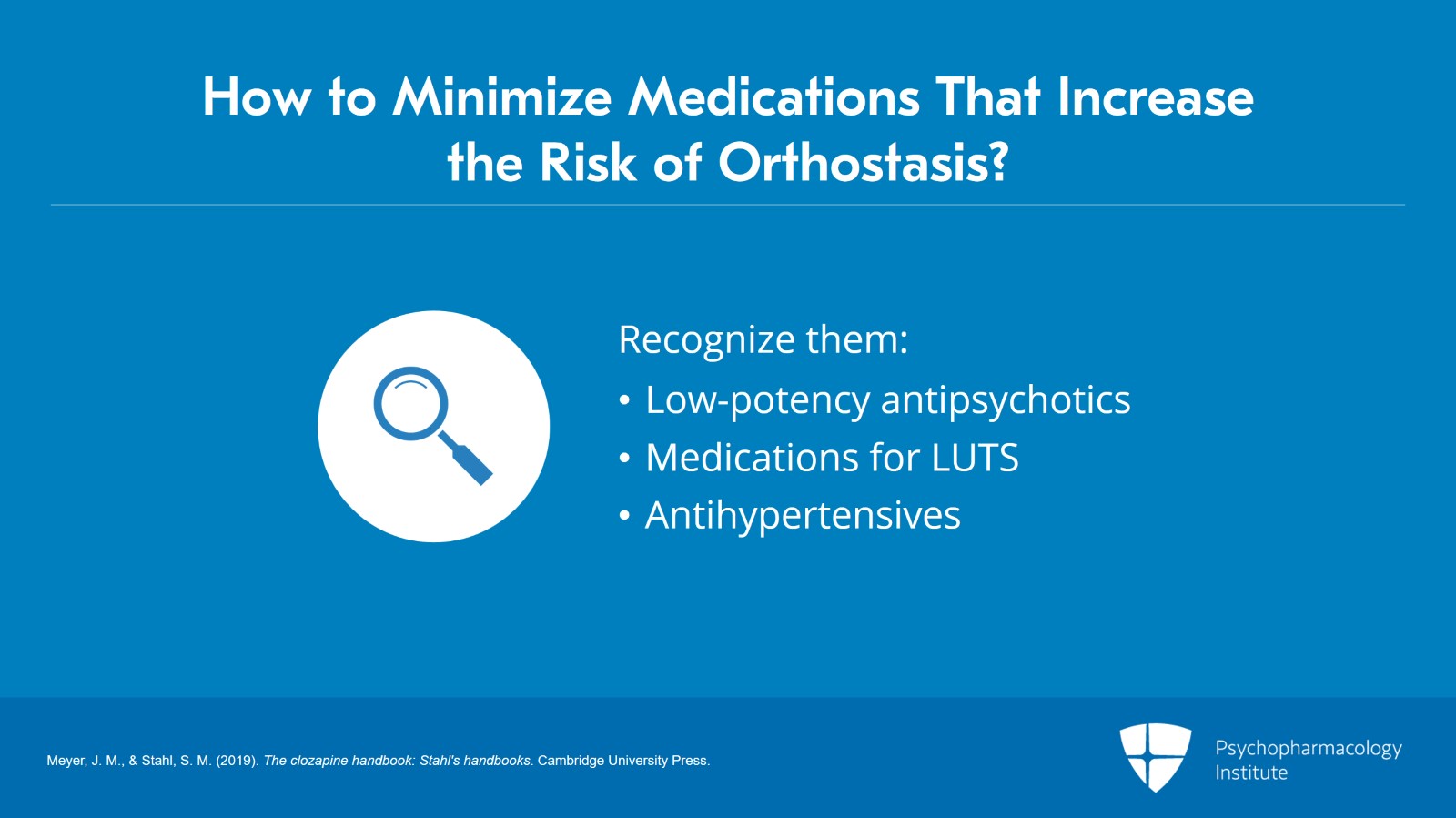
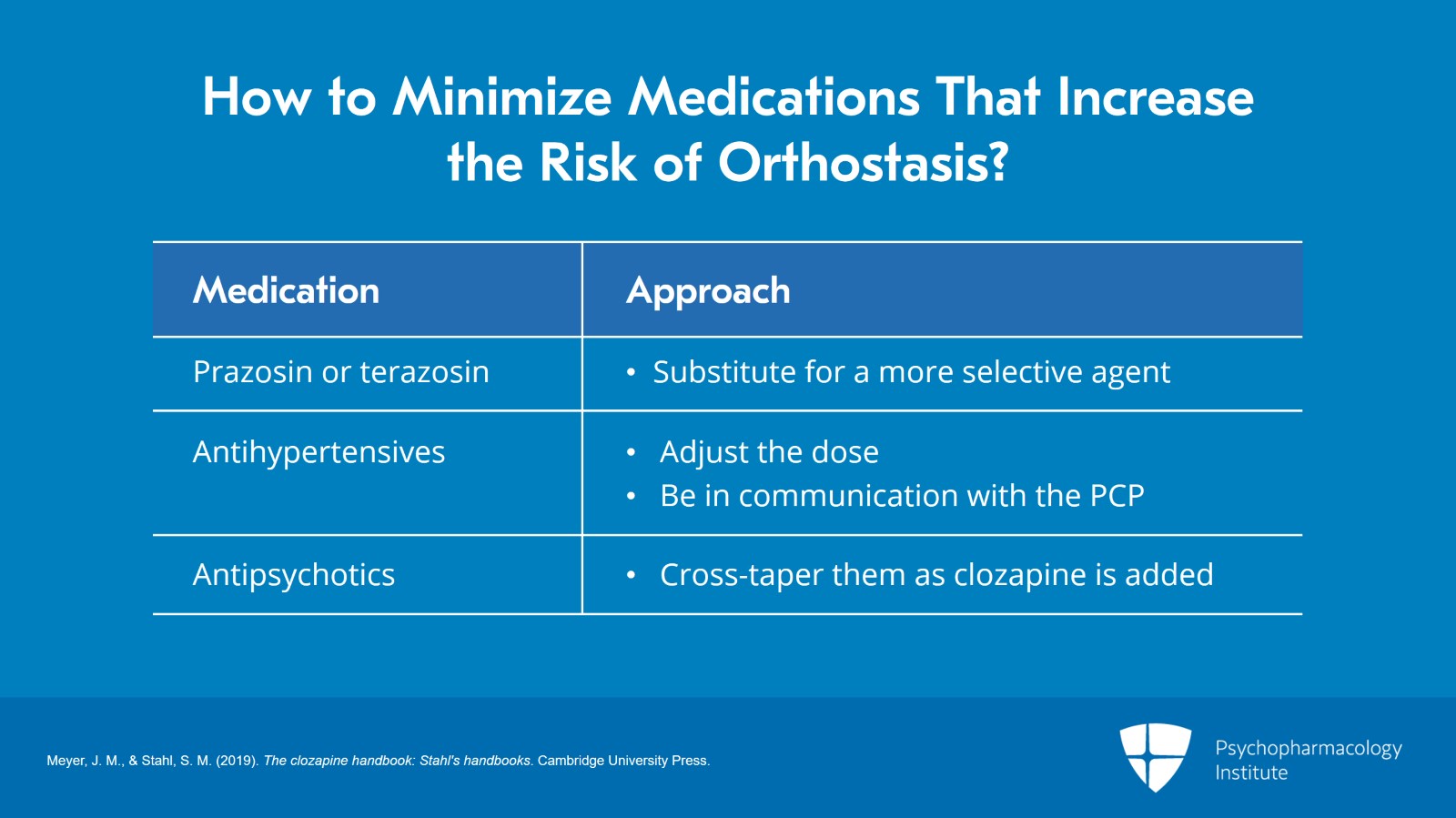
How do you minimize these medications that increase the risk of orthostasis? First, recognize who the offenders are. Among the psychotropics, these are going to be primarily the low potency antipsychotics such as chlorpromazine, also iloperidone, and perhaps high-dose quetiapine. Medications for lower urinary tract symptoms are also strong alpha-1 antagonists especially prazosin and terazosin. The newer medications like tamsulosin are not as much of an offender and we’ll talk about that in a second. And of course, antihypertensives, that’s their purpose, is to lower blood pressure.
References:
  • Meyer, J. M., & Stahl, S. M. (2019). The clozapine handbook: Stahl's handbooks. Cambridge University Press.
Free Files
Success!
Check your inbox, we sent you all the materials there.
Slide 9 of 16

So what does one do? If you have somebody on, for example, prazosin or terazosin for urinary tract symptoms, substitute one of the new more selective agents such as tamsulosin. As you’re titrating clozapine, you may have to adjust both the titration of clozapine but also the doses of the antihypertension meds. Be in communication with the primary care provider. Let them know what clozapine might do to the blood pressure so you can adjust the antihypertensives as needed. And then if they’re on some of these antipsychotics which contribute to the problem, simply cross-taper them as clozapine is added. And the goal is that they’ll be off of them hopefully over the first month to six weeks.
References:
  • Meyer, J. M., & Stahl, S. M. (2019). The clozapine handbook: Stahl's handbooks. Cambridge University Press.

Slide 10 of 16

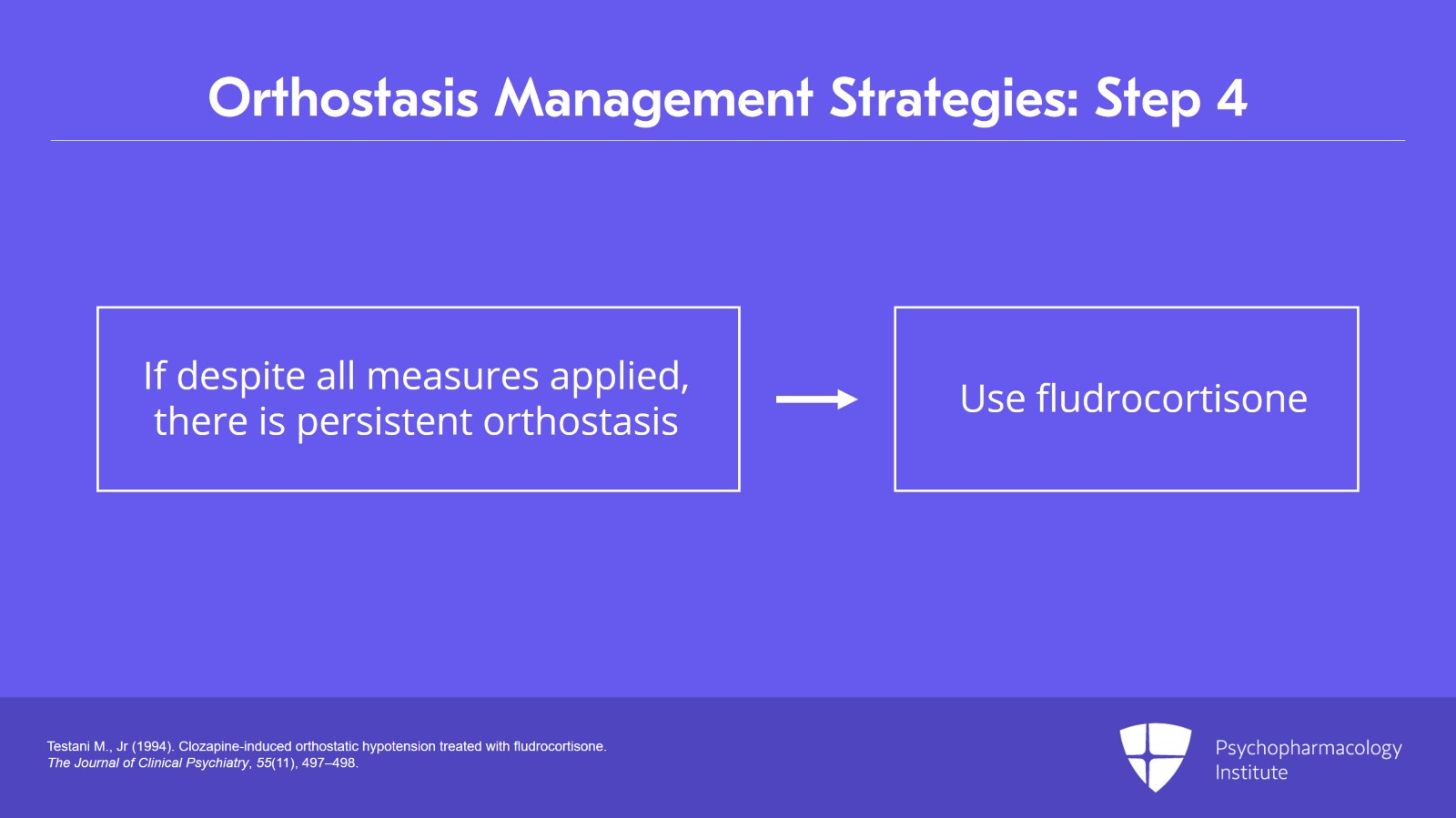
Sometimes, despite all of the measures you try, you run into a problem with persistent orthostasis. What can you do? There is a specific medicine called fludrocortisone which is a volume expander.
References:
  • Testani M., Jr (1994). Clozapine-induced orthostatic hypotension treated with fludrocortisone. The Journal of Clinical Psychiatry, 55(11), 497–498.
Free Files
Success!
Check your inbox, we sent you all the materials there.
Slide 11 of 16

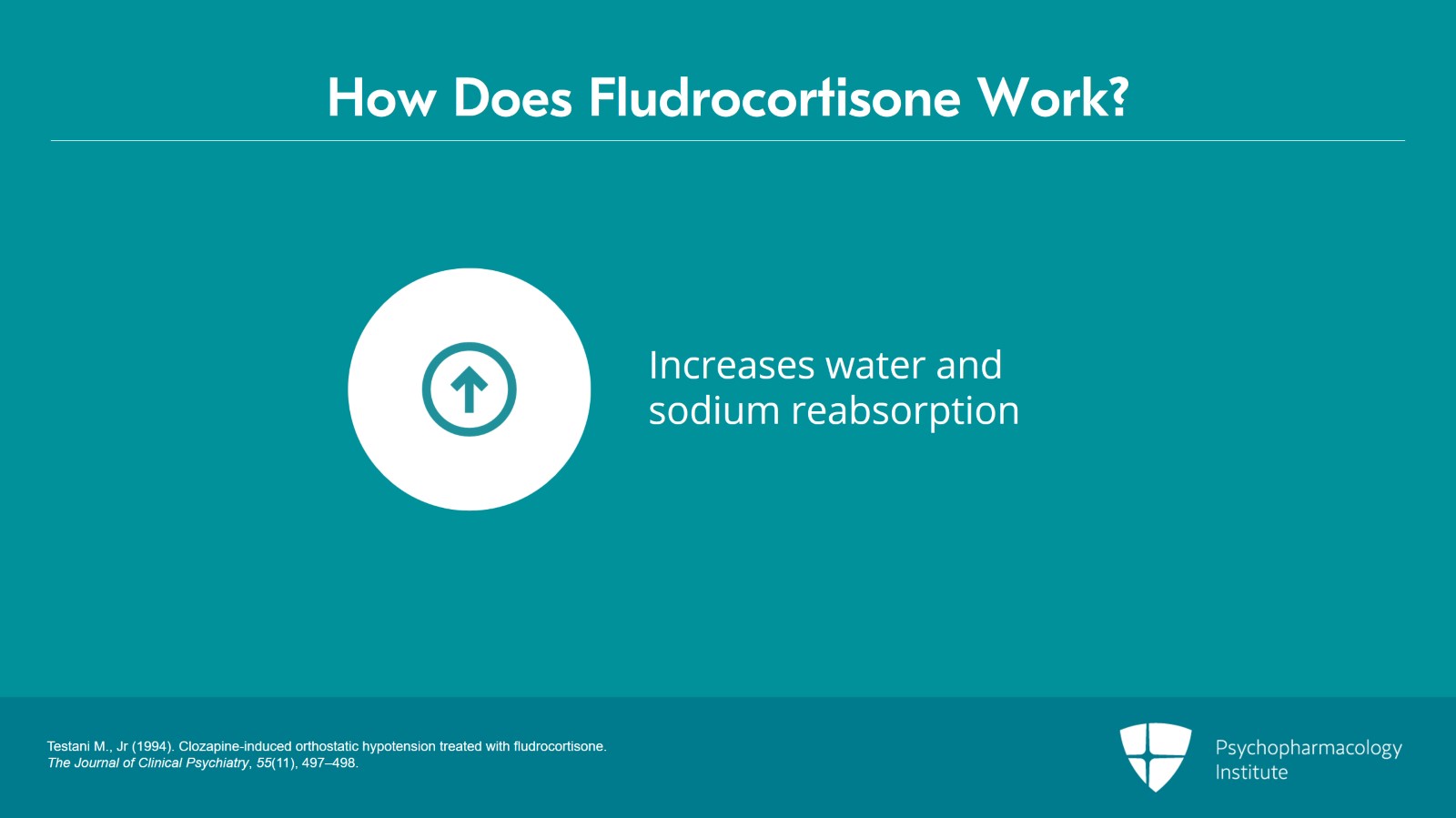
How does fludrocortisone work? It is a potent mineralocorticoid that increases water and sodium reabsorption.
References:
  • Testani M., Jr (1994). Clozapine-induced orthostatic hypotension treated with fludrocortisone. The Journal of Clinical Psychiatry, 55(11), 497–498.

Slide 12 of 16

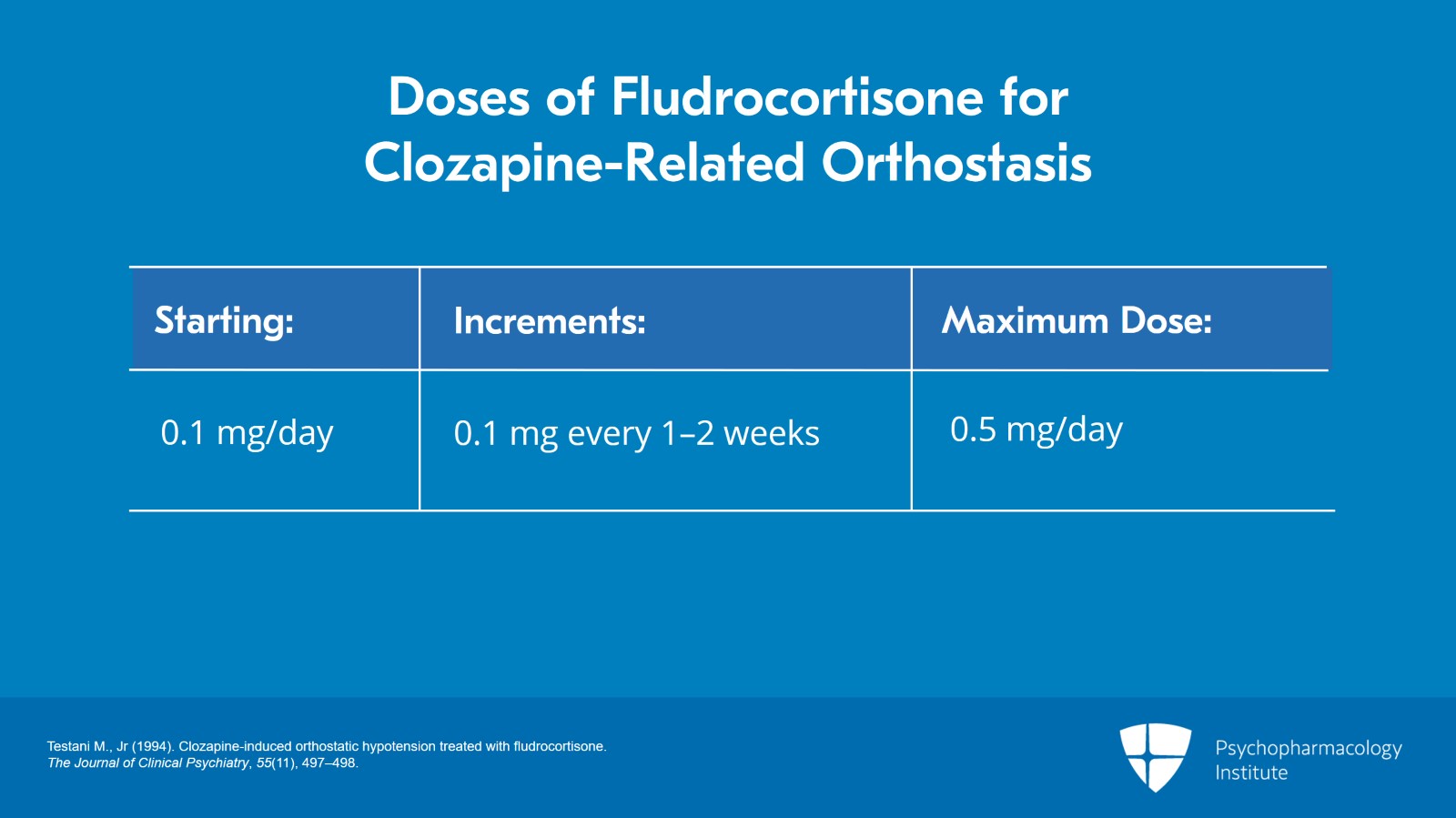
The starting dose is 0.1 mg orally daily. We would say you can increase it every one to two weeks in 0.1 mg increments to the maximal adult daily dose of 0.5 mg. Give each 0.1 mg dose increment some time to work before you go up. It does take a bit of time to volume expand you but often this will allow you to treat the orthostasis and thereby permit further titration of the clozapine.
References:
  • Testani M., Jr (1994). Clozapine-induced orthostatic hypotension treated with fludrocortisone. The Journal of Clinical Psychiatry, 55(11), 497–498.
Free Files
Success!
Check your inbox, we sent you all the materials there.
Slide 13 of 16

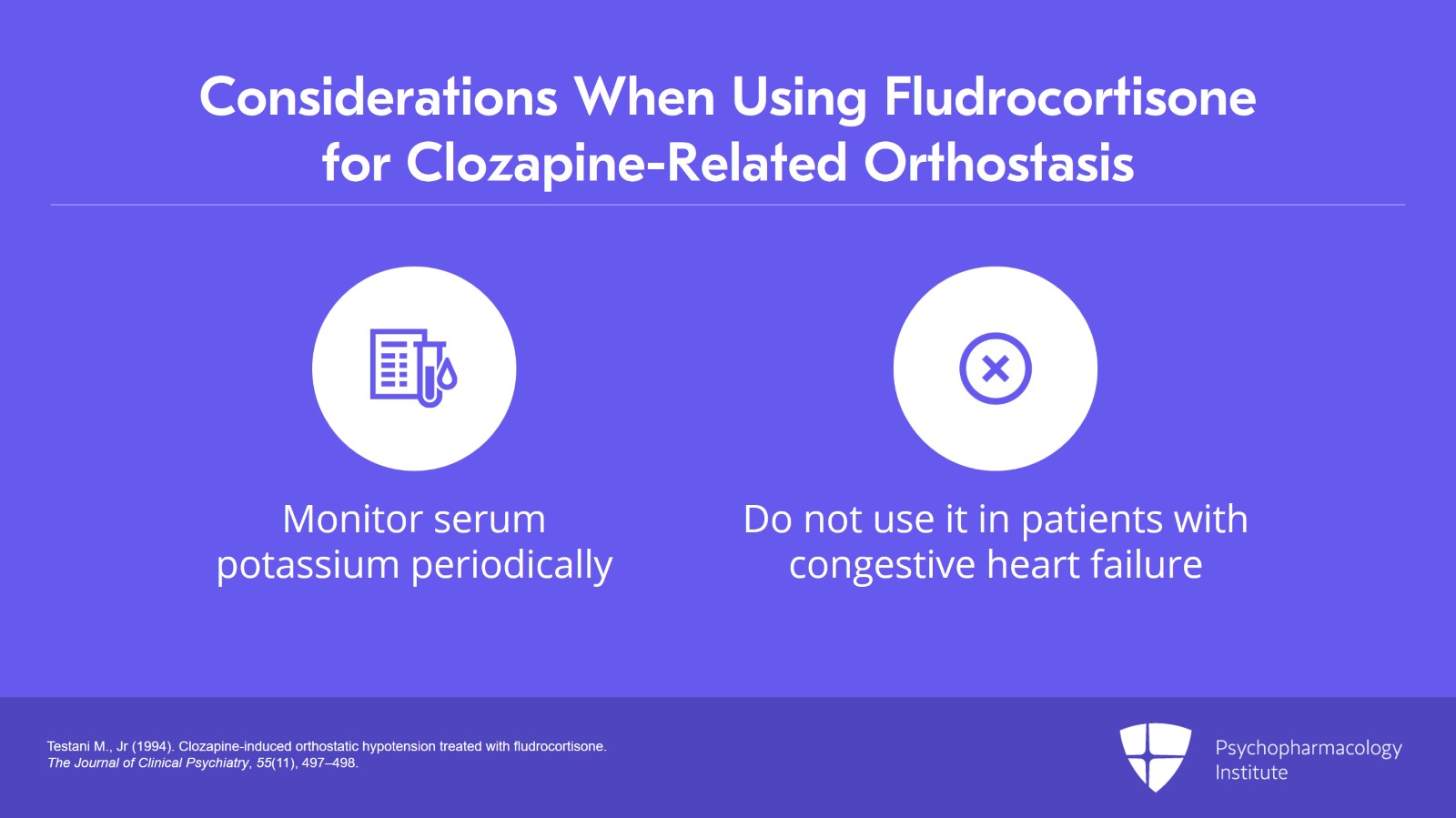
Because of its impact on electrolytes, you should monitor serum potassium periodically to look for hyperkalemia. Most importantly, because you’re volume expanding you cannot use fludrocortisone in patients with congestive heart failure.
References:
  • Testani M., Jr (1994). Clozapine-induced orthostatic hypotension treated with fludrocortisone. The Journal of Clinical Psychiatry, 55(11), 497–498.

Slide 14 of 16

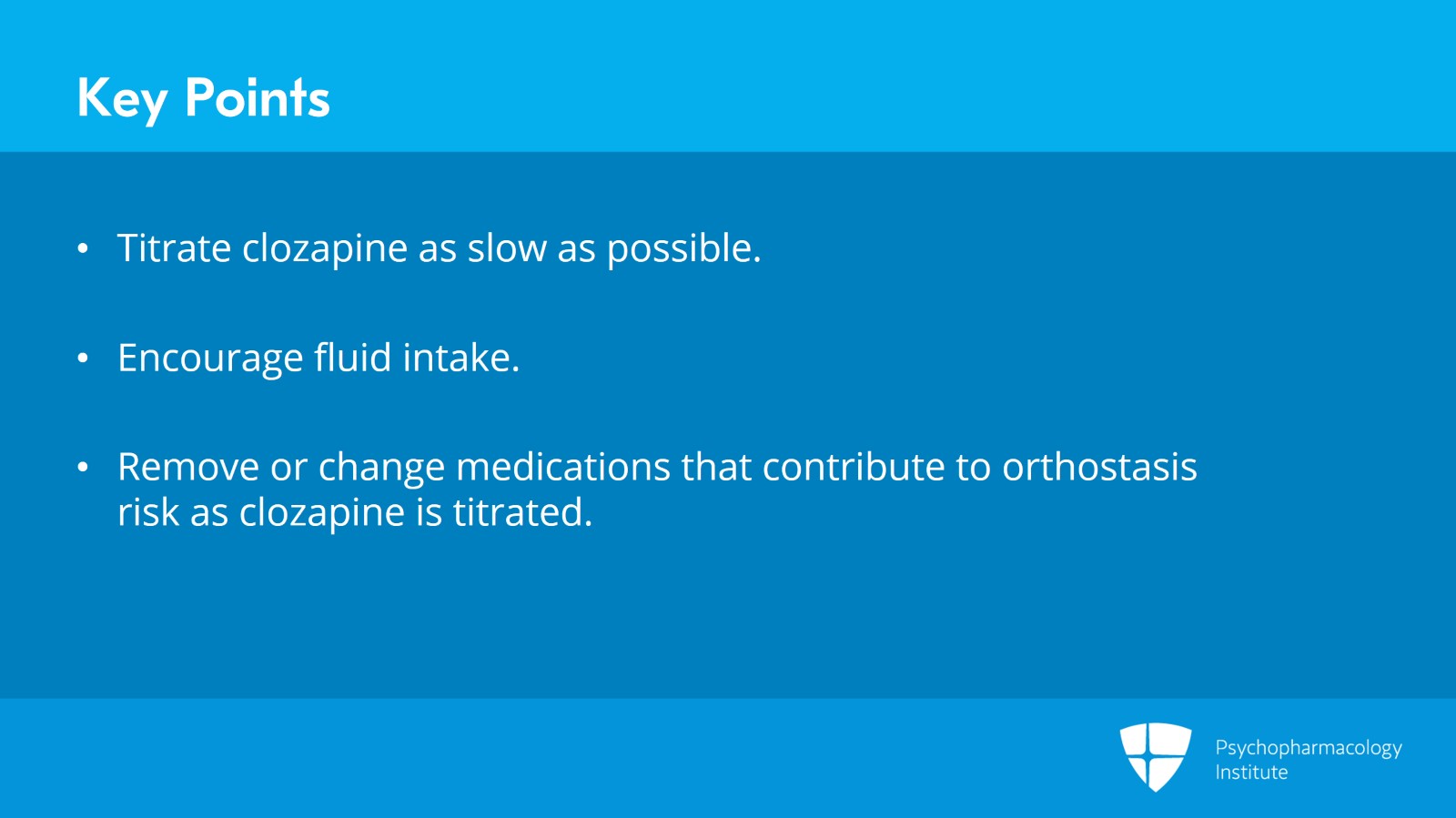
The key points again. Number one, use the slowest titration that seems reasonable. Number two, encourage fluid intake.   Slowly remove or change other medications that contribute to orthostasis risk as clozapine is titrated.
Free Files
Success!
Check your inbox, we sent you all the materials there.
Slide 15 of 16

If all the above measures are not effective, use fludrocortisone for volume expansion.

Slide 16 of 16

Free Files
Success!
Check your inbox, we sent you all the materials there.
Learning Objectives:

After completing this activity, the learner will be able to:

  1. Identify and assess the nonhematologic adverse effects of clozapine.
  2. Discuss the long-term risks associated with clozapine’s adverse effects.
  3. Utilize different strategies for managing the nonhematologic adverse effects of clozapine.

Original Release Date: November 1, 2022

Review and Re-release Date: November 1, 2025

Expiration Date: November 1, 2028

Expert: Jonathan Meyer, M.D.

Medical Editor: Horia Batranu, M.D.

Relevant Financial Disclosures: 

Jonathan Meyer declares the following interests:

– Acadia Pharmaceuticals:  Advisor, speaker

– Alkermes:  Advisor, speaker

– Intra-Cellular Therapies:  Ad

– Karuna:  Advisor

– Neurocrine:  Advisor

– Otsuka America, Inc.:  Advisor

– Sunovion Pharmaceuticals:  Advisor, speaker

All of the relevant financial relationships listed above have been mitigated by Medical Academy and the Psychopharmacology Institute.

Contact Information: For questions regarding the content or access to this activity, contact us at support@psychopharmacologyinstitute.com

Instructions for Participation and Credit:

Participants must complete the activity online during the valid credit period that is noted above.

Follow these steps to earn CME credit:

  1. View the required educational content provided on this course page.
  2. Complete the Post Activity Evaluation for providing the necessary feedback for continuing accreditation purposes and for the development of future activities. NOTE: Completing the Post Activity Evaluation after the quiz is required to receive the earned credit.
  3. Download your certificate.

Accreditation Statement

This activity has been planned and implemented in accordance with the accreditation requirements and policies of the Accreditation Council for Continuing Medical Education through the joint providership of Medical Academy LLC and the Psychopharmacology Institute. Medical Academy is accredited by the ACCME to provide continuing medical education for physicians.

Credit Designation Statement

Medical Academy designates this enduring activity for a maximum of 1.25 AMA PRA Category 1 credit(s)™. Physicians should claim only the credit commensurate with the extent of their participation in the activity.

Free Files
Success!
Check your inbox, we sent you all the materials there.
Continue in the website
Instant access modal

Become a Bronze, Silver, Gold, Bronze extended, Silver extended or Gold extended Member.

2025–26 Psychopharmacology CME Program

Unlock up to 155 CME Credits, including 40 SA CME Credits.