Slides and Transcript
Slide 1 of 17
Welcome to Lamotrigine in Bipolar Depression.
Slide 2 of 17
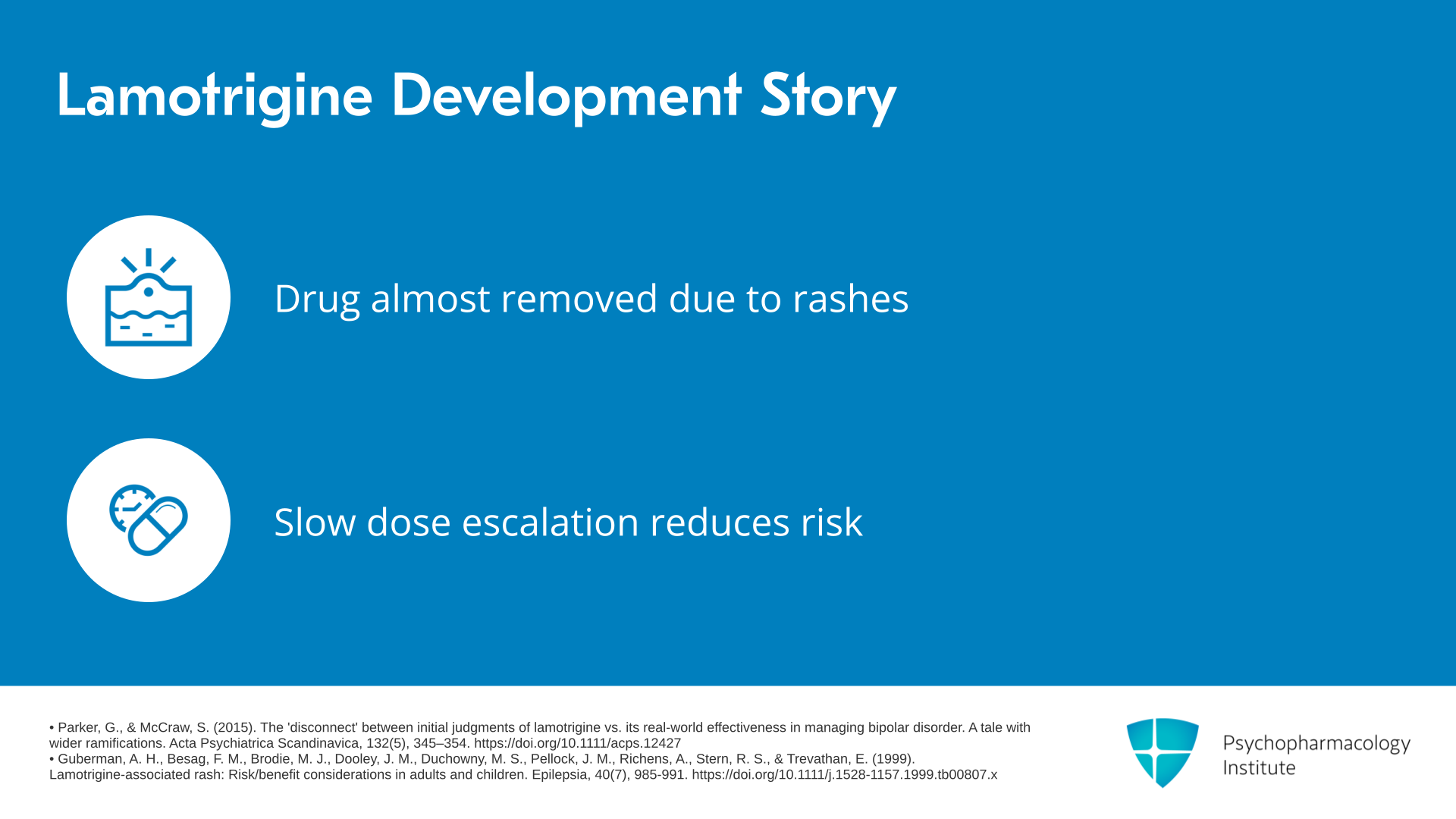
When this medication first came out in the 1990s for seizures it was almost taken off the market, because 1 in 10 patients got severe rashes on it. The drug company figured out that they could minimize that risk of rash by raising the dose very slowly. So they developed slow titration guidelines, and that’s the first thing you need to know about lamotrigine is never deviate from those guidelines because that rash, Stevens-Johnson syndrome, can be deadly and it can be very common if you dose it any faster.
References:
- Parker, G., & McCraw, S. (2015). The 'disconnect' between initial judgments of lamotrigine vs. its real-world effectiveness in managing bipolar disorder. A tale with wider ramifications. Acta Psychiatrica Scandinavica, 132(5), 345–354. https://doi.org/10.1111/acps.12427
- Guberman, A. H., Besag, F. M., Brodie, M. J., Dooley, J. M., Duchowny, M. S., Pellock, J. M., Richens, A., Stern, R. S., & Trevathan, E. (1999). Lamotrigine-associated rash: Risk/benefit considerations in adults and children. Epilepsia, 40(7), 985-991. https://doi.org/10.1111/j.1528-1157.1999.tb00807.x
Free Files
Download PDF and other files
Success!
Check your inbox, we sent you all the materials there.
Slide 3 of 17
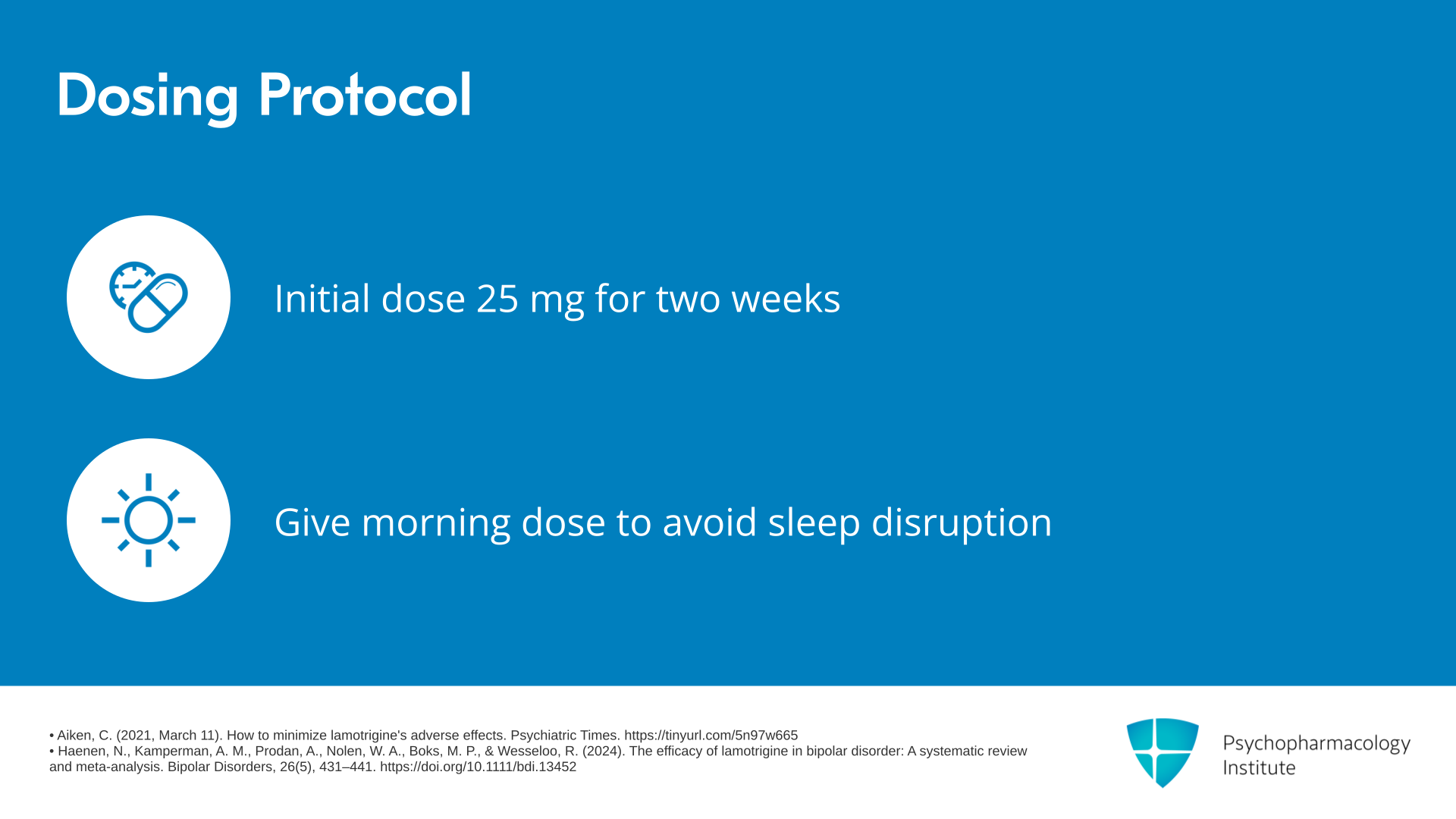
So the general guide is to go by 25 mg a day for two weeks then 50 mg a day for two weeks and then up to 100 mg a day and to titrate every week or so from there. The dose range is 50 to 200 mg for depression. I tend to give it all in the morning because it can disrupt sleep a little bit.
References:
- Aiken, C. (2021, March 11). How to minimize lamotrigine's adverse effects. Psychiatric Times. https://tinyurl.com/5n97w665
- Haenen, N., Kamperman, A. M., Prodan, A., Nolen, W. A., Boks, M. P., & Wesseloo, R. (2024). The efficacy of lamotrigine in bipolar disorder: A systematic review and meta-analysis. Bipolar Disorders, 26(5), 431–441. https://doi.org/10.1111/bdi.13452
Slide 4 of 17
And you have to stop lamotrigine if the patient develops any kind of rash in the first two months while they’re starting it. And rashes are quite common on it. About 1 in 10 people get benign rashes even with this slow titration. So we end up having to stop it a lot unfortunately.
References:
- Aiken, C. (2021, March 11). How to minimize lamotrigine's adverse effects. Psychiatric Times. https://tinyurl.com/5n97w665
- Parker, G., & McCraw, S. (2015). The 'disconnect' between initial judgments of lamotrigine vs. its real-world effectiveness in managing bipolar disorder. A tale with wider ramifications. Acta Psychiatrica Scandinavica, 132(5), 345–354. https://doi.org/10.1111/acps.12427
Free Files
Download PDF and other files
Success!
Check your inbox, we sent you all the materials there.
Slide 5 of 17
And there are times when patients only respond to lamotrigine and they’ll tell you, I don’t want to stop it because it’s the only thing that’s helped my depression. We can retitrate it then. There are about six studies that have tried this involving over 100 patients and they used a very slow retitration starting at 5 mg a day and raising it every two weeks by a 5-mg increment. So it takes about three months to get up to a therapeutic dose. But it is something rarely to use but appropriate for some patients if they didn’t have a severe rash on it.
References:
- Aiken, C. (2021, March 11). How to minimize lamotrigine's adverse effects. Psychiatric Times. https://tinyurl.com/5n97w665
- Aiken, C. B., & Orr, C. (2010). Rechallenge with lamotrigine after a rash: a prospective case series and review of the literature. Psychiatry, 7(5), 27-32.
Slide 6 of 17
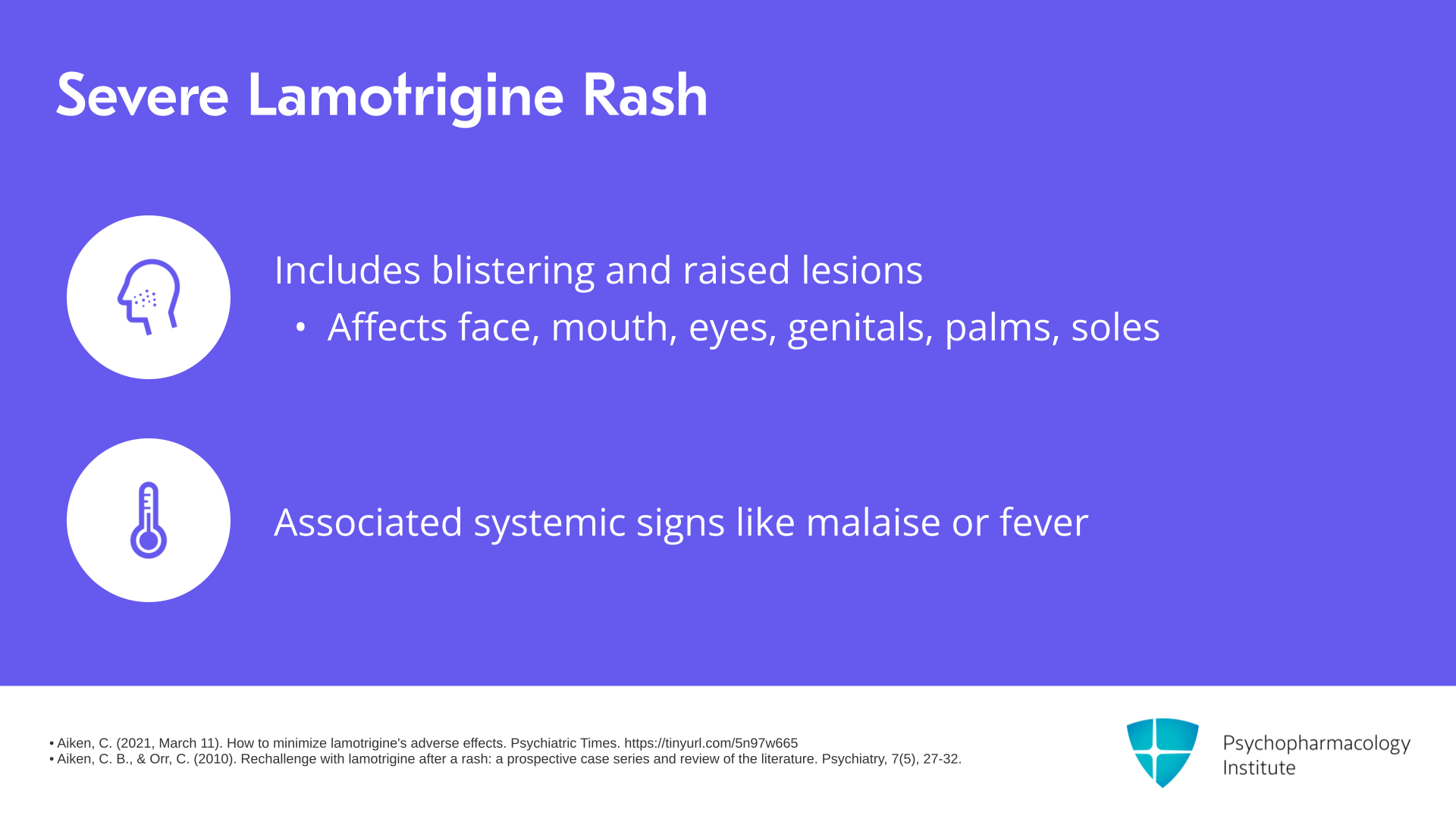
And how does a severe rash on lamotrigine look? It involves blistering of the skin. It’s raised, so it’s not flat. It involves the face or the oral mucosal membranes. That’s the mouth, the eyes, the genitals. It involves the palms of the hands or the soles of the feet. And it involves the lips and mouth. A typical drug rash happens on the chest and is flat and lacelike. A severe lamotrigine rash is one that is raised, bumpy, blistering and on different parts of the body and associated with systemic signs like malaise or fever or lymphadenopathy.
References:
- Aiken, C. (2021, March 11). How to minimize lamotrigine's adverse effects. Psychiatric Times. https://tinyurl.com/5n97w665
- Aiken, C. B., & Orr, C. (2010). Rechallenge with lamotrigine after a rash: a prospective case series and review of the literature. Psychiatry, 7(5), 27-32.
Free Files
Download PDF and other files
Success!
Check your inbox, we sent you all the materials there.
Slide 7 of 17
And you should probably get them to medical help if they have a severe rash. And that medical help is usually going to involve a prednisone taper to quickly turn down the inflammation. These rashes are allergic, inflammatory responses. And if you do retitrate lamotrigine, you need to wait at least a month for the rash to cool down before trying it again.
References:
- Aiken, C. (2021, March 11). How to minimize lamotrigine's adverse effects. Psychiatric Times. https://tinyurl.com/5n97w665
- Aiken, C. B., & Orr, C. (2010). Rechallenge with lamotrigine after a rash: a prospective case series and review of the literature. Psychiatry, 7(5), 27-32.
Slide 8 of 17
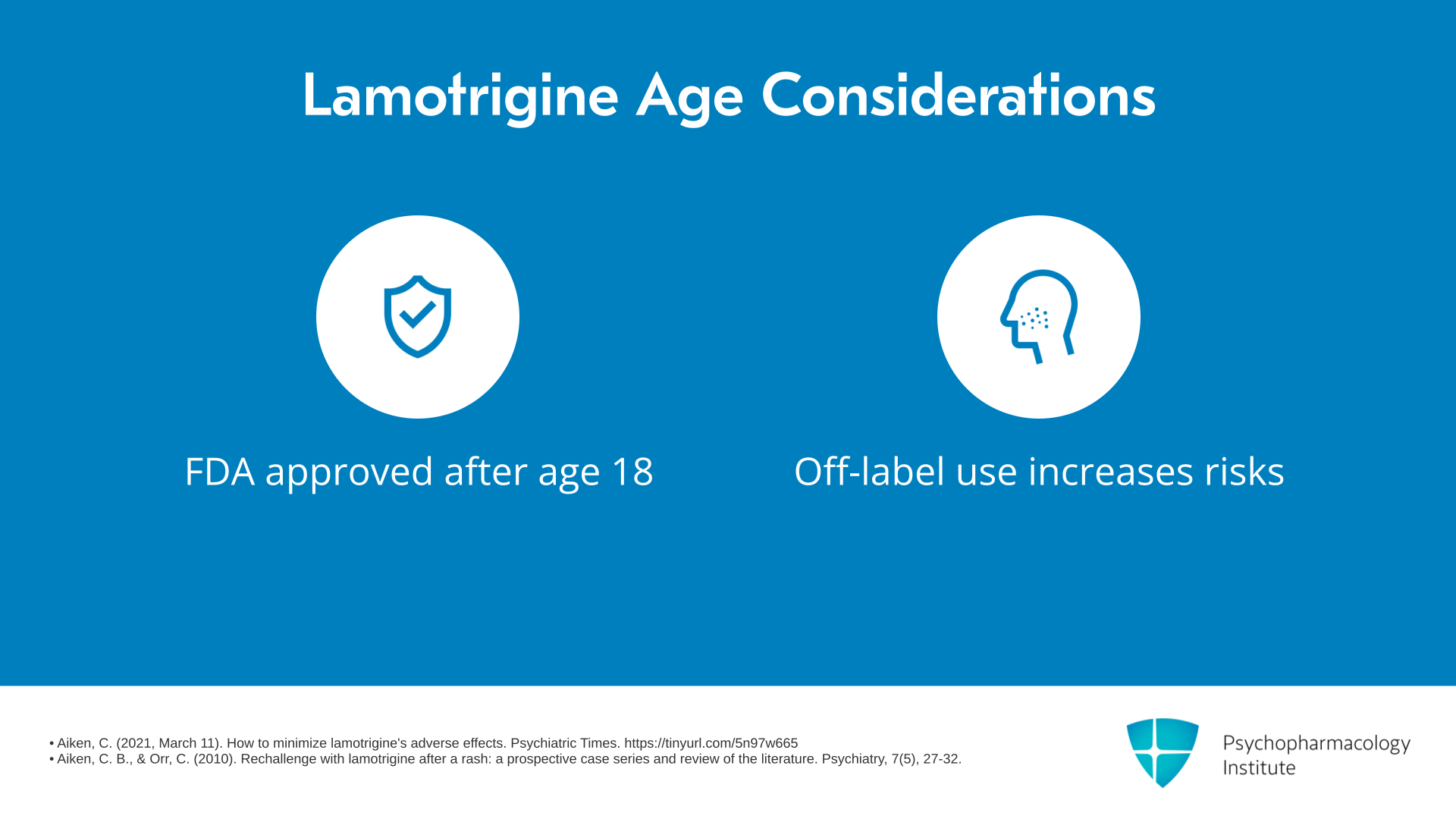
And I’ll mention that lamotrigine is only approved after age 18. So if you’re using it in teenage or children, it’s off-label and you have to be careful with the dosing there ’cause rashes are even more common in children. So if you do that off-label, make sure to look in the PDR to get the titration right. It varies by weight and varies by age when you go below age 18.
References:
- Aiken, C. (2021, March 11). How to minimize lamotrigine's adverse effects. Psychiatric Times. https://tinyurl.com/5n97w665
- Aiken, C. B., & Orr, C. (2010). Rechallenge with lamotrigine after a rash: a prospective case series and review of the literature. Psychiatry, 7(5), 27-32.
Free Files
Download PDF and other files
Success!
Check your inbox, we sent you all the materials there.
Slide 9 of 17
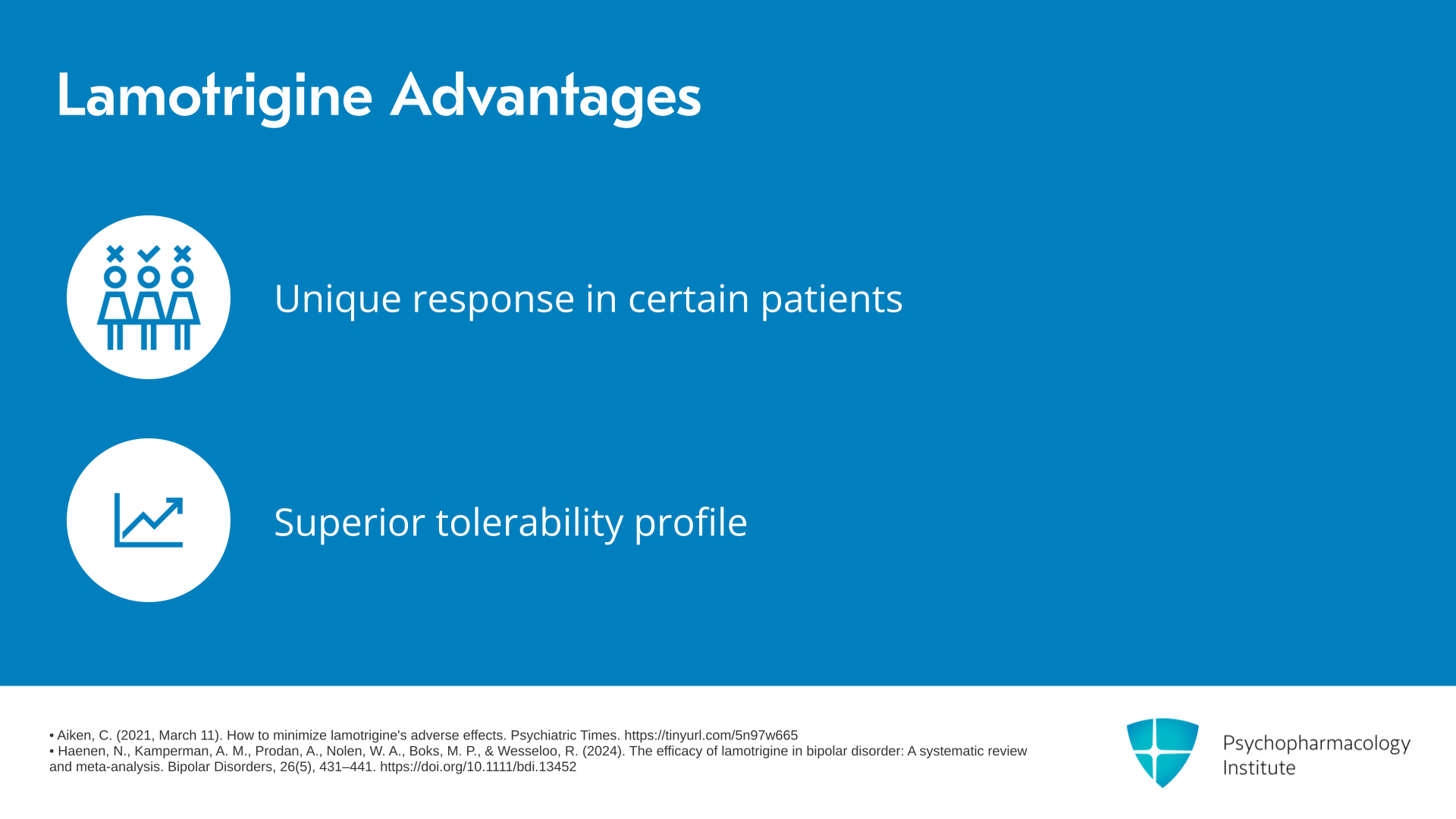
And why use lamotrigine with such a big worry about death and rashes with it? Well, the reason is some patients respond uniquely to it and unique among all bipolar therapies, it is very well tolerated which is not something we can say for most mood stabilizers.
References:
- Aiken, C. (2021, March 11). How to minimize lamotrigine's adverse effects. Psychiatric Times. https://tinyurl.com/5n97w665
- Haenen, N., Kamperman, A. M., Prodan, A., Nolen, W. A., Boks, M. P., & Wesseloo, R. (2024). The efficacy of lamotrigine in bipolar disorder: A systematic review and meta-analysis. Bipolar Disorders, 26(5), 431–441. https://doi.org/10.1111/bdi.13452
Slide 10 of 17
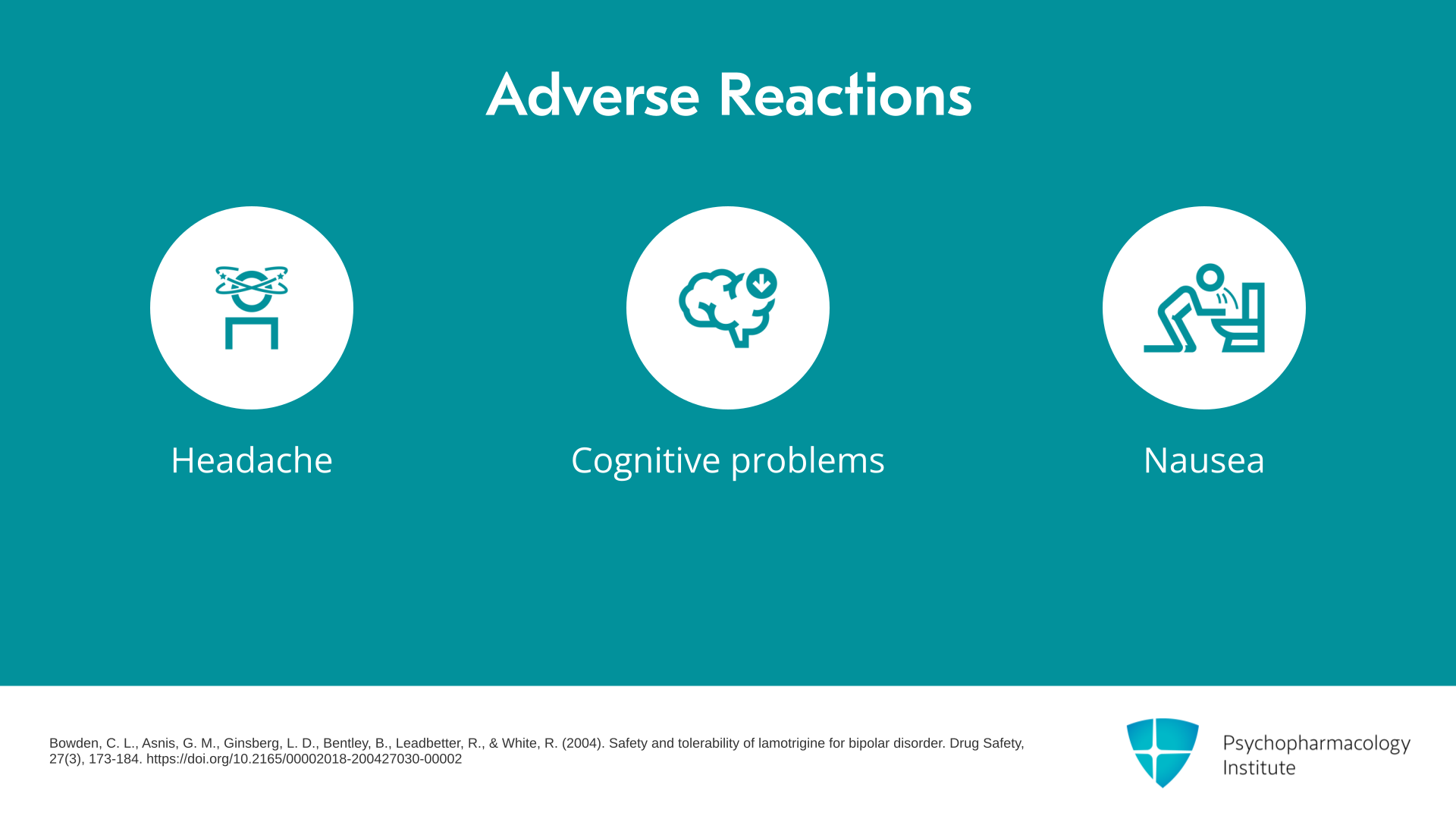
Outside of the rash problem, you might see headache. At higher doses, there can be some cognitive problems like trouble with word finding ability. You might see vivid dreams, some nausea but side effects are pretty rare and pretty mild on it. I’ve given you on this slide some ways to address them like using extended release or ODT versions.
References:
- Bowden, C. L., Asnis, G. M., Ginsberg, L. D., Bentley, B., Leadbetter, R., & White, R. (2004). Safety and tolerability of lamotrigine for bipolar disorder. Drug Safety, 27(3), 173-184. https://doi.org/10.2165/00002018-200427030-00002
Free Files
Download PDF and other files
Success!
Check your inbox, we sent you all the materials there.
Slide 11 of 17
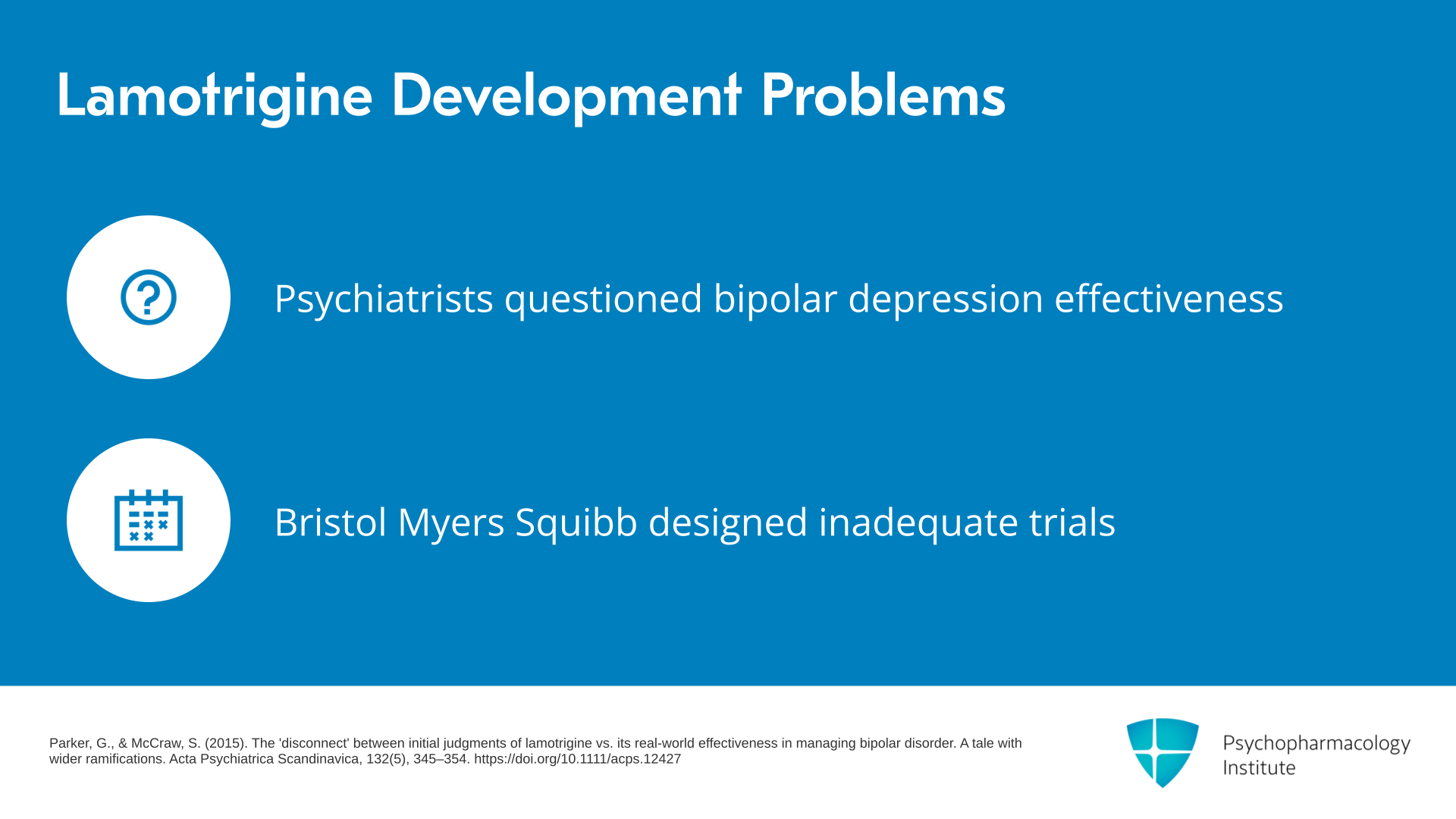
There’s something you need to know about its efficacy. For many years, psychiatrists doubted if lamotrigine even treats bipolar depression and that gets into the great misunderstanding that happened in its drug development. When the Bristol Myers Squibb Company set out to prove that lamotrigine works in bipolar depression, they did some five-week trials. And when it takes four weeks to titrate the drug, you’re not going to get much efficacy at five weeks. So these trials were a notorious flop and the drug did not get approved for acute bipolar depression.
References:
- Parker, G., & McCraw, S. (2015). The 'disconnect' between initial judgments of lamotrigine vs. its real-world effectiveness in managing bipolar disorder. A tale with wider ramifications. Acta Psychiatrica Scandinavica, 132(5), 345–354. https://doi.org/10.1111/acps.12427
Slide 12 of 17
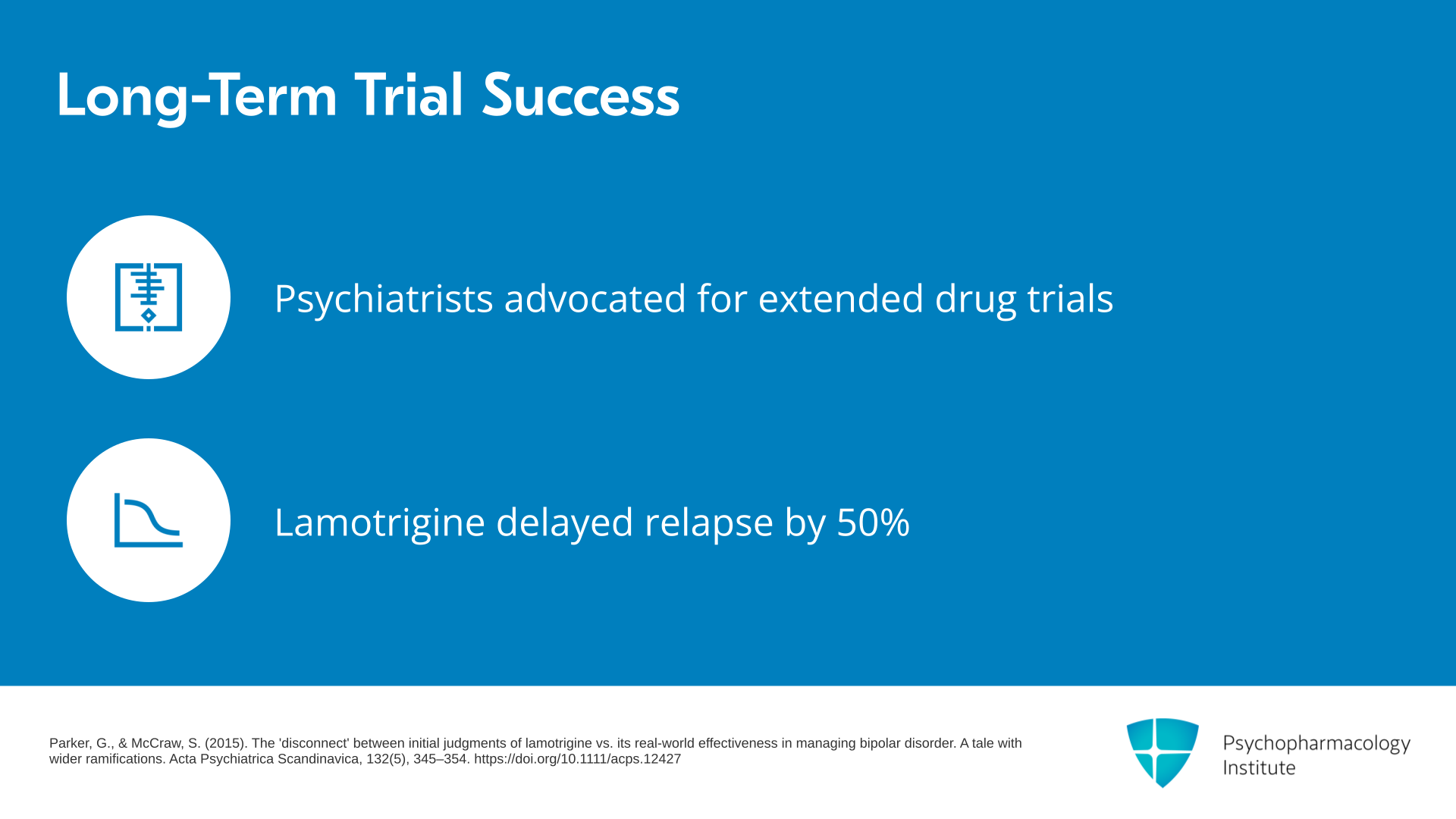
Some psychiatrists, including Richard Weisler, convinced the drug company that there was something in this drug that was worthwhile, and they should do the trials longer. He convinced the company to do a one- to two-year trial to prove that it works long term. And the gamble turned out to pay off, because over those two years lamotrigine delayed the time to relapse, having a new episode by 50%.
References:
- Parker, G., & McCraw, S. (2015). The 'disconnect' between initial judgments of lamotrigine vs. its real-world effectiveness in managing bipolar disorder. A tale with wider ramifications. Acta Psychiatrica Scandinavica, 132(5), 345–354. https://doi.org/10.1111/acps.12427
Free Files
Download PDF and other files
Success!
Check your inbox, we sent you all the materials there.
Slide 13 of 17
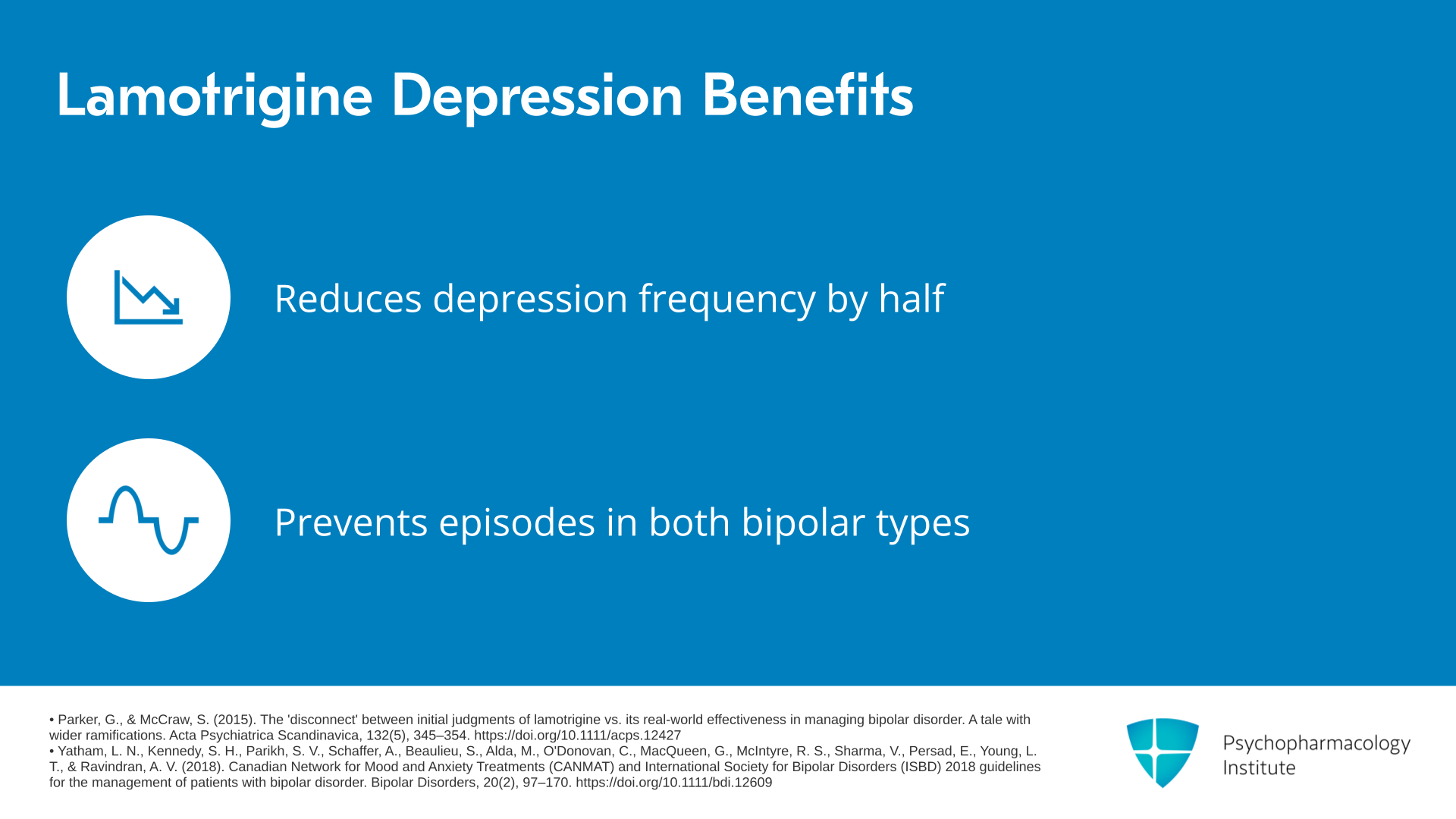
So you can tell patients they may still have depression if they take lamotrigine but they’ll have it a lot less, often about half as common as if they’re not on lamotrigine. And that’s important in assessing its benefits, because you don’t want to stop lamotrigine just ’cause they developed a new depression. It’s mainly there to reduce the frequency. So it got approved to prevent new episodes in bipolar disorder where it works in both bipolar I and bipolar II.
References:
- Parker, G., & McCraw, S. (2015). The 'disconnect' between initial judgments of lamotrigine vs. its real-world effectiveness in managing bipolar disorder. A tale with wider ramifications. Acta Psychiatrica Scandinavica, 132(5), 345–354. https://doi.org/10.1111/acps.12427
- Yatham, L. N., Kennedy, S. H., Parikh, S. V., Schaffer, A., Beaulieu, S., Alda, M., O'Donovan, C., MacQueen, G., McIntyre, R. S., Sharma, V., Persad, E., Young, L. T., & Ravindran, A. V. (2018). Canadian Network for Mood and Anxiety Treatments (CANMAT) and International Society for Bipolar Disorders (ISBD) 2018 guidelines for the management of patients with bipolar disorder. Bipolar Disorders, 20(2), 97–170. https://doi.org/10.1111/bdi.12609
Slide 14 of 17
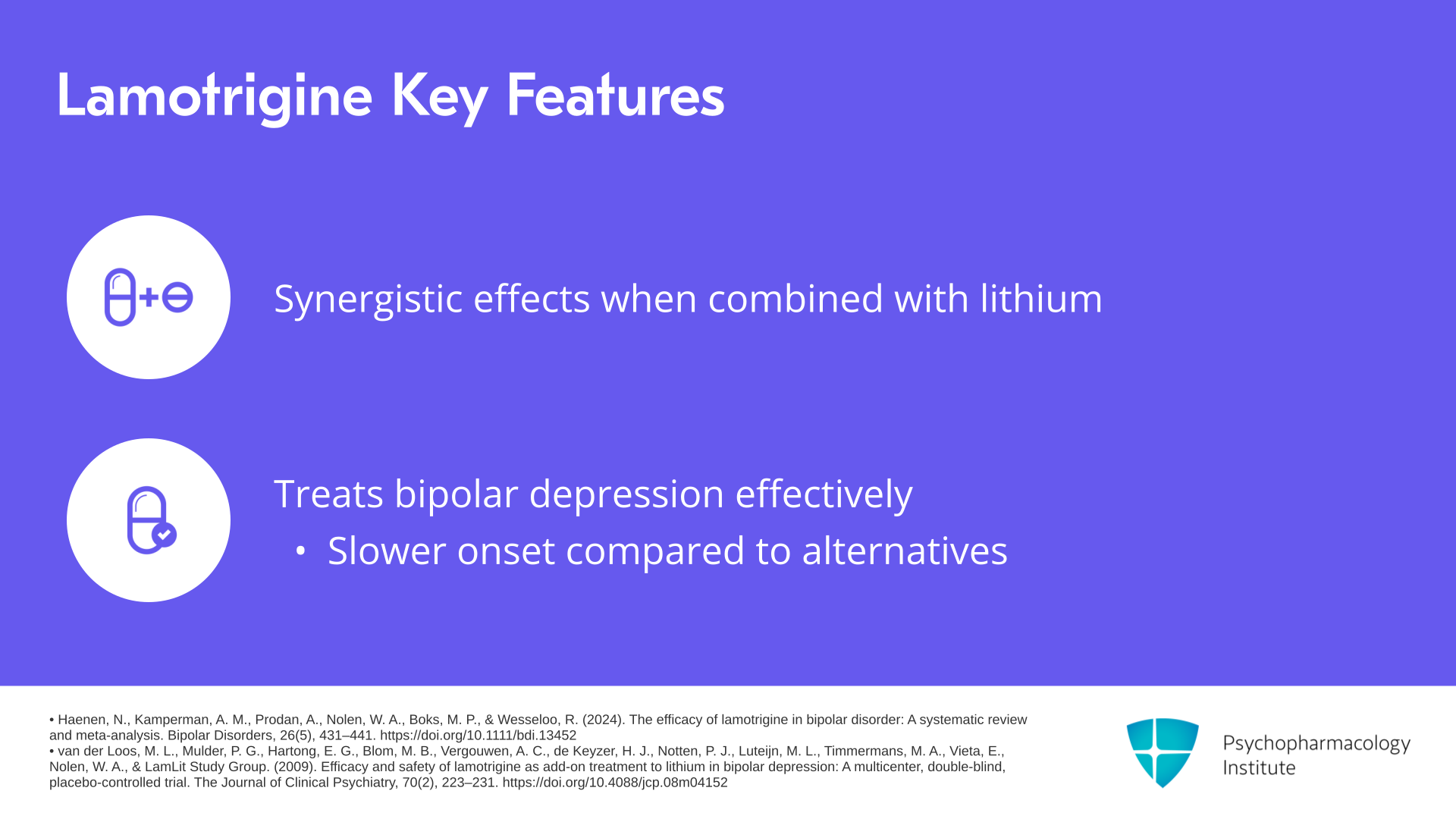
Next, we learned that lamotrigine had synergistic benefits with lithium, that if we used the two together patients got even better responses than either alone. And finally, we learned just in the last 10 years that lamotrigine does indeed treat bipolar depression as some independently funded that’s outside of the drug company’s money, trials went out that tested it for longer periods of times like three months. And we know from those trials that it does treat bipolar depression but it’s slower to act and that’s it’s main drawback. So it’s going to take 6 to 12 weeks to work. Whereas, many of the therapies we’ve talked about in the series like lithium and the antipsychotics, they’re going to take two to four weeks to work.
References:
- Haenen, N., Kamperman, A. M., Prodan, A., Nolen, W. A., Boks, M. P., & Wesseloo, R. (2024). The efficacy of lamotrigine in bipolar disorder: A systematic review and meta-analysis. Bipolar Disorders, 26(5), 431–441. https://doi.org/10.1111/bdi.13452
- van der Loos, M. L., Mulder, P. G., Hartong, E. G., Blom, M. B., Vergouwen, A. C., de Keyzer, H. J., Notten, P. J., Luteijn, M. L., Timmermans, M. A., Vieta, E., Nolen, W. A., & LamLit Study Group. (2009). Efficacy and safety of lamotrigine as add-on treatment to lithium in bipolar depression: A multicenter, double-blind, placebo-controlled trial. The Journal of Clinical Psychiatry, 70(2), 223–231. https://doi.org/10.4088/jcp.08m04152
Free Files
Download PDF and other files
Success!
Check your inbox, we sent you all the materials there.
Slide 15 of 17
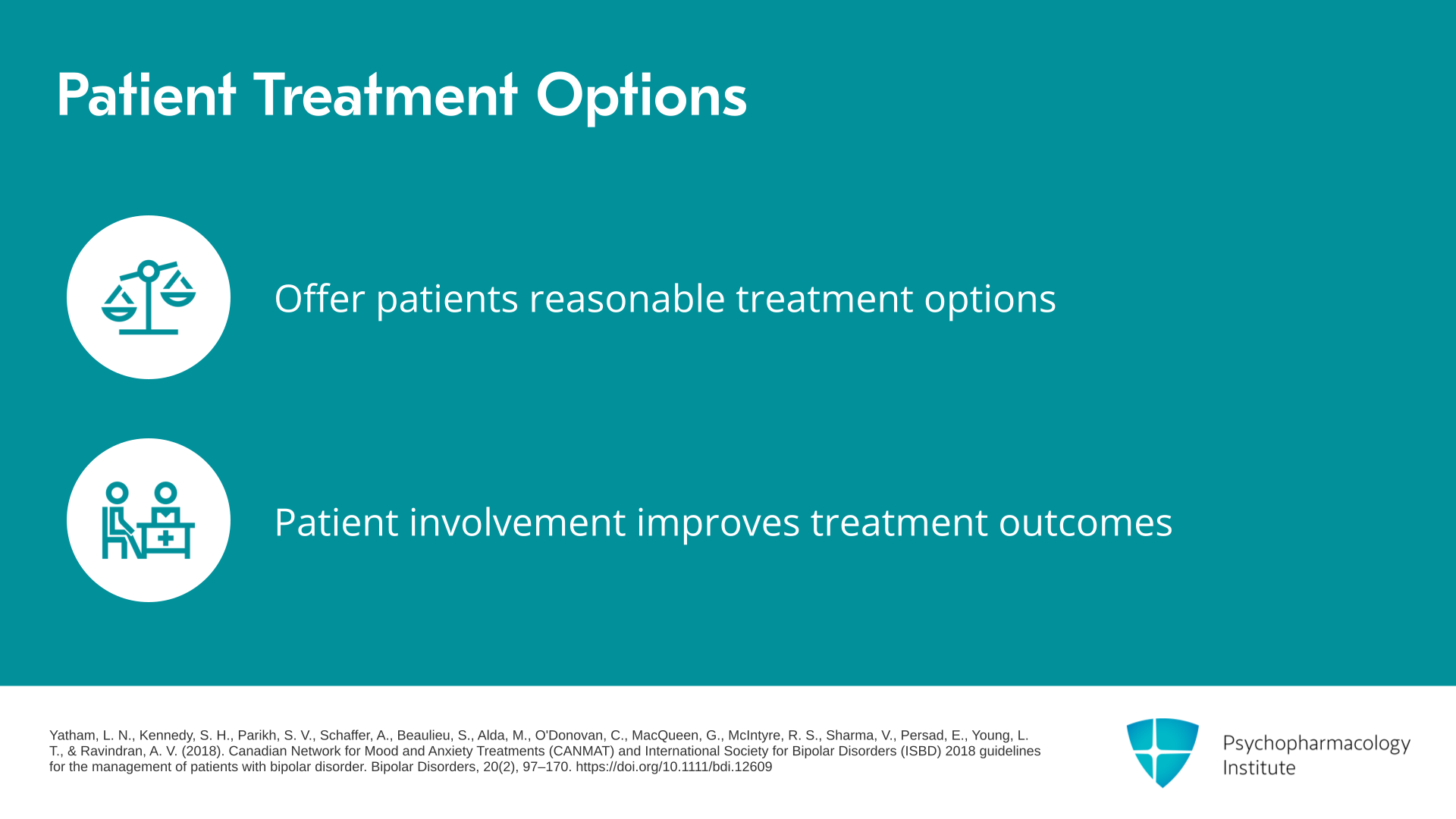
So how would you use all these in practice? By offering patients a reasonable menu of options. You might tell them, I have two treatments that can treat bipolar depression. One of them is slower to work but it’s pretty free of side effects. The other one is going to work quicker within maybe a week or two. This might be an antipsychotic, for example, like lumateperone or lurasidone but it’s going to come with more side effects. So involve your patients in the decision ’cause when they make the choice, they tend to respond better.
References:
- Yatham, L. N., Kennedy, S. H., Parikh, S. V., Schaffer, A., Beaulieu, S., Alda, M., O'Donovan, C., MacQueen, G., McIntyre, R. S., Sharma, V., Persad, E., Young, L. T., & Ravindran, A. V. (2018). Canadian Network for Mood and Anxiety Treatments (CANMAT) and International Society for Bipolar Disorders (ISBD) 2018 guidelines for the management of patients with bipolar disorder. Bipolar Disorders, 20(2), 97–170. https://doi.org/10.1111/bdi.12609
Slide 16 of 17
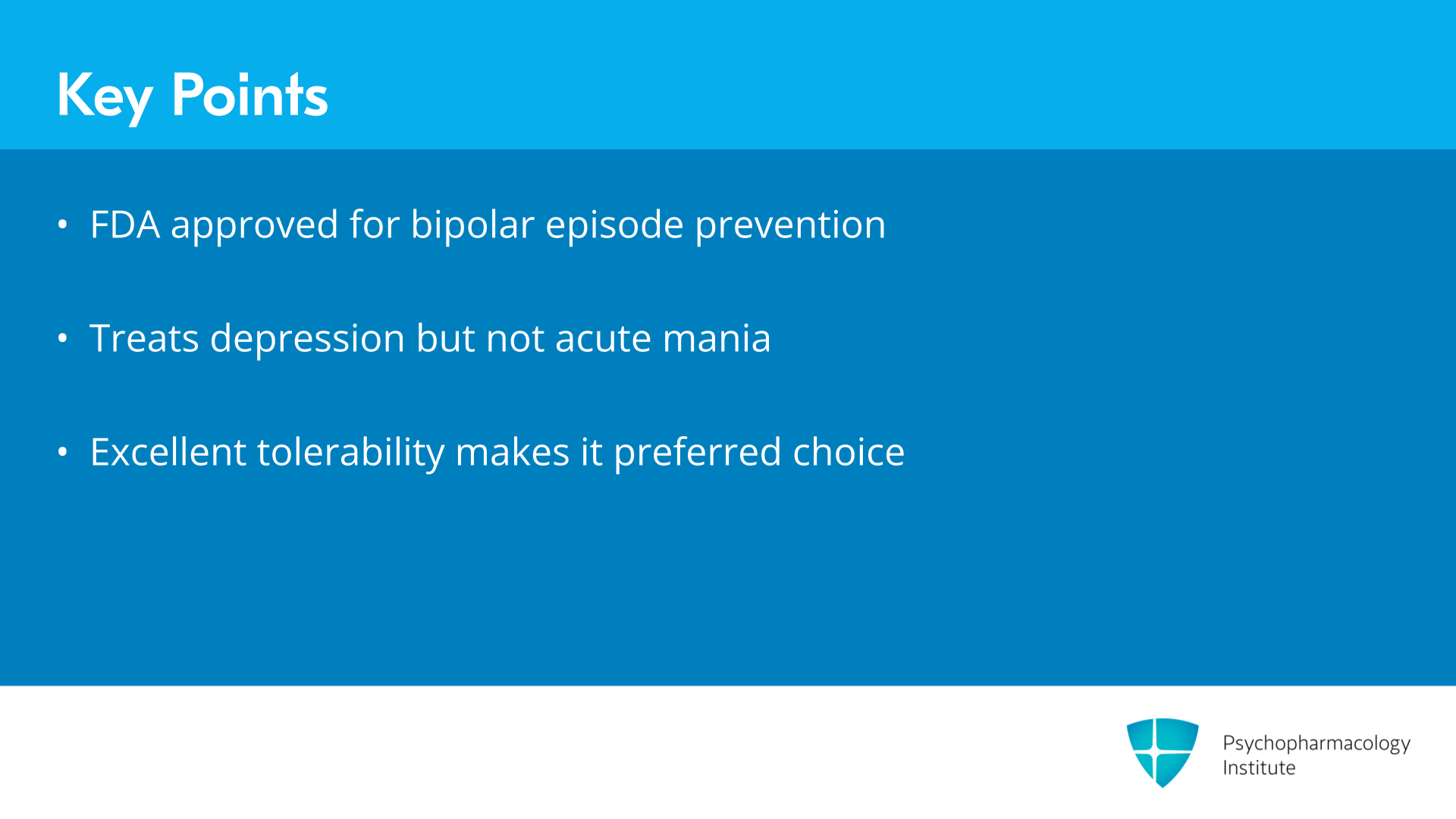
Let’s wrap all that up with the key points on lamotrigine. Lamotrigine is FDA approved in adults for prevention of new episodes in bipolar disorder. And it also treats acute bipolar depression but it does not treat acute mania. Lamotrigine’s main benefit is its tolerability and it is a good choice for patients with bipolar II disorder and cyclothymic temperament.
Free Files
Download PDF and other files
Success!
Check your inbox, we sent you all the materials there.
Slide 17 of 17
Lamotrigine’s main drawbacks are slow onset and a risk of serious rash called Stevens-Johnson syndrome. That risk is about 1 in 3000, but you still need to stop the drug if patients get any kind of skin change or rash in the first two months of starting it.