Slides and Transcript
Slide 1 of 9
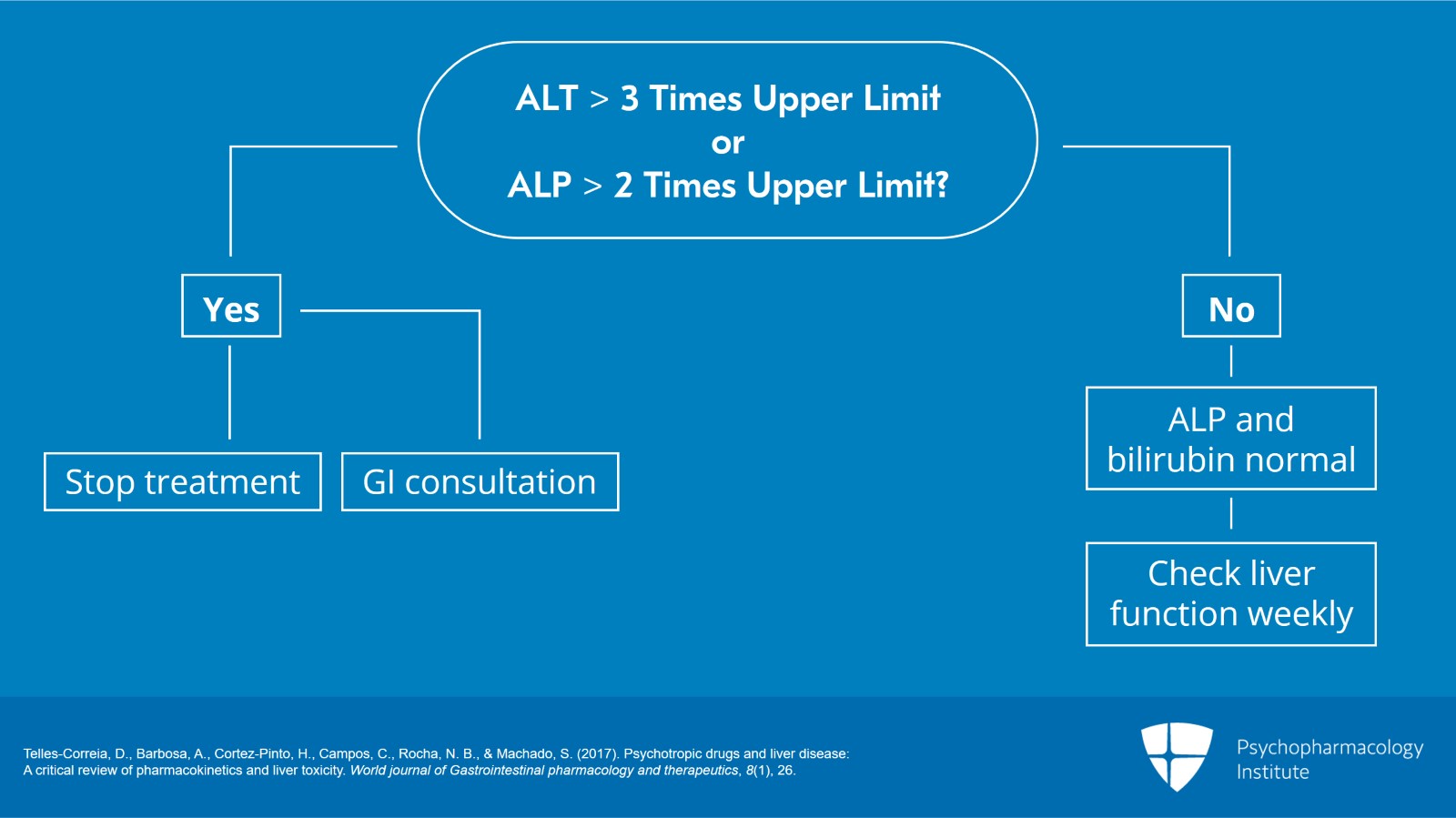
Okay. We’re going to talk briefly now about interpretation of liver function tests. When other causes of liver dysfunction have been ruled out such that you are looking only for drug-induced liver injury and you have test results return to you that are not within the normal range, there are a number of guidelines that can help you decide a course of action.
Slide 2 of 9
The first is a very simple rule of thumb that is used by some clinicians and that is if the ALT is greater than three times the upper limit of normal or the alkaline phosphatase is greater than two times the upper limit of normal, the drug should be stopped and/or consultation obtained. By consultation, I mean, with a gastrointestinal consultant. It’s worth noting though that AST and ALT often increase to some degree early in the course of treatment with a psychotropic drug or with a dose increase. This is not necessarily an indication for drug discontinuation. So if the AST and the ALT values are less than three times baseline and alkaline phosphatase and bilirubin are normal, the liver function test can simply be checked weekly. When the values plateau, testing intervals can be lengthened. If the AST and/or the ALT rise to more than three times the baseline or more than two times the upper limit of normal, the drug should be stopped and/or consultation obtained.
References:
- Telles-Correia, D., Barbosa, A., Cortez-Pinto, H., Campos, C., Rocha, N. B., & Machado, S. (2017). Psychotropic drugs and liver disease: A critical review of pharmacokinetics and liver toxicity. World journal of Gastrointestinal pharmacology and therapeutics, 8(1), 26.
Free Files
Download PDF and other files
Success!
Check your inbox, we sent you all the materials there.
Slide 3 of 9
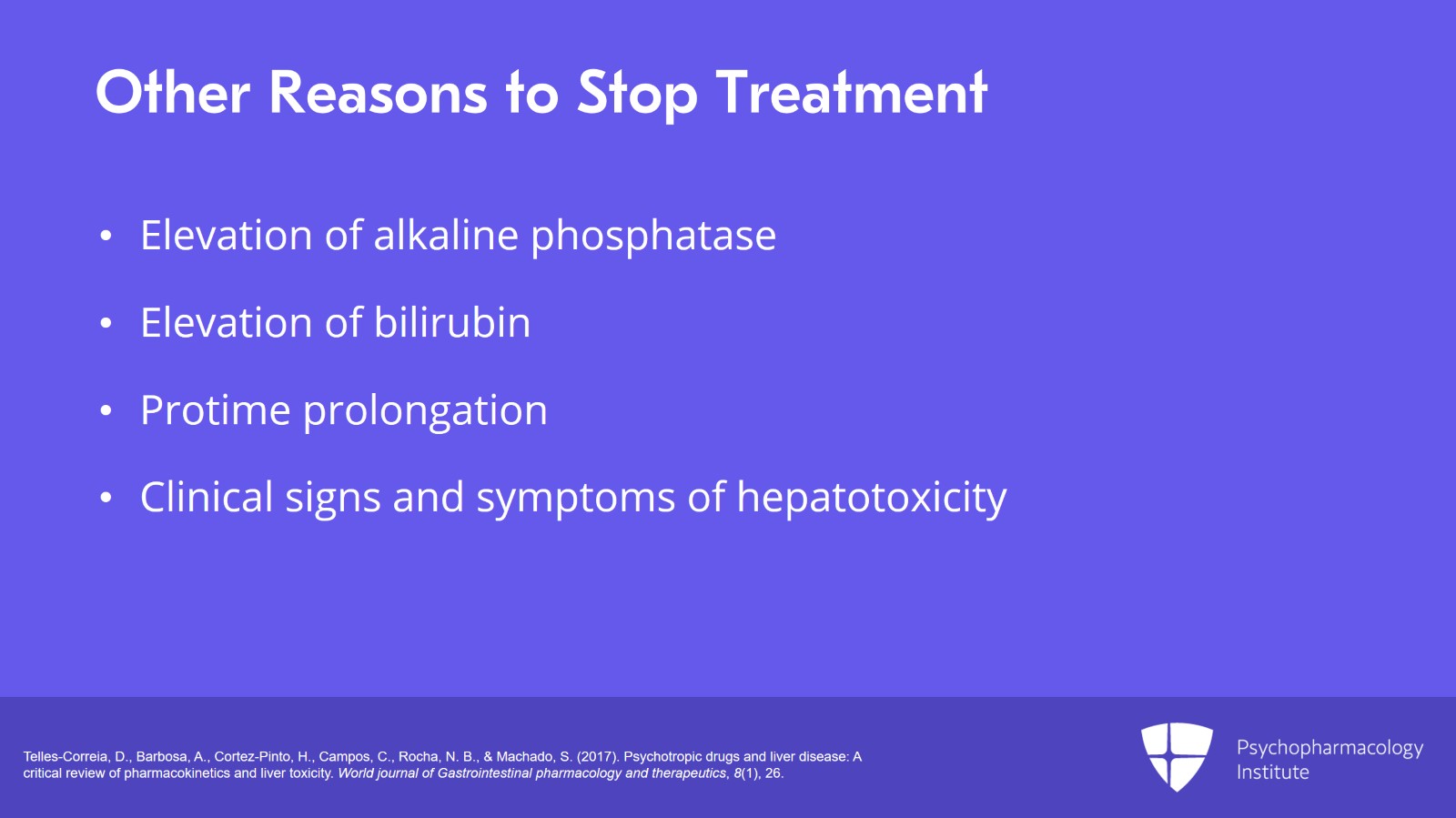
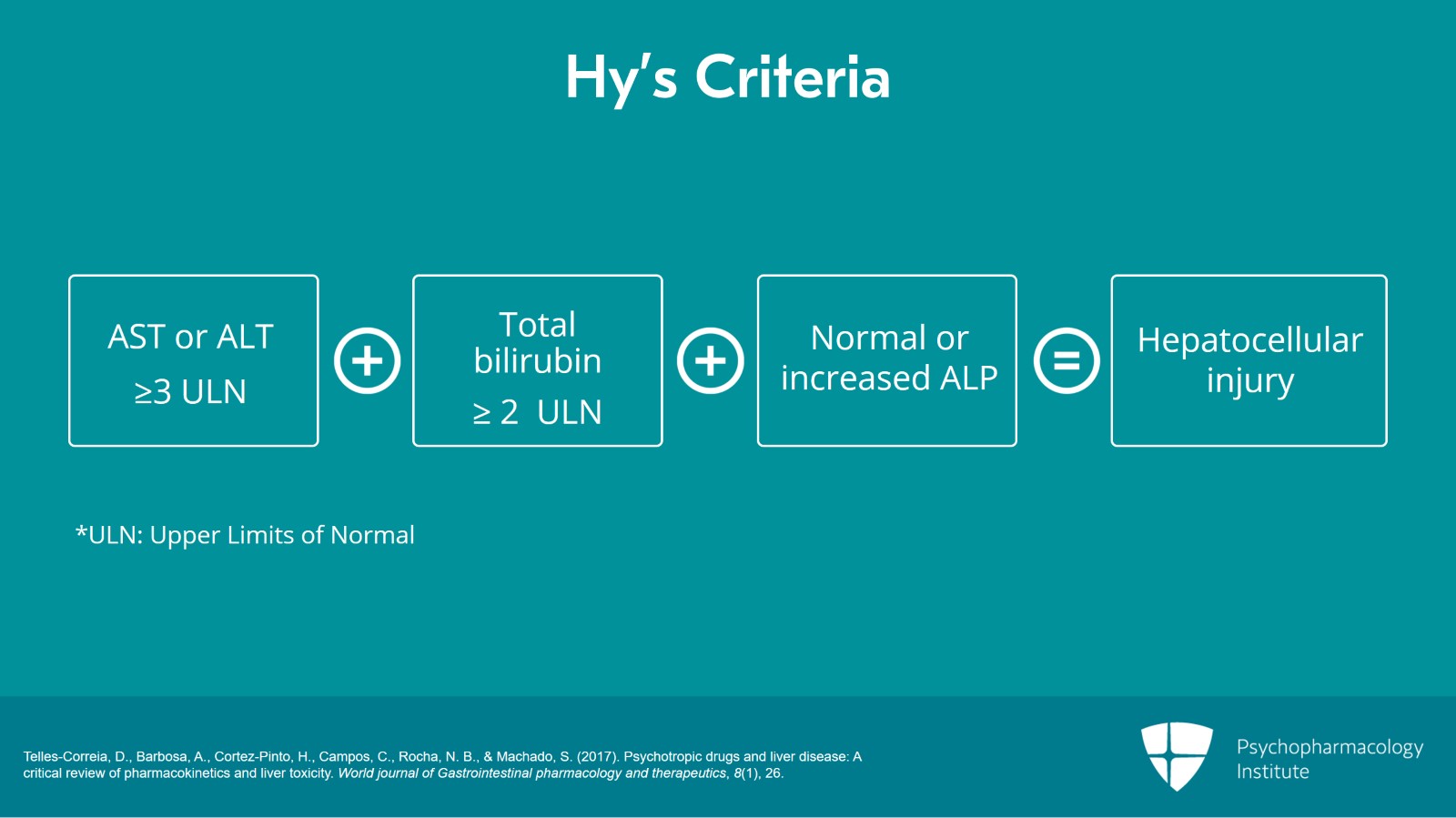
There are of course other reasons to stop a drug like elevation of alkaline phosphatase or bilirubin, protime prolongation or clinical signs and symptoms of hepatotoxicity which brings us to another widely used guideline known as Hy’s law or Hy’s criteria which is shown graphically in the figures provided in your slides.
References:
- Telles-Correia, D., Barbosa, A., Cortez-Pinto, H., Campos, C., Rocha, N. B., & Machado, S. (2017). Psychotropic drugs and liver disease: A critical review of pharmacokinetics and liver toxicity. World journal of Gastrointestinal pharmacology and therapeutics, 8(1), 26.
Slide 4 of 9
Hy’s law can be used to determine the presence of hepatotoxic versus cholestatic drug-induced liver injury. So in the first figure, we show Hy’s criteria for hepatocellular injury. And these criteria are met when the transaminases, either AST or ALT, are normal at baseline and then after the drug is started are increased to three or more times the upper limit of normal while total bilirubin is increased to two or more times the upper limit of normal and alkaline phosphatase is normal or only slightly increased.
References:
- Telles-Correia, D., Barbosa, A., Cortez-Pinto, H., Campos, C., Rocha, N. B., & Machado, S. (2017). Psychotropic drugs and liver disease: A critical review of pharmacokinetics and liver toxicity. World journal of Gastrointestinal pharmacology and therapeutics, 8(1), 26.
Free Files
Download PDF and other files
Success!
Check your inbox, we sent you all the materials there.
Slide 5 of 9
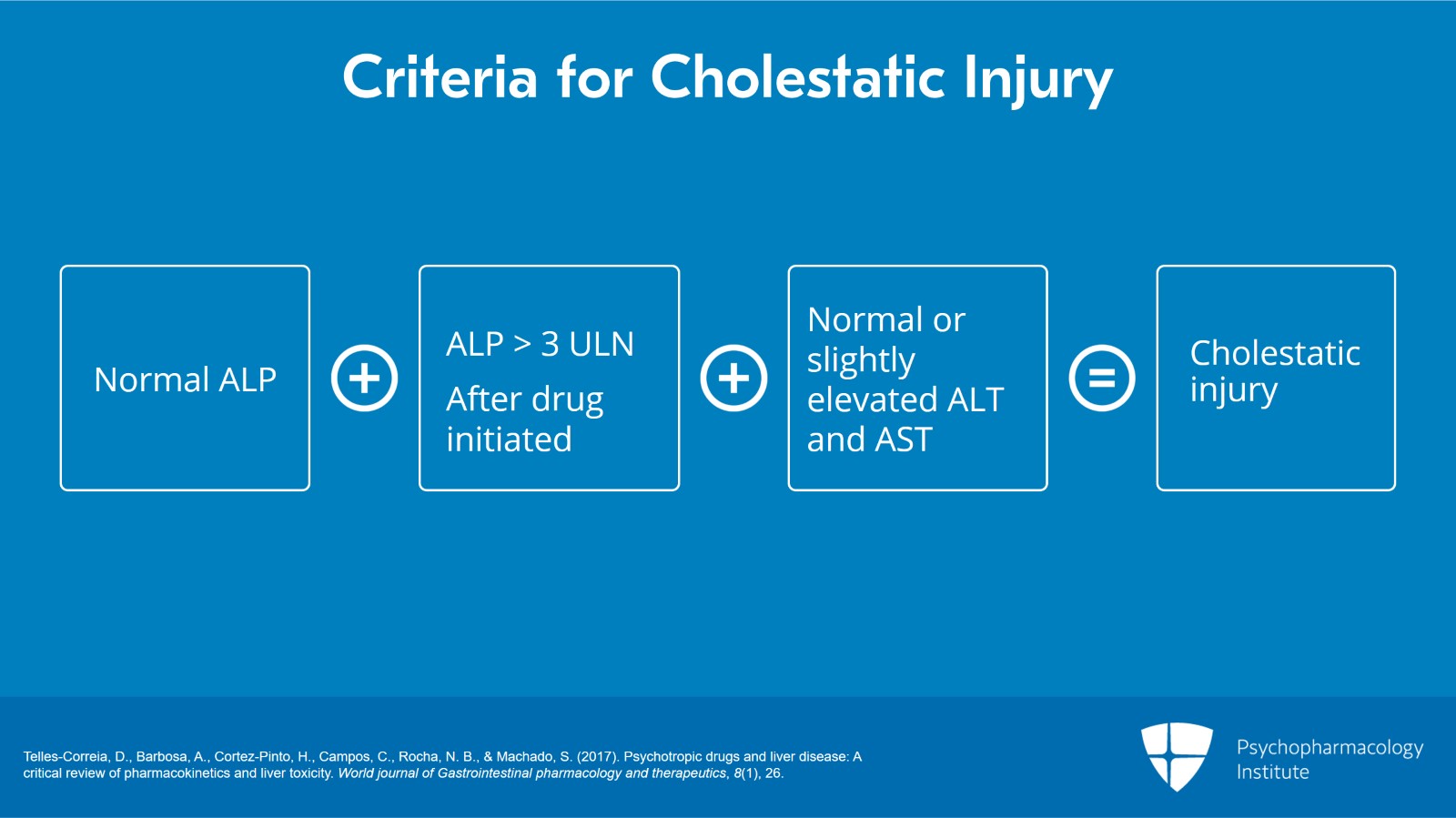
Now taking a look at the next slide labeled cholestatic injury, criteria for this type of injury are met when alkaline phosphatase is normal at baseline and then after the drug is started is increased to more than three times the upper limit of normal while AST and ALT are normal or only slightly elevated. If criteria for either subtype of drug-induced liver injury are met, GI consultation should be requested.
References:
- Telles-Correia, D., Barbosa, A., Cortez-Pinto, H., Campos, C., Rocha, N. B., & Machado, S. (2017). Psychotropic drugs and liver disease: A critical review of pharmacokinetics and liver toxicity. World journal of Gastrointestinal pharmacology and therapeutics, 8(1), 26.
Slide 6 of 9
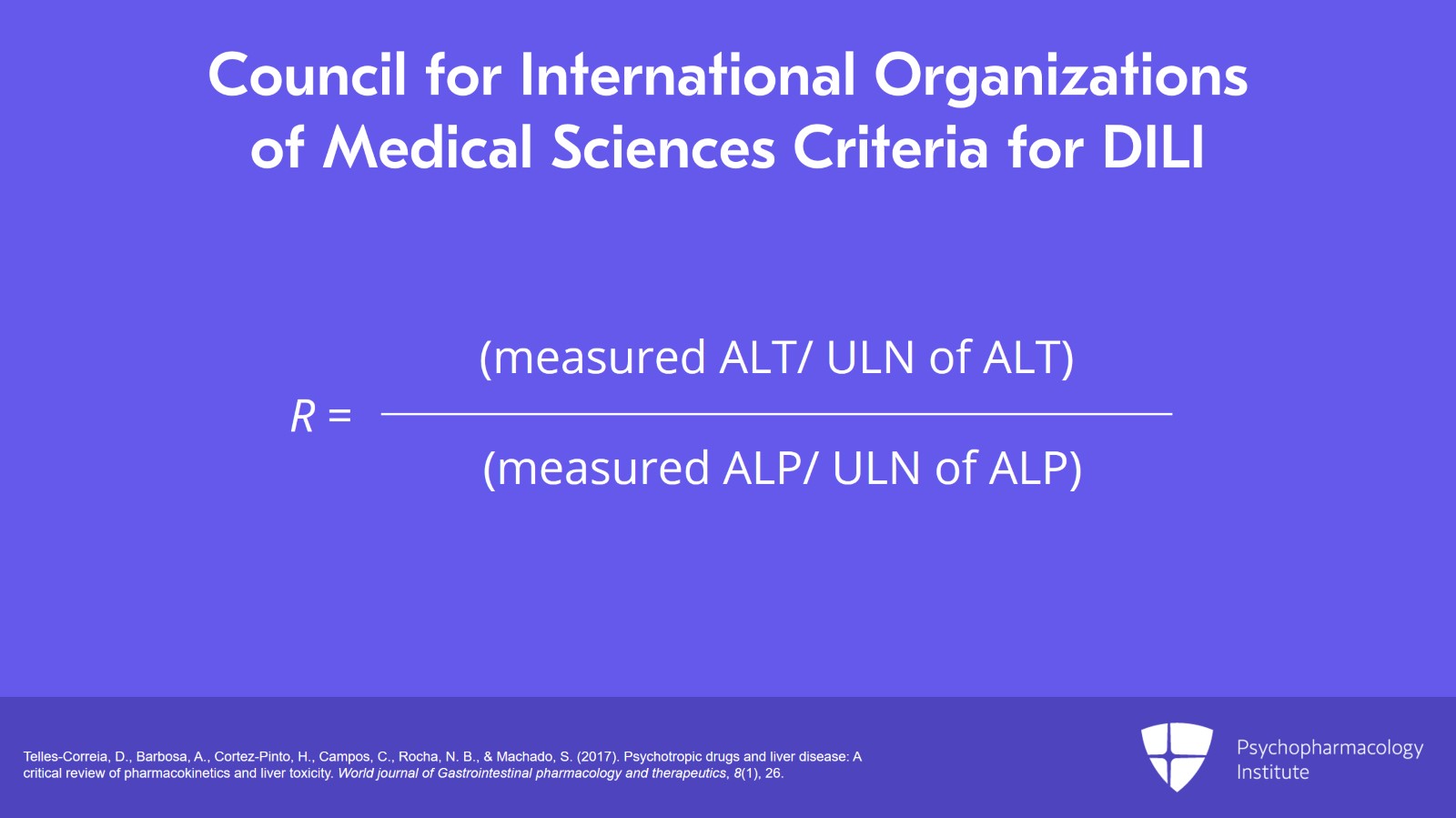
Now, more recently, the Council for International Organizations of Medical Sciences set forth criteria for determining drug-induced liver injury and its subtypes using the values of ALT and alkaline phosphatase. It involves a variable called R and R is equal to – It’s a ratio actually. It’s equal to the measured ALT divided by the upper limit of normal of ALT divided by measured alkaline phosphatase divided by the upper limit of normal of alkaline phosphatase. So that’s how you calculate R.
References:
- Telles-Correia, D., Barbosa, A., Cortez-Pinto, H., Campos, C., Rocha, N. B., & Machado, S. (2017). Psychotropic drugs and liver disease: A critical review of pharmacokinetics and liver toxicity. World journal of Gastrointestinal pharmacology and therapeutics, 8(1), 26.
Free Files
Download PDF and other files
Success!
Check your inbox, we sent you all the materials there.
Slide 7 of 9
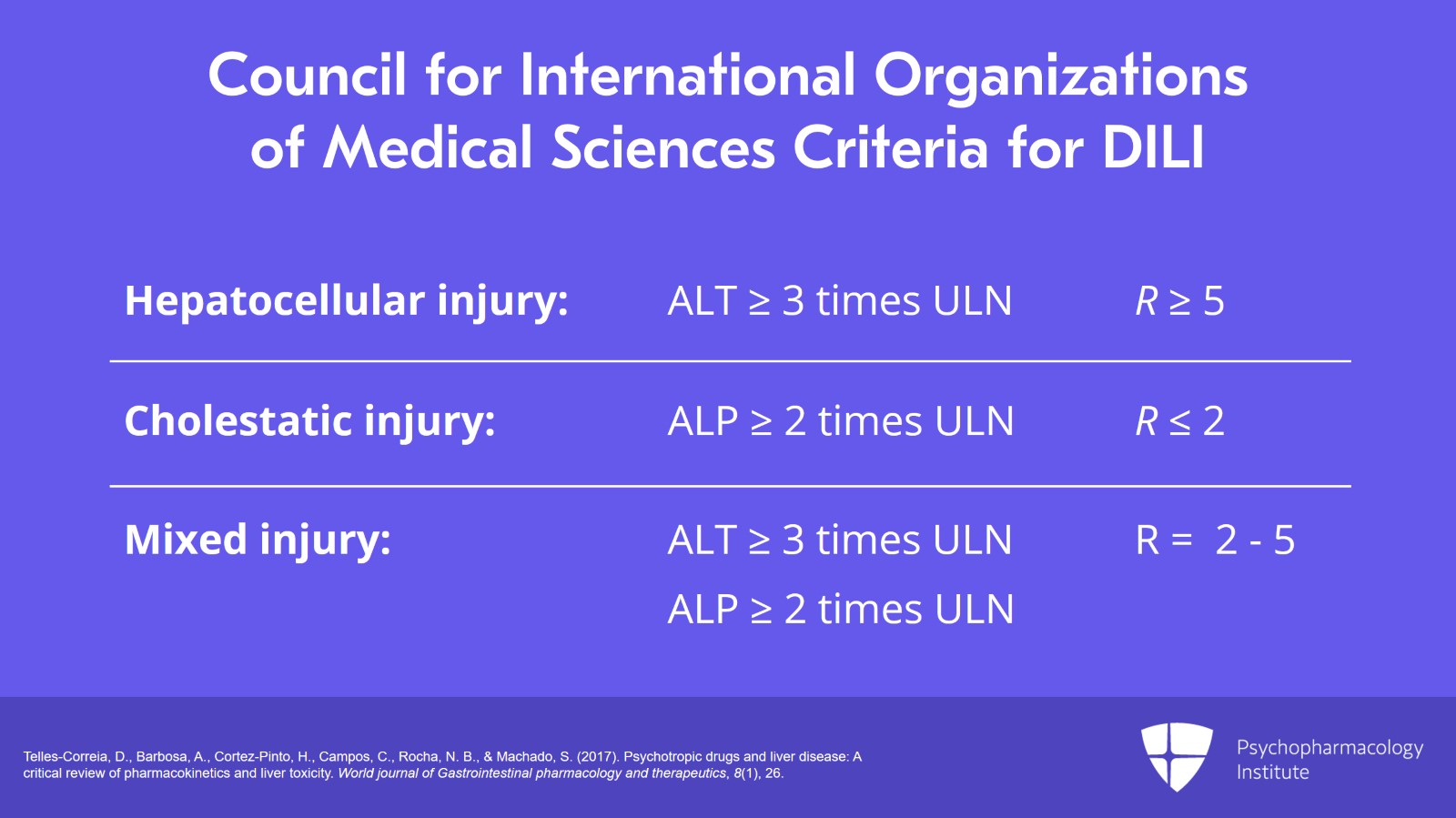
Hepatocellular injury can be diagnosed when the ALT is three or more times the upper limit of normal and that value R is greater than or equal to 5. Cholestatic injury can be diagnosed when the alkaline phosphatase is two or more times the upper limit of normal and R is less than or equal to 2. Mixed injury can be diagnosed when ALT is three or more times the upper limit of normal and alkaline phosphatase two or more times the upper limit of normal and R is between 2 and 5. So basically, a combination of the first two types of injury. So this is sort of the most advanced way to look at this. And you can do your own calculations and then consult GI. Or you can consult GI. They’ll basically do a similar kind of calculation.
References:
- Telles-Correia, D., Barbosa, A., Cortez-Pinto, H., Campos, C., Rocha, N. B., & Machado, S. (2017). Psychotropic drugs and liver disease: A critical review of pharmacokinetics and liver toxicity. World journal of Gastrointestinal pharmacology and therapeutics, 8(1), 26.
Slide 8 of 9
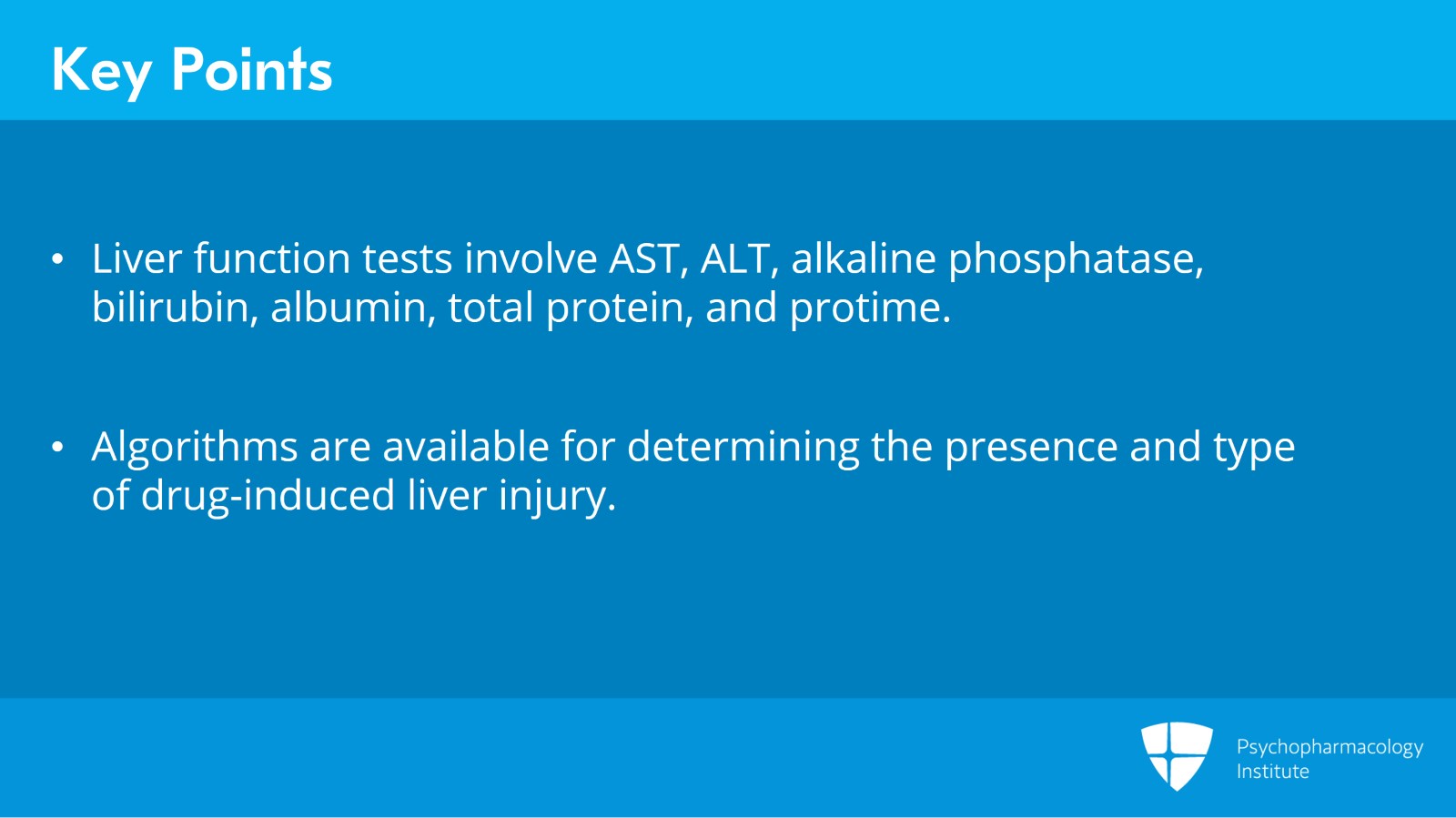
Key points. Liver function tests involve not only the enzymes AST, ALT and alkaline phosphatase but also bilirubin both direct and total, albumin, total protein and protime. Several algorithms are in use for determining the presence and type of drug-induced liver injury and which one you use basically depends upon how involved you want to be in making the diagnosis yourself.
Free Files
Download PDF and other files
Success!
Check your inbox, we sent you all the materials there.