Slides and Transcript
Slide 1 of 12
So we’ve talked through the theory of hyperbolic tapering and the next step is how is this implemented in clinical practice.
Slide 2 of 12
This presents somewhat of an issue, because most of the smallest available tablets or capsules of antidepressants in the US do not allow hyperbolic tapering, and so there are other options that need to be used.
References:
- Horowitz, M., & Taylor, D. M. (2024). The Maudsley deprescribing guidelines: antidepressants, benzodiazepines, gabapentinoids and Z-drugs. John Wiley & Sons.
- Specialist Pharmacy Service. (2024, July 8). SSRI: Suggestions for adults with swallowing difficulties. NHS. https://tinyurl.com/47dfab4p
- Horowitz, M. A., & Taylor, D. (2019). Tapering of SSRI treatment to mitigate withdrawal symptoms. The Lancet Psychiatry, 6(6), 538-546. https://doi.org/10.1016/S2215-0366(19)30032-X
Free Files
Download PDF and other files
Success!
Check your inbox, we sent you all the materials there.
Slide 3 of 12
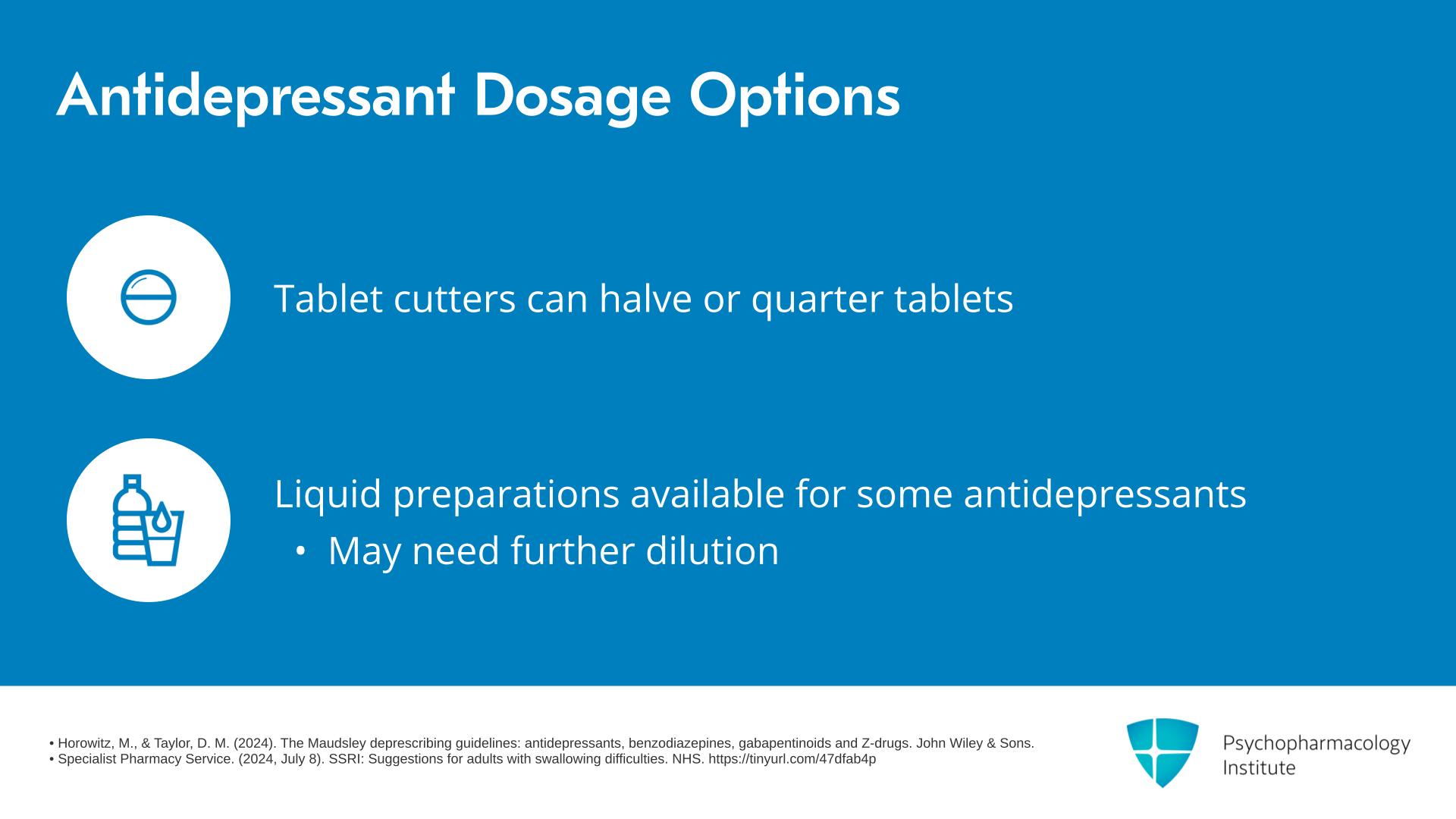
So tablet cutters may be useful to halve or quarter tablets, but at some point even that will not be small enough. Liquid preparations are made by the manufacturer for some but not all antidepressants in the US, and that can be useful. Some of those may need to be diluted further because they can be quite concentrated. You can add water to many of them without causing significant issues with dilutions.
References:
- Horowitz, M., & Taylor, D. M. (2024). The Maudsley deprescribing guidelines: antidepressants, benzodiazepines, gabapentinoids and Z-drugs. John Wiley & Sons.
- Specialist Pharmacy Service. (2024, July 8). SSRI: Suggestions for adults with swallowing difficulties. NHS. https://tinyurl.com/47dfab4p
Slide 4 of 12
Compounded medications can be helpful. Compounded medications can be made as tablets or capsules or liquids, widely available from compounding pharmacies with differing prices.
References:
- Horowitz, M., & Taylor, D. M. (2024). The Maudsley deprescribing guidelines: antidepressants, benzodiazepines, gabapentinoids and Z-drugs. John Wiley & Sons.
- Specialist Pharmacy Service. (2024, July 8). SSRI: Suggestions for adults with swallowing difficulties. NHS. https://tinyurl.com/47dfab4p
Free Files
Download PDF and other files
Success!
Check your inbox, we sent you all the materials there.
Slide 5 of 12
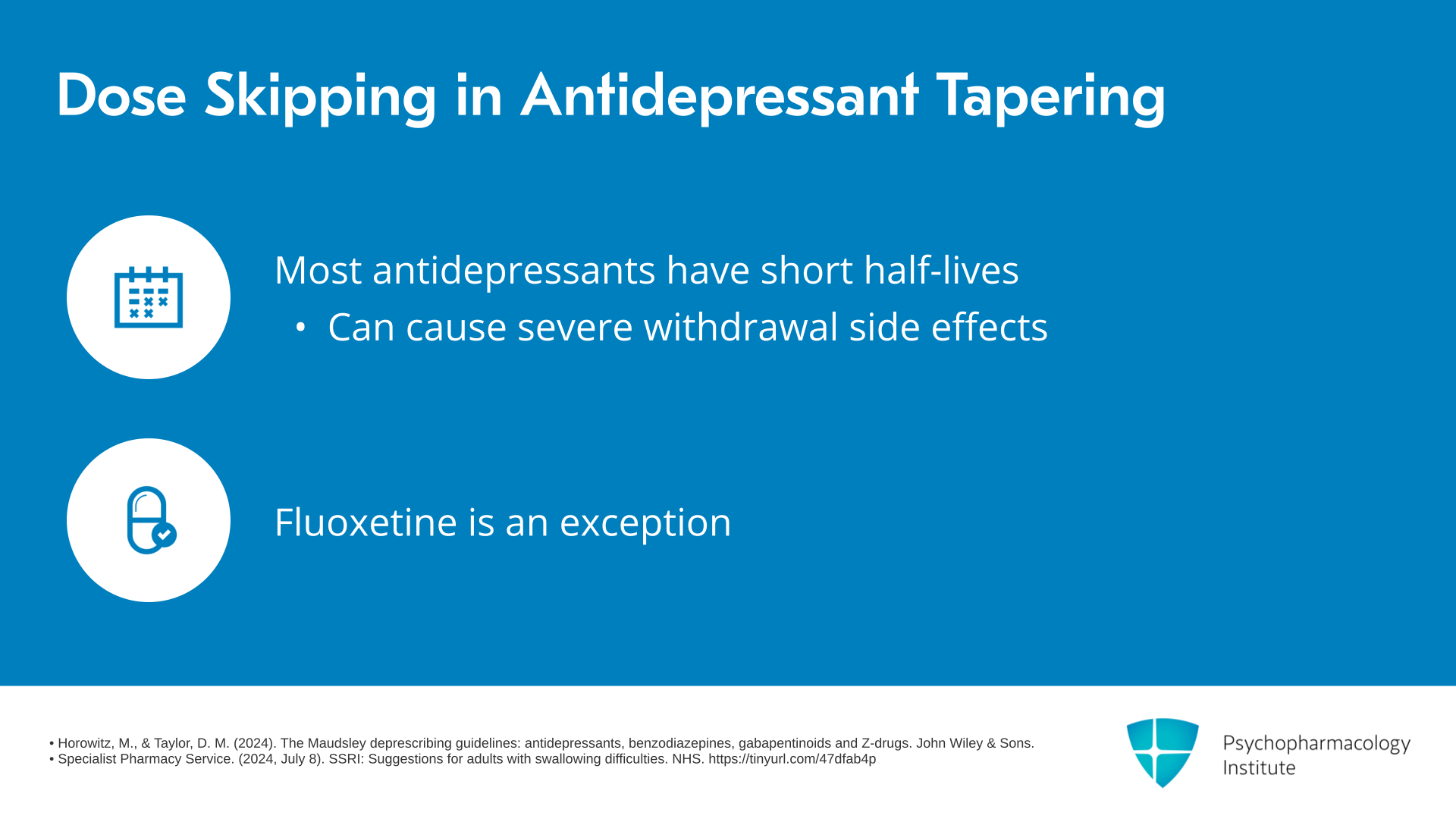
Some clinicians try to approximate these regimes by skipping doses. That is problematic for many antidepressants, because they have a half-life of 24 hours or less. Giving an antidepressant every second or third day can cause wildly up and down plasma levels, which can give people severe withdrawal side effects in some cases. The exception to that is probably fluoxetine, but it’s worth saying about fluoxetine that although the APA recommends switching to fluoxetine and many guidelines do that, fluoxetine is not a self-tapering drug as it’s sometimes advertised.
References:
- Horowitz, M., & Taylor, D. M. (2024). The Maudsley deprescribing guidelines: antidepressants, benzodiazepines, gabapentinoids and Z-drugs. John Wiley & Sons.
- Specialist Pharmacy Service. (2024, July 8). SSRI: Suggestions for adults with swallowing difficulties. NHS. https://tinyurl.com/47dfab4p
Slide 6 of 12
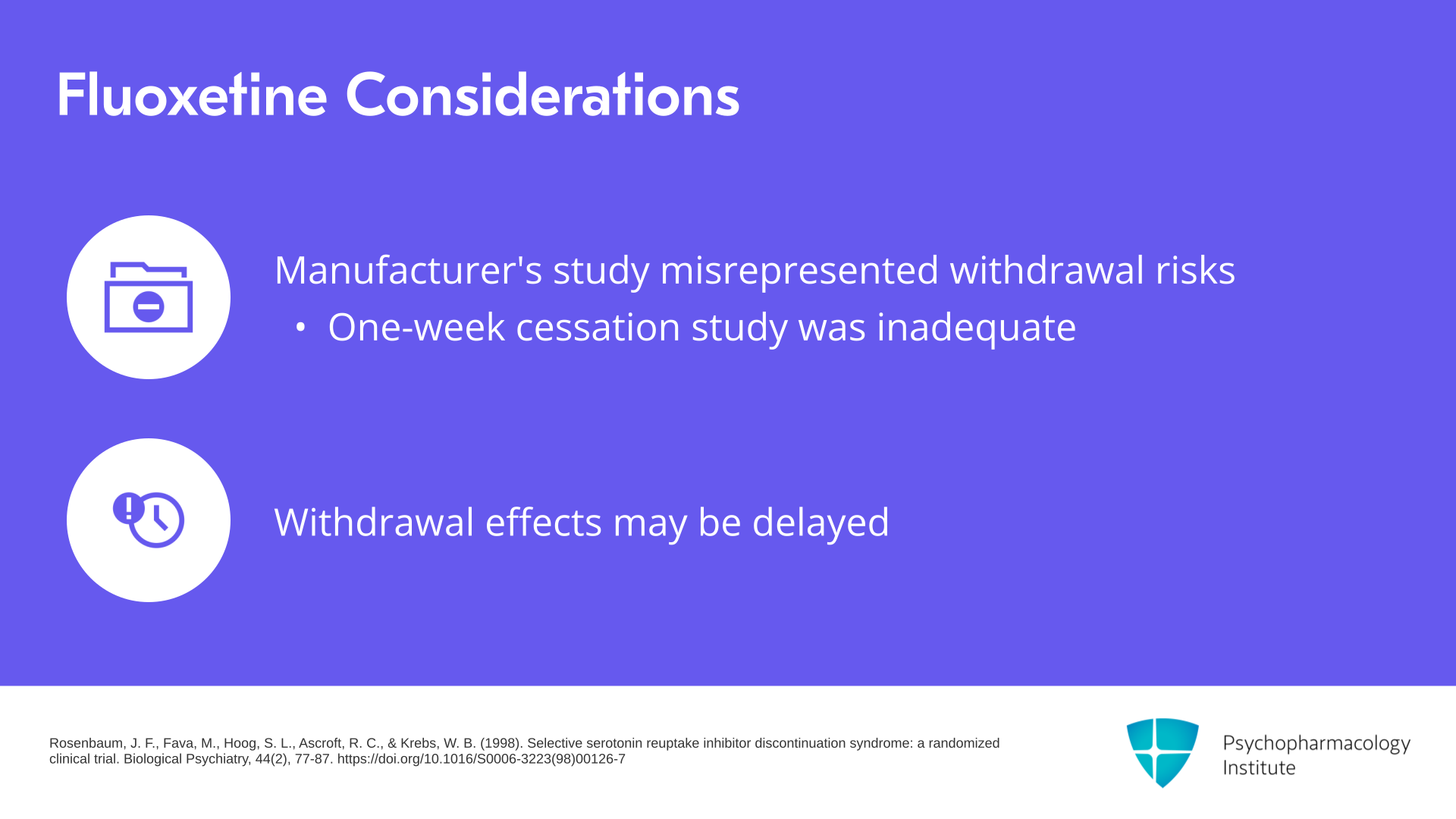
That actually arises from a study that the manufacturer did in the 1990s where they took people on fluoxetine and stopped the drug for a week, and showed that they didn’t have many withdrawal effects. That was a sleight of hand by the manufacturer because the elimination half-life of fluoxetine is about 7 to 15 days, that’s for the active norfluoxetine active metabolite. And so most people will not experience withdrawal effects within a week. It will take six weeks or longer for withdrawal effects to occur. And so this study greatly misrepresented the risk of withdrawal effects from fluoxetine, and people can have delayed onset withdrawal effects commonly with fluoxetine. And so it should be also carefully tapered as for other antidepressants, and not mistaken as a self-tapering drug.
References:
- Rosenbaum, J. F., Fava, M., Hoog, S. L., Ascroft, R. C., & Krebs, W. B. (1998). Selective serotonin reuptake inhibitor discontinuation syndrome: a randomized clinical trial. Biological Psychiatry, 44(2), 77-87. https://doi.org/10.1016/S0006-3223(98)00126-7
Free Files
Download PDF and other files
Success!
Check your inbox, we sent you all the materials there.
Slide 7 of 12
There are also off-label options for tapering, that is ways of manipulating the drugs that is not approved by the manufacturer. About 1 in 4 prescriptions in America are off-label, so this is not unusual.
References:
- Specialist Pharmacy Service. (2024, July 8). SSRI: Suggestions for adults with swallowing difficulties. NHS. https://tinyurl.com/47dfab4p
Slide 8 of 12
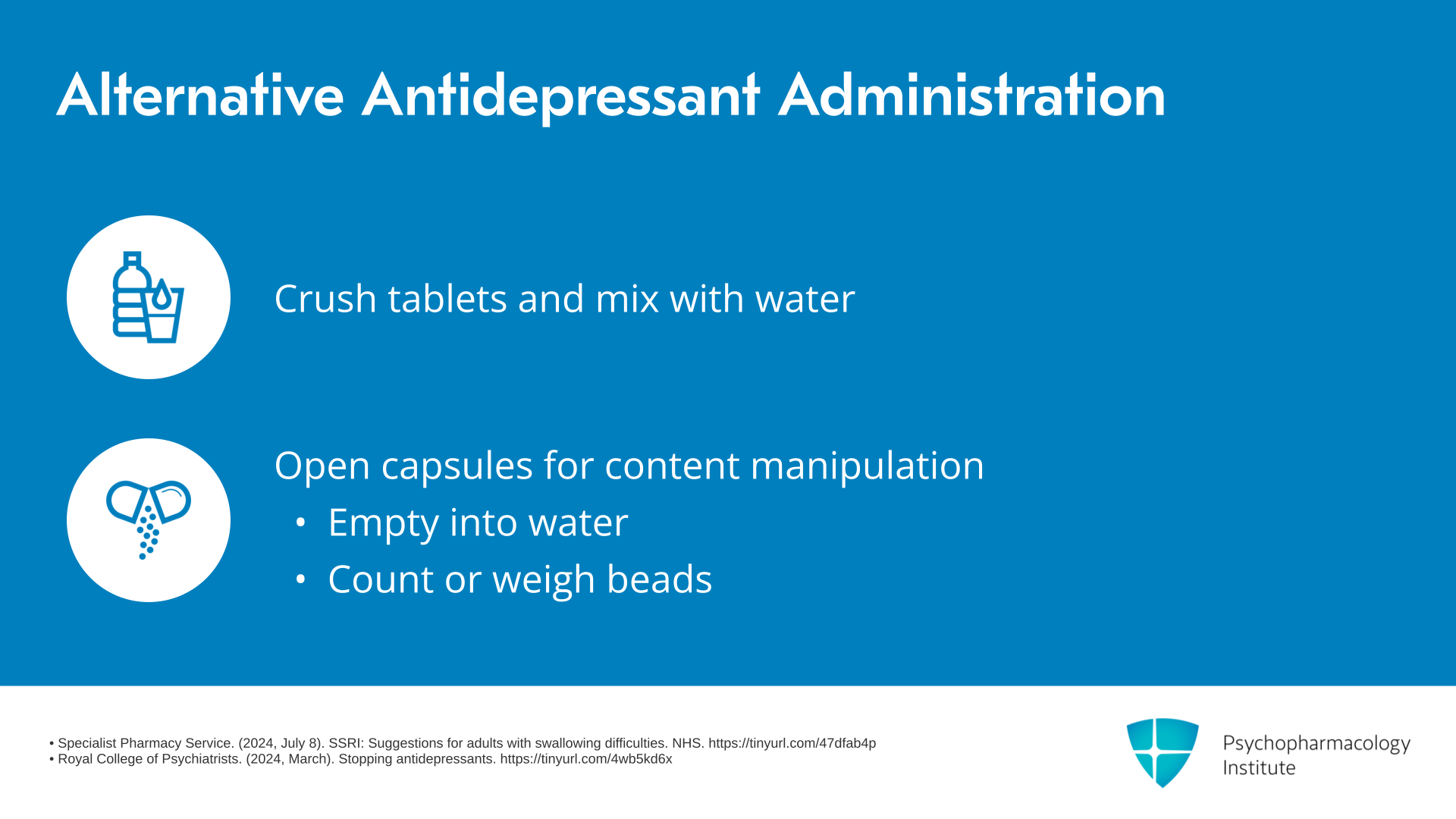
For example, in the UK, the government gives advice on how to crush up tablets of antidepressants mixing them with water to give to people who can’t swallow like old people or children. Other things like opening up capsules to empty the contents into water or to open up capsules like venlafaxine or duloxetine, Effexor or Cymbalta, to count or weigh the beads inside is another option.
References:
- Specialist Pharmacy Service. (2024, July 8). SSRI: Suggestions for adults with swallowing difficulties. NHS. https://tinyurl.com/47dfab4p
- Royal College of Psychiatrists. (2024, March). Stopping antidepressants. https://tinyurl.com/4wb5kd6x
Free Files
Download PDF and other files
Success!
Check your inbox, we sent you all the materials there.
Slide 9 of 12
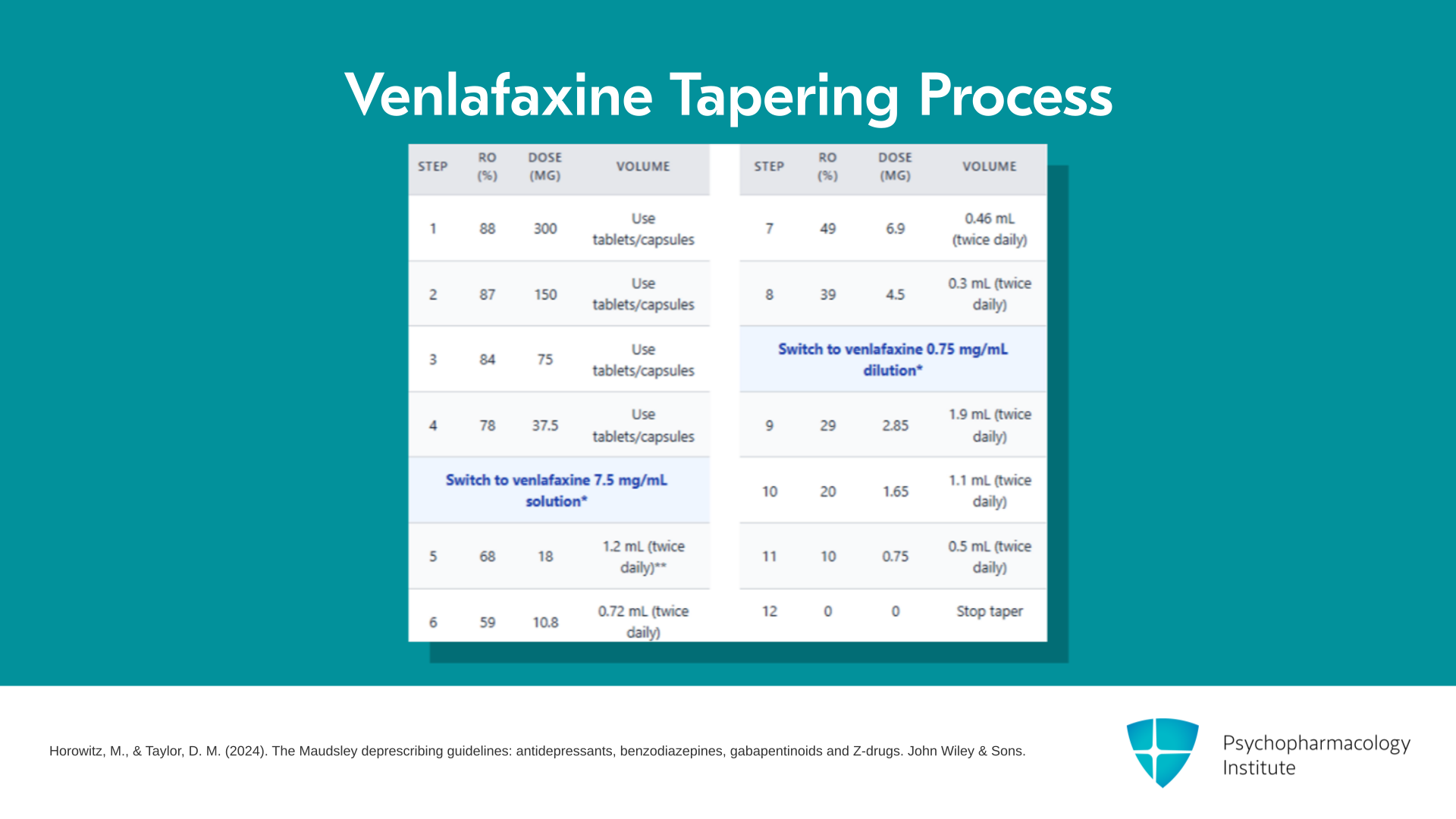
This is from the Maudsley Deprescribing Guidelines. It outlines this would be probably for a shorter-term user because venlafaxine can be a very difficult drug to stop, and this might be appropriate for someone who had used the drug for perhaps a few months or a year. And it shows step by step what dose to reduce to every two to four weeks, starting at 300 mg, reducing to 150 to 75 to 37.5. Below that, so people might want to stop at the smallest available capsule, but actually that has a very large effect on target receptors. So actually, 7/8 is as much as 300 mg and so it’s much more prudent to go down using a liquid version of a drug or a compounded capsule to go down through 18, 10.8, 6.9, etc., all the way down to 0.75 mg before stopping. And many people who were unable to come off the drugs will experience great difficulty in stopping from 37.5 or taking that every second day will be able to stop in this way.
References:
- Horowitz, M., & Taylor, D. M. (2024). The Maudsley deprescribing guidelines: antidepressants, benzodiazepines, gabapentinoids and Z-drugs. John Wiley & Sons.
Slide 10 of 12
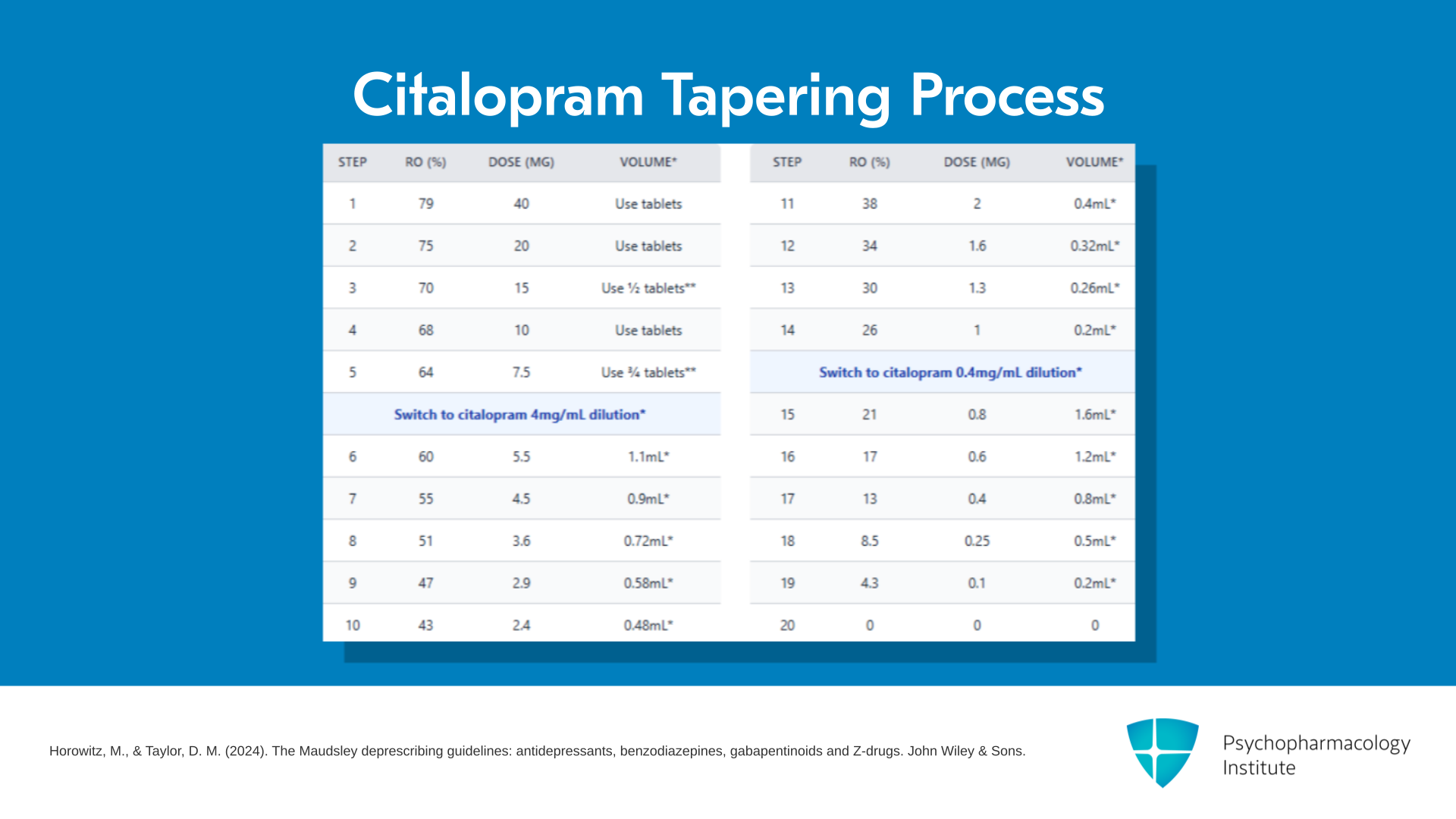
And then there’s an example of citalopram, what will be called a moderate taper for someone who maybe had been on the drugs for a few years and had had some trouble when they’re coming off last time. This process might take a year or two to go through and involves going down step by step, explaining when to use tablets, when to use half tablets and when to switch either to a dilution of citalopram liquid or to be using compounded capsules. And it gives a way to go all the way down to 0.1 mg before stopping.
References:
- Horowitz, M., & Taylor, D. M. (2024). The Maudsley deprescribing guidelines: antidepressants, benzodiazepines, gabapentinoids and Z-drugs. John Wiley & Sons.
Free Files
Download PDF and other files
Success!
Check your inbox, we sent you all the materials there.
Slide 11 of 12
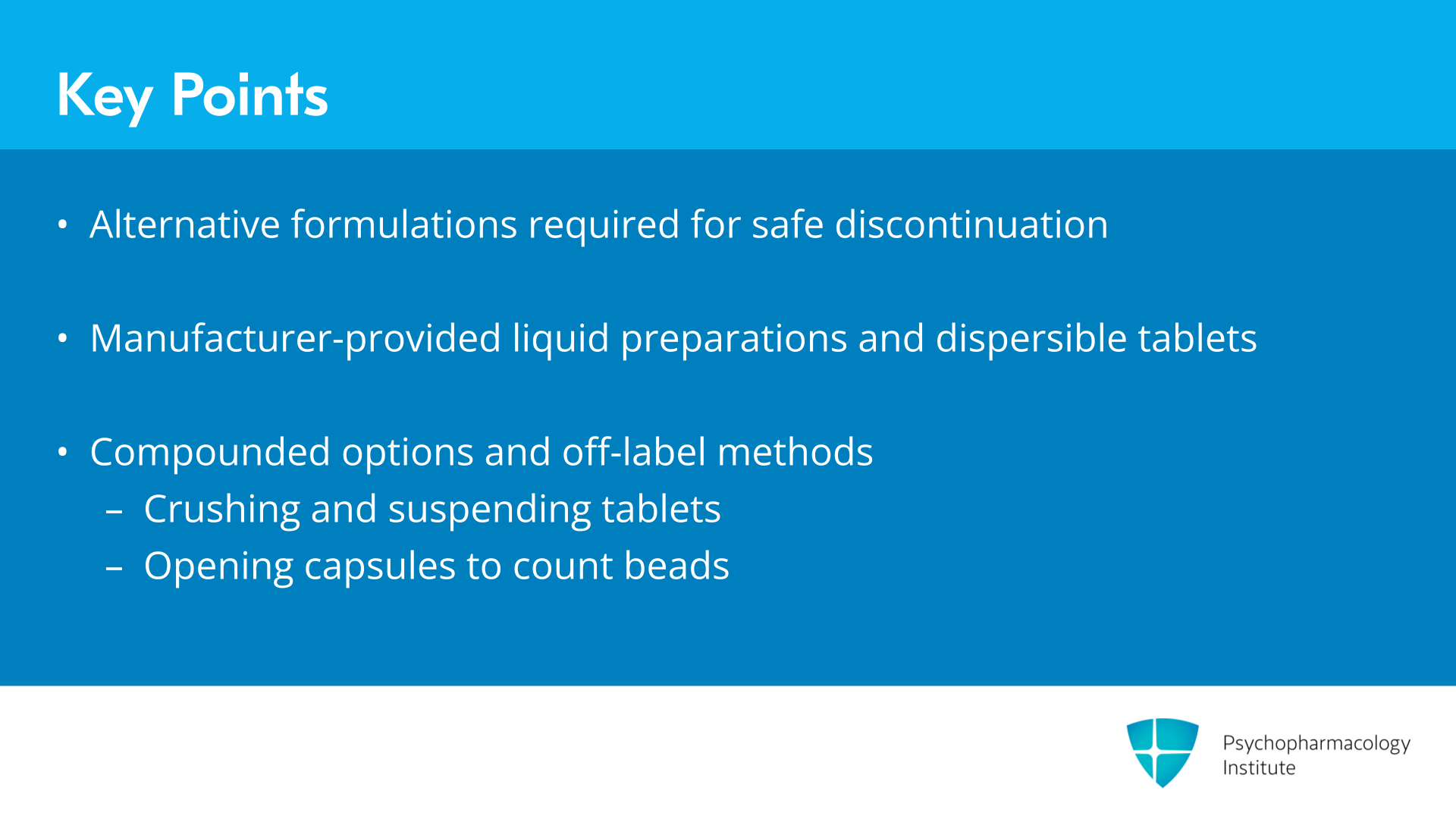
So the key points here are: In practice, to safely stop an antidepressant for most long-term users involves using formulations of antidepressants other than widely available tablets or capsules. There are a variety of other options including liquid preparations made by the manufacturer, dispersible tablets that dissolve in water, compounded capsules or tablets, and also off-label options like crushing and suspending tablets or opening capsules to count beads.
Slide 12 of 12
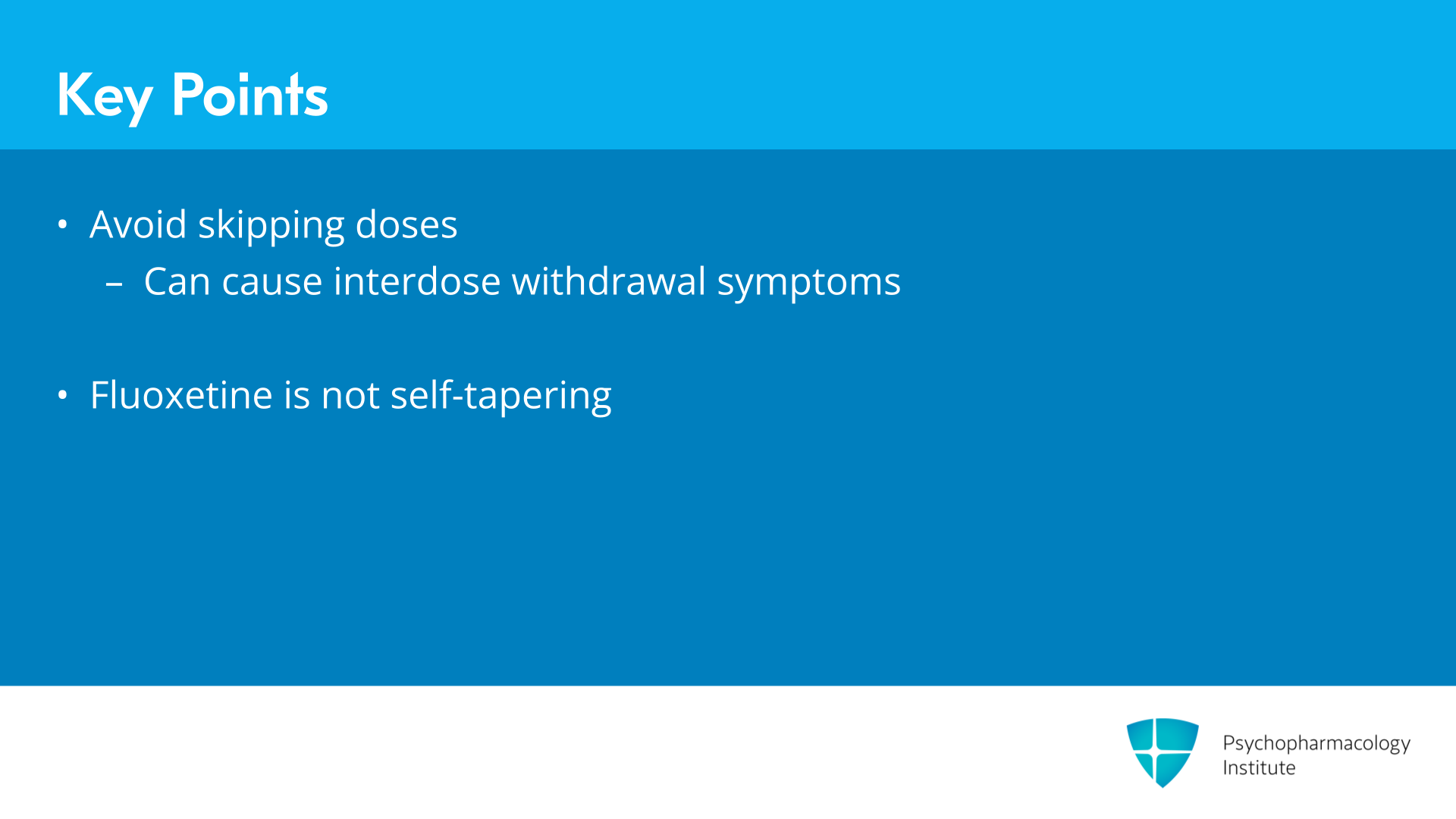
It is not best practice to skip doses of most antidepressants as this can cause interdose withdrawal symptoms. And it’s worth remembering that fluoxetine is not self-tapering as has often been suggested.
Free Files
Download PDF and other files
Success!
Check your inbox, we sent you all the materials there.