Slides and Transcript
Slide 1 of 15
Hello everybody. Today’s video is how to mitigate weight gain and gastrointestinal side effects of lithium.
Slide 2 of 15
So let’s start with weight gain. There are four causes of weight gain that I would like to mention from lithium and I usually tell the patient about these four. Very few of my patients want to gain weight so we want to discuss this in detail before it becomes an issue that makes them want to quit taking it and they had no idea this was going to happen to them. We want to be ready to start with anticipating it and taking steps to prevent it.
References:
- Gitlin, M. (2016). Lithium side effects and toxicity: prevalence and management strategies. International Journal of Bipolar Disorders, 4(1), 27. https://doi.org/10.1186/s40345-016-0068-y
Free Files
Download PDF and other files
Success!
Check your inbox, we sent you all the materials there.
Slide 3 of 15
So the first of the four is consuming caloric beverages to deal with the thirst that increases when you’re on lithium. I determine what are they drinking when they’re thirsty now. And I praise and support them if they tell me it’s water and other non-caloric beverages. And if they tell me that it’s fruit juices and Pepsis, then I tell them this is a major problem that they are going to have to address to be able to take lithium and not gain weight. Low-calorie solute-replacing drinks are actually even better than pure water because they replace some of the solute that may occur because you’ve got more lithium. So so-called sports drinks often have solutes and those are replenishing of those minerals. But we don’t want the calories that are in some of those drinks.
References:
- Gitlin, M. (2016). Lithium side effects and toxicity: prevalence and management strategies. International Journal of Bipolar Disorders, 4(1), 27. https://doi.org/10.1186/s40345-016-0068-y
- Mattes, R. (2006). Fluid calories and energy balance: The good, the bad, and the uncertain. Physiology & Behavior, 89(1), 66-70. https://doi.org/10.1016/j.physbeh.2006.01.023
Slide 4 of 15
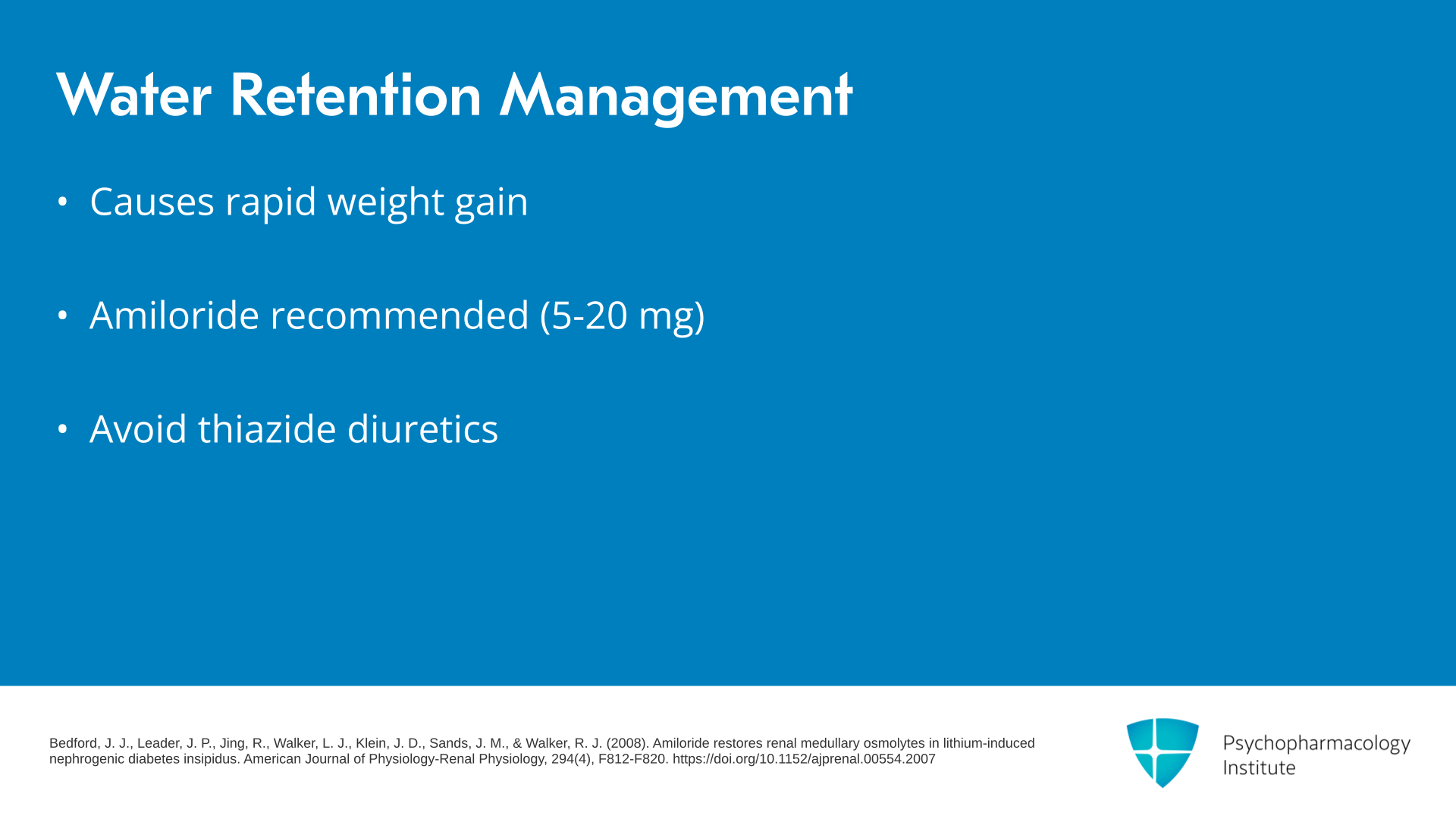
And the second cause of weight gain is water retention causing rapid weight gain. I recommended amiloride for managing it, 5 to 20 mg and to avoid thiazide diuretics to treat their water retention. They do work but they do raise lithium levels by perhaps 50% to 100%. They’re not contraindicated but they make it much more difficult to dosage lithium. So we would avoid them.
References:
- Bedford, J. J., Leader, J. P., Jing, R., Walker, L. J., Klein, J. D., Sands, J. M., & Walker, R. J. (2008). Amiloride restores renal medullary osmolytes in lithium-induced nephrogenic diabetes insipidus. American Journal of Physiology-Renal Physiology, 294(4), F812-F820. https://doi.org/10.1152/ajprenal.00554.2007
Free Files
Download PDF and other files
Success!
Check your inbox, we sent you all the materials there.
Slide 5 of 15
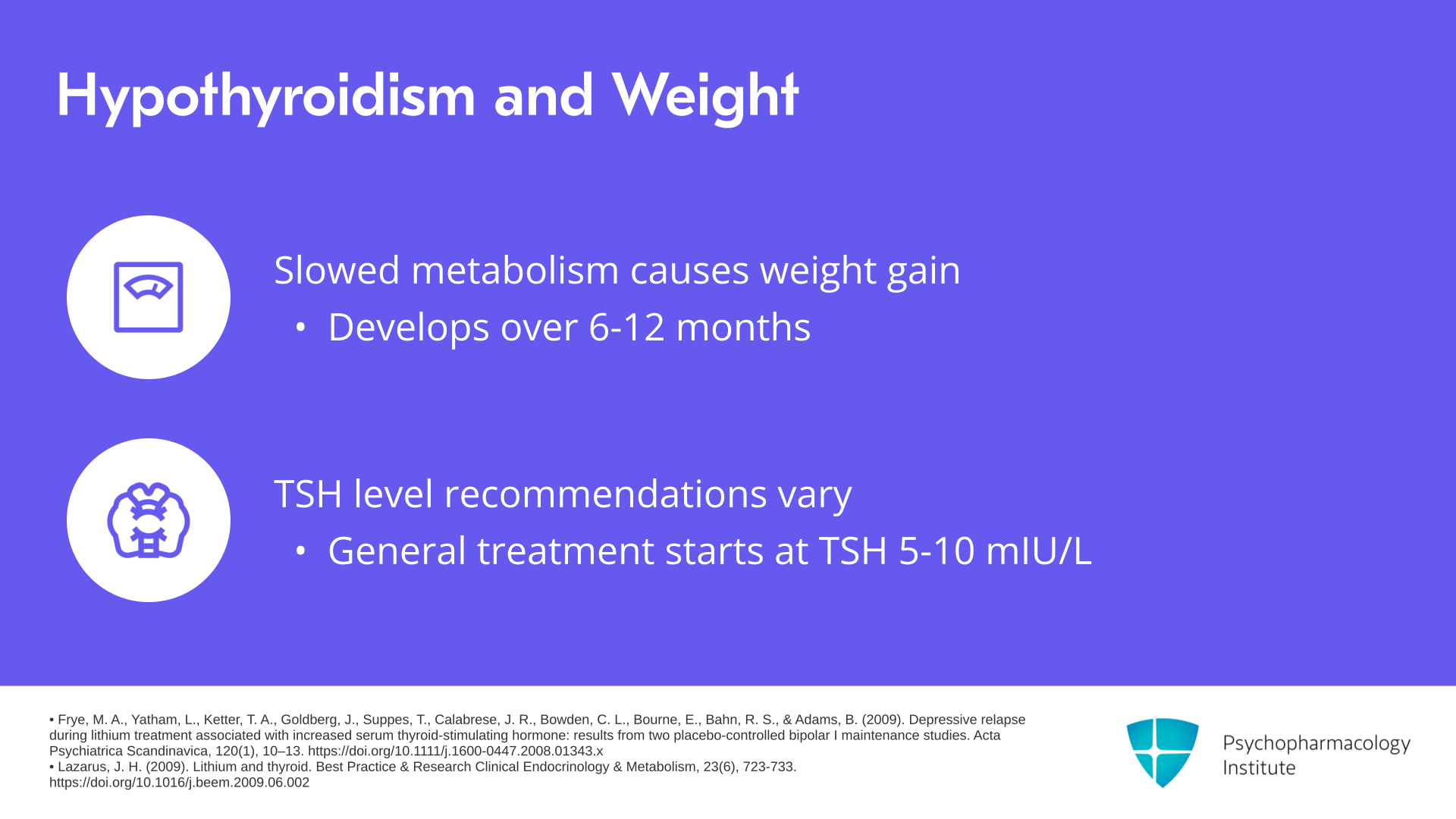
The third cause is slowed metabolism from hypothyroidism. That cause of weight gain is much slower to develop than the first two. It takes 6 or 12 months before they may start to put weight on because they don’t have enough thyroxine circulating. So this is where you have to monitor their thyroid function. And if it starts to go down, you should be ready to start thyroxine. Some experts like Frye and colleagues recommend keeping the TSH levels around 2. We don’t usually treat hypothyroidism until TSHs are at 5. Actually, my Internal Medicine colleagues tell me they usually don’t treat it till it’s closer to 10 before they’re going to start adding thyroxine.
References:
- Frye, M. A., Yatham, L., Ketter, T. A., Goldberg, J., Suppes, T., Calabrese, J. R., Bowden, C. L., Bourne, E., Bahn, R. S., & Adams, B. (2009). Depressive relapse during lithium treatment associated with increased serum thyroid-stimulating hormone: results from two placebo-controlled bipolar I maintenance studies. Acta Psychiatrica Scandinavica, 120(1), 10–13. https://doi.org/10.1111/j.1600-0447.2008.01343.x
- Lazarus, J. H. (2009). Lithium and thyroid. Best Practice & Research Clinical Endocrinology & Metabolism, 23(6), 723-733. https://doi.org/10.1016/j.beem.2009.06.002
Slide 6 of 15
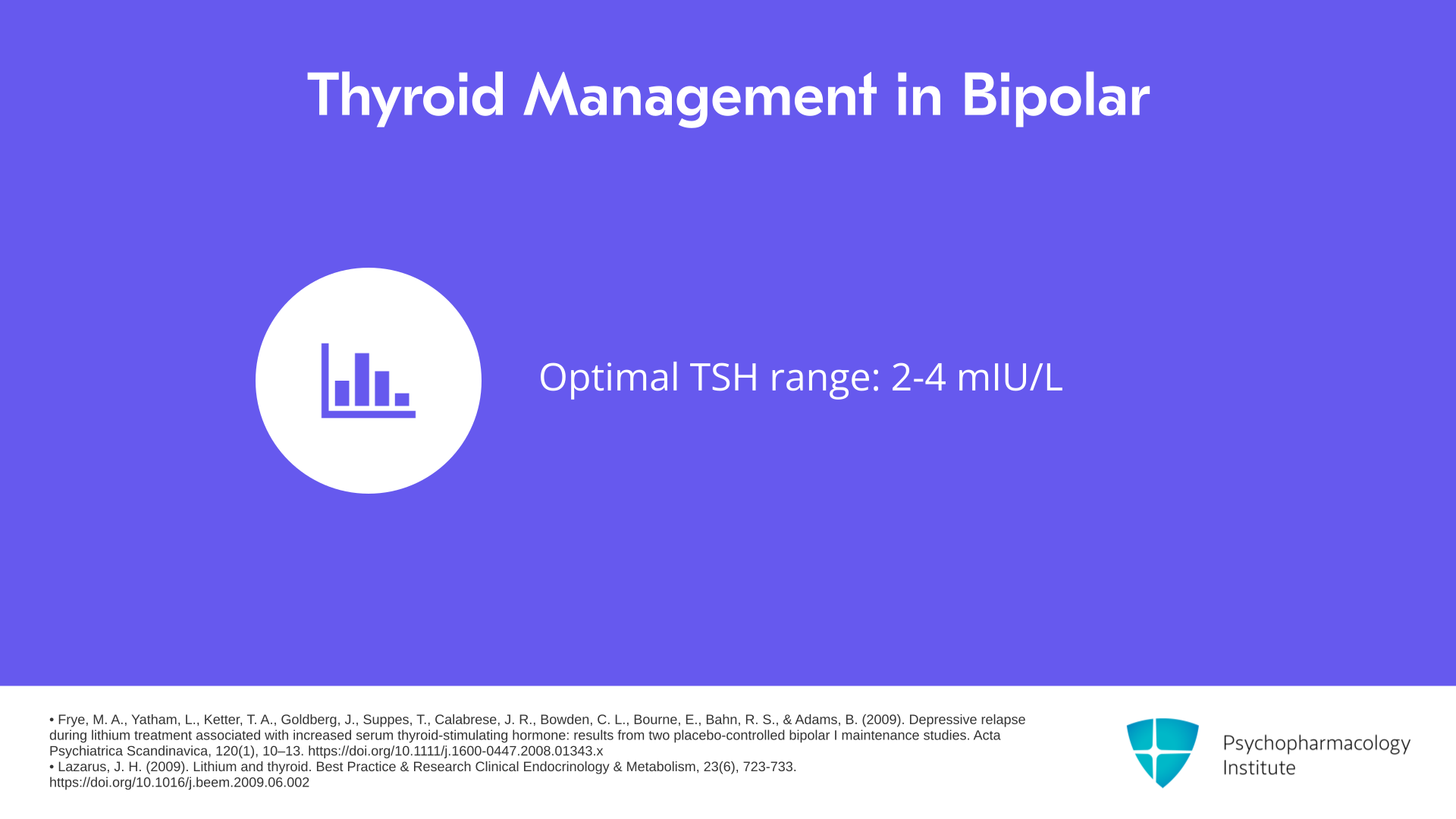
But in Psychopharmacology with bipolar people, our evidence is if you keep it that high there’s more rapid cycling as a complication. So we like to keep our patients around 2 to 4 as the best place to be for preventing problems with the mood disorder itself and also counteracting the effects of lithium which are to lower thyroid.
References:
- Frye, M. A., Yatham, L., Ketter, T. A., Goldberg, J., Suppes, T., Calabrese, J. R., Bowden, C. L., Bourne, E., Bahn, R. S., & Adams, B. (2009). Depressive relapse during lithium treatment associated with increased serum thyroid-stimulating hormone: results from two placebo-controlled bipolar I maintenance studies. Acta Psychiatrica Scandinavica, 120(1), 10–13. https://doi.org/10.1111/j.1600-0447.2008.01343.x
- Lazarus, J. H. (2009). Lithium and thyroid. Best Practice & Research Clinical Endocrinology & Metabolism, 23(6), 723-733. https://doi.org/10.1016/j.beem.2009.06.002
Free Files
Download PDF and other files
Success!
Check your inbox, we sent you all the materials there.
Slide 7 of 15
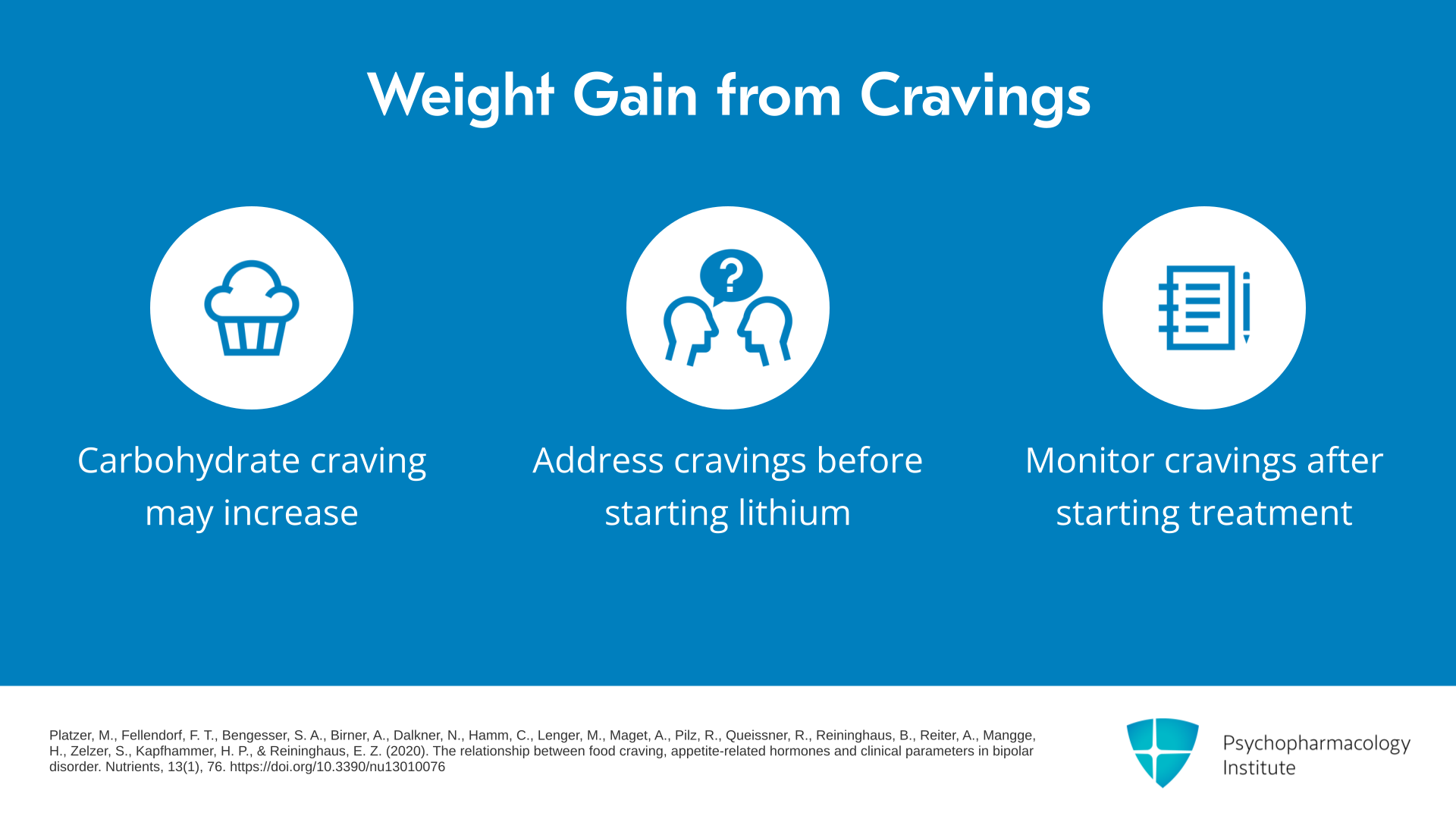
And the fourth cause of weight gain might be the toughest. It’s carbohydrate craving for sweets, cookies, candy bars. I bring it up right at the beginning of starting lithium on someone and I determine their current level of carbohydrate craving. Do they do that now? Do they eat a box of cookies at the drop of a hat when they’re a little bit hungry? Do they go through candy bars? Did your cravings get worse after you started the lithium? They will be monitoring themselves and hopefully guarding against this outcome because they want their bipolar to get better and they don’t want to have side effects from it.
References:
- Platzer, M., Fellendorf, F. T., Bengesser, S. A., Birner, A., Dalkner, N., Hamm, C., Lenger, M., Maget, A., Pilz, R., Queissner, R., Reininghaus, B., Reiter, A., Mangge, H., Zelzer, S., Kapfhammer, H. P., & Reininghaus, E. Z. (2020). The relationship between food craving, appetite-related hormones and clinical parameters in bipolar disorder. Nutrients, 13(1), 76. https://doi.org/10.3390/nu13010076
Slide 8 of 15
So this is how you cope with that. You make it an issue right from the beginning and help them cope as best you can. You don’t want them gaining 50 lbs over six months and saying, I gained 50 lbs from the lithium that you gave me. That stuff is terrible. I won’t take it anymore. You want to prevent that at all costs. If you go by the studies, lithium has been compared with other common bipolar mood-stabilizing meds like valproate, olanzapine and quetiapine and in all cases lithium causes less weight gain than those other common drugs. We know they all cause weight gain. But did you know that they all cause more than lithium? That’s because many of the lithium weight gain issues can be managed.
References:
- Gitlin, M. (2016). Lithium side effects and toxicity: prevalence and management strategies. International Journal of Bipolar Disorders, 4(1), 27. https://doi.org/10.1186/s40345-016-0068-y
- Fiorillo, A., Sampogna, G., Albert, U., Maina, G., Perugi, G., Pompili, M., Rosso, G., Sani, G., & Tortorella, A. (2023). Facts and myths about the use of lithium for bipolar disorder in routine clinical practice: an expert consensus paper. Annals of General Psychiatry, 22(1), 50. https://doi.org/10.1186/s12991-023-00481-y
Free Files
Download PDF and other files
Success!
Check your inbox, we sent you all the materials there.
Slide 9 of 15
The second side effect issue I’m covering in this video is gastrointestinal. So let’s start with nausea and vomiting. That can be a side effect of lithium. So the first thing we usually do is recommend they take it with food so it gets absorbed a little more slowly. So that once a day at night that I’m recommending, maybe take it with their evening meal.
References:
- Gitlin, M. (2016). Lithium side effects and toxicity: prevalence and management strategies. International Journal of Bipolar Disorders, 4(1), 27. https://doi.org/10.1186/s40345-016-0068-y
- Ferensztajn-Rochowiak, E., & Rybakowski, J. K. (2023). Long-term lithium therapy: Side effects and interactions. Pharmaceuticals, 16(1), 74. https://doi.org/10.3390/ph16010074
Slide 10 of 15
We also recommend the capsules instead of the tablets, I mentioned that earlier, because the tablets are very salty tasting, they’re nauseating and people may even vomit after having these tablets in their mouth. So capsules may be better. And this is one of the few times we do recommend considering the long-acting preparations. These preparations are absorbed more distally, beyond the stomach. They go into the small and then large intestine, mostly small, where they get absorbed. So they don’t have this immediate irritating effect on the stomach which is causing the nausea and the vomiting. So despite their disadvantages on the kidney, we’ll do our best to cope with those but if we can’t get past the nausea and the vomiting we’ll have to consider at least a long-acting preparation.
References:
- Gitlin, M. (2016). Lithium side effects and toxicity: prevalence and management strategies. International Journal of Bipolar Disorders, 4(1), 27. https://doi.org/10.1186/s40345-016-0068-y
- Ferensztajn-Rochowiak, E., & Rybakowski, J. K. (2023). Long-term lithium therapy: Side effects and interactions. Pharmaceuticals, 16(1), 74. https://doi.org/10.3390/ph16010074
Free Files
Download PDF and other files
Success!
Check your inbox, we sent you all the materials there.
Slide 11 of 15
Diarrhea is a different situation. This is presumably related to irritability on the distal GI tract. So we need to do something if we can. And first possibility is loperamide might do the job. You could take it up to several times a day, 2 mg. But then we might actually prefer the immediate release.
References:
- Gitlin, M. (2016). Lithium side effects and toxicity: prevalence and management strategies. International Journal of Bipolar Disorders, 4(1), 27. https://doi.org/10.1186/s40345-016-0068-y
- Ferensztajn-Rochowiak, E., & Rybakowski, J. K. (2023). Long-term lithium therapy: Side effects and interactions. Pharmaceuticals, 16(1), 74. https://doi.org/10.3390/ph16010074
Slide 12 of 15
And even more so, there’s a liquid preparation of lithium – lithium citrate. It comes in a cherry-flavored liquid. The 300 mg dose would be the equivalent to one teaspoon of this liquid. I’ve never tasted it but I’m told by patients that it’s horrible tasting. And this is the fastest absorbed form of lithium in the stomach and it may mitigate the diarrhea problem.
References:
- Gitlin, M. (2016). Lithium side effects and toxicity: prevalence and management strategies. International Journal of Bipolar Disorders, 4(1), 27. https://doi.org/10.1186/s40345-016-0068-y
- Ferensztajn-Rochowiak, E., & Rybakowski, J. K. (2023). Long-term lithium therapy: Side effects and interactions. Pharmaceuticals, 16(1), 74. https://doi.org/10.3390/ph16010074
Free Files
Download PDF and other files
Success!
Check your inbox, we sent you all the materials there.
Slide 13 of 15
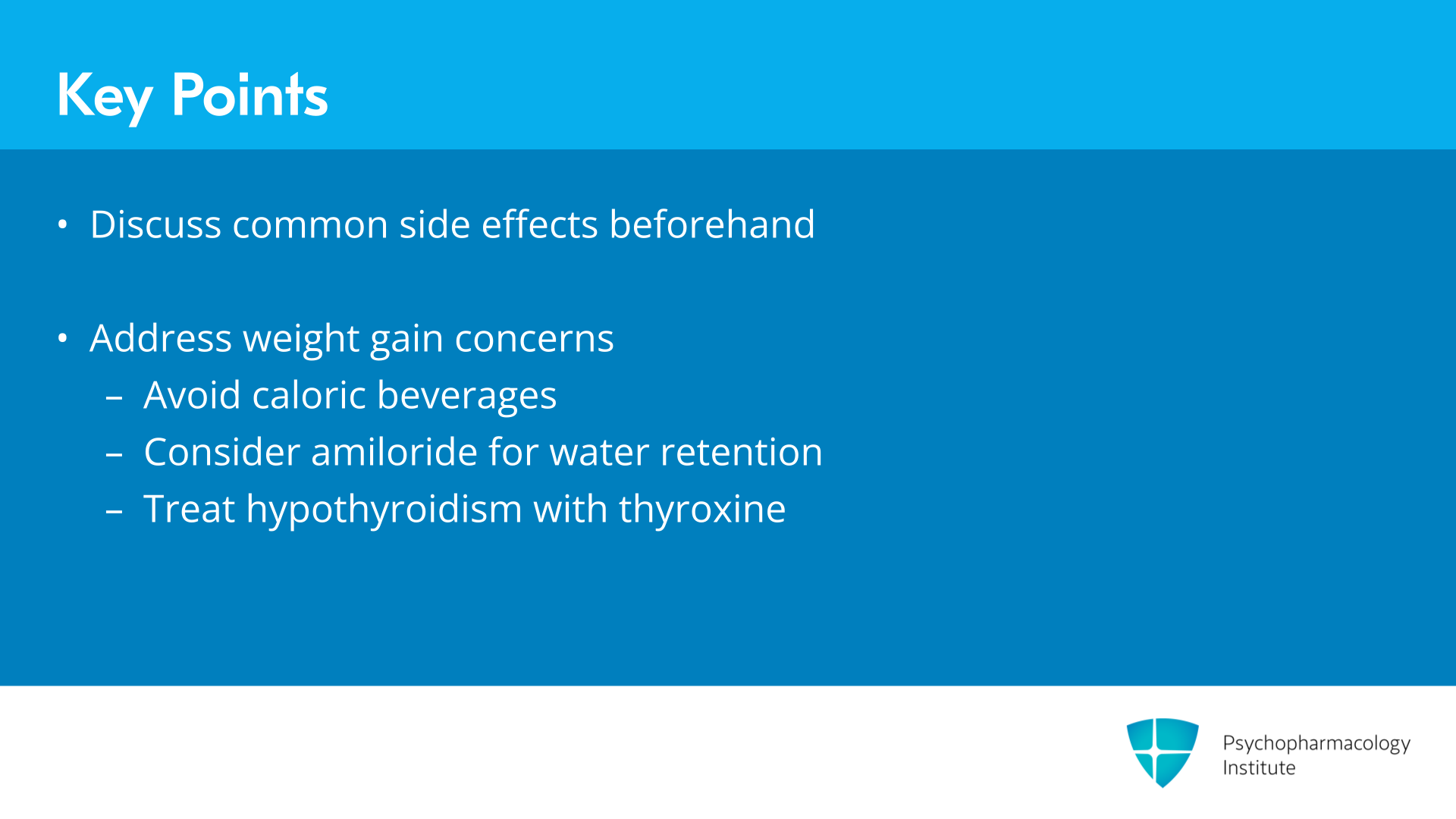
I’ll now summarize the key points which are: Discuss the common side effects of lithium before starting it and reinforce them early to be sure the patient is prepared and ready to execute your remedies before things get out of hand. Weight gain is a common concern of patients. So discuss four possible causes of it before you start your lithium and your plan to prevent them. The plans being drinking caloric beverages to be avoided with the polydipsia. Water retention, what you would do about that? Try a diuretic amiloride. Slowed metabolism from hypothyroidism which comes on more slowly, treat it with thyroxine.
Slide 14 of 15
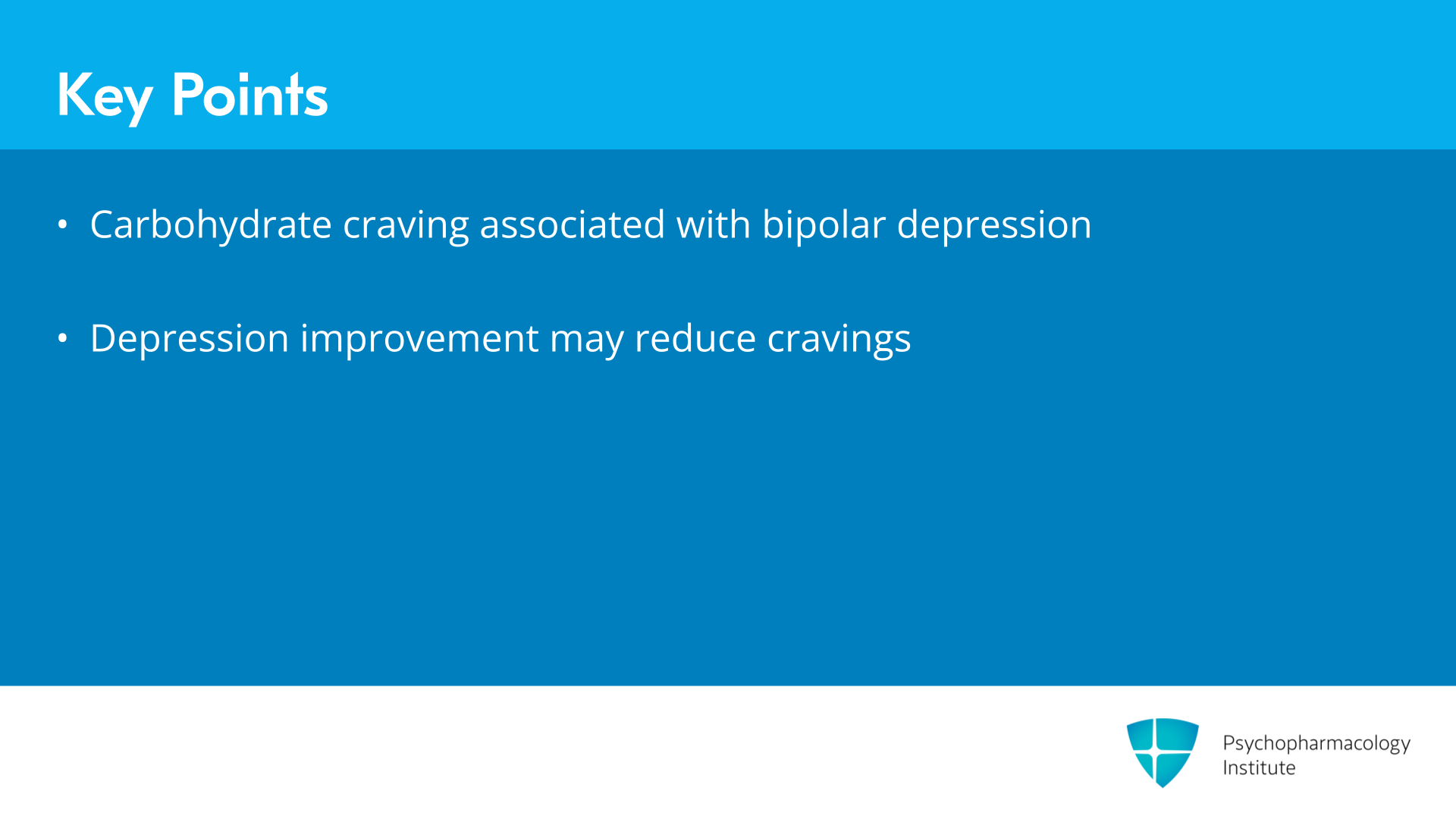
And carbohydrate craving by the way which is often associated with bipolar depressions. Bipolar depressions are often associated with atypical features, specifier which is weight gain and appetite increase when depressed. They’re eating this food to self-medicate and soothe themselves. And sweets are a big form of food that they want to eat when depressed. So by the way, if you can get their depressions better, that in itself will make them less likely to do that. But they may be depressed now and craving the carbohydrates now and so they need to be prepared that that could be worse from the lithium until the lithium and the other treatments you’re giving them start to improve those depressions.
Free Files
Download PDF and other files
Success!
Check your inbox, we sent you all the materials there.
Slide 15 of 15
And the last point about GI side effects is this is one of the few times I might try a distally absorbed preparation of lithium or I might try a proximally absorbed one if it’s vomiting that they’re having which could include lithium citrate, the liquid version.