Close Banner
Section Free  - Video Lectures

06. How to Initiate MAOI Therapy: Steps to Follow

Published on July 1, 2019 Expired on April 1, 2023

Jonathan M. Meyer, M.D.

Assistant Clinical Professor - University of California San Diego

Key Points

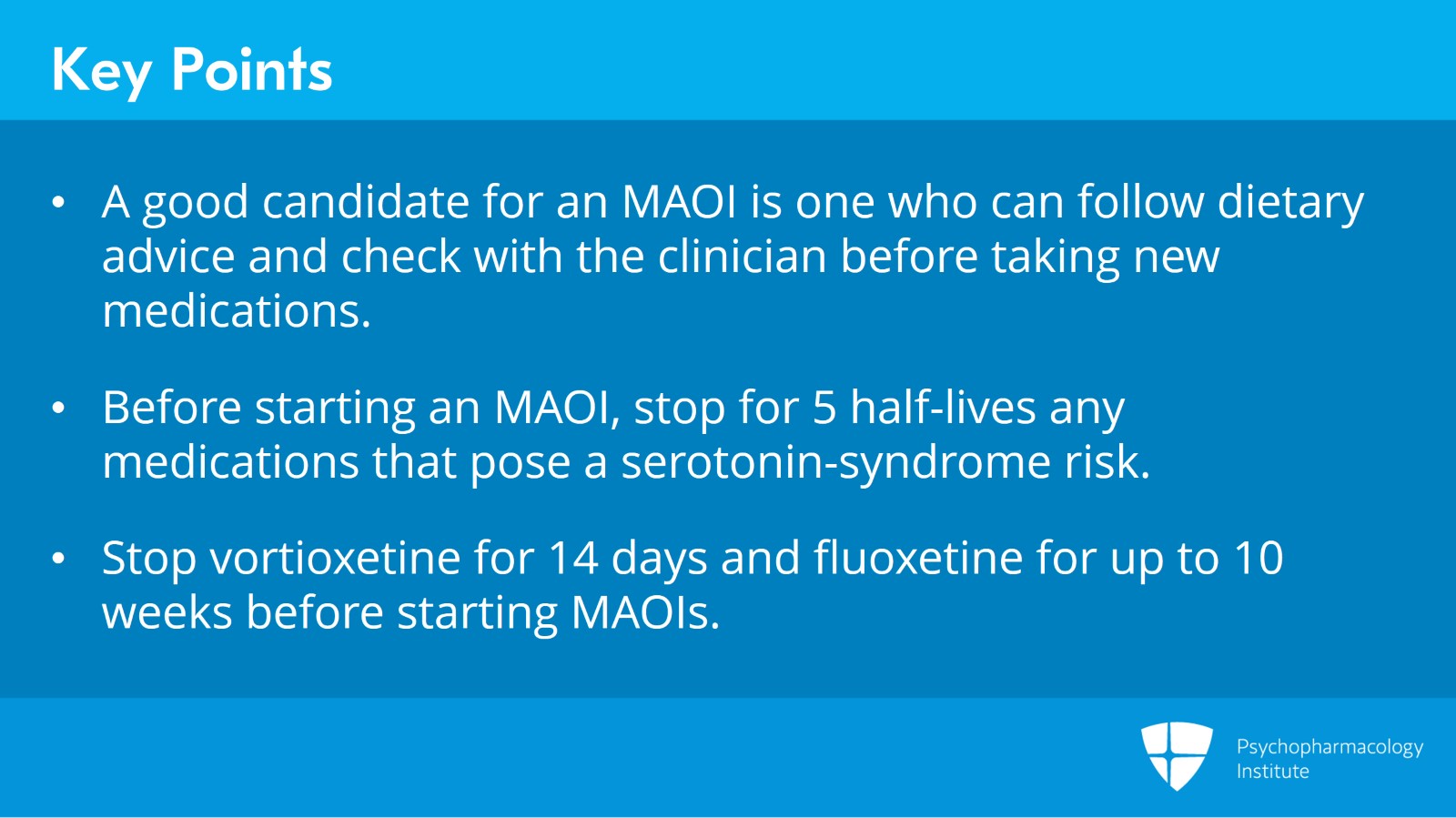
  • A good candidate for an MAOI is someone who can follow the basic dietary advice and who agrees to check with his or her clinician before starting new medications.
  • Medications that pose a risk for serotonin syndrome must be stopped for 5 half-lives before starting an MAOI. For vortioxetine, this translates to 14 days, and for fluoxetine, this may be as long as 10 weeks.
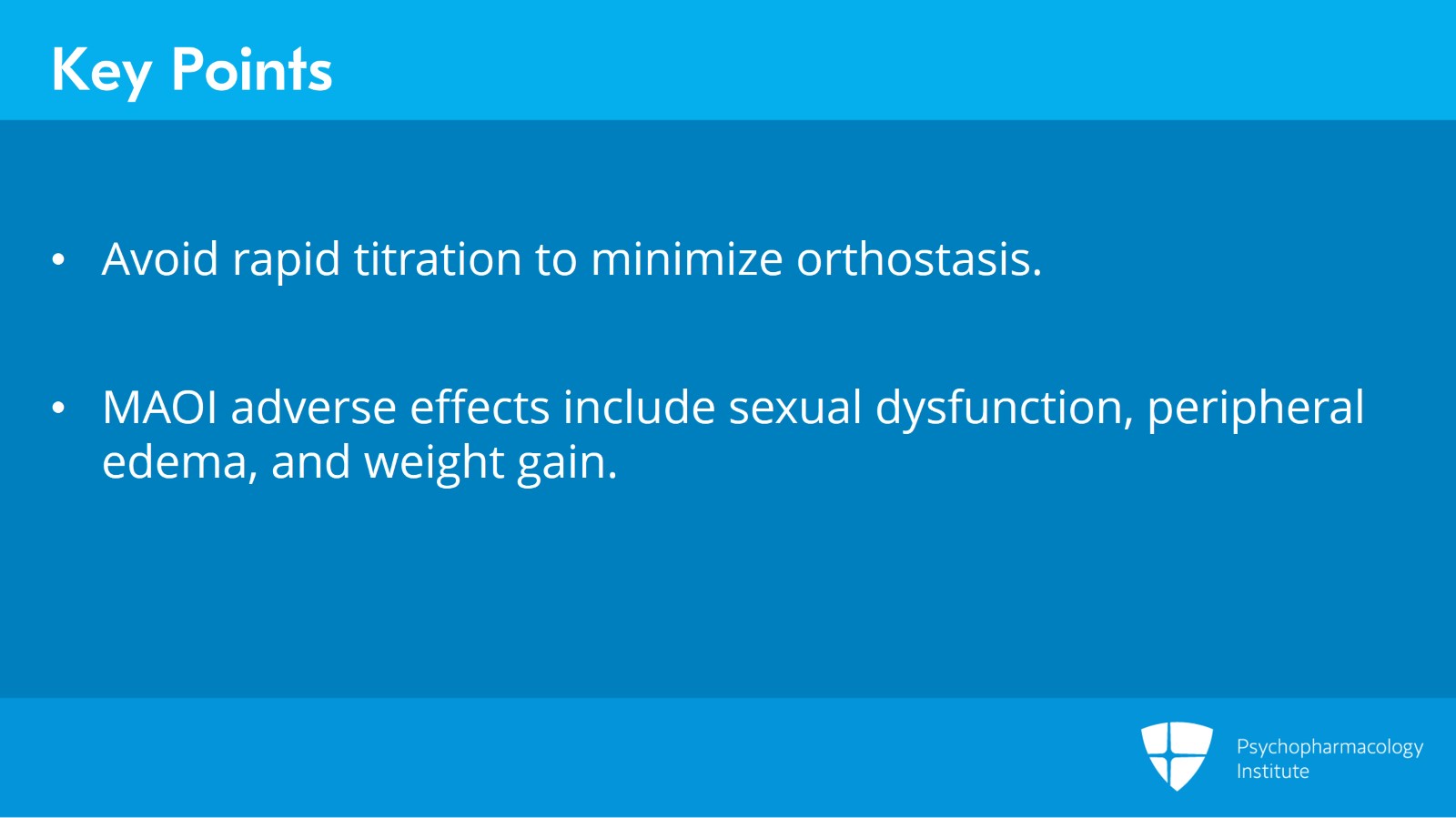
  • Rapid titration should be avoided to minimize the risk of orthostasis. Other reported adverse effects include sexual dysfunction, peripheral edema, and weight gain.

Free Downloads for Offline Access

  • Free Download Audio File (MP3)
  • Free Download Video (MP4)
  • Free Download Presentation File (PPTX)

Slides and Transcript

Slide 1 of 13

Hopefully, the preceding sections have emphasized that the dietary issues are much less stringent than people thought and a little knowledge goes a long way in counseling patients about the dietary restrictions. Now that you understand that the bigger source of risk is serotonin syndrome, we can proceed to give you information about how to initiate somebody on MAOI therapy including patients who are on prior antidepressant treatment.

Slide 2 of 13

The most important issue is that patients who are on contraindicated medications will need to be tapered off prior to beginning MAOI treatment with the duration of washout dependent on the half-life of the medication and any active metabolites. *References*
References:
  • Meyer, J. M. (2018). A concise guide to monoamine oxidase inhibitors: How to avoid drug interactions. Current Psychiatry, 17(1), 22-28, 33.
Free Files
Success!
Check your inbox, we sent you all the materials there.

Slide 3 of 13

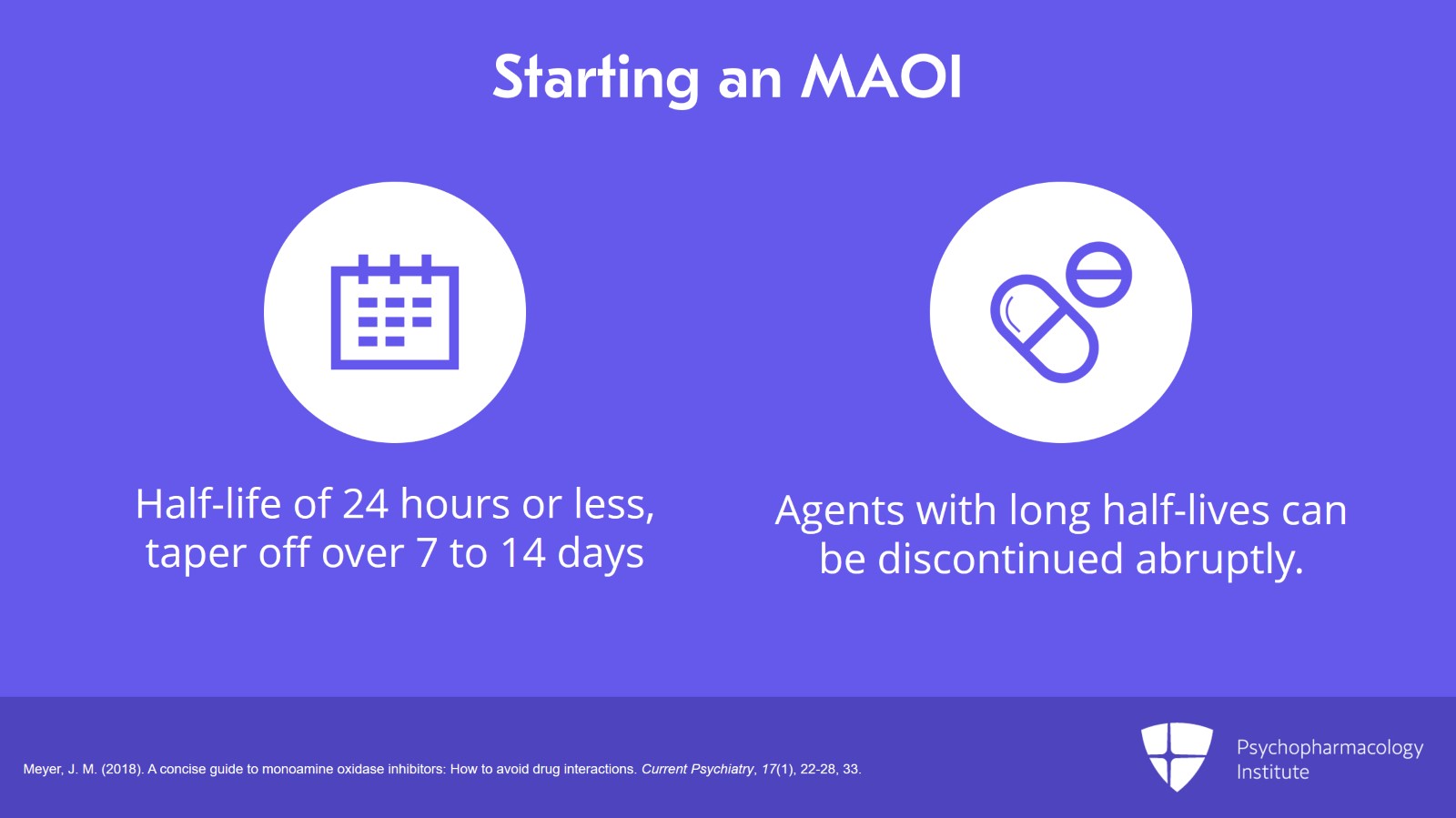
Those antidepressants with half-lives of approximately 24 hours or less should be tapered off over seven to 14 days again depending on dose with the taper adjusted to minimize the risk of withdrawal syndromes. For agents with longer half-lives such as fluoxetine or vortioxetine, these can be discontinued abruptly because they will self-taper. *References*
References:
  • Meyer, J. M. (2018). A concise guide to monoamine oxidase inhibitors: How to avoid drug interactions. Current Psychiatry, 17(1), 22-28, 33.

Slide 4 of 13

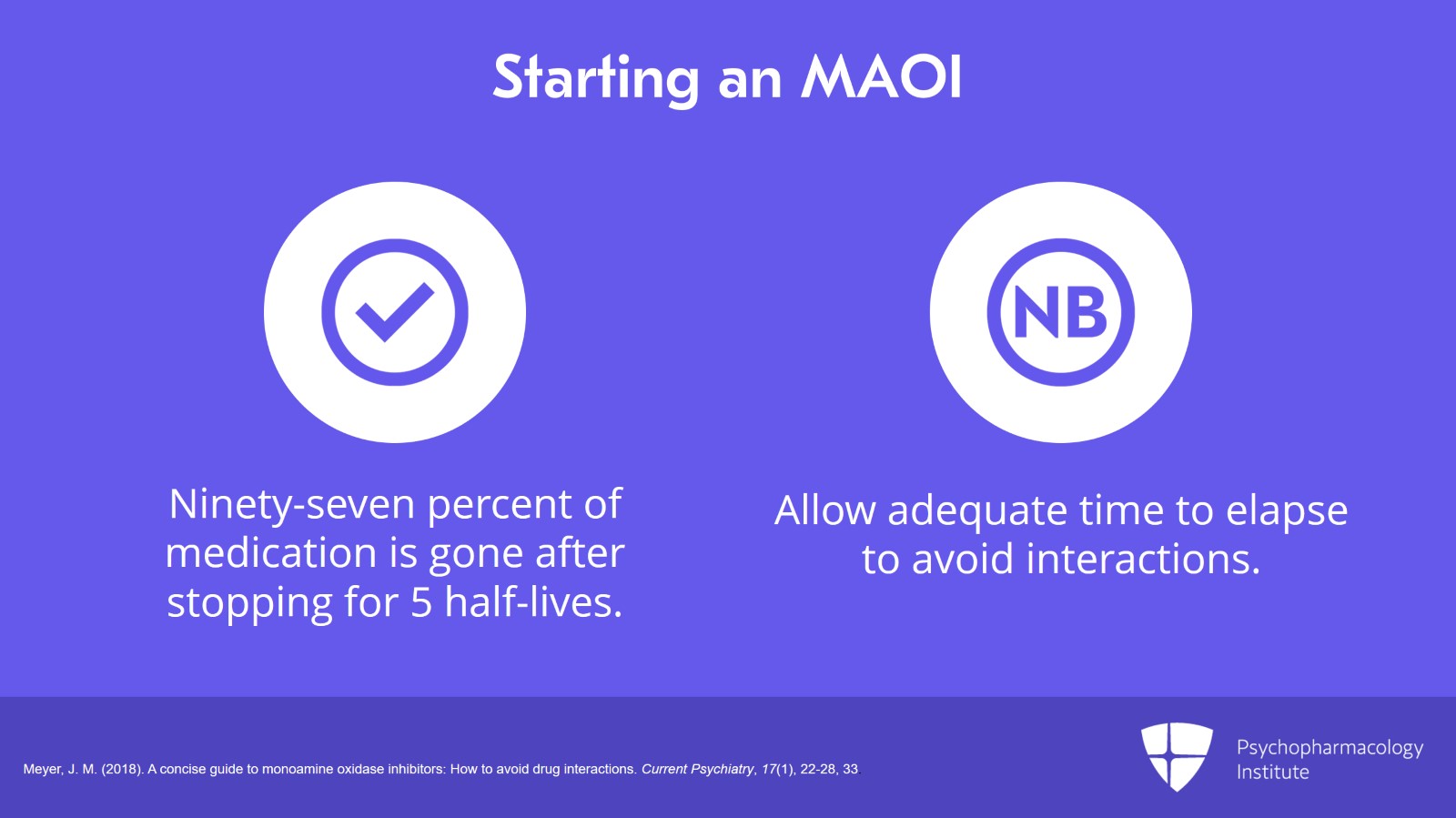
A basic mathematical principle is that after stopping a medication for five half-lives almost 97% of the medication is gone. Most important issue is that you have to allow adequate time to elapse so that there will be no interaction when the MAOI is started. *References*
References:
  • Meyer, J. M. (2018). A concise guide to monoamine oxidase inhibitors: How to avoid drug interactions. Current Psychiatry, 17(1), 22-28, 33.
Free Files
Success!
Check your inbox, we sent you all the materials there.

Slide 5 of 13

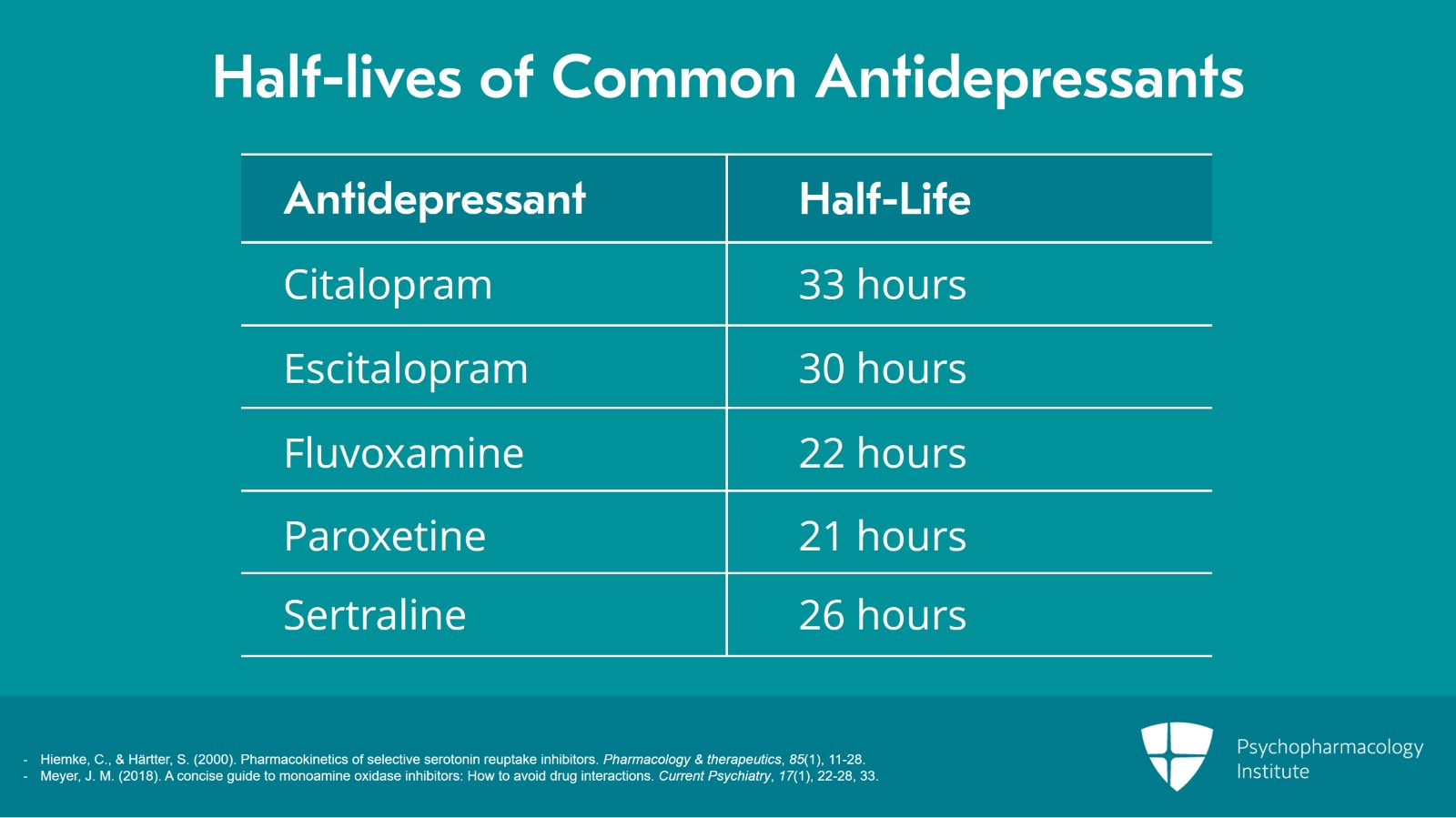
The table here provides the half-lives of commonly used newer antidepressants and any active metabolites or isomers. One should always err on the side of caution before starting the MAOI and also provide the patient with a brief overview of serotonin syndrome symptoms. However, one must be mindful of not extending the patient’s period without effective antidepressant levels. *References*
References:
  • Hiemke, C., & Härtter, S. (2000). Pharmacokinetics of selective serotonin reuptake inhibitors. Pharmacology & therapeutics, 85(1), 11-28.
  • Meyer, J. M. (2018). A concise guide to monoamine oxidase inhibitors: How to avoid drug interactions. Current Psychiatry, 17(1), 22-28, 33.

Slide 6 of 13

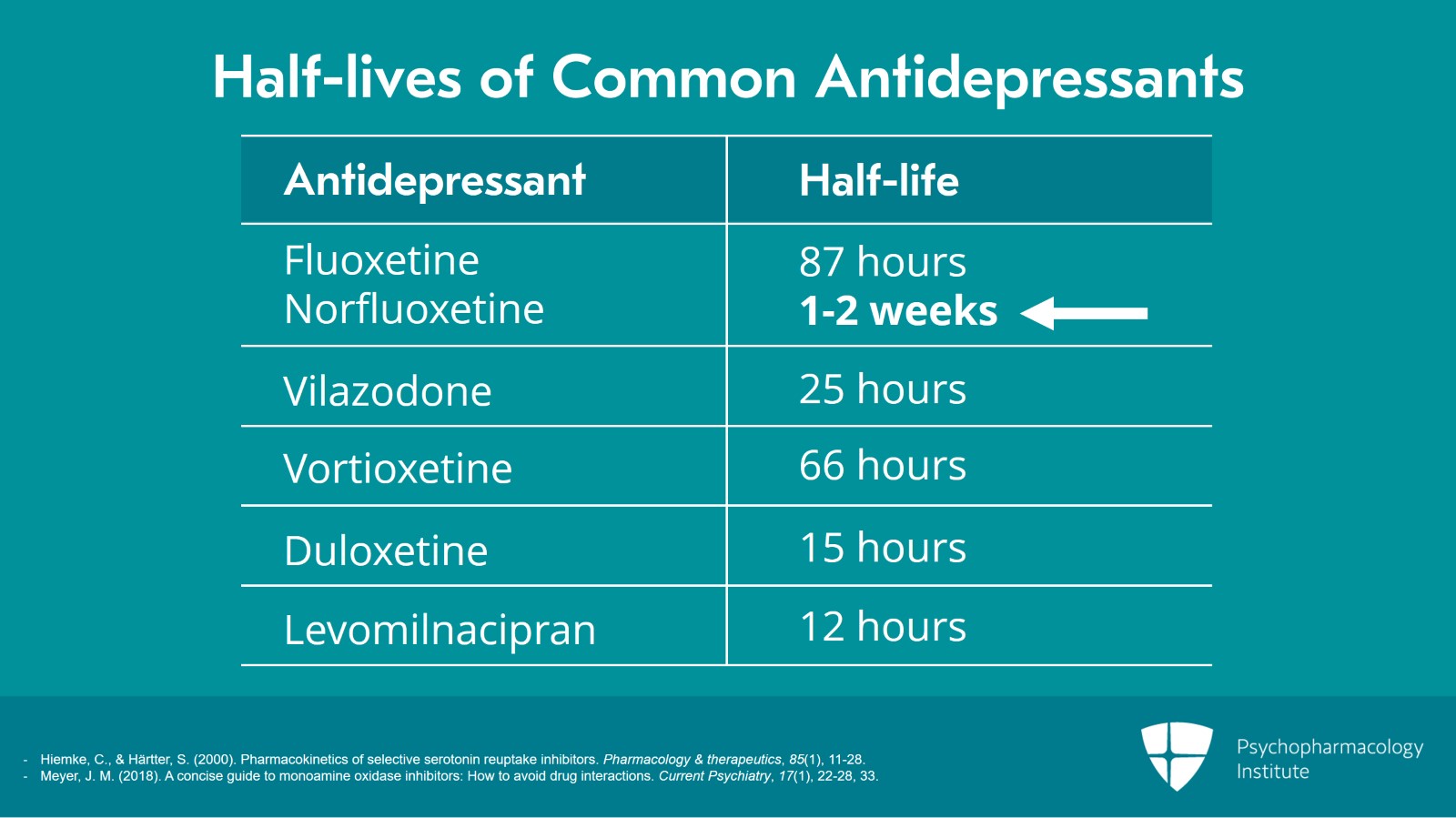
The biggest outlier in all of these of course is fluoxetine. Not only does fluoxetine itself have a half-life of 87 hours, it has an active metabolite, norfluoxetine, which has a half-life of one to two weeks. Often, many clinicians will avoid using fluoxetine because of the prolonged half-life of its metabolite which can interact not only with future MAOIs but other medications as well. *References*
References:
  • Hiemke, C., & Härtter, S. (2000). Pharmacokinetics of selective serotonin reuptake inhibitors. Pharmacology & therapeutics, 85(1), 11-28.
  • Meyer, J. M. (2018). A concise guide to monoamine oxidase inhibitors: How to avoid drug interactions. Current Psychiatry, 17(1), 22-28, 33.
Free Files
Success!
Check your inbox, we sent you all the materials there.

Slide 7 of 13

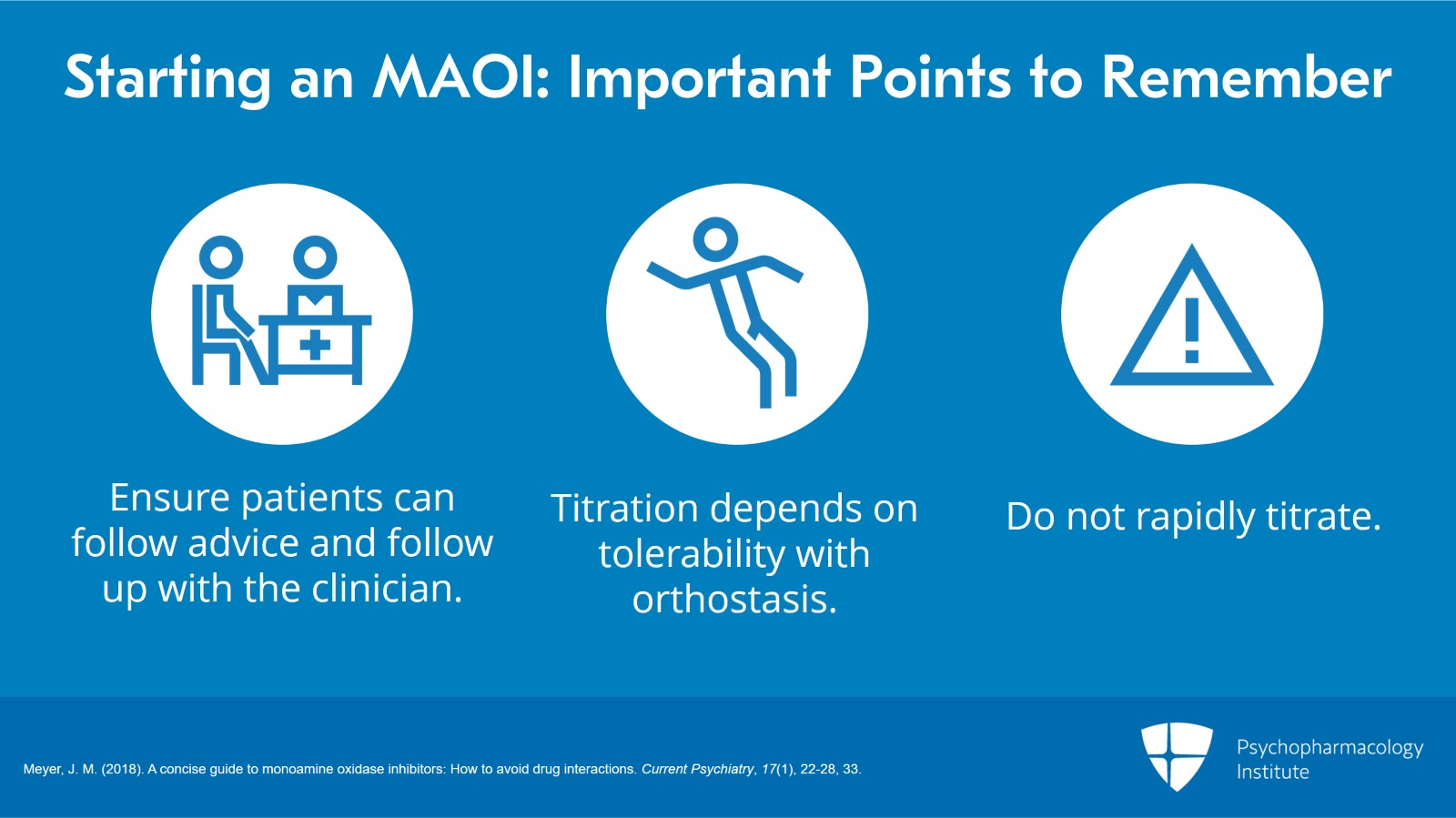
Initiation of an MAOI must always be based on whether the patient can reliably follow the basic dietary advice and agree to check with their clinician before starting any new medications. The titration of MAOIs should proceed based on tolerability with orthostasis being the primary dose-limiting adverse effect with rapid titration. This may be especially true in older patients who have poor vasomotor tone and those on alpha-1 blockers or other agents that may induce orthostasis. The rapid titration schedules present in certain package inserts should not be followed. For example, the Nardil package insert says the initial dose is 15 mg three times a day. It then goes on to say the dosage should be increased to at least 60 mg per day at a fairly rapid pace consistent with patient tolerance. *References*
References:
  • Meyer, J. M. (2018). A concise guide to monoamine oxidase inhibitors: How to avoid drug interactions. Current Psychiatry, 17(1), 22-28, 33.

Slide 8 of 13

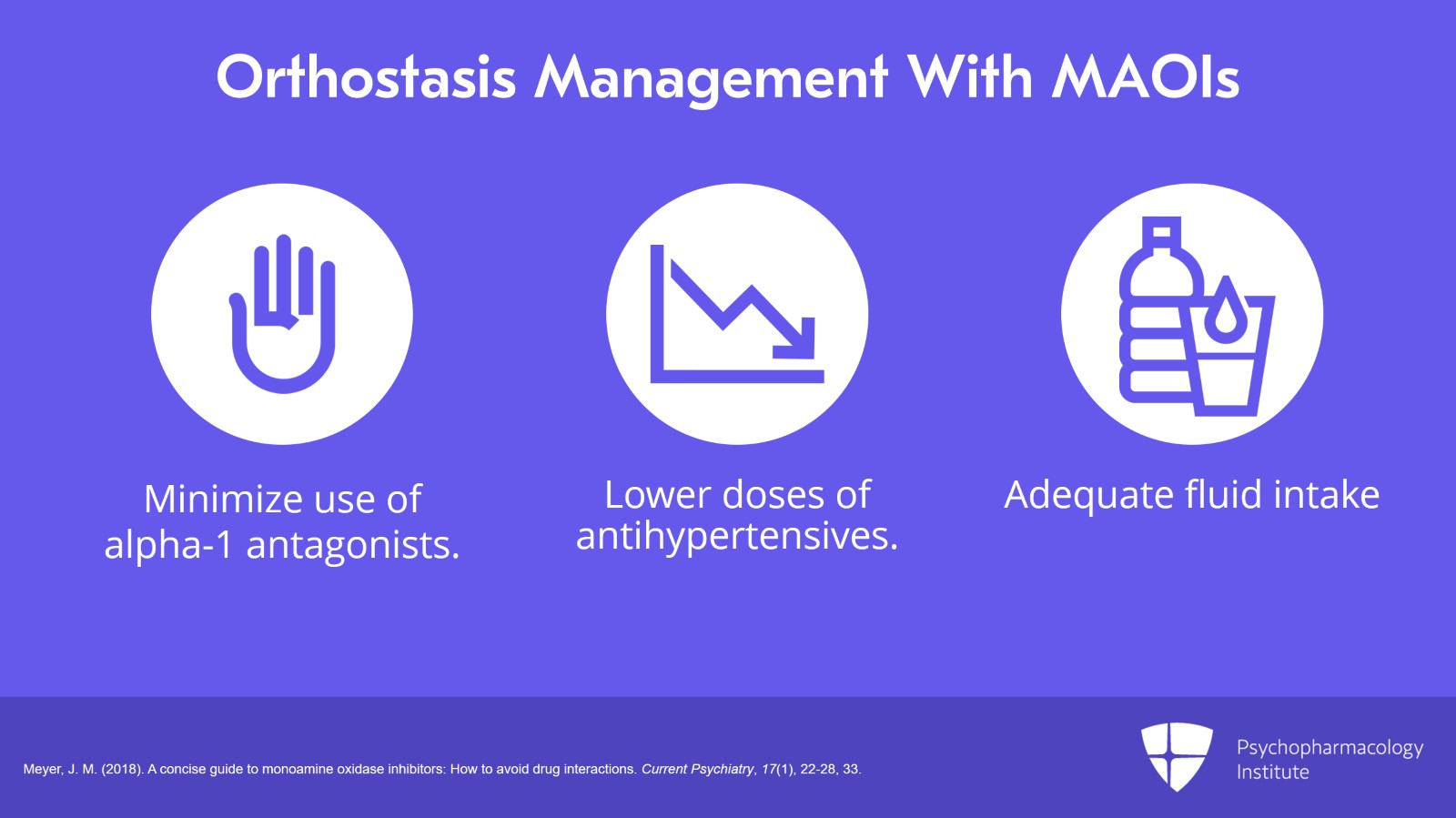
The orthostasis management strategy is very similar to that employed for clozapine, minimize the use of concurrent alpha-1 antagonists, lower doses of antihypertensives as much as possible if the blood pressure starts to drop and encourage adequate fluid intake. *References*
References:
  • Meyer, J. M. (2018). A concise guide to monoamine oxidase inhibitors: How to avoid drug interactions. Current Psychiatry, 17(1), 22-28, 33.
Free Files
Success!
Check your inbox, we sent you all the materials there.

Slide 9 of 13

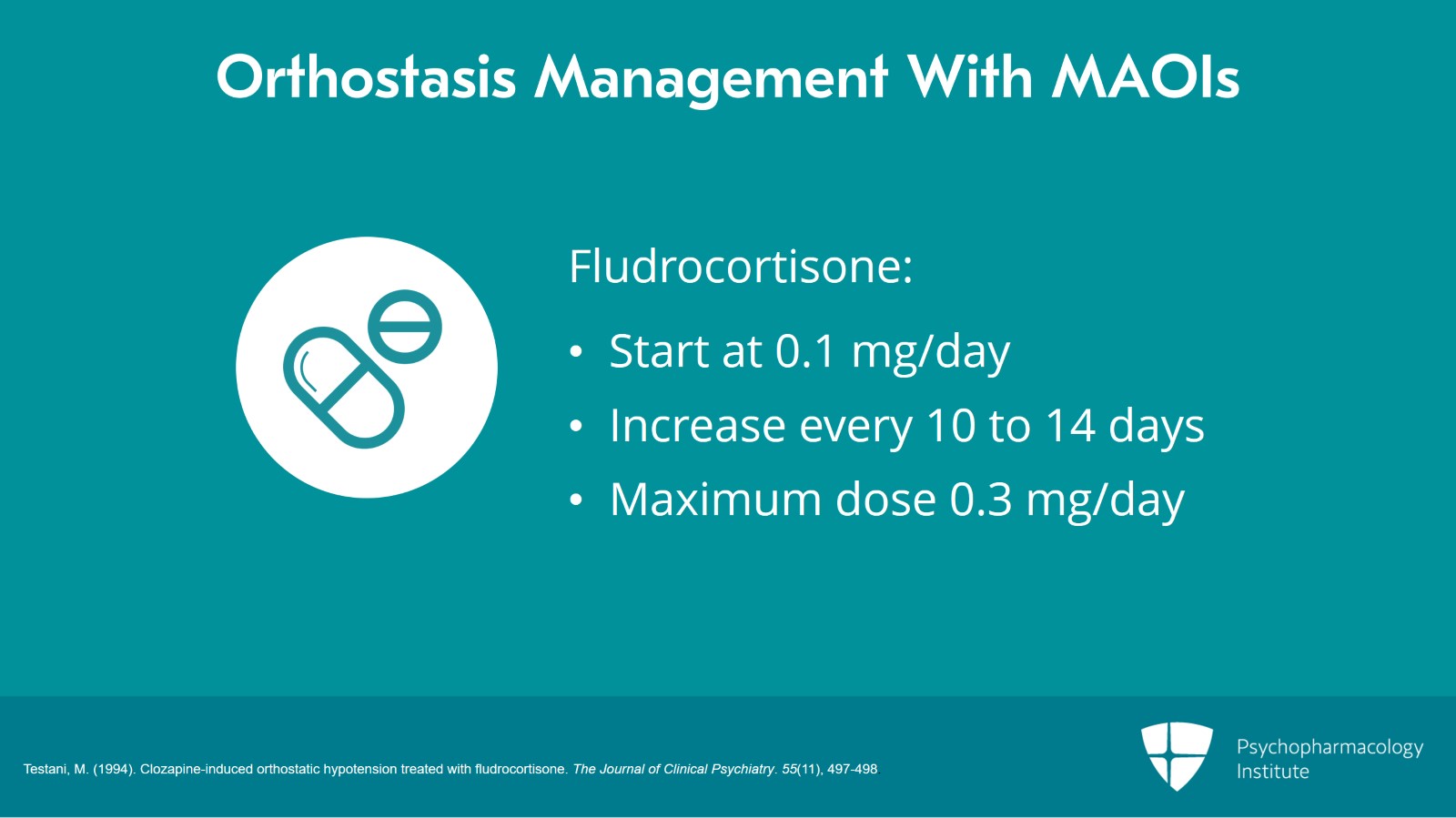
For those who have ongoing orthostasis and don’t have a history of congestive heart failure, one can consider the use of the potent mineralocorticoid, fludrocortisone, starting at 0.1 mg per day and advancing every 10 to 14 days if needed to a maximum of 0.3 mg per day. *References*
References:
  • Testani, M. (1994). Clozapine-induced orthostatic hypotension treated with fludrocortisone. The Journal of Clinical Psychiatry. 55(11), 497-498.

Slide 10 of 13

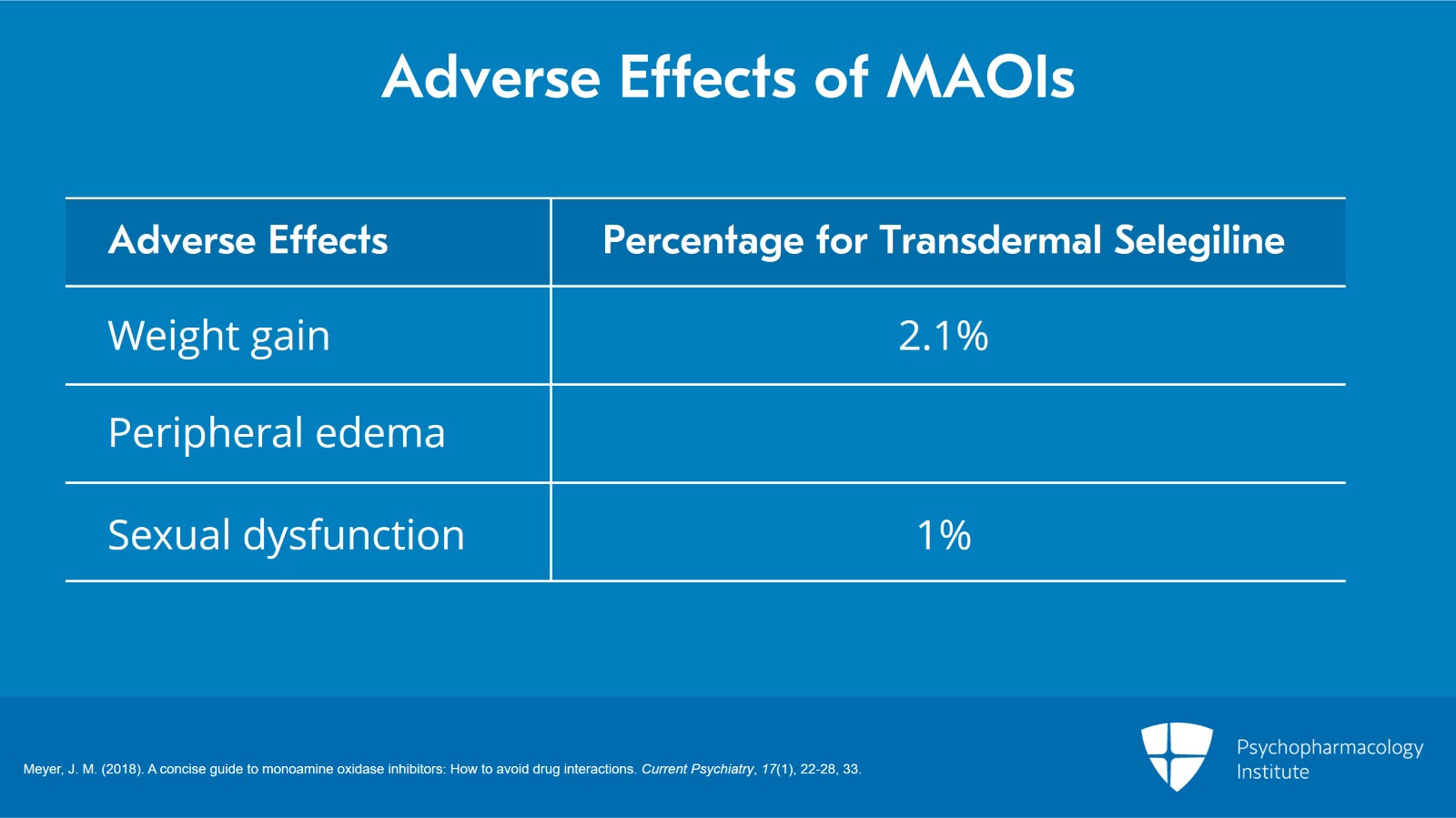
The older literature noted weight gain, peripheral edema and sexual dysfunction as common adverse effects but the most recently studied MAOI, transdermal selegiline, reported rates of these adverse effects as follows in their package insert: So weight gain was 2.1% versus 2.4% for placebo. Sexual dysfunction was up to 1% versus 0.4% for placebo. *References*
References:
  • Meyer, J. M. (2018). A concise guide to monoamine oxidase inhibitors: How to avoid drug interactions. Current Psychiatry, 17(1), 22-28, 33.
Free Files
Success!
Check your inbox, we sent you all the materials there.

Slide 11 of 13

Key points are that a good candidate for an MAOI is someone who can follow the basic dietary advice and who agrees to check with the clinician before starting any new medications. Medications that pose a risk for serotonin syndrome must be stopped for five half-lives before starting an MAOI. For vortioxetine, this translates to 14 days and for fluoxetine, this may be as long as 10 weeks due to the very long half-life of the active metabolite, norfluoxetine.

Slide 12 of 13

Rapid titration should be avoided to minimize the risk for orthostasis. Other reported adverse effects include sexual dysfunction, peripheral edema and weight gain. 12
Free Files
Success!
Check your inbox, we sent you all the materials there.

Slide 13 of 13

Learning Objectives:

After completing this activity, the learner will be able to:

  1. Identify MAOIs as useful antidepressants in order to prescribe them when needed.
  2. Summarize important drug interactions with MAOIs and their possible consequences.

Original Release Date: July 1, 2019

Review and Re-release Date: March 1, 2023

Expiration Date: April 1, 2023

Relevant Financial Disclosures: 

Jonathan Meyer declares the following interests:

- Acadia:  Advisory committee, speaking

- Allergan:  Advisory committee, speaking

- Alkermes:  Advisory committee, speaking

- Intra-Cellular Therapies:  Advisory committee

- Janssen Pharmaceutica:  Speaking

- Merck:  Speaking

- Neurocrine:  Advisory committee, speaking

- Otsuka America, Inc.:  Speaking

- Sunovion Pharmaceuticals:  Speaking

- Acadia:  Advisory board, speaking

- Allergan:  Advisory board, speaking

- Alkermes:  Advisory board, speaking

- Intra-cellular:  Advisory board

All of the relevant financial relationships listed for these individuals have been mitigated.

Contact Information: For questions regarding the content or access to this activity, contact us at support@psychopharmacologyinstitute.com

Instructions for Participation and Credit:

Participants must complete the activity online during the valid credit period that is noted above.

Follow these steps to earn CME credit:

  1. View the required educational content provided on this course page.

  2. Answer the quiz for promoting retention of knowledge.

  3. Complete the Post Activity Evaluation for providing the necessary feedback for continuing accreditation purposes and for the development of future activities. NOTE: Completing the Post Activity Evaluation after the quiz is required to receive the earned credit.

  4. Download your certificate.

Accreditation Statement

This activity has been planned and implemented in accordance with the accreditation requirements and policies of the Accreditation Council for Continuing Medical Education through the joint providership of Medical Academy LLC and the Psychopharmacology Institute. Medical Academy is accredited by the ACCME to provide continuing medical education for physicians.

Credit Designation Statement

Medical Academy designates this enduring activity for a maximum of 0.75 AMA PRA Category 1 credit(s)™. Physicians should claim only the credit commensurate with the extent of their participation in the activity.


Free Files
Success!
Check your inbox, we sent you all the materials there.
Continue in the website
Instant access modal

Become a Bronze, Silver, Gold, Bronze extended, Silver extended or Gold extended Member.

2025–26 Psychopharmacology CME Program

Unlock up to 155 CME Credits, including 40 SA CME Credits.