Slides and Transcript
Slide 1 of 19
So let's talk about what we know about the effects on the brain with psychedelics.
Slide 2 of 19
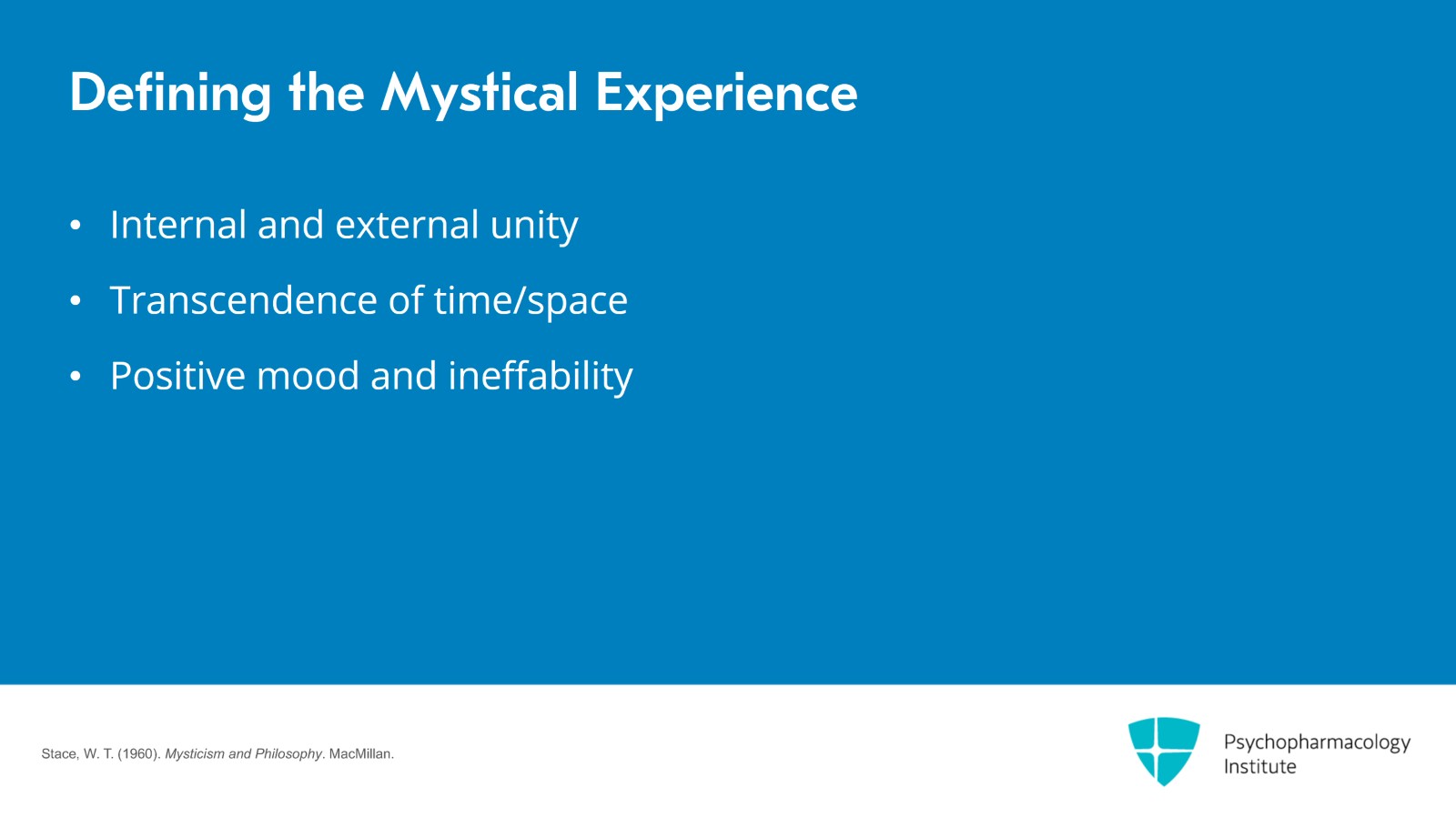
But before talking about the brain, I want to talk about psychedelics and the mystical experience. So the mystical experience has been defined as these cardinal attributes which I've listed here – internal unity, external unity, transcendence of time and space, ineffability, sense of sacredness or awe, noetic quality and deeply felt positive mood.
References:
- Stace, W. T. (1960). Mysticism and Philosophy. MacMillan.
Free Files
Download PDF and other files
Success!
Check your inbox, we sent you all the materials there.
Slide 3 of 19
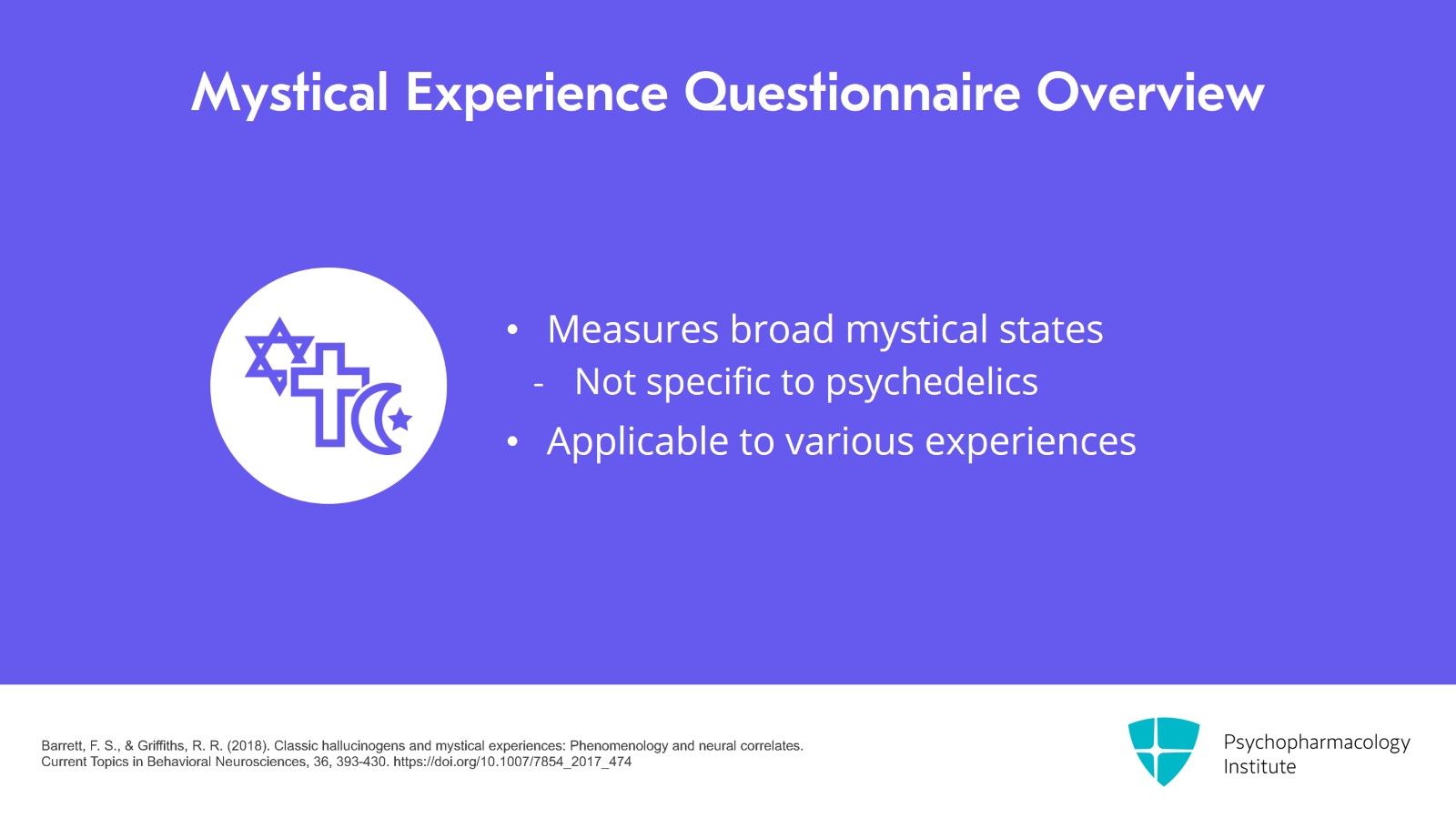
So this was not a measure that was designed to measure psychedelics. This is the Mystical Experience Questionnaire and the attributes and factors that it looks at. This was designed to measure more broadly these mystical states that can be very difficult to describe that can occur not just from psychedelics but in settings of deep meditation, ecstatic dance, religious conversion experiences, all of these things.
References:
- Barrett, F. S., & Griffiths, R. R. (2018). Classic hallucinogens and mystical experiences: Phenomenology and neural correlates. Current Topics in Behavioral Neurosciences, 36, 393-430. https://doi.org/10.1007/7854_2017_474
Slide 4 of 19
The therapeutic effects of psychedelics have been correlated with the degree to which the person had a mystical experience. And this is measured in the Mystical Experience Questionnaire, which I mentioned two segments ago. So the higher the score on the Mystical Experience Questionnaire, the greater the clinical improvement. And this is one of the major areas of focus of the group at Johns Hopkins.
References:
- Barrett, F. S., & Griffiths, R. R. (2018). Classic hallucinogens and mystical experiences: Phenomenology and neural correlates. Current Topics in Behavioral Neurosciences, 36, 393-430. https://doi.org/10.1007/7854_2017_474
Free Files
Download PDF and other files
Success!
Check your inbox, we sent you all the materials there.
Slide 5 of 19
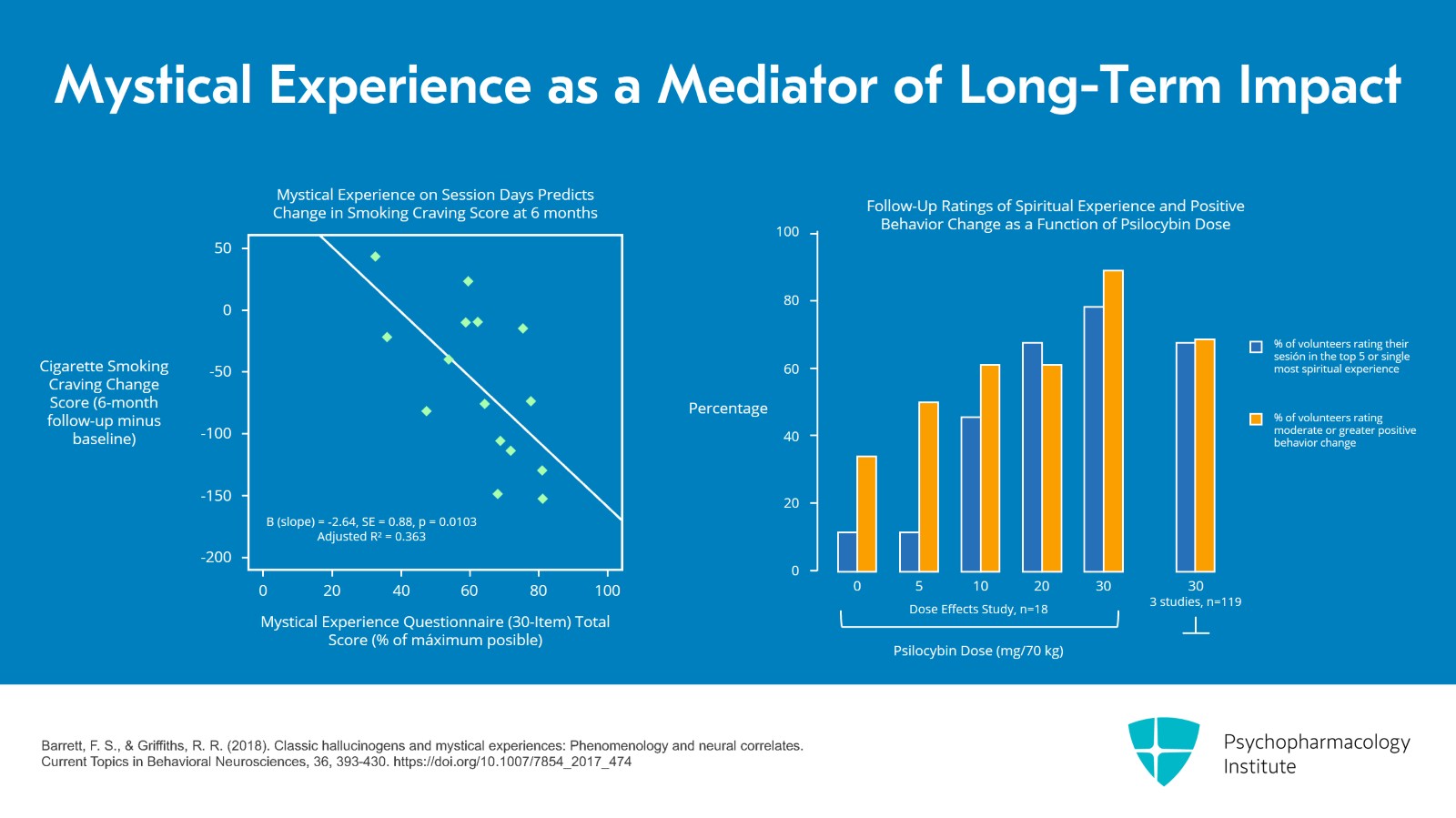
On the left here, you're seeing how the MEQ correlated with reductions in craving. This was a smoking cessation study. So they were given psilocybin and people who had higher scores on the MEQ ended up having lower cravings in the setting of that study. On the right, this was a study looking at anxiety and depression associated with terminal cancer, another Johns Hopkins study and this is showing that mystical experience on the session days predicts reductions in anxiety five weeks post psilocybin.
References:
- Barrett, F. S., & Griffiths, R. R. (2018). Classic hallucinogens and mystical experiences: Phenomenology and neural correlates. Current Topics in Behavioral Neurosciences, 36, 393-430. https://doi.org/10.1007/7854_2017_474
Slide 6 of 19
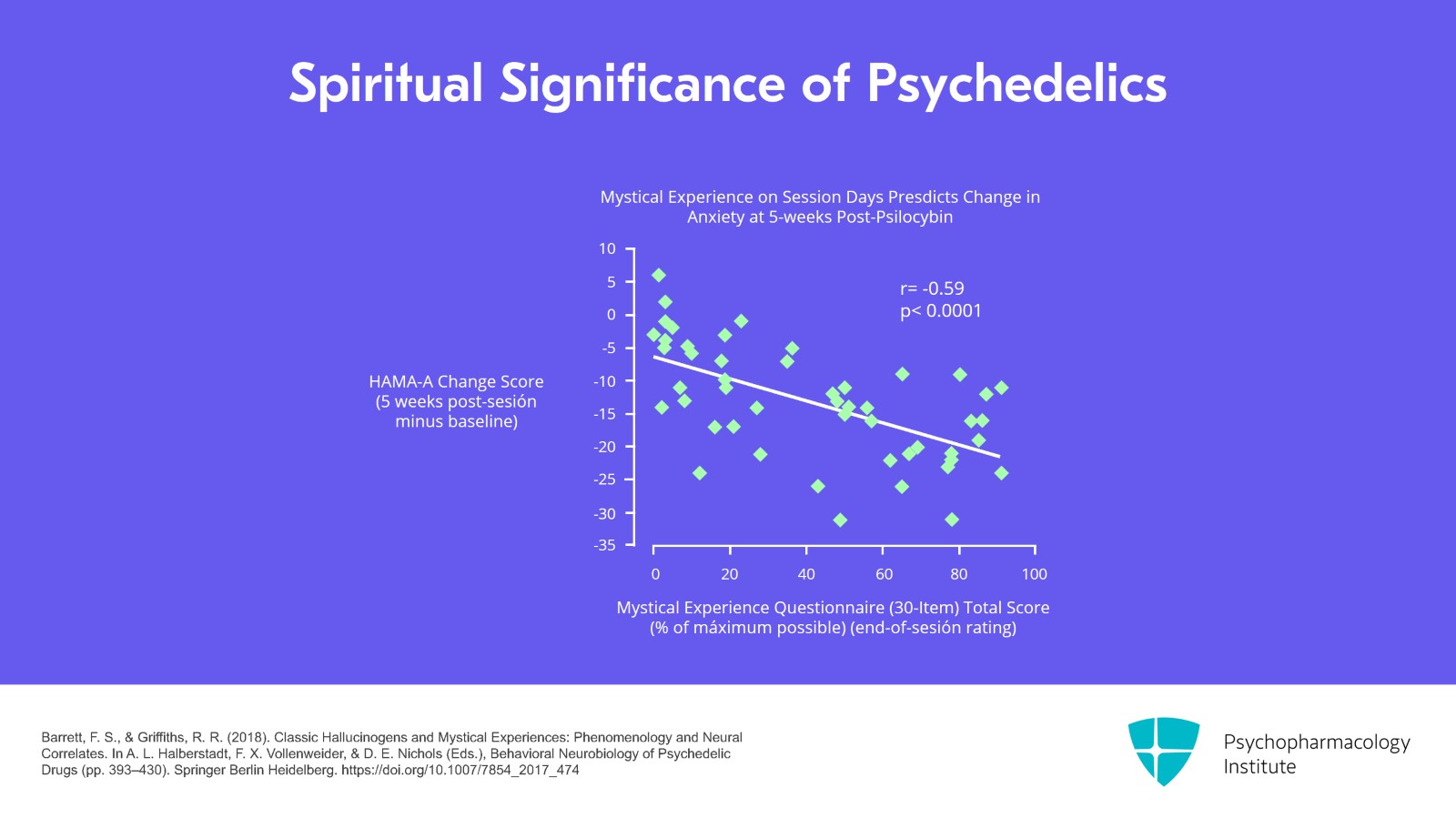
And this is a study of healthy volunteers, another Johns Hopkins study, showing a very large percentage of participants reported that their psilocybin session was in the top 5 most spiritual experiences of their lives. And I should've mentioned that this was a study of people who were religious practitioners. They had to have a daily religious or spiritual practice. So for them to say this indicates I think something very significant that's happening here.
References:
- Barrett, F. S., & Griffiths, R. R. (2018). Classic Hallucinogens and Mystical Experiences: Phenomenology and Neural Correlates. In A. L. Halberstadt, F. X. Vollenweider, & D. E. Nichols (Eds.), Behavioral Neurobiology of Psychedelic Drugs (pp. 393–430). Springer Berlin Heidelberg. https://doi.org/10.1007/7854_2017_474
Free Files
Download PDF and other files
Success!
Check your inbox, we sent you all the materials there.
Slide 7 of 19
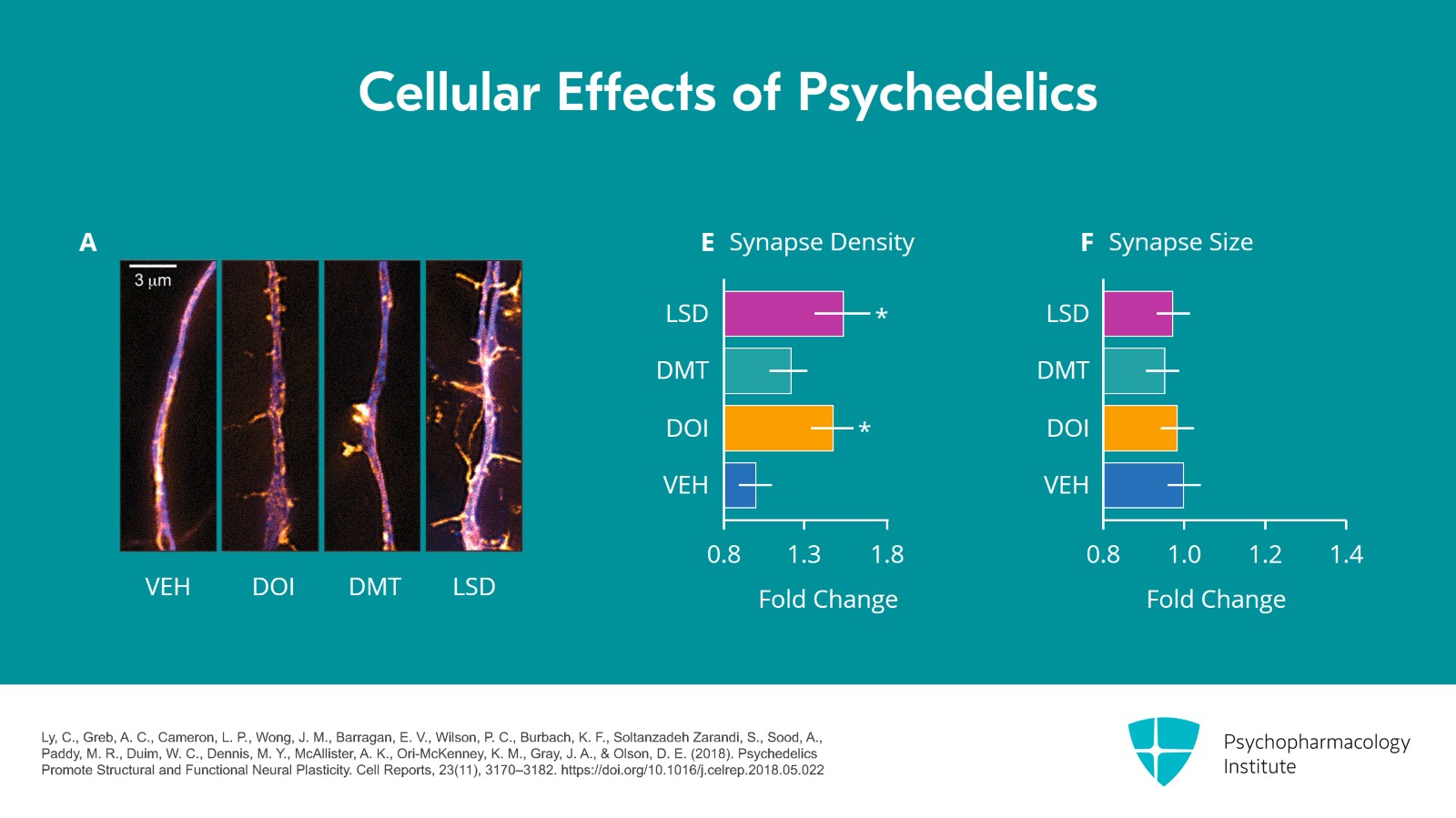
But I want to switch into the petri dish. So as I mentioned, psychedelics promote neuroplasticity. So this is a very interesting study published in 2018 showing individual neurons exposed to three different psychedelics as well as a control. So the VEH just stands for vehicular control. It's the inert substance. DOI is a long-acting psychedelic that I haven't mentioned. It's only used in research. But what you can see is that there is a major change or major presence at least in this but this was a pre and post study in the growth of dendritic spines. So I believe the yellow or gold coloring there is actually a marker for synaptic proteins. And so you can see that there's a growth from all three psychedelics following exposure that was not seen in the controls.
References:
- Ly, C., Greb, A. C., Cameron, L. P., Wong, J. M., Barragan, E. V., Wilson, P. C., Burbach, K. F., Soltanzadeh Zarandi, S., Sood, A., Paddy, M. R., Duim, W. C., Dennis, M. Y., McAllister, A. K., Ori-McKenney, K. M., Gray, J. A., & Olson, D. E. (2018). Psychedelics Promote Structural and Functional Neural Plasticity. Cell Reports, 23(11), 3170–3182. https://doi.org/10.1016/j.celrep.2018.05.022
Slide 8 of 19
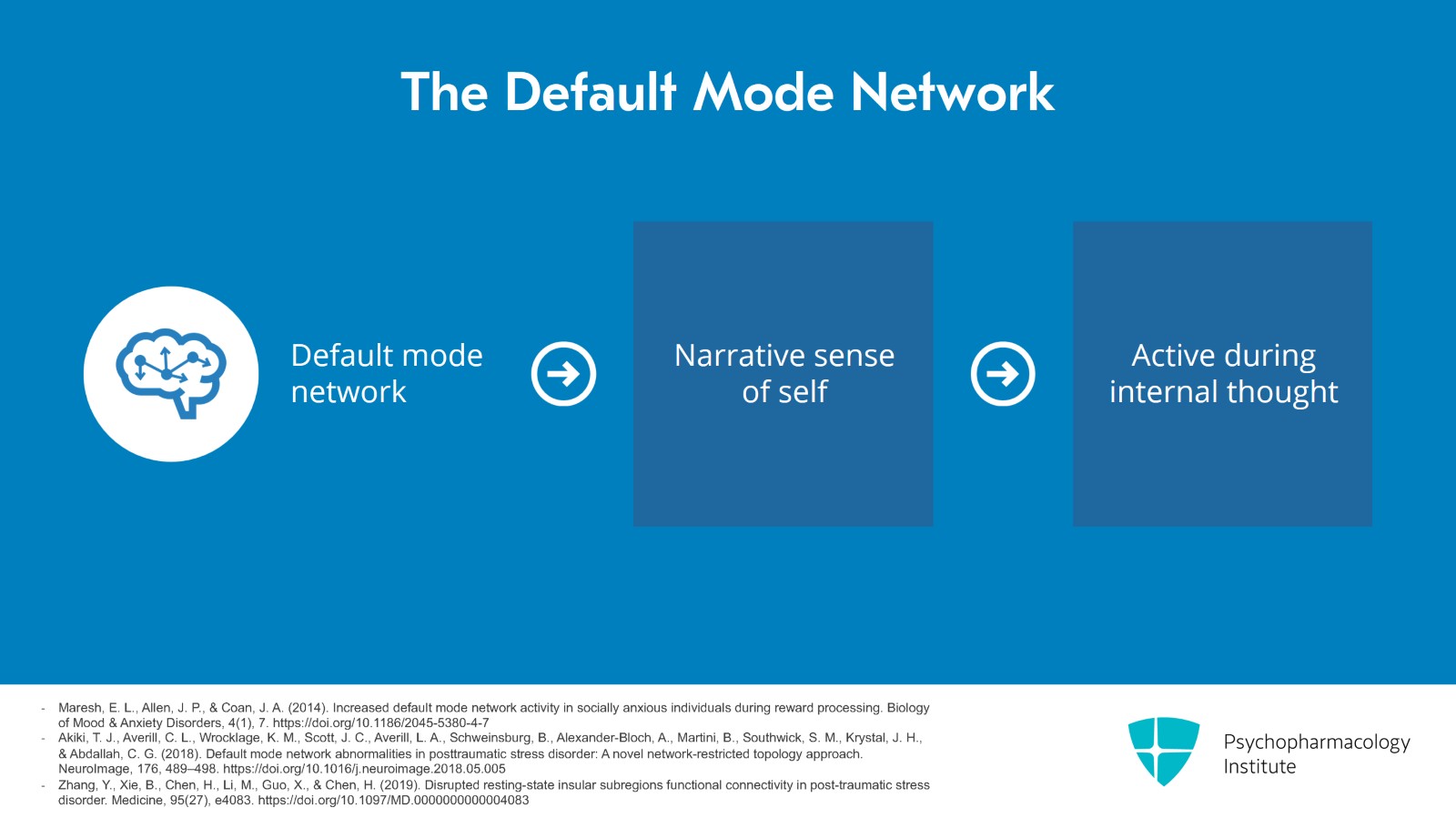
Now, zooming out of the petri dish into more network level aspects of the brain. When we talk about networks, we're talking about different anatomical regions that often are not contiguous geographically with each other in the brain but they are wired together to perform specific tasks. And one of these networks is the default mode network which in normal states the default mode network is involved with our narrative sense of self. It turns on when we're daydreaming, when we're engaged in internally directed thought is when the default mode network is most active.
References:
- Maresh, E. L., Allen, J. P., & Coan, J. A. (2014). Increased default mode network activity in socially anxious individuals during reward processing. Biology of Mood & Anxiety Disorders, 4(1), 7. https://doi.org/10.1186/2045-5380-4-7
- Akiki, T. J., Averill, C. L., Wrocklage, K. M., Scott, J. C., Averill, L. A., Schweinsburg, B., Alexander-Bloch, A., Martini, B., Southwick, S. M., Krystal, J. H., & Abdallah, C. G. (2018). Default mode network abnormalities in posttraumatic stress disorder: A novel network-restricted topology approach. NeuroImage, 176, 489–498. https://doi.org/10.1016/j.neuroimage.2018.05.005
- Zhang, Y., Xie, B., Chen, H., Li, M., Guo, X., & Chen, H. (2019). Disrupted resting-state insular subregions functional connectivity in post-traumatic stress disorder. Medicine, 95(27), e4083. https://doi.org/10.1097/MD.0000000000004083
Free Files
Download PDF and other files
Success!
Check your inbox, we sent you all the materials there.
Slide 9 of 19
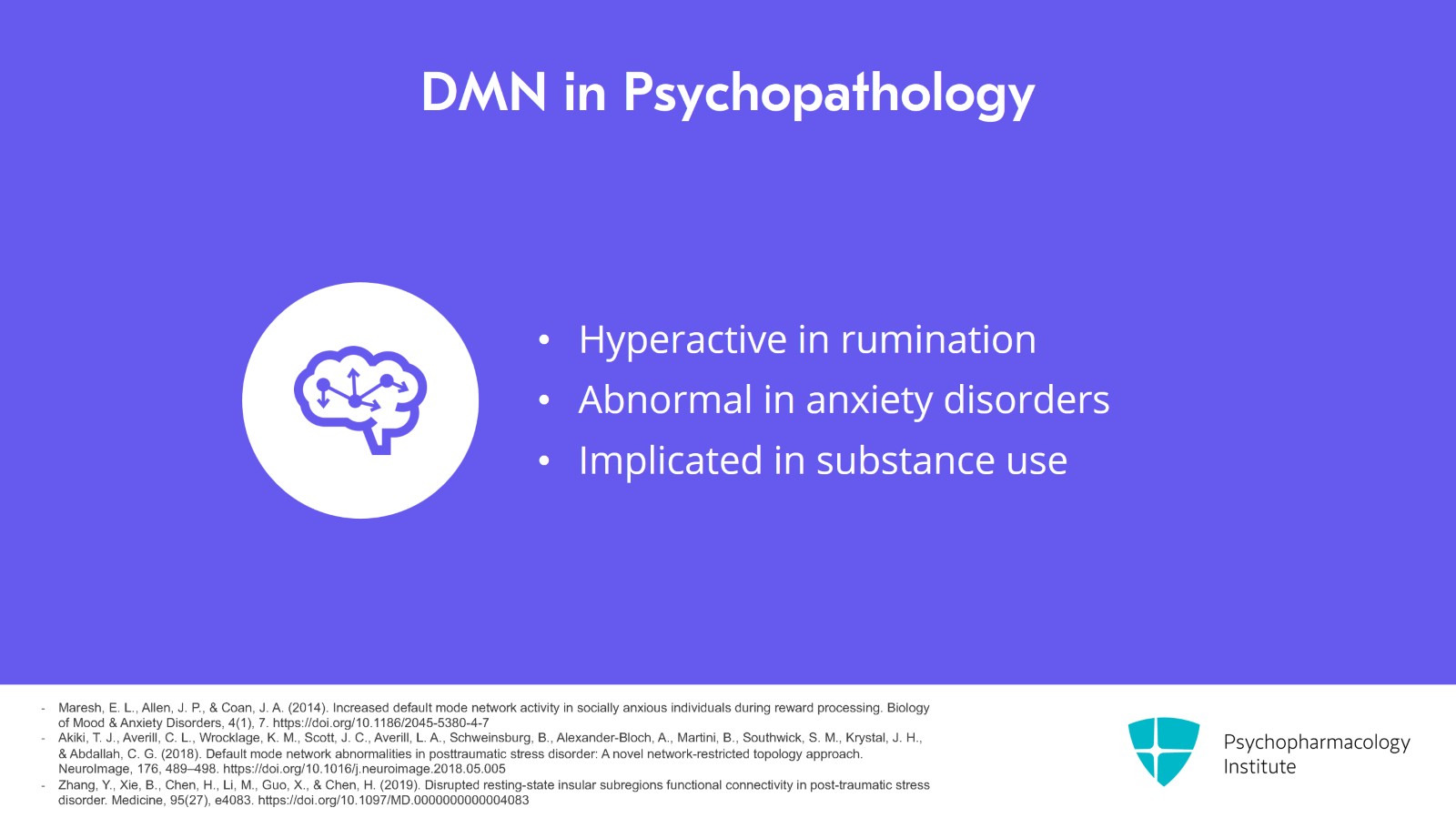
And unsurprisingly, this is a network that's been implicated in a variety of psychopathological conditions. So we know that it's more active or dysfunctional in rumination which of course is repetitive and negative self-directed thoughts. Abnormal activation patterns are seen in anxiety disorders. There's decreased global integrity of the default mode network which has been correlated with PTSD severity. And it's also implicated in reduction in executive function in substance use or decreased attention to the consequences of relapsing, obeying the impulse of craving, etc.
References:
- Maresh, E. L., Allen, J. P., & Coan, J. A. (2014). Increased default mode network activity in socially anxious individuals during reward processing. Biology of Mood & Anxiety Disorders, 4(1), 7. https://doi.org/10.1186/2045-5380-4-7
- Akiki, T. J., Averill, C. L., Wrocklage, K. M., Scott, J. C., Averill, L. A., Schweinsburg, B., Alexander-Bloch, A., Martini, B., Southwick, S. M., Krystal, J. H., & Abdallah, C. G. (2018). Default mode network abnormalities in posttraumatic stress disorder: A novel network-restricted topology approach. NeuroImage, 176, 489–498. https://doi.org/10.1016/j.neuroimage.2018.05.005
- Zhang, Y., Xie, B., Chen, H., Li, M., Guo, X., & Chen, H. (2019). Disrupted resting-state insular subregions functional connectivity in post-traumatic stress disorder. Medicine, 95(27), e4083. https://doi.org/10.1097/MD.0000000000004083
Slide 10 of 19
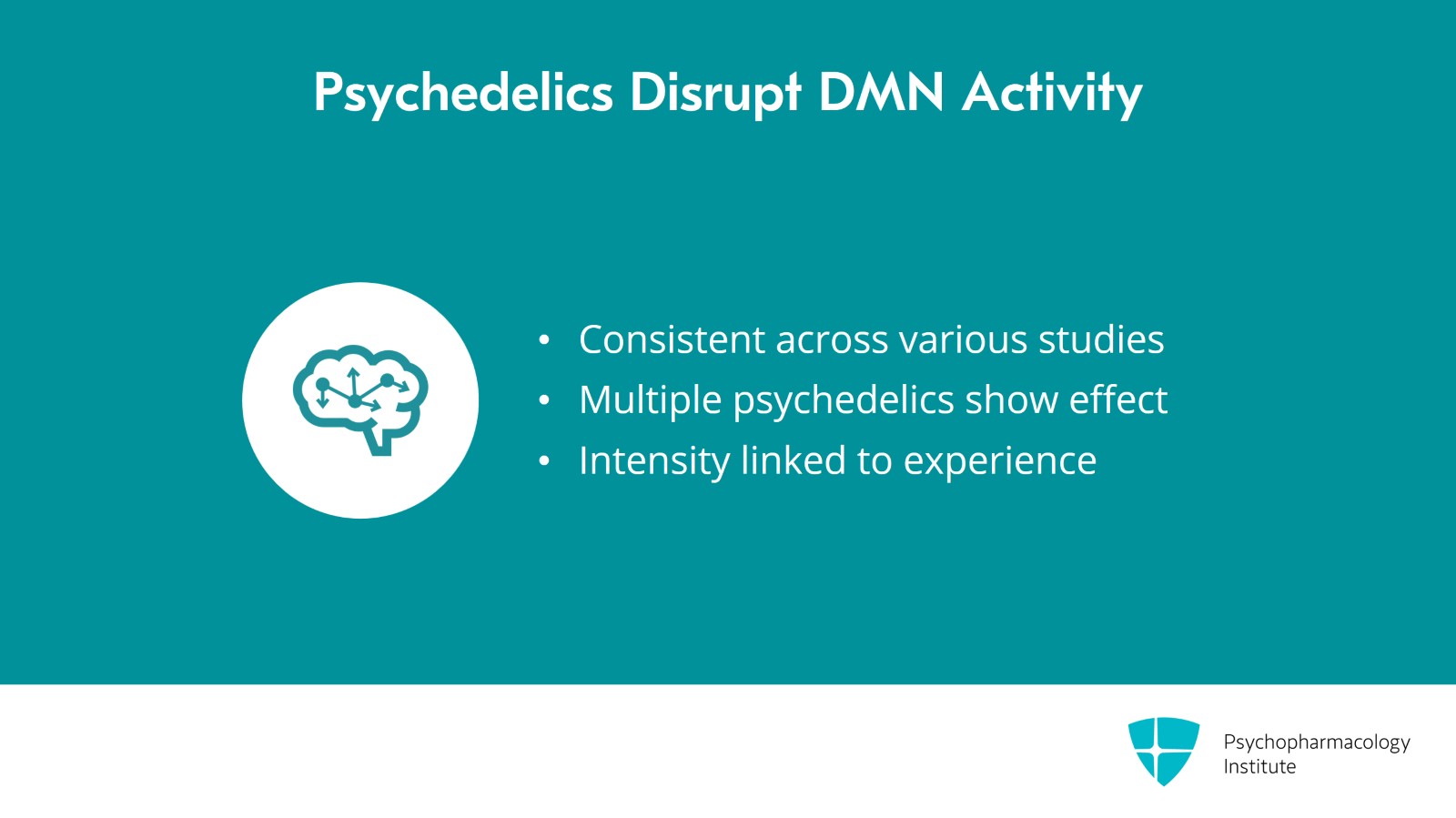
What's interesting about the default mode network is that this network which is involved in our sense of self is precisely one of the major networks that's been shown in many different studies to become disrupted under the influence of psychedelics. And so there're studies of psilocybin as well as LSD and ayahuasca that all show default mode network activity disruption during the acute effects and that some of these studies have even correlated the magnitude of default mode network disruption with the intensity of subjective experience.
Free Files
Download PDF and other files
Success!
Check your inbox, we sent you all the materials there.
Slide 11 of 19
So one way of looking at this is that this may be the neuroanatomical or neural circuitry level basis for this experience of ego dissolution, right, because this is a network that's involved in our sense of self. It is involved in the sort of gating between internally directed thought and externally directed thought which is precisely what becomes experientially disrupted under the influence of psychedelics.
References:
- 1. Carhart-Harris, R. L., Erritzoe, D., Williams, T., Stone, J. M., Reed, L. J., Colasanti, A., Tyacke, R. J., Leech, R., Malizia, A. L., Murphy, K., Hobden, P., Evans, J., Feilding, A., Wise, R. G., & Nutt, D. J. (2012). Neural correlates of the psychedelic state as determined by fMRI studies with psilocybin. Proceedings of the National Academy of Sciences, 109(6), 2138-2143. https://doi.org/10.1073/pnas.1119598109
- 2. Palhano-Fontes, F., Andrade, K. C., Tofoli, L. F., Santos, A. C., Crippa, J. A. S., Hallak, J. E. C., Ribeiro, S., & de Araujo, D. B. (2015). The Psychedelic State Induced by Ayahuasca Modulates the Activity and Connectivity of the Default Mode Network. PLOS ONE, 10(2), e0118143. https://doi.org/10.1371/journal.pone.0118143
- 3. Carhart-Harris, R. L., Roseman, L., Bolstridge, M., Demetriou, L., Pannekoek, J. N., Wall, M. B., Tanner, M., Kaelen, M., McGonigle, J., Murphy, K., Leech, R., Curran, H. V., & Nutt, D. J. (2017). Psilocybin for treatment-resistant depression: fMRI-measured brain mechanisms. Scientific Reports, 7(1), 13187. https://doi.org/10.1038/s41598-017-13282-7
- 4. Müller, F., Lenz, C., Dolder, P., Lang, U., Schmidt, A., Liechti, M., & Borgwardt, S. (2017). Increased thalamic resting-state connectivity as a core driver of LSD-induced hallucinations. Acta Psychiatrica Scandinavica, 136(6), 648-657. https://doi.org/10.1111/acps.12818
Slide 12 of 19
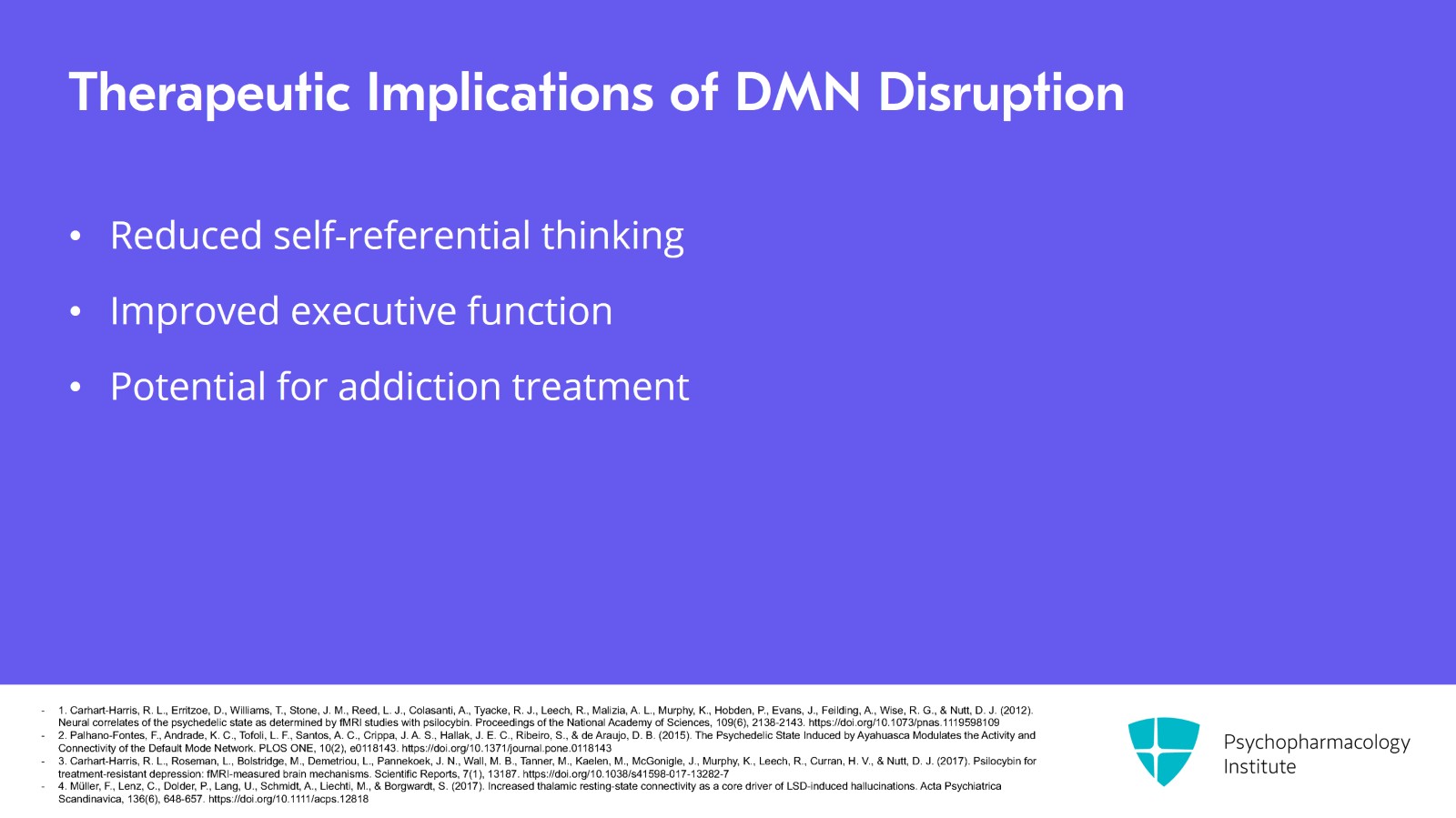
And there's a lot of downstream implications for what this might mean. Disrupting this network could lead to reduced self-referential thinking and improved executive function, so being able to get out of negative thought ruts about the self, being able to lift oneself out of a self-absorbed internally directed state to be more efficiently focused on external tasks and goals and allow other networks involved in those to become more active and functional, right, including in substance use disorders. Having a reduced self-focus in regard to craving may be a mechanism by which we could treat those.
References:
- 1. Carhart-Harris, R. L., Erritzoe, D., Williams, T., Stone, J. M., Reed, L. J., Colasanti, A., Tyacke, R. J., Leech, R., Malizia, A. L., Murphy, K., Hobden, P., Evans, J., Feilding, A., Wise, R. G., & Nutt, D. J. (2012). Neural correlates of the psychedelic state as determined by fMRI studies with psilocybin. Proceedings of the National Academy of Sciences, 109(6), 2138-2143. https://doi.org/10.1073/pnas.1119598109
- 2. Palhano-Fontes, F., Andrade, K. C., Tofoli, L. F., Santos, A. C., Crippa, J. A. S., Hallak, J. E. C., Ribeiro, S., & de Araujo, D. B. (2015). The Psychedelic State Induced by Ayahuasca Modulates the Activity and Connectivity of the Default Mode Network. PLOS ONE, 10(2), e0118143. https://doi.org/10.1371/journal.pone.0118143
- 3. Carhart-Harris, R. L., Roseman, L., Bolstridge, M., Demetriou, L., Pannekoek, J. N., Wall, M. B., Tanner, M., Kaelen, M., McGonigle, J., Murphy, K., Leech, R., Curran, H. V., & Nutt, D. J. (2017). Psilocybin for treatment-resistant depression: fMRI-measured brain mechanisms. Scientific Reports, 7(1), 13187. https://doi.org/10.1038/s41598-017-13282-7
- 4. Müller, F., Lenz, C., Dolder, P., Lang, U., Schmidt, A., Liechti, M., & Borgwardt, S. (2017). Increased thalamic resting-state connectivity as a core driver of LSD-induced hallucinations. Acta Psychiatrica Scandinavica, 136(6), 648-657. https://doi.org/10.1111/acps.12818
Free Files
Download PDF and other files
Success!
Check your inbox, we sent you all the materials there.
Slide 13 of 19
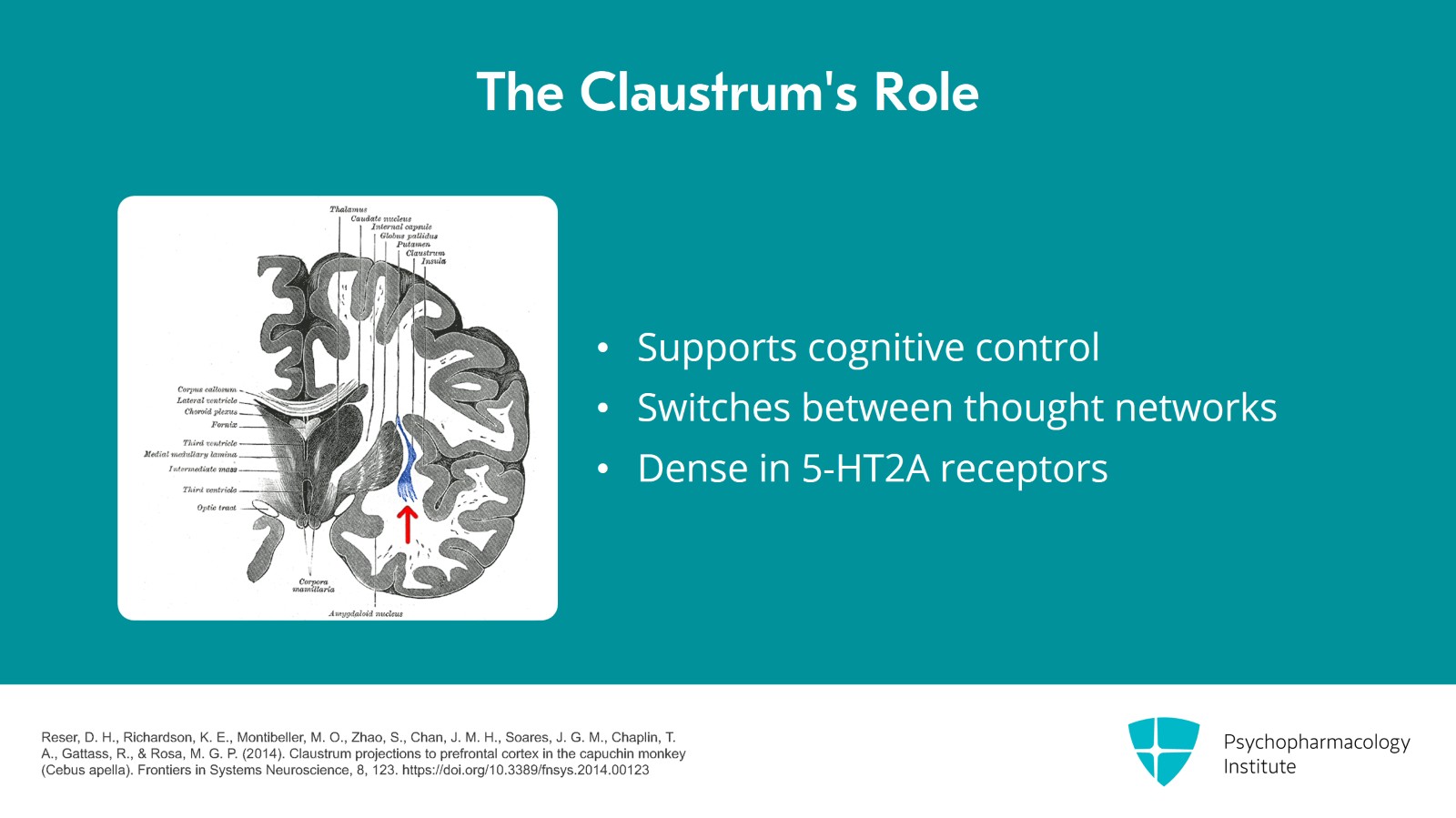
So a little bit more about this moving over to the claustrum. It's deep within the cortex. It's this long thin sheet of neurons that's sort of buried underneath our neocortex. And the role of the claustrum is that it supports the coactivation of widespread cortical regions participating in networks necessary for cognitive control. So the claustrum as well as the salience network is thought to be involved in switching between internally directed thoughts via the default mode network and external task-oriented processing networks like the task-positive networks. So initiation and stabilization of executive and task-based networks via top-down control actions is one of the major functions of the claustrum. And interestingly, the claustrum is one of the territories of the brain that is most densely loaded with 5-HT2A receptors.
References:
- Reser, D. H., Richardson, K. E., Montibeller, M. O., Zhao, S., Chan, J. M. H., Soares, J. G. M., Chaplin, T. A., Gattass, R., & Rosa, M. G. P. (2014). Claustrum projections to prefrontal cortex in the capuchin monkey (Cebus apella). Frontiers in Systems Neuroscience, 8, 123. https://doi.org/10.3389/fnsys.2014.00123
Slide 14 of 19
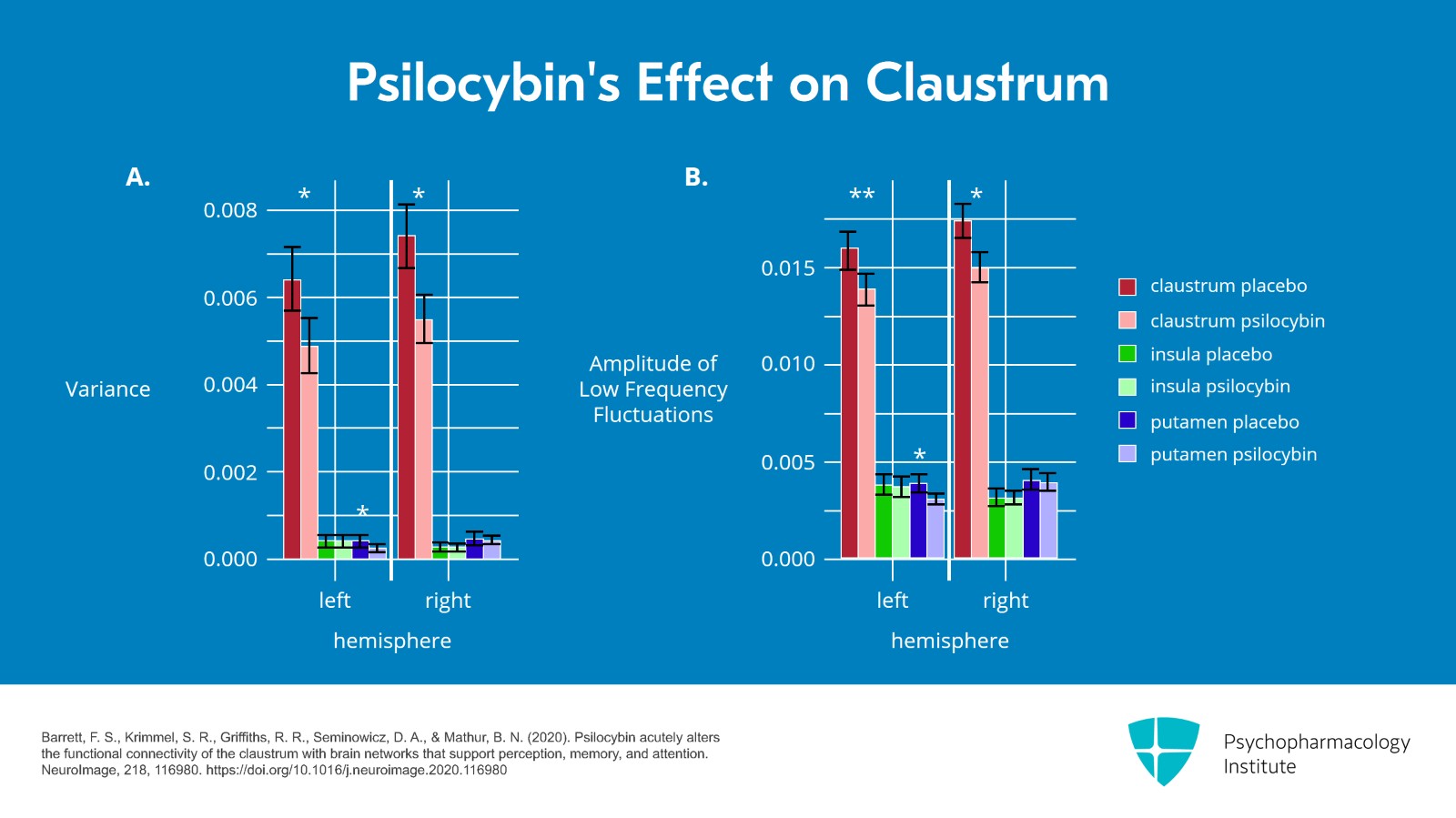
A study conducted at Johns Hopkins showed that psilocybin caused significant changes in the claustrum's connectivity, both to default mode network, internally directed thought as well as task-positive networks, externally directed thought. So the idea is that psilocybin may be inducing a more dynamic or variable activity pattern in the claustrum which is disrupting its ability to coordinate the switching on and off of different networks of the brain that generally are functioning in discrete fashion with the default mode network being activated when we're involved in internally directed thought.
References:
- Barrett, F. S., Krimmel, S. R., Griffiths, R. R., Seminowicz, D. A., & Mathur, B. N. (2020). Psilocybin acutely alters the functional connectivity of the claustrum with brain networks that support perception, memory, and attention. NeuroImage, 218, 116980. https://doi.org/10.1016/j.neuroimage.2020.116980
Free Files
Download PDF and other files
Success!
Check your inbox, we sent you all the materials there.
Slide 15 of 19
Usually, what happens is networks involved in attention or executive function or tasks with the external world, those are going to be turned off. And so if we are disrupting the ability of coordinating the antagonism between these different networks, this may be one of the mechanisms by which there is this profound change in the feeling of consciousness, again, with this disruption of the felt difference between the internal and the external world.
References:
- Barrett, F. S., Krimmel, S. R., Griffiths, R. R., Seminowicz, D. A., & Mathur, B. N. (2020). Psilocybin acutely alters the functional connectivity of the claustrum with brain networks that support perception, memory, and attention. NeuroImage, 218, 116980. https://doi.org/10.1016/j.neuroimage.2020.116980
Slide 16 of 19
The reason I mentioned neuroplasticity is that all of this at the cellular level may be leading to a neuroplastic state. And so by disrupting all of these networks, it's thought that there may be this transient state of neuroplasticity that given the right therapeutic context may actually lead to improved patterns of thought to changes in deeply held thoughts such as negative constructs of the self, perhaps negative sensitivity to things like external distress, somatization, all of the things that we see in many different disorders of Psychiatry and that these might actually be able to be shifted. However, as I'll mention in subsequent slides, this would require a therapeutic setting for this to occur, that for most people this wouldn't happen in isolation. There needs to be a therapeutic context to take advantage of this neuroplastic state in order to effect any change in what is going on in the brain.
References:
- Betchel, N. T., Fariba, K. A., & Saadabadi, A. (2023). Lamotrigine. StatPearls Publishing. https://www.ncbi.nlm.nih.gov/books/NBK470442/
Free Files
Download PDF and other files
Success!
Check your inbox, we sent you all the materials there.
Slide 17 of 19
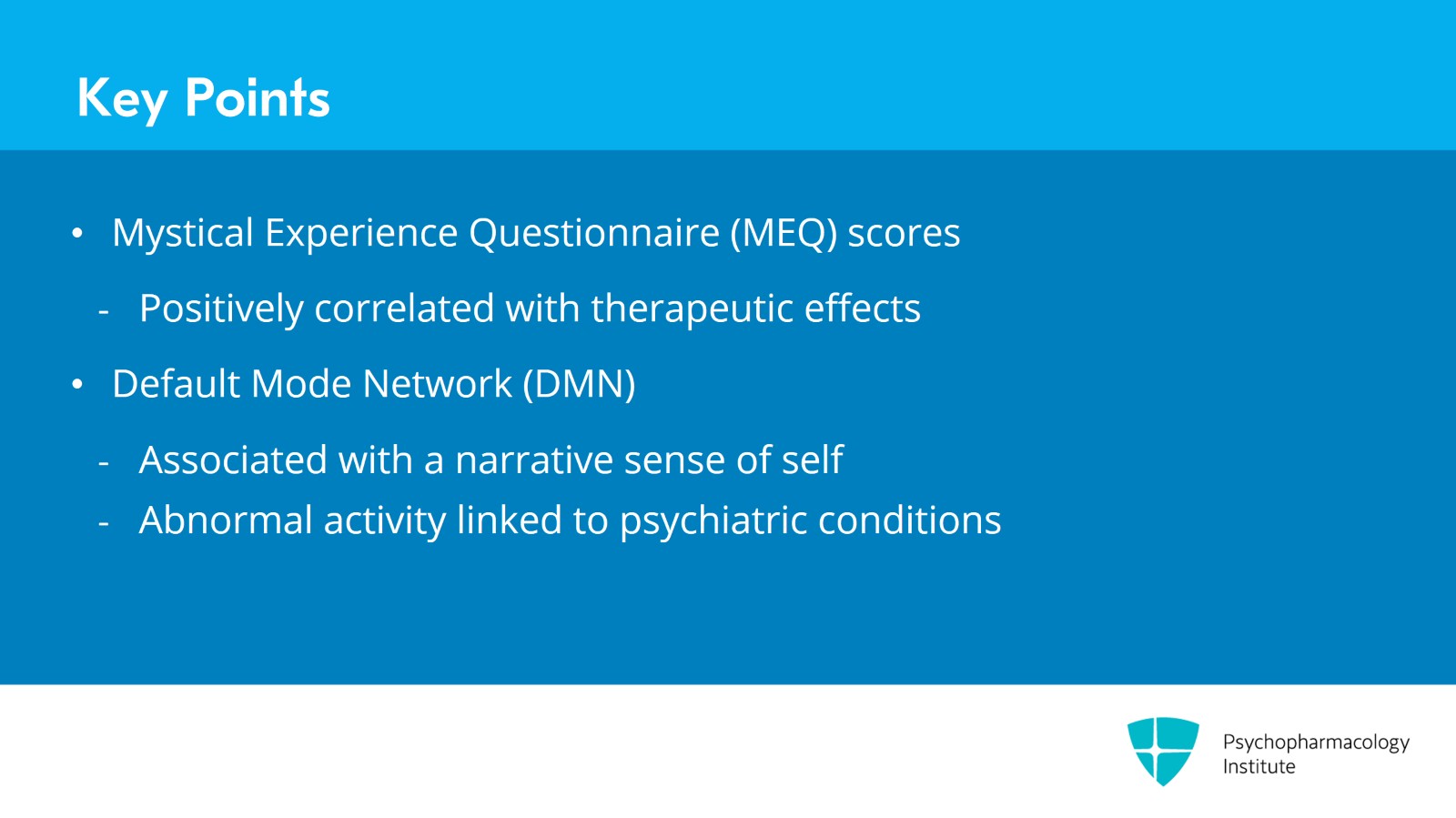
So the key points here are that the degree to which study subjects have had a mystical experience as measured by the MEQ has been positively correlated with the therapeutic effects and numerous clinical trials. The default mode network is a network of the brain normally associated with our narrative sense of self and abnormal default mode network activity has been found in numerous psychiatric conditions.
Slide 18 of 19
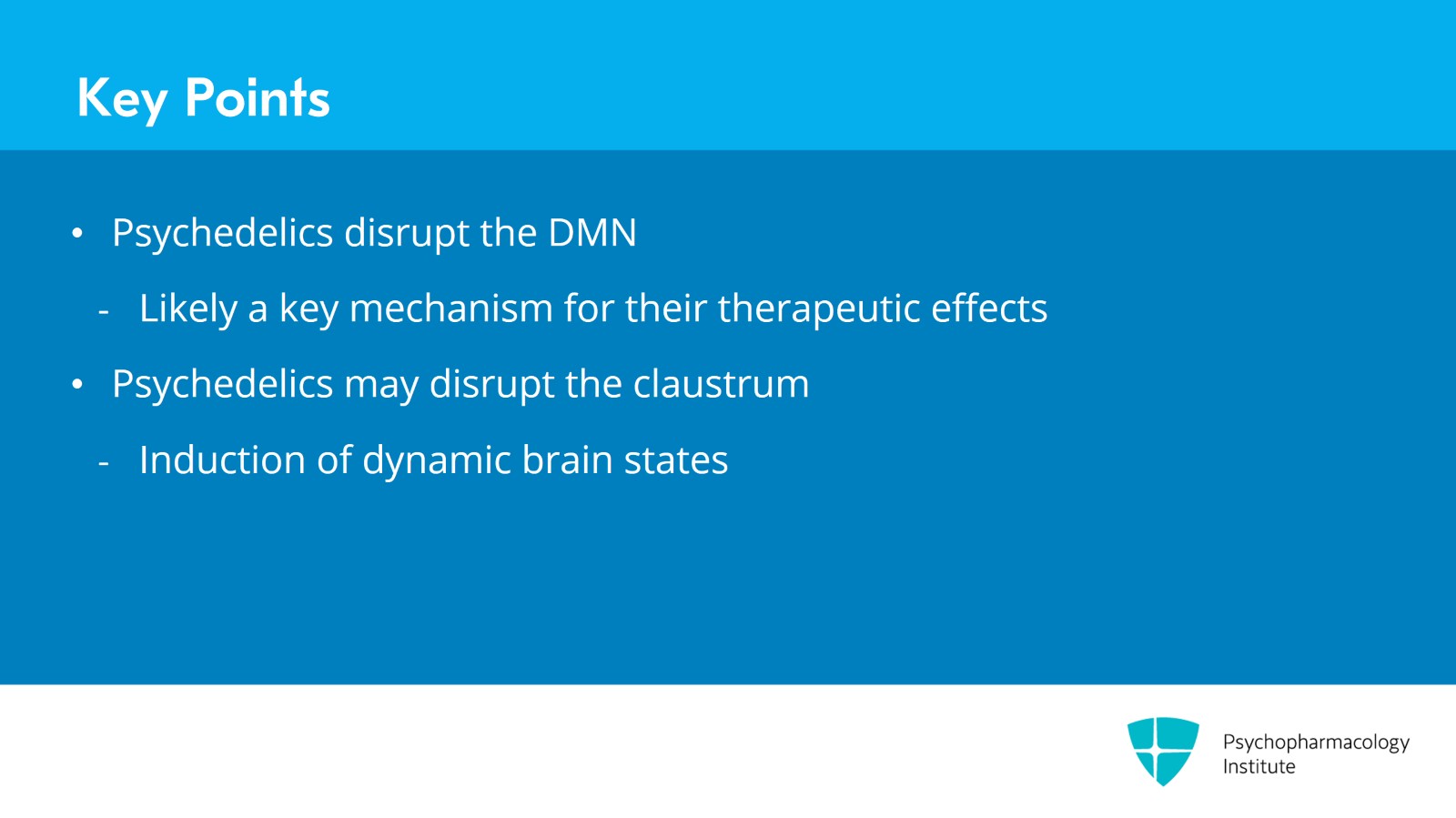
This network has also been shown to be disrupted by psychedelics and is likely a key mechanism by which psychedelics exert therapeutic change. Psychedelics may also disrupt the claustrum which is a small region of the brain responsible for synchronizing and controlling activity of different brain networks including the default mode network. Disruption of the claustrum may be another key mechanism by which psychedelics induce a more dynamic brain state.
Free Files
Download PDF and other files
Success!
Check your inbox, we sent you all the materials there.
Slide 19 of 19