Close Banner
Section Free  - Video Lectures

07. Health Concerns for First-Episode Patients

Published on November 1, 2021 Expired on April 1, 2025

Stephen R. Marder, M.D.

Professor, Psychiatry and Biobehavioral Sciences Director, Section on Psychosis - Resnick Neuropsychiatric Hospital at UCLA Ronald Reagan UCLA Medical Center

Key Points

  • People with schizophrenia have a shortened life span, related to a higher risk of diabetes and cardiovascular disease.
  • Monitor FEP patients for evidence of weight gain and insulin resistance.

Free Downloads for Offline Access

  • Free Download Presentation File (PPTX)
  • Free Download Video (MP4)
  • Free Download Audio File (MP3)

Slides and Transcript

Slide 1 of 12

In the seventh session on the assessment and management of first episodes of psychosis, I’m going to talk about health issues that arise in first episode patients.

Slide 2 of 12

Individuals with schizophrenia have a life expectancy that is 20 to 25 years briefer than general population. There are a number of risk factors for shortening their life span. They have high rates of smoking, obesity and other things but people with schizophrenia are most likely to die from cardiovascular disease. So, we should look at ways to improve physical health and particularly cardiovascular health.
References:
  • Olfson, M., Gerhard, T., Huang, C., Crystal, S., & Stroup, T. S. (2015). Premature mortality among adults with schizophrenia in the United States. JAMA Psychiatry, 72(12), 1172
  • Tanskanen, A., Tiihonen, J., & Taipale, H. (2018). Mortality in schizophrenia: 30-year nationwide follow-up study. Acta Psychiatrica Scandinavica, 138(6), 492-499.
Free Files
Success!
Check your inbox, we sent you all the materials there.

Slide 3 of 12

A study in Denmark which looked at drug naïve people with schizophrenia found that they were three times more likely than the normal population to develop diabetes. These are drug naïve patients so we’re talking about a risk factor that’s associated with having schizophrenia, not with its treatment. And some literature suggests that some of the susceptibility genes for type 2 diabetes are also associated with schizophrenia. When you put patients on an antipsychotic the risk of developing diabetes increases an additional 3.6 fold. So you could see that being aware of these problems is really important in managing people with schizophrenia.
References:
  • Rajkumar, A. P., Horsdal, H. T., Wimberley, T., Cohen, D., Mors, O., Børglum, A. D., & Gasse, C. (2017). Endogenous and antipsychotic-related risks for diabetes mellitus in young people with schizophrenia: A Danish population-based cohort study. American Journal of Psychiatry, 174(7), 686-694.

Slide 4 of 12

This is from an early study in drug naïve first episode patients which measured fasting glucose, insulin and lipids. These patients had higher fasting plasma levels of glucose and insulin, suggesting that even before antipsychotic treatment they were already becoming more insulin resistant.
References:
  • Ryan, M. C., Collins, P., & Thakore, J. H. (2003). Impaired fasting glucose tolerance in first-episode, drug-naive patients with schizophrenia. American Journal of Psychiatry, 160(2), 284-289.
Free Files
Success!
Check your inbox, we sent you all the materials there.

Slide 5 of 12

So, preventing insulin resistance in diabetes should be part of the treatment plan even at the very beginning of managing the illness.
References:
  • Ryan, M. C., Collins, P., & Thakore, J. H. (2003). Impaired fasting glucose tolerance in first-episode, drug-naive patients with schizophrenia. American Journal of Psychiatry, 160(2), 284-289.

Slide 6 of 12

This chart shows the changes in body mass for young people treated with three antipsychotics. Molindone which is a first-generation antipsychotic, olanzapine, and risperidone. And each of those bars represents an individual and a percent increase in BMI and this is during an eight-week trial. And you could see that whereas molindone was relatively weight neutral with more people losing weight than gaining wait, when you go to olanzapine and risperidone you could see a real problem particularly with olanzapine.
References:
  • Sikich, L., Frazier, J. A., McClellan, J., Findling, R. L., Vitiello, B., Ritz, L., Ambler, D., Puglia, M., Maloney, A. E., Michael, E., De Jong, S., Slifka, K., Noyes, N., Hlastala, S., Pierson, L., McNamara, N. K., Delporto-Bedoya, D., Anderson, R., Hamer, R. M., … Lieberman, J. A. (2008). Double-blind comparison of first- and second-generation antipsychotics in early-onset schizophrenia and schizo-affective disorder: Findings from the treatment of early-onset schizophrenia spectrum disorders (TEOSS) study. American Journal of Psychiatry, 165(11), 1420-1431.
Free Files
Success!
Check your inbox, we sent you all the materials there.

Slide 7 of 12

And if you look at metabolic changes and focus on olanzapine, you could see that it’s associated with increases in triglycerides, LDL, and insulin levels. So this should factor into the selection of an antipsychotic.
References:
  • Sikich, L., Frazier, J. A., McClellan, J., Findling, R. L., Vitiello, B., Ritz, L., Ambler, D., Puglia, M., Maloney, A. E., Michael, E., De Jong, S., Slifka, K., Noyes, N., Hlastala, S., Pierson, L., McNamara, N. K., Delporto-Bedoya, D., Anderson, R., Hamer, R. M., … Lieberman, J. A. (2008). Double-blind comparison of first- and second-generation antipsychotics in early-onset schizophrenia and schizo-affective disorder: Findings from the treatment of early-onset schizophrenia spectrum disorders (TEOSS) study. American Journal of Psychiatry, 165(11), 1420-1431.

Slide 8 of 12

This is why the Schizophrenia PORT, the Patient Outcomes Research Team, a few years ago recommended that both clozapine and olanzapine shouldn’t be the first antipsychotic a person receives, that this risk of metabolic effects from both of these antipsychotics was really too substantial.
References:
  • Buchanan, R. W., Kreyenbuhl, J., Kelly, D. L., Noel, J. M., Boggs, D. L., Fischer, B. A., Himelhoch, S., Fang, B., Peterson, E., Aquino, P. R., & Keller, W. (2009). The 2009 schizophrenia PORT Psychopharmacological treatment recommendations and summary statements. Schizophrenia Bulletin, 36(1), 71-93.
Free Files
Success!
Check your inbox, we sent you all the materials there.

Slide 9 of 12

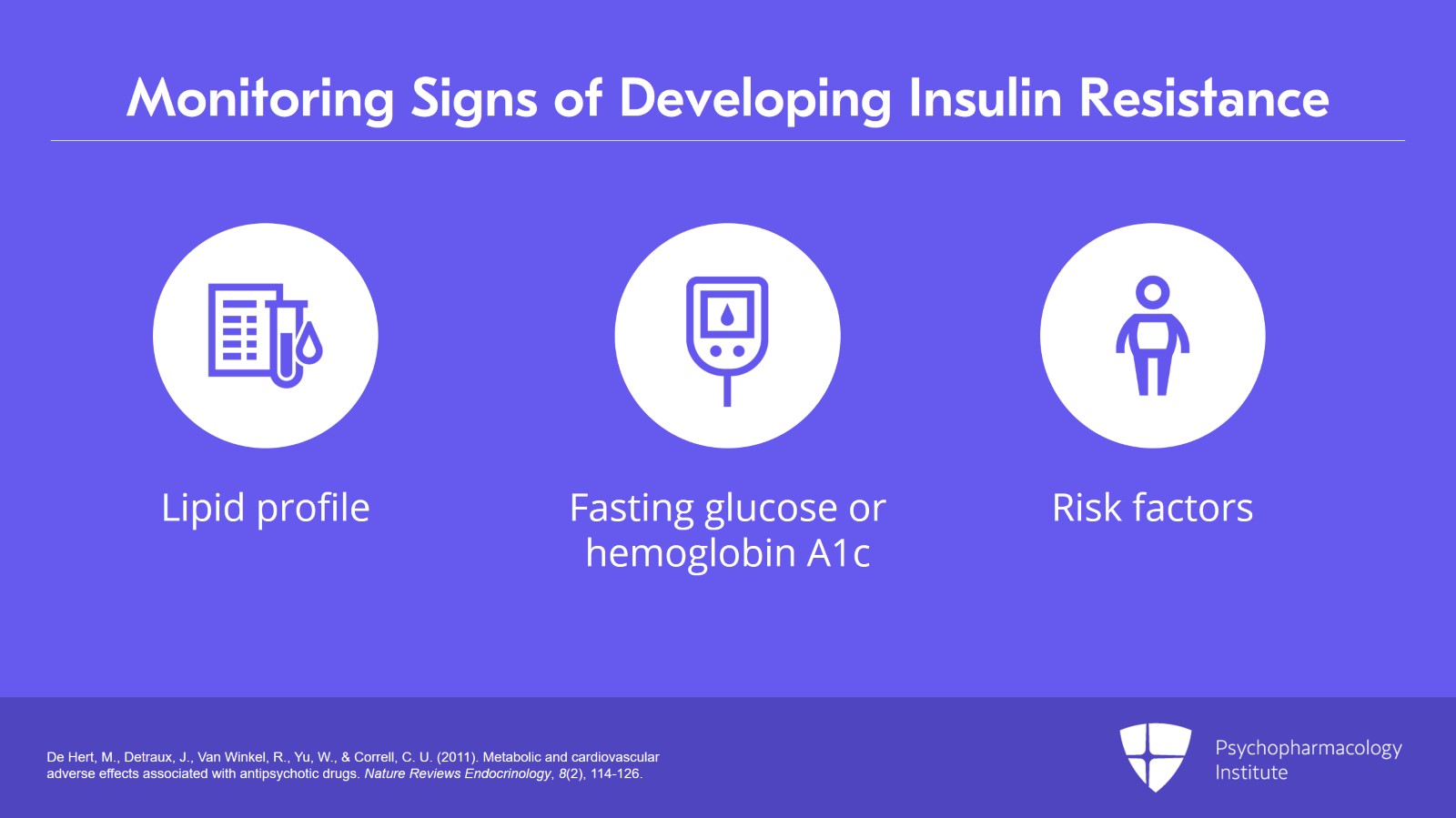
Clinicians during the early stages of treatment, and this is not just at the first episode, for any patient should be monitoring for signs of developing insulin resistance. It could be looking at lipid profiles and focusing on triglycerides, looking at fasting glucose or hemoglobin A1c and of course looking at whether the patients have risk factors to start with.
References:
  • De Hert, M., Detraux, J., Van Winkel, R., Yu, W., & Correll, C. U. (2011). Metabolic and cardiovascular adverse effects associated with antipsychotic drugs. Nature Reviews Endocrinology, 8(2), 114-126.

Slide 10 of 12

What to do when you see evidence during the first few weeks. Cochrane review suggests changing an antipsychotic if they’re on one that promotes substantial weight gain, trying them to one that promotes less. If you see early evidence of weight gain or even if you just see increases in triglycerides or hemoglobin A1c or fasting glucose this is going to predict later elevations, and this could be a time to change antipsychotics. I’m going to talk about recommendations, but lifestyle interventions work and medications like metformin could be considered.
References:
  • De Silva, V. A., Suraweera, C., Ratnatunga, S. S., Dayabandara, M., Wanniarachchi, N., & Hanwella, R. (2016). Metformin in prevention and treatment of antipsychotic induced weight gain: A systematic review and meta-analysis. BMC Psychiatry, 16(1).
  • Mukundan, A., Faulkner, G., Cohn, T., & Remington, G. (2010). Antipsychotic switching for people with schizophrenia who have neuroleptic-induced weight or metabolic problems. Cochrane Database of Systematic Reviews.
Free Files
Success!
Check your inbox, we sent you all the materials there.

Slide 11 of 12

So what I’ve tried to show you during this talk is that people with schizophrenia have a shortened life span and that this seems to be related to both having a high risk of type 2 diabetes which in turn is related to a high risk of cardiovascular disease. When we have first episode patients we should carefully monitor them for evidence of weight gain and insulin resistance. And I’m going to talk in a subsequent lecture about effective medications and lifestyle interventions that should be considered when patients have these problems. Thank you very much.

Slide 12 of 12

Free Files
Success!
Check your inbox, we sent you all the materials there.

Learning Objectives:

After completing this activity, the learner will be able to:

  1. Discuss the typical course of first episode psychosis and predictors of clinical outcome.
  2. Review evidence on the use of psychotropic medications, as well as their potential benefits and risks, in the treatment of first episode psychosis.

Original Release Date: 11/01/2021

Review and Re-release Date: 03/01/2024

Expiration Date: 04/01/2025

Expert: Stephen Marder, M.D.

Medical Editor: Melissa Mariano, M.D

Relevant Financial Disclosures:

The following planners, faculty, and reviewers have the following relevant financial relationships with commercial interests to disclose:

Dr. Marder has disclosed the following relationships:

  • Sunovion: Consulting
  • Mmerck: Consulting
  • Boeringer ingelheim: Consulting
  • Roche: Consulting

All of the relevant financial relationships listed for these individuals have been mitigated.

Contact Information: For questions regarding the content or access to this activity, contact us at support@psychopharmacologyinstitute.com

Instructions for Participation and Credit:

Participants must complete the activity online during the valid credit period that is noted above.

Follow these steps to earn CME credit:

  1. View the required educational content provided on this course page.
  2. Complete the Post Activity Evaluation for providing the necessary feedback for continuing accreditation purposes and for the development of future activities. NOTE: Completing the Post Activity Evaluation after the quiz is required to receive the earned credit.
  3. Download your certificate.

Accreditation Statement

This activity has been planned and implemented in accordance with the accreditation requirements and policies of the Accreditation Council for Continuing Medical Education through the joint providership of Medical Academy LLC and the Psychopharmacology Institute. Medical Academy is accredited by the ACCME to provide continuing medical education for physicians.

Credit Designation Statement

Medical Academy designates this enduring activity for a maximum of 0.75 AMA PRA Category 1 credit(s). Physicians should claim only the credit commensurate with the extent of their participation in the activity.


Free Files
Success!
Check your inbox, we sent you all the materials there.
Continue in the website
Instant access modal

Become a Bronze, Silver, Gold, Bronze extended, Silver extended or Gold extended Member.

2025–26 Psychopharmacology CME Program

Unlock up to 155 CME Credits, including 40 SA CME Credits.