Close Banner
Section Free  - Video Lectures

02. Food Avoidance: Diagnosis and Treatment of Avoidant/Restrictive Food Intake Disorder (ARFID)

Published on March 1, 2021 Expired on April 1, 2025

Timothy Brewerton, M.D., D.L.F.A.P.A., F.A.E.D., D.F.A.A.C.A.P., C.E.D.S.-S.

Affiliate Professor of Psychiatry, Director - Medical University of South Carolina in Charleston, SC, USA.

Key Points

  • There are no randomized, double-blind, placebo-controlled trials of any psychopharmacological agent for ARFID.
  • Evidence supports the use of very-low-dose adjunctive olanzapine.
  • Mirtazapine starting at 7.5 mg/day may be helpful.

Free Downloads for Offline Access

  • Free Download Presentation File (PPTX)
  • Free Download Video (MP4)
  • Free Download Audio File (MP3)

Slides and Transcript

Slide 1 of 10

Slide 2 of 10

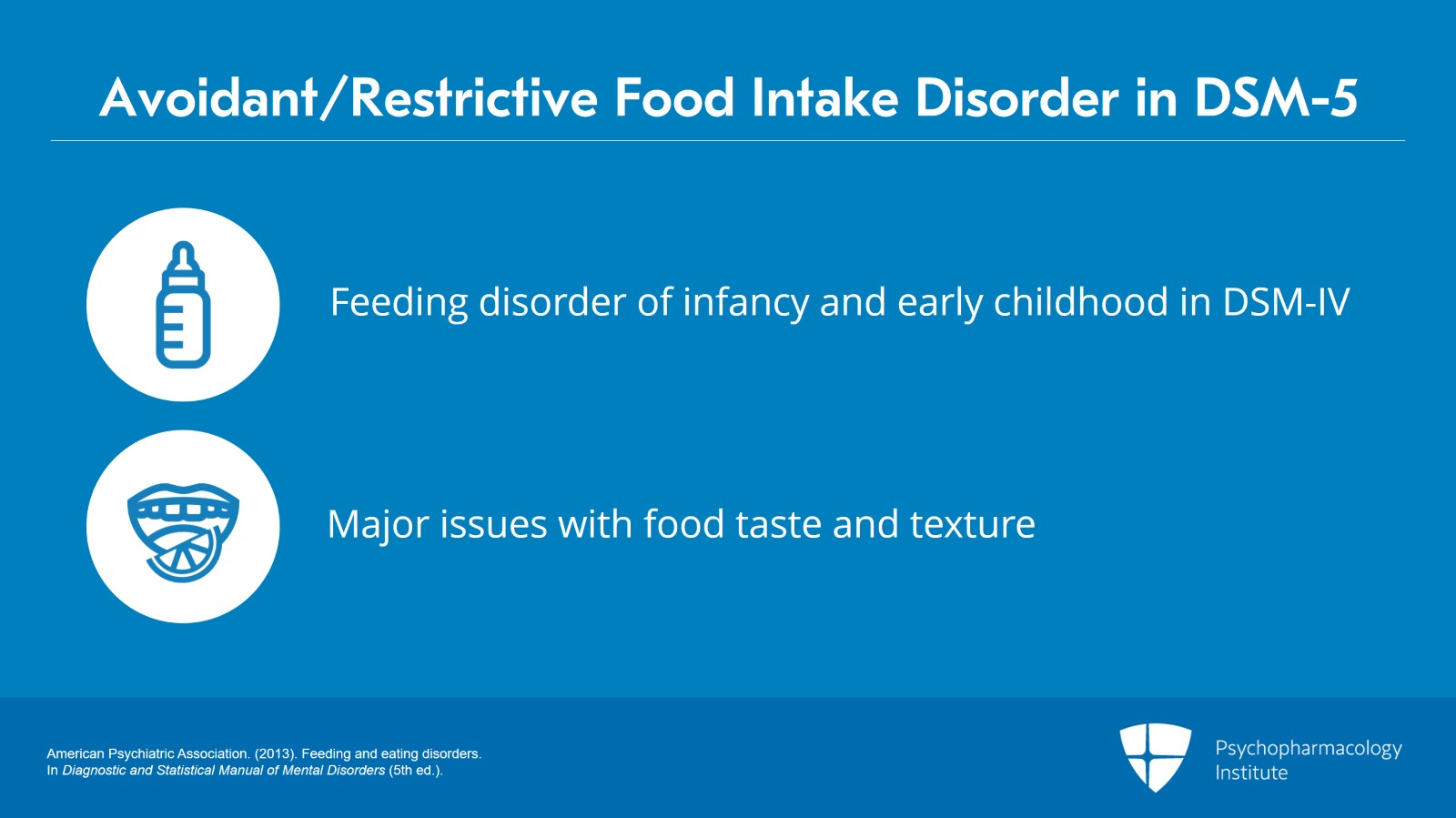
If you’re not familiar with ARFID or avoidant and restrictive food intake disorder, it is basically an upgrade from the feeding disorder of infancy and early childhood described in DSM-IV. For years, pediatricians have been dealing with what has been termed nonorganic failure to thrive in the older literature. We know that many cases of ARFID have autism spectrum disorder symptoms in that they have major issues with food taste and textures that may drive their persistent failure to meet appropriate nutritional energy needs …
References:
  • American Psychiatric Association. (2013). Feeding and eating disorders. In Diagnostic and Statistical Manual of Mental Disorders (5th ed.).
Free Files
Success!
Check your inbox, we sent you all the materials there.

Slide 3 of 10

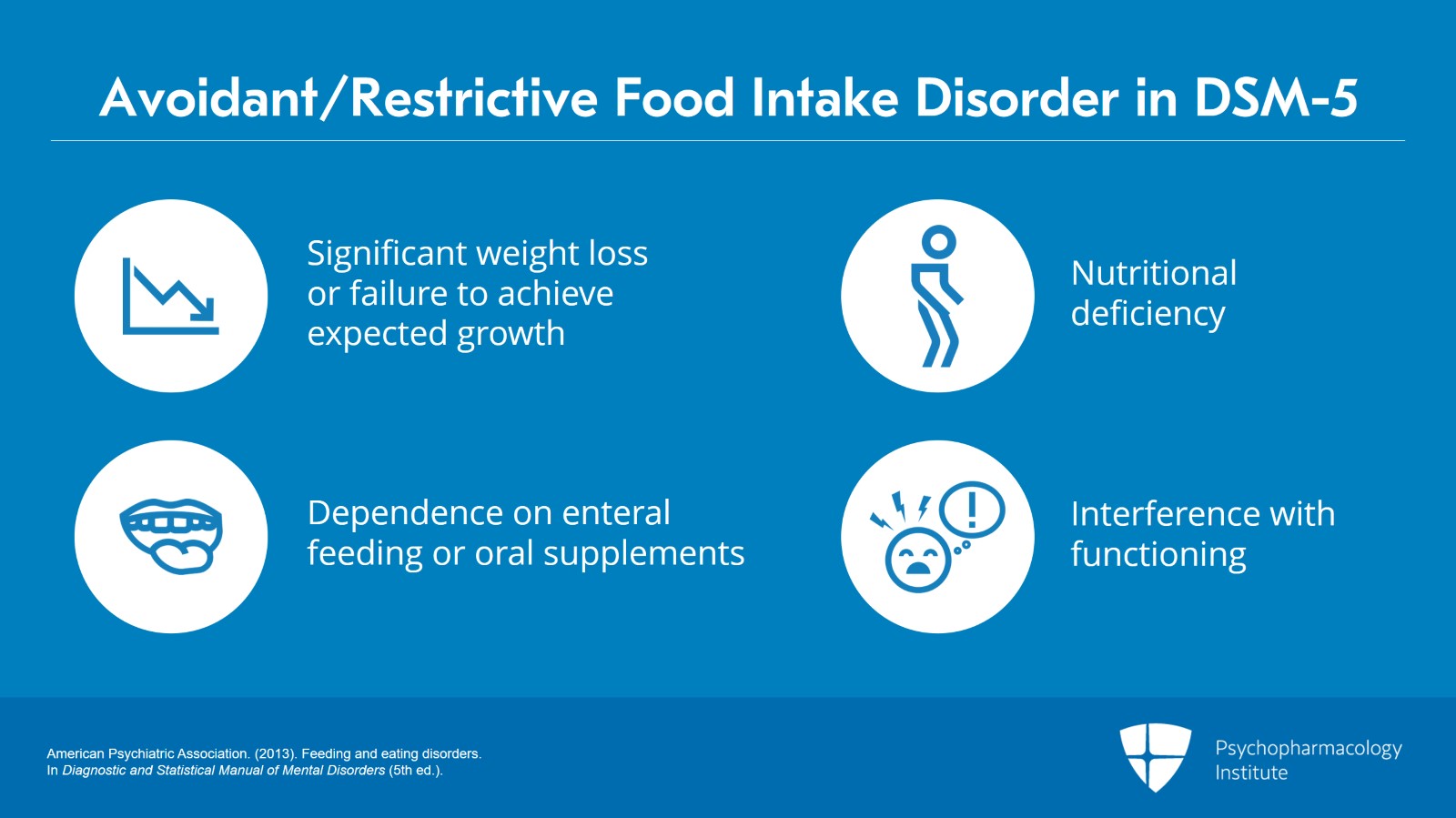
… and that leads to one of the following: Significant weight loss or failure to achieve expected growth, significant nutritional deficiency, dependence on enteral feeding or oral nutritional supplements and marked interference with psychosocial functioning.
References:
  • American Psychiatric Association. (2013). Feeding and eating disorders. In Diagnostic and Statistical Manual of Mental Disorders (5th ed.).

Slide 4 of 10

And it’s not better explained by the lack of available food which has become known as food insecurity or a sanctioned cultural practice. It also does not occur during the course of anorexia nervosa or bulimia nervosa. And there is no evidence of a disturbance in the way in which one’s body, weight or shape is experienced. This is what distinguishes it from classic eating disorders. Finally, ARFID symptoms are not attributable to a concurrent medical condition or mental disorder. And when it does occur, its severity exceeds that routinely associated with the condition or disorder and warrants additional clinical attention.
References:
  • American Psychiatric Association. (2013). Feeding and eating disorders. In Diagnostic and Statistical Manual of Mental Disorders (5th ed.).
Free Files
Success!
Check your inbox, we sent you all the materials there.

Slide 5 of 10

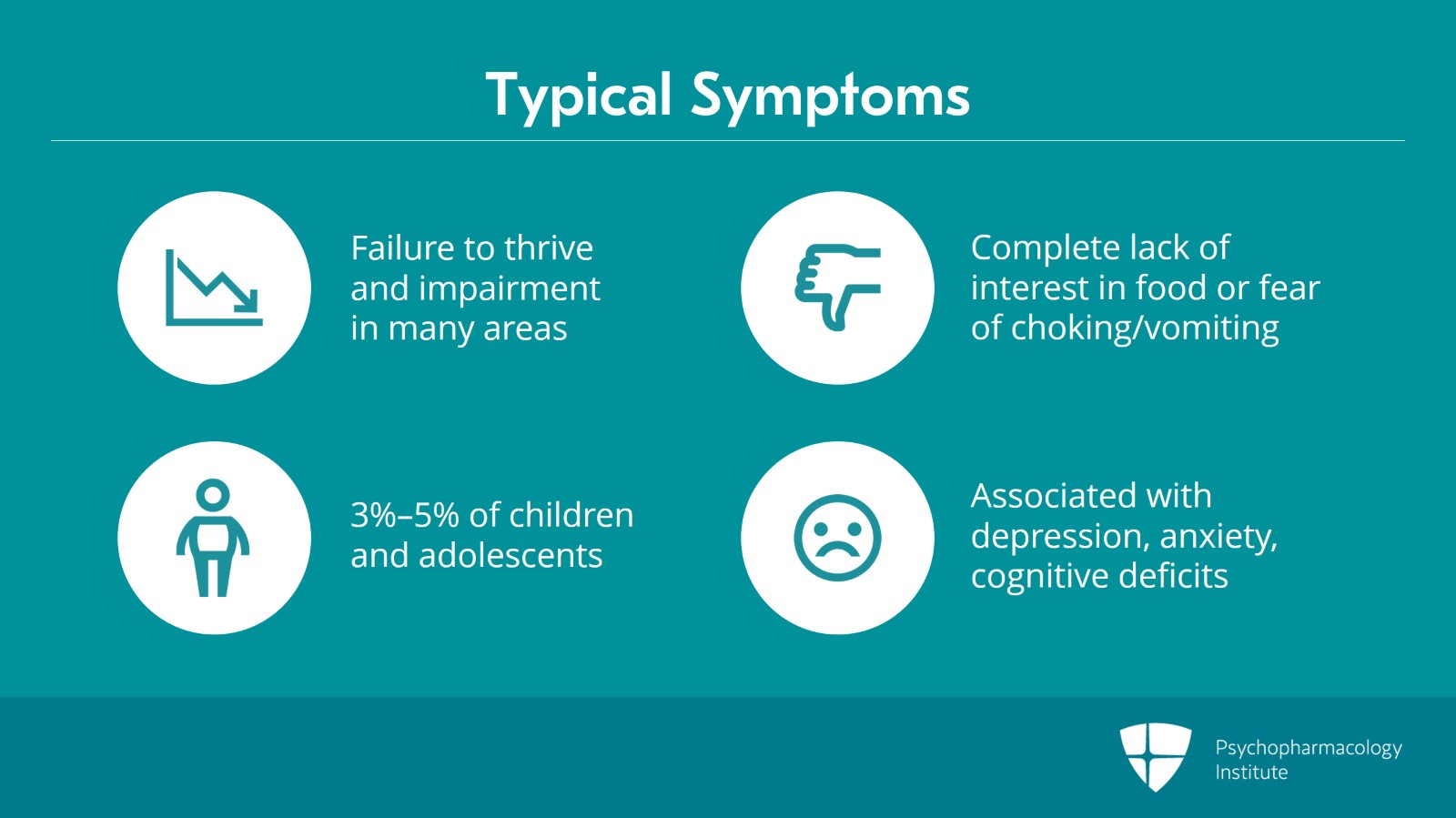
A typical patient with ARFID is a child or young adolescent who presents with failure to thrive in which there are varying degrees of impairment in many areas including physical, mental development, education and socialization as a result of the chronic starvation. The lack of interest in feeding or eating is not driven by body image distortion or fear of weight gain but rather by a complete lack of interest in eating or food and aversion to certain food textures or tastes or a fear of choking or vomiting usually due to a previous traumatic episode. ARFID occurs in about 3% to 5% of children and adolescents and there is often associated depression, anxiety and cognitive deficits.

Slide 6 of 10

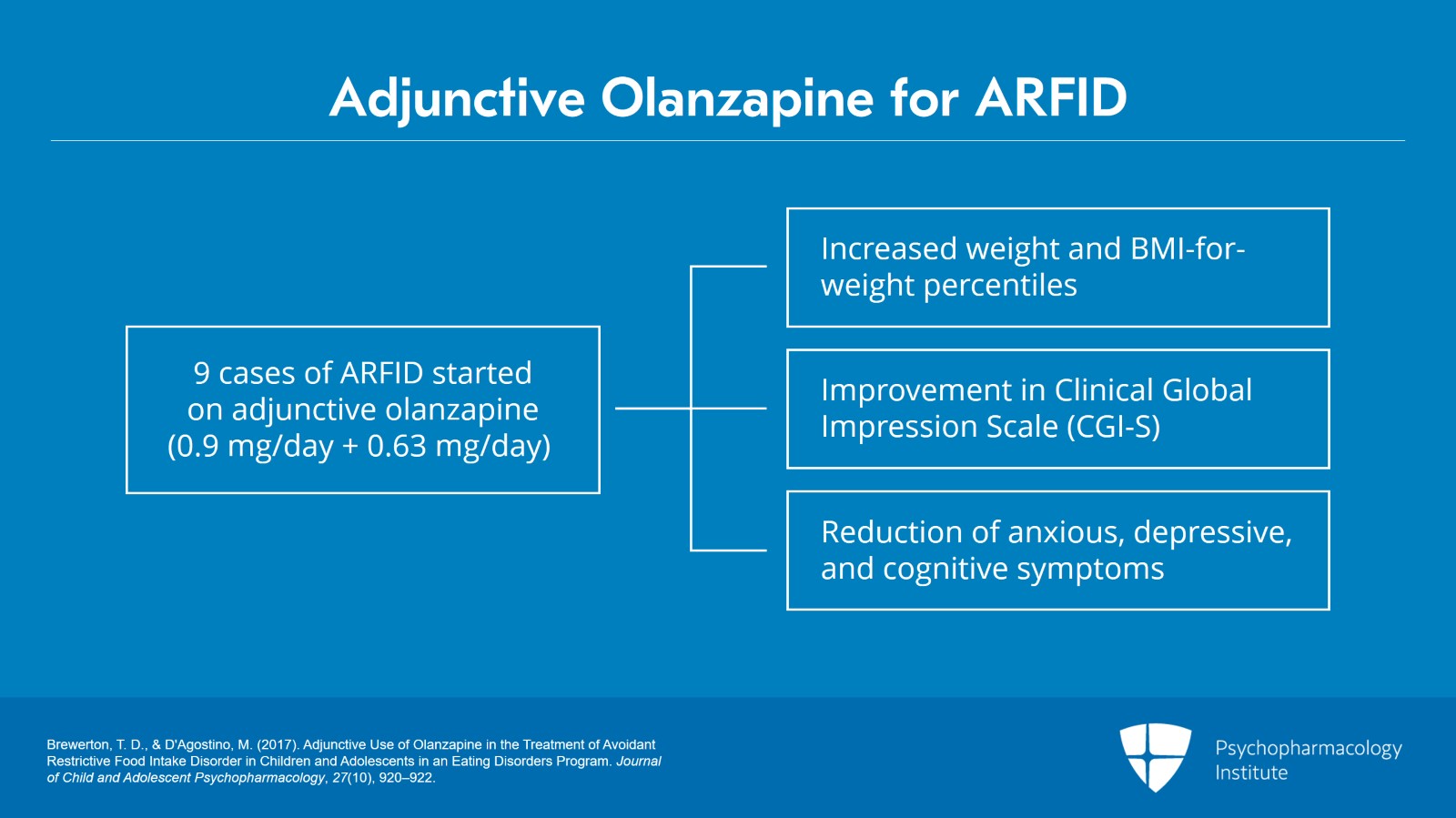
There are no randomized controlled trials as of yet of agents for ARFID but there have been a number of case reports of adjunctive drug therapy. The treatment of ARFID is a multidisciplinary approach as it involves focus on behavioral treatment, sometimes occupational therapy. Meredith D’Agostino, a nurse practitioner, and I reported nine cases treated in an eating disorder program including eight females and one male with adjunctive olanzapine starting at a very, very low dose. Average dose in this study was 0.9 mg. What you don’t want to do is overwhelm any patient or their family members with oversedation. We found that there was significantly greater weight gain after introducing olanzapine in these individuals with ARFID. And they had marked improvements in their Clinical Global Impression Scale. Not only did the weight increase and the feeding behavior improved but reduction of associated anxious, depressive and cognitive symptoms also very much improved. The same kind of story was reported a year later by Spettigue and associates regarding six cases.
References:
  • Brewerton, T. D., & D'Agostino, M. (2017). Adjunctive Use of Olanzapine in the Treatment of Avoidant Restrictive Food Intake Disorder in Children and Adolescents in an Eating Disorders Program. Journal of Child and Adolescent Psychopharmacology, 27(10), 920–922.
Free Files
Success!
Check your inbox, we sent you all the materials there.

Slide 7 of 10

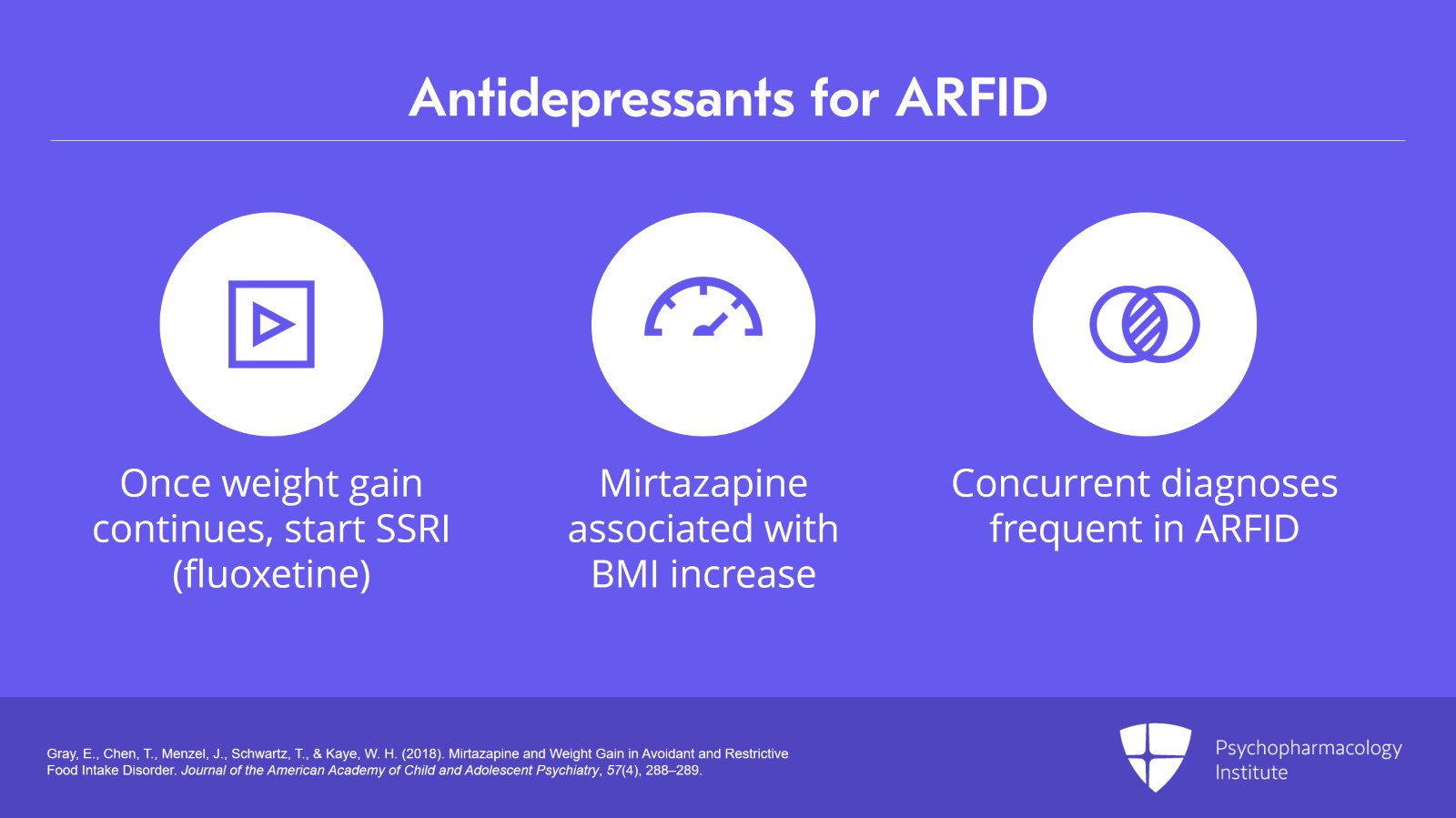
As is common practice, once the weight gain continues or approaches a normal weight, an SSRI, usually fluoxetine, is added to that. Gray and associates from the University of California at San Diego reported a retrospective chart review of 14 cases treated with mirtazapine. There were a number of concurrent diagnoses which tends to be the rule in feeding and eating disorders rather than the exception. They found that there was a significantly higher rate of increase in BMI.
References:
  • Gray, E., Chen, T., Menzel, J., Schwartz, T., & Kaye, W. H. (2018). Mirtazapine and Weight Gain in Avoidant and Restrictive Food Intake Disorder. Journal of the American Academy of Child and Adolescent Psychiatry, 57(4), 288–289.

Slide 8 of 10

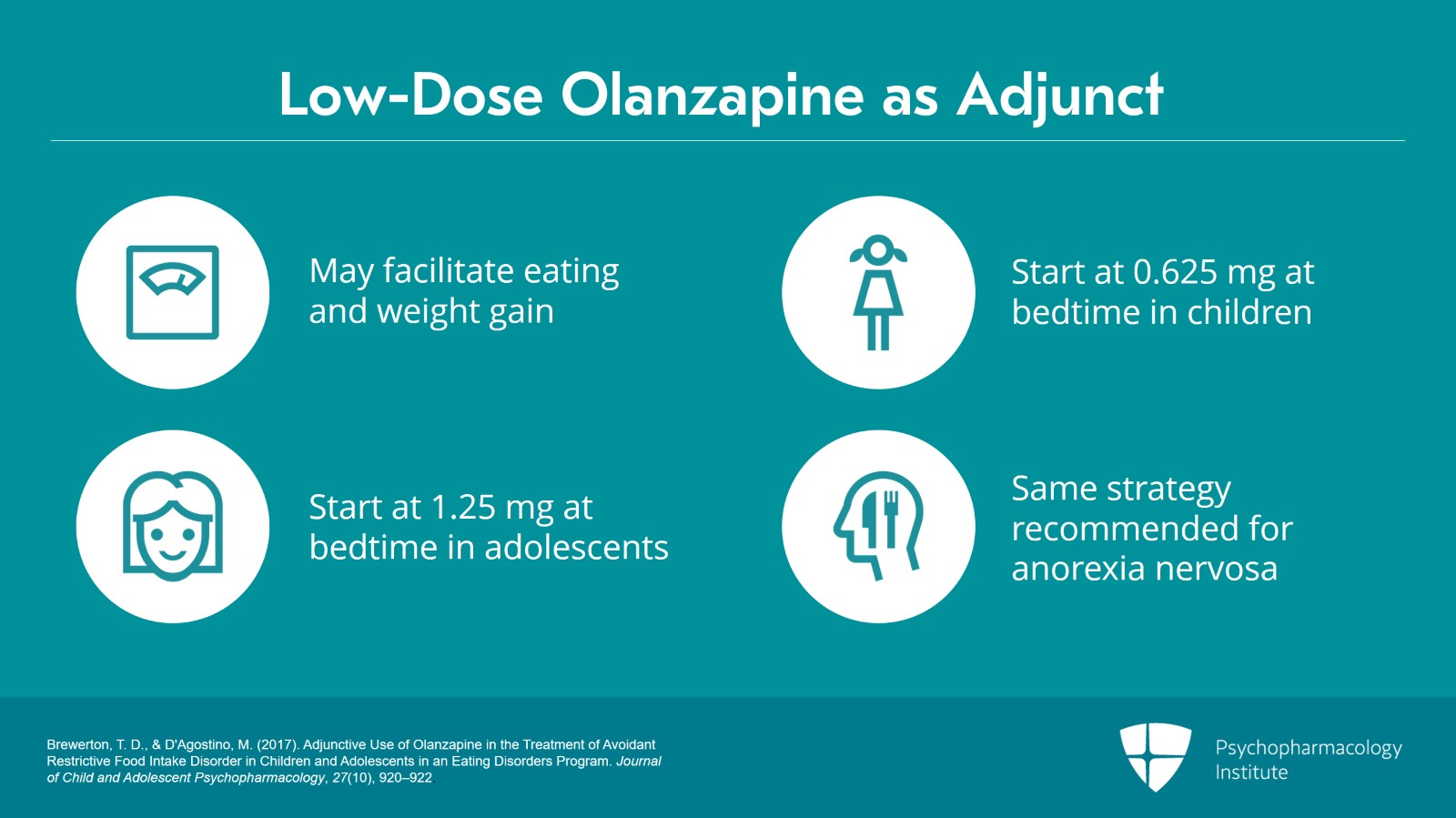
The judicious use of low-dose olanzapine when used as an adjunct to other treatment modalities may facilitate eating, weight gain and the reduction of anxious, depressive and cognitive symptoms. It is highly recommended that super low doses be started, i.e., 0.625 mg at bedtime in children or 1.25 mg at bedtime in adolescents and then slowly titrating upward based on clinical response or side effects. But such low doses ensure the minimization of side effects. And evidence suggests positive responses to very low doses in terms of weight gain and reduction of anxious, depressive and cognitive symptoms in conjunction with other therapies. As we’ll talk about later, this same strategy is recommended in the treatment of anorexia nervosa. Treatment continues indefinitely until normalization of eating behavior and developmental milestones occur or normalize.
References:
  • Brewerton, T. D., & D'Agostino, M. (2017). Adjunctive Use of Olanzapine in the Treatment of Avoidant Restrictive Food Intake Disorder in Children and Adolescents in an Eating Disorders Program. Journal of Child and Adolescent Psychopharmacology, 27(10), 920–922.
Free Files
Success!
Check your inbox, we sent you all the materials there.

Slide 9 of 10

So the key points to this video. There are no randomized double-blind, placebo-controlled trials of any psychopharmacological agent for ARFID, only published retrospective case reports. The best evidence supports the use of very low dose adjunctive olanzapine. Mirtazapine starting at 7.5 mg per day has also been reported to be helpful for weight gain.

Slide 10 of 10

Free Files
Success!
Check your inbox, we sent you all the materials there.

Learning Objectives:

After completing this activity, the learner will be able to:

  1.  Recognize the different eating and feeding disorders.
  2.  Identify evidence-based psychopharmacologic strategies for the treatment of various eating and feeding disorders discussed.

Original Release Date: 03/01/2021

Review and Re-release Date: 03/01/2024

Expiration Date: 04/01/2025

Expert: Timothy Brewerton, M.D.

Medical Editor: Melissa Mariano, M.D

Relevant Financial Disclosures:

None of the faculty, planners, and reviewers for this educational activity have relevant financial relationship(s) to disclose during the last 24 months with ineligible companies whose primary business is producing, marketing, selling, re-selling, or distributing healthcare products used by or on patients.

Contact Information: For questions regarding the content or access to this activity, contact us at support@psychopharmacologyinstitute.com

Instructions for Participation and Credit:

Participants must complete the activity online during the valid credit period that is noted above.

Follow these steps to earn CME credit:

  1. View the required educational content provided on this course page.
  2. Complete the Post Activity Evaluation for providing the necessary feedback for continuing accreditation purposes and for the development of future activities. NOTE: Completing the Post Activity Evaluation after the quiz is required to receive the earned credit.
  3. Download your certificate.

Accreditation Statement

This activity has been planned and implemented in accordance with the accreditation requirements and policies of the Accreditation Council for Continuing Medical Education through the joint providership of Medical Academy LLC and the Psychopharmacology Institute. Medical Academy is accredited by the ACCME to provide continuing medical education for physicians.

Credit Designation Statement

Medical Academy designates this enduring activity for a maximum of 1.00 AMA PRA Category 1 credit(s). Physicians should claim only the credit commensurate with the extent of their participation in the activity.


Free Files
Success!
Check your inbox, we sent you all the materials there.
Continue in the website
Instant access modal

Become a Bronze, Silver, Gold, Bronze extended, Silver extended or Gold extended Member.

2025–26 Psychopharmacology CME Program

Unlock up to 155 CME Credits, including 40 SA CME Credits.