Close Banner
Section Free  - Video Lectures

07. Examining the Efficacy of Extended-Release Naltrexone OUD

Published on August 1, 2024 Certification expiration date: August 1, 2027

Smita Das, M.D., Ph.D., M.P.H.

Addiction Psychiastrist and Addiction Medicine Physician - Stanford Medicine

Key Points

  • Naltrexone is less effective than methadone and buprenorphine for opioid dependence, but useful for safety-sensitive positions. It's effective for comorbid alcohol use disorder and doesn't cause euphoria or withdrawal.
  • Injectable naltrexone requires patients to be opioid-free for at least a week before starting. It's administered as a 380 mg injection in alternating gluteal muscles monthly.
  • Common side effects include nausea, fatigue, and appetite changes. Injection site reactions can occur. Proper muscular injection technique and patient relaxation may improve administration success.

Free Downloads for Offline Access

  • Free Download Presentation File (PPTX)
  • Free Download Audio File (MP3)
  • Free Download Video (MP4)

Slides and Transcript

Slide 1 of 14

The last medication we will discuss is naltrexone.

Slide 2 of 14

Naltrexone  is less effective for opioid dependence than methadone and buprenorphine because the most difficult part of this medication is that it requires somebody to be off of opioids for at least a week. 
References:
  • Ogbuchi, A. (2023). Extended-release injectable naltrexone for opioid use disorder. Current Psychiatry, 22(8).
  • Lee, J. D., Nunes, E. V., Novo, P., Bachrach, K., Bailey, G. L., Bhatt, S., Farkas, S., Fishman, M., Gauthier, P., Hodgkins, C. C., King, J., Lindblad, R., Liu, D., Matthews, A. G., May, J., Peavy, K. M., Ross, S., Salazar, D., Schkolnik, P., … Rotrosen, J. (2018). Comparative effectiveness of extended-release naltrexone versus buprenorphine-naloxone for opioid relapse prevention (X:BOT): A multicentre, open-label, randomised controlled trial. The Lancet, 391(10118), 309-318.
Free Files
Success!
Check your inbox, we sent you all the materials there.

Slide 3 of 14

Extended-release naltrexone serves as a mu-opioid receptor antagonist and therefore it is a blocker at the receptor. If somebody starts to take opioids, they will not be able to bind. The dose is 380 mg in alternating gluteal muscles every month. 
References:
  • Jarvis, B. P., Holtyn, A. F., Subramaniam, S., Tompkins, D. A., Oga, E. A., Bigelow, G. E., & Silverman, K. (2018). Extended‐release injectable naltrexone for opioid use disorder: A systematic review. Addiction, 113(7), 1188-1209.
  • Ogbuchi, A. (2023). Extended-release injectable naltrexone for opioid use disorder. Current Psychiatry, 22(8).

Slide 4 of 14

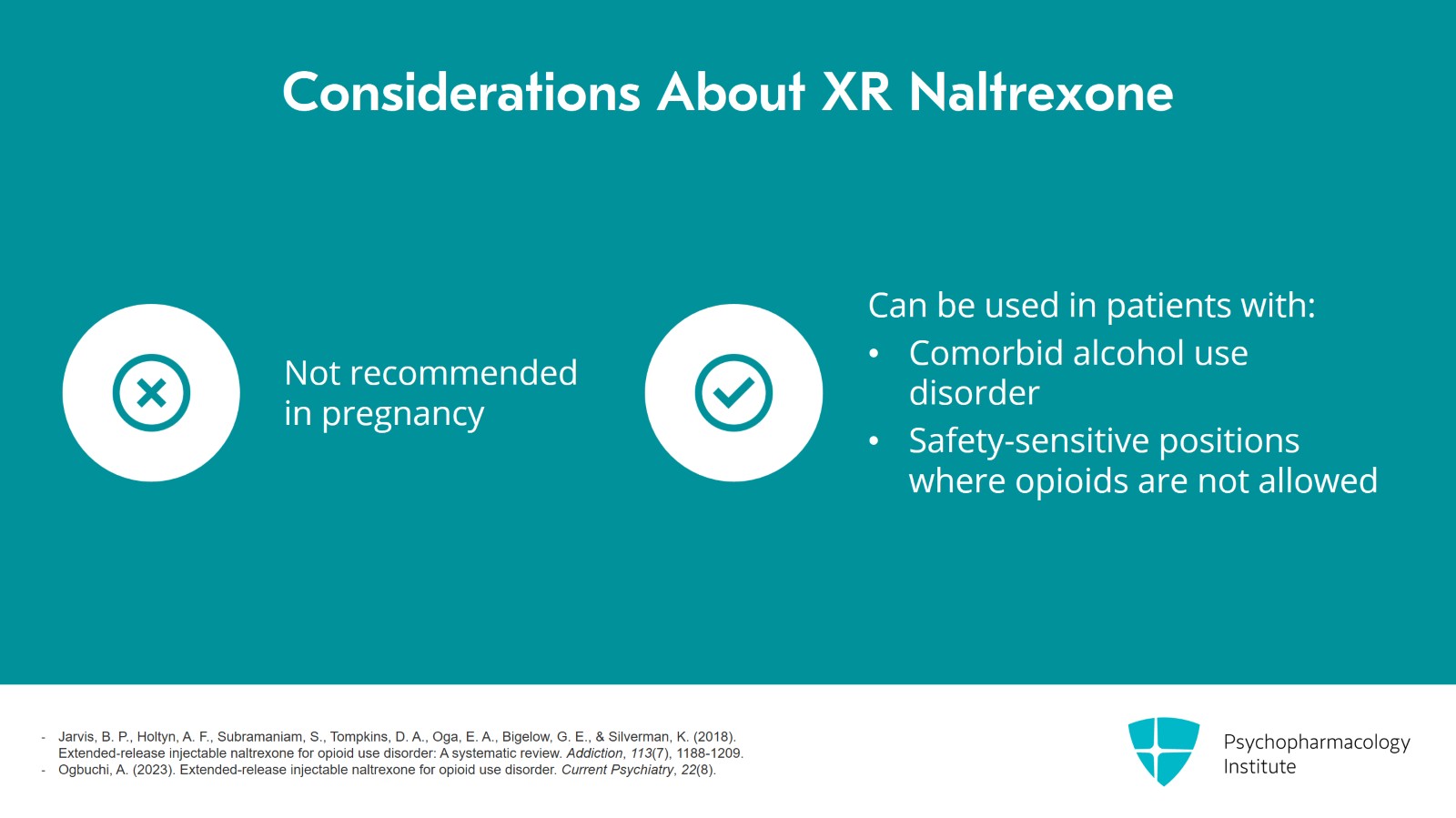
Unlike buprenorphine and methadone, injectable naltrexone is not recommended in pregnancy. A benefit of injectable naltrexone is that it is effective for comorbid alcohol use disorder.  Patients that I've had on injectable naltrexone for opioid use disorder include safety sensitive positions where opioids are not allowed such as physicians or pilots.
References:
  • Jarvis, B. P., Holtyn, A. F., Subramaniam, S., Tompkins, D. A., Oga, E. A., Bigelow, G. E., & Silverman, K. (2018). Extended‐release injectable naltrexone for opioid use disorder: A systematic review. Addiction, 113(7), 1188-1209.
  • Ogbuchi, A. (2023). Extended-release injectable naltrexone for opioid use disorder. Current Psychiatry, 22(8).
Free Files
Success!
Check your inbox, we sent you all the materials there.

Slide 5 of 14

If somebody is in need in of opioids, for example, say if they'll have anesthesia, then they will need to have somebody who's skilled in anesthesia available and a wallet card is helpful to alert people that they are on the medication. 
References:
  • Jarvis, B. P., Holtyn, A. F., Subramaniam, S., Tompkins, D. A., Oga, E. A., Bigelow, G. E., & Silverman, K. (2018). Extended‐release injectable naltrexone for opioid use disorder: A systematic review. Addiction, 113(7), 1188-1209.
  • Ogbuchi, A. (2023). Extended-release injectable naltrexone for opioid use disorder. Current Psychiatry, 22(8).

Slide 6 of 14

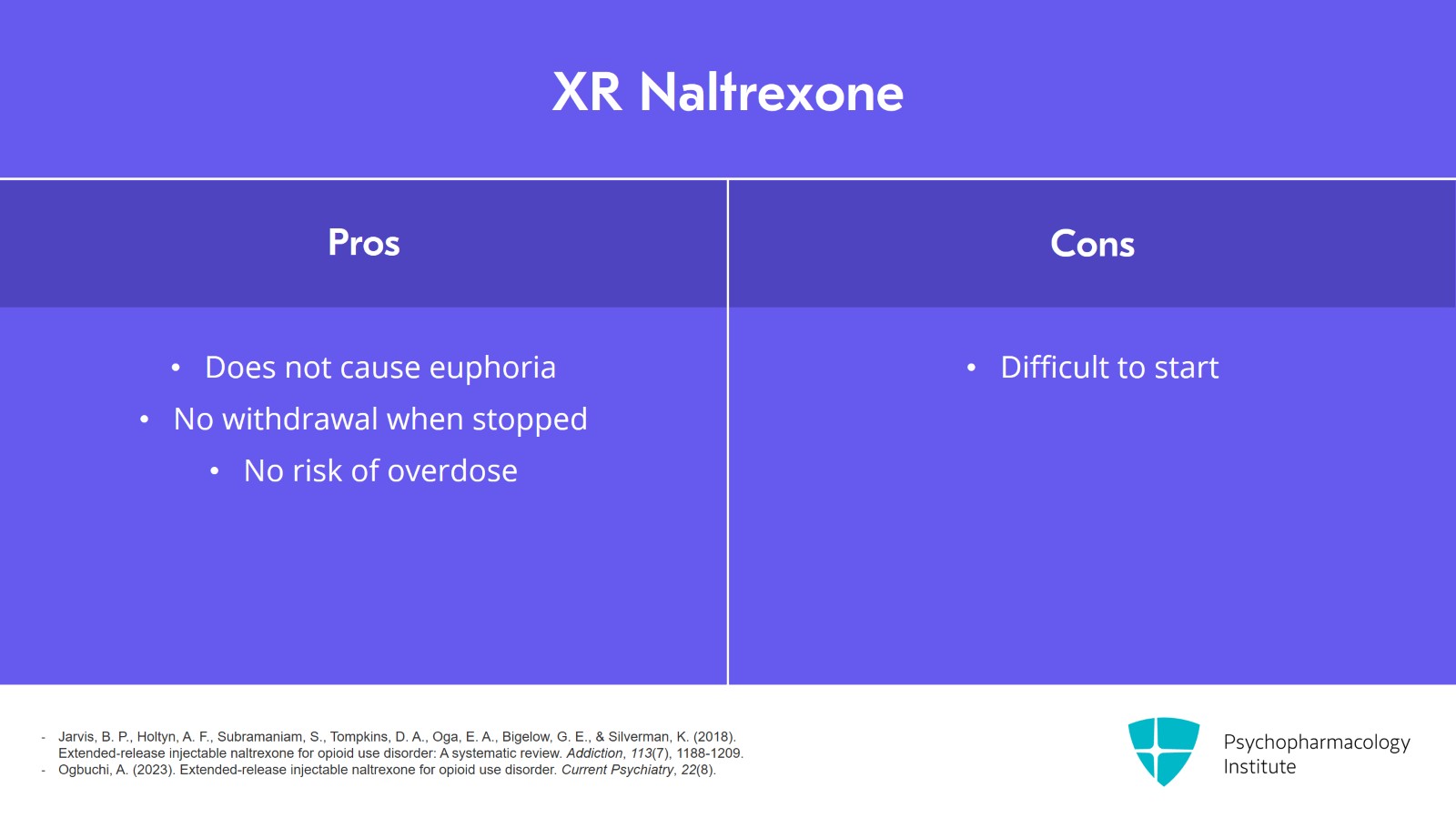
A positive of this medication is that it doesn't cause any euphoria and there is no withdrawal when stopped but there is also no risk of overdose from this medication. On the other hand, it is very hard to start this medication because somebody needs to be tapered off of opioids for at least a week.
References:
  • Jarvis, B. P., Holtyn, A. F., Subramaniam, S., Tompkins, D. A., Oga, E. A., Bigelow, G. E., & Silverman, K. (2018). Extended‐release injectable naltrexone for opioid use disorder: A systematic review. Addiction, 113(7), 1188-1209.
  • Ogbuchi, A. (2023). Extended-release injectable naltrexone for opioid use disorder. Current Psychiatry, 22(8).
Free Files
Success!
Check your inbox, we sent you all the materials there.

Slide 7 of 14

For people to get this medication, I usually go to the manufacturer website and locate a pharmacy that is able to administer this medication.  I've administered very few personally but I've learned from the nurse in my clinic ways to improve injection success. Somebody should be relaxed and not tense when the injection goes in. We should inject into the muscle. The medication should be at room temperature and the patient is advised to massage the area after the injection. The medication is a microsphere of biodegradable polymers and so sometimes it can clump up if administered improperly.
References:
  • Jarvis, B. P., Holtyn, A. F., Subramaniam, S., Tompkins, D. A., Oga, E. A., Bigelow, G. E., & Silverman, K. (2018). Extended‐release injectable naltrexone for opioid use disorder: A systematic review. Addiction, 113(7), 1188-1209.
  • Ogbuchi, A. (2023). Extended-release injectable naltrexone for opioid use disorder. Current Psychiatry, 22(8).

Slide 8 of 14

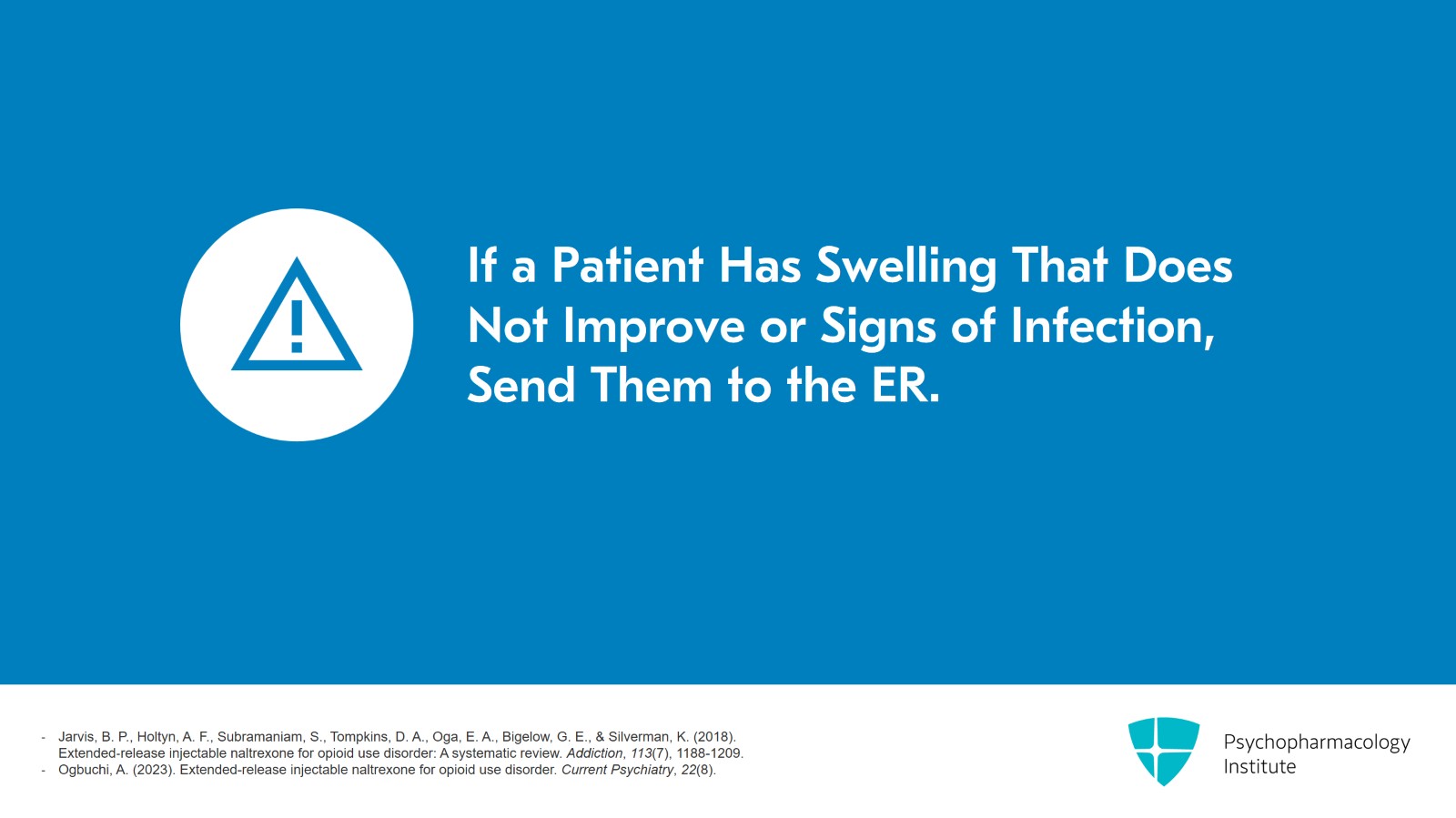
More commonly, I have seen injection site reactions. If somebody has swelling that does not improve or signs of infection, they should see the ER. Often, the reason for injection area issues is due to unintentional subcutaneous injection instead of muscular injection.
References:
  • Jarvis, B. P., Holtyn, A. F., Subramaniam, S., Tompkins, D. A., Oga, E. A., Bigelow, G. E., & Silverman, K. (2018). Extended‐release injectable naltrexone for opioid use disorder: A systematic review. Addiction, 113(7), 1188-1209.
  • Ogbuchi, A. (2023). Extended-release injectable naltrexone for opioid use disorder. Current Psychiatry, 22(8).
Free Files
Success!
Check your inbox, we sent you all the materials there.

Slide 9 of 14

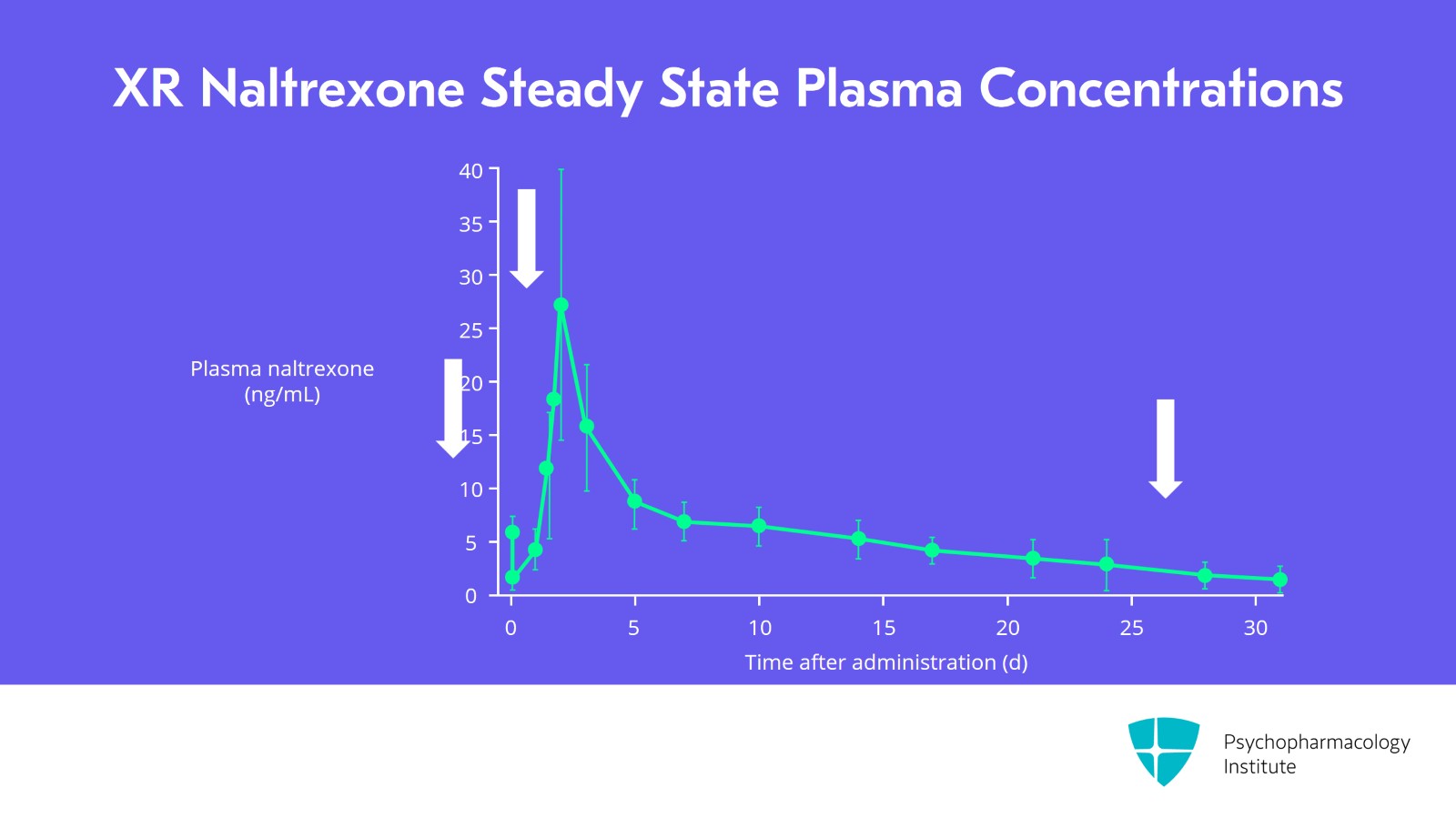
In this image, we see the steady state plasma concentrations over one month. We can see that after 28 days the plasma, as the plasma and naltrexone amount decreases, it's very important for patients to come in because they're going to continue to need their medication. You'll also notice that there are two peaks in blood levels. One is two hours after injection and the other is two to three days after injection. 

Slide 10 of 14

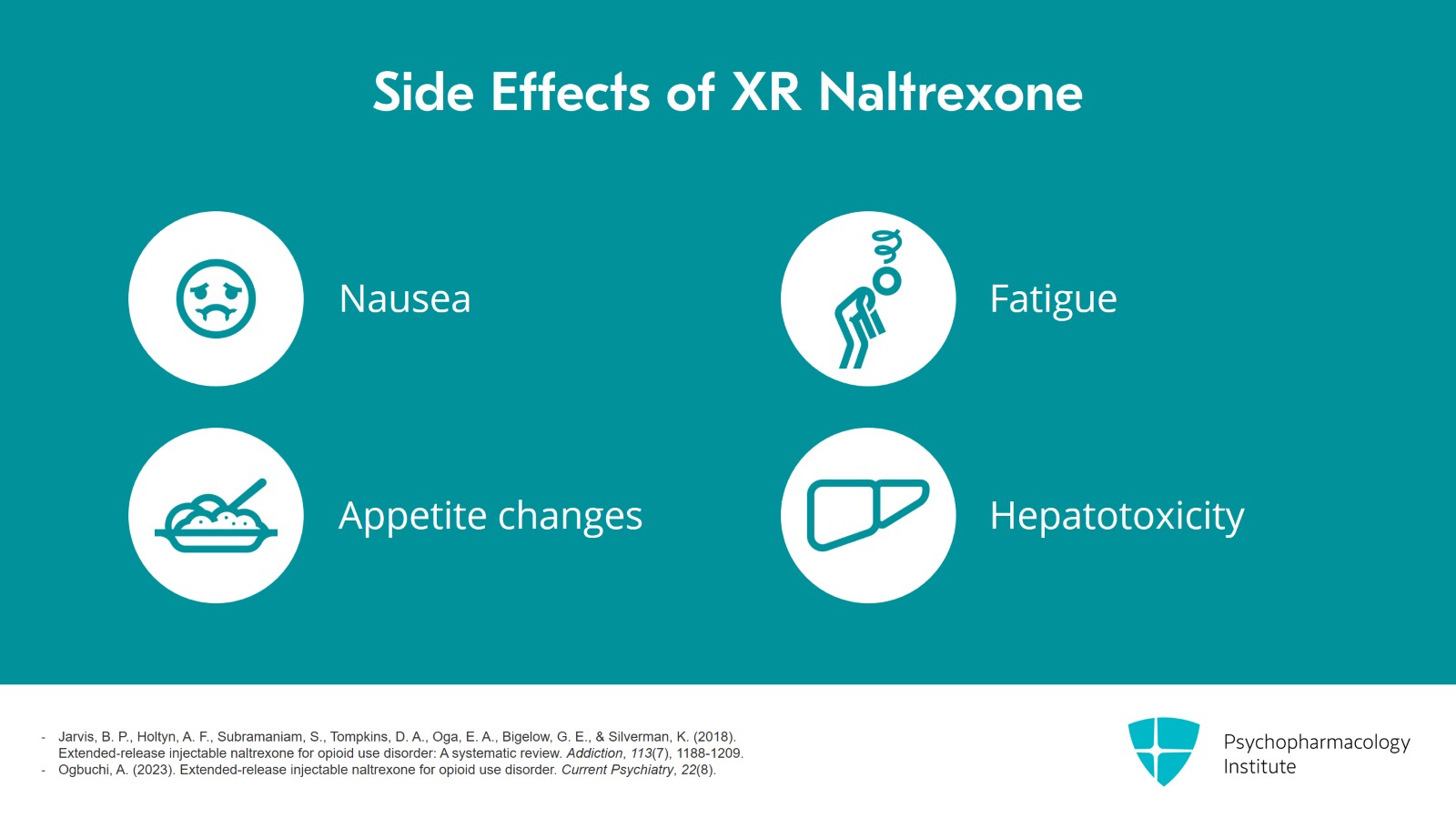
Common side effects associated include nausea as with most of our medications as well as fatigue and appetite changes. Rarely can somebody have hepatotoxicity but that is usually in higher doses. 
References:
  • Jarvis, B. P., Holtyn, A. F., Subramaniam, S., Tompkins, D. A., Oga, E. A., Bigelow, G. E., & Silverman, K. (2018). Extended‐release injectable naltrexone for opioid use disorder: A systematic review. Addiction, 113(7), 1188-1209.
  • Ogbuchi, A. (2023). Extended-release injectable naltrexone for opioid use disorder. Current Psychiatry, 22(8).
Free Files
Success!
Check your inbox, we sent you all the materials there.

Slide 11 of 14

To summarize key points, extended-release naltrexone is an effective medication for opioid use disorder and alcohol use disorder but is less effective than methadone and buprenorphine because the most difficult part of this medication is that it requires somebody to be off of opioids for at least a week. 

Slide 12 of 14

The medication is especially useful for people who are in safety sensitive positions such as pilots or physicians or who cannot take opioids. As with all medications for opioid use disorder, staying on the medication longer will lead to better outcomes. 
Free Files
Success!
Check your inbox, we sent you all the materials there.

Slide 13 of 14

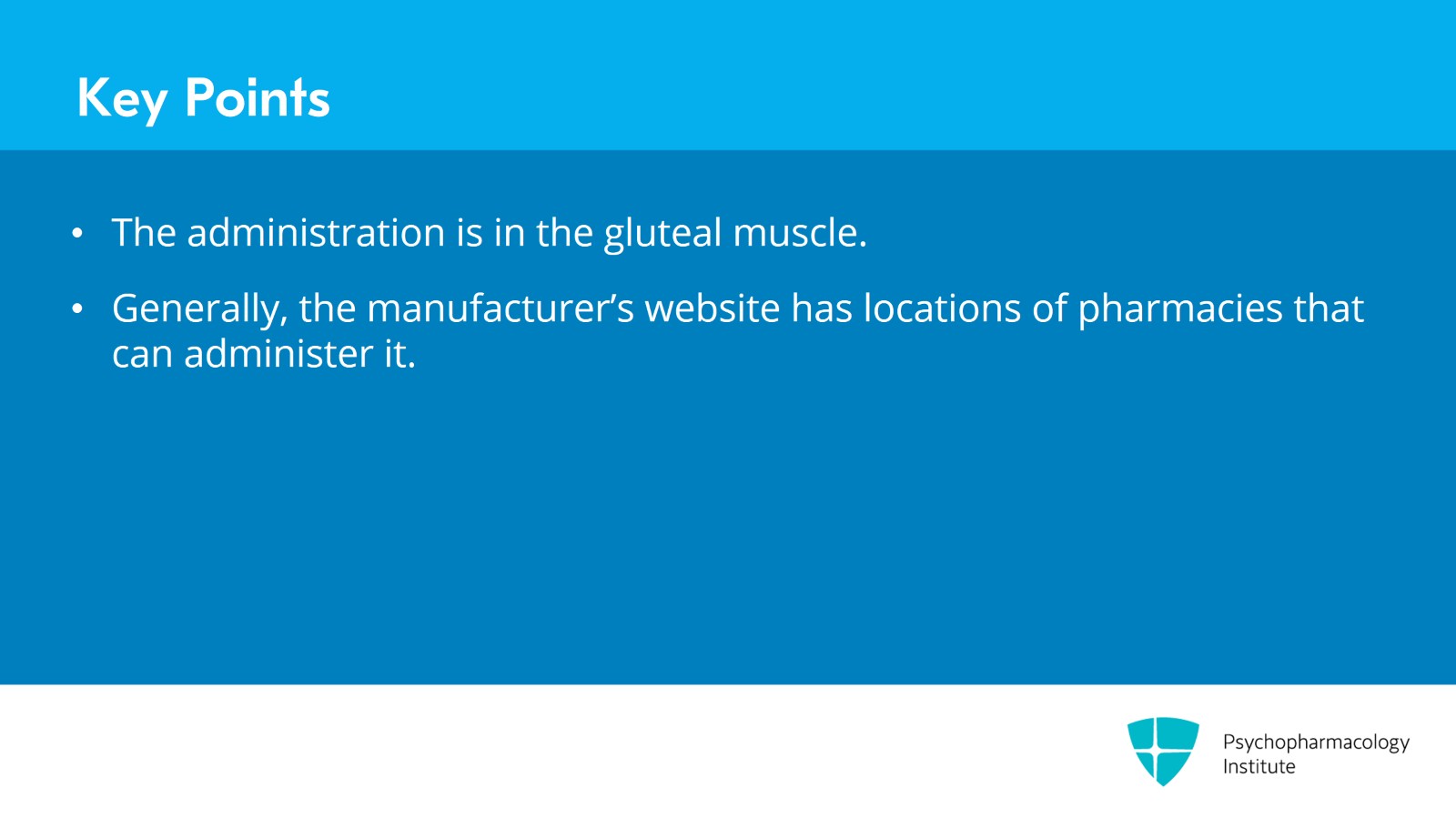
Administration is through the gluteal muscle injection and generally the manufacturer website has locations of pharmacies that can administer it.

Slide 14 of 14

Free Files
Success!
Check your inbox, we sent you all the materials there.

Learning Objectives:

After completing this activity, the learner will be able to:

  1. Assess and manage patients experiencing opioid intoxication and withdrawal symptoms effectively.
  2. Describe the key components of opioid use disorder (OUD) and identify patients who can benefit from pharmacologic treatments.
  3. Develop individualized treatment plans for patients with OUD, utilizing methadone, buprenorphine, and extended-release naltrexone.

Original Release Date: August 1, 2024

Expiration Date: August 1, 2027

Expert: Smita Das, M.D.

Medical Editor: Paz Badía, M.D. 

Relevant Financial Disclosures: 

Smita Das declares the following interests:

- Lyra Health: Employee

All of the relevant financial relationships listed above have been mitigated by Medical Academy and the Psychopharmacology Institute.

None of the others faculty, planners, and reviewers for this educational activity have relevant financial relationships to disclose during the last 24 months with ineligible companies whose primary business is producing, marketing, selling, re-selling, or distributing healthcare products used by or on patients.

Contact Information: For questions regarding the content or access to this activity, contact us at support@psychopharmacologyinstitute.com

Instructions for Participation and Credit:

Participants must complete the activity online during the valid credit period that is noted above.

Follow these steps to earn CME credit:

  1. View the required educational content provided on this course page.

  2. Complete the Post Activity Evaluation for providing the necessary feedback for continuing accreditation purposes and for the development of future activities. NOTE: Completing the Post Activity Evaluation after the quiz is required to receive the earned credit.

  3. Download your certificate.

Accreditation Statement

This activity has been planned and implemented in accordance with the accreditation requirements and policies of the Accreditation Council for Continuing Medical Education through the joint providership of Medical Academy LLC and the Psychopharmacology Institute. Medical Academy is accredited by the ACCME to provide continuing medical education for physicians.

Credit Designation Statement

Medical Academy designates this enduring activity for a maximum of 1.0 AMA PRA Category 1 credit(s)™. Physicians should claim only the credit commensurate with the extent of their participation in the activity.


Free Files
Success!
Check your inbox, we sent you all the materials there.
Continue in the website
Instant access modal

Become a Bronze, Silver, Gold, Bronze extended, Silver extended or Gold extended Member.

2025–26 Psychopharmacology CME Program

Unlock up to 155 CME Credits, including 40 SA CME Credits.