Close Banner
Section Free  - Video Lectures

03. Depression and Mediterranean-Style Diet

Published on January 1, 2023 Certification expiration date: January 1, 2026

Amelia Villagomez, M.D.

Assistant Professor of Psychiatry - University of Arizona

Key Points

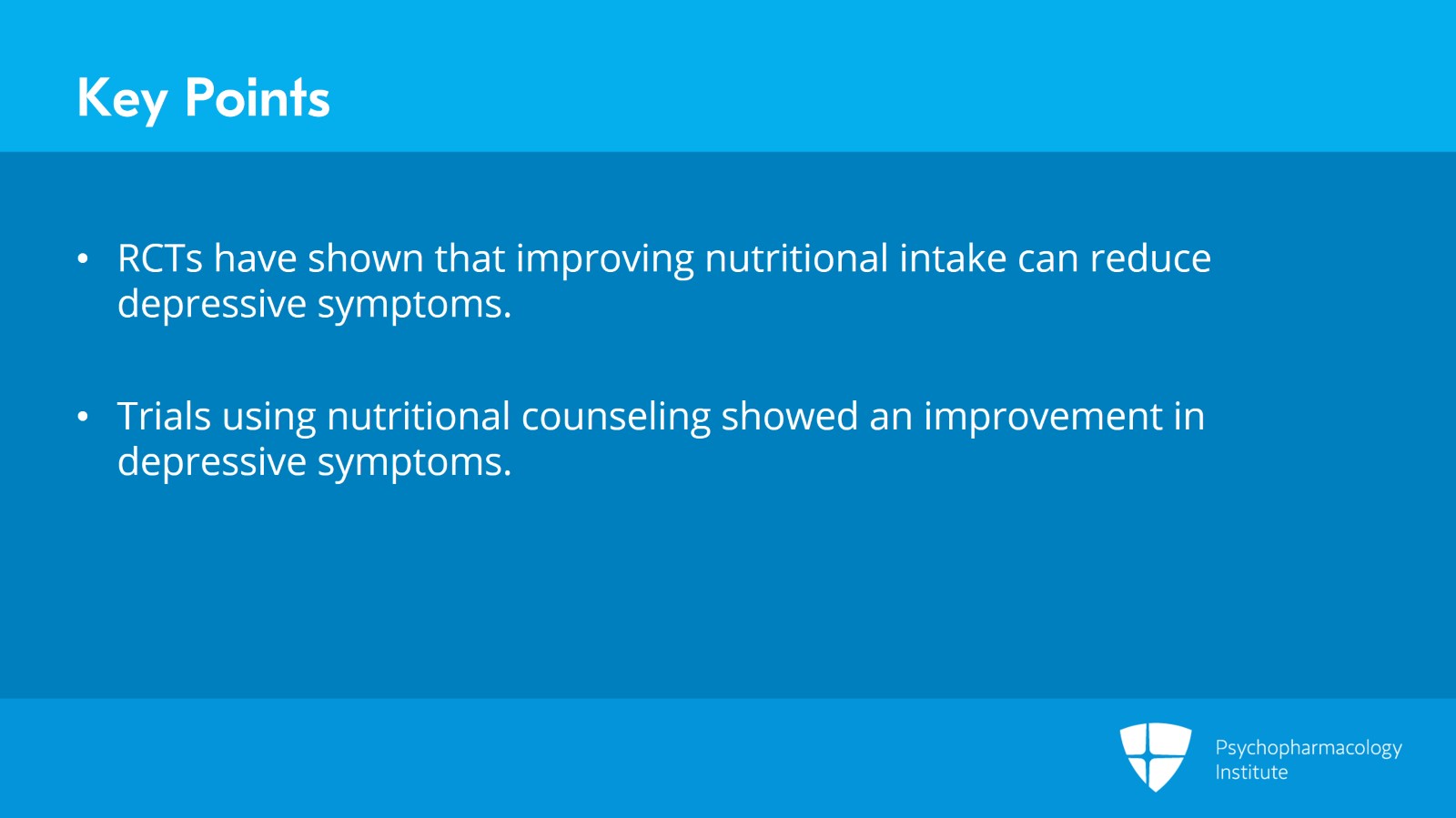
  • RCTs have shown that improving nutritional intake can reduce depressive symptoms.
  • Trials using nutritional counseling showed an improvement in depressive symptoms.
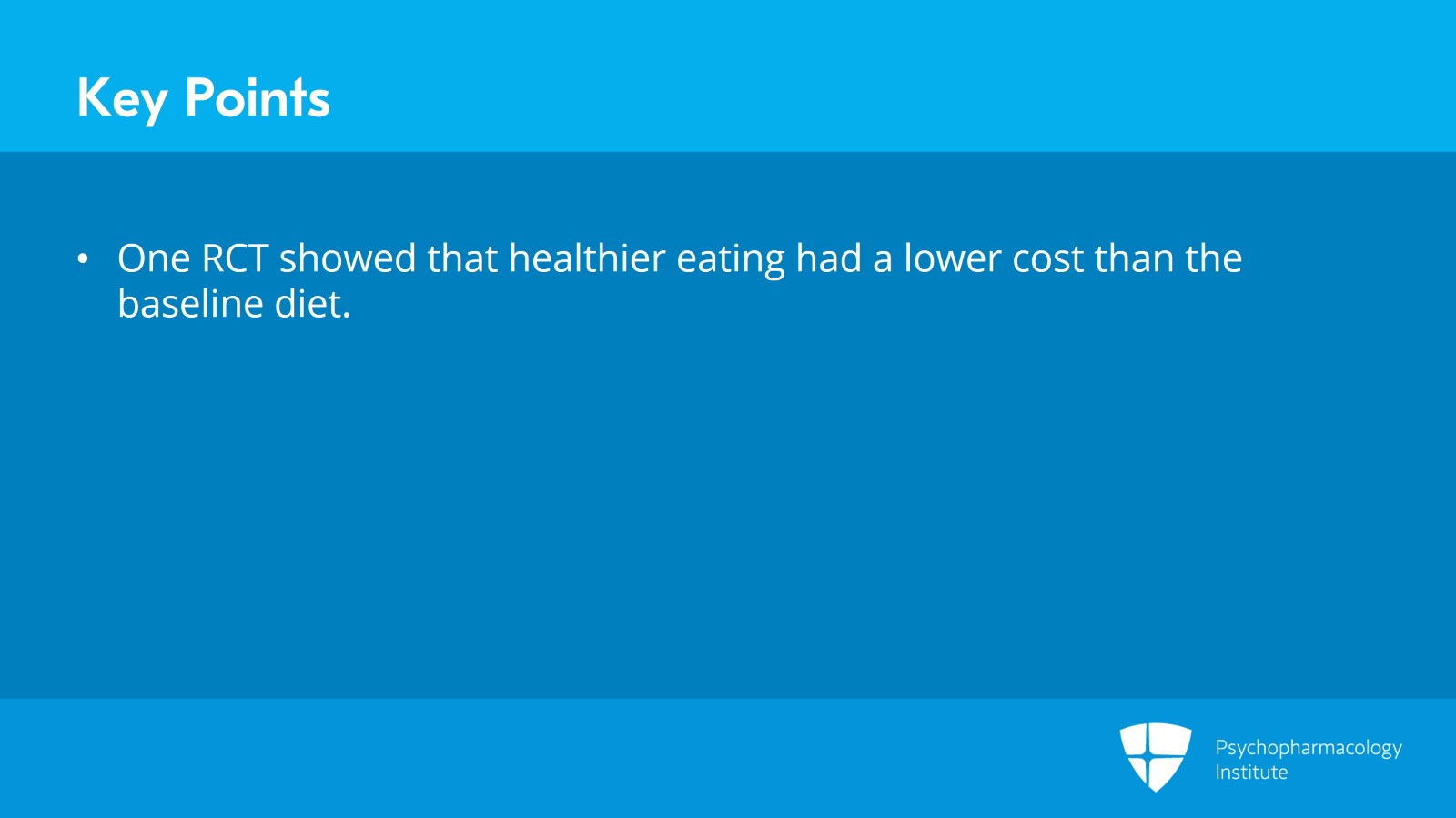
  • One RCT showed that healthier eating had a lower cost than the baseline diet.

Free Downloads for Offline Access

  • Free Download Presentation File (PPTX)
  • Free Download Video (MP4)
  • Free Download Audio File (MP3)

Slides and Transcript

Slide 1 of 14

So, in the next group of studies we will review, investigators were asking the question: If symptoms have already emerged, if people are already depressed, can they improve by a different dietary pattern? There have been four trials aimed to study the effects of a Mediterranean diet on depression of which we will review three.

Slide 2 of 14

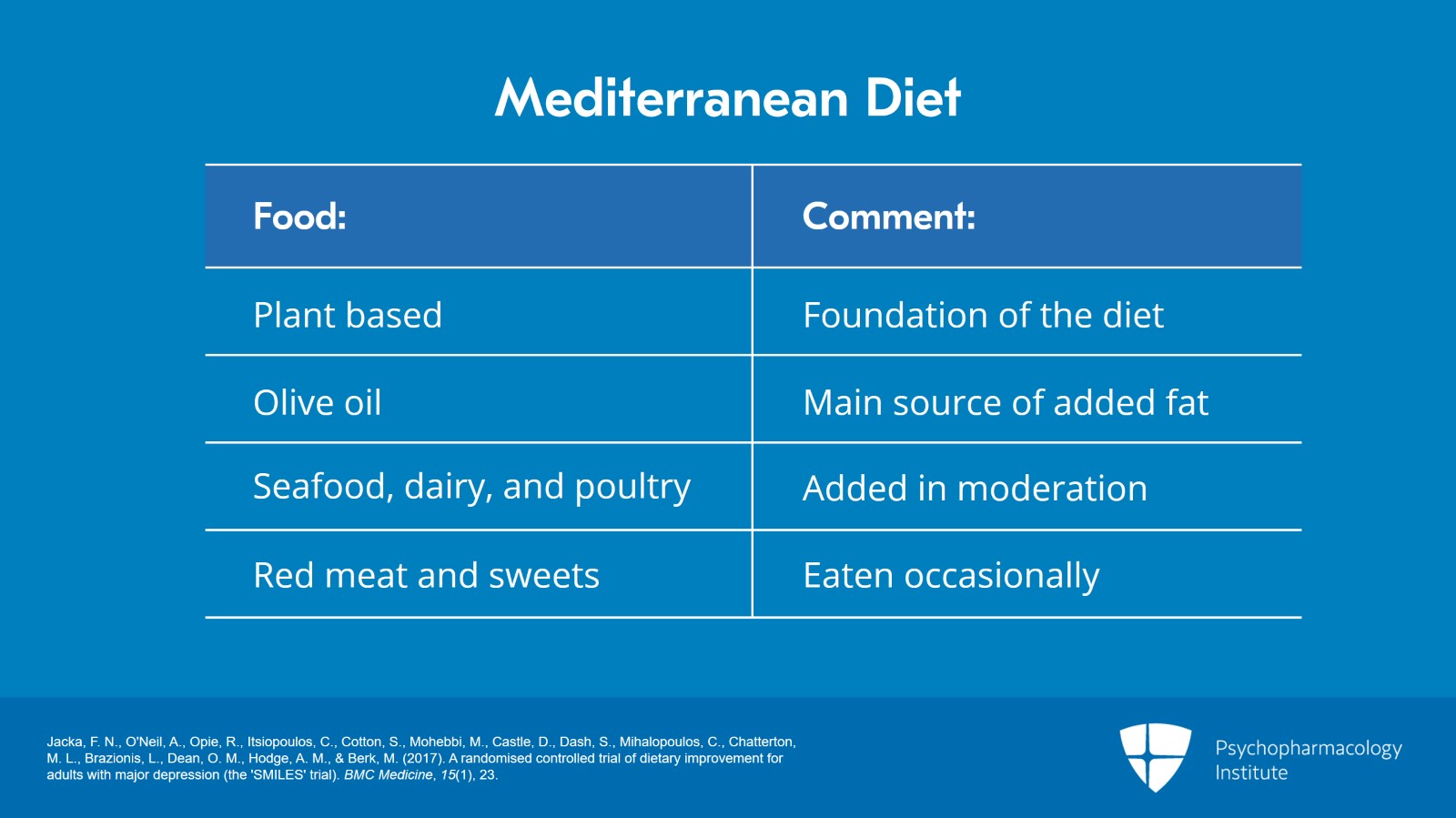
The Mediterranean diet is a way of eating that's based on the traditional cuisines of Greece, Italy, and other countries that border the Mediterranean Sea. Plant-based foods such as whole grains, vegetables, legumes, fruits, nuts, seeds, herbs, and spices are the foundation of the diet. Olive oil is the main source of added fat. Fish, seafood, dairy, and poultry are included in moderation. Red meat and sweets are eaten only occasionally.
References:
  • Jacka, F. N., O'Neil, A., Opie, R., Itsiopoulos, C., Cotton, S., Mohebbi, M., Castle, D., Dash, S., Mihalopoulos, C., Chatterton, M. L., Brazionis, L., Dean, O. M., Hodge, A. M., & Berk, M. (2017). A randomised controlled trial of dietary improvement for adults with major depression (the 'SMILES' trial). BMC Medicine, 15(1), 23.
Free Files
Success!
Check your inbox, we sent you all the materials there.

Slide 3 of 14

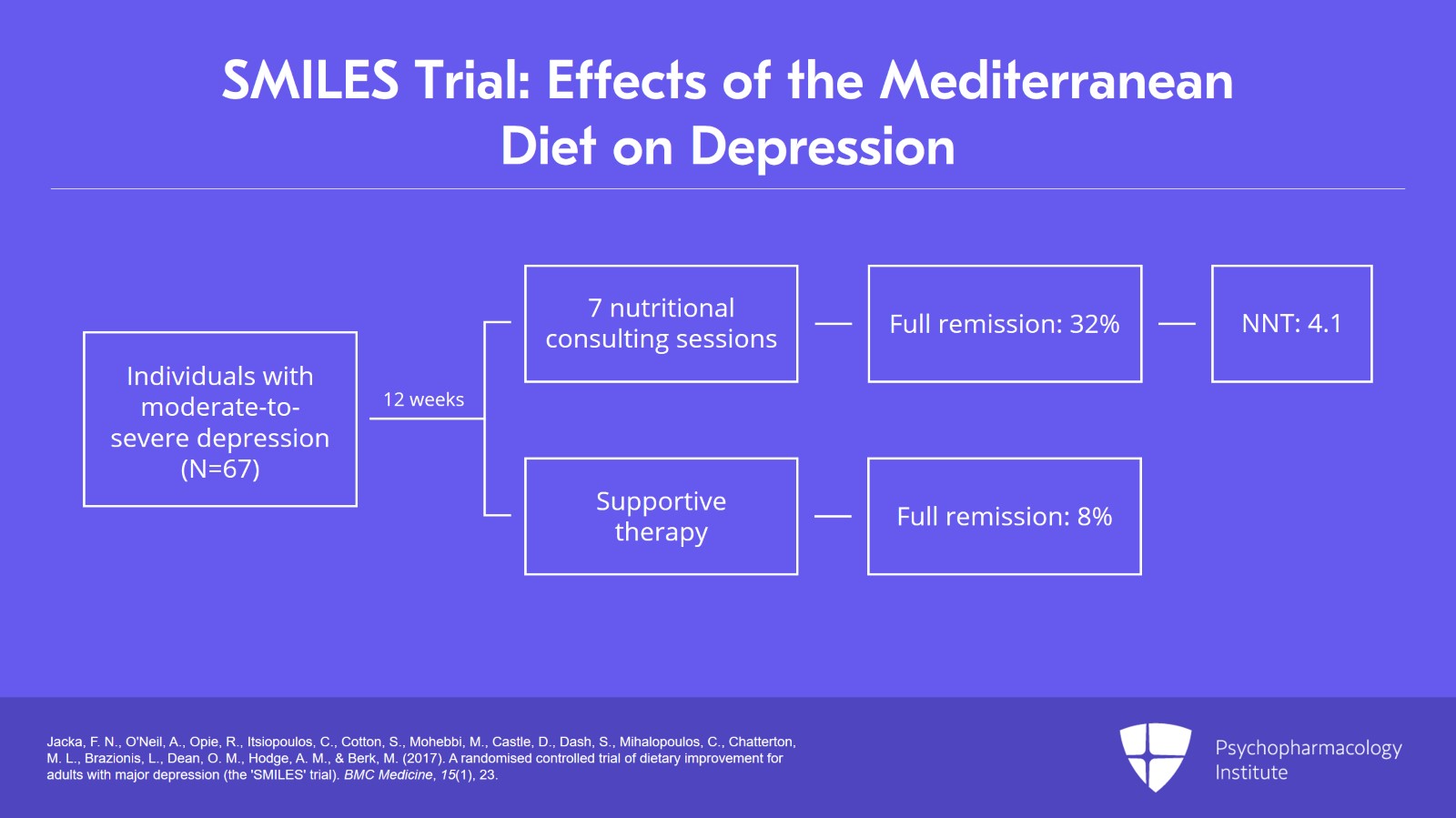
The first study is the SMILES trial which aimed to study the effects of a Mediterranean diet on depression. This 12-week study enrolled 67 individuals with moderate-to-severe depression. The active arm consisted of seven individual nutritional consulting sessions by a clinical dietitian. The control arm was supportive therapy where they came together and talked about hobbies and interests. Interestingly, 32% of patients achieved full remission after changing their diet versus 8% in the control group. The number needed to treat for remission in this study was 4.1. Therefore, four people needed to be given this diet for one of them to achieve remission over what would have been expected in the control group. As a comparison, the number needed to treat for SSRIs or SNRIs for remission of depression is approximately 7.
References:
  • Jacka, F. N., O'Neil, A., Opie, R., Itsiopoulos, C., Cotton, S., Mohebbi, M., Castle, D., Dash, S., Mihalopoulos, C., Chatterton, M. L., Brazionis, L., Dean, O. M., Hodge, A. M., & Berk, M. (2017). A randomised controlled trial of dietary improvement for adults with major depression (the 'SMILES' trial). BMC Medicine, 15(1), 23.

Slide 4 of 14

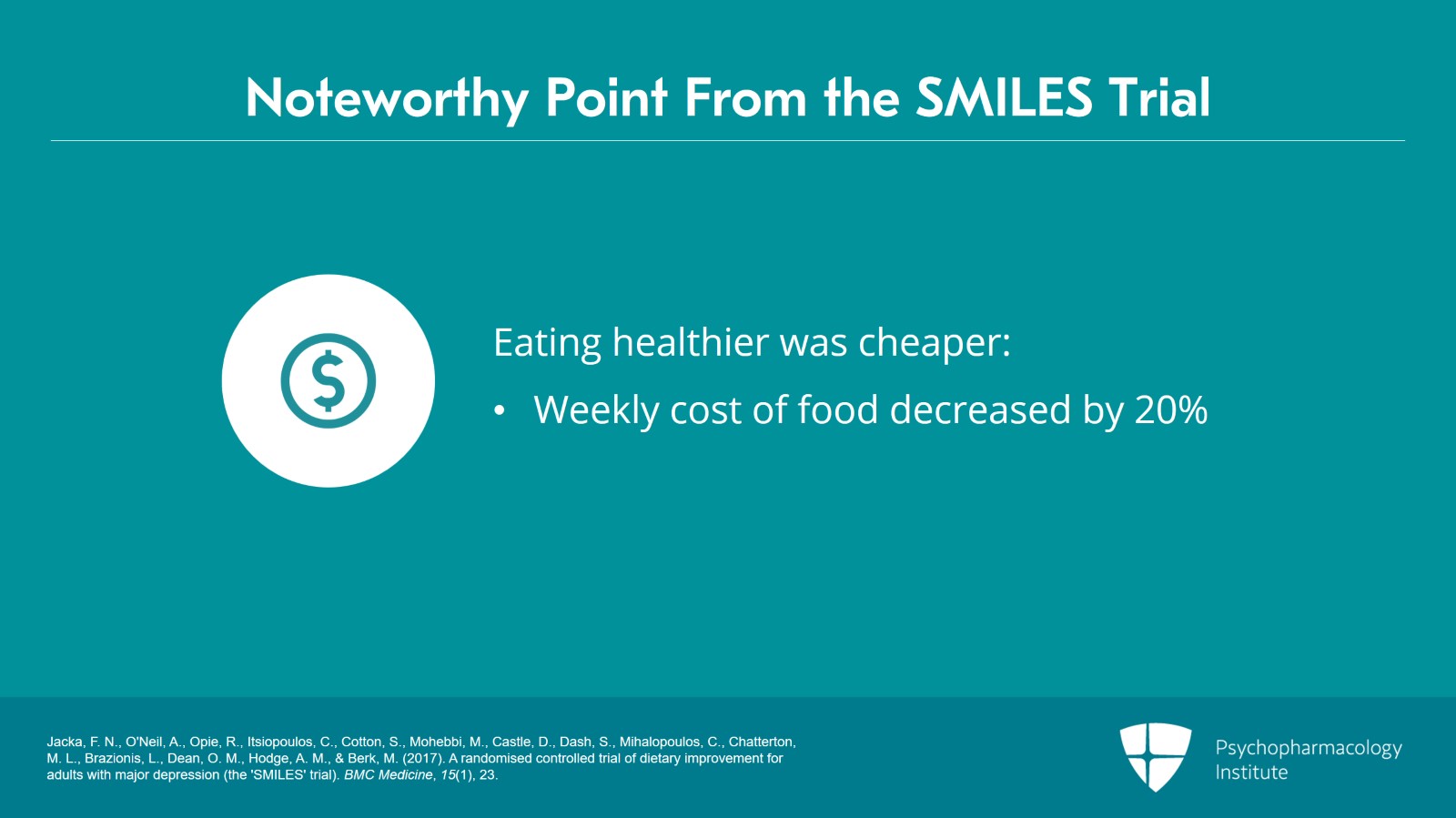
Now, one particularly noteworthy point is that eating healthier was actually cheaper. The weekly cost of food decreased by nearly 20% in the Mediterranean-style diet group.
References:
  • Jacka, F. N., O'Neil, A., Opie, R., Itsiopoulos, C., Cotton, S., Mohebbi, M., Castle, D., Dash, S., Mihalopoulos, C., Chatterton, M. L., Brazionis, L., Dean, O. M., Hodge, A. M., & Berk, M. (2017). A randomised controlled trial of dietary improvement for adults with major depression (the 'SMILES' trial). BMC Medicine, 15(1), 23.
Free Files
Success!
Check your inbox, we sent you all the materials there.

Slide 5 of 14

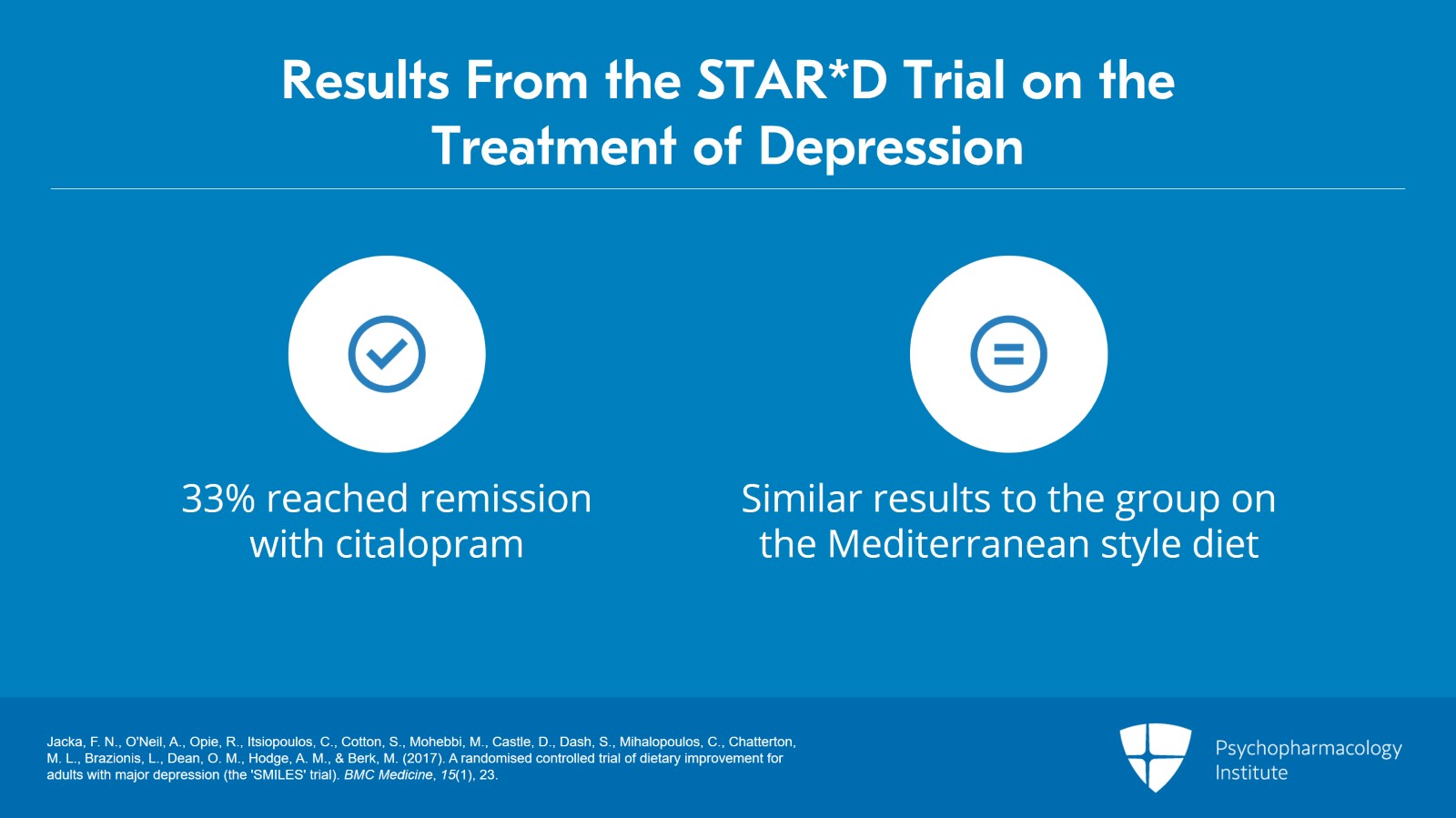
Now, as a comparison in the STAR*D trial, the largest and longest study to ever evaluate depression treatment, 33% reached remission with first-line treatment of 12 weeks of citalopram. So quite similar results to the group on the Mediterranean-style diet.
References:
  • Jacka, F. N., O'Neil, A., Opie, R., Itsiopoulos, C., Cotton, S., Mohebbi, M., Castle, D., Dash, S., Mihalopoulos, C., Chatterton, M. L., Brazionis, L., Dean, O. M., Hodge, A. M., & Berk, M. (2017). A randomised controlled trial of dietary improvement for adults with major depression (the 'SMILES' trial). BMC Medicine, 15(1), 23.

Slide 6 of 14

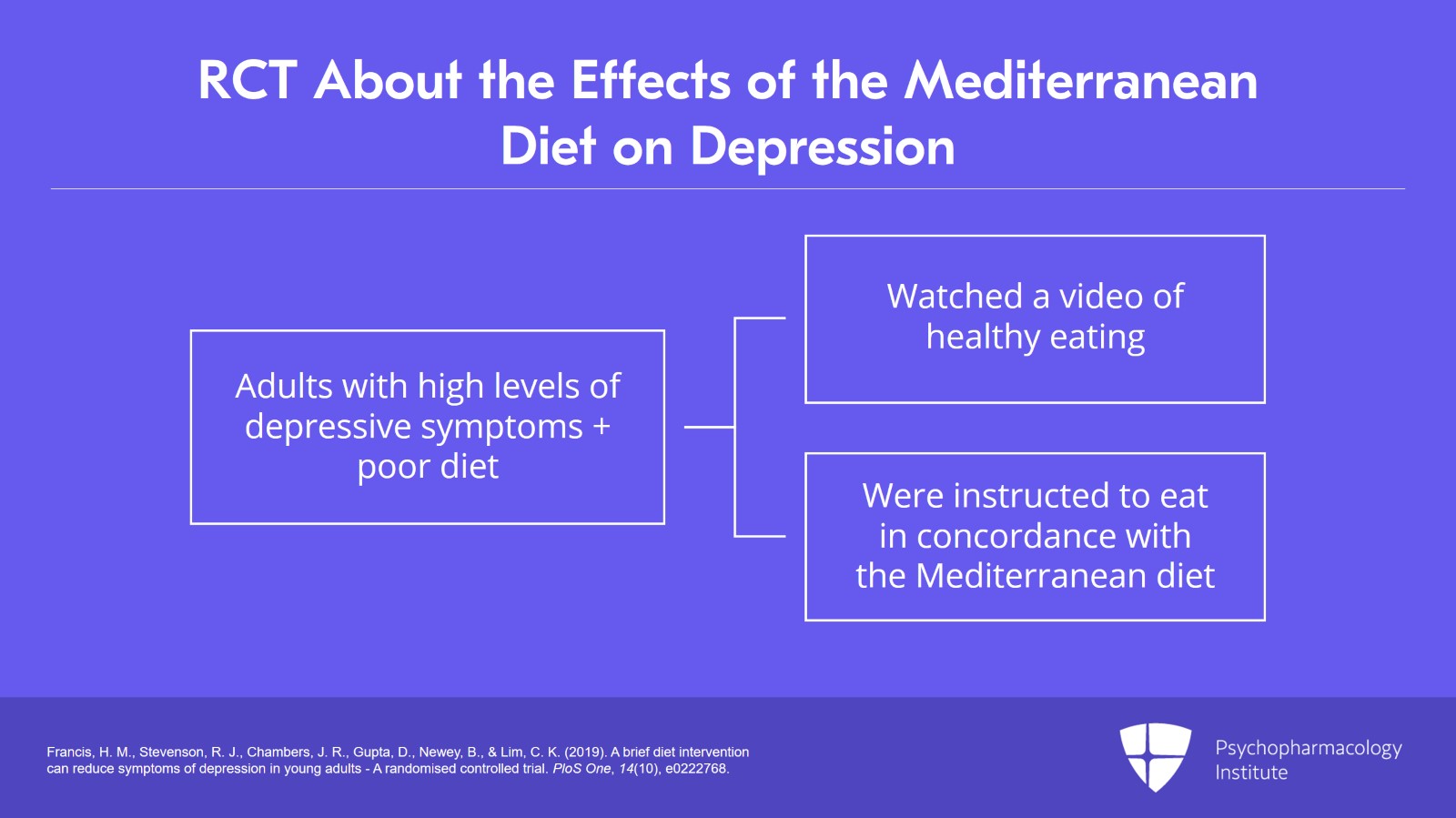
In this next study, young adults with elevated levels of depressive symptoms with a poor diet were randomized to a three-week intervention. The active group received a three-week intervention which consisted of watching a 30-minute video reviewing The Australian Guide to Healthy Eating and Recommendations. To increase concordance with Mediterranean-style diet, participants were instructed to increase intake of vegetables, fruits and whole grain cereals, fish, nuts, seeds, olive oil, spices such as turmeric and cinnamon, and to decrease processed sugar, fatty and soft drinks.
References:
  • Francis, H. M., Stevenson, R. J., Chambers, J. R., Gupta, D., Newey, B., & Lim, C. K. (2019). A brief diet intervention can reduce symptoms of depression in young adults – A randomised controlled trial. PloS One, 14(10), e0222768.
Free Files
Success!
Check your inbox, we sent you all the materials there.

Slide 7 of 14

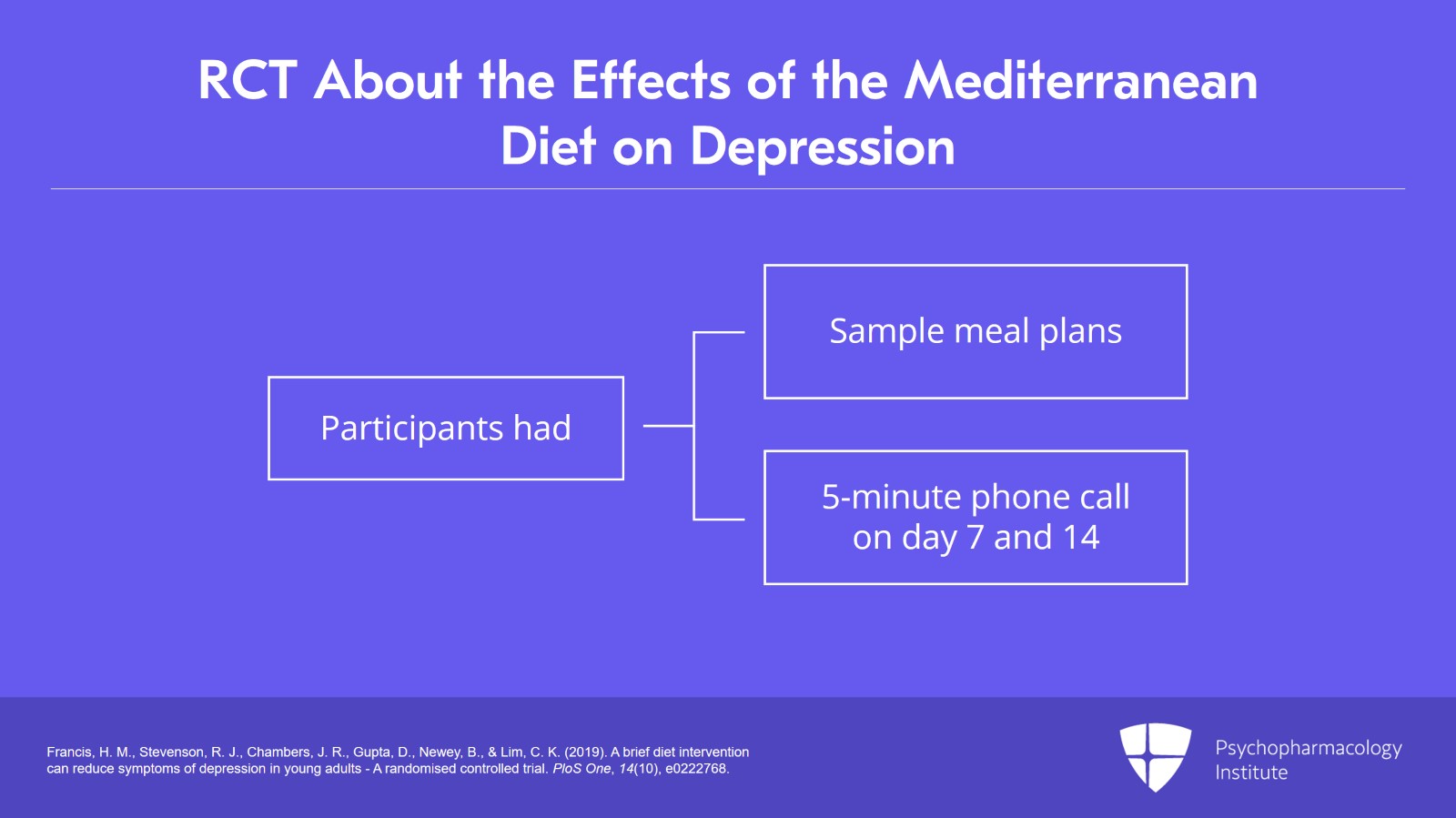
Participants were provided sample meal plans and recipes and received a five-minute phone call on day 7 and 14 to ask if they were having any difficulty adhering to the diet and troubleshoot problems with reference to prescribed handouts.
References:
  • Francis, H. M., Stevenson, R. J., Chambers, J. R., Gupta, D., Newey, B., & Lim, C. K. (2019). A brief diet intervention can reduce symptoms of depression in young adults – A randomised controlled trial. PloS One, 14(10), e0222768.

Slide 8 of 14

The group receiving the nutritional intervention had improvement of depressive symptoms that maintained at three months. This study illustrates that with a low-intensity intervention, I mean these people just watched the video and got a few phone calls, even with this low intervention, dietary patterns can change and result in mood improvement.
References:
  • Francis, H. M., Stevenson, R. J., Chambers, J. R., Gupta, D., Newey, B., & Lim, C. K. (2019). A brief diet intervention can reduce symptoms of depression in young adults – A randomised controlled trial. PloS One, 14(10), e0222768.
Free Files
Success!
Check your inbox, we sent you all the materials there.

Slide 9 of 14

Illustrated here is the drop of depressive symptoms measured using the Depression, Anxiety, and Stress Scale in the group on the Mediterranean-style diet. The diet group had lower self-reported depressive symptoms and a large effect size of 0.75. And we can see that in this graph that the improvement was maintained at three-month follow-up. With this effect size, this dietary intervention is at least on par with antidepressant effect size.
References:
  • Francis, H. M., Stevenson, R. J., Chambers, J. R., Gupta, D., Newey, B., & Lim, C. K. (2019). A brief diet intervention can reduce symptoms of depression in young adults – A randomised controlled trial. PloS One, 14(10), e0222768.

Slide 10 of 14

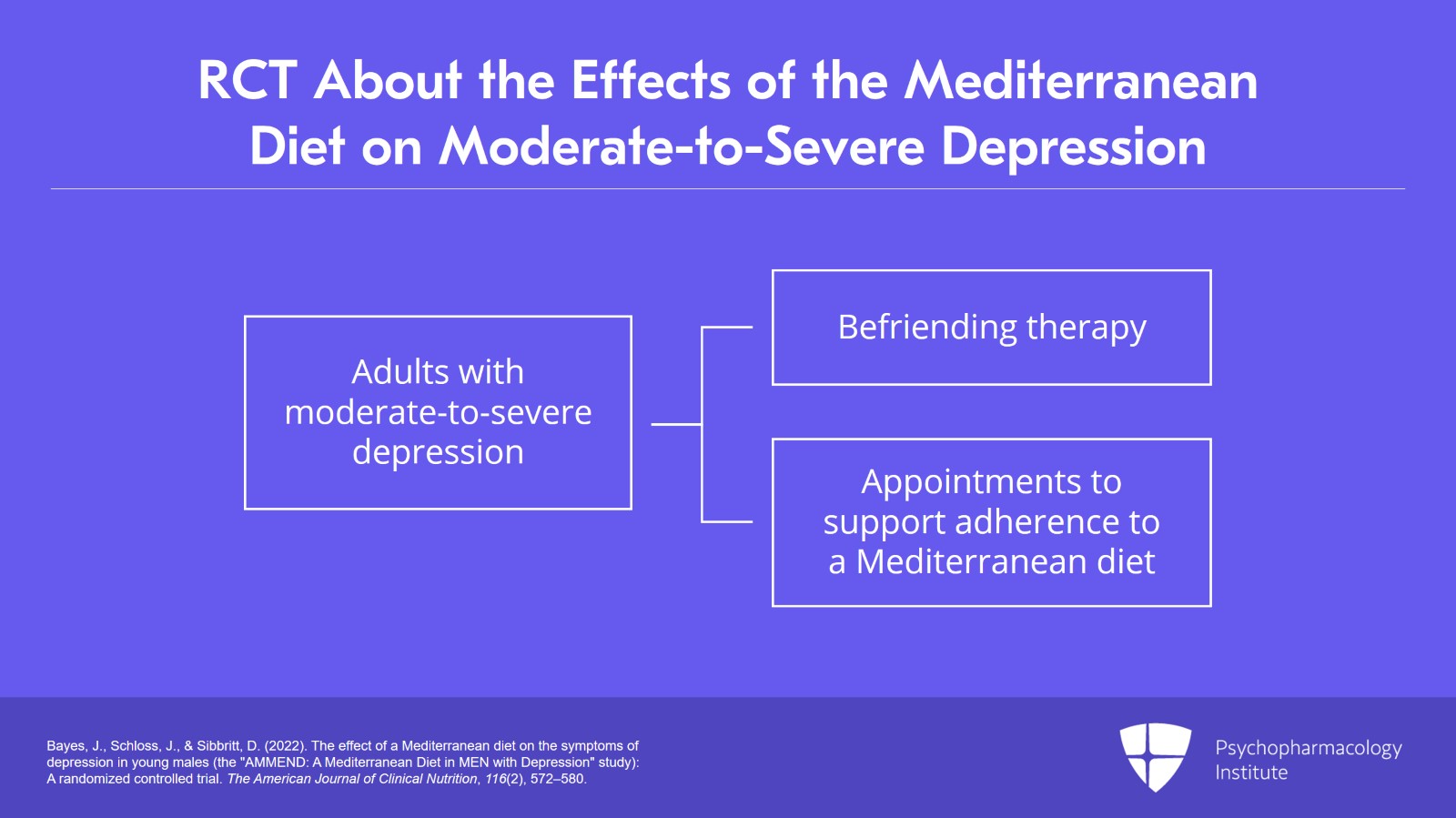
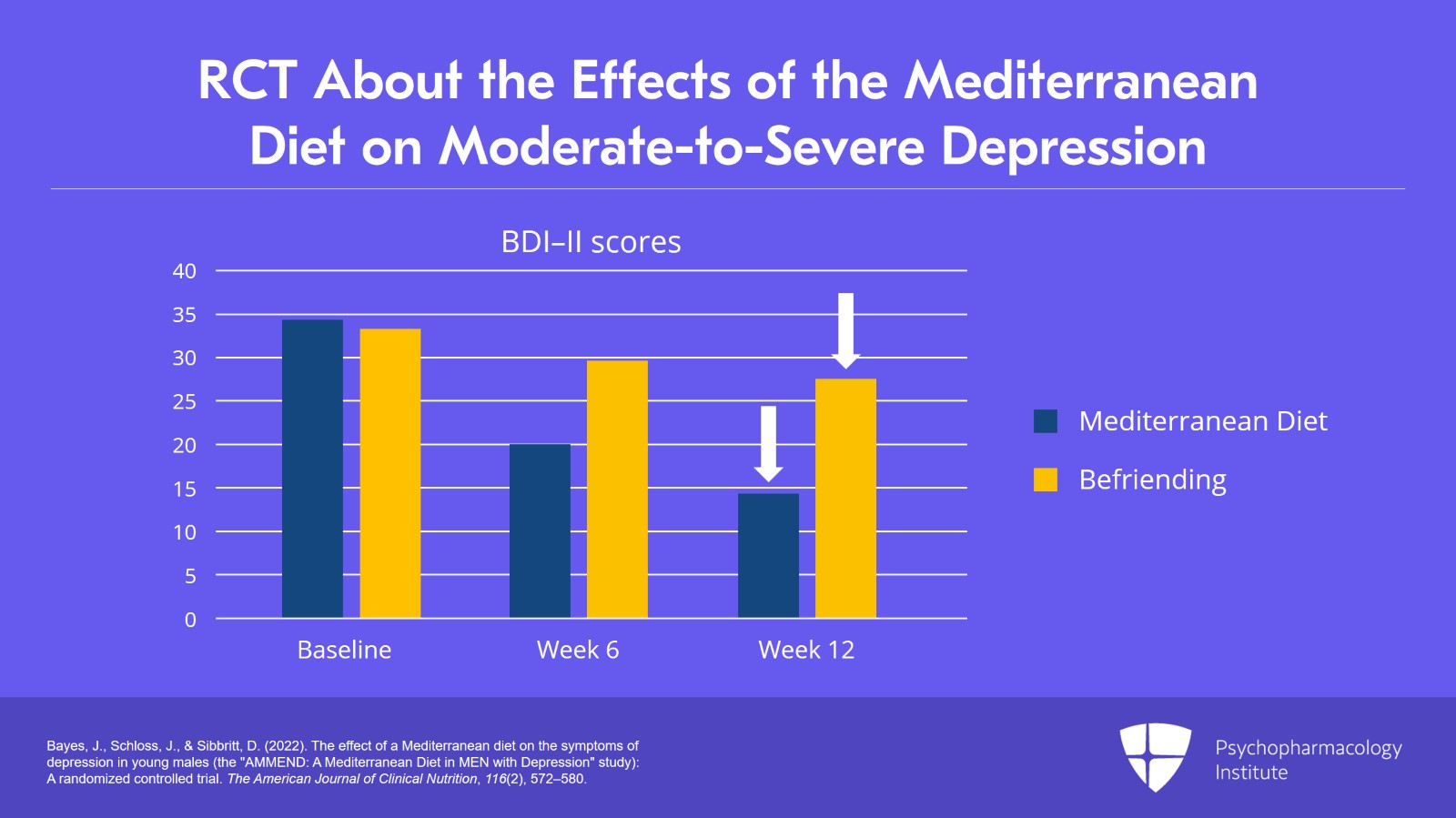
The last RCT that we're going to discuss is in young adults with moderate-to-severe depression where they compared the effects of befriending therapy versus a 60-minute appointment with a clinical nutritionist to support optimal adherence to a Mediterranean diet at baseline, 6, and 12 weeks, so just 180 minutes total of clinical time.
References:
  • Bayes, J., Schloss, J., & Sibbritt, D. (2022). The effect of a Mediterranean diet on the symptoms of depression in young males (the "AMMEND: A Mediterranean Diet in MEN with Depression" study): A randomized controlled trial. The American Journal of Clinical Nutrition, 116(2), 572–580.
Free Files
Success!
Check your inbox, we sent you all the materials there.

Slide 11 of 14

There was a significant decrease in the depressive scores measured by a Beck Depression Inventory-II in the Mediterranean diet compared to the befriending group. In the graph, the blue represents the Mediterranean group and the orange, the befriending group. By week 12, the participants in the Mediterranean diet group had a 20-point drop in their BDI-II score versus only a 6-point drop found in the befriending group. Now, as a reference, participants began with a BDI score consistent with severe depression and ended the study with an average BDI-II score consistent with mild symptoms.
References:
  • Bayes, J., Schloss, J., & Sibbritt, D. (2022). The effect of a Mediterranean diet on the symptoms of depression in young males (the "AMMEND: A Mediterranean Diet in MEN with Depression" study): A randomized controlled trial. The American Journal of Clinical Nutrition, 116(2), 572–580.

Slide 12 of 14

Let's review key points. Three randomized controlled trials have all shown that improving nutritional intake can reduce depressive symptoms a significant amount even in those with moderate-to-severe depression. Trials using a small amount of nutritional counseling also were able to show improvement in depressive symptoms which were sustained at follow-up.
Free Files
Success!
Check your inbox, we sent you all the materials there.

Slide 13 of 14

And one RCT showed healthier eating actually had a lower cost of eating compared to participant baseline diet.

Slide 14 of 14

Free Files
Success!
Check your inbox, we sent you all the materials there.

Learning Objectives:

After completing this activity, the learner will be able to:

  1. Describe the connection between dietary patterns and mental health.
  2. Discuss the available evidence about using BSMs for mental health conditions.
  3. Recognize patients who can benefit from BSM supplementation.

Original Release Date: January 1, 2023

Review and Re-release Date: March 1, 2024

Expiration Date: January 1, 2026

Expert: Amelia Villagomez, M.D.

Medical Editor: Paz Badía, M.D.

Relevant Financial Disclosures: 

None of the faculty, planners, and reviewers for this educational activity have relevant financial relationships to disclose during the last 24 months with ineligible companies whose primary business is producing, marketing, selling, re-selling, or distributing healthcare products used by or on patients.

Contact Information: For questions regarding the content or access to this activity, contact us at support@psychopharmacologyinstitute.com

Instructions for Participation and Credit:

Participants must complete the activity online during the valid credit period that is noted above.

Follow these steps to earn CME credit:

  1. View the required educational content provided on this course page.

  2. Complete the Post Activity Evaluation for providing the necessary feedback for continuing accreditation purposes and for the development of future activities. NOTE: Completing the Post Activity Evaluation after the quiz is required to receive the earned credit.

  3. Download your certificate.

Accreditation Statement

This activity has been planned and implemented in accordance with the accreditation requirements and policies of the Accreditation Council for Continuing Medical Education through the joint providership of Medical Academy LLC and the Psychopharmacology Institute. Medical Academy is accredited by the ACCME to provide continuing medical education for physicians.

Credit Designation Statement

Medical Academy designates this enduring activity for a maximum of 0.75 AMA PRA Category 1 credit(s)™. Physicians should claim only the credit commensurate with the extent of their participation in the activity.


Free Files
Success!
Check your inbox, we sent you all the materials there.
Continue in the website
Instant access modal

Become a Bronze, Silver, Gold, Bronze extended, Silver extended or Gold extended Member.

2025–26 Psychopharmacology CME Program

Unlock up to 155 CME Credits, including 40 SA CME Credits.