Slides and Transcript
Slide 1 of 17
I want to go through in detail for some specific antidepressants, and I’m going to focus here on the SSRIs and mirtazapine.
Slide 2 of 17
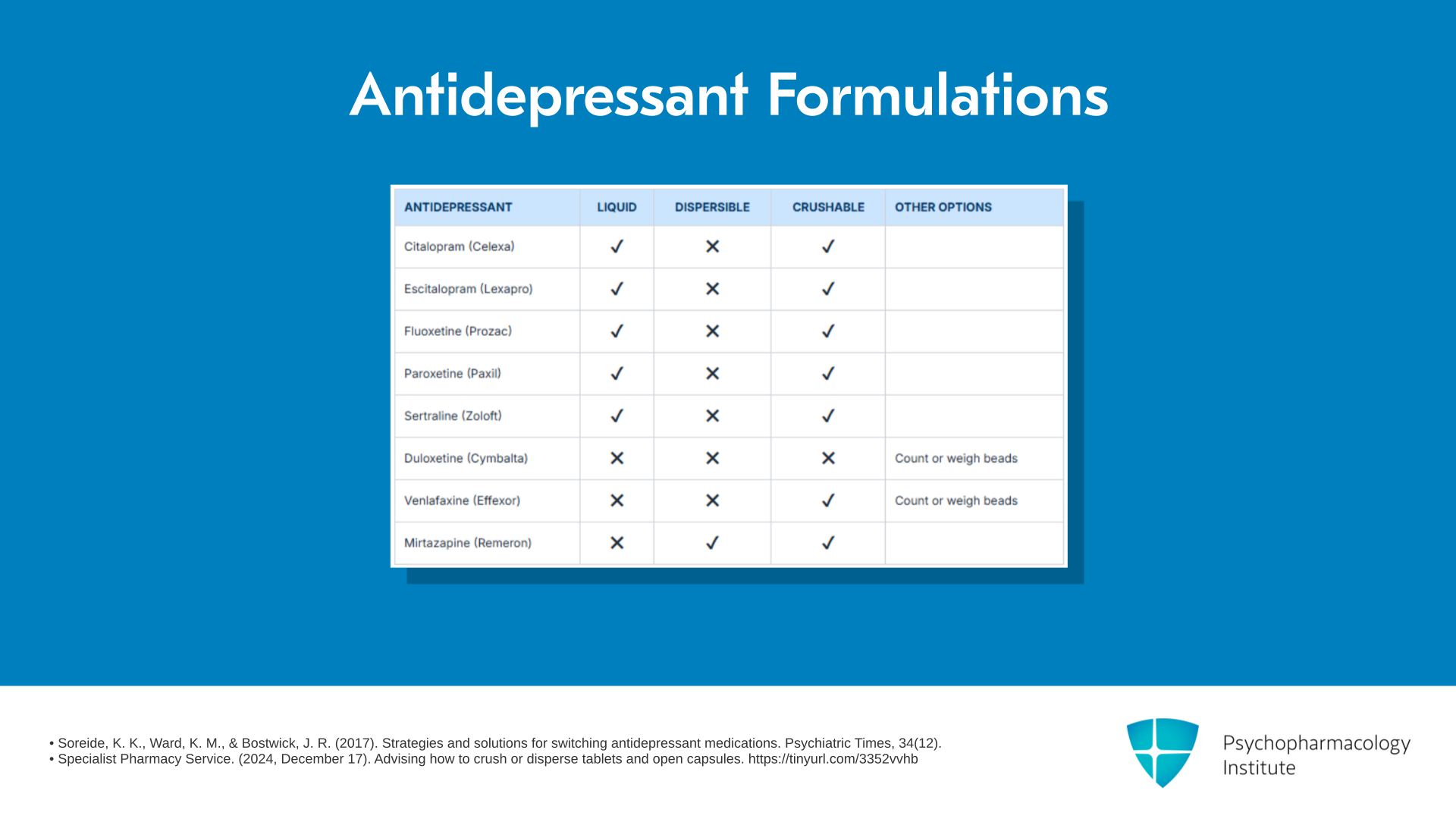
So there’s a table here that summarizes in America which drugs come as a liquid preparation from the manufacturer, which ones come as a dispersible tablet that can be dropped in a glass of water and it will disperse, and then which ones are crushable that therefore could be used off-label to make a suspension. And you can see that there are about five SSRIs that are available as liquid form in America. Mirtazapine is available as a dispersible tablet, and most of them are crushable except duloxetine.
References:
- Soreide, K. K., Ward, K. M., & Bostwick, J. R. (2017). Strategies and solutions for switching antidepressant medications. Psychiatric Times, 34(12).
- Specialist Pharmacy Service. (2024, December 17). Advising how to crush or disperse tablets and open capsules. https://tinyurl.com/3352vvhb
Free Files
Download PDF and other files
Success!
Check your inbox, we sent you all the materials there.
Slide 3 of 17
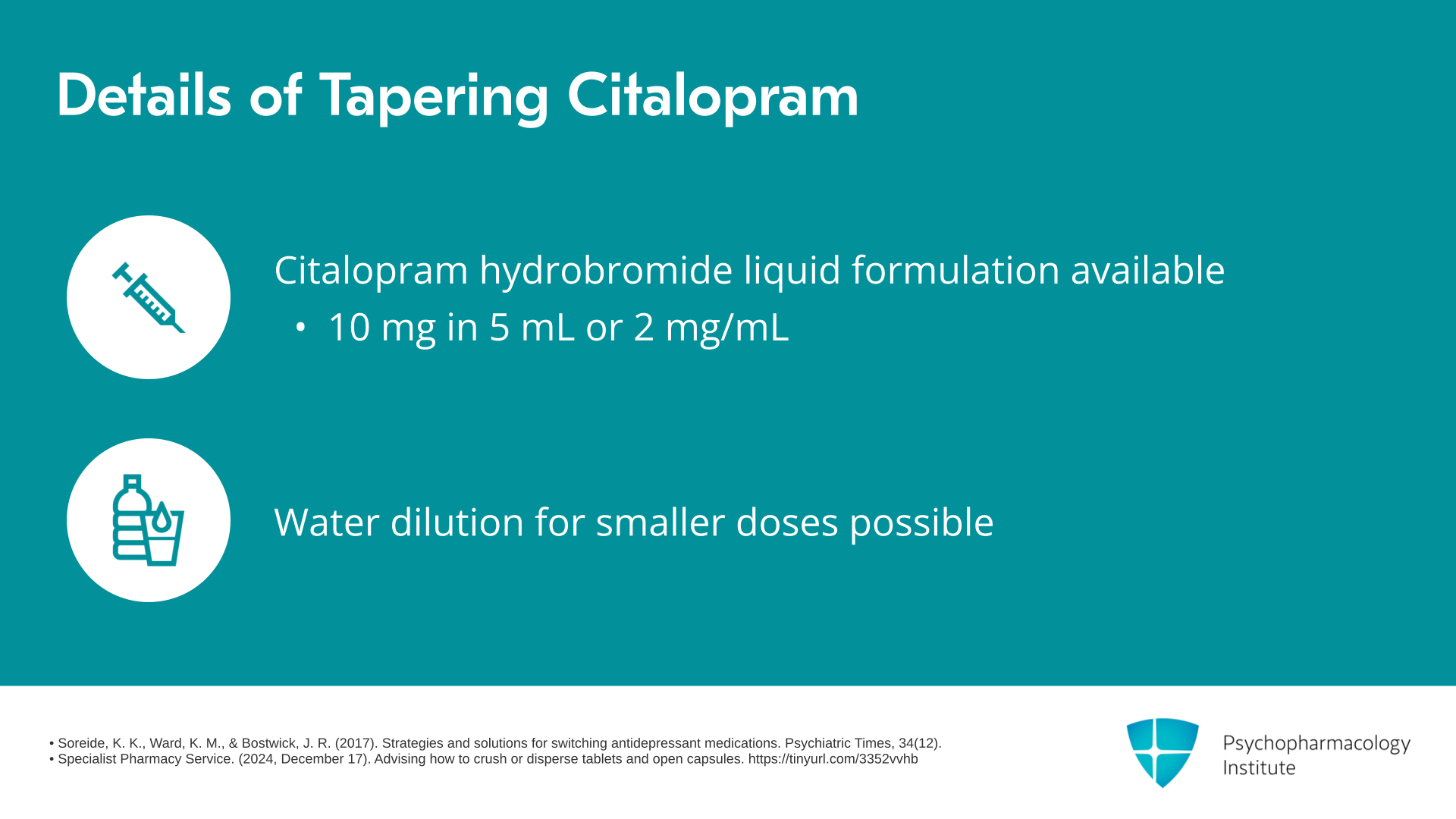
So I’ll give an example of going through tapering of citalopram. So citalopram hydrobromide is available as a liquid in America. It comes as 10 mg in 5 mL or 2 mg/mL. You can use a 1 mL or 5 mL syringe to make doses of between 0.2 mg and 40 mg. And if you need to make up even smaller doses, you can dilute the solution in water. For example, you can take 1 mL of the citalopram solution mix it with 9 mL of water, and shake well to make up a 0.2 mg/mL solution. And using a 1 mL syringe, you can very easily make up then 0.02 mg of the drug.
References:
- Soreide, K. K., Ward, K. M., & Bostwick, J. R. (2017). Strategies and solutions for switching antidepressant medications. Psychiatric Times, 34(12).
- Specialist Pharmacy Service. (2024, December 17). Advising how to crush or disperse tablets and open capsules. https://tinyurl.com/3352vvhb
Slide 4 of 17
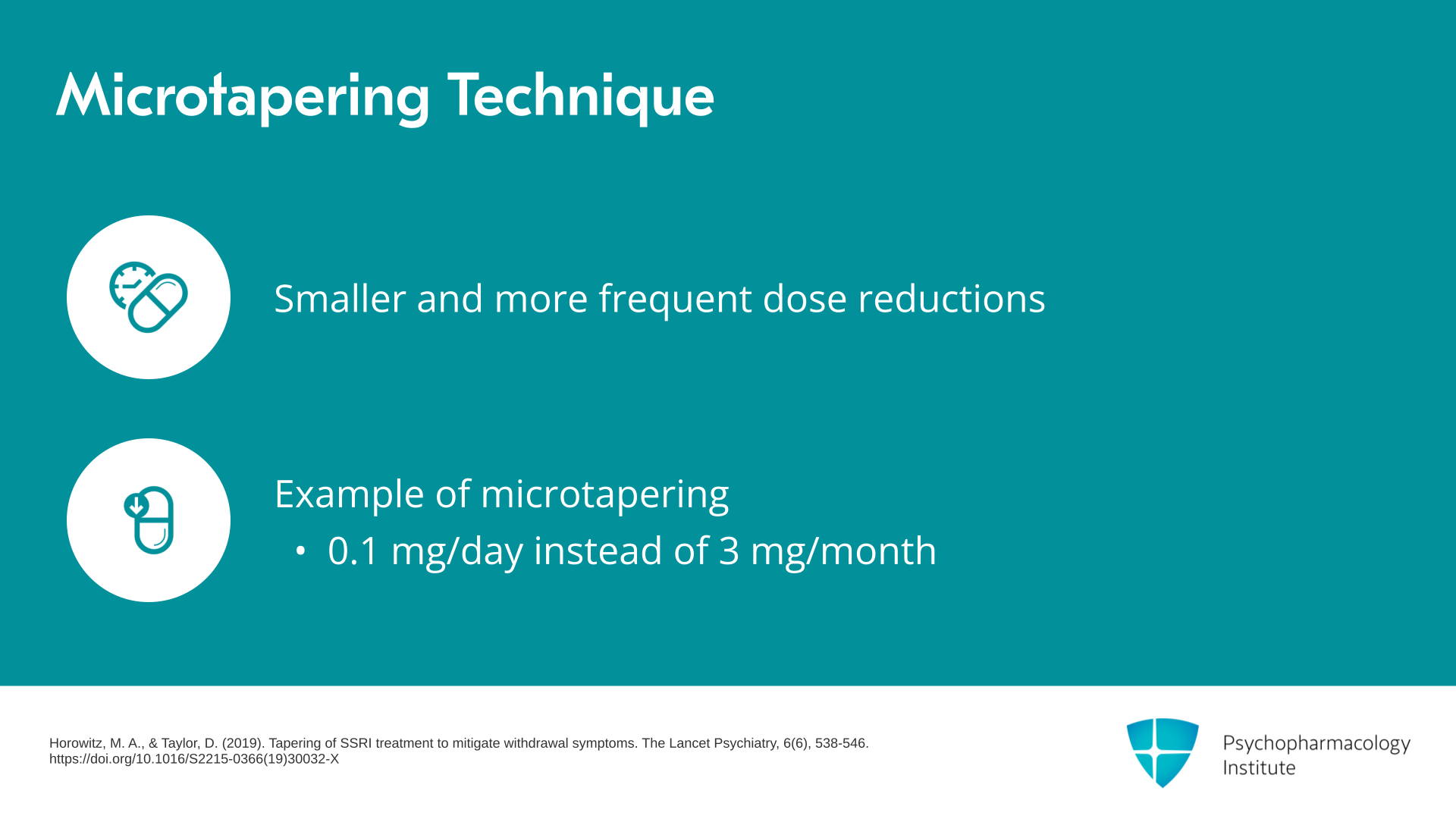
Some patients prefer a technique called microtapering to make smaller steps every day or week. So for example, rather than going down by 3 mg per month of a drug, you might go down by 0.1 mg/day. So 0.1 mg per day over a month will produce a 3 mg reduction, overall the same. You could think of this as the difference between jumping down a flight of stairs in one big jump and waiting 30 days before doing it again versus going down one step every day. Obviously, the bigger jump is more likely to cause your knees trouble, and the same is being applied here to the nervous system.
References:
- Horowitz, M. A., & Taylor, D. (2019). Tapering of SSRI treatment to mitigate withdrawal symptoms. The Lancet Psychiatry, 6(6), 538-546. https://doi.org/10.1016/S2215-0366(19)30032-X
Free Files
Download PDF and other files
Success!
Check your inbox, we sent you all the materials there.
Slide 5 of 17
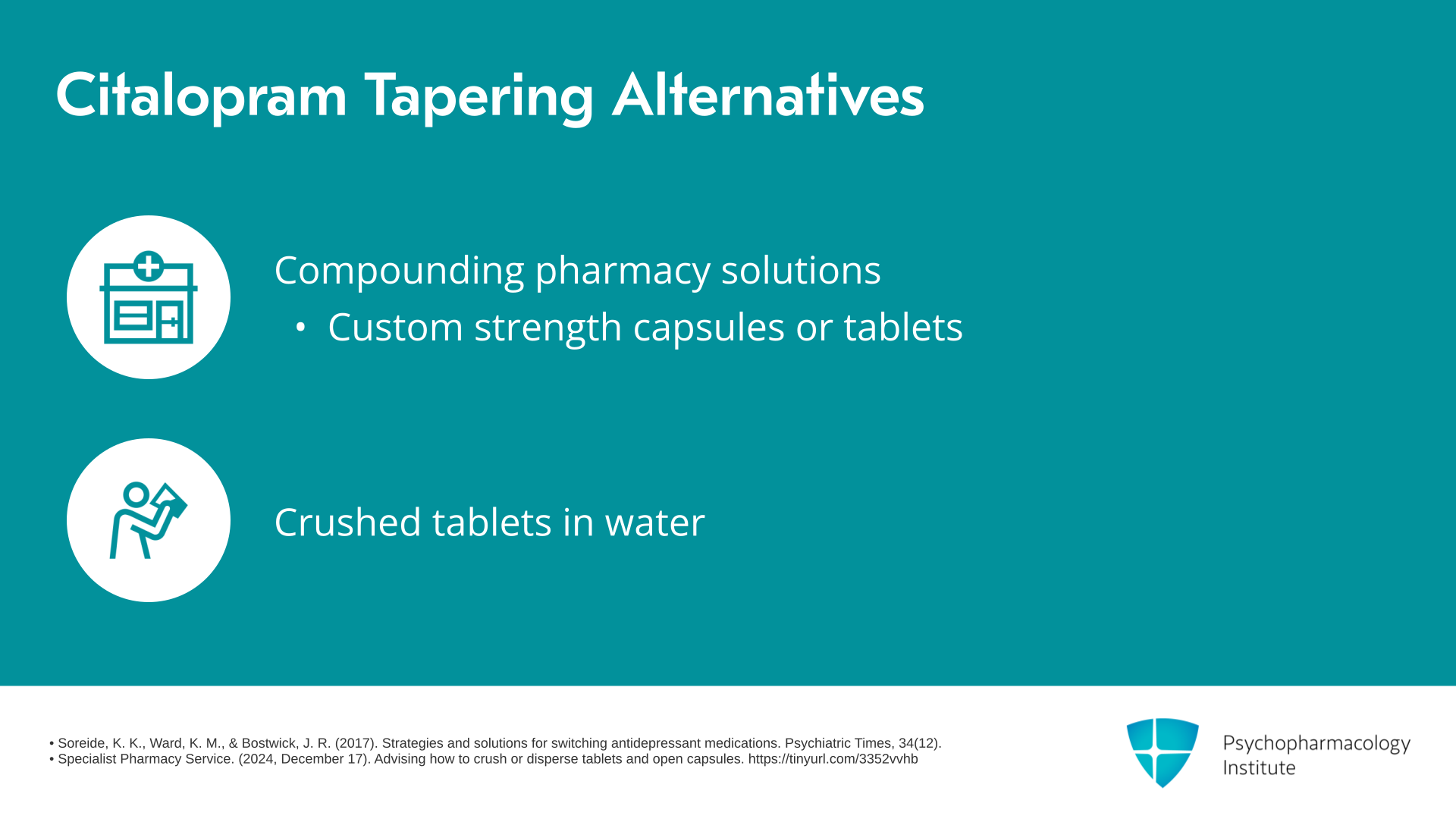
Alternative options for tapering citalopram would be to have a compounding pharmacy make up any strength solution capsule or tablet to match some of the doses outlined above. And citalopram tablets can be crushed and mixed with water to form a suspension if they’re shaken well before use as an option if compounding pharmacies or liquid is not available for some reason.
References:
- Soreide, K. K., Ward, K. M., & Bostwick, J. R. (2017). Strategies and solutions for switching antidepressant medications. Psychiatric Times, 34(12).
- Specialist Pharmacy Service. (2024, December 17). Advising how to crush or disperse tablets and open capsules. https://tinyurl.com/3352vvhb
Slide 6 of 17
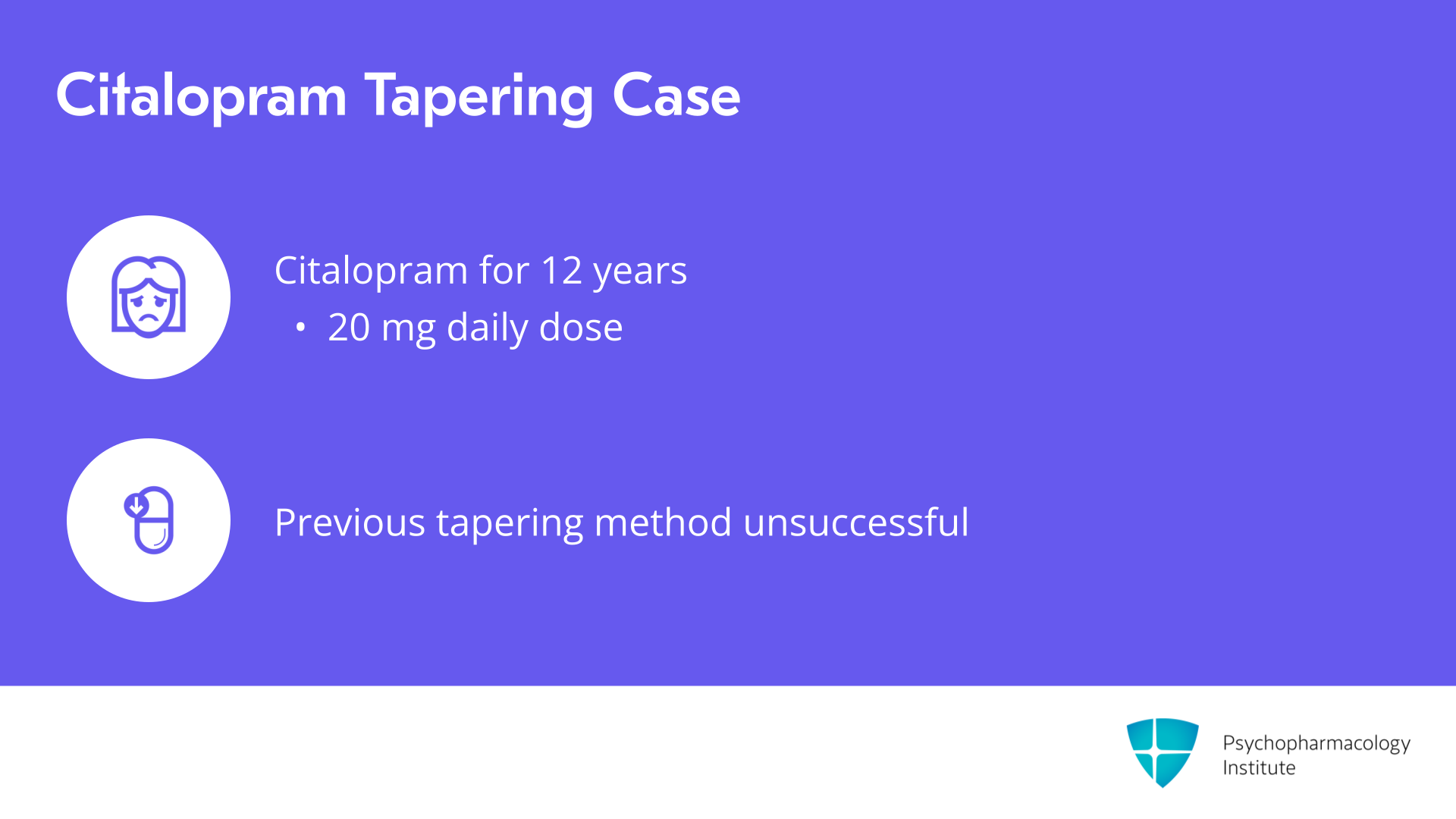
I’m going to outline an example tapering Mrs. Smith from citalopram. This is a woman who’s been taking citalopram for a long time, 12 years, 20 mg per day. She felt very low when her mother died, better in the last few years. She has tried to stop her drugs several times, each time being instructed by her doctor to halve the dose to 10 mg by halving the tablet for two weeks, and then taking half a tablet every second day for two weeks before stopping it.
Free Files
Download PDF and other files
Success!
Check your inbox, we sent you all the materials there.
Slide 7 of 17
When she’s done this, she’s had a lot of trouble. She’s had insomnia, panic attacks, headache and gut trouble, very different from the original symptoms she had when her mother died. She would like to come off the drug because she wonders if it’s making her emotions blunted and has contributed to weight gain.
Slide 8 of 17
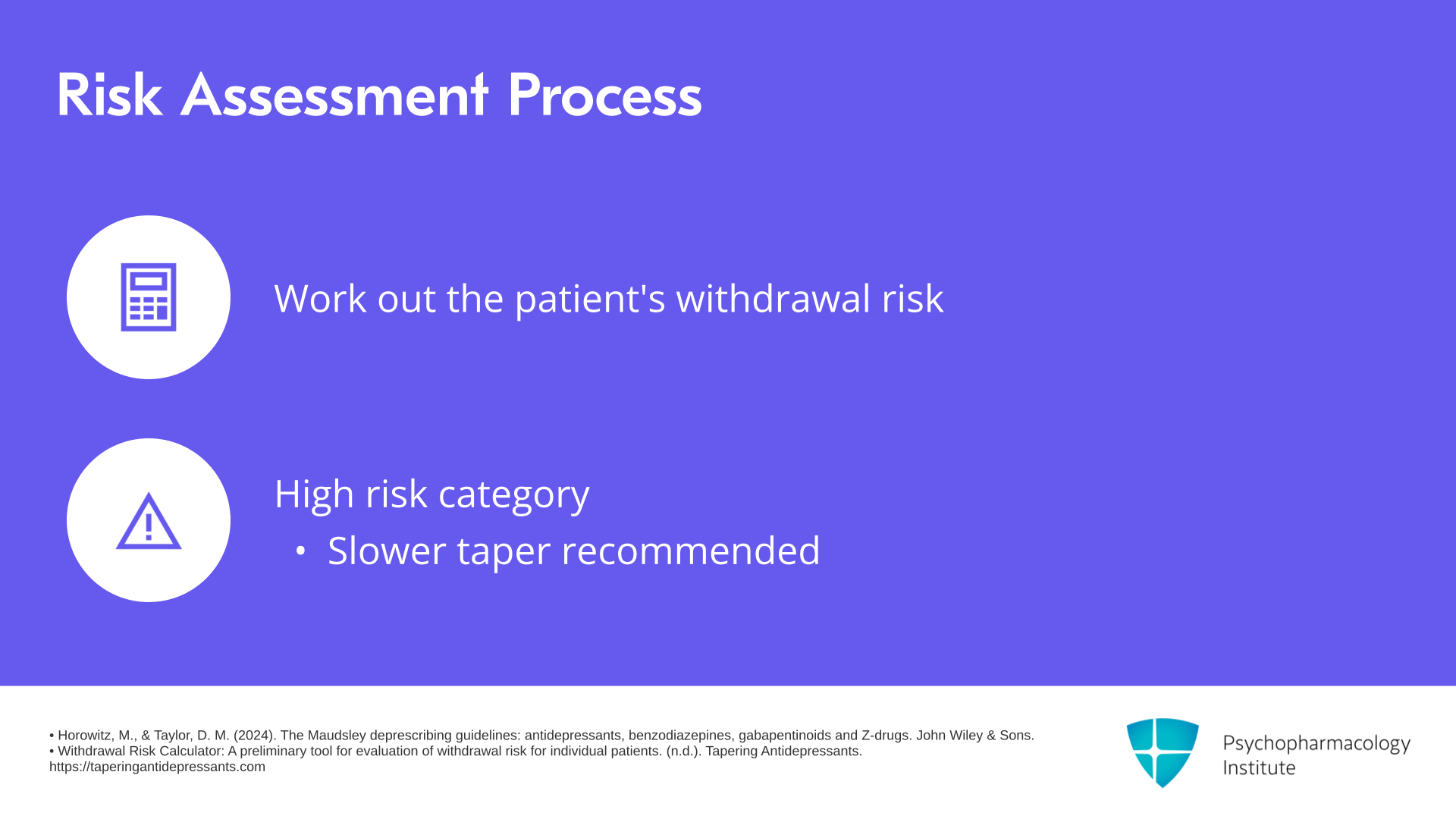
You work out her risk according to the risk calculator in the Maudsley Deprescribing Guidelines – 3 points for long-term use, 2 points for moderate risk because citalopram is intermediate risk compared to other antidepressants, 0 points for the minimum dose and 2 points for having severe withdrawal effects in the past. It gives her 7 points altogether and puts her in a high risk category suggesting a slower taper.
References:
- Horowitz, M., & Taylor, D. M. (2024). The Maudsley deprescribing guidelines: antidepressants, benzodiazepines, gabapentinoids and Z-drugs. John Wiley & Sons.
- Withdrawal Risk Calculator: A preliminary tool for evaluation of withdrawal risk for individual patients. (n.d.). Tapering Antidepressants. https://taperingantidepressants.com
Free Files
Download PDF and other files
Success!
Check your inbox, we sent you all the materials there.
Slide 9 of 17
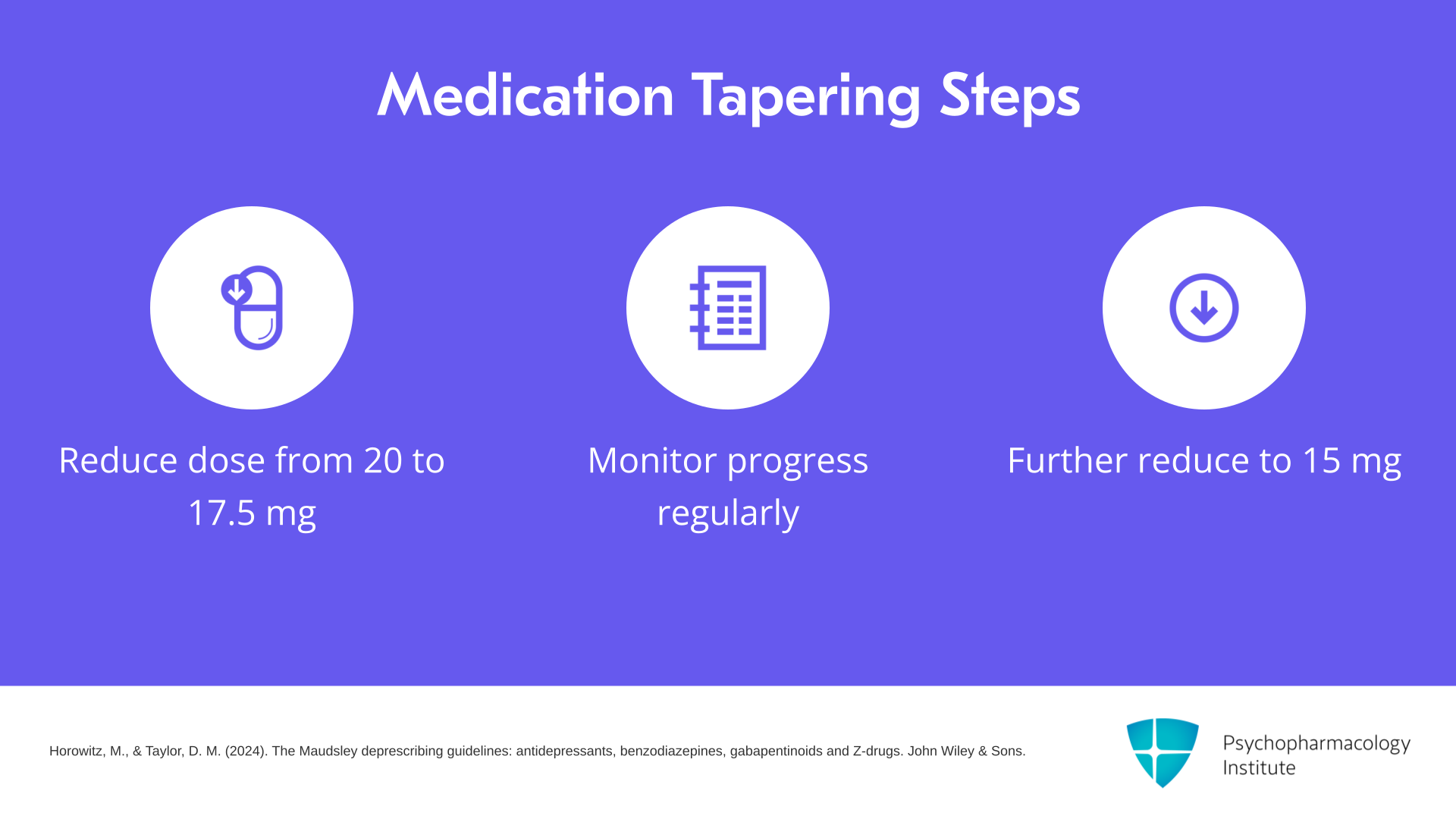
You explain to her that her first reduction will be from 20 to 17.5. She can do this by splitting a 10 mg tablet into four quarters using a tablet cutter, and taking three of the fragments. You see her in a few weeks to monitor her progress, and told her to contact you if she experiences any difficulties. She returns in four weeks and reports no unpleasant symptoms. She makes her next reduction to 15 mg by splitting a 10 mg tablet in two pieces. You see her every four weeks, and she continues to report only mild symptoms. She is pleased with her progress.
References:
- Horowitz, M., & Taylor, D. M. (2024). The Maudsley deprescribing guidelines: antidepressants, benzodiazepines, gabapentinoids and Z-drugs. John Wiley & Sons.
Slide 10 of 17
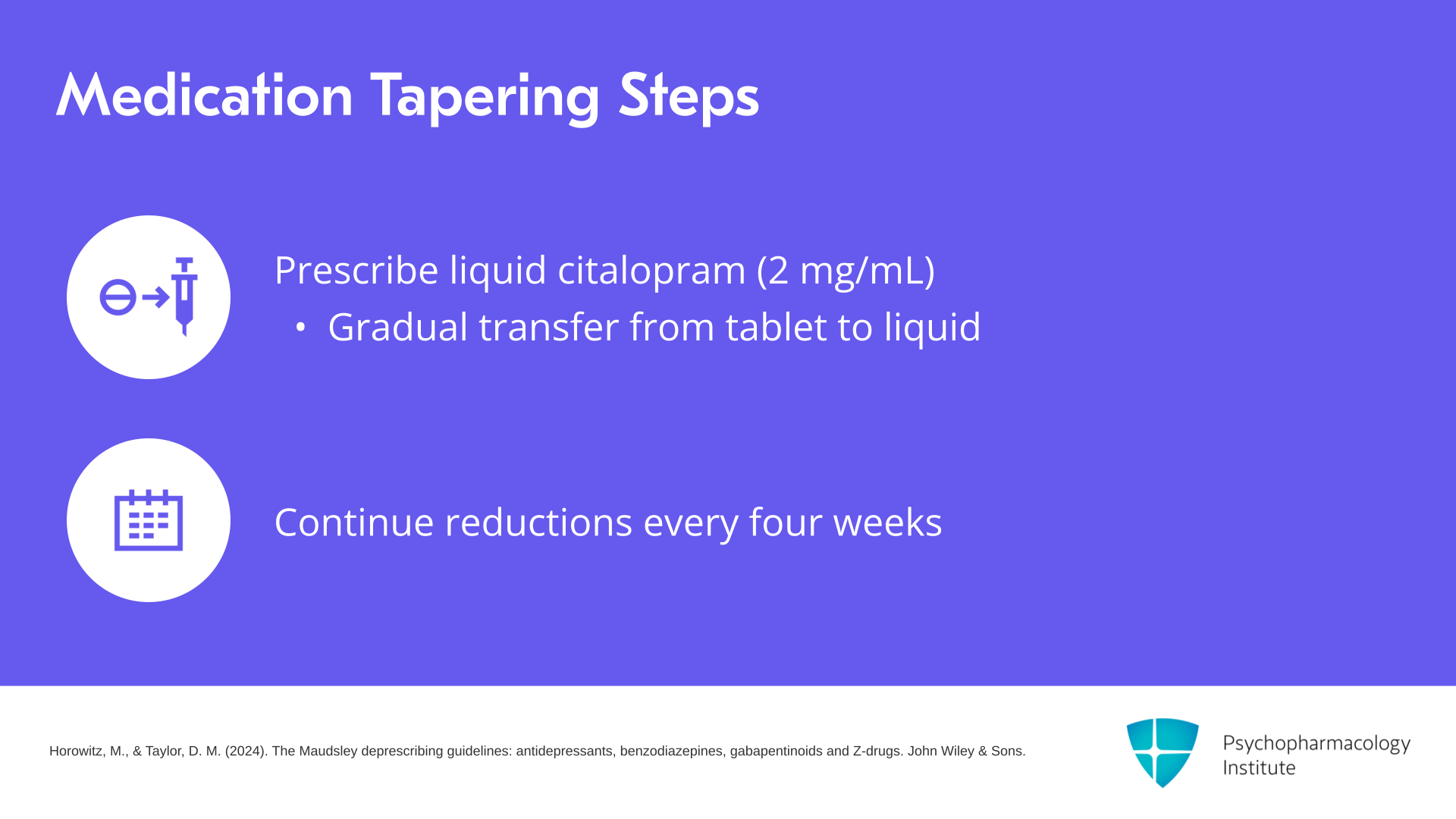
When she gets down to 8.6 mg, you prescribe her a liquid version of citalopram which comes in a 2 mg/mL solution. As some people can react differently to a liquid, you advise her to transfer over 5 mg each week from tablet to liquid. So first week, 5 tablet, 5 liquid. Second week, all liquid. She doesn’t have any trouble. And then she reduces to 8.6 mg by taking 4.3 mL of the liquid using a 5 mL syringe. And she continues making reductions using this liquid every four weeks without any major difficulties.
References:
- Horowitz, M., & Taylor, D. M. (2024). The Maudsley deprescribing guidelines: antidepressants, benzodiazepines, gabapentinoids and Z-drugs. John Wiley & Sons.
Free Files
Download PDF and other files
Success!
Check your inbox, we sent you all the materials there.
Slide 11 of 17
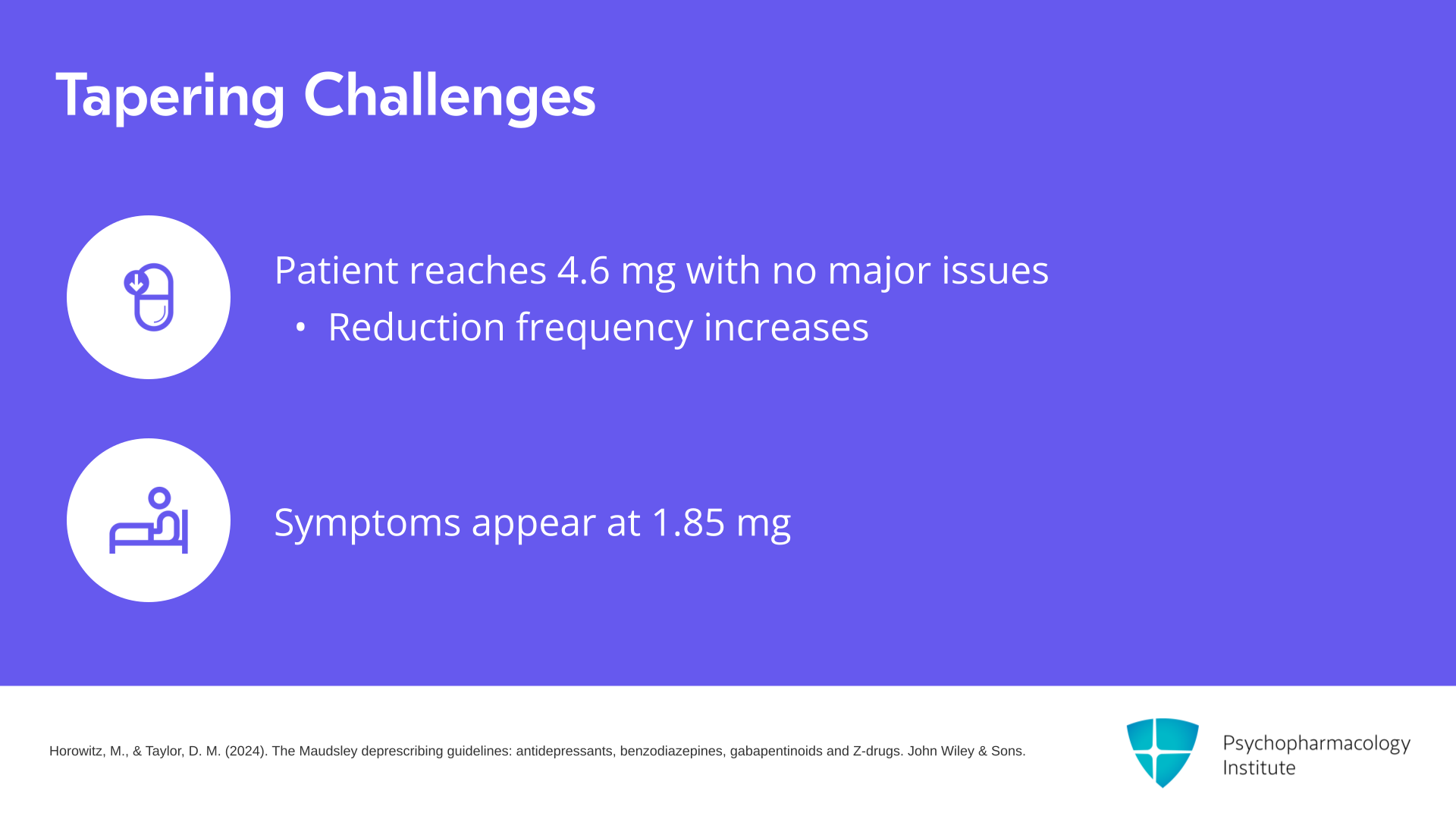
She reaches 4.6 mg, and she says as she is having no issues maybe she might like to increase her cadence to every three weeks as she wants to come off the drug a bit quicker. She makes five further reductions down to 2.25 mg using a 1 mL syringe to measure out the smaller amounts. And as she has no trouble, you decide that she’ll reduce by every two weeks. She follows this advice, but a month later at 1.85 mg she says she is having symptoms that reached 6/10 in intensity – trouble sleeping, trouble staying asleep. She is very anxious in the mornings, and she started to feel nauseous.
References:
- Horowitz, M., & Taylor, D. M. (2024). The Maudsley deprescribing guidelines: antidepressants, benzodiazepines, gabapentinoids and Z-drugs. John Wiley & Sons.
Slide 12 of 17
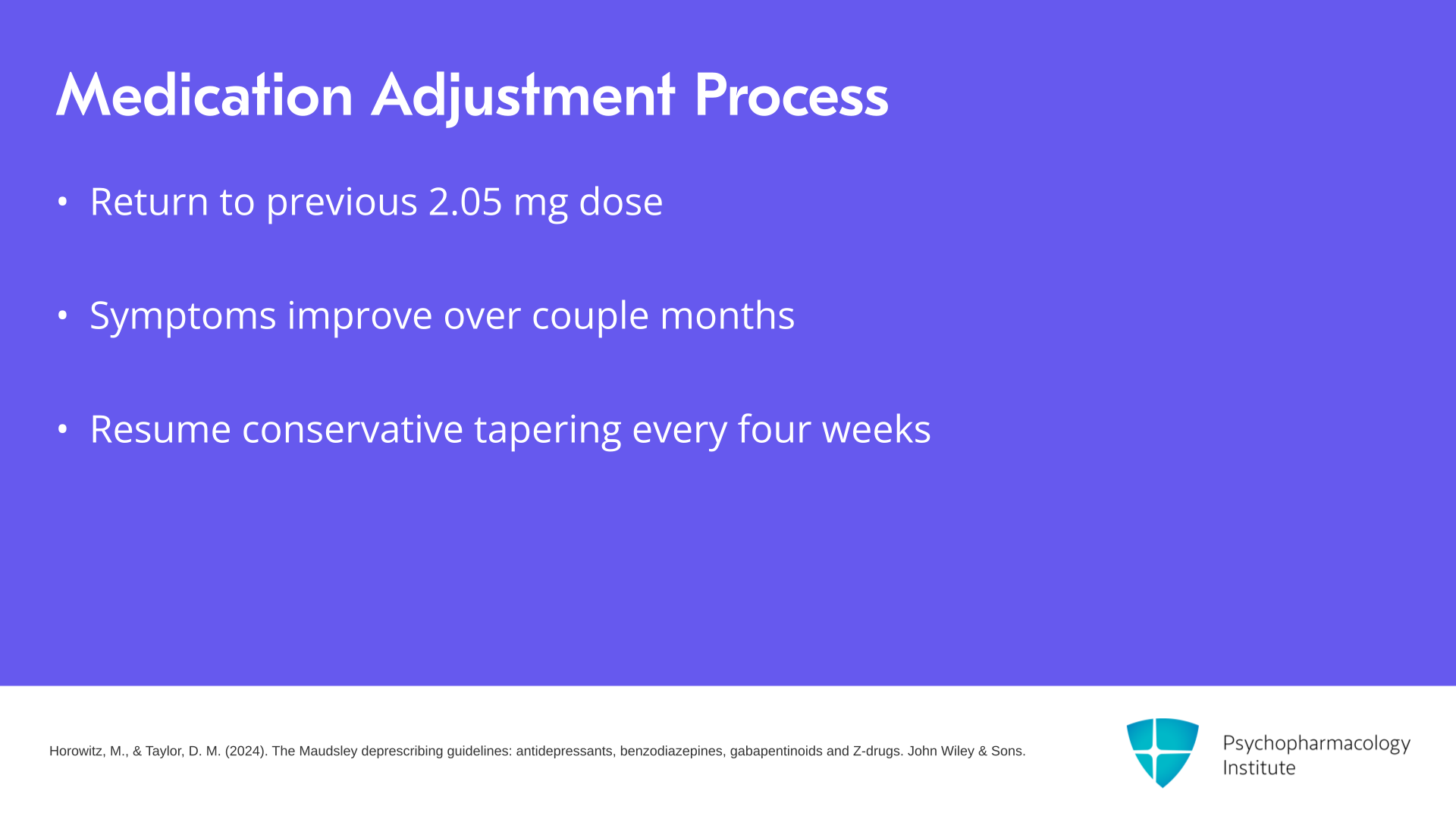
So you suggest to return to her previous dose of 2.05 mg, and wait for the symptoms to settle. She does this and reports her symptoms slowly improve but it took a couple of months. Not unusual after people get destabilized coming off these drugs. She is surprised that she can have such strong symptoms at such a low dose of medication. When she is stable, you advised to keep making reductions every four weeks, back to the more conservative version.
References:
- Horowitz, M., & Taylor, D. M. (2024). The Maudsley deprescribing guidelines: antidepressants, benzodiazepines, gabapentinoids and Z-drugs. John Wiley & Sons.
Free Files
Download PDF and other files
Success!
Check your inbox, we sent you all the materials there.
Slide 13 of 17
When she gets down to 0.4 mg, you tell her it is generally advisable to measure no less than 20% of the volume of a syringe which for her 1 mL syringe is 0.2 mL. You explain to her that she will need to dilute her solution of citalopram 10-fold. This can be done either by a compounding pharmacy or by adding 9 mL of water to her 1 mL citalopram solution which should be discarded each day and made up fresh according to strict guidelines. She chooses a compounding pharmacy to make up this more dilute solution. And she continues making reductions every four weeks. Overall, the process takes her a bit over three years, but she expresses great satisfaction. After all her failed attempts, she thought she would never be able to get off the drug.
References:
- Horowitz, M., & Taylor, D. M. (2024). The Maudsley deprescribing guidelines: antidepressants, benzodiazepines, gabapentinoids and Z-drugs. John Wiley & Sons.
Slide 14 of 17
And a similar approach can be taken for Lexapro, Prozac, Paxil and Zoloft for which the manufacturer makes oral solutions. If dilutions are required, tap water can be added or a compounding pharmacy can be used.
References:
- Horowitz, M., & Taylor, D. M. (2024). The Maudsley deprescribing guidelines: antidepressants, benzodiazepines, gabapentinoids and Z-drugs. John Wiley & Sons.
- Specialist Pharmacy Service. (2024, December 17). Advising how to crush or disperse tablets and open capsules. https://tinyurl.com/3352vvhb
Free Files
Download PDF and other files
Success!
Check your inbox, we sent you all the materials there.
Slide 15 of 17
And for drugs like mirtazapine or Remeron which do not come as a solution from the manufacturer, dispersible tablets can be dispersed in water, for example, 15 mg tablet in 15 mL of water will make a 1 mg/mL mixture which should be shaken well before use because it is not going to be a perfect solution, it will be a suspension, or a compounding pharmacy can make up a solution.
References:
- Horowitz, M., & Taylor, D. M. (2024). The Maudsley deprescribing guidelines: antidepressants, benzodiazepines, gabapentinoids and Z-drugs. John Wiley & Sons.
- Specialist Pharmacy Service. (2024, December 17). Advising how to crush or disperse tablets and open capsules. https://tinyurl.com/3352vvhb
Slide 16 of 17
And of course, an alternative for all drugs is to get a compounding pharmacy to make up smaller dose capsules or tablets to make life easier for some patients who prefer something simpler.
References:
- Horowitz, M., & Taylor, D. M. (2024). The Maudsley deprescribing guidelines: antidepressants, benzodiazepines, gabapentinoids and Z-drugs. John Wiley & Sons.
Free Files
Download PDF and other files
Success!
Check your inbox, we sent you all the materials there.
Slide 17 of 17
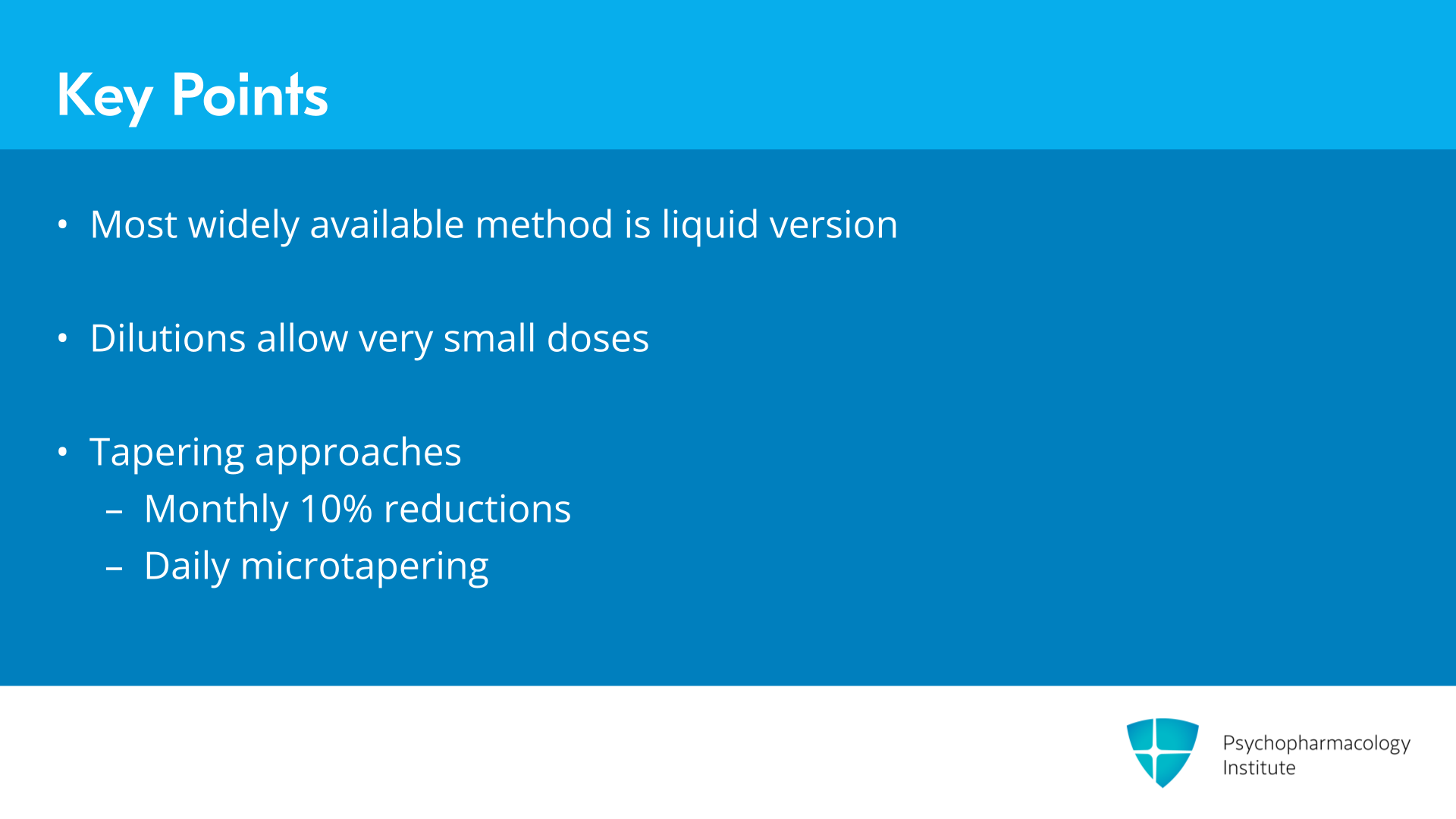
So the key points are: The most widely available method for hyperbolic tapering is to use a liquid version of the drug made by drug manufacturer, available for many antidepressants, which allows small doses to be made up with syringe. Sometimes, dilutions of these drugs are required to make very small doses which can be done at home with water or by compounding pharmacies. Doses can be reduced by about 10% of the last dose per month with liquids, or some people may benefit from making even smaller reductions each day, e.g., 0.1 mg per day rather than 3 mg per month, called microtapering.