Close Banner
Section Free  - Video Lectures

09. Deprescribing SNRIs: Hyperbolic Tapering Techniques

Published on September 1, 2025 Certification expiration date: September 1, 2028

Mark Horowitz, M.D.

Clinical Research Fellow in Psychiatry - National Health Service (NHS)

Key Points

  • For venlafaxine tapering, bead counting maintains extended-release properties and once-daily dosing, unlike liquid formulations.
  • Duloxetine requires bead counting/weighing for tapering since it is acid-sensitive and cannot be pulverized or liquefied.
  • Crushing and suspending tablets is best done with instant-release drugs, because dose dumping can be a concern if extended-release options are crushed.

Free Downloads for Offline Access

  • Free Download Video (MP4)
  • Free Download Audio File (MP3)
  • Free Download PDF File

Slides and Transcript

Slide 1 of 11

Now we’re going to talk about tapering guidance in practice for SNRIs. I’ll give some examples.

Slide 2 of 11

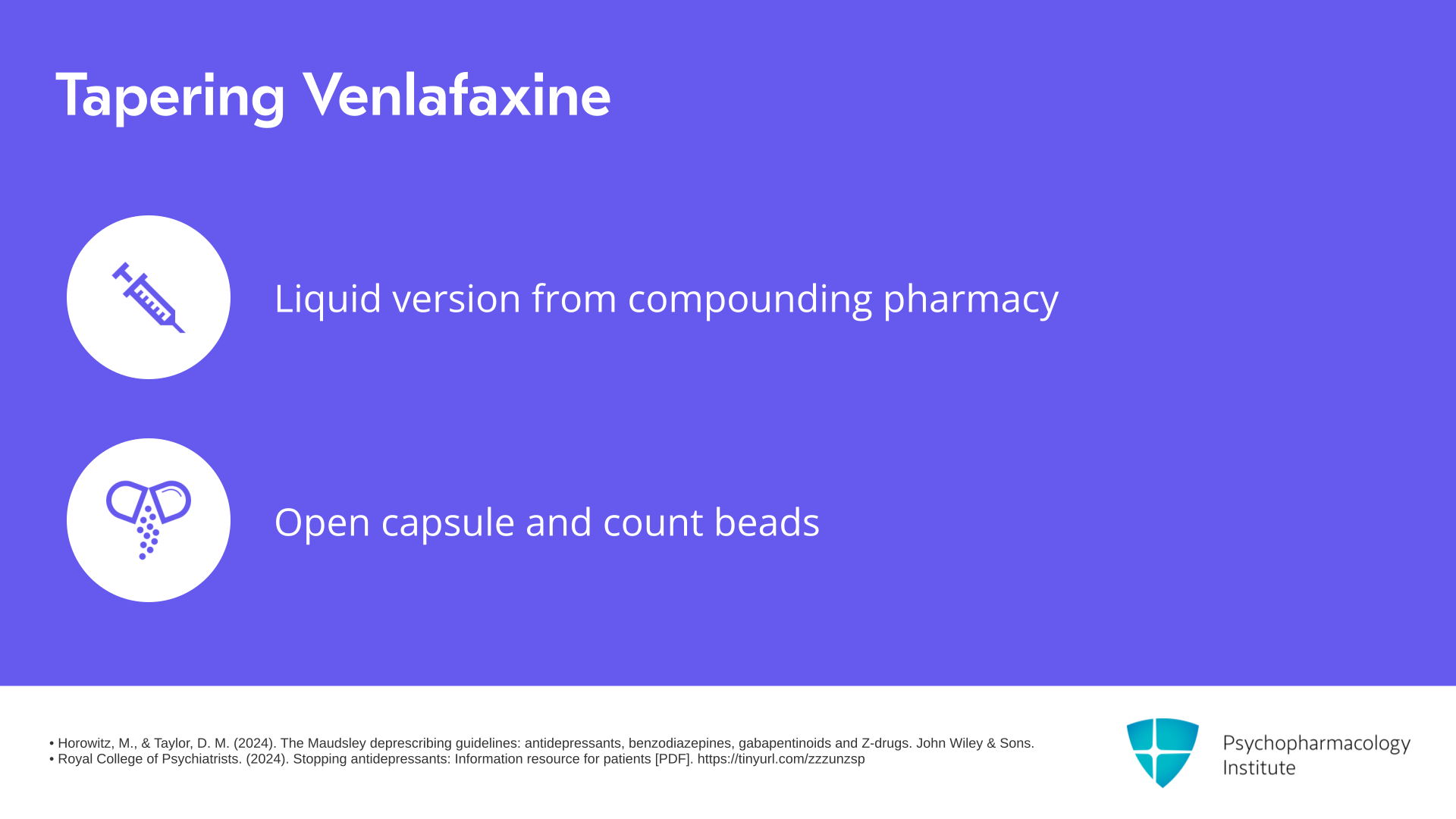
Venlafaxine can be tapered in a variety of ways. It can be tapered with a liquid version of the drug made by a compounding pharmacy. Another way to taper venlafaxine is to open up the capsule and to either count or weigh the beads. So you can see a picture of a drug like venlafaxine which is a capsule which contains a lot of small, little, little microbeads. Different manufacturers have different numbers. But to make the example easy, if we say that in a 75 mg capsule there are about 300 beads, you can reduce dose by 10% each month by taking out 30 beads the first month, so down to 270 beads and 27 beads the second month and so on.
References:
  • Horowitz, M., & Taylor, D. M. (2024). The Maudsley deprescribing guidelines: antidepressants, benzodiazepines, gabapentinoids and Z-drugs. John Wiley & Sons.
  • Royal College of Psychiatrists. (2024). Stopping antidepressants: Information resource for patients [PDF]. https://tinyurl.com/zzzunzsp
Free Files
Success!
Check your inbox, we sent you all the materials there.

Slide 3 of 11

Beads can be different sizes, which can make life a little bit tricky. And some people weigh rather than count the beads. You can do this using a jeweler’s scale, best to use a precise one that has three decimal places in its precision. Compounding pharmacies can actually do this for patients where they will weigh the beads and re-encapsulate them, and sell them back to the patient or some of them will also pulverize the beads and turn them into a suspension with a suspending vehicle.
References:
  • Horowitz, M., & Taylor, D. M. (2024). The Maudsley deprescribing guidelines: antidepressants, benzodiazepines, gabapentinoids and Z-drugs. John Wiley & Sons.
  • Royal College of Psychiatrists. (2024). Stopping antidepressants: Information resource for patients [PDF]. https://tinyurl.com/zzzunzsp

Slide 4 of 11

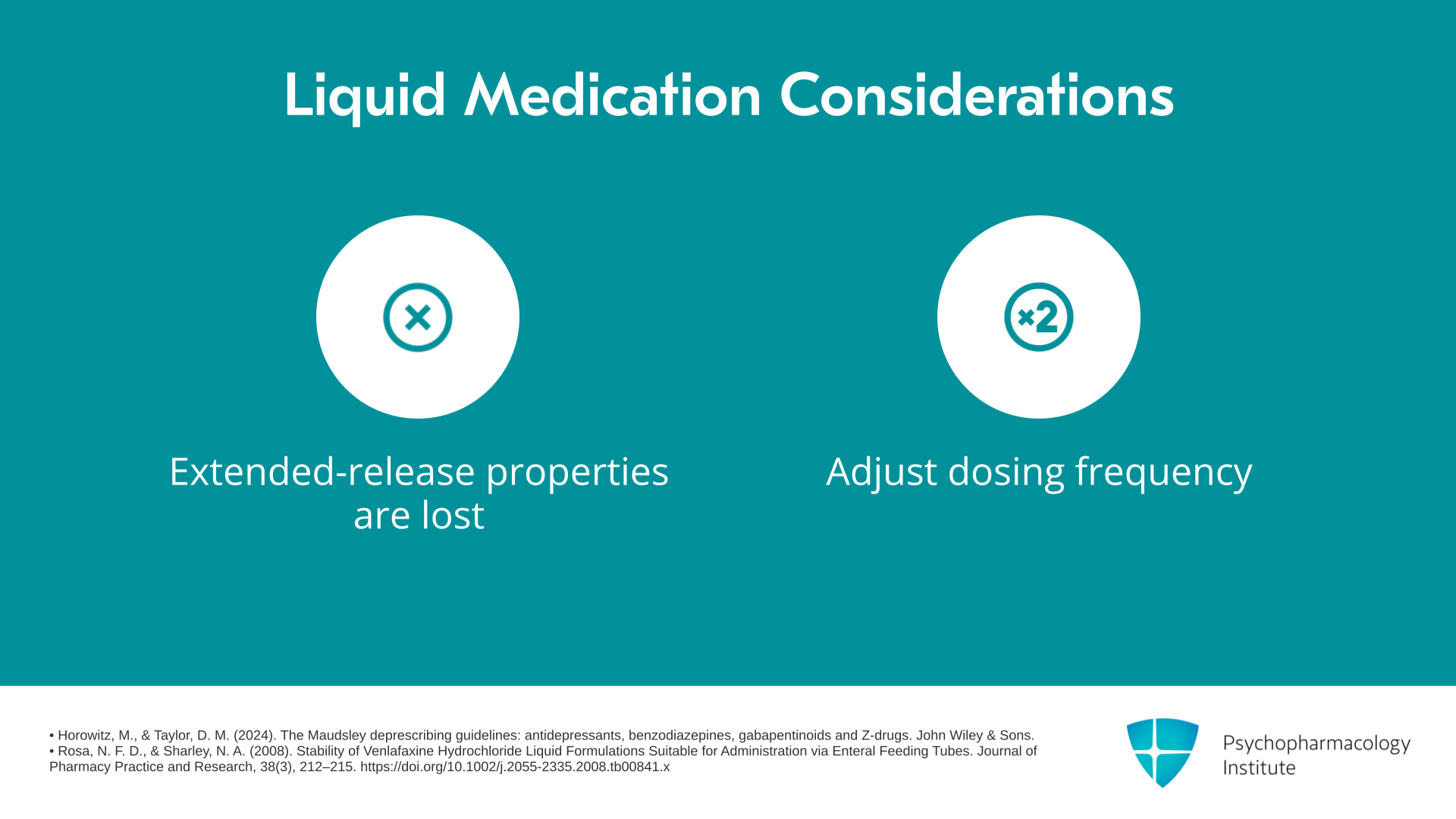
If a liquid is used, it should be noted that the extended-release properties of the drug are removed which are part of the beads. And so the drug should be taken either twice or for particularly sensitive patients three times a day to avoid interdose withdrawal.
References:
  • Horowitz, M., & Taylor, D. M. (2024). The Maudsley deprescribing guidelines: antidepressants, benzodiazepines, gabapentinoids and Z-drugs. John Wiley & Sons.
  • Rosa, N. F. D., & Sharley, N. A. (2008). Stability of Venlafaxine Hydrochloride Liquid Formulations Suitable for Administration via Enteral Feeding Tubes. Journal of Pharmacy Practice and Research, 38(3), 212–215. https://doi.org/10.1002/j.2055-2335.2008.tb00841.x
Free Files
Success!
Check your inbox, we sent you all the materials there.

Slide 5 of 11

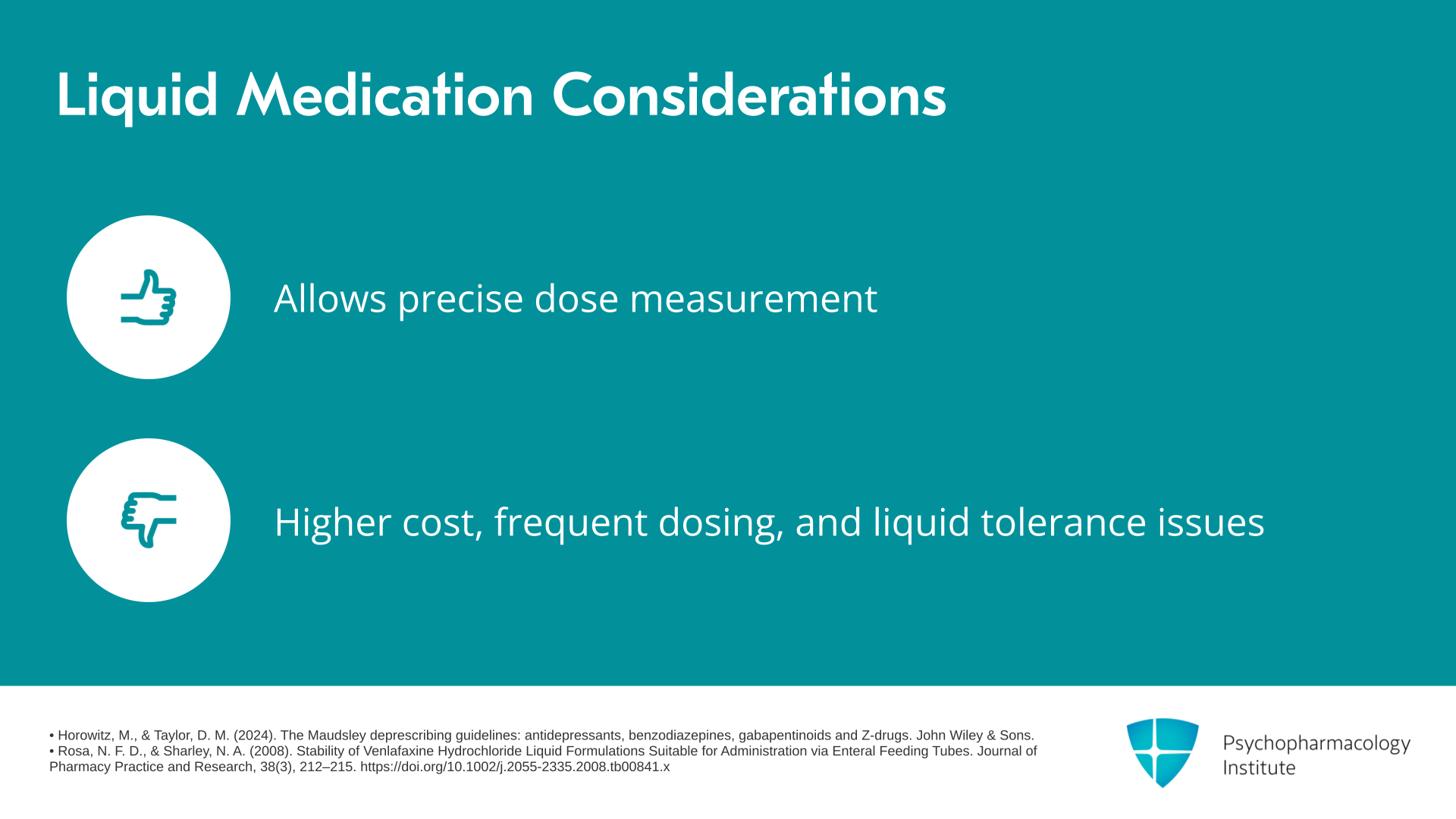
The advantage of a liquid in these cases is it allows very precise measurement of a dose with a syringe. The downsides are the extra cost, the fact that it must be taken two or three times a day. Some people don’t tolerate liquid. For some people, it might be that they’re absorbing it quicker or the preservatives used don’t jell with some people well, so it’s good to be cautious and to see how people respond to this.
References:
  • Horowitz, M., & Taylor, D. M. (2024). The Maudsley deprescribing guidelines: antidepressants, benzodiazepines, gabapentinoids and Z-drugs. John Wiley & Sons.
  • Rosa, N. F. D., & Sharley, N. A. (2008). Stability of Venlafaxine Hydrochloride Liquid Formulations Suitable for Administration via Enteral Feeding Tubes. Journal of Pharmacy Practice and Research, 38(3), 212–215. https://doi.org/10.1002/j.2055-2335.2008.tb00841.x

Slide 6 of 11

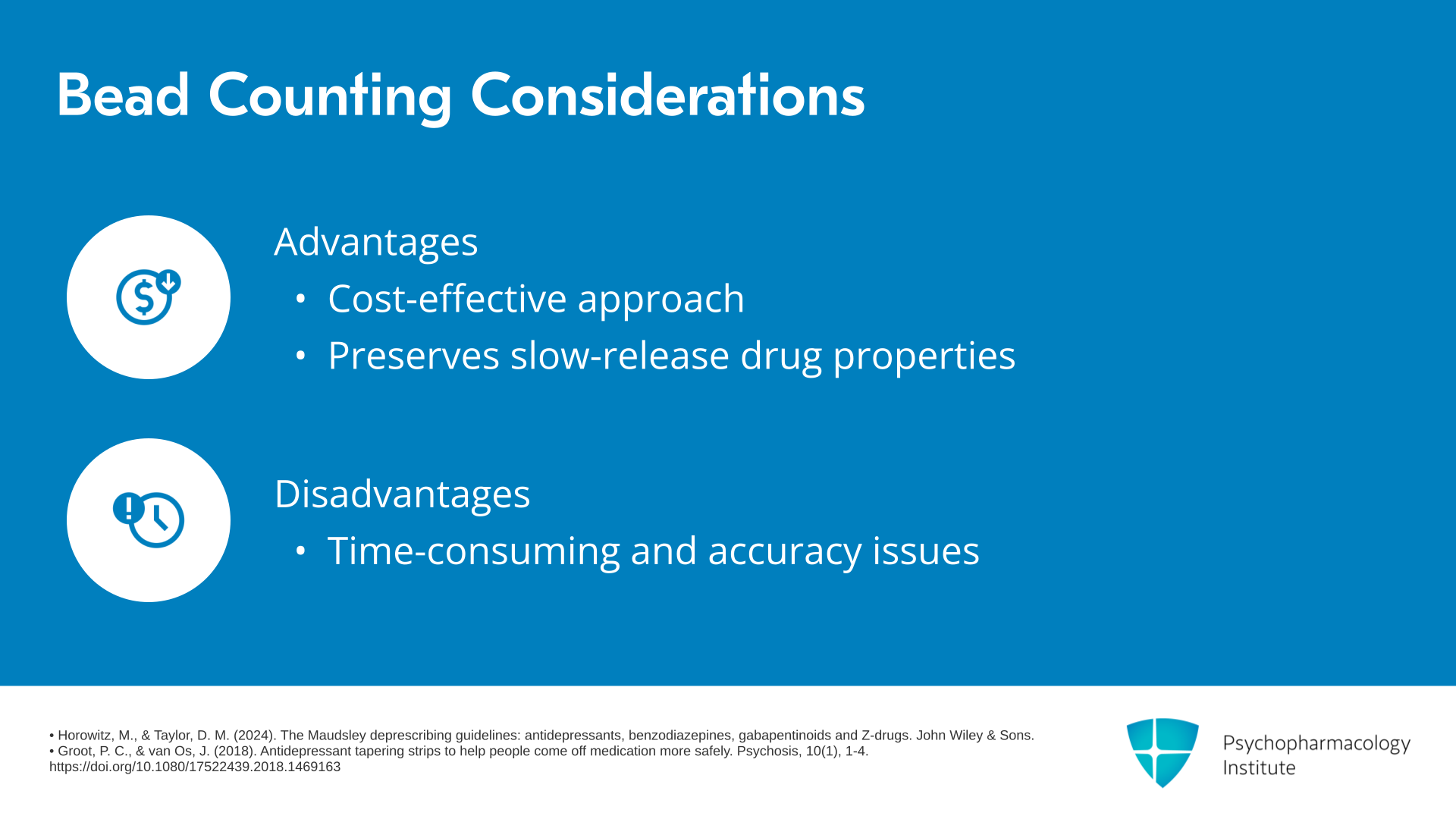
The advantage of the bead counting or weighing method is that it’s cheap. It maintains the slow-release properties of the drug, and the manufacturer has conducted a study to verify that the pharmacokinetic properties of the beads are stable when exposed to air, and people can just dose once a day. The beads should be placed back into a capsule to avoid irritating the throat when it’s swallowed. The downside is it can be quite fiddly, time consuming to count or weigh the beads but many patients become adept at it. Beads are different sizes which can become an issue for accuracy especially at lower doses. And some compounding pharmacies may be able to weigh beads for patients to make into capsule.
References:
  • Horowitz, M., & Taylor, D. M. (2024). The Maudsley deprescribing guidelines: antidepressants, benzodiazepines, gabapentinoids and Z-drugs. John Wiley & Sons.
  • Groot, P. C., & van Os, J. (2018). Antidepressant tapering strips to help people come off medication more safely. Psychosis, 10(1), 1-4. https://doi.org/10.1080/17522439.2018.1469163
Free Files
Success!
Check your inbox, we sent you all the materials there.

Slide 7 of 11

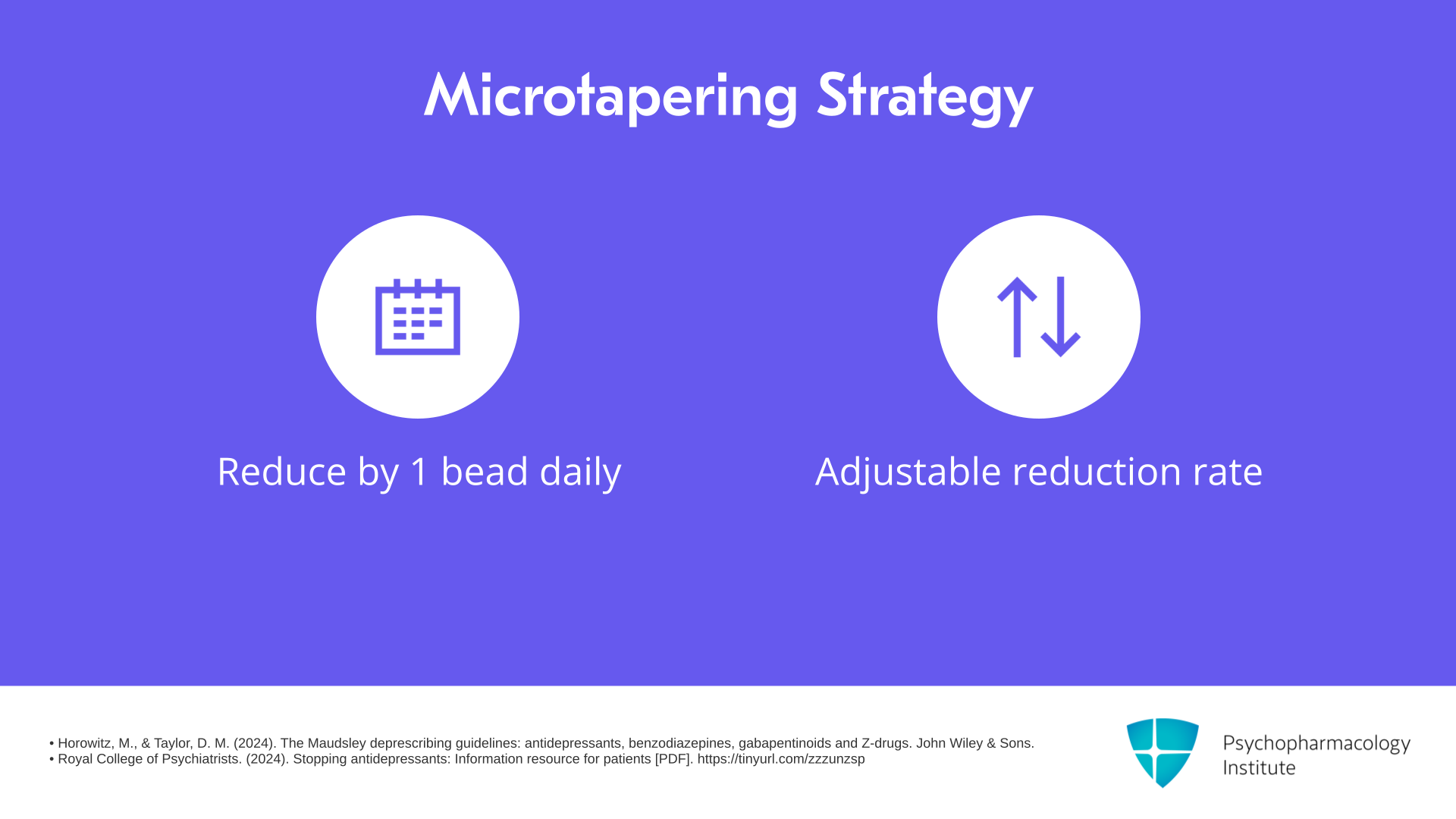
Microtapering can also be instituted here. For example, rather than reducing by 30 beads per month, a patient could reduce by 1 bead per day and that should lessen the destabilization caused by each reduction and the rate can be adjusted to be quicker or slower. Remembering that as people get down to lower doses, the rate will need to be reduced because of the hyperbolic pattern of the relationship between dose and effect on the brain.
References:
  • Horowitz, M., & Taylor, D. M. (2024). The Maudsley deprescribing guidelines: antidepressants, benzodiazepines, gabapentinoids and Z-drugs. John Wiley & Sons.
  • Royal College of Psychiatrists. (2024). Stopping antidepressants: Information resource for patients [PDF]. https://tinyurl.com/zzzunzsp

Slide 8 of 11

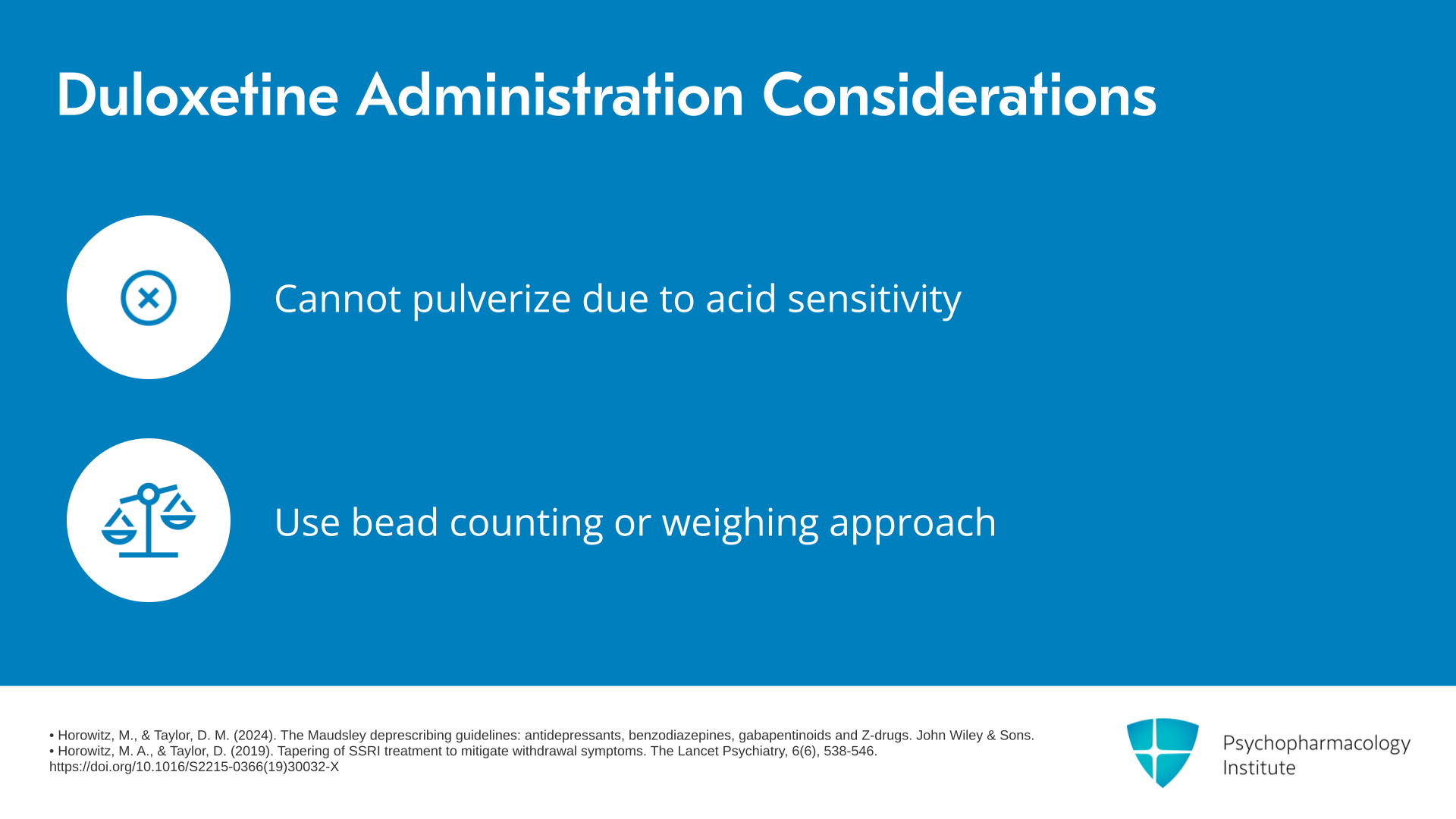
A few other examples. Duloxetine cannot be pulverized or liquefied because the drug is acid sensitive, and so the same approach can be taken as I’ve just outlined for venlafaxine, counting or weighing beads.
References:
  • Horowitz, M., & Taylor, D. M. (2024). The Maudsley deprescribing guidelines: antidepressants, benzodiazepines, gabapentinoids and Z-drugs. John Wiley & Sons.
  • Horowitz, M. A., & Taylor, D. (2019). Tapering of SSRI treatment to mitigate withdrawal symptoms. The Lancet Psychiatry, 6(6), 538-546. https://doi.org/10.1016/S2215-0366(19)30032-X
Free Files
Success!
Check your inbox, we sent you all the materials there.

Slide 9 of 11

And one thing to note in general is crushing and suspending tablets is best done with instant-release drugs rather than extended-release tablets or capsules, because dose dumping can be a concern if extended-release tablets or capsules are crushed.
References:
  • Horowitz, M., & Taylor, D. M. (2024). The Maudsley deprescribing guidelines: antidepressants, benzodiazepines, gabapentinoids and Z-drugs. John Wiley & Sons.
  • Horowitz, M. A., & Taylor, D. (2019). Tapering of SSRI treatment to mitigate withdrawal symptoms. The Lancet Psychiatry, 6(6), 538-546. https://doi.org/10.1016/S2215-0366(19)30032-X

Slide 10 of 11

Key points here are: Some drugs like venlafaxine and duloxetine are supplied as capsules containing microbeads. This can be opened and counted or weighed, or prepared by compounding pharmacies. This allows reductions of about 10% per month. Another option is even smaller reductions, more often called microtapering.
Free Files
Success!
Check your inbox, we sent you all the materials there.

Slide 11 of 11

And the rate of taper should be adjusted to the individual’s withdrawal symptoms – slowed, paused or dose increased if symptoms become too severe.

Learning Objectives:

After completing this activity, the learner will be able to:

  1. Recognize withdrawal symptoms from antidepressants in patients who have been on long-term treatment and differentiate these symptoms from relapse of the underlying condition.
  2. Apply hyperbolic tapering principles when discontinuing antidepressants.
  3. Identify patients at higher risk for severe withdrawal.

Original Release Date: September 1, 2025

Expiration Date: September 1, 2028

Expert: Mark Horowitz, M.D.

Medical Editor: Tomás Abudarham, M.D.

Relevant Financial Disclosures: 

Mark Horowitz declares the following interests:

– Outro Health: Co-founder, Consultant
All the relevant financial relationships listed above have been mitigated by Medical Academy and the Psychopharmacology Institute.

None of the other faculty, planners, and reviewers for this educational activity has relevant financial relationships to disclose during the last 24 months with ineligible companies whose primary business is producing, marketing, selling, re-selling, or distributing healthcare products used by or on patients.

Contact Information: For questions regarding the content or access to this activity, contact us at support@psychopharmacologyinstitute.com

Instructions for Participation and Credit:

Participants must complete the activity online during the valid credit period that is noted above.

Follow these steps to earn CME credit:

  1. View the required educational content provided on this course page.
  2. Complete the Post Activity Evaluation for providing the necessary feedback for continuing accreditation purposes and for the development of future activities. NOTE: Completing the Post Activity Evaluation after the quiz is required to receive the earned credit.
  3. Download your certificate.

Accreditation Statement

This activity has been planned and implemented in accordance with the accreditation requirements and policies of the Accreditation Council for Continuing Medical Education through the joint providership of Medical Academy LLC and the Psychopharmacology Institute. Medical Academy is accredited by the ACCME to provide continuing medical education for physicians.

Credit Designation Statement

Medical Academy designates this enduring activity for a maximum of 1.25 AMA PRA Category 1 credit(s)™. Physicians should claim only the credit commensurate with the extent of their participation in the activity.

Free Files
Success!
Check your inbox, we sent you all the materials there.
Continue in the website
Instant access modal

Become a Bronze, Silver, Gold, Bronze extended, Silver extended or Gold extended Member.

2025–26 Psychopharmacology CME Program

Unlock up to 155 CME Credits, including 40 SA CME Credits.