Slides and Transcript
Slide 1 of 15
Next, we’ll be talking about the pharmacologic management of dementia.
Slide 2 of 15
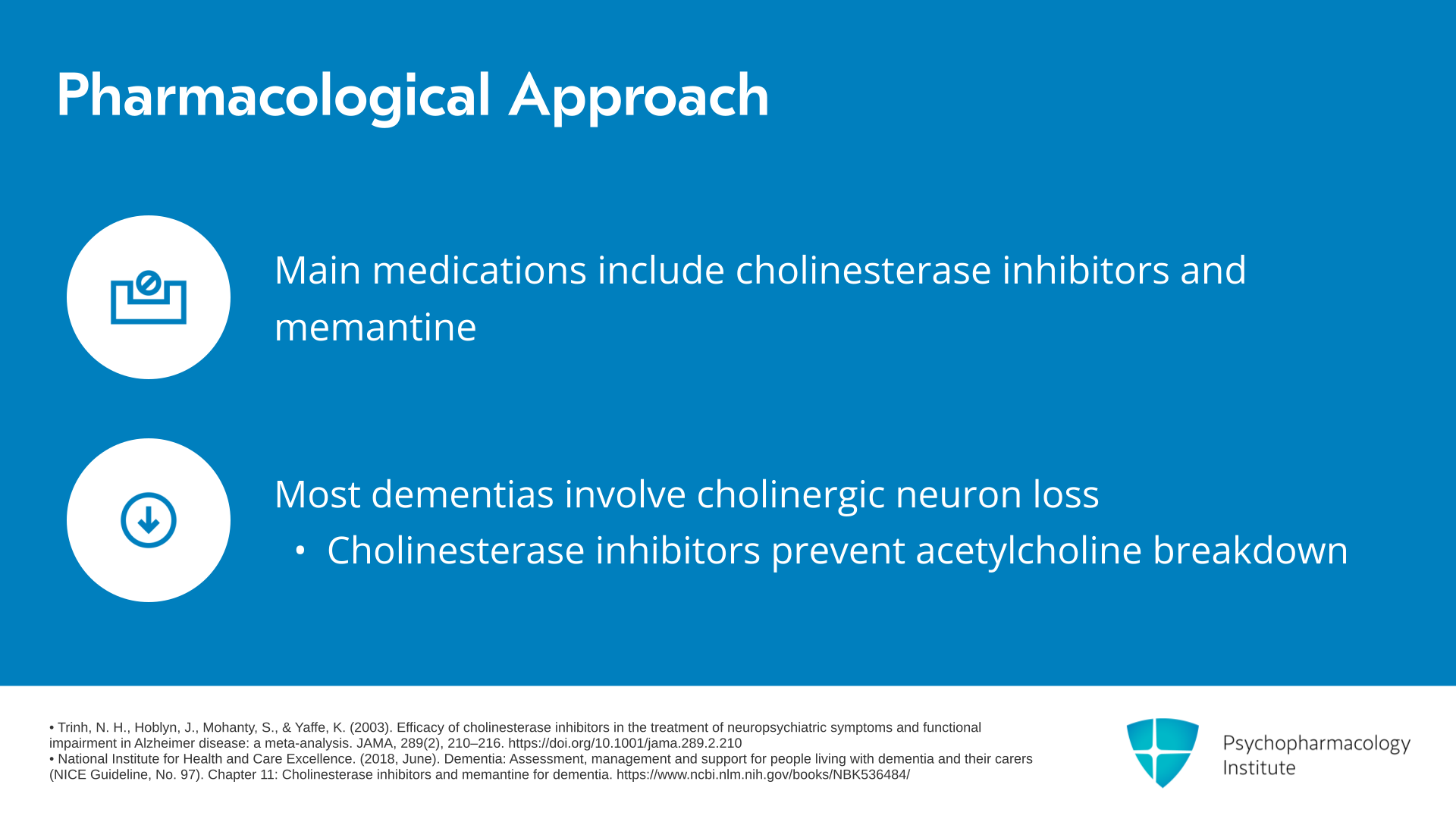
The main medications that we think about using are cholinesterase inhibitors and memantine. So in most forms of dementia, there’s generally a loss of cholinergic neurons. In Alzheimer’s disease, this generally tends to be in the hippocampus. And so cholinesterase inhibitors can help prevent the breakdown of acetylcholine.
References:
- Trinh, N. H., Hoblyn, J., Mohanty, S., & Yaffe, K. (2003). Efficacy of cholinesterase inhibitors in the treatment of neuropsychiatric symptoms and functional impairment in Alzheimer disease: a meta-analysis. JAMA, 289(2), 210–216. https://doi.org/10.1001/jama.289.2.210
- National Institute for Health and Care Excellence. (2018, June). Dementia: Assessment, management and support for people living with dementia and their carers (NICE Guideline, No. 97). Chapter 11: Cholinesterase inhibitors and memantine for dementia. https://www.ncbi.nlm.nih.gov/books/NBK536484/
Free Files
Download PDF and other files
Success!
Check your inbox, we sent you all the materials there.
Slide 3 of 15
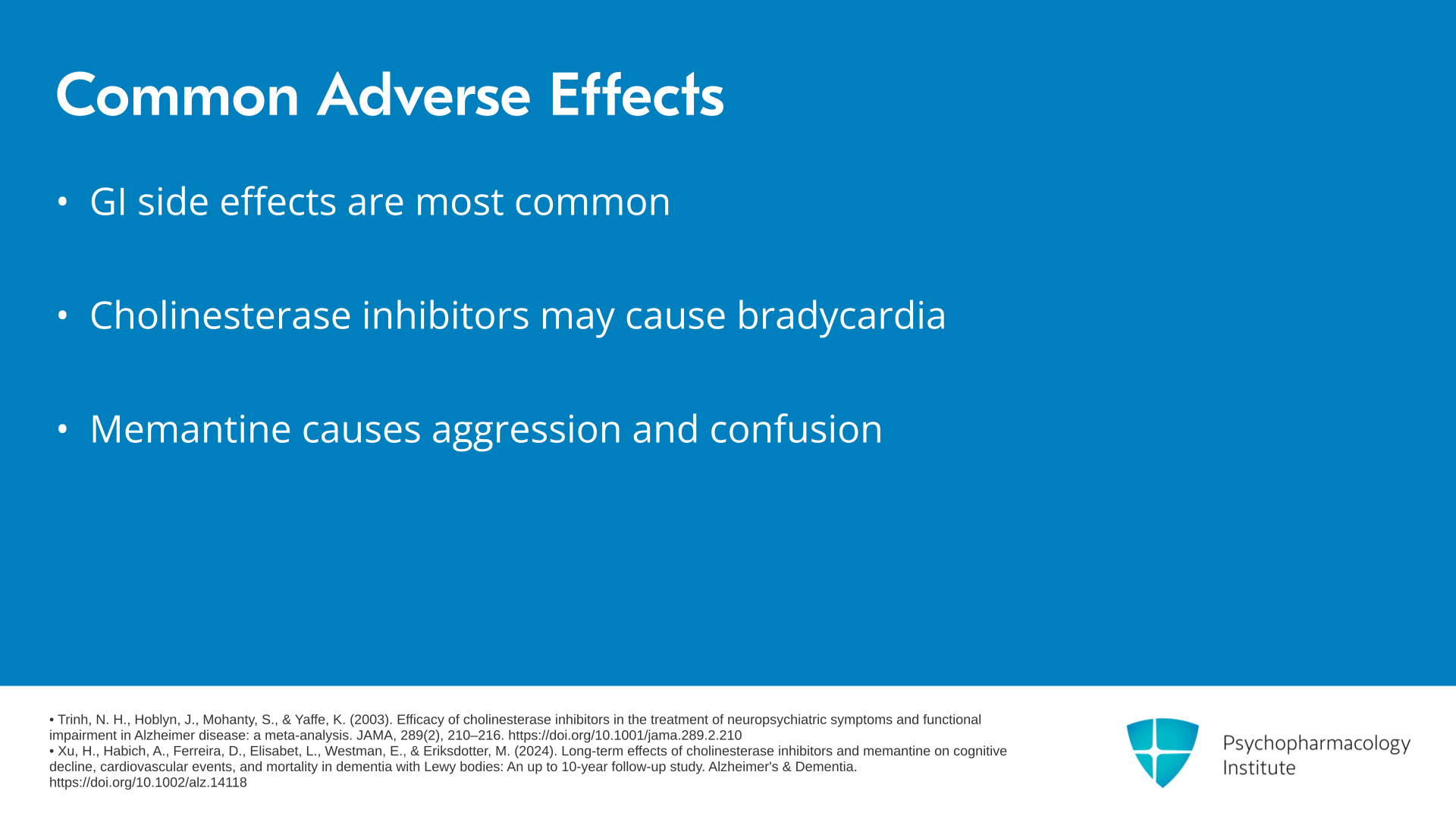
We know that the most common side effects with these medications often tend to be nausea, vomiting, diarrhea, so these GI side effects which can lead to weight loss. The cholinesterase inhibitors also can lead to bradycardia. Memantine can lead to aggression, confusion, headaches and dizziness, and tends to be more indicated for more advanced or at least moderate dementia.
References:
- Trinh, N. H., Hoblyn, J., Mohanty, S., & Yaffe, K. (2003). Efficacy of cholinesterase inhibitors in the treatment of neuropsychiatric symptoms and functional impairment in Alzheimer disease: a meta-analysis. JAMA, 289(2), 210–216. https://doi.org/10.1001/jama.289.2.210
- Xu, H., Habich, A., Ferreira, D., Elisabet, L., Westman, E., & Eriksdotter, M. (2024). Long-term effects of cholinesterase inhibitors and memantine on cognitive decline, cardiovascular events, and mortality in dementia with Lewy bodies: An up to 10-year follow-up study. Alzheimer's & Dementia. https://doi.org/10.1002/alz.14118
Slide 4 of 15
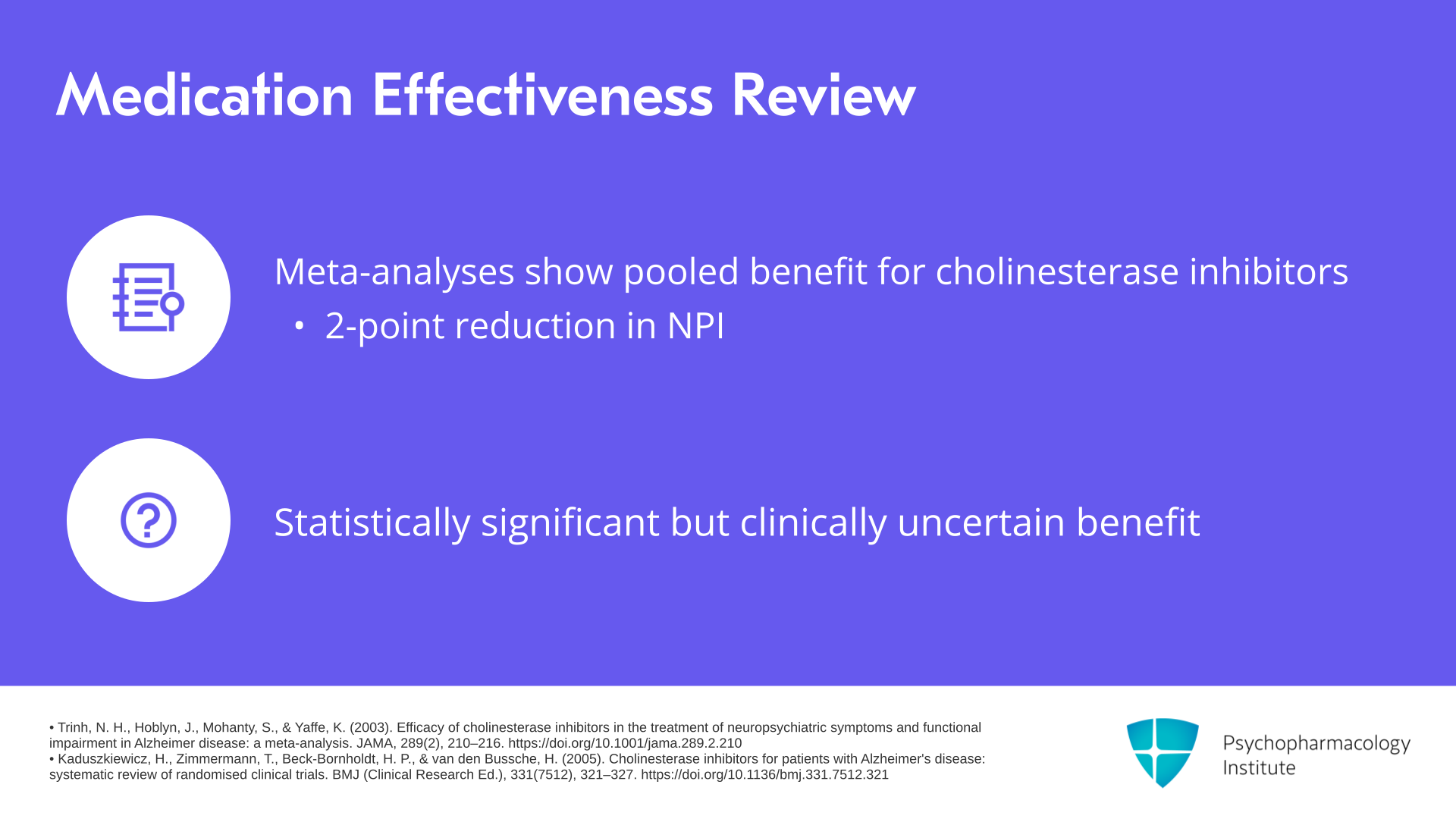
When we look at use of these medications and whether they can improve behavioral disturbances in dementia, when we look across pooled meta-analyses, there is a pooled benefit for use of cholinesterase inhibitors. And in general, they reduce the neuropsychiatric inventory by about 2 points. However, this is a scale that ranges from 0 to 144 and so this is a statistically significant benefit but jury is still out whether or not this is a clinically significant benefit.
References:
- Trinh, N. H., Hoblyn, J., Mohanty, S., & Yaffe, K. (2003). Efficacy of cholinesterase inhibitors in the treatment of neuropsychiatric symptoms and functional impairment in Alzheimer disease: a meta-analysis. JAMA, 289(2), 210–216. https://doi.org/10.1001/jama.289.2.210
- Kaduszkiewicz, H., Zimmermann, T., Beck-Bornholdt, H. P., & van den Bussche, H. (2005). Cholinesterase inhibitors for patients with Alzheimer's disease: systematic review of randomised clinical trials. BMJ (Clinical Research Ed.), 331(7512), 321–327. https://doi.org/10.1136/bmj.331.7512.321
Free Files
Download PDF and other files
Success!
Check your inbox, we sent you all the materials there.
Slide 5 of 15
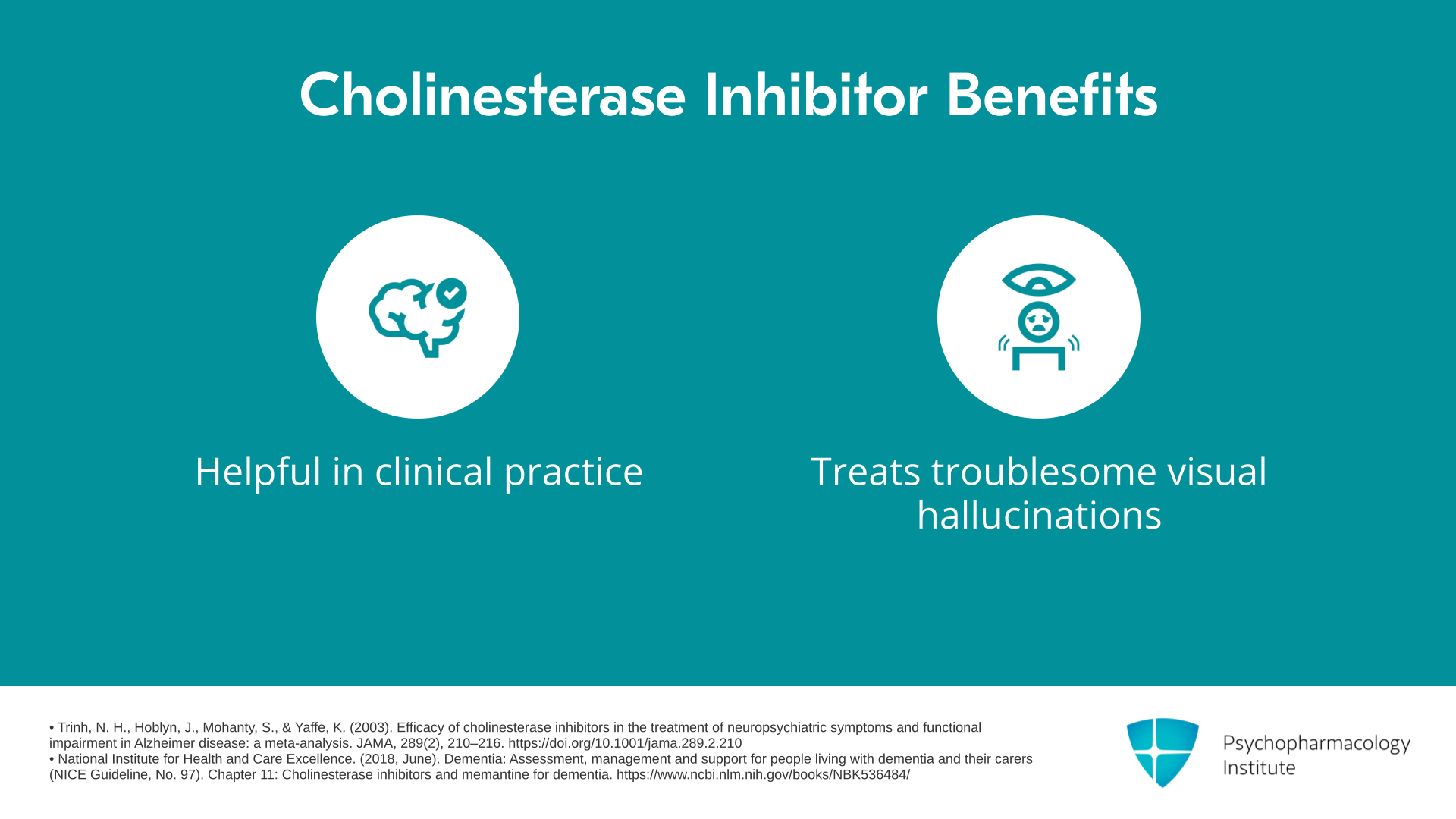
I think we can all think about patients where we’ve used these medications and it has been helpful. Maybe a situation where I’m more inclined to use cholinesterase inhibitors would be in the setting of Lewy body or Parkinson’s disease dementia, where patients may have troublesome visual hallucinations. There can be some evidence that cholinesterase inhibitors can be helpful in treating those visual hallucinations.
References:
- Trinh, N. H., Hoblyn, J., Mohanty, S., & Yaffe, K. (2003). Efficacy of cholinesterase inhibitors in the treatment of neuropsychiatric symptoms and functional impairment in Alzheimer disease: a meta-analysis. JAMA, 289(2), 210–216. https://doi.org/10.1001/jama.289.2.210
- National Institute for Health and Care Excellence. (2018, June). Dementia: Assessment, management and support for people living with dementia and their carers (NICE Guideline, No. 97). Chapter 11: Cholinesterase inhibitors and memantine for dementia. https://www.ncbi.nlm.nih.gov/books/NBK536484/
Slide 6 of 15
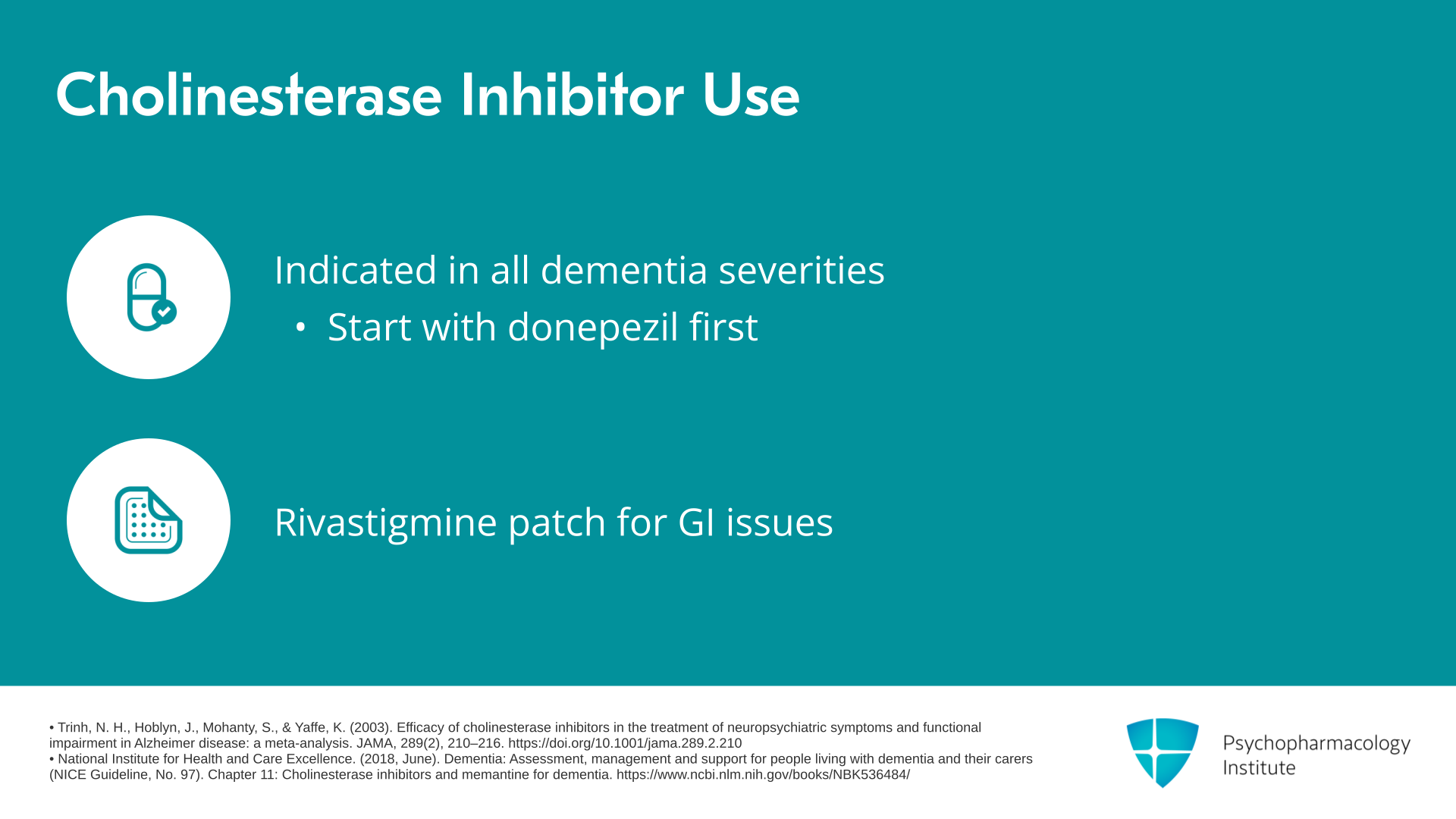
Use of cholinesterase inhibitors are indicated in all dementia severities. And generally, we will start with donepezil or Aricept first and then switch agents if side effects develop. For patients who have significant GI side effects with use of oral medications, there is a rivastigmine transdermal patch that generally can help bypass some of those GI side effects.
References:
- Trinh, N. H., Hoblyn, J., Mohanty, S., & Yaffe, K. (2003). Efficacy of cholinesterase inhibitors in the treatment of neuropsychiatric symptoms and functional impairment in Alzheimer disease: a meta-analysis. JAMA, 289(2), 210–216. https://doi.org/10.1001/jama.289.2.210
- National Institute for Health and Care Excellence. (2018, June). Dementia: Assessment, management and support for people living with dementia and their carers (NICE Guideline, No. 97). Chapter 11: Cholinesterase inhibitors and memantine for dementia. https://www.ncbi.nlm.nih.gov/books/NBK536484/
Free Files
Download PDF and other files
Success!
Check your inbox, we sent you all the materials there.
Slide 7 of 15
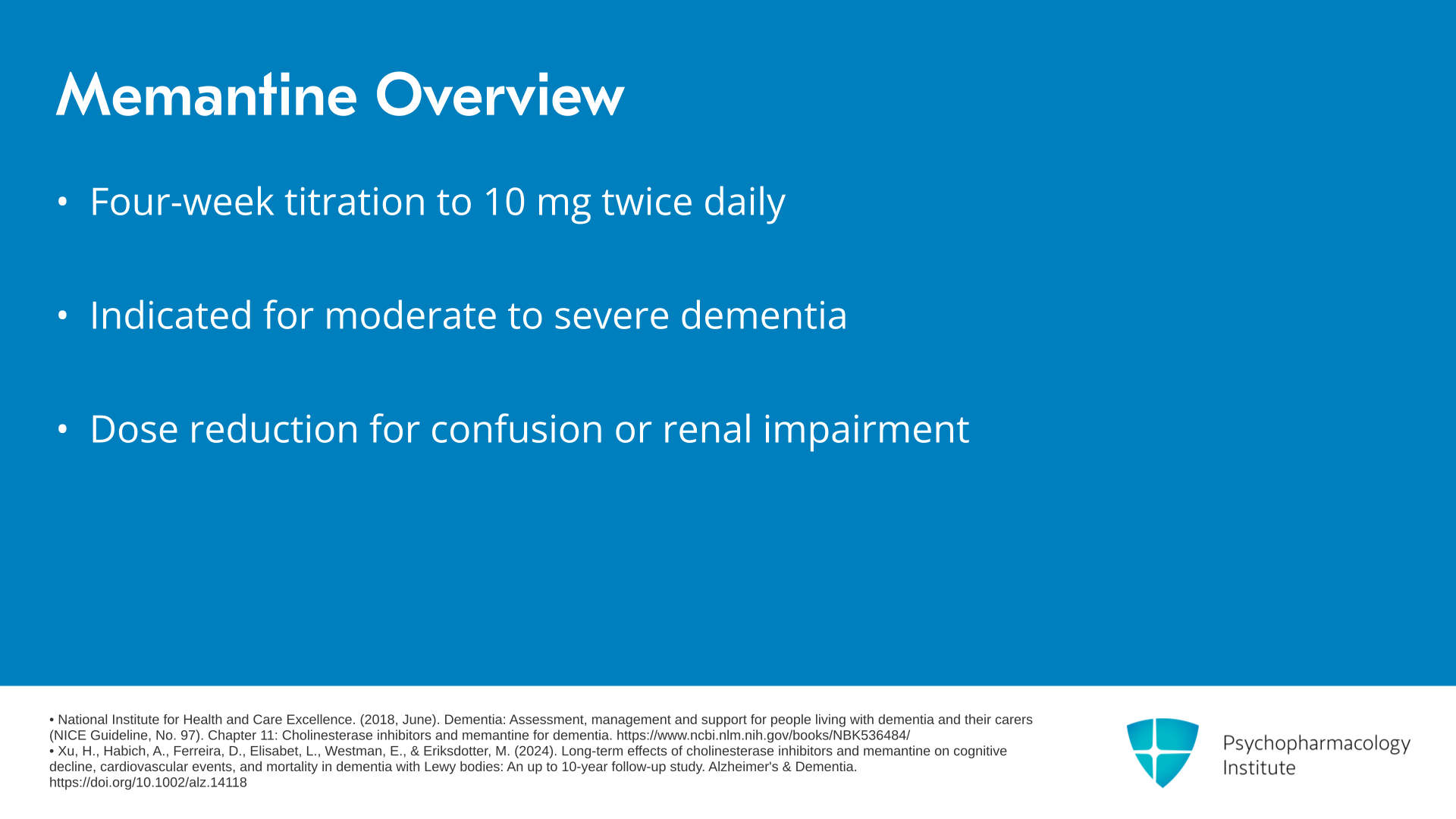
Memantine is generally titrated over four weeks to 10 mg twice daily or a 28 mg extended-release version, and is indicated for moderate to severe dementia. And we will often think about reducing the dose if patients have persistent confusion or chronic renal impairment.
References:
- National Institute for Health and Care Excellence. (2018, June). Dementia: Assessment, management and support for people living with dementia and their carers (NICE Guideline, No. 97). Chapter 11: Cholinesterase inhibitors and memantine for dementia. https://www.ncbi.nlm.nih.gov/books/NBK536484/
- Xu, H., Habich, A., Ferreira, D., Elisabet, L., Westman, E., & Eriksdotter, M. (2024). Long-term effects of cholinesterase inhibitors and memantine on cognitive decline, cardiovascular events, and mortality in dementia with Lewy bodies: An up to 10-year follow-up study. Alzheimer's & Dementia. https://doi.org/10.1002/alz.14118
Slide 8 of 15
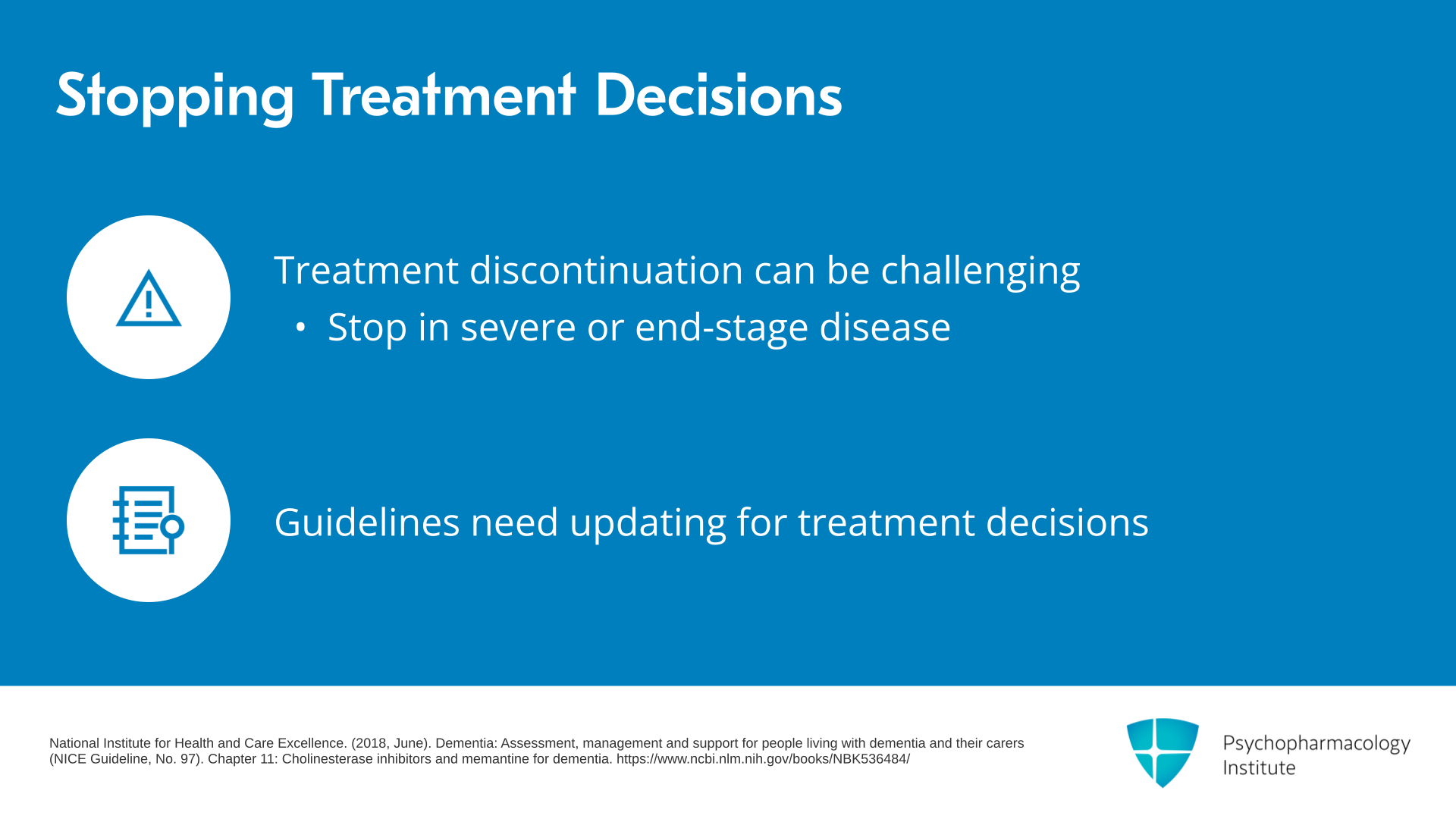
And the decision when to stop treatment can be difficult. In general, we recommend stopping treatment in severe or end stage disease where there’s an inability to respond to environment, dependence on others for most activities of daily living or there’s limited life expectancy such as when folks are entering hospice care. But there really needs to be an update to guidelines, both to start as well as to discontinue these treatments.
References:
- National Institute for Health and Care Excellence. (2018, June). Dementia: Assessment, management and support for people living with dementia and their carers (NICE Guideline, No. 97). Chapter 11: Cholinesterase inhibitors and memantine for dementia. https://www.ncbi.nlm.nih.gov/books/NBK536484/
Free Files
Download PDF and other files
Success!
Check your inbox, we sent you all the materials there.
Slide 9 of 15
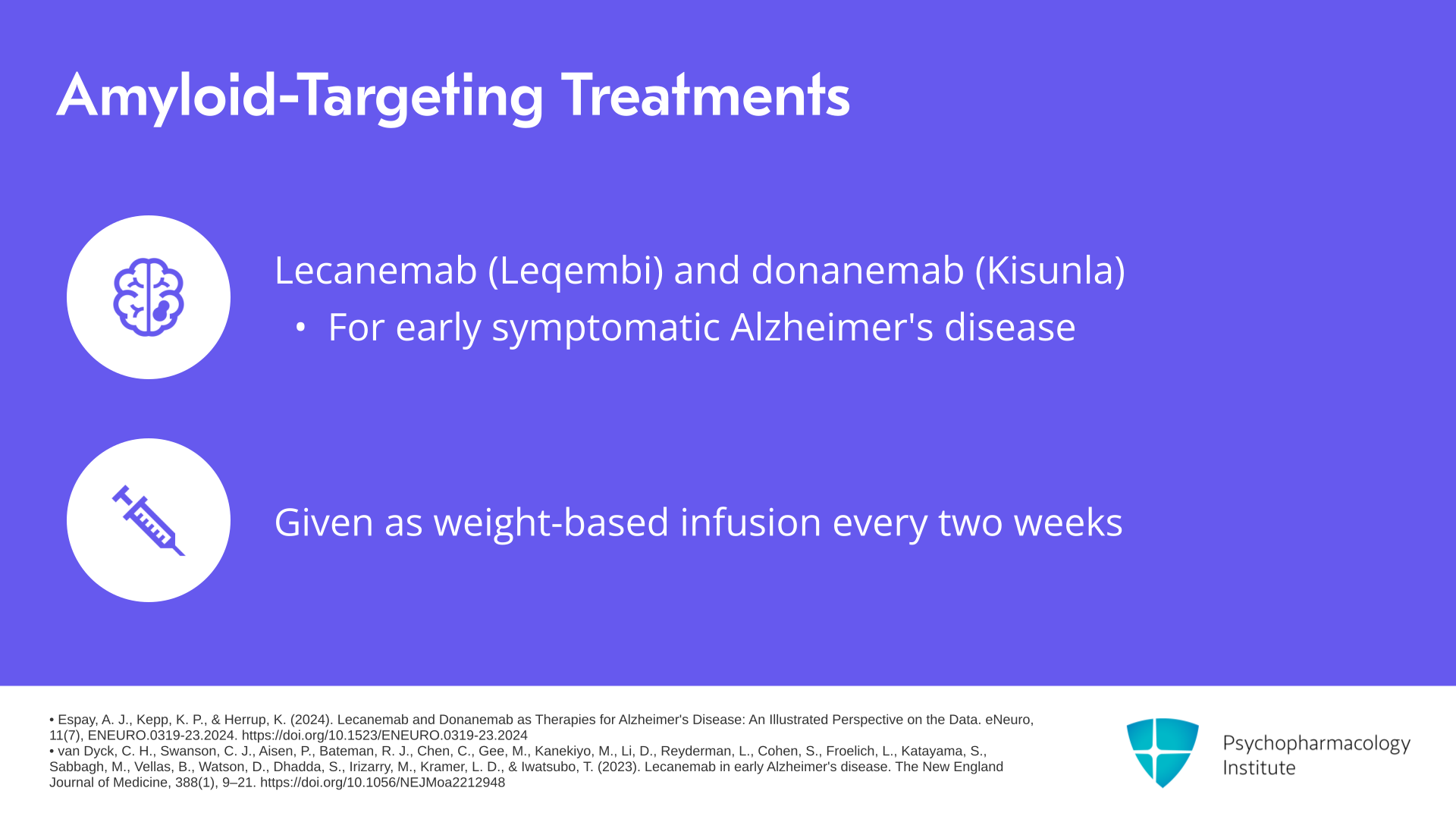
Newer agents that are out are amyloid-targeting treatments for individuals living with early symptomatic Alzheimer’s disease with confirmed amyloid pathology. And the two medications that are out are lecanemab and donanemab which are Leqembi or Kisunla, and these medications bind to amyloid and remove amyloid buildup. And they’re given as an infusion every two weeks, and dosing is based on weight.
References:
- Espay, A. J., Kepp, K. P., & Herrup, K. (2024). Lecanemab and Donanemab as Therapies for Alzheimer's Disease: An Illustrated Perspective on the Data. eNeuro, 11(7), ENEURO.0319-23.2024. https://doi.org/10.1523/ENEURO.0319-23.2024
- van Dyck, C. H., Swanson, C. J., Aisen, P., Bateman, R. J., Chen, C., Gee, M., Kanekiyo, M., Li, D., Reyderman, L., Cohen, S., Froelich, L., Katayama, S., Sabbagh, M., Vellas, B., Watson, D., Dhadda, S., Irizarry, M., Kramer, L. D., & Iwatsubo, T. (2023). Lecanemab in early Alzheimer's disease. The New England Journal of Medicine, 388(1), 9–21. https://doi.org/10.1056/NEJMoa2212948
Slide 10 of 15
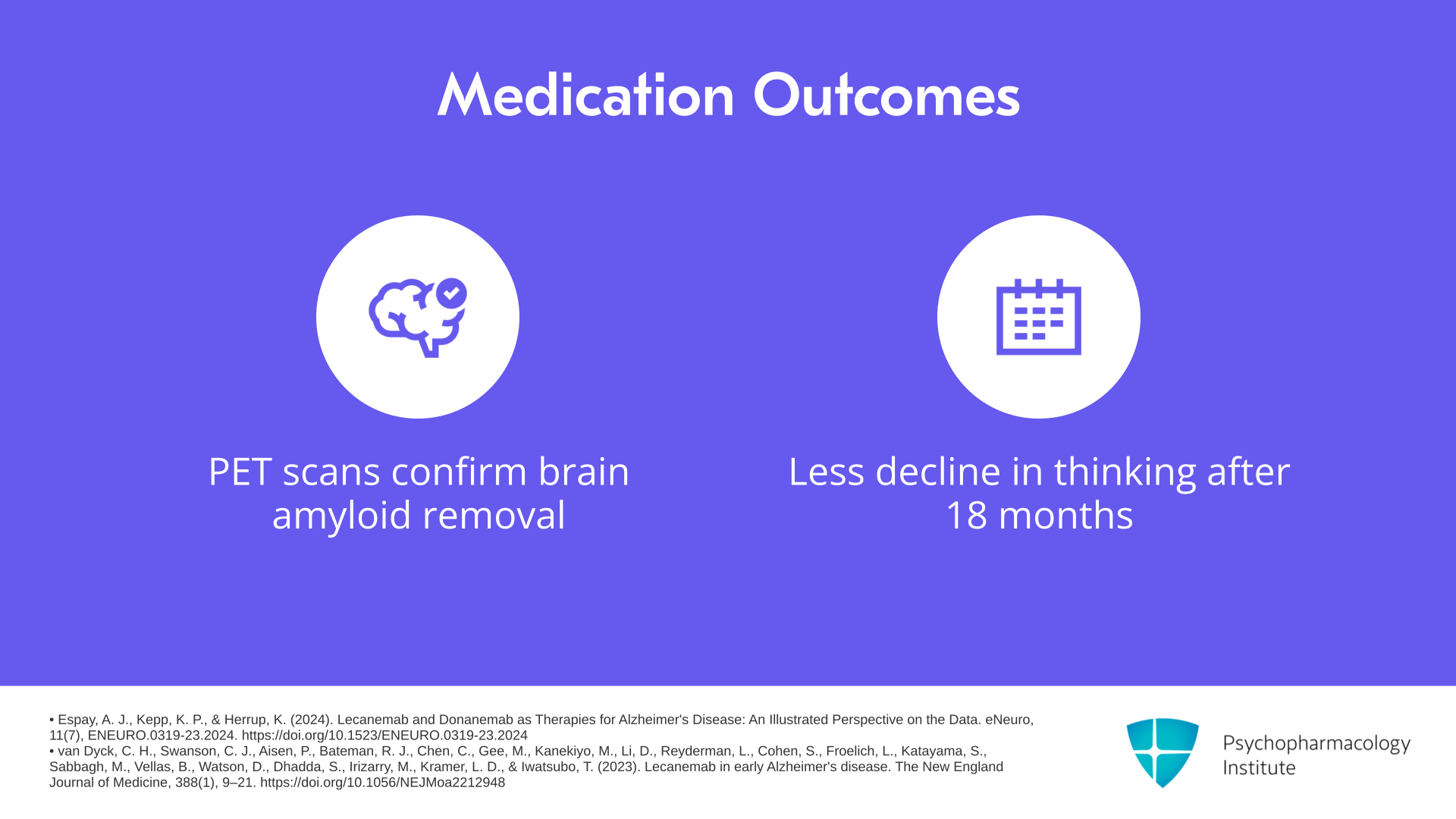
And PET scans have shown that these medications can lead to removal of brain amyloid. And in research trials with lecanemab and donanemab, they found that persons with mild symptoms of Alzheimer’s disease experienced less decline in thinking and daily function at 18 months on the medication. And so there was moderate slowing of cognitive decline.
References:
- Espay, A. J., Kepp, K. P., & Herrup, K. (2024). Lecanemab and Donanemab as Therapies for Alzheimer's Disease: An Illustrated Perspective on the Data. eNeuro, 11(7), ENEURO.0319-23.2024. https://doi.org/10.1523/ENEURO.0319-23.2024
- van Dyck, C. H., Swanson, C. J., Aisen, P., Bateman, R. J., Chen, C., Gee, M., Kanekiyo, M., Li, D., Reyderman, L., Cohen, S., Froelich, L., Katayama, S., Sabbagh, M., Vellas, B., Watson, D., Dhadda, S., Irizarry, M., Kramer, L. D., & Iwatsubo, T. (2023). Lecanemab in early Alzheimer's disease. The New England Journal of Medicine, 388(1), 9–21. https://doi.org/10.1056/NEJMoa2212948
Free Files
Download PDF and other files
Success!
Check your inbox, we sent you all the materials there.
Slide 11 of 15
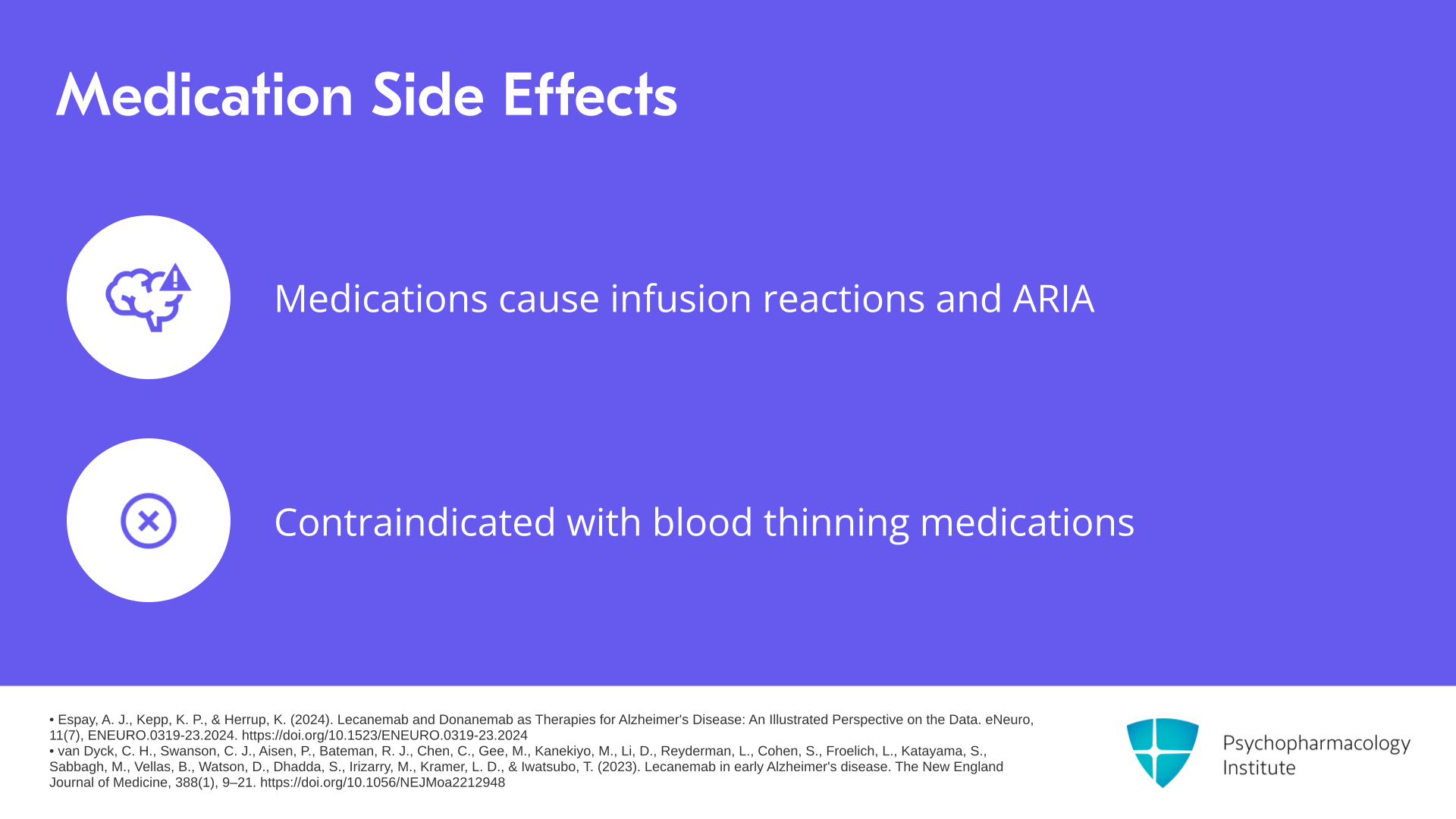
However, these medications do come with significant side effects. They can have infusion-related reactions and something we worry about is called ARIA, or amyloid-related imaging abnormalities, which are swelling and brain bleeds which require monitoring with recurrent MRIs to check for these. And they are not recommended for patients who are taking anticoagulants or thrombolytic. These clinical trials also excluded patients with stroke or TIAs, patients with bleeding disorders, seizures or severe depression, so we don’t know how these medications or the safety in those conditions.
References:
- Espay, A. J., Kepp, K. P., & Herrup, K. (2024). Lecanemab and Donanemab as Therapies for Alzheimer's Disease: An Illustrated Perspective on the Data. eNeuro, 11(7), ENEURO.0319-23.2024. https://doi.org/10.1523/ENEURO.0319-23.2024
- van Dyck, C. H., Swanson, C. J., Aisen, P., Bateman, R. J., Chen, C., Gee, M., Kanekiyo, M., Li, D., Reyderman, L., Cohen, S., Froelich, L., Katayama, S., Sabbagh, M., Vellas, B., Watson, D., Dhadda, S., Irizarry, M., Kramer, L. D., & Iwatsubo, T. (2023). Lecanemab in early Alzheimer's disease. The New England Journal of Medicine, 388(1), 9–21. https://doi.org/10.1056/NEJMoa2212948
Slide 12 of 15
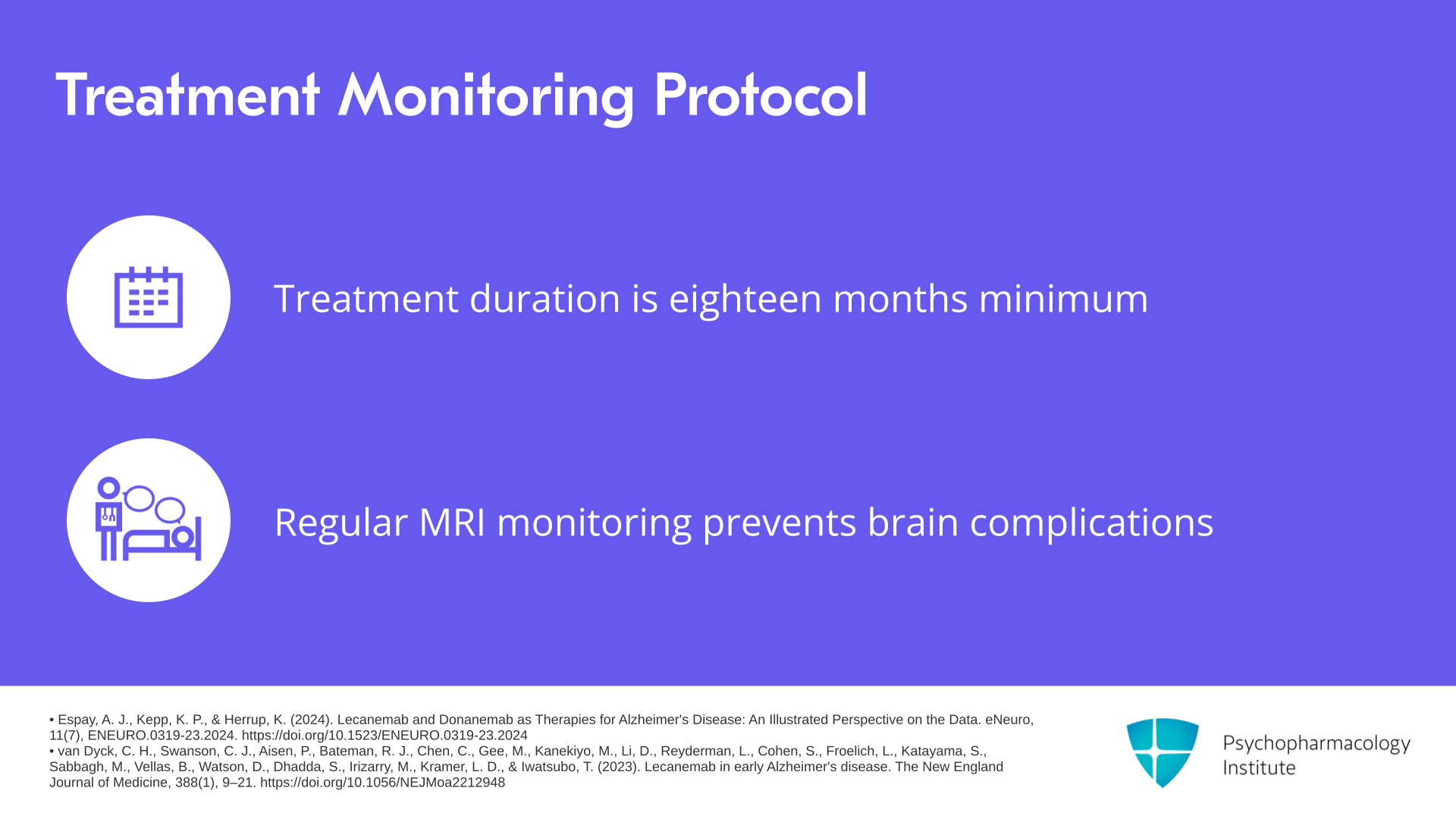
Treatment is generally for 18 months at least and I think there are still questions out about what ongoing maintenance might look like after that. And recurrent MRIs are needed for monitoring to look for these potential bleeding and brain bleeds or swelling.The cost is about $27,000 to $32,000 per year covered by Medicare. MRIs are generally indicated one year prior to the start, within one year prior to the start of treatment and then followup prior to the 5th, 7th and 14th treatments and continued MRIs for selected patients.
References:
- Espay, A. J., Kepp, K. P., & Herrup, K. (2024). Lecanemab and Donanemab as Therapies for Alzheimer's Disease: An Illustrated Perspective on the Data. eNeuro, 11(7), ENEURO.0319-23.2024. https://doi.org/10.1523/ENEURO.0319-23.2024
- van Dyck, C. H., Swanson, C. J., Aisen, P., Bateman, R. J., Chen, C., Gee, M., Kanekiyo, M., Li, D., Reyderman, L., Cohen, S., Froelich, L., Katayama, S., Sabbagh, M., Vellas, B., Watson, D., Dhadda, S., Irizarry, M., Kramer, L. D., & Iwatsubo, T. (2023). Lecanemab in early Alzheimer's disease. The New England Journal of Medicine, 388(1), 9–21. https://doi.org/10.1056/NEJMoa2212948
Free Files
Download PDF and other files
Success!
Check your inbox, we sent you all the materials there.
Slide 13 of 15
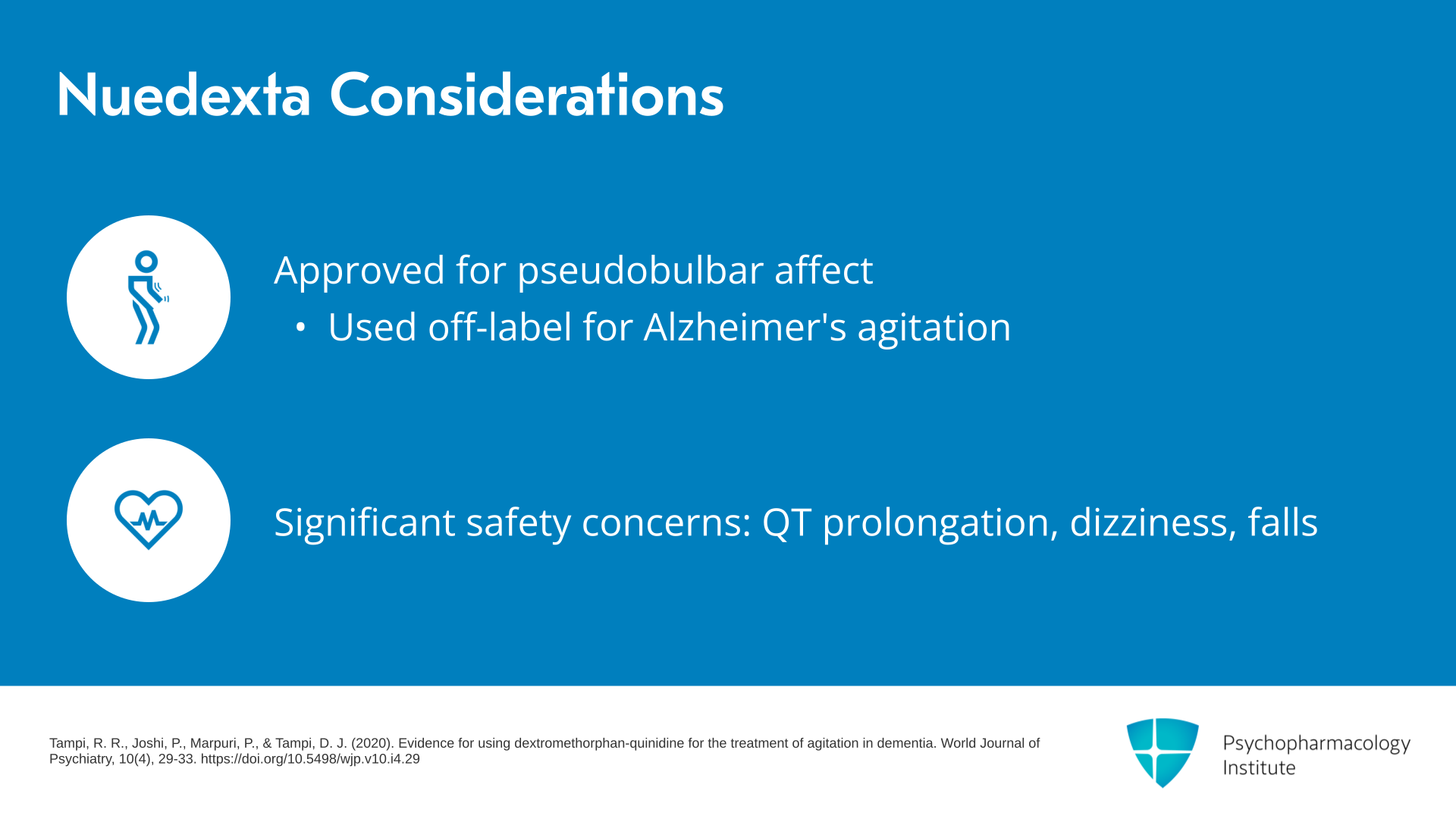
I’ll mention Nuedexta or dextromethorphan/quinidine, which is a combination approved for pseudobulbar affect, which is used off-label for agitation in Alzheimer’s disease. This has been investigated for off-label use through a study called TRIAD, which demonstrated statistically significant improvements in agitation symptoms for patients living with dementia. However, there are some significant safety concerns, including QT prolongation, dizziness, and falls. And you want to use in caution with frail elderly and requires monitoring EKGs.
References:
- Tampi, R. R., Joshi, P., Marpuri, P., & Tampi, D. J. (2020). Evidence for using dextromethorphan-quinidine for the treatment of agitation in dementia. World Journal of Psychiatry, 10(4), 29-33. https://doi.org/10.5498/wjp.v10.i4.29
Slide 14 of 15
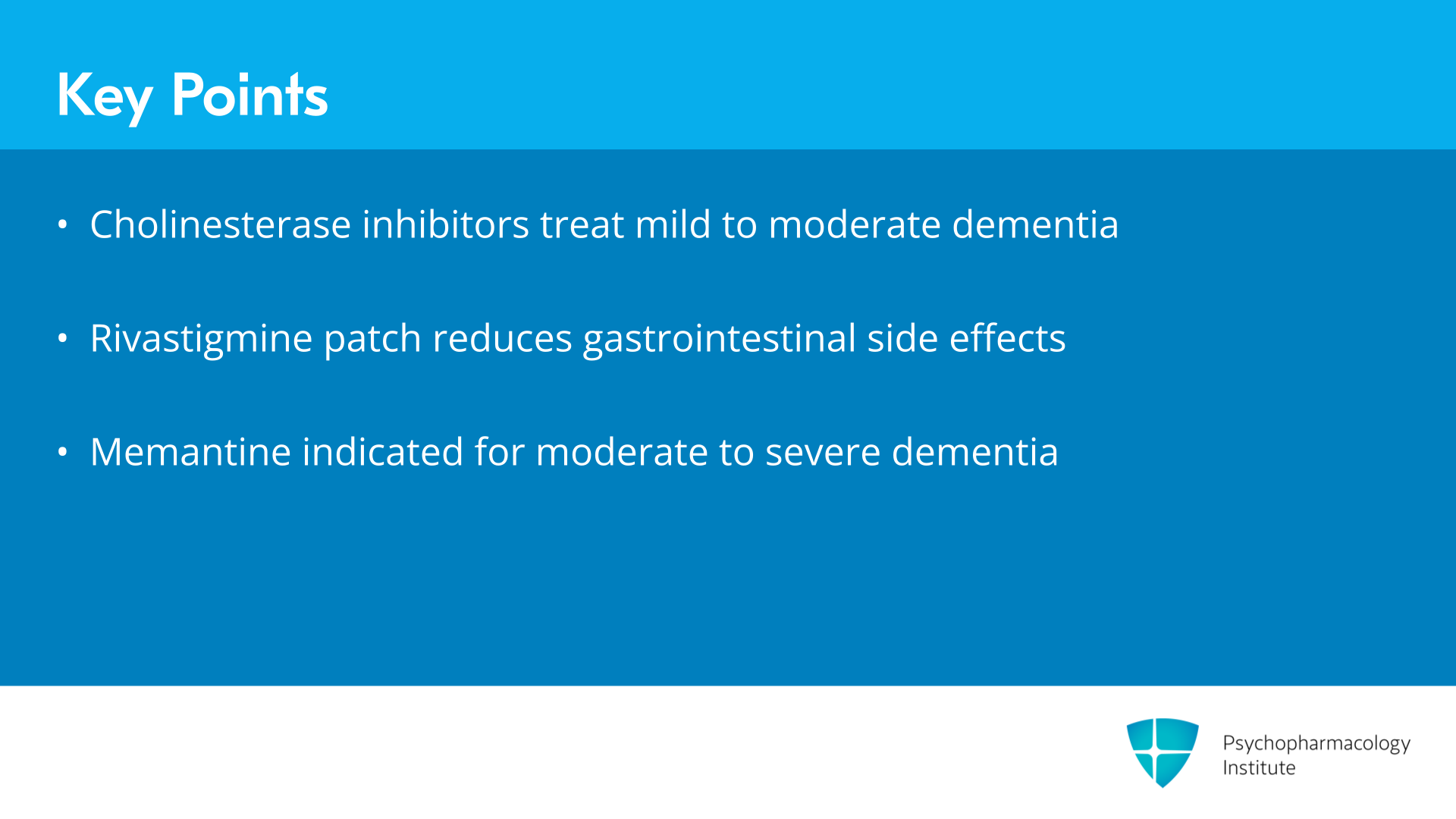
So key points for this section: Cholinesterase inhibitors are indicated for mild to moderate dementia and the main side effects include nausea, vomiting and diarrhea. If those GI side effects become too troublesome with oral medications, there is a transdermal patch, the rivastigmine patch which can be used. Memantine is indicated for moderate to severe dementia and the main side effects include confusion, headaches, dizziness and aggression.
Free Files
Download PDF and other files
Success!
Check your inbox, we sent you all the materials there.
Slide 15 of 15
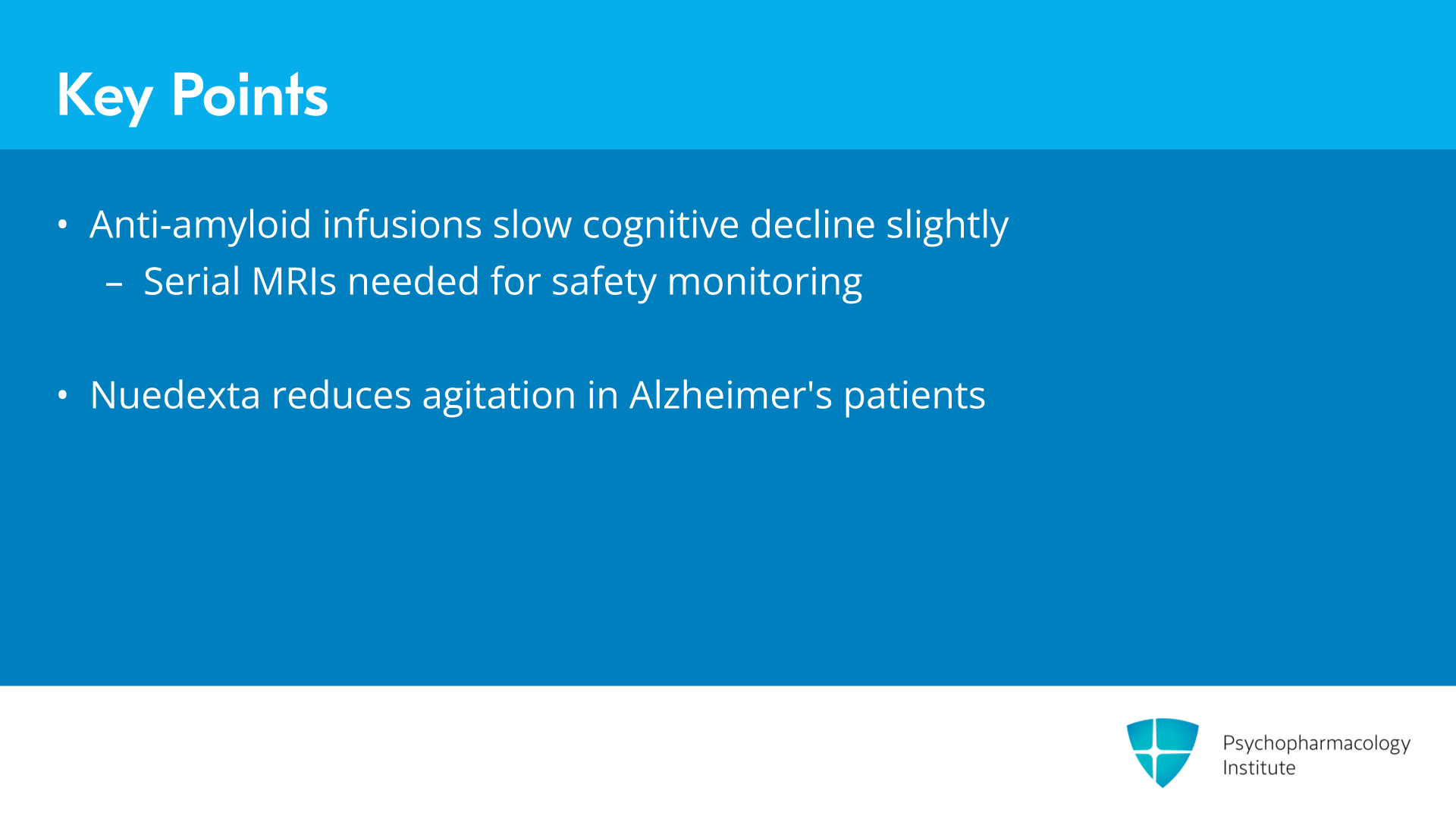
Anti-amyloid infusions for early Alzheimer’s disease with confirmed amyloid pathology, they can slow cognitive decline slightly but there are significant side effects including ARIA which are brain and bleeds and swelling, and these medications require serial MRIs for monitoring. Nuedexta or dextromethorphan/quinidine may reduce agitation in patients with Alzheimer’s disease but requires caution due to QT prolongation and fall risk.