Close Banner
Section Free  - Video Lectures

02. Delirium: Assessment, Consequences and Sequelae

Published on May 1, 2021 Expired on April 1, 2025

Scott R. Beach, M.D.

Associate Professor of Psychiatry - Harvard Medical School - Massachusetts General Hospital

Key Points

  • The consequences of delirium include increased mortality and morbidity.
  • The sequelae of delirium include agitation and perceptual disturbances.
  • Differential diagnoses may include other neurocognitive disorders, depression, mania, and schizophrenia.
  • Diagnosis relies on history, course of illness, neurological exam, and cognitive testing.

Free Downloads for Offline Access

  • Free Download Video (MP4)
  • Free Download Audio File (MP3)
  • Free Download Presentation File (PPTX)

Slides and Transcript
Slide 1 of 15

When we are assessing somebody who may be delirious, it's important to keep in mind…

Slide 2 of 15

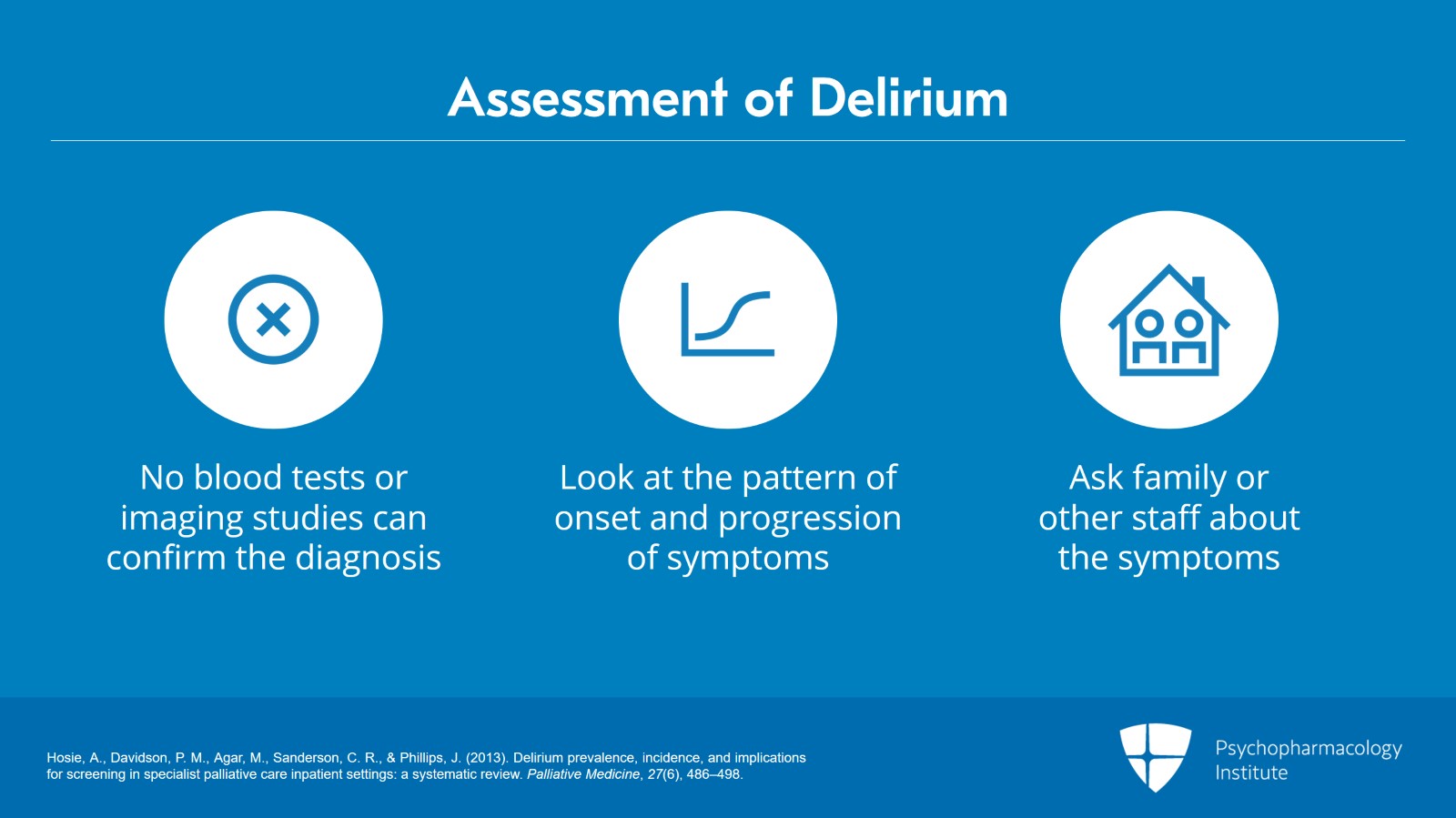
that delirium is a bedside diagnosis. Meaning, there are no blood tests or imaging studies that will confirm the diagnosis. So we have to rely on history. In particular, we want to look at the pattern of onset and the progression of symptoms. And we want to look for an abrupt onset and again for that waxing and waning quality. It's important to keep in mind that patients who are delirious are often poor historians so we generally rely on family or other staff. It turns out that in the hospital nurses, physical therapists and occupational therapists are the best at diagnosing delirium because they tend to spend longer amounts of time with patients and often engage them in tasks requiring executive functioning.
References:
  • Hosie, A., Davidson, P. M., Agar, M., Sanderson, C. R., & Phillips, J. (2013). Delirium prevalence, incidence, and implications for screening in specialist palliative care inpatient settings: a systematic review. Palliative Medicine, 27(6), 486–498.
Free Files
Success!
Check your inbox, we sent you all the materials there.
Slide 3 of 15

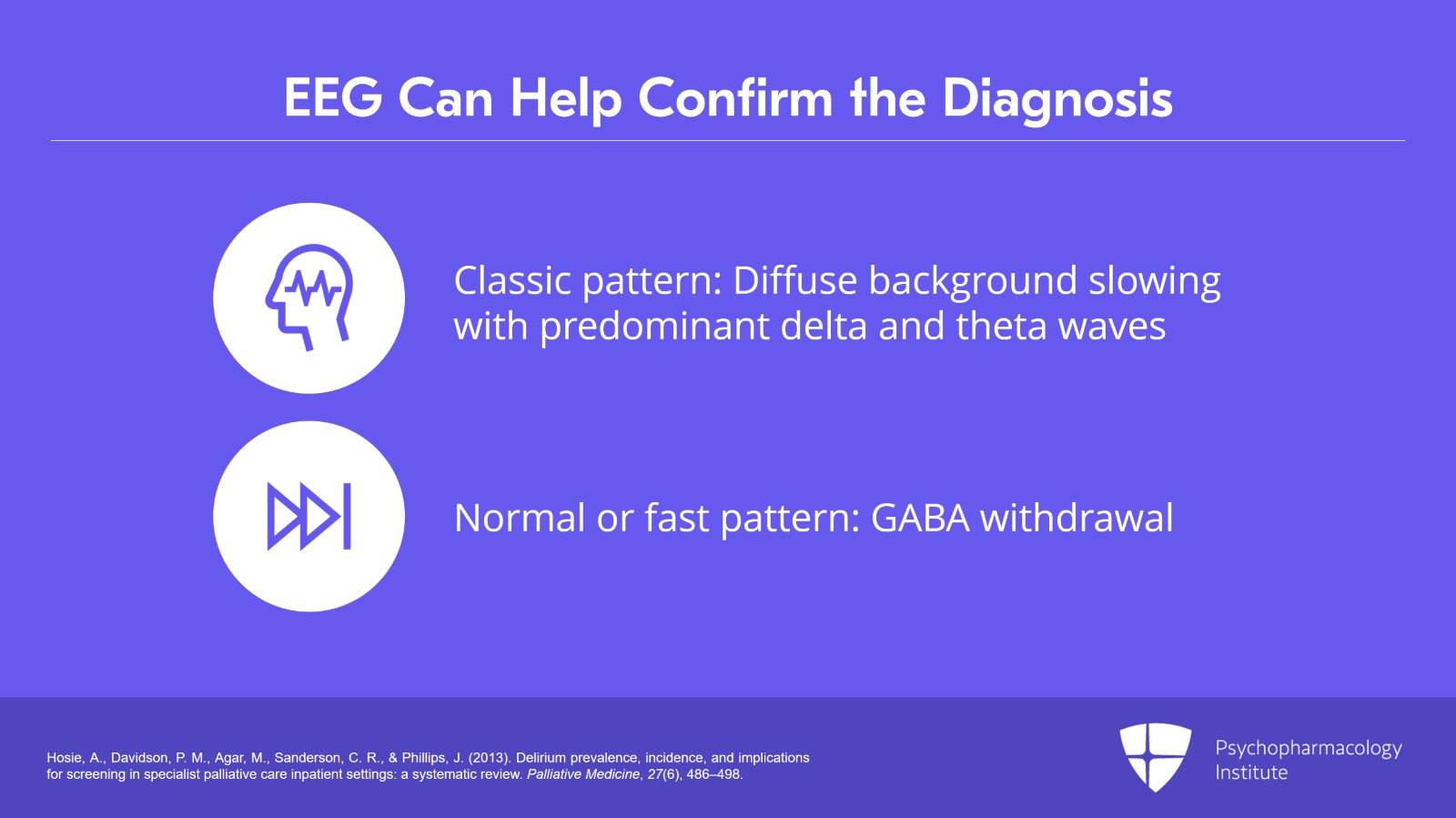
If you're really unsure about whether somebody is delirious, an electroencephalogram can help confirm the diagnosis. The classic EEG pattern in delirium is one of diffuse background slowing, so showing predominantly delta, theta waves. Importantly, the EEG will actually be normal or even fast if the delirium is due to GABA withdrawal like in the case of alcohol or benzodiazepine withdrawal but that is the only cause of delirium that will give you a different EEG pattern than the typical diffuse background slowing. 
References:
  • Hosie, A., Davidson, P. M., Agar, M., Sanderson, C. R., & Phillips, J. (2013). Delirium prevalence, incidence, and implications for screening in specialist palliative care inpatient settings: a systematic review. Palliative Medicine, 27(6), 486–498.

Slide 4 of 15

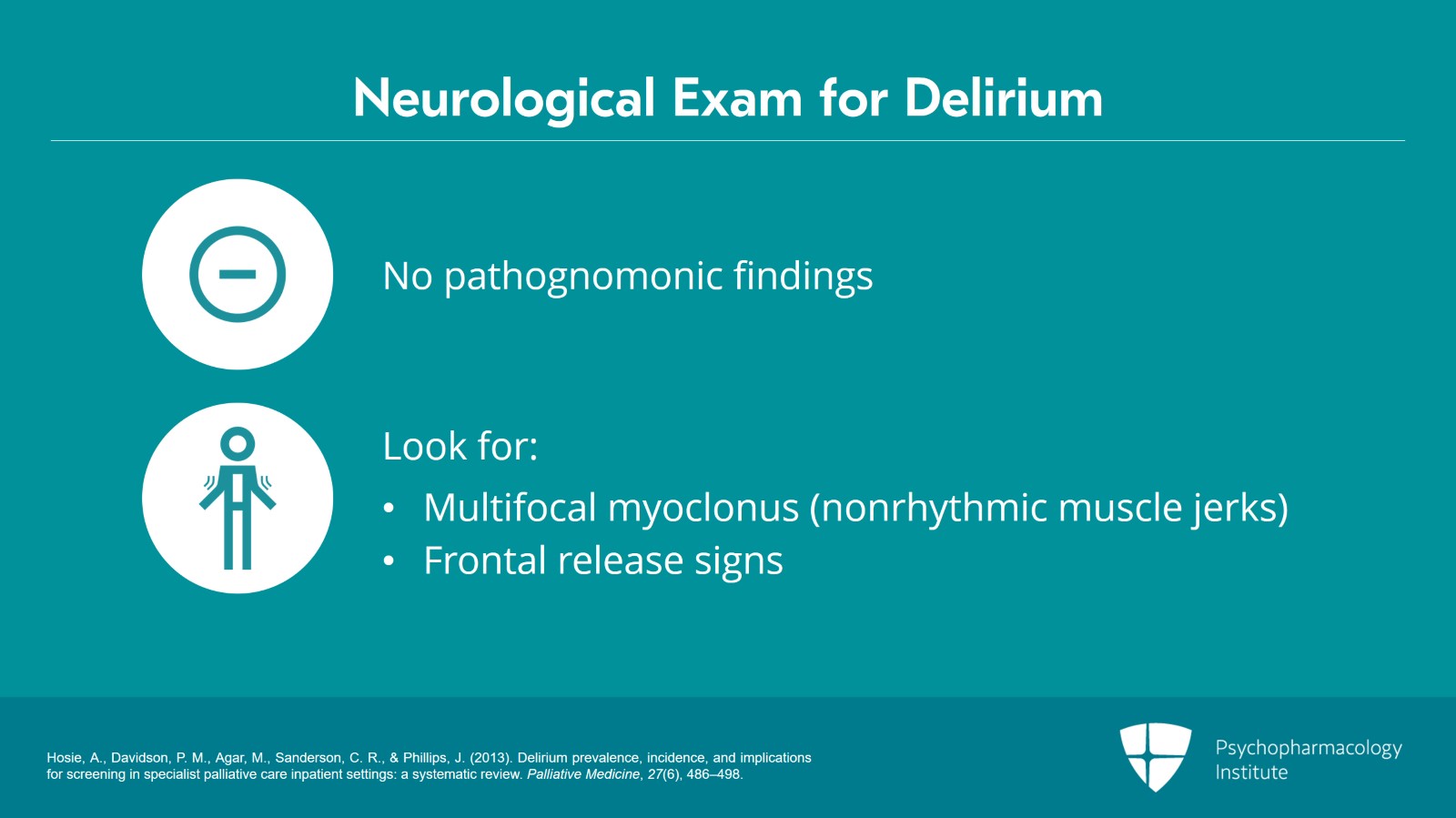
A neurological exam is an important component of the workup for delirium. There are no findings that are pathognomonic but several findings are suggestive of global brain dysfunction. It's been said that a multifocal myoclonus is perhaps the most common neurological feature in delirious patients. So you should be on the lookout for patients displaying nonrhythmic muscle jerks or muscle twitches distributed throughout various muscle groups. Remember too that frontal release signs may return in patients who are delirious likely due to involvement of the frontal lobes. These frontal release signs can include things like the Babinski or the grasp reflex but you may also test for other frontal release signs like the glabellar sign or the palmomental reflex.
References:
  • Hosie, A., Davidson, P. M., Agar, M., Sanderson, C. R., & Phillips, J. (2013). Delirium prevalence, incidence, and implications for screening in specialist palliative care inpatient settings: a systematic review. Palliative Medicine, 27(6), 486–498.
Free Files
Success!
Check your inbox, we sent you all the materials there.
Slide 5 of 15

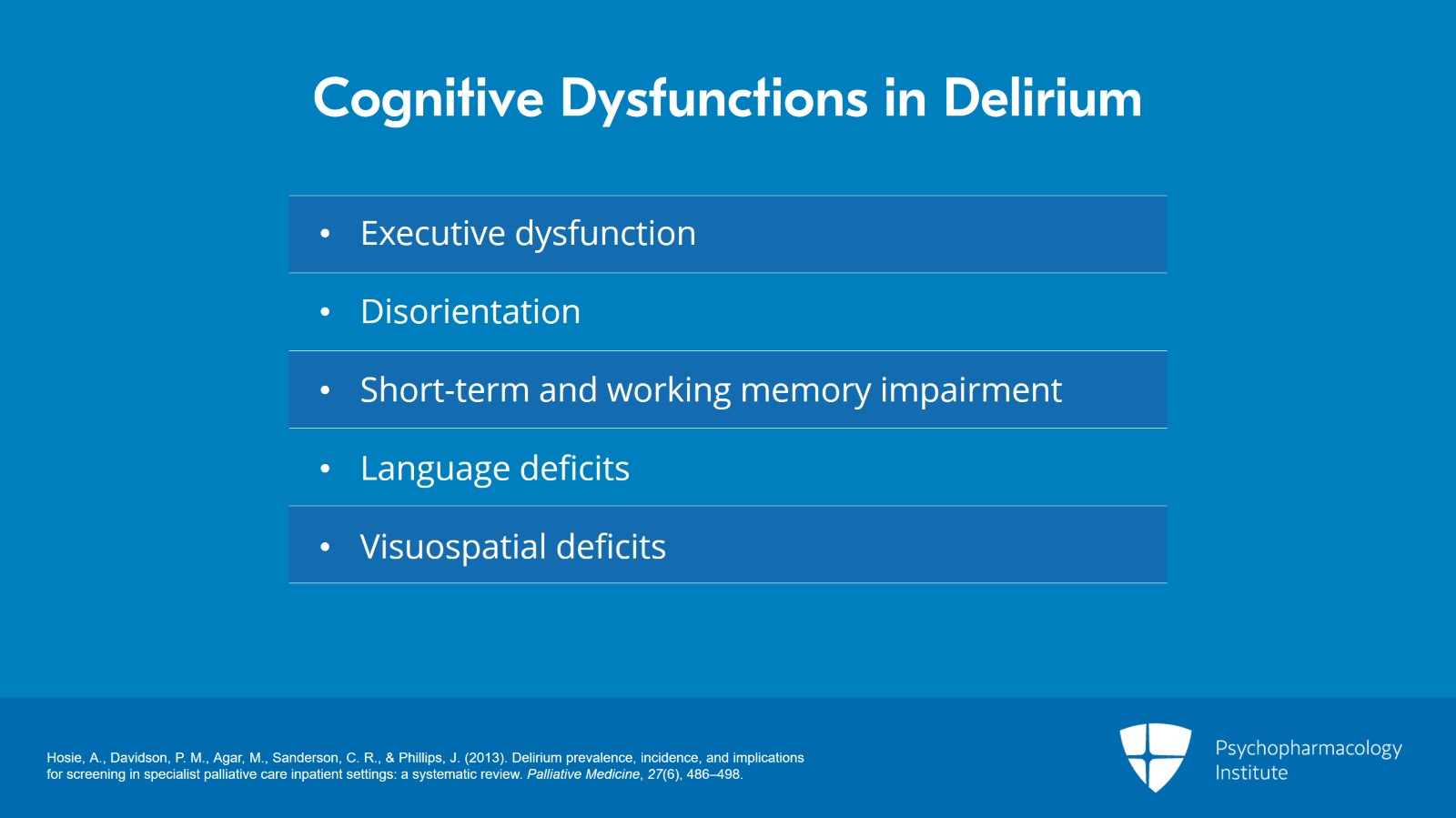
The cognitive exam is a really important part of any workup for delirium. Of all the different cognitive dysfunctions that may be present in delirium, executive dysfunction is the most common manifestation. This again has to do with the fact that delirium has a predilection for the frontal lobes. Disorientation is also common but it's really important to keep in mind that some delirious patients will be intermittently oriented and a small minority may actually remain oriented throughout the course. So intact orientation does not rule out delirium. Short-term and working memory are often impaired, whereas long-term memory is generally intact. Language deficits can be present in delirium and may include word finding difficulties and paraphasic errors. Visuospatial deficits, however, are pretty uncommon in delirium.
References:
  • Hosie, A., Davidson, P. M., Agar, M., Sanderson, C. R., & Phillips, J. (2013). Delirium prevalence, incidence, and implications for screening in specialist palliative care inpatient settings: a systematic review. Palliative Medicine, 27(6), 486–498.

Slide 6 of 15

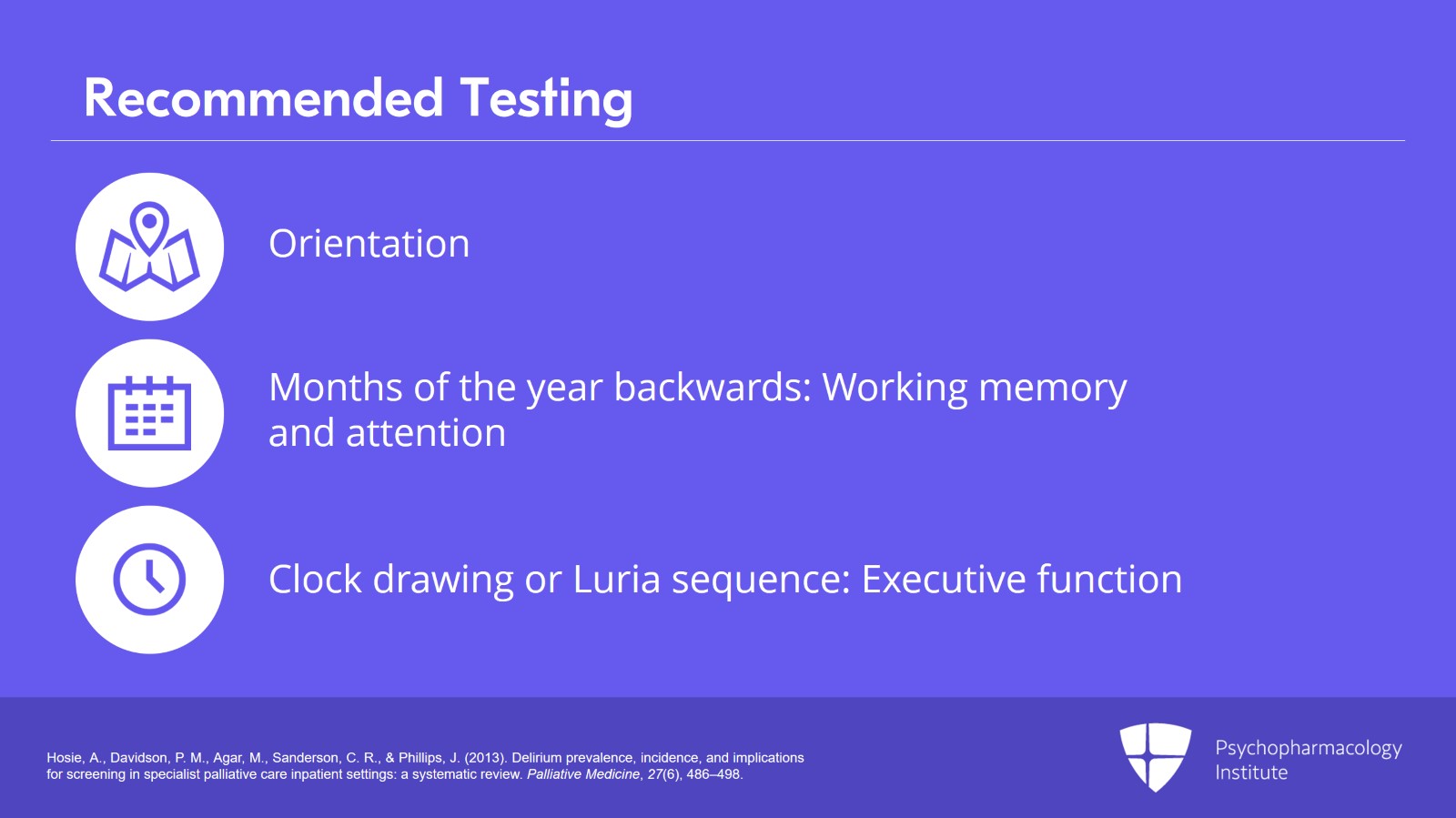
Recommended testing for delirium includes starting with orientation but also including months of the year backwards as a test of working memory, attention and set as well as either the clock draw or the Luria sequence, both of which are great tests of executive function and allow for serial exams. Though we have standardized cognitive tests like the Montreal Cognitive Assessment tool, the MoCA, or the Mini Mental State Exam, it's important to keep in mind that many delirious patients will not attend to a 30-point questionnaire.  
References:
  • Hosie, A., Davidson, P. M., Agar, M., Sanderson, C. R., & Phillips, J. (2013). Delirium prevalence, incidence, and implications for screening in specialist palliative care inpatient settings: a systematic review. Palliative Medicine, 27(6), 486–498.
Free Files
Success!
Check your inbox, we sent you all the materials there.
Slide 7 of 15

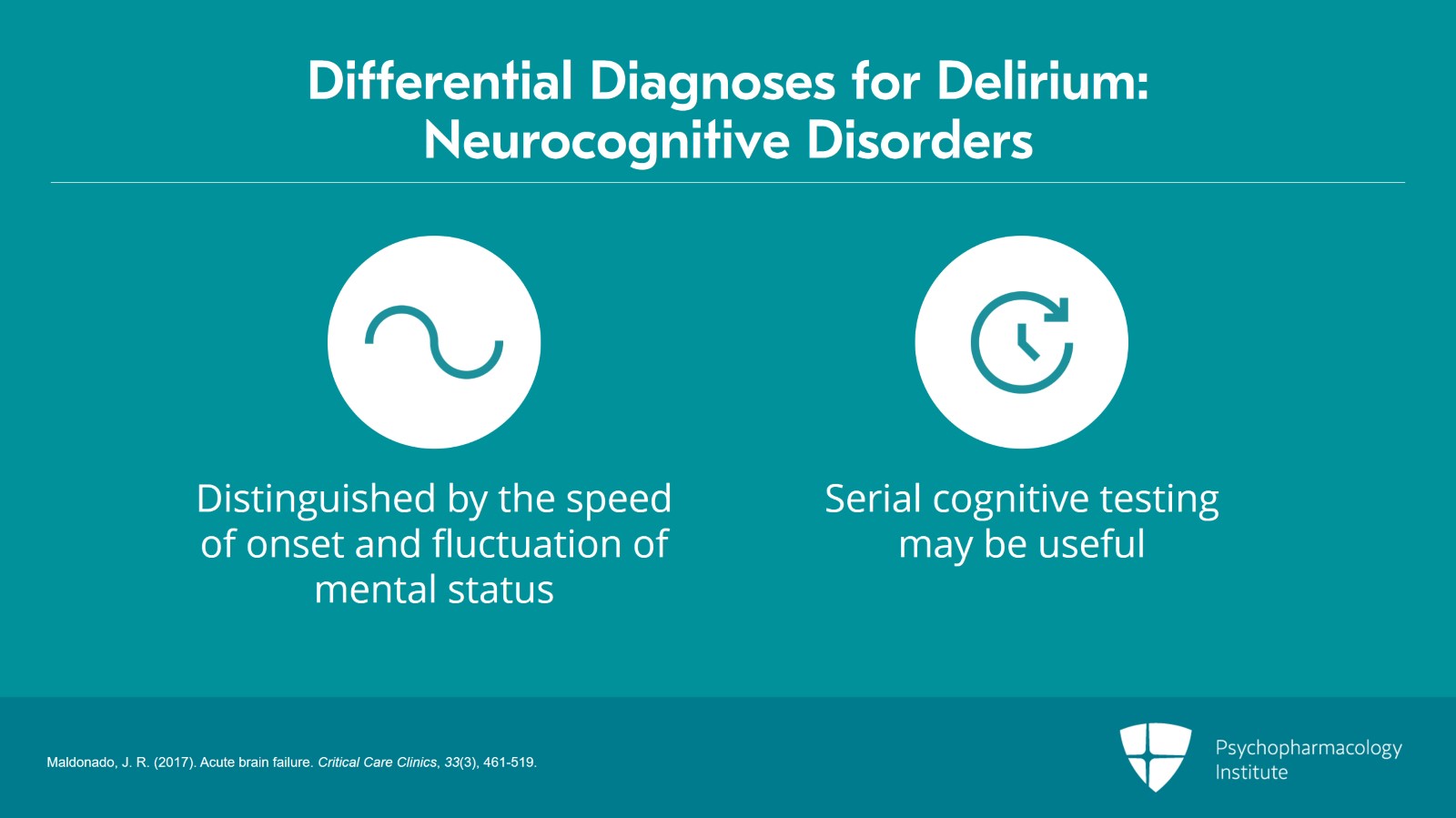
Among other entities on the differential diagnoses for delirium, first and foremost, it's important to rule out other neurocognitive disorders like dementia and traumatic brain injury. These can often be distinguished by paying attention to their speed of onset and the fluctuation of the mental status throughout the day. If somebody has a relatively rapid onset of mental status changes, dementia is an unlikely diagnosis. Serial cognitive testing may also be useful. The clock draw done once may not help you distinguish delirium from dementia but done several times a day over the course of several days is likely to help make that distinction.  
References:
  • Maldonado, J. R. (2017). Acute brain failure. Critical Care Clinics, 33(3), 461-519.

Slide 8 of 15

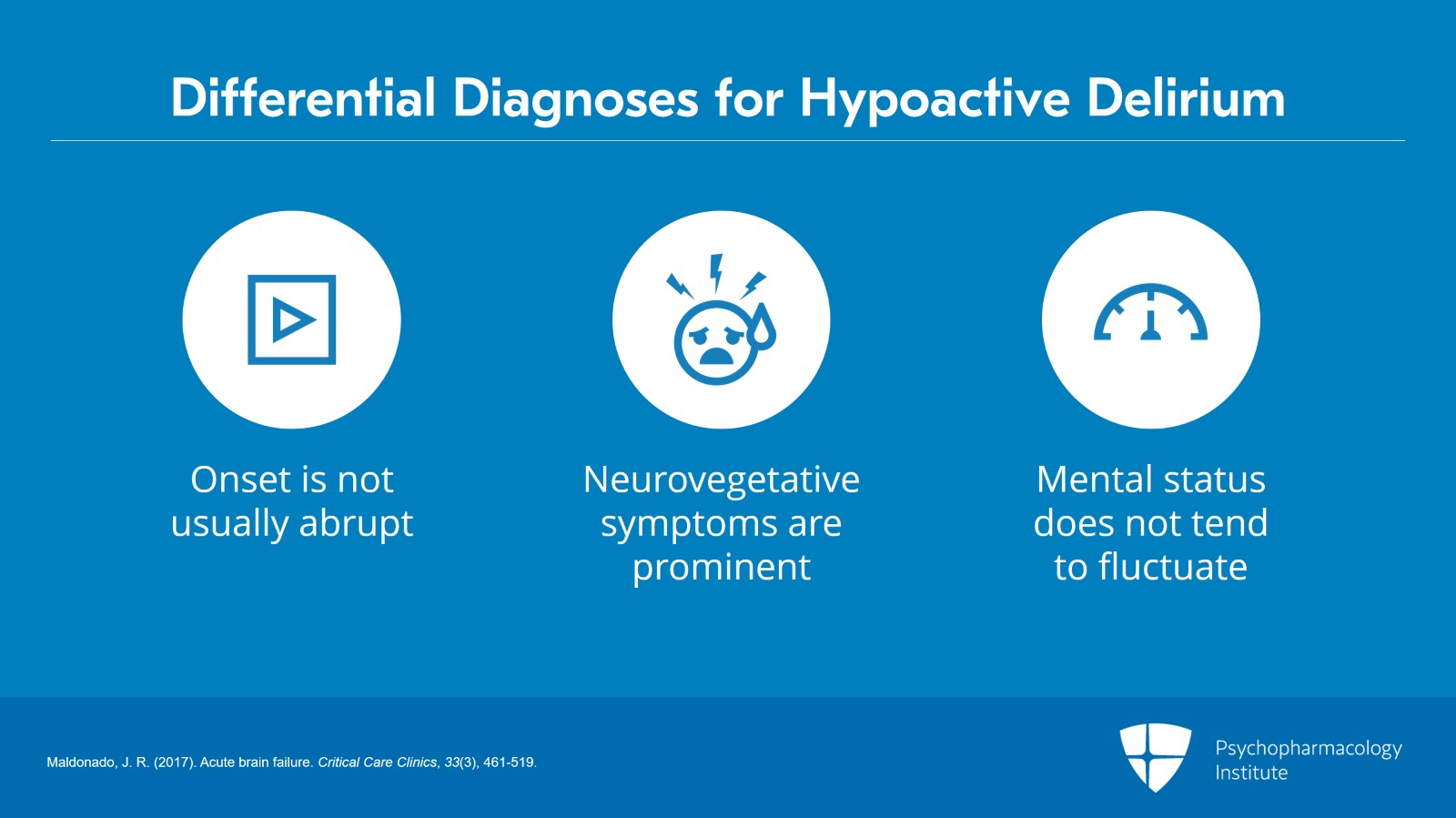
Another key thing on the differential diagnoses is depression and demoralization particularly if the delirium is of the hypoactive variety. While depression may cause pseudodementia in rare cases, the onset is not usually abrupt. Other neurovegetative symptoms are typically prominent and the mental status does not tend to fluctuate.  
References:
  • Maldonado, J. R. (2017). Acute brain failure. Critical Care Clinics, 33(3), 461-519.
Free Files
Success!
Check your inbox, we sent you all the materials there.
Slide 9 of 15

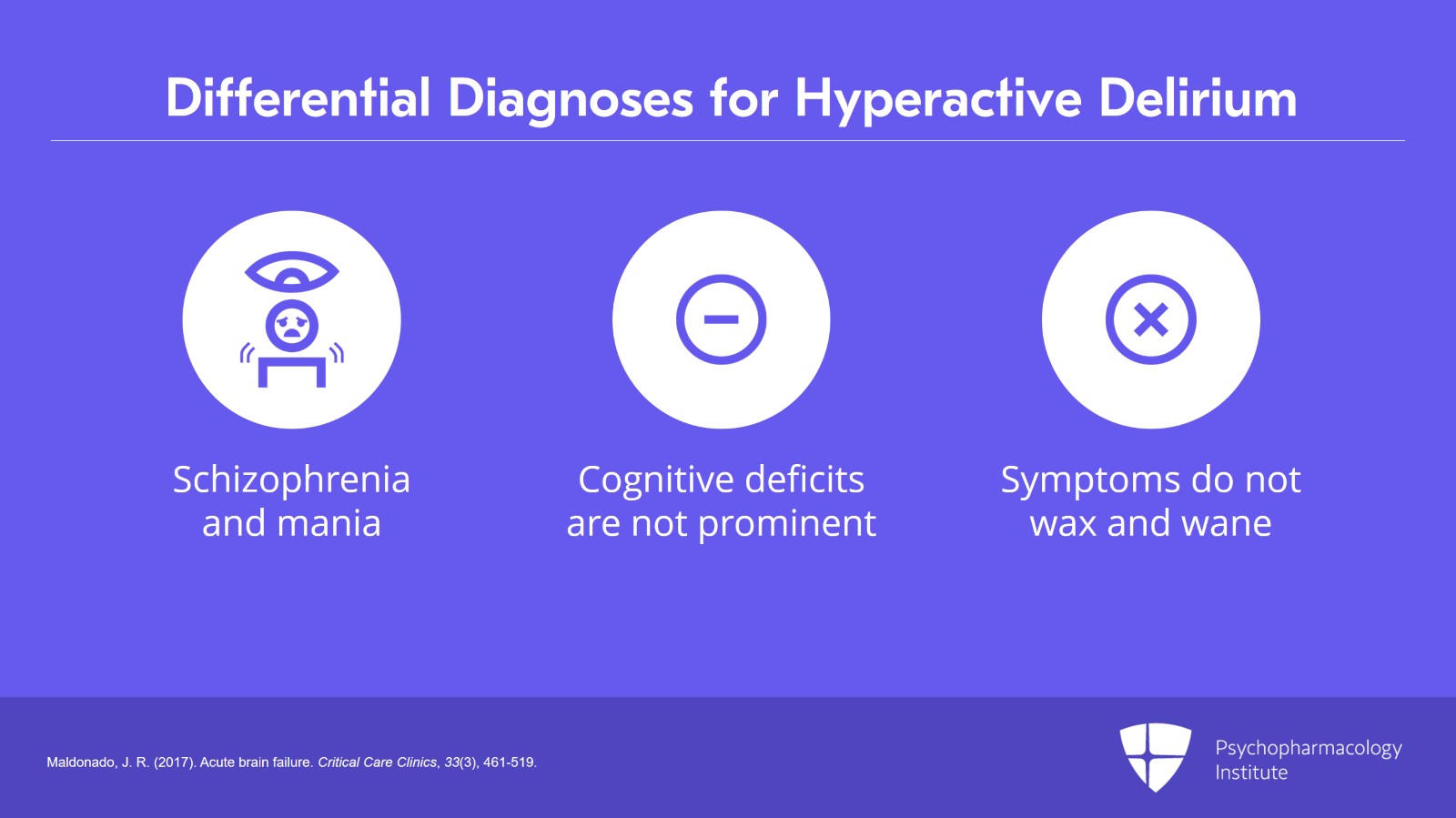
Patients with a hyperactive delirium may look like patients with mania or schizophrenia due to their agitation and their perceptual disturbances. However, keep in mind that cognitive deficits are not typically prominent in mania or schizophrenia. And again, the symptoms do not wax and wane over the course of the day.  
References:
  • Maldonado, J. R. (2017). Acute brain failure. Critical Care Clinics, 33(3), 461-519.

Slide 10 of 15

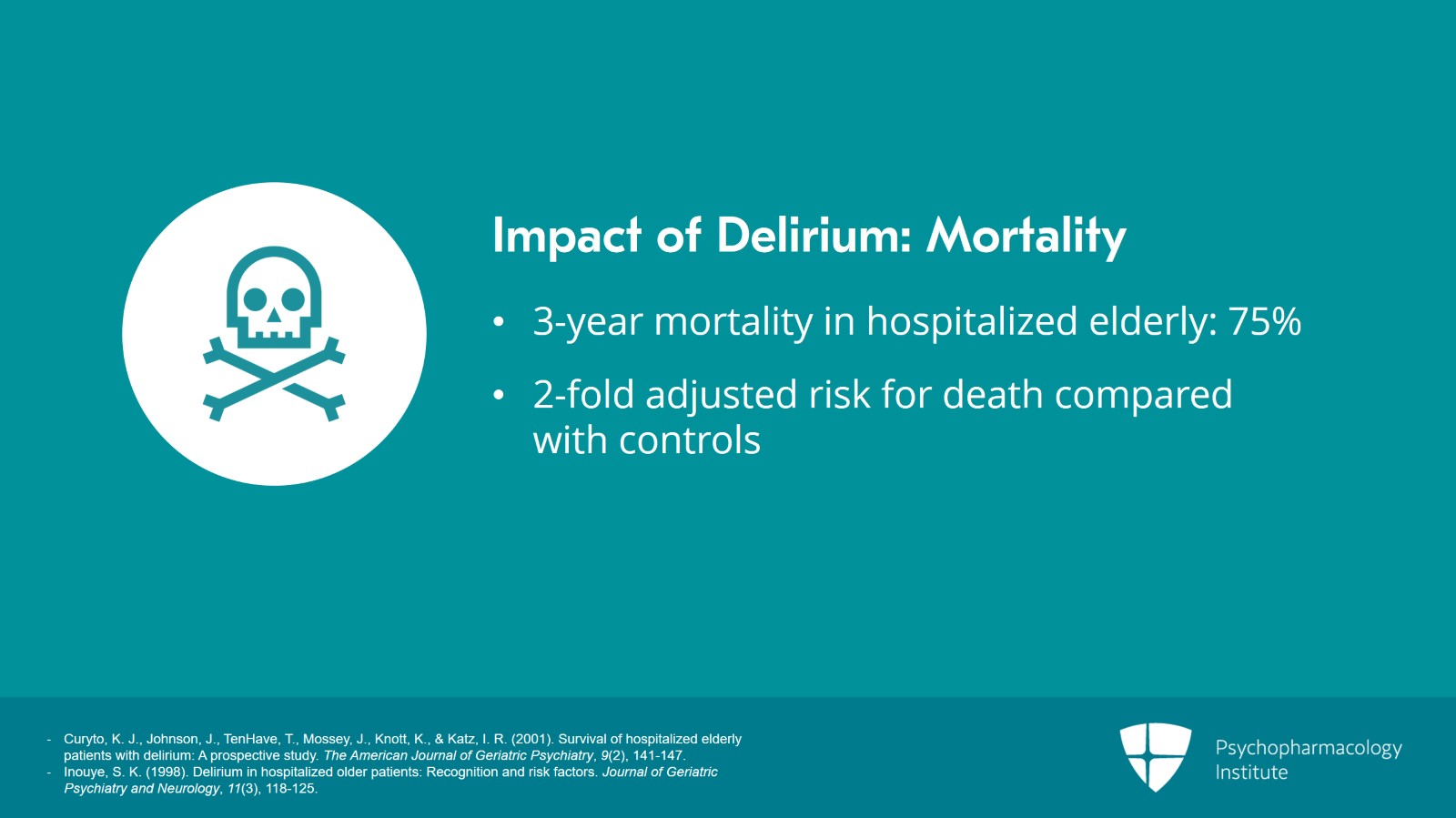
So why do we care so much about diagnosing delirium? Why is that important? Well, it turns out that delirium has significant consequences in terms of both morbidity and mortality. The three-year mortality for hospitalized elderly patients with an index episode of delirium is 75% as compared to 50% for nondelirious controls. And delirious patients may experience an adjusted risk of death of almost two-fold compared to nondelirious controls.
References:
  • Curyto, K. J., Johnson, J., TenHave, T., Mossey, J., Knott, K., & Katz, I. R. (2001). Survival of hospitalized elderly patients with delirium: A prospective study. The American Journal of Geriatric Psychiatry, 9(2), 141-147.
  • Inouye, S. K. (1998). Delirium in hospitalized older patients: Recognition and risk factors. Journal of Geriatric Psychiatry and Neurology, 11(3), 118-125.
Free Files
Success!
Check your inbox, we sent you all the materials there.
Slide 11 of 15

Increased morbidity is also prominent with patients displaying poor functional recovery and an increased risk of medical complications. Most importantly, delirious patients also have an increased risk of future cognitive decline which may occur in up to 40% of delirious patients and that includes an increased risk of dementia. Some patients never really recover from the delirium and basically develop dementia. Increased nursing home placement and increased length of stay is also a consequence of delirium.  
References:
  • Curyto, K. J., Johnson, J., TenHave, T., Mossey, J., Knott, K., & Katz, I. R. (2001). Survival of hospitalized elderly patients with delirium: A prospective study. The American Journal of Geriatric Psychiatry, 9(2), 141-147.
  • Inouye, S. K. (1998). Delirium in hospitalized older patients: Recognition and risk factors. Journal of Geriatric Psychiatry and Neurology, 11(3), 118-125.

Slide 12 of 15

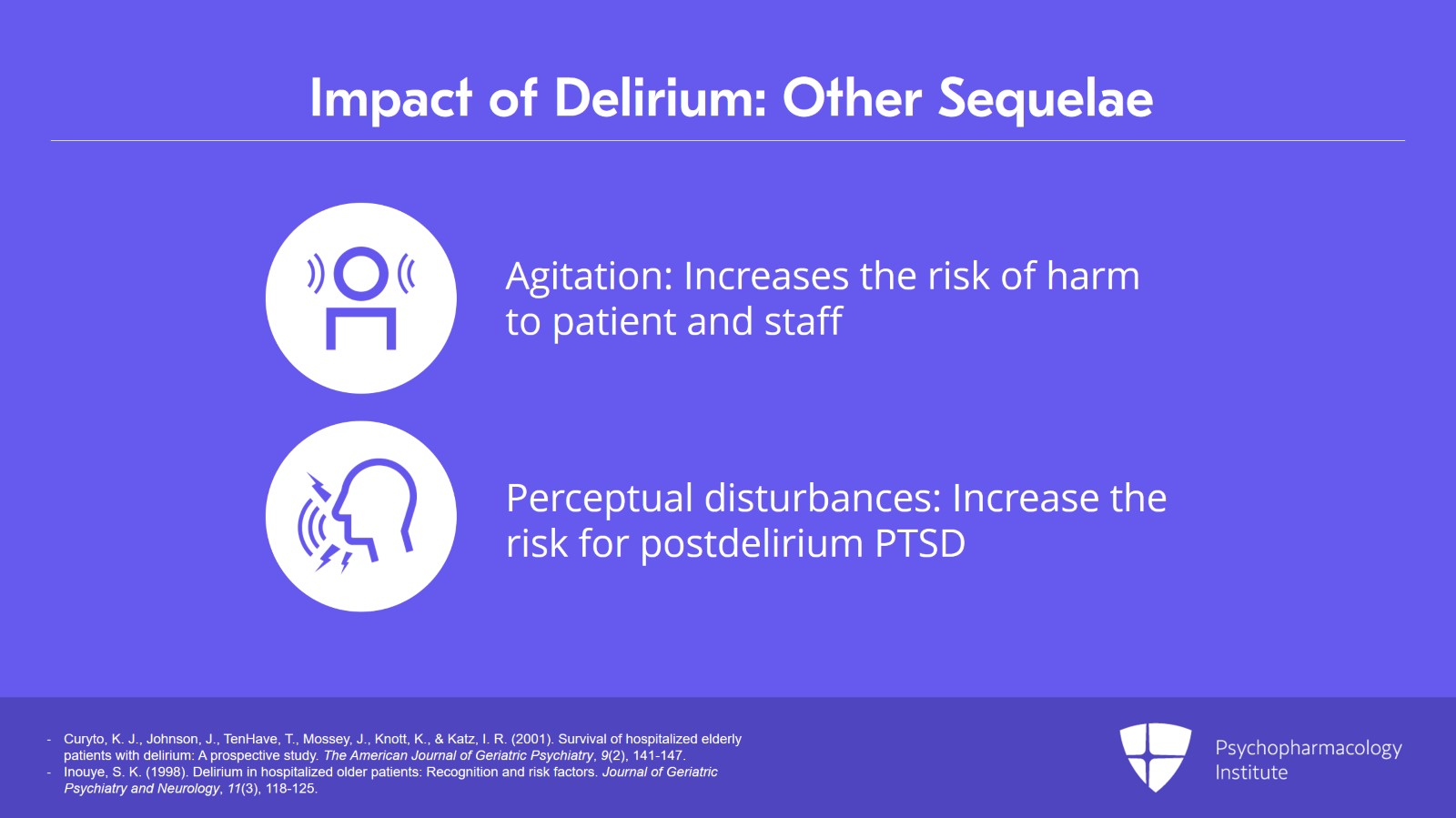
Furthermore, if there are many sequelae of delirium and this becomes particularly important when we think about the possibility of managing delirium with medications, we think often of agitation as a major sequela of delirium. Agitation increases the risk of harm to the patient and the staff. Patients may pull out IVs. They may rip at central lines. They may fall out of bed. And they may lug assaults on nursing staff and other hospital workers. Furthermore, patients with delirium are at risk for perceptual disturbances, things like hallucinations and delusions and those perceptual disturbances greatly increase the risk for post-delirium PTSD. This is now a well-described phenomenon which itself is probably very underdiagnosed but is incredibly distressing to patients who have suffered from an episode of delirium.  
References:
  • Curyto, K. J., Johnson, J., TenHave, T., Mossey, J., Knott, K., & Katz, I. R. (2001). Survival of hospitalized elderly patients with delirium: A prospective study. The American Journal of Geriatric Psychiatry, 9(2), 141-147.
  • Inouye, S. K. (1998). Delirium in hospitalized older patients: Recognition and risk factors. Journal of Geriatric Psychiatry and Neurology, 11(3), 118-125.
Free Files
Success!
Check your inbox, we sent you all the materials there.
Slide 13 of 15

So to wrap up this section. The consequences of delirium include increased mortality and morbidity. The sequelae of delirium include agitation and perceptual disturbances.

Slide 14 of 15

The differential diagnosis of delirium is broad and includes other neurocognitive disorders, depression, mania and schizophrenia. The diagnosis of delirium should be made at the bedside, relies primarily on history and course of illness and may also benefit from a good neurologic exam and cognitive testing.
Free Files
Success!
Check your inbox, we sent you all the materials there.
Slide 15 of 15

Visual Designer: Title has been changed.

Learning Objectives:

After completing this activity, the learner will be able to:

  1. Identify and assess different symptoms and presentations of delirium
  2. Summarize research on medications with evidence for the prevention and management of delirium
  3. Discuss special considerations in delirium, such as catatonia and COVID-19 delirium

Original Release Date: 05/01/2021

Review and Re-release Date: 03/01/2024

Expiration Date: 04/01/2025

Expert: Scott Beach, M.D.

Medical Editor: Melissa Mariano, M.D

Relevant Financial Disclosures:

None of the faculty, planners, and reviewers for this educational activity have relevant financial relationship(s) to disclose during the last 24 months with ineligible companies whose primary business is producing, marketing, selling, re-selling, or distributing healthcare products used by or on patients.

Contact Information: For questions regarding the content or access to this activity, contact us at support@psychopharmacologyinstitute.com

Instructions for Participation and Credit:

Participants must complete the activity online during the valid credit period that is noted above.

Follow these steps to earn CME credit:

  1. View the required educational content provided on this course page.
  2. Complete the Post Activity Evaluation for providing the necessary feedback for continuing accreditation purposes and for the development of future activities. NOTE: Completing the Post Activity Evaluation after the quiz is required to receive the earned credit.
  3. Download your certificate.

Accreditation Statement

This activity has been planned and implemented in accordance with the accreditation requirements and policies of the Accreditation Council for Continuing Medical Education through the joint providership of Medical Academy LLC and the Psychopharmacology Institute. Medical Academy is accredited by the ACCME to provide continuing medical education for physicians.

Credit Designation Statement

Medical Academy designates this enduring activity for a maximum of 1.00 AMA PRA Category 1 credit(s). Physicians should claim only the credit commensurate with the extent of their participation in the activity.

Free Files
Success!
Check your inbox, we sent you all the materials there.
Continue in the website
Instant access modal

Become a Bronze, Silver, Gold, Bronze extended, Silver extended or Gold extended Member.

2025–26 Psychopharmacology CME Program

Unlock up to 155 CME Credits, including 40 SA CME Credits.