Slides and Transcript
Slide 1 of 20
This is video 4 of the Algorithm for the Psychopharmacology of Acute Mania or Severe Hypomania.
Slide 2 of 20
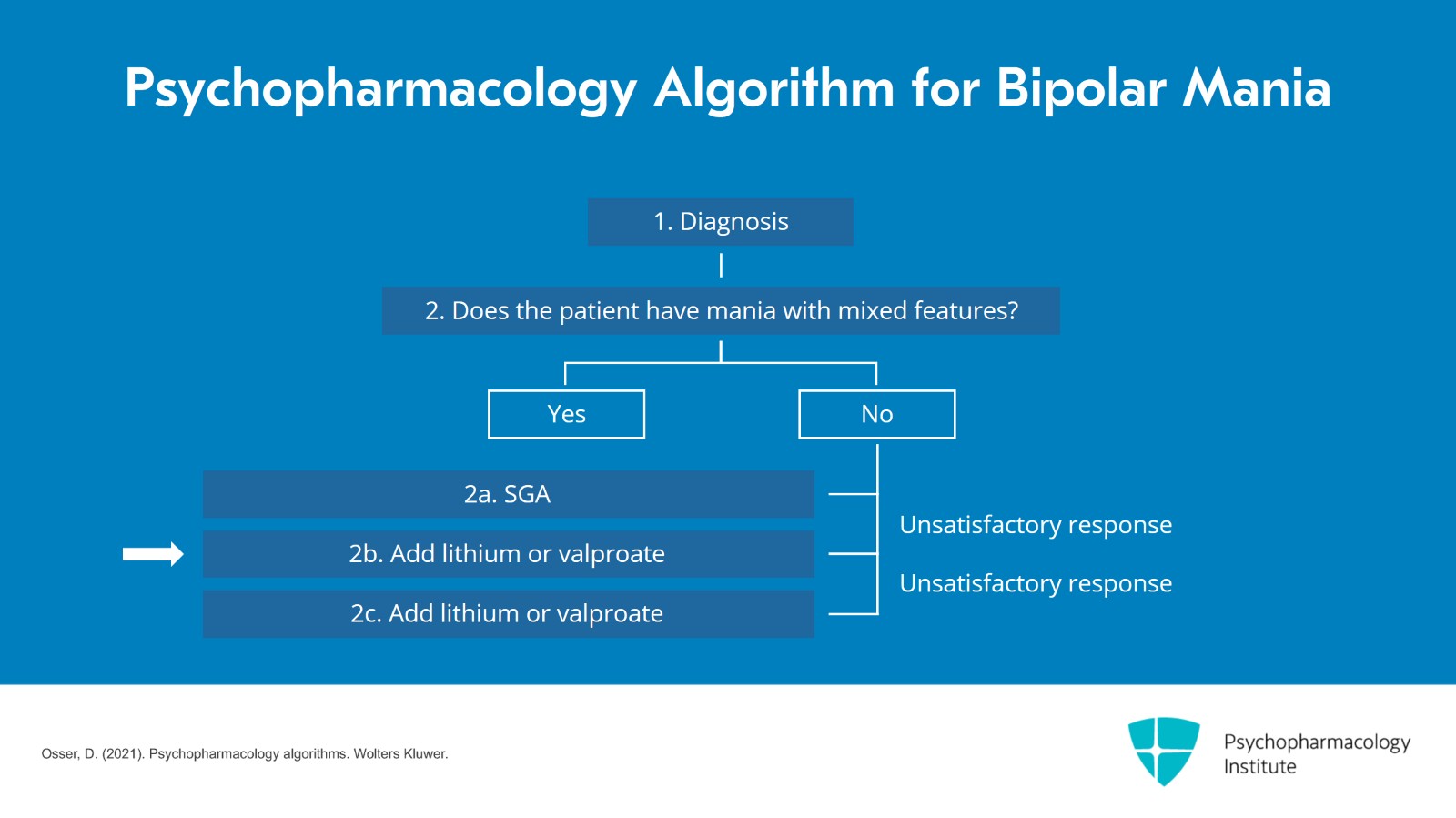
We've reached the point in the algorithm where you have tried your first treatment for acute mania with mixed features. And what if the response to the chosen treatment which was quetiapine was our number one choice, what if the response was unsatisfactory over the next days or week or so of this effort with that second-generation antipsychotic? Then our recommendation is to add lithium or valproate to your SGA.
References:
- Osser, D. (2021). Psychopharmacology algorithms. Wolters Kluwer.
Free Files
Download PDF and other files
Success!
Check your inbox, we sent you all the materials there.
Slide 3 of 20
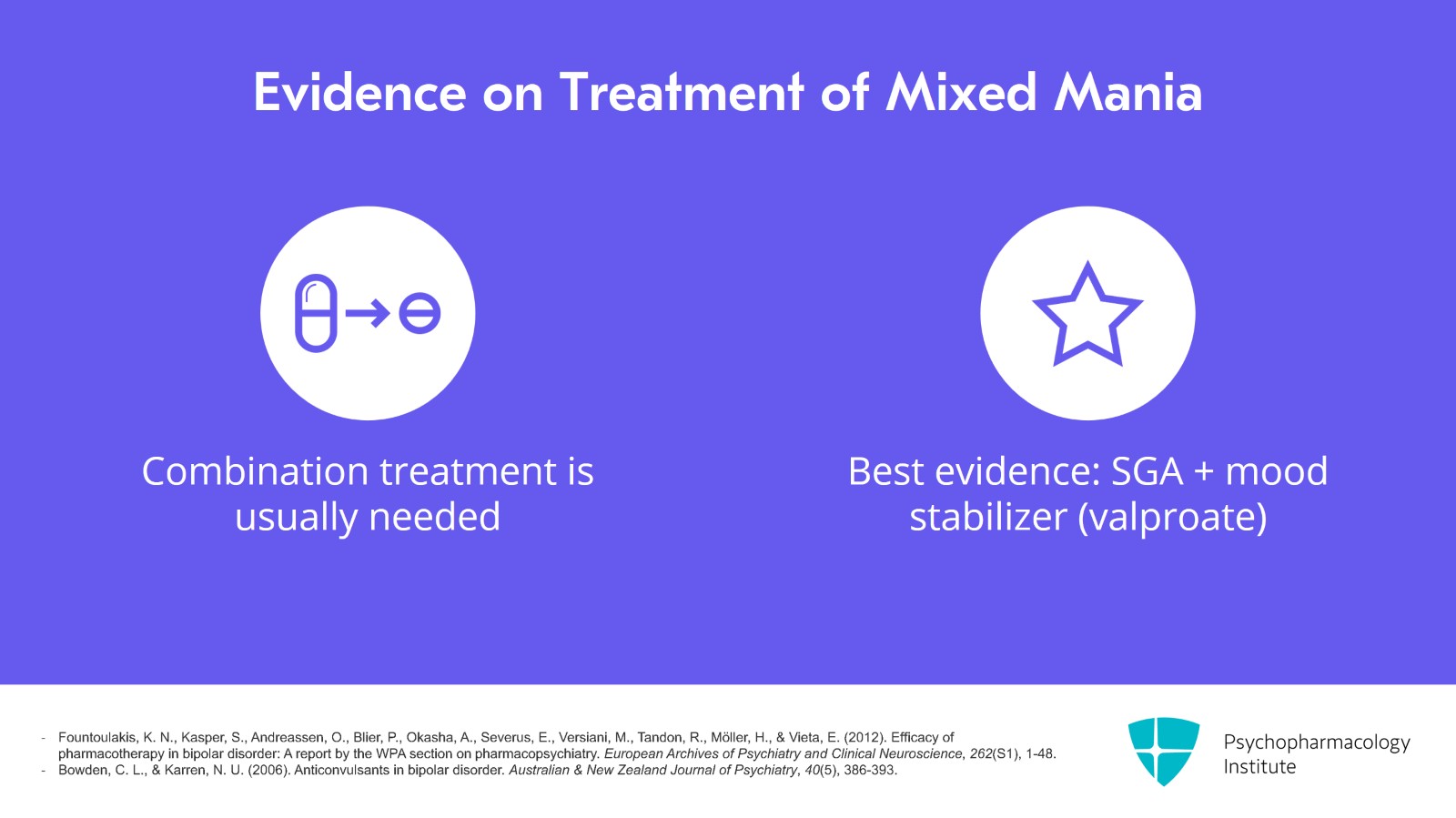
The evidence says that combination treatment is usually needed in mixed mania with an SGA plus a mood stabilizer having the best evidence. Probably, the overall best evidence that, in terms of quantity of evidence is to add valproate.
References:
- Fountoulakis, K. N., Kasper, S., Andreassen, O., Blier, P., Okasha, A., Severus, E., Versiani, M., Tandon, R., Möller, H., & Vieta, E. (2012). Efficacy of pharmacotherapy in bipolar disorder: A report by the WPA section on pharmacopsychiatry. European Archives of Psychiatry and Clinical Neuroscience, 262(S1), 1-48.
- Bowden, C. L., & Karren, N. U. (2006). Anticonvulsants in bipolar disorder. Australian & New Zealand Journal of Psychiatry, 40(5), 386-393.
Slide 4 of 20
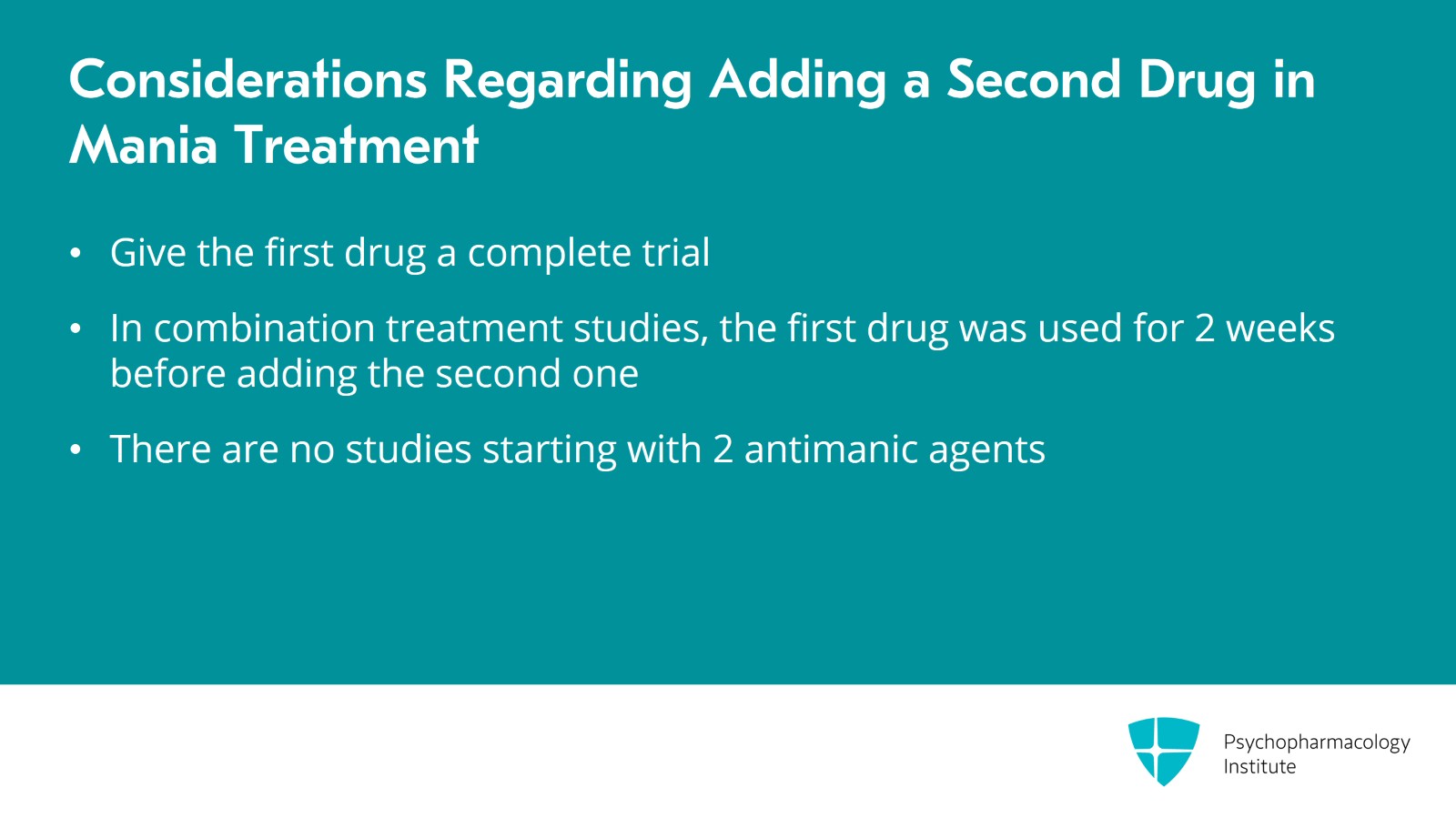
Now, we should caution you to give the first drug you gave a good trial if you can before adding the second one. And this is because all of these positive studies of combination treatment, all had as their design to have the patient have a two-week trial on the first drug and have an unsatisfactory response after two weeks. That was in all of the add-on studies. There are essentially no studies of starting with a combination of two antimanic agents versus starting with one. No one studied that. Everybody studies two weeks on something and if the response is unsatisfactory add a second one.
Free Files
Download PDF and other files
Success!
Check your inbox, we sent you all the materials there.
Slide 5 of 20
And many people do well on that first treatment and therefore they don't even enter into the study where the second drug is added versus adding a placebo.
References:
- Osser, D. (2021). Psychopharmacology algorithms. Wolters Kluwer.
Slide 6 of 20
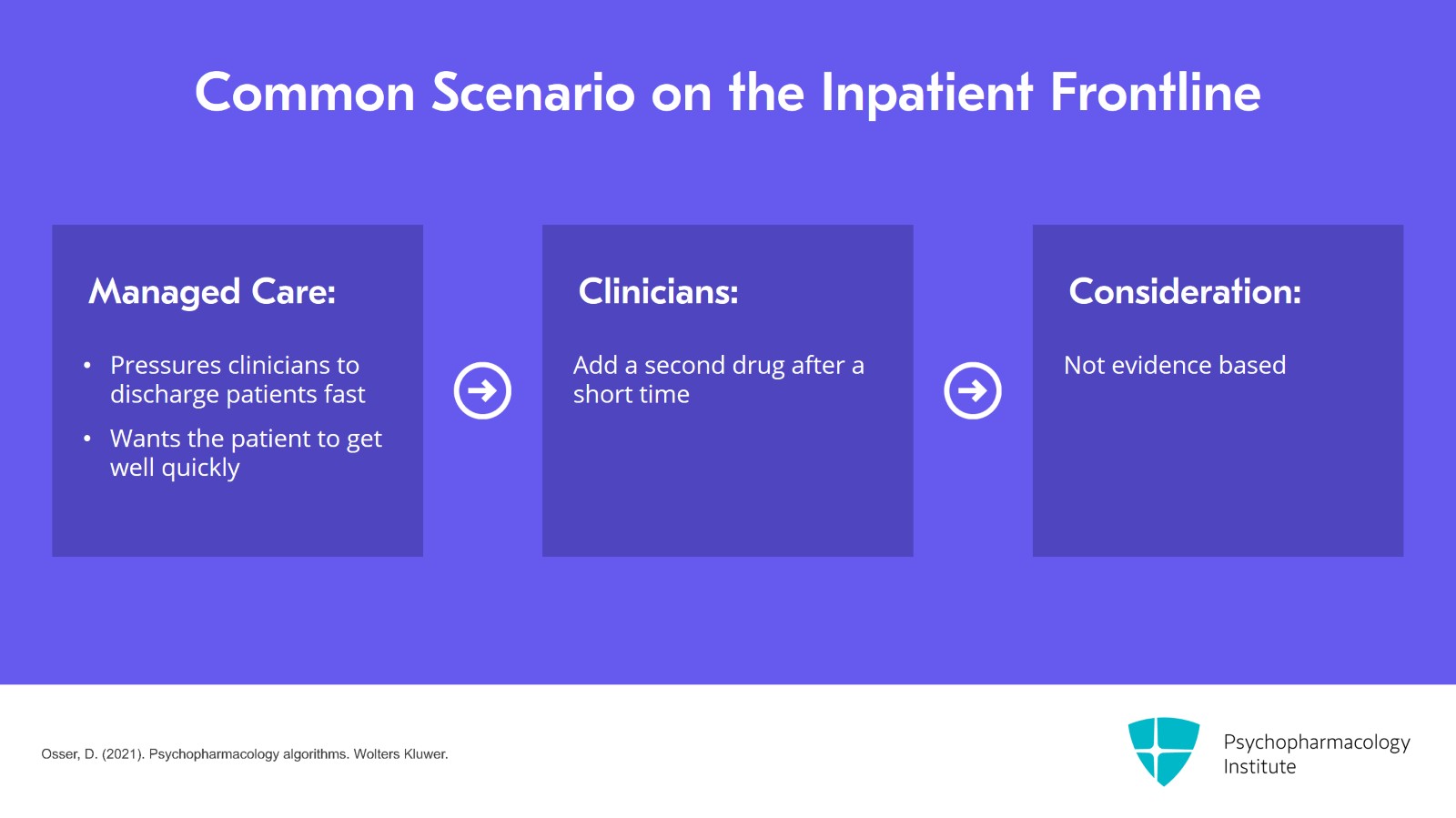
So you on the inpatient frontlines are confronted with the situation where you start one drug but you need to get this patient out fast, right? Managed care is on your back. They're not going to give you more days if you don't get the patient well quickly. And you have had the patient in for one day, two days, three days. They're still fairly manic. The managed care people want you to do something. So you will add a second drug after a short time, if not, immediately. This is not an evidence-based practice.
References:
- Osser, D. (2021). Psychopharmacology algorithms. Wolters Kluwer.
Free Files
Download PDF and other files
Success!
Check your inbox, we sent you all the materials there.
Slide 7 of 20
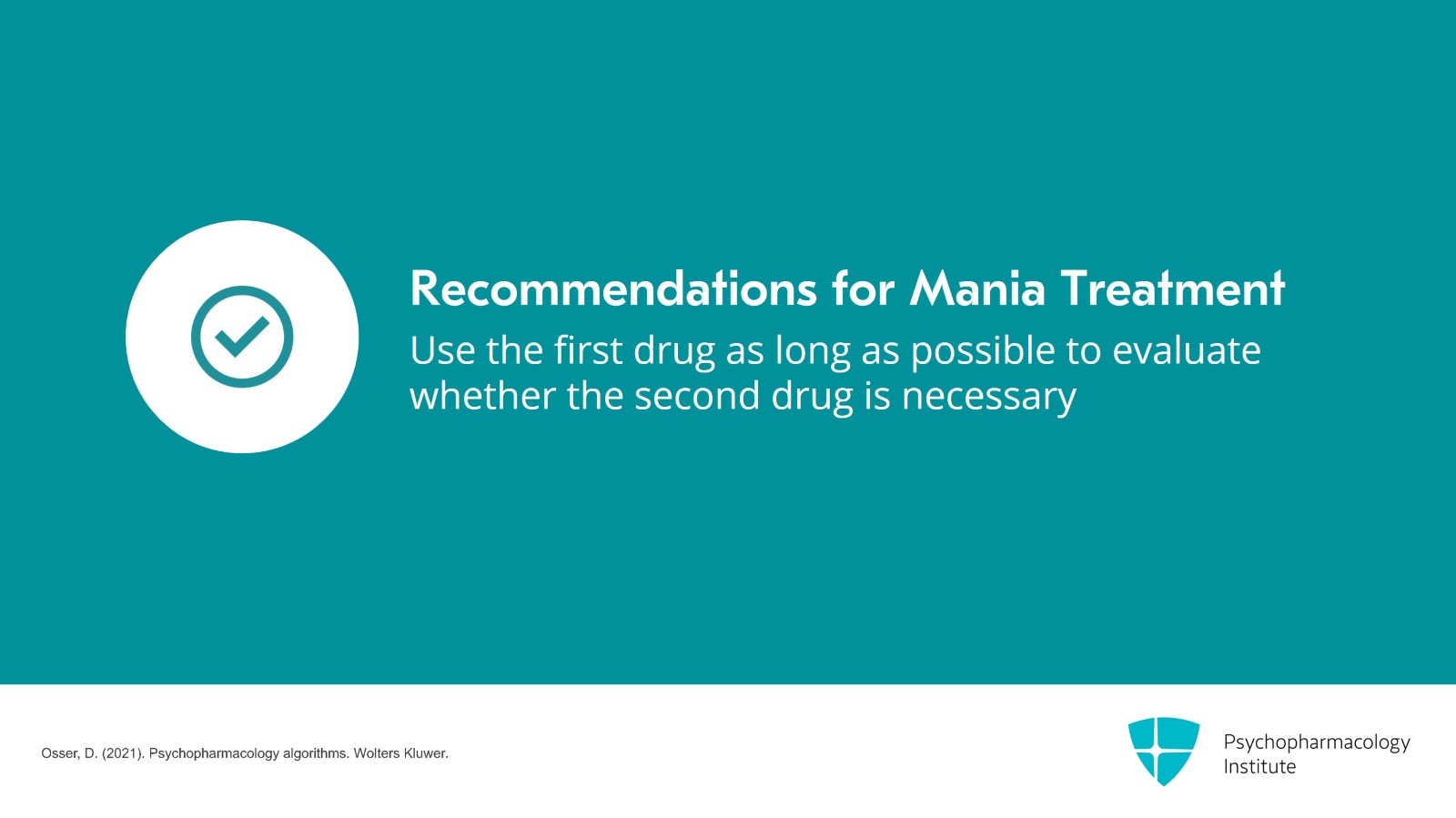
We think you should try to have that first drug be in there as long as possible so you can see if you can avoid adding that second drug with all of its additional side effects that it's going to give you. So that's our general advice about how to add this second drug. Wait as long as you can to be sure the first drug isn't going to work. It may well work and will work in many cases.
References:
- Osser, D. (2021). Psychopharmacology algorithms. Wolters Kluwer.7
Slide 8 of 20
Now, adding valproate or carbamazepine for women of childbearing potential though is not a great idea as we discussed. Valproate is X rated, causes severe high rate of fetal malformations. You hope to not have to keep any woman of childbearing potential on valproate. And carbamazepine is almost as bad. So see, particularly you want to avoid those.
References:
- Balon, R., & Riba, M. (2016). Should women of childbearing potential be prescribed Valproate? A call to action. The Journal of Clinical Psychiatry, 77(04), 525-526.
- Osser, D. (2021). Psychopharmacology algorithms. Wolters Kluwer.
Free Files
Download PDF and other files
Success!
Check your inbox, we sent you all the materials there.
Slide 9 of 20
Now, while you're waiting for this SGA to work though, you need to do something often at least for the patient's comfort, if not, to keep the managed care people off your back. So improvement in the first few days does occur. So you wonder, how does that happen? It's usually due to coming into the milieu, supportive people there, psychotherapy but also we often use sedative drugs, tranquilizer drugs in the early days to slow down the manic patient. And we urge you to be liberal about doing that rather than adding a second antimanic mood stabilizing agent like valproate or carbamazepine.
References:
- Osser, D. (2021). Psychopharmacology algorithms. Wolters Kluwer.
- Goodwin, F. K., & Jamison, K. R. (2007). Manic-depressive illness: Bipolar disorders and recurrent depression. Oxford University Press.
Slide 10 of 20
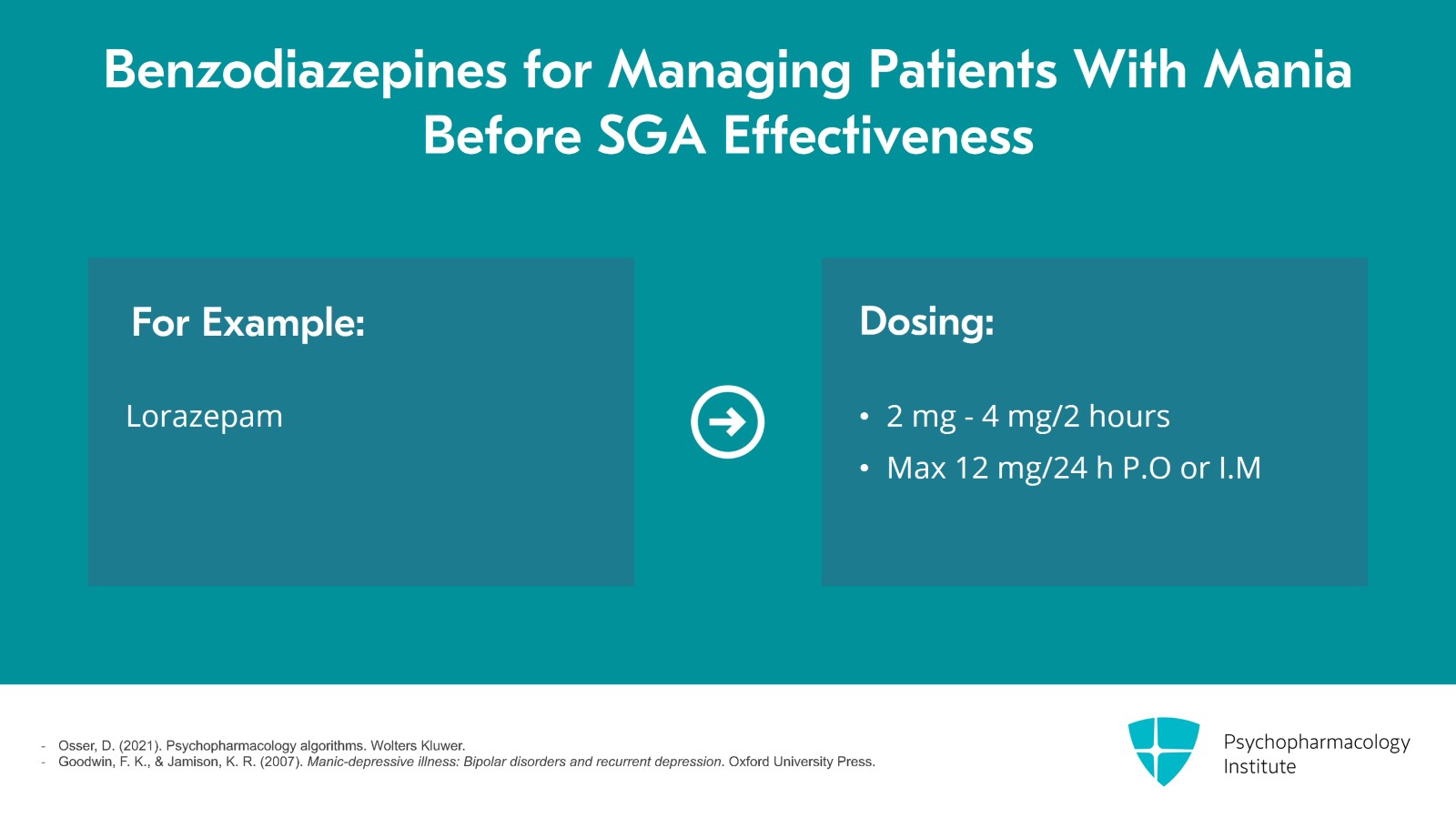
So benzodiazepines are your usual choice such as lorazepam 2 to 4 mg every two hours, maximum 12 mg in 24 hours which can be given p.o. or IM rather than adding unnecessary antimanics.
References:
- Osser, D. (2021). Psychopharmacology algorithms. Wolters Kluwer.
- Goodwin, F. K., & Jamison, K. R. (2007). Manic-depressive illness: Bipolar disorders and recurrent depression. Oxford University Press.
Free Files
Download PDF and other files
Success!
Check your inbox, we sent you all the materials there.
Slide 11 of 20
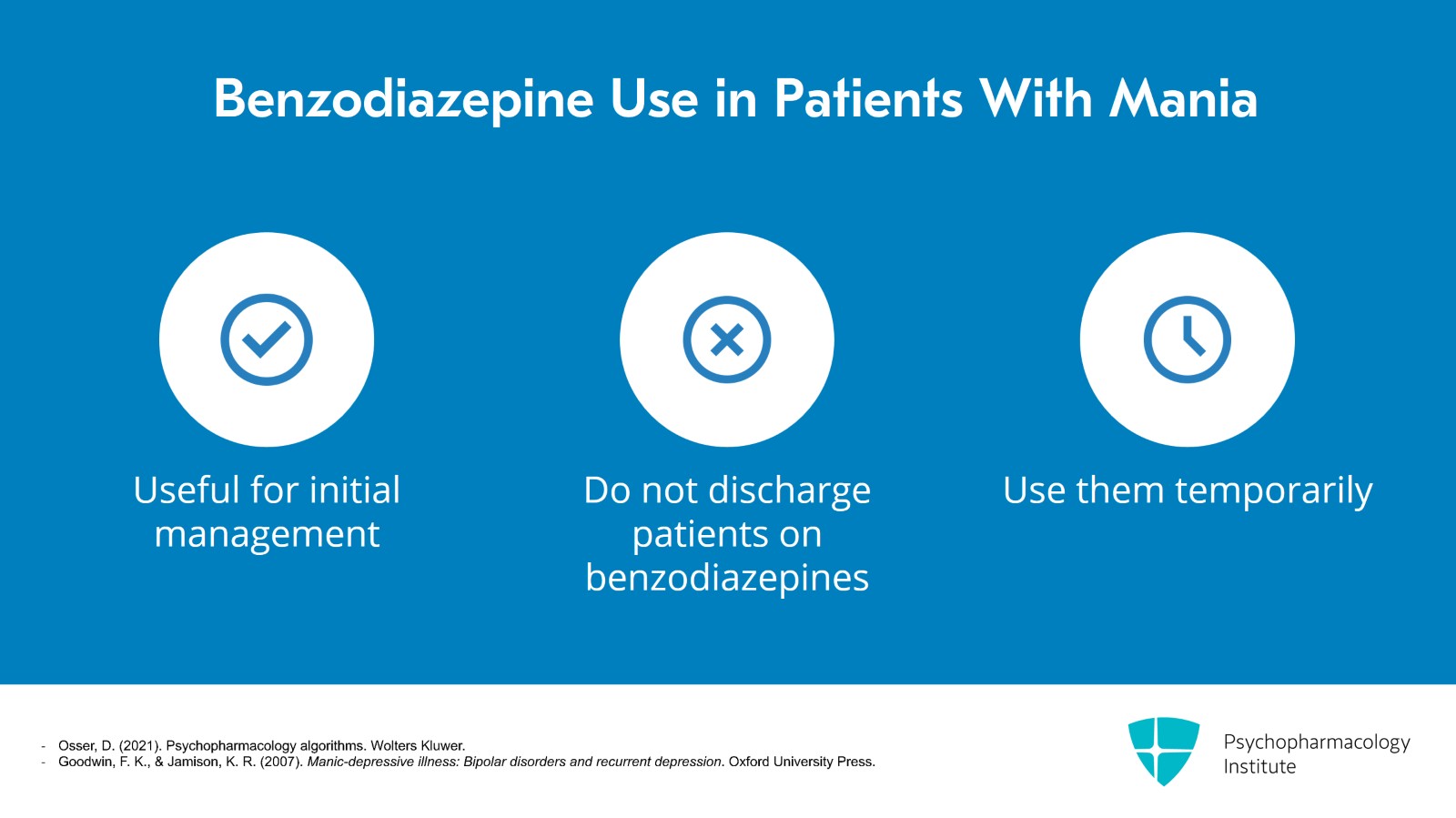
Now, benzodiazepines are not antimanic agents but they do significantly improve people in the short term, may even put them to sleep and often they wake up significantly less manic. But you don't want to discharge the patient on the benzodiazepine. You just want to use them temporarily to help the patient improve on the single antimanic agent so that they can be discharged on that rather than having to add a second one. So that's our general strategy for how to hold off on adding that second antimanic agent in the patient with mixed mania.
References:
- Osser, D. (2021). Psychopharmacology algorithms. Wolters Kluwer.
- Goodwin, F. K., & Jamison, K. R. (2007). Manic-depressive illness: Bipolar disorders and recurrent depression. Oxford University Press.
Slide 12 of 20
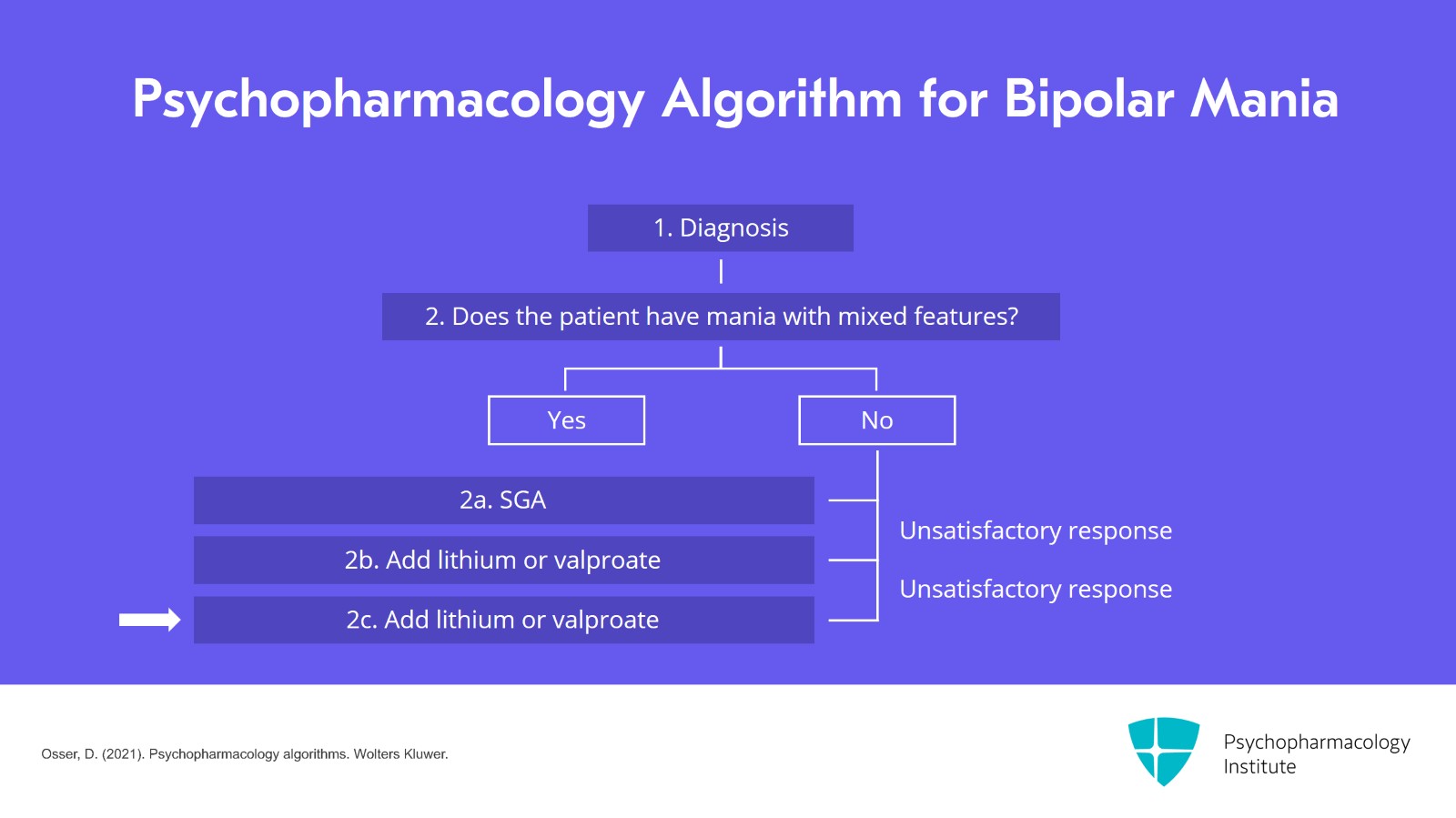
But admittedly, many of these mixed manic patients are going to need or seem to need two mood stabilizing agents and we have discussed valproate and also lithium is an option for the second drug to add. It's really not very effective overall but it can be helpful so this would be where you would consider adding it.
References:
- Osser, D. (2021). Psychopharmacology algorithms. Wolters Kluwer.
Free Files
Download PDF and other files
Success!
Check your inbox, we sent you all the materials there.
Slide 13 of 20
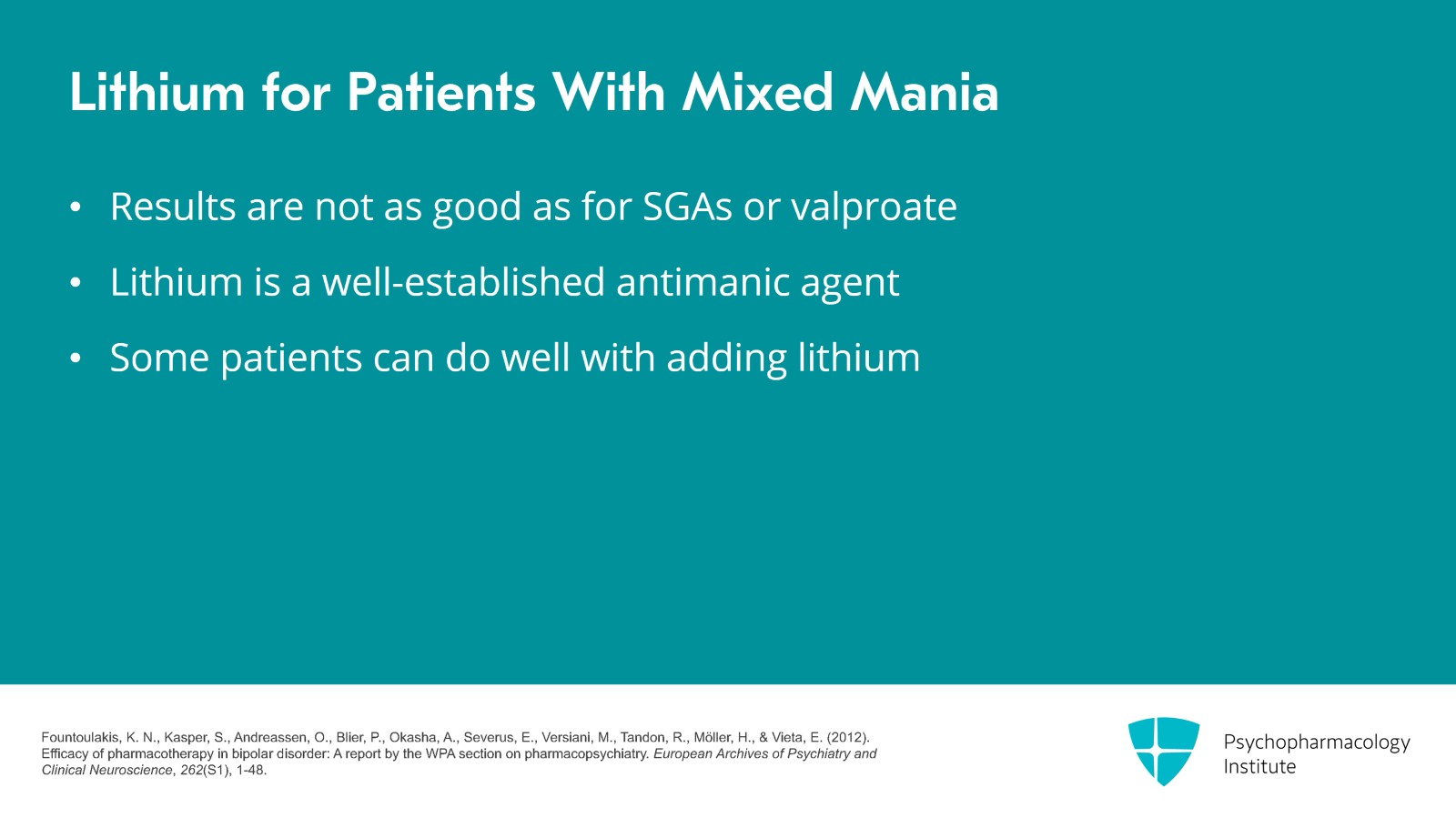
Results in lithium in the mixed cases are not as good as the SGAs or valproate but the data are sparse. And lithium is a well-established antimanic agent in general. So it may be that some of these people will do well with adding lithium especially if you don't want to use valproate or carbamazepine.
References:
- Fountoulakis, K. N., Kasper, S., Andreassen, O., Blier, P., Okasha, A., Severus, E., Versiani, M., Tandon, R., Möller, H., & Vieta, E. (2012). Efficacy of pharmacotherapy in bipolar disorder: A report by the WPA section on pharmacopsychiatry. European Archives of Psychiatry and Clinical Neuroscience, 262(S1), 1-48.
Slide 14 of 20
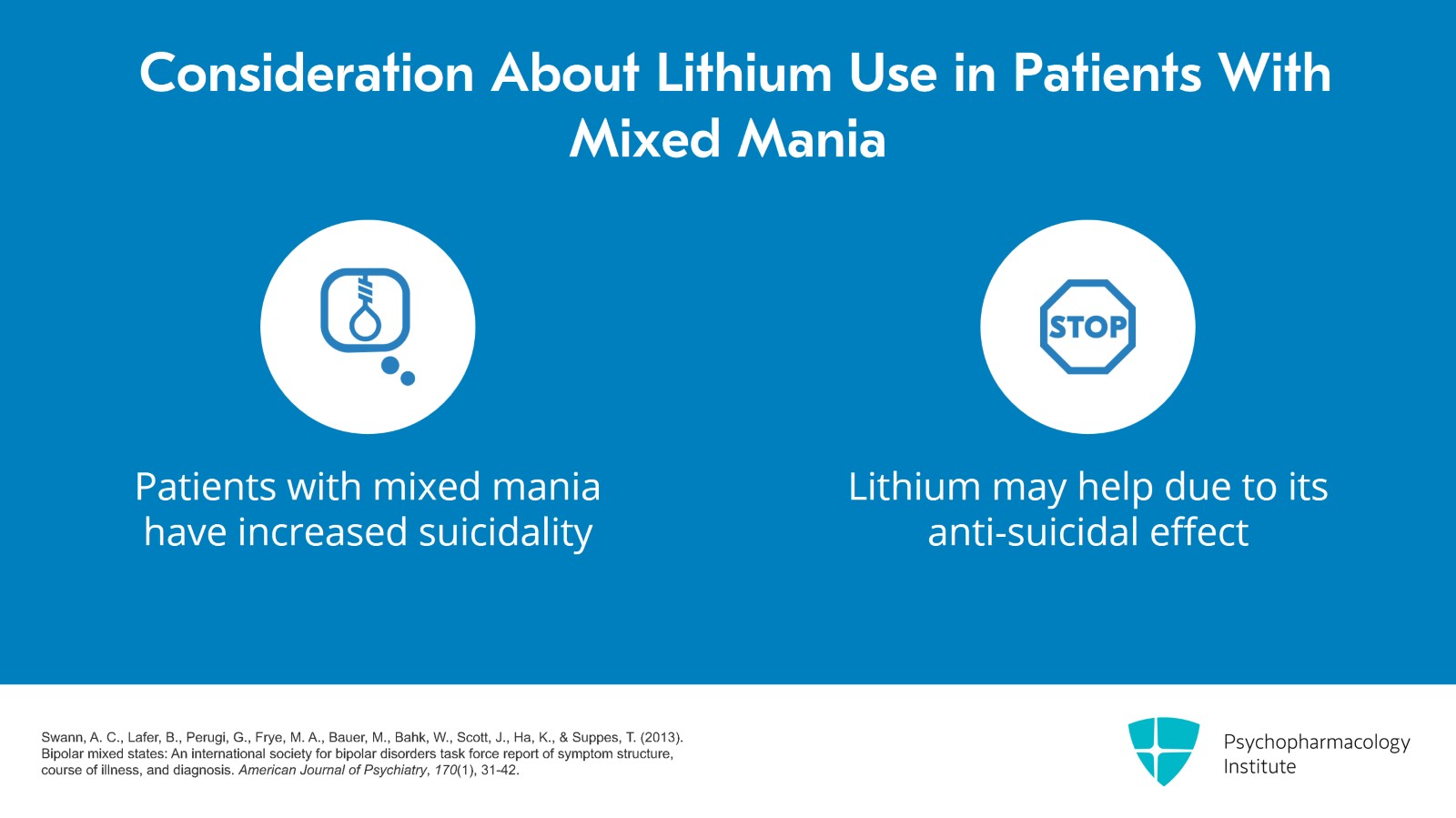
Now, mixed patients often have increased suicidality compared to nonmixed people. They have these depressive symptoms after all. So they may be suicidal while manic. Lithium is good for that even if it's not effective for the mood episode according to two studies. It can help to have an anti-suicide effect even when it's not treating the acute mania. So that's why we consider it if you didn't want to use the other options.
References:
- Swann, A. C., Lafer, B., Perugi, G., Frye, M. A., Bauer, M., Bahk, W., Scott, J., Ha, K., & Suppes, T. (2013). Bipolar mixed states: An international society for bipolar disorders task force report of symptom structure, course of illness, and diagnosis. American Journal of Psychiatry, 170(1), 31-42.
Free Files
Download PDF and other files
Success!
Check your inbox, we sent you all the materials there.
Slide 15 of 20
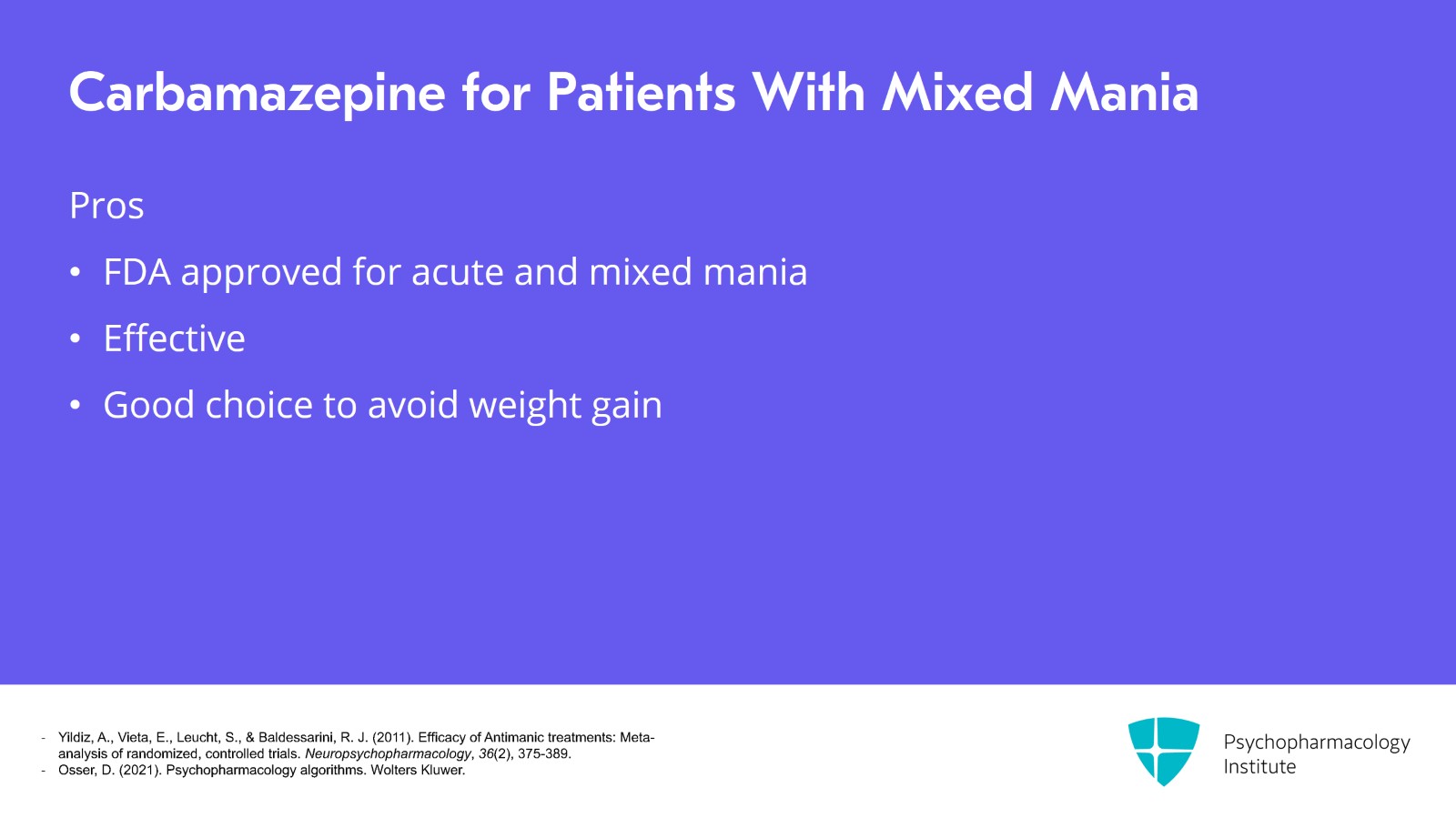
Now, carbamazepine, we do mention it as an option. It's FDA approved for acute and mixed mania. It is effective. And it has the slow-release formulation that has the most efficacy in the studies. It's critical to avoid weight gain, that could be a positive consideration in choosing carbamazepine for your second or third-line choice for treating this acute mania.
References:
- Yildiz, A., Vieta, E., Leucht, S., & Baldessarini, R. J. (2011). Efficacy of Antimanic treatments: Meta-analysis of randomized, controlled trials. Neuropsychopharmacology, 36(2), 375-389.
- Osser, D. (2021). Psychopharmacology algorithms. Wolters Kluwer.
Slide 16 of 20
But there are many drug interactions with carbamazepine. And the only uncontrolled reports on treating acute depression and it's never been studied significantly as a maintenance treatment. It's also hard to dose. It self-induces its own metabolism. You have to keep increasing the dose over several weeks. It also has certain side effects – hyponatremia, rare blood dyscrasias.
References:
- Yildiz, A., Vieta, E., Leucht, S., & Baldessarini, R. J. (2011). Efficacy of Antimanic treatments: Meta-analysis of randomized, controlled trials. Neuropsychopharmacology, 36(2), 375-389.
- Osser, D. (2021). Psychopharmacology algorithms. Wolters Kluwer.
Free Files
Download PDF and other files
Success!
Check your inbox, we sent you all the materials there.
Slide 17 of 20
So with all those negatives, we think of it as a third choice.
References:
- Yildiz, A., Vieta, E., Leucht, S., & Baldessarini, R. J. (2011). Efficacy of Antimanic treatments: Meta-analysis of randomized, controlled trials. Neuropsychopharmacology, 36(2), 375-389.
- Osser, D. (2021). Psychopharmacology algorithms. Wolters Kluwer.17
Slide 18 of 20
So the key points were we consider lithium second line as an add-on but it can be used along with the option of an anticonvulsant mood stabilizer like valproate or carbamazepine.
Free Files
Download PDF and other files
Success!
Check your inbox, we sent you all the materials there.
Slide 19 of 20
If you possibly can, give the first-line treatment time to work before adding a second medication resisting pressures from managed care and other reasons to pile on meds as fast as possible with inpatients to shorten length of stay. And how can you get them to avoid that second antimanic agent? By using a benzodiazepine to help calm the patient temporarily while waiting for the first drug to have its full effect.
Free Files
Download PDF and other files
Success!
Check your inbox, we sent you all the materials there.