



Slides and Transcript
Slide 1 of 24
Next, we’re going to move into talking about pharmacologic treatment for catatonia, and we’ll start with the role of benzodiazepines. Since our last talk about catatonia, there’s been a number of things that are new with regard to medications and with regard to treatment.
Slide 2 of 24
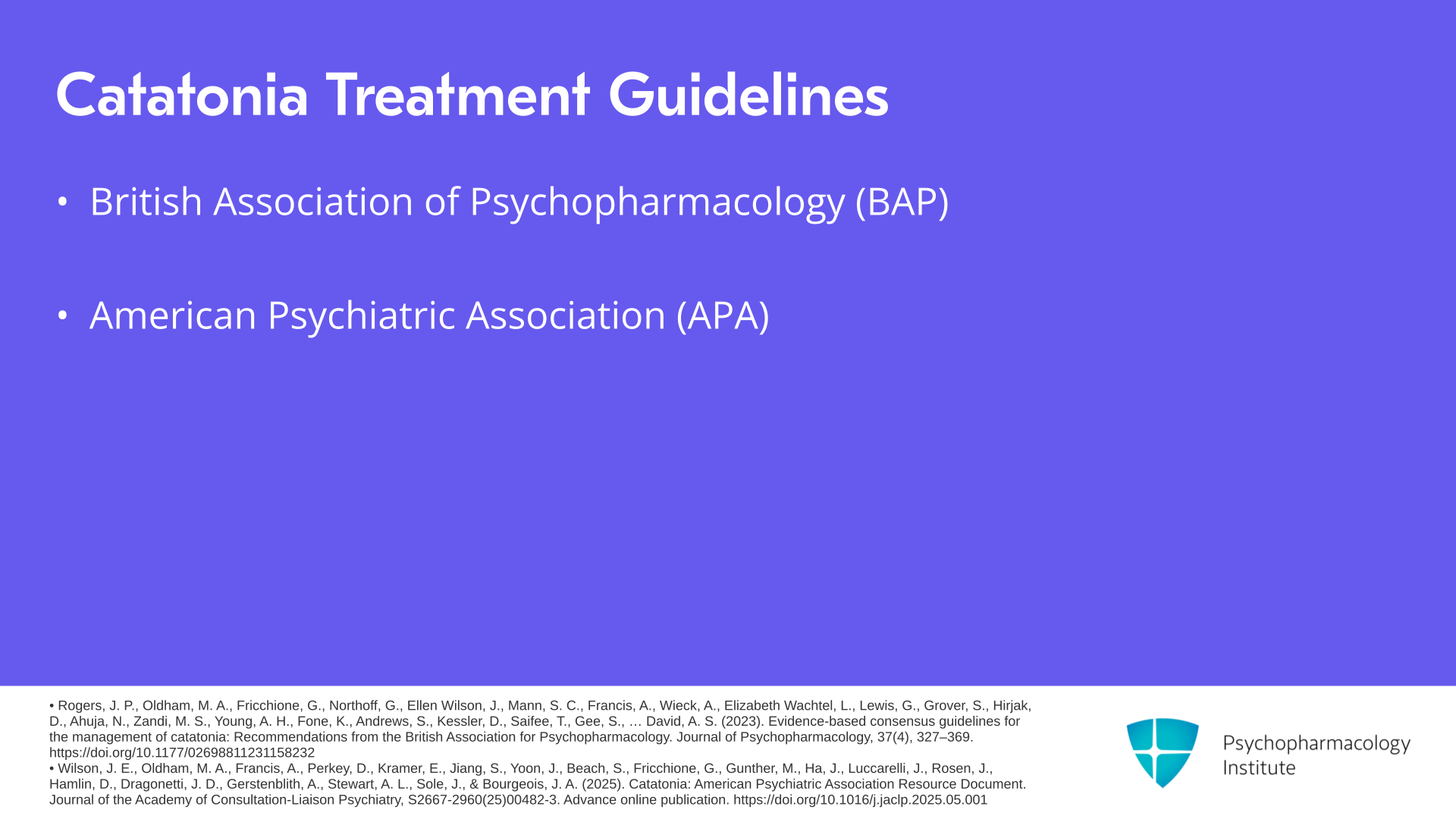
Probably the biggest thing is that consensus guidelines have been issued by the British Association of Psychopharmacology, and a resource document is forthcoming from the American Psychiatric Association with regard to catatonia in general but also dealing with treatment. So I’ll reference both of these things throughout this talk.
References:
- Rogers, J. P., Oldham, M. A., Fricchione, G., Northoff, G., Ellen Wilson, J., Mann, S. C., Francis, A., Wieck, A., Elizabeth Wachtel, L., Lewis, G., Grover, S., Hirjak, D., Ahuja, N., Zandi, M. S., Young, A. H., Fone, K., Andrews, S., Kessler, D., Saifee, T., Gee, S., … David, A. S. (2023). Evidence-based consensus guidelines for the management of catatonia: Recommendations from the British Association for Psychopharmacology. Journal of Psychopharmacology, 37(4), 327–369. https://doi.org/10.1177/02698811231158232
- Wilson, J. E., Oldham, M. A., Francis, A., Perkey, D., Kramer, E., Jiang, S., Yoon, J., Beach, S., Fricchione, G., Gunther, M., Ha, J., Luccarelli, J., Rosen, J., Hamlin, D., Dragonetti, J. D., Gerstenblith, A., Stewart, A. L., Sole, J., & Bourgeois, J. A. (2025). Catatonia: American Psychiatric Association Resource Document. Journal of the Academy of Consultation-Liaison Psychiatry, S2667-2960(25)00482-3. Advance online publication. https://doi.org/10.1016/j.jaclp.2025.05.001
Free Files
Download PDF and other files
Success!
Check your inbox, we sent you all the materials there.
Slide 3 of 24
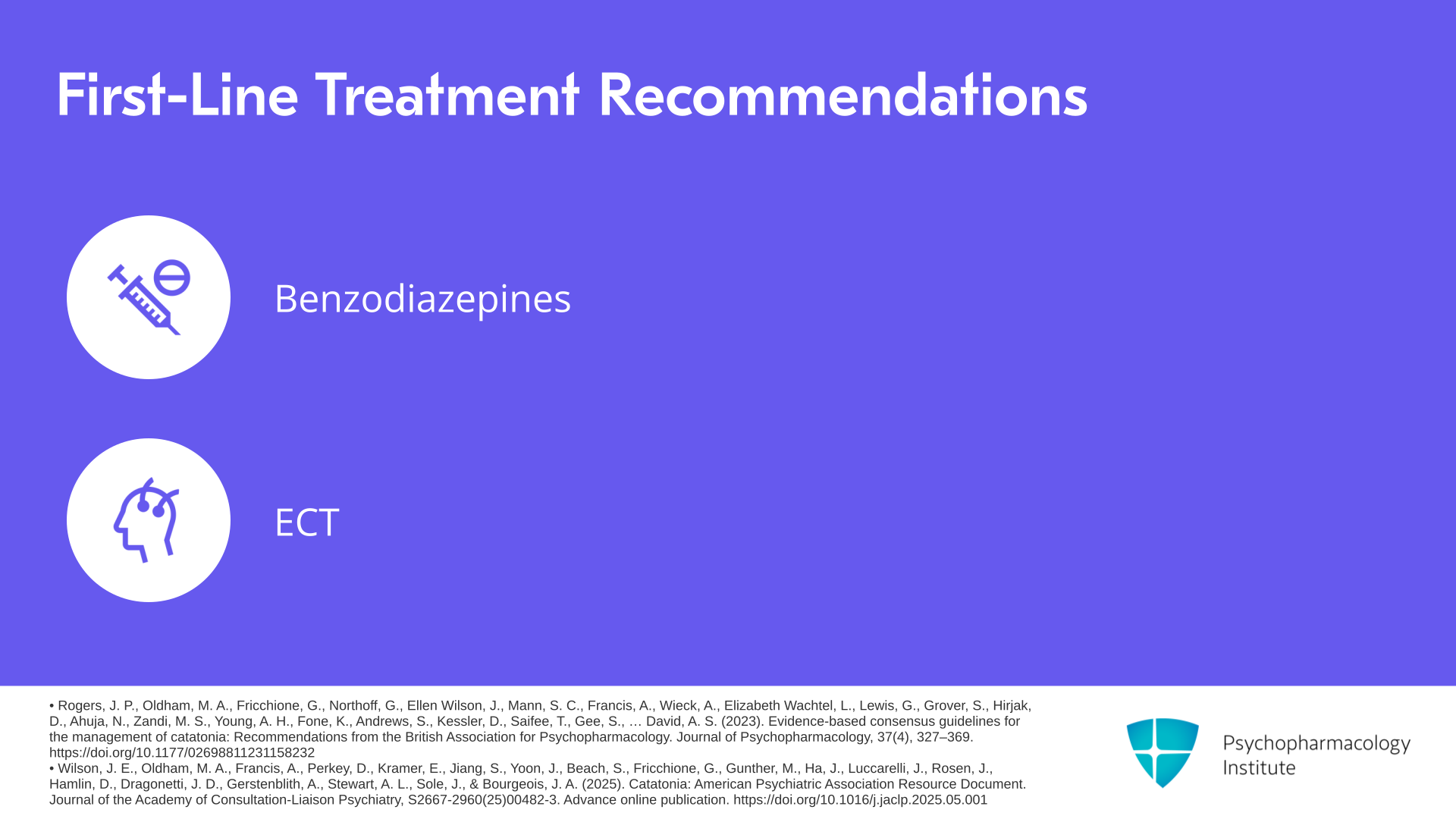
One of the key take-aways is that both groups recommend benzodiazepines and ECT as first-line treatments. So there’s pretty good expert consensus agreement on that recommendation.
References:
- Rogers, J. P., Oldham, M. A., Fricchione, G., Northoff, G., Ellen Wilson, J., Mann, S. C., Francis, A., Wieck, A., Elizabeth Wachtel, L., Lewis, G., Grover, S., Hirjak, D., Ahuja, N., Zandi, M. S., Young, A. H., Fone, K., Andrews, S., Kessler, D., Saifee, T., Gee, S., … David, A. S. (2023). Evidence-based consensus guidelines for the management of catatonia: Recommendations from the British Association for Psychopharmacology. Journal of Psychopharmacology, 37(4), 327–369. https://doi.org/10.1177/02698811231158232
- Wilson, J. E., Oldham, M. A., Francis, A., Perkey, D., Kramer, E., Jiang, S., Yoon, J., Beach, S., Fricchione, G., Gunther, M., Ha, J., Luccarelli, J., Rosen, J., Hamlin, D., Dragonetti, J. D., Gerstenblith, A., Stewart, A. L., Sole, J., & Bourgeois, J. A. (2025). Catatonia: American Psychiatric Association Resource Document. Journal of the Academy of Consultation-Liaison Psychiatry, S2667-2960(25)00482-3. Advance online publication. https://doi.org/10.1016/j.jaclp.2025.05.001
Slide 4 of 24
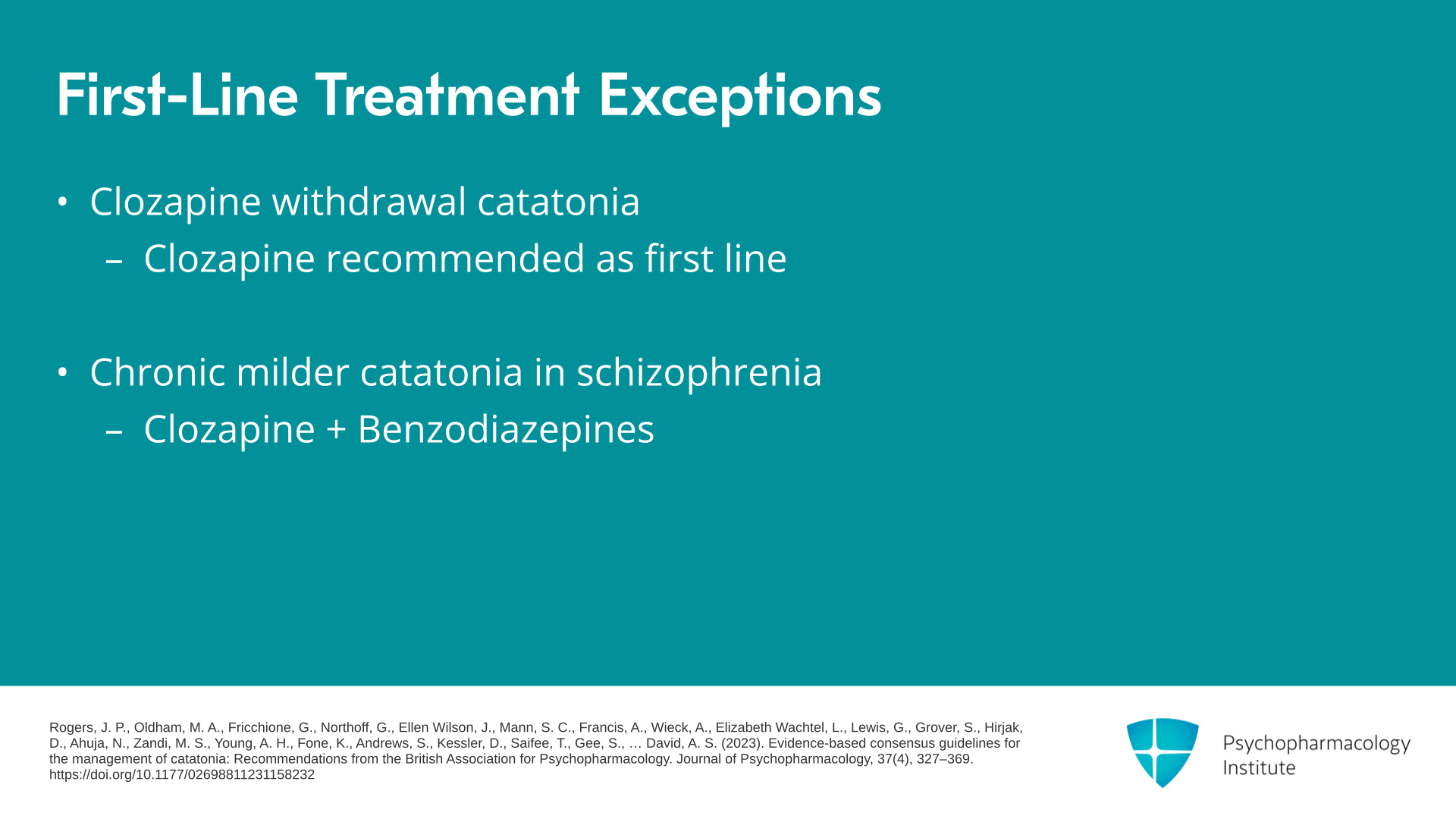
The British Association of Psychopharmacology guidelines do give a few exceptions for this. For example, in cases of clozapine withdrawal catatonia, clozapine is recommended as first line. And they note that in chronic milder catatonia in the context of schizophrenia, there is some anecdotal evidence for clozapine sometimes in combination with benzodiazepines.
References:
- Rogers, J. P., Oldham, M. A., Fricchione, G., Northoff, G., Ellen Wilson, J., Mann, S. C., Francis, A., Wieck, A., Elizabeth Wachtel, L., Lewis, G., Grover, S., Hirjak, D., Ahuja, N., Zandi, M. S., Young, A. H., Fone, K., Andrews, S., Kessler, D., Saifee, T., Gee, S., … David, A. S. (2023). Evidence-based consensus guidelines for the management of catatonia: Recommendations from the British Association for Psychopharmacology. Journal of Psychopharmacology, 37(4), 327–369. https://doi.org/10.1177/02698811231158232
Free Files
Download PDF and other files
Success!
Check your inbox, we sent you all the materials there.
Slide 5 of 24
They also note that the choice between benzodiazepines and ECT should weigh things like side effect profile, the availability of ECT and whether there’s an underlying condition that itself is responsive to ECT.
References:
- Rogers, J. P., Oldham, M. A., Fricchione, G., Northoff, G., Ellen Wilson, J., Mann, S. C., Francis, A., Wieck, A., Elizabeth Wachtel, L., Lewis, G., Grover, S., Hirjak, D., Ahuja, N., Zandi, M. S., Young, A. H., Fone, K., Andrews, S., Kessler, D., Saifee, T., Gee, S., … David, A. S. (2023). Evidence-based consensus guidelines for the management of catatonia: Recommendations from the British Association for Psychopharmacology. Journal of Psychopharmacology, 37(4), 327–369. https://doi.org/10.1177/02698811231158232
Slide 6 of 24
A few reminders about benzodiazepines in catatonia more generally. As I mentioned before, when we were talking about the challenge, lorazepam remains the preferred agent. Diazepam is really the other benzodiazepine that’s been shown to be effective. Both of these have the advantage of being given via multiple routes – intravenous, intramuscular, oral.
References:
- Fernández Hurst, N., Zanetti, S. R., Baez, N. S., Bibolini, M. J., Bouzat, C. B., & et al. (2017). Diazepam treatment reduces inflammatory cells and mediators in the central nervous system of rats with experimental autoimmune encephalomyelitis. Journal of Neuroimmunology, 313, 145-151. https://doi.org/10.1016/j.jneuroim.2017.09.012
- Gunther, M., Luccarelli, J., & Beach, S. (2025). Revisiting the lorazepam challenge: An algorithm for clinical-decision making. General Hospital Psychiatry, 93(1). https://doi.org/10.1016/j.genhosppsych.2025.01.016
Free Files
Download PDF and other files
Success!
Check your inbox, we sent you all the materials there.
Slide 7 of 24
And it’s important to keep in mind that many other benzodiazepines including clonazepam and midazolam do not seem to be as effective for adults. We don’t know for sure why that is. There are many theories. Part of the difference may lie in the preference of diazepam and lorazepam for the GABA-A receptor which may be more involved in catatonia.
References:
- Gunther, M., Luccarelli, J., & Beach, S. (2025). Revisiting the lorazepam challenge: An algorithm for clinical-decision making. General Hospital Psychiatry, 93(1). https://doi.org/10.1016/j.genhosppsych.2025.01.016
- Suchandra, H. H., Reddi, V. S. K., Aandi Subramaniyam, B., & Muliyala, K. P. (2020). Revisiting lorazepam challenge test: Clinical response with dose variations and utility for catatonia in a psychiatric emergency setting. Australian & New Zealand Journal of Psychiatry, 55(10), 993-1004. https://doi.org/10.1177/0004867420968915
Slide 8 of 24
There’s another theory having to do with anti-inflammatory properties of diazepam and lorazepam, and their specific actions on translocator protein which may be unique. But we still have a lot to understand about why those two benzodiazepines in particular seem to be so effective.
References:
- Fernández Hurst, N., Zanetti, S. R., Baez, N. S., Bibolini, M. J., Bouzat, C. B., & et al. (2017). Diazepam treatment reduces inflammatory cells and mediators in the central nervous system of rats with experimental autoimmune encephalomyelitis. Journal of Neuroimmunology, 313, 145-151. https://doi.org/10.1016/j.jneuroim.2017.09.012
- Gunther, M., Luccarelli, J., & Beach, S. (2025). Revisiting the lorazepam challenge: An algorithm for clinical-decision making. General Hospital Psychiatry, 93(1). https://doi.org/10.1016/j.genhosppsych.2025.01.016
Free Files
Download PDF and other files
Success!
Check your inbox, we sent you all the materials there.
Slide 9 of 24
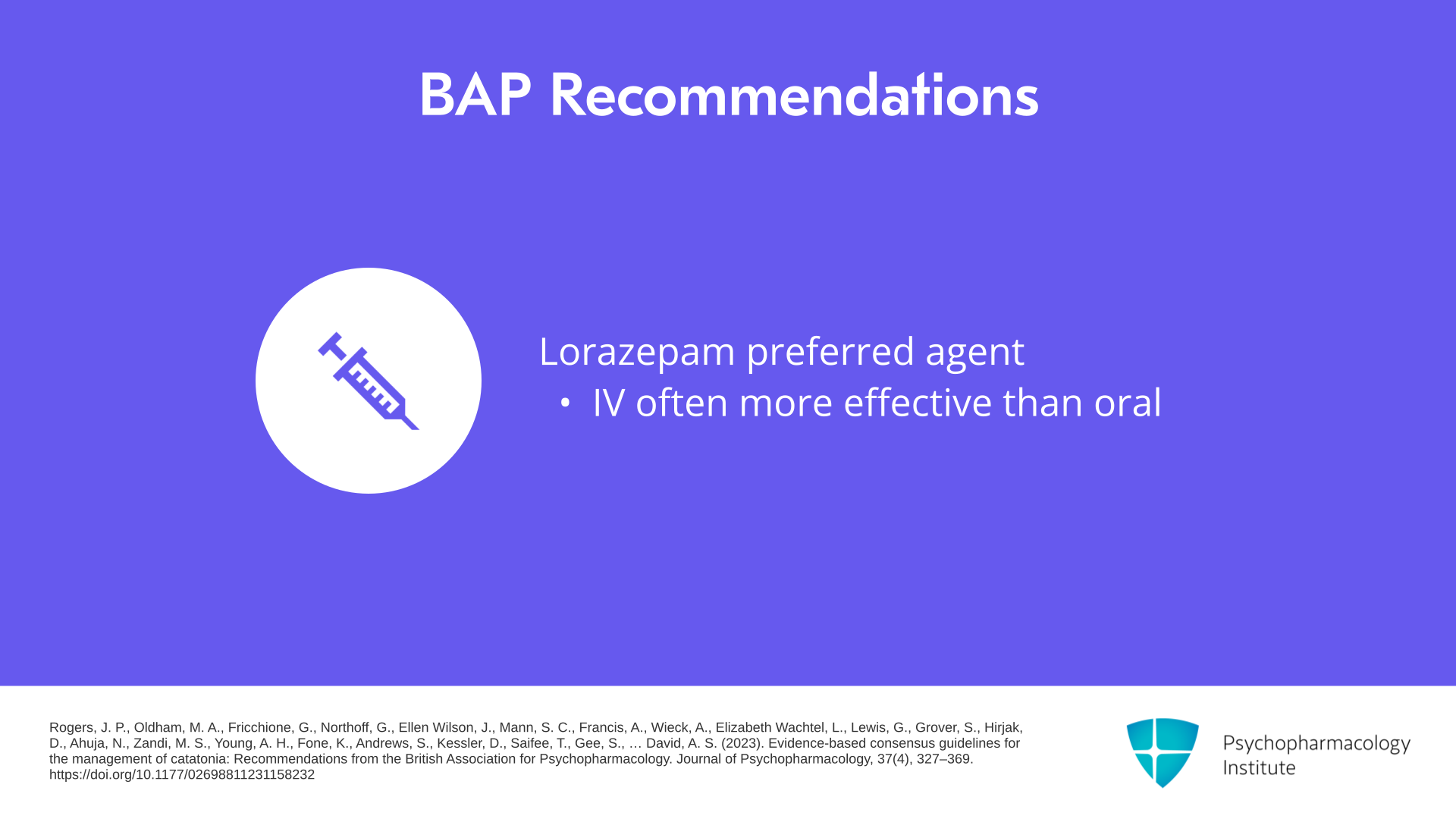
The British guidelines for benzodiazepines emphasize that lorazepam is the preferred agent. They don’t necessarily offer a preference in terms of the route. Our experience would say that intravenous lorazepam tends to work better than oral lorazepam. I’ve seen many patients who don’t respond to doses of oral lorazepam, but respond pretty quickly to intravenous lorazepam.
References:
- Rogers, J. P., Oldham, M. A., Fricchione, G., Northoff, G., Ellen Wilson, J., Mann, S. C., Francis, A., Wieck, A., Elizabeth Wachtel, L., Lewis, G., Grover, S., Hirjak, D., Ahuja, N., Zandi, M. S., Young, A. H., Fone, K., Andrews, S., Kessler, D., Saifee, T., Gee, S., … David, A. S. (2023). Evidence-based consensus guidelines for the management of catatonia: Recommendations from the British Association for Psychopharmacology. Journal of Psychopharmacology, 37(4), 327–369. https://doi.org/10.1177/02698811231158232
Slide 10 of 24
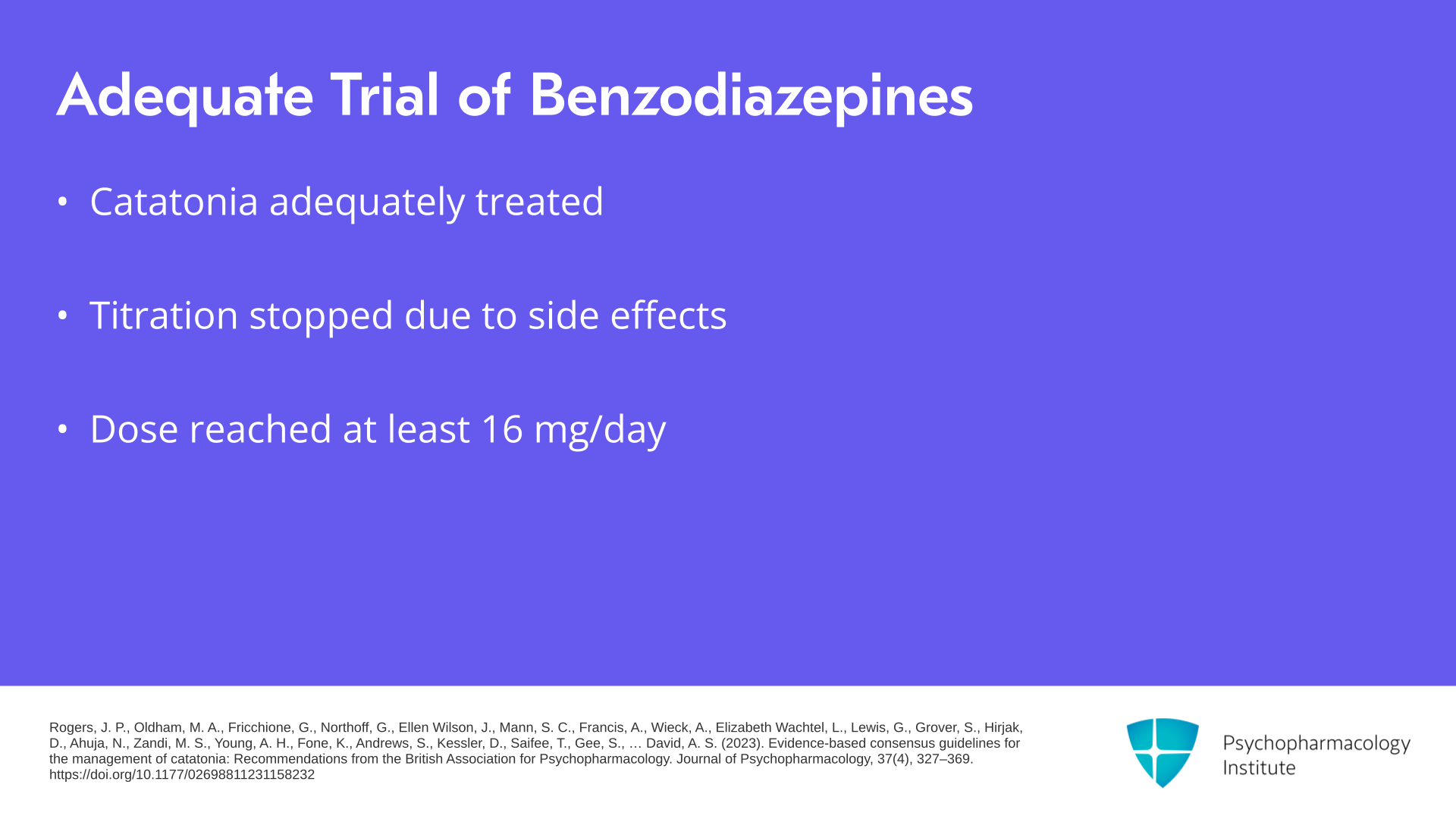
The British guidelines define an adequate trial of benzodiazepines as occurring when either the catatonia is adequately treated, the titration has been stopped due to side effects or the dose has reached at least 16 mg per day.
References:
- Rogers, J. P., Oldham, M. A., Fricchione, G., Northoff, G., Ellen Wilson, J., Mann, S. C., Francis, A., Wieck, A., Elizabeth Wachtel, L., Lewis, G., Grover, S., Hirjak, D., Ahuja, N., Zandi, M. S., Young, A. H., Fone, K., Andrews, S., Kessler, D., Saifee, T., Gee, S., … David, A. S. (2023). Evidence-based consensus guidelines for the management of catatonia: Recommendations from the British Association for Psychopharmacology. Journal of Psychopharmacology, 37(4), 327–369. https://doi.org/10.1177/02698811231158232
Free Files
Download PDF and other files
Success!
Check your inbox, we sent you all the materials there.
Slide 11 of 24
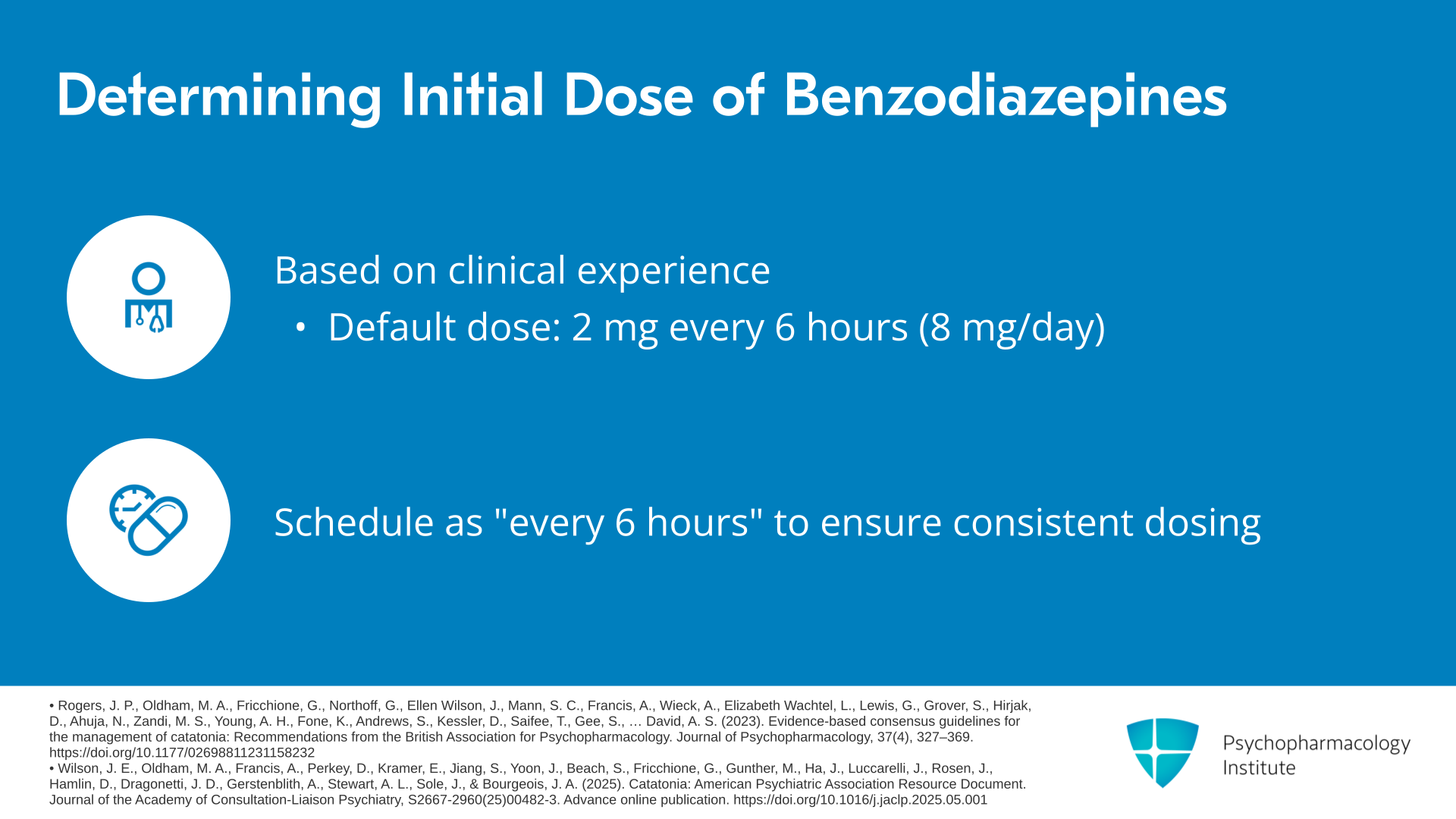
One thing that I’m commonly asked is how we decide the initial dose of benzodiazepines to use after a lorazepam challenge. Unfortunately, there is essentially no data to guide us here, and so it’s really just based on clinical intuition and anecdotal experience but generally, I’m going to start a dose of 2 mg every six hours as my default. That is a dose of 8 mg a day. I always write that as every six hours rather than q.i.d. because if you write an order as q.i.d. or t.i.d. you’re giving the patient a long period of time overnight where they won’t get a dose, whereas you want patients with catatonia to get consistent and regular doses.
References:
- Rogers, J. P., Oldham, M. A., Fricchione, G., Northoff, G., Ellen Wilson, J., Mann, S. C., Francis, A., Wieck, A., Elizabeth Wachtel, L., Lewis, G., Grover, S., Hirjak, D., Ahuja, N., Zandi, M. S., Young, A. H., Fone, K., Andrews, S., Kessler, D., Saifee, T., Gee, S., … David, A. S. (2023). Evidence-based consensus guidelines for the management of catatonia: Recommendations from the British Association for Psychopharmacology. Journal of Psychopharmacology, 37(4), 327–369. https://doi.org/10.1177/02698811231158232
- Wilson, J. E., Oldham, M. A., Francis, A., Perkey, D., Kramer, E., Jiang, S., Yoon, J., Beach, S., Fricchione, G., Gunther, M., Ha, J., Luccarelli, J., Rosen, J., Hamlin, D., Dragonetti, J. D., Gerstenblith, A., Stewart, A. L., Sole, J., & Bourgeois, J. A. (2025). Catatonia: American Psychiatric Association Resource Document. Journal of the Academy of Consultation-Liaison Psychiatry, S2667-2960(25)00482-3. Advance online publication. https://doi.org/10.1016/j.jaclp.2025.05.001
Slide 12 of 24
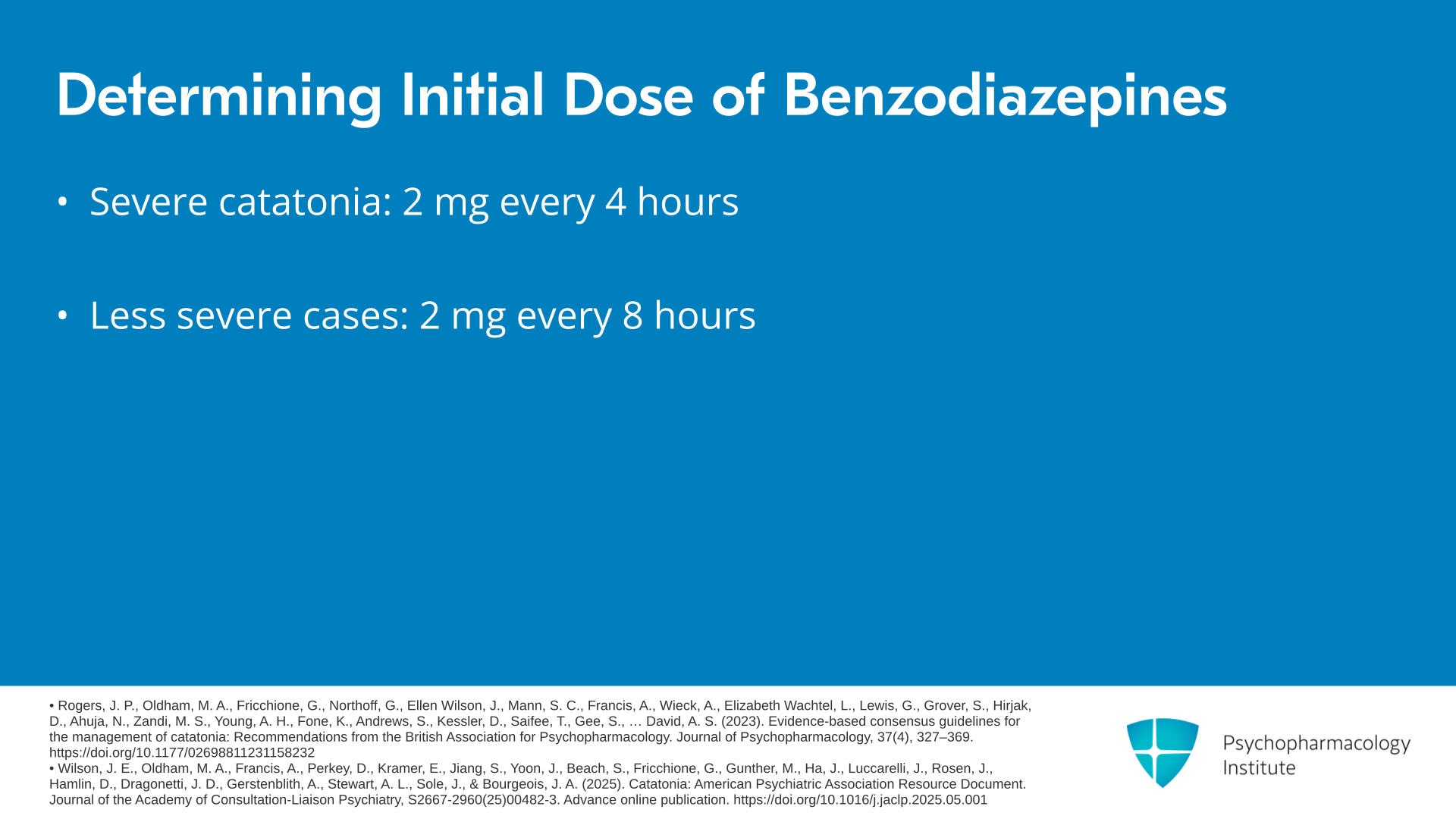
If somebody has what I would think about as more severe catatonia, then I may start them at 2 mg every four hours. If somebody has less severe catatonia, I may think about starting them at 2 mg every eight hours but almost always in that initial range.
References:
- Rogers, J. P., Oldham, M. A., Fricchione, G., Northoff, G., Ellen Wilson, J., Mann, S. C., Francis, A., Wieck, A., Elizabeth Wachtel, L., Lewis, G., Grover, S., Hirjak, D., Ahuja, N., Zandi, M. S., Young, A. H., Fone, K., Andrews, S., Kessler, D., Saifee, T., Gee, S., … David, A. S. (2023). Evidence-based consensus guidelines for the management of catatonia: Recommendations from the British Association for Psychopharmacology. Journal of Psychopharmacology, 37(4), 327–369. https://doi.org/10.1177/02698811231158232
- Wilson, J. E., Oldham, M. A., Francis, A., Perkey, D., Kramer, E., Jiang, S., Yoon, J., Beach, S., Fricchione, G., Gunther, M., Ha, J., Luccarelli, J., Rosen, J., Hamlin, D., Dragonetti, J. D., Gerstenblith, A., Stewart, A. L., Sole, J., & Bourgeois, J. A. (2025). Catatonia: American Psychiatric Association Resource Document. Journal of the Academy of Consultation-Liaison Psychiatry, S2667-2960(25)00482-3. Advance online publication. https://doi.org/10.1016/j.jaclp.2025.05.001
Free Files
Download PDF and other files
Success!
Check your inbox, we sent you all the materials there.
Slide 13 of 24
When I think about escalating a dose of benzodiazepines, I often think in total daily doses first rather than in specifically how I’m going to write the order, and how I’m going to space the medication. So if I’ve come to a decision to increase the total daily dose because I think the response is not as strong as it could be, then in order to decide whether I’m going to increase the amount of benzodiazepines that they’re given at each dose or whether I’m going to increase the frequency, I will often look at the pattern of response.
References:
- Rogers, J. P., Oldham, M. A., Fricchione, G., Northoff, G., Ellen Wilson, J., Mann, S. C., Francis, A., Wieck, A., Elizabeth Wachtel, L., Lewis, G., Grover, S., Hirjak, D., Ahuja, N., Zandi, M. S., Young, A. H., Fone, K., Andrews, S., Kessler, D., Saifee, T., Gee, S., … David, A. S. (2023). Evidence-based consensus guidelines for the management of catatonia: Recommendations from the British Association for Psychopharmacology. Journal of Psychopharmacology, 37(4), 327–369. https://doi.org/10.1177/02698811231158232
- Wilson, J. E., Oldham, M. A., Francis, A., Perkey, D., Kramer, E., Jiang, S., Yoon, J., Beach, S., Fricchione, G., Gunther, M., Ha, J., Luccarelli, J., Rosen, J., Hamlin, D., Dragonetti, J. D., Gerstenblith, A., Stewart, A. L., Sole, J., & Bourgeois, J. A. (2025). Catatonia: American Psychiatric Association Resource Document. Journal of the Academy of Consultation-Liaison Psychiatry, S2667-2960(25)00482-3. Advance online publication. https://doi.org/10.1016/j.jaclp.2025.05.001
Slide 14 of 24
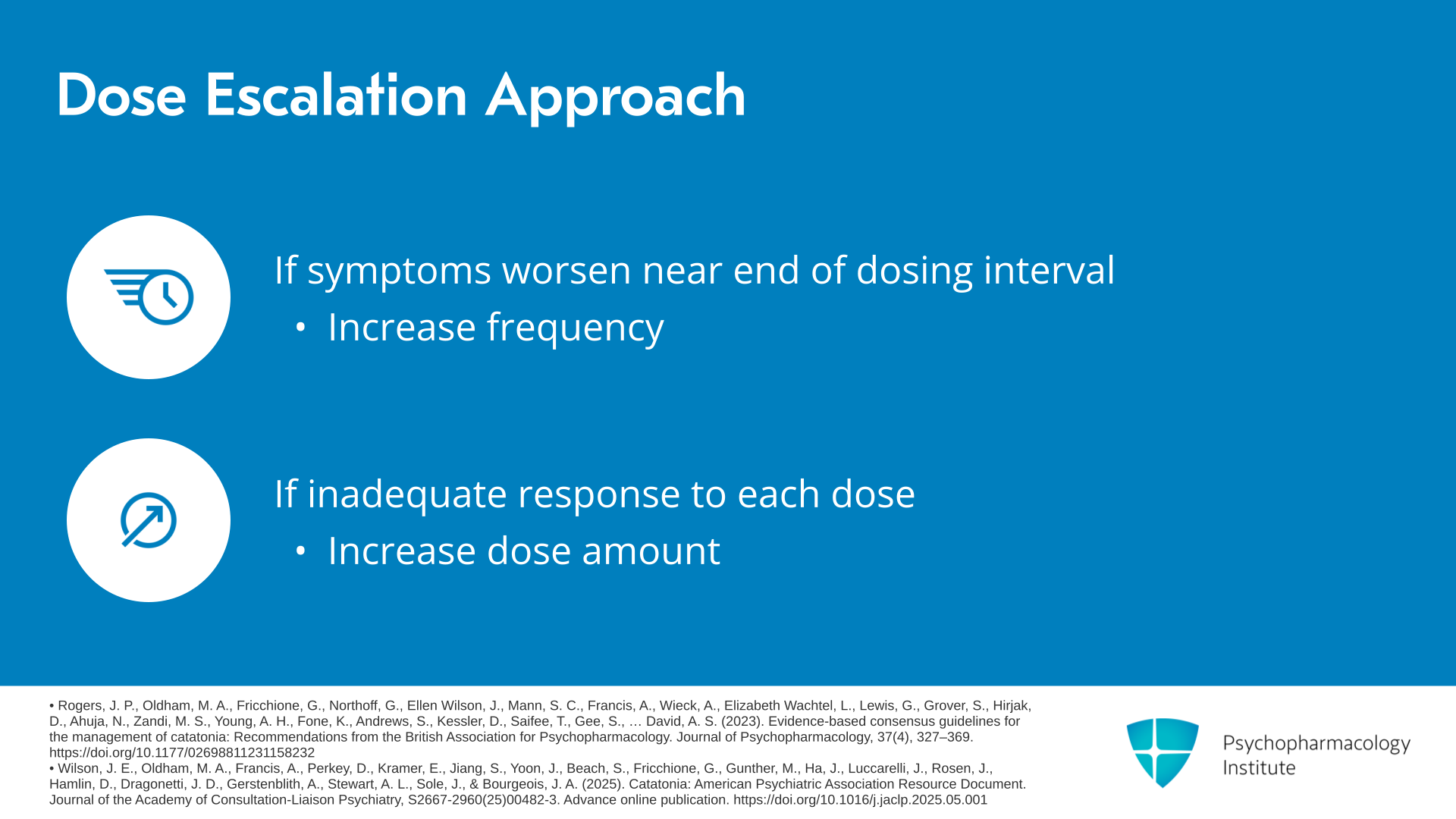
If somebody is responding to the dose of benzodiazepine, for example, 2 mg q.6 but I’m noticing that at the end of the six hours their symptoms are getting much worse, that’s a time when I’m going to think about increasing the frequency. So I might go to 2 mg q.4. Whereas, if somebody is not having as much of a response as I would like to each dose that they’re receiving, then I might think about increasing the dose that they’re given.
References:
- Rogers, J. P., Oldham, M. A., Fricchione, G., Northoff, G., Ellen Wilson, J., Mann, S. C., Francis, A., Wieck, A., Elizabeth Wachtel, L., Lewis, G., Grover, S., Hirjak, D., Ahuja, N., Zandi, M. S., Young, A. H., Fone, K., Andrews, S., Kessler, D., Saifee, T., Gee, S., … David, A. S. (2023). Evidence-based consensus guidelines for the management of catatonia: Recommendations from the British Association for Psychopharmacology. Journal of Psychopharmacology, 37(4), 327–369. https://doi.org/10.1177/02698811231158232
- Wilson, J. E., Oldham, M. A., Francis, A., Perkey, D., Kramer, E., Jiang, S., Yoon, J., Beach, S., Fricchione, G., Gunther, M., Ha, J., Luccarelli, J., Rosen, J., Hamlin, D., Dragonetti, J. D., Gerstenblith, A., Stewart, A. L., Sole, J., & Bourgeois, J. A. (2025). Catatonia: American Psychiatric Association Resource Document. Journal of the Academy of Consultation-Liaison Psychiatry, S2667-2960(25)00482-3. Advance online publication. https://doi.org/10.1016/j.jaclp.2025.05.001
Free Files
Download PDF and other files
Success!
Check your inbox, we sent you all the materials there.
Slide 15 of 24
So 16 mg per day in my mind is a moderate dose, but I would continue to push lorazepam beyond that dose as long as patients were tolerating it and there was no evidence of respiratory compromise.
References:
- Rogers, J. P., Oldham, M. A., Fricchione, G., Northoff, G., Ellen Wilson, J., Mann, S. C., Francis, A., Wieck, A., Elizabeth Wachtel, L., Lewis, G., Grover, S., Hirjak, D., Ahuja, N., Zandi, M. S., Young, A. H., Fone, K., Andrews, S., Kessler, D., Saifee, T., Gee, S., … David, A. S. (2023). Evidence-based consensus guidelines for the management of catatonia: Recommendations from the British Association for Psychopharmacology. Journal of Psychopharmacology, 37(4), 327–369. https://doi.org/10.1177/02698811231158232
- Wilson, J. E., Oldham, M. A., Francis, A., Perkey, D., Kramer, E., Jiang, S., Yoon, J., Beach, S., Fricchione, G., Gunther, M., Ha, J., Luccarelli, J., Rosen, J., Hamlin, D., Dragonetti, J. D., Gerstenblith, A., Stewart, A. L., Sole, J., & Bourgeois, J. A. (2025). Catatonia: American Psychiatric Association Resource Document. Journal of the Academy of Consultation-Liaison Psychiatry, S2667-2960(25)00482-3. Advance online publication. https://doi.org/10.1016/j.jaclp.2025.05.001
Slide 16 of 24
Another recommendation from the British guidelines that I think is really important for prescribers to be aware of is the idea that benzodiazepines for catatonia should not be stopped abruptly. They should be tapered and generally the taper should be quite gradual. The speed of the taper really depends on balancing the benefits and the risks of withdrawal, but what we find in patients with catatonia is that the quicker the taper, the more likelihood there is for recurrence or relapse.
References:
- Rogers, J. P., Oldham, M. A., Fricchione, G., Northoff, G., Ellen Wilson, J., Mann, S. C., Francis, A., Wieck, A., Elizabeth Wachtel, L., Lewis, G., Grover, S., Hirjak, D., Ahuja, N., Zandi, M. S., Young, A. H., Fone, K., Andrews, S., Kessler, D., Saifee, T., Gee, S., … David, A. S. (2023). Evidence-based consensus guidelines for the management of catatonia: Recommendations from the British Association for Psychopharmacology. Journal of Psychopharmacology, 37(4), 327–369. https://doi.org/10.1177/02698811231158232
Free Files
Download PDF and other files
Success!
Check your inbox, we sent you all the materials there.
Slide 17 of 24
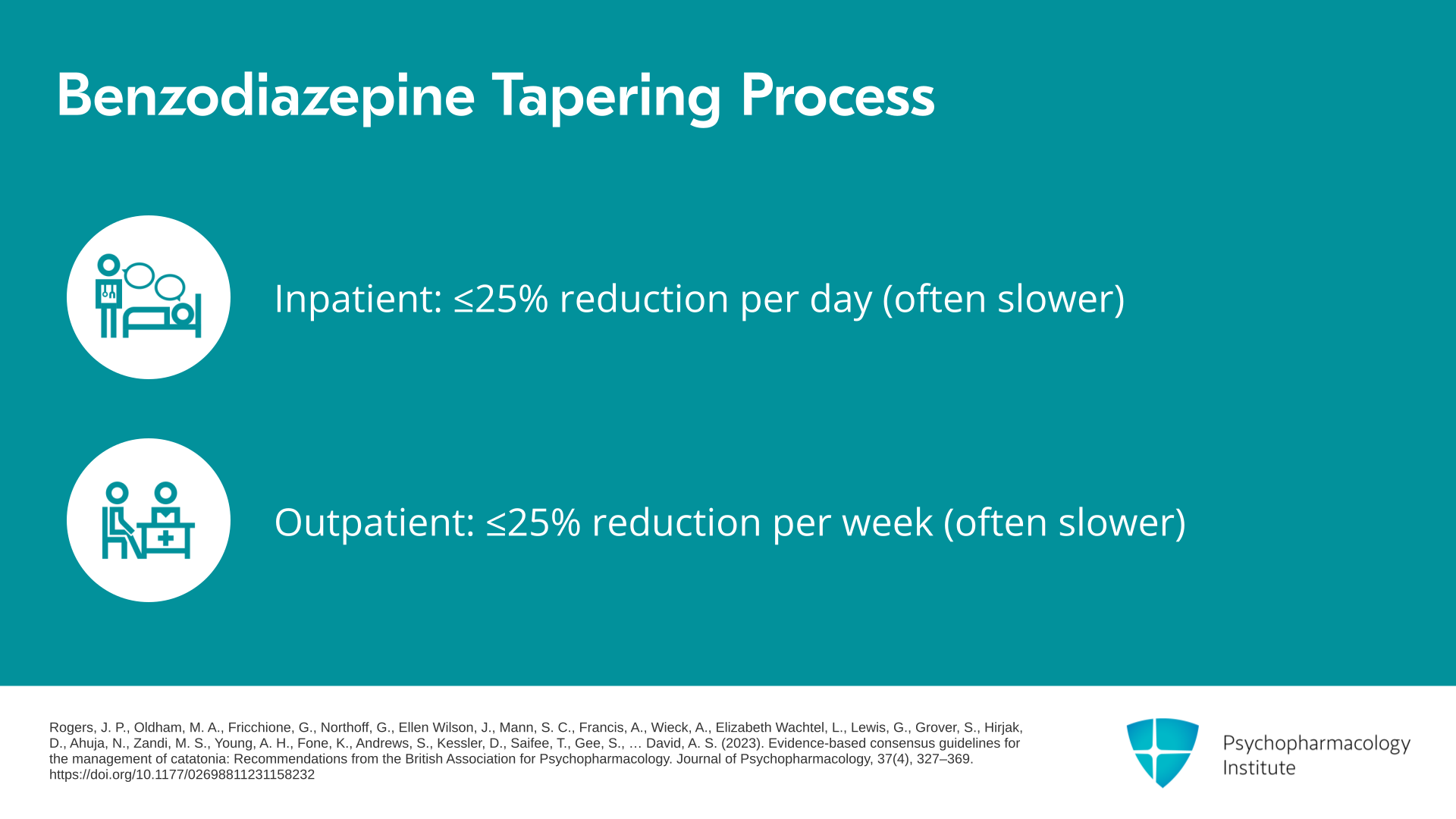
On the inpatient settings, we usually taper by no more than 25% per day and commonly much slower than that. And in the outpatient settings, we often taper by no more than 25% per week and again often much more slowly. It’s important to keep in mind that there are some patients who may require maintenance on benzodiazepines indefinitely and the risk of catatonia recurrence should be weighed against the other risks of benzodiazepines.
References:
- Rogers, J. P., Oldham, M. A., Fricchione, G., Northoff, G., Ellen Wilson, J., Mann, S. C., Francis, A., Wieck, A., Elizabeth Wachtel, L., Lewis, G., Grover, S., Hirjak, D., Ahuja, N., Zandi, M. S., Young, A. H., Fone, K., Andrews, S., Kessler, D., Saifee, T., Gee, S., … David, A. S. (2023). Evidence-based consensus guidelines for the management of catatonia: Recommendations from the British Association for Psychopharmacology. Journal of Psychopharmacology, 37(4), 327–369. https://doi.org/10.1177/02698811231158232
Slide 18 of 24
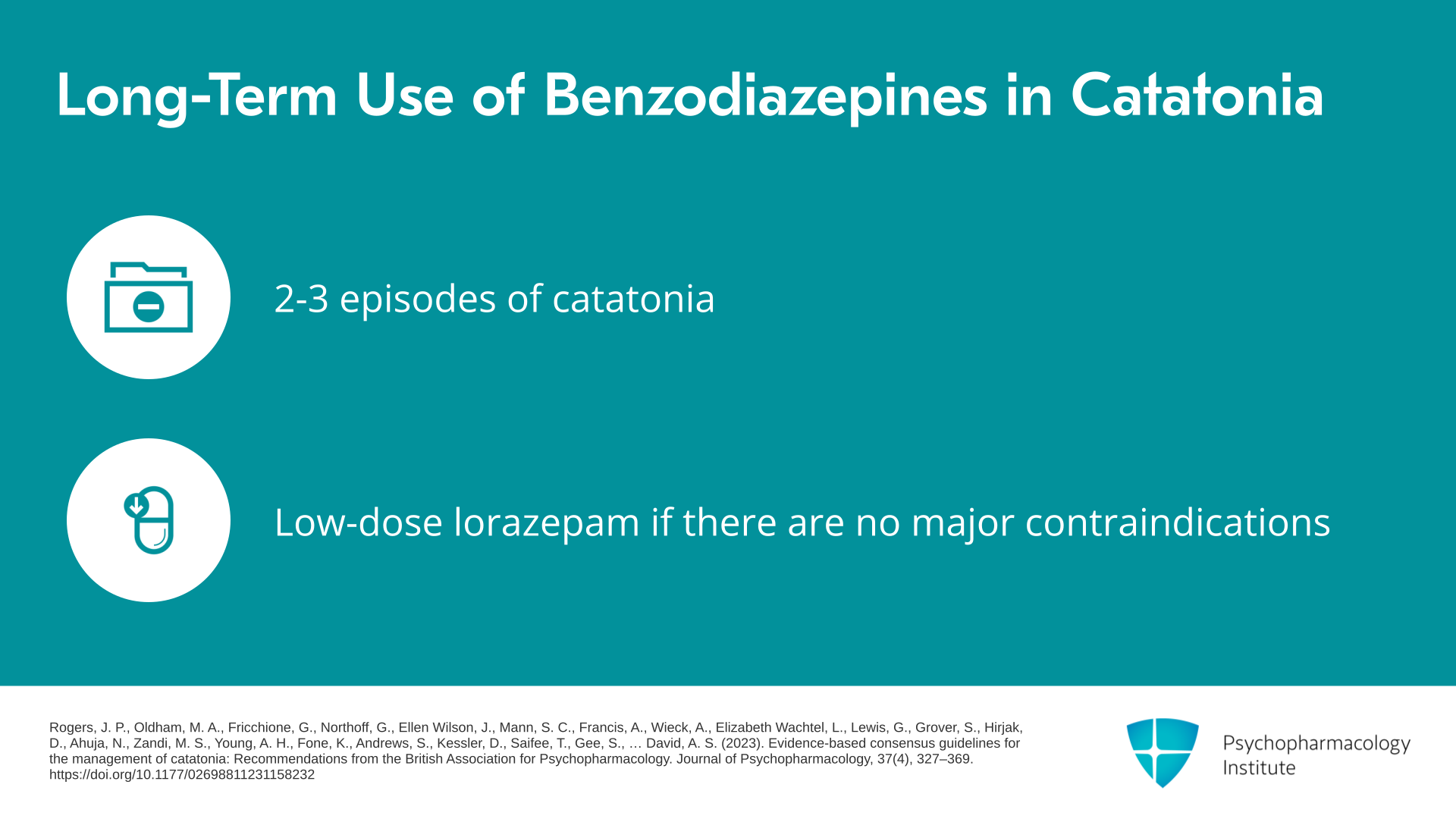
I think in general as a field we’ve become scared a little bit of benzodiazepines and while I think there are good reasons to be concerned about the use of benzodiazepines, there are also many conditions which respond very well to benzodiazepines and catatonia is certainly number 1 on that list. So I think there are patients who have two or three episodes of catatonia, and that’s an argument for them to be maintained indefinitely on low-dose lorazepam as long as there are no major contraindications.
References:
- Rogers, J. P., Oldham, M. A., Fricchione, G., Northoff, G., Ellen Wilson, J., Mann, S. C., Francis, A., Wieck, A., Elizabeth Wachtel, L., Lewis, G., Grover, S., Hirjak, D., Ahuja, N., Zandi, M. S., Young, A. H., Fone, K., Andrews, S., Kessler, D., Saifee, T., Gee, S., … David, A. S. (2023). Evidence-based consensus guidelines for the management of catatonia: Recommendations from the British Association for Psychopharmacology. Journal of Psychopharmacology, 37(4), 327–369. https://doi.org/10.1177/02698811231158232
Free Files
Download PDF and other files
Success!
Check your inbox, we sent you all the materials there.
Slide 19 of 24
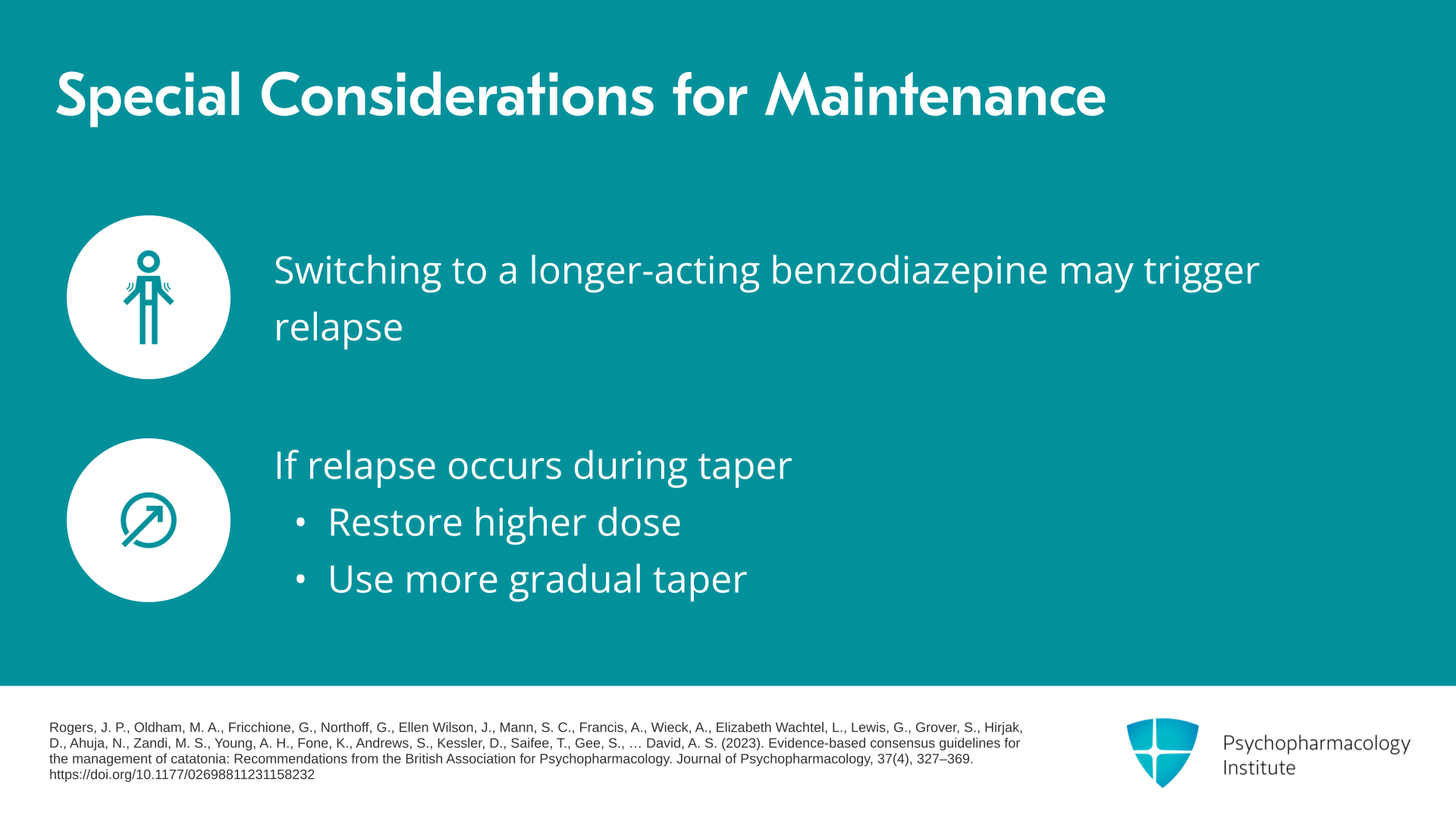
There’s also some evidence that attempting to switch from maintenance lorazepam to a longer-acting benzodiazepine such as clonazepam for maintenance may also result in relapse. So again, there seems to be something that’s unique about lorazepam and probably diazepam as well. If catatonia does relapse during the benzodiazepine taper, it’s important to restore a higher dose and then proceed with a more gradual taper.
References:
- Rogers, J. P., Oldham, M. A., Fricchione, G., Northoff, G., Ellen Wilson, J., Mann, S. C., Francis, A., Wieck, A., Elizabeth Wachtel, L., Lewis, G., Grover, S., Hirjak, D., Ahuja, N., Zandi, M. S., Young, A. H., Fone, K., Andrews, S., Kessler, D., Saifee, T., Gee, S., … David, A. S. (2023). Evidence-based consensus guidelines for the management of catatonia: Recommendations from the British Association for Psychopharmacology. Journal of Psychopharmacology, 37(4), 327–369. https://doi.org/10.1177/02698811231158232
Slide 20 of 24
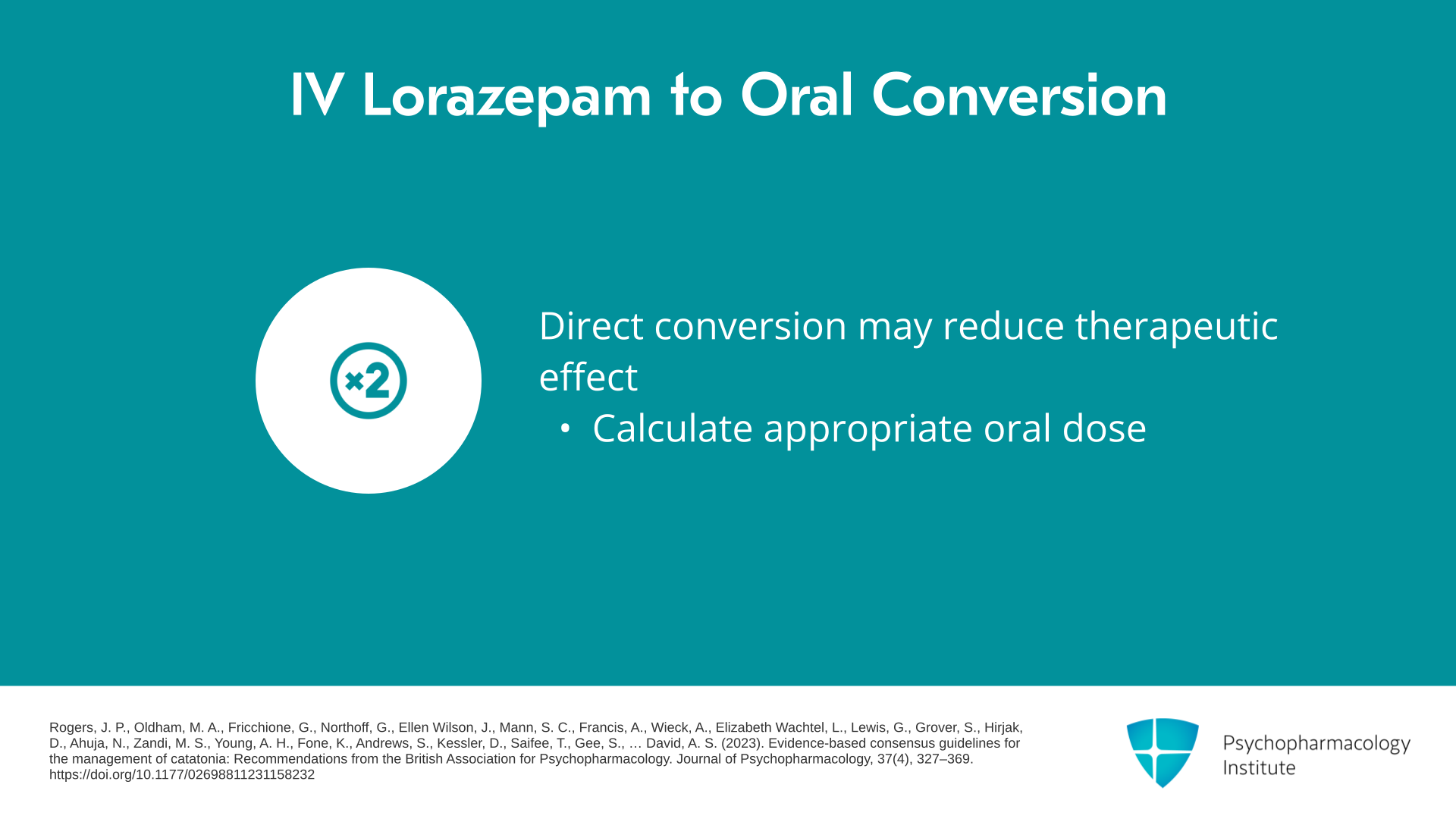
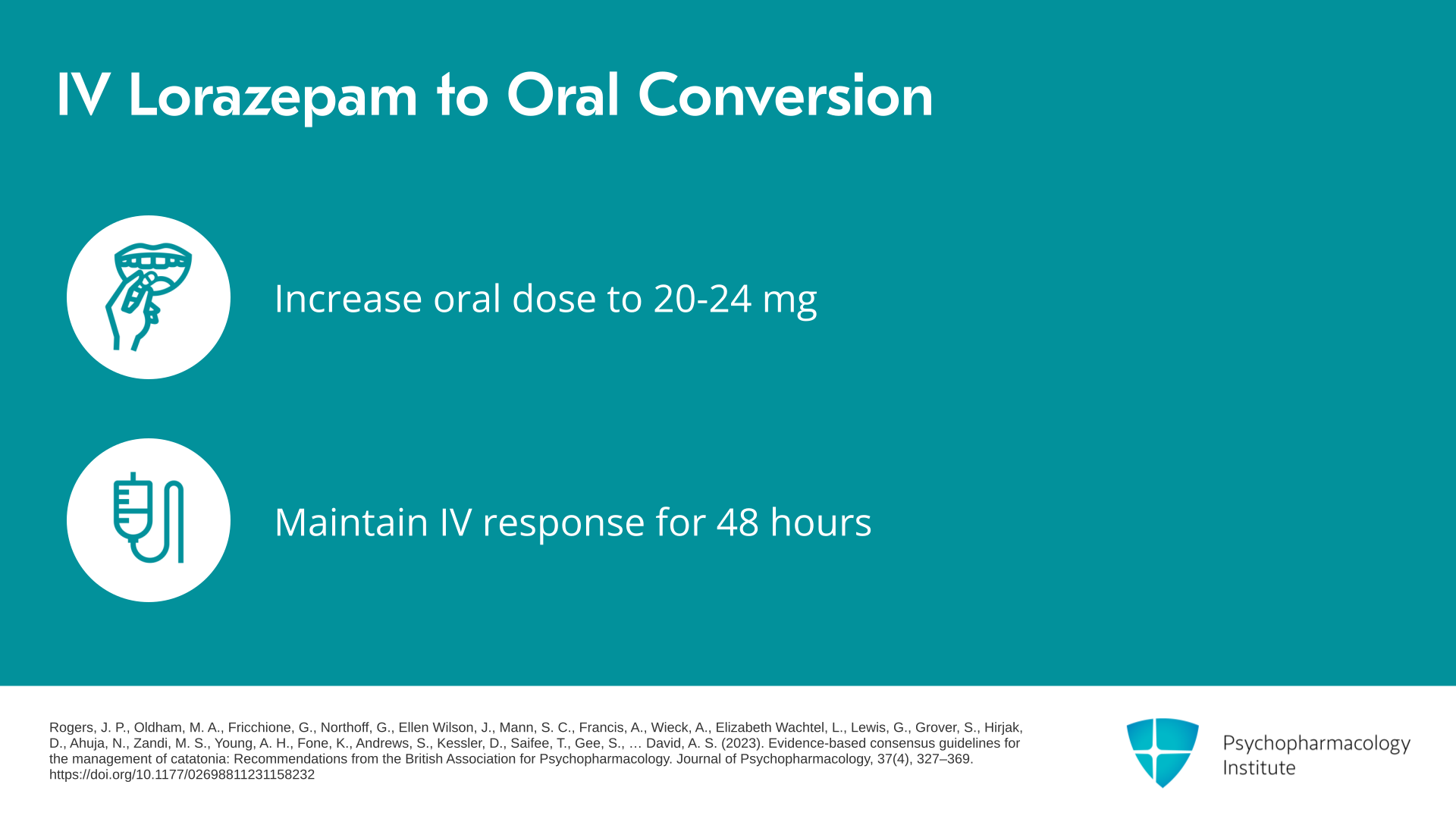
The other thing that I would highlight in terms of tapering on the inpatient setting is that we think of intravenous lorazepam as being sort of twice as potent for catatonia as compared to oral lorazepam. So when you’re getting to the point where you want to convert from intravenous lorazepam to oral lorazepam, we will generally increase the dose of the oral lorazepam that we’re using because if we just do a straight conversion from 16 mg a day of IV lorazepam to 16 mg a day of p.o. lorazepam, you may effectively be cutting the dose in half and that may be an increased risk for relapse.
References:
- Rogers, J. P., Oldham, M. A., Fricchione, G., Northoff, G., Ellen Wilson, J., Mann, S. C., Francis, A., Wieck, A., Elizabeth Wachtel, L., Lewis, G., Grover, S., Hirjak, D., Ahuja, N., Zandi, M. S., Young, A. H., Fone, K., Andrews, S., Kessler, D., Saifee, T., Gee, S., … David, A. S. (2023). Evidence-based consensus guidelines for the management of catatonia: Recommendations from the British Association for Psychopharmacology. Journal of Psychopharmacology, 37(4), 327–369. https://doi.org/10.1177/02698811231158232
Free Files
Download PDF and other files
Success!
Check your inbox, we sent you all the materials there.
Slide 21 of 24
So in that case, we will often bump up the p.o. dose to something like 20 or 24 mg of p.o. lorazepam a day before we continue the gradual taper using oral lorazepam. Generally, on the inpatient settings, when you’re thinking about converting from intravenous to p.o. lorazepam, you want to have had a sustained response for about 48 hours on intravenous lorazepam before you would even think about making that conversion.
References:
- Rogers, J. P., Oldham, M. A., Fricchione, G., Northoff, G., Ellen Wilson, J., Mann, S. C., Francis, A., Wieck, A., Elizabeth Wachtel, L., Lewis, G., Grover, S., Hirjak, D., Ahuja, N., Zandi, M. S., Young, A. H., Fone, K., Andrews, S., Kessler, D., Saifee, T., Gee, S., … David, A. S. (2023). Evidence-based consensus guidelines for the management of catatonia: Recommendations from the British Association for Psychopharmacology. Journal of Psychopharmacology, 37(4), 327–369. https://doi.org/10.1177/02698811231158232
Slide 22 of 24
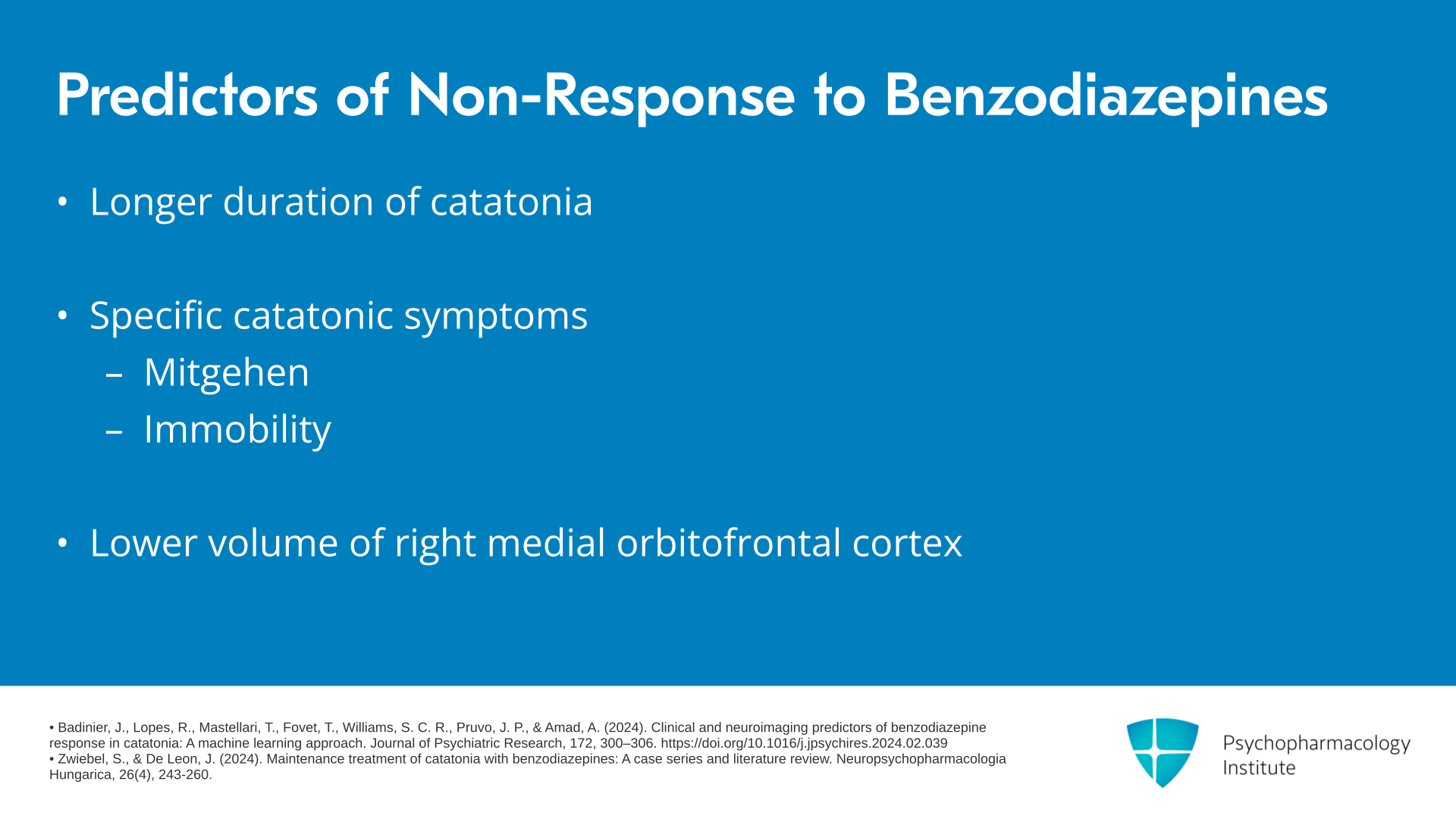
Some newer data on benzodiazepines have suggested that a few additional predictors of nonresponse to benzodiazepines may include a longer duration of catatonia. That’s been thought to be the case for a while. The presence of mitgehen or immobility specifically may predict nonresponse to benzodiazepines. And then data that you’re unlikely to have but is important for research purposes is that a lower volume of the right medial orbitofrontal cortex has also been suggested to be a predictor of nonresponse to benzodiazepines.
References:
- Badinier, J., Lopes, R., Mastellari, T., Fovet, T., Williams, S. C. R., Pruvo, J. P., & Amad, A. (2024). Clinical and neuroimaging predictors of benzodiazepine response in catatonia: A machine learning approach. Journal of Psychiatric Research, 172, 300–306. https://doi.org/10.1016/j.jpsychires.2024.02.039
- Zwiebel, S., & De Leon, J. (2024). Maintenance treatment of catatonia with benzodiazepines: A case series and literature review. Neuropsychopharmacologia Hungarica, 26(4), 243-260.
Free Files
Download PDF and other files
Success!
Check your inbox, we sent you all the materials there.
Slide 23 of 24
To summarize, some key points from this section: Benzodiazepines especially lorazepam and diazepam really remain the first-line treatment strategies for catatonia. Benzodiazepines should be tapered slowly rather than abruptly stopped in order to mitigate against worsening or recurrence.
Slide 24 of 24
Patients with a longer duration of catatonia, those demonstrating mitgehen or immobility and those with a lower volume of the right medial orbitofrontal cortex may be less likely to respond to benzodiazepines.
Free Files
Download PDF and other files
Success!
Check your inbox, we sent you all the materials there.
