Close Banner
Section Free  - Video Lectures

05. Cannabidiol: Evidence for Psychiatric Disorders and Recommendations for Using It

Published on November 1, 2023 Certification expiration date: November 1, 2026

David Mischoulon, M.D., Ph.D.

Professor of Psychiatry - Harvard Medical School

Key Points

  • CBD is an increasingly popular drug with potential psychiatric applications.
  • Be cautious when using CBD in individuals with certain medical conditions and women who are pregnant or breastfeeding.
  • Be cautious if a patient uses a CBD preparation containing THC.

Free Downloads for Offline Access

  • Free Download Presentation File (PPTX)
  • Free Download Audio File (MP3)
  • Free Download Video (MP4)

Slides and Transcript

Slide 1 of 16

Now, we'll talk about cannabidiol or CBD. This is an increasingly popular drug which has some evidence as potentially useful for psychiatric disorders. So we'll talk about that and about recommendations.

Slide 2 of 16

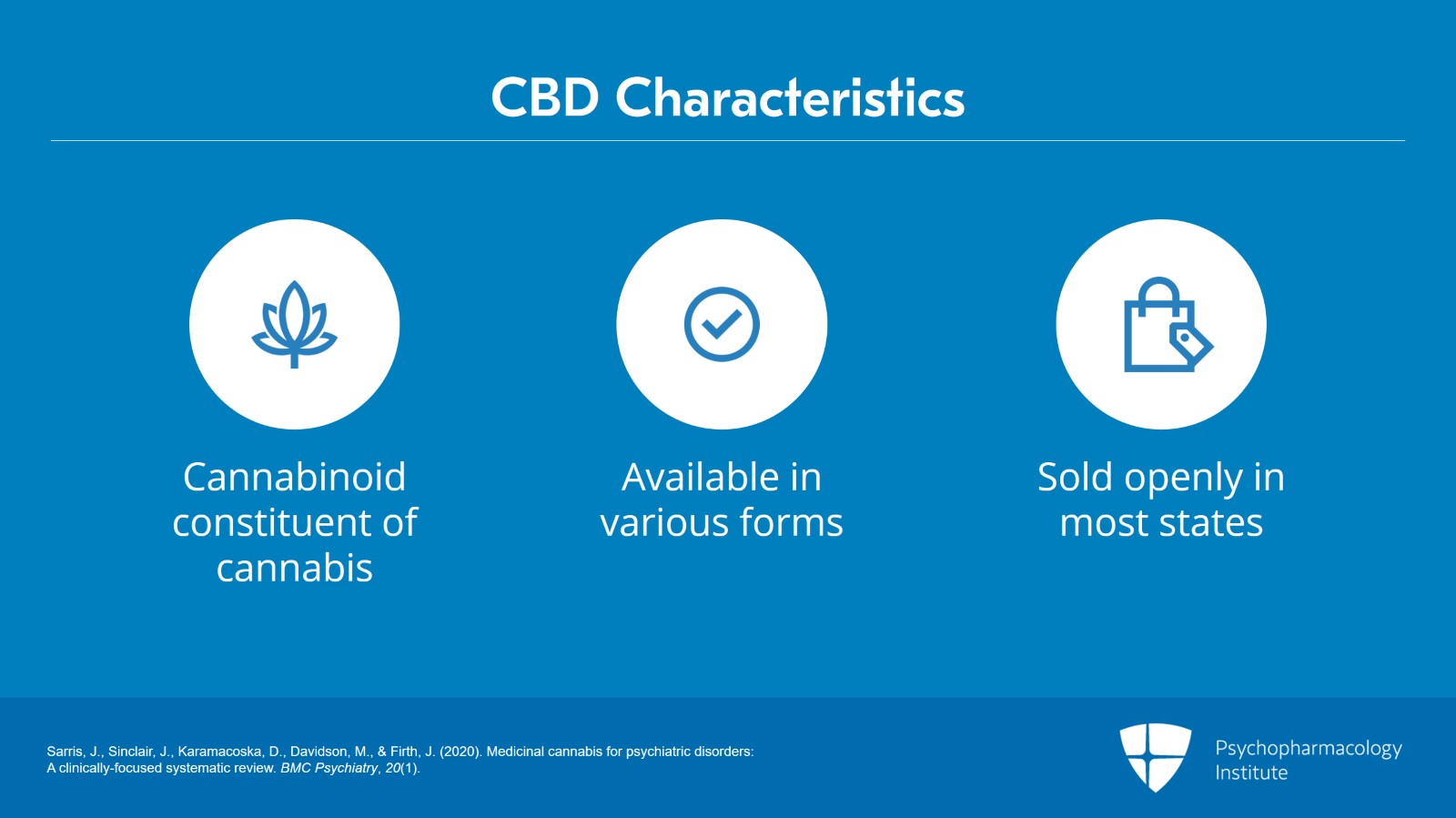
CBD represents the cannabinoid constituent of cannabis or marijuana. It is sold in various different forms, for example, an oil that contains only CBD but no THC. It may also be obtained as a full plant CBD-dominant extract oil or it may be bought in capsule form in dried cannabis or as a liquid solution. It is sold openly in most states and is increasingly accessible to the general public.
References:
  • Sarris, J., Sinclair, J., Karamacoska, D., Davidson, M., & Firth, J. (2020). Medicinal cannabis for psychiatric disorders: A clinically-focused systematic review. BMC Psychiatry, 20(1).
Free Files
Success!
Check your inbox, we sent you all the materials there.

Slide 3 of 16

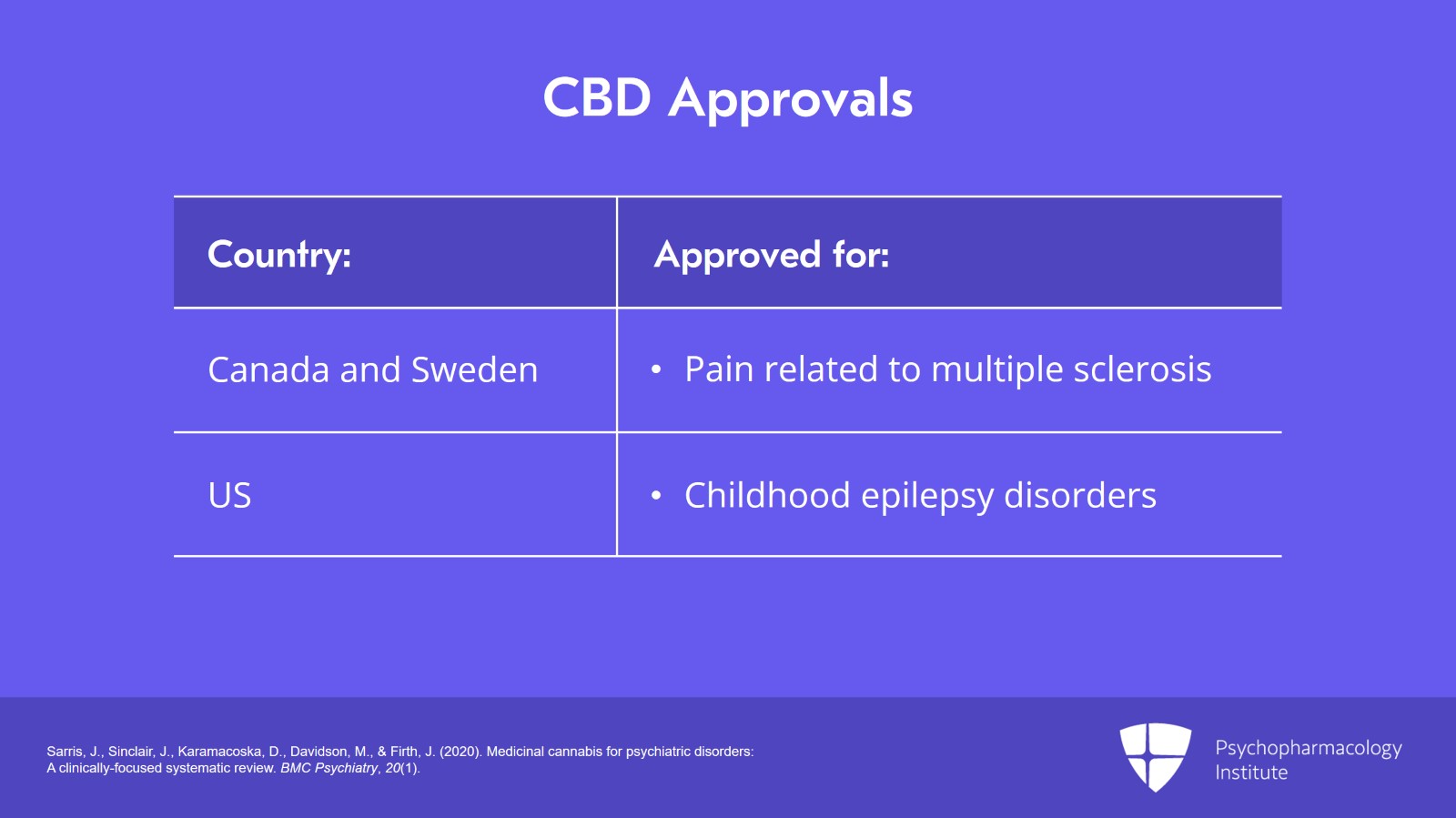
Interestingly, CBD is approved for treatment of certain medical conditions. For example, in Canada and Sweden, it's approved for treating pain related to multiple sclerosis. In the US, CBD is approved for certain childhood epilepsy disorders.
References:
  • Sarris, J., Sinclair, J., Karamacoska, D., Davidson, M., & Firth, J. (2020). Medicinal cannabis for psychiatric disorders: A clinically-focused systematic review. BMC Psychiatry, 20(1).

Slide 4 of 16

CBD is thought to work by multiple mechanisms including serotonergic ones. Thus, it may have applications in different psychiatric disorders.
References:
  • Sarris, J., Sinclair, J., Karamacoska, D., Davidson, M., & Firth, J. (2020). Medicinal cannabis for psychiatric disorders: A clinically-focused systematic review. BMC Psychiatry, 20(1).
Free Files
Success!
Check your inbox, we sent you all the materials there.

Slide 5 of 16

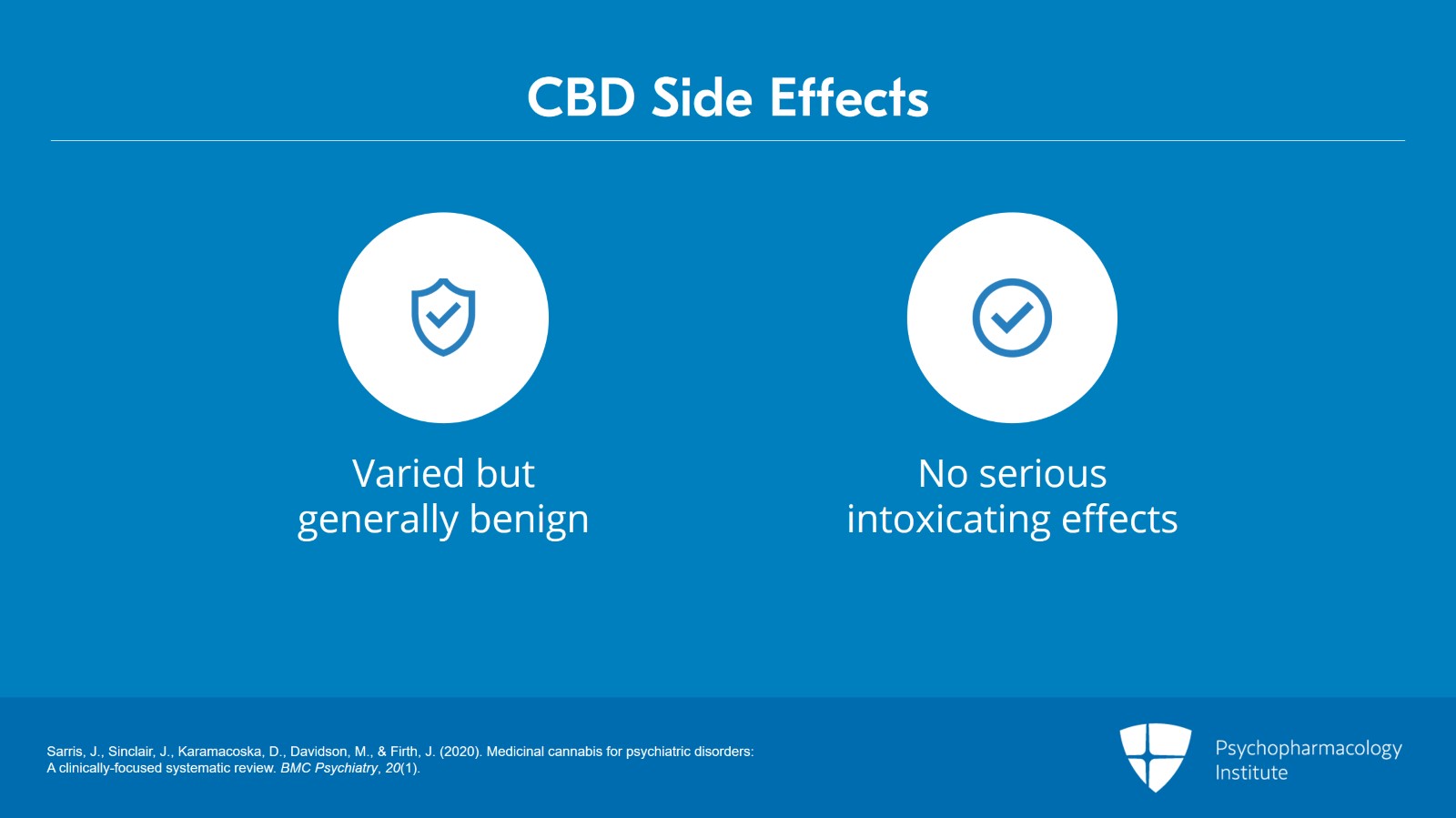
Its side effects are varied but generally benign. Sleepiness has been reported as has decreased appetite, diarrhea, fatigue, malaise, weakness, and insomnia. However, no serious intoxicating effects have been reported.
References:
  • Sarris, J., Sinclair, J., Karamacoska, D., Davidson, M., & Firth, J. (2020). Medicinal cannabis for psychiatric disorders: A clinically-focused systematic review. BMC Psychiatry, 20(1).

Slide 6 of 16

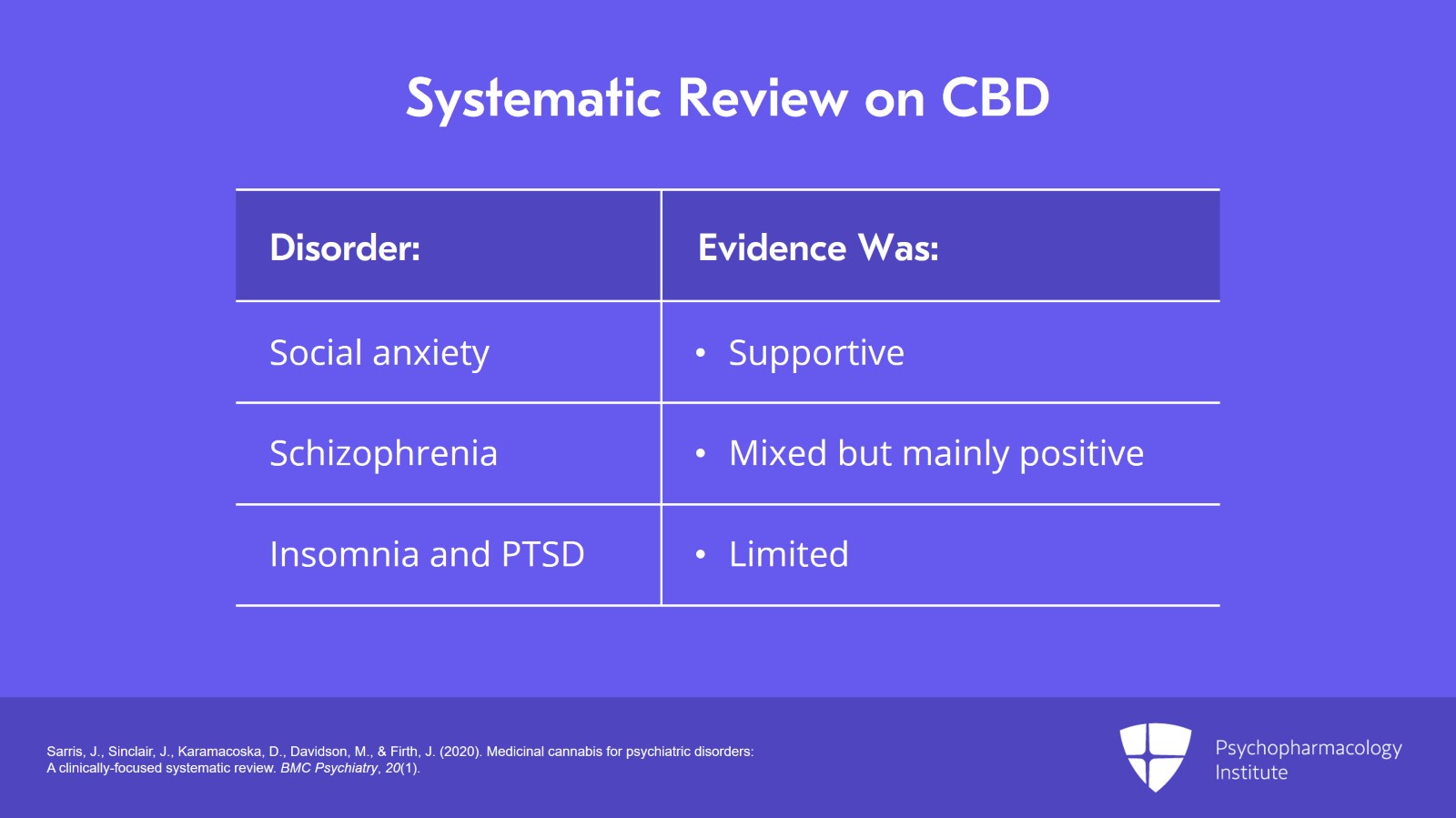
There has been a recent systematic review of cannabis products by Jerome Sarris and colleagues and I'll summarize the key points from this review. By and large, the review was supportive of CBD as potentially helping to reduce symptoms of social anxiety. For other conditions such as schizophrenia, the evidence was mixed but mainly positive. There was also limited evidence for CBD in terms of treatment of insomnia and PTSD.
References:
  • Sarris, J., Sinclair, J., Karamacoska, D., Davidson, M., & Firth, J. (2020). Medicinal cannabis for psychiatric disorders: A clinically-focused systematic review. BMC Psychiatry, 20(1).
Free Files
Success!
Check your inbox, we sent you all the materials there.

Slide 7 of 16

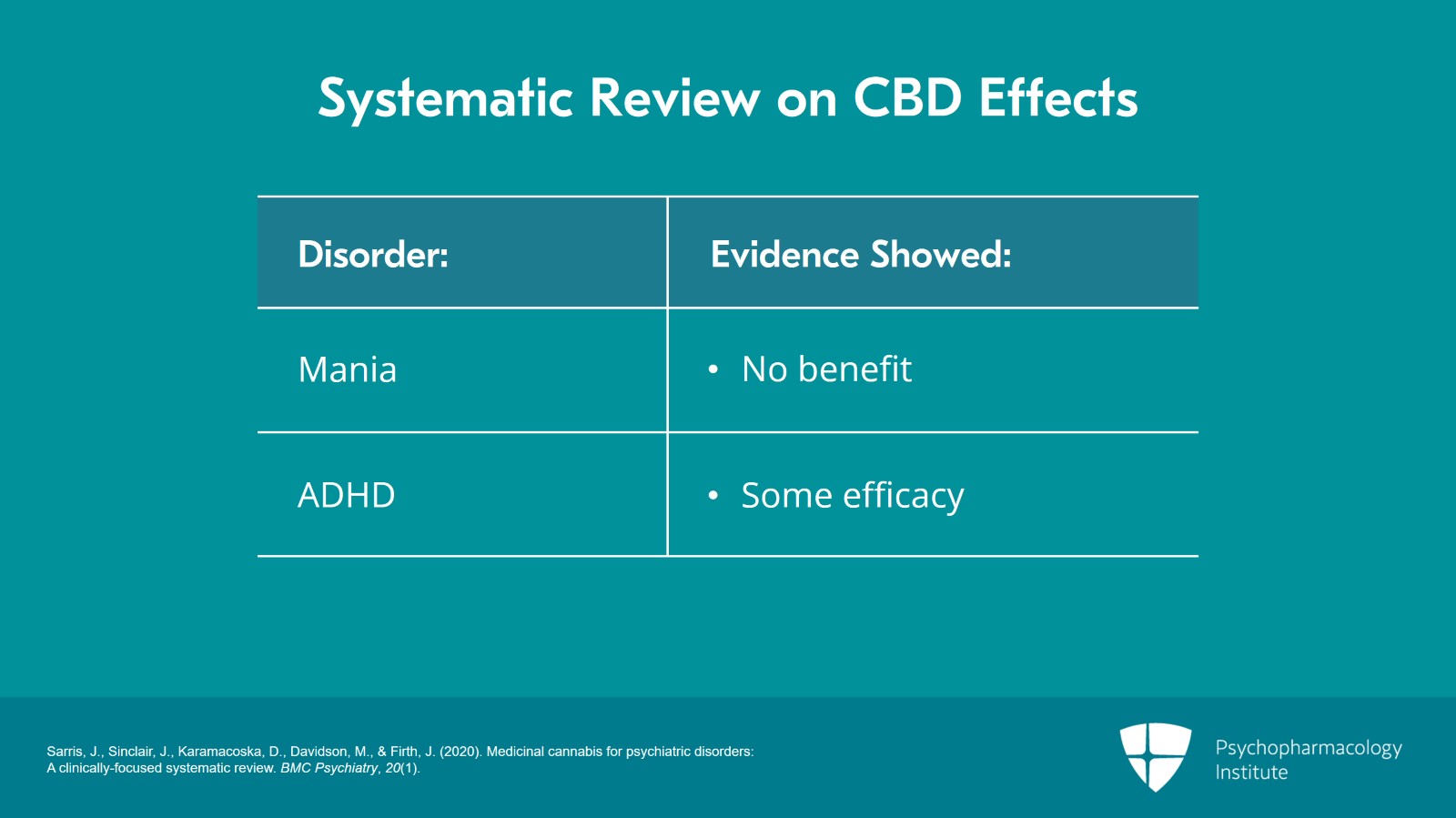
There was no evidence of benefit for CBD in mania. Finally, there was some evidence of efficacy for an oral combination of cannabinoids and terpenes in ADHD.
References:
  • Sarris, J., Sinclair, J., Karamacoska, D., Davidson, M., & Firth, J. (2020). Medicinal cannabis for psychiatric disorders: A clinically-focused systematic review. BMC Psychiatry, 20(1).

Slide 8 of 16

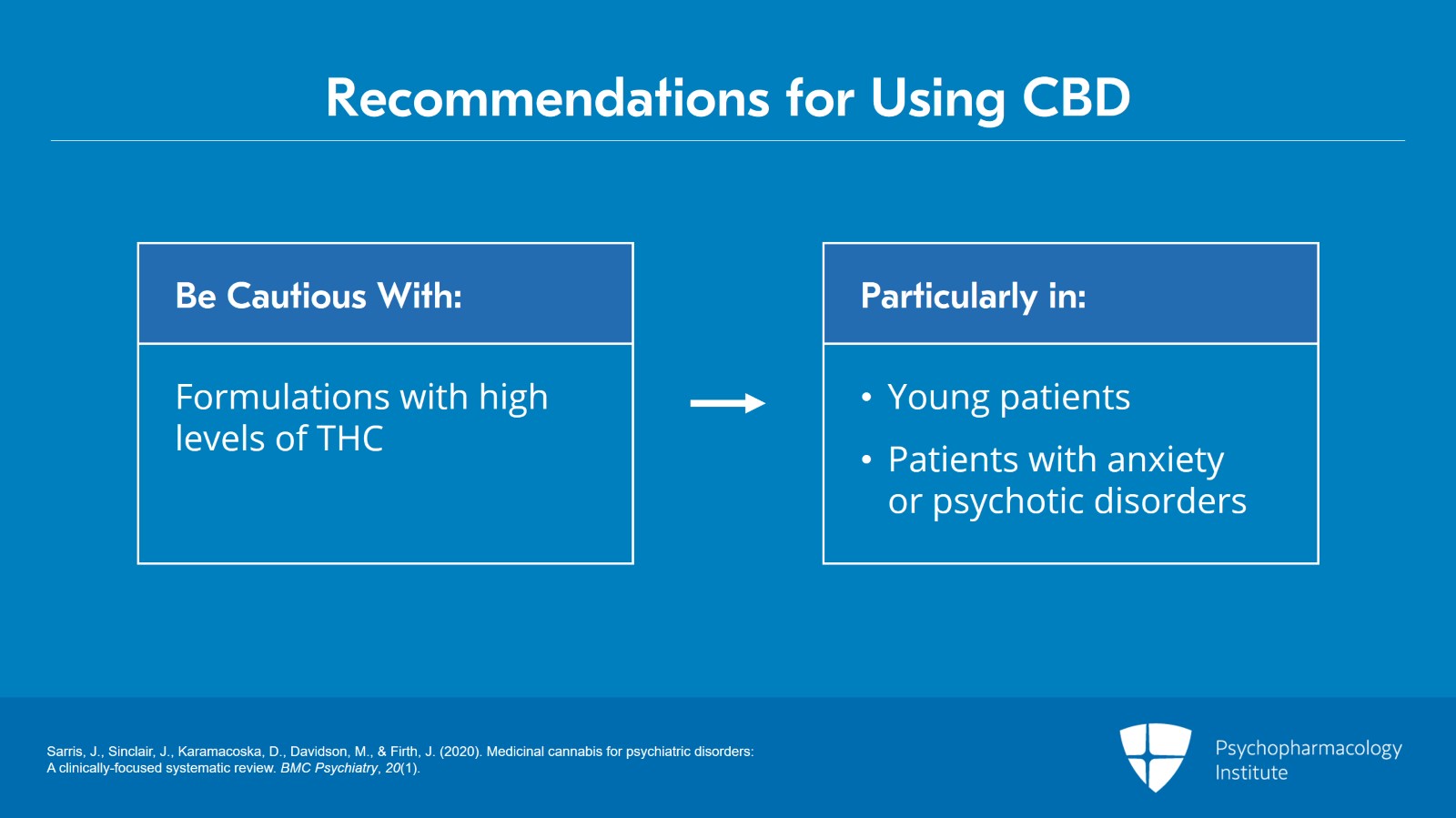
What recommendations can we make regarding CBD? By and large, caution should be exercised with any formulations that include high levels of THC which can be more intoxicating. This is particularly important if it's a young person using it or somebody with an anxious or psychotic disorder.
References:
  • Sarris, J., Sinclair, J., Karamacoska, D., Davidson, M., & Firth, J. (2020). Medicinal cannabis for psychiatric disorders: A clinically-focused systematic review. BMC Psychiatry, 20(1).
Free Files
Success!
Check your inbox, we sent you all the materials there.

Slide 9 of 16

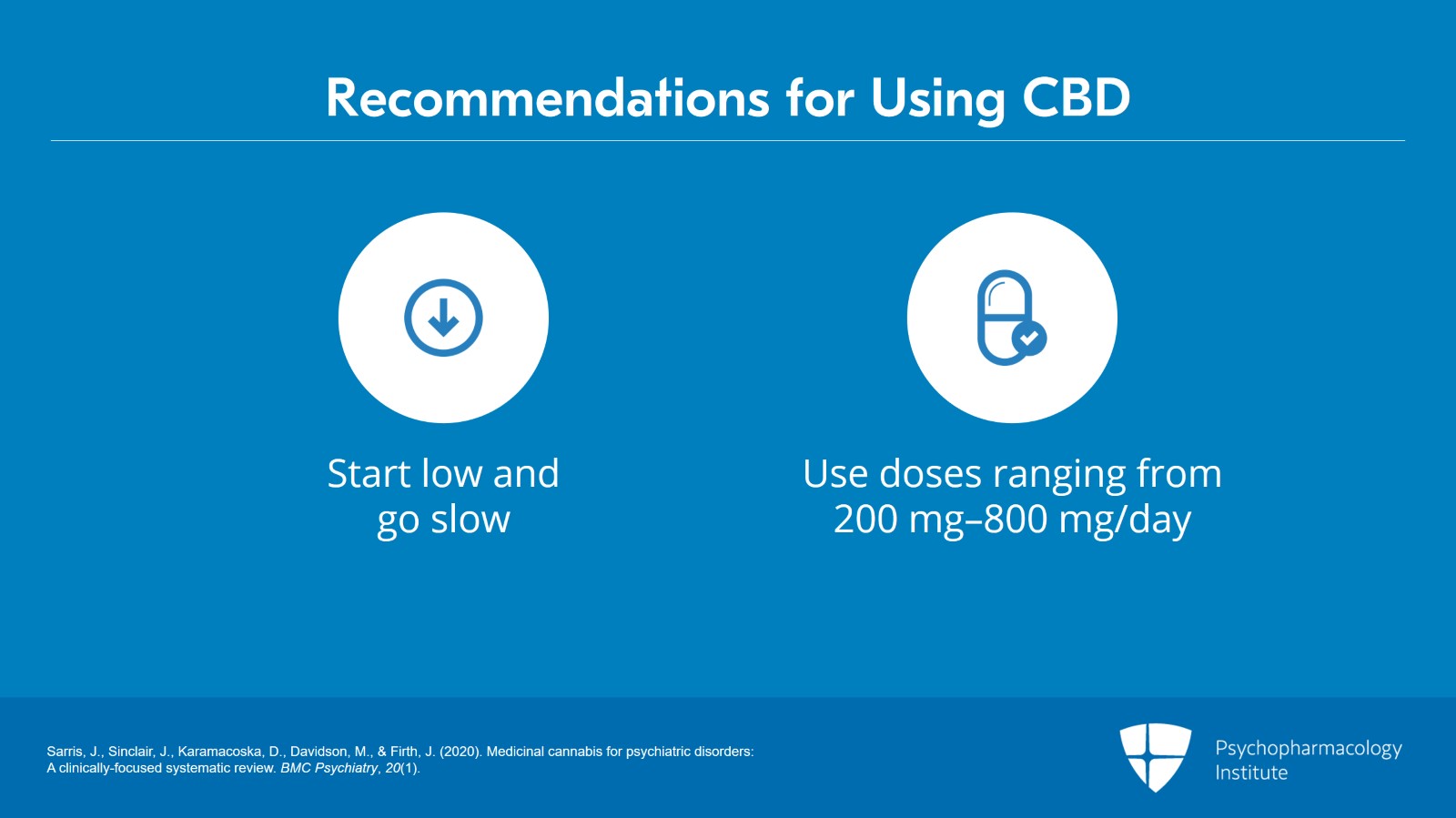
As with many of these drugs, it's recommended to start low and go slow, titrate gradually. Dosing of CBD can be complex depending on the type of formulation and delivery system that you're using. Research reports have generally focused on doses ranging from 200 to 800 mg a day so it may make sense to start somewhere in that range.
References:
  • Sarris, J., Sinclair, J., Karamacoska, D., Davidson, M., & Firth, J. (2020). Medicinal cannabis for psychiatric disorders: A clinically-focused systematic review. BMC Psychiatry, 20(1).

Slide 10 of 16

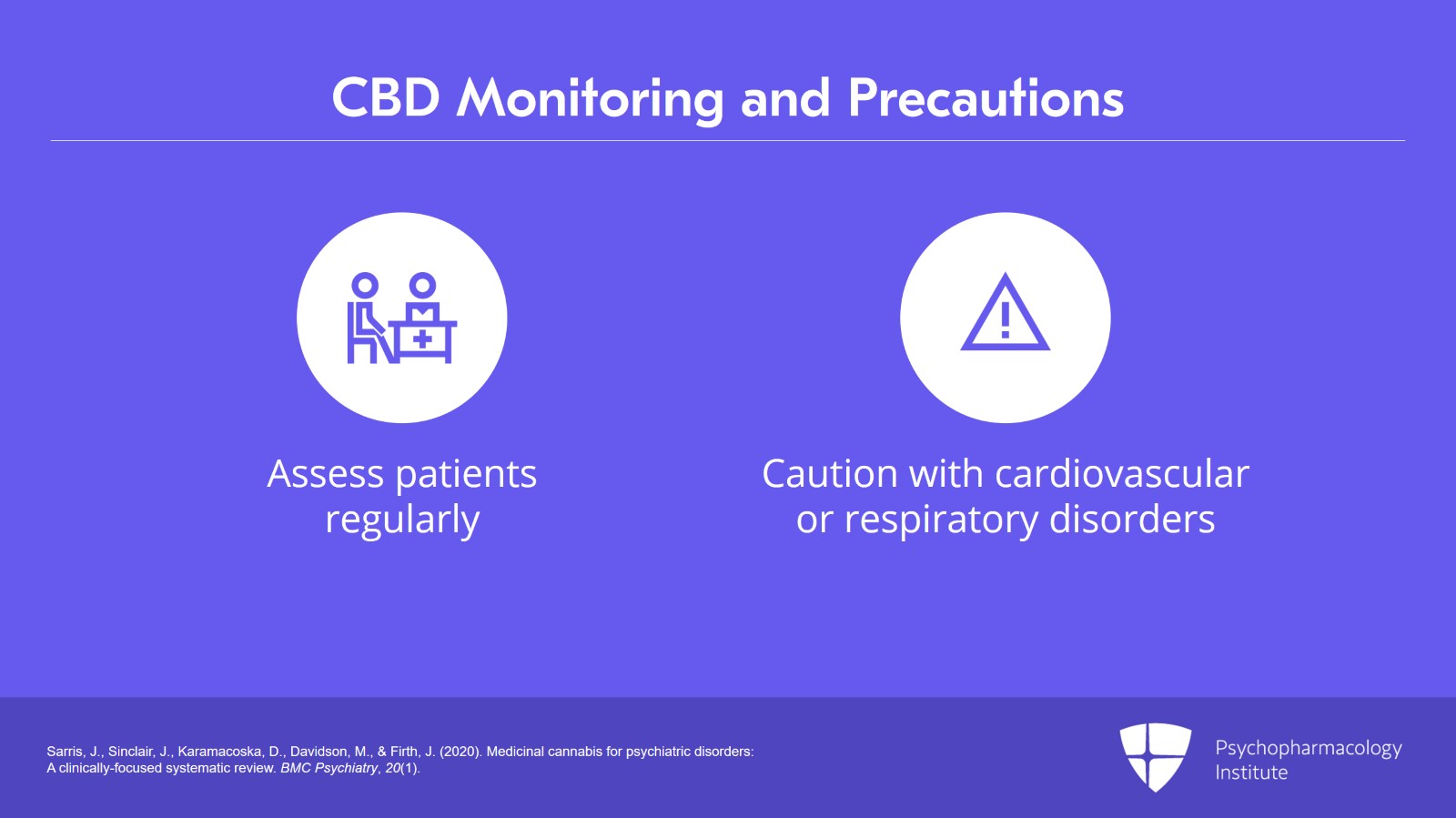
A patient receiving CBD should be regularly assessed by their psychiatrist to make sure that they are doing okay and not having any potential adverse effects. It is advisable to exercise caution in people with cardiovascular or respiratory disorders.
References:
  • Sarris, J., Sinclair, J., Karamacoska, D., Davidson, M., & Firth, J. (2020). Medicinal cannabis for psychiatric disorders: A clinically-focused systematic review. BMC Psychiatry, 20(1).
Free Files
Success!
Check your inbox, we sent you all the materials there.

Slide 11 of 16

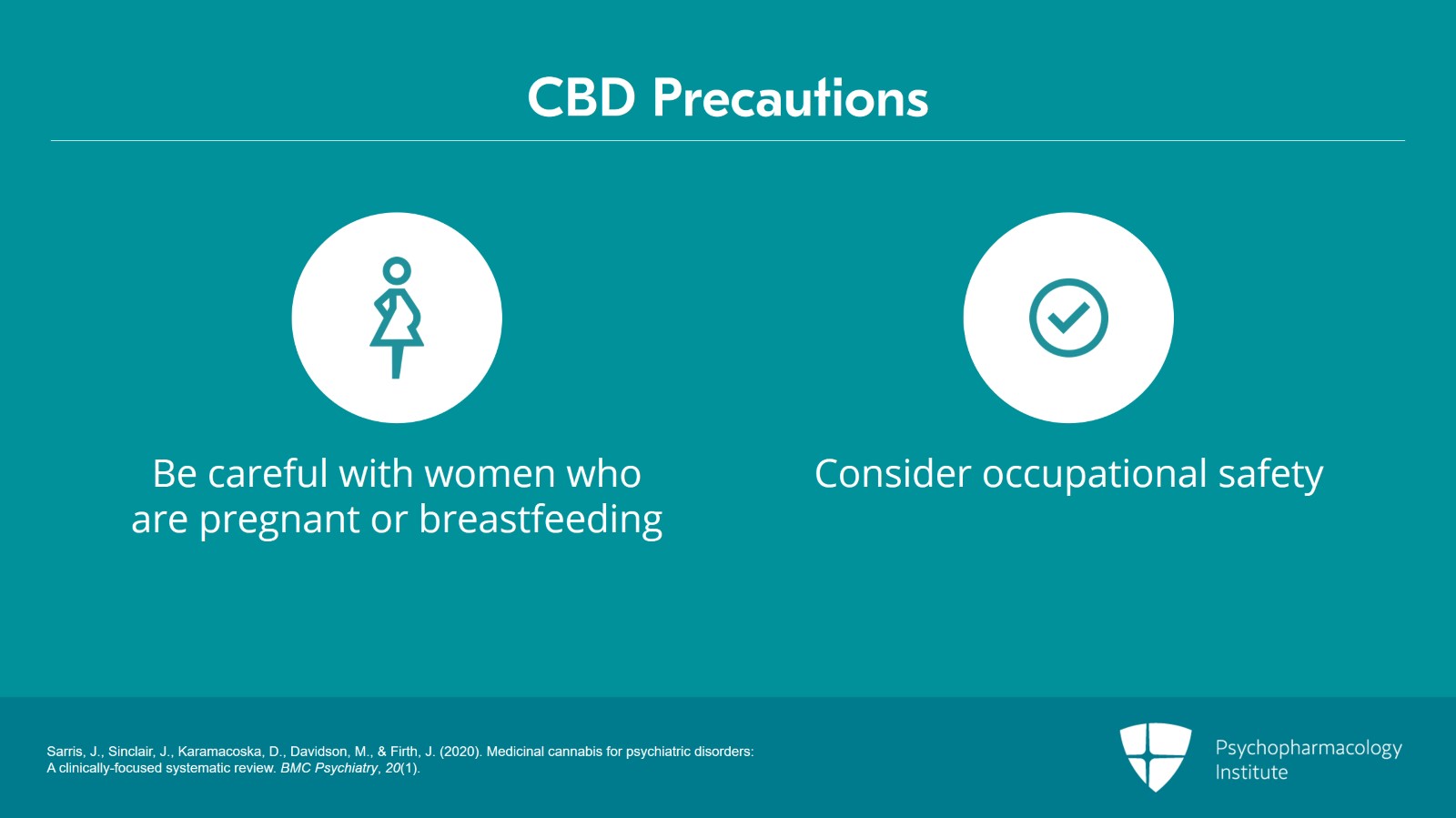
And likewise it's important to be very careful in women who are pregnant or breastfeeding. Finally, it's important to take into account occupational safety. If the individual, for example, works with heavy machinery in a job where they could injure themselves or other people, it's important to make sure that they are not impaired in any way when at work.
References:
  • Sarris, J., Sinclair, J., Karamacoska, D., Davidson, M., & Firth, J. (2020). Medicinal cannabis for psychiatric disorders: A clinically-focused systematic review. BMC Psychiatry, 20(1).

Slide 12 of 16

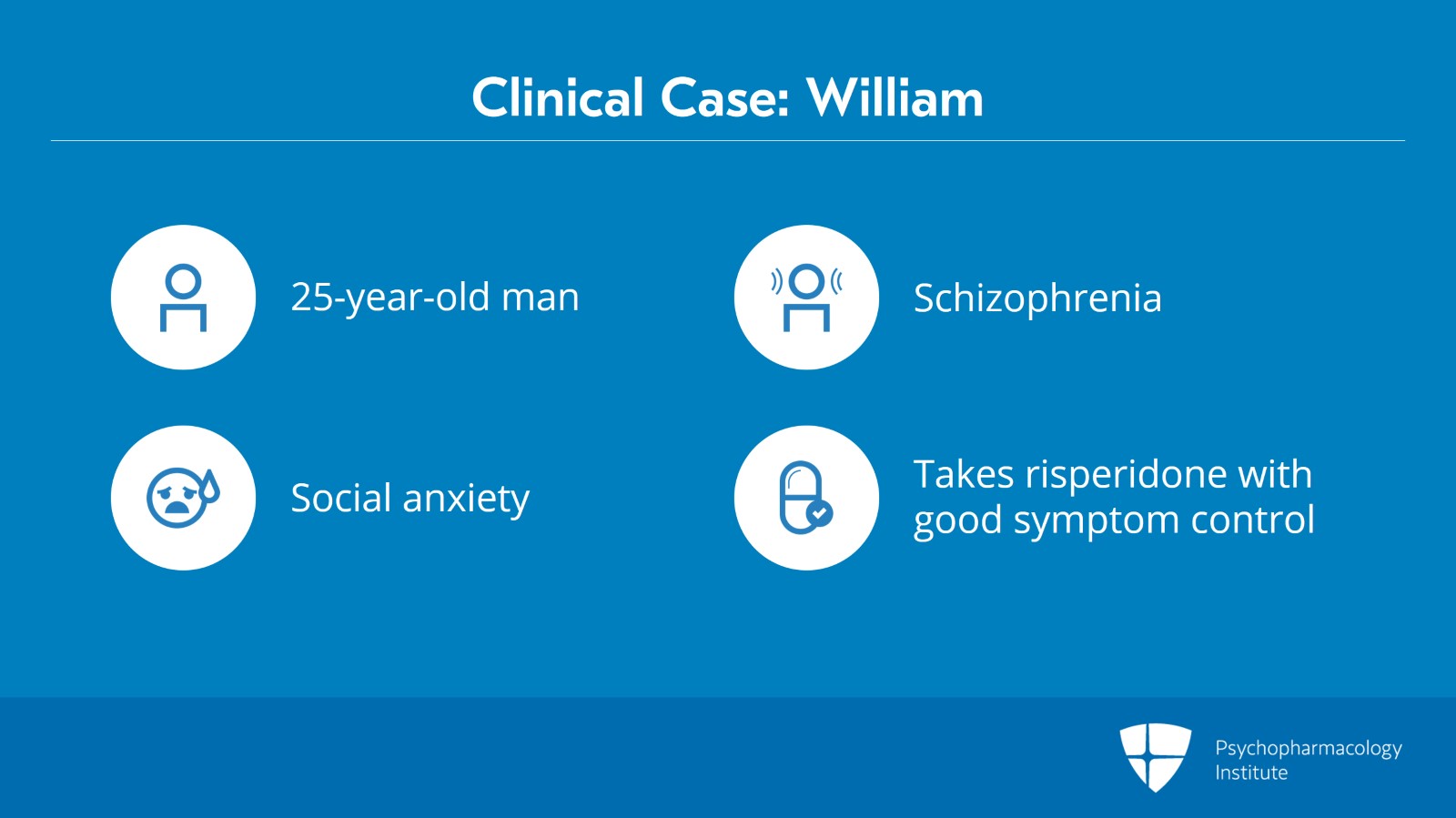
To illustrate the potential use of CBD, we'll look at our third patient whom we'll call William. So William is a 25-year-old man with schizophrenia. His condition manifests in part by social anxiety especially in larger groups such as in the day program where he participates. He takes risperidone which controls his symptoms pretty well but he is unable to tolerate higher doses because he gets side effects.
Free Files
Success!
Check your inbox, we sent you all the materials there.

Slide 13 of 16

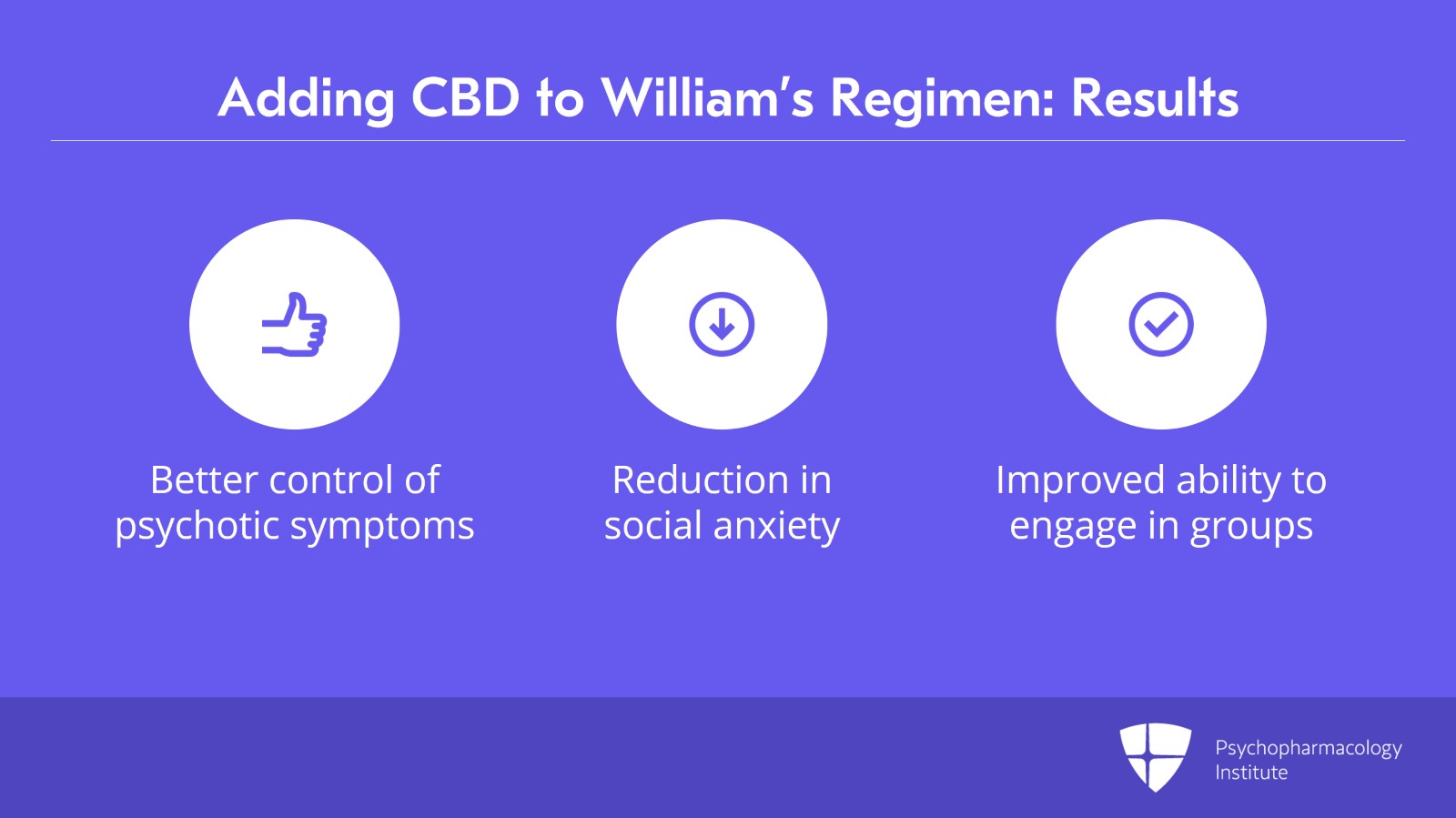
His psychiatrist added a low dose of CBD to his regimen and the result of this was better control of his psychotic symptoms, a notable reduction in social anxiety and the ability to engage a little better when participating in the groups in his day program.

Slide 14 of 16

I'll summarize this section with three key points. CBD is an increasingly popular drug with potential psychiatric applications including in some anxiety and psychotic disorders. Nonetheless, caution is required when using CBD particularly in individuals who have certain medical conditions and also caution should be exercised in women who are pregnant or breastfeeding. 
Free Files
Success!
Check your inbox, we sent you all the materials there.

Slide 15 of 16

Finally, particular caution needs to be taken if a patient is using a CBD preparation that contains THC which could pose the risk of more serious adverse effects. 

Slide 16 of 16

Free Files
Success!
Check your inbox, we sent you all the materials there.

Learning Objectives:

After completing this activity, the learner will be able to:

  • Evaluate the evidence-based applications and benefits of natural medication in psychiatric treatments.
  • Analyze the potential risks and side effects of using natural medication in psychiatric treatments.
  • Identify potential combinations of natural remedies and acquire strategies to optimize their use in psychiatric care.

Original Release Date: November 1, 2023

Review and Re-release Date: March 1, 2024

Expiration Date: November 1, 2026

Expert: David Mischoulon, M.D.

Medical Editor: Paz Badía, M.D.

Relevant Financial Disclosures: 

David Mischoulon declares the following interests:

- Nordic Naturals:  Received research support (medication and placebo for a study)

- heckel medizintechnik GmbH:  Received research support (Whole Body Hyperthermia device for research study)

- MGH Clinical Trials Network and Institute (CTNI):  Received salary support

All of the relevant financial relationships listed above have been mitigated by Medical Academy and the Psychopharmacology Institute.

None of the others faculty, planners, and reviewers for this educational activity have relevant financial relationships to disclose during the last 24 months with ineligible companies whose primary business is producing, marketing, selling, re-selling, or distributing healthcare products used by or on patients.

Contact Information: For questions regarding the content or access to this activity, contact us at support@psychopharmacologyinstitute.com

Instructions for Participation and Credit:

Participants must complete the activity online during the valid credit period that is noted above.

Follow these steps to earn CME credit:

  1. View the required educational content provided on this course page.

  2. Complete the Post Activity Evaluation for providing the necessary feedback for continuing accreditation purposes and for the development of future activities. NOTE: Completing the Post Activity Evaluation after the quiz is required to receive the earned credit.

  3. Download your certificate.

Accreditation Statement

This activity has been planned and implemented in accordance with the accreditation requirements and policies of the Accreditation Council for Continuing Medical Education through the joint providership of Medical Academy LLC and the Psychopharmacology Institute. Medical Academy is accredited by the ACCME to provide continuing medical education for physicians.

Credit Designation Statement

Medical Academy designates this enduring activity for a maximum of 0.75 AMA PRA Category 1 credit(s)™. Physicians should claim only the credit commensurate with the extent of their participation in the activity.


Free Files
Success!
Check your inbox, we sent you all the materials there.
Continue in the website
Instant access modal

Become a Bronze, Silver, Gold, Bronze extended, Silver extended or Gold extended Member.

2025–26 Psychopharmacology CME Program

Unlock up to 155 CME Credits, including 40 SA CME Credits.