Slides and Transcript
Slide 1 of 8
Bipolar emergencies in pregnancy. So unfortunately, these can and will occur in pregnancy.
Slide 2 of 8
Of primary importance in this topic area is suicidality.
Women with a diagnosis of bipolar disorder have a higher risk for suicide and are more likely to die by suicide during pregnancy than women with unipolar depression.
Perinatal suicide is also higher in women with a history of suicide attempts, abrupt discontinuation of these psychotropic medications during pregnancy who are experiencing inter-partner violence and who have a stillbirth.
References:
- Khalifeh, H., Hunt, I. M., Appleby, L., & Howard, L. M. (2016). Suicide in perinatal and non-perinatal women in contact with psychiatric services: 15 year findings from a UK national inquiry. The Lancet Psychiatry, 3(3), 233-242.
- Appleby, L. (1991). Suicide during pregnancy and in the first postnatal year. BMJ, 302(6769), 137-140.
- Palladino, C. L., Singh, V., Campbell, J., Flynn, H., & Gold, K. J. (2012). Homicide and suicide during the perinatal period. Obstetrics & Gynecology, 119(6), 1275-1276.
Free Files
Download PDF and other files
Success!
Check your inbox, we sent you all the materials there.
Slide 3 of 8
Suicide prevention requires early screening, assessment, monitoring and intervention of all patients in the perinatal period regardless of emotional affect and appearance.
So assessment for suicidality, if you’ve used the EPDS, you want to follow up on question 10 about self-harm. And also, if you used the PHQ-9, it’s the last question on that questionnaire. You want to be scanning for that answer to that question before you let the patient out of the office so you can address that. And then of course, asking directly.
So assessment of suicide risk is necessary to determine whether a patient requires emergent hospitalization or can continue outpatient care. Assessment for suicidality in pregnancy is not different than that in standard of care in general.
References:
- American Psychiatric Association. (2003). Practice guidelines for the assessment and treatment of patients with suicide behaviors. Arlington VA: American Psychiatric Publishing, 31.
Slide 4 of 8
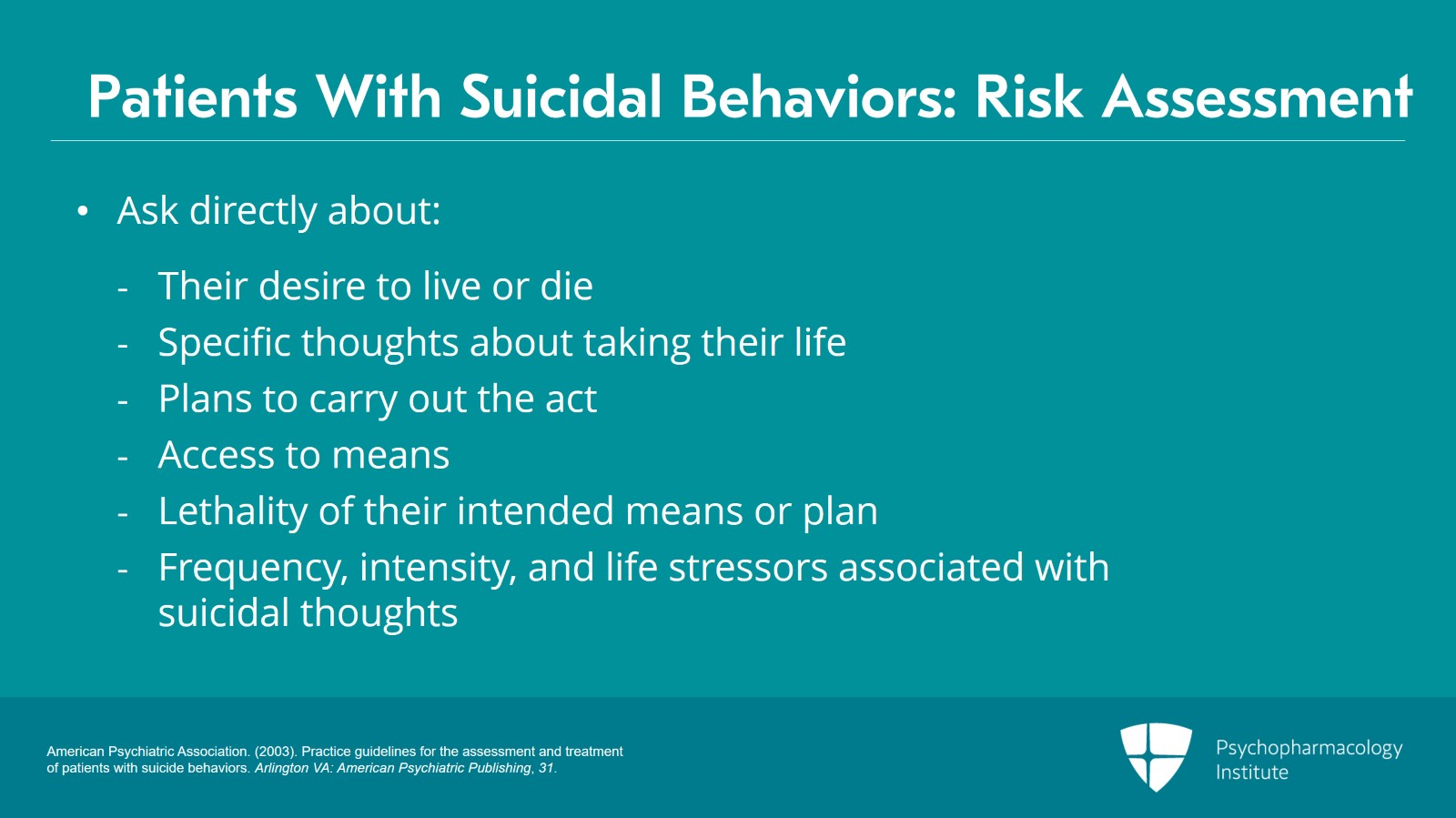
So according to the American Psychiatric Association Practice Guidelines for the assessment and treatment of patients with suicidal behaviors, a suicide risk assessment requires that the provider ask directly about the patient’s desire to live or die, the specific thoughts about taking their life, any plans they have to carry out the act, access to means and finally the lethality of their intended means or plan.
For patients who endorse thoughts of suicide or death, the clinician must ask about frequency, intensity and life stressors associated with those thoughts.
References:
- American Psychiatric Association. (2003). Practice guidelines for the assessment and treatment of patients with suicide behaviors. Arlington VA: American Psychiatric Publishing, 31.
Free Files
Download PDF and other files
Success!
Check your inbox, we sent you all the materials there.
Slide 5 of 8
Contact the woman’s significant other or preferred family member ideally with the patient’s permission to complete a suicide risk assessment for patients who endorse suicidal ideation and to assist in removing any potential suicide methods from the home, guns being one of the most lethal. Stockpiled medications are a frequent plan for patients who are considering ending their life.
And then inform significant others of the potential risk for suicide and give instructions on what to do if risky behaviors develop. This is especially important for patients who have risk factors that include histories of mood or anxiety disorders like our patients with bipolar disorder or have a new onset of a mood disorder or endorse suicidal ideation but who’ll be managed as an outpatient if she’s not at imminent risk that requires inpatient care.
Managing pharmacotherapy and monitoring until further psychiatric assessment is obtained for patients with suicidal ideation who do not endorse a plan or intent and who can identify protective factors against suicide.
So again, that close followup of care and assessment.
As outside of pregnancy, if there is concern for acute or imminent self-harm, the woman needs to be evaluated or directly admitted for inpatient care to maintain her and her baby’s safety and well-being.
References:
- American Psychiatric Association. (2003). Practice guidelines for the assessment and treatment of patients with suicide behaviors. Arlington VA: American Psychiatric Publishing, 31.
Slide 6 of 8
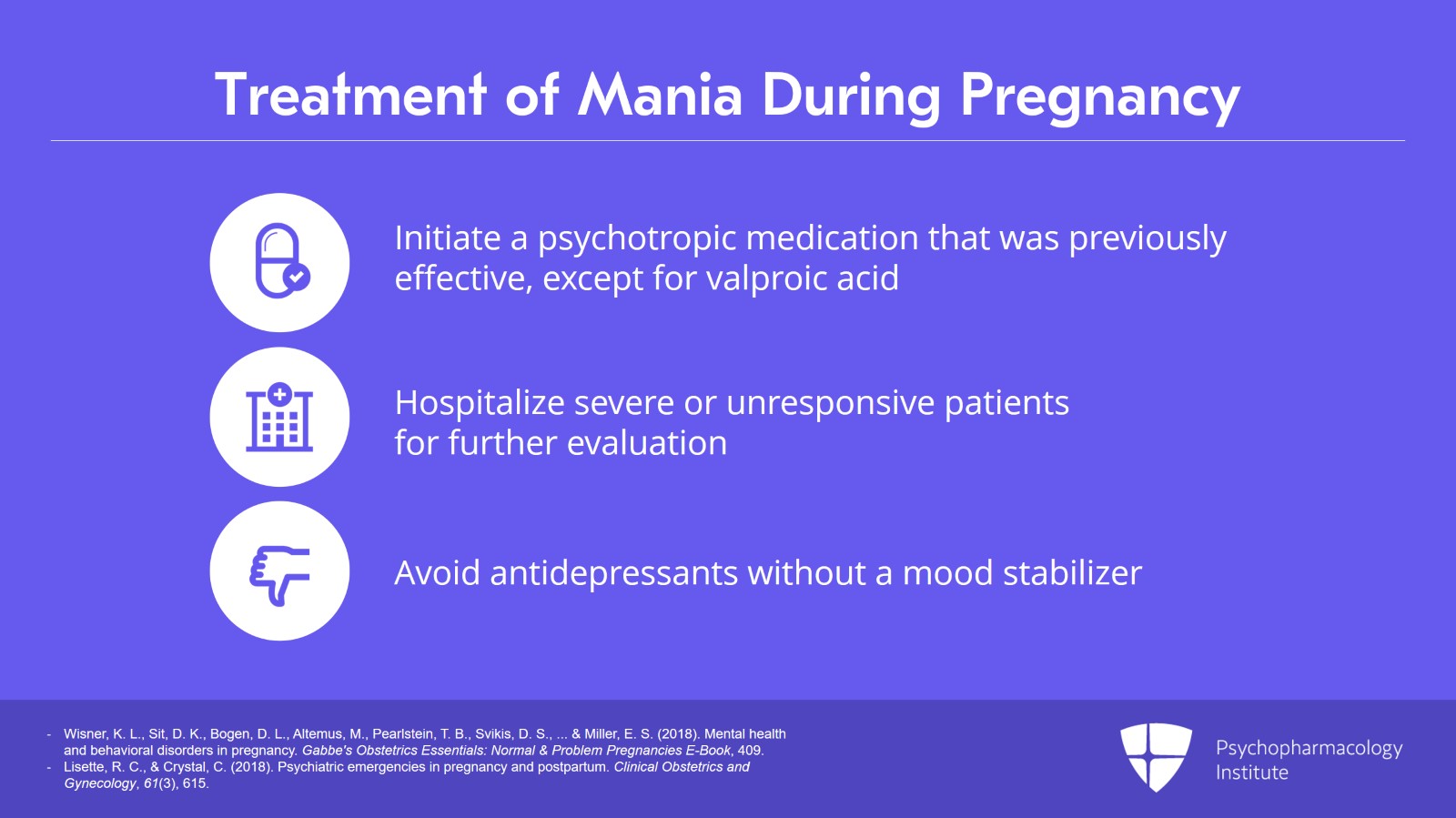
Beyond suicidality, if there is emergent concern for mania, so for women with a prior history of mania, initiate the psychotropic medication regime that has been most effective for that woman. Valproate may be the exception in this case. If there’s concern for safety and effectiveness of treatment or origin of mania, obtain evaluation for hospitalization.
We want to hospitalize severe or medication-unresponsive patients with mania for further evaluation, safety assessment and maintenance and then treatment.
And then complete a workup for treatable physical illnesses potentially as inpatient for a woman who’s manic. And then avoid antidepressants without a mood stabilizer, anti-manic agent in mania.
References:
- Wisner, K. L., Sit, D. K., Bogen, D. L., Altemus, M., Pearlstein, T. B., Svikis, D. S., … & Miller, E. S. (2018). Mental health and behavioral disorders in pregnancy. Gabbe's Obstetrics Essentials: Normal & Problem Pregnancies E-Book, 409.
- Lisette, R. C., & Crystal, C. (2018). Psychiatric emergencies in pregnancy and postpartum. Clinical Obstetrics and Gynecology, 61(3), 615.
Free Files
Download PDF and other files
Success!
Check your inbox, we sent you all the materials there.
Slide 7 of 8
So key points.
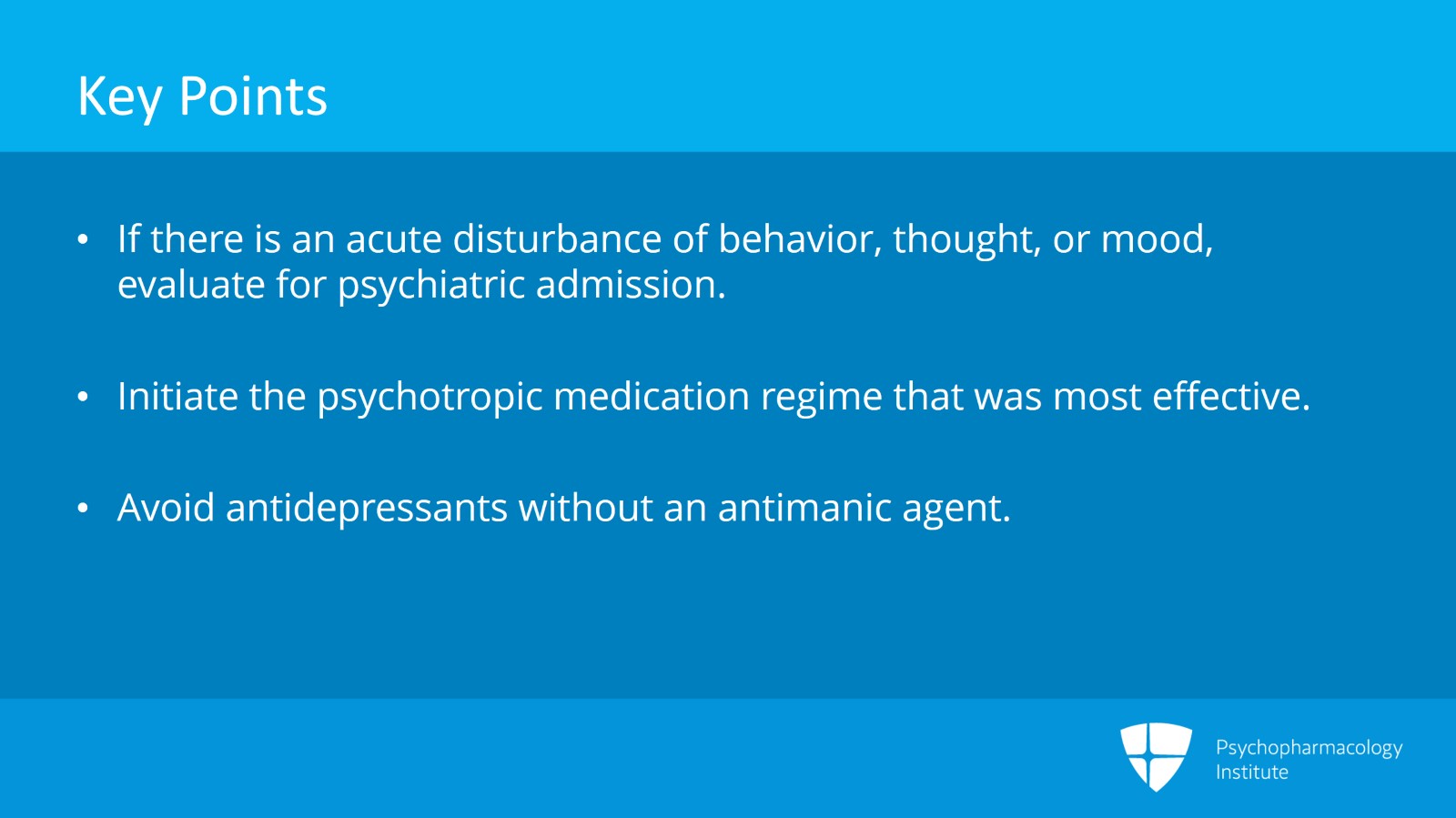
In psychiatric emergencies in pregnancies, if there’s an acute disturbance of behavior, thought or mood which if untreated may lead to harm, the patient should be evaluated for psychiatric admission.
Initiate the psychotropic medication regime that was most effective for that woman.
And again, avoid antidepressants without an anti-manic agent.
Free Files
Download PDF and other files
Success!
Check your inbox, we sent you all the materials there.