Close Banner
Section Free  - Video Lectures

09. Binge Eating Disorder (BED): Diagnosis and Treatment Overview

Published on March 1, 2021 Expired on April 1, 2025

Timothy Brewerton, M.D., D.L.F.A.P.A., F.A.E.D., D.F.A.A.C.A.P., C.E.D.S.-S.

Affiliate Professor of Psychiatry, Director - Medical University of South Carolina in Charleston, SC, USA.

Key Points

  • BED is the most prevalent ED. 
  • The BEDS-7 is a good screening instrument. 
  • A number of psychotropic agents have been found to be effective in BED.

Free Downloads for Offline Access

  • Free Download Video (MP4)
  • Free Download Audio File (MP3)
  • Free Download Presentation File (PPTX)

Slides and Transcript

Slide 1 of 9

Slide 2 of 9

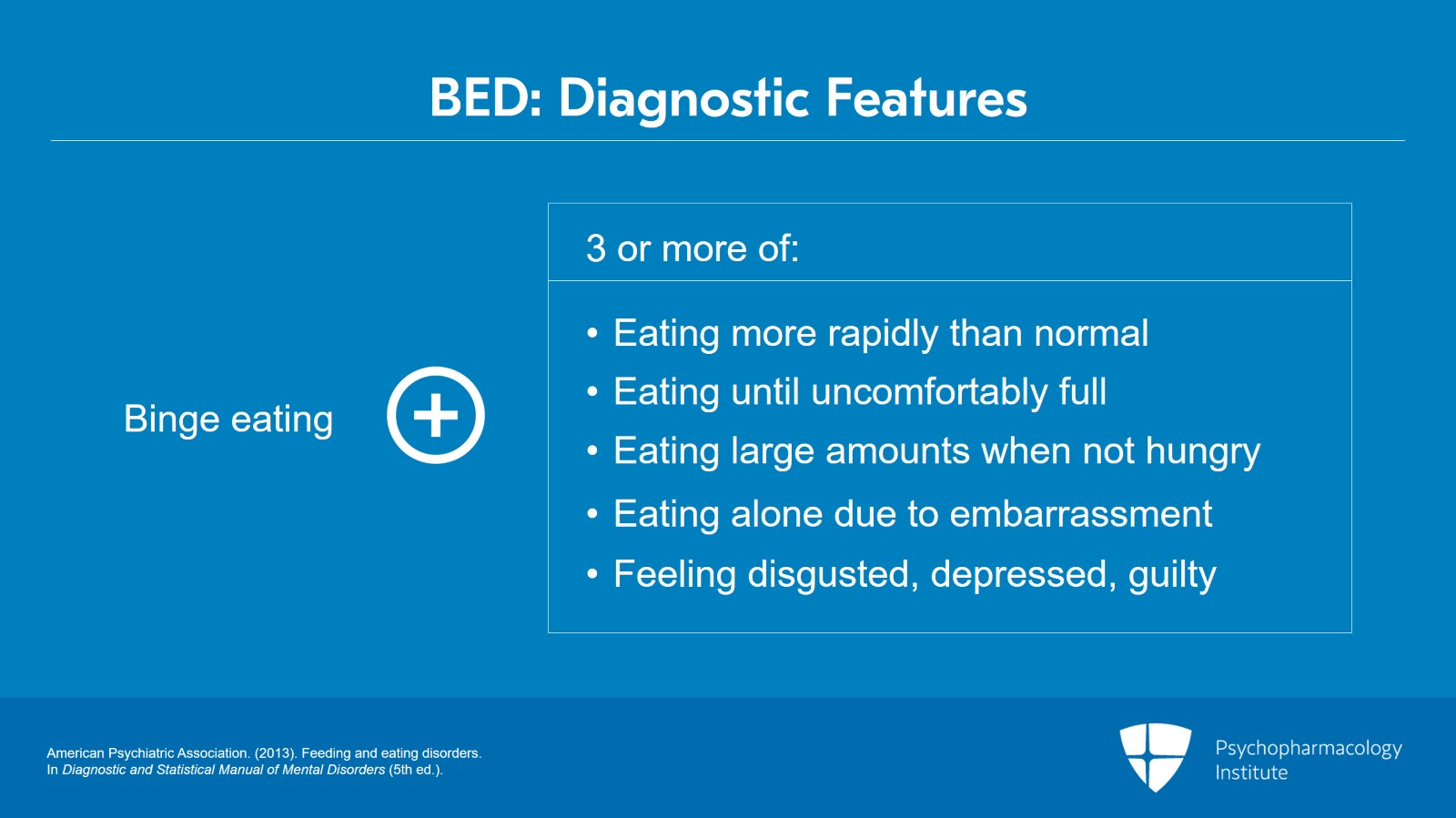
In binge eating disorder, you have the same binge eating that occurs in bulimia nervosa and anorexia nervosa binge-purge type. The binge eating in binge eating disorder is associated with three or more of these specific criteria: Eating more rapidly than normal, eating until uncomfortably full, eating large amounts when not hungry, eating alone due to embarrassment and feeling disgusted with one’s self or depressed or guilty.
References:
  • American Psychiatric Association. (2013). Feeding and eating disorders. In Diagnostic and Statistical Manual of Mental Disorders (5th ed.).
Free Files
Success!
Check your inbox, we sent you all the materials there.

Slide 3 of 9

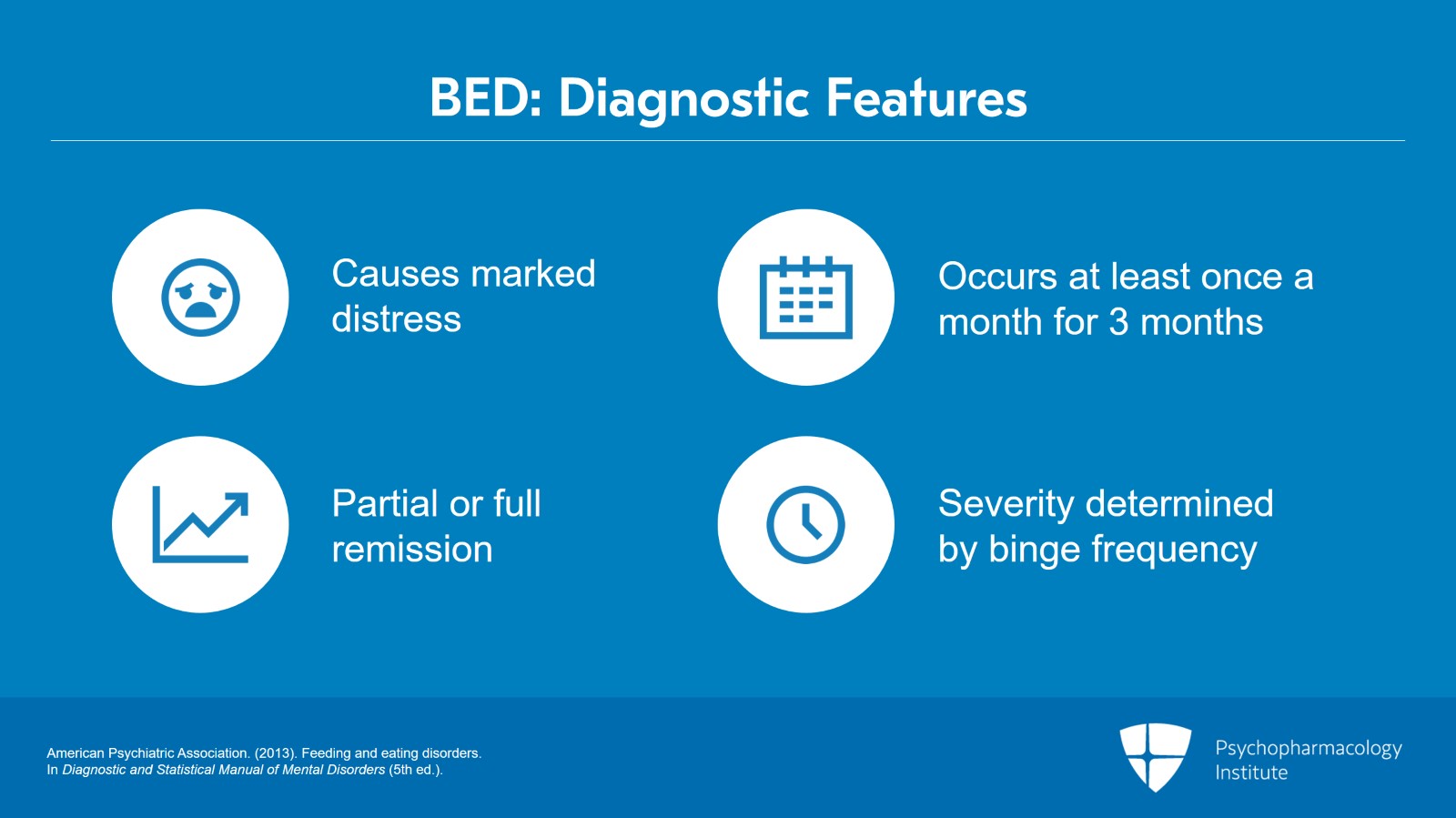
It causes marked distress and it occurs at least once a month for three months. Like in bulimia nervosa, there is partial and full remission. And severity is determined by binge frequency occurring along the range of once a week or mild to 14 or more times a week or extreme.
References:
  • American Psychiatric Association. (2013). Feeding and eating disorders. In Diagnostic and Statistical Manual of Mental Disorders (5th ed.).

Slide 4 of 9

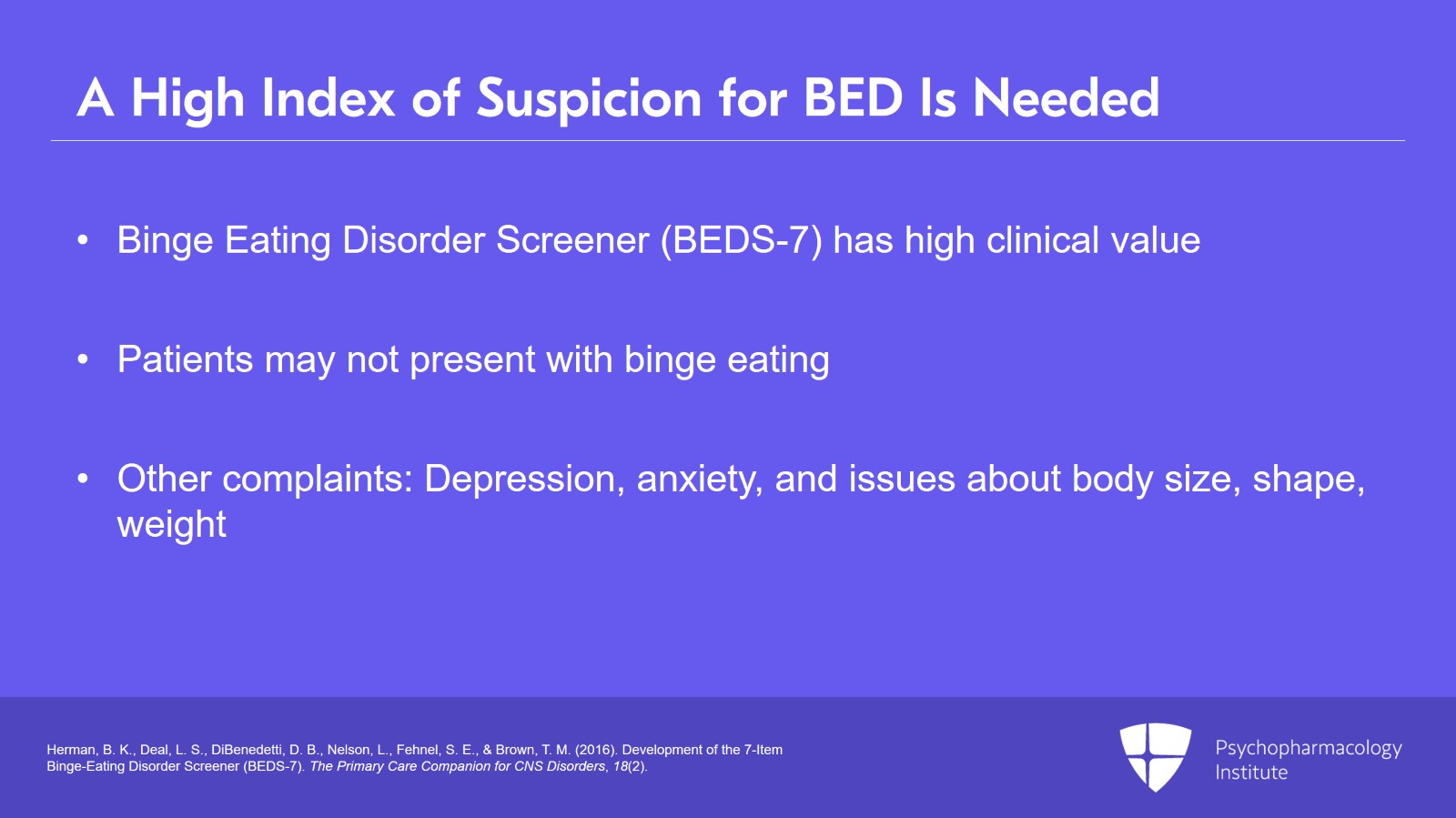
Psychiatrists should have a high index of suspicion for the presence of binge eating disorder which is the most prevalent eating disorder. The seven-item Binge Eating Disorder Screener or BEDS-7 is an easy to administer self-report screening instrument of high clinical value. Patients may not present with binge eating per se. Any number of associated medical and psychiatric complaints, for example, depression, anxiety and issues around body size, shape and overweight may be prominent.
References:
  • Herman, B. K., Deal, L. S., DiBenedetti, D. B., Nelson, L., Fehnel, S. E., & Brown, T. M. (2016). Development of the 7-Item Binge-Eating Disorder Screener (BEDS-7). The Primary Care Companion for CNS Disorders, 18(2).
Free Files
Success!
Check your inbox, we sent you all the materials there.

Slide 5 of 9

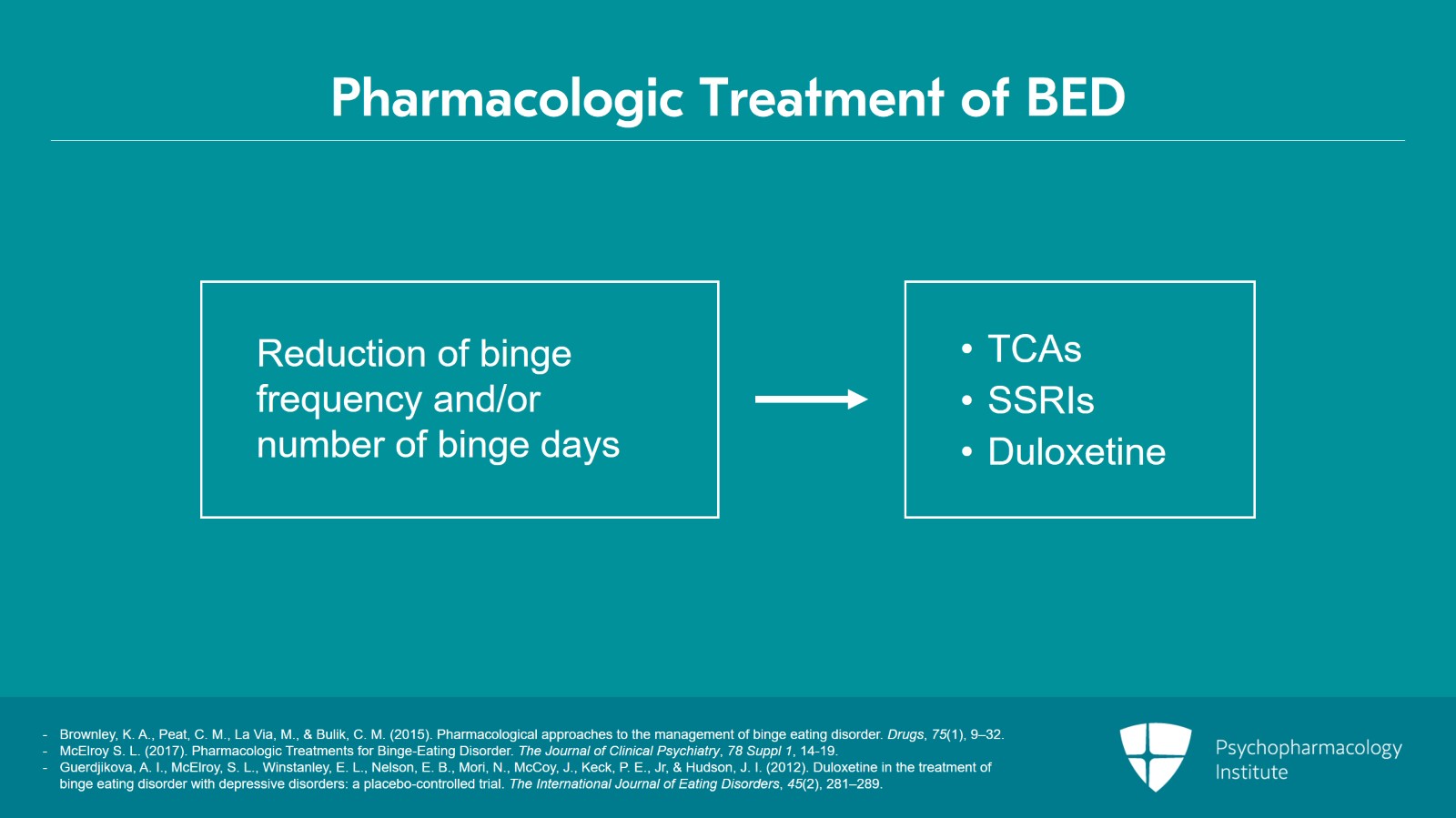
There have been a host of drugs studied in the treatment of binge eating disorder, many more than in bulimia nervosa. A number of antidepressants have been found in randomized double-blind, placebo-controlled studies to be effective in reducing binge frequency and/or number of binge days including tricyclic antidepressants, SSRIs and duloxetine.
References:
  • Brownley, K. A., Peat, C. M., La Via, M., & Bulik, C. M. (2015). Pharmacological approaches to the management of binge eating disorder. Drugs, 75(1), 9–32.
  • McElroy S. L. (2017). Pharmacologic Treatments for Binge-Eating Disorder. The Journal of Clinical Psychiatry, 78 Suppl 1, 14-19.
  • Guerdjikova, A. I., McElroy, S. L., Winstanley, E. L., Nelson, E. B., Mori, N., McCoy, J., Keck, P. E., Jr, & Hudson, J. I. (2012). Duloxetine in the treatment of binge eating disorder with depressive disorders: a placebo-controlled trial. The International Journal of Eating Disorders, 45(2), 281–289.

Slide 6 of 9

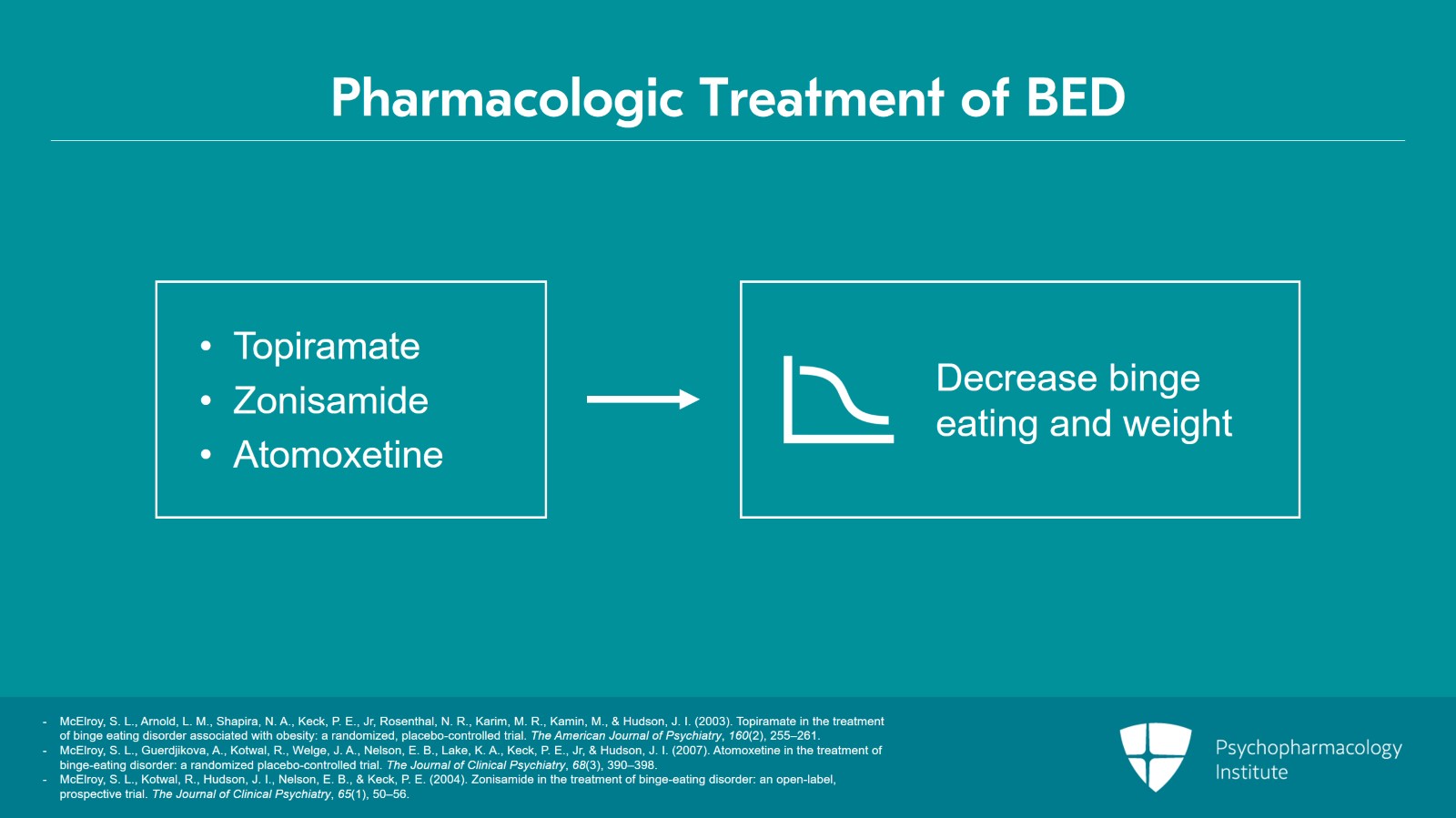
…..the anticonvulsants, topiramate and zonisamide, and the norepinephrine-dopamine reuptake inhibitor, atomoxetine, have been shown in randomized double-blind, placebo-controlled trials to not only decrease binge eating but weight as well.
References:
  • McElroy, S. L., Arnold, L. M., Shapira, N. A., Keck, P. E., Jr, Rosenthal, N. R., Karim, M. R., Kamin, M., & Hudson, J. I. (2003). Topiramate in the treatment of binge eating disorder associated with obesity: a randomized, placebo-controlled trial. The American Journal of Psychiatry, 160(2), 255–261.
  • McElroy, S. L., Guerdjikova, A., Kotwal, R., Welge, J. A., Nelson, E. B., Lake, K. A., Keck, P. E., Jr, & Hudson, J. I. (2007). Atomoxetine in the treatment of binge-eating disorder: a randomized placebo-controlled trial. The Journal of Clinical Psychiatry, 68(3), 390–398.
  • McElroy, S. L., Kotwal, R., Hudson, J. I., Nelson, E. B., & Keck, P. E. (2004). Zonisamide in the treatment of binge-eating disorder: an open-label, prospective trial. The Journal of Clinical Psychiatry, 65(1), 50–56.
Free Files
Success!
Check your inbox, we sent you all the materials there.

Slide 7 of 9

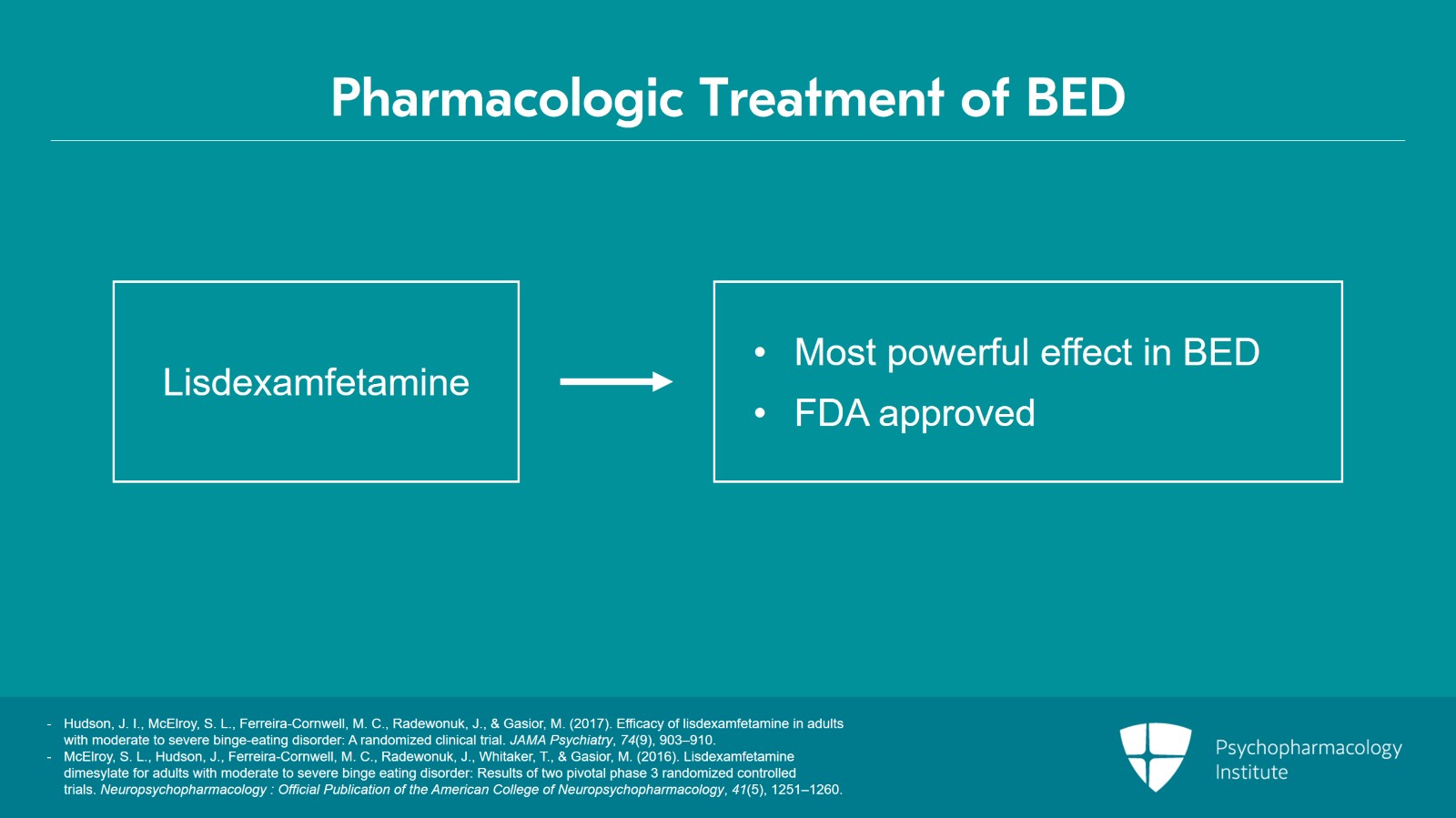
Lisdexamfetamine has shown the most powerful effect in binge eating disorder such that it received FDA approval.
References:
  • Hudson, J. I., McElroy, S. L., Ferreira-Cornwell, M. C., Radewonuk, J., & Gasior, M. (2017). Efficacy of lisdexamfetamine in adults with moderate to severe binge-eating disorder: A randomized clinical trial. JAMA Psychiatry, 74(9), 903–910.
  • McElroy, S. L., Hudson, J., Ferreira-Cornwell, M. C., Radewonuk, J., Whitaker, T., & Gasior, M. (2016). Lisdexamfetamine dimesylate for adults with moderate to severe binge eating disorder: Results of two pivotal phase 3 randomized controlled trials. Neuropsychopharmacology : Official Publication of the American College of Neuropsychopharmacology, 41(5), 1251–1260.

Slide 8 of 9

The key points are as follows: Binge eating disorder is the most prevalent eating disorder. The Binge Eating Disorder Screener or BEDS-7 is a good screening instrument. A number of psychotropic agents have been found to be effective in binge eating disorder.
Free Files
Success!
Check your inbox, we sent you all the materials there.

Slide 9 of 9

Learning Objectives:

After completing this activity, the learner will be able to:

  1.  Recognize the different eating and feeding disorders.
  2.  Identify evidence-based psychopharmacologic strategies for the treatment of various eating and feeding disorders discussed.

Original Release Date: 03/01/2021

Review and Re-release Date: 03/01/2024

Expiration Date: 04/01/2025

Expert: Timothy Brewerton, M.D.

Medical Editor: Melissa Mariano, M.D

Relevant Financial Disclosures:

None of the faculty, planners, and reviewers for this educational activity have relevant financial relationship(s) to disclose during the last 24 months with ineligible companies whose primary business is producing, marketing, selling, re-selling, or distributing healthcare products used by or on patients.

Contact Information: For questions regarding the content or access to this activity, contact us at support@psychopharmacologyinstitute.com

Instructions for Participation and Credit:

Participants must complete the activity online during the valid credit period that is noted above.

Follow these steps to earn CME credit:

  1. View the required educational content provided on this course page.
  2. Complete the Post Activity Evaluation for providing the necessary feedback for continuing accreditation purposes and for the development of future activities. NOTE: Completing the Post Activity Evaluation after the quiz is required to receive the earned credit.
  3. Download your certificate.

Accreditation Statement

This activity has been planned and implemented in accordance with the accreditation requirements and policies of the Accreditation Council for Continuing Medical Education through the joint providership of Medical Academy LLC and the Psychopharmacology Institute. Medical Academy is accredited by the ACCME to provide continuing medical education for physicians.

Credit Designation Statement

Medical Academy designates this enduring activity for a maximum of 1.00 AMA PRA Category 1 credit(s). Physicians should claim only the credit commensurate with the extent of their participation in the activity.


Free Files
Success!
Check your inbox, we sent you all the materials there.
Continue in the website
Instant access modal

Become a Bronze, Silver, Gold, Bronze extended, Silver extended or Gold extended Member.

2025–26 Psychopharmacology CME Program

Unlock up to 155 CME Credits, including 40 SA CME Credits.