



Slides and Transcript
Slide 1 of 26
We’re now ready to talk about baseline testing, monitoring and optimal dosing of lithium.
Slide 2 of 26
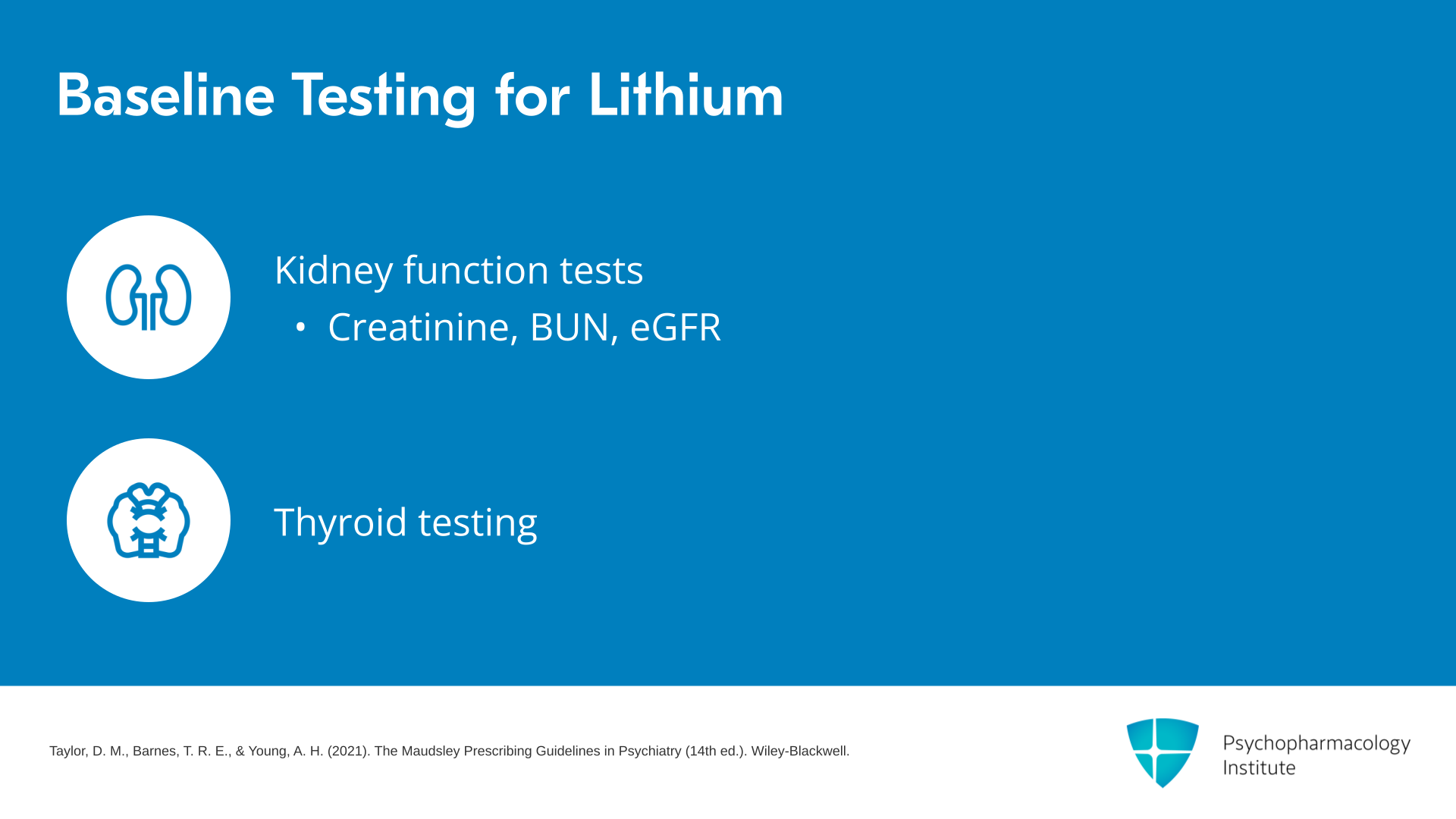
So here are some recommended baseline testing that you should do. I took these from the Maudsley Prescribing Guidelines in Psychiatry 14th Edition by Wiley-Blackwell. So the baseline testing includes kidney function tests most critically. You want the creatinine, BUN, eGFR. Then you want thyroid testing to see if they’re hypothyroid to start.
References:
- Taylor, D. M., Barnes, T. R. E., & Young, A. H. (2021). The Maudsley Prescribing Guidelines in Psychiatry (14th ed.). Wiley-Blackwell.
Free Files
Download PDF and other files
Success!
Check your inbox, we sent you all the materials there.
Slide 3 of 26
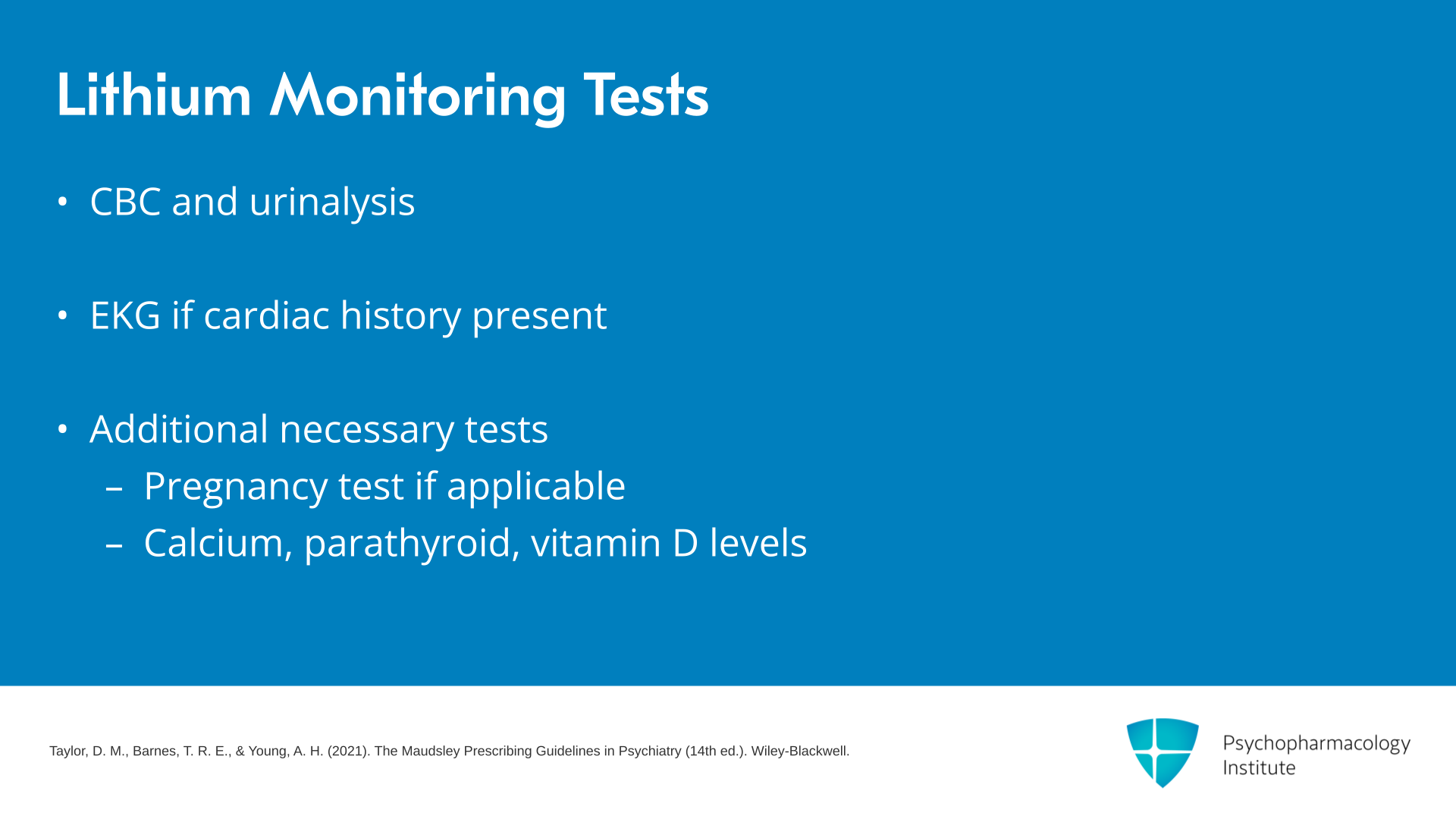
You need a CBC, urinalysis. EKG if indicated they have a history of cardiac disease. I don’t think you routinely need an EKG in everybody if you don’t suspect any problems. Pregnancy, if it’s a person of childbearing potential or possibly pregnant, you may need a pregnancy test cause you’ll need to have extensive discussion of the pregnancy risks of lithium and any other drugs you’re using. And calcium and parathyroid and vitamin D levels.
References:
- Taylor, D. M., Barnes, T. R. E., & Young, A. H. (2021). The Maudsley Prescribing Guidelines in Psychiatry (14th ed.). Wiley-Blackwell.
Slide 4 of 26
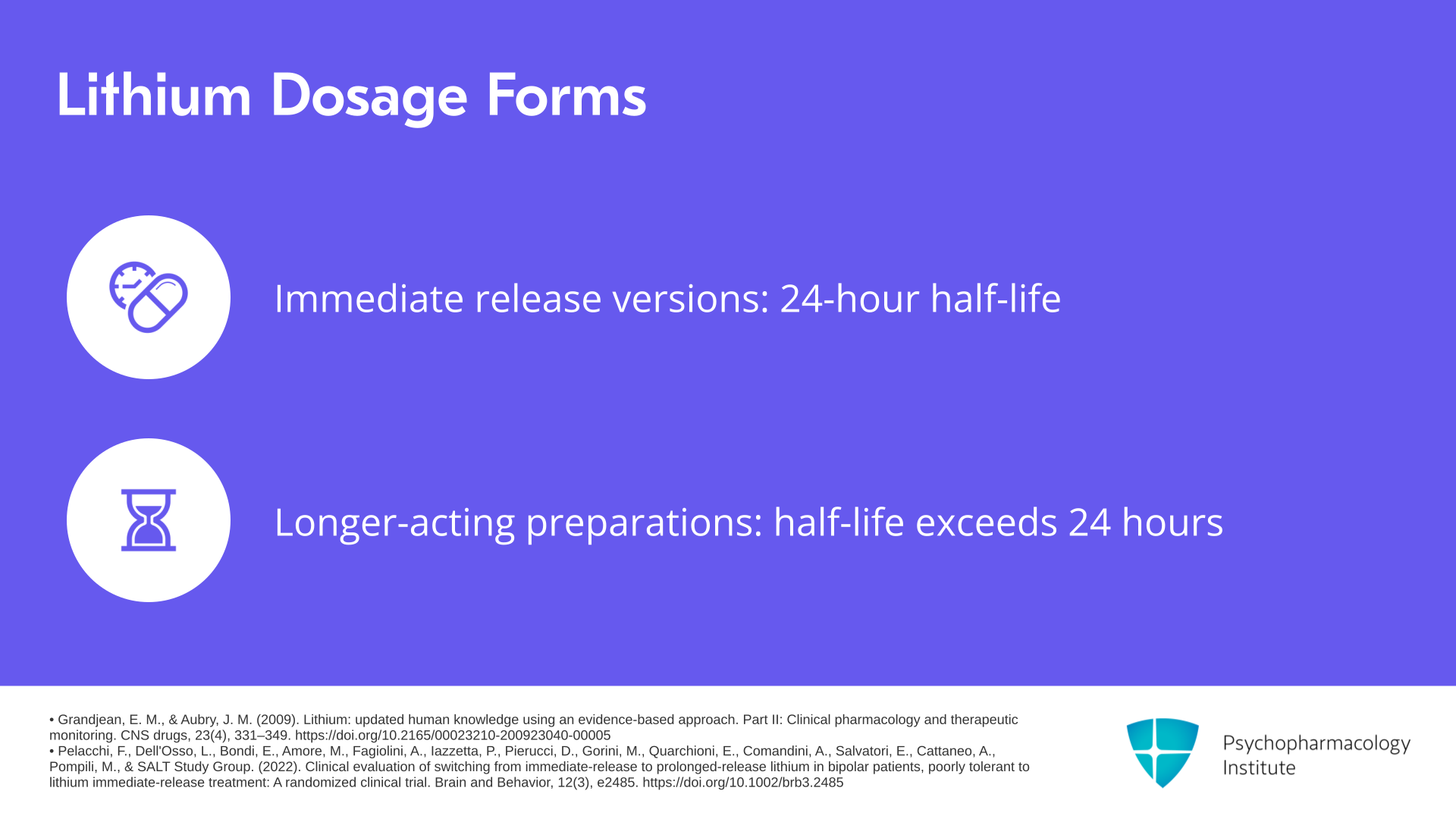
Now, let’s talk about dosage and titration of lithium. Lithium comes in capsules or white tablets. There are immediate release versions. They’re called that but they actually are not that immediate. They have 24-hour half-lives. For the most rapid excreted form, still the half-life is 24 hours. And then there are longer-acting preparations, with a half-life of longer than 24 hours.
References:
- Grandjean, E. M., & Aubry, J. M. (2009). Lithium: updated human knowledge using an evidence-based approach. Part II: Clinical pharmacology and therapeutic monitoring. CNS drugs, 23(4), 331–349. https://doi.org/10.2165/00023210-200923040-00005
- Pelacchi, F., Dell'Osso, L., Bondi, E., Amore, M., Fagiolini, A., Iazzetta, P., Pierucci, D., Gorini, M., Quarchioni, E., Comandini, A., Salvatori, E., Cattaneo, A., Pompili, M., & SALT Study Group. (2022). Clinical evaluation of switching from immediate-release to prolonged-release lithium in bipolar patients, poorly tolerant to lithium immediate-release treatment: A randomized clinical trial. Brain and Behavior, 12(3), e2485. https://doi.org/10.1002/brb3.2485
Free Files
Download PDF and other files
Success!
Check your inbox, we sent you all the materials there.
Slide 5 of 26
The immediate release or IR is preferred. Because once-a-day immediate-release lithium reduces urine volume and probably most other kidney side effects will be less. On anatomic examinations of kidney morphology that had been done in a number of cases, they compared biopsies with people on and off lithium in different forms and the least damage to the kidney is associated with the patients who were getting the short-acting immediate-release formulation once a day. So why is this important? Because you want to minimize the risk of long-term kidney problems.
References:
- Pelacchi, F., Dell'Osso, L., Bondi, E., Amore, M., Fagiolini, A., Iazzetta, P., Pierucci, D., Gorini, M., Quarchioni, E., Comandini, A., Salvatori, E., Cattaneo, A., Pompili, M., & SALT Study Group. (2022). Clinical evaluation of switching from immediate-release to prolonged-release lithium in bipolar patients, poorly tolerant to lithium immediate-release treatment: A randomized clinical trial. Brain and Behavior, 12(3), e2485. https://doi.org/10.1002/brb3.2485
- Carter, L., Zolezzi, M., & Lewczyk, A. (2013). An updated review of the optimal lithium dosage regimen for renal protection. Canadian Journal of Psychiatry, 58(10), 595-600. https://doi.org/10.1177/070674371305801009
- Bowen, R. C., Grof, P., & Grof, E. (1991). Less frequent lithium administration and lower urine volume. The American Journal of Psychiatry, 148(2), 189-192. https://doi.org/10.1176/ajp.148.2.189
Slide 6 of 26
However, the immediate release should be given once a day. If you give it more than once a day, then you’ll undermine some of its benefit and it may produce more tremor. When you give it once a day, they have most of their tremor at night.
References:
- Pelacchi, F., Dell'Osso, L., Bondi, E., Amore, M., Fagiolini, A., Iazzetta, P., Pierucci, D., Gorini, M., Quarchioni, E., Comandini, A., Salvatori, E., Cattaneo, A., Pompili, M., & SALT Study Group. (2022). Clinical evaluation of switching from immediate-release to prolonged-release lithium in bipolar patients, poorly tolerant to lithium immediate-release treatment: A randomized clinical trial. Brain and Behavior, 12(3), e2485. https://doi.org/10.1002/brb3.2485
- Carter, L., Zolezzi, M., & Lewczyk, A. (2013). An updated review of the optimal lithium dosage regimen for renal protection. Canadian Journal of Psychiatry, 58(10), 595-600. https://doi.org/10.1177/070674371305801009
Free Files
Download PDF and other files
Success!
Check your inbox, we sent you all the materials there.
Slide 7 of 26
That period of lower lithium level compared to someone who’s getting one of the longer-acting preparations which keeps your level constant throughout the day and night, that’s apparently more toxic to the kidneys than having an opportunity once a day to have the level drop below that level. And there seems to be no harm from the greater increase temporarily in the level from taking the drug all at once at night.
References:
- Pelacchi, F., Dell'Osso, L., Bondi, E., Amore, M., Fagiolini, A., Iazzetta, P., Pierucci, D., Gorini, M., Quarchioni, E., Comandini, A., Salvatori, E., Cattaneo, A., Pompili, M., & SALT Study Group. (2022). Clinical evaluation of switching from immediate-release to prolonged-release lithium in bipolar patients, poorly tolerant to lithium immediate-release treatment: A randomized clinical trial. Brain and Behavior, 12(3), e2485. https://doi.org/10.1002/brb3.2485
Slide 8 of 26
What dose should you start? Usually, it would be 300 or 300 twice a day for outpatients unless there’s some drug interaction that you’re anticipating. If they’re on something that could raise lithium levels like NSAIDs or antihypertensives, then you’d start lower. You might even start with 150 maybe in an elderly person and work up gradually from there checking levels.
References:
- Nunes, R. P. (2018). Lithium interactions with non-steroidal anti-inflammatory drugs and diuretics–A review. Archives of Clinical Psychiatry (São Paulo), 45, 38-40. https://doi.org/10.1590/0101-60830000000153
Free Files
Download PDF and other files
Success!
Check your inbox, we sent you all the materials there.
Slide 9 of 26
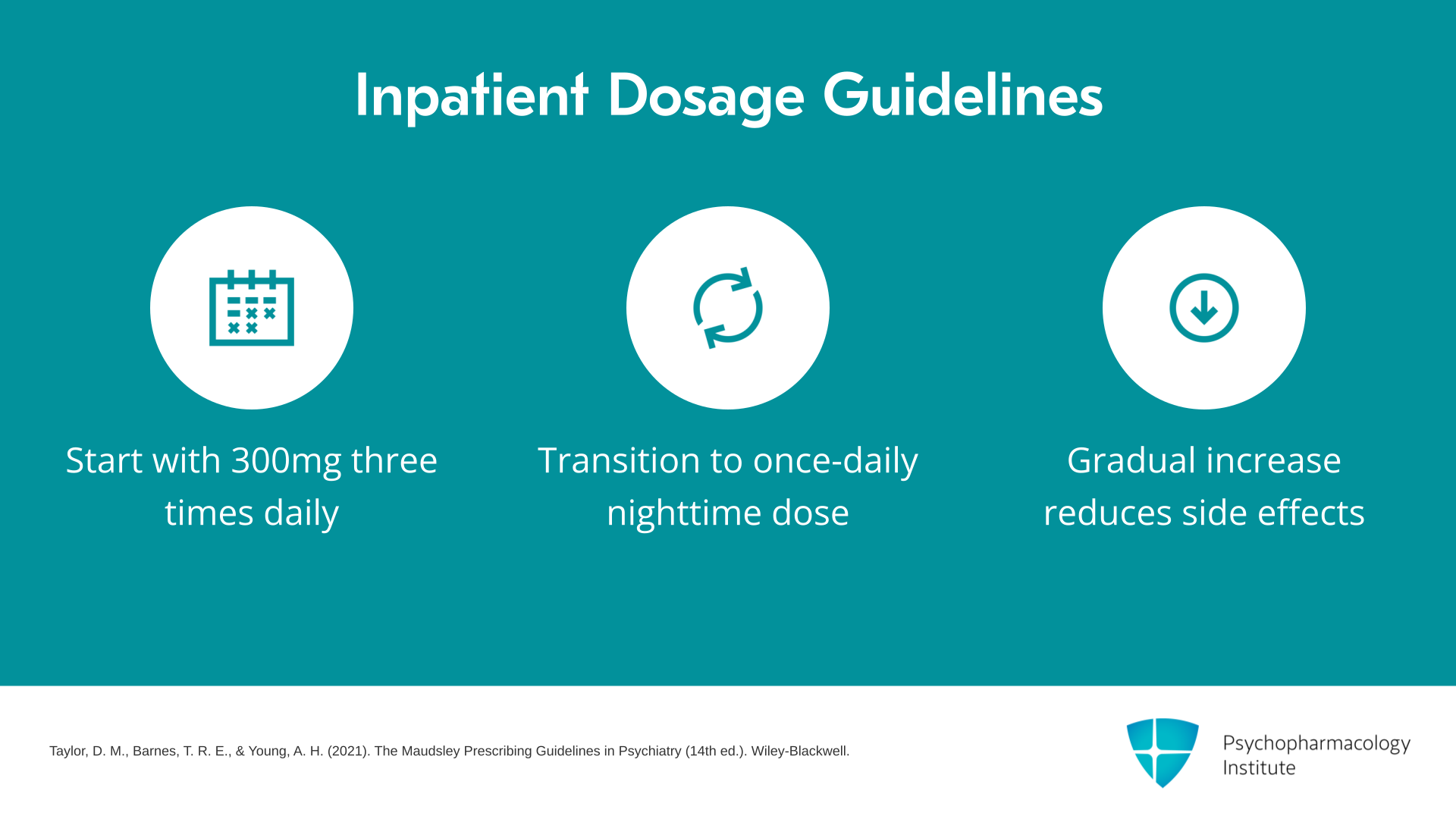
But for inpatients where you’re in more of a hurry, you have observation of the patient going on 24/7, you can usually start with 300 three times a day in divided doses. And then by the end of their stay in the hospital, you convert them over to once a day at night. But you would spread it out three times a day when first starting it just to minimize immediate side effects compared to starting 900 all at once for the first exposure to the drug.
References:
- Taylor, D. M., Barnes, T. R. E., & Young, A. H. (2021). The Maudsley Prescribing Guidelines in Psychiatry (14th ed.). Wiley-Blackwell.
Slide 10 of 26
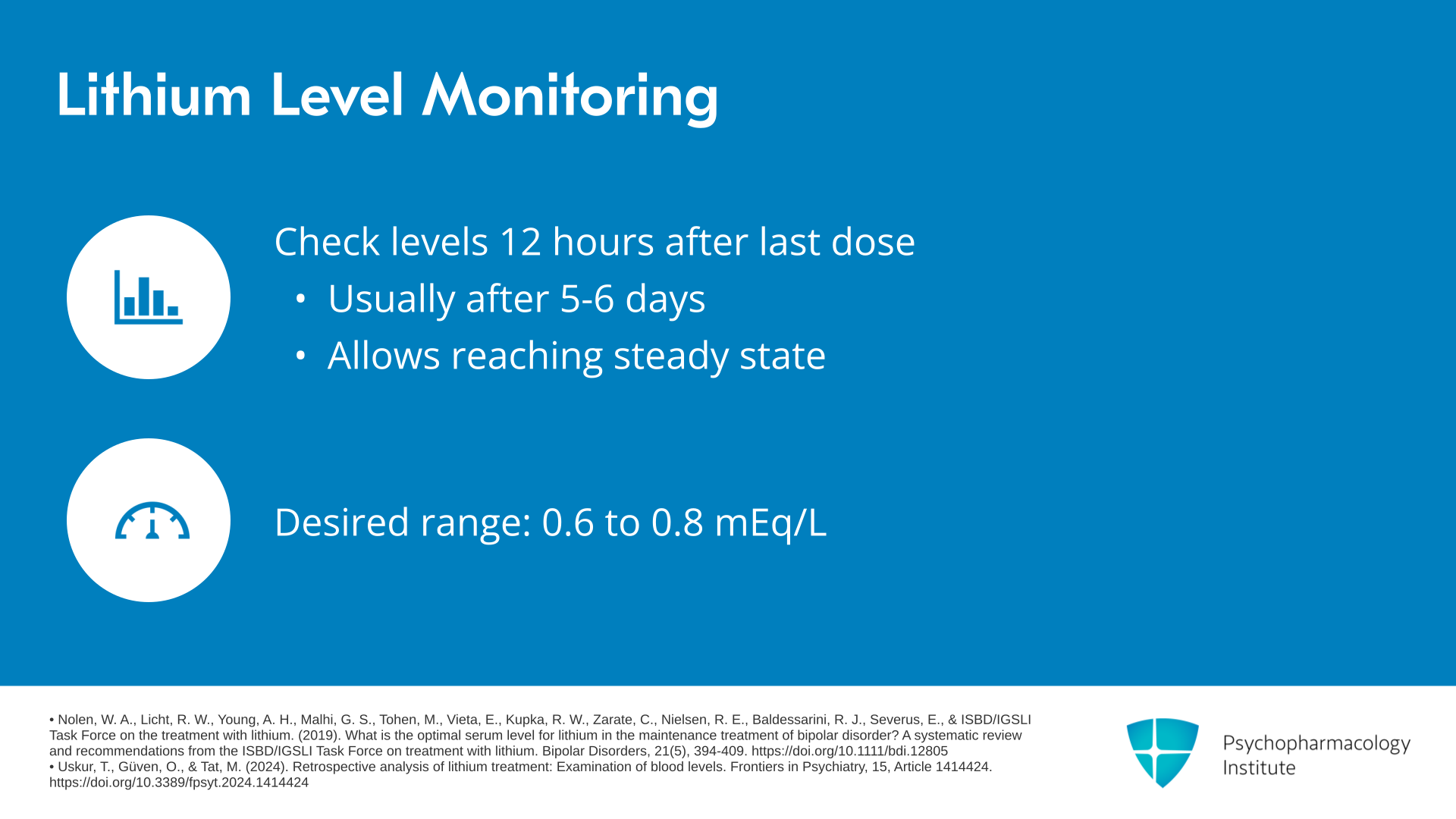
We usually check levels at the 12-hour period after the last dose usually in five or six days because as I mentioned lithium has a half-life of 24 hours so that means it takes five or six half-lives to reach steady state level. So you’ll be able to see whether it’s in the desired range of 0.4 to, 0.6 to 0.8.
References:
- Nolen, W. A., Licht, R. W., Young, A. H., Malhi, G. S., Tohen, M., Vieta, E., Kupka, R. W., Zarate, C., Nielsen, R. E., Baldessarini, R. J., Severus, E., & ISBD/IGSLI Task Force on the treatment with lithium. (2019). What is the optimal serum level for lithium in the maintenance treatment of bipolar disorder? A systematic review and recommendations from the ISBD/IGSLI Task Force on treatment with lithium. Bipolar Disorders, 21(5), 394-409. https://doi.org/10.1111/bdi.12805
- Uskur, T., Güven, O., & Tat, M. (2024). Retrospective analysis of lithium treatment: Examination of blood levels. Frontiers in Psychiatry, 15, Article 1414424. https://doi.org/10.3389/fpsyt.2024.1414424
Free Files
Download PDF and other files
Success!
Check your inbox, we sent you all the materials there.
Slide 11 of 26
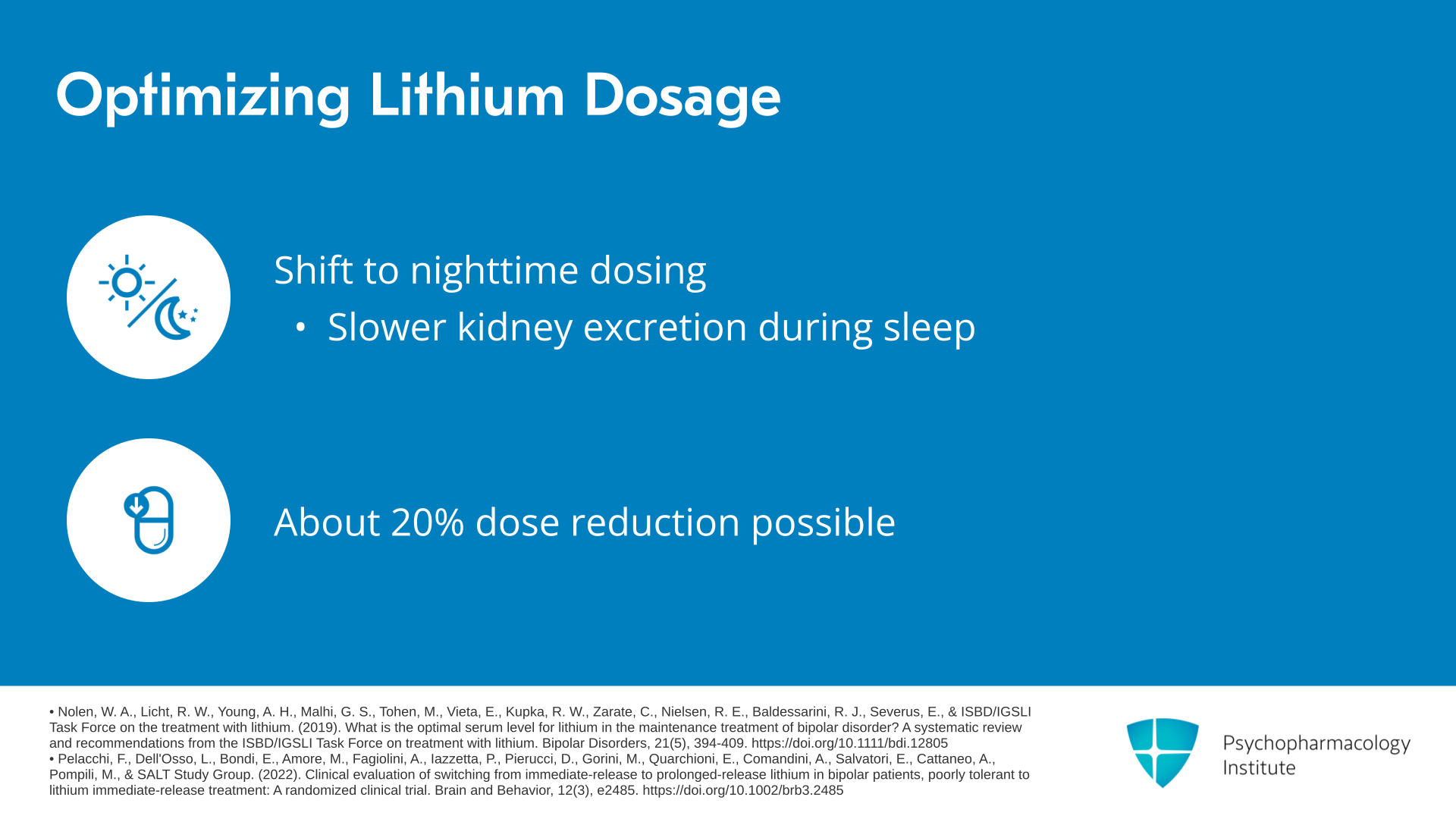
There is some change in dose when you shift from multiple times a day to all at night. The kidneys excrete lithium more slowly at night when you’re sleeping. It reduces the total amount of lithium you have to give the patient to get the desired benefit. And it’s about a 20% difference. So let’s say they were taking maybe 150 mg, five tablets or capsules and you’re going to take it all at night now, you would give them four capsules at night.
References:
- Pelacchi, F., Dell'Osso, L., Bondi, E., Amore, M., Fagiolini, A., Iazzetta, P., Pierucci, D., Gorini, M., Quarchioni, E., Comandini, A., Salvatori, E., Cattaneo, A., Pompili, M., & SALT Study Group. (2022). Clinical evaluation of switching from immediate-release to prolonged-release lithium in bipolar patients, poorly tolerant to lithium immediate-release treatment: A randomized clinical trial. Brain and Behavior, 12(3), e2485. https://doi.org/10.1002/brb3.2485
- Nolen, W. A., Licht, R. W., Young, A. H., Malhi, G. S., Tohen, M., Vieta, E., Kupka, R. W., Zarate, C., Nielsen, R. E., Baldessarini, R. J., Severus, E., & ISBD/IGSLI Task Force on the treatment with lithium. (2019). What is the optimal serum level for lithium in the maintenance treatment of bipolar disorder? A systematic review and recommendations from the ISBD/IGSLI Task Force on treatment with lithium. Bipolar Disorders, 21(5), 394-409. https://doi.org/10.1111/bdi.12805
Slide 12 of 26
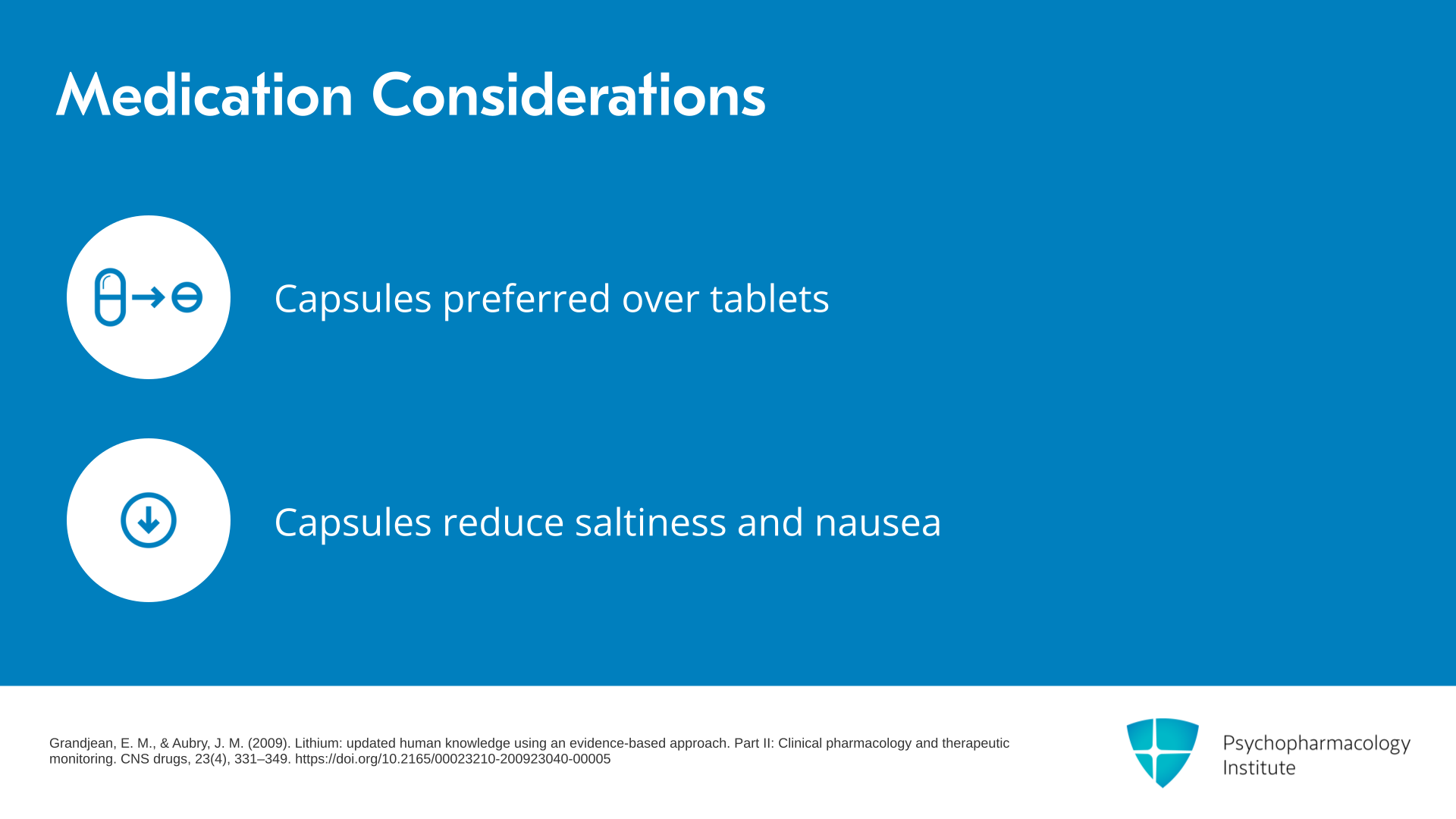
By the way, we prefer the capsules to the tablets because they’re not very salty the way the pills are that can induce nausea. It’s an unpleasant sensation that saltiness and with the capsules you avoid that.
References:
- Grandjean, E. M., & Aubry, J. M. (2009). Lithium: updated human knowledge using an evidence-based approach. Part II: Clinical pharmacology and therapeutic monitoring. CNS drugs, 23(4), 331–349. https://doi.org/10.2165/00023210-200923040-00005
Free Files
Download PDF and other files
Success!
Check your inbox, we sent you all the materials there.
Slide 13 of 26
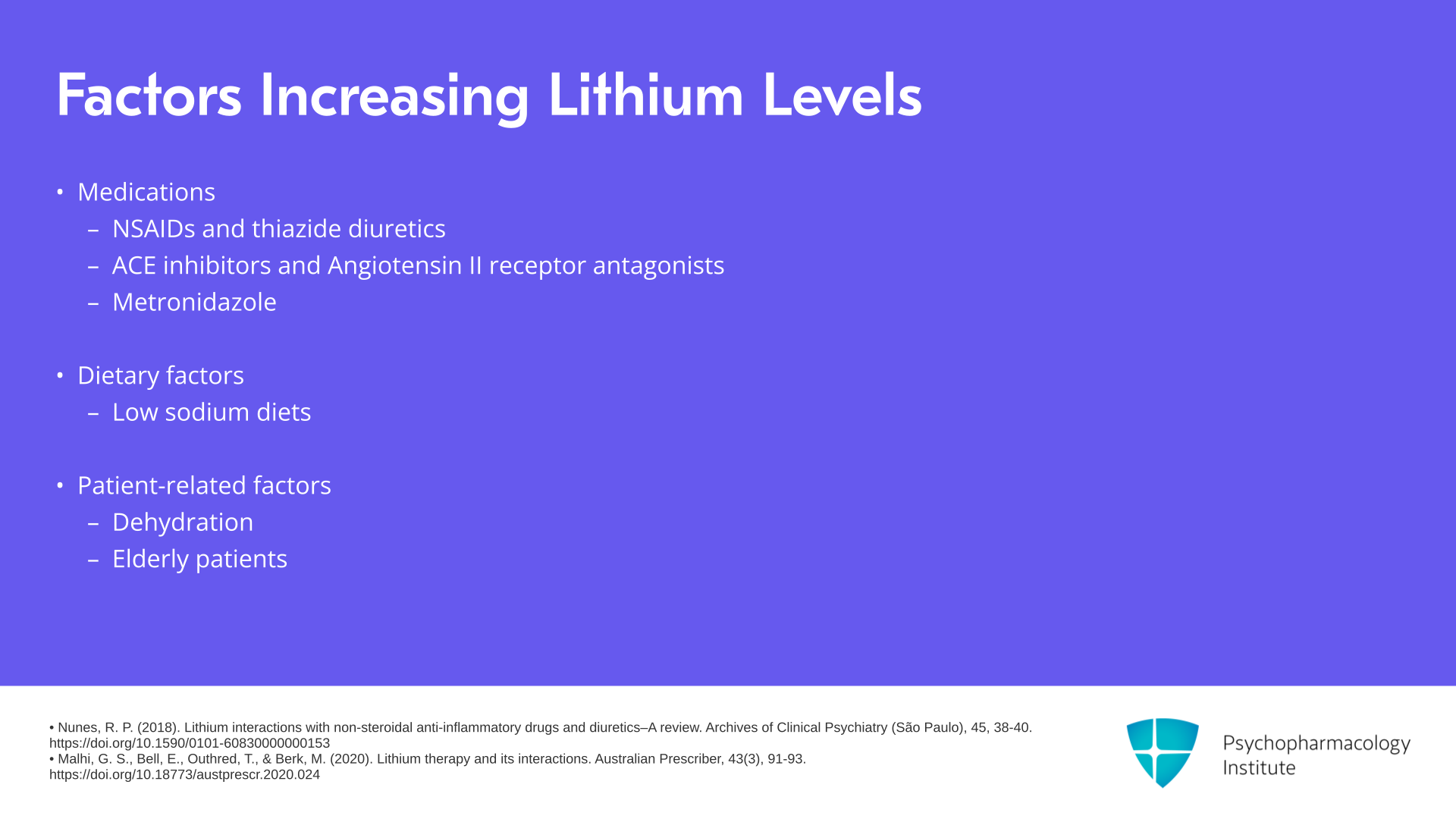
The next slide shows drugs that increase or decrease lithium levels that you need to take into account whether they’re on them now as you’re starting the lithium or when you maybe see that these drugs are going to be started to your patient already on lithium and may require you to make adjustments to the dose. So drugs whose levels are increased when they’re combined with lithium. The NSAIDs, the thiazide diuretics like hydrochlorothiazide. Angiotensin II receptor antagonists, two examples would be lisinopril and enalapril. And then metronidazole, treatment for urinary tract infections. Low sodium diets, dehydration and elderly people in general.
References:
- Nunes, R. P. (2018). Lithium interactions with non-steroidal anti-inflammatory drugs and diuretics–A review. Archives of Clinical Psychiatry (São Paulo), 45, 38-40. https://doi.org/10.1590/0101-60830000000153
- Malhi, G. S., Bell, E., Outhred, T., & Berk, M. (2020). Lithium therapy and its interactions. Australian Prescriber, 43(3), 91-93. https://doi.org/10.18773/austprescr.2020.024
Slide 14 of 26
Sulindac is an NSAID that is an exception to the rest of them. It seems not to change lithium levels. It used to go by the brand name Clinoril. It is generic now. But anyway, I have a question mark because it’s not 100% sure that it won’t affect the levels so you better check them.
References:
- Furnell, M. M., & Davies, J. (1985). The effect of sulindac on lithium therapy. Drug Intelligence & Clinical Pharmacy, 19(5), 374–376. https://doi.org/10.1177/106002808501900509
Free Files
Download PDF and other files
Success!
Check your inbox, we sent you all the materials there.
Slide 15 of 26
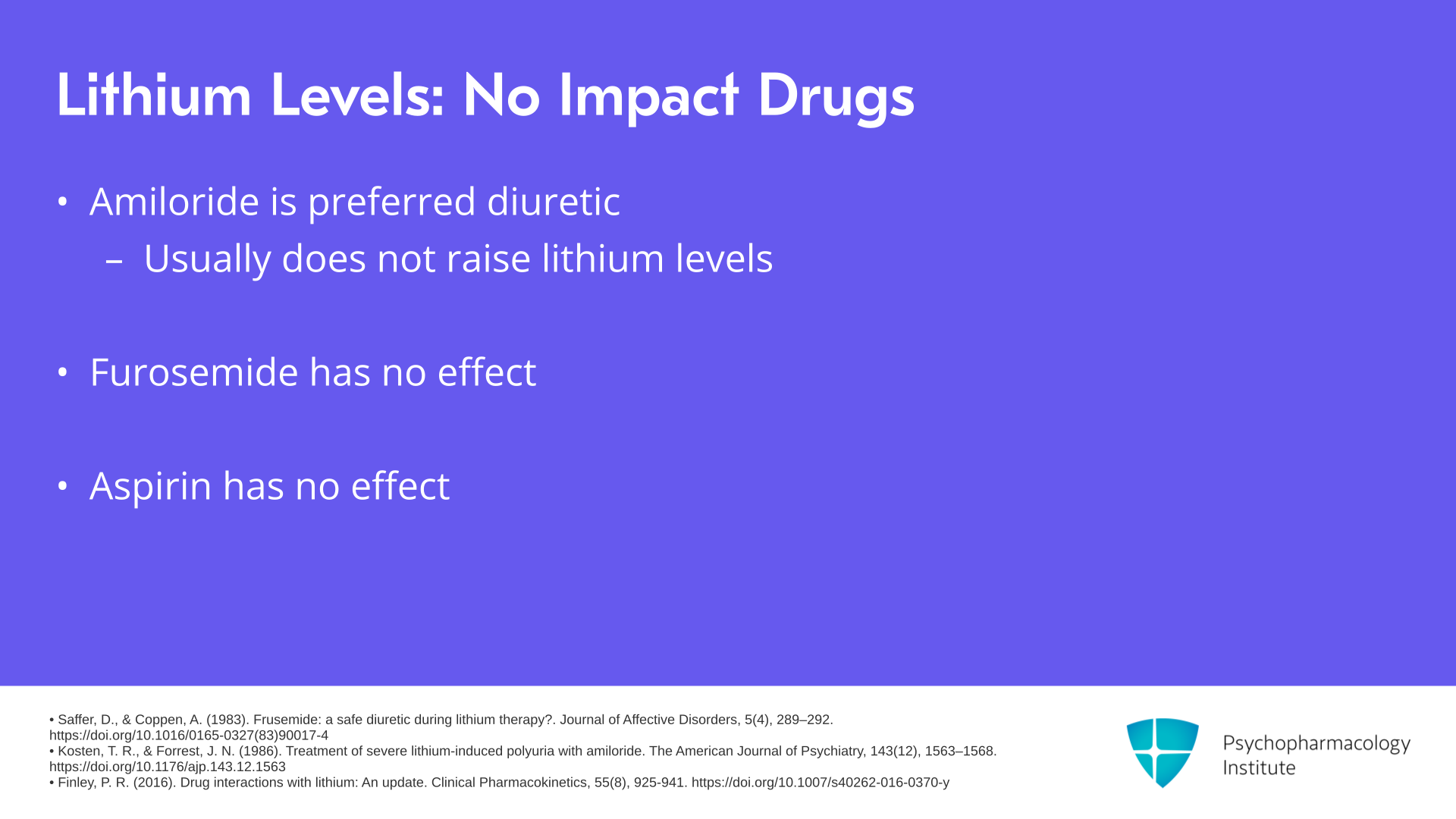
The following meds are not having any effect on lithium levels. The first is the diuretic amiloride which is our preferred diuretic if you need to use one in a patient on lithium. It does not raise lithium levels usually. You should still check the level of lithium after you’ve started amiloride to be sure it didn’t change. Furosemide, aspirin do not change lithium levels.
References:
- Saffer, D., & Coppen, A. (1983). Frusemide: a safe diuretic during lithium therapy?. Journal of Affective Disorders, 5(4), 289–292. https://doi.org/10.1016/0165-0327(83)90017-4
- Kosten, T. R., & Forrest, J. N. (1986). Treatment of severe lithium-induced polyuria with amiloride. The American Journal of Psychiatry, 143(12), 1563–1568. https://doi.org/10.1176/ajp.143.12.1563
- Finley, P. R. (2016). Drug interactions with lithium: An update. Clinical Pharmacokinetics, 55(8), 925-941. https://doi.org/10.1007/s40262-016-0370-y
Slide 16 of 26
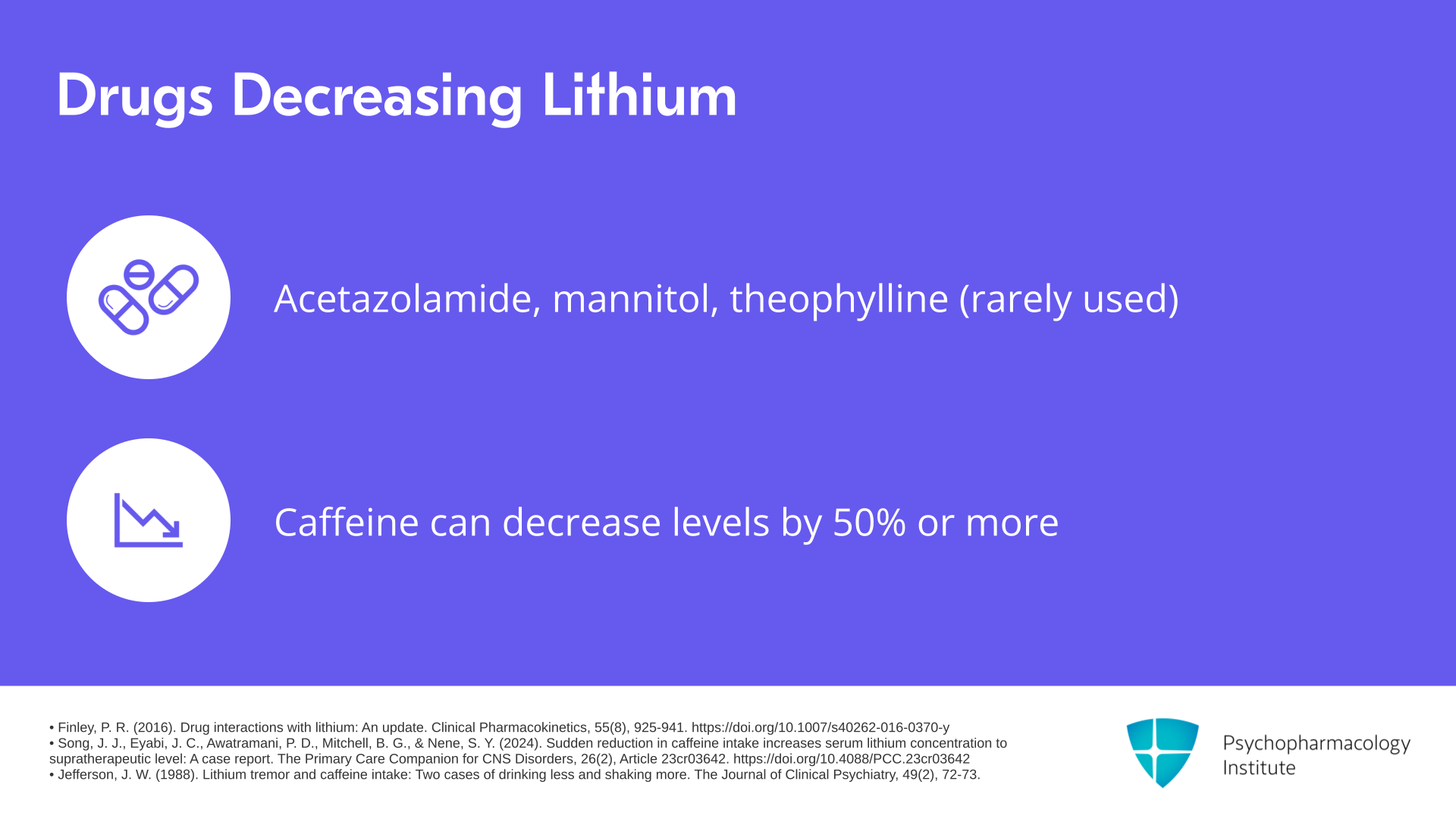
Drugs that decrease lithium levels. Some of these we’re really not using much today – acetazolamide, mannitol, theophylline. But something you will very commonly encounter is those heavy caffeine users out there, the ones that are drinking 20 Pepsis a day, coffee, or stimulant drinks. So these will decrease lithium levels sometimes by 50% or more. So we have to try to get situations stabilized with their caffeine use in relation to your lithium dose you’re giving.
References:
- Finley, P. R. (2016). Drug interactions with lithium: An update. Clinical Pharmacokinetics, 55(8), 925-941. https://doi.org/10.1007/s40262-016-0370-y
- Song, J. J., Eyabi, J. C., Awatramani, P. D., Mitchell, B. G., & Nene, S. Y. (2024). Sudden reduction in caffeine intake increases serum lithium concentration to supratherapeutic level: A case report. The Primary Care Companion for CNS Disorders, 26(2), Article 23cr03642. https://doi.org/10.4088/PCC.23cr03642
- Jefferson, J. W. (1988). Lithium tremor and caffeine intake: Two cases of drinking less and shaking more. The Journal of Clinical Psychiatry, 49(2), 72-73.
Free Files
Download PDF and other files
Success!
Check your inbox, we sent you all the materials there.
Slide 17 of 26
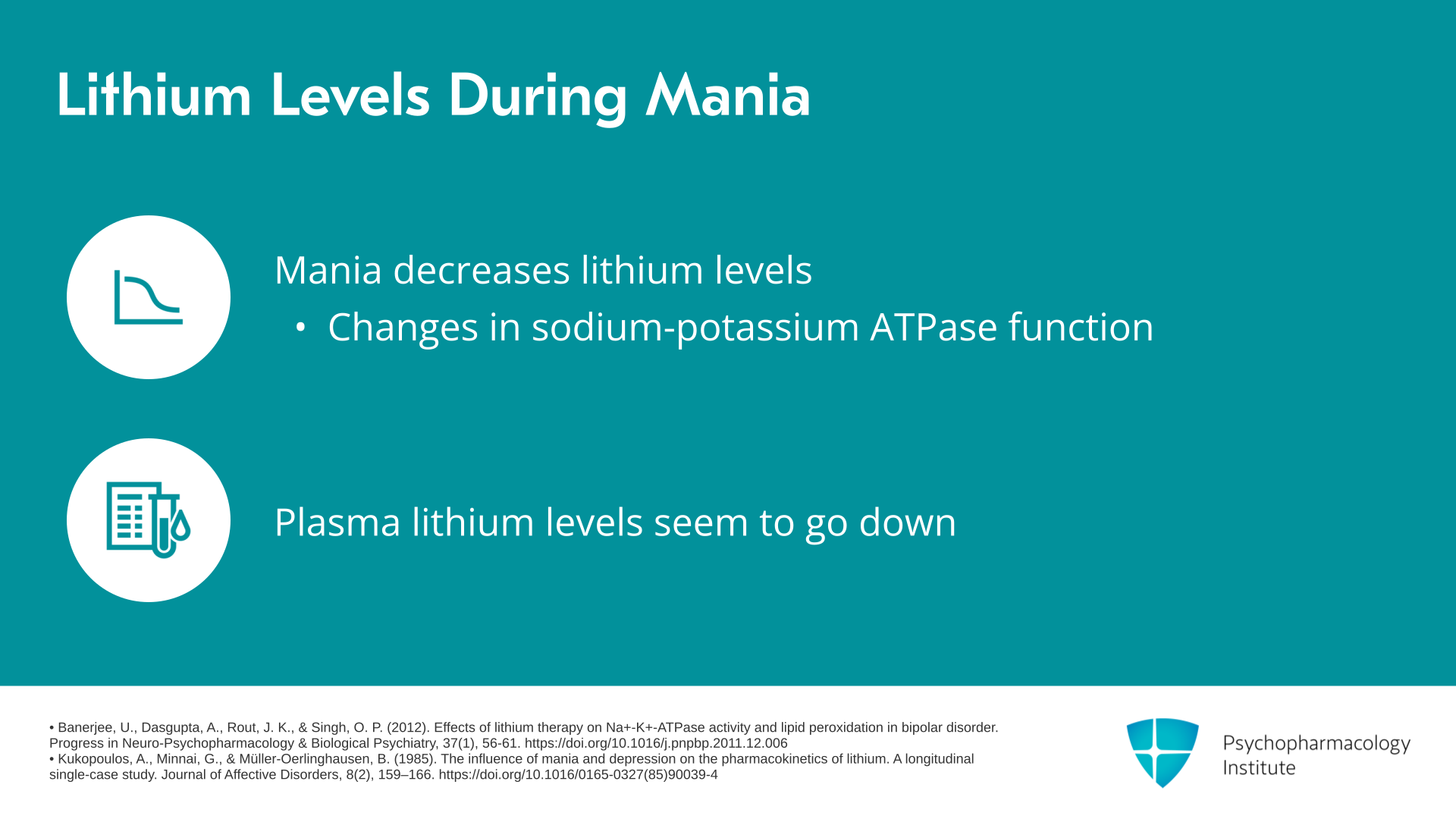
But here’s an important thing that decreases lithium levels and it is mania. When people go into mania, there seems to be something different about how their sodium, potassium, ATPase which is an enzyme that controls the in and out passage of lithium and sodium and potassium into cells. And it seems that when the mania starts lithium will be drawn into the cells and will be present in a lower amount in plasma with the result that lithium levels will seem to go down, will go down in fact when you measure them. But they’re actually not down probably. There’s probably plenty of lithium in the cells and maybe even too much.
References:
- Banerjee, U., Dasgupta, A., Rout, J. K., & Singh, O. P. (2012). Effects of lithium therapy on Na+-K+-ATPase activity and lipid peroxidation in bipolar disorder. Progress in Neuro-Psychopharmacology & Biological Psychiatry, 37(1), 56-61. https://doi.org/10.1016/j.pnpbp.2011.12.006
- Kukopoulos, A., Minnai, G., & Müller-Oerlinghausen, B. (1985). The influence of mania and depression on the pharmacokinetics of lithium. A longitudinal single-case study. Journal of Affective Disorders, 8(2), 159–166. https://doi.org/10.1016/0165-0327(85)90039-4
Slide 18 of 26
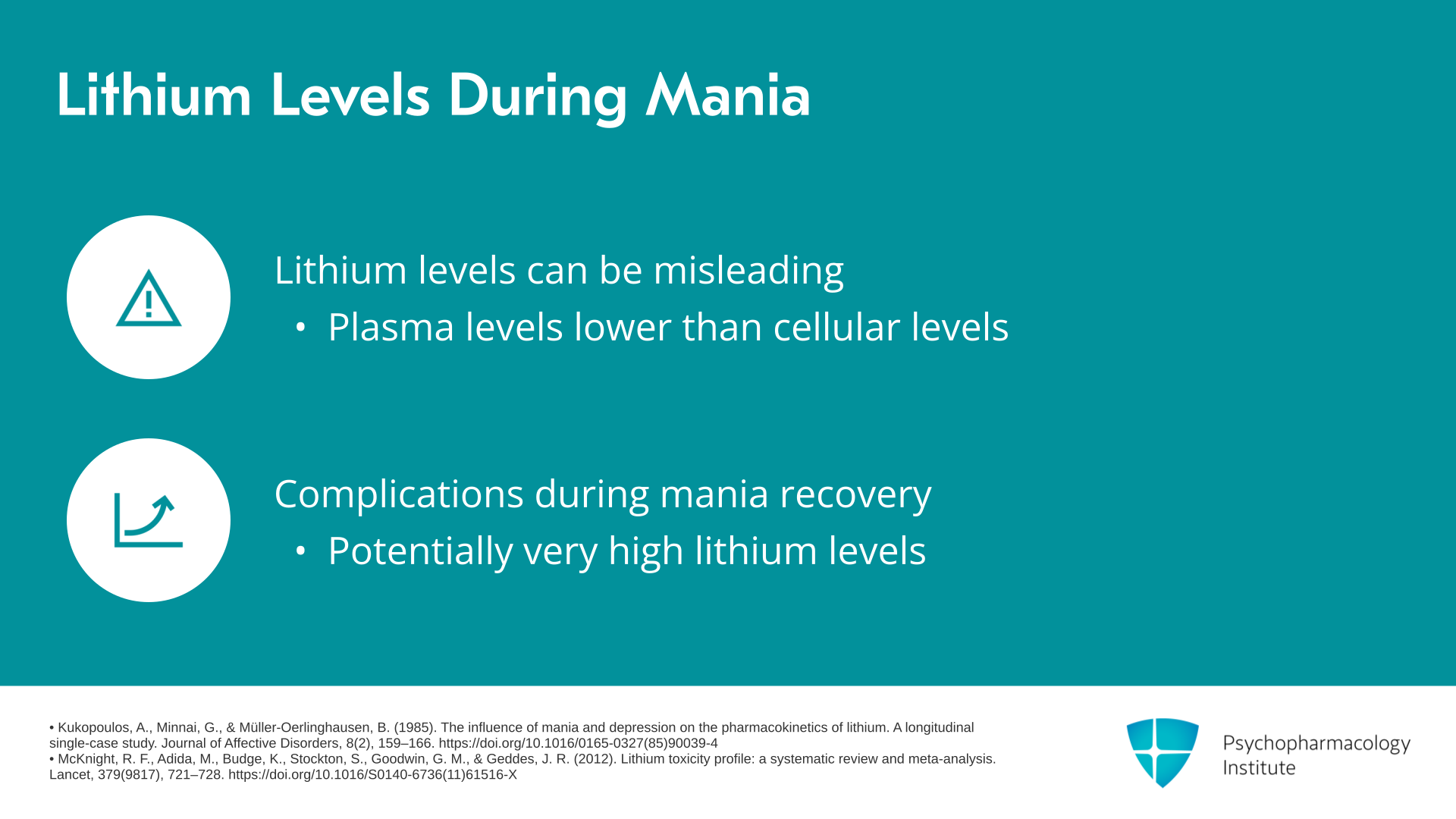
So this situation leads to a common problem of people getting into lithium toxicity during treatment of mania because they’re given too much lithium. The lithium levels are lower when you measure them than they actually are in the cells and they get toxic. And then they’re also coming down from their manias at the same time so the lithium moves out of the cells back into the plasma and super high lithium levels may now be present. So this causes, major problems cause the end of many lithium trials. People won’t want to go back on it after that. So try to avoid that mistake.
References:
- McKnight, R. F., Adida, M., Budge, K., Stockton, S., Goodwin, G. M., & Geddes, J. R. (2012). Lithium toxicity profile: a systematic review and meta-analysis. Lancet, 379(9817), 721–728. https://doi.org/10.1016/S0140-6736(11)61516-X
- Kukopoulos, A., Minnai, G., & Müller-Oerlinghausen, B. (1985). The influence of mania and depression on the pharmacokinetics of lithium. A longitudinal single-case study. Journal of Affective Disorders, 8(2), 159–166. https://doi.org/10.1016/0165-0327(85)90039-4
Free Files
Download PDF and other files
Success!
Check your inbox, we sent you all the materials there.
Slide 19 of 26
And another issue that comes up is pregnancy. That decreases lithium levels as well and causes issues with monitoring and titrating.
References:
- Poels, E. M. P., Bijma, H. H., Galbally, M., & Bergink, V. (2018). Lithium during pregnancy and after delivery: a review. International Journal of Bipolar Disorders, 6(1), 26. https://doi.org/10.1186/s40345-018-0135-7
Slide 20 of 26
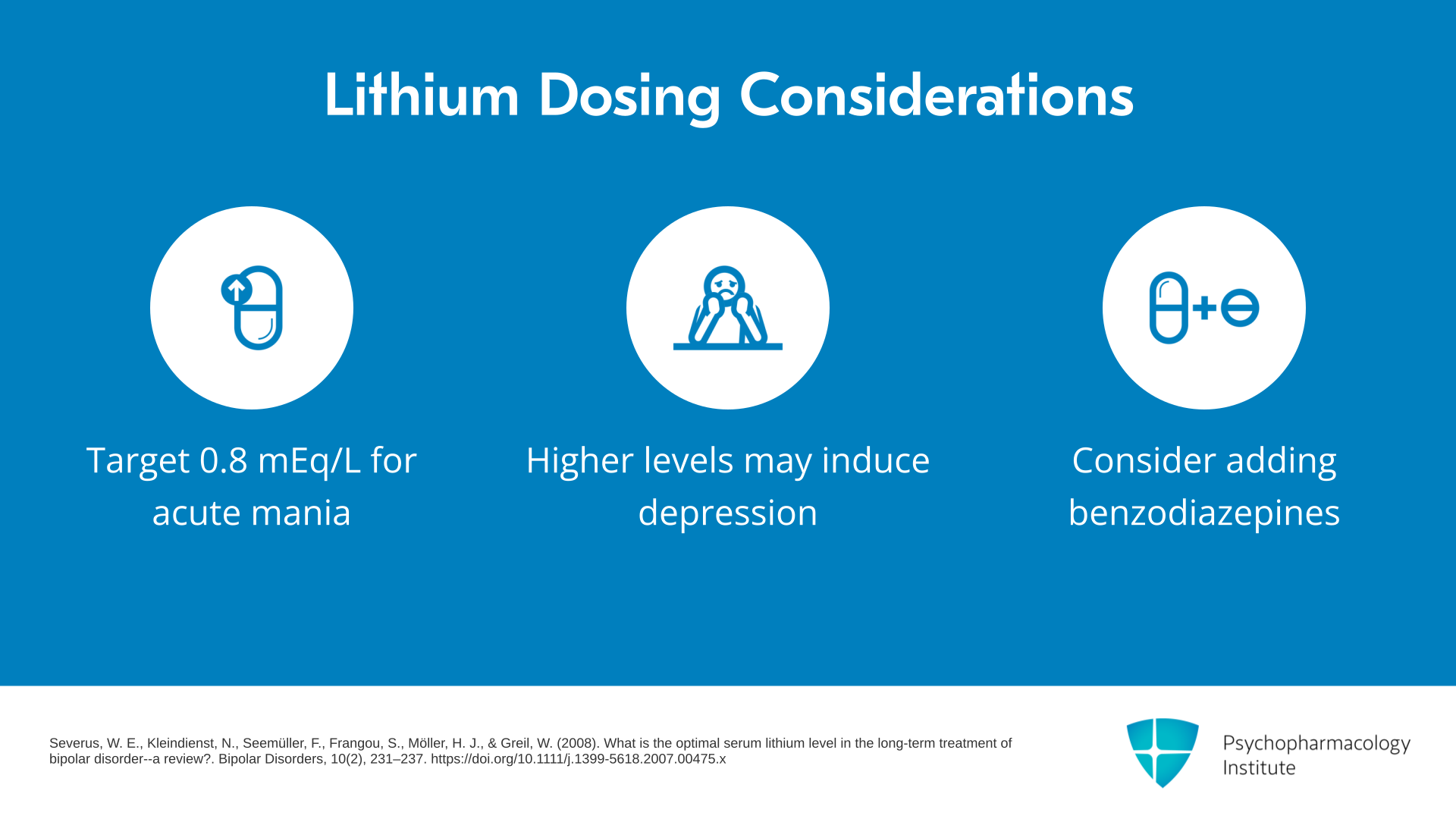
Doses and titration. For acute treatment of mania, you usually need 0.8 mEq/L briefly. Higher levels, anything over 0.8 may produce more flips into depression. This is not very well known. But you could be creating a higher risk of flipping into depression by using too high a dose of lithium to treat your mania. So keep the level not much higher than 0.8. If you need to add other things to bring them down even temporarily like a benzodiazepine, that would be preferable to go into super high lithium levels and also there’s that risk of toxicity.
References:
- Severus, W. E., Kleindienst, N., Seemüller, F., Frangou, S., Möller, H. J., & Greil, W. (2008). What is the optimal serum lithium level in the long-term treatment of bipolar disorder–a review?. Bipolar Disorders, 10(2), 231–237. https://doi.org/10.1111/j.1399-5618.2007.00475.x
Free Files
Download PDF and other files
Success!
Check your inbox, we sent you all the materials there.
Slide 21 of 26
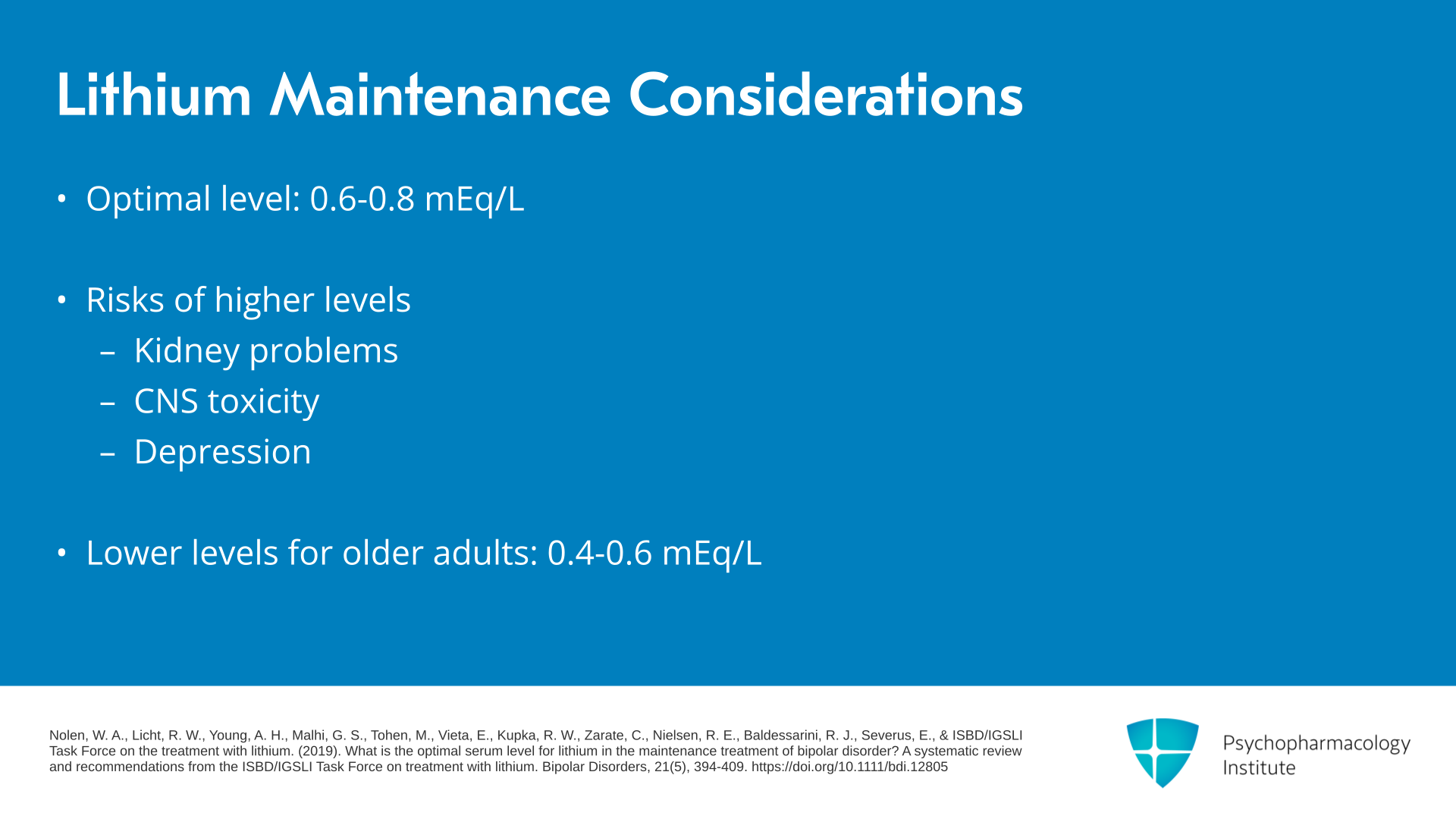
The optimal maintenance level is 0.6 to 0.8 is okay but you should not be going higher than that for maintenance. There are many problems associated with the higher levels. You can get more kidney problems over the long term. You can get toxicity, CNS toxicity, flipping into depression. However, lower levels are often adequate in older adults like 0.4 to 0.6 and probably safer.
References:
- Nolen, W. A., Licht, R. W., Young, A. H., Malhi, G. S., Tohen, M., Vieta, E., Kupka, R. W., Zarate, C., Nielsen, R. E., Baldessarini, R. J., Severus, E., & ISBD/IGSLI Task Force on the treatment with lithium. (2019). What is the optimal serum level for lithium in the maintenance treatment of bipolar disorder? A systematic review and recommendations from the ISBD/IGSLI Task Force on treatment with lithium. Bipolar Disorders, 21(5), 394-409. https://doi.org/10.1111/bdi.12805
Slide 22 of 26
It’s important with lithium to avoid rapid discontinuations. This is associated with destabilization, early relapses, increased suicide. This is something you must remind and keep reminding over and over your patients to not do that. If they want to go off lithium, it should be tapered under your supervision slowly. Otherwise, they can rapidly decompensate. They may forget that you’ve told them the first time. That’s why you need frequent involvement so that you can remind them.
References:
- Goodwin, G. M. (1994). Recurrence of mania after lithium withdrawal. Implications for the use of lithium in the treatment of bipolar affective disorder. The British Journal of Psychiatry, 164(2), 149-152. https://doi.org/10.1192/bjp.164.2.149
Free Files
Download PDF and other files
Success!
Check your inbox, we sent you all the materials there.
Slide 23 of 26
Overdoses can be fatal. On the other hand, it’s our best medication for people who are suicidal. So at least in the early phases of treatment where they still may be suicidal, you may need to give them small quantities.
References:
- Grandjean, E. M., & Aubry, J. M. (2009). Lithium: updated human knowledge using an evidence-based approach. Part II: Clinical pharmacology and therapeutic monitoring. CNS drugs, 23(4), 331–349. https://doi.org/10.2165/00023210-200923040-00005
Slide 24 of 26
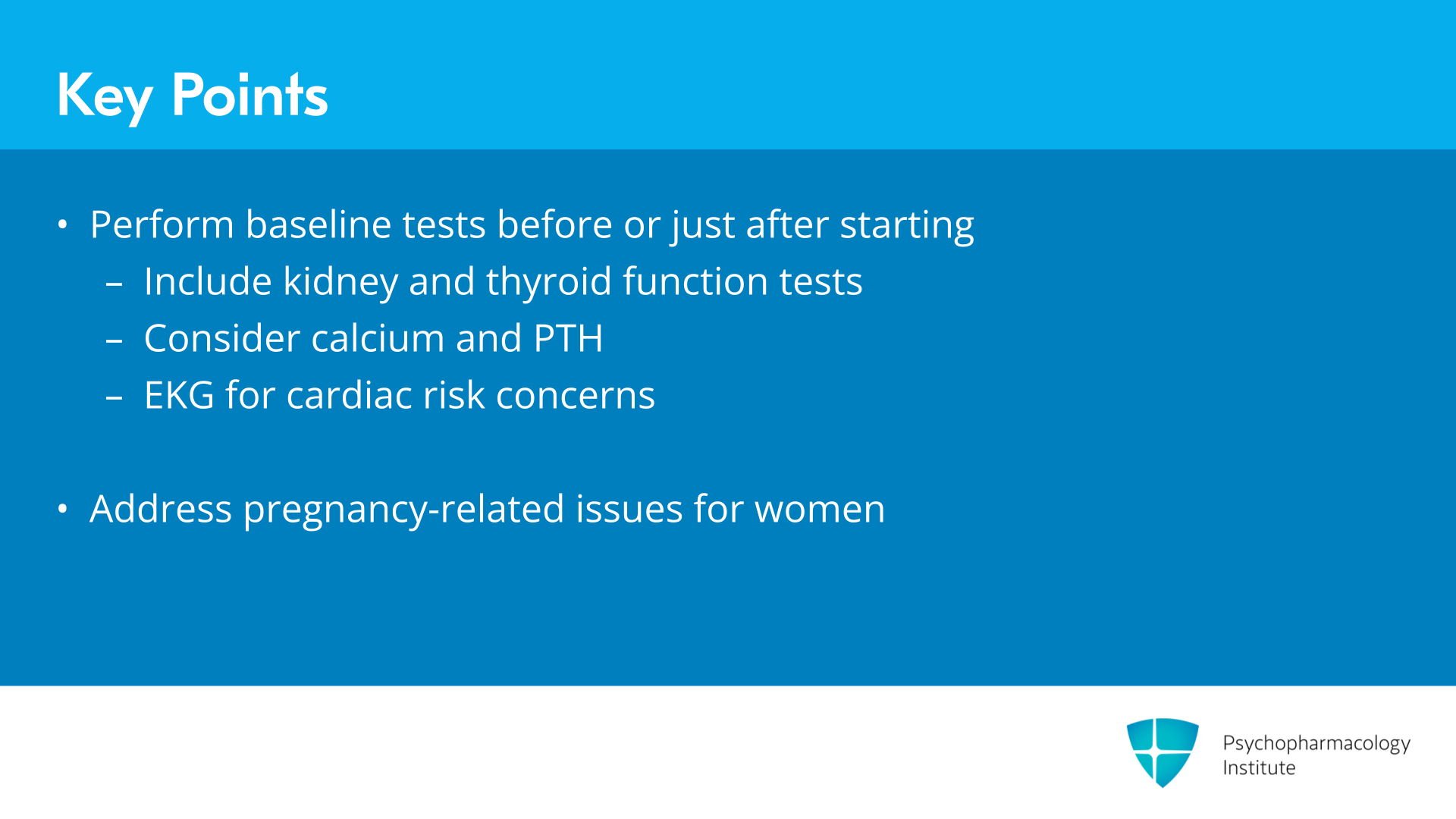
I will now summarize the key points of this video. First of all, baseline testing before or just after if more convenient. Sometimes, you’re really in a hurry to get that lithium started but they haven’t gotten their lab work yet. So get those tests which include kidney function tests and thyroid function tests most importantly and maybe also calcium and PTH, parathyroid hormone. If there’s concern about cardiac risk, an EKG may be done. If it’s a woman who could become pregnant, consider the issues with this in the baseline evaluation.
Free Files
Download PDF and other files
Success!
Check your inbox, we sent you all the materials there.
Slide 25 of 26
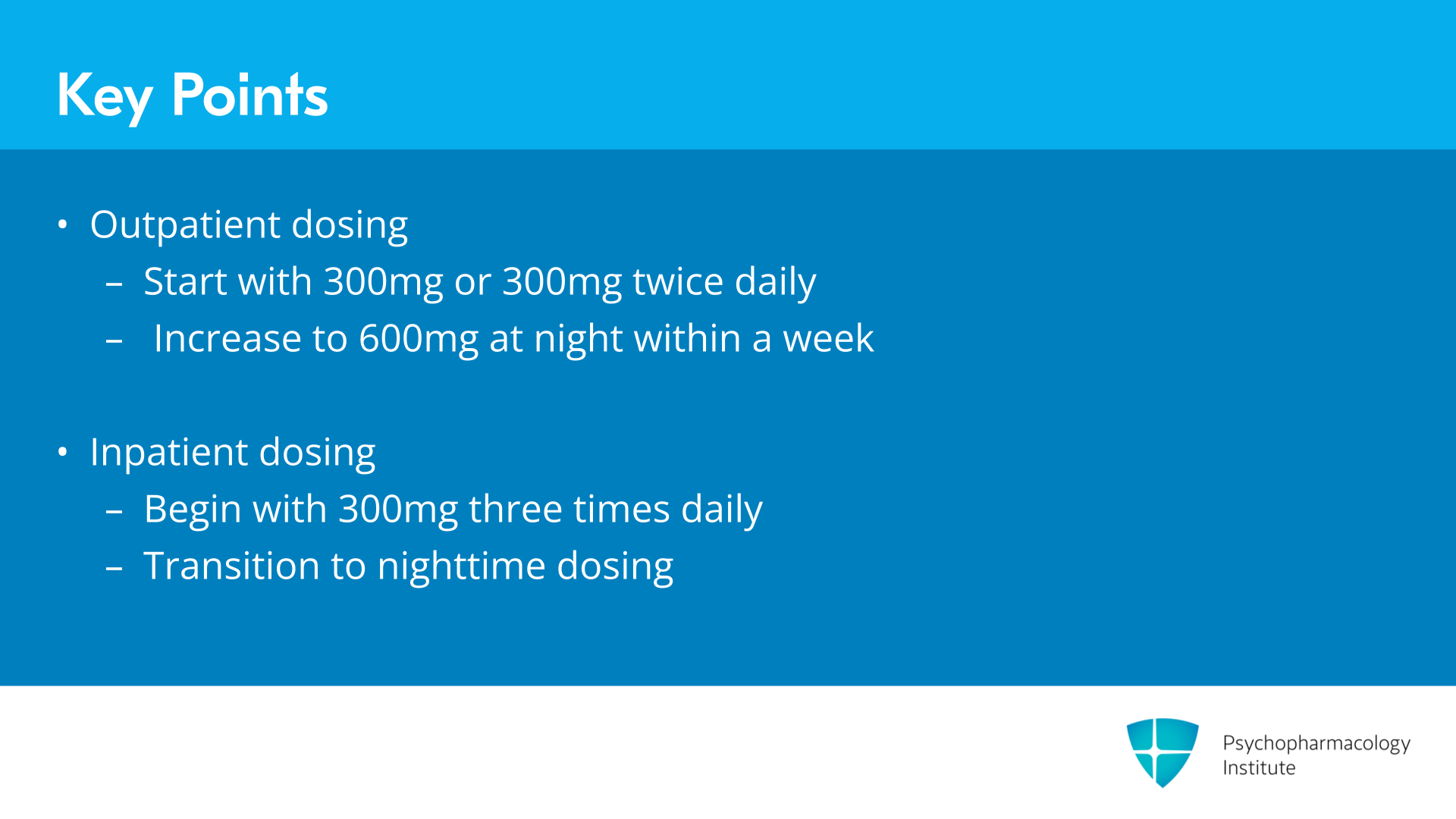
Second key point is about dosing. Dosing should almost always be with the immediate-release formulation, not the long-acting. I prefer the capsule form of it, not the pills and have you give it all at night. With an outpatient, you can build it up with all the doses at night – one at night then two at night then three at night. Dosing – outpatients can start at 300 or 300 twice daily or I’d prefer at least twice daily if you’re going to start in outpatient but then move it to all 600 at night in a week or so. But with an inpatient, you may want to start with three a day and then you’ll give three separate doses and transition them to all at night later. Inpatient, you can start at 300 three times a day as I said. But do remember when you make the switch from two or three times a day to all at night, lower the dose by about 20%.
Slide 26 of 26
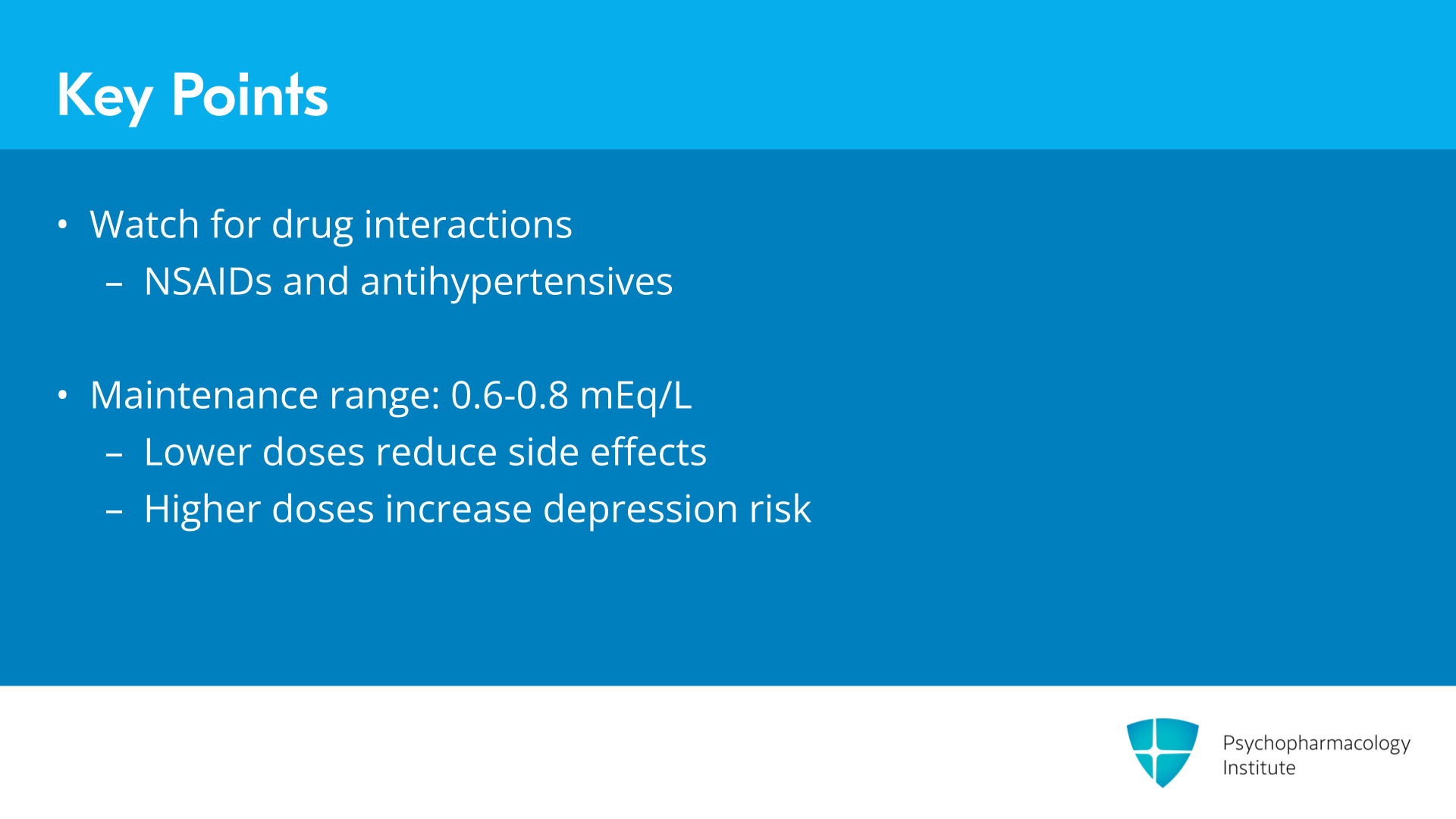
Watch for drug interactions with NSAIDs, antihypertensives and others. Overly caffeinated patients may need higher doses to get where you need to get. And then for maintenance, 0.6 to 0.8 mEq/L. Kidney dysfunction is dose related so you want to stay in the middle of that range or even slightly below it if it’s clinically effective. Higher doses will produce moe flips to depression and other side effects.
Free Files
Download PDF and other files
Success!
Check your inbox, we sent you all the materials there.
