



Slides and Transcript
Slide 1 of 9
So in this video, I’m going to discuss the augmentation of SSRIs in treatment-resistant OCD patients with the use of glutamatergic agents including the D-cycloserine and talk about ketamine as well.
Slide 2 of 9
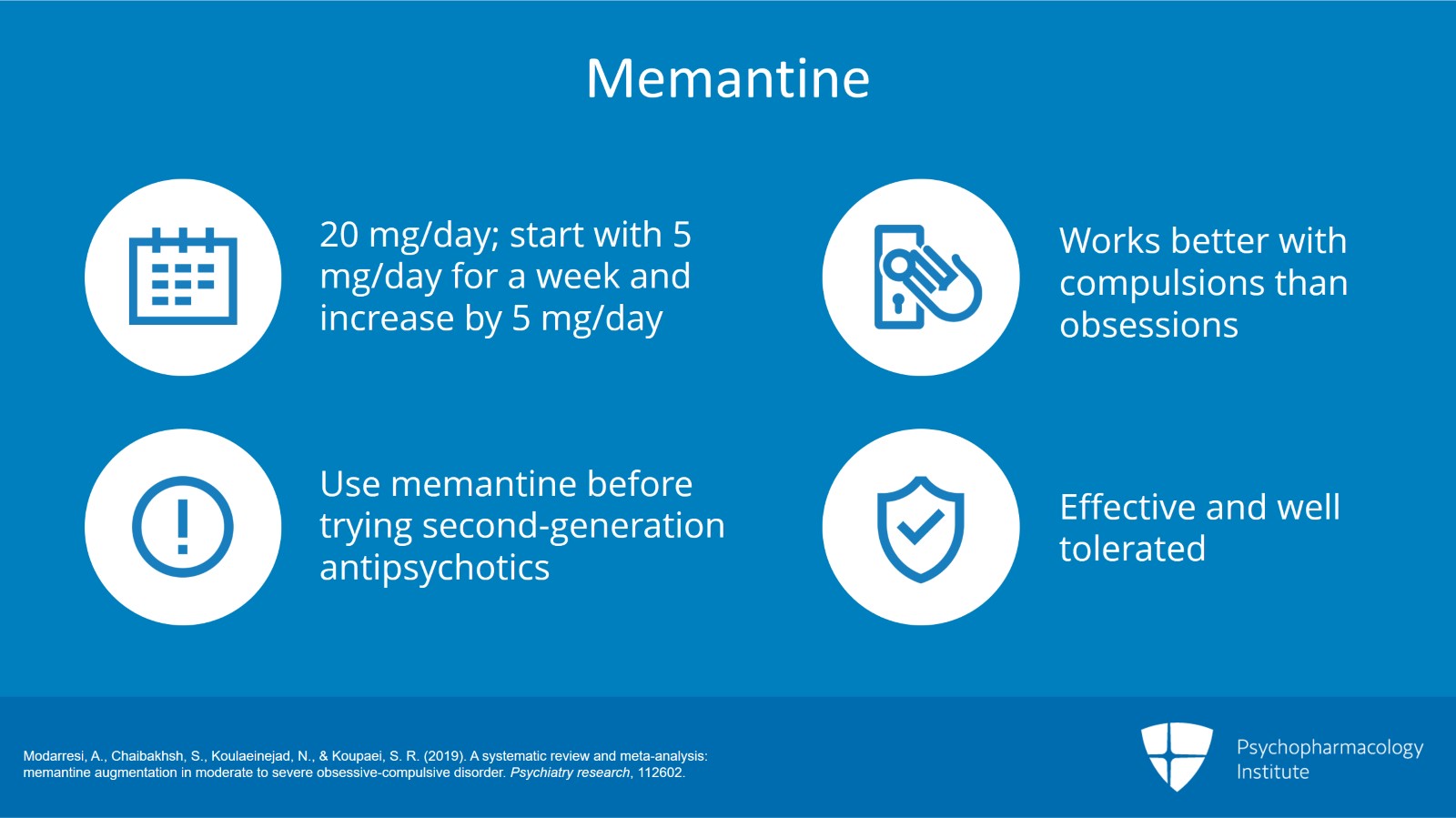
So I would like to first talk about memantine. Memantine is probably the most common augmentation agent that I’m using for OCD nowadays. It’s a noncompetitive NMDA receptor antagonist. Now, it is approved for moderate to severe Alzheimer’s and it limits glutamatergic excitotoxicity. Now, for OCD, it has been effective in some double-blind randomized controlled trials. It’s only been used with open-label studies in the United States. It’s used at generally 20 mg a day and not really shown to have benefit at lower doses. We use the same 20 mg a day of memantine in our OCD patients as is used in dementia.
The titration that we use for memantine is similar to that of dementia starting out at 5 mg daily for a week and then increasing by 5 mg daily until they get up to 20 mg. I usually dose it b.i.d. as you typically dose it with dementia patients. However, having said that, many patients do take it daily. There is some evidence in the literature to suggest that the medication is effective once daily. And so for compliance purposes, if you want to use it once a day, that is okay at the 20 mg dose.
Obviously, there are much less side effects with memantine than compared to second-generation antipsychotics. And my strong recommendation is that as an augmentation agent, you should try memantine or other glutamatergic agents prior to the use of any antipsychotics. There may be somewhat better evidence for antipsychotic augmentation. However, when you weigh side effects and risks, I think we’re better off using memantine as a first-line agent.
One of the interesting things about memantine is that it seems to work better with compulsions than with obsessions. Now, this is solely a clinical observation, not necessarily supported yet by research but it’s something that many people who work with OCD patients have noted, that the memantine seems to reduce the amount of time they spend on rituals, not necessarily on the strength or the frequency of their intrusive obsessive thoughts. I do think that someday we may consider memantine as co-primary treatment rather than augmentation of SSRIs. Yet, however, still at this time, I still encourage you to think of memantine and other glutamatergic agents as augmentation to the original SSRI.
Again, because of its safety and tolerability, I’ll use it as augmentation over any of the other non-serotonergic medications. And I think it is typically effective, typically well tolerated. Often, you will note that the patient doesn’t have a great deal of nice things to say about the memantine. They may not feel better but people around them, however, may notice that the patient spends a lot less time ritualizing. So it’s always helpful when using memantine as a two-month augmentation trial, get collateral history from family. They may report that the patient is at least appearing much better.
References:
- Modarresi, A., Chaibakhsh, S., Koulaeinejad, N., & Koupaei, S. R. (2019). A systematic review and meta-analysis: memantine augmentation in moderate to severe obsessive-compulsive disorder. Psychiatry research, 112602.
Unlock this Video Lecture and earn 1.25 CMEs
Become a Bronze, Silver, Gold, Bronze extended, Silver extended or Gold extended Member.
Already have an account? Sign in
