Slides and Transcript
Slide 1 of 15
Hi everyone. This video is about three side effects – sexual problems, hair loss and rashes.
Slide 2 of 15
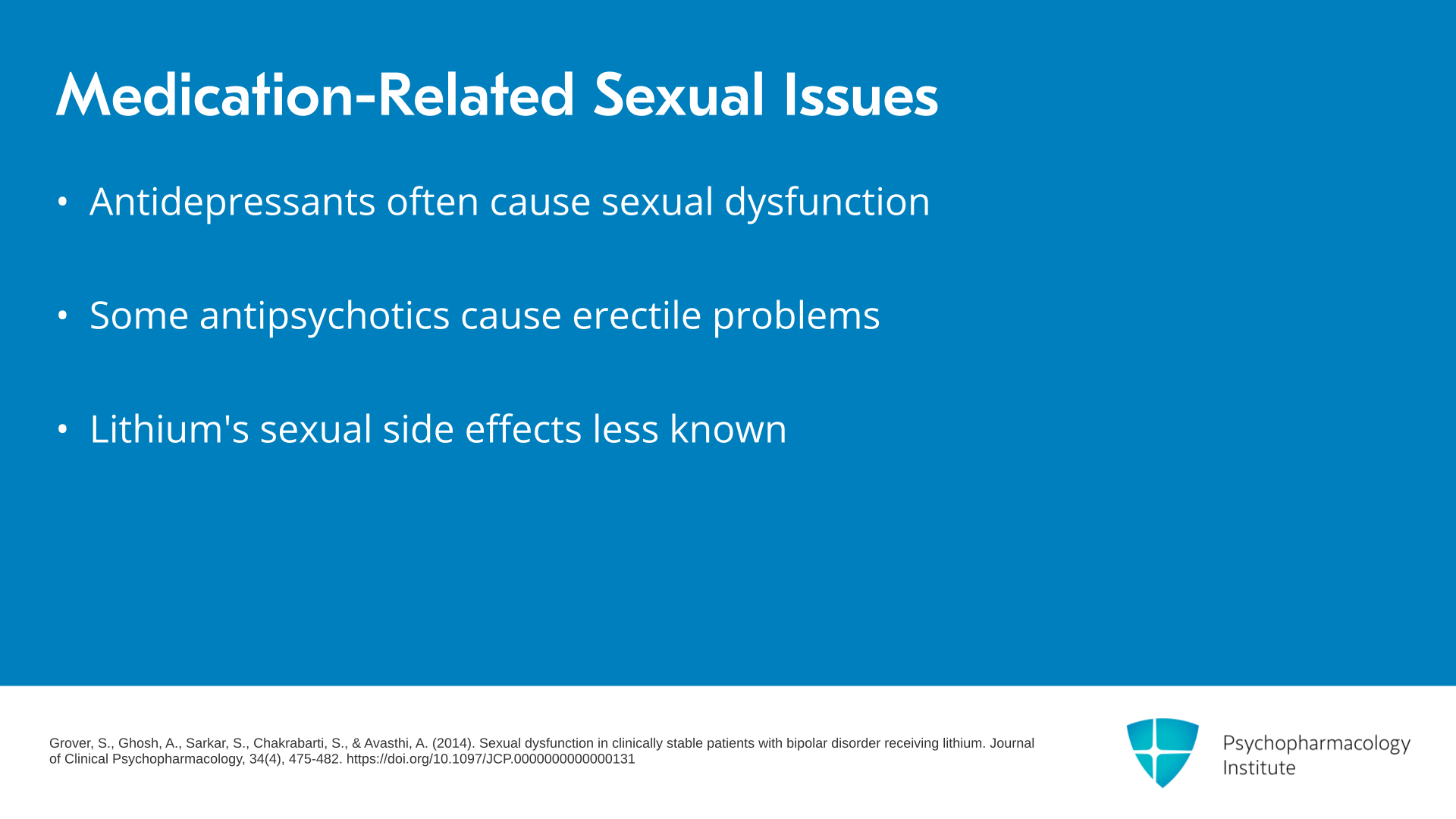
The first one we’re going to talk about is sexual problems. We don’t usually think of lithium as a major issue with sexual problems. We think of the antidepressants causing sexual dysfunction. Certain of the antipsychotics, those with strong dopamine effect like risperidone can cause erectile problems in men and prolactin elevation can be a problem for women as well. So what about lithium? Does that have sexual problems? Can you promise your patient that this is an alternative that won’t do that?
References:
- Grover, S., Ghosh, A., Sarkar, S., Chakrabarti, S., & Avasthi, A. (2014). Sexual dysfunction in clinically stable patients with bipolar disorder receiving lithium. Journal of Clinical Psychopharmacology, 34(4), 475-482. https://doi.org/10.1097/JCP.0000000000000131
Free Files
Download PDF and other files
Success!
Check your inbox, we sent you all the materials there.
Slide 3 of 15
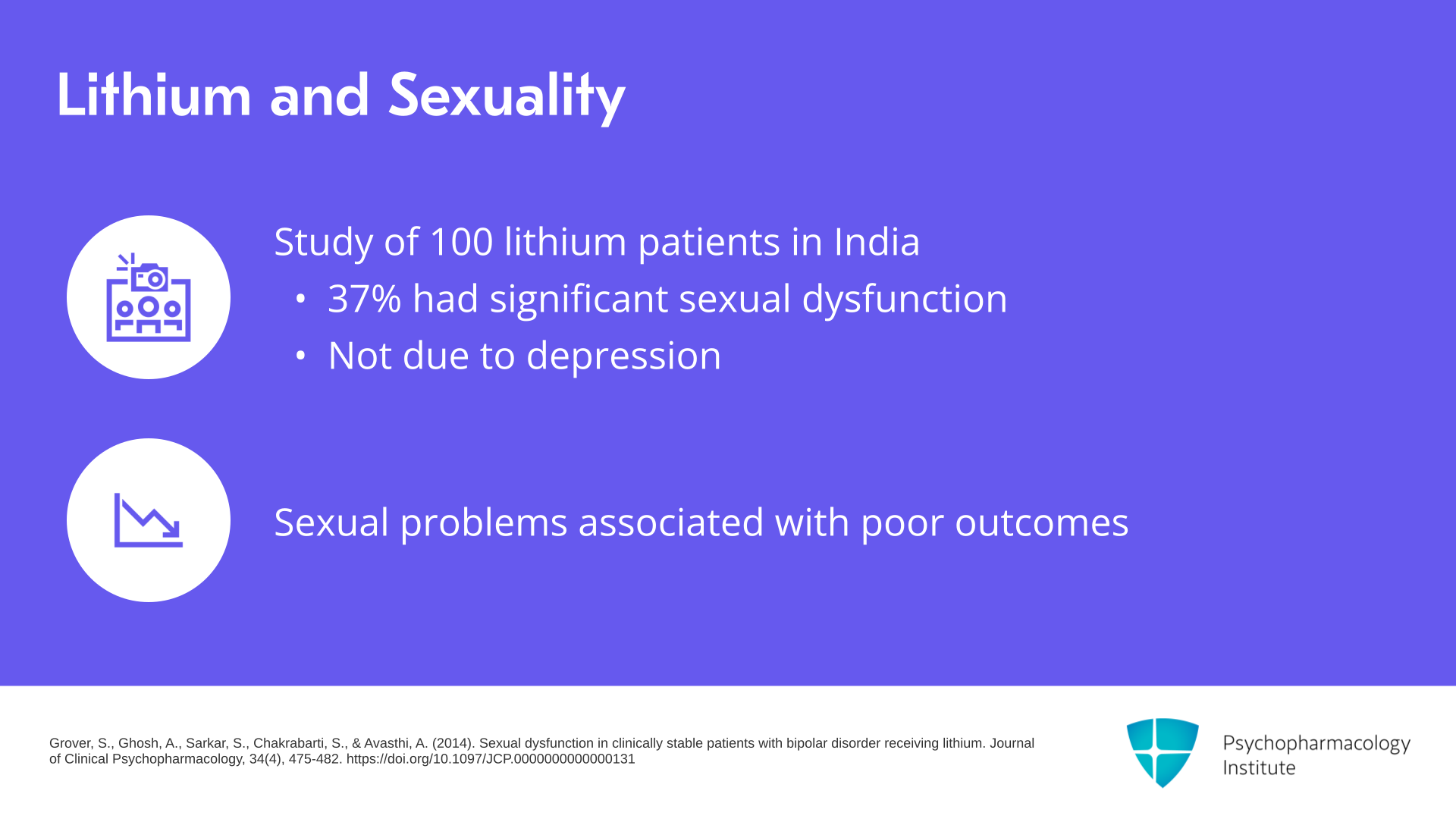
There was this study of 100 lithium patients from India, mean age 44, all married, all had a sexual partner and doing a detailed evaluation of their sex life using the ASEX rating scale, 37% had significant sexual dysfunction and it was not due to depression. They were not depressed because in bipolar depression there’s usually zero interest in sex. But these were people who were not depressed but half of them did have comorbid substance use disorders or serious medical problems. So those might have been the cause or at least contributing to these 37% that had the sexual problems. 17% overall had more than one med but the rate was no higher in the people with the sexual problems versus the others. So what do we make of this? Well, it was a small study. It wasn’t controlled. The people with sexual problems though, that was associated with poor adherence and other side effects and poor functioning.
References:
- Grover, S., Ghosh, A., Sarkar, S., Chakrabarti, S., & Avasthi, A. (2014). Sexual dysfunction in clinically stable patients with bipolar disorder receiving lithium. Journal of Clinical Psychopharmacology, 34(4), 475-482. https://doi.org/10.1097/JCP.0000000000000131
Slide 4 of 15
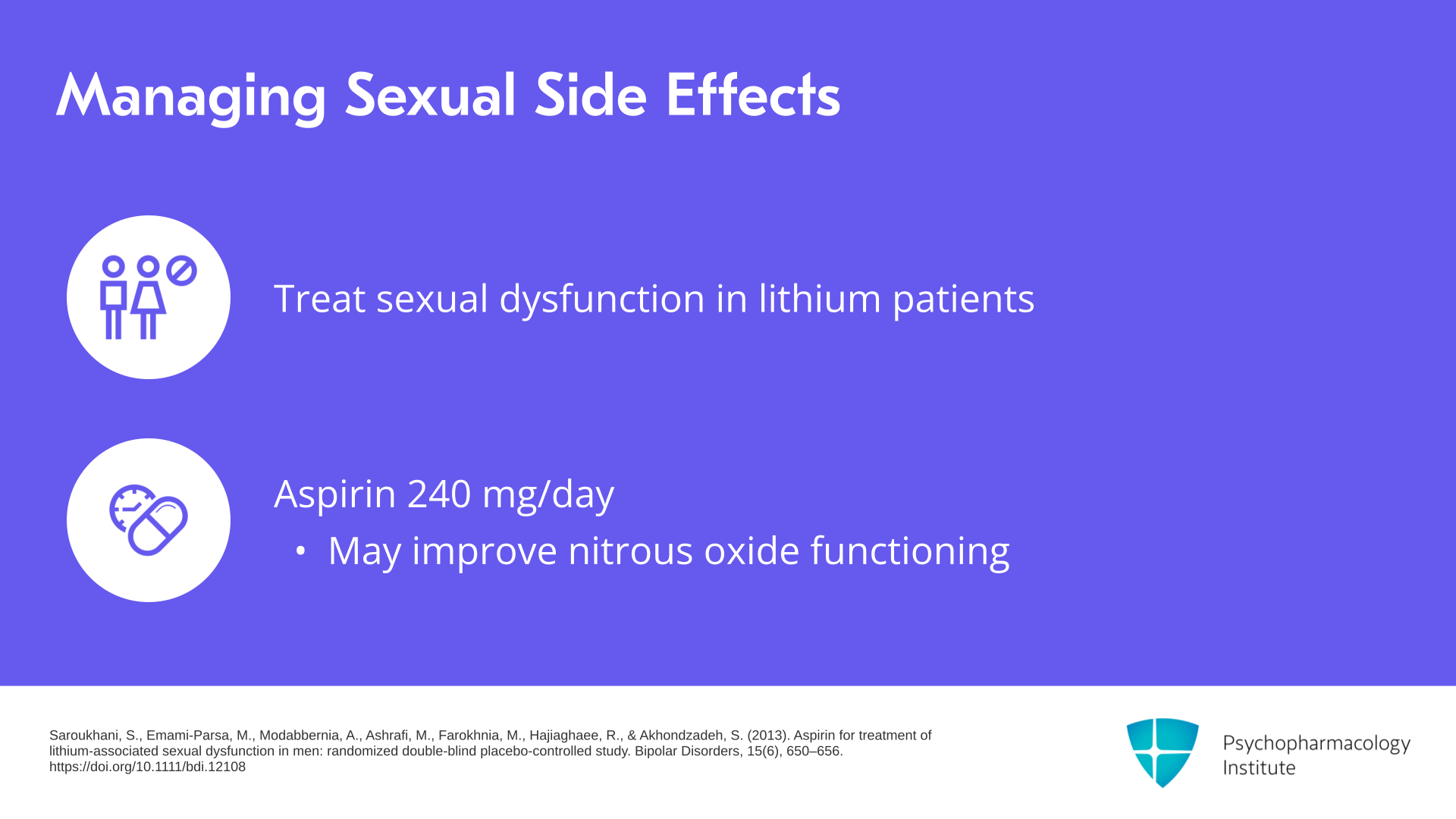
So maybe you should try to treat the sexual dysfunction if it occurs in your lithium patient and there’s no other explanation for it. There just happens to be one small study of aspirin 240 mg a day which is not a full-sized aspirin tablet, maybe 2/3 of one. The theory offered by the authors is that nitrous oxide functioning which is important in erectile functioning may be impaired by lithium and aspirin improves it. We do need more study though before you can feel like all this is fact.
References:
- Saroukhani, S., Emami-Parsa, M., Modabbernia, A., Ashrafi, M., Farokhnia, M., Hajiaghaee, R., & Akhondzadeh, S. (2013). Aspirin for treatment of lithium-associated sexual dysfunction in men: randomized double-blind placebo-controlled study. Bipolar Disorders, 15(6), 650–656. https://doi.org/10.1111/bdi.12108
Free Files
Download PDF and other files
Success!
Check your inbox, we sent you all the materials there.
Slide 5 of 15
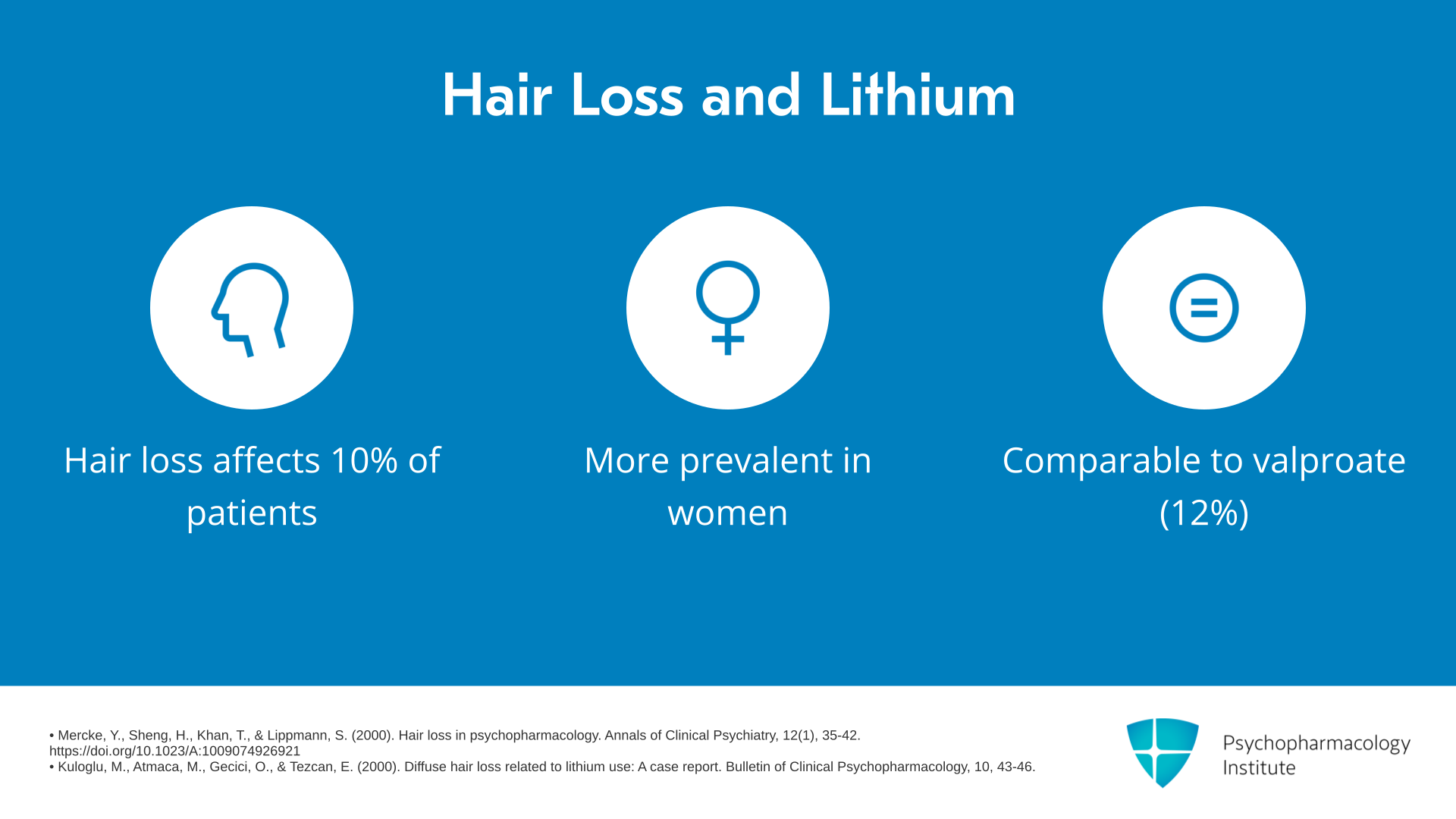
Let’s move on to another side effect, one often a reason why people want to quit lithium also, hair loss. It seems to occur in about 10% of people on lithium. And it’s more common in women than men. Now, in studies of valproate just for comparison by the way, the rate of hair loss is 12%. So there’s no advantage to valproate if you’re thinking that you might want to switch to that on this side effect. On the other hand, carbamazepine, we don’t have really strong data on this but it probably has less.
References:
- Mercke, Y., Sheng, H., Khan, T., & Lippmann, S. (2000). Hair loss in psychopharmacology. Annals of Clinical Psychiatry, 12(1), 35-42. https://doi.org/10.1023/A:1009074926921
- Kuloglu, M., Atmaca, M., Gecici, O., & Tezcan, E. (2000). Diffuse hair loss related to lithium use: A case report. Bulletin of Clinical Psychopharmacology, 10, 43-46.
Slide 6 of 15
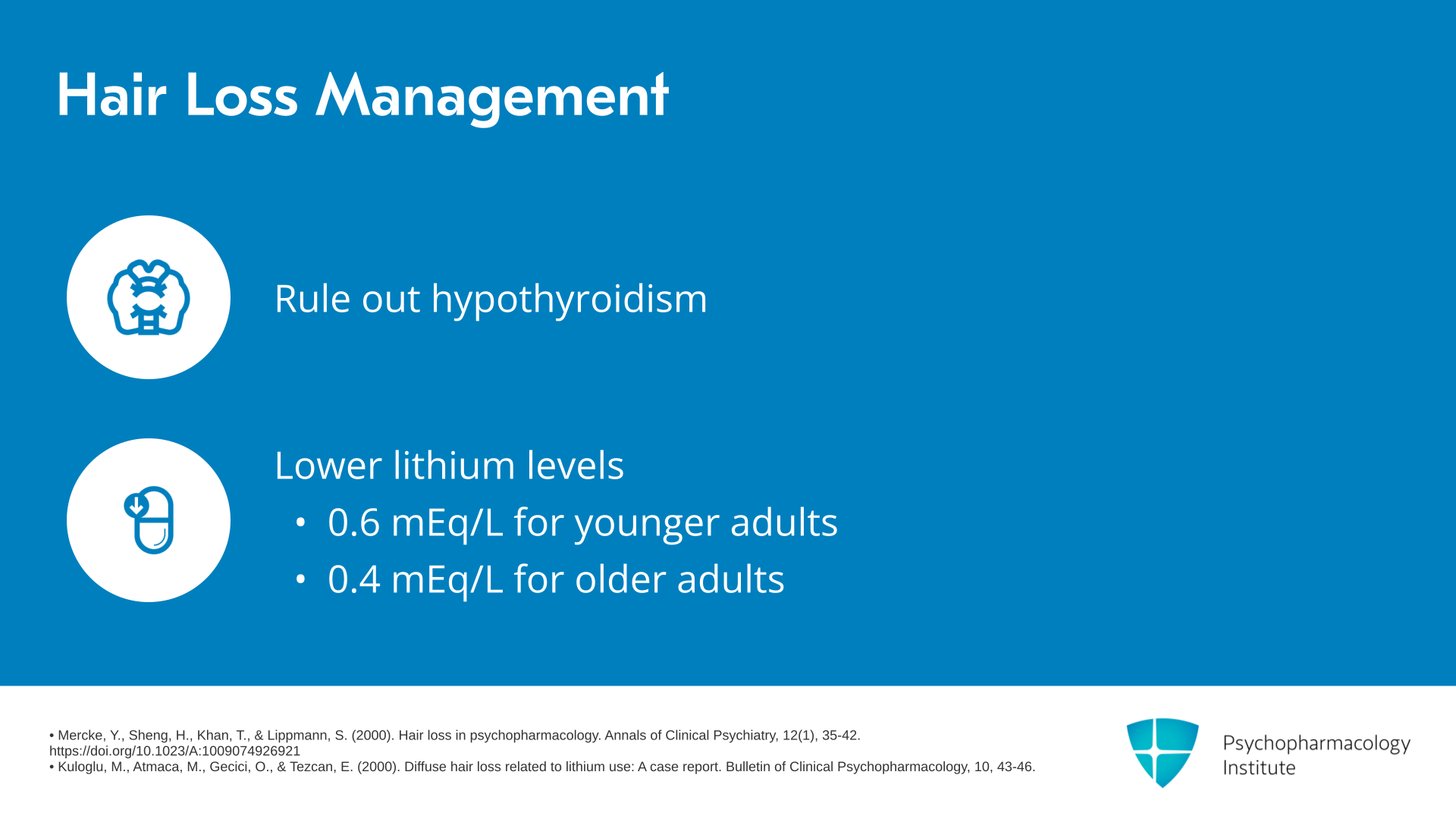
What can you do for this hair loss? Hypothyroidism can cause hair loss. So you need to rule that out. You presumably are monitoring their thyroid as I have recommended earlier and treated it if it’s low with thyroxine. Get them to the lowest level that is clinically reasonable therapeutically for them like 0.6 for a younger adult, 0.4 for an older adult.
References:
- Mercke, Y., Sheng, H., Khan, T., & Lippmann, S. (2000). Hair loss in psychopharmacology. Annals of Clinical Psychiatry, 12(1), 35-42. https://doi.org/10.1023/A:1009074926921
- Kuloglu, M., Atmaca, M., Gecici, O., & Tezcan, E. (2000). Diffuse hair loss related to lithium use: A case report. Bulletin of Clinical Psychopharmacology, 10, 43-46.
Free Files
Download PDF and other files
Success!
Check your inbox, we sent you all the materials there.
Slide 7 of 15
And beyond that, there’s been interest in multivitamins with minerals. Specifically, zinc and selenium are thought important for hair growth. It’s not clear that supplements will help though. There are no studies of zinc and selenium supplementation for hair loss due to lithium that we have been able to find. Yet you will frequently see this recommended. The only evidence is that these minerals may be important in hair growth.
References:
- Mikhael, N. W., Hussein, M. S., Mansour, A. I., & Abdalamer, R. S. (2020). Evaluation of serum level of zinc and biotin in patients with alopecia areata. Benha Journal of Applied Sciences, 5(6 part (1)), 67-72.
Slide 8 of 15
The other option is minoxidil, a treatment for hair loss. It’s effective and the problem with it though is as soon as you stop applying it to the scalp the hair falls right off again. So it’s not as good as hair transplants, if you’re serious about long term changing your hair loss situation for men or women. But the package insert for minoxidil specifically says don’t use it for people with hair loss from drugs like lithium or valproate.
References:
- Meyer, J. M., & Stahl, S. M. (2023). The Lithium Handbook: Stahl's Handbooks. Cambridge University Press. https://doi.org/10.1017/9781009225069
Free Files
Download PDF and other files
Success!
Check your inbox, we sent you all the materials there.
Slide 9 of 15
So the third side effect I’m talking about is rashes in people on lithium. Let’s start with acne. It makes it worse if you have it and it may start it and this is unpleasant for people. They may decide they don’t want to take it.
References:
- Yeung, C. K., & Chan, H. H. (2004). Cutaneous adverse effects of lithium: epidemiology and management. American Journal of Clinical Dermatology, 5(1), 3–8. https://doi.org/10.2165/00128071-200405010-00002
Slide 10 of 15
Conventional treatment can be used for acne like tetracycline and spontaneous improvement may occur. And it also may help to reduce their blood level to 0.6 or, or less depending on the clinical situation.
References:
- Yeung, C. K., & Chan, H. H. (2004). Cutaneous adverse effects of lithium: epidemiology and management. American Journal of Clinical Dermatology, 5(1), 3–8. https://doi.org/10.2165/00128071-200405010-00002
Free Files
Download PDF and other files
Success!
Check your inbox, we sent you all the materials there.
Slide 11 of 15
Now, the tougher story is psoriasis. Exacerbations or breakthroughs can be related to lithium’s effect to demarginalized neutrophils and this can also occur de novo cases or exacerbation in up to 6 %. So what to do? Confer with their treater for psoriasis as well as with the patient whether they’re willing to take some risks of it exacerbating and they can be treated with conventional treatments should that occur in order to get the benefits of lithium.
References:
- Yeung, C. K., & Chan, H. H. (2004). Cutaneous adverse effects of lithium: epidemiology and management. American Journal of Clinical Dermatology, 5(1), 3–8. https://doi.org/10.2165/00128071-200405010-00002
- Jafferany, M. (2008). Lithium and psoriasis: what primary care and family physicians should know. Primary Care Companion to the Journal of Clinical Psychiatry, 10(6), 435-439. https://doi.org/10.4088/pcc.v10n0602
Slide 12 of 15
If they have mild psoriasis, they may be more willing to give that a chance. If they have really severe psoriasis, if they’ve got joint involvement, maybe they don’t want to take a risk of making it even worse with lithium and you’ll have to go to something else. There are also other rashes other than acne and psoriasis that may lead you to have issues with lithium that may need conventional treatment.
References:
- Yeung, C. K., & Chan, H. H. (2004). Cutaneous adverse effects of lithium: epidemiology and management. American Journal of Clinical Dermatology, 5(1), 3–8. https://doi.org/10.2165/00128071-200405010-00002
- Jafferany, M. (2008). Lithium and psoriasis: what primary care and family physicians should know. Primary Care Companion to the Journal of Clinical Psychiatry, 10(6), 435-439. https://doi.org/10.4088/pcc.v10n0602
Free Files
Download PDF and other files
Success!
Check your inbox, we sent you all the materials there.
Slide 13 of 15
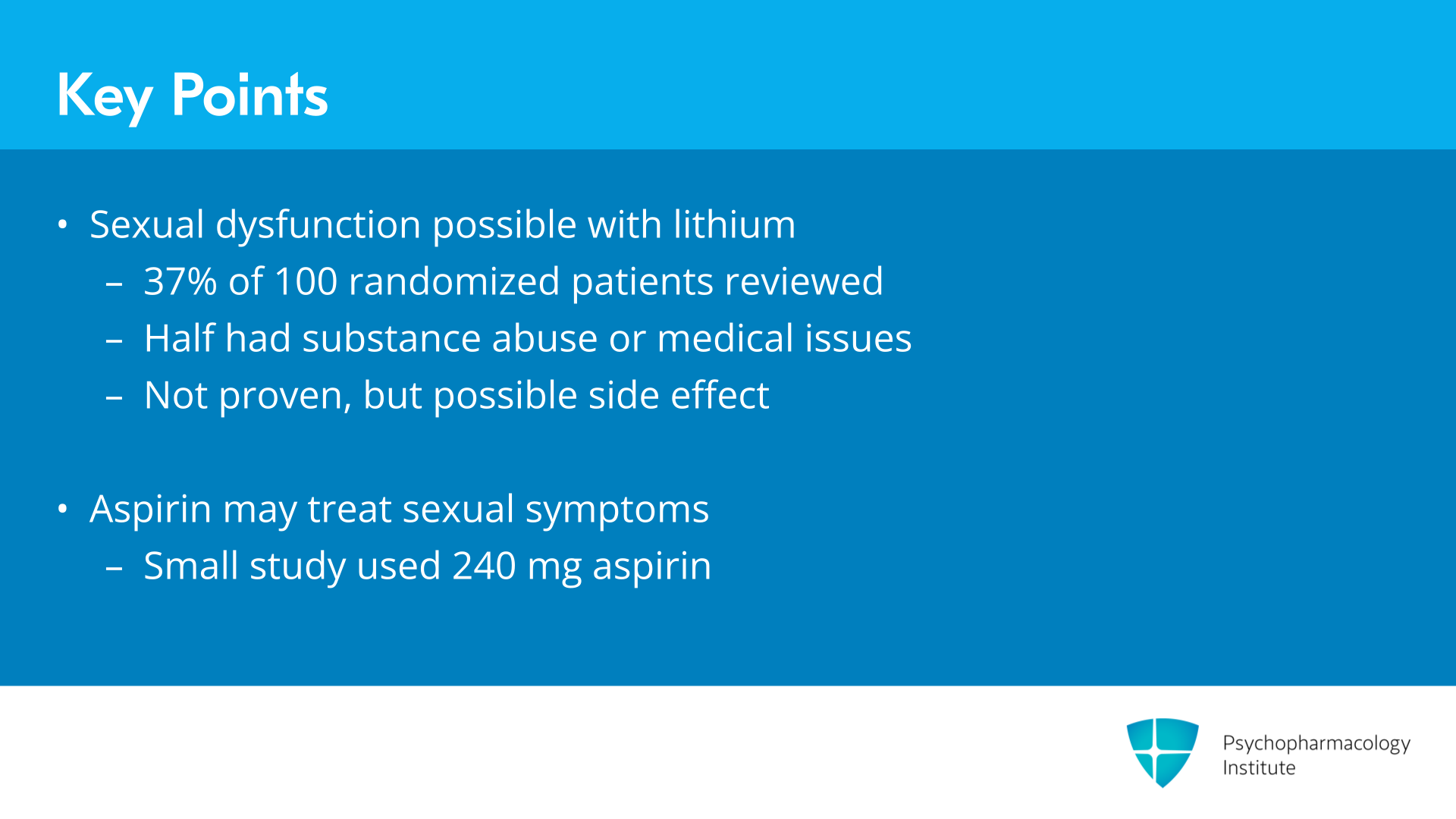
The key points of the video. I’ll start with the key point about sexual dysfunction from lithium and remind you that 37% of a group of 100 randomized patients were selected for review. These were patients in India and half of them had substance abuse problems or medical issues that could explain their sexual problems. They weren’t depressed. It wasn’t that but they could have had these other issues. So it’s a possible side effect of lithium, not a proven one. But there was a study using aspirin 240 mg in one small study for correcting these sexual problems that people were complaining about on lithium.
Slide 14 of 15
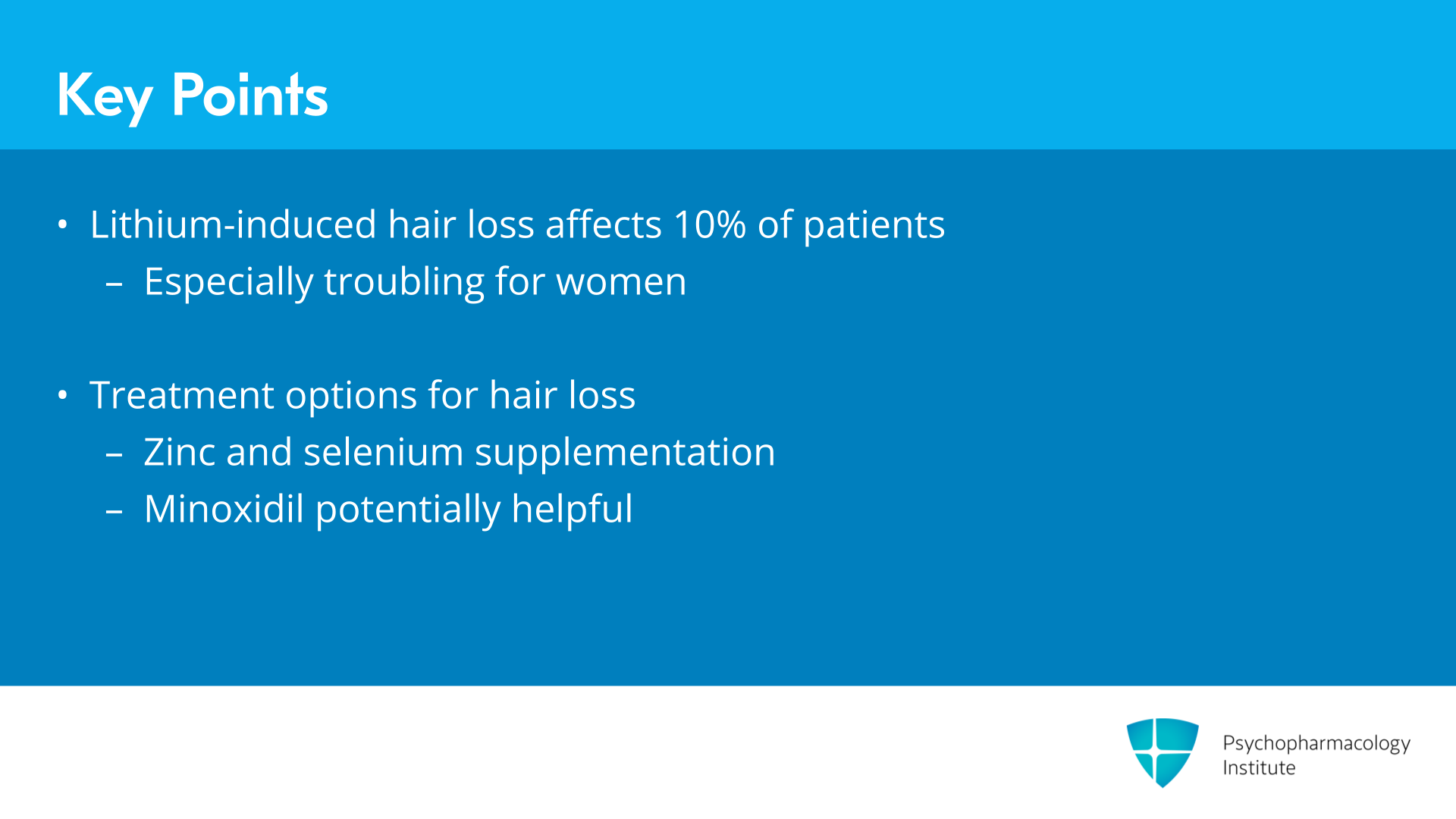
Next, we talked about hair loss. It’s a very troubling side effect especially for women on lithium. The frequency seems to be about 10% but note that it’s 12% on valproate but it may be less on carbamazepine. You could try zinc and selenium mineral replacement for hair loss and minoxidil is reported to be helpful in case report data but the package insert for minoxidil for using it for general hair loss recommends against using it for drug-induced hair loss problems.
Free Files
Download PDF and other files
Success!
Check your inbox, we sent you all the materials there.
Slide 15 of 15
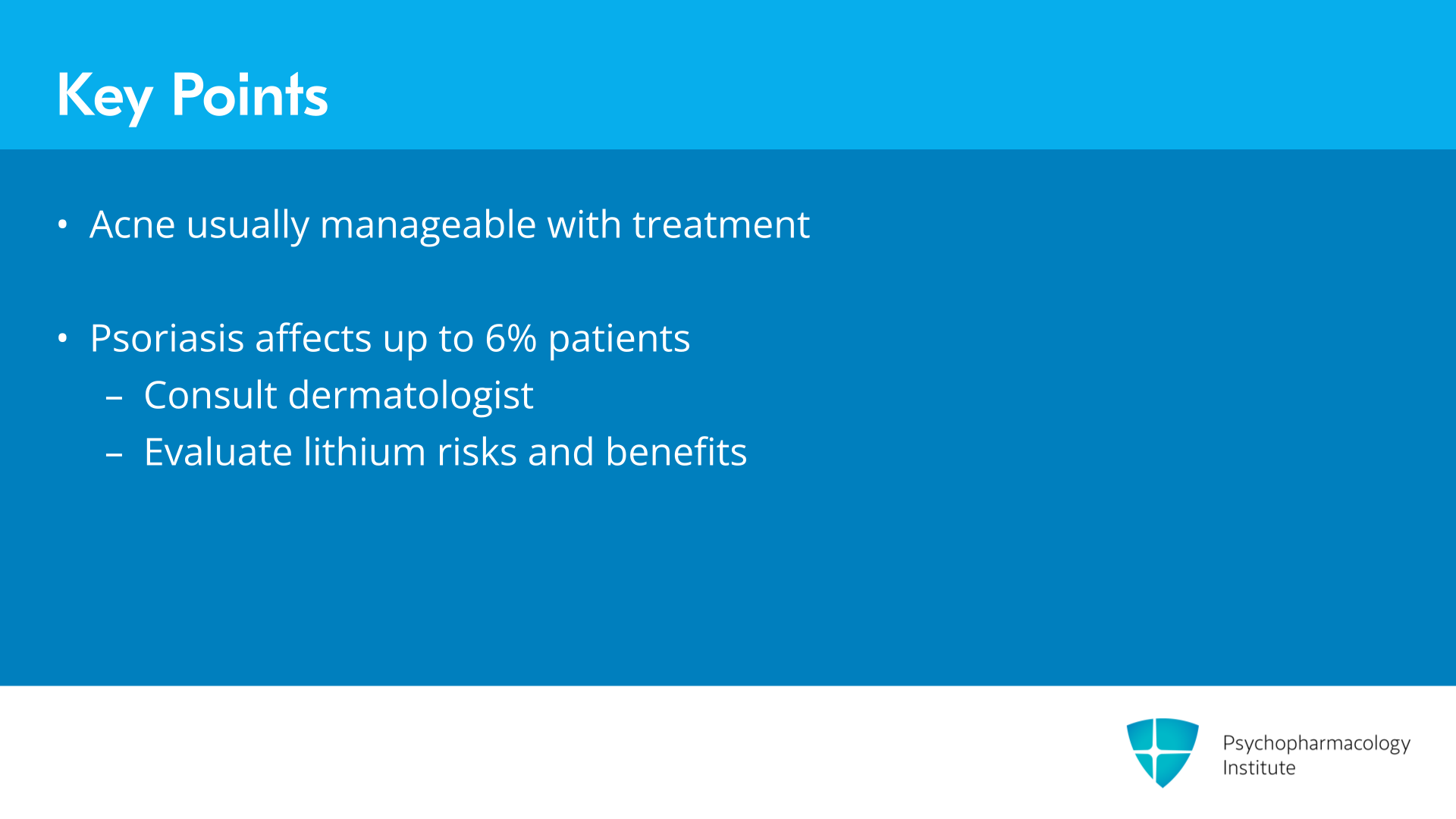
And finally, we talked about skin problems including acne and psoriasis. Conventional treatment usually is good for the acne and enables them to stay on their lithium. But for the latter, psoriasis, which happens in up to six percent of people treated with lithium, you better consult with their dermatologist and see if a consensus can be reached with you, the patient and the dermatologist about whether it’s worth the risk to start lithium or continue it if this developed while they were on it for the first time. After determining the advisability of using lithium, you may either have to discontinue and go on to other treatments or the dermatologist can step up on their standard treatments.