Close Banner
Section Free  - Video Lectures

02. Antipsychotics for BPD

Published on January 1, 2022 Certification expiration date: April 1, 2028

Paul Links, M.D.

Professor with the Department of Psychiatry and Behavioural Neurosciences - McMaster University, Hamilton ON, Canada

Key Points

  • The use of antipsychotics in patients with BPD can be useful for:
    • Anger.
    • Impulsivity.
    • Aggression.
    • Cognitive–perceptual disturbances.
  • Side effects of antipsychotics can limit their usefulness.

Free Downloads for Offline Access

  • Free Download Presentation File (PPTX)
  • Free Download Audio File (MP3)
  • Free Download Video (MP4)

Slides and Transcript

Slide 1 of 10

The next section of our talk is going to talk about antipsychotic medication for patients with borderline personality disorder.

Slide 2 of 10

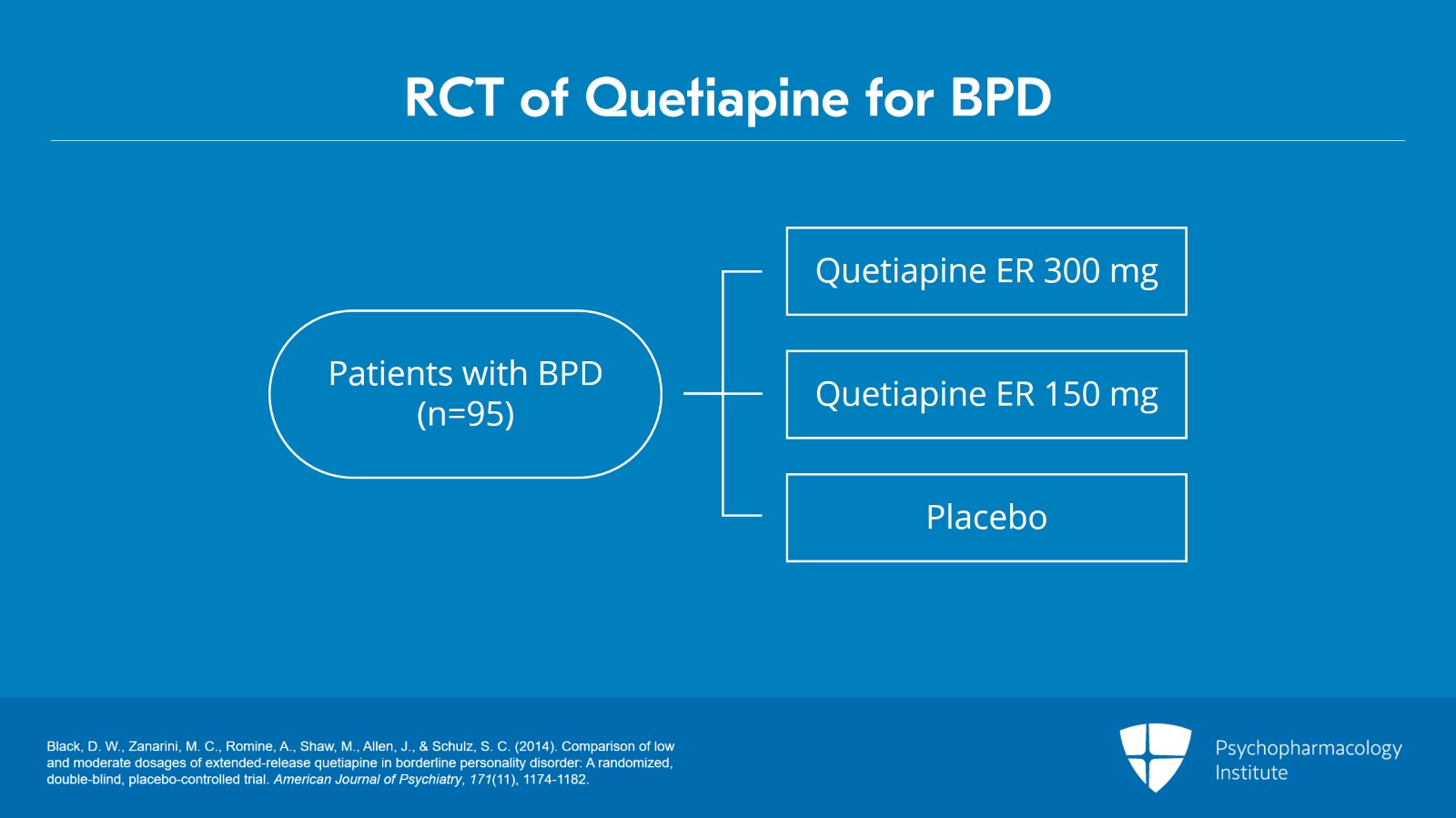
And we'll review a study by Black from 2014 which I think highlights some of the strengths and weaknesses of the research. So, these researchers studied quetiapine extended release versus placebo in a randomized controlled trial for borderline personality disorder. It was a large trial, 95 participants. And they compared 300 mg of quetiapine ER to 150 mg versus placebo.
References:
  • Black, D. W., Zanarini, M. C., Romine, A., Shaw, M., Allen, J., & Schulz, S. C. (2014). Comparison of low and moderate dosages of extended-release quetiapine in borderline personality disorder: A randomized, double-blind, placebo-controlled trial. American Journal of Psychiatry, 171(11), 1174-1182.
Free Files
Success!
Check your inbox, we sent you all the materials there.

Slide 3 of 10

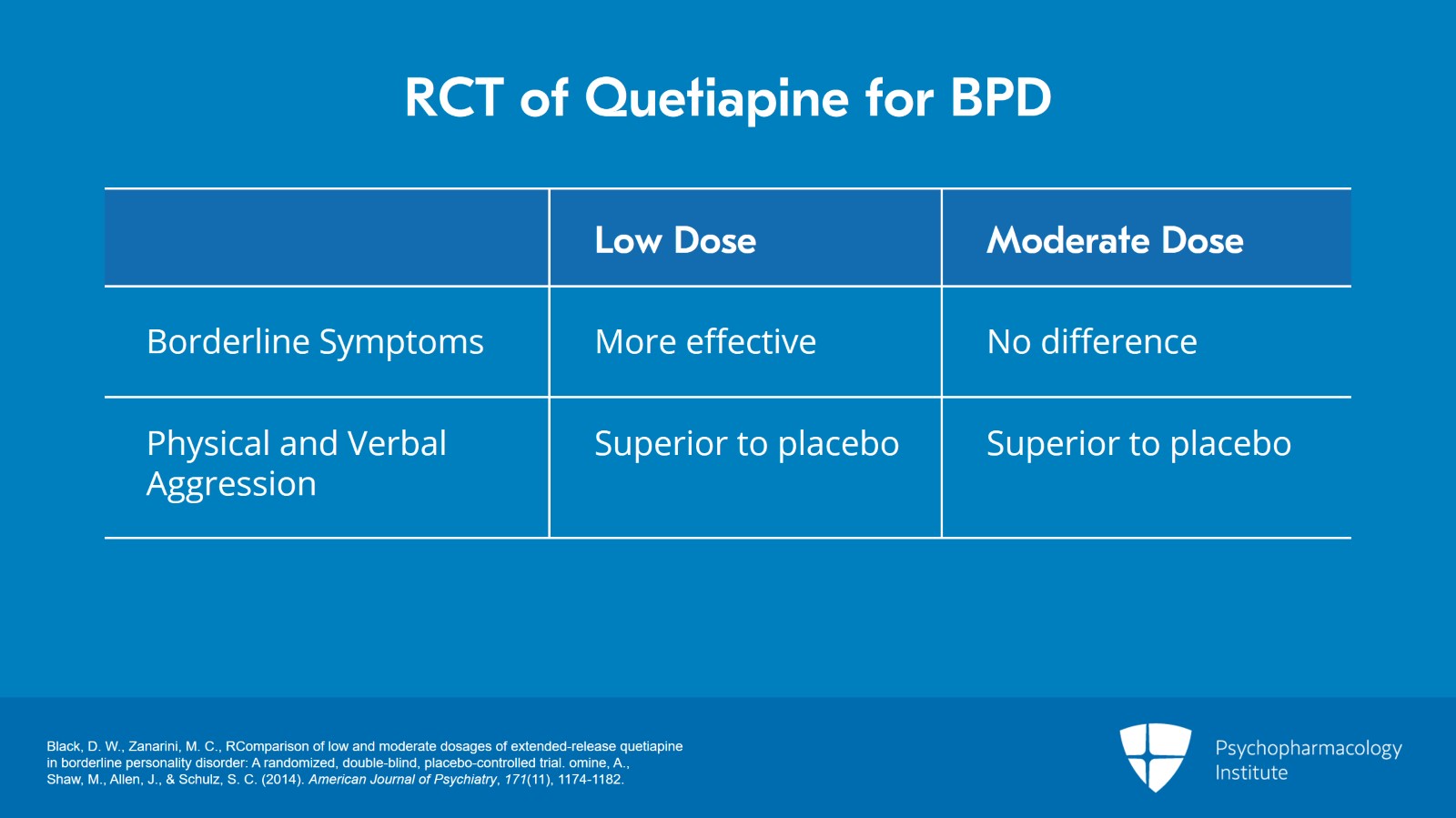
They found that the lower dose was more effective than placebo on borderline symptoms which was the primary outcome. And it actually had an effect size that was almost 0.8 which is quite meaningful. The moderate dose wasn't significantly better than placebo. There were no significant differences between the two doses themselves. On the secondary outcomes which were things like physical and verbal aggression, both medication doses were superior.
References:
  • Black, D. W., Zanarini, M. C., RComparison of low and moderate dosages of extended-release quetiapine in borderline personality disorder: A randomized, double-blind, placebo-controlled trial. omine, A., Shaw, M., Allen, J., & Schulz, S. C. (2014). American Journal of Psychiatry, 171(11), 1174-1182.

Slide 4 of 10

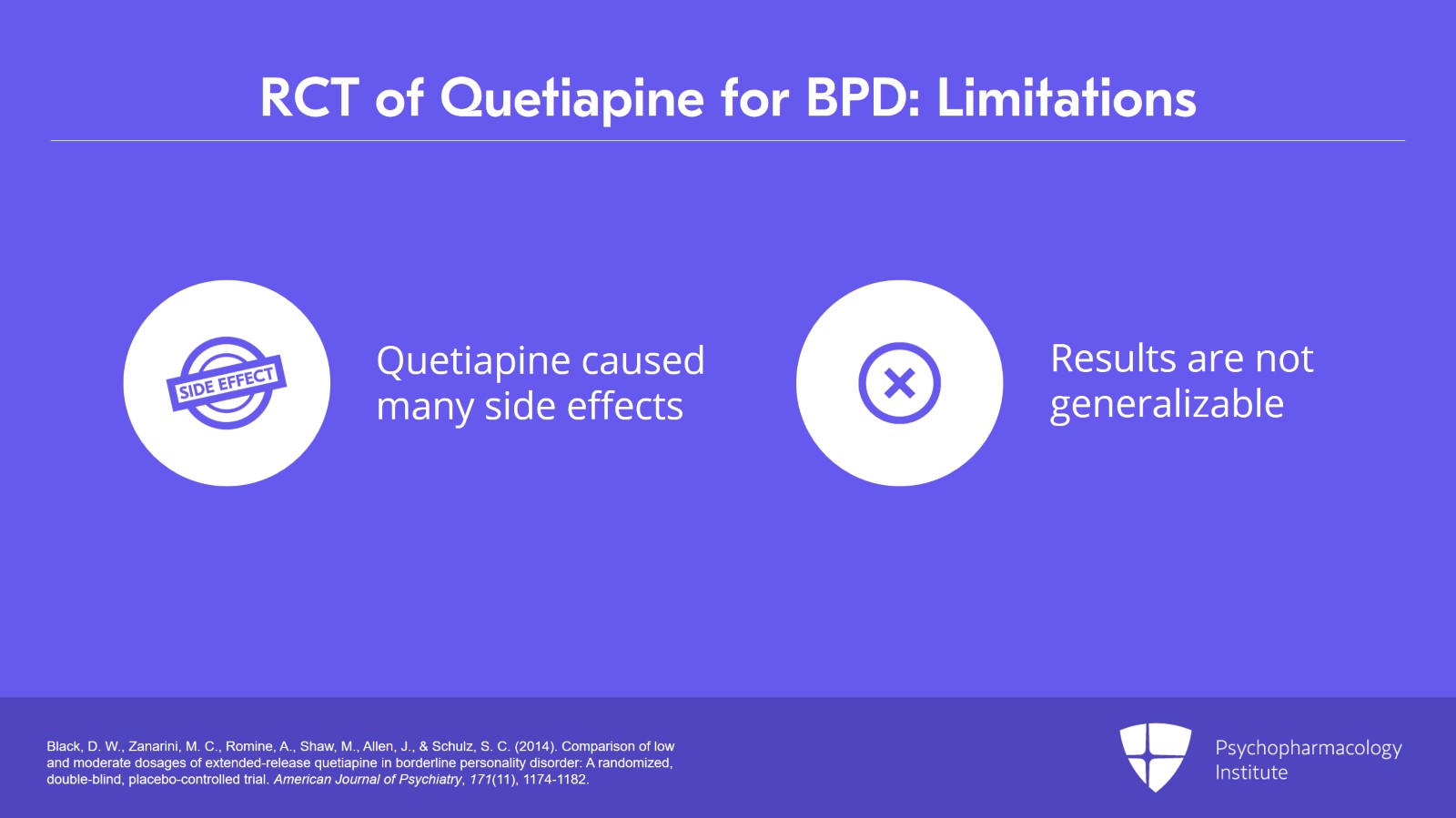
But as you might expect, this medication caused many side effects like sedation. And sedation was a reason that patients discontinued the trial. And the study had quite a few exclusions in terms of comorbid diagnoses. So, it does make it limited in terms of generalizing to all clinical situations.
References:
  • Black, D. W., Zanarini, M. C., Romine, A., Shaw, M., Allen, J., & Schulz, S. C. (2014). Comparison of low and moderate dosages of extended-release quetiapine in borderline personality disorder: A randomized, double-blind, placebo-controlled trial. American Journal of Psychiatry, 171(11), 1174-1182.
Free Files
Success!
Check your inbox, we sent you all the materials there.

Slide 5 of 10

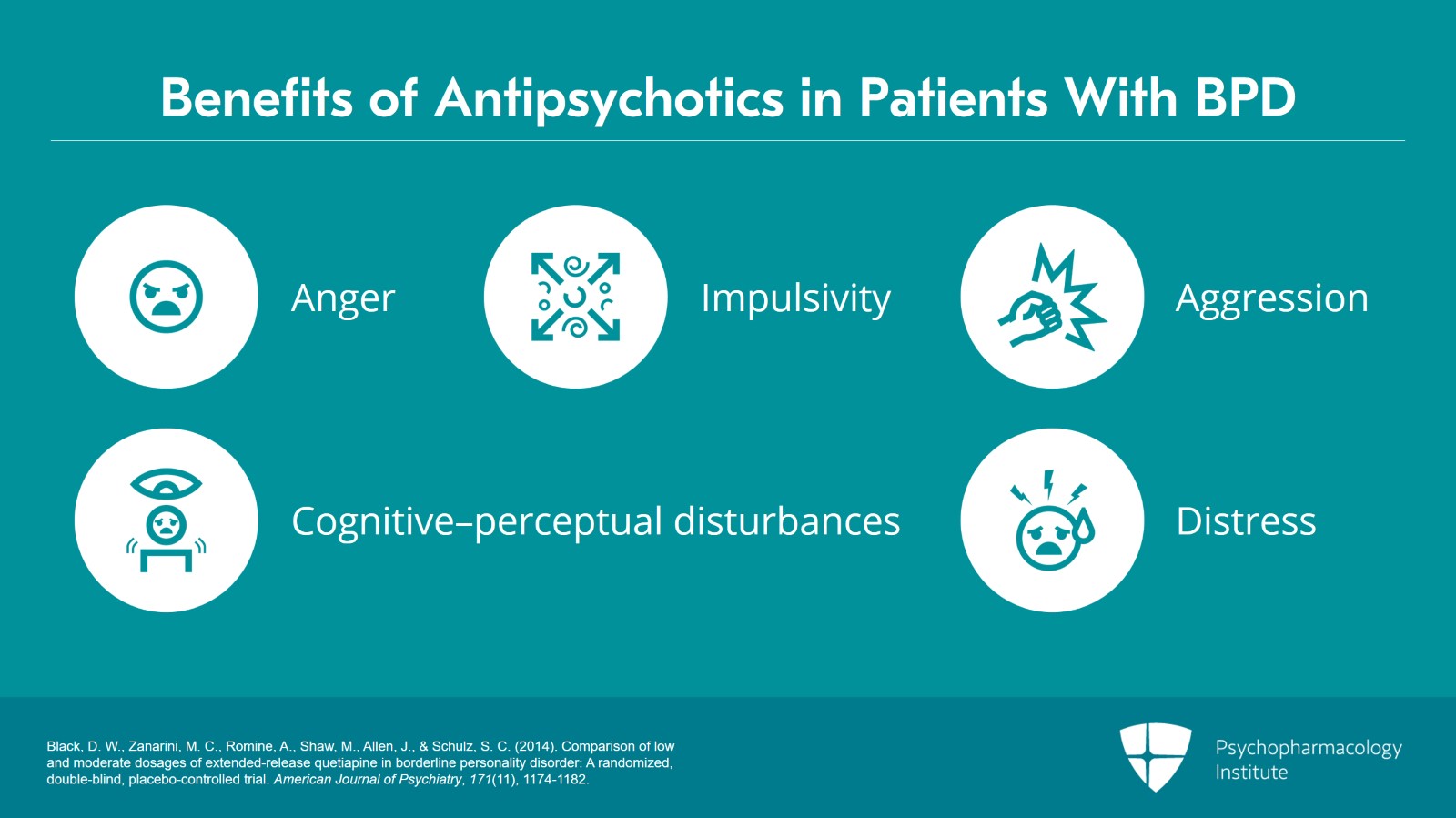
But this study really highlights the points of the use of antipsychotics in patients with borderline personality disorder. They do have benefits. They can be particularly useful for anger, impulsivity and aggression and they do have some value for the cognitive-perceptual disturbances, you know, non-delusional paranoid ideation or even some dissociative features. These medications can be useful when the patient is in distress and showing a lot of borderline symptoms.
References:
  • Black, D. W., Zanarini, M. C., Romine, A., Shaw, M., Allen, J., & Schulz, S. C. (2014). Comparison of low and moderate dosages of extended-release quetiapine in borderline personality disorder: A randomized, double-blind, placebo-controlled trial. American Journal of Psychiatry, 171(11), 1174-1182.

Slide 6 of 10

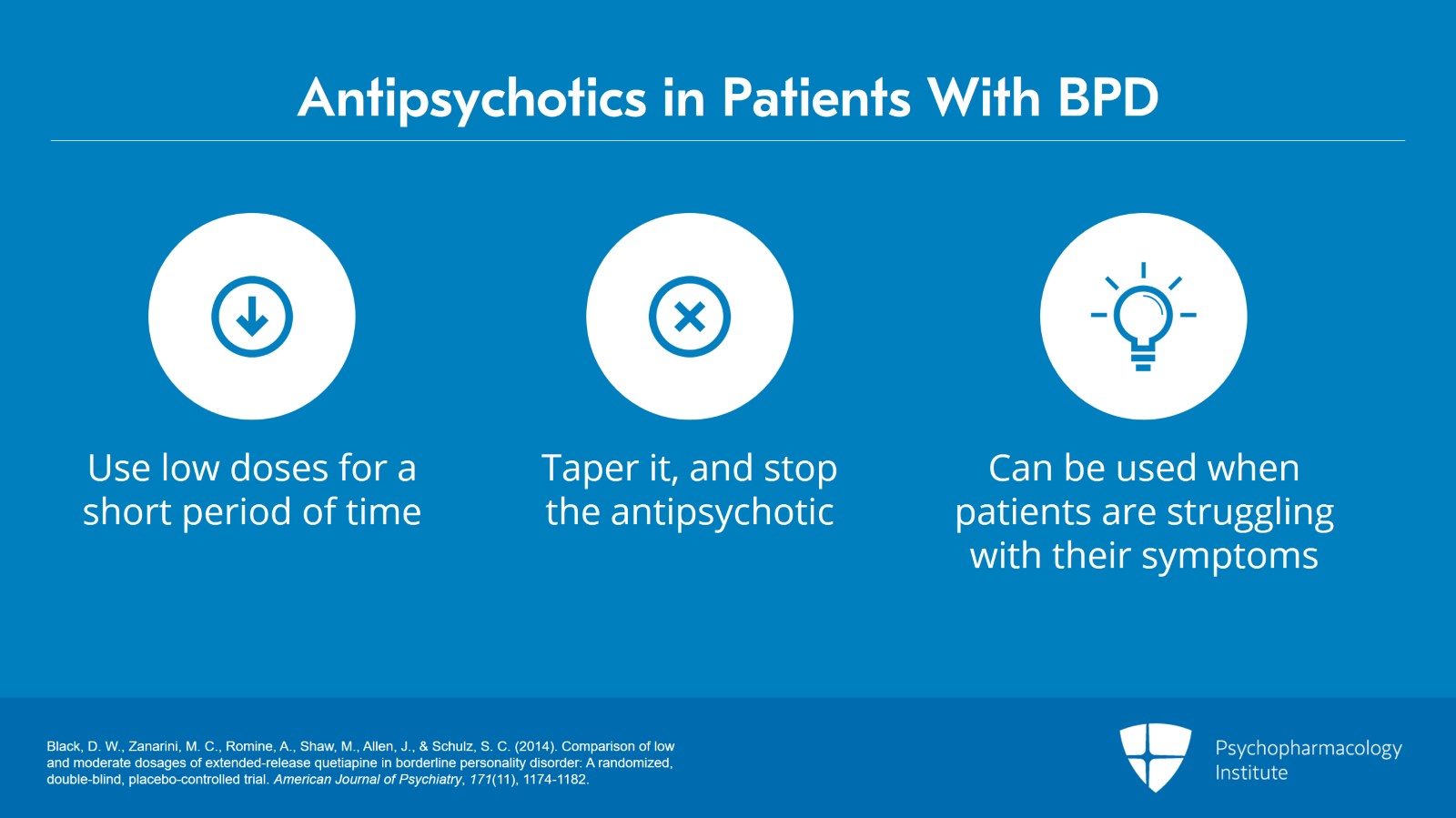
Then to work collaboratively with a patient to use low-dose antipsychotics and have them use them for a period of time, maybe two or three months, and then have them taper and stop the medication. And they may see this as a tool they can use in the future if they're really struggling with their symptoms.
References:
  • Black, D. W., Zanarini, M. C., Romine, A., Shaw, M., Allen, J., & Schulz, S. C. (2014). Comparison of low and moderate dosages of extended-release quetiapine in borderline personality disorder: A randomized, double-blind, placebo-controlled trial. American Journal of Psychiatry, 171(11), 1174-1182.
Free Files
Success!
Check your inbox, we sent you all the materials there.

Slide 7 of 10

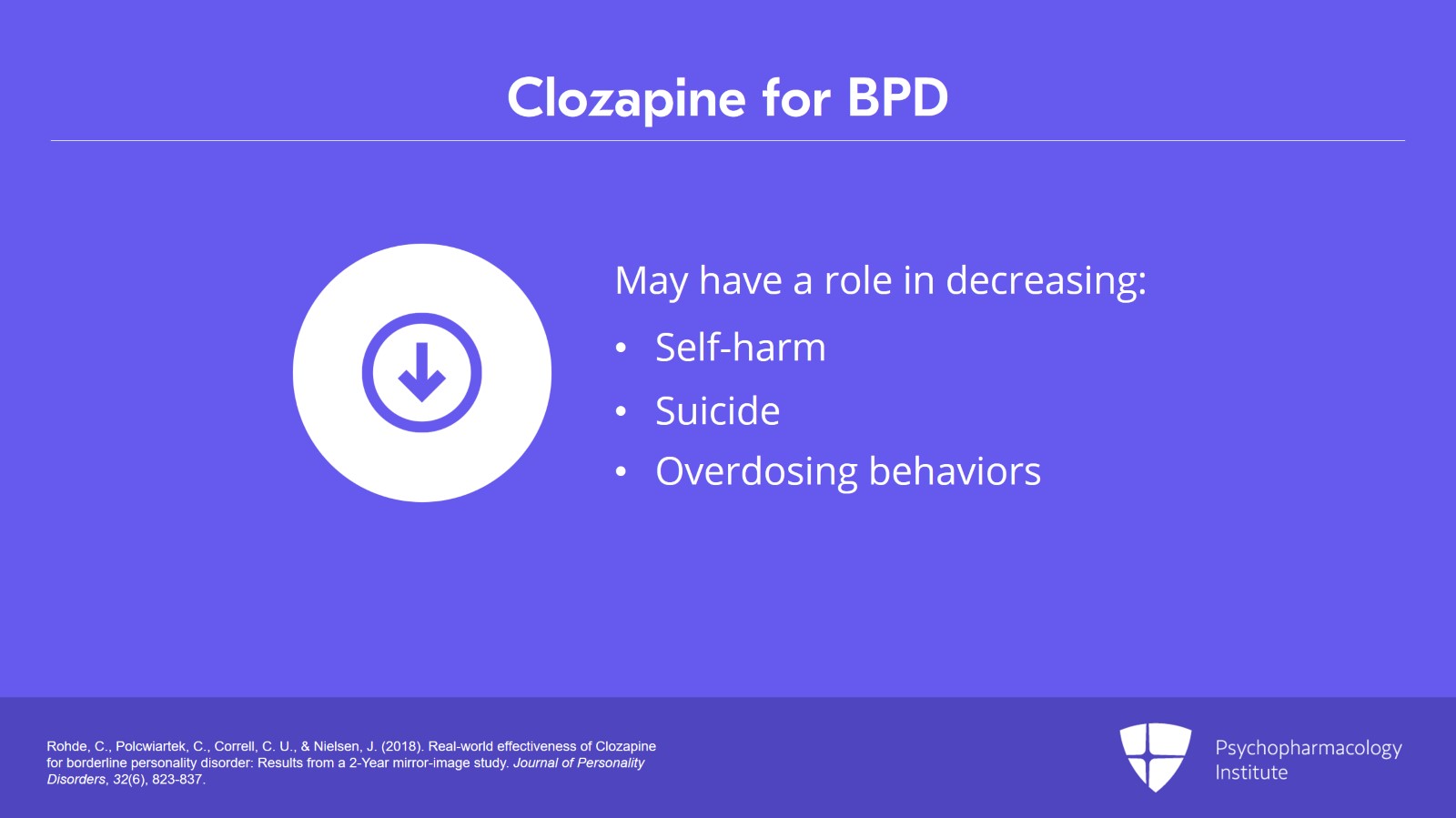
There's a very interesting study that was using large databases looking at exposure to clozapine in patients who were diagnosed with borderline personality disorder. And on the basis of large datasets, they were able to show that clozapine may have a role in decreasing self-harm, suicide, overdosing behavior.
References:
  • Rohde, C., Polcwiartek, C., Correll, C. U., & Nielsen, J. (2018). Real-world effectiveness of Clozapine for borderline personality disorder: Results from a 2-Year mirror-image study. Journal of Personality Disorders, 32(6), 823-837.

Slide 8 of 10

The use of antipsychotics in patients with borderline personality disorder can be particularly useful for anger, impulsivity and aggression and they do have some value for the cognitive perceptual disturbances.  
Free Files
Success!
Check your inbox, we sent you all the materials there.

Slide 9 of 10

And of course, you do have to remember the many side effects of antipsychotic medication, particularly weight gain, sedation that can limit their usefulness with these patients. 

Slide 10 of 10

Free Files
Success!
Check your inbox, we sent you all the materials there.

Learning Objectives:

After completing this activity, the learner will be able to:

  1. Understand the importance of good psychiatric management in BPD.
  2. Determine which psychotropic medication may be appropriate for each symptom domain and comorbidity in BPD.
  3.  Discuss the available evidence about novel pharmacologic approaches and future research directions in the treatment of BPD.

Original Release Date: January 01, 2022

Review and Re-release Date: April 1, 2025

Expiration Date: April 1, 2028

Expert: Paul Links, M.D.

Medical Editor: Paz Badía, M.D

Relevant Financial Disclosures:

The following planners, faculty, and reviewers have the following relevant financial relationships with commercial interests to disclose:

Dr. Links has disclosed the following relationships:

All of the relevant financial relationships listed for these individuals have been mitigated.

Contact Information: For questions regarding the content or access to this activity, contact us at support@psychopharmacologyinstitute.com

Instructions for Participation and Credit:

Participants must complete the activity online during the valid credit period that is noted above.

Follow these steps to earn CME credit:

  1. View the required educational content provided on this course page.
  2. Complete the Post Activity Evaluation for providing the necessary feedback for continuing accreditation purposes and for the development of future activities. NOTE: Completing the Post Activity Evaluation after the quiz is required to receive the earned credit.
  3. Download your certificate.

Accreditation Statement

This activity has been planned and implemented in accordance with the accreditation requirements and policies of the Accreditation Council for Continuing Medical Education through the joint providership of Medical Academy LLC and the Psychopharmacology Institute. Medical Academy is accredited by the ACCME to provide continuing medical education for physicians.

Credit Designation Statement

Medical Academy designates this enduring activity for a maximum of 0.50 AMA PRA Category 1 credit(s). Physicians should claim only the credit commensurate with the extent of their participation in the activity.


Free Files
Success!
Check your inbox, we sent you all the materials there.
Continue in the website
Instant access modal

Become a Bronze, Silver, Gold, Bronze extended, Silver extended or Gold extended Member.

2025–26 Psychopharmacology CME Program

Unlock up to 155 CME Credits, including 40 SA CME Credits.