Close Banner
Section Free  - Video Lectures

08. Antipsychotics and Cholinesterase Inhibitors for BPSD

Published on April 1, 2022 Certification expiration date: April 1, 2028

Lauren B. Gerlach, D.O., M.S.

Health Services Researcher - University of Michigan Department of Psychiatry

Key Points

  • Use the lowest effective dose of antipsychotics to treat BPSD.
  • Attempt gradual dose reductions when possible.
  • Antipsychotics are associated with other side effects in addition to the FDA box warning for increased mortality.
  • Use antipsychotic medications with low D2 blockade in patients with LBD or PDD.
  • Cholinesterase inhibitors and memantine show a statistically significant improvement in BPSD but limited clinical impact.

Free Downloads for Offline Access

  • Free Download Video (MP4)
  • Free Download Audio File (MP3)
  • Free Download Presentation File (PPTX)

Slides and Transcript
Slide 1 of 16

Now, let’s delve a little bit more into some of the specific psychotropic medication classes and some of the evidence for treating behavioral disturbances in dementia.

Slide 2 of 16

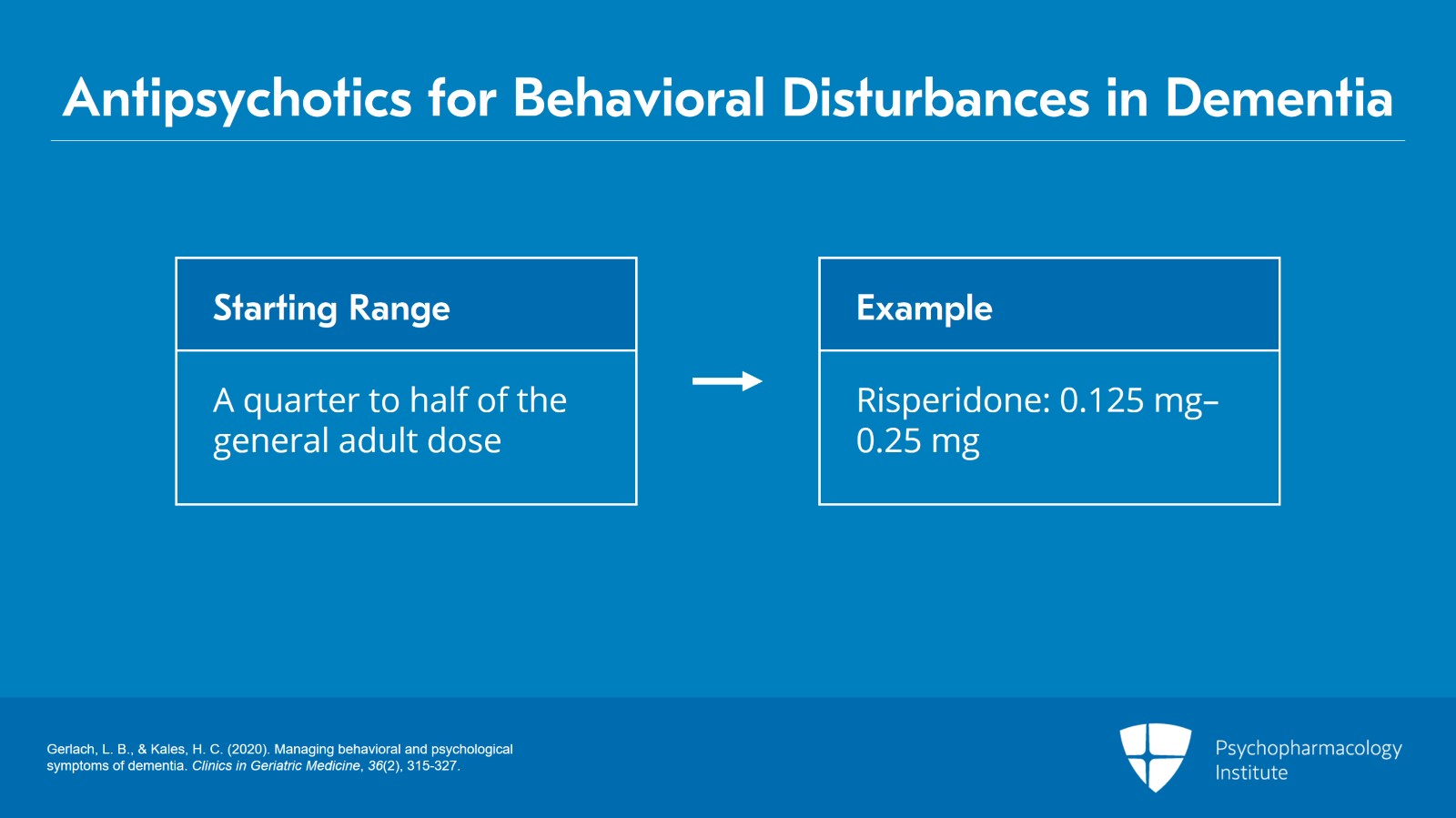
So let’s start off first talking about antipsychotics. Generally, our starting range for these medications is going to be about a quarter to half of the general starting dose for a general adult. So for instance, risperidone, we might start it kind of 0.125 or 0.25 mg.
References:
  • Gerlach, L. B., & Kales, H. C. (2020). Managing behavioral and psychological symptoms of dementia. Clinics in Geriatric Medicine, 36(2), 315-327.
Free Files
Success!
Check your inbox, we sent you all the materials there.
Slide 3 of 16

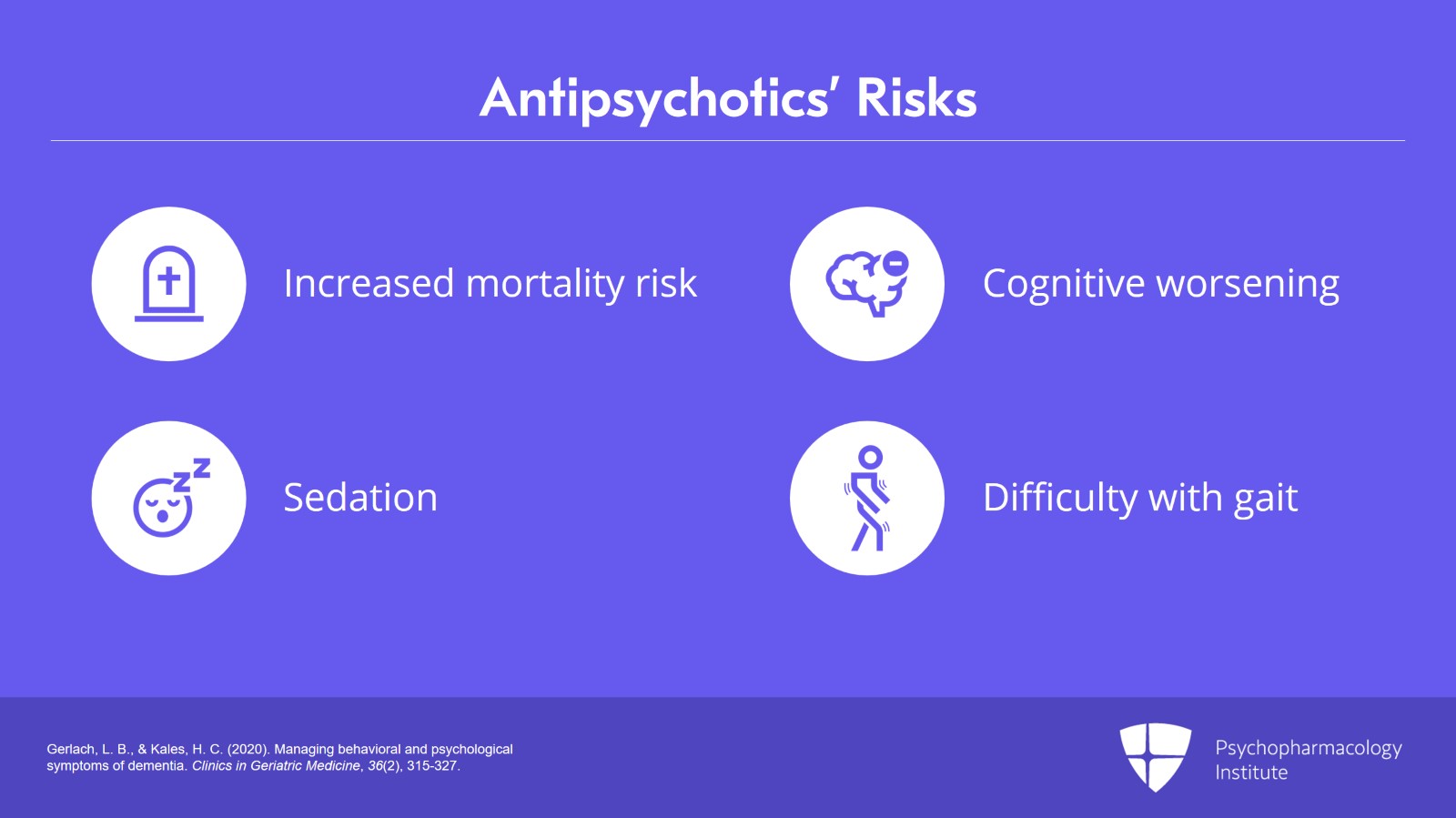
So antipsychotics do have risks outside of the FDA black box warning for mortality and some of the things include kind of cognitive worsening, sedation, difficulty with gait.
References:
  • Gerlach, L. B., & Kales, H. C. (2020). Managing behavioral and psychological symptoms of dementia. Clinics in Geriatric Medicine, 36(2), 315-327.

Slide 4 of 16

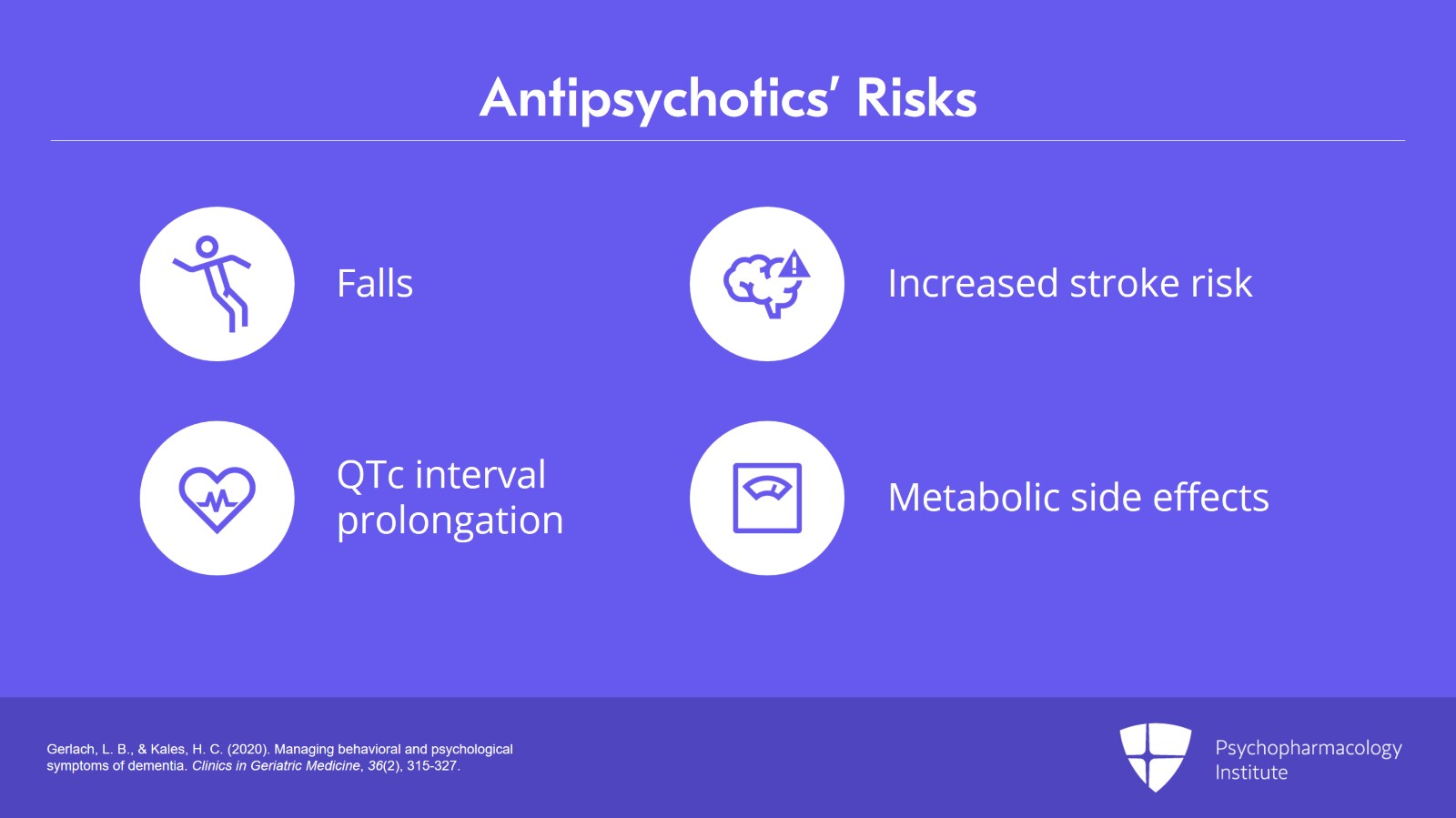
And falls and there’s also an association with increased stroke risk. Antipsychotic medications as a class can cause prolongations to the QTc interval as well as metabolic side effects such as weight gain, dyslipidemia, and diabetes. And while some of these side effects might be less of a concern in patients with limited life expectancy, we know that from the time of diagnosis to death that can be quite variable for patients with dementia.
References:
  • Gerlach, L. B., & Kales, H. C. (2020). Managing behavioral and psychological symptoms of dementia. Clinics in Geriatric Medicine, 36(2), 315-327.
Free Files
Success!
Check your inbox, we sent you all the materials there.
Slide 5 of 16

I’ll mention some of the caveats for Parkinson’s disease and Lewy body dementia psychosis. This is a situation where patients tend to be very sensitive to antipsychotics medications and can have significant worsening of extrapyramidal symptoms.
References:
  • Gerlach, L. B., & Kales, H. C. (2020). Managing behavioral and psychological symptoms of dementia. Clinics in Geriatric Medicine, 36(2), 315-327.

Slide 6 of 16

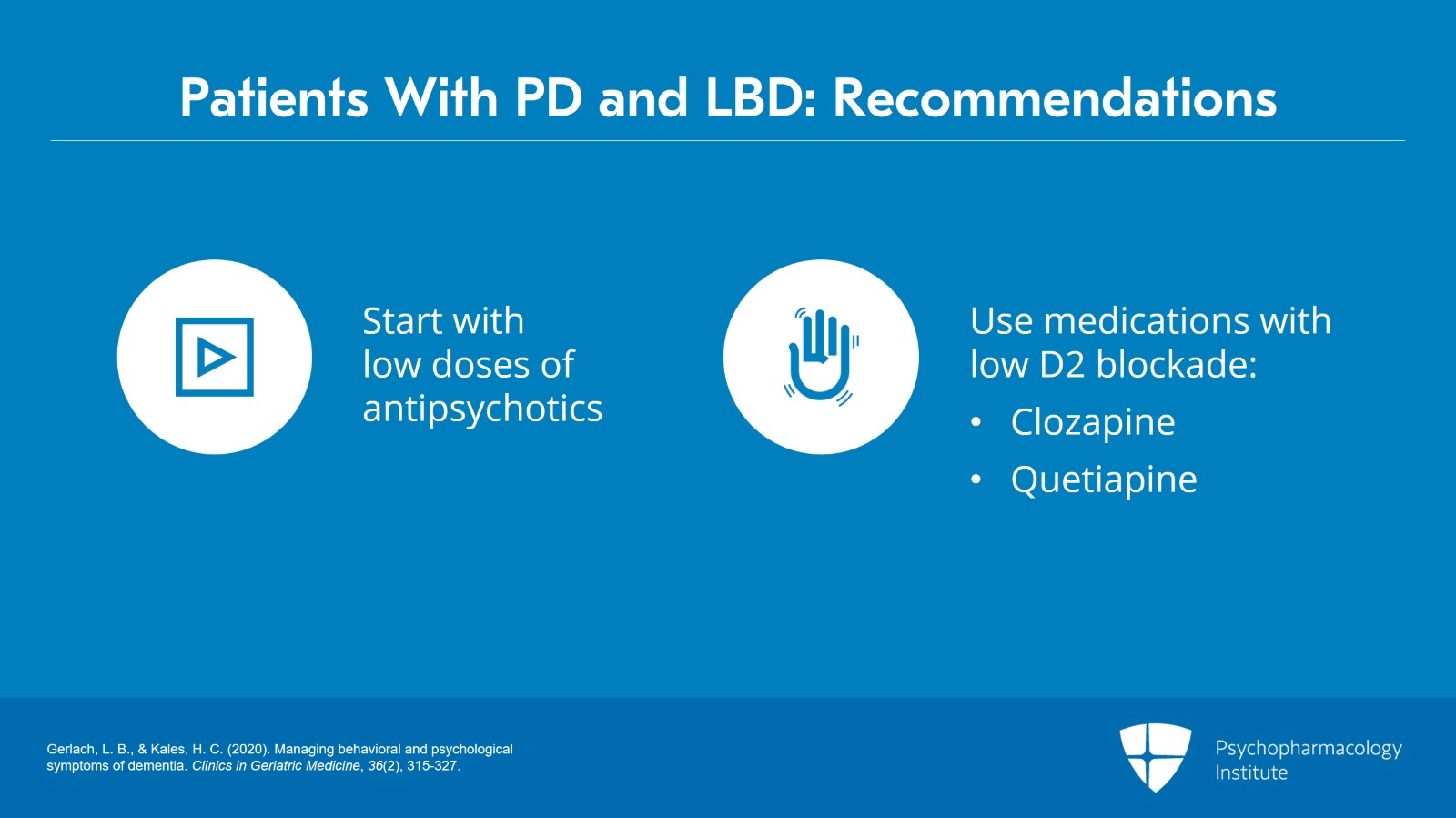
And so generally, we’re going to start with very tiny doses of these medications and as I said utilize medications with lower D2 blockade. We also know that the extrapyramidal or motor side effect potentials are not equal, that medications like clozapine and quetiapine are going to have less risk of that as compared to more typical agents like risperidone and haloperidol.
References:
  • Gerlach, L. B., & Kales, H. C. (2020). Managing behavioral and psychological symptoms of dementia. Clinics in Geriatric Medicine, 36(2), 315-327.
Free Files
Success!
Check your inbox, we sent you all the materials there.

Slide 7 of 16

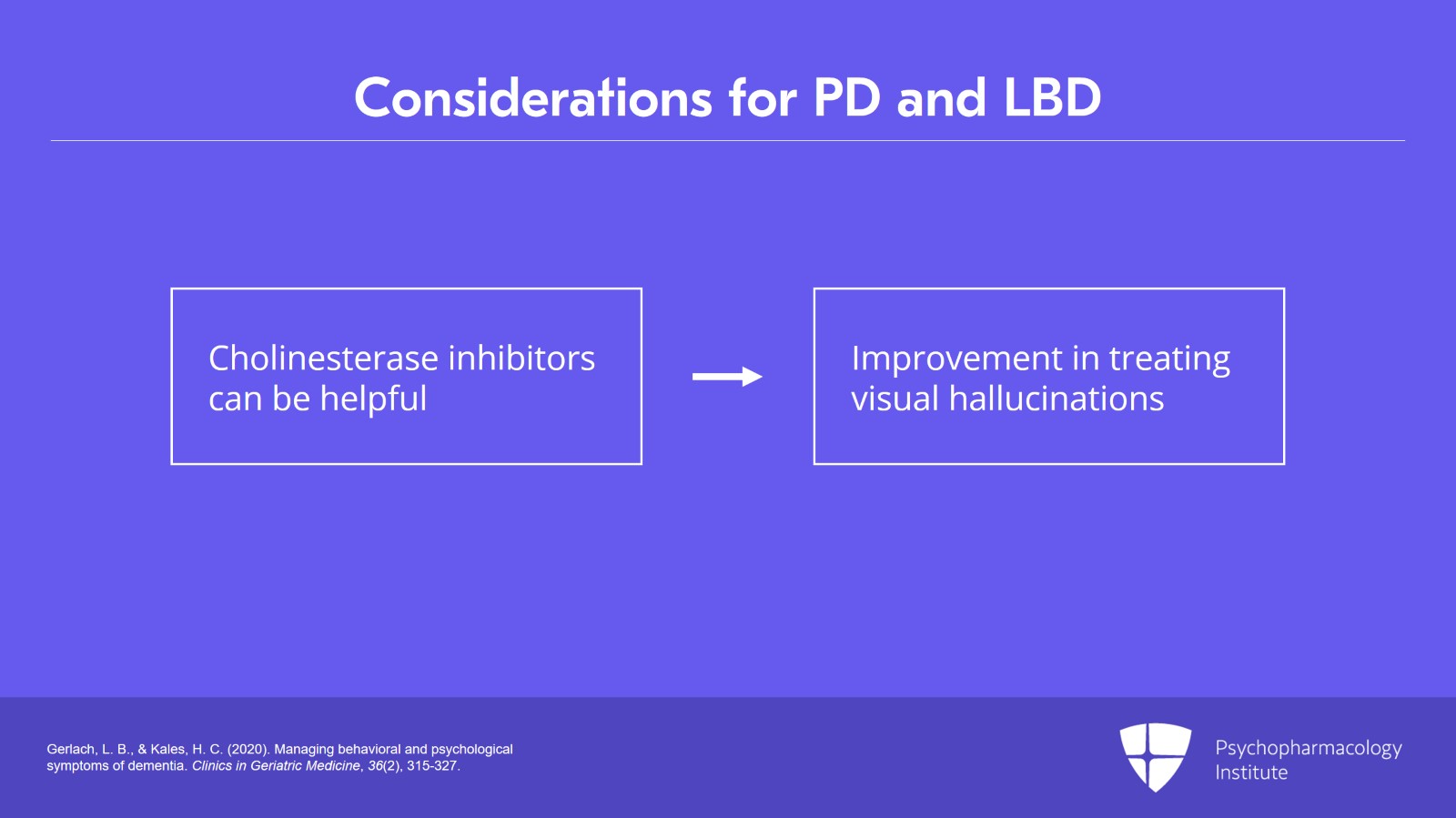
This is also a situation where cholinesterase inhibitors can actually be quite helpful and so rivastigmine or donepezil. Cholinesterase inhibitors have shown some improvement especially in treating visual hallucinations in Parkinson’s disease dementia as well as Lewy body dementia.
References:
  • Gerlach, L. B., & Kales, H. C. (2020). Managing behavioral and psychological symptoms of dementia. Clinics in Geriatric Medicine, 36(2), 315-327.

Slide 8 of 16

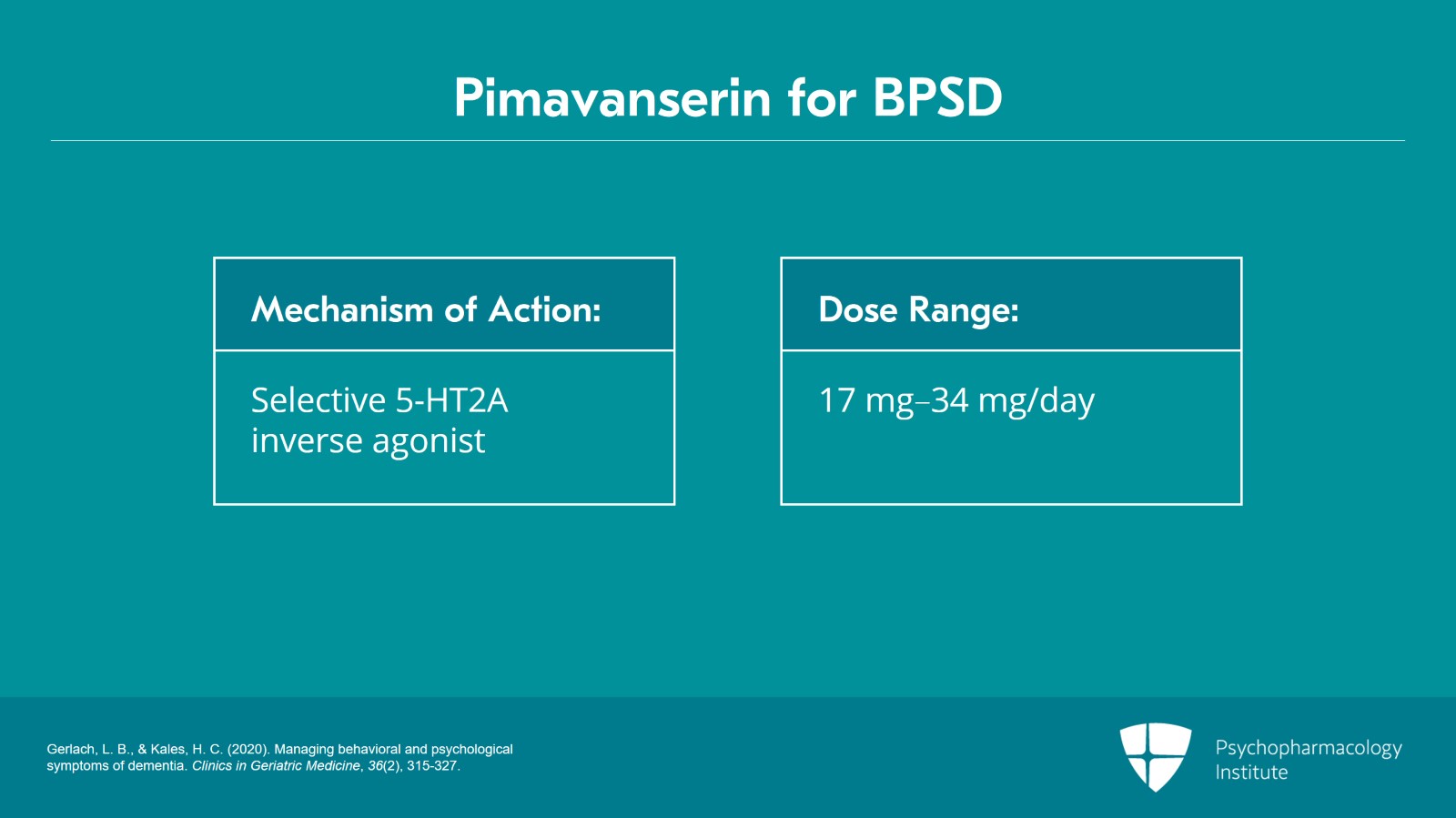
Pimavanserin is a newer antipsychotic medication that came out a few years ago. It has a novel mechanism of action in that it has no D2 blockade and works as a selective inverse agonist at the 5-HT2A receptor. The dose range generally starts at 17 mg with a max dose of 34 mg per day.
References:
  • Gerlach, L. B., & Kales, H. C. (2020). Managing behavioral and psychological symptoms of dementia. Clinics in Geriatric Medicine, 36(2), 315-327.
Free Files
Success!
Check your inbox, we sent you all the materials there.
Slide 9 of 16

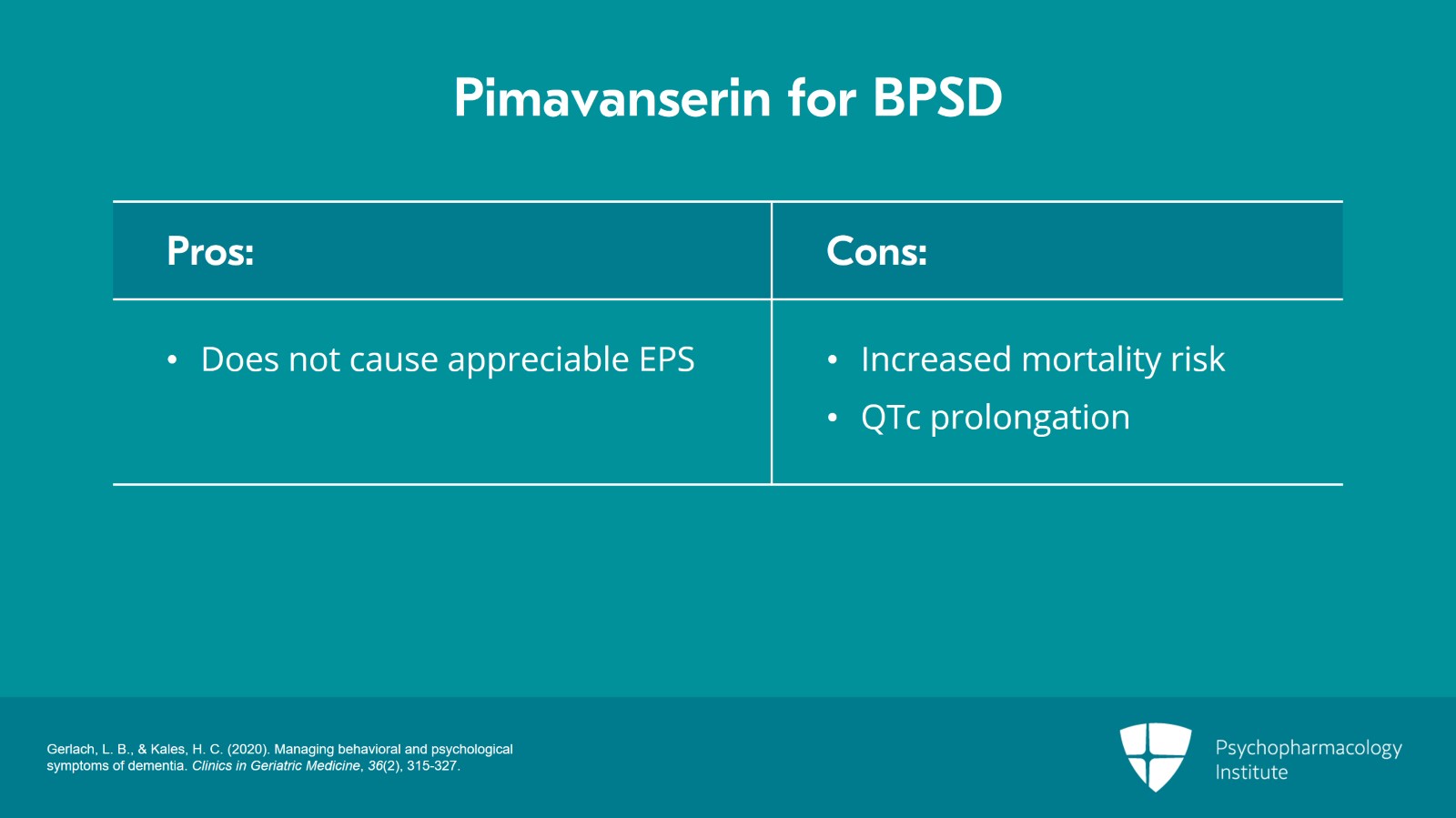
This medication can be helpful in that it does not cause appreciable extrapyramidal side effects. However, it’s important to notice that it still has the same FDA black box warning for increased mortality in use with dementia-related behaviors and additionally it also causes prolongation of the QTc interval.
References:
  • Gerlach, L. B., & Kales, H. C. (2020). Managing behavioral and psychological symptoms of dementia. Clinics in Geriatric Medicine, 36(2), 315-327.

Slide 10 of 16

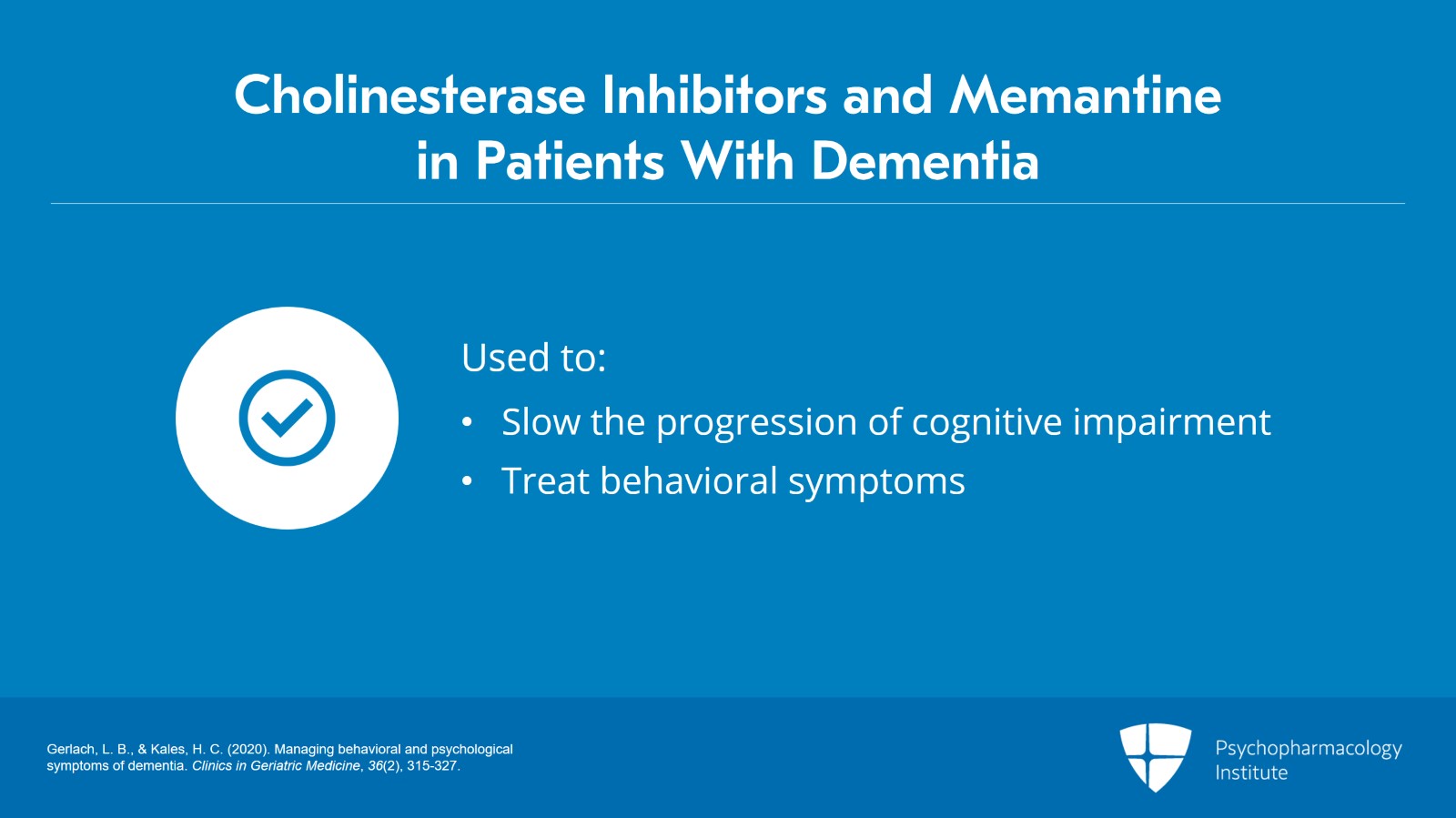
Cholinesterase inhibitors and memantine, these are medications that are used to help, generally we’ll say slow the kind of progression of cognitive impairment in dementia by about a six- to eight-month period of time. And these medications can be used to treat behavioral symptoms in dementia as well.
References:
  • Gerlach, L. B., & Kales, H. C. (2020). Managing behavioral and psychological symptoms of dementia. Clinics in Geriatric Medicine, 36(2), 315-327.
Free Files
Success!
Check your inbox, we sent you all the materials there.
Slide 11 of 16

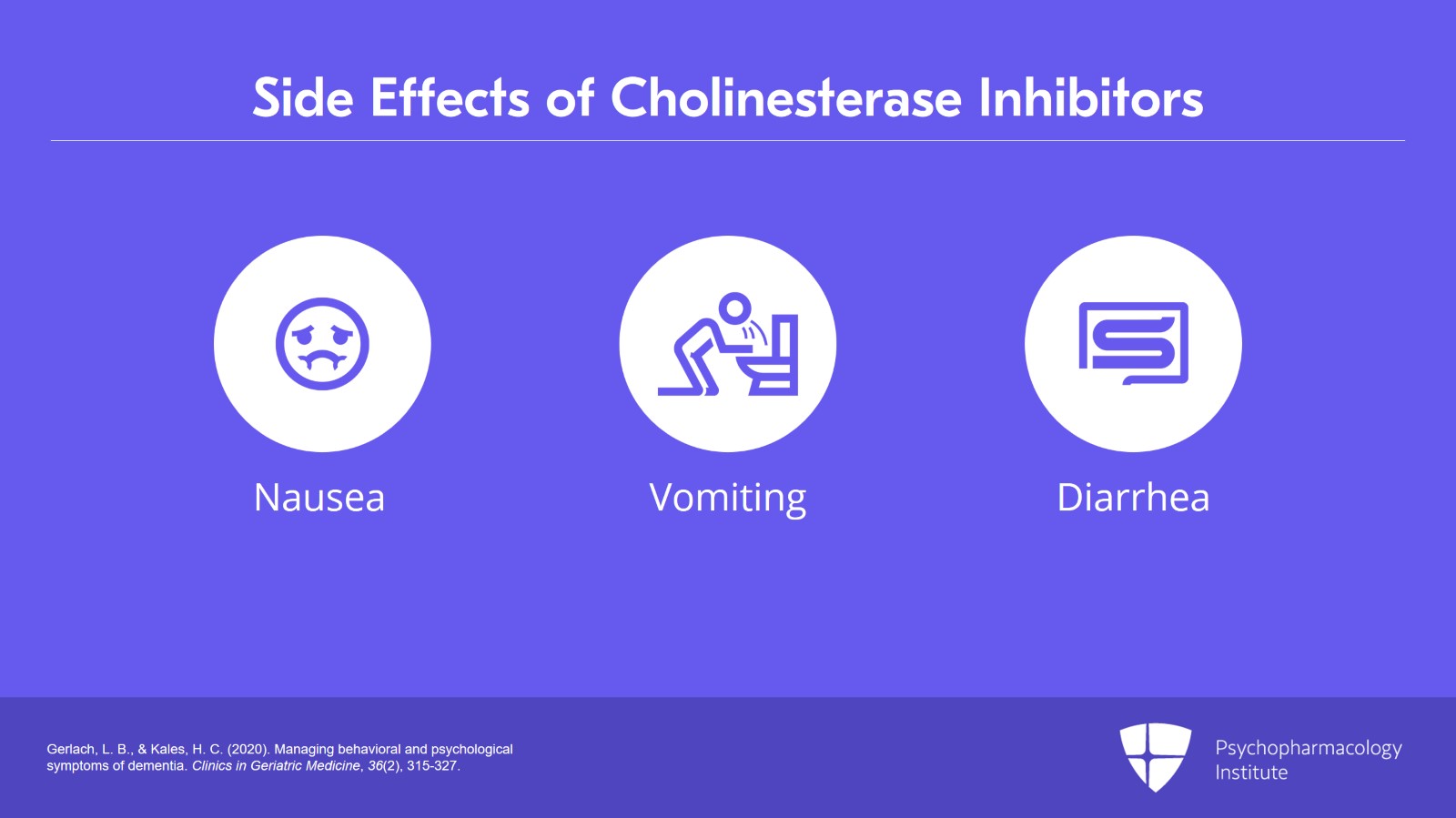
These medications do have some side effects that you want to be aware of.The most common side effects with the cholinesterase inhibitors like donepezil would be GI side effects so things like nausea, vomiting, diarrhea. There’s a lot of cholinergic neurons in the brain. There’s also a lot of cholinergic neurons in the gut as well.
References:
  • Gerlach, L. B., & Kales, H. C. (2020). Managing behavioral and psychological symptoms of dementia. Clinics in Geriatric Medicine, 36(2), 315-327.

Slide 12 of 16

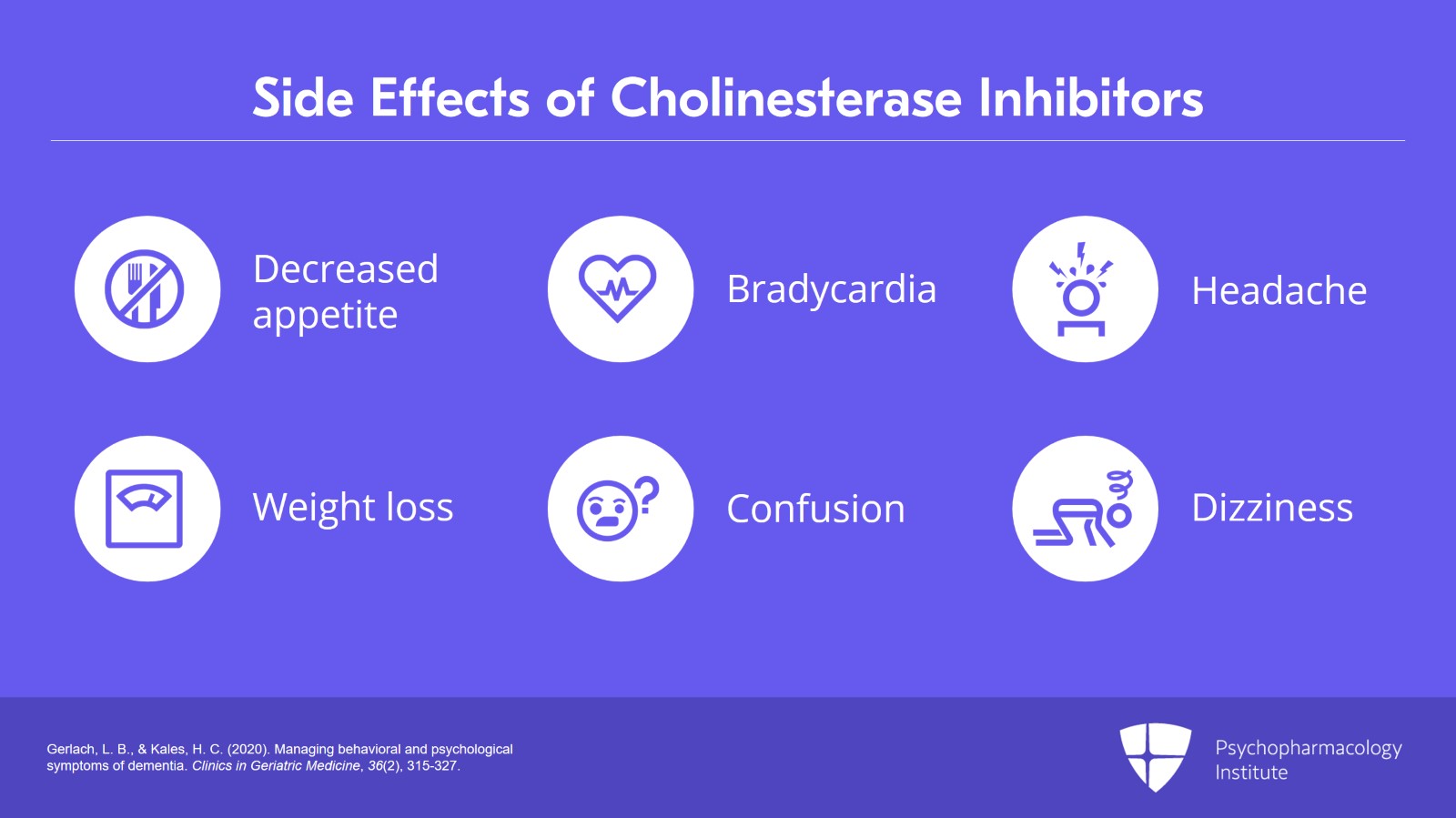
This medication and related to that is GI side effects can cause decreased appetite and weight loss. Bradycardia is also a concern as well as confusion, headache, and dizziness.
References:
  • Gerlach, L. B., & Kales, H. C. (2020). Managing behavioral and psychological symptoms of dementia. Clinics in Geriatric Medicine, 36(2), 315-327.
Free Files
Success!
Check your inbox, we sent you all the materials there.
Slide 13 of 16

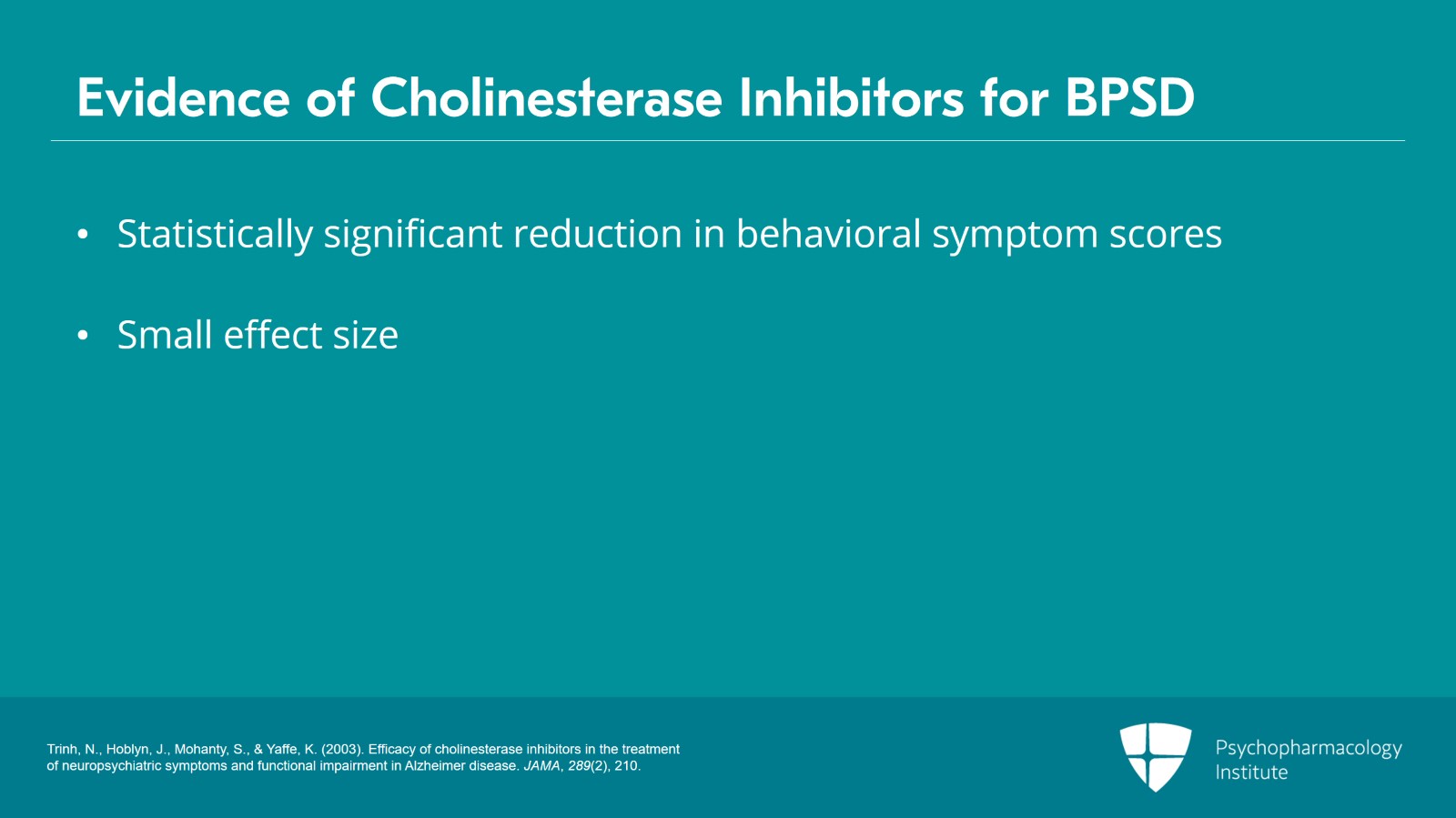
In terms of how well these medications improve behavioral disturbances in dementia, there’s been a couple of meta-analyses that have been done that show that there is a statistically significant reduction in behavioral symptom scores using what’s called the Neuropsychiatric Inventory. And cholinesterase inhibitors overall had an effect of reducing the Neuropsychiatric Inventory by 1.7 points. However, the Neuropsychiatric Inventory is a scale that goes from zero to 144. So a reduction of 2 points on this scale although statistically significant has a very small effect size. That being said, I think anecdotally all of us have probably had experiences where these medications have been helpful for patients. It’s just the pooled study showed that the actual reduction in symptoms is quite modest.
References:
  • Trinh, N., Hoblyn, J., Mohanty, S., & Yaffe, K. (2003). Efficacy of cholinesterase inhibitors in the treatment of neuropsychiatric symptoms and functional impairment in Alzheimer disease. JAMA, 289(2), 210.

Slide 14 of 16

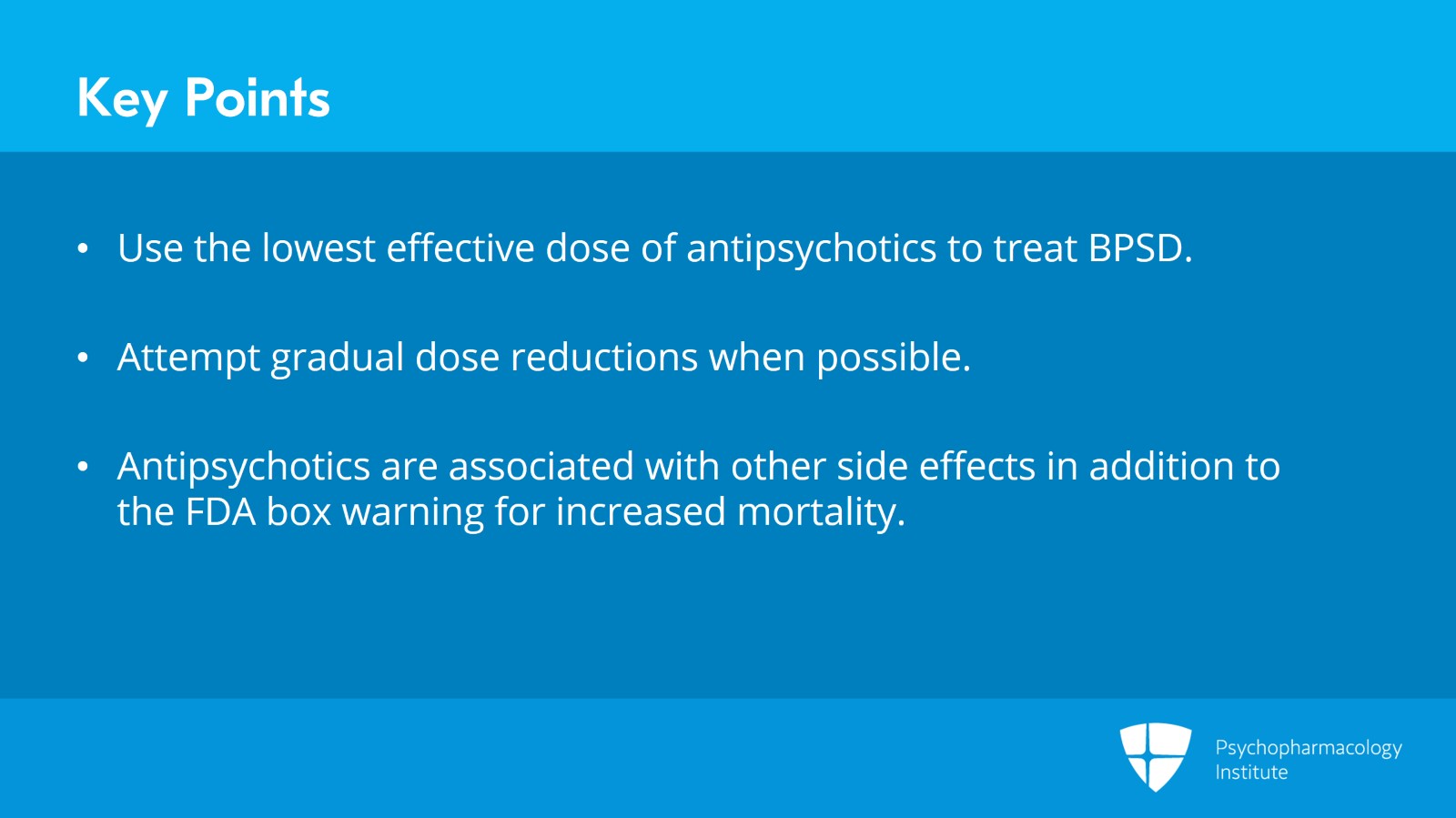
So some key points. So clinicians should really try to use the lowest effective dose of antipsychotic medications to treat behavioral and psychological symptoms of dementia and attempt gradual dose reductions when possible. Antipsychotics are associated with a host of other side effects in addition to the US FDA box warning for increased mortality.
Free Files
Success!
Check your inbox, we sent you all the materials there.
Slide 15 of 16

And special considerations should be given to using antipsychotic medications with low D2 blockade and patients with Lewy body dementia or Parkinson’s disease dementia. Cholinesterase inhibitors and memantine show a statistically significant improvement in behavioral and psychological symptoms of dementia, however, with a somewhat limited clinical impact.

Slide 16 of 16

Free Files
Success!
Check your inbox, we sent you all the materials there.
Learning Objectives:

After completing this activity, the learner will be able to:

  1. Assess and recognize the underlying factors that contribute to the development of behavioral and psychological symptoms of dementia.
  2. Utilize nonpharmacologic approaches to investigate and treat behavioral disturbances.
  3. Identify the clinical scenarios where medications should be considered as first-line treatment and prescribe them accordingly.

Original Release Date: April 1, 2022

Review and Re-release Date: April 1, 2025

Expiration Date: April 1, 2028

Expert: Lauren Gerlach, M.D.

Medical Editor: Paz Badía, M.D.

Relevant Financial Disclosures: 

None of the faculty, planners, and reviewers for this educational activity have relevant financial relationships to disclose during the last 24 months with ineligible companies whose primary business is producing, marketing, selling, re-selling, or distributing healthcare products used by or on patients.

Contact Information: For questions regarding the content or access to this activity, contact us at support@psychopharmacologyinstitute.com

Instructions for Participation and Credit:

Participants must complete the activity online during the valid credit period that is noted above.

Follow these steps to earn CME credit:

  1. View the required educational content provided on this course page.
  2. Complete the Post Activity Evaluation for providing the necessary feedback for continuing accreditation purposes and for the development of future activities. NOTE: Completing the Post Activity Evaluation after the quiz is required to receive the earned credit.
  3. Download your certificate.

Accreditation Statement

This activity has been planned and implemented in accordance with the accreditation requirements and policies of the Accreditation Council for Continuing Medical Education through the joint providership of Medical Academy LLC and the Psychopharmacology Institute. Medical Academy is accredited by the ACCME to provide continuing medical education for physicians.

Credit Designation Statement

Medical Academy designates this enduring activity for a maximum of 1.00 AMA PRA Category 1 credit(s). Physicians should claim only the credit commensurate with the extent of their participation in the activity.

Free Files
Success!
Check your inbox, we sent you all the materials there.
Continue in the website
Instant access modal

Become a Bronze, Silver, Gold, Bronze extended, Silver extended or Gold extended Member.

2025–26 Psychopharmacology CME Program

Unlock up to 155 CME Credits, including 40 SA CME Credits.