Close Banner
Section Free  - Video Lectures

06. Antidepressants and Naltrexone for Methamphetamine Use Disorder

Published on December 1, 2021 Expired on April 1, 2025

Andrew Saxon, M.D.

Professor, Department of Psychiatry and Behavioral Sciences - University of Washington School of Medicine

Key Points

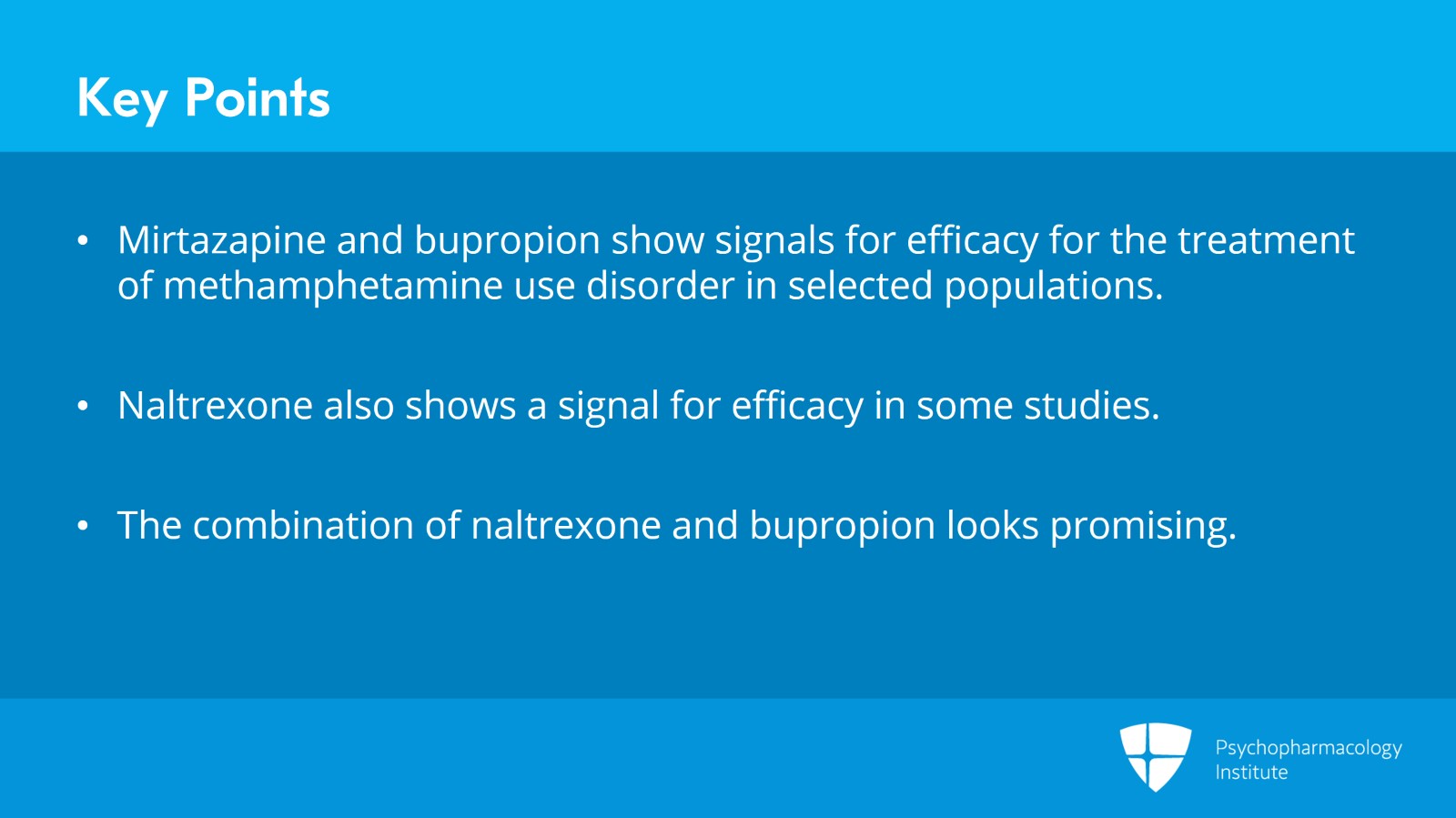
  • Mirtazapine and bupropion show signals for efficacy for the treatment of methamphetamine use disorder in selected populations.
  • Naltrexone also shows a signal for efficacy in some studies.
  • The combination of naltrexone and bupropion looks promising.

Free Downloads for Offline Access

  • Free Download Audio File (MP3)
  • Free Download Video (MP4)
  • Free Download Presentation File (PPTX)

Slides and Transcript
Slide 1 of 17

Next, we’re going to turn to looking at a couple of antidepressants and also to opioid antagonist for methamphetamine and amphetamine use disorder.

Slide 2 of 17

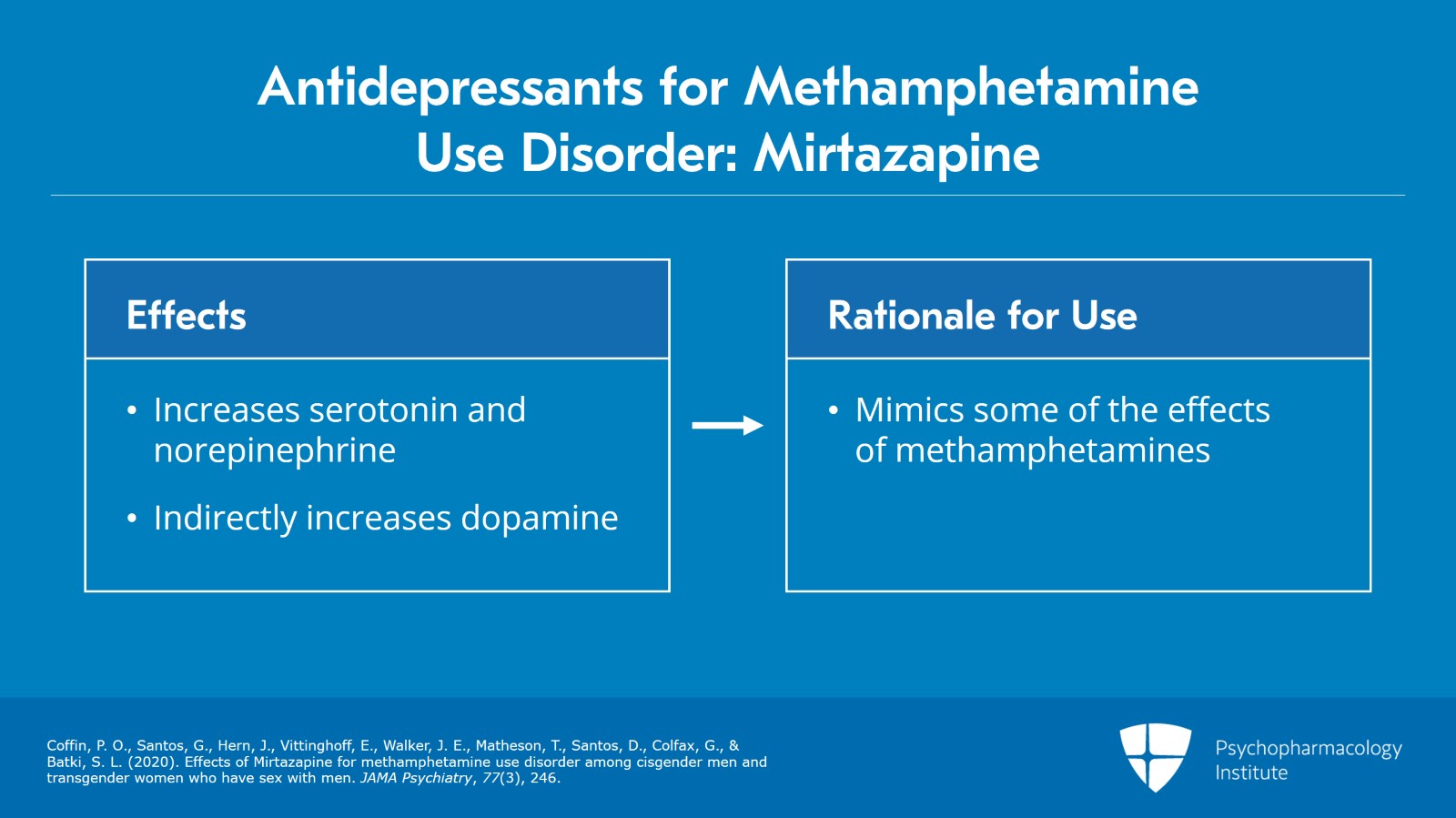
So, mirtazapine is an antidepressant that primarily works increasing both the effects of serotonin and norepinephrine and it probably has indirect effects on increasing dopamine slightly in the brain reward pathway. So that’s the rationale for using mirtazapine to treat methamphetamine use disorder because it may mildly mimic some of the effects of methamphetamine while not being euphorigenic.
References:
  • Coffin, P. O., Santos, G., Hern, J., Vittinghoff, E., Walker, J. E., Matheson, T., Santos, D., Colfax, G., & Batki, S. L. (2020). Effects of Mirtazapine for methamphetamine use disorder among cisgender men and transgender women who have sex with men. JAMA Psychiatry, 77(3), 246.
Free Files
Success!
Check your inbox, we sent you all the materials there.
Slide 3 of 17

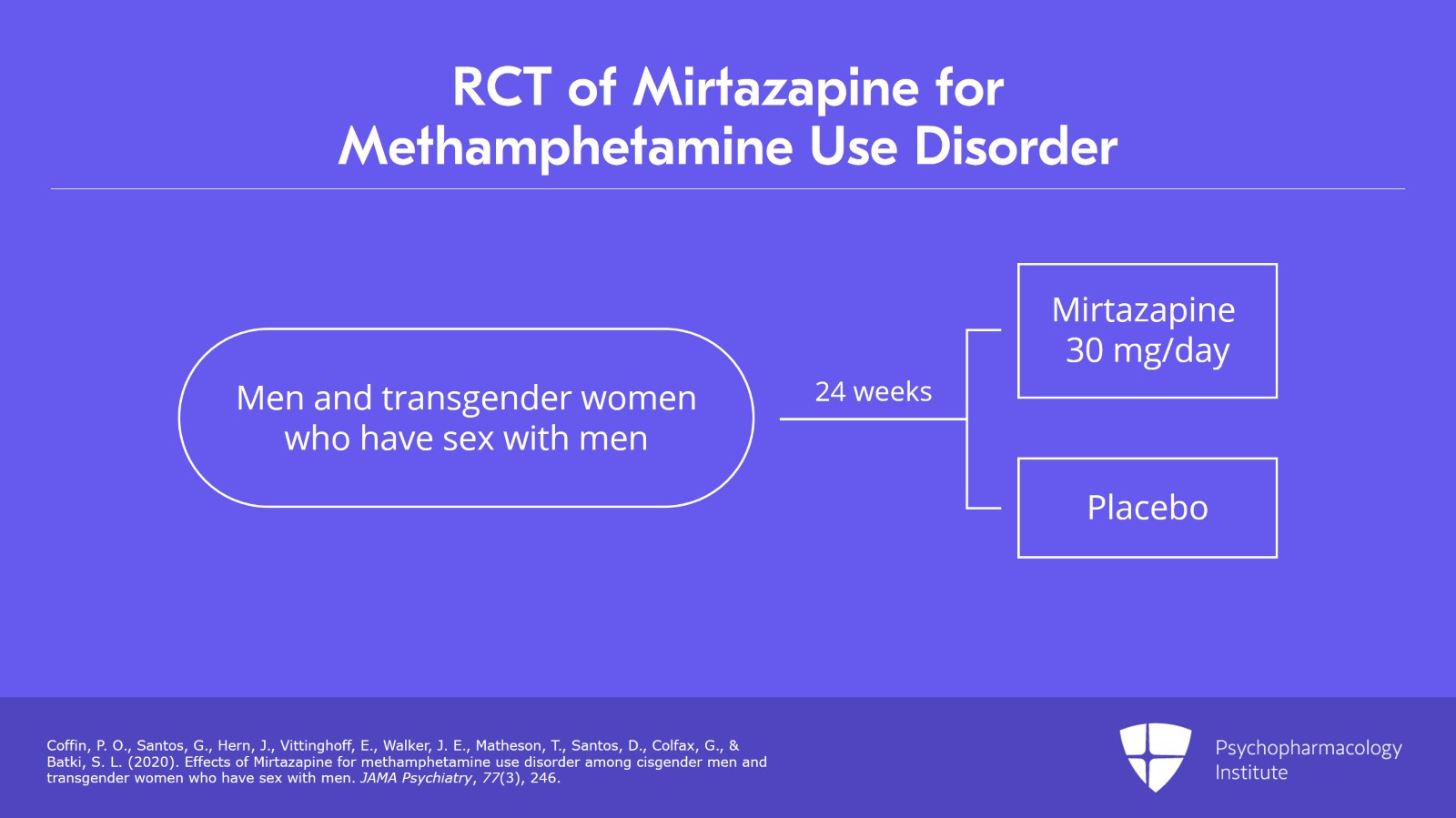
So, we’re presenting here a double-blind, placebo-controlled trial. Now, this was primarily men and transgender women who have sex with men, so it was not a highly generalizable sample. And the mirtazapine dose was 30 mg per day for 24 weeks.
References:
  • Coffin, P. O., Santos, G., Hern, J., Vittinghoff, E., Walker, J. E., Matheson, T., Santos, D., Colfax, G., & Batki, S. L. (2020). Effects of Mirtazapine for methamphetamine use disorder among cisgender men and transgender women who have sex with men. JAMA Psychiatry, 77(3), 246.

Slide 4 of 17

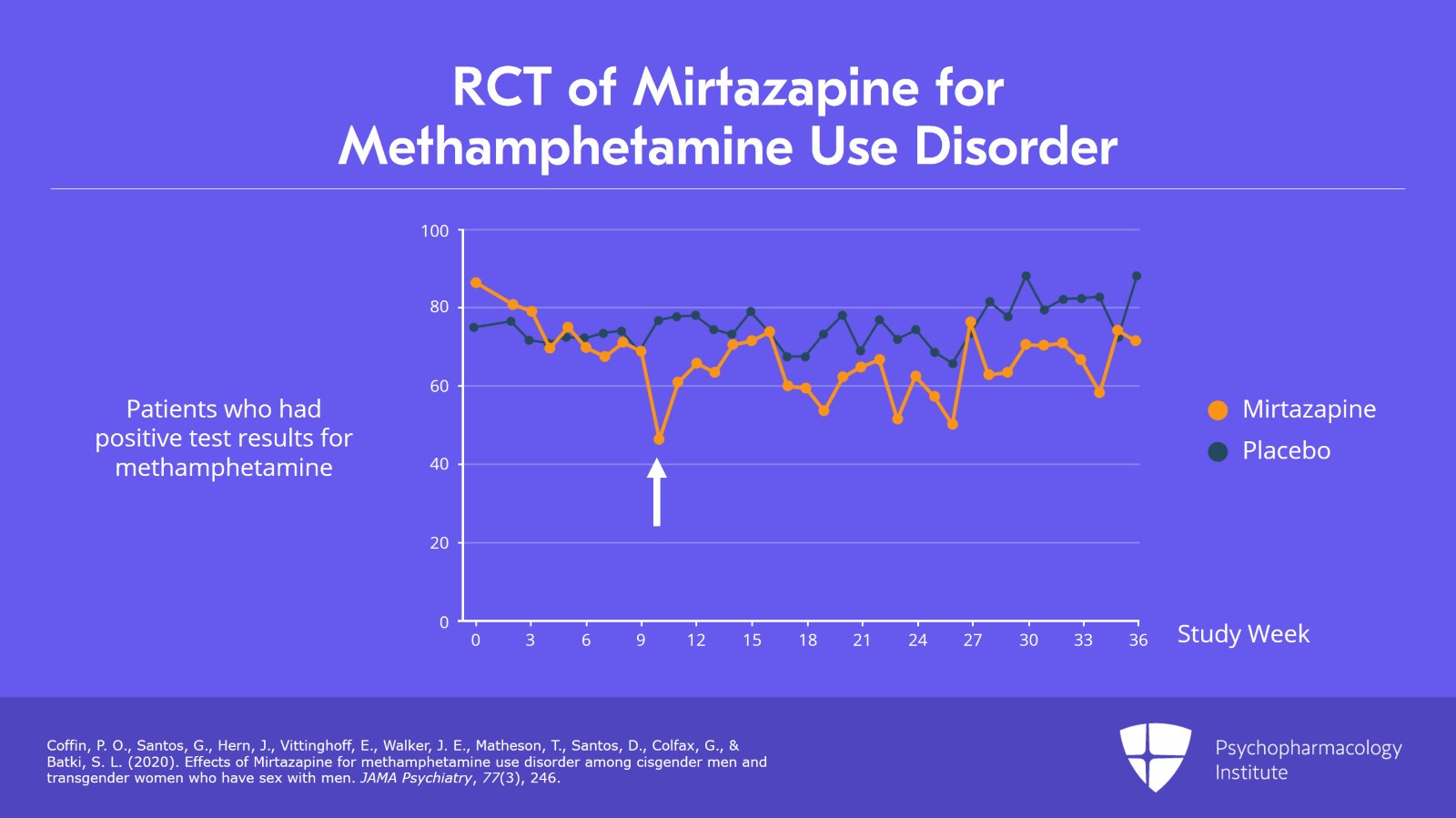
The adherence to this oral medication was quite poor but despite poor adherence you’ll also see that it did demonstrate some potential benefits. And what we are looking at on the Y axis is the percent of patients who had positive test results for methamphetamine, so once again looking at urine testing results. And the orange line represents mirtazapine, the black line placebo. And although for the first several weeks they tracked very closely, you can see at about week 9 there appears to be some reduction in methamphetamine use with the mirtazapine group and that was a statistically significant effect at week 12.
References:
  • Coffin, P. O., Santos, G., Hern, J., Vittinghoff, E., Walker, J. E., Matheson, T., Santos, D., Colfax, G., & Batki, S. L. (2020). Effects of Mirtazapine for methamphetamine use disorder among cisgender men and transgender women who have sex with men. JAMA Psychiatry, 77(3), 246.
Free Files
Success!
Check your inbox, we sent you all the materials there.
Slide 5 of 17

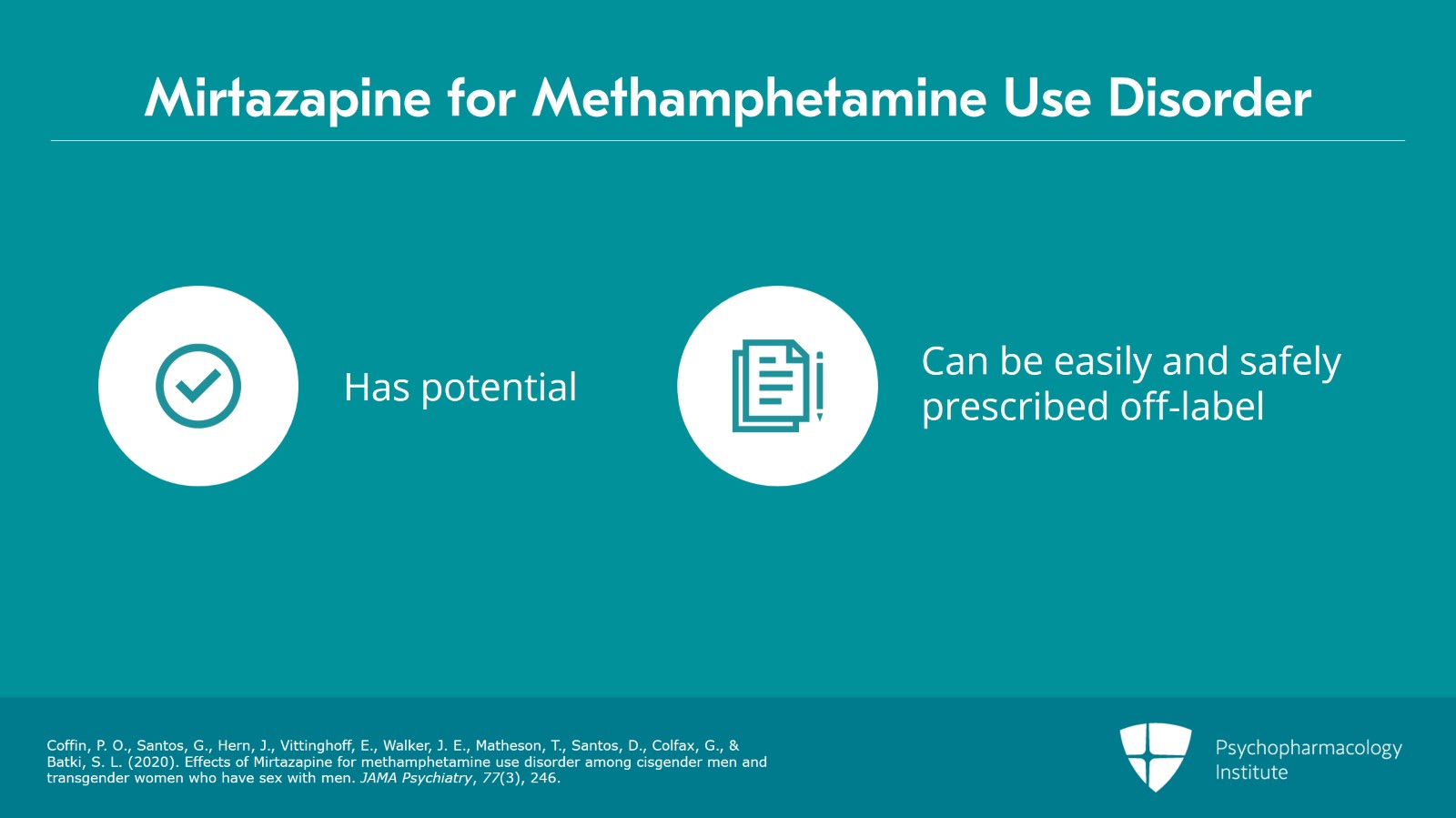
So, more needs to be explored with this medication but it is one that has potential and can be very easily and safely prescribed off-label if nothing else is working.
References:
  • Coffin, P. O., Santos, G., Hern, J., Vittinghoff, E., Walker, J. E., Matheson, T., Santos, D., Colfax, G., & Batki, S. L. (2020). Effects of Mirtazapine for methamphetamine use disorder among cisgender men and transgender women who have sex with men. JAMA Psychiatry, 77(3), 246.

Slide 6 of 17

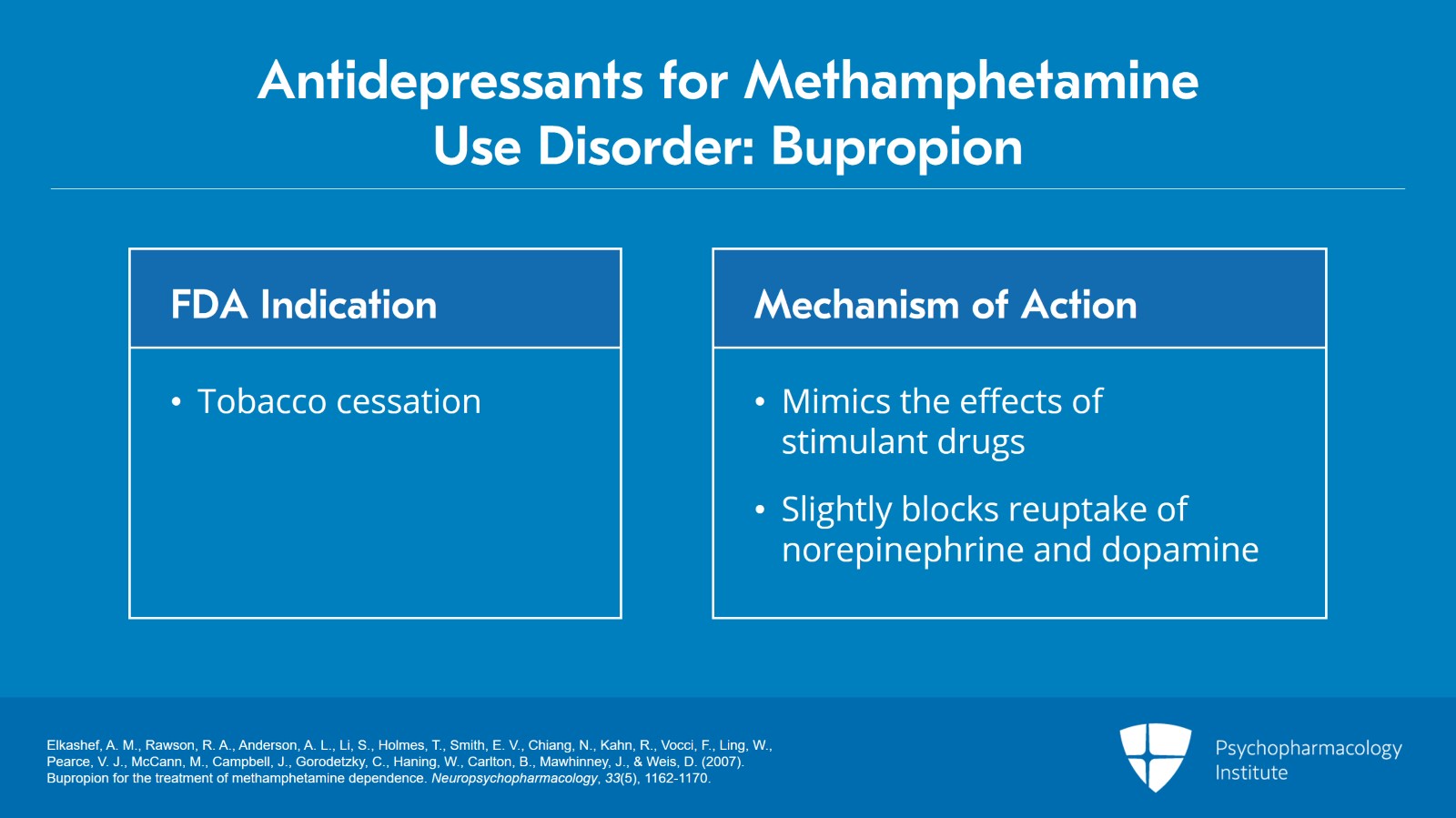
Bupropion is another commonly used antidepressant. Bupropion has an FDA indication for tobacco cessation. And the mechanism of action, we believe that it mimics the effects of stimulant drugs and that it very slightly blocks reuptake of norepinephrine and dopamine but not nearly to the extent that the stimulants do.
References:
  • Elkashef, A. M., Rawson, R. A., Anderson, A. L., Li, S., Holmes, T., Smith, E. V., Chiang, N., Kahn, R., Vocci, F., Ling, W., Pearce, V. J., McCann, M., Campbell, J., Gorodetzky, C., Haning, W., Carlton, B., Mawhinney, J., & Weis, D. (2007). Bupropion for the treatment of methamphetamine dependence. Neuropsychopharmacology, 33(5), 1162-1170.
Free Files
Success!
Check your inbox, we sent you all the materials there.
Slide 7 of 17

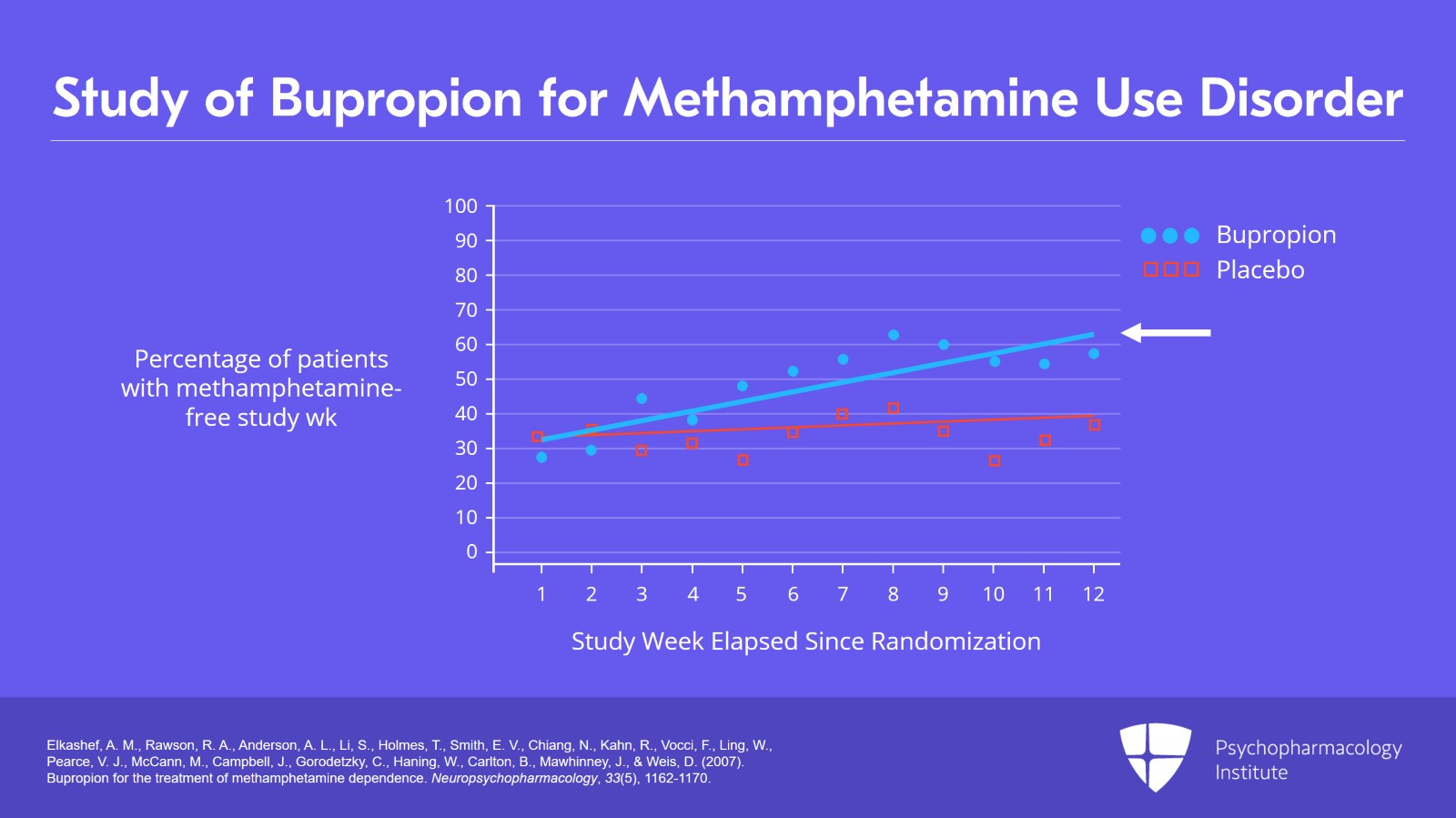
And these are data from a larger study where bupropion was found not to be effective. But when they separated the sample out and they looked at the people who had lower levels of methamphetamine use, they did see a signal there. So, we are looking at the percentage of patients with methamphetamine-free day per week. And the blue symbols represent those treated with bupropion, the red symbols represent placebo. And you can see over time the patients on bupropion who had low levels of methamphetamine use were increasing their numbers of days not using. So, there’s something there worth exploring.
References:
  • Elkashef, A. M., Rawson, R. A., Anderson, A. L., Li, S., Holmes, T., Smith, E. V., Chiang, N., Kahn, R., Vocci, F., Ling, W., Pearce, V. J., McCann, M., Campbell, J., Gorodetzky, C., Haning, W., Carlton, B., Mawhinney, J., & Weis, D. (2007). Bupropion for the treatment of methamphetamine dependence. Neuropsychopharmacology, 33(5), 1162-1170.

Slide 8 of 17

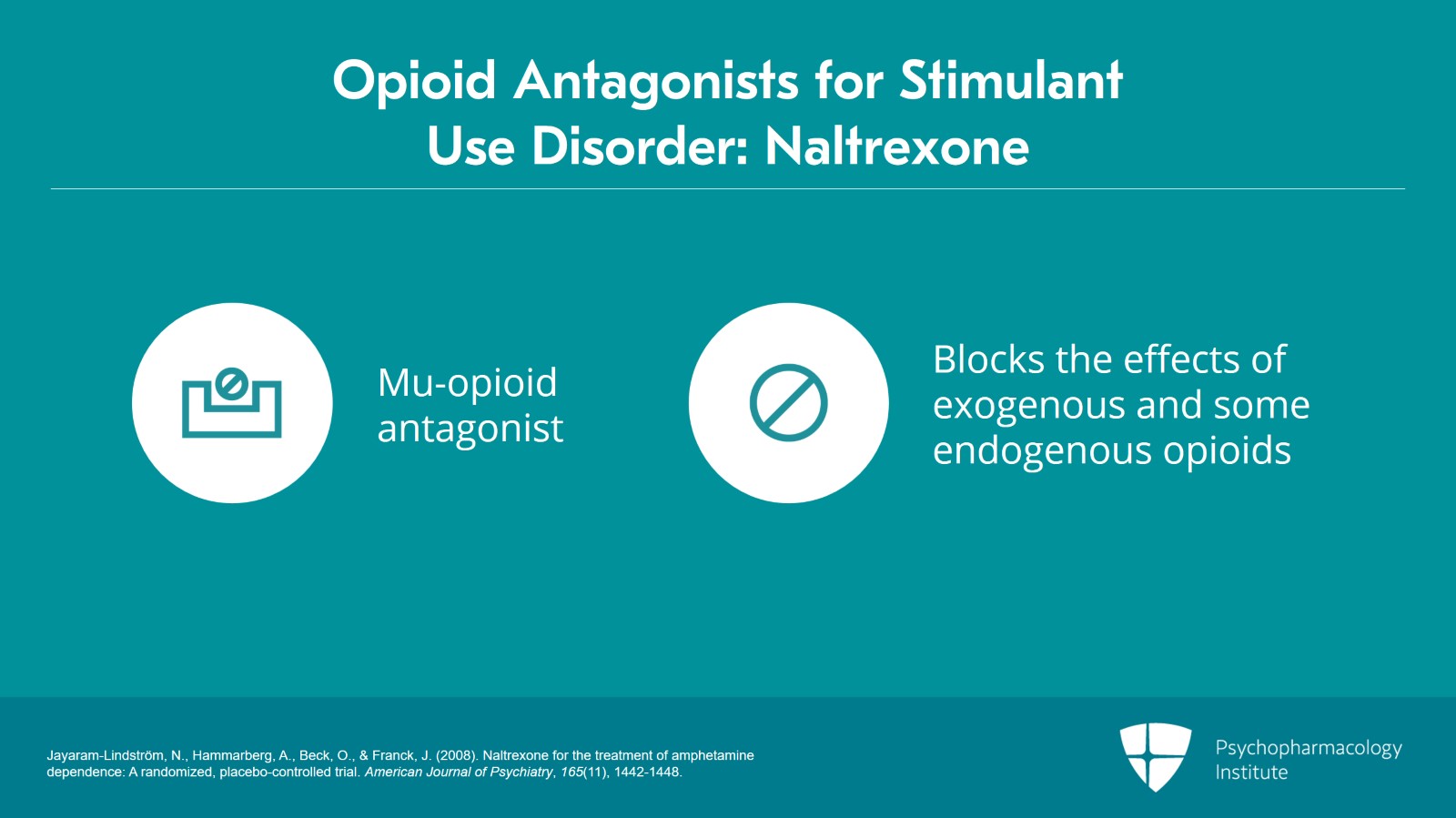
Now, we’re going to turn to the opioid antagonists. So, naltrexone is a mu-opioid antagonist. When naltrexone is in the system, it sits on the mu-opioid receptor, and it blocks the effects of exogenous and some endogenous opioids that are involved in brain reward systems.
References:
  • Jayaram-Lindström, N., Hammarberg, A., Beck, O., & Franck, J. (2008). Naltrexone for the treatment of amphetamine dependence: A randomized, placebo-controlled trial. American Journal of Psychiatry, 165(11), 1442-1448.
Free Files
Success!
Check your inbox, we sent you all the materials there.
Slide 9 of 17

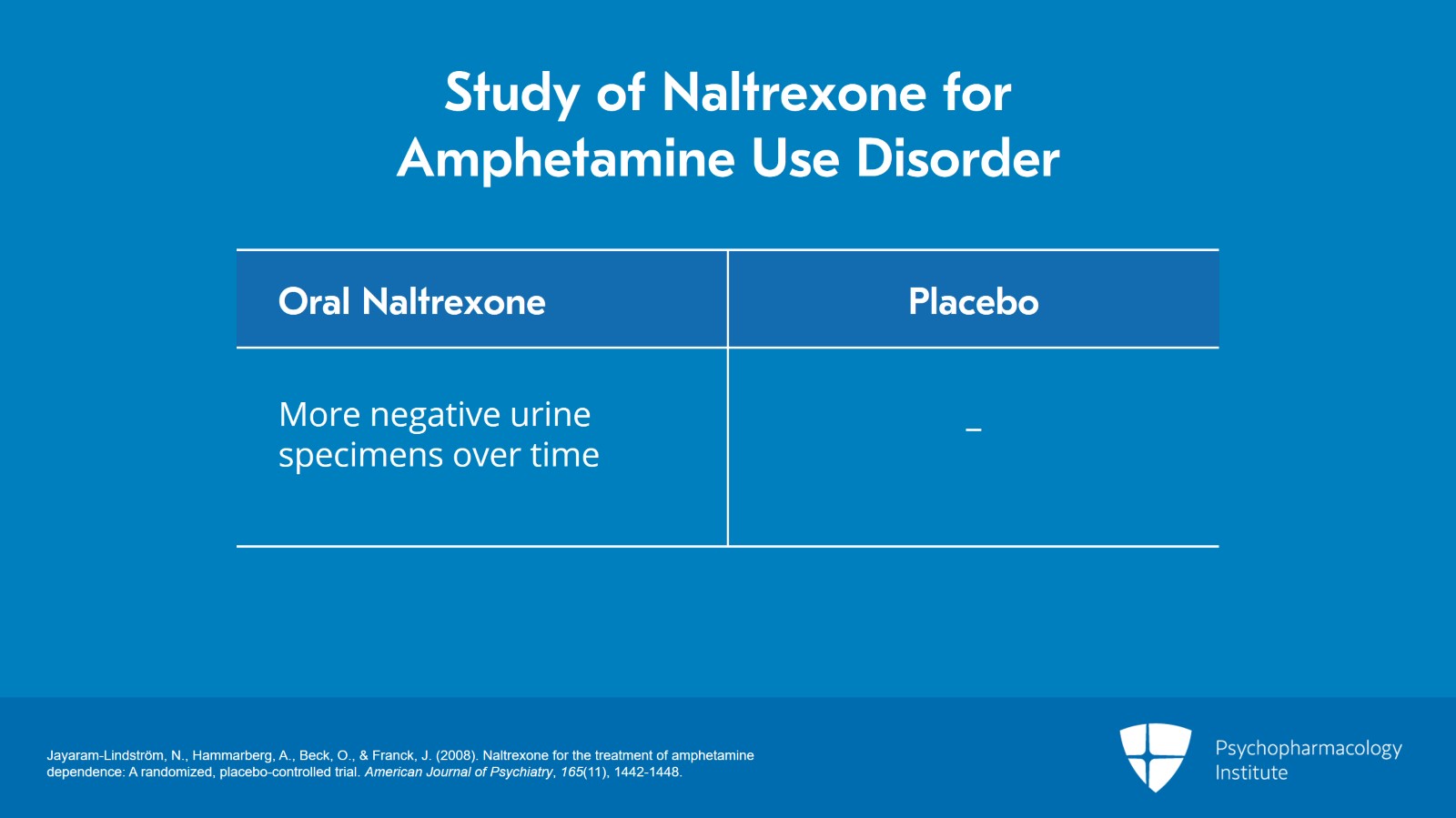
And so, in this study of amphetamine use disorder done in Scandinavia, they compared oral naltrexone which is typically dosed at 50 mg per day to a double-blind placebo. And the active treatment group with oral naltrexone gave more negative urine specimens over time than the placebo group. Again, not even getting over 50% but beating placebo.
References:
  • Jayaram-Lindström, N., Hammarberg, A., Beck, O., & Franck, J. (2008). Naltrexone for the treatment of amphetamine dependence: A randomized, placebo-controlled trial. American Journal of Psychiatry, 165(11), 1442-1448.

Slide 10 of 17

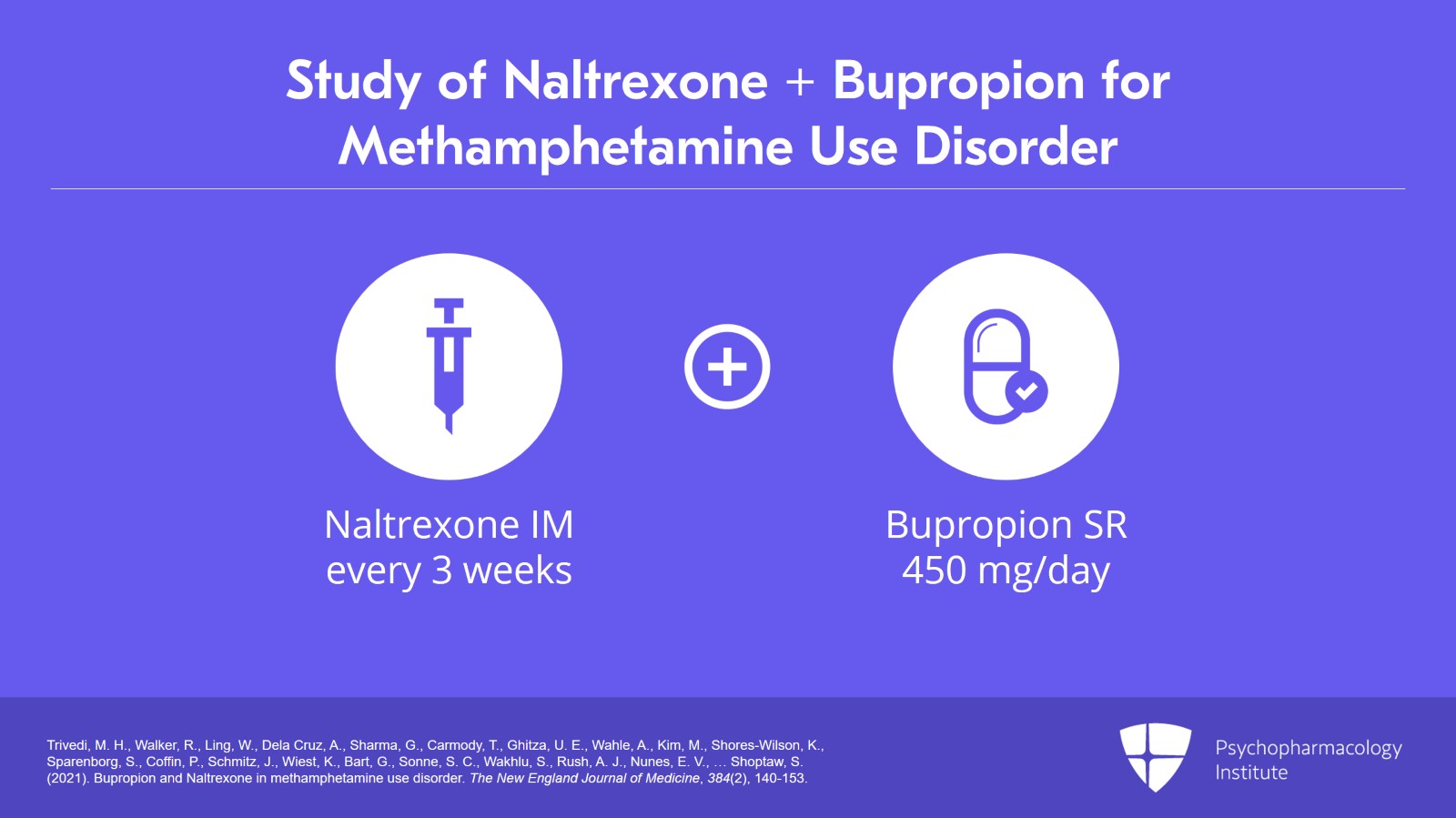
So that created the idea of if bupropion works a little bit and naltrexone works a little bit maybe by combining them and they have different mechanisms of action we can get even more benefit. In this particular study, they gave Naltrexone in a long-acting injection every three weeks to make sure that naltrexone levels in the bloodstream stayed up. And they also combined that in the active treatment group with bupropion sustained release 450 mg per day.
References:
  • Trivedi, M. H., Walker, R., Ling, W., Dela Cruz, A., Sharma, G., Carmody, T., Ghitza, U. E., Wahle, A., Kim, M., Shores-Wilson, K., Sparenborg, S., Coffin, P., Schmitz, J., Wiest, K., Bart, G., Sonne, S. C., Wakhlu, S., Rush, A. J., Nunes, E. V., … Shoptaw, S. (2021). Bupropion and Naltrexone in methamphetamine use disorder. The New England Journal of Medicine, 384(2), 140-153.
Free Files
Success!
Check your inbox, we sent you all the materials there.
Slide 11 of 17

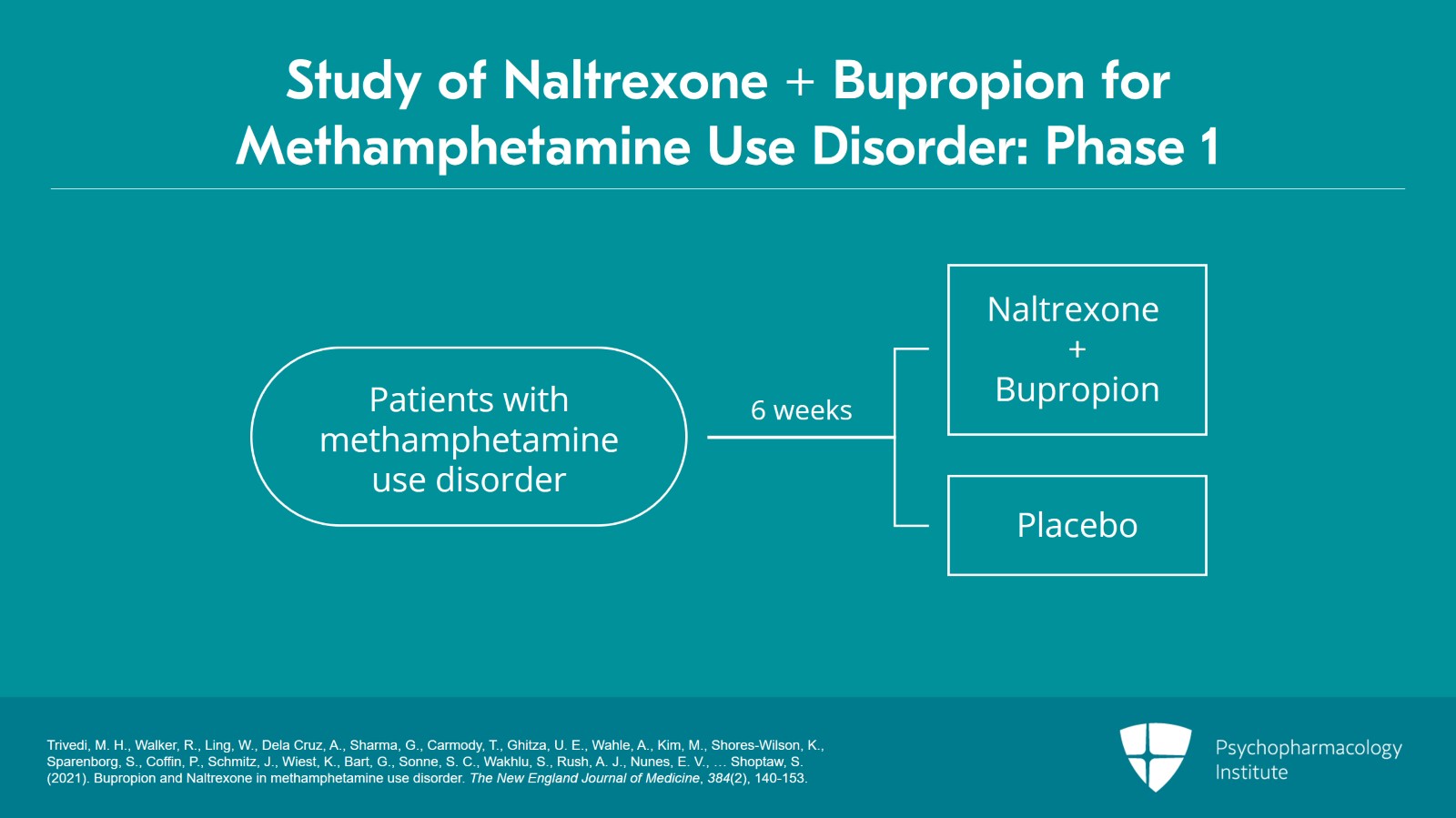
A somewhat complex study that’s depicted here, so there were two phases to the study with an adaptive design. In phase 1 which was six weeks, the patients were randomly assigned to the combination of naltrexone and bupropion or to placebo forms of both of those medications.
References:
  • Trivedi, M. H., Walker, R., Ling, W., Dela Cruz, A., Sharma, G., Carmody, T., Ghitza, U. E., Wahle, A., Kim, M., Shores-Wilson, K., Sparenborg, S., Coffin, P., Schmitz, J., Wiest, K., Bart, G., Sonne, S. C., Wakhlu, S., Rush, A. J., Nunes, E. V., … Shoptaw, S. (2021). Bupropion and Naltrexone in methamphetamine use disorder. The New England Journal of Medicine, 384(2), 140-153.

Slide 12 of 17

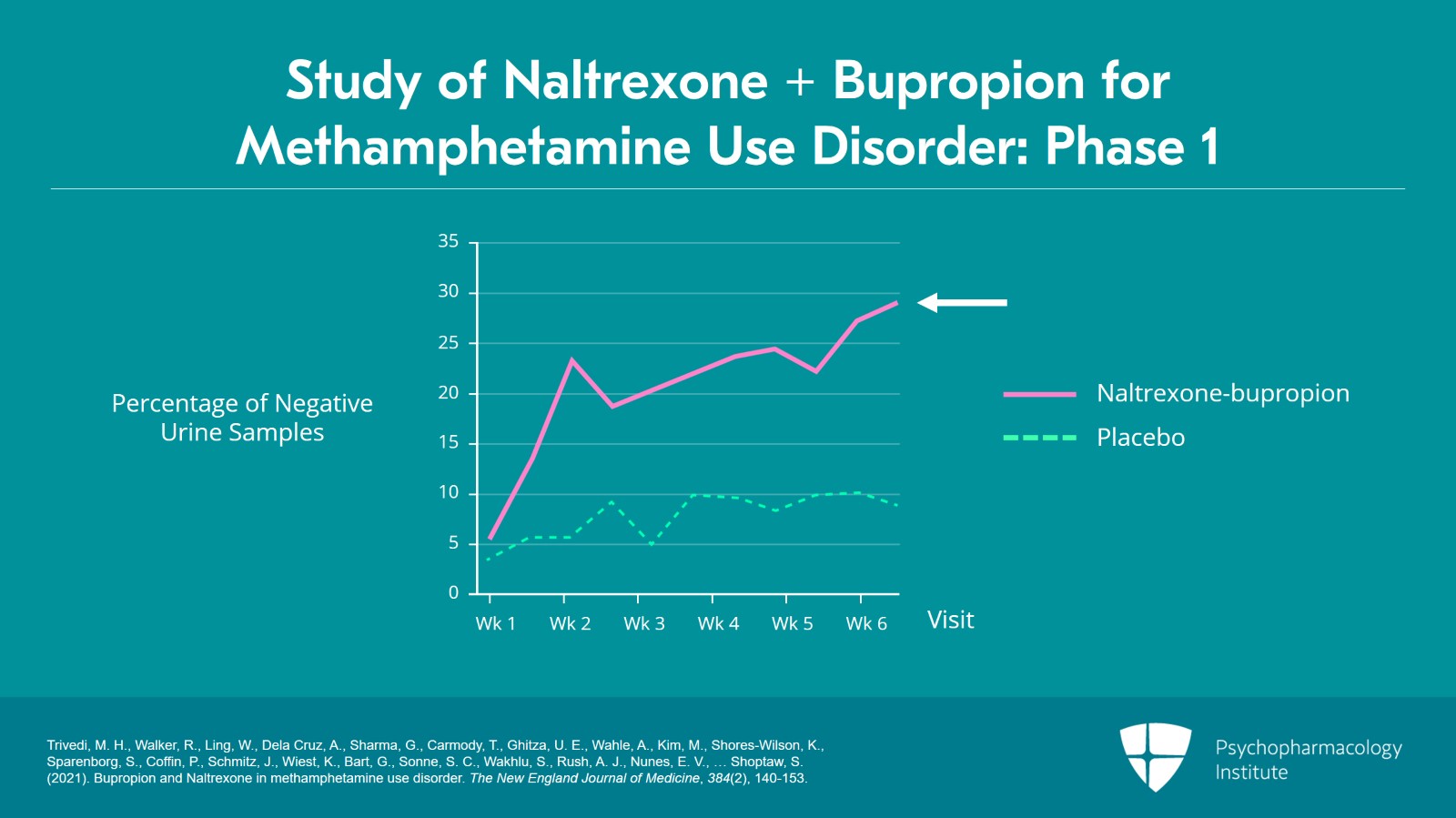
And so, what we’re looking at is the percentage of negative methamphetamine urine samples. And although the active treatment group is really only getting up to 25%, it’s still doing much better than placebo where they hardly gave any negative specimens.
References:
  • Trivedi, M. H., Walker, R., Ling, W., Dela Cruz, A., Sharma, G., Carmody, T., Ghitza, U. E., Wahle, A., Kim, M., Shores-Wilson, K., Sparenborg, S., Coffin, P., Schmitz, J., Wiest, K., Bart, G., Sonne, S. C., Wakhlu, S., Rush, A. J., Nunes, E. V., … Shoptaw, S. (2021). Bupropion and Naltrexone in methamphetamine use disorder. The New England Journal of Medicine, 384(2), 140-153.
Free Files
Success!
Check your inbox, we sent you all the materials there.
Slide 13 of 17

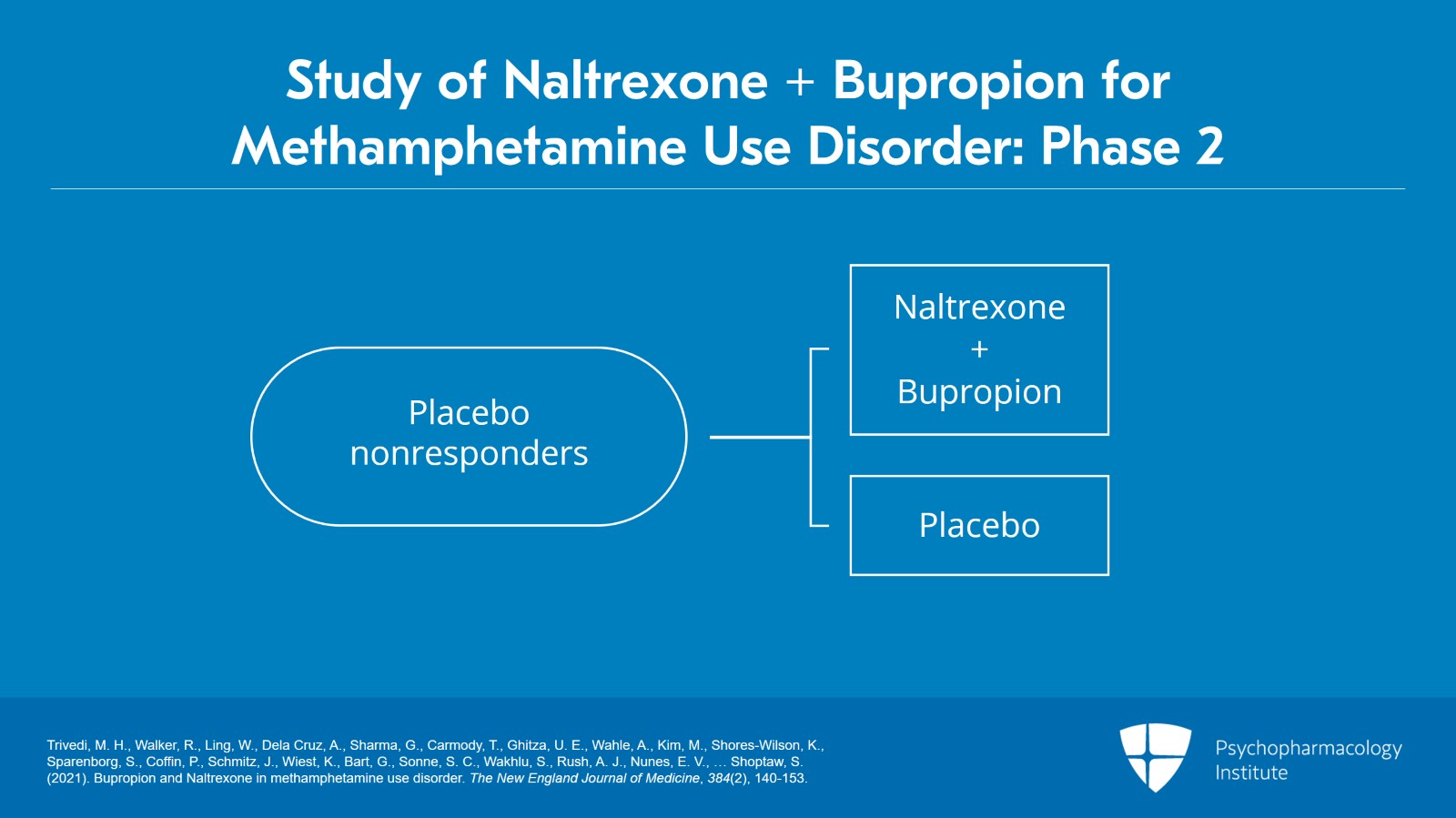
After that first part of the study, all the people who got placebo in that first part and did not respond to placebo, the non-placebo responders, were re-randomized either to the active combination or back to placebo, so the point is to eliminate placebo responders.
References:
  • Trivedi, M. H., Walker, R., Ling, W., Dela Cruz, A., Sharma, G., Carmody, T., Ghitza, U. E., Wahle, A., Kim, M., Shores-Wilson, K., Sparenborg, S., Coffin, P., Schmitz, J., Wiest, K., Bart, G., Sonne, S. C., Wakhlu, S., Rush, A. J., Nunes, E. V., … Shoptaw, S. (2021). Bupropion and Naltrexone in methamphetamine use disorder. The New England Journal of Medicine, 384(2), 140-153.

Slide 14 of 17

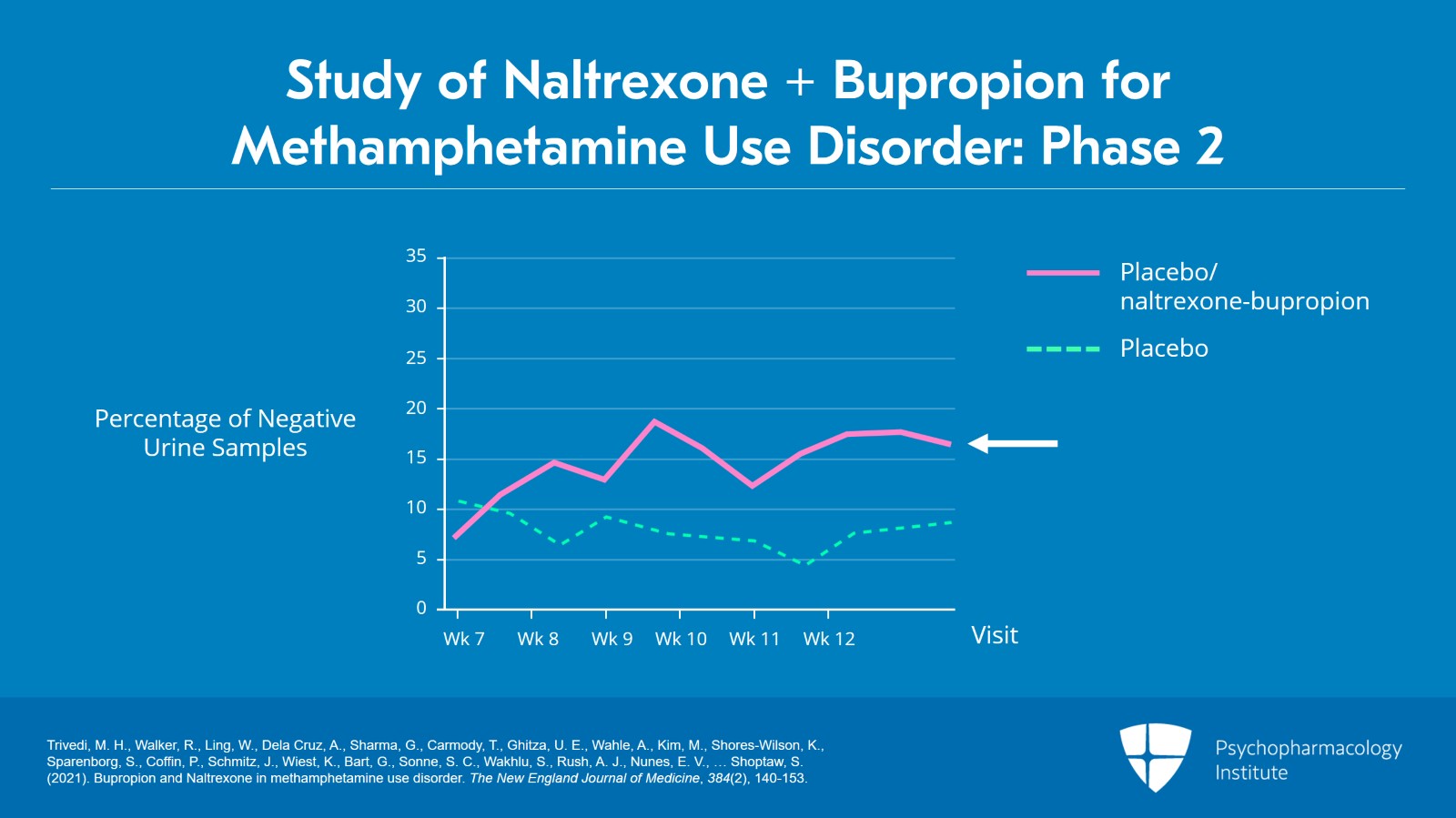
And you can see, once again, the combination medication does better at producing negative urine specimens compared to the placebo although it wasn’t as dramatic as it was in the first part of the study which makes sense because by enrolling only placebo nonresponders you’re essentially enrolling people who have even no placebo effect.
References:
  • Trivedi, M. H., Walker, R., Ling, W., Dela Cruz, A., Sharma, G., Carmody, T., Ghitza, U. E., Wahle, A., Kim, M., Shores-Wilson, K., Sparenborg, S., Coffin, P., Schmitz, J., Wiest, K., Bart, G., Sonne, S. C., Wakhlu, S., Rush, A. J., Nunes, E. V., … Shoptaw, S. (2021). Bupropion and Naltrexone in methamphetamine use disorder. The New England Journal of Medicine, 384(2), 140-153.
Free Files
Success!
Check your inbox, we sent you all the materials there.
Slide 15 of 17

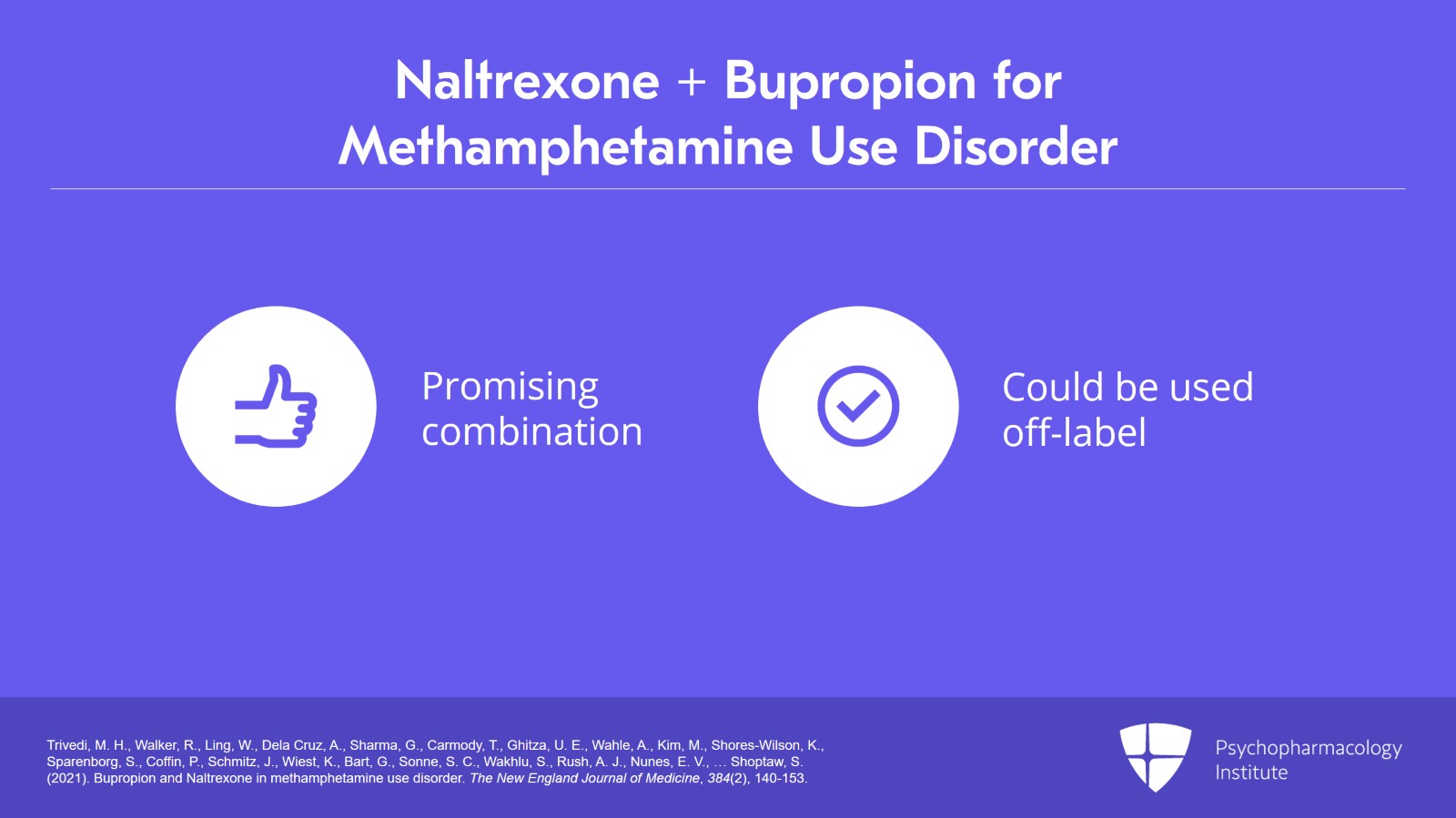
So, this looks like a promising combination. It was recently published in the New England Journal of Medicine and will need some follow-up but is certainly something that could be used in clinical practice if using the medications off-label even now.
References:
  • Trivedi, M. H., Walker, R., Ling, W., Dela Cruz, A., Sharma, G., Carmody, T., Ghitza, U. E., Wahle, A., Kim, M., Shores-Wilson, K., Sparenborg, S., Coffin, P., Schmitz, J., Wiest, K., Bart, G., Sonne, S. C., Wakhlu, S., Rush, A. J., Nunes, E. V., … Shoptaw, S. (2021). Bupropion and Naltrexone in methamphetamine use disorder. The New England Journal of Medicine, 384(2), 140-153.

Slide 16 of 17

So, the antidepressants, mirtazapine, and bupropion, show some signal for efficacy for the treatment of methamphetamine use disorder in selected populations. The opioid antagonist, naltrexone, also shows a signal in some studies but not others. The combination of naltrexone and bupropion looks quite promising based on a sizeable randomized, double-blind, placebo-controlled trial, the results of which were recently published.
Free Files
Success!
Check your inbox, we sent you all the materials there.
Slide 17 of 17

Learning Objectives:

After completing this activity, the learner will be able to:

  1. Review the pathophysiology and clinical course of stimulant use disorder.
  2. Discuss the appropriate use of psychotropic medications for the management of stimulant use disorder.
  3. Cite specific strategies in the management of specific stimulant use disorders, such as methamphetamine and cocaine use disorders.

Original Release Date: 12/01/2021

Review and Re-release Date: 03/01/2024

Expiration Date: 04/01/2025

Expert: Andrew Saxon, M.D.

Medical Editor: Melissa Mariano, M.D

Relevant Financial Disclosures: 

The following planners, faculty, and reviewers have the following relevant financial relationships with commercial interests to disclose:

Dr. Saxon has disclosed the following relationships:

  • Indivior, Inc.: Advisory board
  • UpToDate, Inc.: Section Editor
  • Indivior, Inc.: Advisory board
  • UpToDate, Inc.: Editor

All of the relevant financial relationships listed for these individuals have been mitigated.

Contact Information: For questions regarding the content or access to this activity, contact us at support@psychopharmacologyinstitute.com

Instructions for Participation and Credit:

Participants must complete the activity online during the valid credit period that is noted above.

Follow these steps to earn CME credit:

  1. View the required educational content provided on this course page.
  2. Complete the Post Activity Evaluation for providing the necessary feedback for continuing accreditation purposes and for the development of future activities. NOTE: Completing the Post Activity Evaluation after the quiz is required to receive the earned credit.
  3. Download your certificate.

Accreditation Statement

This activity has been planned and implemented in accordance with the accreditation requirements and policies of the Accreditation Council for Continuing Medical Education through the joint providership of Medical Academy LLC and the Psychopharmacology Institute. Medical Academy is accredited by the ACCME to provide continuing medical education for physicians.

Credit Designation Statement

Medical Academy designates this enduring activity for a maximum of 1 AMA PRA Category 1 credit(s). Physicians should claim only the credit commensurate with the extent of their participation in the activity.

Free Files
Success!
Check your inbox, we sent you all the materials there.
Continue in the website
Instant access modal

Become a Bronze, Silver, Gold, Bronze extended, Silver extended or Gold extended Member.

2025–26 Psychopharmacology CME Program

Unlock up to 155 CME Credits, including 40 SA CME Credits.