Close Banner
Section Free  - Video Lectures

07. Antidepressants and Mood Stabilizers for Managing Explosive Behavior

Published on June 1, 2022 Expired on June 1, 2025

Carrie A. Vaudreuil, M.D.

Psychiatrist, Massachusetts General Hospital Instructor, Harvard Medical School - Massachusetts General Hospital

Key Points

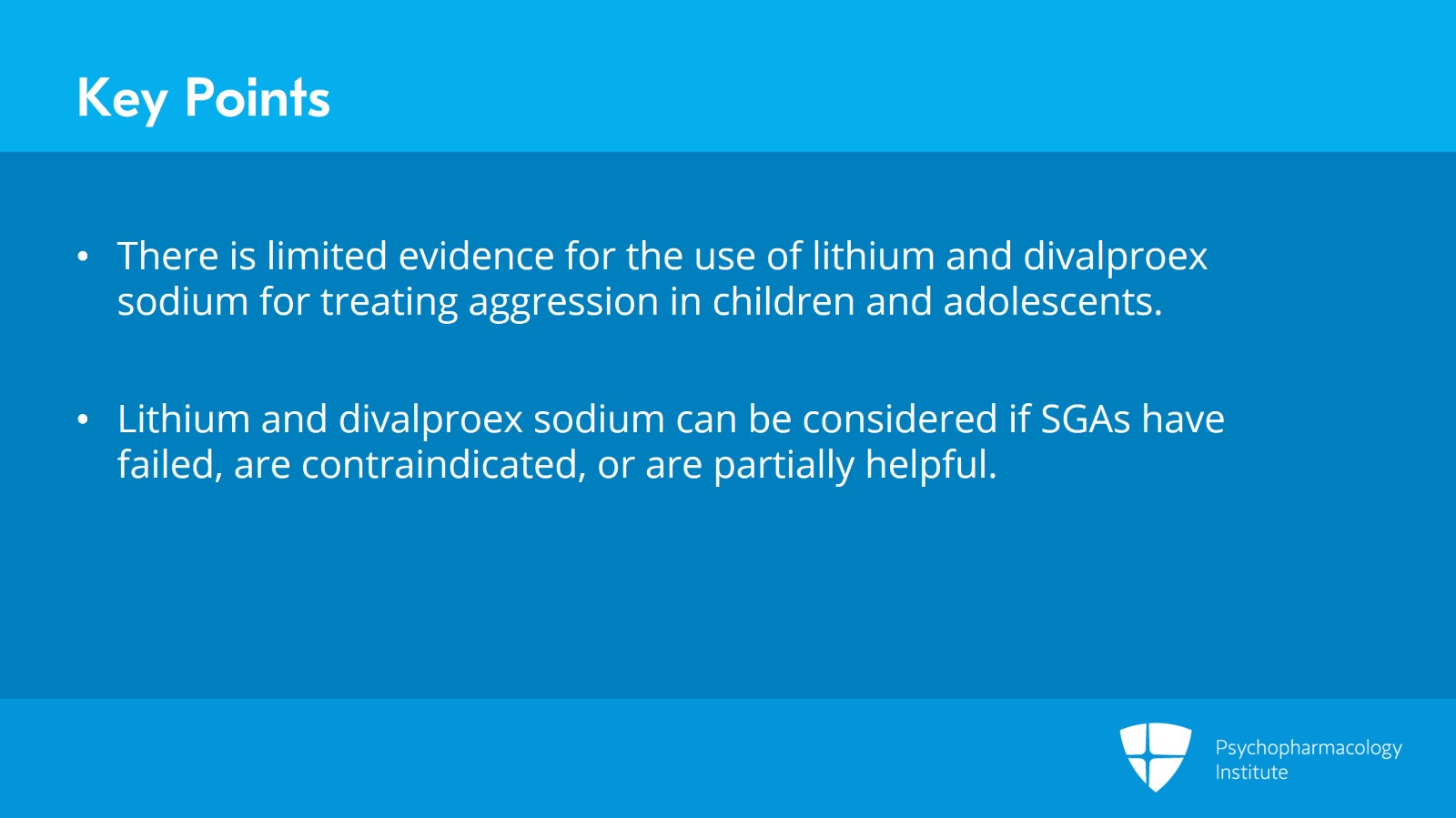
  • There is limited evidence for the use of lithium and divalproex sodium for treating aggression in children and adolescents.
  • Lithium and divalproex sodium can be considered if SGAs have failed, are contraindicated, or are partially helpful.
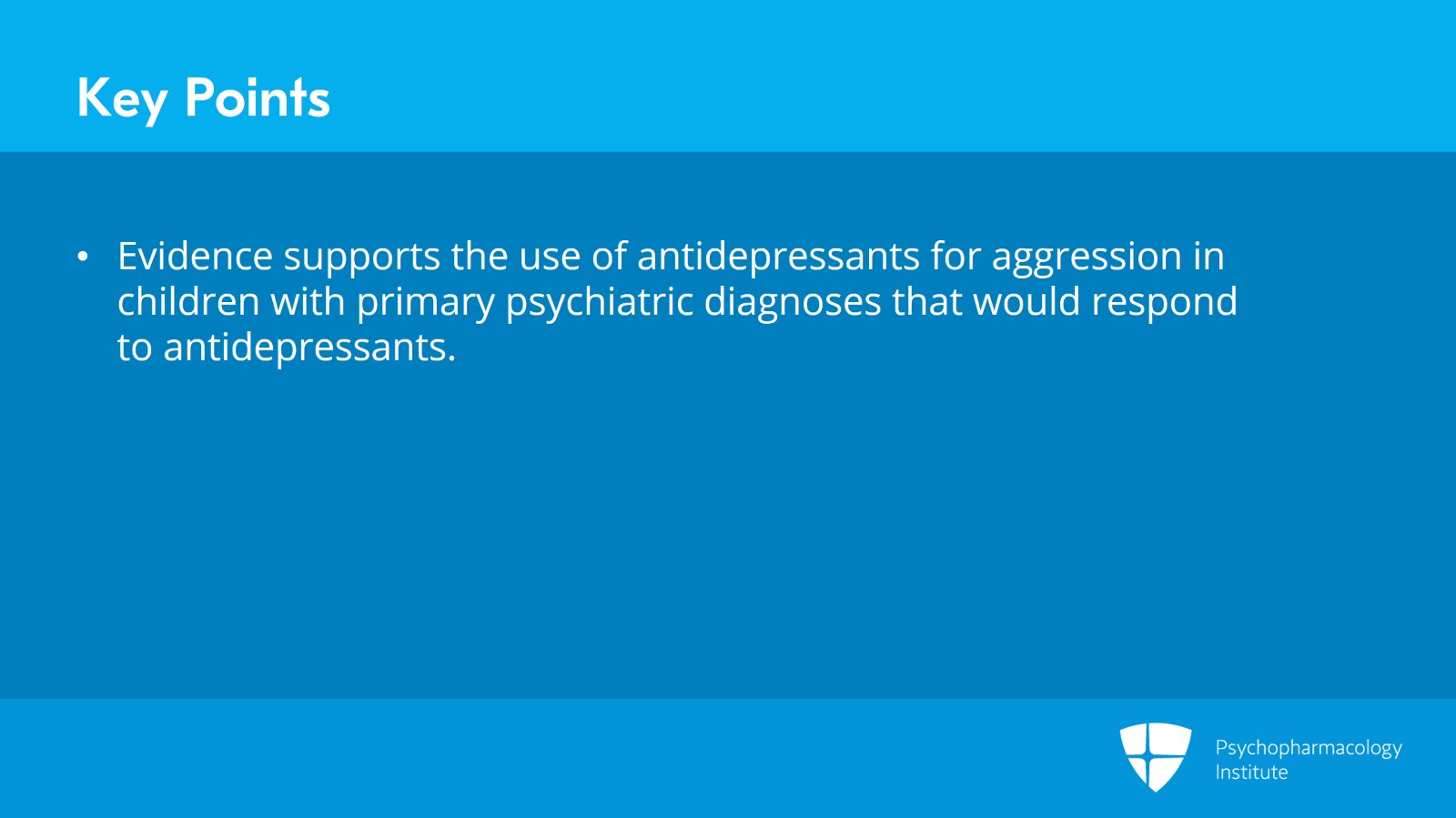
  • Evidence supports the use of antidepressants for aggression in children with primary psychiatric diagnoses that would respond to antidepressants.

Free Downloads for Offline Access

  • Free Download Audio File (MP3)
  • Free Download Video (MP4)
  • Free Download Presentation File (PPTX)

Slides and Transcript

Slide 1 of 8

In this next section, we're going to discuss antidepressants and mood stabilizers for managing explosive behavior.

Slide 2 of 8

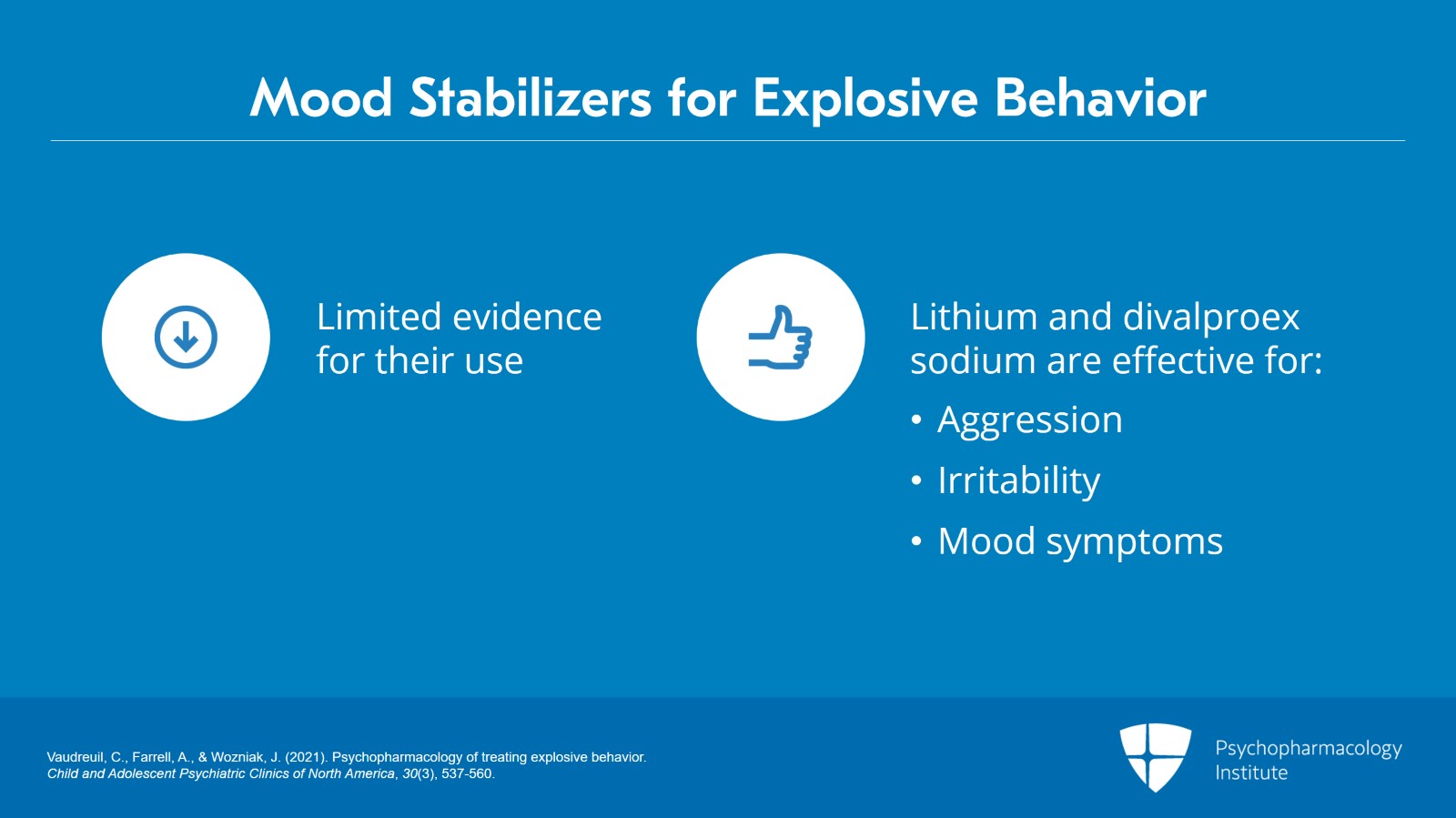
There is some limited evidence for the use of mood stabilizers such as lithium and divalproex sodium in the treatment of explosive behavior. The data for both of these medications again is fairly limited with a small number of double-blind, placebo-controlled trials supporting their use. However, the studies that are available do show that both lithium and divalproex sodium seem to be effective for treating aggression, irritability, and mood symptoms across a variety of psychiatric disorders.
References:
  • Vaudreuil, C., Farrell, A., & Wozniak, J. (2021). Psychopharmacology of treating explosive behavior. Child and Adolescent Psychiatric Clinics of North America, 30(3), 537-560.
Free Files
Success!
Check your inbox, we sent you all the materials there.

Slide 3 of 8

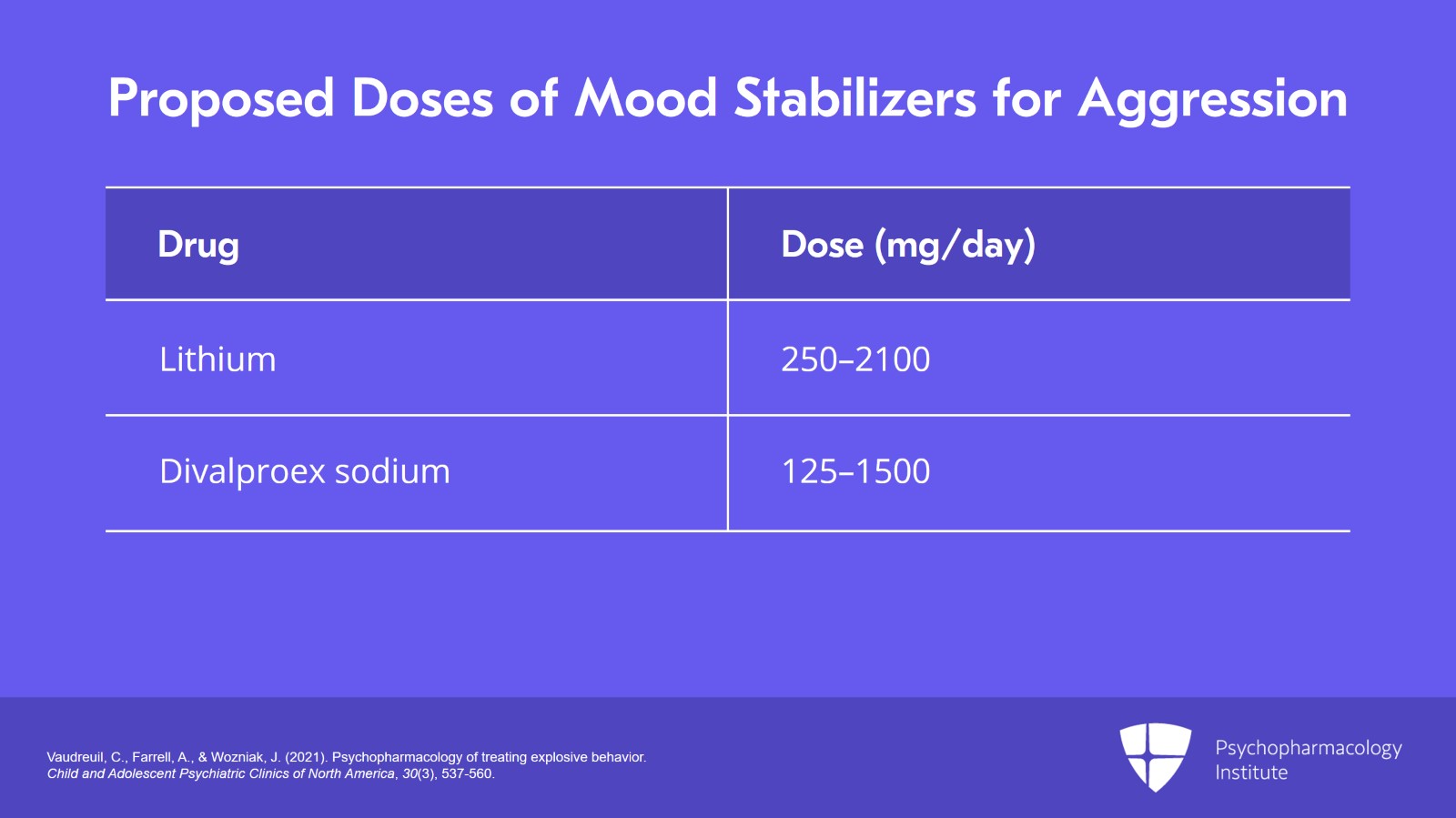
Studies investigating the use of lithium for aggression used dosages in the range of 250 to 2100 mg daily. Studies investigating the use of divalproex sodium in aggression used dosages in the range of 125 to 1500 mg daily.
References:
  • Vaudreuil, C., Farrell, A., & Wozniak, J. (2021). Psychopharmacology of treating explosive behavior. Child and Adolescent Psychiatric Clinics of North America, 30(3), 537-560.

Slide 4 of 8

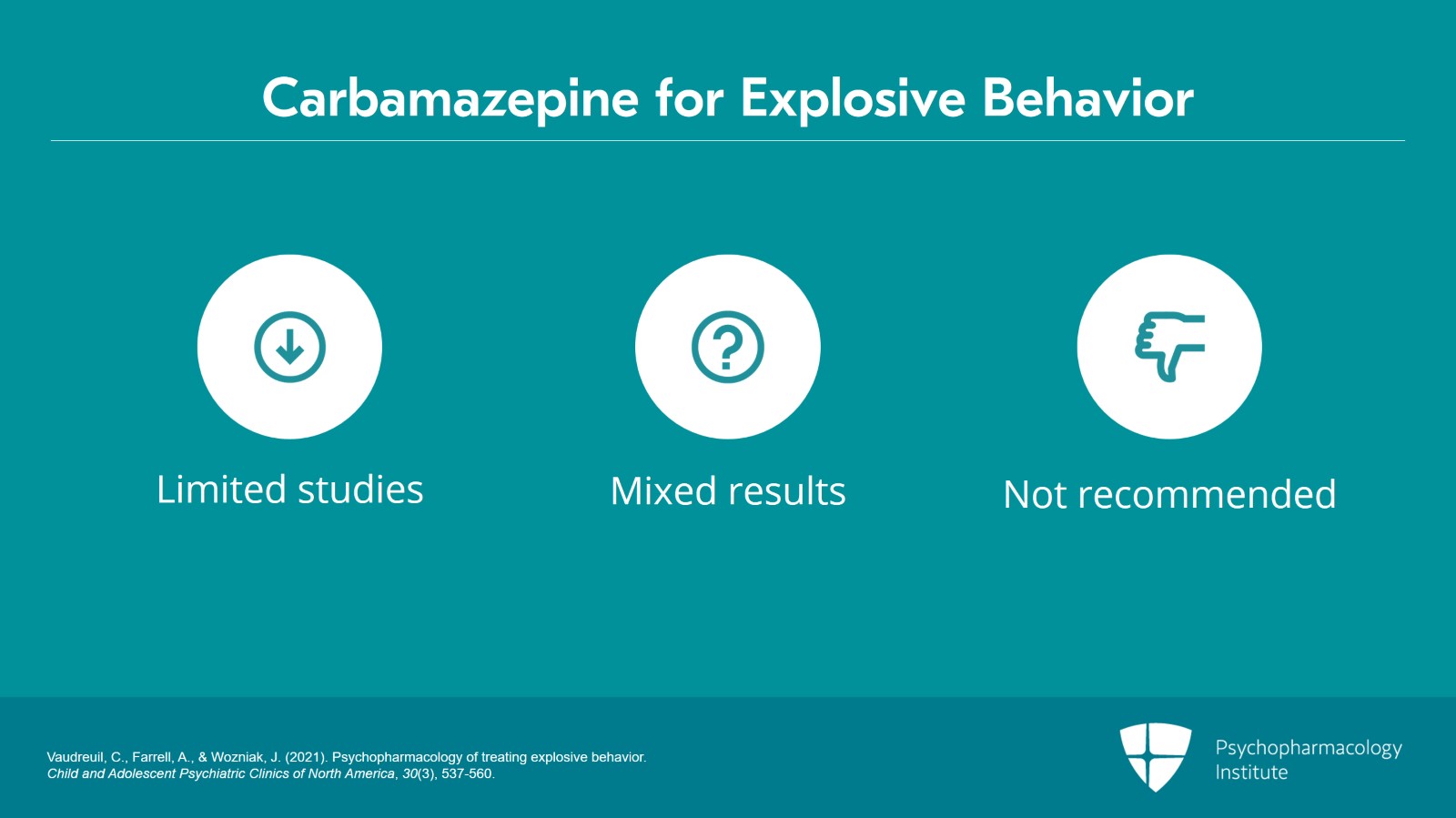
There are a very limited number of studies exploring the use of carbamazepine in the treatment of explosive behavior. Of the two studies that I found prior to this presentation, one study did show improvement in aggression and explosiveness but the other study did not find any benefit and the number of subjects in both studies was very small. So for this reason, carbamazepine is not currently recommended for the treatment of explosive behavior in children and adolescents.
References:
  • Vaudreuil, C., Farrell, A., & Wozniak, J. (2021). Psychopharmacology of treating explosive behavior. Child and Adolescent Psychiatric Clinics of North America, 30(3), 537-560.
Free Files
Success!
Check your inbox, we sent you all the materials there.

Slide 5 of 8

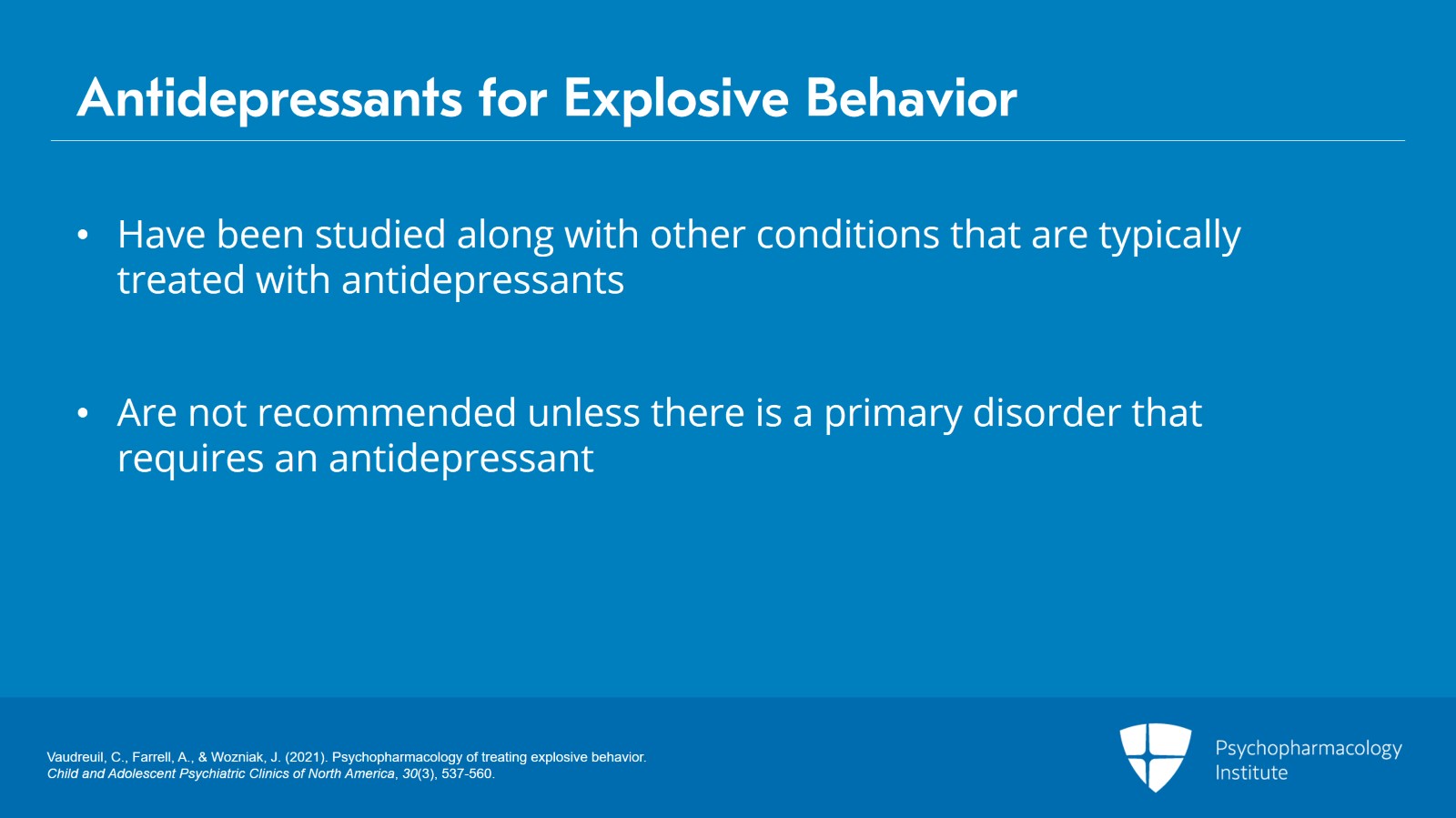
In terms of the antidepressants, there are a number of studies that looked at the use of antidepressants for the treatment of explosive behavior. However, the majority of these studies looked at the use of antidepressants in treating conditions that would typically be treated with antidepressants. So for example, these studies were conducted in children who had OCD, depression, anxiety, or other conditions where these medications would normally be prescribed. Because of this, it is not recommended to use antidepressants to treat explosive behaviors unless there is a primary disorder that would normally be treated by an antidepressant such as a primary mood or anxiety disorder or OCD.
References:
  • Vaudreuil, C., Farrell, A., & Wozniak, J. (2021). Psychopharmacology of treating explosive behavior. Child and Adolescent Psychiatric Clinics of North America, 30(3), 537-560.

Slide 6 of 8

The key points for this section are that: 1. There is limited evidence for the use of lithium and divalproex sodium in the treatment of aggression in children and adolescents. These agents can be considered if second-generation antipsychotics have failed, or are contraindicated, or if there is a desire to use a mood stabilizer in combination with a second-generation antipsychotic because the second-generation antipsychotic is helpful but does not completely treat the behavior.
Free Files
Success!
Check your inbox, we sent you all the materials there.

Slide 7 of 8

2. Evidence supports the use of antidepressants for aggression only in children with a primary psychiatric diagnosis that would respond to an antidepressant such as anxiety, depression or OCD.

Slide 8 of 8

Free Files
Success!
Check your inbox, we sent you all the materials there.

Learning Objectives:

After completing this activity, the learner will be able to:

  1. Perform a thorough evaluation of explosive behavior in children and adolescents.
  2. Differentiate explosive behavior from other common diagnoses in children and adolescents.
  3. Identify the recommended treatments for explosive behavior and prescribe them accordingly.

Release Date: June 1, 2022

Expiration Date: June 1, 2025

Expert: Carrie Vaudreuil, M.D.

Medical Editor: Paz Badía, M.D.

Relevant Financial Disclosures: 

None of the faculty, planners, and reviewers for this educational activity have relevant financial relationships to disclose during the last 24 months with ineligible companies whose primary business is producing, marketing, selling, re-selling, or distributing healthcare products used by or on patients.

Contact Information: For questions regarding the content or access to this activity, contact us at support@psychopharmacologyinstitute.com

Instructions for Participation and Credit:

Participants must complete the activity online during the valid credit period that is noted above.

Follow these steps to earn CME credit:

  1. View the required educational content provided on this course page.

  2. Complete the Post Activity Evaluation for providing the necessary feedback for continuing accreditation purposes and for the development of future activities. NOTE: Completing the Post Activity Evaluation after the quiz is required to receive the earned credit.

  3. Download your certificate.

Accreditation Statement

This activity has been planned and implemented in accordance with the accreditation requirements and policies of the Accreditation Council for Continuing Medical Education through the joint providership of Medical Academy LLC and the Psychopharmacology Institute. Medical Academy is accredited by the ACCME to provide continuing medical education for physicians.

Credit Designation Statement

Medical Academy designates this enduring activity for a maximum of 0.75 AMA PRA Category 1 credit(s)™. Physicians should claim only the credit commensurate with the extent of their participation in the activity.


Free Files
Success!
Check your inbox, we sent you all the materials there.
Continue in the website
Instant access modal

Become a Bronze, Silver, Gold, Bronze extended, Silver extended or Gold extended Member.

2025–26 Psychopharmacology CME Program

Unlock up to 155 CME Credits, including 40 SA CME Credits.