
Slides and Transcript
Slide 1 of 11
This is video number 9. Amphetamine and alprazolam. And the common thread throughout this combination is that there is one medicine with the function to improve attention and then there’s another medicine that’s designed, a benzodiazepine, to reduce anxiety. The problem comes – And I will focus on amphetamine and alprazolam.
Slide 2 of 11
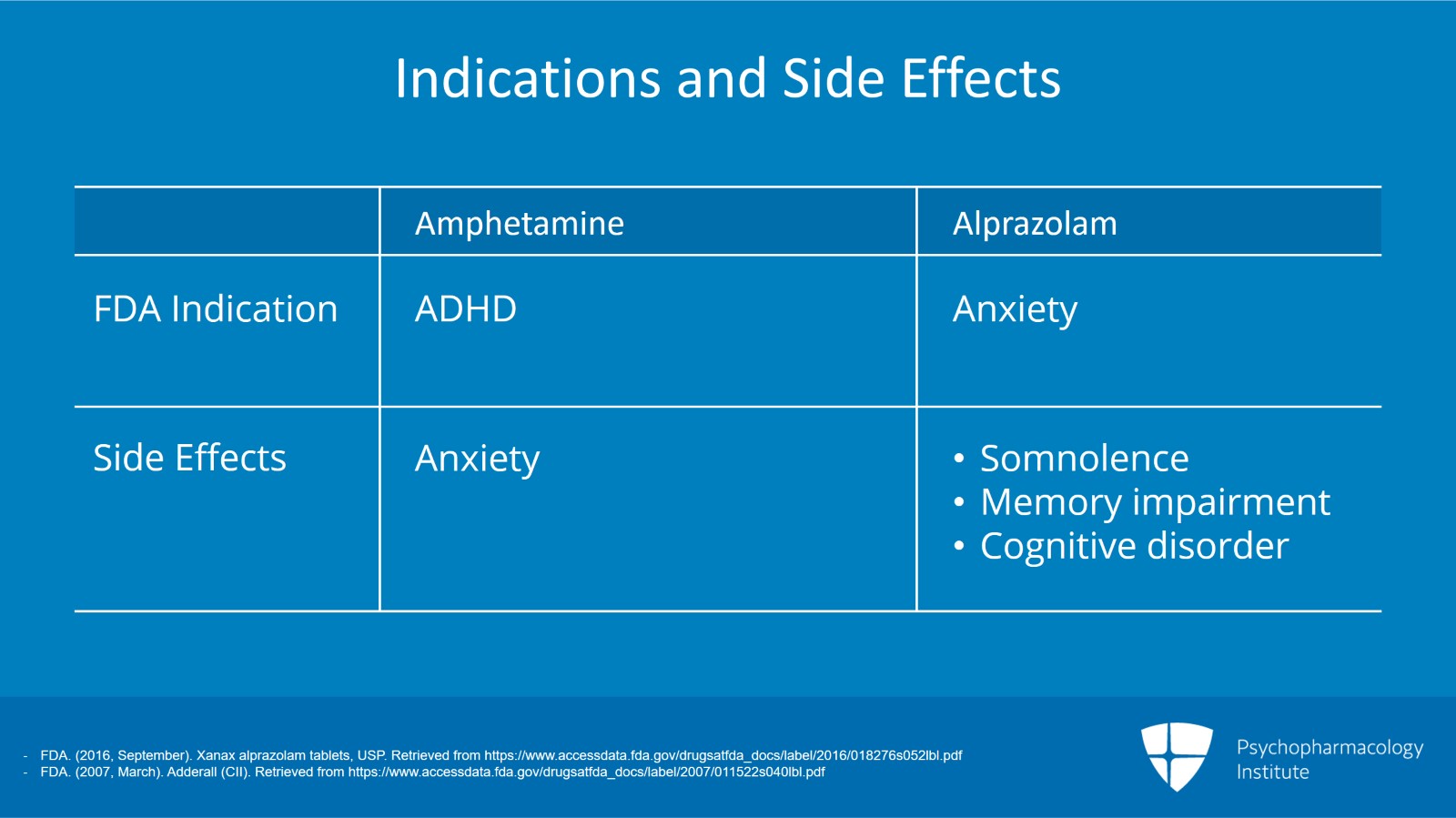
Amphetamine has an FDA indication for ADHD. However, in the manufacturer’s literature, it can lead to anxiety in 8% leading to discontinuation in 2.1%.
In clinical practice where we could often reach higher doses, the prevalence of anxiety may be higher. What happens frequently is that then alprazolam is added which is an FDA treatment for anxiety. However, alprazolam leads to somnolence in 76%, memory impairment in 33% and cognitive disorder in 29%, pretty much the opposite from what we were looking for when we added the amphetamine.
References:
- FDA. (2016, September). Xanax alprazolam tablets, USP. Retrieved from https://www.accessdata.fda.gov/drugsatfda_docs/label/2016/018276s052lbl.pdf
- FDA. (2007, March). Adderall (CII). Retrieved from https://www.accessdata.fda.gov/drugsatfda_docs/label/2007/011522s040lbl.pdf
Free Files
Download PDF and other files
Success!
Check your inbox, we sent you all the materials there.
Slide 3 of 11
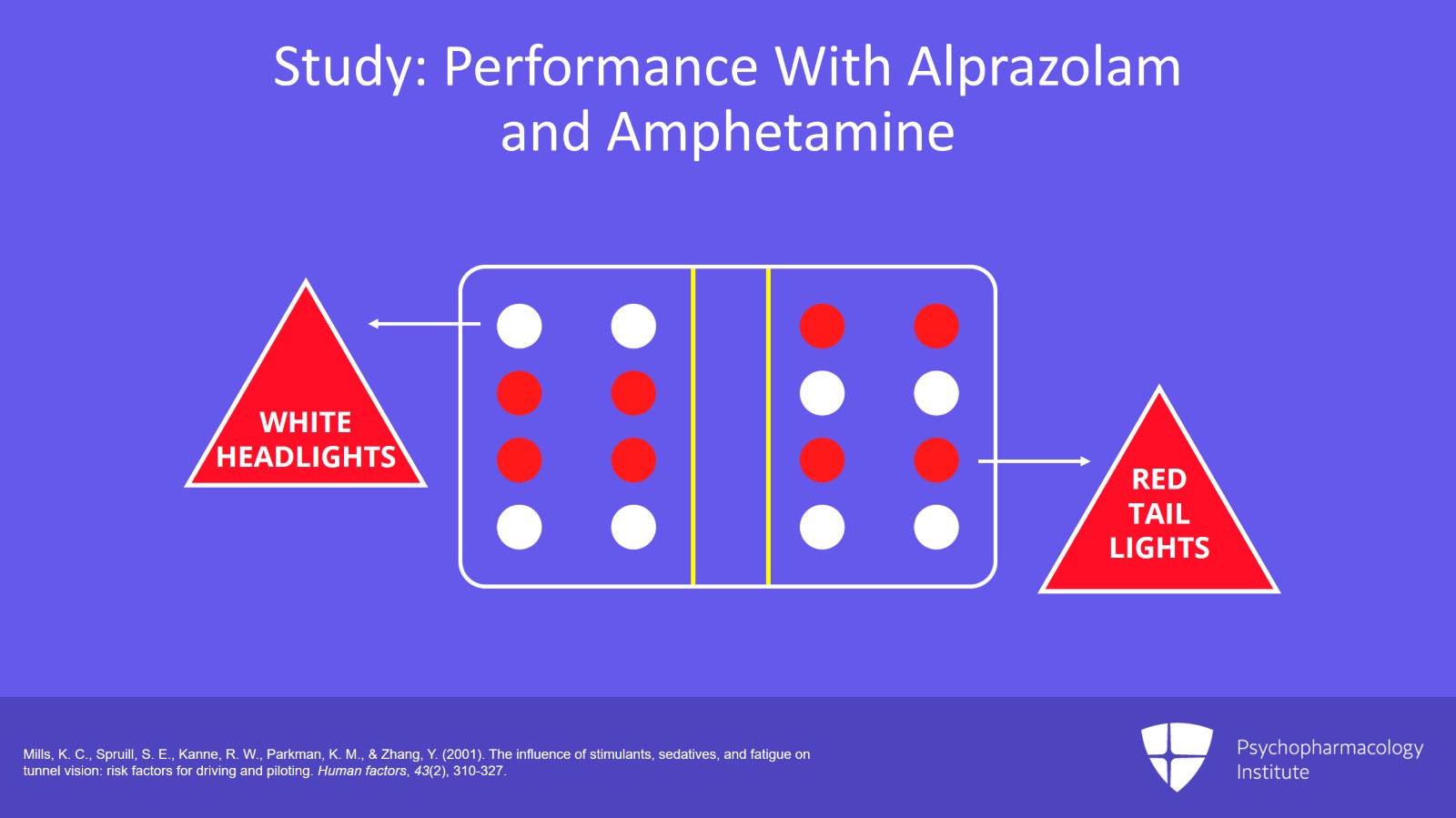
There have been studies that show an opposite effect on performance within the same study. And on this one study where you can see the screen that was shown to the healthy subjects, you can see it kind of looks like what somebody would see when they’re driving. On the right, there are red tail lights. On the left, there are white headlights. You’re supposed to stay behind the red tail lights.
References:
- Mills, K. C., Spruill, S. E., Kanne, R. W., Parkman, K. M., & Zhang, Y. (2001). The influence of stimulants, sedatives, and fatigue on tunnel vision: risk factors for driving and piloting. Human factors, 43(2), 310-327.
Slide 4 of 11
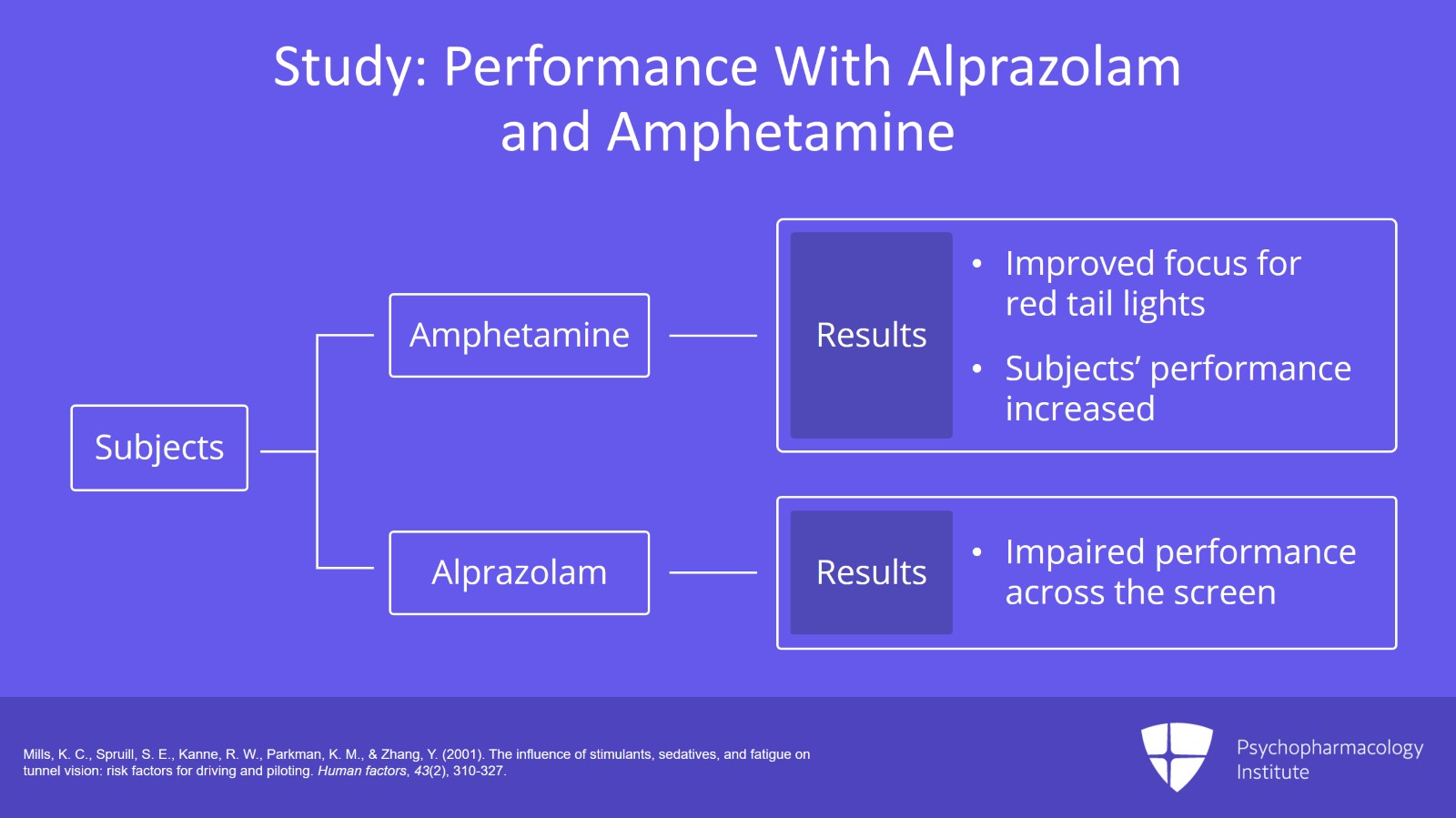
And in this study, what they did is they gave their subjects 10 mg of dextroamphetamine which they noticed improved focus for the red tail lights.
The distractors around the periphery which may be stop signs or traffic regulations, the performance did not increase around the periphery. It only increased directly in front of the subject.
Alprazolam impaired performance across the screen, not only the side, the side signs but also directly in front of the subjects. So the combination of those two together was not tested in this particular study but it suggests an antagonistic effect.
It is often prescribed with the idea that alprazolam has a shorter duration of action and a shorter half-life. It’s often thought to be the off switch. Many of my patients think of amphetamine as the on switch and alprazolam as the off switch. And these studies are just a caution.
References:
- Mills, K. C., Spruill, S. E., Kanne, R. W., Parkman, K. M., & Zhang, Y. (2001). The influence of stimulants, sedatives, and fatigue on tunnel vision: risk factors for driving and piloting. Human factors, 43(2), 310-327.
Free Files
Download PDF and other files
Success!
Check your inbox, we sent you all the materials there.
Slide 5 of 11
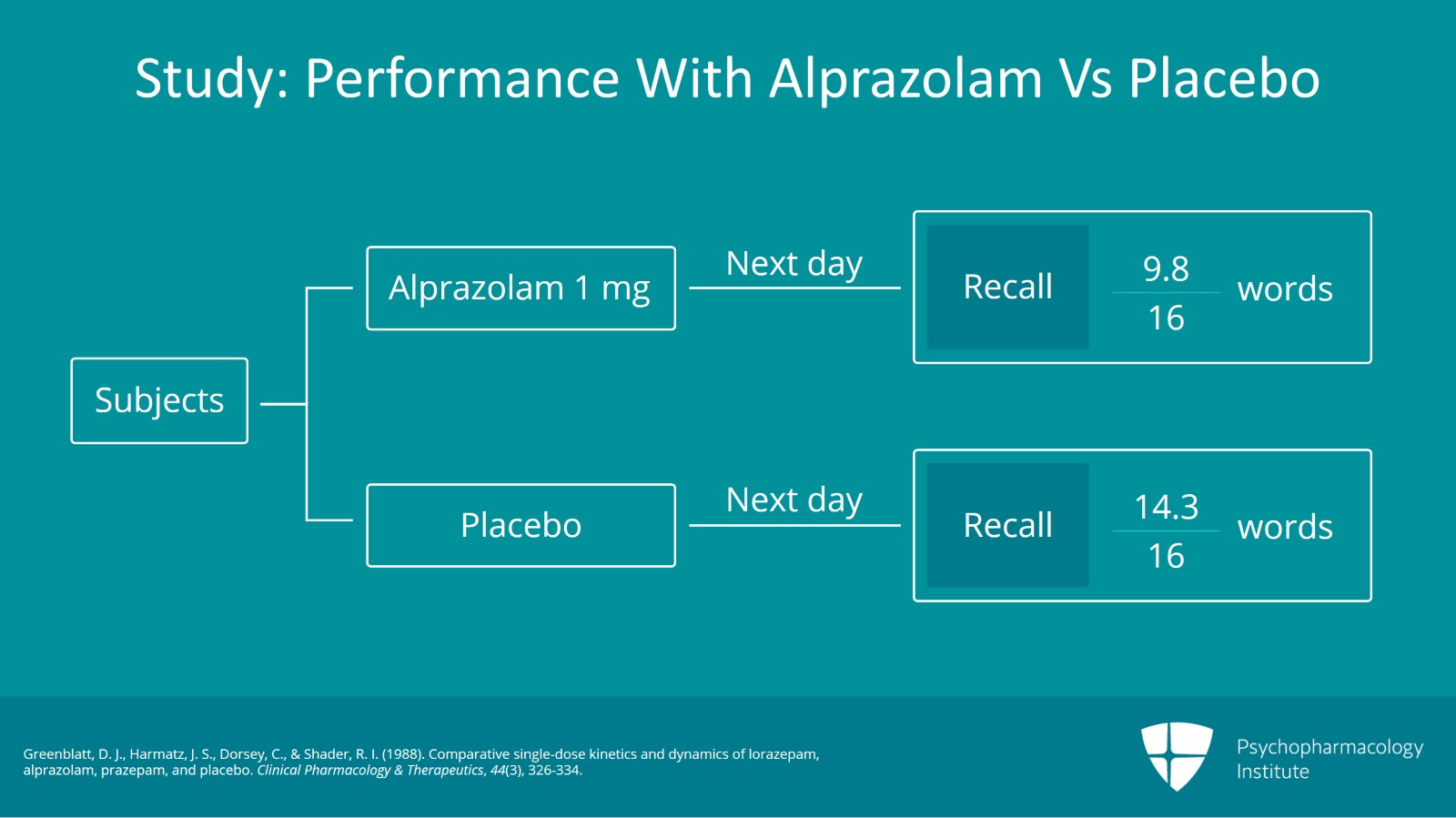
Memory impairment persists for 24 hours after a single 1 mg dose of alprazolam. In this particular study, they gave people alprazolam and then they studied how many words they could remember the next day. Typically, with placebo, they could remember 14.3 words out of the 16. But with alprazolam, they could remember only 9.8.
References:
- Greenblatt, D. J., Harmatz, J. S., Dorsey, C., & Shader, R. I. (1988). Comparative single‐dose kinetics and dynamics of lorazepam, alprazolam, prazepam, and placebo. Clinical Pharmacology & Therapeutics, 44(3), 326-334.
Slide 6 of 11
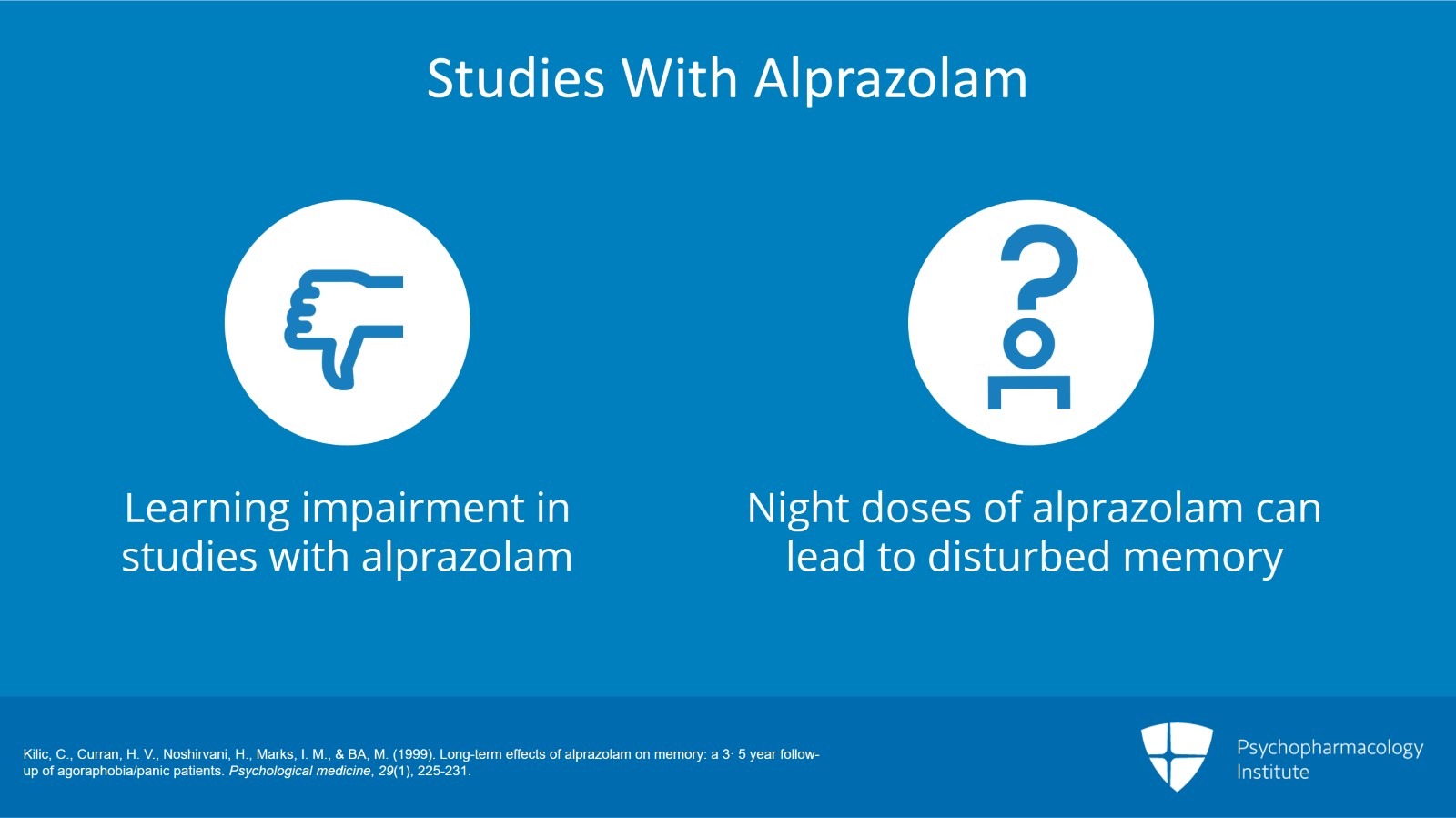
There have been studies in patients with panic that have shown longer impairment, up to eight weeks and then at one study, 24 weeks.
These same study authors went back and found that what really happened when they looked at them at 3.5 years is the patients on alprazolam did not get the benefit of practice that the placebo patients got in that they were not learning how to do the word test and that is why they found a persisting effect at 24 weeks when they rechecked. The people on placebo knew how to do word test very effectively. The people on alprazolam never learned.
This is evidence though of a persisting effect when people take alprazolam at night. It possibly leads to disturbed memory that persists into the next day and gives people a feeling that they’re not as competent or as sharp as people that are not taking it.
References:
- Kilic, C., Curran, H. V., Noshirvani, H., Marks, I. M., & BA, M. (1999). Long-term effects of alprazolam on memory: a 3· 5 year follow-up of agoraphobia/panic patients. Psychological medicine, 29(1), 225-231.
Free Files
Download PDF and other files
Success!
Check your inbox, we sent you all the materials there.
Slide 7 of 11
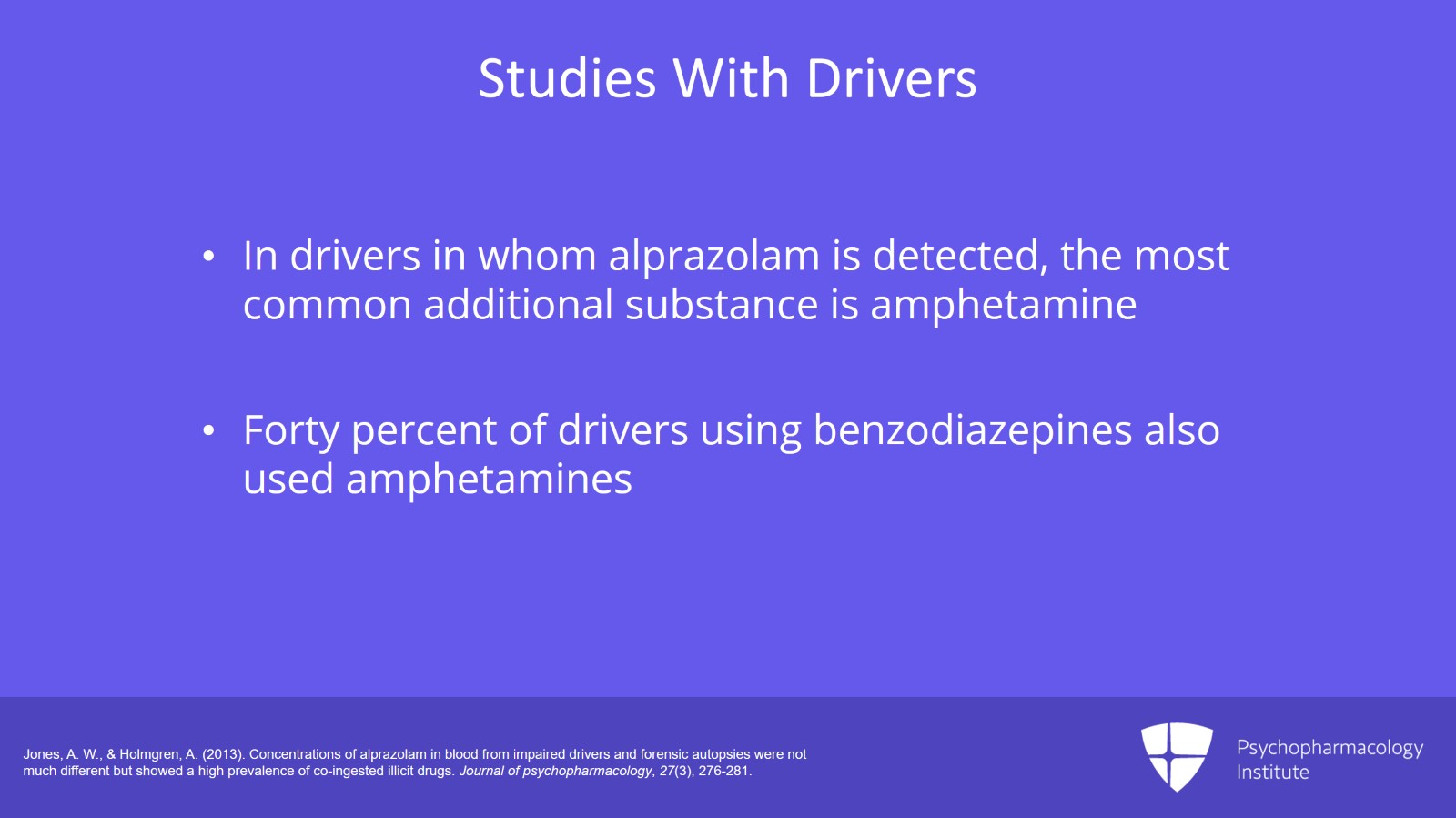
And in this one study from Sweden, they found that once alprazolam is detected in those pulled over for driving under the influence, the most common additional substance is amphetamine. Why is that? Well, if you take, say, diazepam and alprazolam, you might just fall asleep or same thing with alcohol or codeine. But if you take amphetamine and alprazolam, you’re good to go and you’re up and you’re driving and you’re likely causing, in this particular study, a much higher risk of getting pulled over for driving under the influence.
This same study was found in Finland. They noticed an increased prevalence of amphetamine-benzos. Forty percent of the drivers pulled over for using a benzo were also using amphetamine.
References:
- Jones, A. W., & Holmgren, A. (2013). Concentrations of alprazolam in blood from impaired drivers and forensic autopsies were not much different but showed a high prevalence of co-ingested illicit drugs. Journal of psychopharmacology, 27(3), 276-281.
Slide 8 of 11
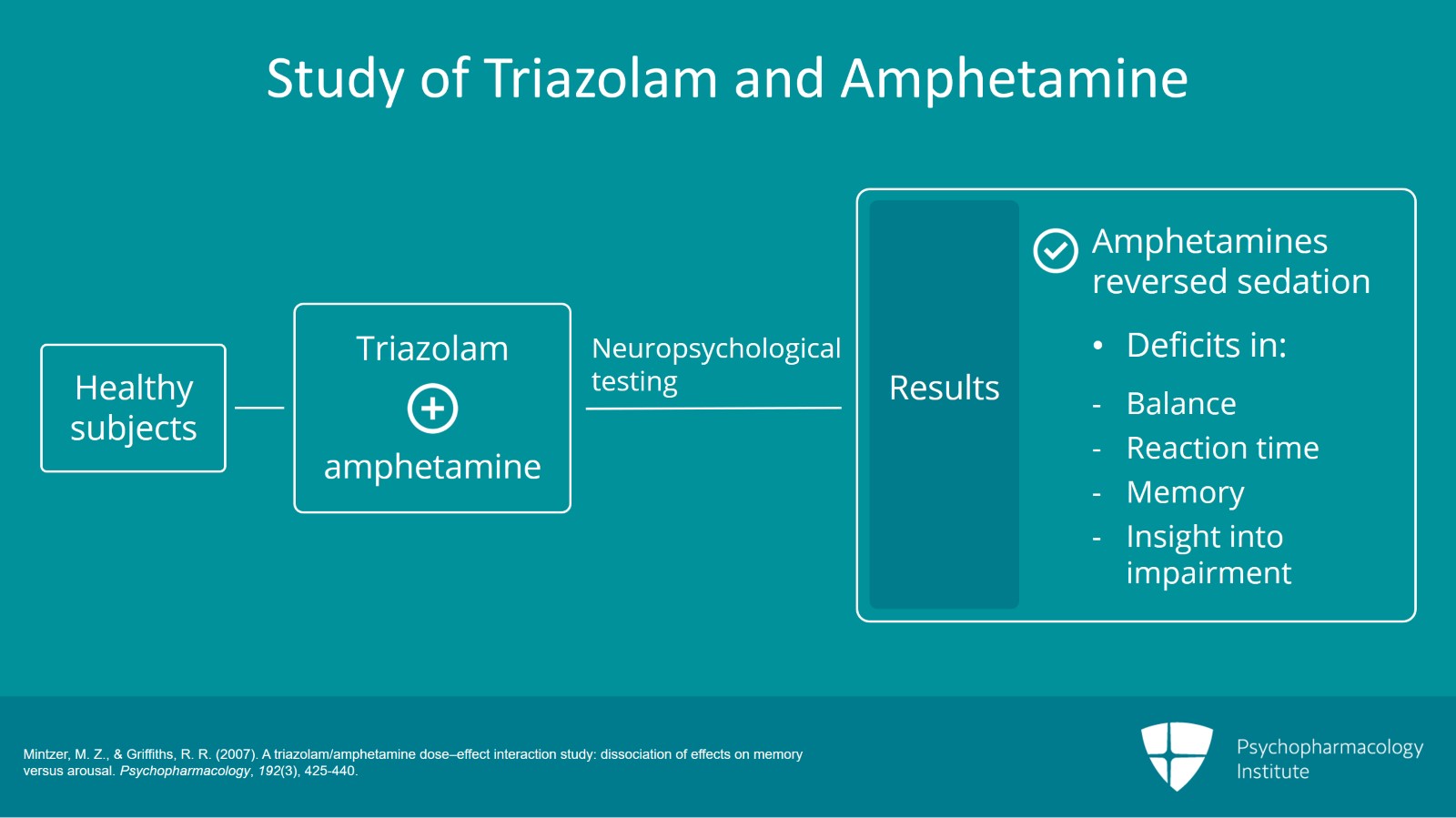
Lastly, there is one good study that compared the combination of triazolam and amphetamine in healthy subjects.
They gave them triazolam 0.25, 0.5 mg and then a collection of neuropsychological testing. Then they gave them amphetamine 20 and 30 and then they gave them the combination.
And what they found was that amphetamine relieved or reversed the sedation in triazolam but left substantial deficits in balance, in reaction time, in memory. And most importantly for this combination, it left deficits in insight to impairment. Whereas, the people on that combination thought they were good to go but in reality they had substantial deficits that they were not aware of.
References:
- Mintzer, M. Z., & Griffiths, R. R. (2007). A triazolam/amphetamine dose–effect interaction study: dissociation of effects on memory versus arousal. Psychopharmacology, 192(3), 425-440.
Free Files
Download PDF and other files
Success!
Check your inbox, we sent you all the materials there.
Slide 9 of 11
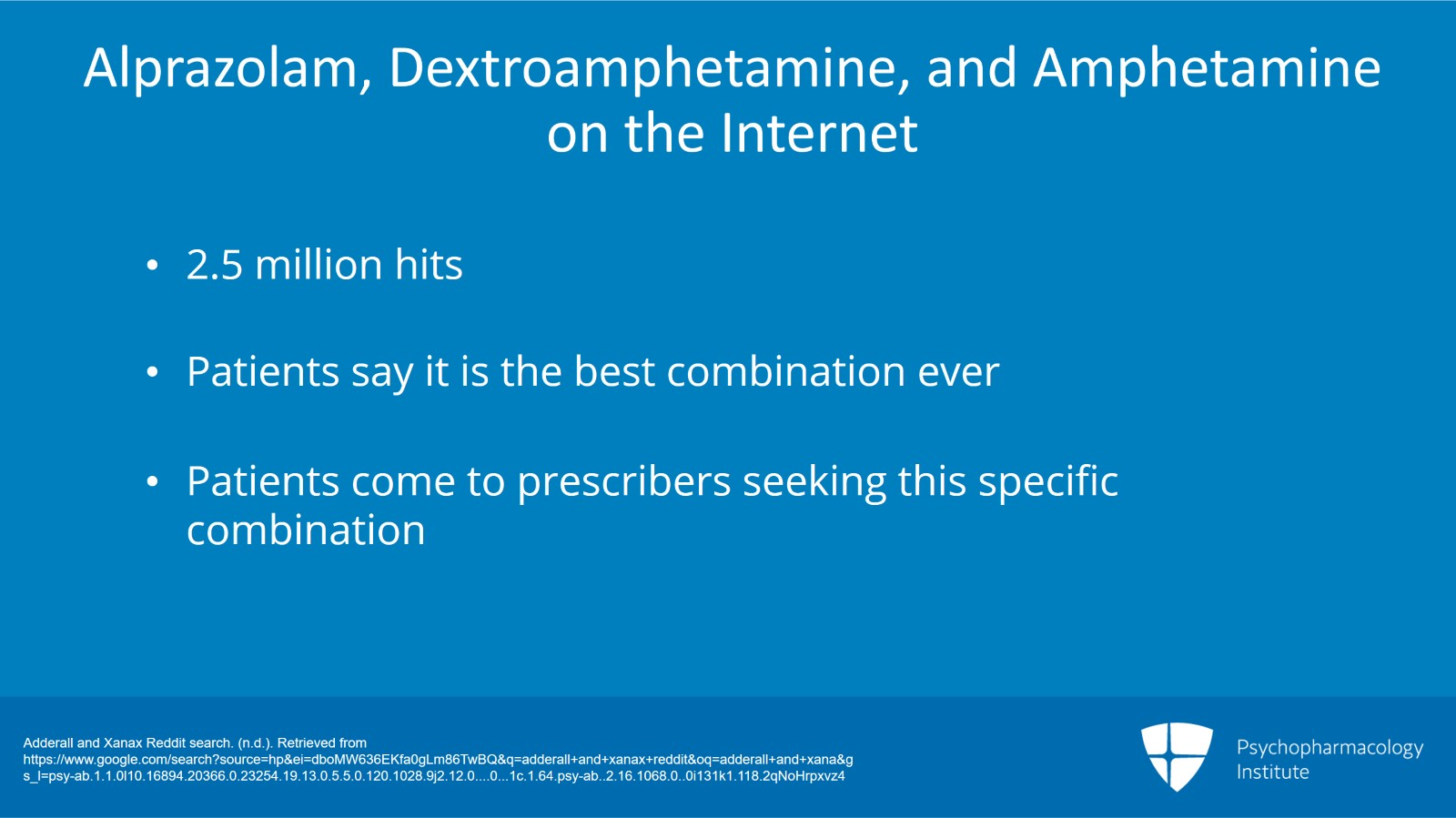
So in contrast to the clinical study showing efficacy for this combination is 2.5 million hits on Google. I don’t know if you ever Google the combinations of medications that your patients are asking for. But this dextroamphetamine, amphetamine, and alprazoma has 2.5 million hits. And a lot of them are found on Reddit in which patients say it’s the best combination ever. I plan on taking alprazolam, dextroamphetamine, and amphetamine together. How should I dose it?
And finally, this combination, literally turn into god. And this is probably why patients come to prescribers seeking this specific combination.
They’re hard to distract with other medications and often they’re looking for this combination. And in our sample, this was prescribed together more often than chance. You could say, well, they’re prescribing alprazolam because they think it’s short acting. But lorazepam and amphetamine were prescribed together significantly less often than chance.
References:
- Adderall and Xanax Reddit search. (n.d.). Retrieved from https://www.google.com/search?source=hp&ei=dboMW636EKfa0gLm86TwBQ&q=adderall+and+xanax+reddit&oq=adderall+and+xana&gs_l=psy-ab.1.1.0l10.16894.20366.0.23254.19.13.0.5.5.0.120.1028.9j2.12.0….0…1c.1.64.psy-ab..2.16.1068.0..0i131k1.118.2qNoHrpxvz4
- Zarkowski, P. (n.d.). Relative prevalence of ten types of pharmacodynamic interactions in psychiatric treatment. International Journal of Psychiatry in Medicine.
Slide 10 of 11
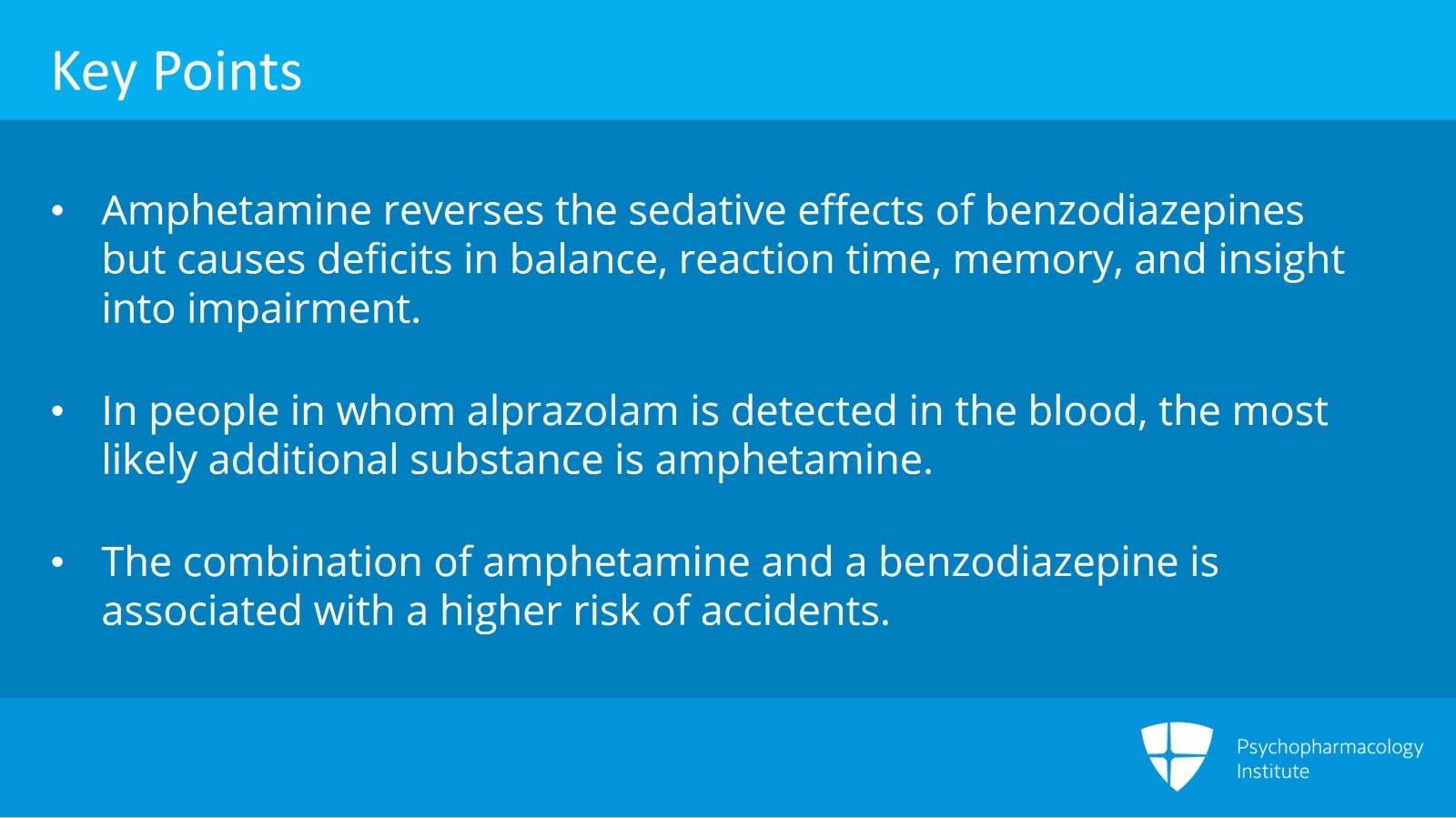
So the key points of this section are that amphetamine reverses the sedative effects of benzodiazepine but leaves substantial deficits in balance, reaction time, memory and most importantly insight to impairment.
And once alprazolam is detected in the blood of an impaired driver, the most likely additional substance is amphetamine.
And finally, this combination of amphetamine and benzos is associated with a much higher risk of accidents than any other substance alone.
Free Files
Download PDF and other files
Success!
Check your inbox, we sent you all the materials there.
Slide 11 of 11