



Slides and Transcript
Slide 1 of 16
The second section is how to diagnose and manage akathisia.
Slide 2 of 16
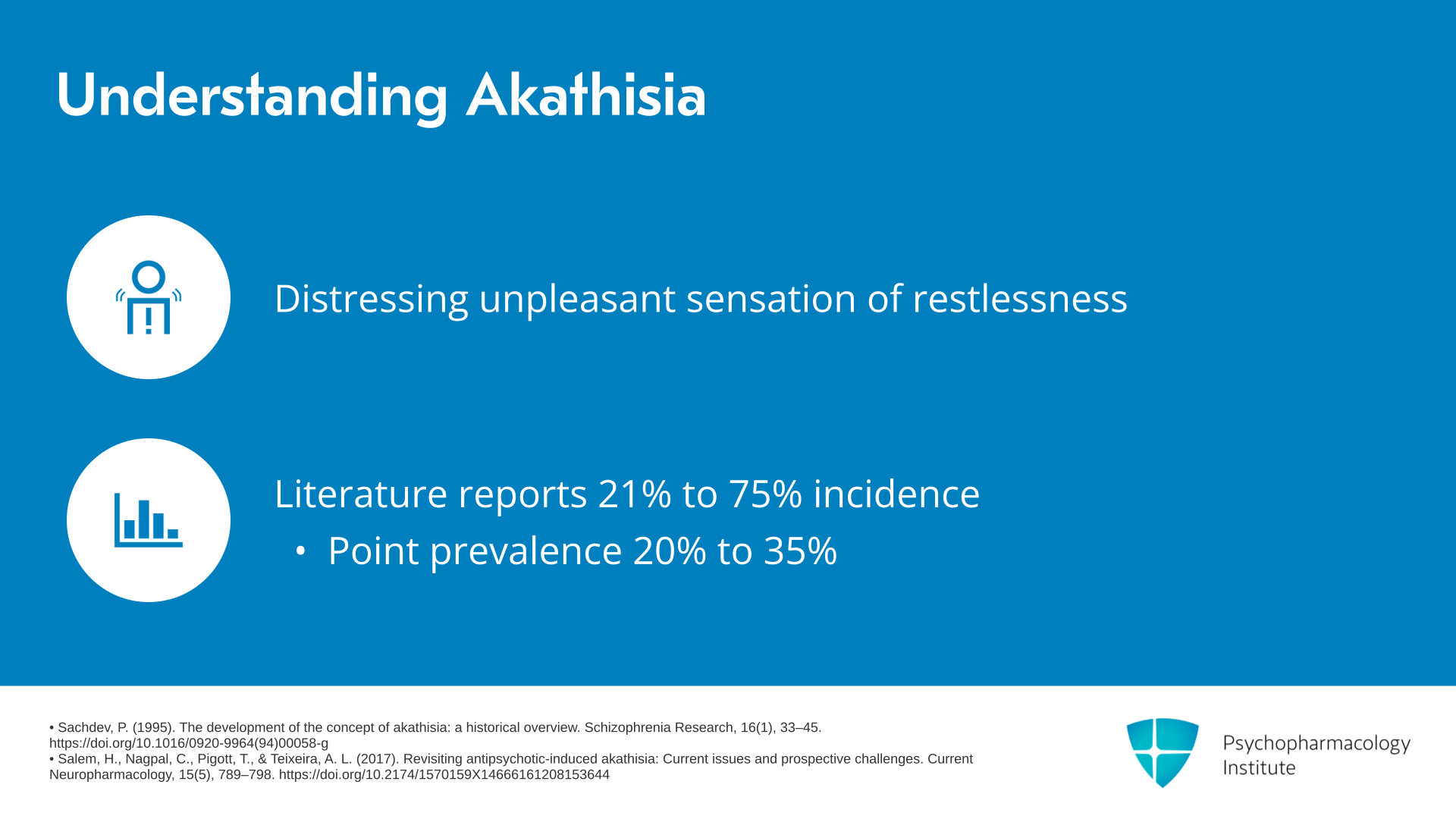
So let’s start with the etymology of the word akathisia. It’s from Ancient Greek for not to sit. It’s really a syndrome characterized by this distressing, unpleasant sensation of restlessness, and usually people have to fidget, shuffle their feet, or move around to dispel this discomfort. The reported incidence across the literature ranges from 21% to 75% of people exposed to medications associated with akathisia. The point prevalence is between 20% and 35%. So this is one of the more common drug-induced movement disorders that you’ll see in practice.
References:
- Sachdev, P. (1995). The development of the concept of akathisia: a historical overview. Schizophrenia Research, 16(1), 33–45. https://doi.org/10.1016/0920-9964(94)00058-g
- Salem, H., Nagpal, C., Pigott, T., & Teixeira, A. L. (2017). Revisiting antipsychotic-induced akathisia: Current issues and prospective challenges. Current Neuropharmacology, 15(5), 789–798. https://doi.org/10.2174/1570159X14666161208153644
Free Files
Download PDF and other files
Success!
Check your inbox, we sent you all the materials there.
Slide 3 of 16
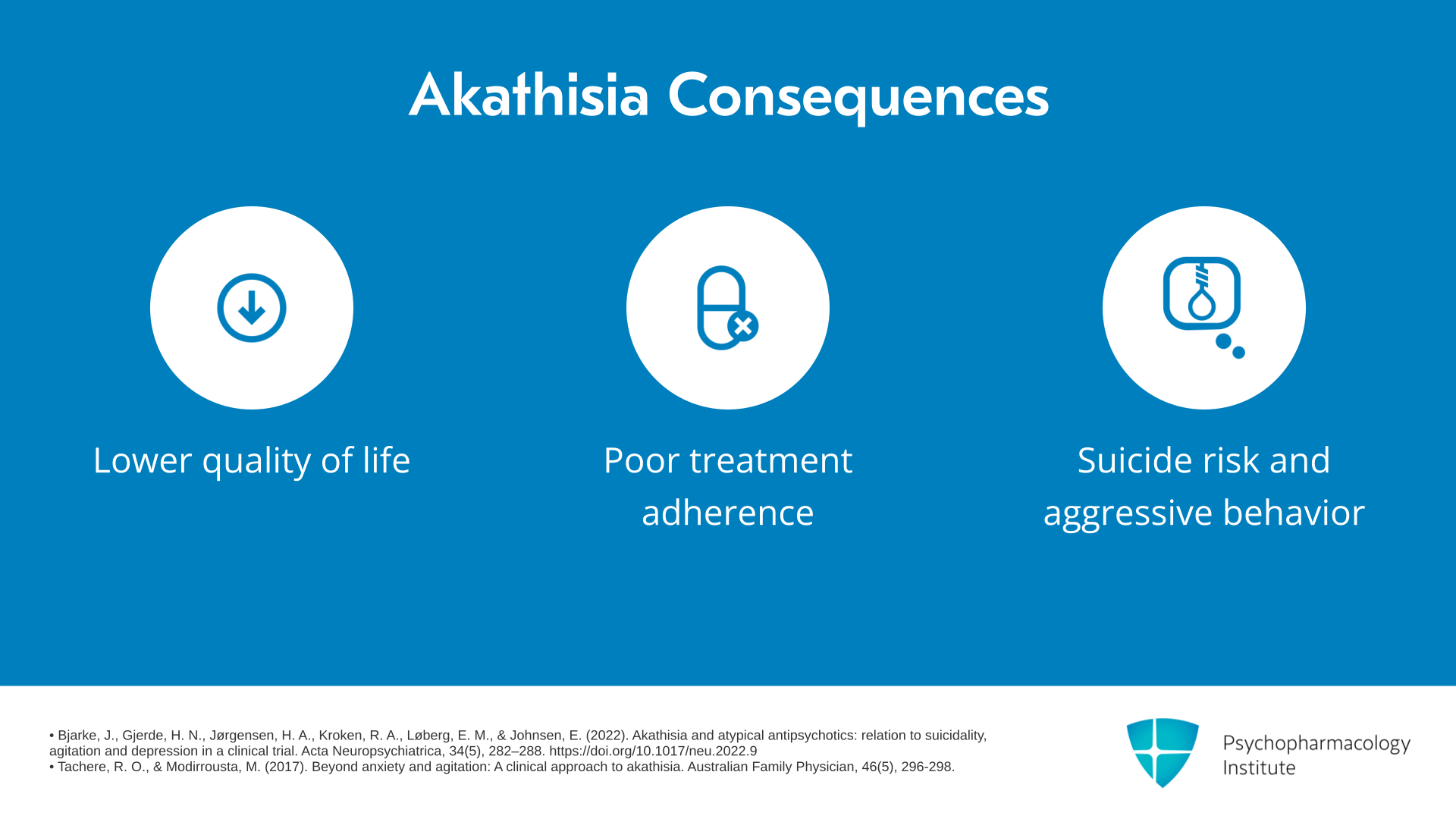
Akathisia is usually associated with a lower quality of life, and it can be a pretty common reason for non-adherence to treatment. In extreme cases, there have actually been studies that show that it’s associated with risk of suicide and aggressive behavior.
References:
- Bjarke, J., Gjerde, H. N., Jørgensen, H. A., Kroken, R. A., Løberg, E. M., & Johnsen, E. (2022). Akathisia and atypical antipsychotics: relation to suicidality, agitation and depression in a clinical trial. Acta Neuropsychiatrica, 34(5), 282–288. https://doi.org/10.1017/neu.2022.9
- Tachere, R. O., & Modirrousta, M. (2017). Beyond anxiety and agitation: A clinical approach to akathisia. Australian Family Physician, 46(5), 296-298.
Slide 4 of 16
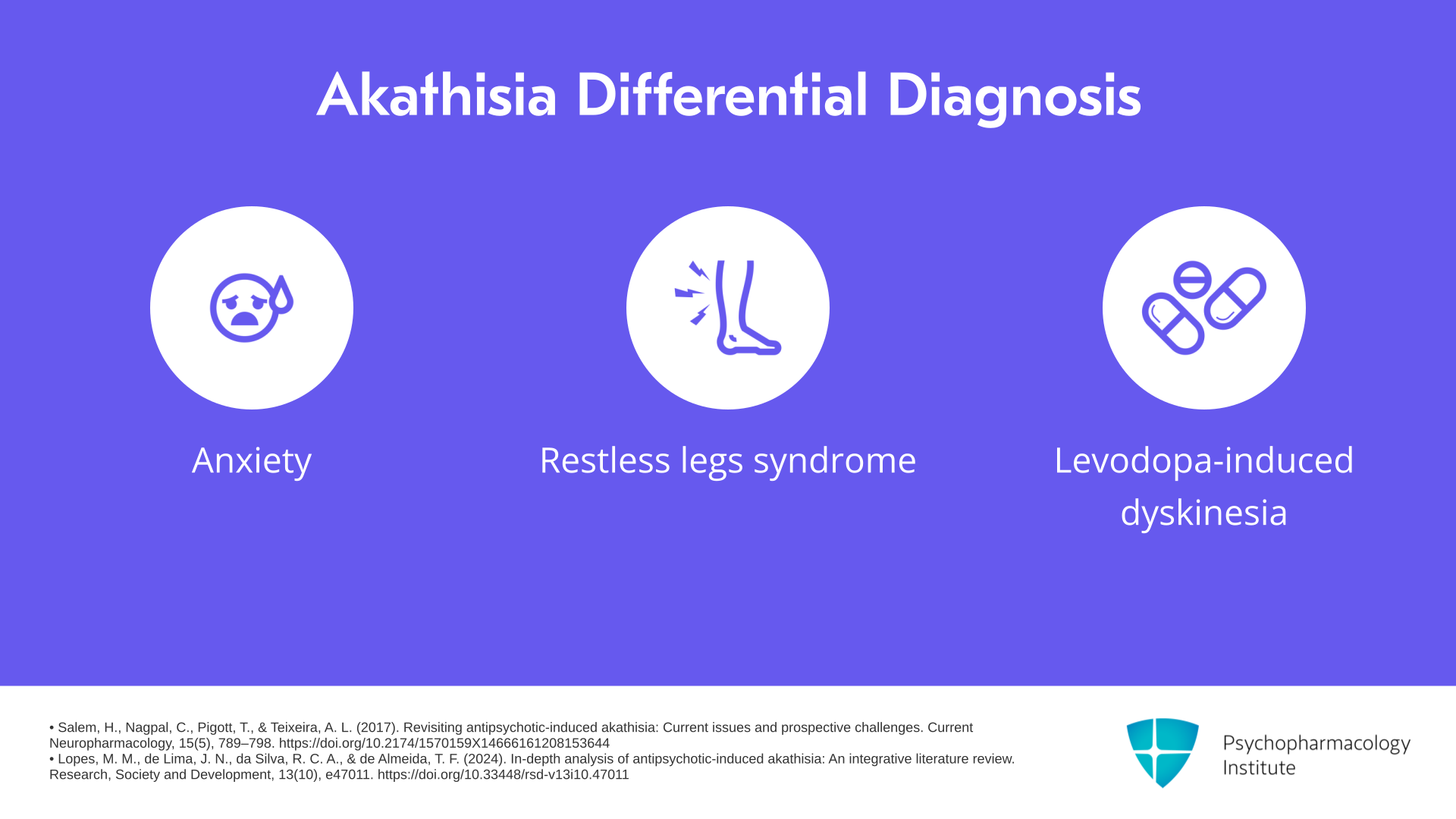
The differential diagnosis when you have akathisia includes anxiety, so people who are really anxious can have symptoms of fidgeting and restlessness that can look like akathisia; restless legs syndrome, people who are sort of pedaling their lower extremities can look like akathisia but can actually be from this different syndrome. In neurodegenerative disorders like Parkinson’s and in people who are on levodopa which is a dopamine precursor, you can see dyskinesias from exposure to that medication.
References:
- Salem, H., Nagpal, C., Pigott, T., & Teixeira, A. L. (2017). Revisiting antipsychotic-induced akathisia: Current issues and prospective challenges. Current Neuropharmacology, 15(5), 789–798. https://doi.org/10.2174/1570159X14666161208153644
- Lopes, M. M., de Lima, J. N., da Silva, R. C. A., & de Almeida, T. F. (2024). In-depth analysis of antipsychotic-induced akathisia: An integrative literature review. Research, Society and Development, 13(10), e47011. https://doi.org/10.33448/rsd-v13i10.47011
Free Files
Download PDF and other files
Success!
Check your inbox, we sent you all the materials there.
Slide 5 of 16
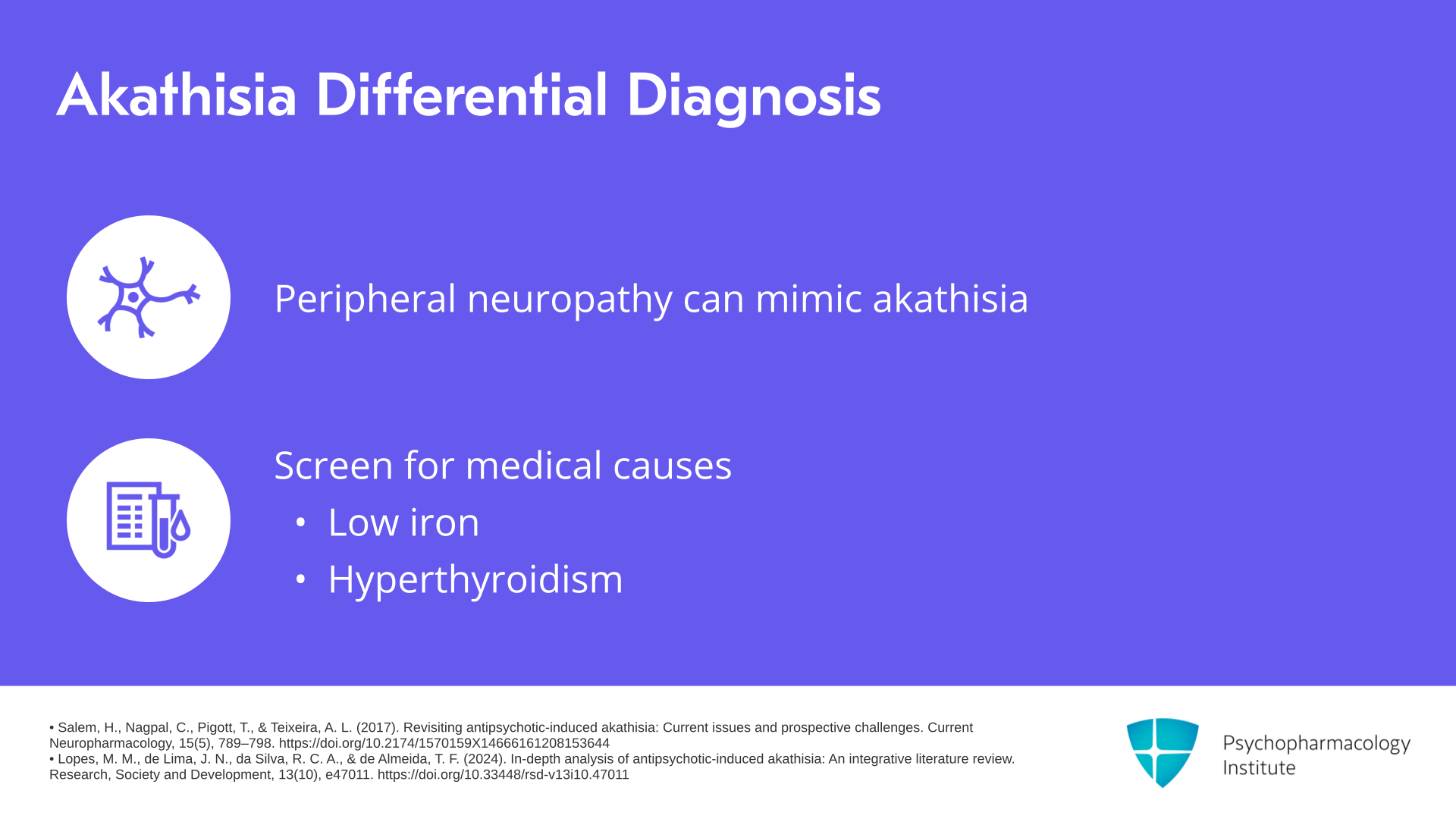
Peripheral neuropathy, sometimes the discomfort of the neuropathy will cause people to move their limbs and that can look like akathisia. Low iron is another sort of thing in the differential of akathisia. So we commonly will screen people for iron and iron binding proteins to make sure that it’s not caused by that abnormality before we go forward with treatment. Hyperthyroidism can also look like akathisia. You can be restless and fidgety. So we’ll typically take a look at thyroid stimulating hormone.
References:
- Salem, H., Nagpal, C., Pigott, T., & Teixeira, A. L. (2017). Revisiting antipsychotic-induced akathisia: Current issues and prospective challenges. Current Neuropharmacology, 15(5), 789–798. https://doi.org/10.2174/1570159X14666161208153644
- Lopes, M. M., de Lima, J. N., da Silva, R. C. A., & de Almeida, T. F. (2024). In-depth analysis of antipsychotic-induced akathisia: An integrative literature review. Research, Society and Development, 13(10), e47011. https://doi.org/10.33448/rsd-v13i10.47011
Slide 6 of 16
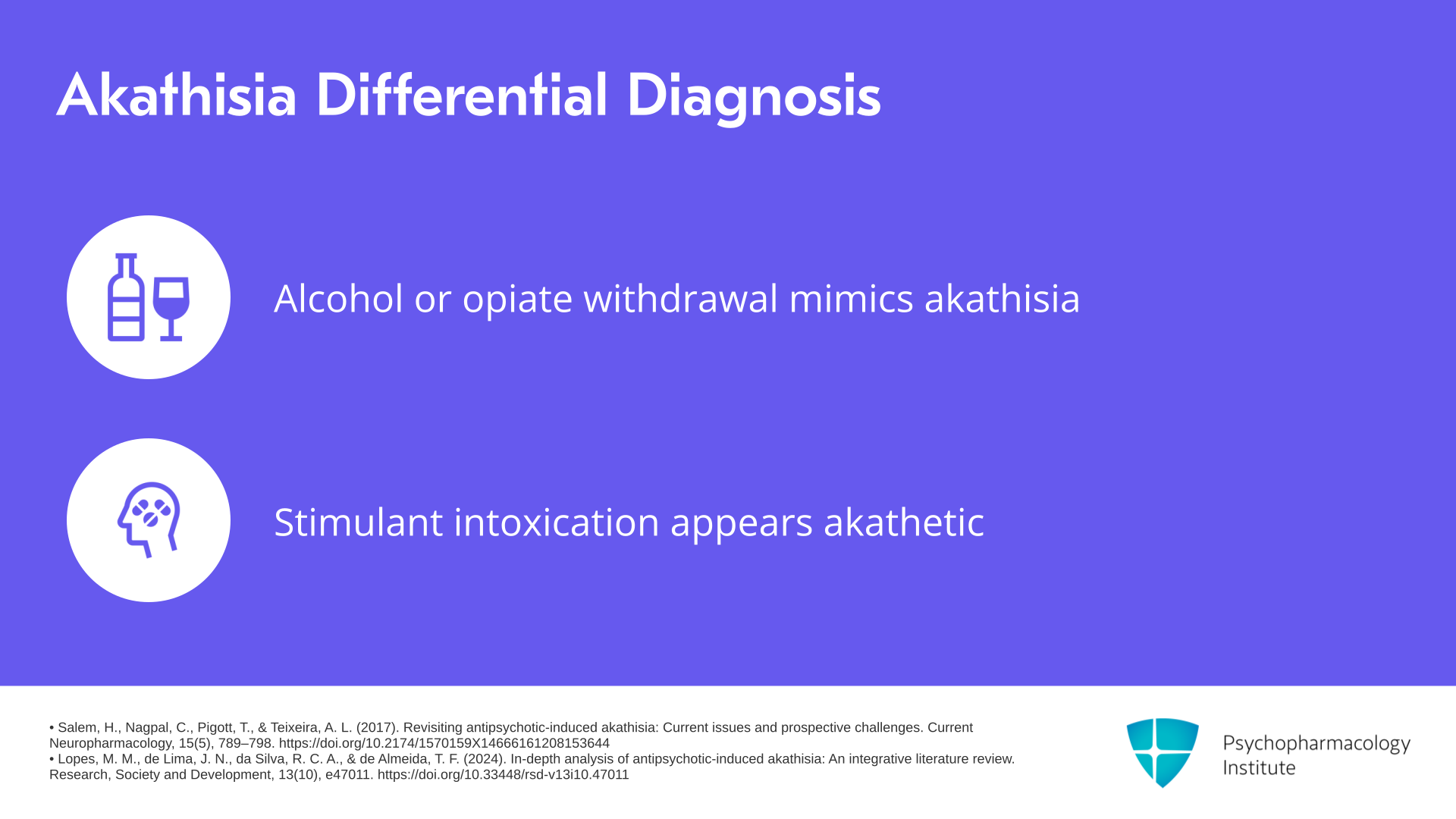
Alcohol or opiate withdrawal, acute withdrawal especially can look like akathisia. People will be restless and uncomfortable. And then stimulant intoxication, so while actively intoxicated from stimulants, people will often appear to be akathetic.
References:
- Salem, H., Nagpal, C., Pigott, T., & Teixeira, A. L. (2017). Revisiting antipsychotic-induced akathisia: Current issues and prospective challenges. Current Neuropharmacology, 15(5), 789–798. https://doi.org/10.2174/1570159X14666161208153644
- Lopes, M. M., de Lima, J. N., da Silva, R. C. A., & de Almeida, T. F. (2024). In-depth analysis of antipsychotic-induced akathisia: An integrative literature review. Research, Society and Development, 13(10), e47011. https://doi.org/10.33448/rsd-v13i10.47011
Free Files
Download PDF and other files
Success!
Check your inbox, we sent you all the materials there.
Slide 7 of 16
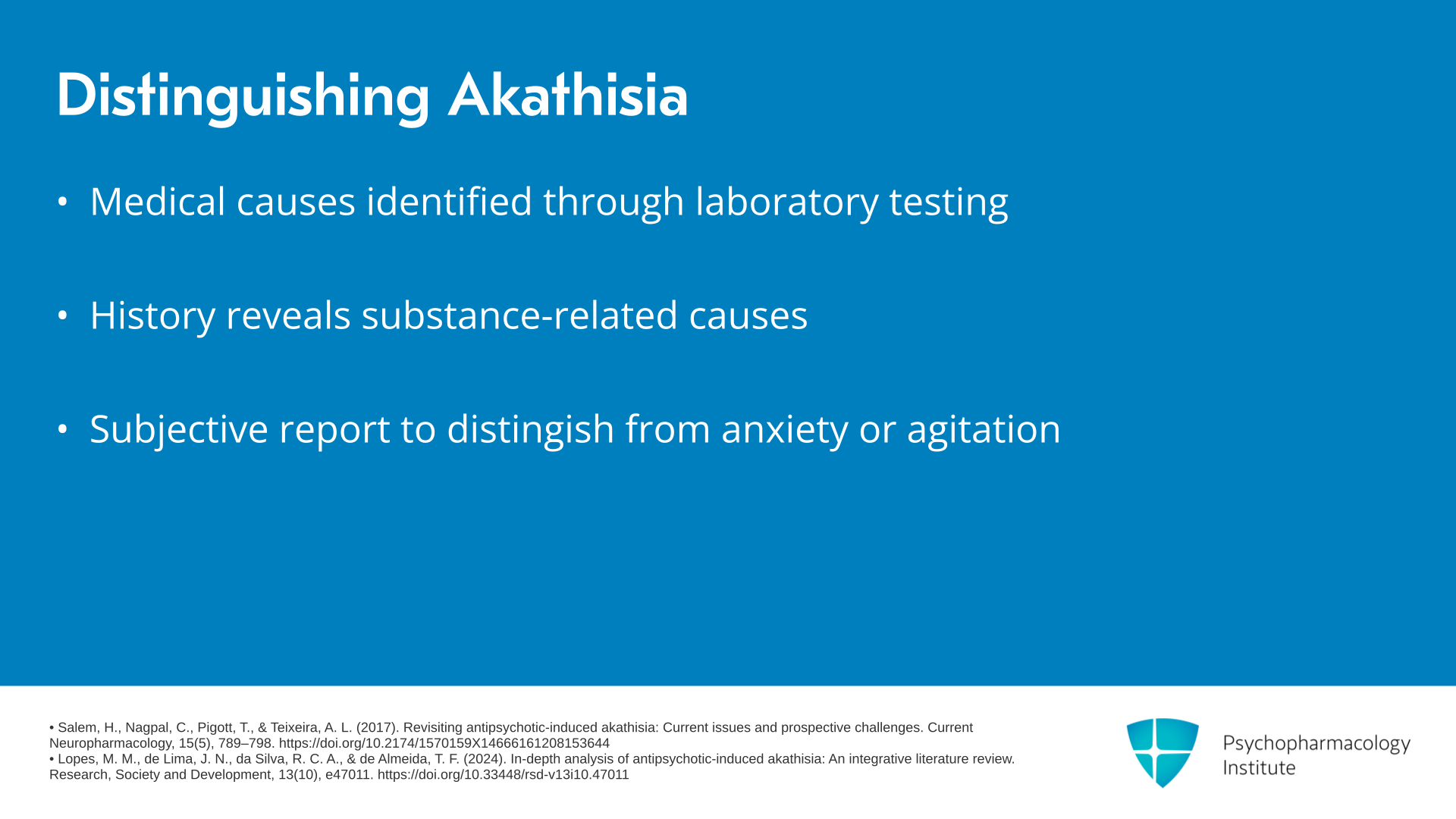
So how do you distinguish things in the differential of akathisia from one another? Well, I mentioned that there are some things like low iron that you can simply do a blood test and thyroid problems, and the history will tell you whether or not someone’s been on a stimulant or is withdrawing from alcohol or opiates. But to distinguish akathisia from anxiety or agitation, you really have to rely on their subjective report of the inner sensation or compulsion to move. So it can be a little tricky but again once you know the differential, you can ask questions that can help you differentiate between a drug-induced akathisia and things that may look like akathisia.
References:
- Salem, H., Nagpal, C., Pigott, T., & Teixeira, A. L. (2017). Revisiting antipsychotic-induced akathisia: Current issues and prospective challenges. Current Neuropharmacology, 15(5), 789–798. https://doi.org/10.2174/1570159X14666161208153644
- Lopes, M. M., de Lima, J. N., da Silva, R. C. A., & de Almeida, T. F. (2024). In-depth analysis of antipsychotic-induced akathisia: An integrative literature review. Research, Society and Development, 13(10), e47011. https://doi.org/10.33448/rsd-v13i10.47011
Slide 8 of 16
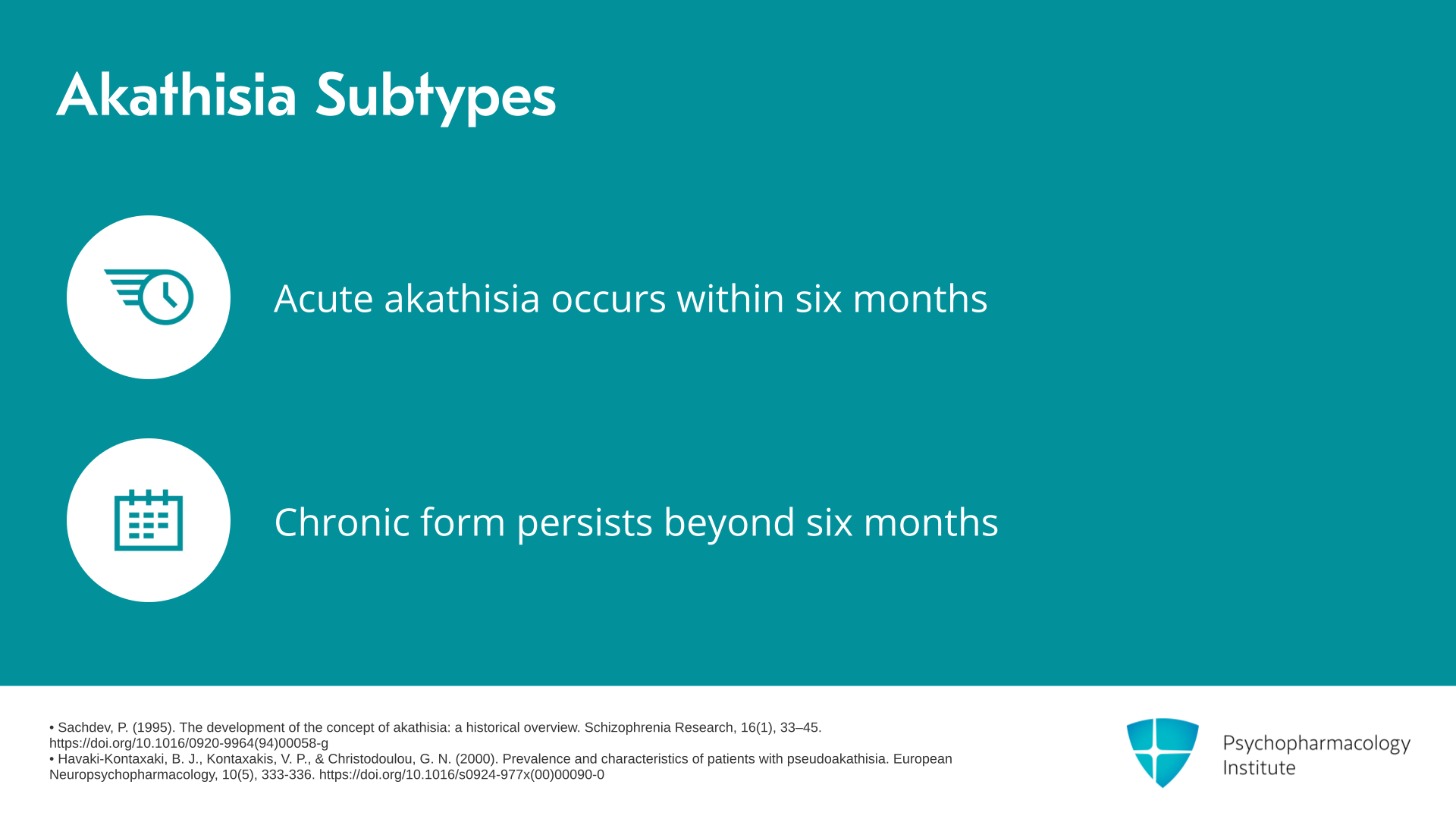
Now, even within the syndrome of akathisia, there are different subtypes. One is acute akathisia, and this is when the akathisia occurs within six months of exposure to the medication. So any time up to six months, we sort of call that acute akathisia. Chronic akathisia is if it persists for more than six months after the last dosage increment.
References:
- Sachdev, P. (1995). The development of the concept of akathisia: a historical overview. Schizophrenia Research, 16(1), 33–45. https://doi.org/10.1016/0920-9964(94)00058-g
- Havaki-Kontaxaki, B. J., Kontaxakis, V. P., & Christodoulou, G. N. (2000). Prevalence and characteristics of patients with pseudoakathisia. European Neuropsychopharmacology, 10(5), 333-336. https://doi.org/10.1016/s0924-977x(00)00090-0
Free Files
Download PDF and other files
Success!
Check your inbox, we sent you all the materials there.
Slide 9 of 16
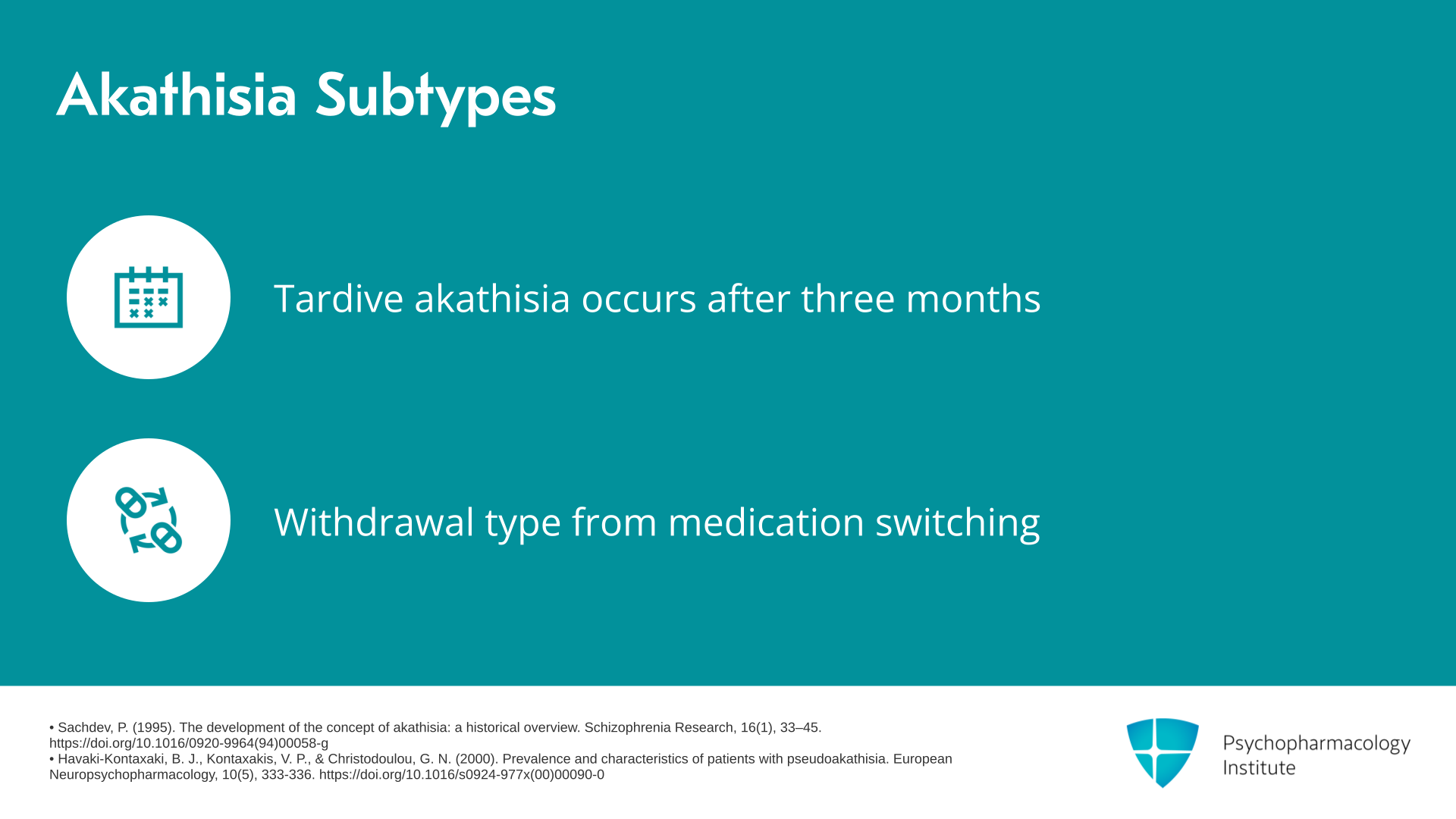
And then tardive akathisia, tardive just means delayed so you’ll hear that term used across these movement disorders, is when the delay of onset is about three months. That’s the average, not related to dose change. And then occasionally, not as often as the others, we’ll see withdrawal akathisia which is associated with switching antipsychotics or withdrawing the anticholinergics that we use sometimes along with antipsychotics. All of these can produce akathisia, and we talk about the subtype of akathisia based on these parameters.
References:
- Sachdev, P. (1995). The development of the concept of akathisia: a historical overview. Schizophrenia Research, 16(1), 33–45. https://doi.org/10.1016/0920-9964(94)00058-g
- Havaki-Kontaxaki, B. J., Kontaxakis, V. P., & Christodoulou, G. N. (2000). Prevalence and characteristics of patients with pseudoakathisia. European Neuropsychopharmacology, 10(5), 333-336. https://doi.org/10.1016/s0924-977x(00)00090-0
Slide 10 of 16
There’s even a controversial condition called pseudoakathisia, where the movement phenomenology of restless pacing and fidgeting, but the patient when asked will deny awareness of the feeling of discomfort. So usually in classic akathisia, the patient will say, I feel like I have to move, I feel restless, I feel uncomfortable and then I move to dissipate that feeling. In pseudoakathisia, the patient says that they’re not aware of any feeling of discomfort.
References:
- Salem, H., Nagpal, C., Pigott, T., & Teixeira, A. L. (2017). Revisiting antipsychotic-induced akathisia: Current issues and prospective challenges. Current Neuropharmacology, 15(5), 789–798. https://doi.org/10.2174/1570159X14666161208153644
- Havaki-Kontaxaki, B. J., Kontaxakis, V. P., & Christodoulou, G. N. (2000). Prevalence and characteristics of patients with pseudoakathisia. European Neuropsychopharmacology, 10(5), 333-336. https://doi.org/10.1016/s0924-977x(00)00090-0
Free Files
Download PDF and other files
Success!
Check your inbox, we sent you all the materials there.
Slide 11 of 16
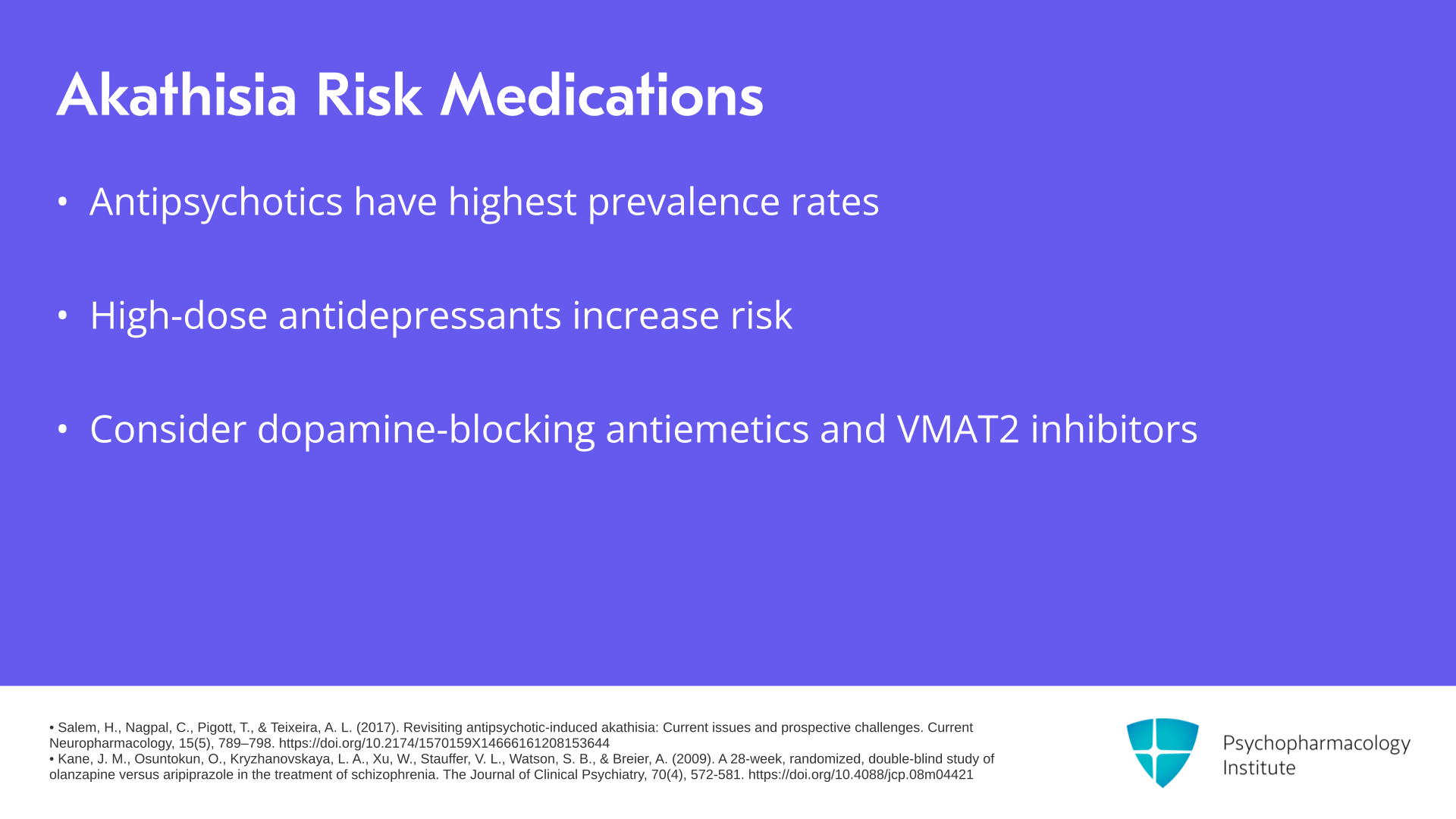
What are some of the medications associated with akathisia? Well, probably the highest prevalence of akathisia comes from typical and atypical antipsychotics. So anything that’s blockading the dopamine receptor can cause this. Antidepressants especially in high doses. Dopamine-blocking antiemetics are another class of medications and again through a mechanism of dopamine blockade. Reserpine, alpha-methyldopa, lithium, calcium channel blockers and then any of these new VMAT2 inhibitors could potentially cause akathisia, but we especially see it in the first-generation tetrabenazine VMAT2 inhibitor. So have an awareness of this list when you see the syndrome of akathisia in patients because these are likely the culprit.
References:
- Salem, H., Nagpal, C., Pigott, T., & Teixeira, A. L. (2017). Revisiting antipsychotic-induced akathisia: Current issues and prospective challenges. Current Neuropharmacology, 15(5), 789–798. https://doi.org/10.2174/1570159X14666161208153644
- Kane, J. M., Osuntokun, O., Kryzhanovskaya, L. A., Xu, W., Stauffer, V. L., Watson, S. B., & Breier, A. (2009). A 28-week, randomized, double-blind study of olanzapine versus aripiprazole in the treatment of schizophrenia. The Journal of Clinical Psychiatry, 70(4), 572-581. https://doi.org/10.4088/jcp.08m04421
Slide 12 of 16
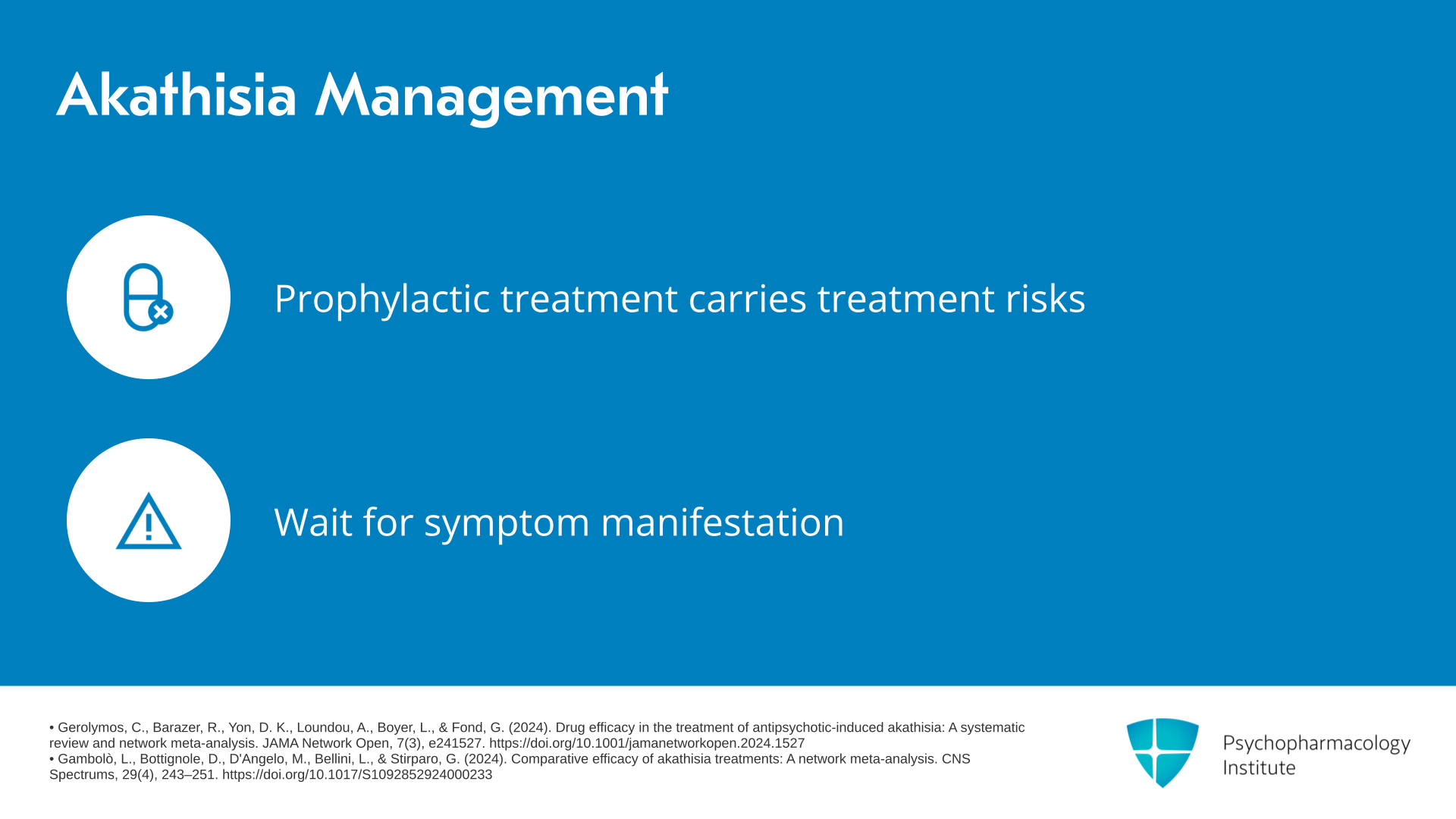
Now, even though akathisia can decrease quality of life and has these associations with other adverse outcomes, we don’t necessarily recommend prophylactic treatment because it has the risk of side effects from the treatment of akathisia and polypharmacy. And so usually, we don’t treat akathisia until it manifests. So even if you’re putting someone on one of these drugs that’s known to cause akathisia a third of the time, let’s take the high estimate, we don’t recommend prophylactically treating for akathisia.
References:
- Gerolymos, C., Barazer, R., Yon, D. K., Loundou, A., Boyer, L., & Fond, G. (2024). Drug efficacy in the treatment of antipsychotic-induced akathisia: A systematic review and network meta-analysis. JAMA Network Open, 7(3), e241527. https://doi.org/10.1001/jamanetworkopen.2024.1527
- Gambolò, L., Bottignole, D., D'Angelo, M., Bellini, L., & Stirparo, G. (2024). Comparative efficacy of akathisia treatments: A network meta-analysis. CNS Spectrums, 29(4), 243–251. https://doi.org/10.1017/S1092852924000233
Free Files
Download PDF and other files
Success!
Check your inbox, we sent you all the materials there.
Slide 13 of 16
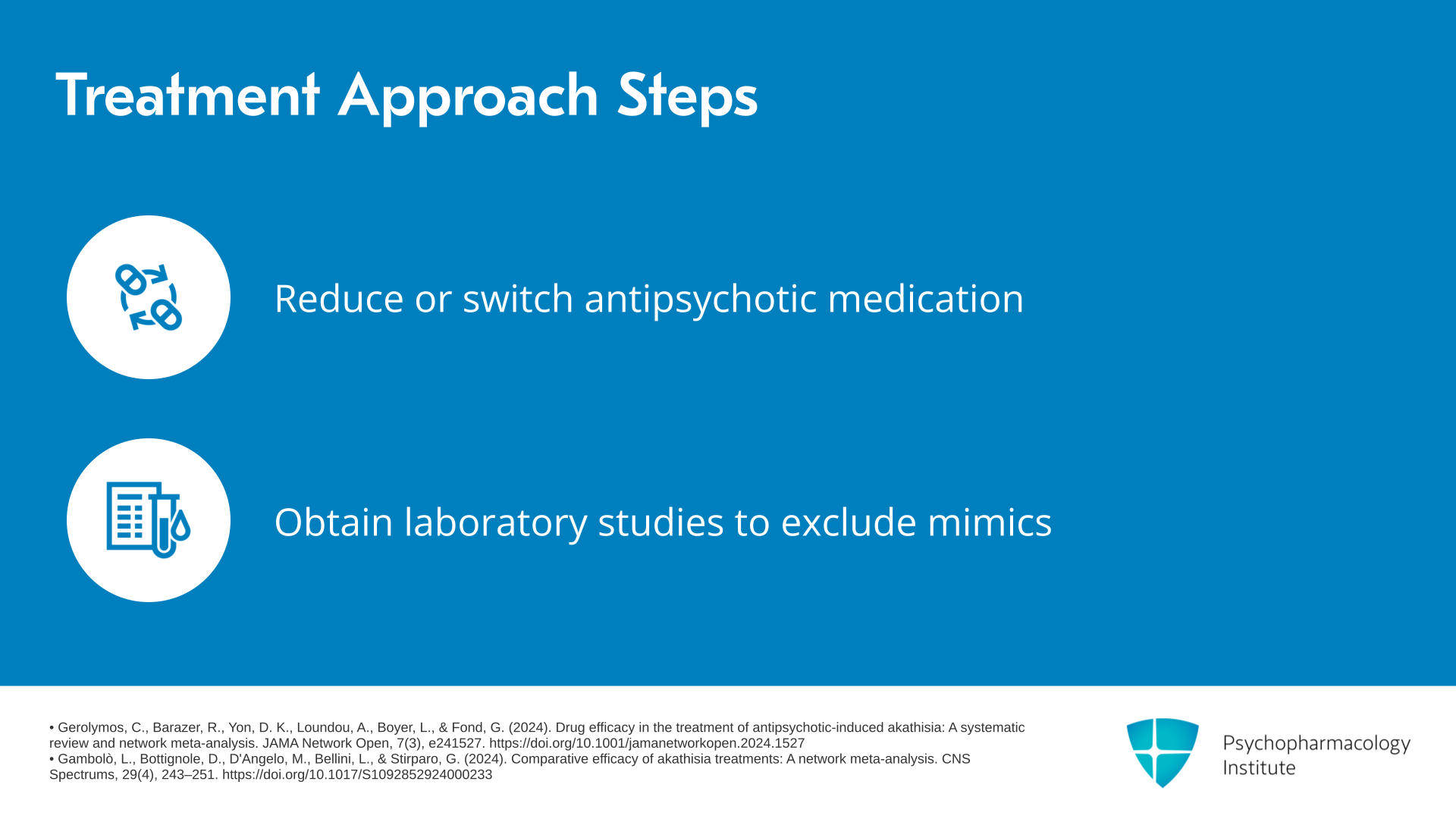
How would you go about treating akathisia? What would be your algorithm? First, if you can without compromising care, the efficacy for which you started the medication in the first place, you can lower the associated medication. So if they’re on an antipsychotic and they’ve been doing well, you can have a trial reduction to see if that helps. You can switch to an antipsychotic with a lower liability. For instance, first-generation antipsychotics are on average more likely to cause akathisia than second-generation. So you could simply try switching from a first-generation like Haldol to a second-generation like olanzapine, for instance, and see if that helps. Check for iron deficiency. As I mentioned, there are certain things that can masquerade as akathisia. So, getting blood work for iron deficiency, thyroid abnormalities at a minimum is a good idea.
References:
- Gerolymos, C., Barazer, R., Yon, D. K., Loundou, A., Boyer, L., & Fond, G. (2024). Drug efficacy in the treatment of antipsychotic-induced akathisia: A systematic review and network meta-analysis. JAMA Network Open, 7(3), e241527. https://doi.org/10.1001/jamanetworkopen.2024.1527
- Gambolò, L., Bottignole, D., D'Angelo, M., Bellini, L., & Stirparo, G. (2024). Comparative efficacy of akathisia treatments: A network meta-analysis. CNS Spectrums, 29(4), 243–251. https://doi.org/10.1017/S1092852924000233
Slide 14 of 16
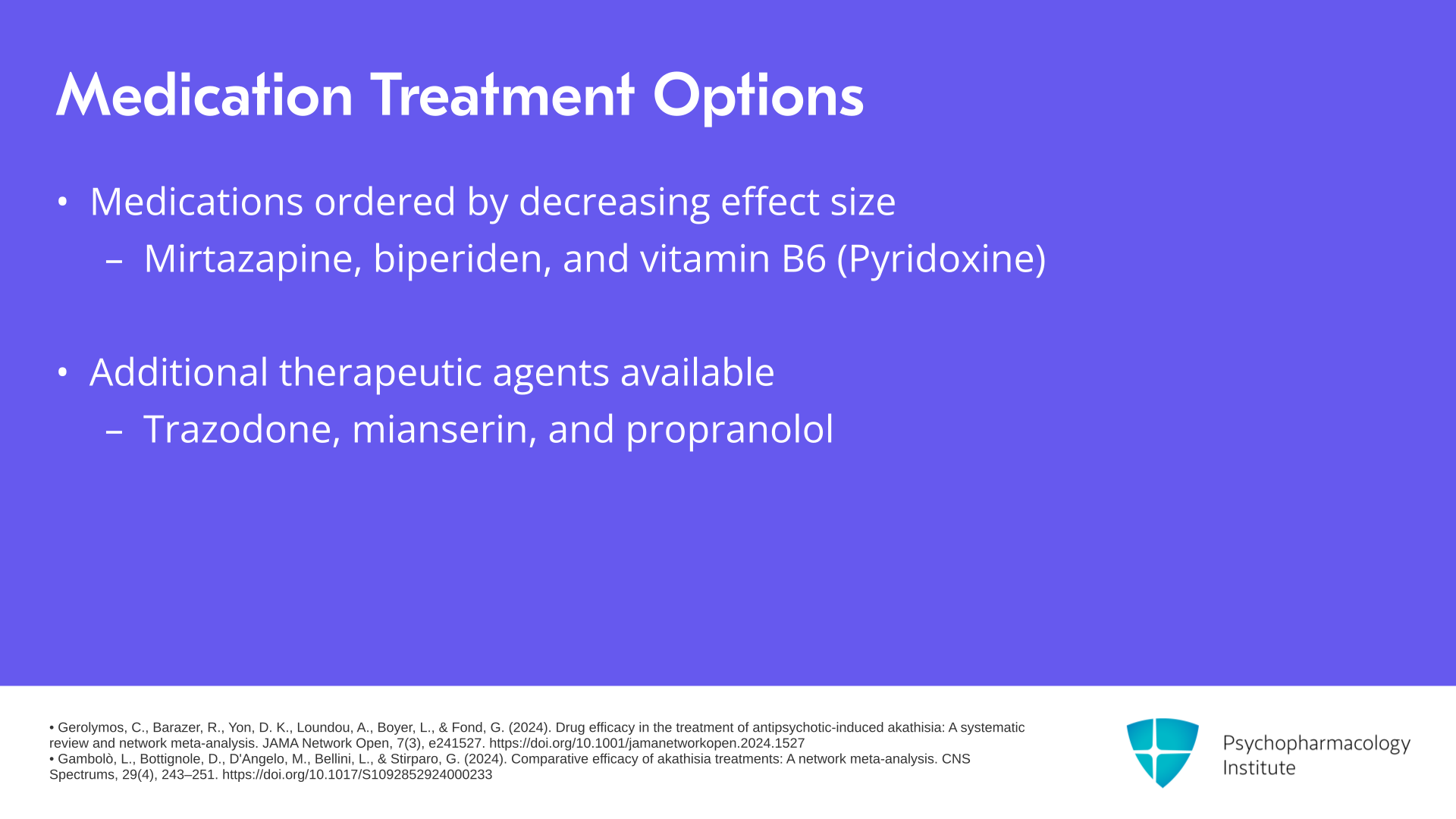
Now, you’ve done these three things and you still have the problem, or you weren’t able to lower the medication because the primary symptom was too severe. Then you need to treat with medications. And what medications are helpful? I’m going to give you a list in order of decreasing effect size or impact on akathisia. So mirtazapine has good evidence and a good effect size. Biperiden is another one that’s good. Vitamin B6 or pyridoxine is the other name for that one. Trazodone, mianserin and propranolol.
References:
- Gerolymos, C., Barazer, R., Yon, D. K., Loundou, A., Boyer, L., & Fond, G. (2024). Drug efficacy in the treatment of antipsychotic-induced akathisia: A systematic review and network meta-analysis. JAMA Network Open, 7(3), e241527. https://doi.org/10.1001/jamanetworkopen.2024.1527
- Gambolò, L., Bottignole, D., D'Angelo, M., Bellini, L., & Stirparo, G. (2024). Comparative efficacy of akathisia treatments: A network meta-analysis. CNS Spectrums, 29(4), 243–251. https://doi.org/10.1017/S1092852924000233
Free Files
Download PDF and other files
Success!
Check your inbox, we sent you all the materials there.
Slide 15 of 16
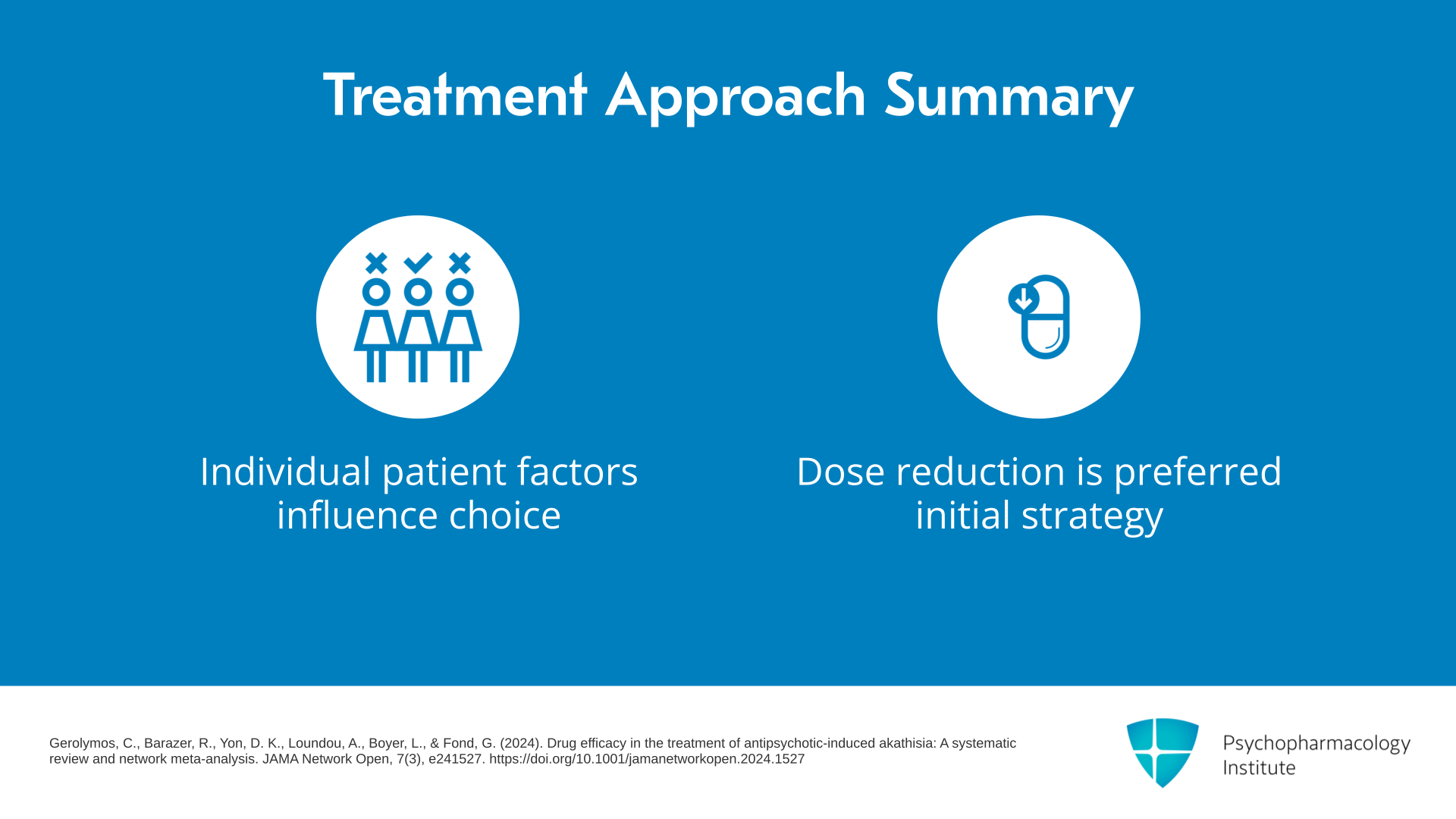
And so typically, that’s by effect size, individual patients may tolerate some of these better than others or have contraindications. And so this is just based on demonstrated effect size. And this comes from a meta-analysis that was conducted in 2024. So depending on the acuity of the clinical illness, treatment of akathisia should really start with that dose reduction. And like I said, sometimes, this is going to be possible and other times it’s not.
References:
- Gerolymos, C., Barazer, R., Yon, D. K., Loundou, A., Boyer, L., & Fond, G. (2024). Drug efficacy in the treatment of antipsychotic-induced akathisia: A systematic review and network meta-analysis. JAMA Network Open, 7(3), e241527. https://doi.org/10.1001/jamanetworkopen.2024.1527
Slide 16 of 16
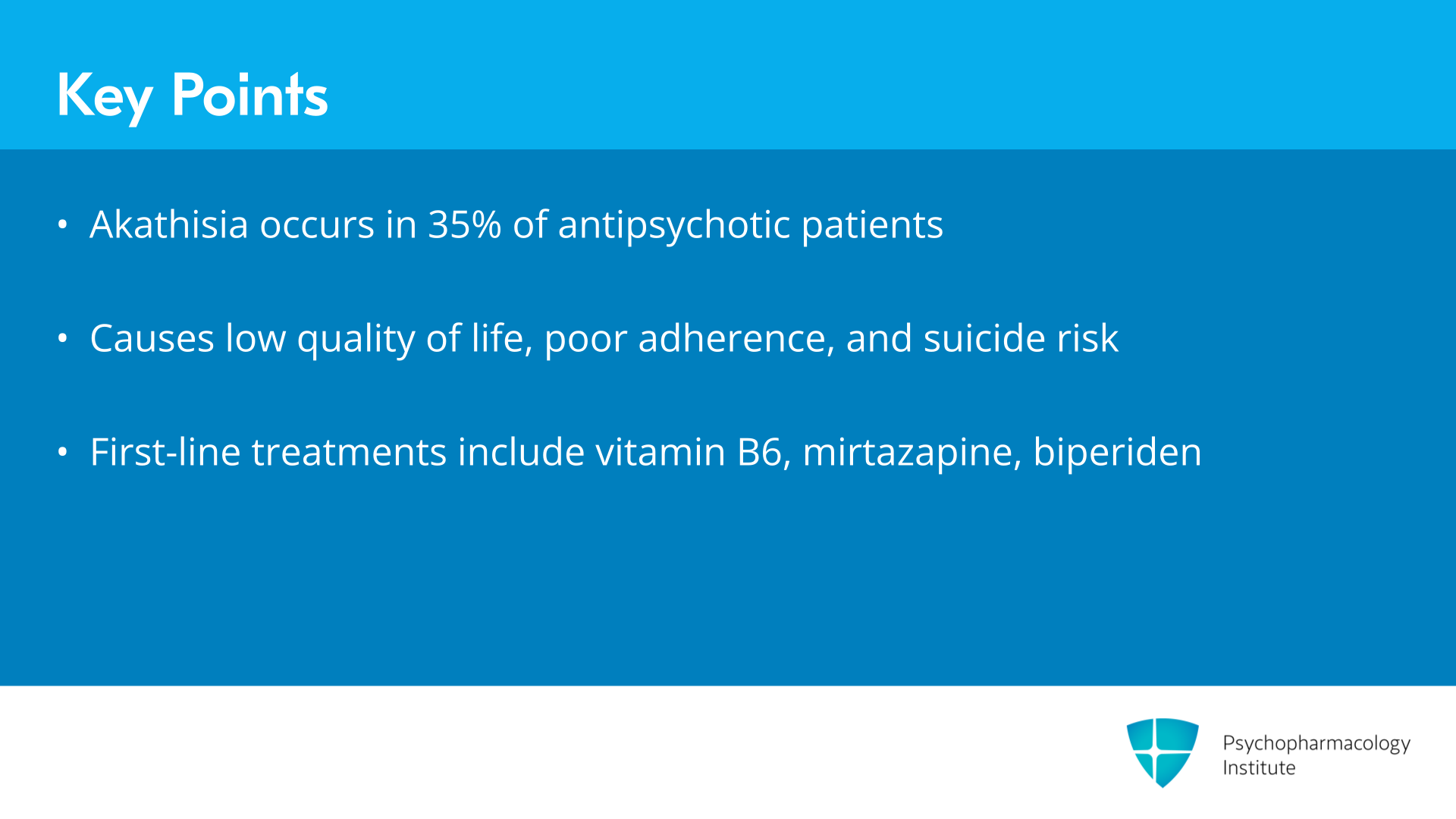
Now, the key points for this section, I think that it’s important to know that akathisia occurs in up to 35% of patients taking antipsychotics and certain other types of medications. So this is something you’re going to see very commonly, in about a third of your patients. Akathisia is associated with a lower quality of life with treatment discontinuation or non-adherence and an increased risk of suicide and aggressive behaviors. First-line treatments for akathisia include vitamin B6, mirtazapine and biperiden.
Free Files
Download PDF and other files
Success!
Check your inbox, we sent you all the materials there.
