



Slides and Transcript
Slide 1 of 12
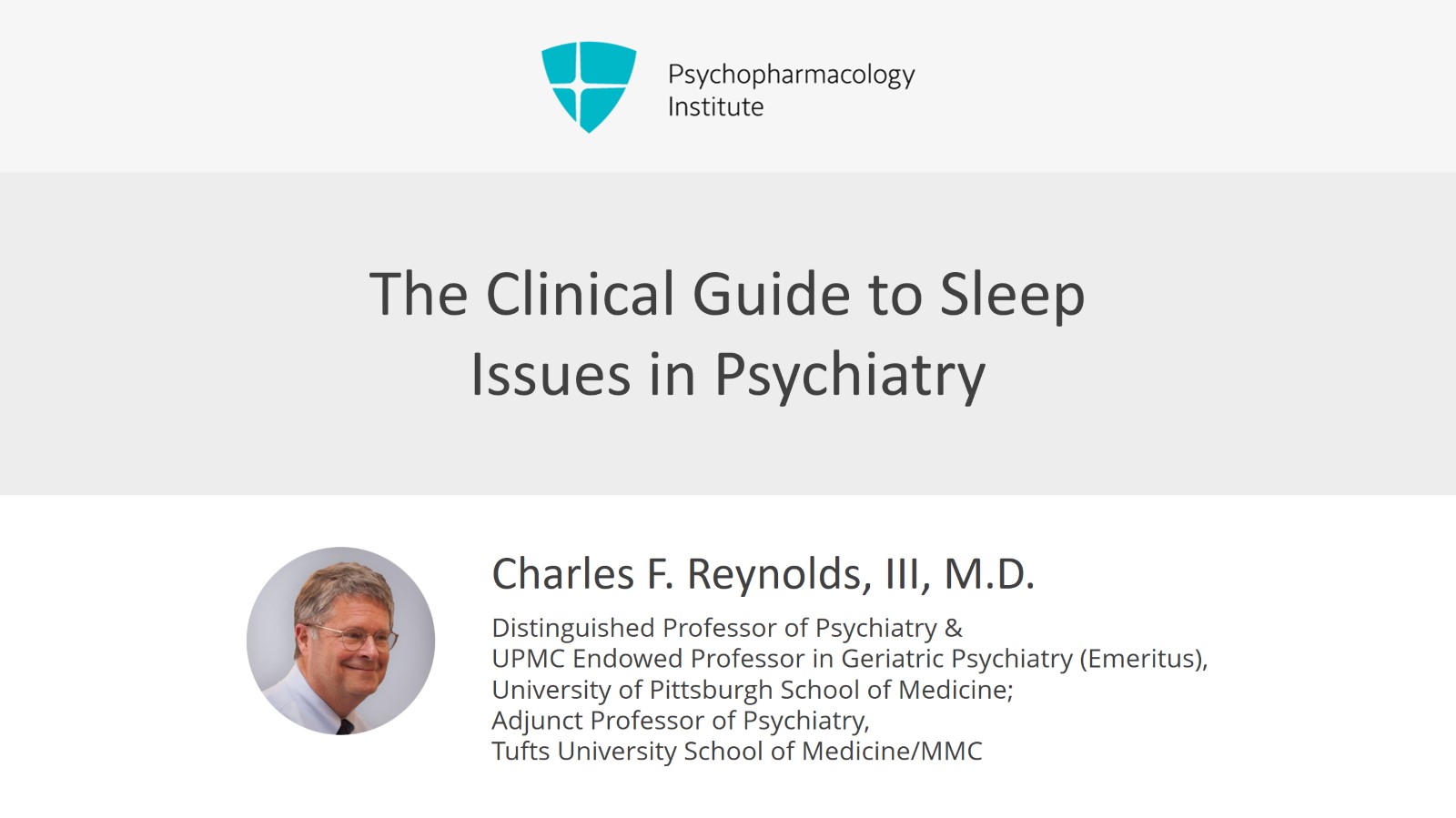
Thank you, colleagues. This is Charles F. Reynolds III. I am a professor of Psychiatry at the University of Pittsburgh School of Medicine and have previously served as the chair of the DSM-5 work group on sleep-wake disorders. I'm pleased to be with you today to walk you through a clinical and pragmatic guide to sleep issues that occur in the practice of Psychiatry. The fundamental point that I would like to make and that really provides an overarching theme for my talk today is that there is a bidirectional relationship between sleep disturbances and mental disorders like depression and psychotic disorders. Sleep disturbances represent an important risk factor for both the onset and recurrence of episodes of mental disorders like depression as well as of course being a symptomatic expression of those disorders. Continued sleep disturbance during the treatment of a psychiatric disorder may presage a relapsing and chronic course. For this reason, it's very important for practicing clinicians to pay attention to the quality of their patient's sleep and to place sleep within a 24-hour or circadian understanding of sleep-wake quality in general. Very often, we find that to put the odds in our patient's favor it's necessary both to treat the psychiatric disorder and co-occurring sleep-wake disorders that may well require different or independent approaches to management. So our overall objectives for this lecture then are to understand something about the sleep and circadian rhythm changes that occur with age. We'll identify the underlying causes of insomnia and their differential diagnoses from other sleep-wake disorders. And we'll discuss evidence-based and evidence-informed pharmacologic and nonpharmacologic treatment approaches to insomnia and its related sleep-wake disorders. I think that this will provide a good basis for shared decision making between clinicians on the one hand and patients and family caregivers on the other.
Slide 2 of 12
Let's now consider the case of Chip. He's not an actual patient but rather is a composite of several patients that I've cared for over the years. I think Chip's case will illustrate some of the differential diagnostic issues confronted in psychiatric practice in patients with sleep-wake disorders as well as the importance of talking to a patient's bed partner.
Unlock this Video Lecture and earn 1.00 CMEs
Become a Bronze, Silver, Gold, Bronze extended, Silver extended or Gold extended Member.
Already have an account? Sign in
