



Text version
In this Quick Take today, we are going to look at a clinical trial that goes by the name of EMERGENT-5. This trial is one of the long-term studies of the new non-dopaminergic antipsychotic xanomeline plus trospium, which most of you in the United States will know as KarXT or, by its brand name, Cobenfy. If you practice in the United States, you may already have tried it.
I thought it would be good to alert you to this publication because it will help you gain confidence with this medication, combining your own clinical experience with what the literature says. One problem we often face is that while short-term efficacy and safety data are all the FDA requires for approval, as clinicians we really need to know how a drug performs over the long run. Put differently: is there durability of short-term efficacy, and is there continued tolerability when you give this medication not just for a few weeks but possibly for many years?
Understanding the Naming of Clinical Trials
Before getting into the data, I want to take a brief excursion into the naming of clinical trials, which began in the 1980s — MRFIT being probably one of the first well-known examples. Some names are better than others. MRFIT, the Multiple Risk Factor Intervention Trial, is a good name because you can still guess what the trial was about from the acronym alone: reducing cardiac risk by addressing several risk factors for heart disease.
By comparison, many trial names today are contrived — common English words that no longer tell you what the trial is about or even which specialty it belongs to. You would not know that the SOLARIS trial is a subcutaneous long-acting injectable olanzapine trial unless you already knew the acronym. And to make matters worse, many names today are not even acronyms but simply words.
That said, naming a drug development program does serve a practical purpose: it helps with reporting, data management, and — importantly for us as readers — provides a rough timeline and structure for the various trials a company has conducted. Earlier numbers generally indicate earlier-phase studies, with higher numbers reflecting later long-term work. In the EMERGENT program, the company labeled their five main trials EMERGENT-1 through EMERGENT-5:
- EMERGENT-1: Phase 2 proof-of-concept trial
- EMERGENT-2 and EMERGENT-3: Acute phase 3 placebo-controlled RCTs used for FDA approval
- EMERGENT-4: Open-label long-term extension of EMERGENT-1, 2, and 3
- EMERGENT-5: An independent long-term trial enrolling new patients who had never taken Cobenfy before
And in case you wondered, I don’t believe EMERGENT is actually an acronym. It is simply a name. That was a long excursion into trial naming, but I hope it helps put today’s data in context.
Download PDF and other files
EMERGENT-5 Design and Population
EMERGENT-5 was designed to collect long-term efficacy and tolerability data on Cobenfy. Unlike EMERGENT-4, where patients rolled over from the short-term registration trials, EMERGENT-5 enrolled patients de novo — participants did not need to have been in any prior EMERGENT trial. This approach expanded the safety database, creating a more diverse safety population with greater flexibility around who could enter.
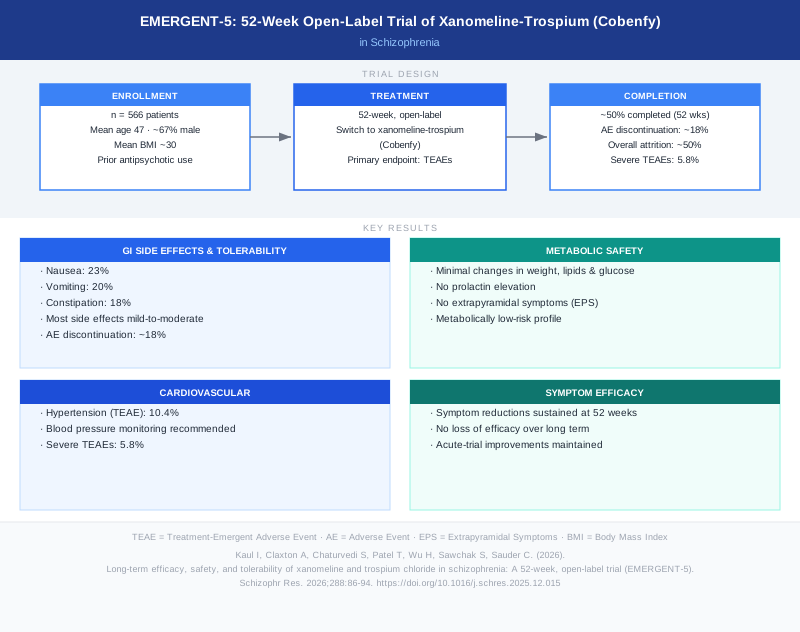
The primary endpoint was a safety endpoint: specifically, the incidence of treatment-emergent adverse events (TEAEs). In practical terms, EMERGENT-5 was an open-label outpatient trial in which all participants were switched from their existing antipsychotic — not Cobenfy — to Cobenfy and then followed longitudinally.
The trial enrolled 566 patients, of whom approximately 50% completed the full one year — a dropout rate that is not atypical for this type of long-term study. The population was typical for schizophrenia research: middle-aged (mean age 47), predominantly male (about two-thirds), and mostly overweight or obese (mean BMI of nearly 30).
Key Results Highlights
The safety profile of Cobenfy in EMERGENT-5 was broadly similar to what was seen in the short-term trials. Importantly, there were no new safety signals — which is very reassuring. Here are the key results across five domains:
- Overall safety: No new safety signal; profile consistent with short-term registration trials. The most common TEAEs were nausea (23%), vomiting (20%), and constipation (18%).
- Discontinuation: Discontinuation due to adverse events was almost 18%, though overall attrition was about 50%. Most side effects were mild to moderate and tended to decrease over time. However, 5.8% experienced severe TEAEs — a number that is probably not insignificant.
- Metabolic profile: Metabolic side effects were low, with minimal changes in weight, lipids, and glucose. Prolactin did not change appreciably, and there was no suggestion that Cobenfy causes extrapyramidal symptoms.
- Blood pressure: 10.4% reported high blood pressure as a treatment-emergent adverse event — an important finding I will return to.
- Efficacy: Symptom reductions achieved in the acute trials were maintained over the long term, with sustained improvements in many participants.
Download PDF and other files
Cobenfy’s Metabolic Profile Is Reassuring
The metabolic findings deserve a moment of emphasis. Cobenfy appears to be a metabolically low-risk antipsychotic, at least relative to many alternatives. It did not add meaningful weight gain in this population of mostly chronic patients — although honestly, it also did not produce significant weight loss in most participants.
For patients who have already been on metabolically high-risk antipsychotics for years, that stability is meaningful. The absence of prolactin elevation and EPS further distinguishes this drug from dopamine-blocking agents.
Blood Pressure Monitoring Is Needed
The finding that 10.4% of patients reported hypertension as a treatment-emergent adverse event is clinically important. We should probably begin thinking systematically about blood pressure monitoring with this drug and how to build that into our clinical workflow. Blood pressure monitoring is good practice recommended by many schizophrenia guidelines anyway, so you may already be doing this — but if not, EMERGENT-5 gives us a concrete reason to start.
Download PDF and other files
Long-Term Efficacy Maintained
The symptom reductions achieved during the short-term acute trials were sustained over the course of EMERGENT-5, with improvements maintained in many participants over one year. This is a key finding: Cobenfy did not lose efficacy with prolonged use. That durability matters clinically, because a drug that works for six weeks but fades over months is not truly useful for a chronic condition like schizophrenia.
Clinical Bottom Line
The overall message of EMERGENT-5 is straightforward: no surprises. The drug maintained its efficacy, and the side effect profile confirmed what we already knew from the short-term trials. This should be very reassuring to you as a clinician. EMERGENT-5, together with the also recently published EMERGENT-4, now provides a solid foundation for your informed consent discussions when you are considering switching a patient to Cobenfy or starting someone for the first time.
Download PDF and other files
Managing Cobenfy’s GI Side Effects
We are still learning how to best manage the GI side effects that are so characteristic of Cobenfy — particularly nausea and vomiting — to help patients stay on treatment. How quickly do we need to titrate? When should we use an antiemetic, and which one? These are open clinical questions we are actively working through.
Worth noting: Cobenfy’s side effect profile is a mixture of procholinergic effects (nausea and vomiting from xanomeline) and anticholinergic effects (constipation and dry mouth from trospium), a combination we simply do not see with other antipsychotics. Managing this drug requires some new learning on our part. It is encouraging that Cobenfy appears to be metabolically low risk, but we should add blood pressure monitoring to our standard safety monitoring protocol if we have not already done so.
Abstract
Long-term efficacy, safety, and tolerability of xanomeline and trospium chloride in schizophrenia: A 52-week, open-label trial (EMERGENT-5)
Inder Kaul, Amy Claxton, Soumya Chaturvedi, Tejendra Patel, Hsiuanlin Wu, Sharon Sawchak Colin Sauder
Background
The M1/M4 muscarinic receptor agonist xanomeline combined with the peripherally restricted pan-muscarinic receptor antagonist trospium chloride is the first approved treatment for adults with schizophrenia with no direct D2 dopamine receptor blockade. Xanomeline and trospium chloride (KarXT) reduced symptoms and was generally well tolerated in adults with schizophrenia in three, 5-week, randomized, double-blind, placebo-controlled trials and a 52-week, open-label extension trial.
Methods
EMERGENT-5 (NCT04820309) was a 52-week, open-label trial evaluating the long-term safety, tolerability, and efficacy of twice daily KarXT (maximum dose 125/30 mg) in psychiatrically stable adults with schizophrenia. Safety measures included treatment-emergent adverse events (TEAEs), vital signs, and laboratory parameters. Efficacy measures included change in Positive and Negative Syndrome Scale (PANSS) and Clinical Global Impression-Severity (CGI S).
S).
Results
Between June 2021–May 2024, 566 participants at 54 US sites received ≥1 dose of KarXT. Overall, 277/566 (48.9 %) participants completed the trial. A total of 466/566 (82.3 %) experienced ≥1 TEAE, the majority of which were mild or moderate in intensity; severe TEAEs were reported in 33/566 (5.8 %) participants. The most common TEAEs occurring in ≥5 % of participants were nausea (23.1 %), vomiting (20.3 %), constipation (18.0 %), hypertension (10.4 %), diarrhea and dry mouth (9.4 % each), dizziness (8.8 %), headache (8.1 %), dyspepsia (7.2 %), somnolence (6.2 %), weight decreased (5.7 %), and hyperhidrosis (5.1 %). KarXT improved PANSS total, PANSS positive and negative subscale, and CGI-S scores over the trial duration.
Conclusions
Psychiatrically stable adults with schizophrenia were safely switched from prior antipsychotics to KarXT with a trend toward symptom improvement over 1 year. The safety and tolerability profile of KarXT was consistent with observations in prior clinical trials; no new safety issues emerged.
Download PDF and other files
Reference
Kaul,i., Claxton, A., Chaturvedi, S., Patel, T., Wu, H., Sawchak, S. & Sauder, C. (2026). Long-term efficacy, safety, and tolerability of xanomeline and trospium chloride in schizophrenia: A 52-week, open-label trial (EMERGENT-5). Schizophrenia Research, Volume 288, Pages 86-94, ISSN 0920-9964.
