



Slides and Transcript
Slide 1 of 18
Welcome to Adjunctive Treatments for Bipolar Depression: Pramipexole, Thyroid, and Light Therapy. All of these treatments are off-label so they’re generally not first line, but they are treatments that are well established with randomized controlled trials.
Slide 2 of 18
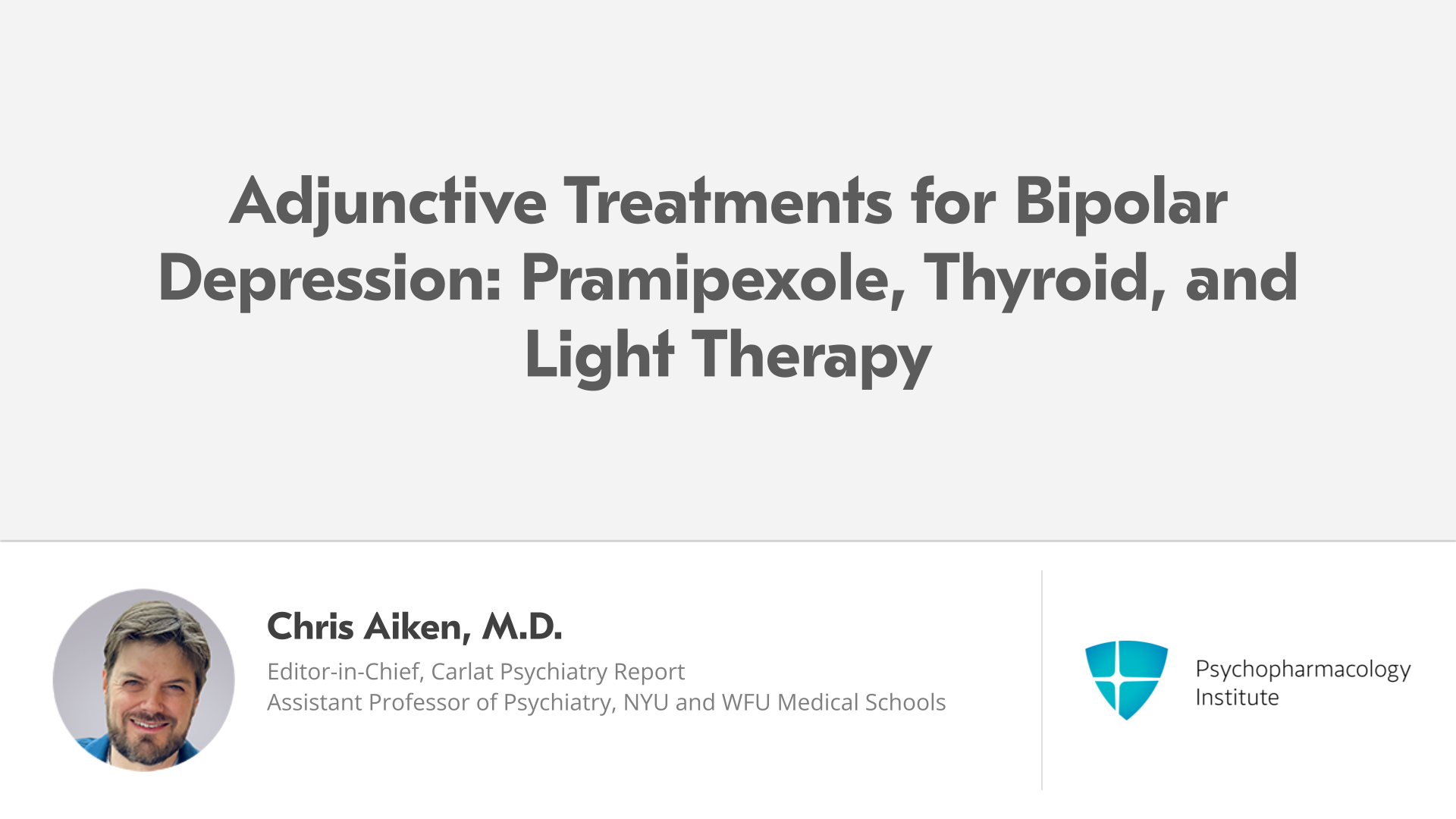
Let’s start with pramipexole, which is a dopamine D3 agonist. It has small controlled trials in both unipolar and bipolar depression, so it’s a good one to go to if you’re not sure what the diagnosis is. There are a few reports of mania on it, but generally the trials show a low risk of mania.
References:
- Tundo, A., Betro', S., de Filippis, R., Marchetti, F., Nacca, D., Necci, R., & Iommi, M. (2023). Pramipexole augmentation for treatment-resistant unipolar and bipolar depression in the real world: A systematic review and meta-analysis. Life, 13(4), 1043. https://doi.org/10.3390/life13041043
- Goldberg, J. F., Burdick, K. E., & Endick, C. J. (2004). Preliminary randomized, double‑blind, placebo‑controlled trial of pramipexole added to mood stabilizers for treatment‑resistant bipolar depression. American Journal of Psychiatry, 161(3), 564–566. https://doi.org/10.1176/appi.ajp.161.3.564
Free Files
Download PDF and other files
Success!
Check your inbox, we sent you all the materials there.
Slide 3 of 18
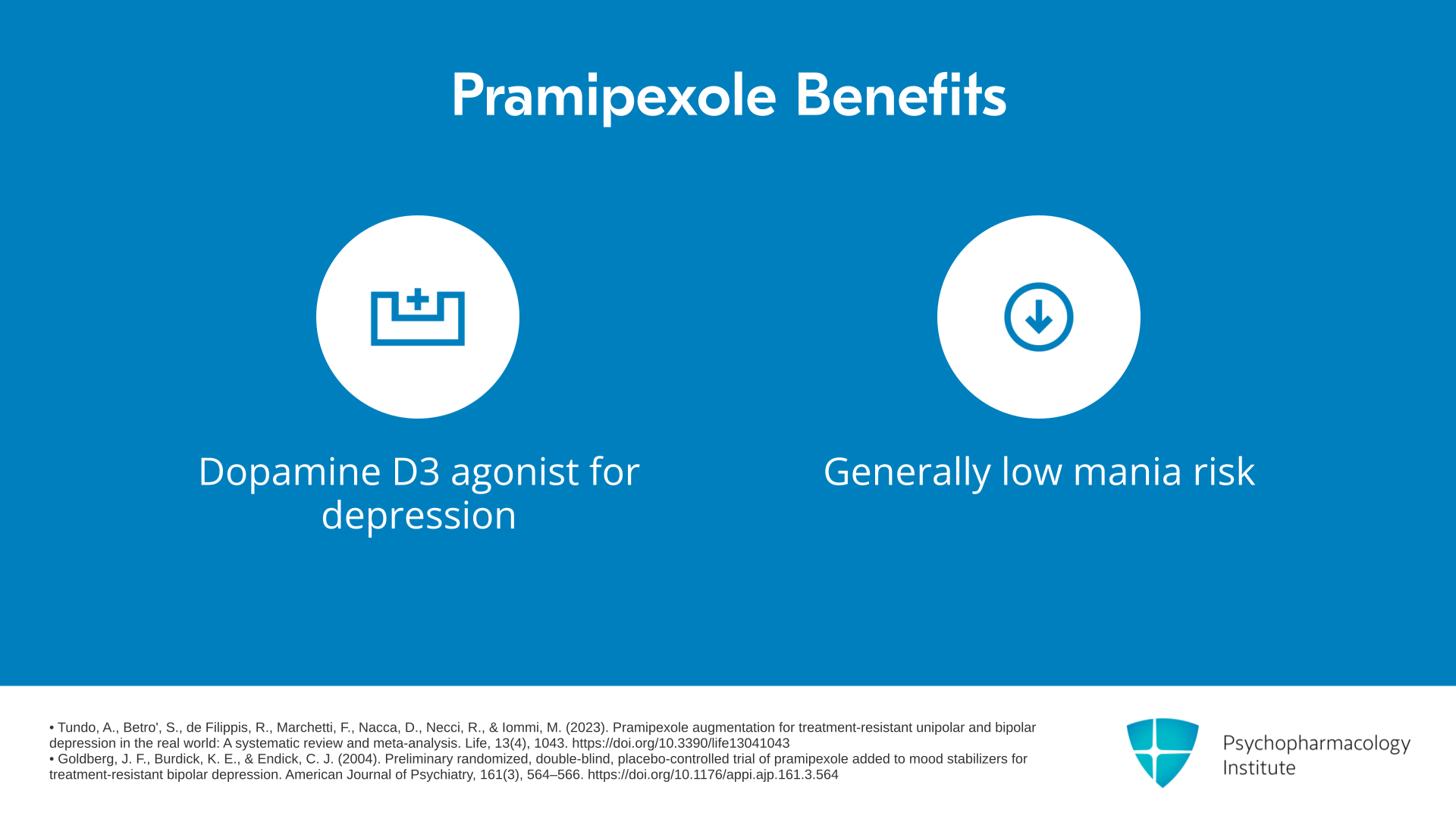
Instead, what we worry about on it is the syndrome of hedonic dysregulation where people do pleasurable things to a compulsive degree, most typically compulsive gambling but you can also see compulsive masturbation or eating on it. What’s interesting about this syndrome is that it actually doesn’t involve any other manic symptoms. It’s just compulsively doing things, but there’s not racing thoughts or shortened sleep or hyperactivity along with it.
References:
- Tundo, A., Betro', S., de Filippis, R., Marchetti, F., Nacca, D., Necci, R., & Iommi, M. (2023). Pramipexole augmentation for treatment-resistant unipolar and bipolar depression in the real world: A systematic review and meta-analysis. Life, 13(4), 1043. https://doi.org/10.3390/life13041043
Slide 4 of 18
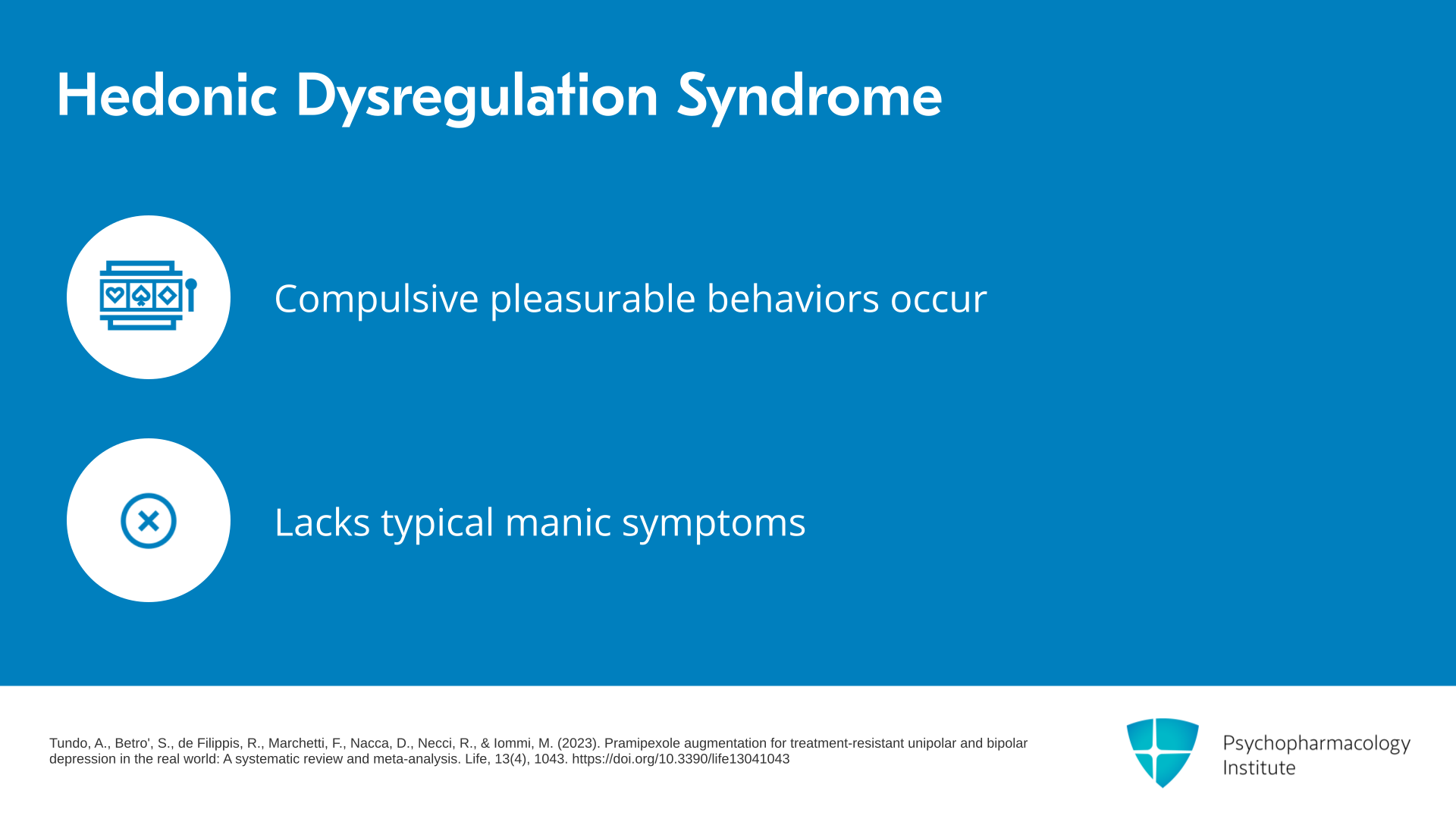
It also has a rare risk of hallucinations. We estimate that the risk of hallucinations on it is about 1 in 200, and it’s more at the higher dose. And the risk of hedonic dysregulation is about 1% to 3%. So very low risks of both of these. Upside of that, the good thing about pramipexole is there are no significant side effects that tend to be deal breakers for patients.
References:
- Tundo, A., Betro', S., de Filippis, R., Marchetti, F., Nacca, D., Necci, R., & Iommi, M. (2023). Pramipexole augmentation for treatment-resistant unipolar and bipolar depression in the real world: A systematic review and meta-analysis. Life, 13(4), 1043. https://doi.org/10.3390/life13041043
- Browning, M., et al. (2025). Pramipexole augmentation for the acute phase of treatment-resistant, unipolar depression: a placebo-controlled, double-blind, randomised trial in the UK. The Lancet Psychiatry, 12(8), 579-589. https://doi.org/10.1016/S2215-0366(25)00001-0
Free Files
Download PDF and other files
Success!
Check your inbox, we sent you all the materials there.
Slide 5 of 18
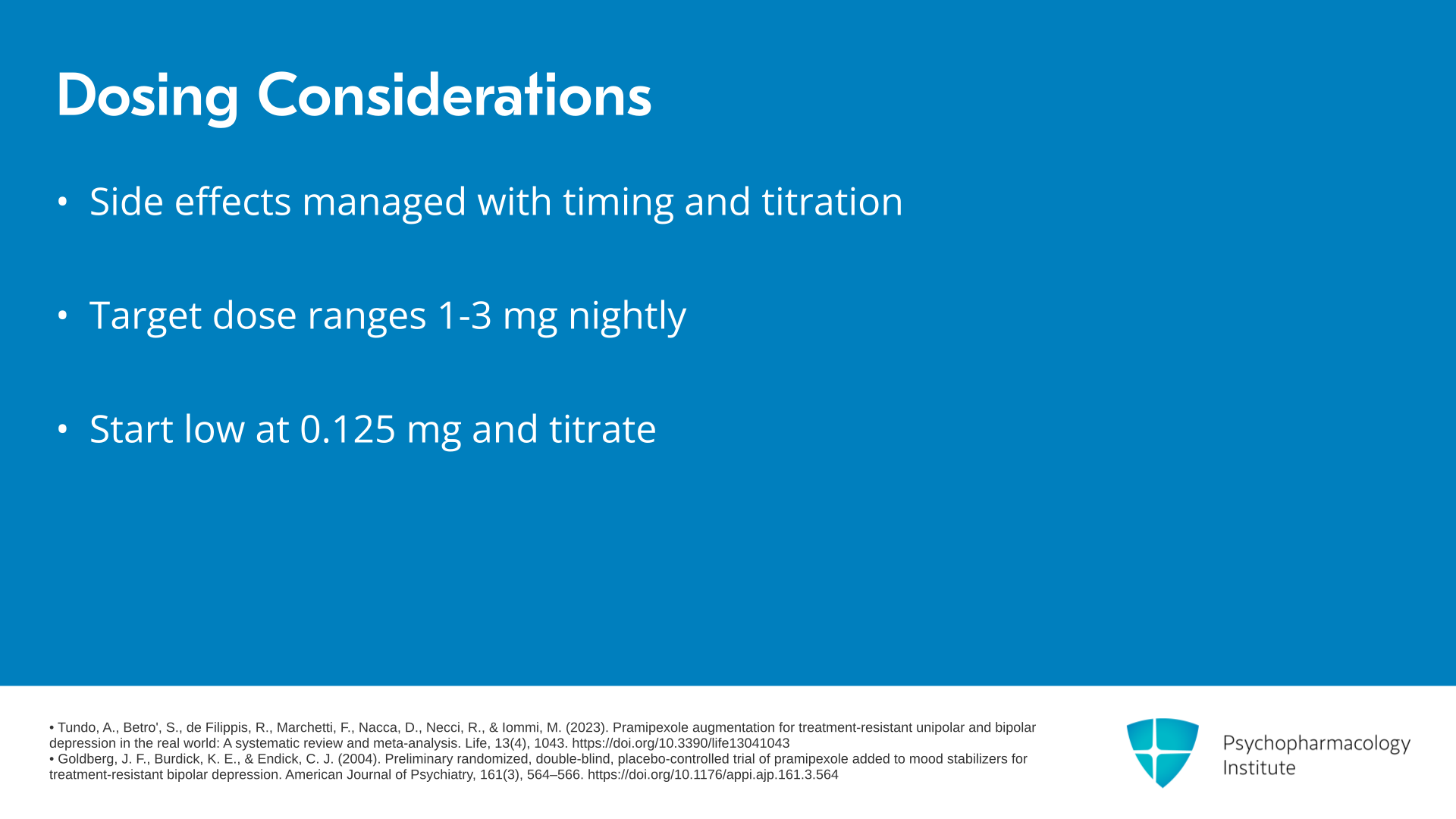
It can cause sedation, but you give it at night, and it can cause nausea, which you get around by raising the dose slowly. And the target dose here is 1 to 3 mg at night. On average, 1.5 works well. People with high levels of treatment resistance tend to need a higher dose like 2 to 3 mg. And we start it very low, around 0.125 mg at night, and raise by that same amount every five to seven days.
References:
- Tundo, A., Betro', S., de Filippis, R., Marchetti, F., Nacca, D., Necci, R., & Iommi, M. (2023). Pramipexole augmentation for treatment-resistant unipolar and bipolar depression in the real world: A systematic review and meta-analysis. Life, 13(4), 1043. https://doi.org/10.3390/life13041043
- Goldberg, J. F., Burdick, K. E., & Endick, C. J. (2004). Preliminary randomized, double‑blind, placebo‑controlled trial of pramipexole added to mood stabilizers for treatment‑resistant bipolar depression. American Journal of Psychiatry, 161(3), 564–566. https://doi.org/10.1176/appi.ajp.161.3.564
Slide 6 of 18
So pramipexole has a mechanism of action that we know addresses key symptoms like anhedonia, and it works well in inflammatory depression, which is common in bipolar disorder.
References:
- Tundo, A., Betro', S., de Filippis, R., Marchetti, F., Nacca, D., Necci, R., & Iommi, M. (2023). Pramipexole augmentation for treatment-resistant unipolar and bipolar depression in the real world: A systematic review and meta-analysis. Life, 13(4), 1043. https://doi.org/10.3390/life13041043
Free Files
Download PDF and other files
Success!
Check your inbox, we sent you all the materials there.
Slide 7 of 18
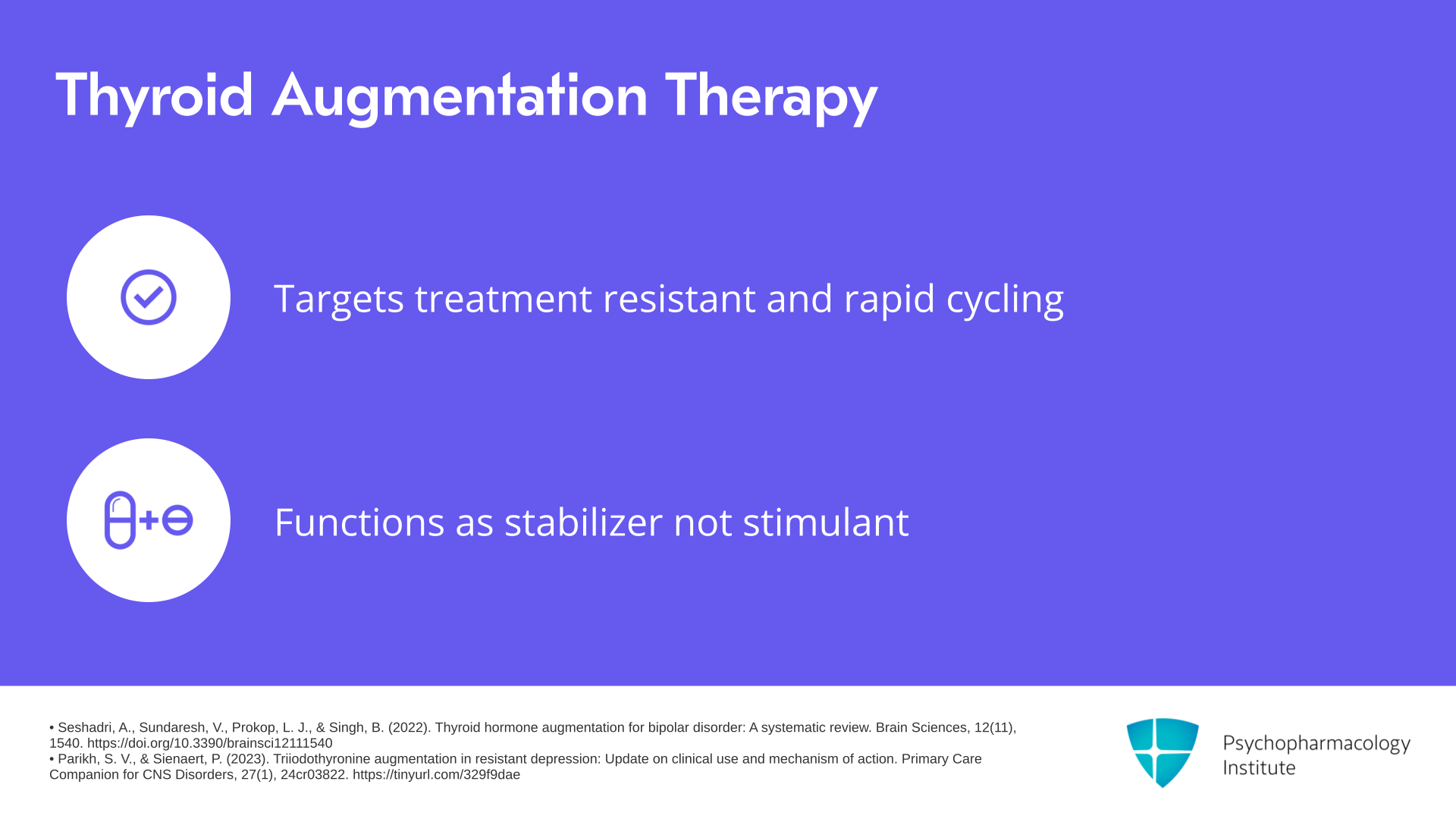
Our next treatment is thyroid, which has been used for depression since the 1930s. And in bipolar disorder, it specifically works in treatment resistant cases and may also work in rapid cycling bipolar disorder. In the studies in mood disorders, when people respond to thyroid, their anxiety levels actually go down and their manic symptoms actually go down. So don’t think of it as a stimulant, is more of a stabilizer in bipolar disorder. But it’s something we use as augmentation, not as a primary mood stabilizer.
References:
- Seshadri, A., Sundaresh, V., Prokop, L. J., & Singh, B. (2022). Thyroid hormone augmentation for bipolar disorder: A systematic review. Brain Sciences, 12(11), 1540. https://doi.org/10.3390/brainsci12111540
- Parikh, S. V., & Sienaert, P. (2023). Triiodothyronine augmentation in resistant depression: Update on clinical use and mechanism of action. Primary Care Companion for CNS Disorders, 27(1), 24cr03822. https://tinyurl.com/329f9dae
Slide 8 of 18
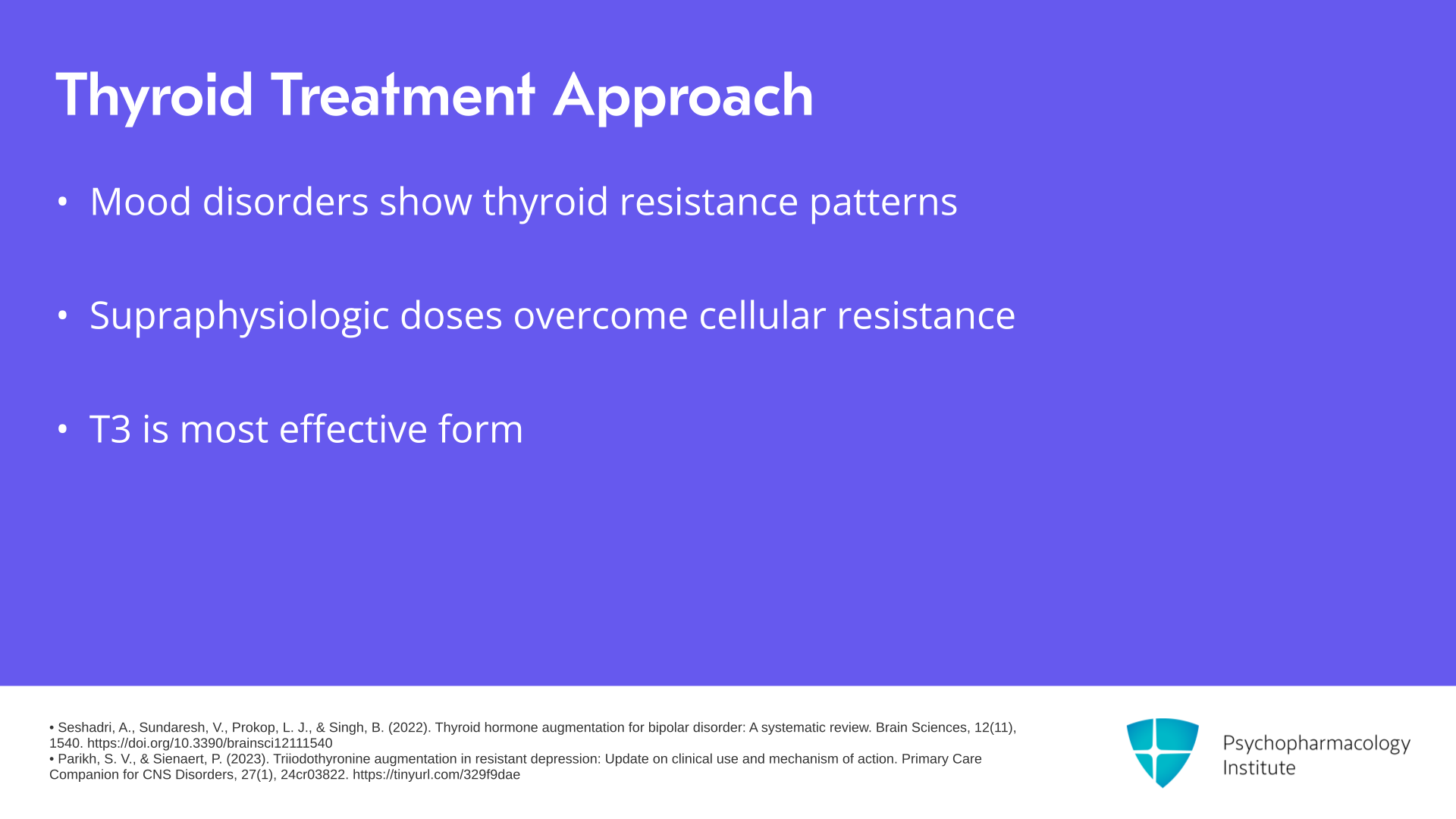
Now, the dosing of thyroid is rather unique, because the theory is that the brain in some people with mood disorders is resistant to the effects of thyroid. They have normal circulating thyroid in their blood but they’re not getting the effects in their brain. Here, we’re giving more thyroid, supraphysiologic dosages to get those effects in the brain. And in doing that, we want to use triiodothyroid, that’s T3 or Cytomel, triiodothyronine because that is the form of thyroid that is more active in the brain and is used in more of the clinical trials.
References:
- Seshadri, A., Sundaresh, V., Prokop, L. J., & Singh, B. (2022). Thyroid hormone augmentation for bipolar disorder: A systematic review. Brain Sciences, 12(11), 1540. https://doi.org/10.3390/brainsci12111540
- Parikh, S. V., & Sienaert, P. (2023). Triiodothyronine augmentation in resistant depression: Update on clinical use and mechanism of action. Primary Care Companion for CNS Disorders, 27(1), 24cr03822. https://tinyurl.com/329f9dae
Free Files
Download PDF and other files
Success!
Check your inbox, we sent you all the materials there.
Slide 9 of 18
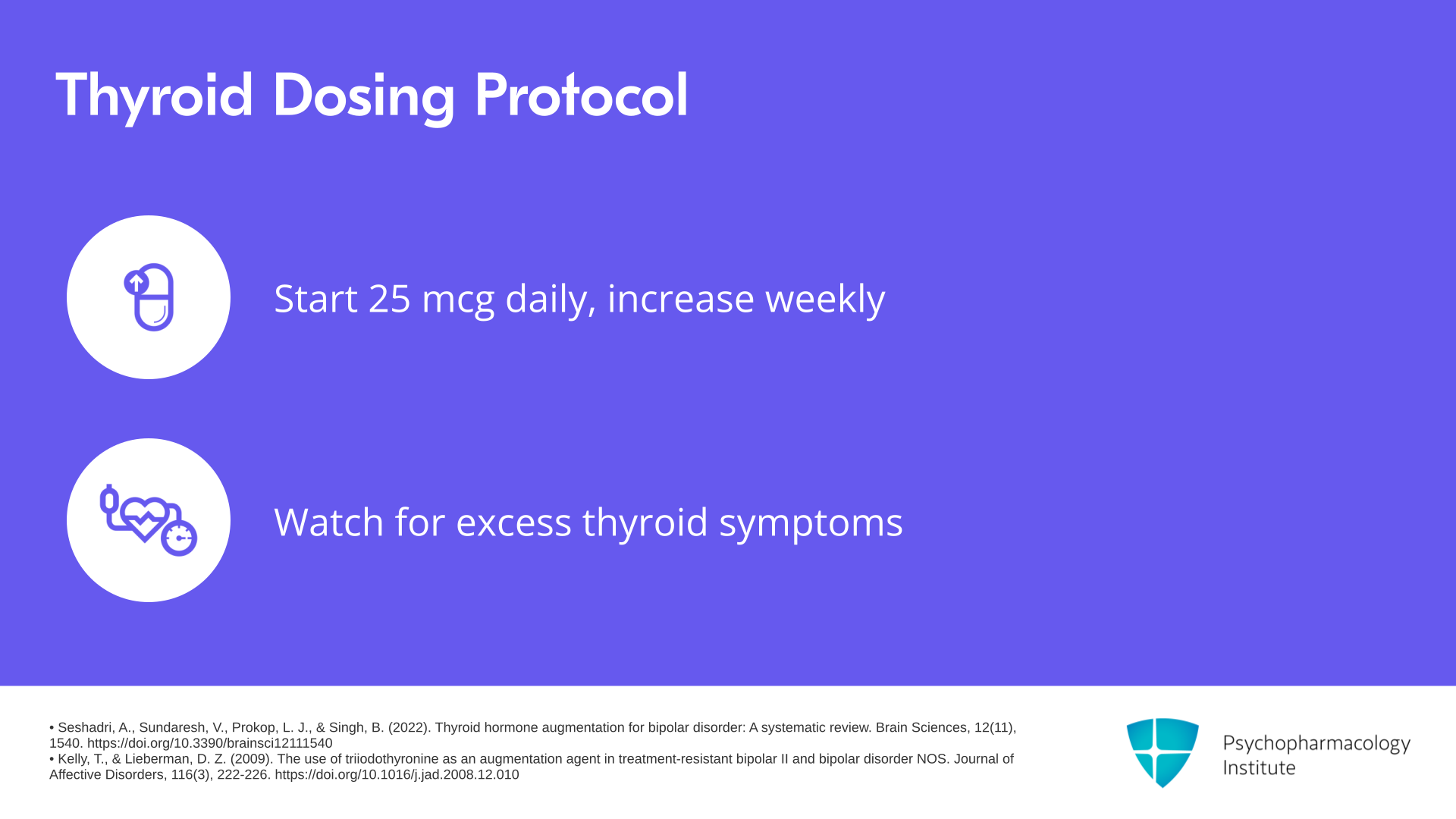
And it shows you on this slide how to dose it starting at 25 mcg a day, and raising by that same amount each week up to a max of 150. But you’re really doing in this dosing is you’re checking for symptoms of too much thyroid. That would be racing heart, hot sensation, sweats, headache, restlessness or anxiety. If you see those symptoms, you know you’ve given too much. And if you don’t see those symptoms, you can keep titrating because it’s well tolerated. So the goal is to get just enough in there to get some effect but not too much that you’re causing hyperthyroid symptoms.
References:
- Seshadri, A., Sundaresh, V., Prokop, L. J., & Singh, B. (2022). Thyroid hormone augmentation for bipolar disorder: A systematic review. Brain Sciences, 12(11), 1540. https://doi.org/10.3390/brainsci12111540
- Kelly, T., & Lieberman, D. Z. (2009). The use of triiodothyronine as an augmentation agent in treatment-resistant bipolar II and bipolar disorder NOS. Journal of Affective Disorders, 116(3), 222-226. https://doi.org/10.1016/j.jad.2008.12.010
Slide 10 of 18
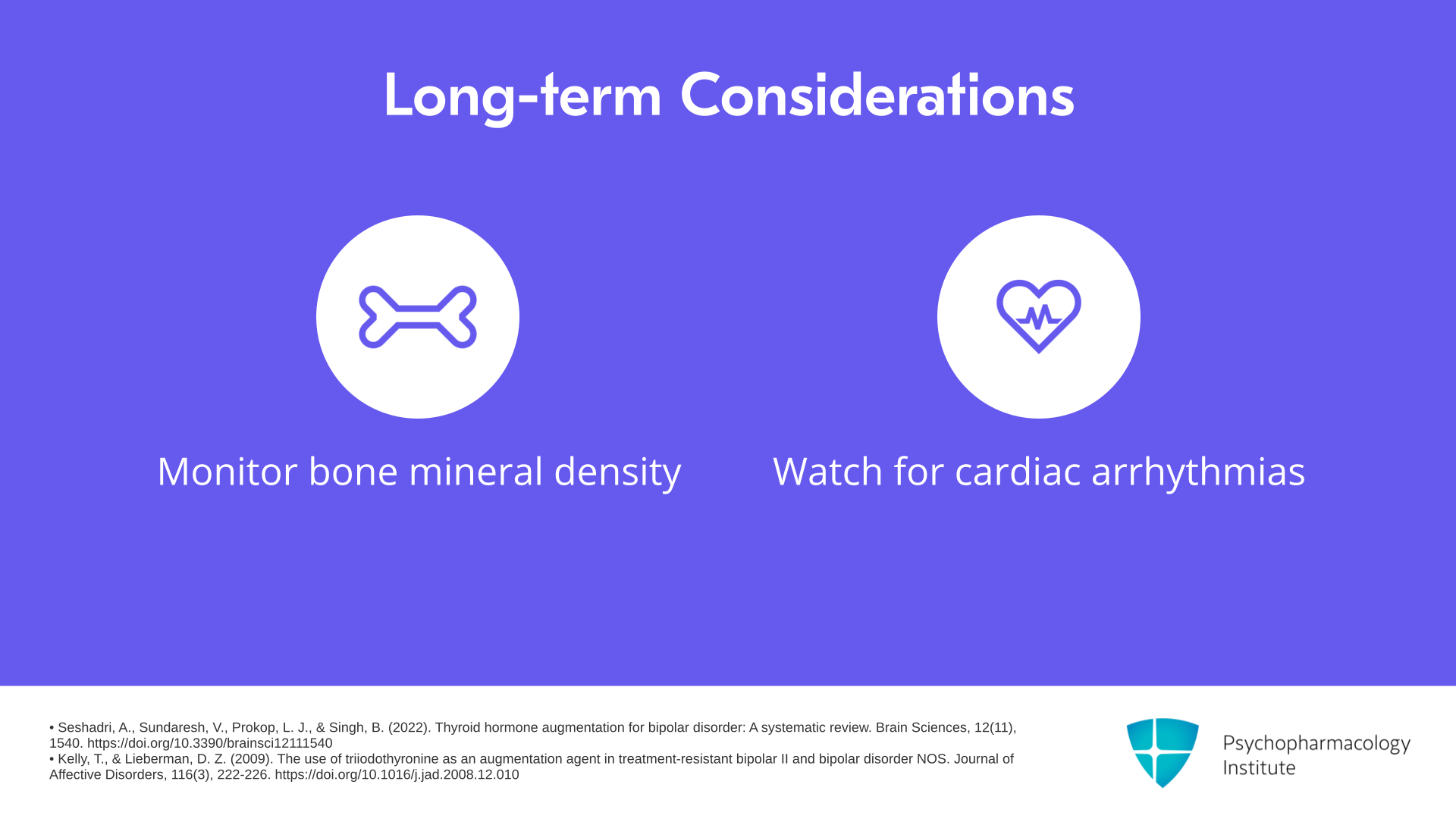
Now, there are some risks long term. I’m going to say they’re really theoretical risks because they’ve not shown up in the trials of mood disorders and that might be because thyroid metabolism is different in people with depression. Those risks are that it could lower bone mineral density. So you might want to make sure your patient is getting that check with their PCP if they stay on it long term. And it could cause cardiac arrhythmias.
References:
- Seshadri, A., Sundaresh, V., Prokop, L. J., & Singh, B. (2022). Thyroid hormone augmentation for bipolar disorder: A systematic review. Brain Sciences, 12(11), 1540. https://doi.org/10.3390/brainsci12111540
- Kelly, T., & Lieberman, D. Z. (2009). The use of triiodothyronine as an augmentation agent in treatment-resistant bipolar II and bipolar disorder NOS. Journal of Affective Disorders, 116(3), 222-226. https://doi.org/10.1016/j.jad.2008.12.010
Free Files
Download PDF and other files
Success!
Check your inbox, we sent you all the materials there.
Slide 11 of 18
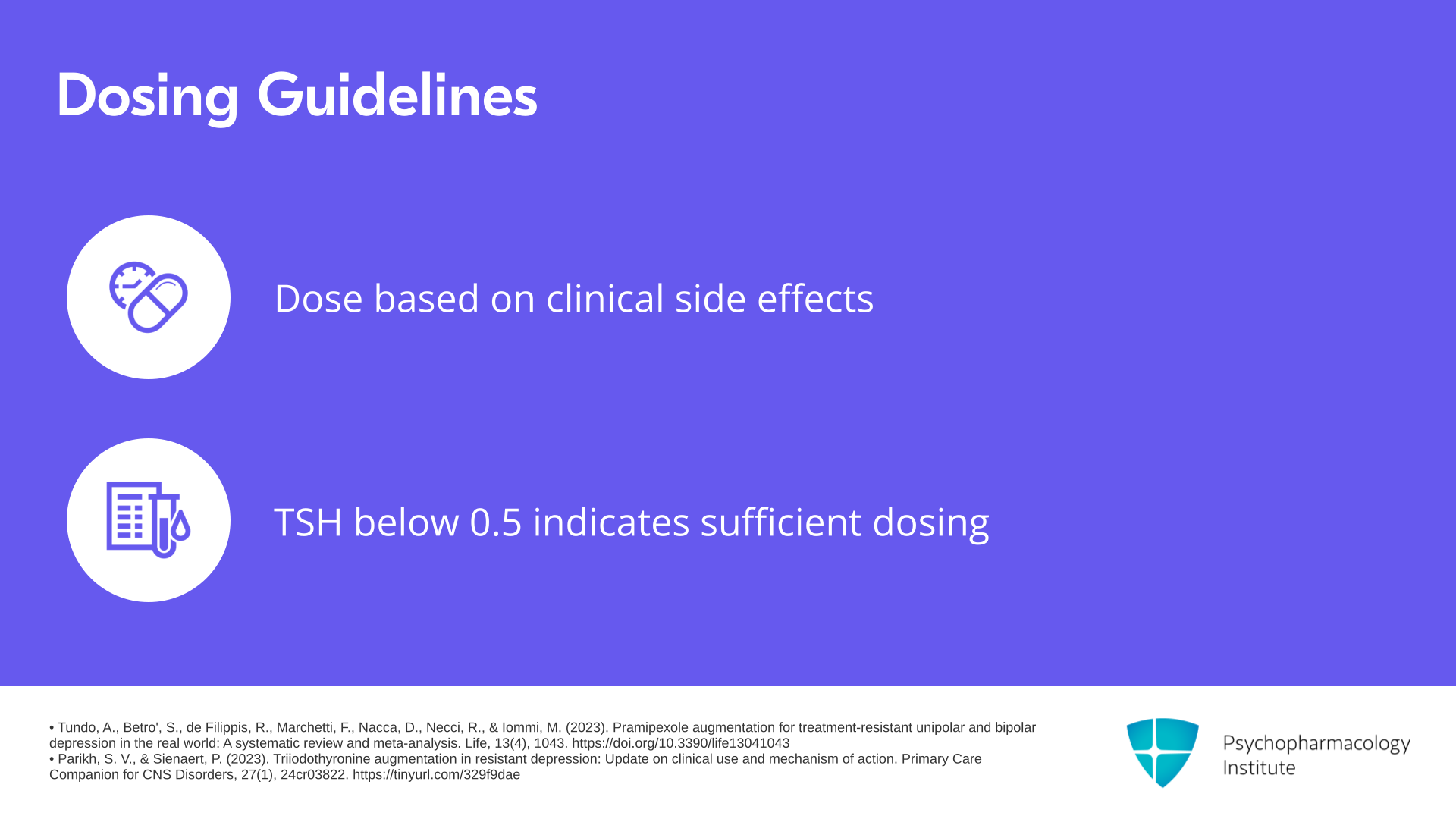
Outside of that, a well-tolerated option. And the main message here is that you dose it based on the clinical side effects, not based on the labs. Some books recommend that if the TSH goes below 0.5, you’ve probably given enough or too much and should not raise it any further. We don’t know that for sure but it’s a good guideline. So we do check labs along with it just as good practice.
References:
- Tundo, A., Betro', S., de Filippis, R., Marchetti, F., Nacca, D., Necci, R., & Iommi, M. (2023). Pramipexole augmentation for treatment-resistant unipolar and bipolar depression in the real world: A systematic review and meta-analysis. Life, 13(4), 1043. https://doi.org/10.3390/life13041043
- Parikh, S. V., & Sienaert, P. (2023). Triiodothyronine augmentation in resistant depression: Update on clinical use and mechanism of action. Primary Care Companion for CNS Disorders, 27(1), 24cr03822. https://tinyurl.com/329f9dae
Slide 12 of 18
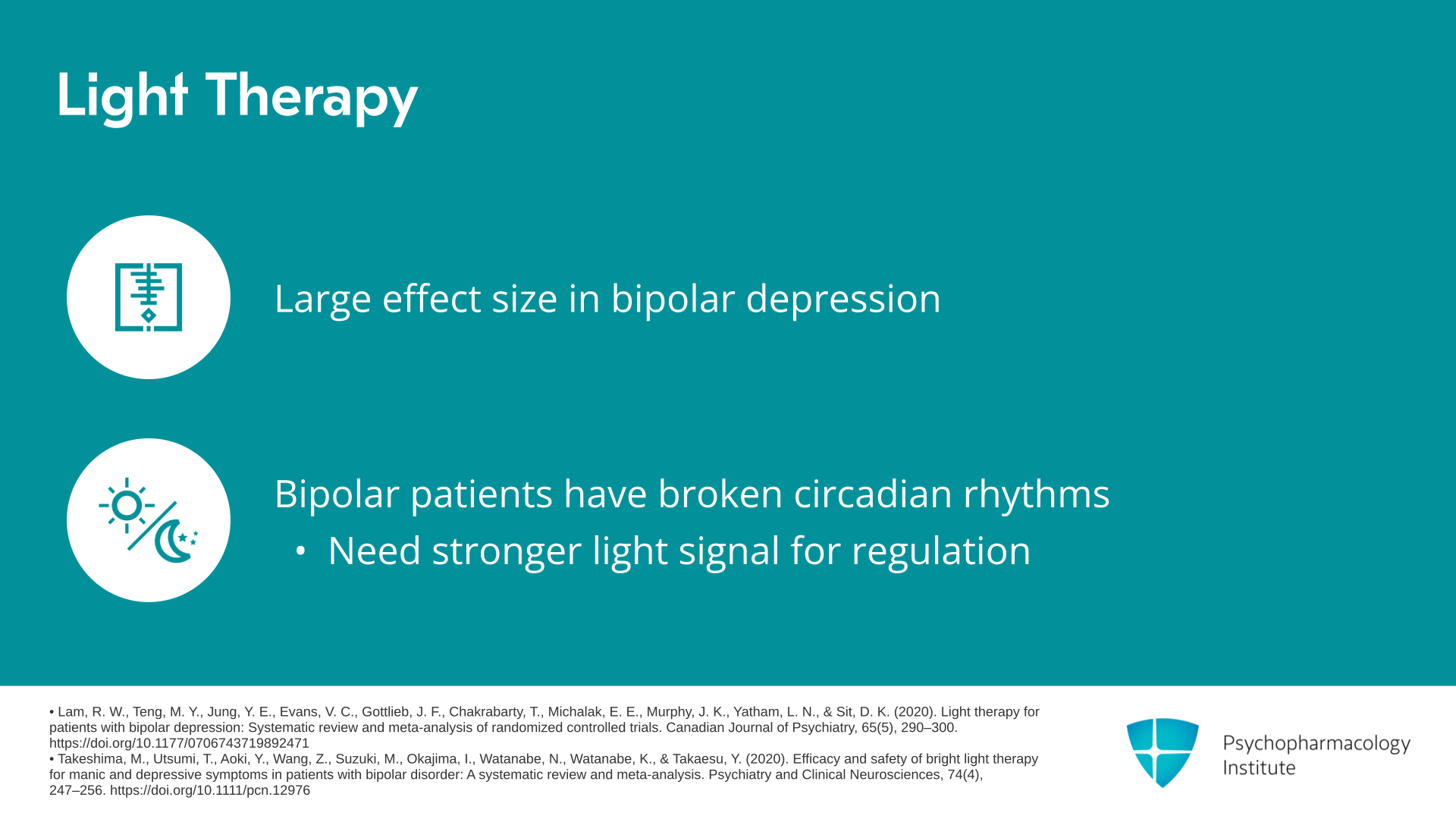
The next off-label therapy has a big effect size in bipolar depression. It’s light therapy. There are about three randomized controlled trials that prove that it works, and they used it regardless of season. Why is that? My guess is that people with bipolar disorder have a broken circadian rhythm, a broken biological clock. And they’re hence more responsive to that extra pulse of light in the morning, and they need a stronger signal to regulate that circadian rhythm. So they need that big pulse of light in the morning even in the summertime and likewise they need darkness at night. And that tells you something about how to use light therapy, which is only use it in the morning or the early afternoon. Don’t use it after 2 p.m. That can flip the circadian rhythm the wrong way causing mania and depression and insomnia.
References:
- Lam, R. W., Teng, M. Y., Jung, Y. E., Evans, V. C., Gottlieb, J. F., Chakrabarty, T., Michalak, E. E., Murphy, J. K., Yatham, L. N., & Sit, D. K. (2020). Light therapy for patients with bipolar depression: Systematic review and meta-analysis of randomized controlled trials. Canadian Journal of Psychiatry, 65(5), 290–300. https://doi.org/10.1177/0706743719892471
- Takeshima, M., Utsumi, T., Aoki, Y., Wang, Z., Suzuki, M., Okajima, I., Watanabe, N., Watanabe, K., & Takaesu, Y. (2020). Efficacy and safety of bright light therapy for manic and depressive symptoms in patients with bipolar disorder: A systematic review and meta-analysis. Psychiatry and Clinical Neurosciences, 74(4), 247–256. https://doi.org/10.1111/pcn.12976
Free Files
Download PDF and other files
Success!
Check your inbox, we sent you all the materials there.
Slide 13 of 18
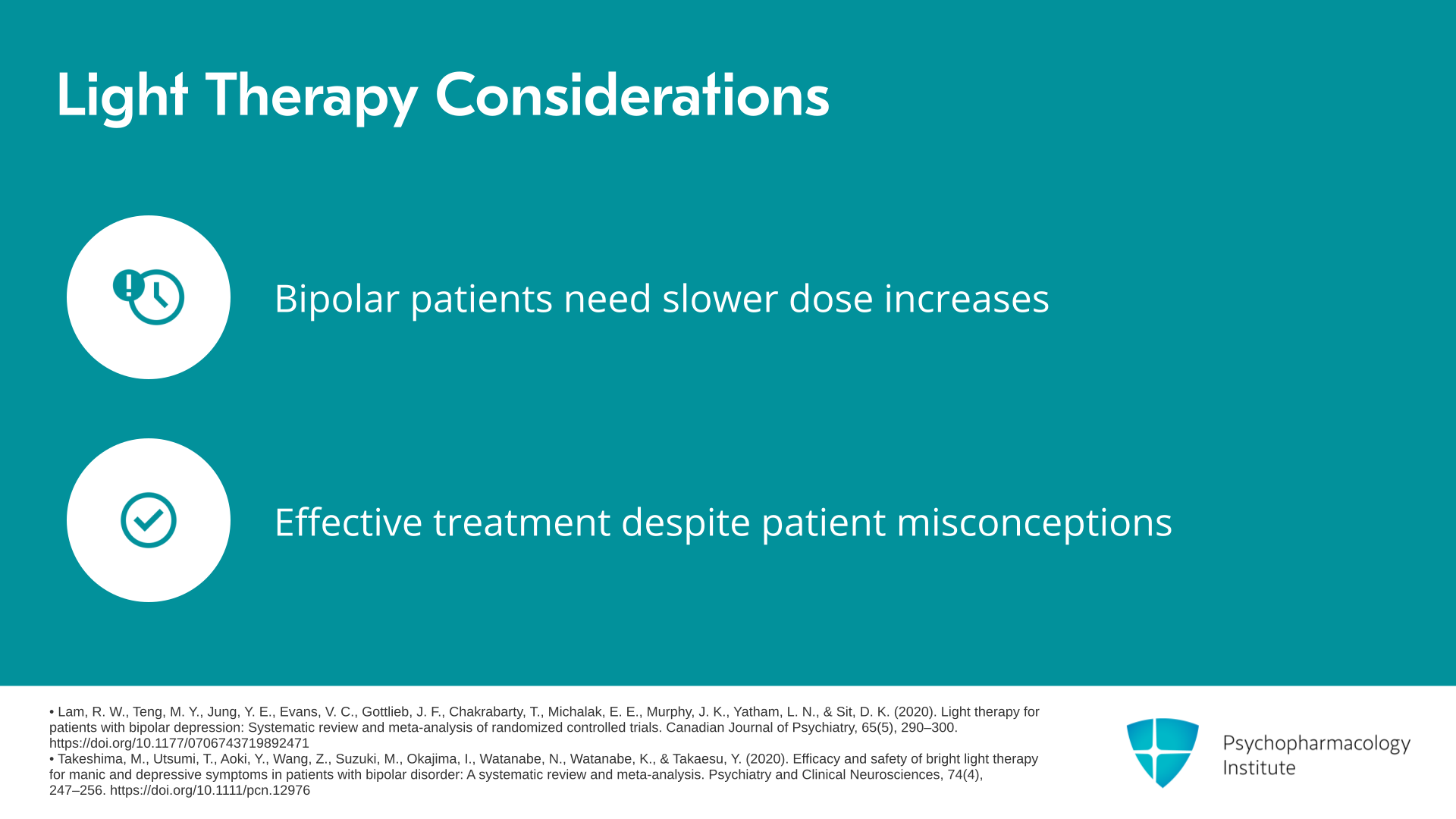
Generally, we raise it slower in bipolar than we do in unipolar ’cause we’re a little more worried about the risk of inducing mania with light box. Something that is controversial and theoretical, it might happen, it doesn’t seem to happen in the controlled trials and if any hypomania develops, it looks like it’s controllable by just lowering the dose. So if your patient gets agitated at 30 minutes a day of light, you lower it down to 15 minutes a day of light. But it is effective in bipolar depression, and you got to emphasize that because patients think light therapy is light.
References:
- Lam, R. W., Teng, M. Y., Jung, Y. E., Evans, V. C., Gottlieb, J. F., Chakrabarty, T., Michalak, E. E., Murphy, J. K., Yatham, L. N., & Sit, D. K. (2020). Light therapy for patients with bipolar depression: Systematic review and meta-analysis of randomized controlled trials. Canadian Journal of Psychiatry, 65(5), 290–300. https://doi.org/10.1177/0706743719892471
- Takeshima, M., Utsumi, T., Aoki, Y., Wang, Z., Suzuki, M., Okajima, I., Watanabe, N., Watanabe, K., & Takaesu, Y. (2020). Efficacy and safety of bright light therapy for manic and depressive symptoms in patients with bipolar disorder: A systematic review and meta-analysis. Psychiatry and Clinical Neurosciences, 74(4), 247–256. https://doi.org/10.1111/pcn.12976
Slide 14 of 18
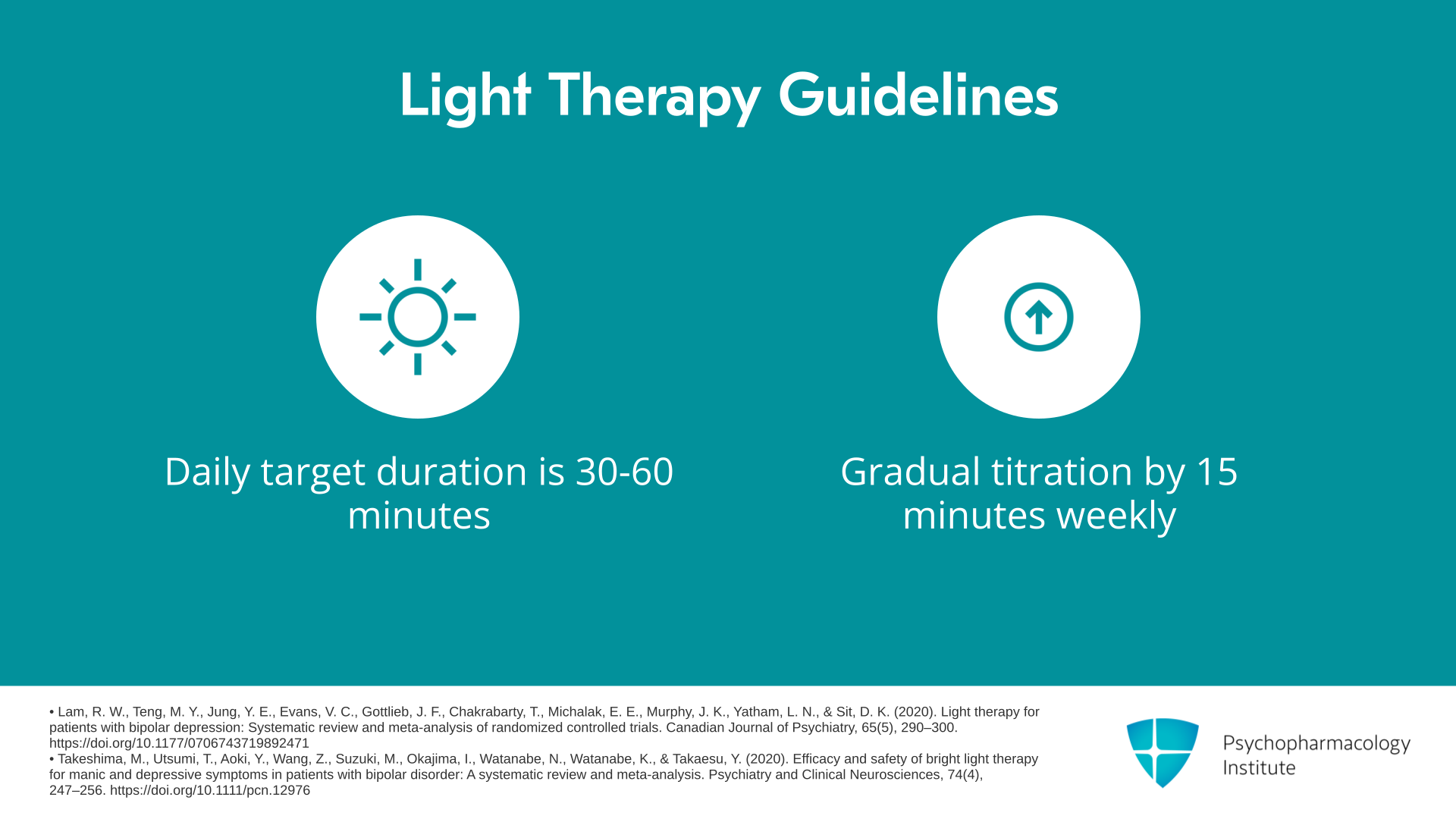
The target is 30 to 60 minutes a day and it works best in some studies at 60 minutes a day. You titrate it slowly by about 15 minutes a week. So it takes about a month to get up to that full dose. Light therapy is fairly well tolerated.
References:
- Lam, R. W., Teng, M. Y., Jung, Y. E., Evans, V. C., Gottlieb, J. F., Chakrabarty, T., Michalak, E. E., Murphy, J. K., Yatham, L. N., & Sit, D. K. (2020). Light therapy for patients with bipolar depression: Systematic review and meta-analysis of randomized controlled trials. Canadian Journal of Psychiatry, 65(5), 290–300. https://doi.org/10.1177/0706743719892471
- Takeshima, M., Utsumi, T., Aoki, Y., Wang, Z., Suzuki, M., Okajima, I., Watanabe, N., Watanabe, K., & Takaesu, Y. (2020). Efficacy and safety of bright light therapy for manic and depressive symptoms in patients with bipolar disorder: A systematic review and meta-analysis. Psychiatry and Clinical Neurosciences, 74(4), 247–256. https://doi.org/10.1111/pcn.12976
Free Files
Download PDF and other files
Success!
Check your inbox, we sent you all the materials there.
Slide 15 of 18
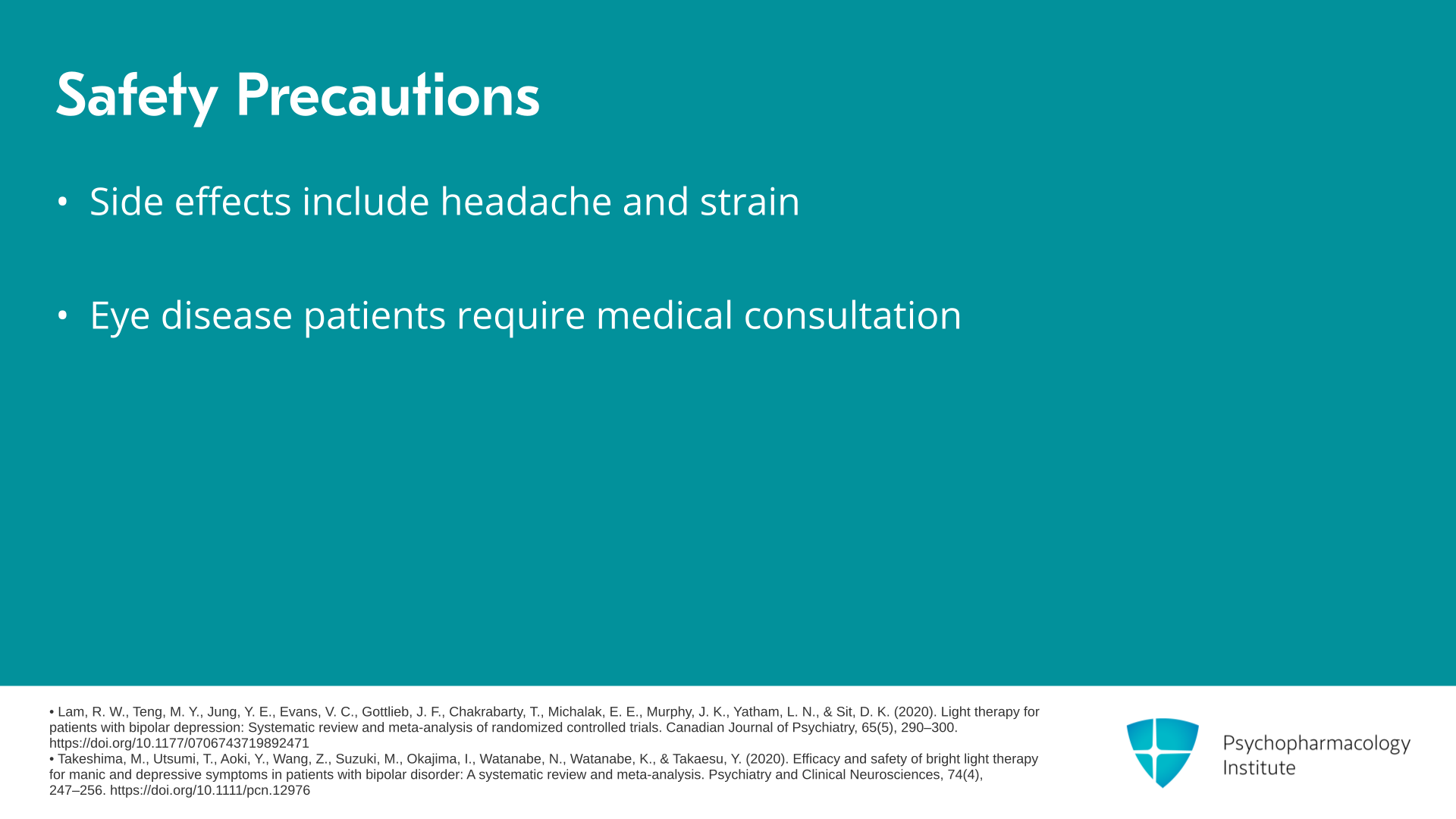
There can be headache, eye strain, photosensitivity. Patients with eye disease do have some risks with it so they should check with their eye doctor before using it. But the boxes that are recommended have ultraviolet filters so we reduce that risk of ultraviolet light.
References:
- Lam, R. W., Teng, M. Y., Jung, Y. E., Evans, V. C., Gottlieb, J. F., Chakrabarty, T., Michalak, E. E., Murphy, J. K., Yatham, L. N., & Sit, D. K. (2020). Light therapy for patients with bipolar depression: Systematic review and meta-analysis of randomized controlled trials. Canadian Journal of Psychiatry, 65(5), 290–300. https://doi.org/10.1177/0706743719892471
- Takeshima, M., Utsumi, T., Aoki, Y., Wang, Z., Suzuki, M., Okajima, I., Watanabe, N., Watanabe, K., & Takaesu, Y. (2020). Efficacy and safety of bright light therapy for manic and depressive symptoms in patients with bipolar disorder: A systematic review and meta-analysis. Psychiatry and Clinical Neurosciences, 74(4), 247–256. https://doi.org/10.1111/pcn.12976
Slide 16 of 18
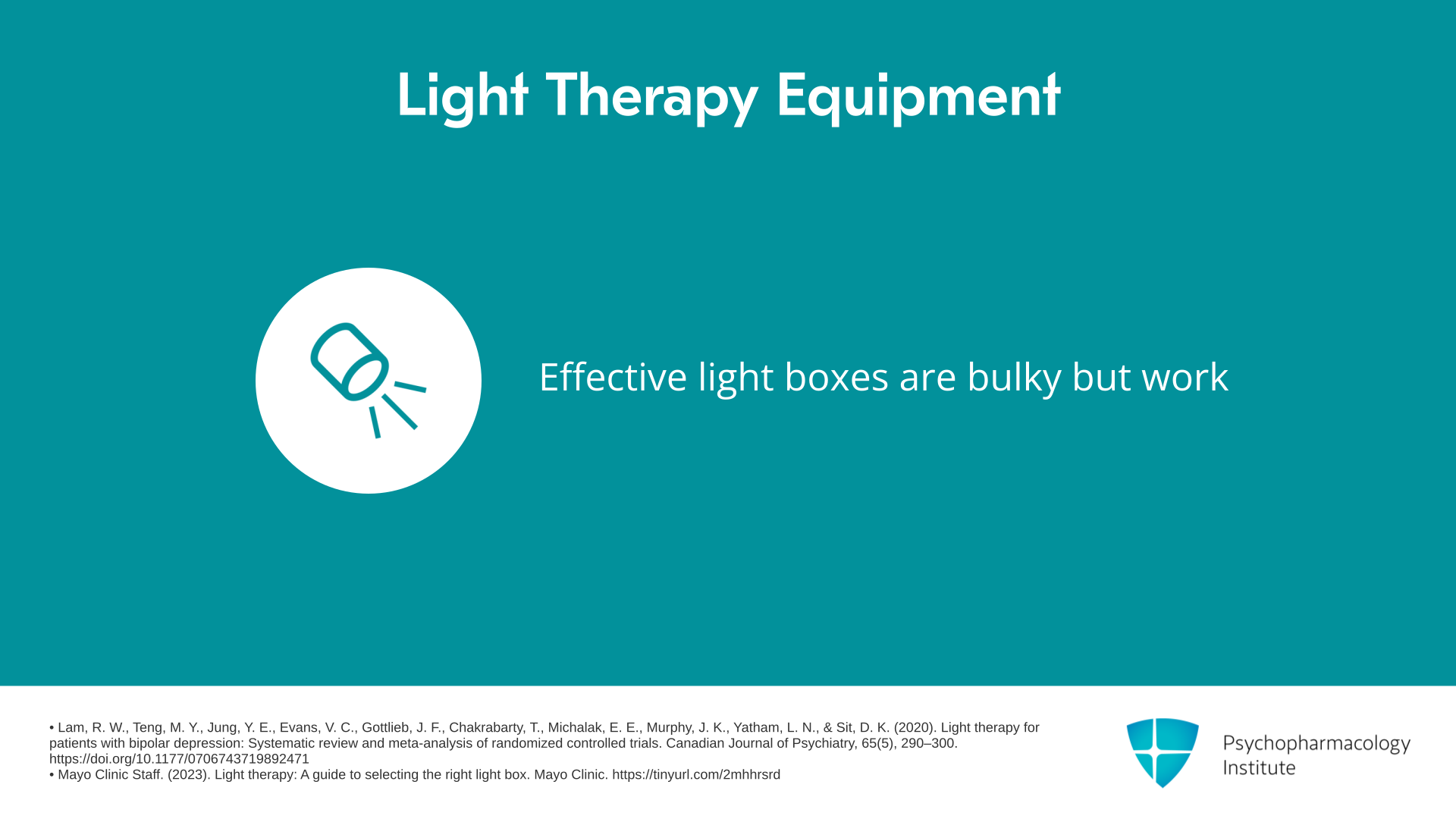
And the other thing to know about light therapy is it’s not going to work at all unless your patient gets the right kind of light box. The ones that are popular and look nice ’cause they’re small and portable don’t work at all. And the ones that are not popular ’cause they’re big and bulky work great. The most affordable ones that work are the Carex brands like the Daylight models. These are now available using LED lights that last a long time and are more stable.
References:
- Lam, R. W., Teng, M. Y., Jung, Y. E., Evans, V. C., Gottlieb, J. F., Chakrabarty, T., Michalak, E. E., Murphy, J. K., Yatham, L. N., & Sit, D. K. (2020). Light therapy for patients with bipolar depression: Systematic review and meta-analysis of randomized controlled trials. Canadian Journal of Psychiatry, 65(5), 290–300. https://doi.org/10.1177/0706743719892471
- Mayo Clinic Staff. (2023). Light therapy: A guide to selecting the right light box. Mayo Clinic. https://tinyurl.com/2mhhrsrd
Free Files
Download PDF and other files
Success!
Check your inbox, we sent you all the materials there.
Slide 17 of 18
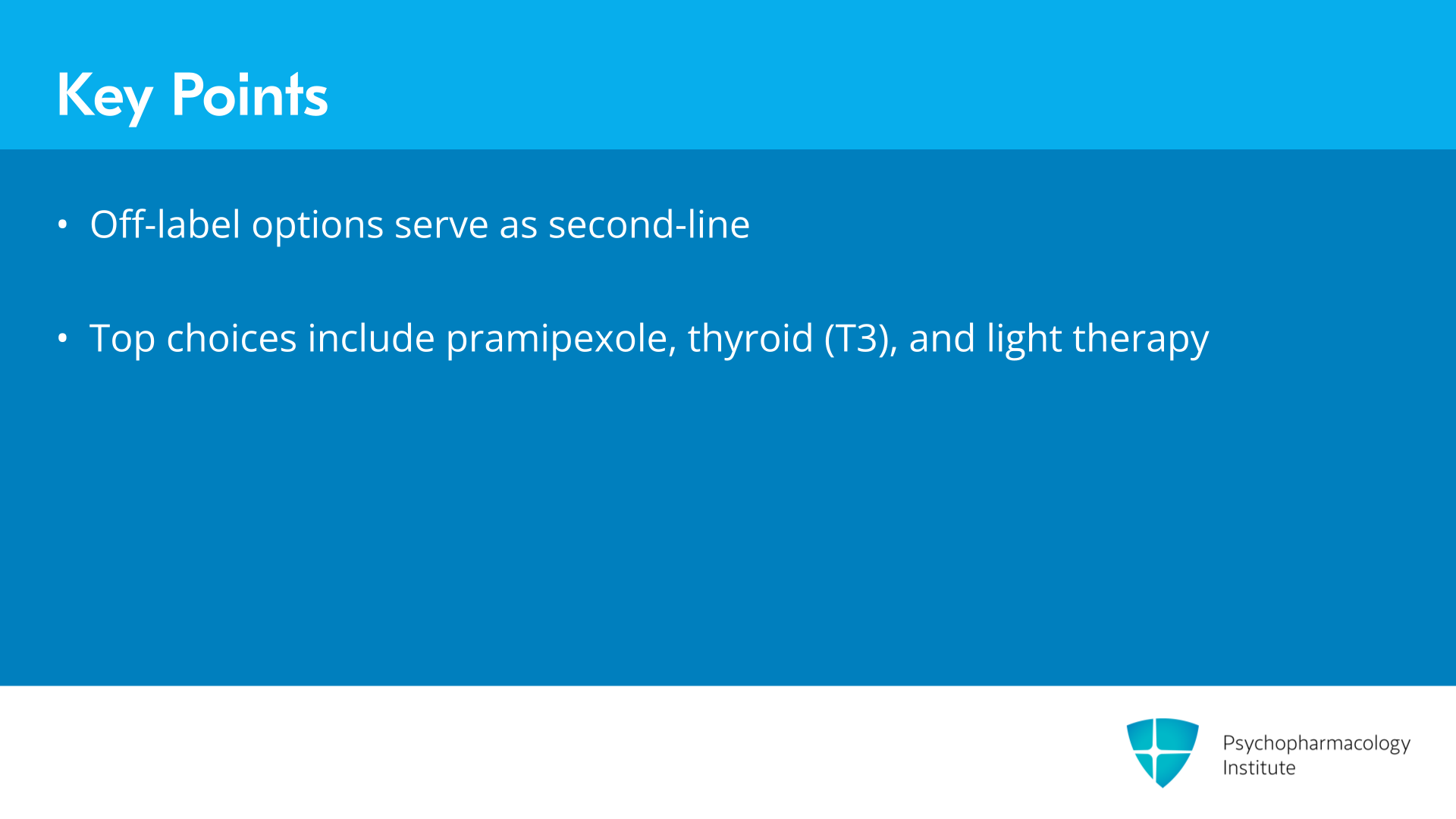
Let’s close with key points. Off-label options for bipolar depression are second line, and the top choices among them are pramipexole, thyroid/T3, and light therapy which works in seasonal as well as non-seasonal types.
Slide 18 of 18
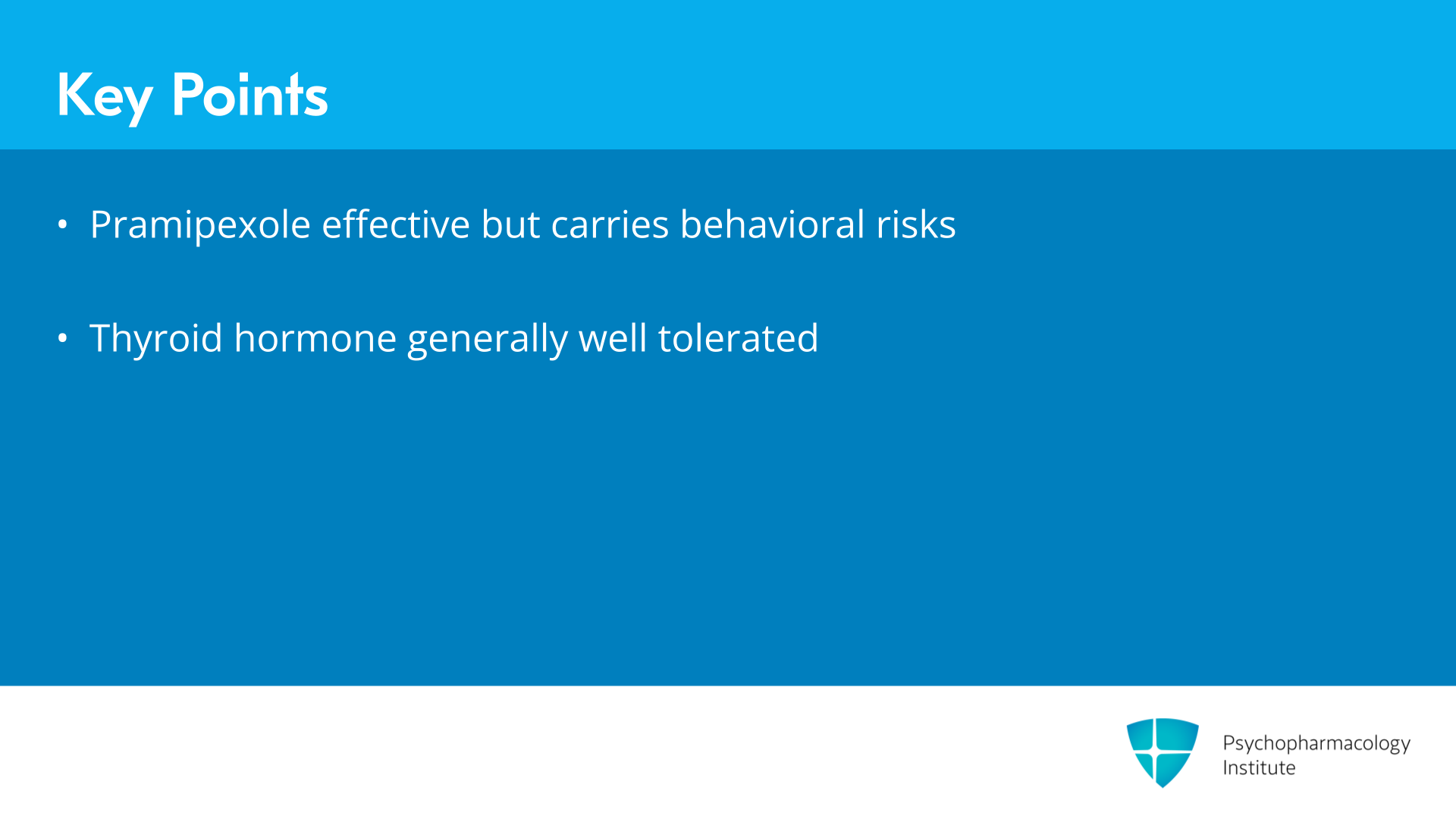
Pramipexole has a large effect size in bipolar and unipolar depression, and it carries a risk of hallucinations and compulsive gambling. Thyroid hormone/T3 is well tolerated when dosed by the patient’s response. It carries a theoretical risk of arrhythmias and decreased bone mineral density.
Free Files
Download PDF and other files
Success!
Check your inbox, we sent you all the materials there.
