Slides and Transcript
Slide 1 of 23
Welcome to Atypical Antipsychotics for Bipolar Depression.
Slide 2 of 23
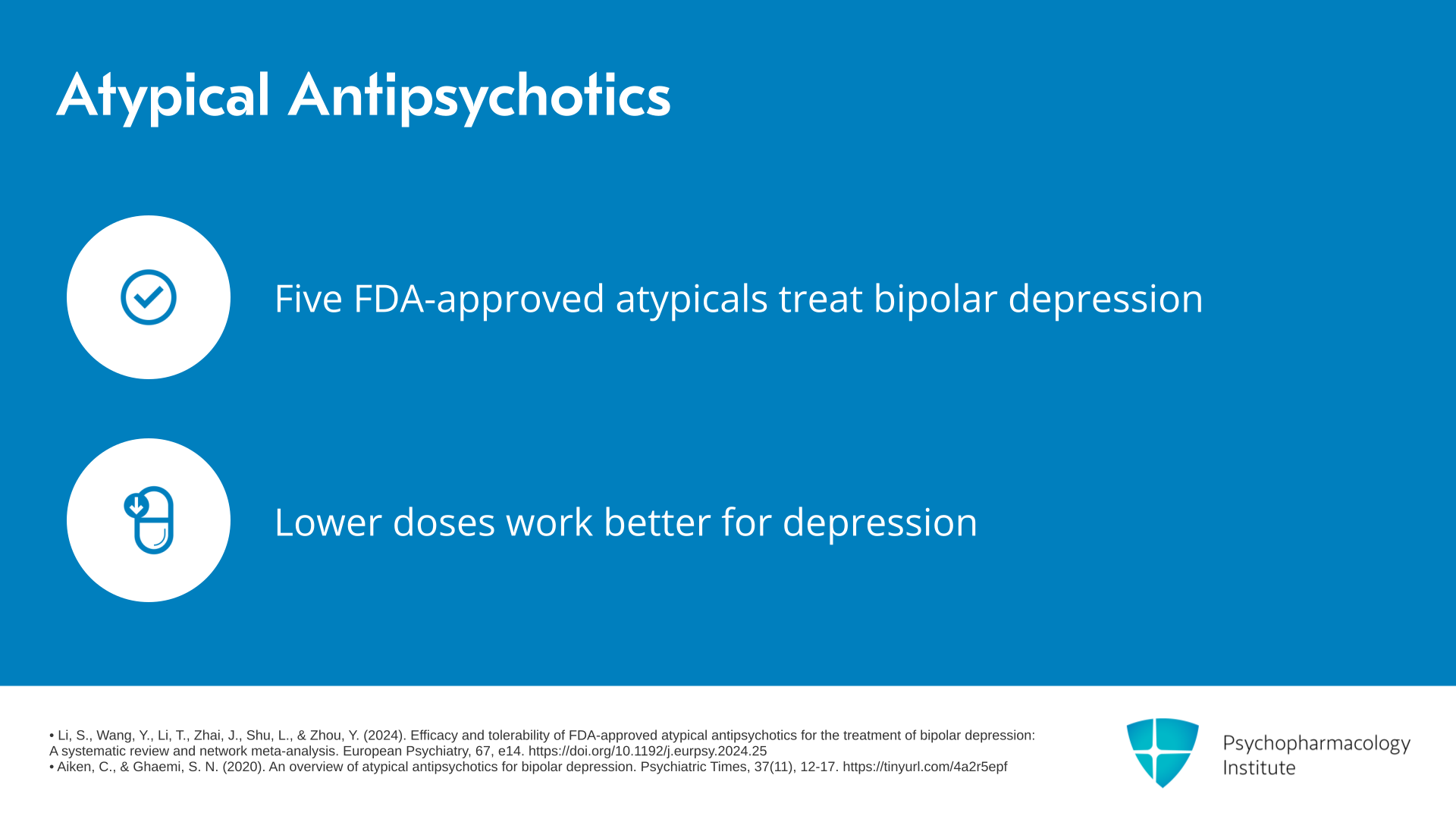
There are five atypical or second-generation antipsychotics that treat bipolar depression, and possibly six that work. When I say treat, I mean FDA approved. So the bottom line of this lecture is that most of the antipsychotics out there do not help depression. In fact, why would we think they do? Blocking dopamine is not a way to help depression. And that fact there tells you a bit about how these work, which is they tend to work for depression in the lower dose range where they’re not blocking dopamine as much.
References:
- Li, S., Wang, Y., Li, T., Zhai, J., Shu, L., & Zhou, Y. (2024). Efficacy and tolerability of FDA-approved atypical antipsychotics for the treatment of bipolar depression: A systematic review and network meta-analysis. European Psychiatry, 67, e14. https://doi.org/10.1192/j.eurpsy.2024.25
- Aiken, C., & Ghaemi, S. N. (2020). An overview of atypical antipsychotics for bipolar depression. Psychiatric Times, 37(11), 12-17. https://tinyurl.com/4a2r5epf
Free Files
Download PDF and other files
Success!
Check your inbox, we sent you all the materials there.
Slide 3 of 23
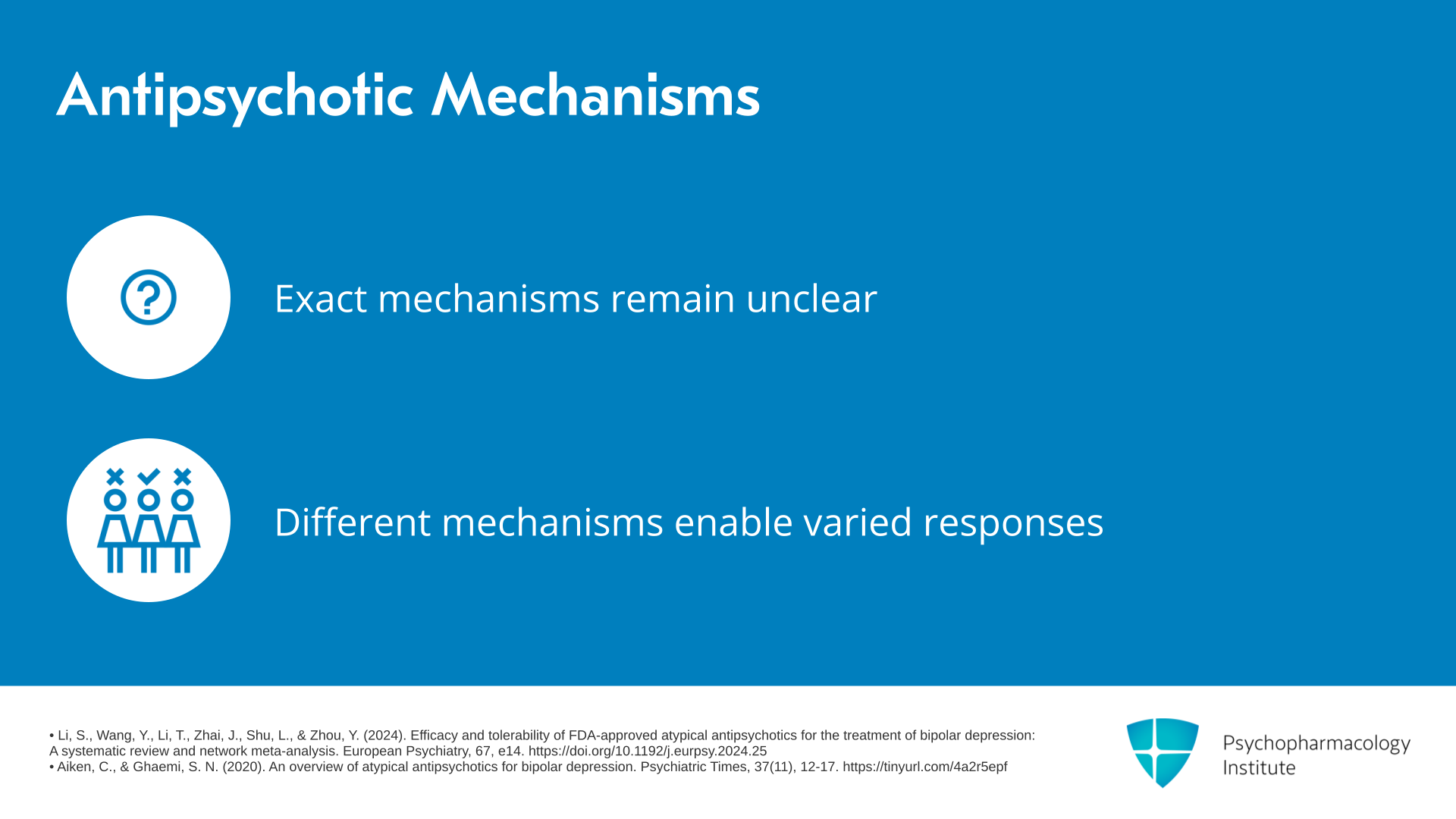
We don’t understand exactly how they work. They might be augmenting or enhancing dopamine D3 transmission or other serotonergic transmission. We don’t know exactly. But the proposed mechanisms are different for each of these, and that’s important to know because that means that patients may respond to one who don’t respond to another.
References:
- Li, S., Wang, Y., Li, T., Zhai, J., Shu, L., & Zhou, Y. (2024). Efficacy and tolerability of FDA-approved atypical antipsychotics for the treatment of bipolar depression: A systematic review and network meta-analysis. European Psychiatry, 67, e14. https://doi.org/10.1192/j.eurpsy.2024.25
- Aiken, C., & Ghaemi, S. N. (2020). An overview of atypical antipsychotics for bipolar depression. Psychiatric Times, 37(11), 12-17. https://tinyurl.com/4a2r5epf
Slide 4 of 23
But just as antipsychotics do not all treat bipolar depression, they also don’t all treat mania. Some antipsychotics like brexpiprazole, it actually failed in large trials of mania and others are untested. So we don’t want to use these for mania necessarily. And unfortunately, many of the ones that are FDA approved for bipolar depression are not approved in mania. Only two of them have approvals in both mood states, and those are quetiapine and cariprazine.
References:
- Aiken, C., & Ghaemi, S. N. (2020). An overview of atypical antipsychotics for bipolar depression. Psychiatric Times, 37(11), 12-17. https://tinyurl.com/4a2r5epf
- Vieta, E., Sachs, G., Chang, D., Hellsten, J., Brewer, C., Peters-Strickland, T., & Hefting, N. (2021). Two randomized, double-blind, placebo-controlled trials and one open-label, long-term trial of brexpiprazole for the acute treatment of bipolar mania. Journal of Psychopharmacology, 35(8), 971–982. https://doi.org/10.1177/0269881120985102
Free Files
Download PDF and other files
Success!
Check your inbox, we sent you all the materials there.
Slide 5 of 23
Asenapine. It’s not FDA approved in bipolar depression but it has two things that speak for it there. One is that it prevented bipolar depression in a large controlled trial, so that’s favorable. And in a very small randomized trial, it did treat bipolar depression. So there’s some possibility there. If all of the others have not worked or have caused problems, asenapine is one worth considering. And it also treats mania in mixed states. So you’ll find it useful for some patients but it’s definitely not your go-to.
References:
- Szegedi, A., Durgam, S., Mackle, M., Yu, S. Y., Wu, X., Mathews, M., & Landbloom, R. P. (2018). Randomized, double-blind, placebo-controlled trial of asenapine maintenance therapy in adults with an acute manic or mixed episode associated with bipolar I disorder. The American Journal of Psychiatry, 175(1), 71-79. https://doi.org/10.1176/appi.ajp.2017.16040419
- El-Mallakh, R. S., Nuss, S., Gao, D., Gao, Y., Ahmad, S. C., Schrodt, C., & Adler, C. (2020). Asenapine in the treatment of bipolar depression. Psychopharmacology Bulletin, 50(1), 8-18. https://doi.org/10.64719/pb.4597
Slide 6 of 23
Which of these is your go-to to start with? Well, that’s a tough one. Each is different. If your patient has a lot of anxiety and insomnia which many do, then quetiapine, Seroquel, is probably where you’re going to get the strongest effects ’cause unique among the antipsychotics quetiapine improves sleep.
References:
- Li, S., Wang, Y., Li, T., Zhai, J., Shu, L., & Zhou, Y. (2024). Efficacy and tolerability of FDA-approved atypical antipsychotics for the treatment of bipolar depression: A systematic review and network meta-analysis. European Psychiatry, 67, e14. https://doi.org/10.1192/j.eurpsy.2024.25
Free Files
Download PDF and other files
Success!
Check your inbox, we sent you all the materials there.
Slide 7 of 23
You might think, don’t they all improve sleep? They’re all sedatives, but only quetiapine in this list improved sleep quality as well and that makes a more meaningful difference for the patients’ lives. And quetiapine has unique antianxiety effects which have been proven in controlled trials, both with bipolar disorder and in generalized anxiety disorder where quetiapine almost got FDA approved. They had the data to show it worked in generalized anxiety disorder, but it didn’t get approved. The FDA thought probably rightfully so that this drug has too many side effects and risks to warrant widespread use in anxious patients everywhere. We don’t want everyone with anxiety to be taking quetiapine. But for bipolar anxiety, which is otherwise very difficult to treat, quetiapine is a good choice.
References:
- Li, S., Wang, Y., Li, T., Zhai, J., Shu, L., & Zhou, Y. (2024). Efficacy and tolerability of FDA-approved atypical antipsychotics for the treatment of bipolar depression: A systematic review and network meta-analysis. European Psychiatry, 67, e14. https://doi.org/10.1192/j.eurpsy.2024.25
- Hirschfeld, R. M., Weisler, R. H., Raines, S. R., Macfadden, W., & BOLDER Study Group. (2006). Quetiapine in the treatment of anxiety in patients with bipolar I or II depression: A secondary analysis from a randomized, double-blind, placebo-controlled study. The Journal of Clinical Psychiatry, 67(3), 355–362. https://doi.org/10.4088/jcp.v67n0304
Slide 8 of 23
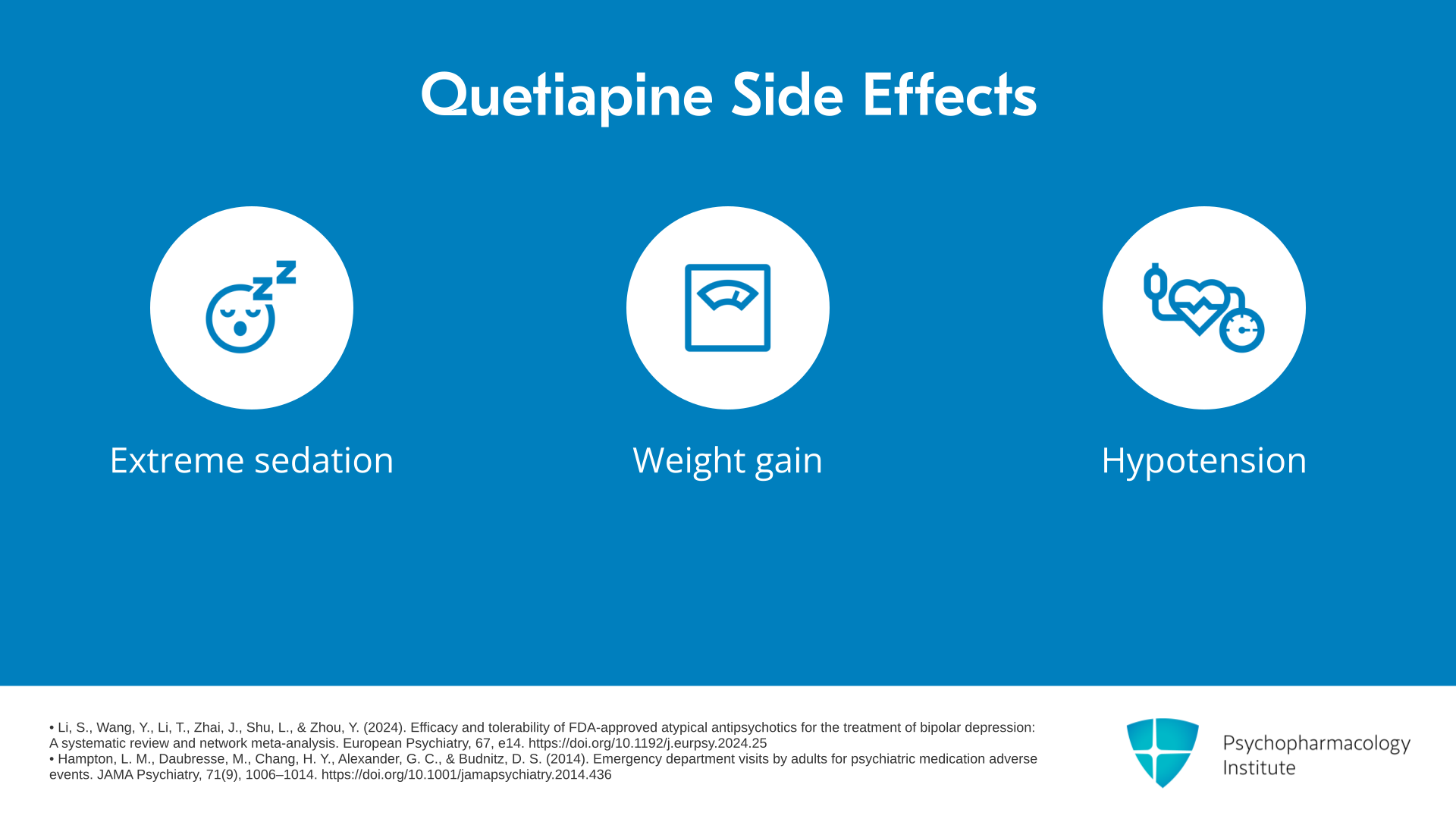
But there may be reasons you don’t want to start with quetiapine, like it’s extremely sedating for some patients and there’s a higher risk of weight gain with this one. So there’s a lot of tolerability problems that give me pause. In one study of patients who went to the emergency room because of side effects on psych meds, quetiapine was one of the top meds that brought them to the emergency room. Some patients were falling from low blood pressure on it. It can cause hypotension and some patients were bothered by the extreme fatigue.
References:
- Li, S., Wang, Y., Li, T., Zhai, J., Shu, L., & Zhou, Y. (2024). Efficacy and tolerability of FDA-approved atypical antipsychotics for the treatment of bipolar depression: A systematic review and network meta-analysis. European Psychiatry, 67, e14. https://doi.org/10.1192/j.eurpsy.2024.25
- Hampton, L. M., Daubresse, M., Chang, H. Y., Alexander, G. C., & Budnitz, D. S. (2014). Emergency department visits by adults for psychiatric medication adverse events. JAMA Psychiatry, 71(9), 1006–1014. https://doi.org/10.1001/jamapsychiatry.2014.436
Free Files
Download PDF and other files
Success!
Check your inbox, we sent you all the materials there.
Slide 9 of 23
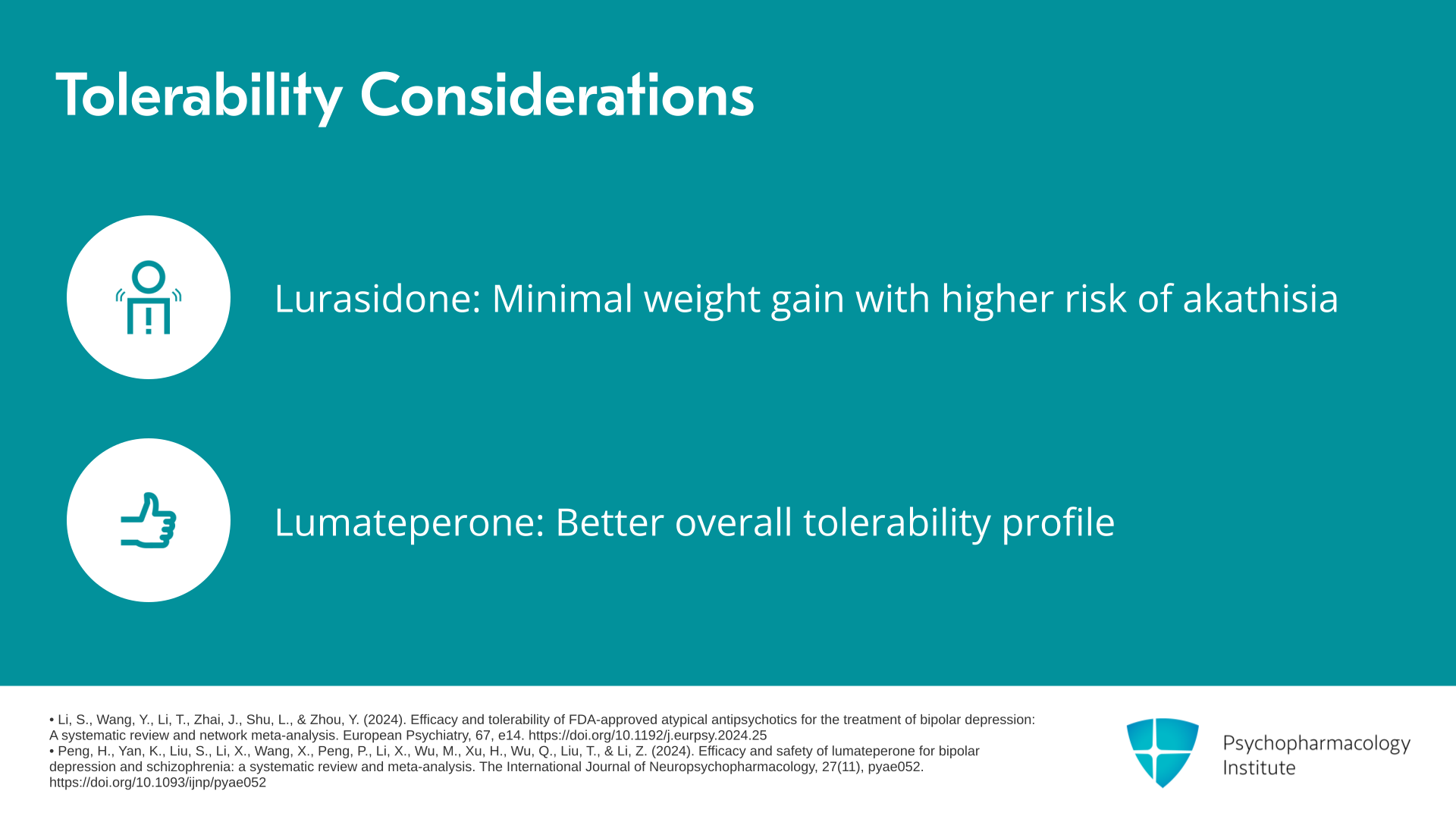
So if tolerability is more of a concern, you might want to choose lurasidone or lumateperone as your go-to. Lurasidone, fairly well tolerated on the metabolic and weight gain side, but it does have a higher risk of akathisia, that anxious, restless feeling that is very bothersome for many patients. Lumateperone is relatively well tolerated within this class. Its main risk is sedation, which is not so bad if you take it at night. Lumateperone has low rates of akathisia and weight gain. And here’s a tip about it. The PDR says to start it at 42 mg a day which is the treating dose. I think we’ve learned since it’s come out that you need to start it lower, and they’ve now created lower dosage forms to allow you to do that.
References:
- Li, S., Wang, Y., Li, T., Zhai, J., Shu, L., & Zhou, Y. (2024). Efficacy and tolerability of FDA-approved atypical antipsychotics for the treatment of bipolar depression: A systematic review and network meta-analysis. European Psychiatry, 67, e14. https://doi.org/10.1192/j.eurpsy.2024.25
- Peng, H., Yan, K., Liu, S., Li, X., Wang, X., Peng, P., Li, X., Wu, M., Xu, H., Wu, Q., Liu, T., & Li, Z. (2024). Efficacy and safety of lumateperone for bipolar depression and schizophrenia: a systematic review and meta-analysis. The International Journal of Neuropsychopharmacology, 27(11), pyae052. https://doi.org/10.1093/ijnp/pyae052
Slide 10 of 23
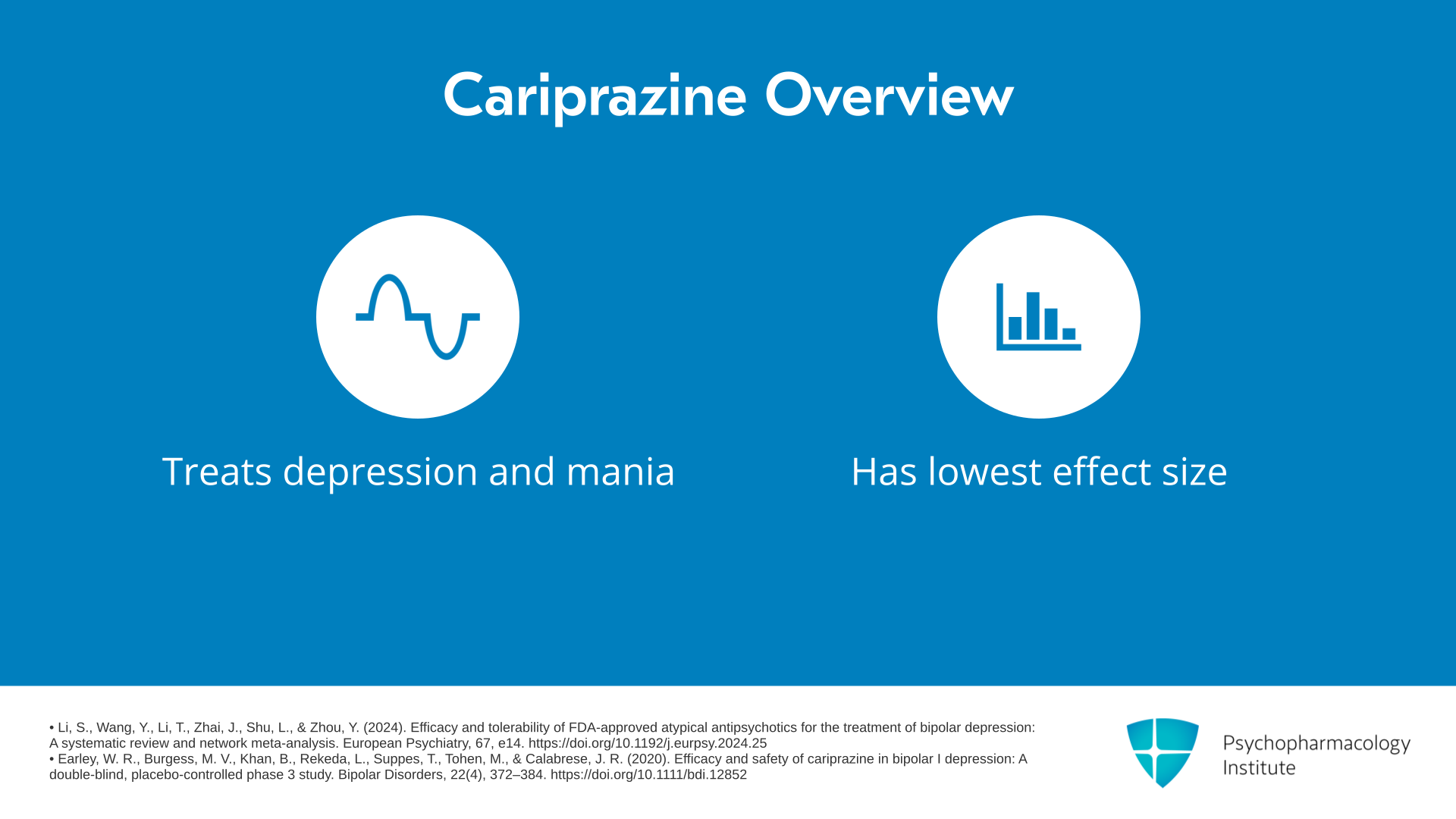
And cariprazine. Cariprazine is a great all-around drug within this class ’cause it treats depression and mania, and it’s relatively well tolerated within its class. So why would you not want to just go with that one? Well, it may not be as effective as the rest; it has the lowest effect size.
References:
- Li, S., Wang, Y., Li, T., Zhai, J., Shu, L., & Zhou, Y. (2024). Efficacy and tolerability of FDA-approved atypical antipsychotics for the treatment of bipolar depression: A systematic review and network meta-analysis. European Psychiatry, 67, e14. https://doi.org/10.1192/j.eurpsy.2024.25
- Earley, W. R., Burgess, M. V., Khan, B., Rekeda, L., Suppes, T., Tohen, M., & Calabrese, J. R. (2020). Efficacy and safety of cariprazine in bipolar I depression: A double-blind, placebo-controlled phase 3 study. Bipolar Disorders, 22(4), 372–384. https://doi.org/10.1111/bdi.12852
Free Files
Download PDF and other files
Success!
Check your inbox, we sent you all the materials there.
Slide 11 of 23
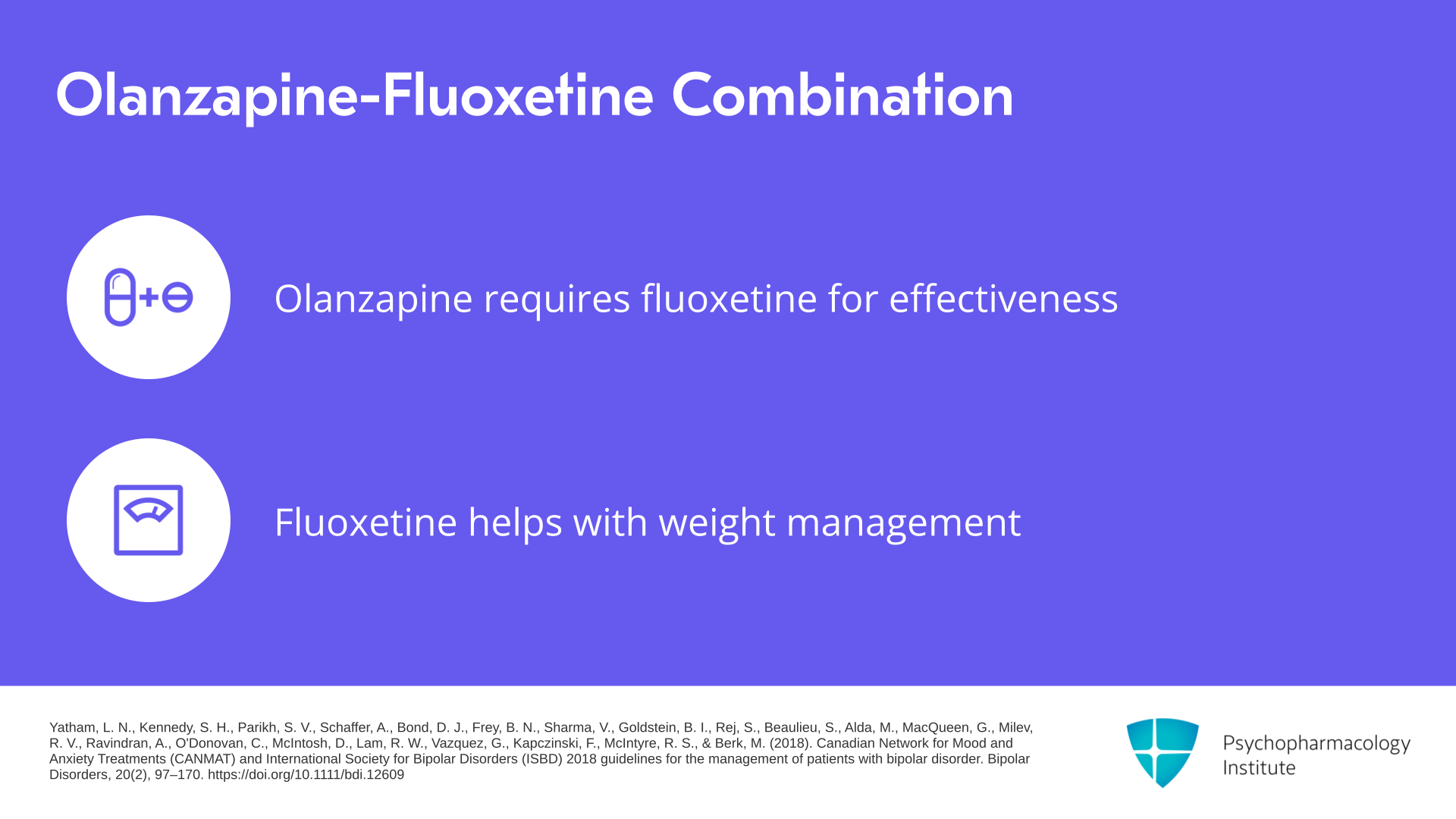
And then we have olanzapine-fluoxetine combination. This is the only one where the antipsychotic only worked in combination with the antidepressant so you have to use them together. And there are reasons to use it with fluoxetine besides the fact that it’s FDA approved that way. Fluoxetine can help a little with weight loss which is the biggest risk with olanzapine, and the reason many people avoid using this combination because it has the highest risk of metabolic problems and weight gain. So you shouldn’t go to it first line but you shouldn’t avoid it all together because it can be very effective for bipolar depression. It has a good effect size and there are patients where it will just change their life in a very positive way. And you will see patients who do not gain weight on it.
References:
- Yatham, L. N., Kennedy, S. H., Parikh, S. V., Schaffer, A., Bond, D. J., Frey, B. N., Sharma, V., Goldstein, B. I., Rej, S., Beaulieu, S., Alda, M., MacQueen, G., Milev, R. V., Ravindran, A., O'Donovan, C., McIntosh, D., Lam, R. W., Vazquez, G., Kapczinski, F., McIntyre, R. S., & Berk, M. (2018). Canadian Network for Mood and Anxiety Treatments (CANMAT) and International Society for Bipolar Disorders (ISBD) 2018 guidelines for the management of patients with bipolar disorder. Bipolar Disorders, 20(2), 97–170. https://doi.org/10.1111/bdi.12609
Slide 12 of 23
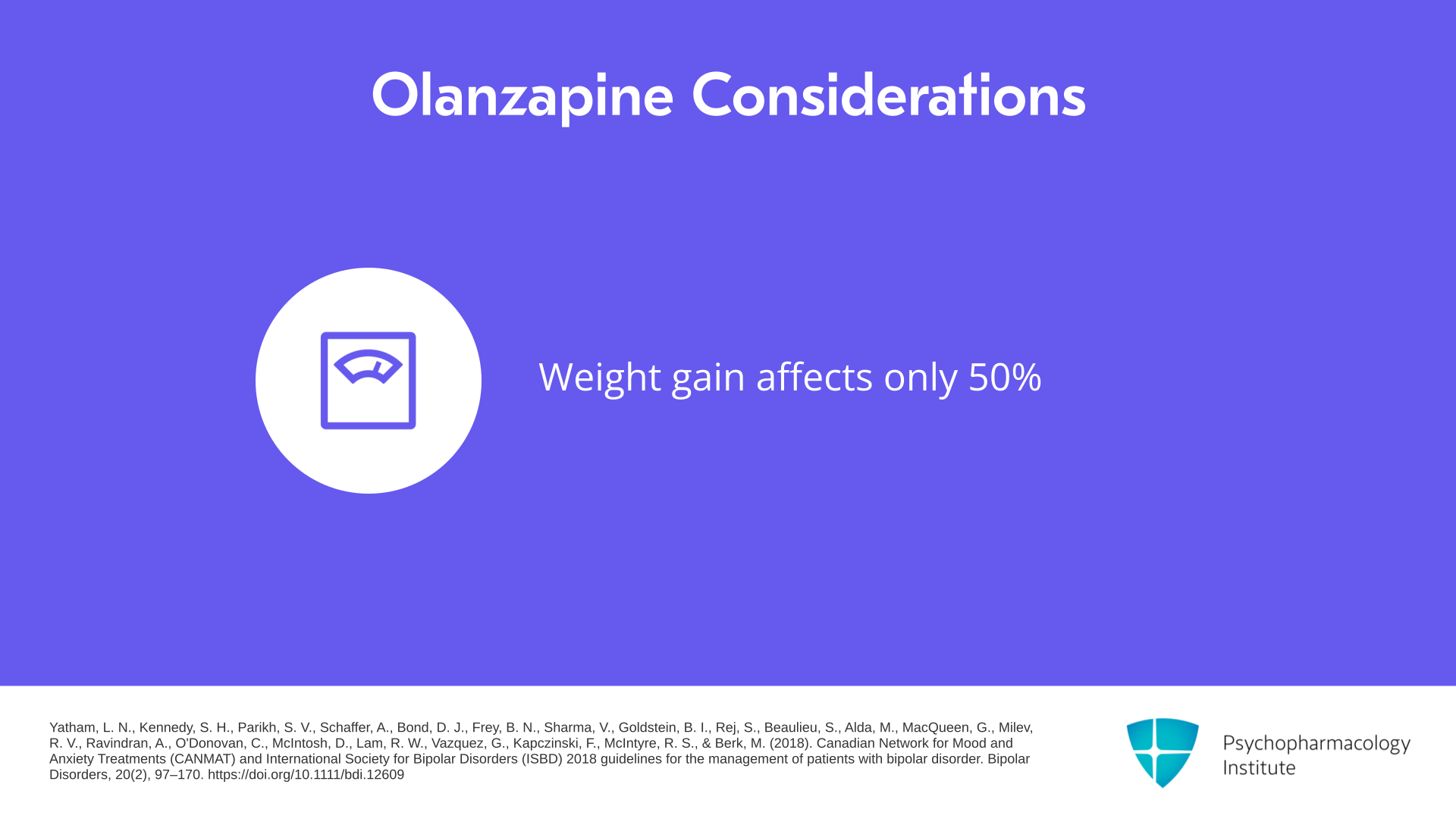
So let’s drop some of our stereotypes about these meds. Not everybody gains weight on olanzapine. Only about 50% of people gain significant weight which is a lot, but I have patients I see who complain to me that they don’t gain weight on olanzapine and they want to put on some weight. So it’s not a universal effect. It really depends on how the patient’s genes interact with the medication.
References:
- Yatham, L. N., Kennedy, S. H., Parikh, S. V., Schaffer, A., Bond, D. J., Frey, B. N., Sharma, V., Goldstein, B. I., Rej, S., Beaulieu, S., Alda, M., MacQueen, G., Milev, R. V., Ravindran, A., O'Donovan, C., McIntosh, D., Lam, R. W., Vazquez, G., Kapczinski, F., McIntyre, R. S., & Berk, M. (2018). Canadian Network for Mood and Anxiety Treatments (CANMAT) and International Society for Bipolar Disorders (ISBD) 2018 guidelines for the management of patients with bipolar disorder. Bipolar Disorders, 20(2), 97–170. https://doi.org/10.1111/bdi.12609
Free Files
Download PDF and other files
Success!
Check your inbox, we sent you all the materials there.
Slide 13 of 23
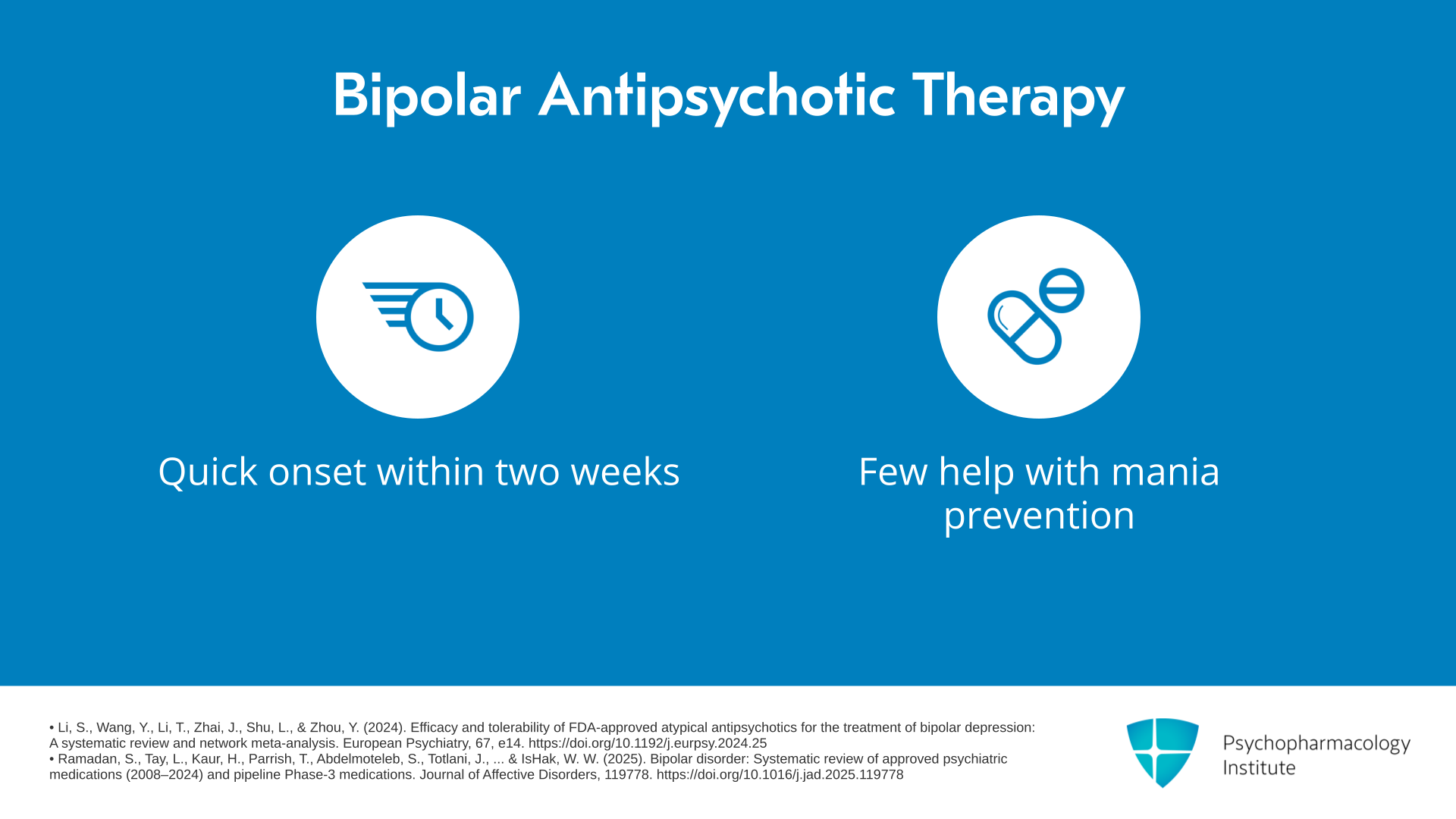
Bottom line is that you have a limited number of antipsychotics that help bipolar depression. They work quickly within two weeks. You might give them up to four weeks to see a full effect. And unfortunately, only a few of them are helpful at preventing and treating mania.
References:
- Li, S., Wang, Y., Li, T., Zhai, J., Shu, L., & Zhou, Y. (2024). Efficacy and tolerability of FDA-approved atypical antipsychotics for the treatment of bipolar depression: A systematic review and network meta-analysis. European Psychiatry, 67, e14. https://doi.org/10.1192/j.eurpsy.2024.25
- Ramadan, S., Tay, L., Kaur, H., Parrish, T., Abdelmoteleb, S., Totlani, J., … & IsHak, W. W. (2025). Bipolar disorder: Systematic review of approved psychiatric medications (2008–2024) and pipeline Phase-3 medications. Journal of Affective Disorders, 119778. https://doi.org/10.1016/j.jad.2025.119778
Slide 14 of 23
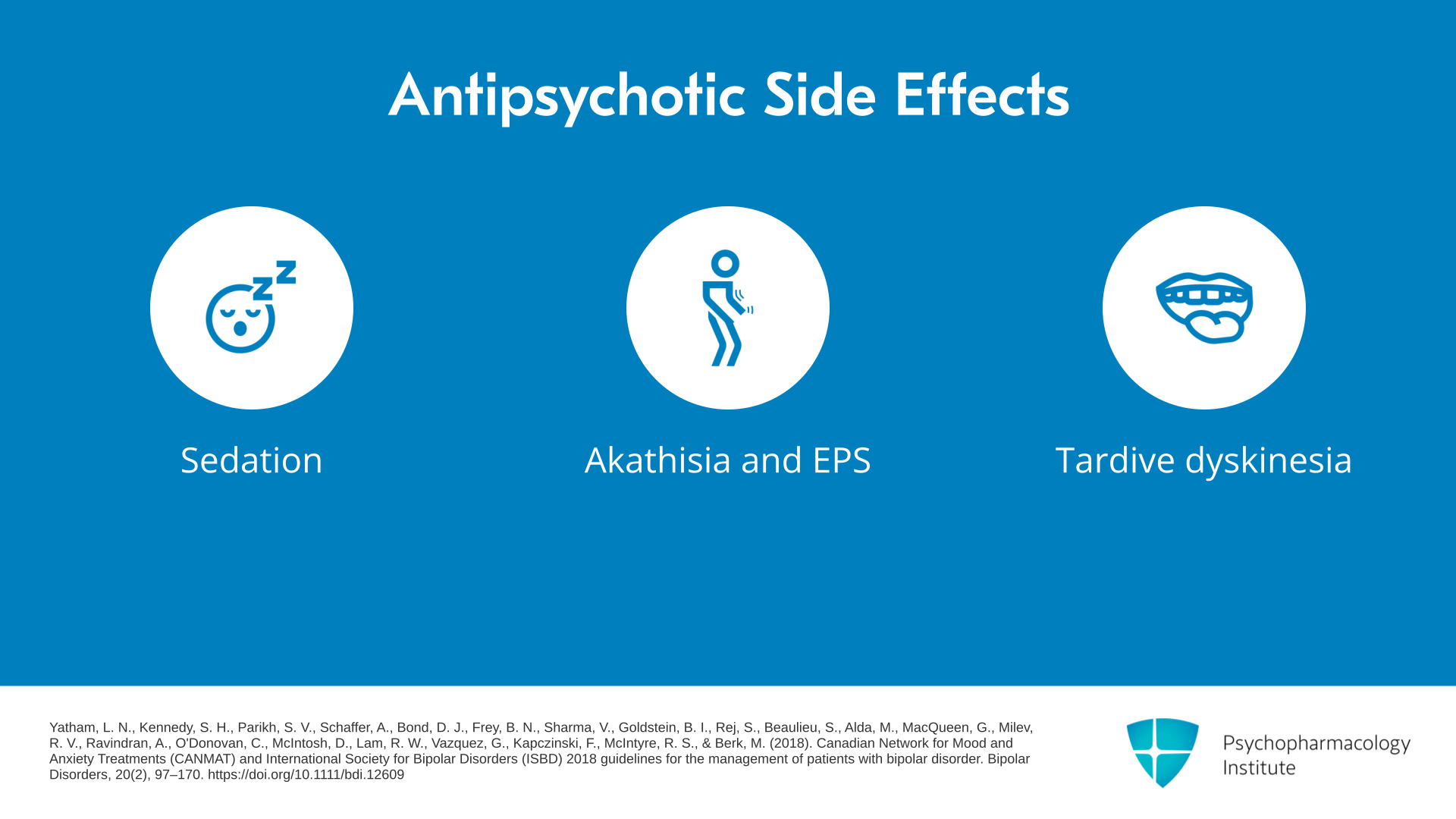
The other problem with antipsychotics is that you run into tolerability problems with most of these, whether it’s weight gain, sedation, hypotension, akathisia or various muscular problems like EPS and stiffness or with long-term use, tardive dyskinesia.
References:
- Yatham, L. N., Kennedy, S. H., Parikh, S. V., Schaffer, A., Bond, D. J., Frey, B. N., Sharma, V., Goldstein, B. I., Rej, S., Beaulieu, S., Alda, M., MacQueen, G., Milev, R. V., Ravindran, A., O'Donovan, C., McIntosh, D., Lam, R. W., Vazquez, G., Kapczinski, F., McIntyre, R. S., & Berk, M. (2018). Canadian Network for Mood and Anxiety Treatments (CANMAT) and International Society for Bipolar Disorders (ISBD) 2018 guidelines for the management of patients with bipolar disorder. Bipolar Disorders, 20(2), 97–170. https://doi.org/10.1111/bdi.12609
Free Files
Download PDF and other files
Success!
Check your inbox, we sent you all the materials there.
Slide 15 of 23
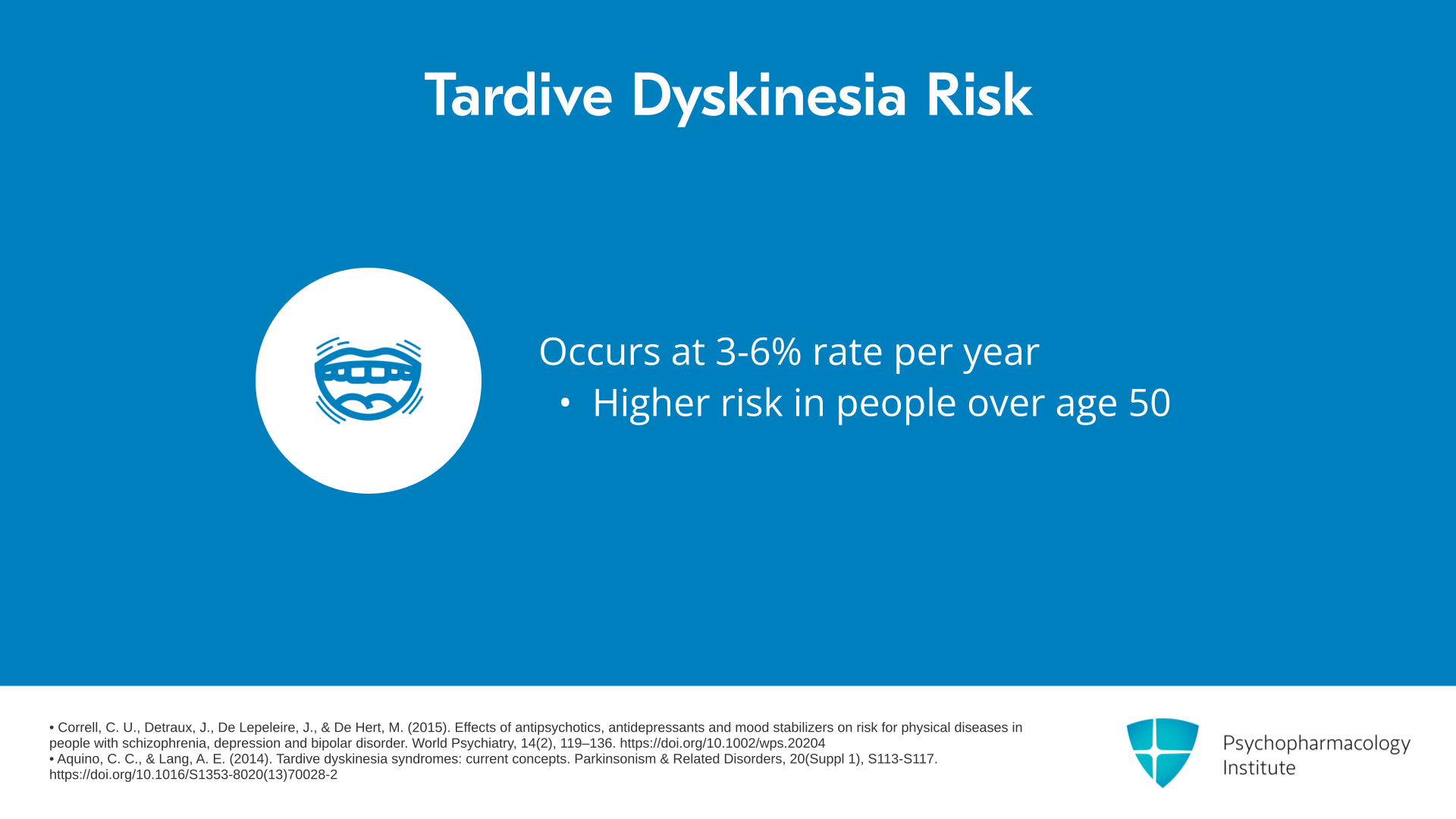
And tardive dyskinesia is surprisingly common even with this new generation of antipsychotics. It happens at a rate of 3% to 6% per year, higher risk in people over age 50. When you add that number up, that means that if you’ve been on an antipsychotic for about 10 years, your risk of getting tardive dyskinesia is 25%. So that’s a serious risk and something that makes me want to avoid these medications if we have other options.
References:
- Correll, C. U., Detraux, J., De Lepeleire, J., & De Hert, M. (2015). Effects of antipsychotics, antidepressants and mood stabilizers on risk for physical diseases in people with schizophrenia, depression and bipolar disorder. World Psychiatry, 14(2), 119–136. https://doi.org/10.1002/wps.20204
- Aquino, C. C., & Lang, A. E. (2014). Tardive dyskinesia syndromes: current concepts. Parkinsonism & Related Disorders, 20(Suppl 1), S113-S117. https://doi.org/10.1016/S1353-8020(13)70028-2
Slide 16 of 23
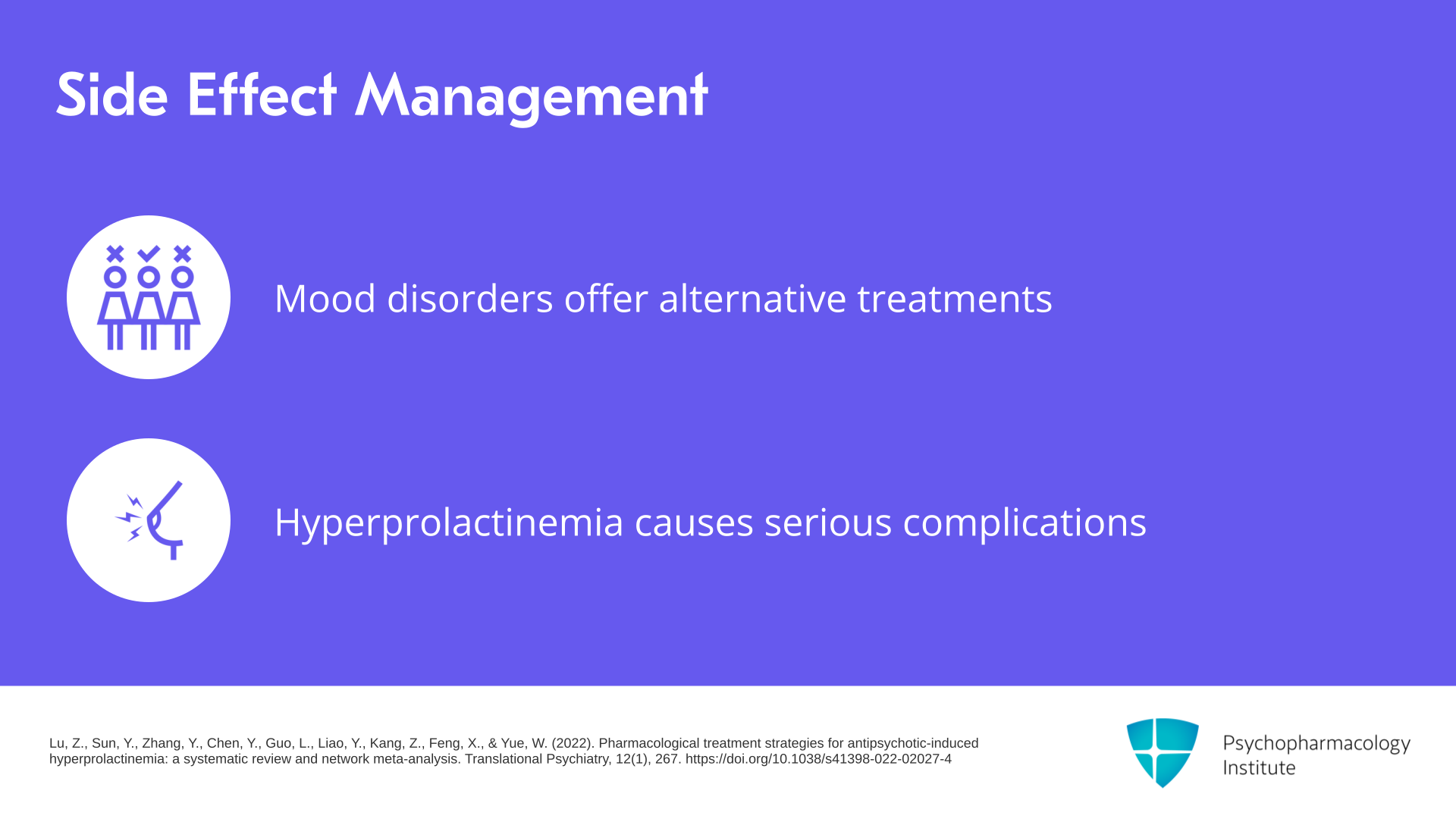
Then, there are a few side effects that would make me want to stop the antipsychotic in mood disorders. You know, in schizophrenia, we might have to keep it going. But in mood disorders, we have other options so we might stop the antipsychotic if they develop hyperprolactinemia, which can cause breast engorgement and increase the risk of cancer, and sexual dysfunction. We can treat hyperprolactinemia with, for example, bromocriptine 2.5 mg. Metformin also improves it a little bit, but it’s difficult to treat. So we might need to stop it.
References:
- Lu, Z., Sun, Y., Zhang, Y., Chen, Y., Guo, L., Liao, Y., Kang, Z., Feng, X., & Yue, W. (2022). Pharmacological treatment strategies for antipsychotic-induced hyperprolactinemia: a systematic review and network meta-analysis. Translational Psychiatry, 12(1), 267. https://doi.org/10.1038/s41398-022-02027-4
Free Files
Download PDF and other files
Success!
Check your inbox, we sent you all the materials there.
Slide 17 of 23
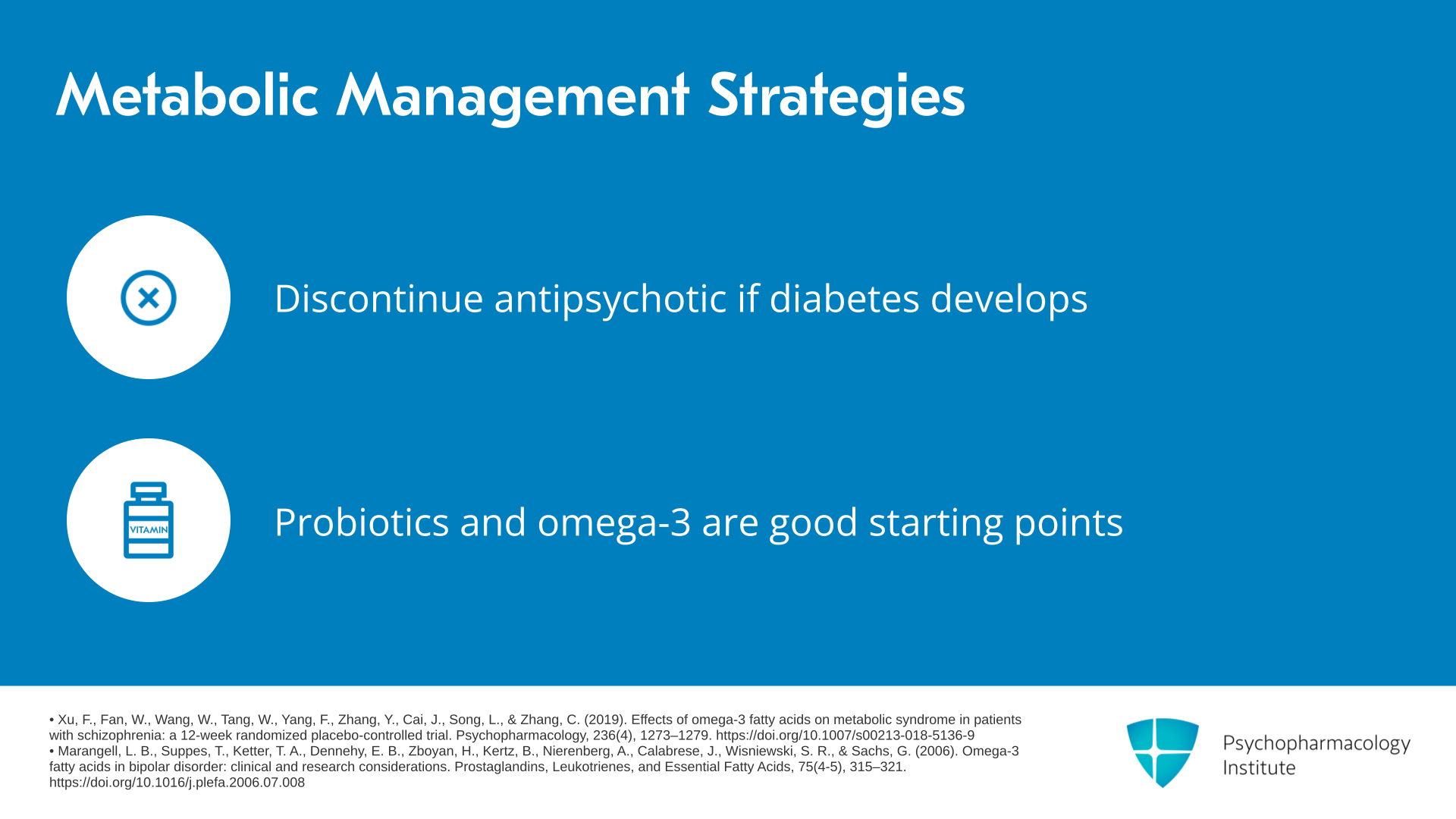
And finally, we’d want to discontinue the antipsychotic if they develop diabetes on it. And that brings us to the metabolic side effects, which are common on many of these, particularly quetiapine and olanzapine. And here are some strategies, from mild ones to more intensive ones, like the GLP-1 injections for antipsychotic weight gain. I like to start with probiotics and omega-3. Both of these have prevented metabolic effects in controlled trials, and both of them help bipolar depression. So they’re good places to start with.
References:
- Xu, F., Fan, W., Wang, W., Tang, W., Yang, F., Zhang, Y., Cai, J., Song, L., & Zhang, C. (2019). Effects of omega-3 fatty acids on metabolic syndrome in patients with schizophrenia: a 12-week randomized placebo-controlled trial. Psychopharmacology, 236(4), 1273–1279. https://doi.org/10.1007/s00213-018-5136-9
- Marangell, L. B., Suppes, T., Ketter, T. A., Dennehy, E. B., Zboyan, H., Kertz, B., Nierenberg, A., Calabrese, J., Wisniewski, S. R., & Sachs, G. (2006). Omega-3 fatty acids in bipolar disorder: clinical and research considerations. Prostaglandins, Leukotrienes, and Essential Fatty Acids, 75(4-5), 315–321. https://doi.org/10.1016/j.plefa.2006.07.008
Slide 18 of 23
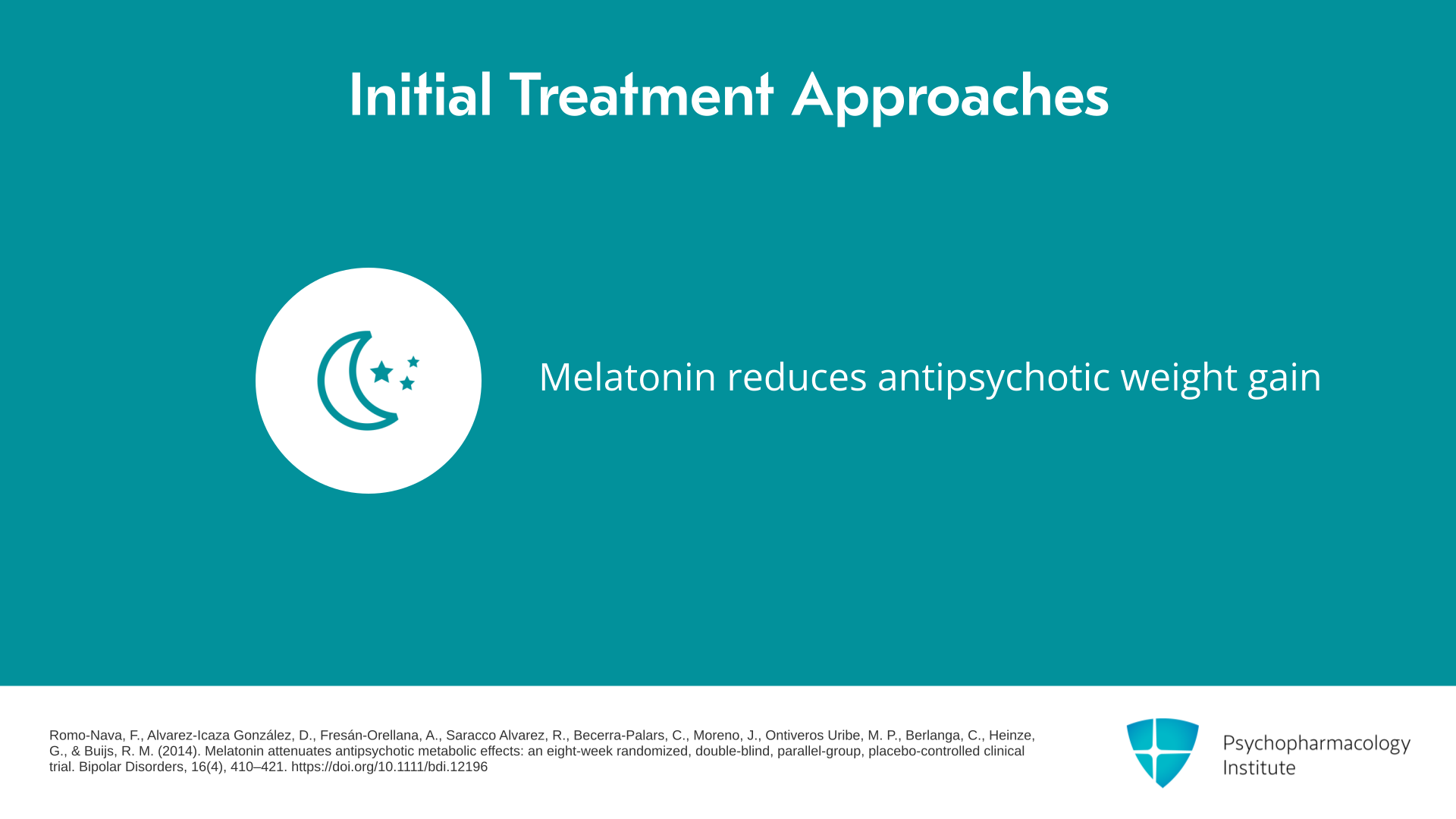
Melatonin helps reduce weight gain on antipsychotics a little bit. That’s from a few controlled trials and it’s part of the reason that we know people have less weight gain and fewer metabolic problems if they sleep well at night and they sleep in darkness allowing more melatonin in their brain but taking it also helps.
References:
- Romo-Nava, F., Alvarez-Icaza González, D., Fresán-Orellana, A., Saracco Alvarez, R., Becerra-Palars, C., Moreno, J., Ontiveros Uribe, M. P., Berlanga, C., Heinze, G., & Buijs, R. M. (2014). Melatonin attenuates antipsychotic metabolic effects: an eight-week randomized, double-blind, parallel-group, placebo-controlled clinical trial. Bipolar Disorders, 16(4), 410–421. https://doi.org/10.1111/bdi.12196
Free Files
Download PDF and other files
Success!
Check your inbox, we sent you all the materials there.
Slide 19 of 23
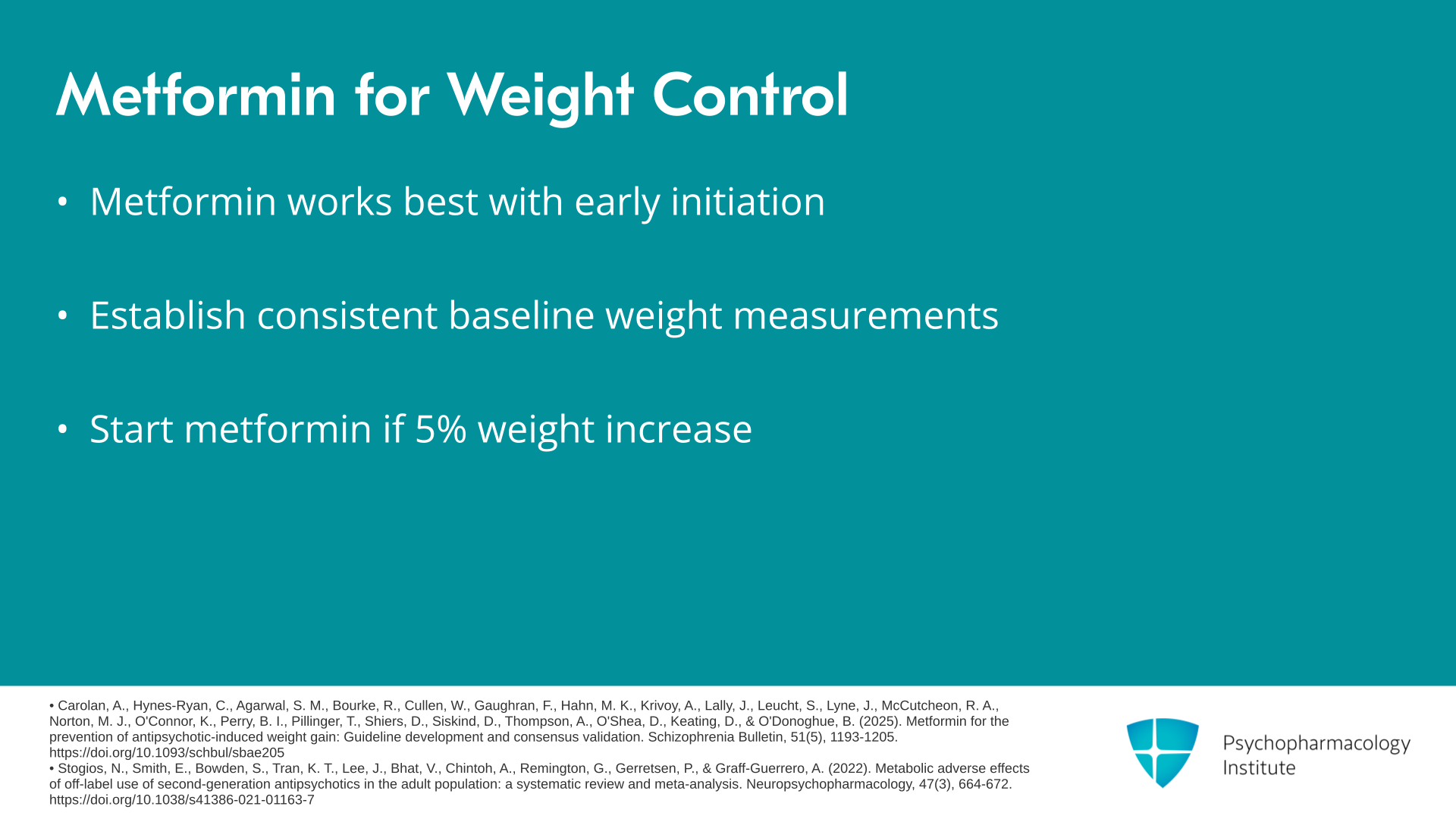
Then, we get into more pharmacologic approaches. I start with metformin. Metformin is one that works best if you start it early before the weight gain gets out of control. The way to do that is have the patient get a good body weight, that’s naked in the morning on the same scale after using the bathroom and before eating breakfast. So get a stable weight before starting the medicine and a month later. If they’ve gained 5% or more of their weight in that one-month period, then you know they’re at high risk of continuing to gain weight, and you may want to start metformin to prevent that problem there.
References:
- Carolan, A., Hynes-Ryan, C., Agarwal, S. M., Bourke, R., Cullen, W., Gaughran, F., Hahn, M. K., Krivoy, A., Lally, J., Leucht, S., Lyne, J., McCutcheon, R. A., Norton, M. J., O'Connor, K., Perry, B. I., Pillinger, T., Shiers, D., Siskind, D., Thompson, A., O'Shea, D., Keating, D., & O'Donoghue, B. (2025). Metformin for the prevention of antipsychotic-induced weight gain: Guideline development and consensus validation. Schizophrenia Bulletin, 51(5), 1193-1205. https://doi.org/10.1093/schbul/sbae205
- Stogios, N., Smith, E., Bowden, S., Tran, K. T., Lee, J., Bhat, V., Chintoh, A., Remington, G., Gerretsen, P., & Graff-Guerrero, A. (2022). Metabolic adverse effects of off-label use of second-generation antipsychotics in the adult population: a systematic review and meta-analysis. Neuropsychopharmacology, 47(3), 664-672. https://doi.org/10.1038/s41386-021-01163-7
Slide 20 of 23
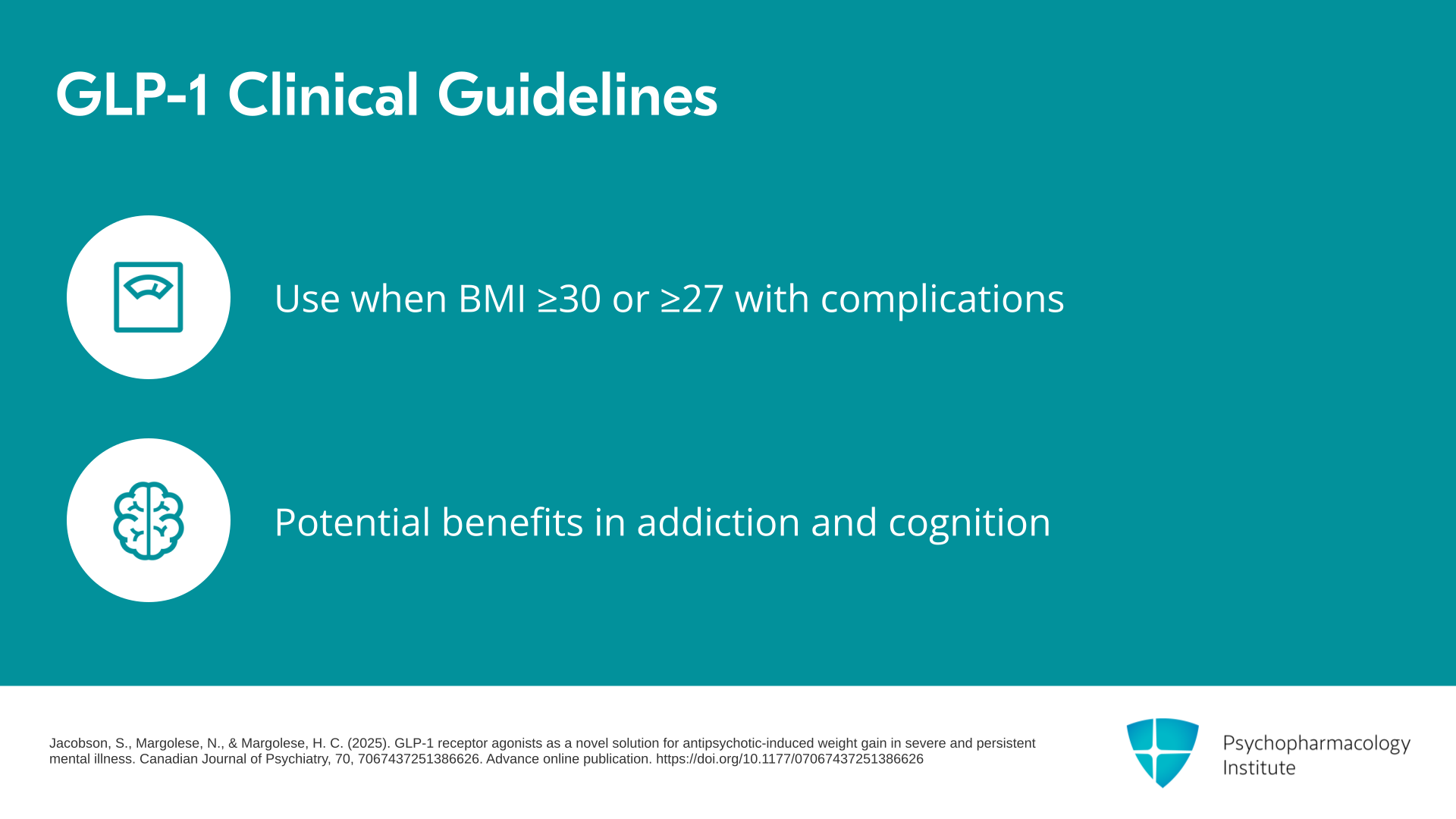
The GLP-1 agonists are more useful once weight gain is out of control. In fact, I wouldn’t recommend them unless the patient’s BMI is at or over 30 or a cutoff of 27 if they have medical complications of obesity like hypertension or dyslipidemia. Those are the FDA guidelines and I would follow them because there are risks with these medications. The GLP-1s are useful and have a good risk profile if the obesity is a serious problem. They also have potential benefits in addiction and cognition.
References:
- Jacobson, S., Margolese, N., & Margolese, H. C. (2025). GLP-1 receptor agonists as a novel solution for antipsychotic-induced weight gain in severe and persistent mental illness. Canadian Journal of Psychiatry, 70, 7067437251386626. Advance online publication. https://doi.org/10.1177/07067437251386626
Free Files
Download PDF and other files
Success!
Check your inbox, we sent you all the materials there.
Slide 21 of 23
And then there’s topiramate which is useful for a lot of comorbidities like OCD and PTSD and substance use disorders and bulimia, comorbidities you often see in bipolar disorder. So it has a its role and it’s pretty good at taking off some weight. Usually, it takes it off for about 6 to 12 months and then you don’t get any benefit after that.
References:
- Guille, C., Grant, J. E., & Vytopil, M. (2002). Clinical outcome of adjunctive topiramate treatment in a sample of patients with bipolar disorder. Progress in Neuro-Psychopharmacology and Biological Psychiatry, 26(2), 363–367. https://doi.org/10.1016/S0278-5846(01)00278-0
Slide 22 of 23
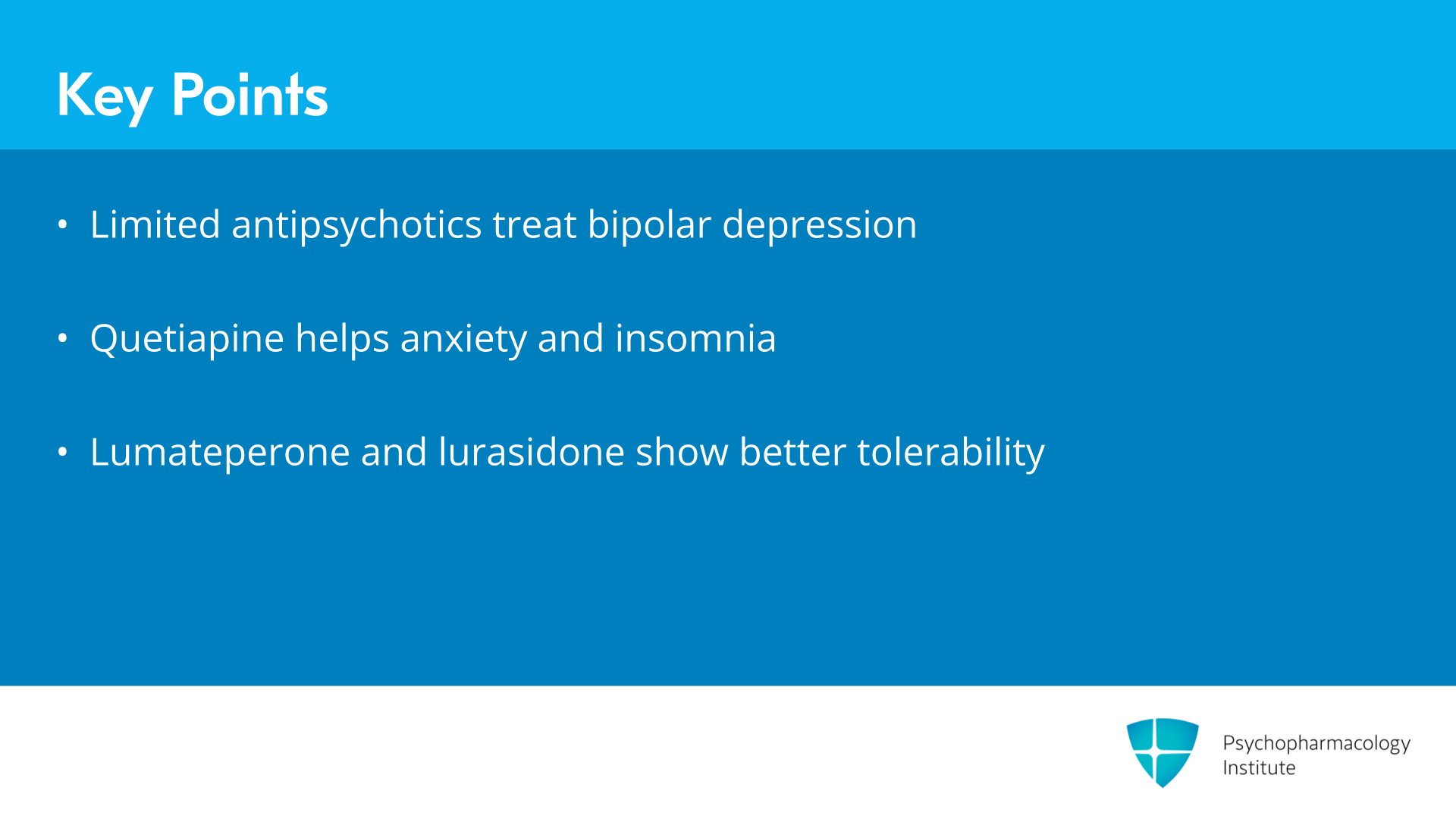
Let’s close with our key points. Only a handful of antipsychotics treat bipolar depression. They are cariprazine, lumateperone, lurasidone, olanzapine-fluoxetine combination, and quetiapine. And only two of these have antimanic effects – cariprazine and quetiapine. Among them, quetiapine stands out for its benefits in anxiety and insomnia, while lumateperone and lurasidone stand out for their relative tolerability.
Free Files
Download PDF and other files
Success!
Check your inbox, we sent you all the materials there.
Slide 23 of 23
Antipsychotics are best reserved for short-term use like around six months, because of their long-term risks of tardive dyskinesia and metabolic syndrome.