Close Banner
Free Section  - Video Lectures

07. Implementing Hyperbolic Antidepressant Tapering: Formulation Options and Clinical Considerations

Published on September 1, 2025 Certification expiration date: September 1, 2028

Mark Horowitz, M.D.

Clinical Research Fellow in Psychiatry - National Health Service (NHS)

Key Points

  • Use tablet cutters, liquid preparations, or compounding pharmacies when implementing hyperbolic tapering for antidepressants.
  • Consider off-label tapering options like crushing tablets or counting beads from capsules when smaller doses are needed.
  • Fluoxetine is not self-tapering; withdrawal effects may take six weeks to appear due to its long half-life.

Free Downloads for Offline Access

  • Free Download Video (MP4)
  • Free Download Audio File (MP3)
  • Free Download PDF File

Slides and Transcript

Slide 1 of 12

So we’ve talked through the theory of hyperbolic tapering and the next step is how is this implemented in clinical practice.

Slide 2 of 12

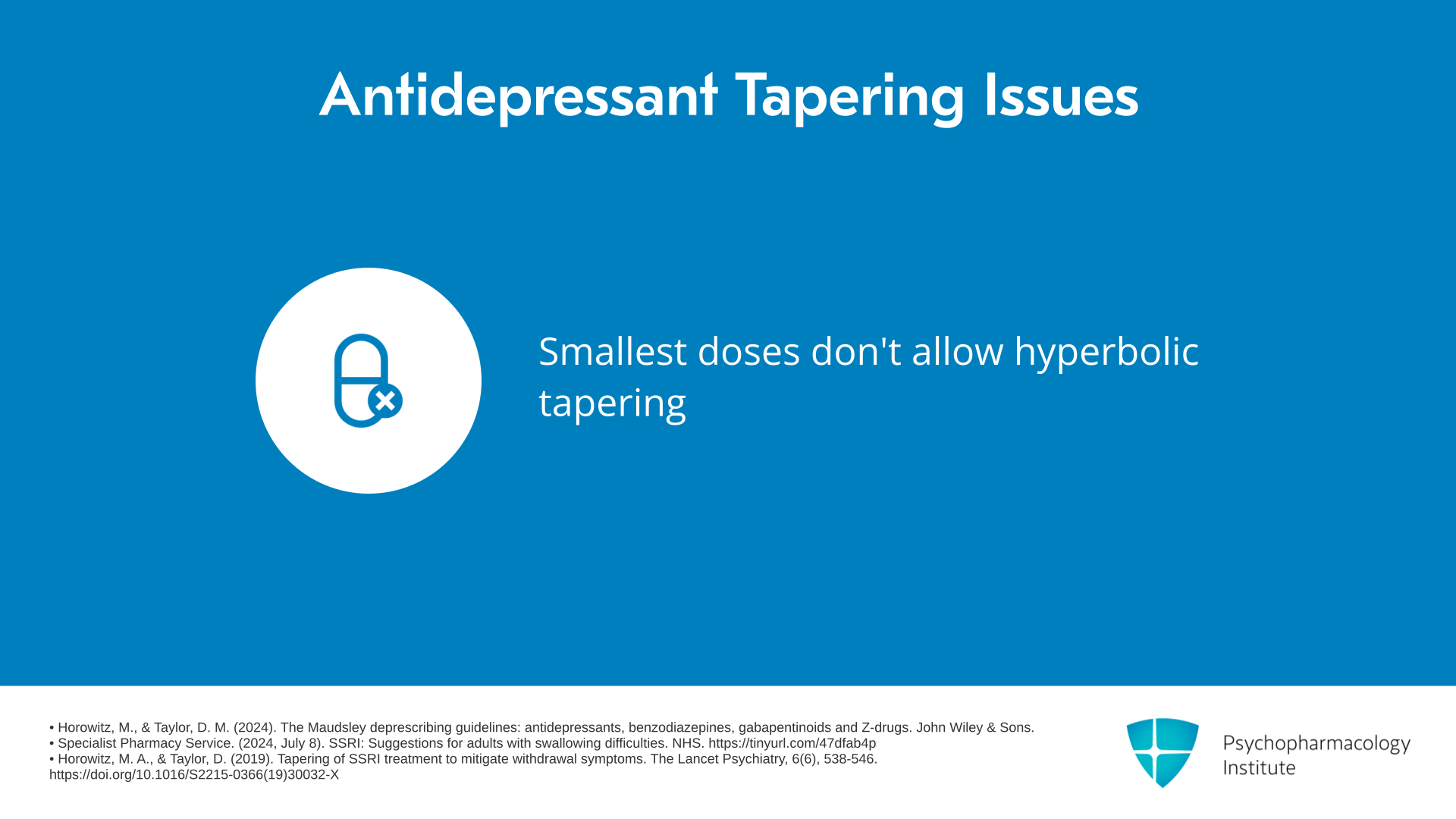
This presents somewhat of an issue, because most of the smallest available tablets or capsules of antidepressants in the US do not allow hyperbolic tapering, and so there are other options that need to be used.
References:
  • Horowitz, M., & Taylor, D. M. (2024). The Maudsley deprescribing guidelines: antidepressants, benzodiazepines, gabapentinoids and Z-drugs. John Wiley & Sons.
  • Specialist Pharmacy Service. (2024, July 8). SSRI: Suggestions for adults with swallowing difficulties. NHS. https://tinyurl.com/47dfab4p
  • Horowitz, M. A., & Taylor, D. (2019). Tapering of SSRI treatment to mitigate withdrawal symptoms. The Lancet Psychiatry, 6(6), 538-546. https://doi.org/10.1016/S2215-0366(19)30032-X
Free Files
Success!
Check your inbox, we sent you all the materials there.

Slide 3 of 12

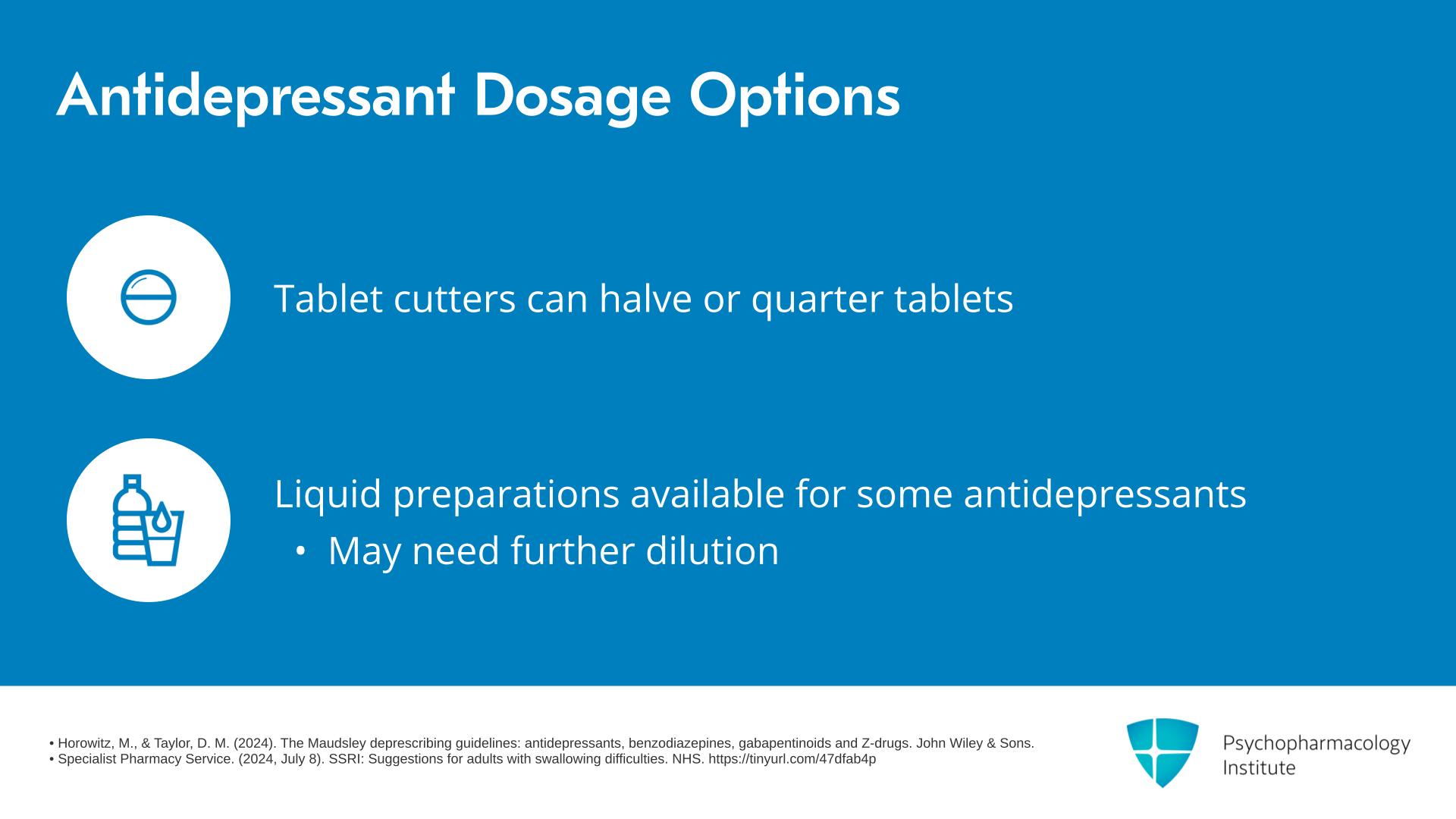
So tablet cutters may be useful to halve or quarter tablets, but at some point even that will not be small enough. Liquid preparations are made by the manufacturer for some but not all antidepressants in the US, and that can be useful. Some of those may need to be diluted further because they can be quite concentrated. You can add water to many of them without causing significant issues with dilutions.
References:
  • Horowitz, M., & Taylor, D. M. (2024). The Maudsley deprescribing guidelines: antidepressants, benzodiazepines, gabapentinoids and Z-drugs. John Wiley & Sons.
  • Specialist Pharmacy Service. (2024, July 8). SSRI: Suggestions for adults with swallowing difficulties. NHS. https://tinyurl.com/47dfab4p

Slide 4 of 12

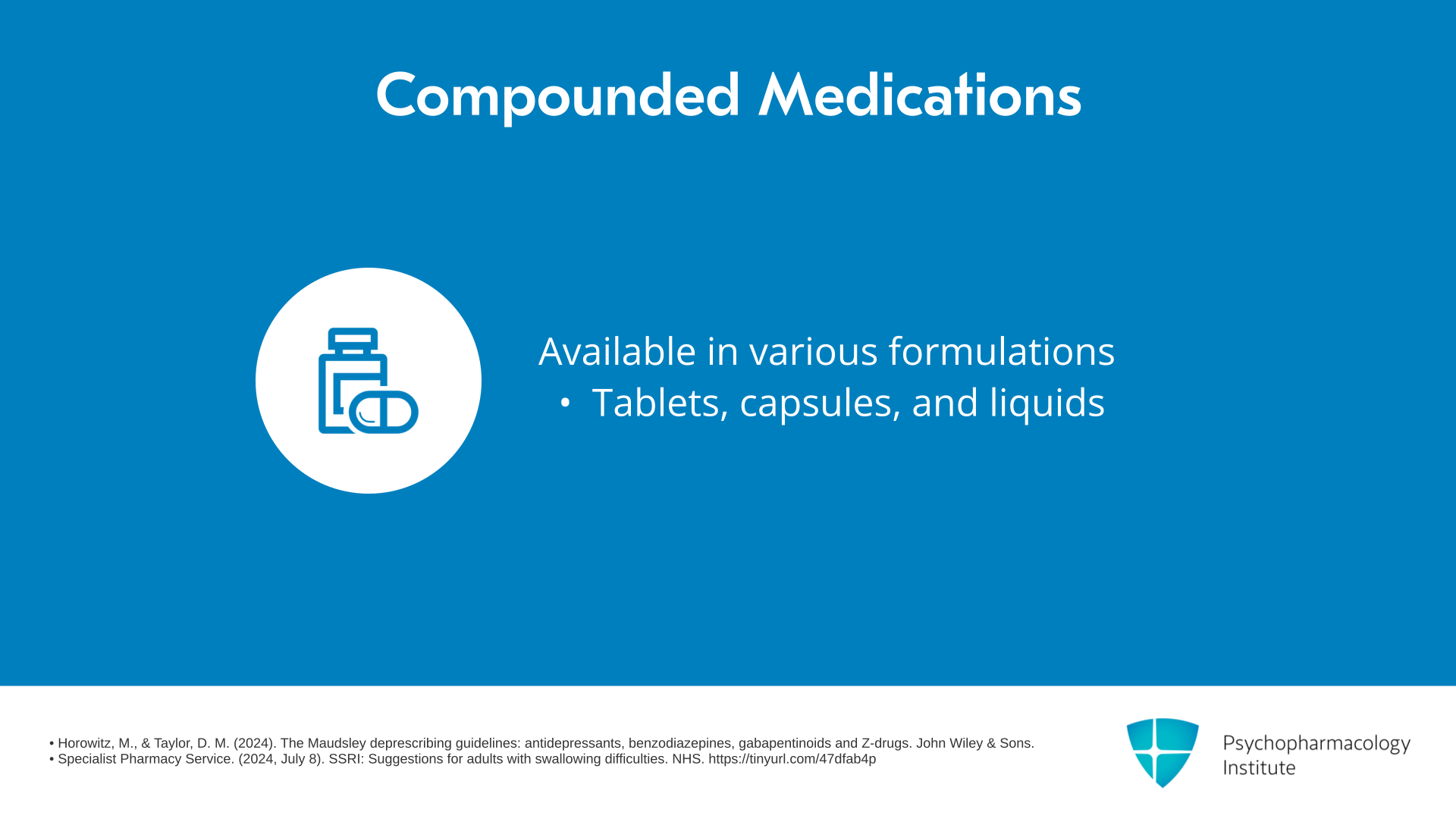
Compounded medications can be helpful. Compounded medications can be made as tablets or capsules or liquids, widely available from compounding pharmacies with differing prices.
References:
  • Horowitz, M., & Taylor, D. M. (2024). The Maudsley deprescribing guidelines: antidepressants, benzodiazepines, gabapentinoids and Z-drugs. John Wiley & Sons.
  • Specialist Pharmacy Service. (2024, July 8). SSRI: Suggestions for adults with swallowing difficulties. NHS. https://tinyurl.com/47dfab4p
Free Files
Success!
Check your inbox, we sent you all the materials there.

Slide 5 of 12

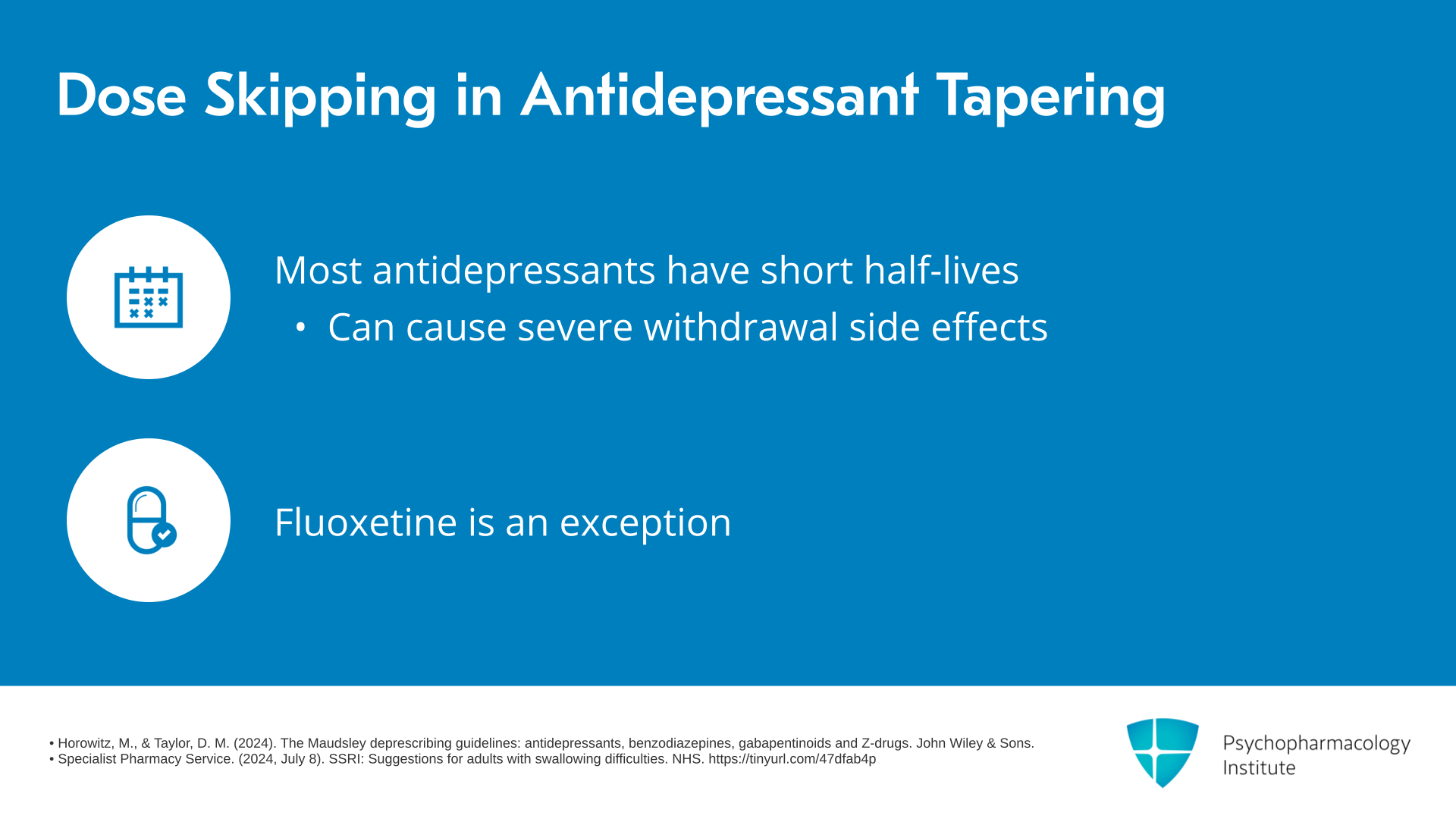
Some clinicians try to approximate these regimes by skipping doses. That is problematic for many antidepressants, because they have a half-life of 24 hours or less. Giving an antidepressant every second or third day can cause wildly up and down plasma levels, which can give people severe withdrawal side effects in some cases. The exception to that is probably fluoxetine, but it’s worth saying about fluoxetine that although the APA recommends switching to fluoxetine and many guidelines do that, fluoxetine is not a self-tapering drug as it’s sometimes advertised.
References:
  • Horowitz, M., & Taylor, D. M. (2024). The Maudsley deprescribing guidelines: antidepressants, benzodiazepines, gabapentinoids and Z-drugs. John Wiley & Sons.
  • Specialist Pharmacy Service. (2024, July 8). SSRI: Suggestions for adults with swallowing difficulties. NHS. https://tinyurl.com/47dfab4p

Slide 6 of 12

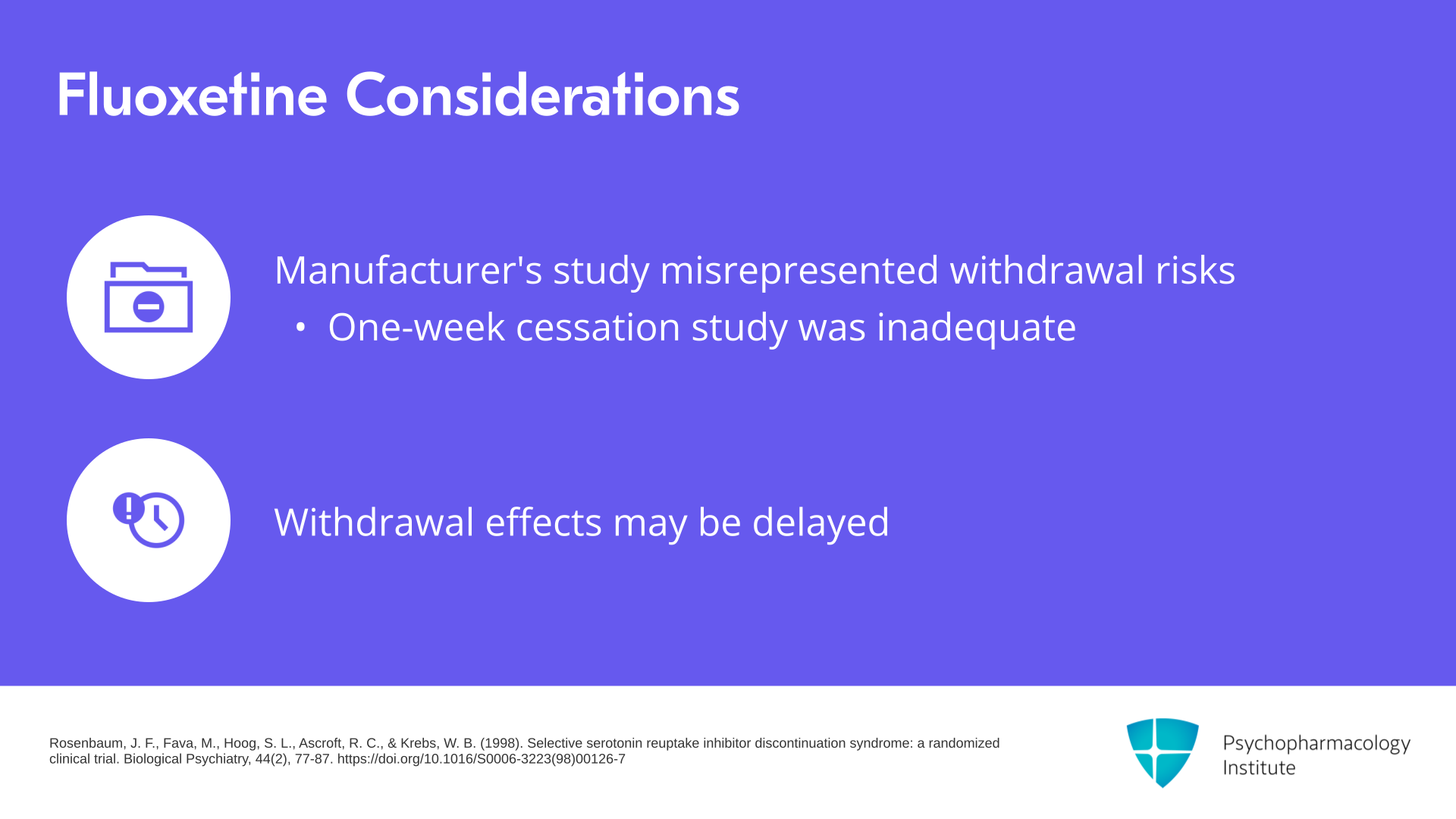
That actually arises from a study that the manufacturer did in the 1990s where they took people on fluoxetine and stopped the drug for a week, and showed that they didn’t have many withdrawal effects. That was a sleight of hand by the manufacturer because the elimination half-life of fluoxetine is about 7 to 15 days, that’s for the active norfluoxetine active metabolite. And so most people will not experience withdrawal effects within a week. It will take six weeks or longer for withdrawal effects to occur. And so this study greatly misrepresented the risk of withdrawal effects from fluoxetine, and people can have delayed onset withdrawal effects commonly with fluoxetine. And so it should be also carefully tapered as for other antidepressants, and not mistaken as a self-tapering drug.
References:
  • Rosenbaum, J. F., Fava, M., Hoog, S. L., Ascroft, R. C., & Krebs, W. B. (1998). Selective serotonin reuptake inhibitor discontinuation syndrome: a randomized clinical trial. Biological Psychiatry, 44(2), 77-87. https://doi.org/10.1016/S0006-3223(98)00126-7
Free Files
Success!
Check your inbox, we sent you all the materials there.

Slide 7 of 12

There are also off-label options for tapering, that is ways of manipulating the drugs that is not approved by the manufacturer. About 1 in 4 prescriptions in America are off-label, so this is not unusual.
References:
  • Specialist Pharmacy Service. (2024, July 8). SSRI: Suggestions for adults with swallowing difficulties. NHS. https://tinyurl.com/47dfab4p

Slide 8 of 12

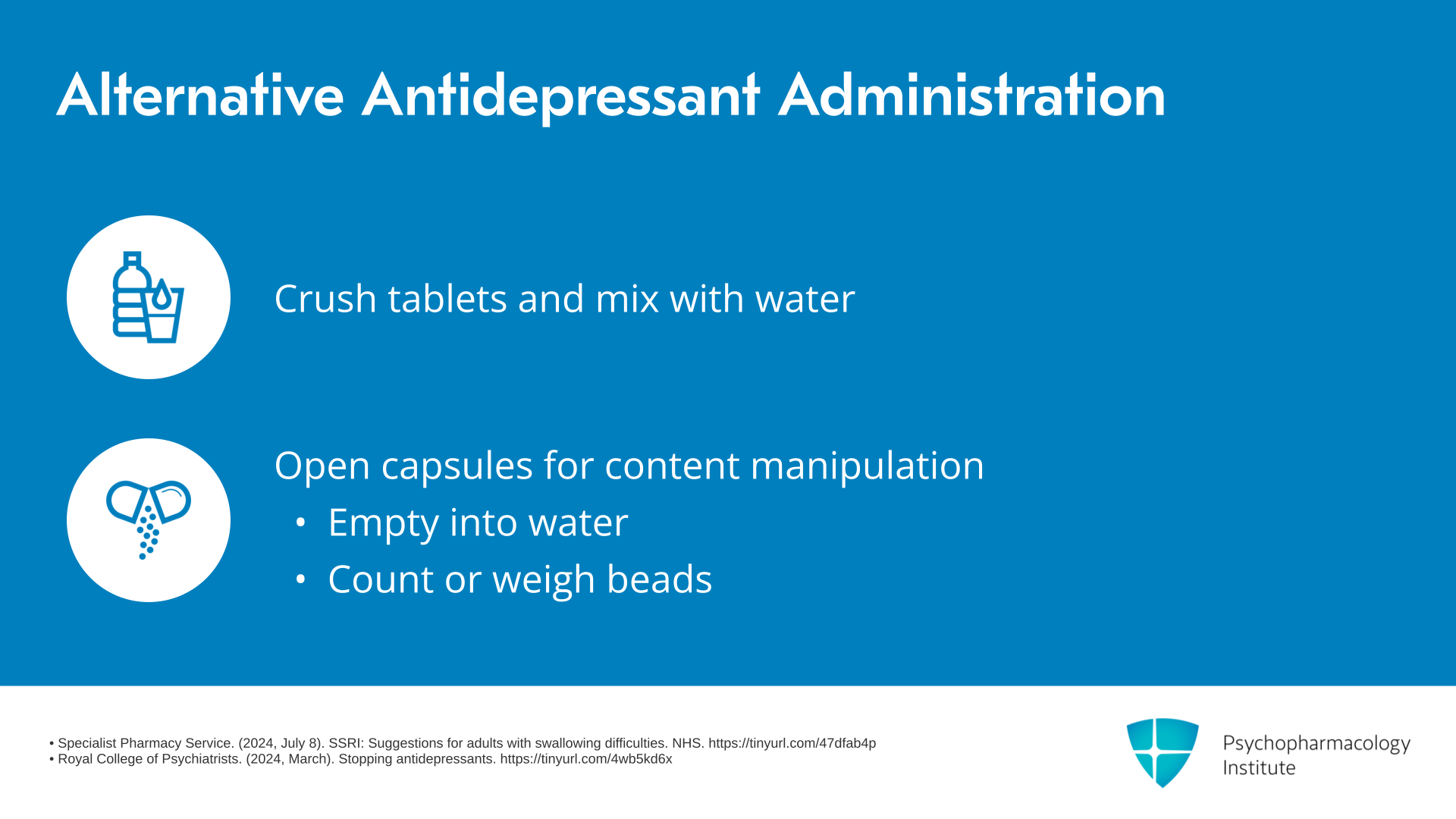
For example, in the UK, the government gives advice on how to crush up tablets of antidepressants mixing them with water to give to people who can’t swallow like old people or children. Other things like opening up capsules to empty the contents into water or to open up capsules like venlafaxine or duloxetine, Effexor or Cymbalta, to count or weigh the beads inside is another option.
References:
  • Specialist Pharmacy Service. (2024, July 8). SSRI: Suggestions for adults with swallowing difficulties. NHS. https://tinyurl.com/47dfab4p
  • Royal College of Psychiatrists. (2024, March). Stopping antidepressants. https://tinyurl.com/4wb5kd6x
Free Files
Success!
Check your inbox, we sent you all the materials there.

Slide 9 of 12

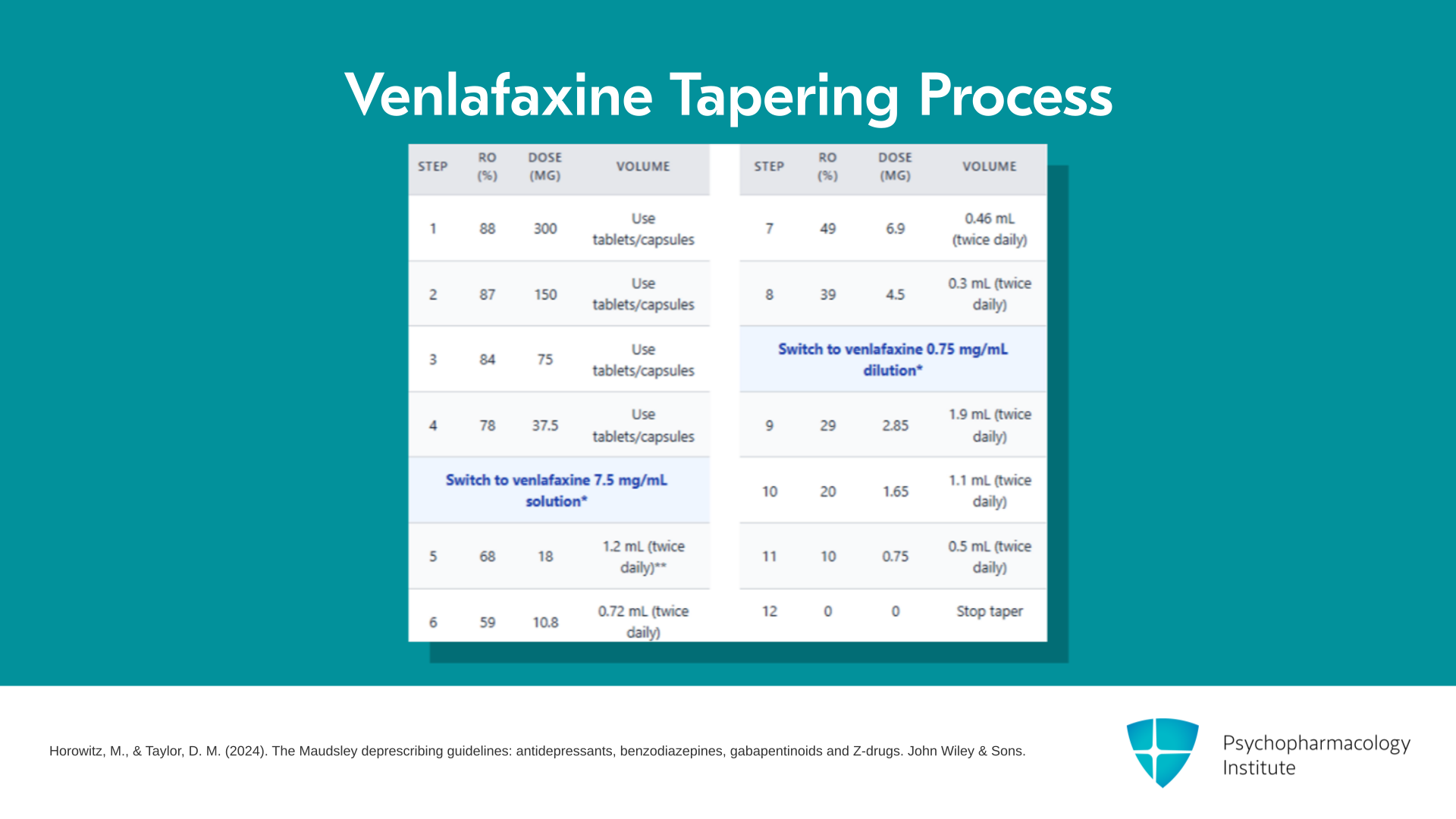
This is from the Maudsley Deprescribing Guidelines. It outlines this would be probably for a shorter-term user because venlafaxine can be a very difficult drug to stop, and this might be appropriate for someone who had used the drug for perhaps a few months or a year. And it shows step by step what dose to reduce to every two to four weeks, starting at 300 mg, reducing to 150 to 75 to 37.5. Below that, so people might want to stop at the smallest available capsule, but actually that has a very large effect on target receptors. So actually, 7/8 is as much as 300 mg and so it’s much more prudent to go down using a liquid version of a drug or a compounded capsule to go down through 18, 10.8, 6.9, etc., all the way down to 0.75 mg before stopping. And many people who were unable to come off the drugs will experience great difficulty in stopping from 37.5 or taking that every second day will be able to stop in this way.
References:
  • Horowitz, M., & Taylor, D. M. (2024). The Maudsley deprescribing guidelines: antidepressants, benzodiazepines, gabapentinoids and Z-drugs. John Wiley & Sons.

Slide 10 of 12

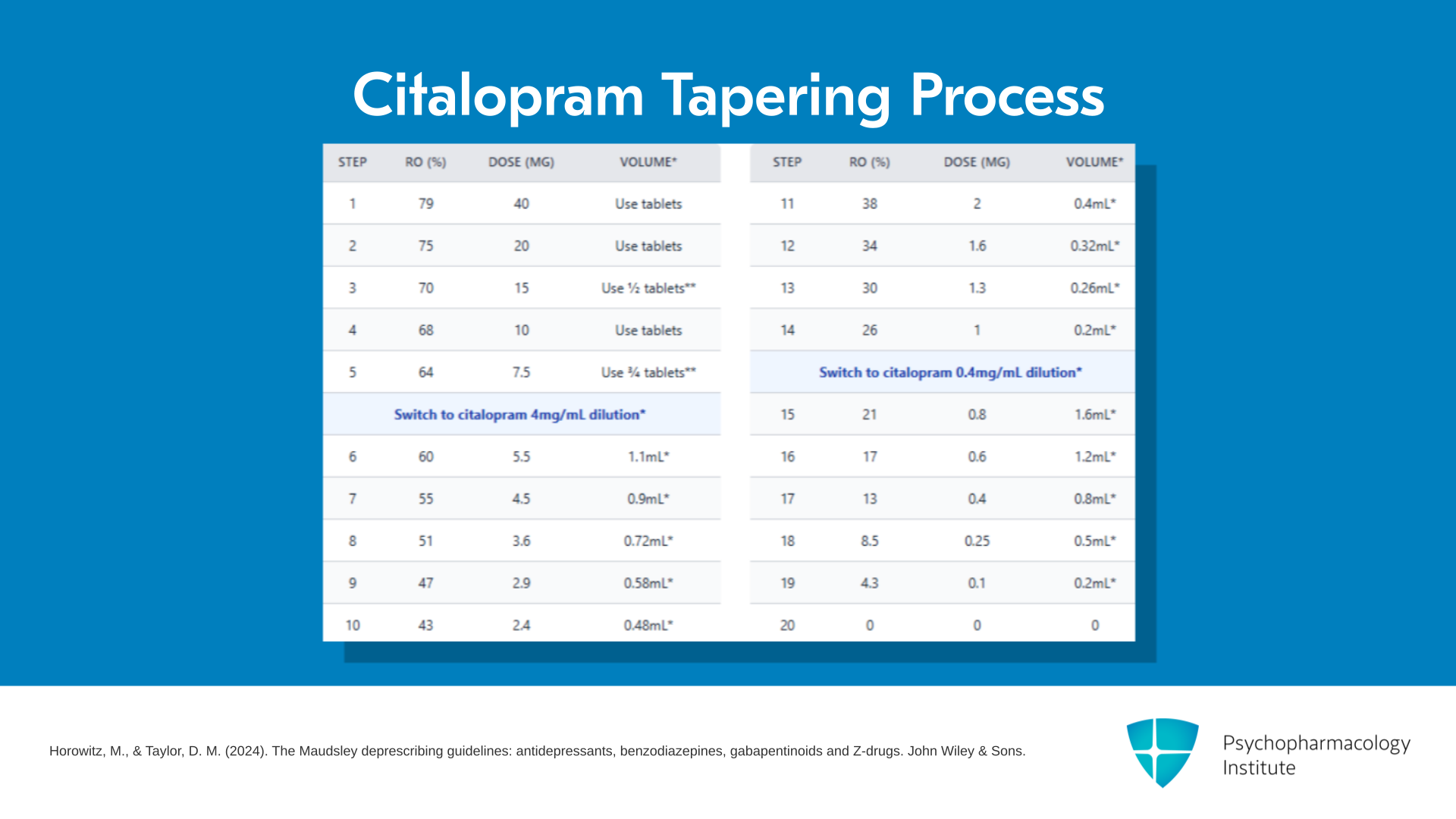
And then there’s an example of citalopram, what will be called a moderate taper for someone who maybe had been on the drugs for a few years and had had some trouble when they’re coming off last time. This process might take a year or two to go through and involves going down step by step, explaining when to use tablets, when to use half tablets and when to switch either to a dilution of citalopram liquid or to be using compounded capsules. And it gives a way to go all the way down to 0.1 mg before stopping.
References:
  • Horowitz, M., & Taylor, D. M. (2024). The Maudsley deprescribing guidelines: antidepressants, benzodiazepines, gabapentinoids and Z-drugs. John Wiley & Sons.
Free Files
Success!
Check your inbox, we sent you all the materials there.

Slide 11 of 12

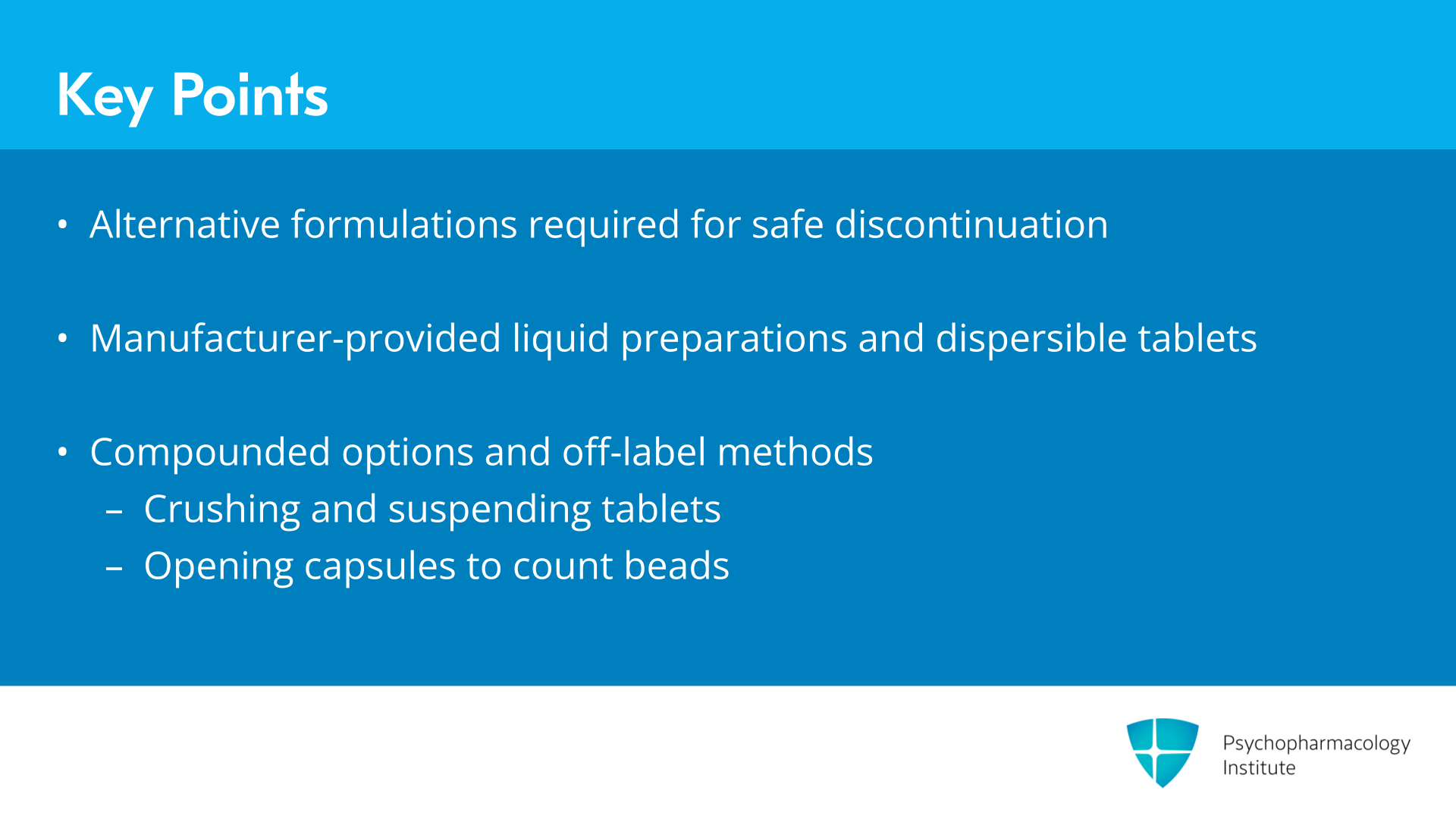
So the key points here are: In practice, to safely stop an antidepressant for most long-term users involves using formulations of antidepressants other than widely available tablets or capsules. There are a variety of other options including liquid preparations made by the manufacturer, dispersible tablets that dissolve in water, compounded capsules or tablets, and also off-label options like crushing and suspending tablets or opening capsules to count beads.

Slide 12 of 12

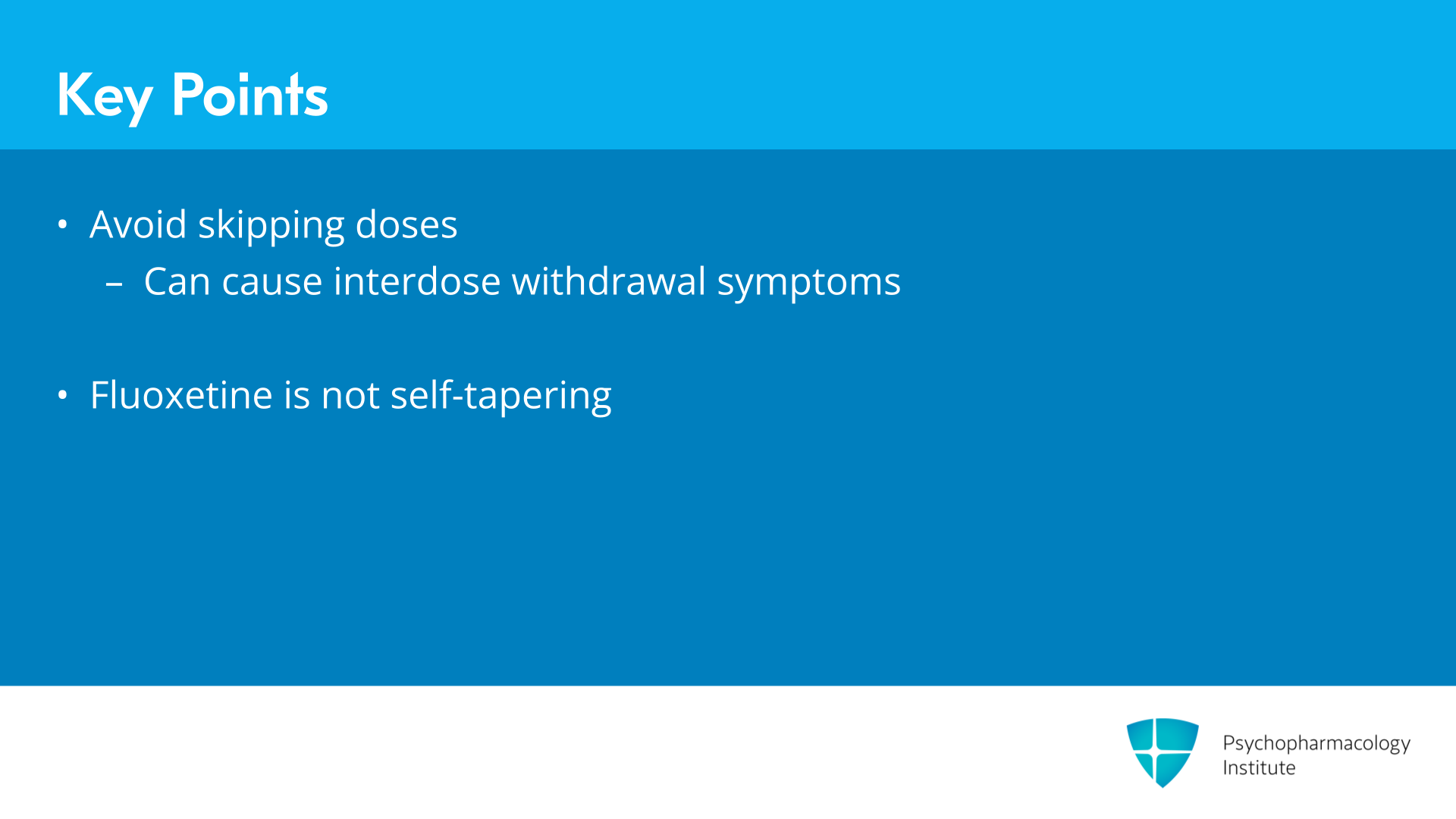
It is not best practice to skip doses of most antidepressants as this can cause interdose withdrawal symptoms. And it’s worth remembering that fluoxetine is not self-tapering as has often been suggested.
Free Files
Success!
Check your inbox, we sent you all the materials there.

Learning Objectives:

After completing this activity, the learner will be able to:

  1. Recognize withdrawal symptoms from antidepressants in patients who have been on long-term treatment and differentiate these symptoms from relapse of the underlying condition.
  2. Apply hyperbolic tapering principles when discontinuing antidepressants.
  3. Identify patients at higher risk for severe withdrawal.

Original Release Date: September 1, 2025

Expiration Date: September 1, 2028

Expert: Mark Horowitz, M.D.

Medical Editor: Tomás Abudarham, M.D.

Relevant Financial Disclosures: 

Mark Horowitz declares the following interests:

– Outro Health: Co-founder, Consultant
All the relevant financial relationships listed above have been mitigated by Medical Academy and the Psychopharmacology Institute.

None of the other faculty, planners, and reviewers for this educational activity has relevant financial relationships to disclose during the last 24 months with ineligible companies whose primary business is producing, marketing, selling, re-selling, or distributing healthcare products used by or on patients.

Contact Information: For questions regarding the content or access to this activity, contact us at support@psychopharmacologyinstitute.com

Instructions for Participation and Credit:

Participants must complete the activity online during the valid credit period that is noted above.

Follow these steps to earn CME credit:

  1. View the required educational content provided on this course page.
  2. Complete the Post Activity Evaluation for providing the necessary feedback for continuing accreditation purposes and for the development of future activities. NOTE: Completing the Post Activity Evaluation after the quiz is required to receive the earned credit.
  3. Download your certificate.

Accreditation Statement

This activity has been planned and implemented in accordance with the accreditation requirements and policies of the Accreditation Council for Continuing Medical Education through the joint providership of Medical Academy LLC and the Psychopharmacology Institute. Medical Academy is accredited by the ACCME to provide continuing medical education for physicians.

Credit Designation Statement

Medical Academy designates this enduring activity for a maximum of 1.25 AMA PRA Category 1 credit(s)™. Physicians should claim only the credit commensurate with the extent of their participation in the activity.

Free Files
Success!
Check your inbox, we sent you all the materials there.
Continue in the website
Instant access modal

Become a Bronze, Silver, Gold, Bronze extended, Silver extended or Gold extended Member.

2025–26 Psychopharmacology CME Program

Unlock up to 155 CME Credits, including 40 SA CME Credits.