Slides and Transcript
Slide 1 of 10
Let’s talk about understanding when to prescribe long-acting injectable antipsychotics.
Slide 2 of 10
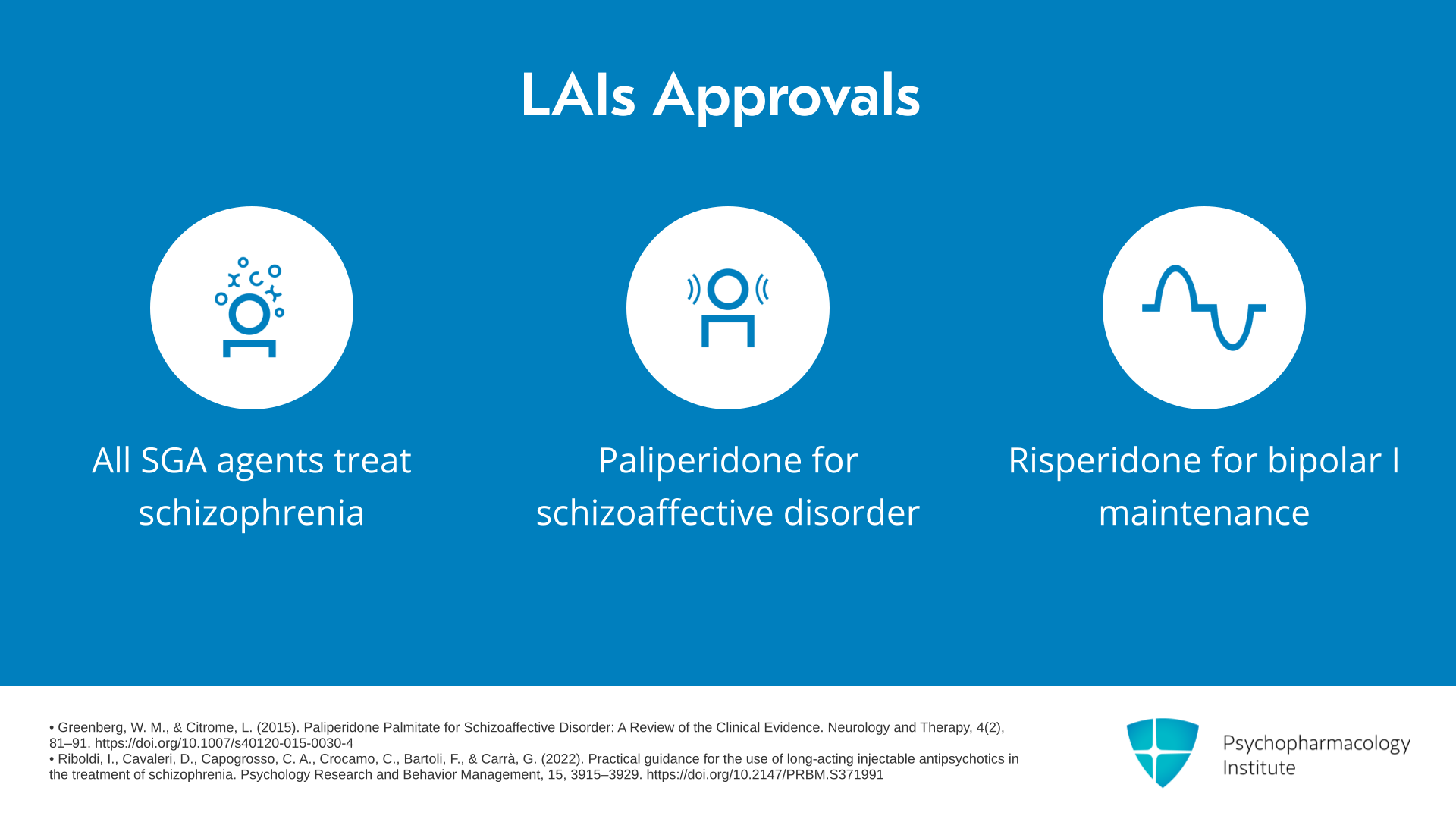
We’ll begin by talking about their approved indications. First of all, all second-generation agent LAIs are approved for the treatment of schizophrenia. Paliperidone palmitate is specifically approved for schizoaffective disorder either as monotherapy or an adjunct to mood stabilizers or antidepressants. Risperidone microspheres are approved for bipolar I disorder specifically maintenance treatment either as monotherapy or as an adjunct to lithium or valproate.
References:
- Greenberg, W. M., & Citrome, L. (2015). Paliperidone Palmitate for Schizoaffective Disorder: A Review of the Clinical Evidence. Neurology and Therapy, 4(2), 81–91. https://doi.org/10.1007/s40120-015-0030-4
- Riboldi, I., Cavaleri, D., Capogrosso, C. A., Crocamo, C., Bartoli, F., & Carrà, G. (2022). Practical guidance for the use of long-acting injectable antipsychotics in the treatment of schizophrenia. Psychology Research and Behavior Management, 15, 3915–3929. https://doi.org/10.2147/PRBM.S371991
Free Files
Download PDF and other files
Success!
Check your inbox, we sent you all the materials there.
Slide 3 of 10
And both of the first-generation antipsychotic LAIs are approved for patients requiring prolonged parenteral antipsychotic therapy, for example, patients with chronic schizophrenia.
References:
- Riboldi, I., Cavaleri, D., Capogrosso, C. A., Crocamo, C., Bartoli, F., & Carrà, G. (2022). Practical guidance for the use of long-acting injectable antipsychotics in the treatment of schizophrenia. Psychology Research and Behavior Management, 15, 3915–3929. https://doi.org/10.2147/PRBM.S371991
Slide 4 of 10
All that said, LAIs are often used off-label for patients with both schizoaffective disorder as well as patients with bipolar disorder.
References:
- D'Agostino, A., Aguglia, A., Barbui, C., Bartoli, F., Carrà, G., Cavallotti, S., Chirico, M., Ostinelli, E. G., Zangani, C., Martinotti, G., Ostuzzi, G., & STAR Network Depot Investigators. (2022). Off-label long acting injectable antipsychotics in real-world clinical practice: A cross-sectional analysis of prescriptive patterns from the STAR Network DEPOT study. BMC Psychiatry, 22(1), 442. https://doi.org/10.1186/s12888-022-04071-2
Free Files
Download PDF and other files
Success!
Check your inbox, we sent you all the materials there.
Slide 5 of 10
So let’s talk about now specific candidates for LAI antipsychotics. Importantly, we want to consider patient preference. If a patient prefers to be treated with an LAI, then that automatically makes them a good candidate.
References:
- Correll, C. U., Citrome, L., Haddad, P. M., Lauriello, J., Olfson, M., Calloway, S. M., & Kane, J. M. (2016). The use of long-acting injectable antipsychotics in schizophrenia: Evaluating the evidence. The Journal of Clinical Psychiatry, 77(suppl 3), 1-24. https://doi.org/10.4088/JCP.15032su1
- Sajatovic, M., Ross, R., Legacy, S. N., Correll, C. U., Kane, J. M., DiBiasi, F., Fitzgerald, H., & Byerly, M. (2018). Identifying patients and clinical scenarios for use of long-acting injectable antipsychotics – expert consensus survey part 1. Neuropsychiatric Disease and Treatment, 14, 1463-1474. https://doi.org/10.2147/NDT.S167394
Slide 6 of 10
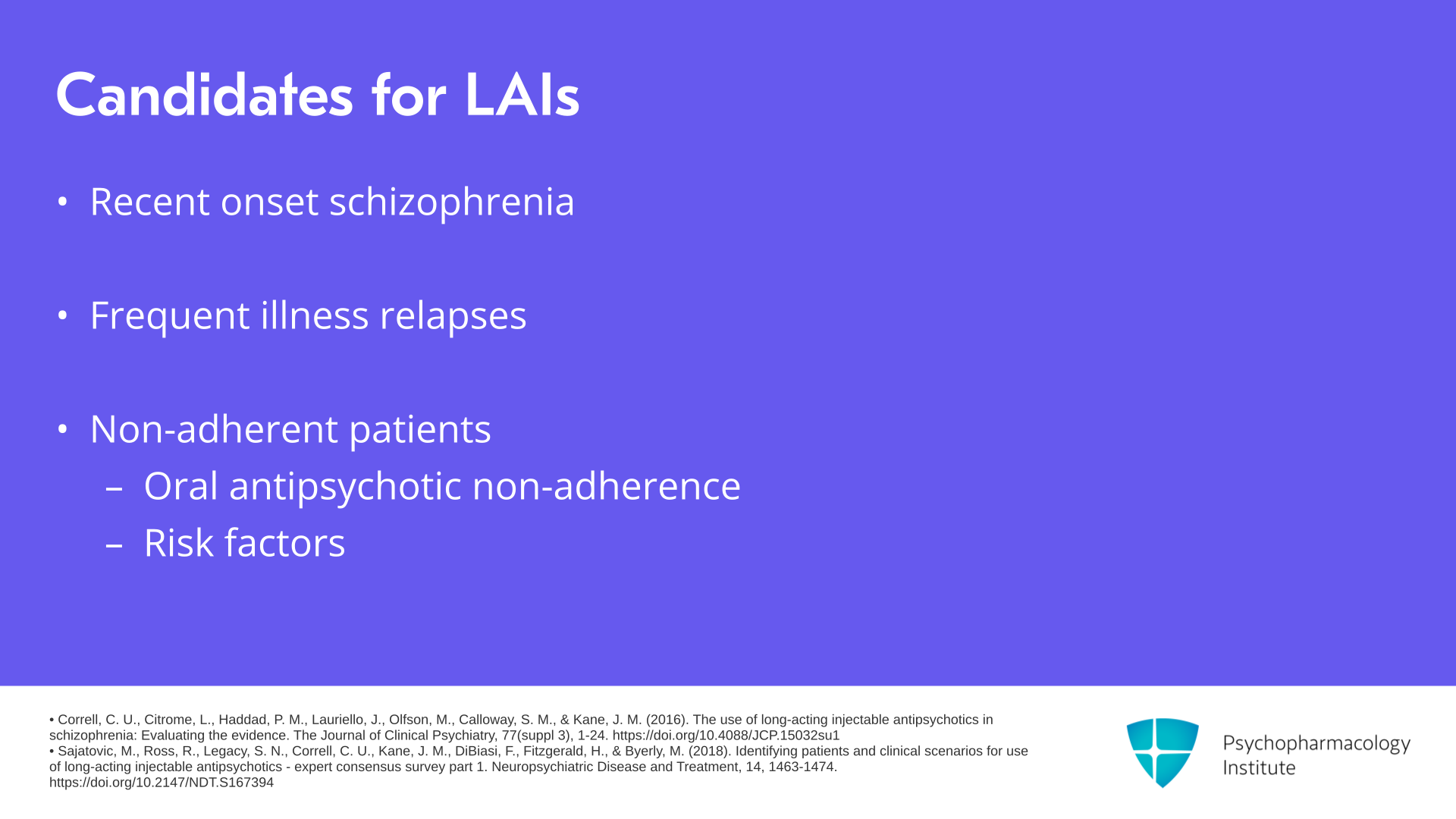
Other candidates include patients with recent onset schizophrenia, those with frequent illness relapses, patients who are non-adherent with oral antipsychotics as well as patients with risk factors for medication non-adherence, specifically those patients with severe symptoms, cognitive impairment, diminished insight into illness, substance use comorbidity as well as negative attitudes towards medications.
References:
- Correll, C. U., Citrome, L., Haddad, P. M., Lauriello, J., Olfson, M., Calloway, S. M., & Kane, J. M. (2016). The use of long-acting injectable antipsychotics in schizophrenia: Evaluating the evidence. The Journal of Clinical Psychiatry, 77(suppl 3), 1-24. https://doi.org/10.4088/JCP.15032su1
- Sajatovic, M., Ross, R., Legacy, S. N., Correll, C. U., Kane, J. M., DiBiasi, F., Fitzgerald, H., & Byerly, M. (2018). Identifying patients and clinical scenarios for use of long-acting injectable antipsychotics – expert consensus survey part 1. Neuropsychiatric Disease and Treatment, 14, 1463-1474. https://doi.org/10.2147/NDT.S167394
Free Files
Download PDF and other files
Success!
Check your inbox, we sent you all the materials there.
Slide 7 of 10
An adage from my clinical training is that you don’t diagnose anything that you don’t ask about. By analogy, you won’t prescribe long-acting injectable antipsychotics if you don’t talk with your patients about them. So here, I advocate for principles of shared and collaborative decision making with our patients.
References:
- Fiorillo, A., Barlati, S., Bellomo, A., Corrivetti, G., Nicolò, G., Sampogna, G., Stanga, V., Veltro, F., Maina, G., & Vita, A. (2020). The role of shared decision-making in improving adherence to pharmacological treatments in patients with schizophrenia: a clinical review. Annals of General Psychiatry, 19, 43. https://doi.org/10.1186/s12991-020-00293-4
Slide 8 of 10
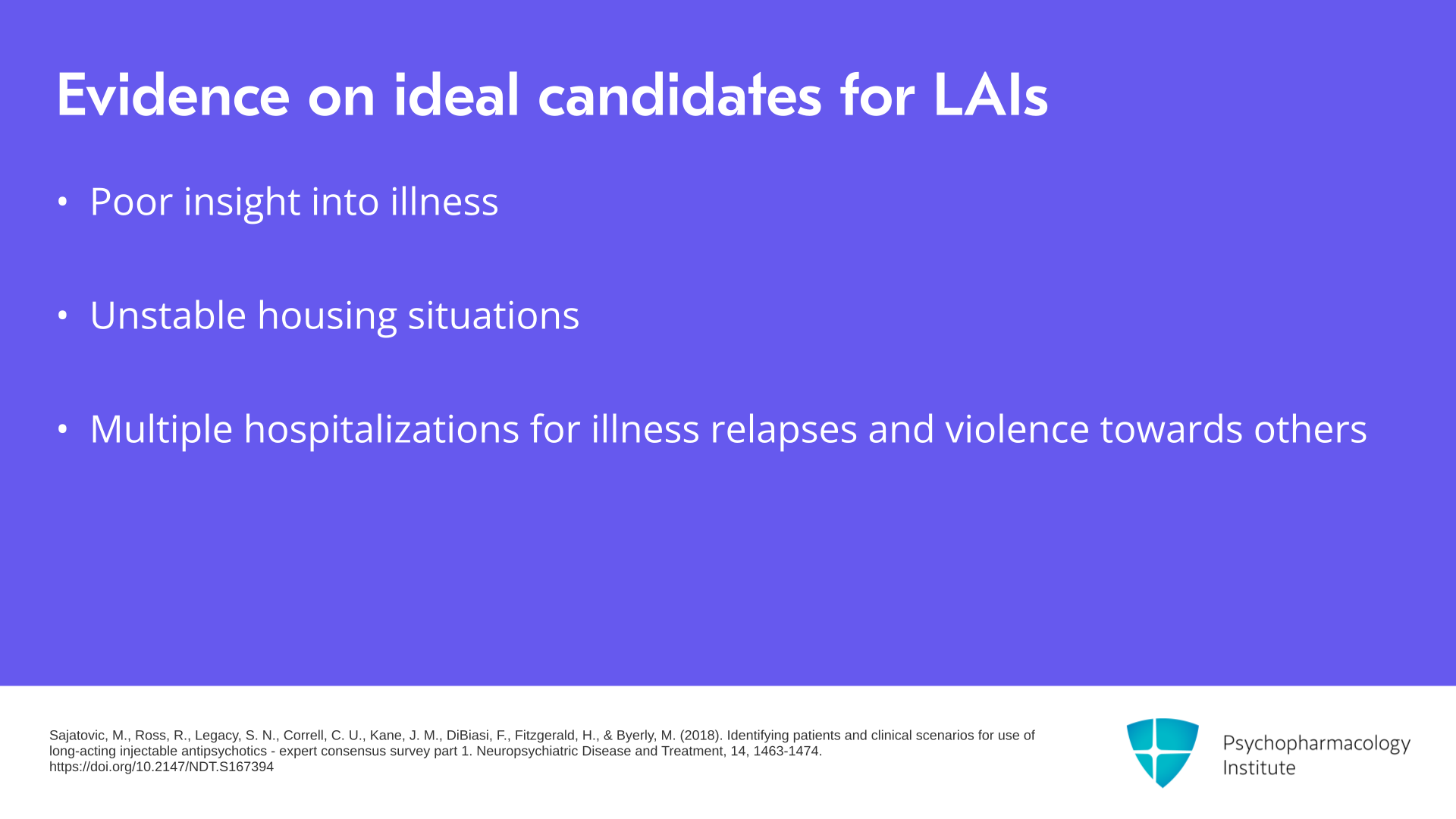
What does the evidence tell us for good candidates for LAIs? Well, a survey of over 40 research experts and high prescribers with extensive experience with these medications found that the strongest factors for selecting appropriate patients for LAIs, those are items that received the highest rating by over half of the respondents, included patients with poor insight into their illness and need for treatment, those who are homeless or have unstable housing situations, patients with multiple hospitalizations for illness relapses and patients with a history of violence towards others.
References:
- Sajatovic, M., Ross, R., Legacy, S. N., Correll, C. U., Kane, J. M., DiBiasi, F., Fitzgerald, H., & Byerly, M. (2018). Identifying patients and clinical scenarios for use of long-acting injectable antipsychotics – expert consensus survey part 1. Neuropsychiatric Disease and Treatment, 14, 1463-1474. https://doi.org/10.2147/NDT.S167394
Free Files
Download PDF and other files
Success!
Check your inbox, we sent you all the materials there.
Slide 9 of 10
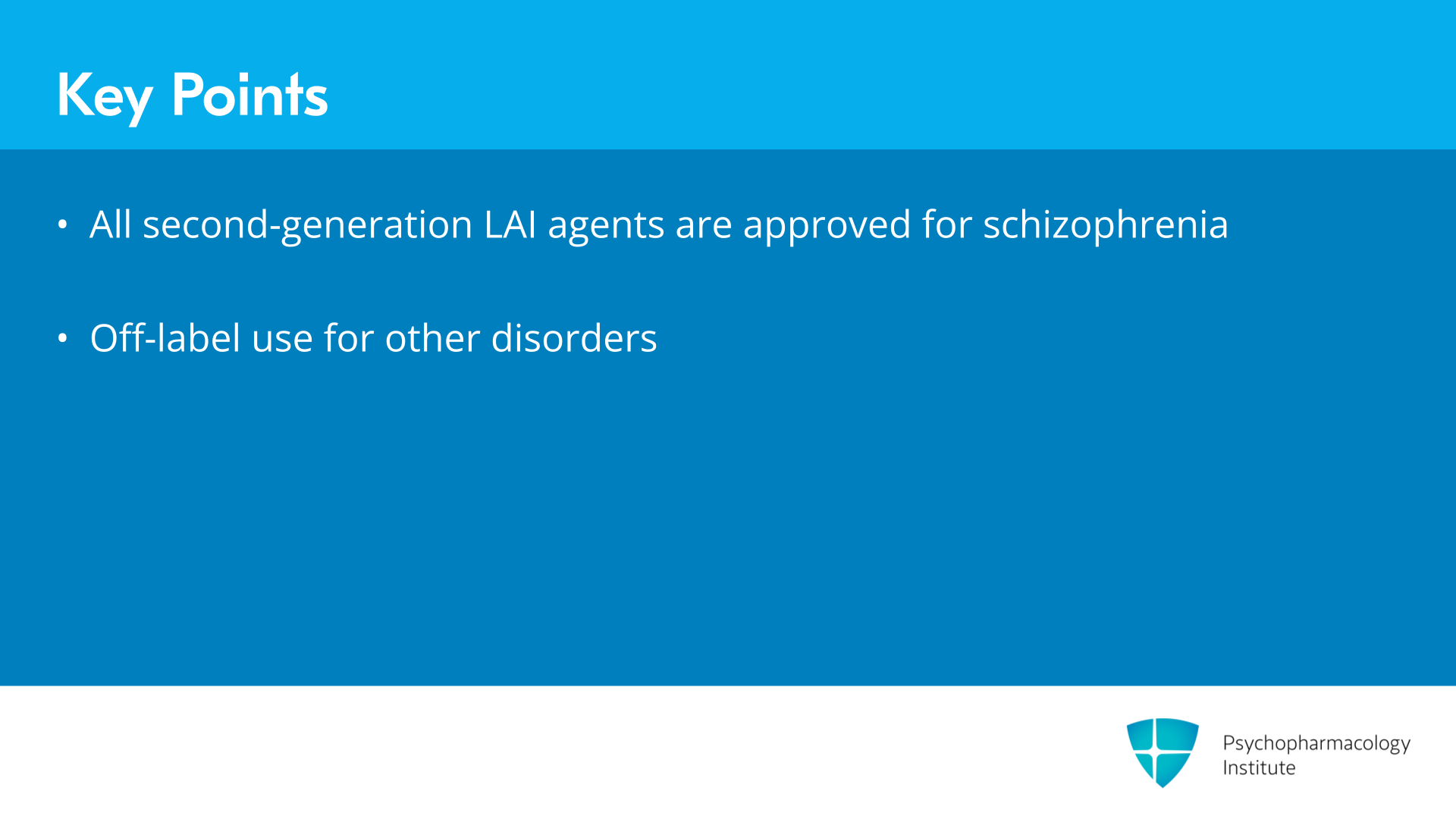
So our key points for this section is that all second-generation LAI antipsychotics have approval for schizophrenia but they’re often used off-label for schizoaffective disorder and bipolar disorder as well.
Slide 10 of 10
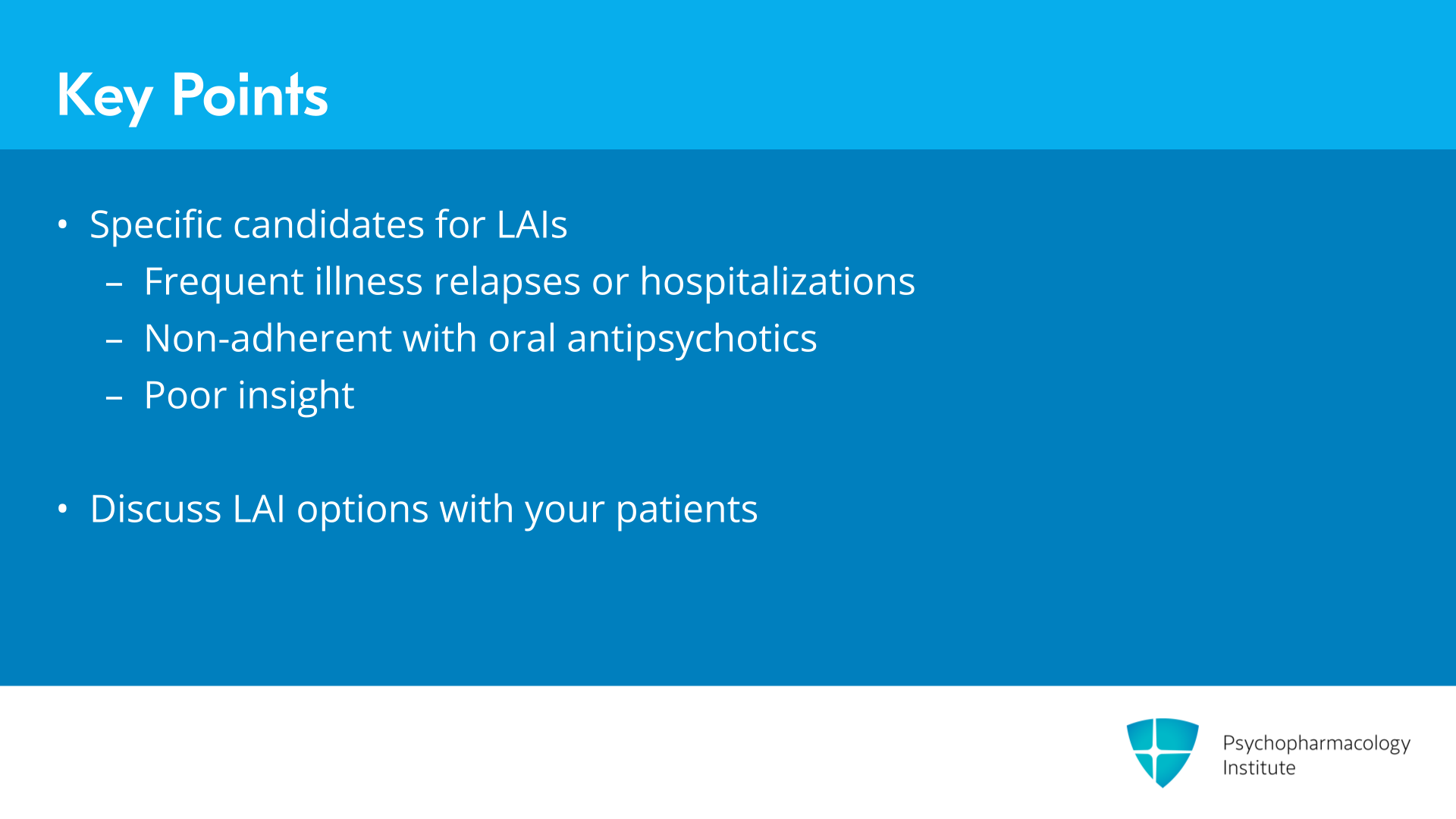
Specific candidates for LAIs include patients with frequent illness relapses or hospitalizations, patients who are non-adherent with oral antipsychotics and those with poor insight but also those who prefer treatment with LAIs. And ultimately, clinicians should discuss LAIs as a treatment option with their patients.
Free Files
Download PDF and other files
Success!
Check your inbox, we sent you all the materials there.