Slides and Transcript
Slide 1 of 11
So we've talked now about pharmacologic strategies that can be used to treat postpartum depression and postpartum OCD including two brand new drugs but we haven't talked yet about the pharmacologic strategies for treating postpartum psychosis, our third main mood syndrome of the postpartum.
Slide 2 of 11
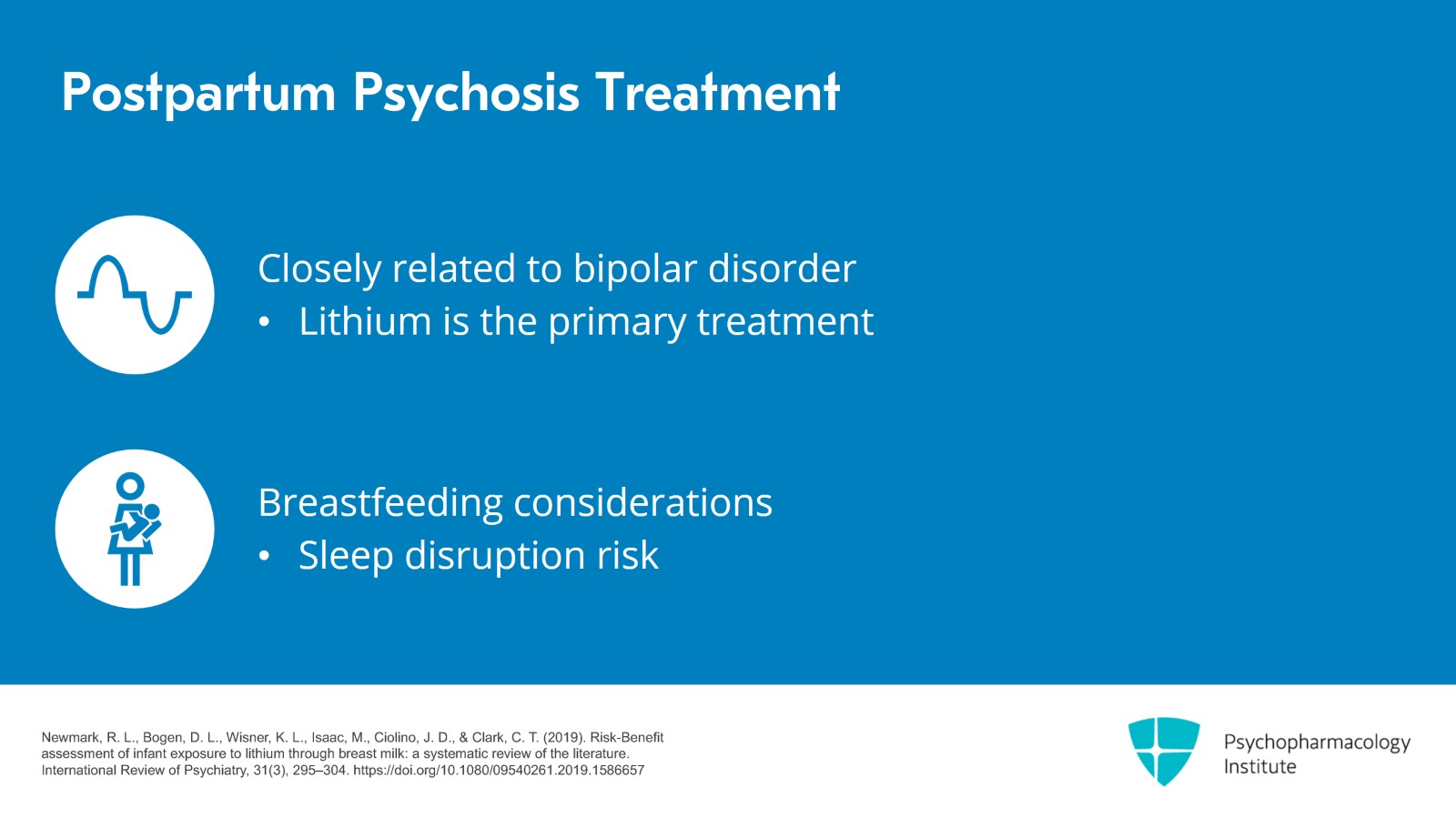
It's really important to remember that postpartum psychosis again is an affective illness with a close relationship with bipolar disorder. Therefore, the mainstay of treatment is a mood stabilizer, lithium. What do we have to know about treating people with mood stabilizers while breastfeeding? Well, first of all, let's remember that the breastfeeding decision is complicated in women with bipolar disorder, not primarily because of the drug risk but because of the risk of sleep disruption.
References:
- Newmark, R. L., Bogen, D. L., Wisner, K. L., Isaac, M., Ciolino, J. D., & Clark, C. T. (2019). Risk-Benefit assessment of infant exposure to lithium through breast milk: a systematic review of the literature. International Review of Psychiatry, 31(3), 295–304. https://doi.org/10.1080/09540261.2019.15866572
Free Files
Download PDF and other files
Success!
Check your inbox, we sent you all the materials there.
Slide 3 of 11
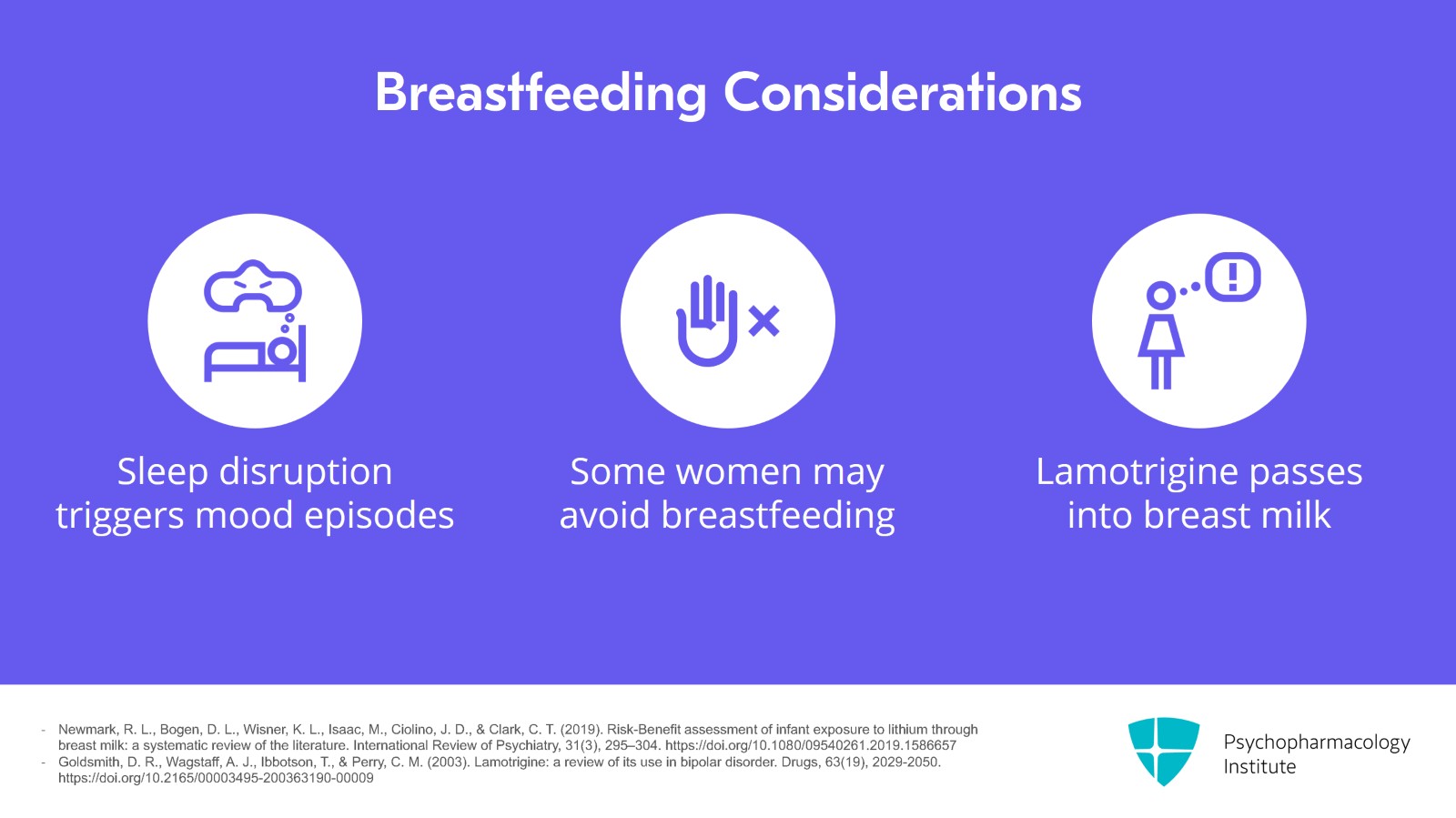
For many women with bipolar disorder, sleep disruption is a trigger for entering into a mood episode. So for some women who have bipolar disorder, the decision not to breastfeed may be the right one. What about particular mood stabilizers and their use in breastfeeding? We know that lamotrigine has high passage into the breast milk. Adverse reactions are not common but there's a theoretical risk of Stevens-Johnsons and it's important to inform patients of that.
References:
- Newmark, R. L., Bogen, D. L., Wisner, K. L., Isaac, M., Ciolino, J. D., & Clark, C. T. (2019). Risk-Benefit assessment of infant exposure to lithium through breast milk: a systematic review of the literature. International Review of Psychiatry, 31(3), 295–304. https://doi.org/10.1080/09540261.2019.1586657
- Goldsmith, D. R., Wagstaff, A. J., Ibbotson, T., & Perry, C. M. (2003). Lamotrigine: a review of its use in bipolar disorder. Drugs, 63(19), 2029-2050. https://doi.org/10.2165/00003495-200363190-000093
Slide 4 of 11
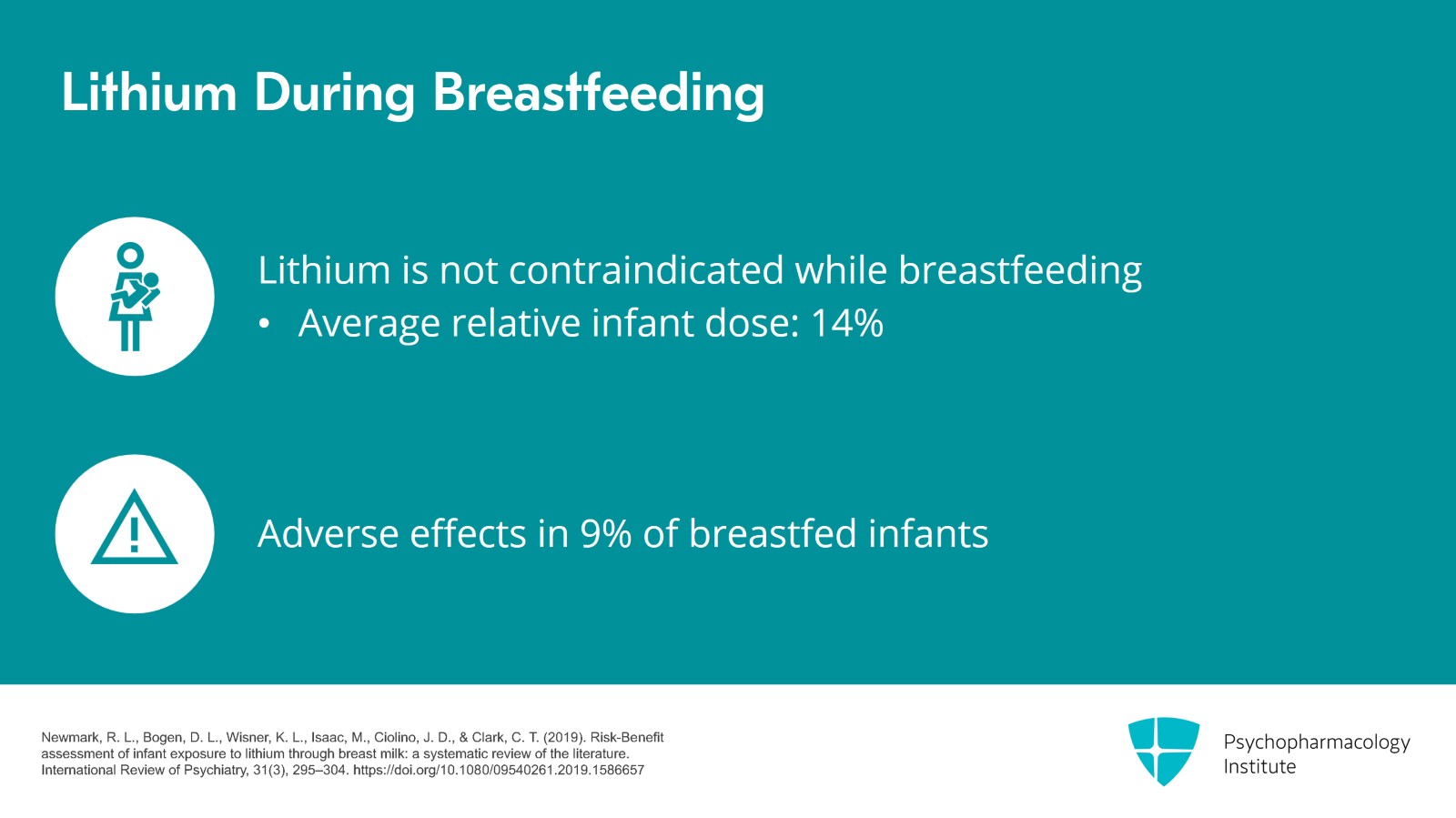
Lithium is a complicated drug to use in breastfeeding but it's not contraindicated. It has variable passage into the breast milk with the average relative infant dose of about 14% which is much lower than placental passage. A recent meta-analysis showed adverse effects in about 9% of breastfed infants whose mothers were taking lithium.
References:
- Newmark, R. L., Bogen, D. L., Wisner, K. L., Isaac, M., Ciolino, J. D., & Clark, C. T. (2019). Risk-Benefit assessment of infant exposure to lithium through breast milk: a systematic review of the literature. International Review of Psychiatry, 31(3), 295–304. https://doi.org/10.1080/09540261.2019.15866574
Free Files
Download PDF and other files
Success!
Check your inbox, we sent you all the materials there.
Slide 5 of 11
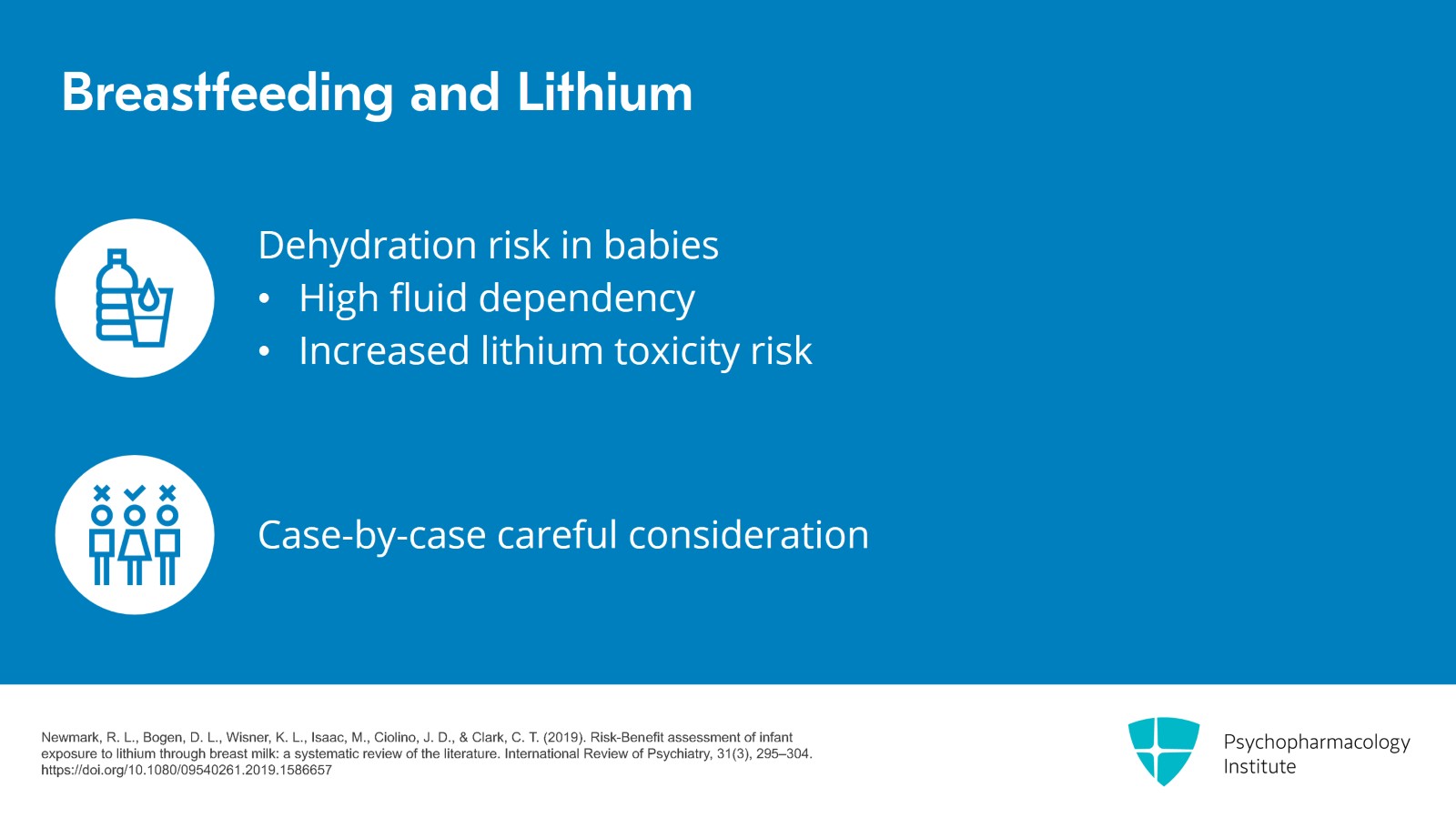
It's important to use caution due to the risk for dehydration. So for babies, everything they do is fluid based. Everything they eat is fluid. Everything they excrete is fluid. So they're at high risk of dehydration. And of course, when people become dehydrated, the risk for lithium toxicity is elevated. That means that the use of lithium in breastfeeding, it has to be a case-by-case decision. It can be useful and helpful in motivated parents who have cooperation with a pediatrician but it's something to think about carefully and to think about whether this is the patient for whom lithium can be used in breastfeeding.
References:
- Newmark, R. L., Bogen, D. L., Wisner, K. L., Isaac, M., Ciolino, J. D., & Clark, C. T. (2019). Risk-Benefit assessment of infant exposure to lithium through breast milk: a systematic review of the literature. International Review of Psychiatry, 31(3), 295–304. https://doi.org/10.1080/09540261.2019.1586657
Slide 6 of 11
When we think about the other mood stabilizers, the antiepileptic drugs, they're all considered compatible with breastfeeding. Even valproic acid which cannot be used in pregnancy due to its high teratogenic potential, it can be used in breastfeeding. So that's an important thing to think about as well.
References:
- Newmark, R. L., Bogen, D. L., Wisner, K. L., Isaac, M., Ciolino, J. D., & Clark, C. T. (2019). Risk-Benefit assessment of infant exposure to lithium through breast milk: a systematic review of the literature. International Review of Psychiatry, 31(3), 295–304. https://doi.org/10.1080/09540261.2019.1586657
- Anderson, P. O. (2019). Antiepileptic Drugs During Breastfeeding. Breastfeeding Medicine, 15(1), 2-4. https://doi.org/10.1089/bfm.2019.02386
Free Files
Download PDF and other files
Success!
Check your inbox, we sent you all the materials there.
Slide 7 of 11
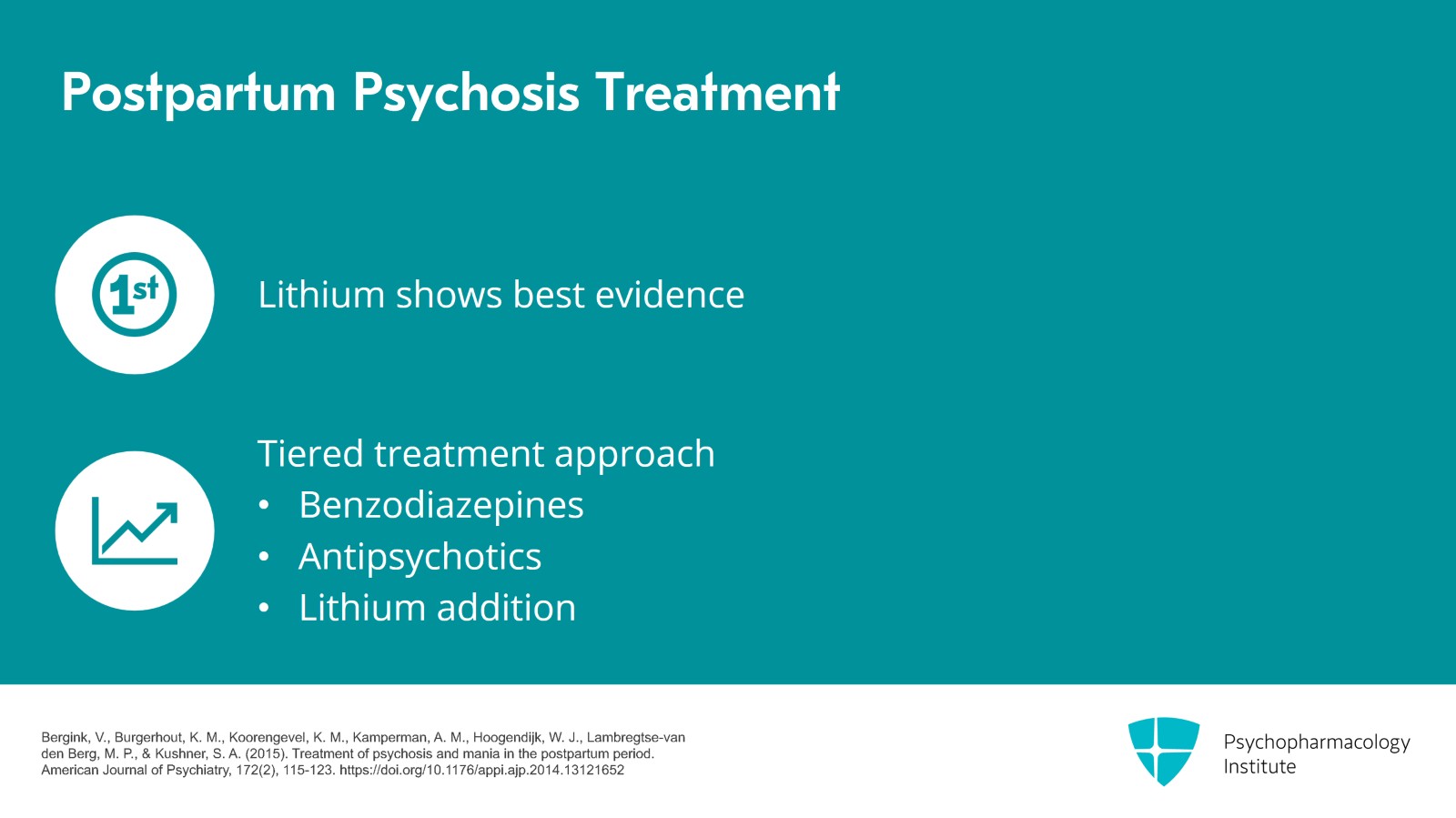
So we've established that all mood stabilizers can be used in postpartum psychosis. But what should we be using? Well, the reality is the best evidence is for lithium. There was a study done in an inpatient group of women with postpartum psychosis and it looked at a tiered system of giving benzodiazepines, antipsychotics and lithium for the treatment of postpartum psychosis. Step 1 was acute treatment with benzodiazepines only. Step 2 was acute treatment with benzodiazepines and antipsychotics. And step 3 was the addition of lithium. And what this study found was that 98% of women responded with the addition of lithium and many women did not respond at those earlier stages of just benzodiazepines or benzodiazepines with antipsychotics.
References:
- Bergink, V., Burgerhout, K. M., Koorengevel, K. M., Kamperman, A. M., Hoogendijk, W. J., Lambregtse-van den Berg, M. P., & Kushner, S. A. (2015). Treatment of psychosis and mania in the postpartum period. American Journal of Psychiatry, 172(2), 115-123. https://doi.org/10.1176/appi.ajp.2014.13121652
Slide 8 of 11
This has led the field to consider lithium the gold standard medication for postpartum psychosis both for treatment of acute episodes and for prophylaxis of future episodes.
References:
- Bergink, V., Burgerhout, K. M., Koorengevel, K. M., Kamperman, A. M., Hoogendijk, W. J., Lambregtse-van den Berg, M. P., & Kushner, S. A. (2015). Treatment of psychosis and mania in the postpartum period. American Journal of Psychiatry, 172(2), 115-123. https://doi.org/10.1176/appi.ajp.2014.13121652
Free Files
Download PDF and other files
Success!
Check your inbox, we sent you all the materials there.
Slide 9 of 11
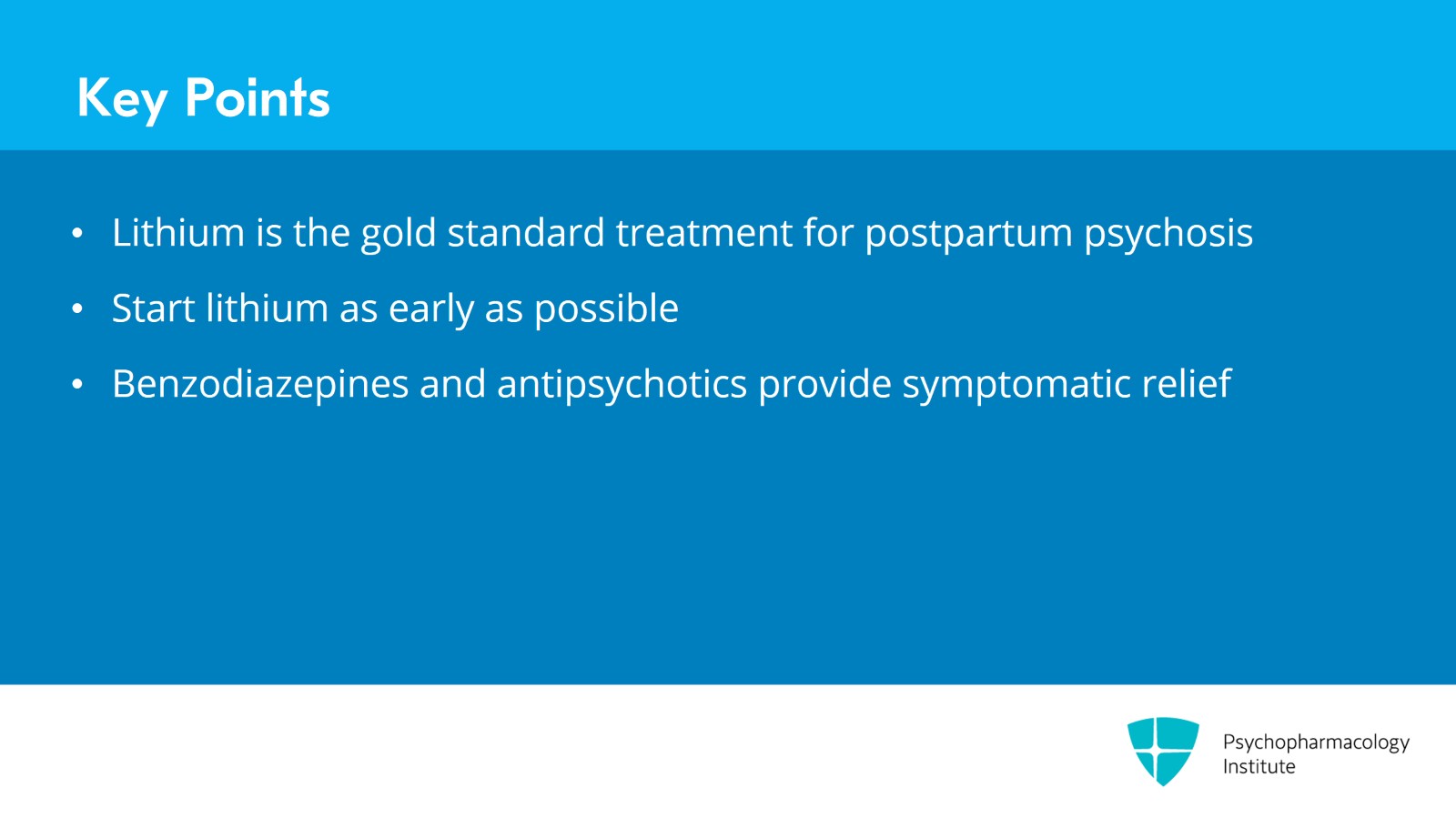
So let's review the key points of the treatment of postpartum psychosis. Remember that all mood stabilizing medications can be used in the postpartum but that of the mood stabilizing medications lithium is the gold standard treatment for postpartum psychosis and it should be started as early as possible for all patients identified with this illness. Benzodiazepines and antipsychotics can be used for symptomatic relief in postpartum psychosis but they do not replace lithium.
Slide 10 of 11
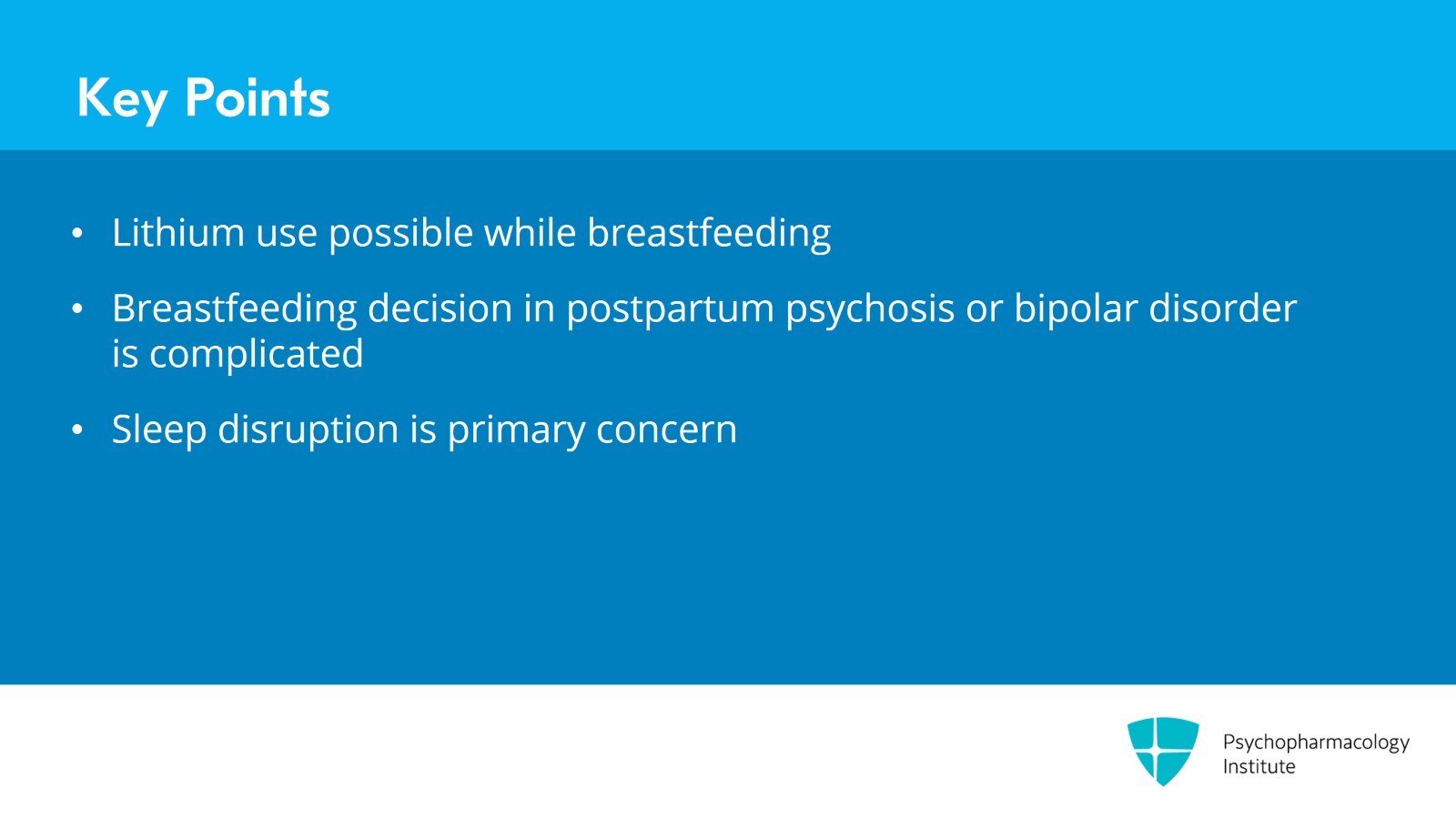
Remember also that lithium can be used with care in breastfeeding but the breastfeeding decision in women with postpartum psychosis or bipolar disorder is complicated, more because of the sleep disruption it entails than because of the effects of lithium in breast milk.
Free Files
Download PDF and other files
Success!
Check your inbox, we sent you all the materials there.