Slides and Transcript
Slide 1 of 21
We've talked about the usefulness of both pharmacotherapy and non-pharmacological strategies in treating postpartum mood disorders but let's talk a little specifically about just how we would manage that medication if we're going to use a pharmacological approach.
Slide 2 of 21
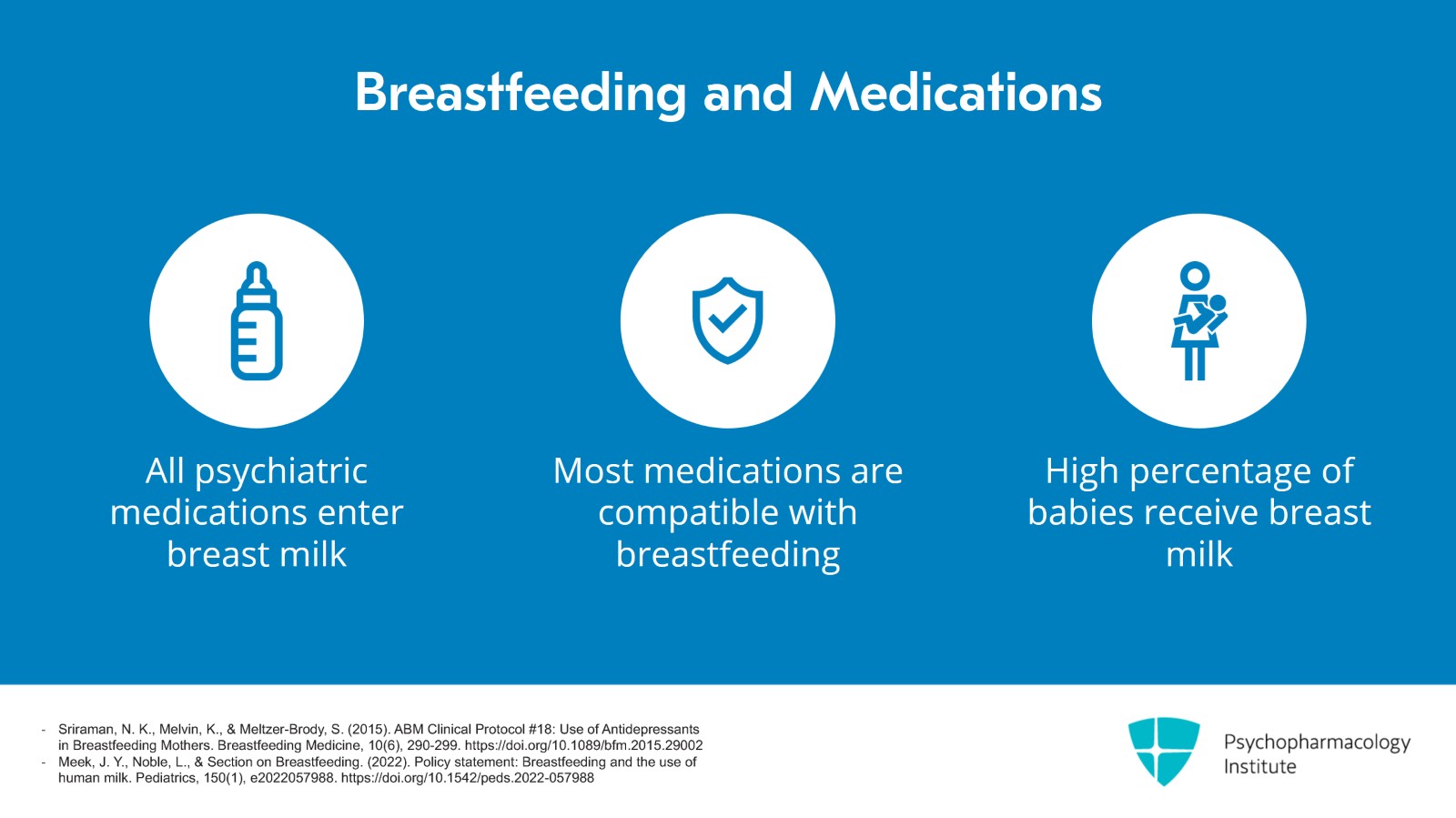
A lot of patients and some clinicians will have concerns about whether or not they can use psychiatric medications with a patient who's breastfeeding. And the answer to that is yes. All psychiatric medications enter breast milk but most of them are compatible with breastfeeding. Remember that at least in the US about 84% of women will at least initiate breastfeeding and another 6% will pump exclusively but never nurse. So that's a very high proportion of babies who get at least some breast milk.
References:
- Sriraman, N. K., Melvin, K., & Meltzer-Brody, S. (2015). ABM Clinical Protocol #18: Use of Antidepressants in Breastfeeding Mothers. Breastfeeding Medicine, 10(6), 290-299. https://doi.org/10.1089/bfm.2015.29002
- Meek, J. Y., Noble, L., & Section on Breastfeeding. (2022). Policy statement: Breastfeeding and the use of human milk. Pediatrics, 150(1), e2022057988. https://doi.org/10.1542/peds.2022-057988
Free Files
Download PDF and other files
Success!
Check your inbox, we sent you all the materials there.
Slide 3 of 21
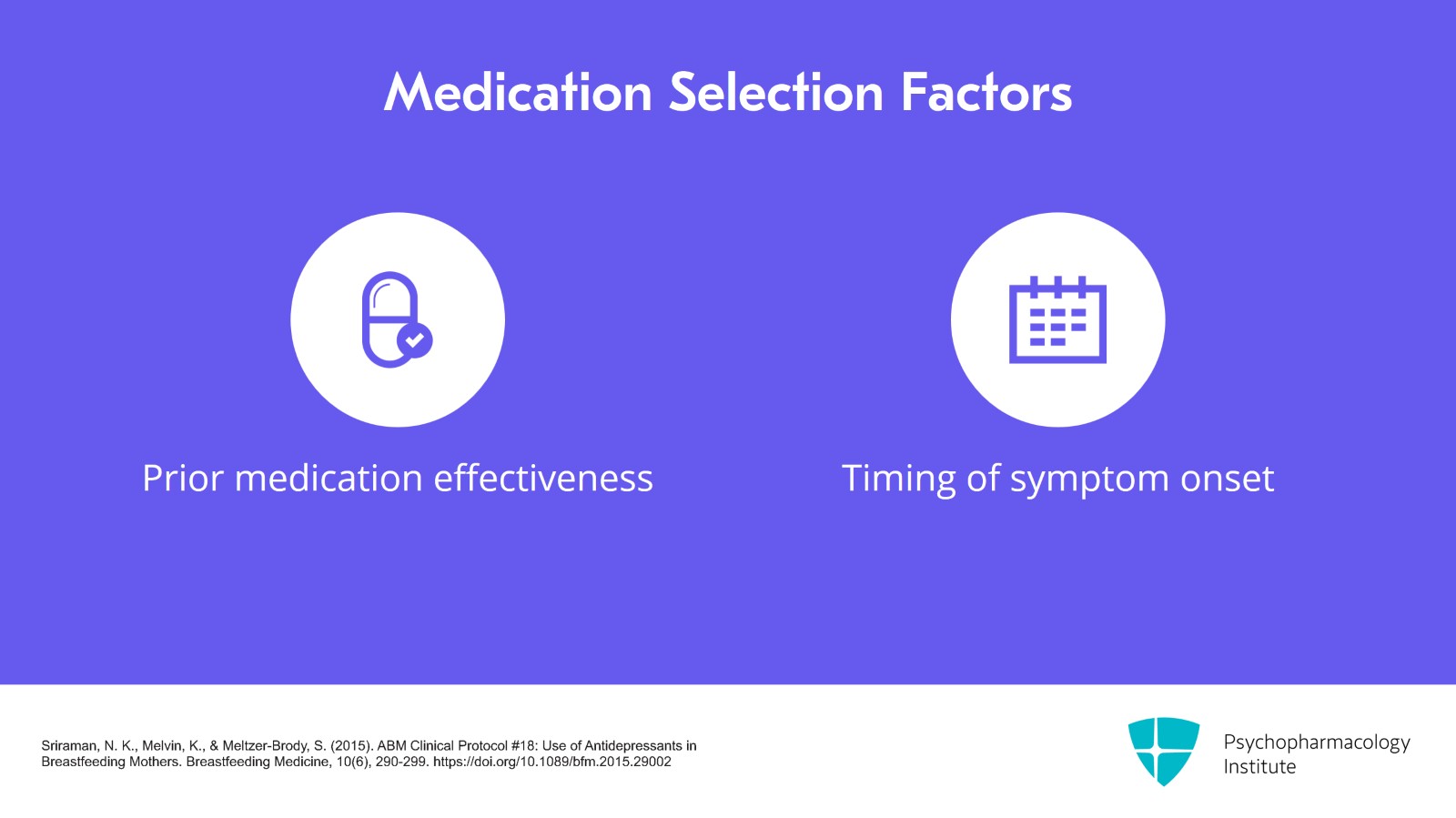
What do we have to consider when thinking about the choice of medications and how breastfeeding intersects with that? Well, it's really important to think about that woman's history of prior medication use. We want to use a medication that worked for her and that's going to trump pretty much everything else because the worst thing we'd want to do is give a medication that isn't going to help. We want to consider the time of onset of her symptoms, whether she had onset in pregnancy versus postpartum. That may affect to some extent the choice of medication.
References:
- Sriraman, N. K., Melvin, K., & Meltzer-Brody, S. (2015). ABM Clinical Protocol #18: Use of Antidepressants in Breastfeeding Mothers. Breastfeeding Medicine, 10(6), 290-299. https://doi.org/10.1089/bfm.2015.29002
Slide 4 of 21
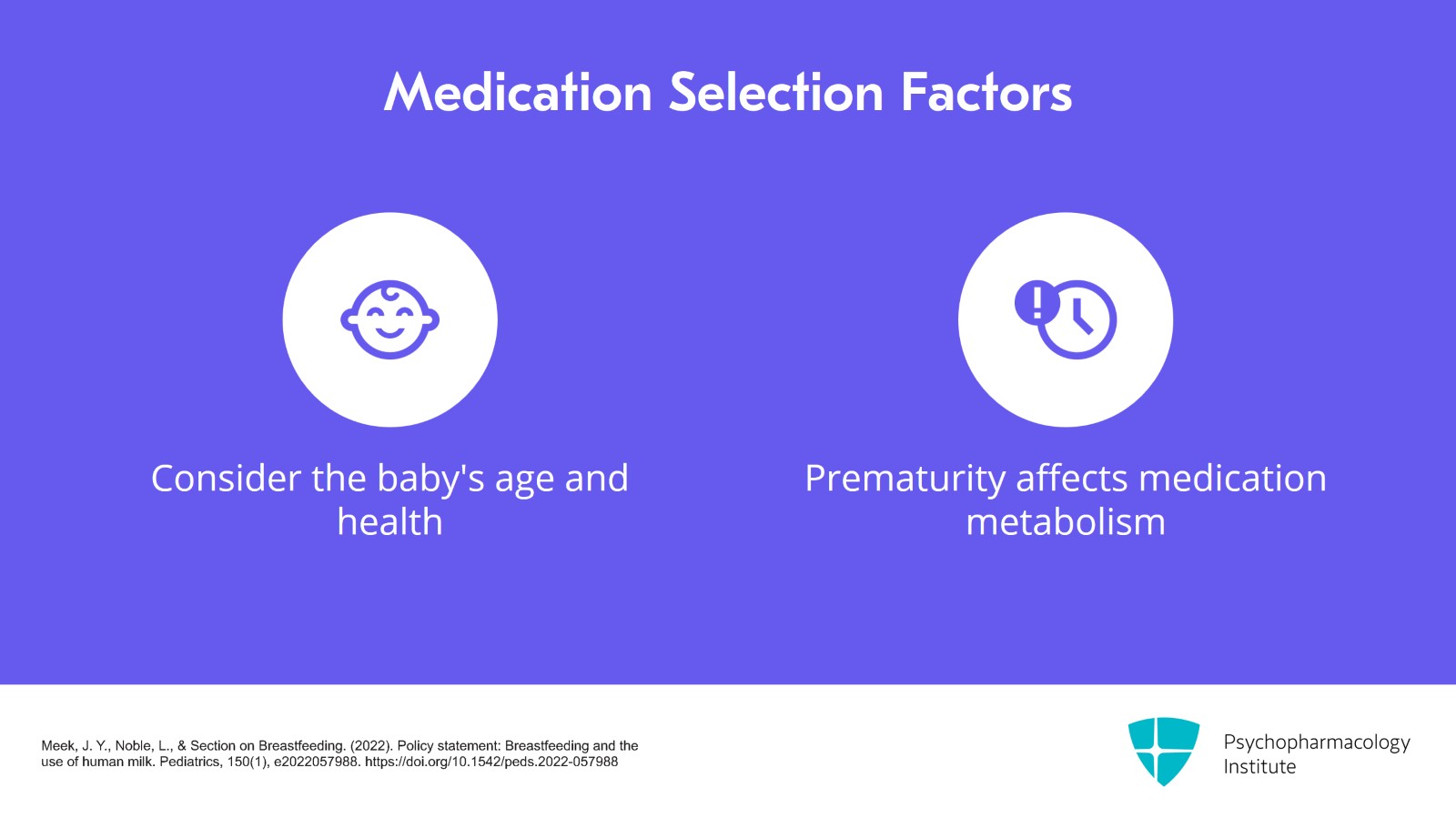
And we want to consider the age and health of the baby. A baby who is substantially premature and may not have a mature liver, for example, is going to be very different to treat and do a very different job metabolizing medications than a mature baby at a healthy gestational age.
References:
- Meek, J. Y., Noble, L., & Section on Breastfeeding. (2022). Policy statement: Breastfeeding and the use of human milk. Pediatrics, 150(1), e2022057988. https://doi.org/10.1542/peds.2022-057988
Free Files
Download PDF and other files
Success!
Check your inbox, we sent you all the materials there.
Slide 5 of 21
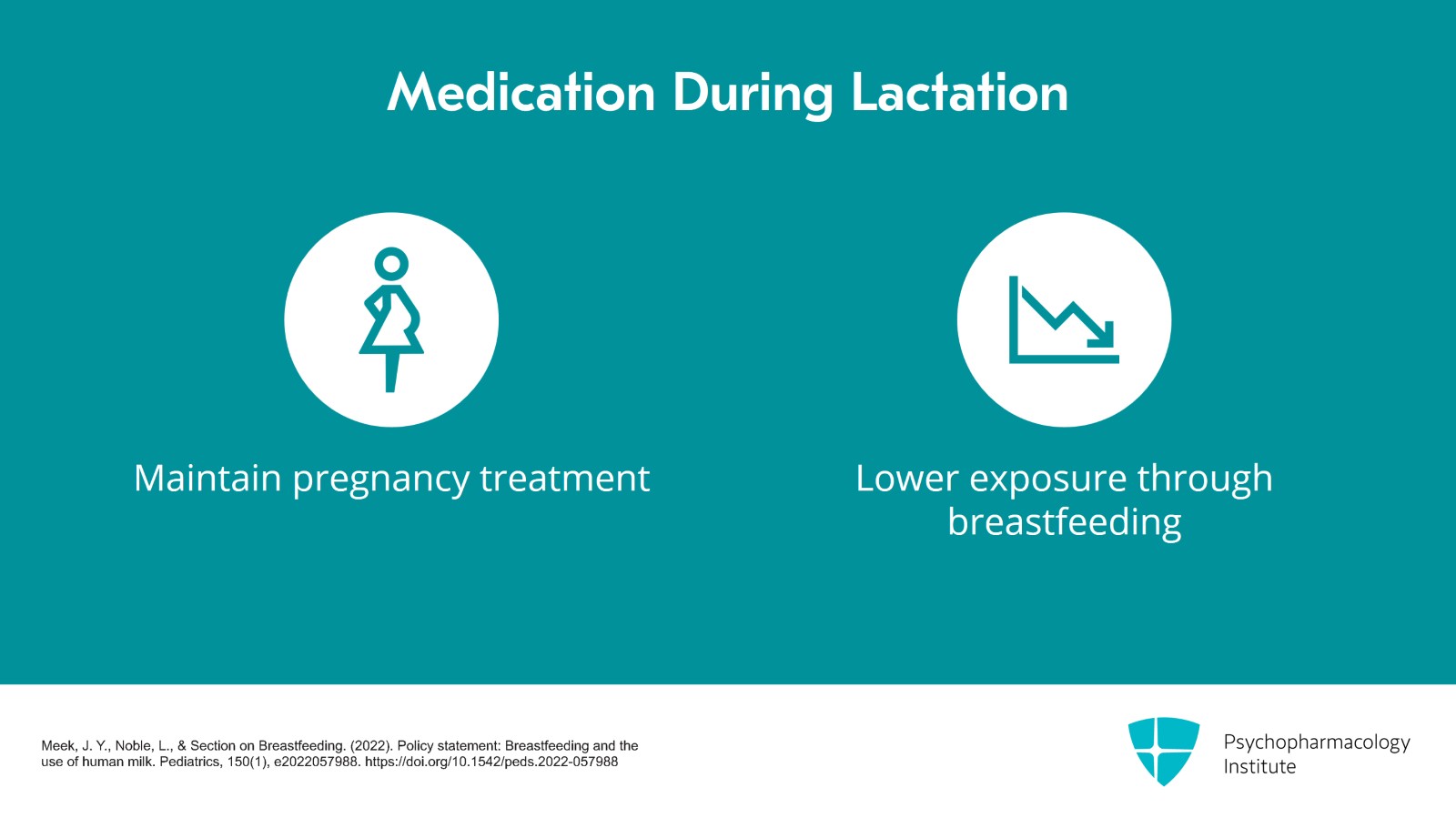
It's also important to remember that if a woman was treated during pregnancy there is usually no logic to changing her treatment for lactation. Sure, different medications enter the breast milk at different percentages but for sure the exposure of the baby to anything through breastfeeding is going to be lower than the exposure across the placenta during pregnancy. So it doesn't make sense to think about changing to a different medication just because it may have a lower proportion entering into the breast milk.
References:
- Meek, J. Y., Noble, L., & Section on Breastfeeding. (2022). Policy statement: Breastfeeding and the use of human milk. Pediatrics, 150(1), e2022057988. https://doi.org/10.1542/peds.2022-057988
Slide 6 of 21
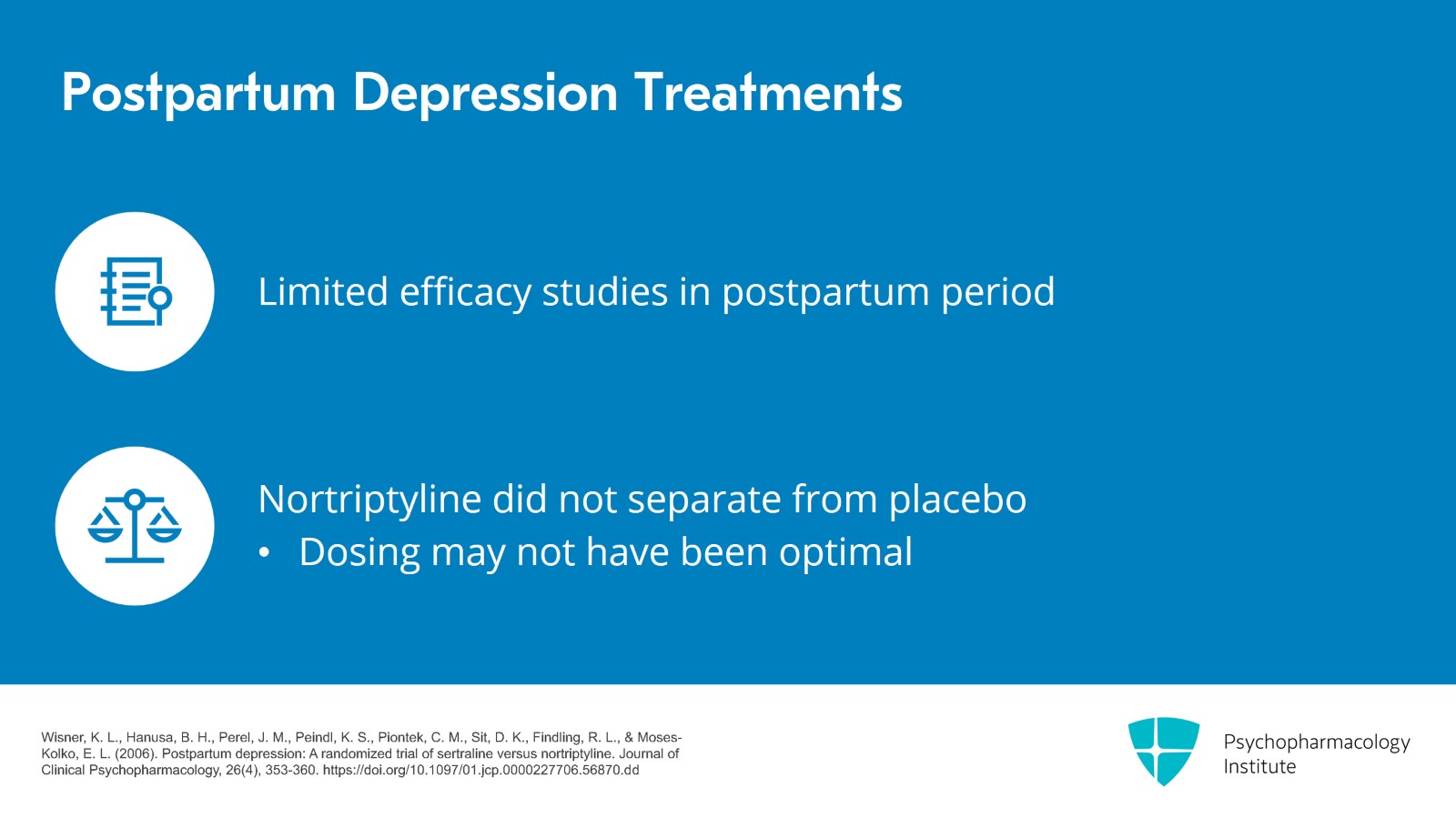
We don't have very many efficacy or effectiveness studies of particular medications in the postpartum period. Remember it's very hard to do a randomized controlled trial of people in this area. We did have some studies in the early 2000s that looked at the usefulness of sertraline versus nortriptyline for the prevention of the recurrence of postpartum depression. One study looked at sertraline and nortriptyline versus placebo for that recurrence. And in that study, nortriptyline did not separate from placebo but it was shown that it may not have been optimally dosed.
References:
- Wisner, K. L., Hanusa, B. H., Perel, J. M., Peindl, K. S., Piontek, C. M., Sit, D. K., Findling, R. L., & Moses-Kolko, E. L. (2006). Postpartum depression: A randomized trial of sertraline versus nortriptyline. Journal of Clinical Psychopharmacology, 26(4), 353-360. https://doi.org/10.1097/01.jcp.0000227706.56870.dd
Free Files
Download PDF and other files
Success!
Check your inbox, we sent you all the materials there.
Slide 7 of 21
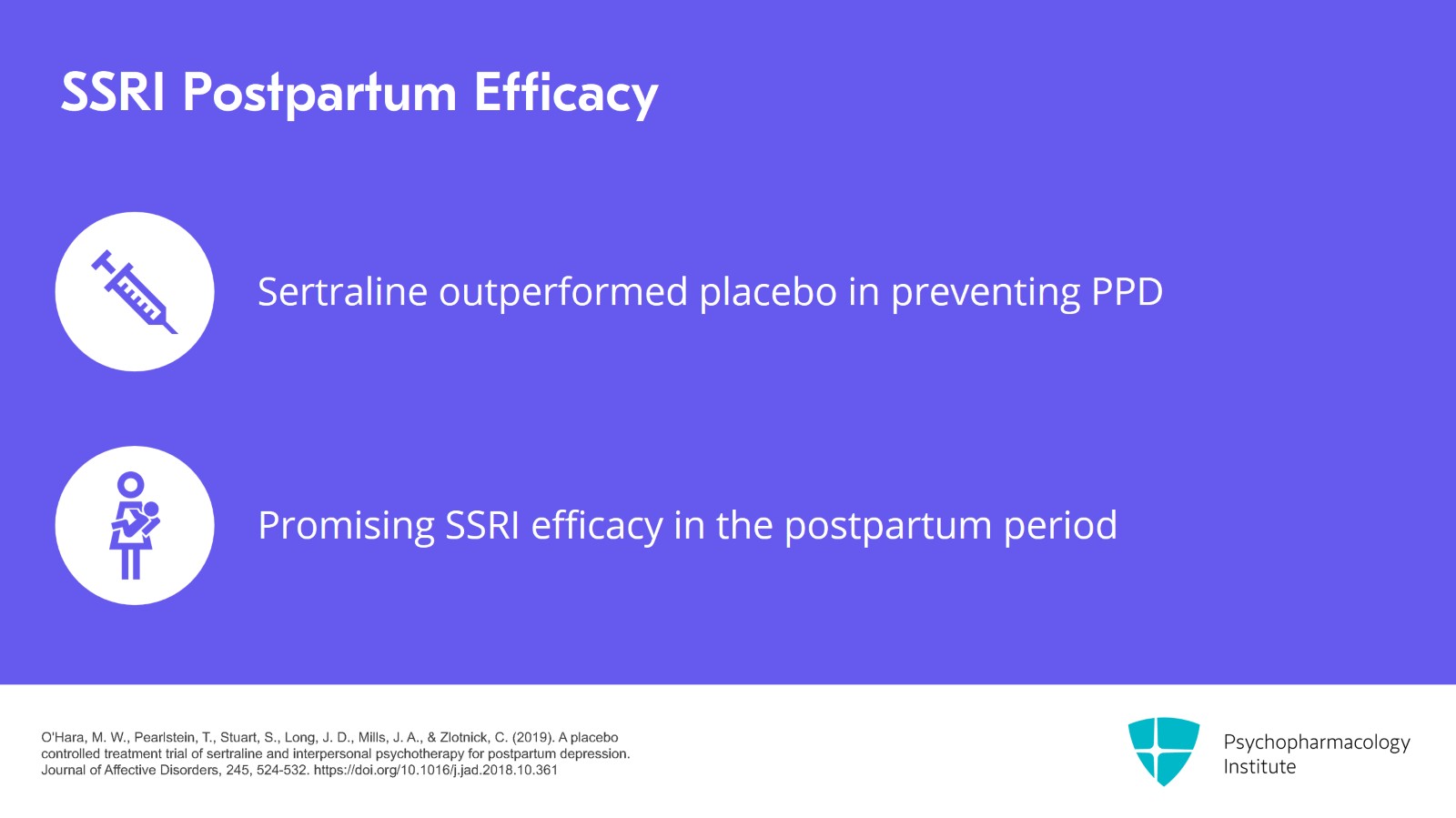
Whereas, in a later study that looked at sertraline, it was shown that sertraline was superior to placebo in preventing postpartum depression. This was a double-blind, randomized trial and it gave us some hope that SSRIs may in fact work very well in the postpartum period.
References:
- O'Hara, M. W., Pearlstein, T., Stuart, S., Long, J. D., Mills, J. A., & Zlotnick, C. (2019). A placebo controlled treatment trial of sertraline and interpersonal psychotherapy for postpartum depression. Journal of Affective Disorders, 245, 524-532. https://doi.org/10.1016/j.jad.2018.10.361
Slide 8 of 21
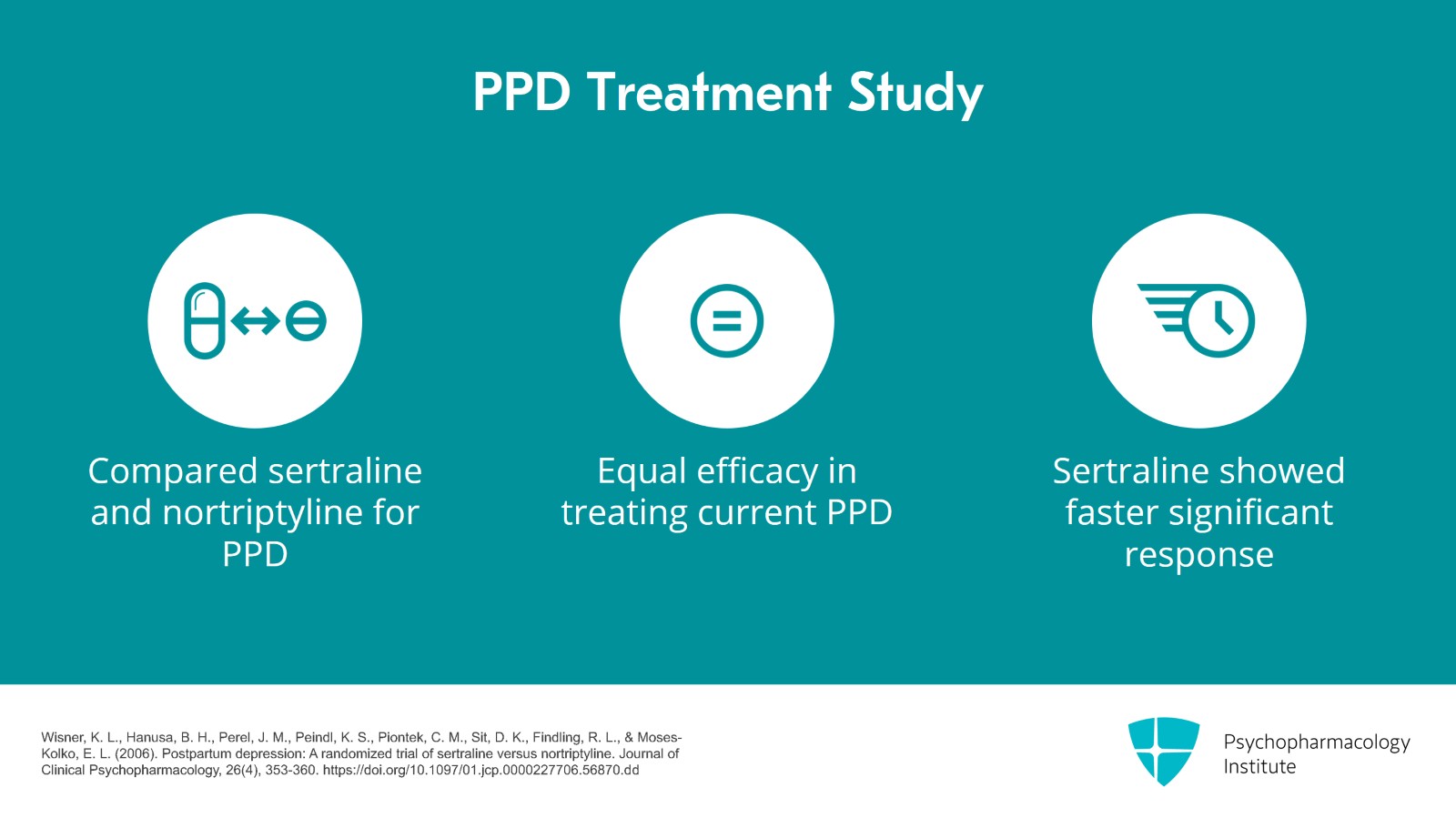
There was another study a few years later that compared, a double-blind comparison of sertraline or nortriptyline to treat women with PPD, so not to prevent recurrence but to treat women with active PPD within three months of delivery. And it was found there that they had equal efficacy in the treatment of current PPD but the response to sertraline was significant within the first week of treatment while the response to nortriptyline was not significant until week 2.
References:
- Wisner, K. L., Hanusa, B. H., Perel, J. M., Peindl, K. S., Piontek, C. M., Sit, D. K., Findling, R. L., & Moses-Kolko, E. L. (2006). Postpartum depression: A randomized trial of sertraline versus nortriptyline. Journal of Clinical Psychopharmacology, 26(4), 353-360. https://doi.org/10.1097/01.jcp.0000227706.56870.dd
Free Files
Download PDF and other files
Success!
Check your inbox, we sent you all the materials there.
Slide 9 of 21
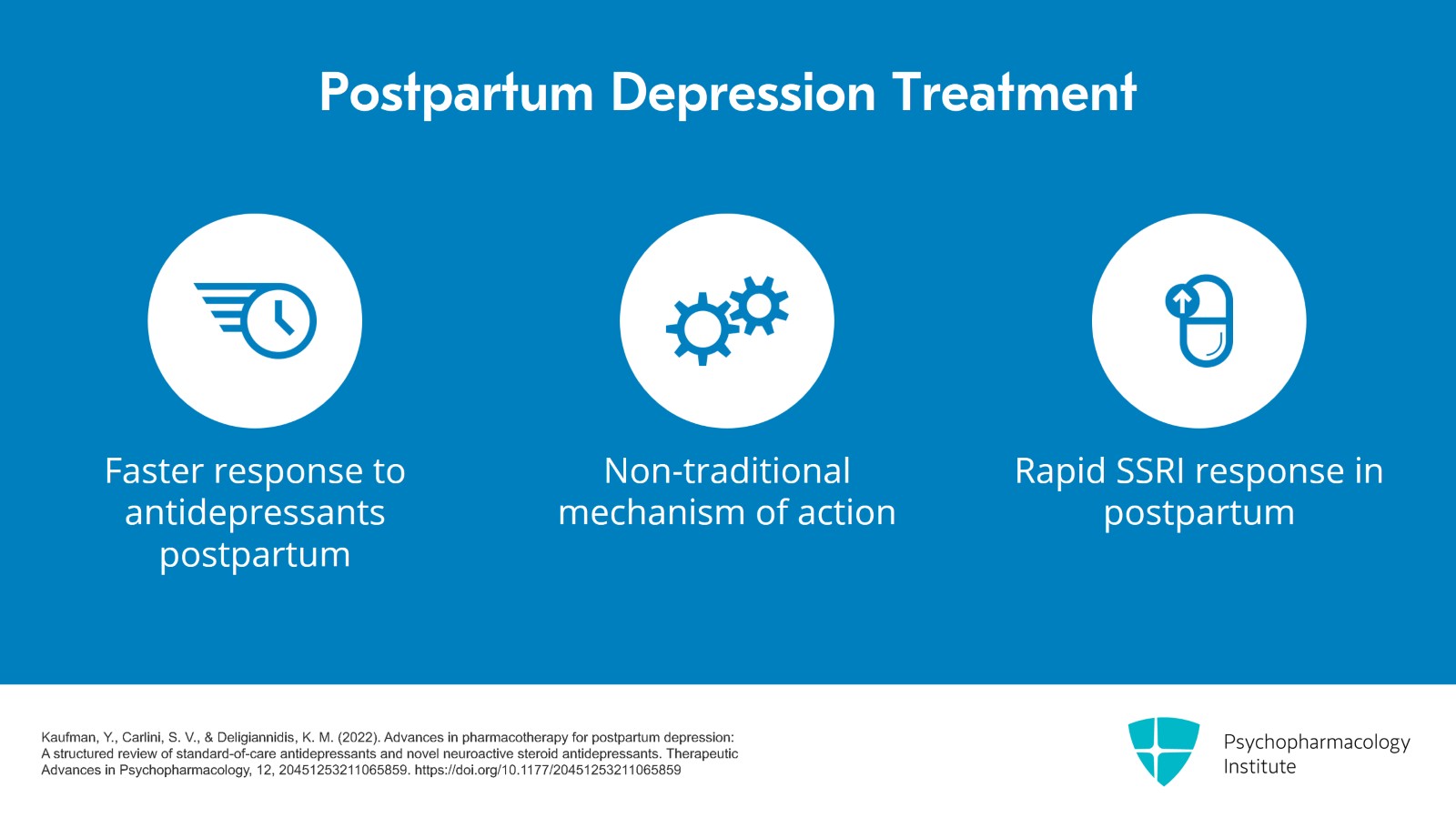
This is an important point because it points out that it's possible that the postpartum period is a period when response may be quicker to antidepressants than at other times that people have depression. It may be acting not through the traditional serotonin mechanism but through other mechanisms such as the GABA system. We therefore think that women can respond to SSRIs very quickly in the postpartum period.
References:
- Kaufman, Y., Carlini, S. V., & Deligiannidis, K. M. (2022). Advances in pharmacotherapy for postpartum depression: A structured review of standard-of-care antidepressants and novel neuroactive steroid antidepressants. Therapeutic Advances in Psychopharmacology, 12, 20451253211065859. https://doi.org/10.1177/20451253211065859
Slide 10 of 21
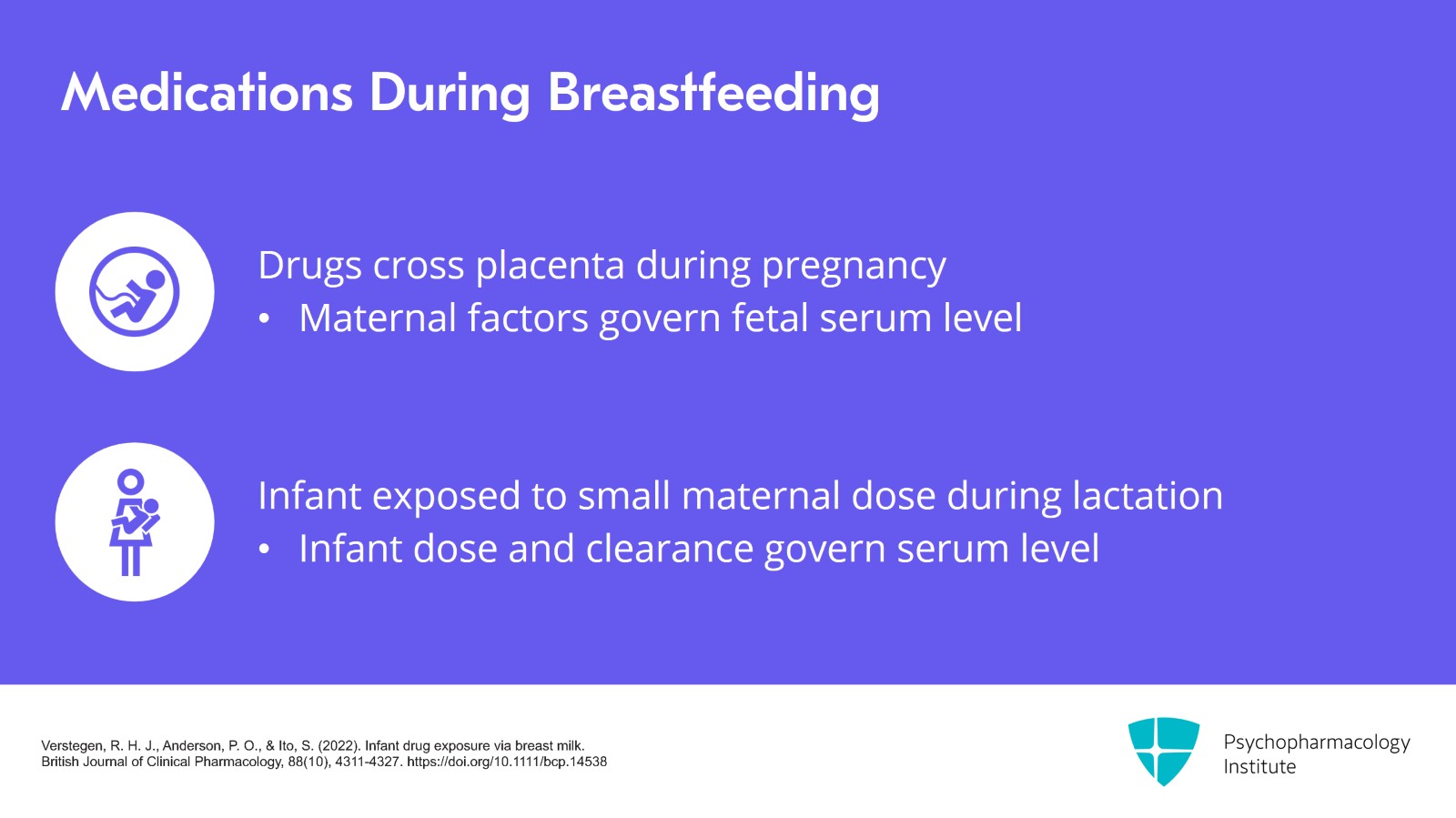
So let's talk a little bit more about breastfeeding and those crucial considerations about choosing medications in breastfeeding. So first of all, let's think about secretion into breast milk. Remember that during pregnancy, most drugs cross the placenta and the level in the fetal serum will equilibrate with the level in the maternal serum. Maternal dose and clearance will therefore govern the infant's serum level. But during lactation, the infant is exposed only to a small fraction of the maternal dose and therefore the infant dose and infant clearance govern that infant serum level.
References:
- Verstegen, R. H. J., Anderson, P. O., & Ito, S. (2022). Infant drug exposure via breast milk. British Journal of Clinical Pharmacology, 88(10), 4311-4327. https://doi.org/10.1111/bcp.14538
Free Files
Download PDF and other files
Success!
Check your inbox, we sent you all the materials there.
Slide 11 of 21
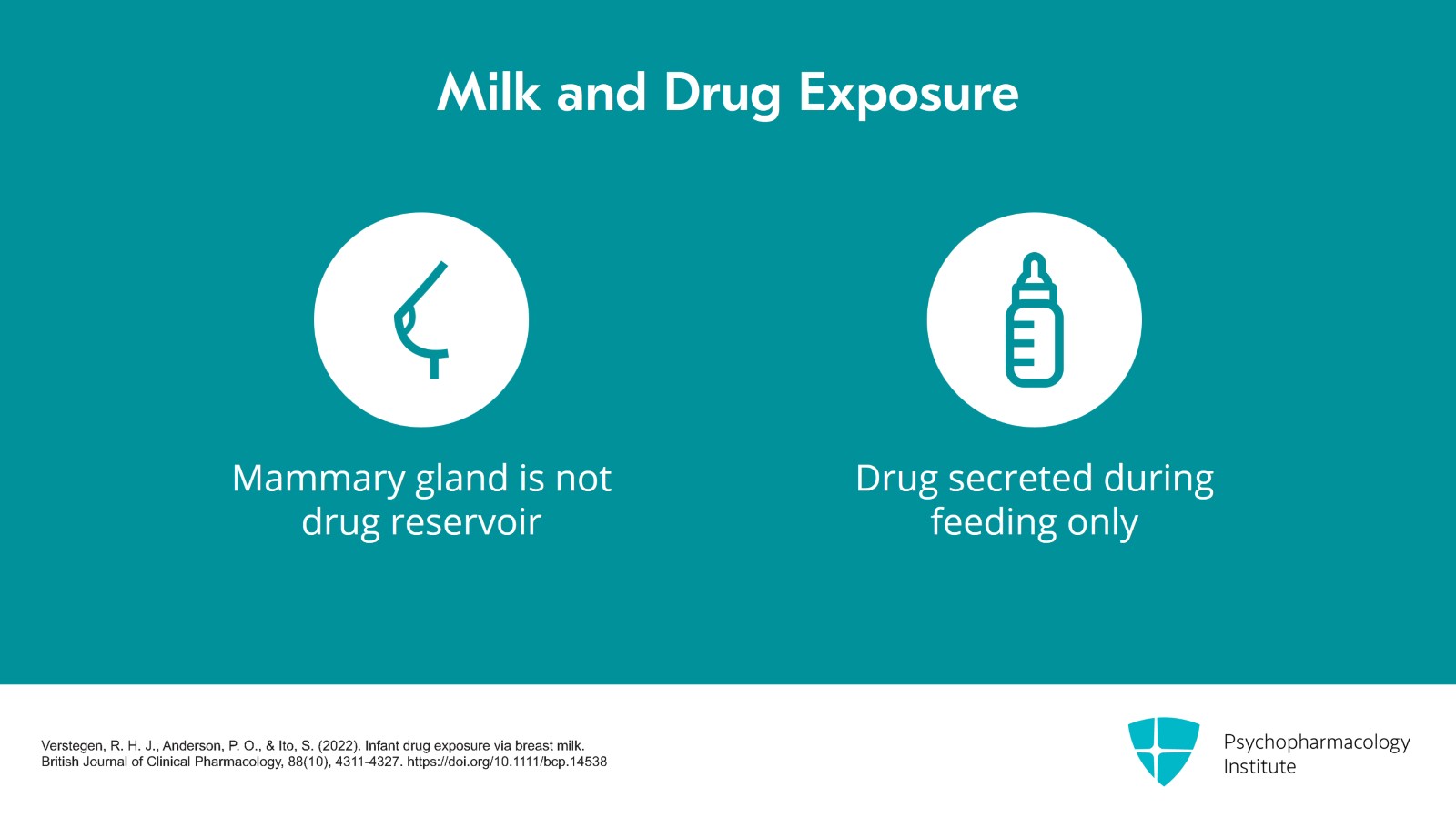
Why is that? Well, the mammary gland is not a major drug eliminating organ but it's also not a drug reservoir. Therefore, the drug is not just sitting in the milk waiting for the baby to feed but that exposure to the infant is just the amount that's secreted while the infant is feeding.
References:
- Verstegen, R. H. J., Anderson, P. O., & Ito, S. (2022). Infant drug exposure via breast milk. British Journal of Clinical Pharmacology, 88(10), 4311-4327. https://doi.org/10.1111/bcp.14538
Slide 12 of 21
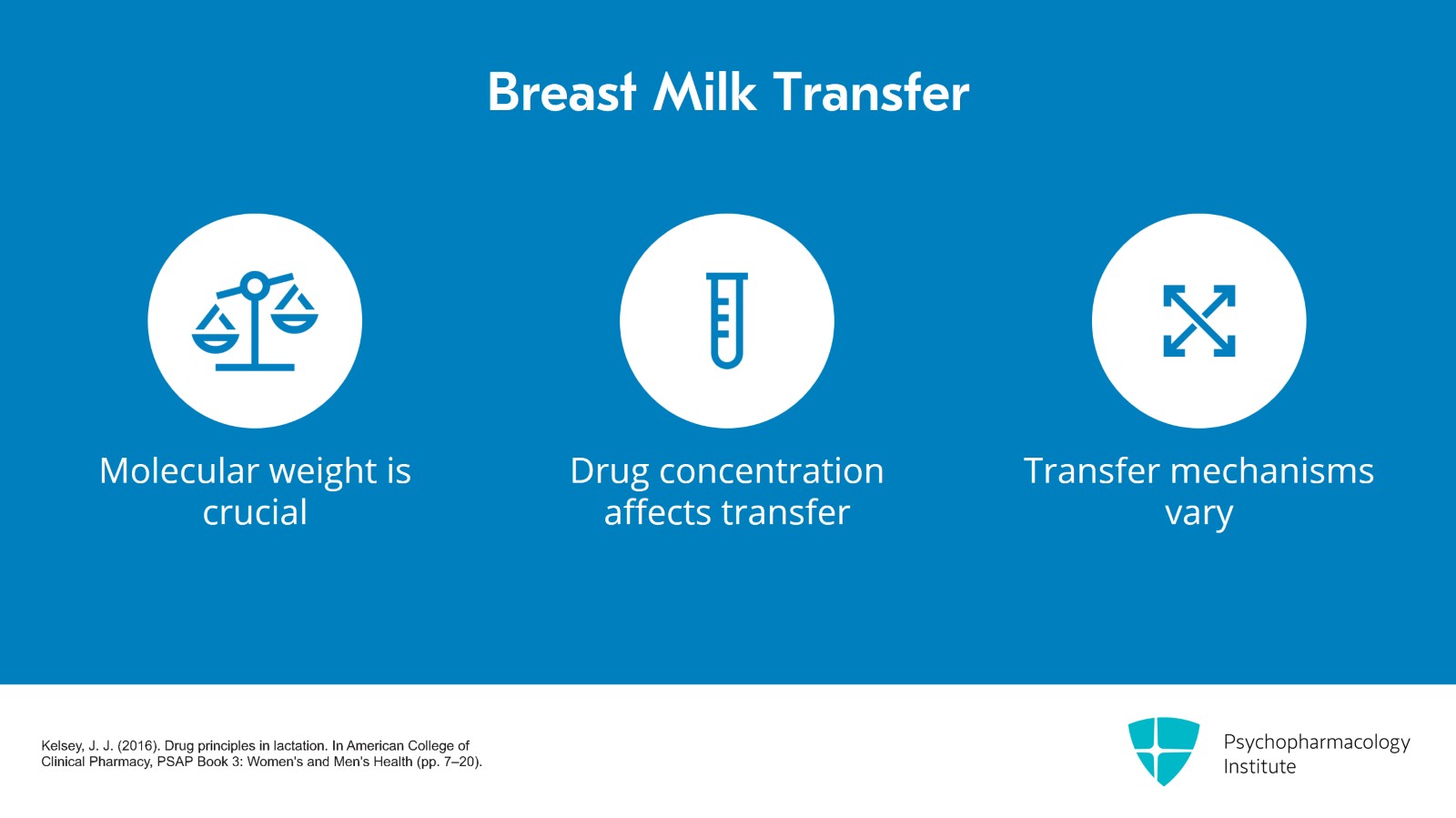
So what determines how much of a drug gets into the breast milk? Well, there are a few important considerations. First of all, molecular weight. Anything that's up to 200 Da easily gets into the breast milk. Up to 1000 Da is possible. But anything larger is going to be much more difficult. We also need to think about drug concentration. Drugs mostly pass in by diffusion but some have to pass in by active transport which will lead to an elevated milk/plasma ratio.
References:
- Kelsey, J. J. (2016). Drug principles in lactation. In American College of Clinical Pharmacy, PSAP Book 3: Women's and Men's Health (pp. 7–20).
Free Files
Download PDF and other files
Success!
Check your inbox, we sent you all the materials there.
Slide 13 of 21
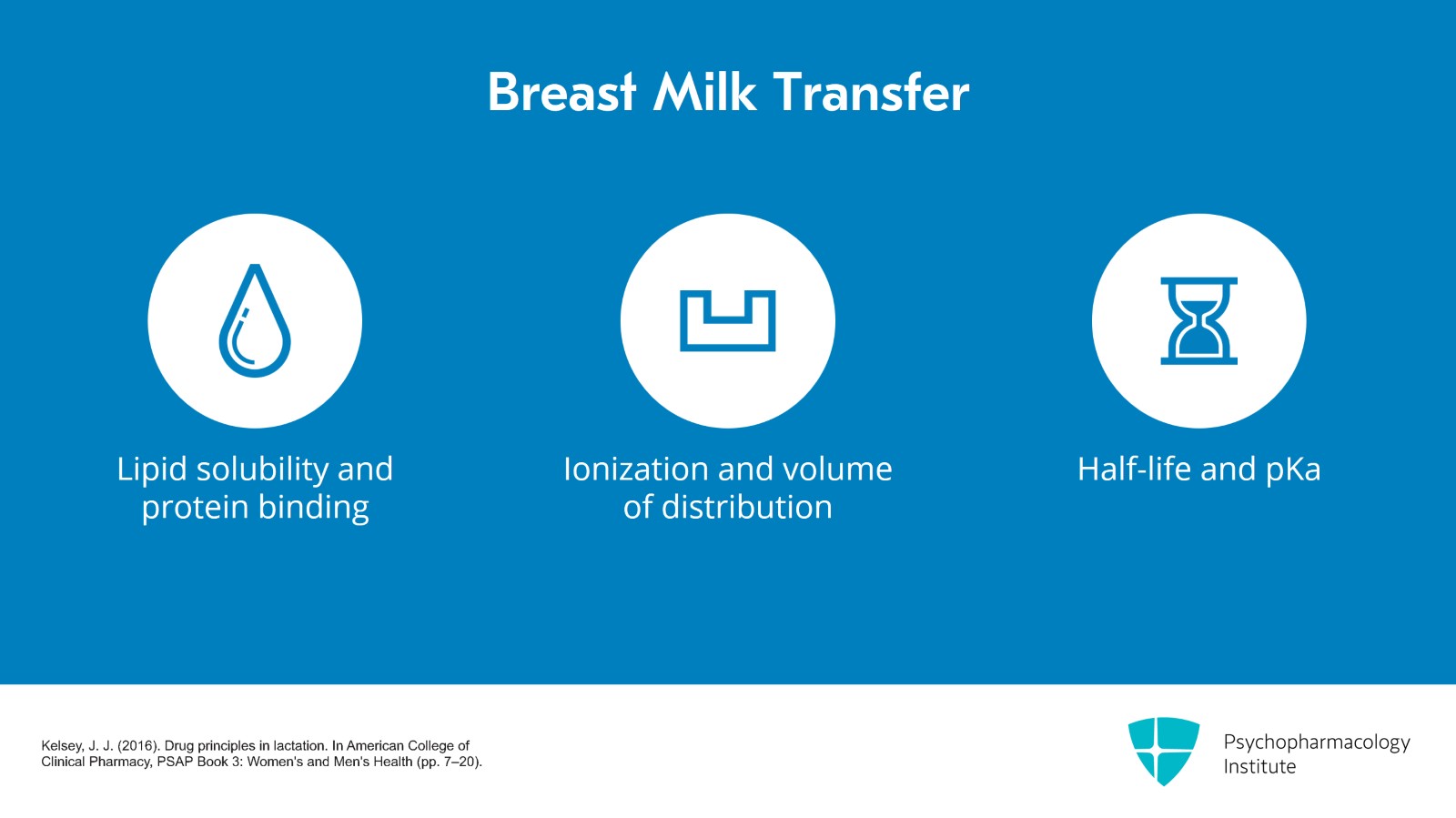
We need to think about the lipid solubility of the drug. Remember that it's a lipid membrane so anything lipid soluble is more likely to pass into the breast milk. We need to think about protein binding. Those with high protein binding will enter more easily. Think about the degree of ionization. Again, more highly ionized will enter more easily. And think about that volume of distribution. We also want to think about the half-life. For medications that have a short half-life, a higher concentration in milk will actually promote passage back into the maternal circulation. And we need to think about the pKa. Weakly basic drugs will become trapped in the milk department because they're more acidic than blood.
References:
- Kelsey, J. J. (2016). Drug principles in lactation. In American College of Clinical Pharmacy, PSAP Book 3: Women's and Men's Health (pp. 7–20).
Slide 14 of 21
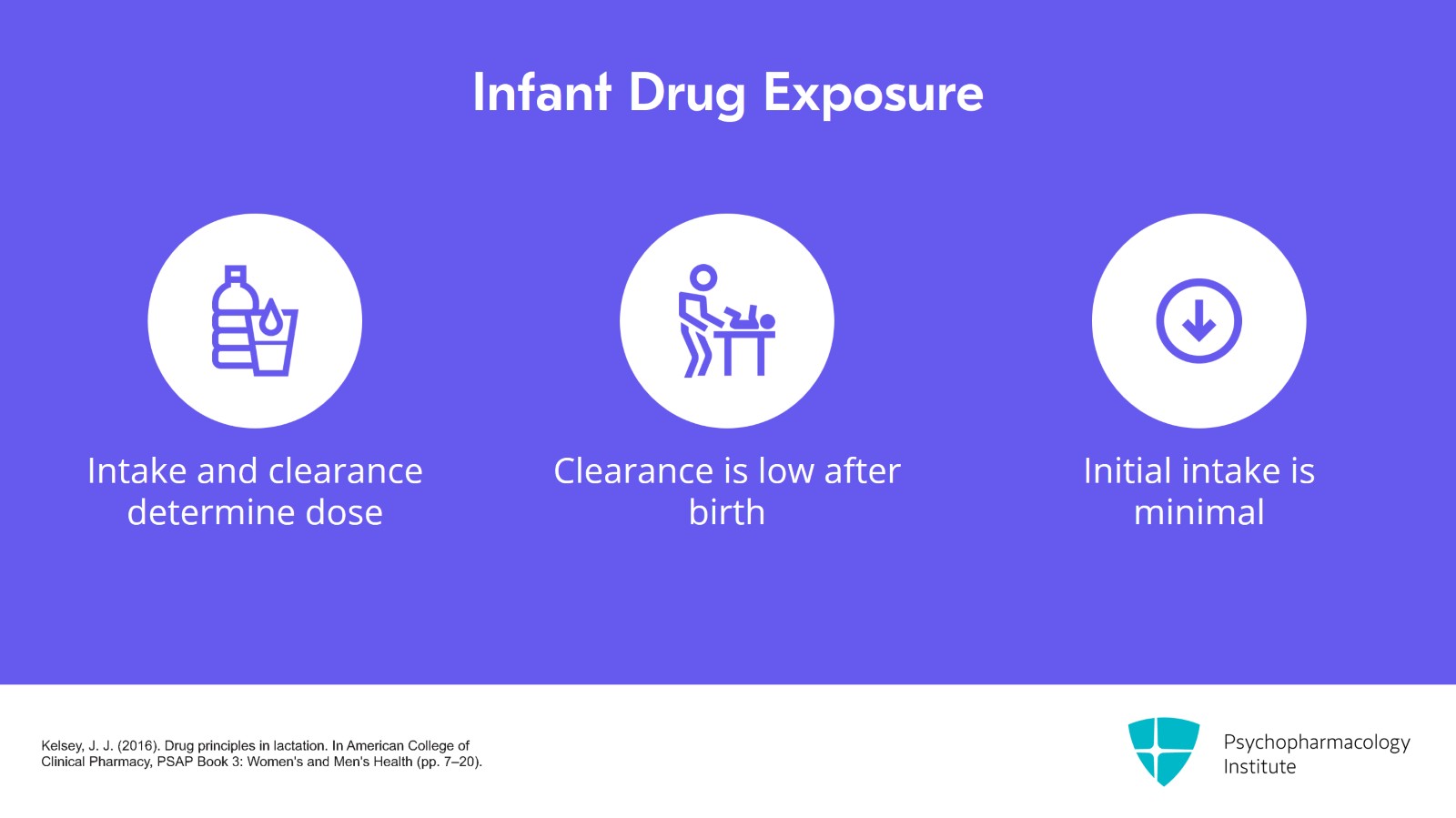
So those are things about the drug that determine the passage into the breast milk. What are things we need to think about in terms of the infant and the mother that affect what the infant will be exposed to? So the key infant considerations are that remember that the infant intake and infant clearance together determine the dose. So for example, if a baby ingests a high amount of drug and has a low rate of clearance, you're going to have a lot more in the baby than if the baby ingests that same high amount of drug but has good clearance. So in the first few days after birth, clearance is very low but remember so is the intake. It's just colostrum and very little is getting into the baby.
References:
- Kelsey, J. J. (2016). Drug principles in lactation. In American College of Clinical Pharmacy, PSAP Book 3: Women's and Men's Health (pp. 7–20).
Free Files
Download PDF and other files
Success!
Check your inbox, we sent you all the materials there.
Slide 15 of 21
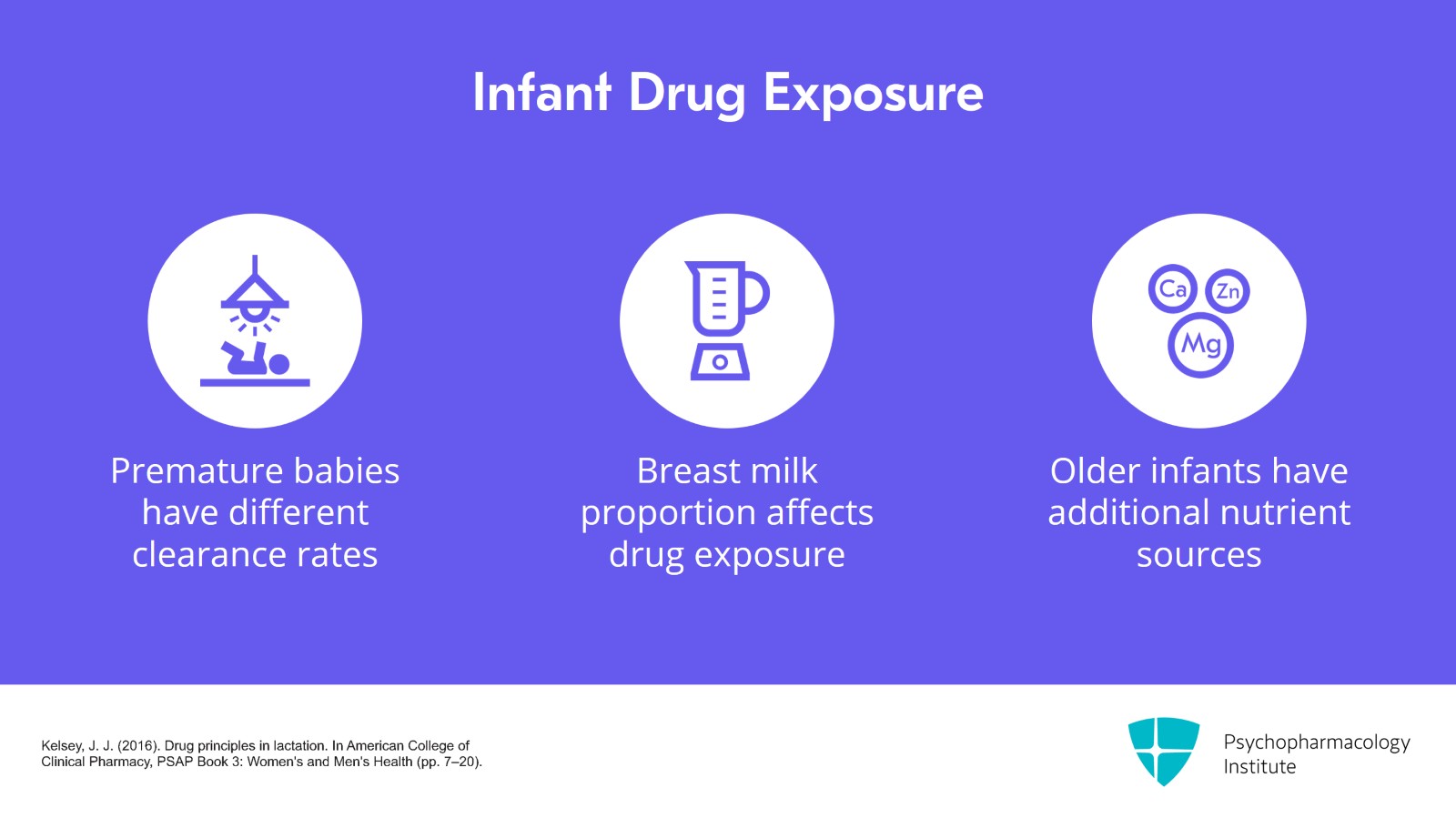
Infant pharmacokinetics differ. So for example, premature babies may not have the same clearance rates because kidney and liver function are crucial to clearing those drugs. We also need to think about what proportion of the total nutritional intake is made up by breast milk. Some mothers combine breast milk and formula. That reduces the exposure to the drug. Older infants have other sources of nutrients such as solid food, again reducing the infant's exposure to the drug.
References:
- Kelsey, J. J. (2016). Drug principles in lactation. In American College of Clinical Pharmacy, PSAP Book 3: Women's and Men's Health (pp. 7–20).
Slide 16 of 21
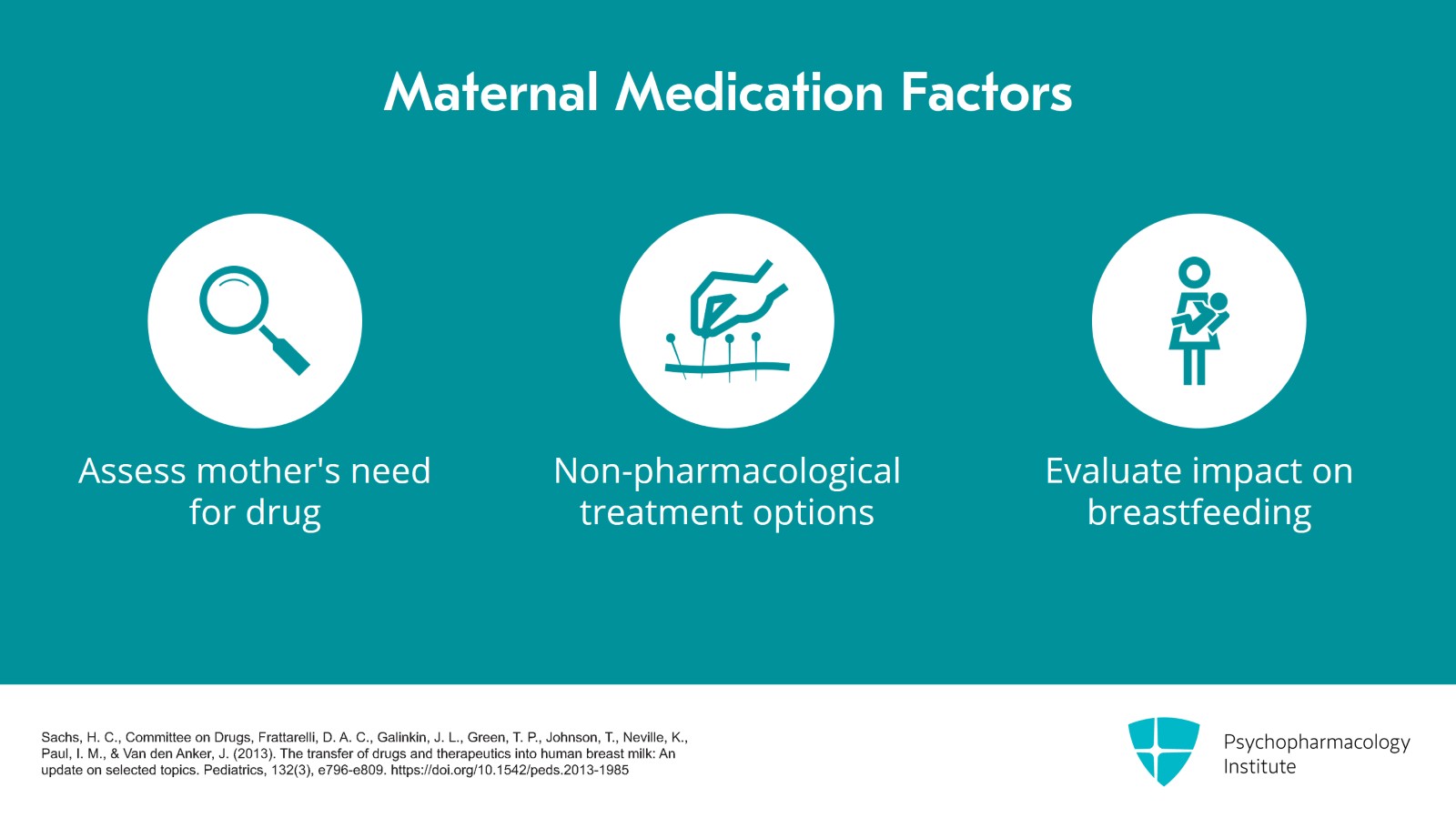
What about crucial maternal considerations that can help us understand the choice for a drug. So the number one is, what is the need for the drug by the mother? How ill is the mother? To what extent does she need this drug in order to be able to function? What are the potential adverse effects on the mother and the family if she is not treated? What is the mother's access to and response to non-pharmacological treatment? And finally, what's the effect of the drug on milk production? So things that have an effect on prolactin or things that have an effect on dopamine will have an effect on milk production and that's important particularly if a woman is struggling to breastfeed or if part of her mood symptoms have to do with her feelings of failure because of being unable to breastfeed.
References:
- Sachs, H. C., Committee on Drugs, Frattarelli, D. A. C., Galinkin, J. L., Green, T. P., Johnson, T., Neville, K., Paul, I. M., & Van den Anker, J. (2013). The transfer of drugs and therapeutics into human breast milk: An update on selected topics. Pediatrics, 132(3), e796-e809. https://doi.org/10.1542/peds.2013-1985
Free Files
Download PDF and other files
Success!
Check your inbox, we sent you all the materials there.
Slide 17 of 21
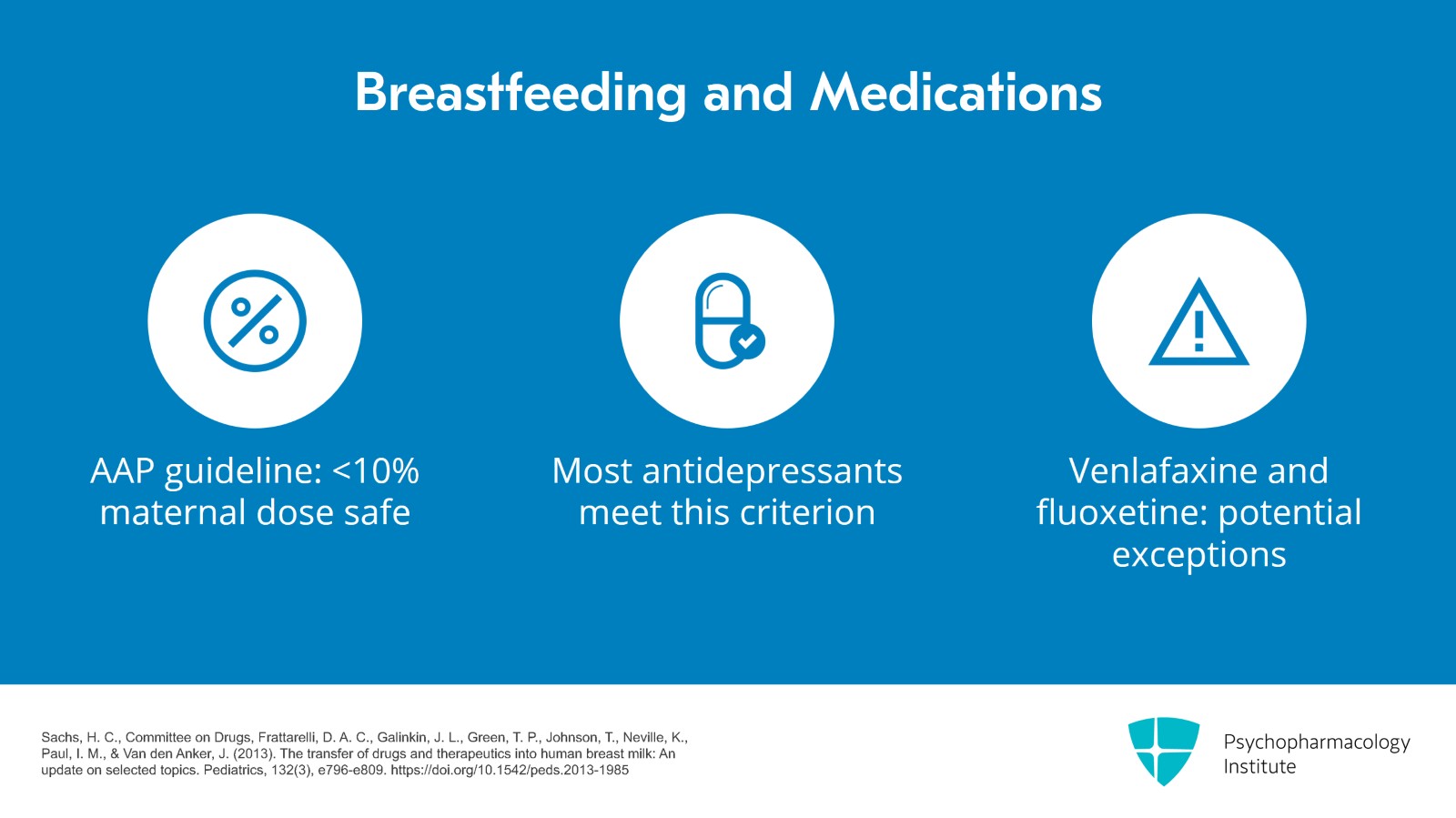
The American Academy of Pediatrics has declared that drugs that enter the breast milk at a rate of less than 10% of the maternal dose going to the breastfeeding baby are likely compatible with breastfeeding. Nearly all antidepressants fall below that rate of 10% with two possible exceptions. A few studies have shown rates for venlafaxine being slightly higher and a few studies have shown that rates of fluoxetine may also be slightly higher. That makes sense because of that longer half-life and there have been more case reports for fluoxetine of, for example, excessive crying and irritability of the babies but these are just case reports and case series. There hasn't been a systematic study of it.
References:
- Sachs, H. C., Committee on Drugs, Frattarelli, D. A. C., Galinkin, J. L., Green, T. P., Johnson, T., Neville, K., Paul, I. M., & Van den Anker, J. (2013). The transfer of drugs and therapeutics into human breast milk: An update on selected topics. Pediatrics, 132(3), e796-e809. https://doi.org/10.1542/peds.2013-1985
Slide 18 of 21
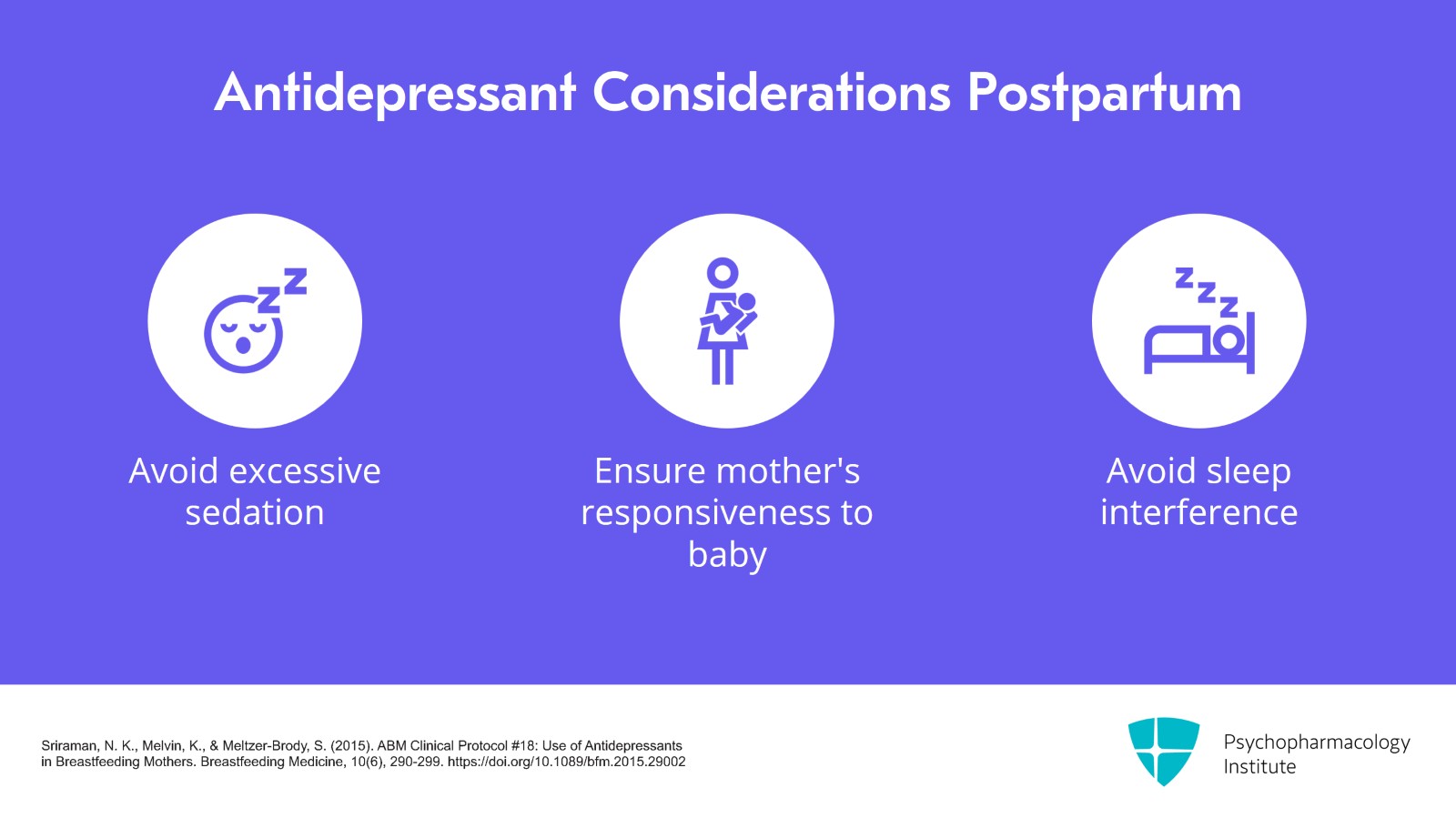
So how do we consider how to choose an antidepressant choice postpartum? Well, we really want to make sure that we're avoiding excessive sedation even at night because the mother has to be able to respond to the baby. She needs to be able to hear the baby cry. She needs to be able to feed the baby without dropping it. And we don't want excessive sedation to pose an increased risk for mothers who are co-sleeping. We also don't want to choose a drug that's going to interfere with their sleep because postpartum women are already sleep deprived. They don't need another reason to have less sleep.
References:
- Sriraman, N. K., Melvin, K., & Meltzer-Brody, S. (2015). ABM Clinical Protocol #18: Use of Antidepressants in Breastfeeding Mothers. Breastfeeding Medicine, 10(6), 290-299. https://doi.org/10.1089/bfm.2015.29002
Free Files
Download PDF and other files
Success!
Check your inbox, we sent you all the materials there.
Slide 19 of 21
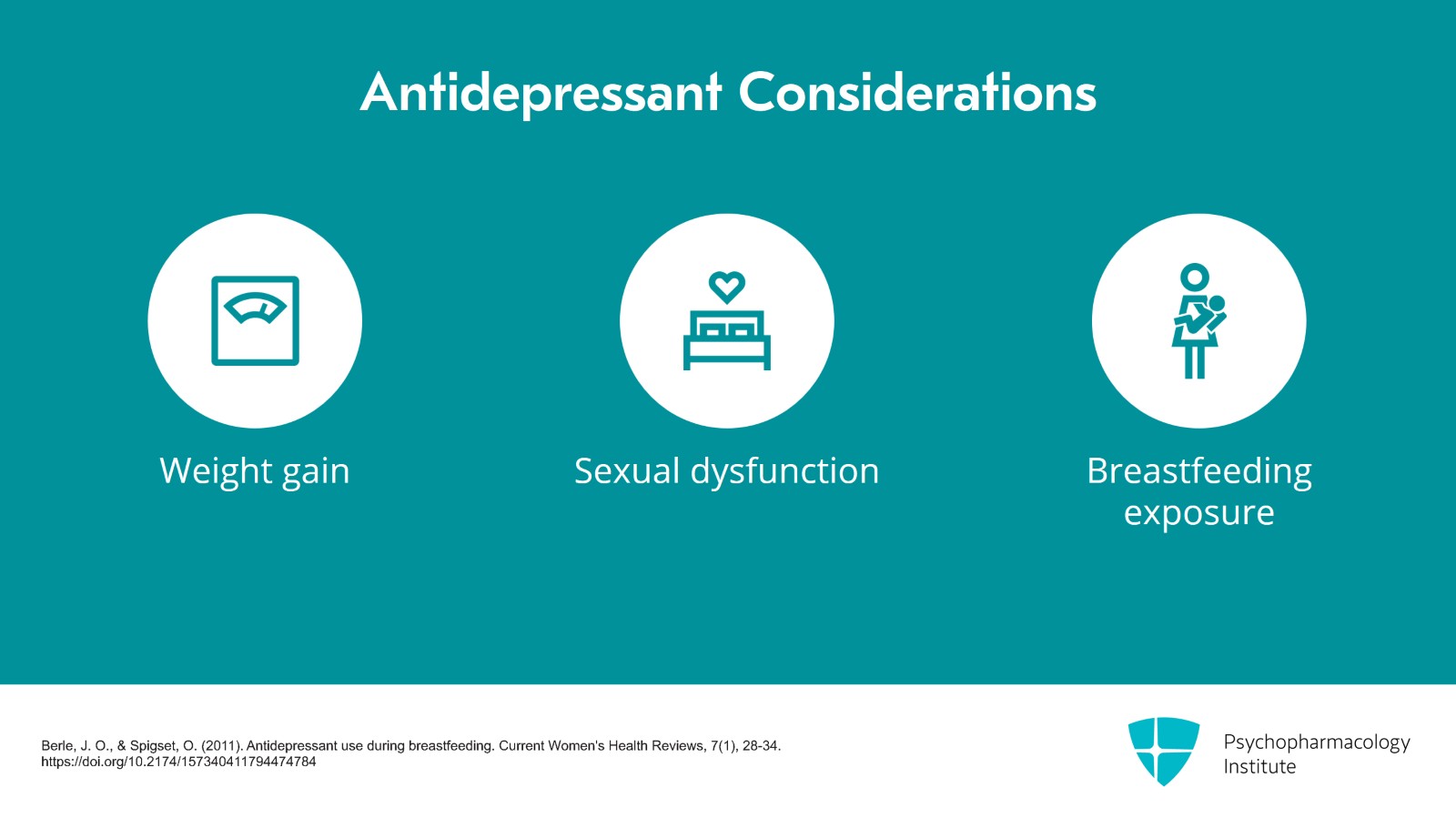
We also need to think about the role of the drug in weight gain. There is postpartum weight retention for a lot of women and that can be associated with greater long-term health risks and can also contribute to some women's feelings of inadequacy or concern about their body image postpartum. Remember that SSRIs are not associated with a high degree of weight gain but for some patients this may be something that holds great salience for them. We also need to think about sexual dysfunction. While in the first few weeks postpartum this isn't likely to be an issue, later into the postpartum it is and it may affect intimate relationships at a vulnerable time. And then finally, we also have to think about breastfeeding exposure but again being reassured that most of the antidepressants we have enter the breast milk at a rate lower than we would think is concerning.
References:
- Berle, J. O., & Spigset, O. (2011). Antidepressant use during breastfeeding. Current Women's Health Reviews, 7(1), 28-34. https://doi.org/10.2174/157340411794474784
Slide 20 of 21
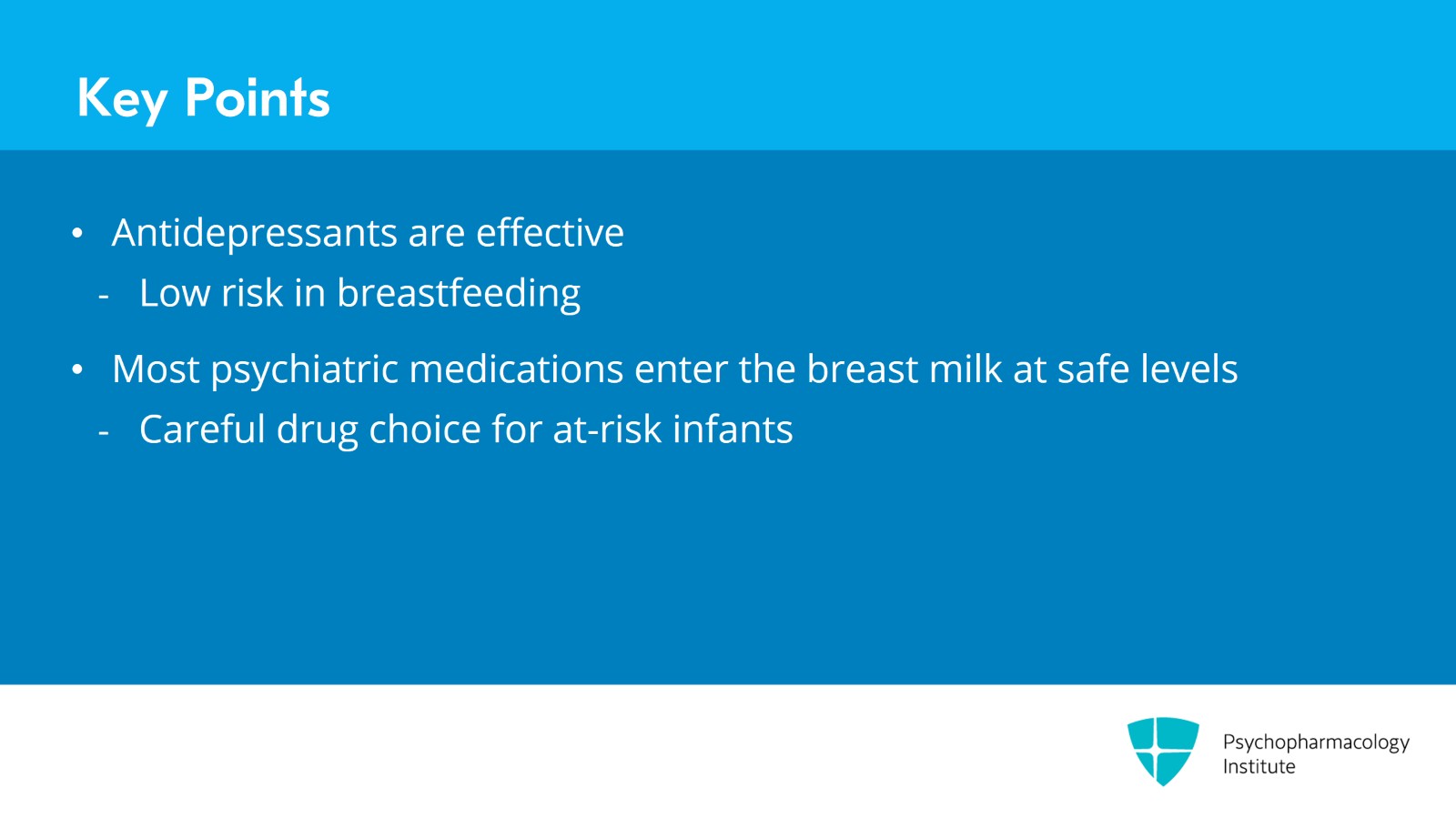
So let's wrap up with some key points for this section. Remember that patients with postpartum depression respond well to antidepressant medications and the small amount of data that we have about efficacy is reassuring. All psychiatric medications enter the breast milk but almost all at levels below those that would pose any risk to the infant. Remember that rates of clearance are different in premature babies or those with health concerns and those are the babies for whom we might want to think very carefully about the choice of drug for the mother. Remember that these drugs are low risk in breastfeeding so the mother's need for the drug rather than concern about passage into the breast milk is usually the governing rule except in those cases where the baby has a health concern.
Free Files
Download PDF and other files
Success!
Check your inbox, we sent you all the materials there.
Slide 21 of 21