Close Banner
Section Free  - Video Lectures

04. Bipolar Disorder During Pregnancy: Management of Lithium

Published on September 1, 2023 Certification expiration date: September 1, 2026

Vivien K. Burt, M.D., Ph.D.

Professor Emeritus of Psychiatry - UCLA

Key Points

  • Lithium levels tend to decrease in pregnancy.
  • Monitor lithium levels and adjust the dose to maintain clinical efficacy.
  • Continue lithium during labor and delivery.
  • Monitor lithium twice-weekly during the first 2 postpartum weeks with the goal of achieving preconception levels.

Free Downloads for Offline Access

  • Free Download Presentation File (PPTX)
  • Free Download Audio File (MP3)
  • Free Download Video (MP4)

Slides and Transcript

Slide 1 of 14

So how then do we manage lithium in pregnancy?

Slide 2 of 14

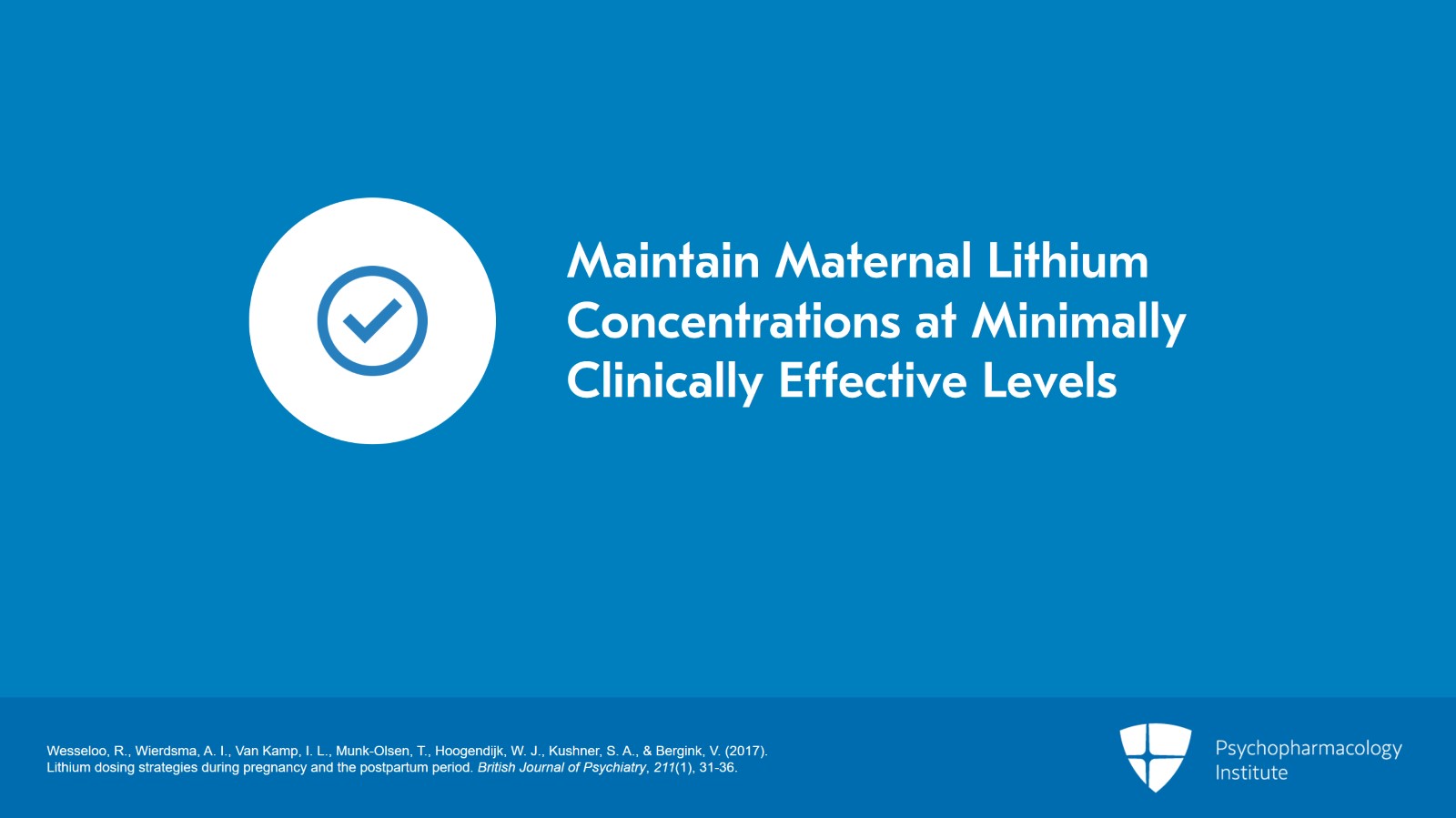
Well, one of the mainstays of treatment is that we try to maintain the maternal target lithium concentration in the mother at minimally clinically effective levels. So yes, the word is minimum, but if it’s not clinically effective there’s no point in using it. You want to use the dose that is clinically effective and can be used at the lowest dose that gives you clinically effective levels.
References:
  • Wesseloo, R., Wierdsma, A. I., Van Kamp, I. L., Munk-Olsen, T., Hoogendijk, W. J., Kushner, S. A., & Bergink, V. (2017). Lithium dosing strategies during pregnancy and the postpartum period. British Journal of Psychiatry, 211(1), 31-36.
Free Files
Success!
Check your inbox, we sent you all the materials there.

Slide 3 of 14

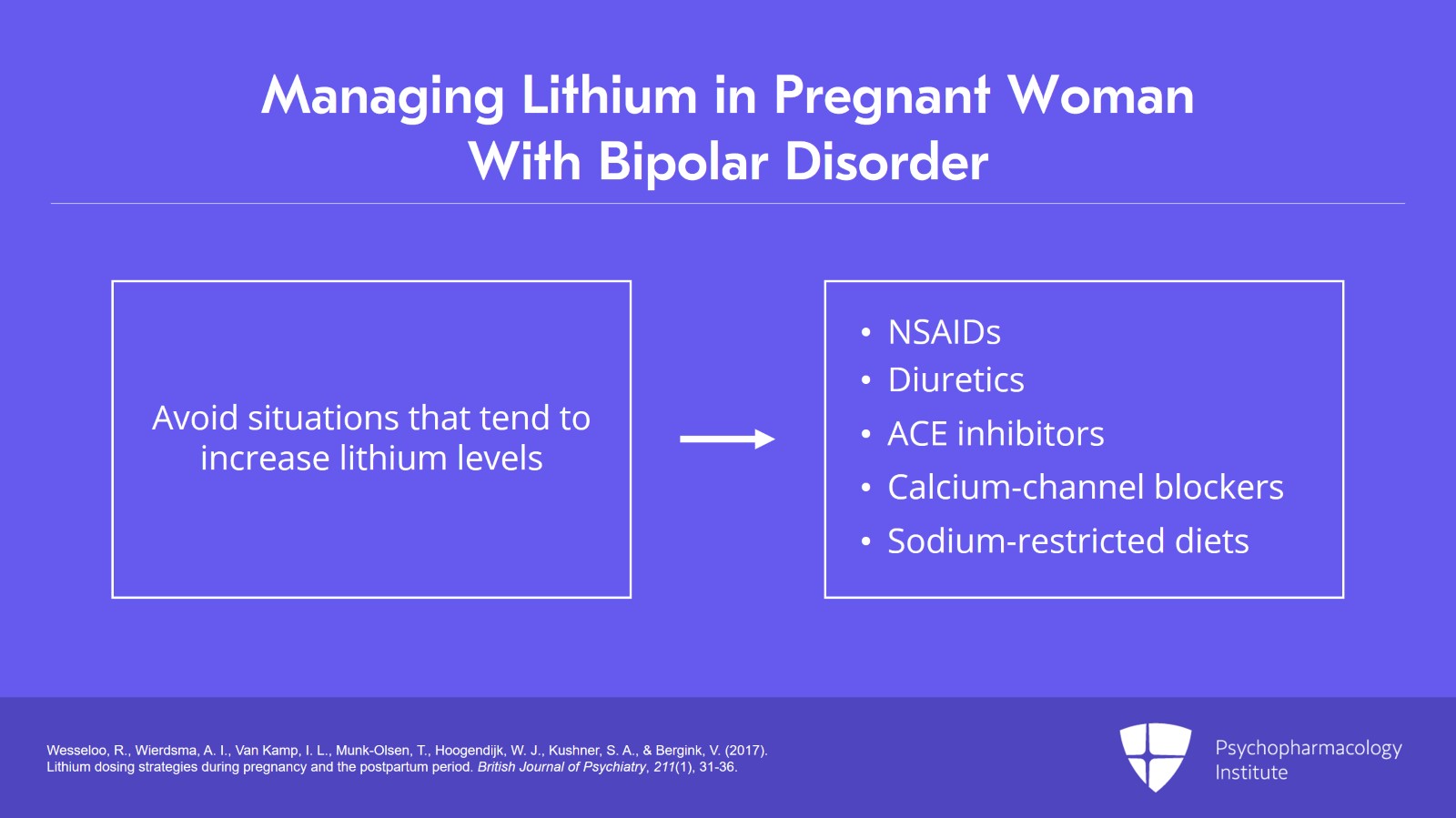
If possible, we avoid situations that tend to increase lithium levels so we try to avoid NSAIDs, diuretics, ACE inhibitors, calcium-channel blockers and we also watch for sodium-restricted diets. For example, sometimes, these are used to manage preeclampsia or edema and that also can cause increased lithium levels so we have to watch for that.
References:
  • Wesseloo, R., Wierdsma, A. I., Van Kamp, I. L., Munk-Olsen, T., Hoogendijk, W. J., Kushner, S. A., & Bergink, V. (2017). Lithium dosing strategies during pregnancy and the postpartum period. British Journal of Psychiatry, 211(1), 31-36.

Slide 4 of 14

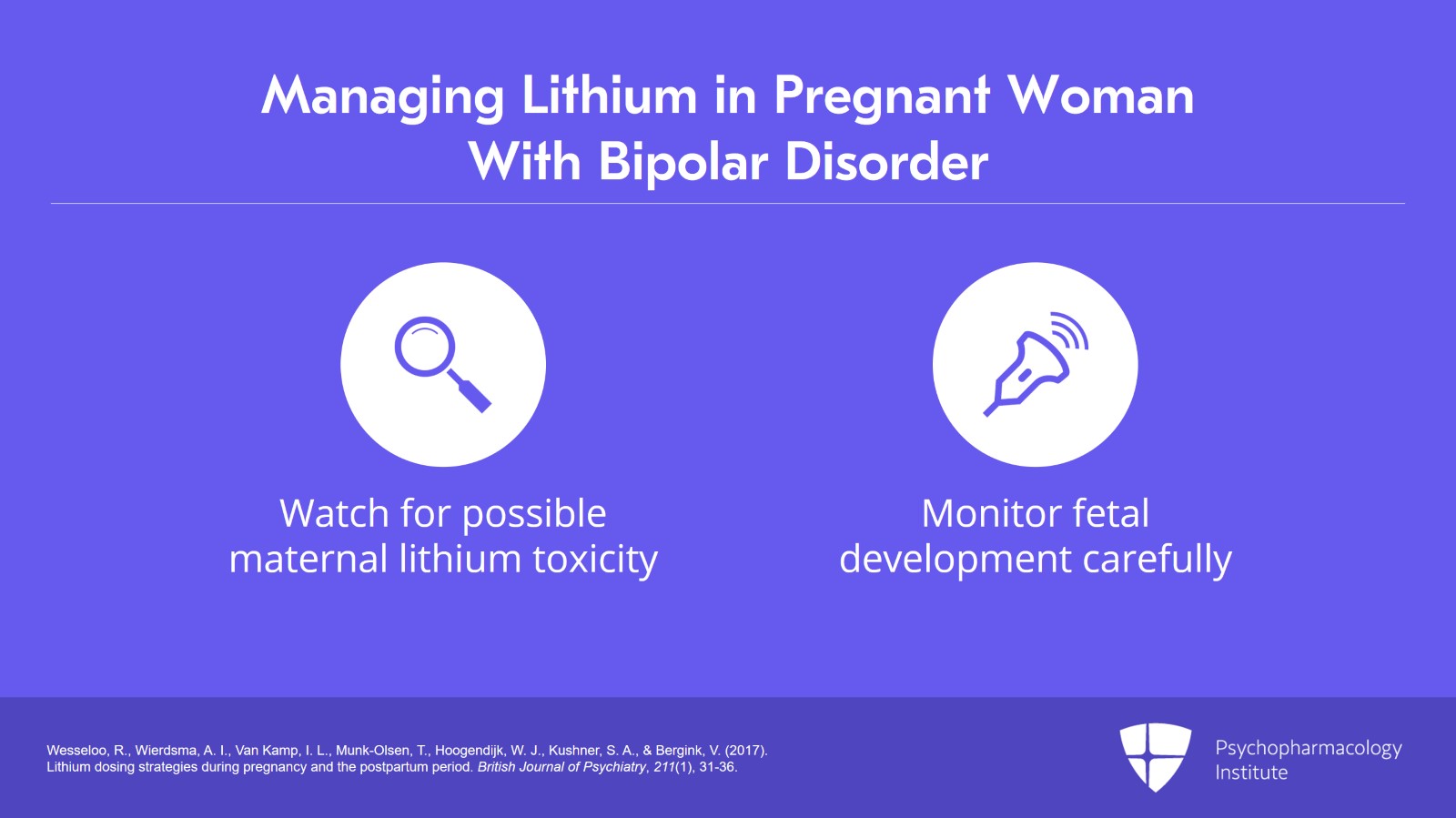
We watch for possible maternal lithium toxicity which can arise in the event of acute fluid loss, hyperemesis gravidarum, or as I mentioned, preeclampsia. And we always monitor fetal development carefully.
References:
  • Wesseloo, R., Wierdsma, A. I., Van Kamp, I. L., Munk-Olsen, T., Hoogendijk, W. J., Kushner, S. A., & Bergink, V. (2017). Lithium dosing strategies during pregnancy and the postpartum period. British Journal of Psychiatry, 211(1), 31-36.
Free Files
Success!
Check your inbox, we sent you all the materials there.

Slide 5 of 14

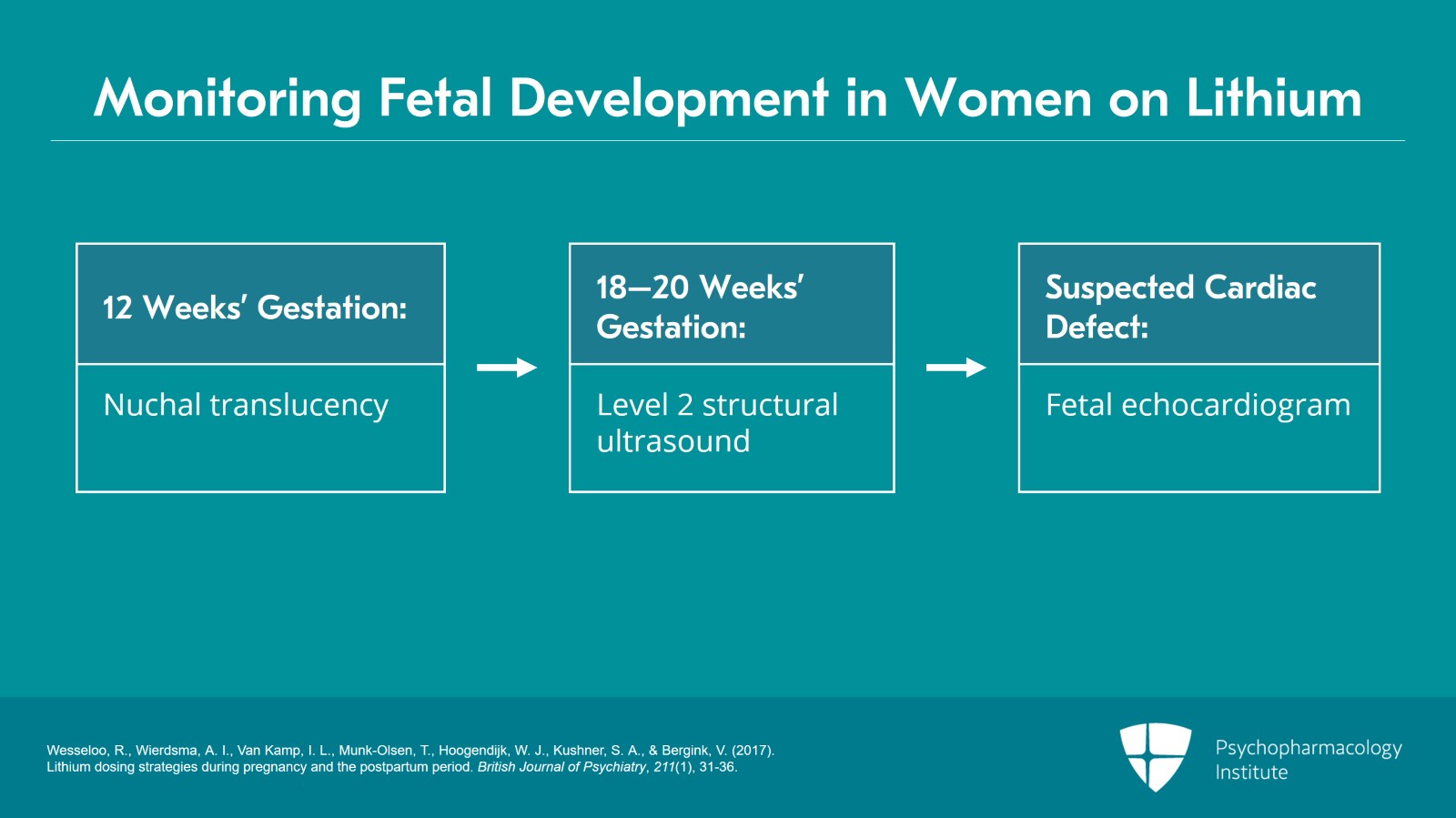
Remember often a nuchal translucency test that’s done at 12 weeks’ gestation, that measures the depth of the nuchal fold in a developing embryo and when it is higher than normal that increases the suspicion of cardiac defect, doesn’t mean that there is one but it is a possible harbinger of cardiac defect and then there would be more tests that have to be done. We want to make sure that a level 2 structural ultrasound is done between weeks 18 to 20 of gestation. Every part of every organ is looked at. And if for some reason there is a further suspicion of a cardiac defect, a fetal echocardiogram can then be performed which really will hone-in in detail on the health of the heart.
References:
  • Wesseloo, R., Wierdsma, A. I., Van Kamp, I. L., Munk-Olsen, T., Hoogendijk, W. J., Kushner, S. A., & Bergink, V. (2017). Lithium dosing strategies during pregnancy and the postpartum period. British Journal of Psychiatry, 211(1), 31-36.

Slide 6 of 14

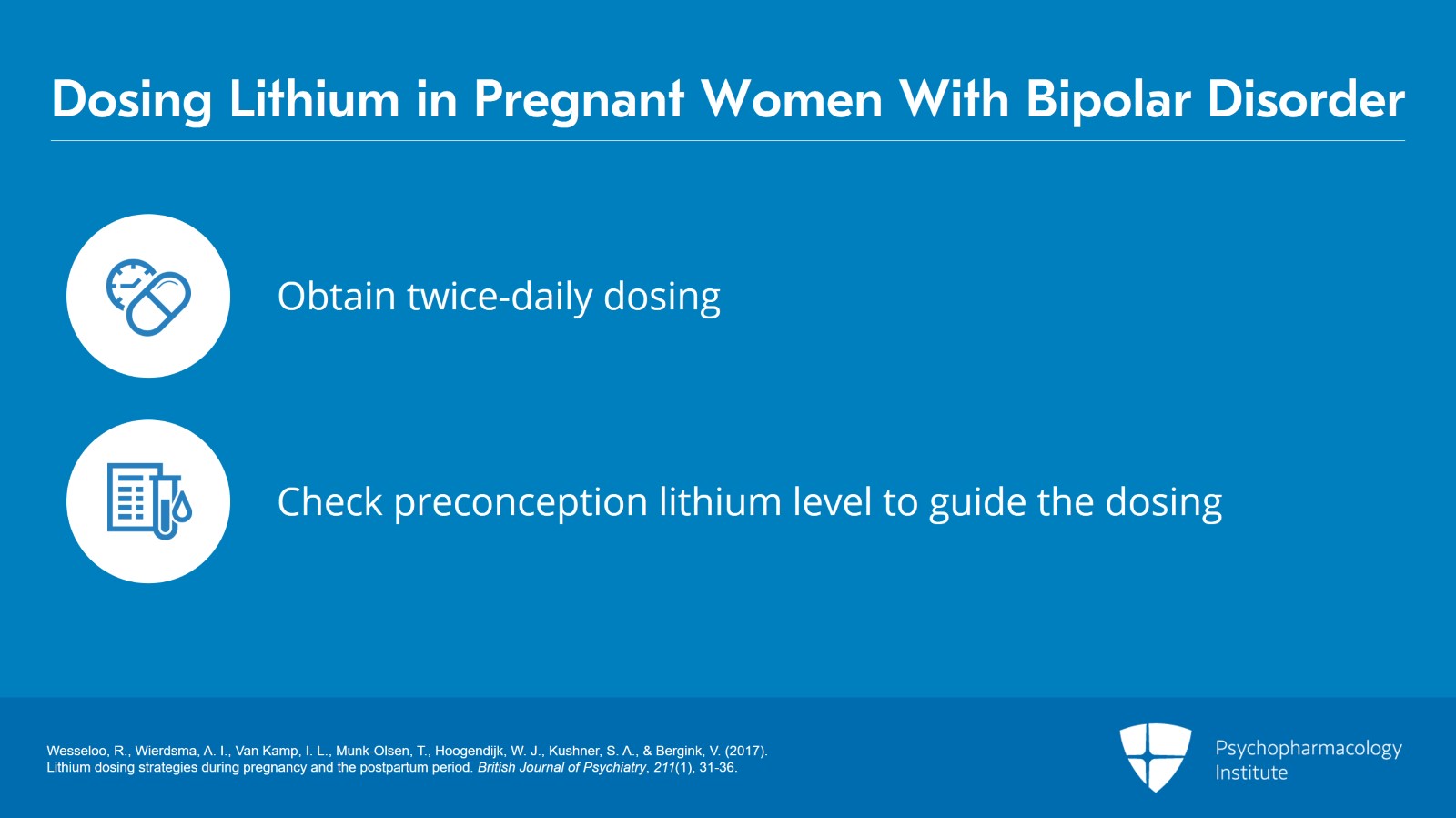
How then do we dose lithium in pregnant bipolar patients? Well, we try to obtain twice daily dosing because this minimizes peak lithium blood levels and it reduces the risk for side effects. We check the preconception lithium level to guide dosage both during pregnancy and the postpartum.
References:
  • Wesseloo, R., Wierdsma, A. I., Van Kamp, I. L., Munk-Olsen, T., Hoogendijk, W. J., Kushner, S. A., & Bergink, V. (2017). Lithium dosing strategies during pregnancy and the postpartum period. British Journal of Psychiatry, 211(1), 31-36.
Free Files
Success!
Check your inbox, we sent you all the materials there.

Slide 7 of 14

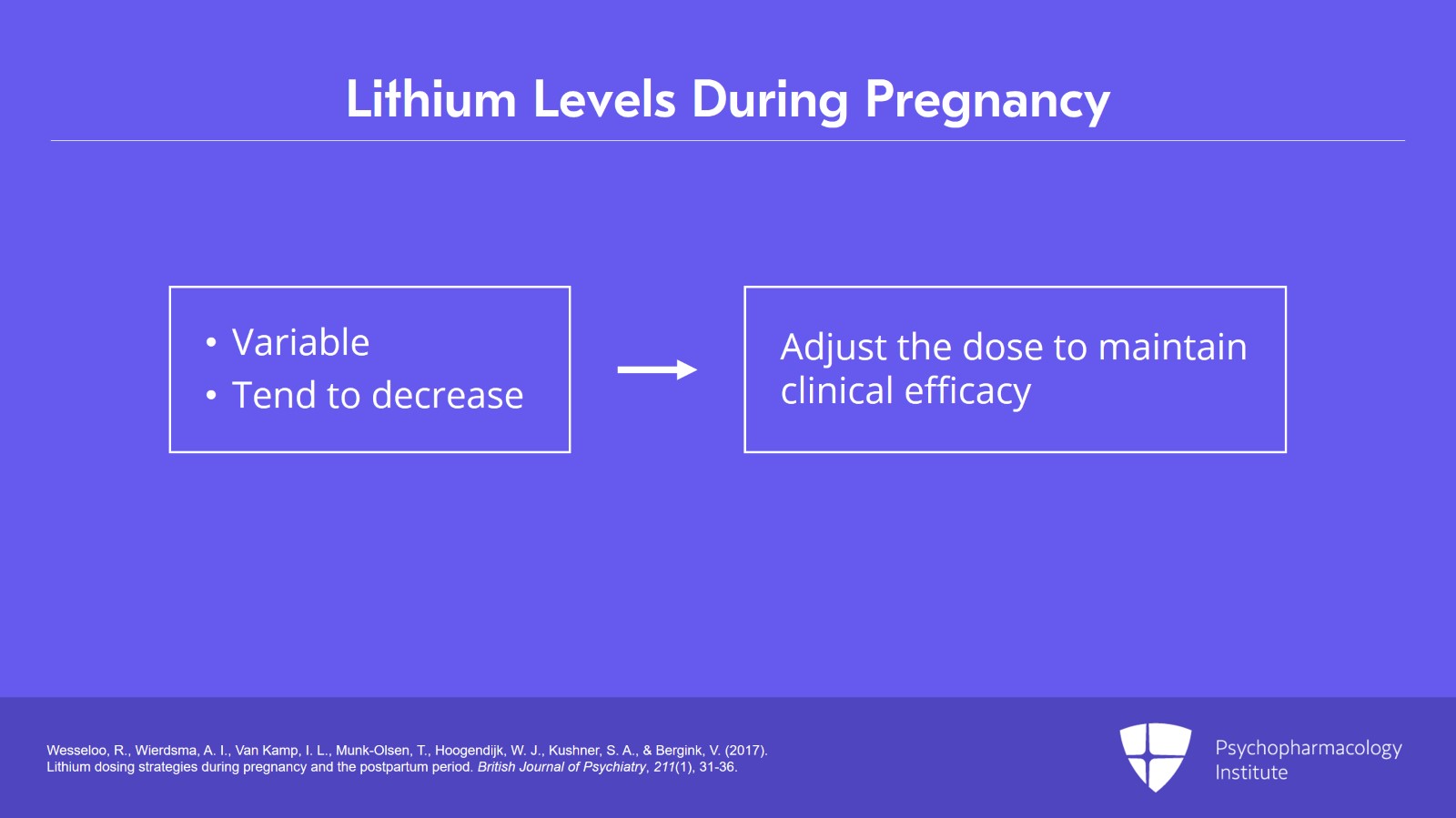
Additionally, lithium levels are variable during pregnancy. In one study, first trimester lithium levels decreased by 24%, by the second trimester decreased by 36%, and by the third trimester decreased by 21%. So it’s variable but generally lithium levels tend to decrease during pregnancy and the dose then needs to be adjusted and we adjust it not just for the level but also for clinical efficacy.
References:
  • Wesseloo, R., Wierdsma, A. I., Van Kamp, I. L., Munk-Olsen, T., Hoogendijk, W. J., Kushner, S. A., & Bergink, V. (2017). Lithium dosing strategies during pregnancy and the postpartum period. British Journal of Psychiatry, 211(1), 31-36.

Slide 8 of 14

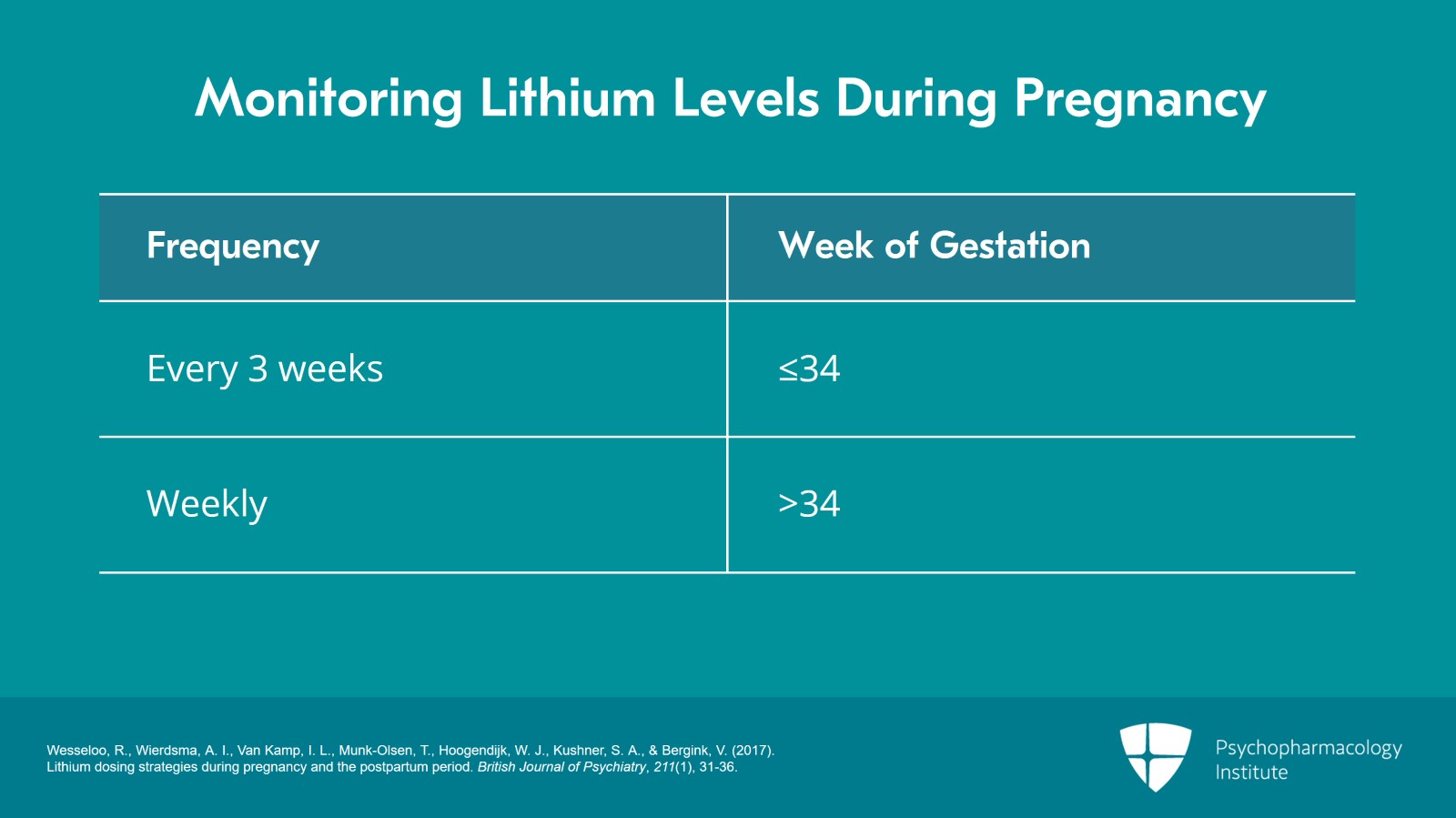
We want to monitor lithium levels carefully about once every three weeks during the first 34 weeks of gestation and weekly after 34 weeks until delivery.
References:
  • Wesseloo, R., Wierdsma, A. I., Van Kamp, I. L., Munk-Olsen, T., Hoogendijk, W. J., Kushner, S. A., & Bergink, V. (2017). Lithium dosing strategies during pregnancy and the postpartum period. British Journal of Psychiatry, 211(1), 31-36.
Free Files
Success!
Check your inbox, we sent you all the materials there.

Slide 9 of 14

During labor and delivery, we now maintain fluids and we do not discontinue lithium.
References:
  • Wesseloo, R., Wierdsma, A. I., Van Kamp, I. L., Munk-Olsen, T., Hoogendijk, W. J., Kushner, S. A., & Bergink, V. (2017). Lithium dosing strategies during pregnancy and the postpartum period. British Journal of Psychiatry, 211(1), 31-36.

Slide 10 of 14

After delivery, we monitor lithium in the mother twice a week during the first two weeks post delivery with the goal of achieving the preconception lithium level.
References:
  • Wesseloo, R., Wierdsma, A. I., Van Kamp, I. L., Munk-Olsen, T., Hoogendijk, W. J., Kushner, S. A., & Bergink, V. (2017). Lithium dosing strategies during pregnancy and the postpartum period. British Journal of Psychiatry, 211(1), 31-36.
Free Files
Success!
Check your inbox, we sent you all the materials there.

Slide 11 of 14

If possible, we adjust lithium doses based on the preconception history of the response clinically to lithium and we aim to keep the lithium in the therapeutic blood range.
References:
  • Wesseloo, R., Wierdsma, A. I., Van Kamp, I. L., Munk-Olsen, T., Hoogendijk, W. J., Kushner, S. A., & Bergink, V. (2017). Lithium dosing strategies during pregnancy and the postpartum period. British Journal of Psychiatry, 211(1), 31-36.

Slide 12 of 14

Key points here then are lithium levels tend to decrease in pregnancy so levels should be monitored and the dose adjusted to maintain clinical efficacy.
Free Files
Success!
Check your inbox, we sent you all the materials there.

Slide 13 of 14

Lithium should be continued during labor and delivery and lithium levels should be monitored twice a week during the first two postpartum weeks with the goal of achieving preconception mood stabilizing levels.

Slide 14 of 14

Free Files
Success!
Check your inbox, we sent you all the materials there.

Learning Objectives:

After completing this activity, the learner will be able to:

  1. Recognize the complexities and risks of treating bipolar disorder during the perinatal period.
  2. Utilize the recommended management strategies for the perinatal treatment of bipolar disorder.
  3. Provide safe treatment options for pregnant women with bipolar disorder.

Original Release Date: September 1, 2023

Review and Re-release Date: March 1, 2024

Expiration Date: September 1, 2026

Expert: Vivien Burt, M.D.

Medical Editor: Paz Badía, M.D.

Relevant Financial Disclosures: 

Vivien K. Burt MD PhD declares the following interests:

- SAGE Therapeutics:  Speaker

All of the relevant financial relationships listed above have been mitigated by Medical Academy and the Psychopharmacology Institute.

None of the other planners, and reviewers for this educational activity have relevant financial relationships to disclose during the last 24 months with ineligible companies whose primary business is producing, marketing, selling, re-selling, or distributing healthcare products used by or on patients.

Contact Information: For questions regarding the content or access to this activity, contact us at support@psychopharmacologyinstitute.com

Instructions for Participation and Credit:

Participants must complete the activity online during the valid credit period that is noted above.

Follow these steps to earn CME credit:

  1. View the required educational content provided on this course page.

  2. Complete the Post Activity Evaluation for providing the necessary feedback for continuing accreditation purposes and for the development of future activities. NOTE: Completing the Post Activity Evaluation after the quiz is required to receive the earned credit.

  3. Download your certificate.

Accreditation Statement

This activity has been planned and implemented in accordance with the accreditation requirements and policies of the Accreditation Council for Continuing Medical Education through the joint providership of Medical Academy LLC and the Psychopharmacology Institute. Medical Academy is accredited by the ACCME to provide continuing medical education for physicians

Credit Designation Statement

Medical Academy designates this enduring activity for a maximum of 1 AMA PRA Category 1 credit(s)™. Physicians should claim only the credit commensurate with the extent of their participation in the activity.


Free Files
Success!
Check your inbox, we sent you all the materials there.
Continue in the website
Instant access modal

Become a Bronze, Silver, Gold, Bronze extended, Silver extended or Gold extended Member.

2025–26 Psychopharmacology CME Program

Unlock up to 155 CME Credits, including 40 SA CME Credits.