Close Banner
Section Free  - Video Lectures

06. Pharmacologic Therapies for Fibromyalgia

Published on July 1, 2023 Certification expiration date: July 1, 2026

Daniel J. Clauw, M.D.

Professor of anesthesiology & Psychiatry at the University of Michigan - Georgetown University

Key Points

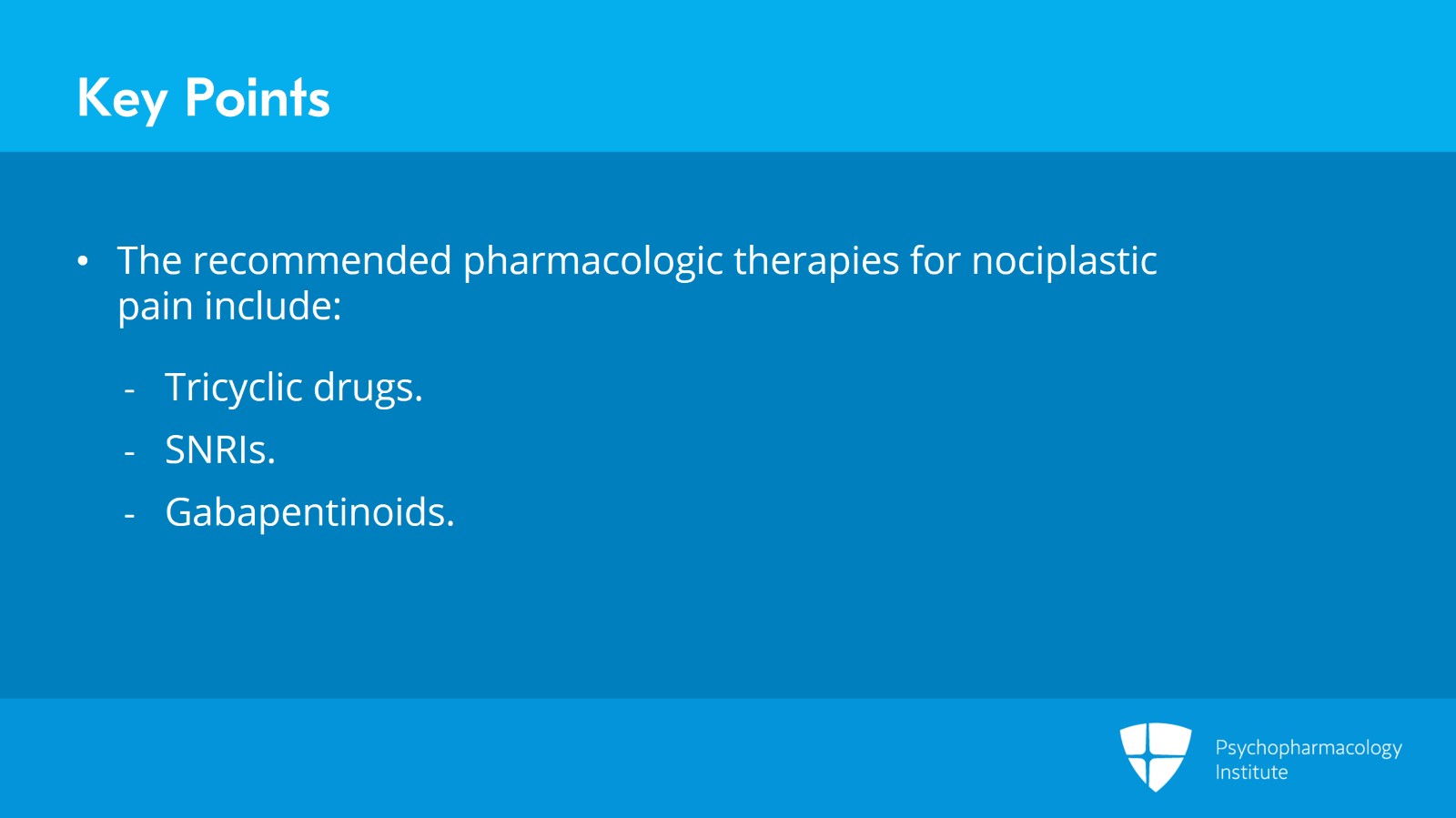
  • The recommended pharmacologic therapies for nociplastic pain include:
    -Tricyclic drugs.
    -SNRIs.
    -Gabapentinoids.

Free Downloads for Offline Access

  • Free Download Presentation File (PPTX)
  • Free Download Audio File (MP3)
  • Free Download Video (MP4)

Slides and Transcript

Slide 1 of 13

Pharmacologic therapies for fibromyalgia or centralized pain.

Slide 2 of 13

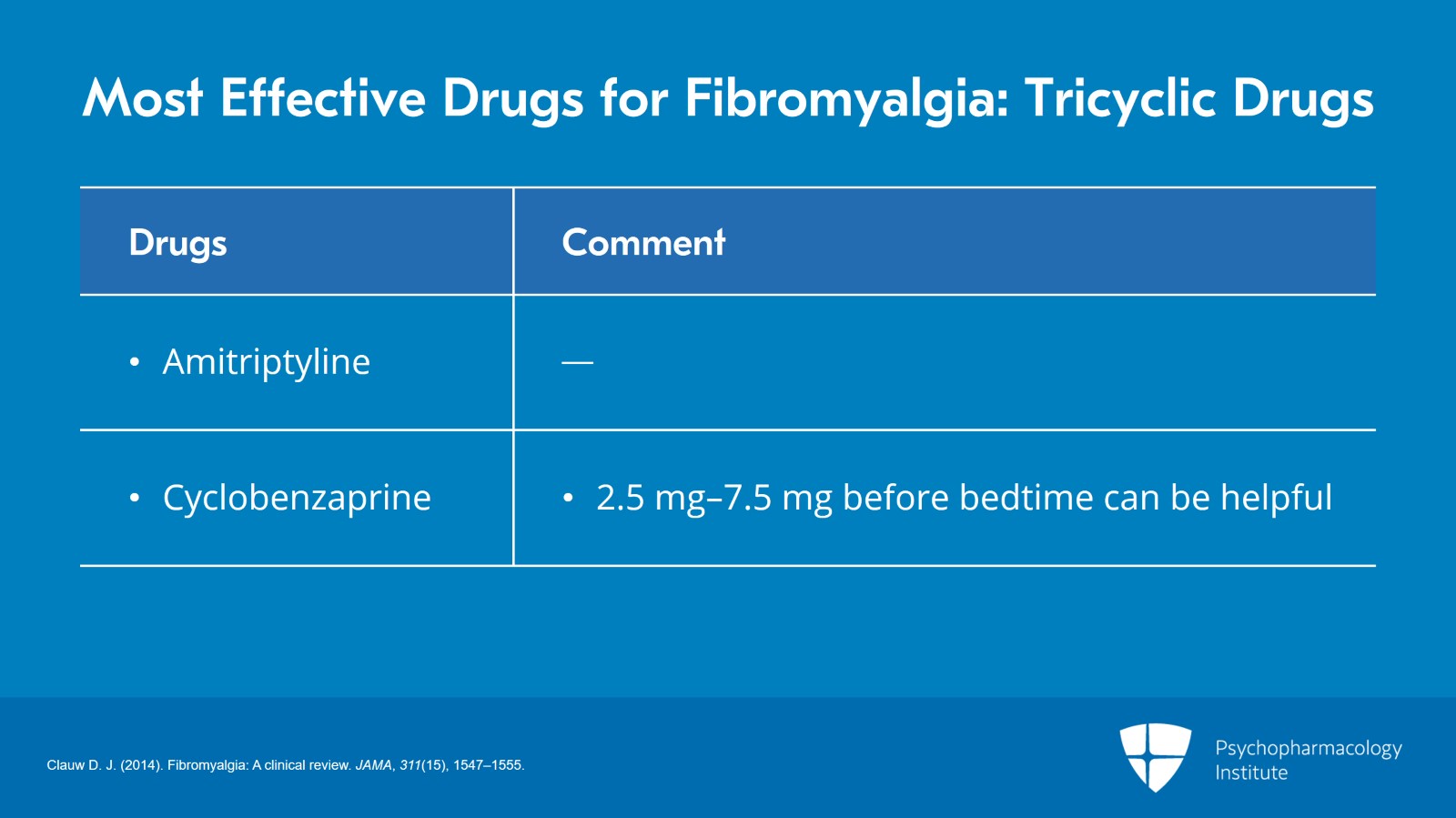
The three classes of drugs that seem to be most effective are tricyclic drugs which would include amitriptyline and cyclobenzaprine. A low dose of cyclobenzaprine is one of my favorite drugs for fibromyalgia, 2.5, 5 mg, 7.5 mg of cyclobenzaprine a couple of hours before bedtime can be really helpful.
References:
  • Clauw D. J. (2014). Fibromyalgia: A clinical review. JAMA, 311(15), 1547–1555.
Free Files
Success!
Check your inbox, we sent you all the materials there.

Slide 3 of 13

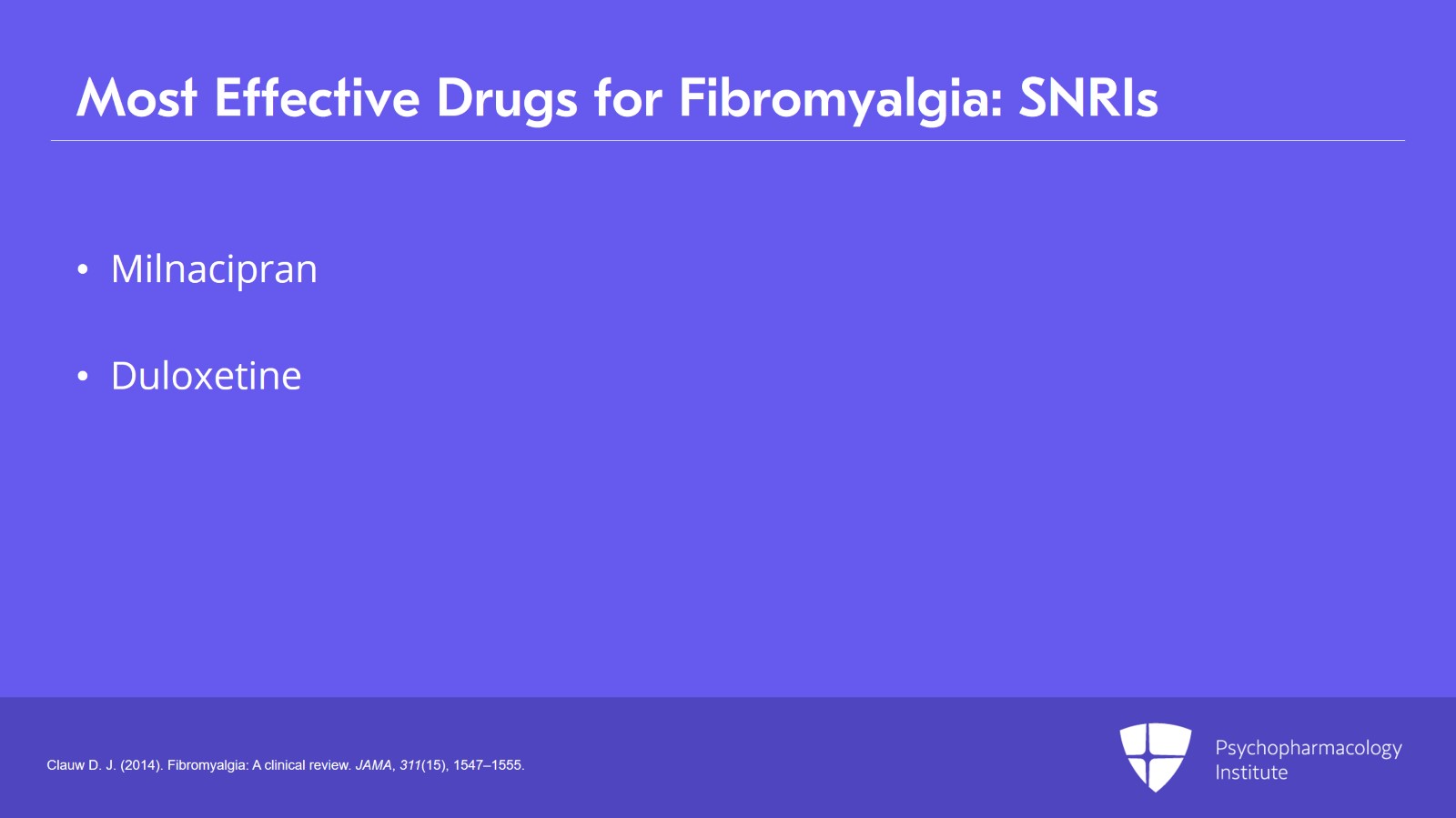
The serotonin-norepinephrine reuptake inhibitors, the ones that are more noradrenergic like milnacipran and duloxetine seem to be more effective.
References:
  • Clauw D. J. (2014). Fibromyalgia: A clinical review. JAMA, 311(15), 1547–1555.

Slide 4 of 13

And then the gabapentinoids, such as pregabalin and gabapentin, these drugs can be quite helpful. They're probably working at least in part by helping improve sleep. And one of the things you should know about these drugs is you often can get by just using a single nighttime dose of these drugs rather than giving them two to three times a day and often that will have the same beneficial effect with less of the side effects we see with other drugs.
References:
  • Clauw D. J. (2014). Fibromyalgia: A clinical review. JAMA, 311(15), 1547–1555.
Free Files
Success!
Check your inbox, we sent you all the materials there.

Slide 5 of 13

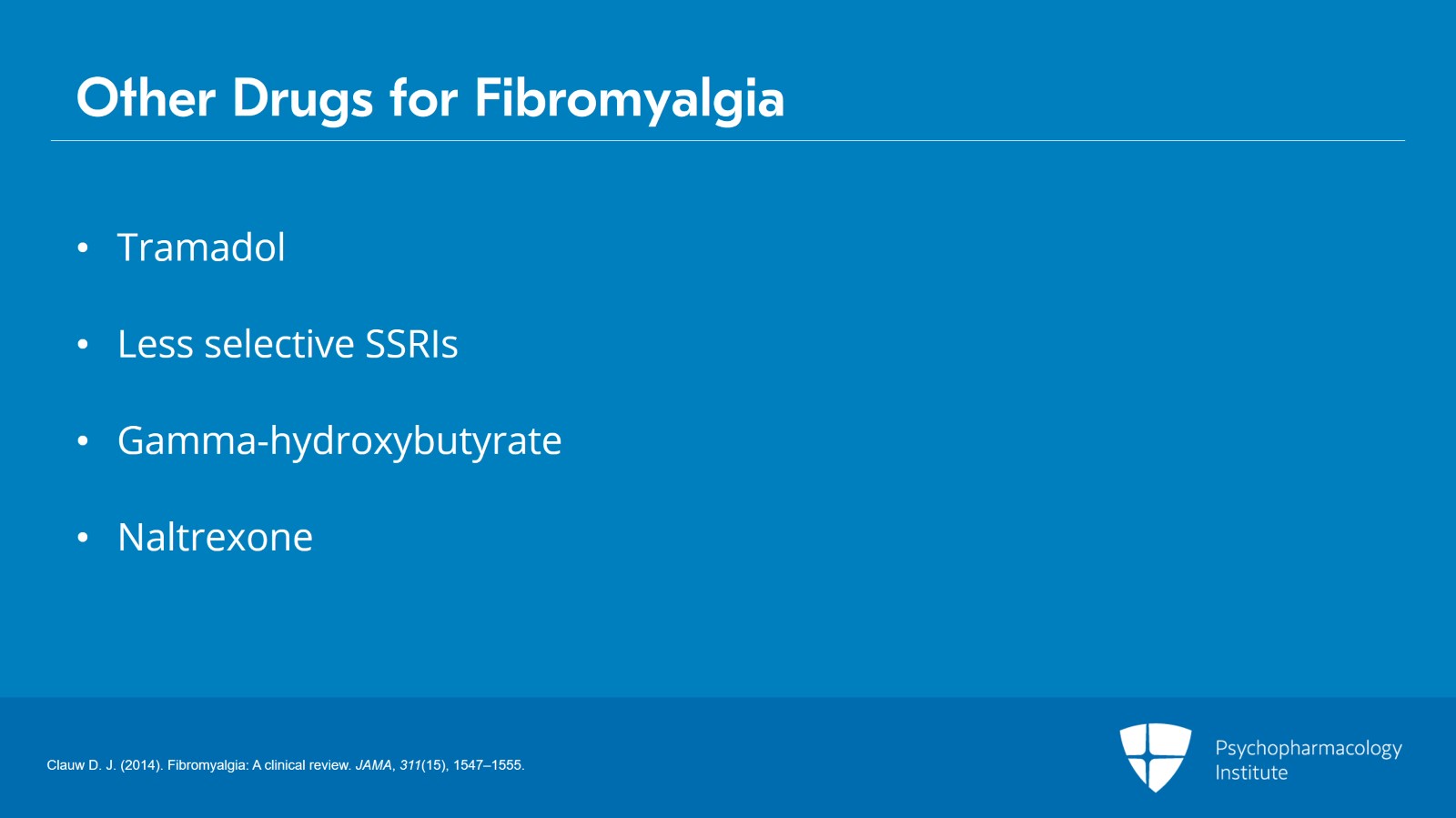
Other drugs for fibromyalgia include tramadol, older less selective SSRIs, gamma-hydroxybutyrate, low-dose naltrexone.
References:
  • Clauw D. J. (2014). Fibromyalgia: A clinical review. JAMA, 311(15), 1547–1555.

Slide 6 of 13

The body's own endogenous opioid system or internal opioid system is hyperactive in people with fibromyalgia. We should be blocking the endogenous opioid system in people with conditions like fibromyalgia, not giving them opioids.
References:
  • Clauw D. J. (2014). Fibromyalgia: A clinical review. JAMA, 311(15), 1547–1555.
Free Files
Success!
Check your inbox, we sent you all the materials there.

Slide 7 of 13

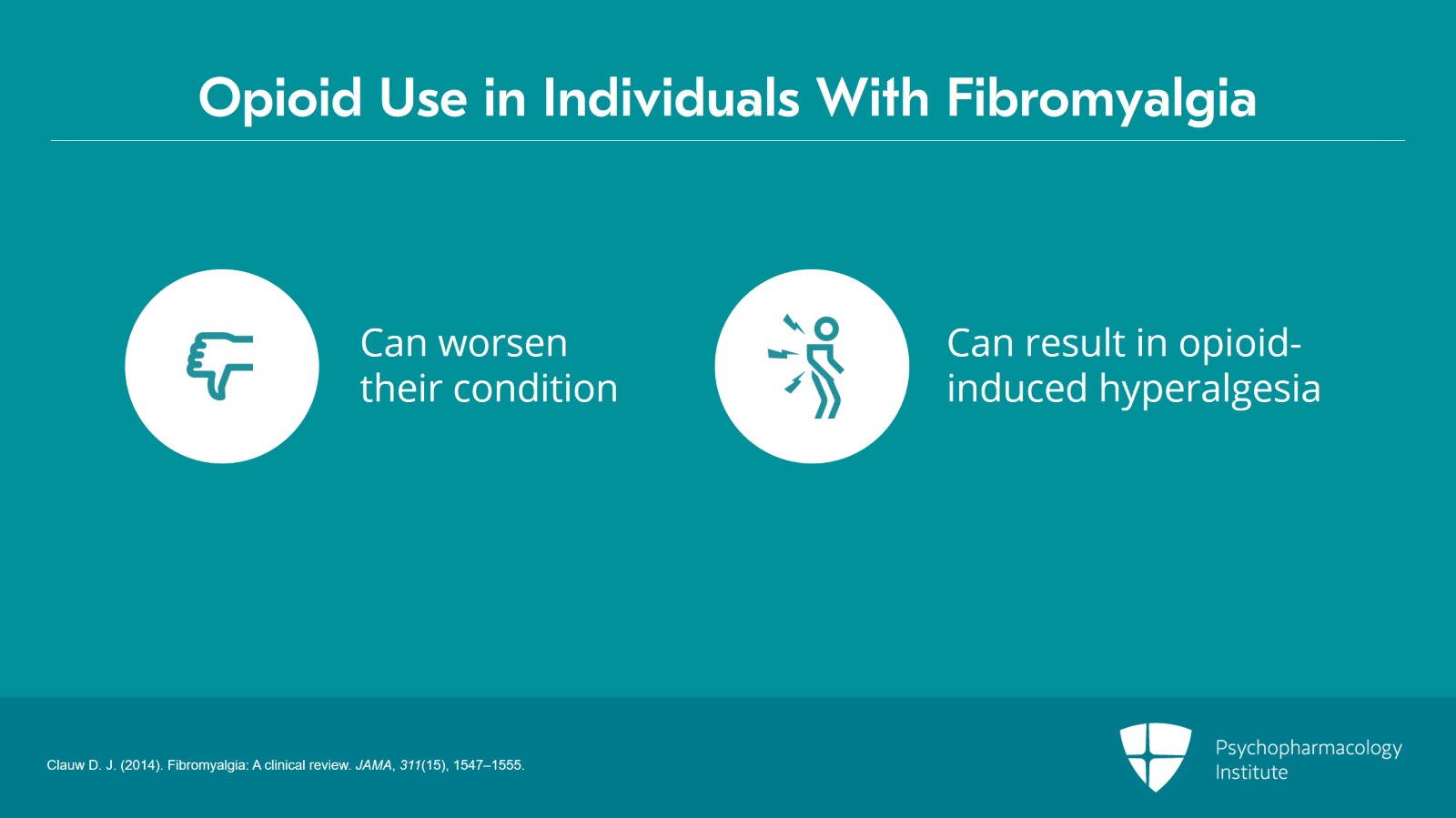
We actually might likely be making conditions like fibromyalgia worse by giving someone an opioid. We've historically focused on the fact that opioids don't make people better but there's a lot of evidence and continuing to emerge that a lot of individuals with chronic pain that are given opioids that develop opioid-induced hyperalgesia and their pain is literally made worse by that class of drugs not, simply not made better.
References:
  • Clauw D. J. (2014). Fibromyalgia: A clinical review. JAMA, 311(15), 1547–1555.

Slide 8 of 13

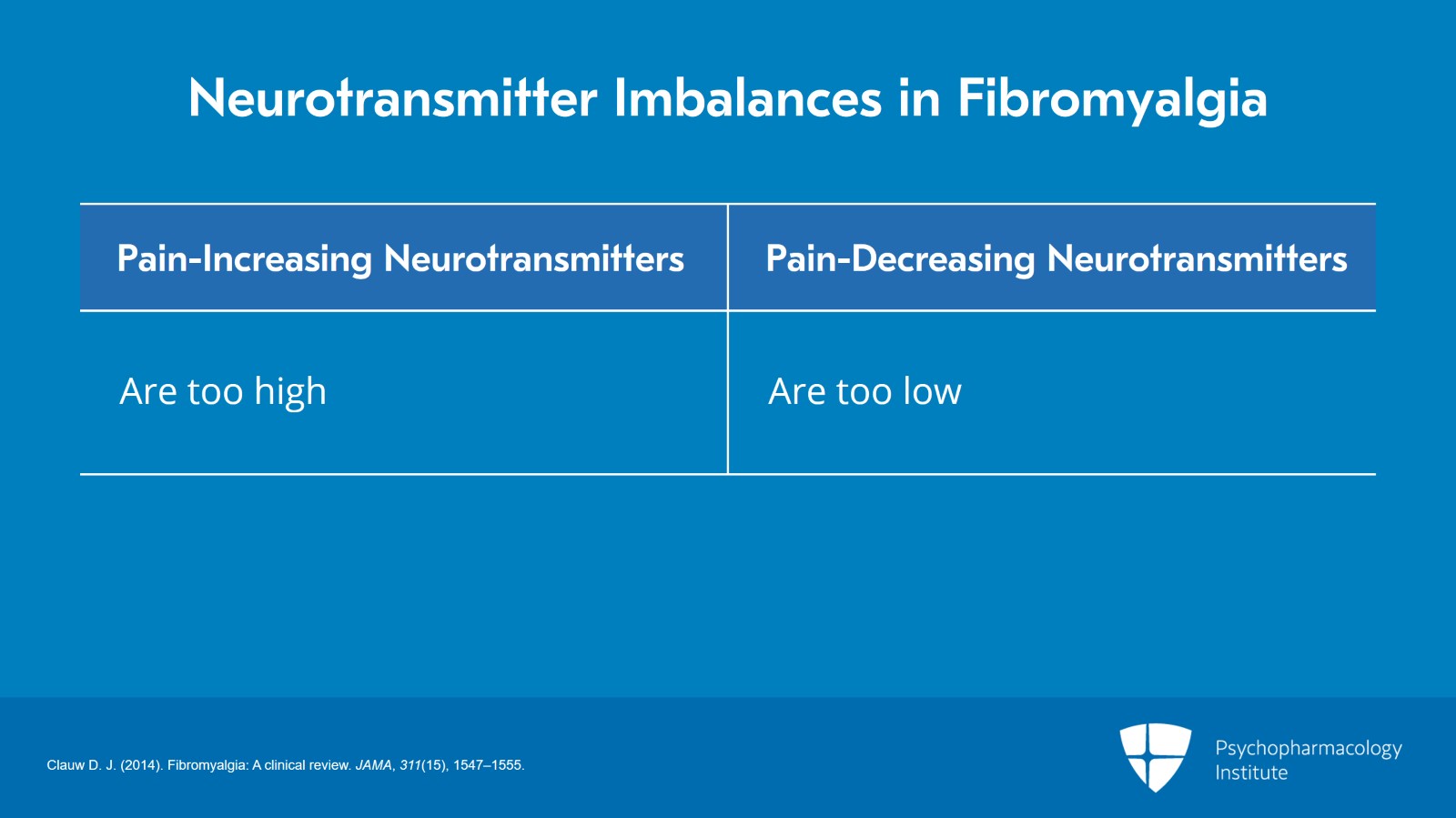
And we actually know that a lot of the neurotransmitters that control pain and sensory transmission are out of balance in conditions like fibromyalgia. Some of the neurotransmitters that increase pain and sensory sensitivity like glutamate, substance P, and nerve growth factor are too high in conditions like fibromyalgia. Other neurotransmitters that decrease pain and sensory sensitivity like norepinephrine, serotonin, GABA are too low.
References:
  • Clauw D. J. (2014). Fibromyalgia: A clinical review. JAMA, 311(15), 1547–1555.
Free Files
Success!
Check your inbox, we sent you all the materials there.

Slide 9 of 13

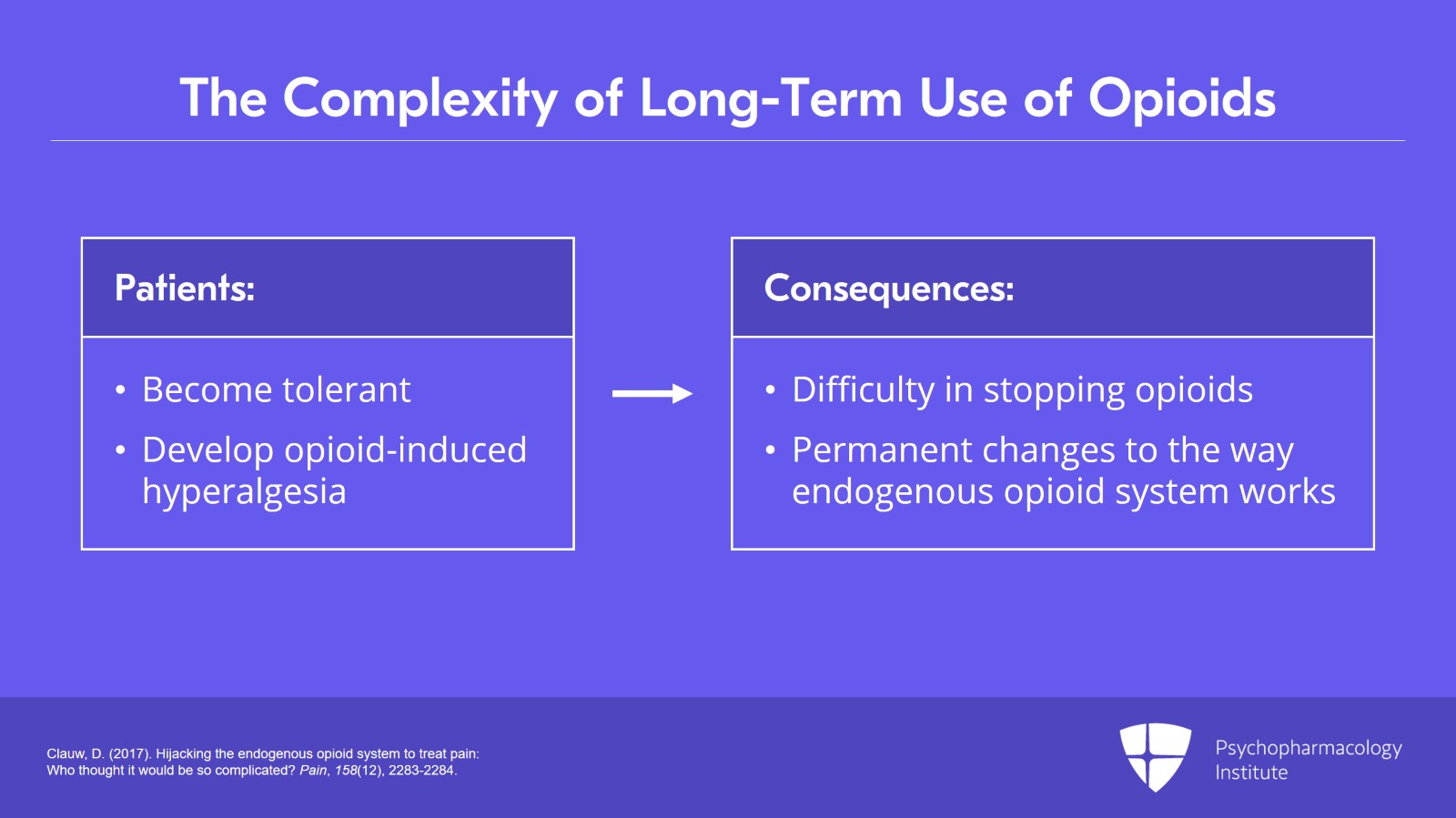
Why it's really complicated to give someone an opioid to treat chronic pain. The longer people take opioids, the more the body adjusts to those opioids. People become tolerant to the opioids. They develop opioid-induced hyperalgesia. And it's almost impossible to get a lot of these patients off opioids, not because they're working well but because they become dependent on the opioid and it's permanently changed the way their endogenous opioid system works.
References:
  • Clauw, D. (2017). Hijacking the endogenous opioid system to treat pain: Who thought it would be so complicated? Pain, 158(12), 2283-2284.

Slide 10 of 13

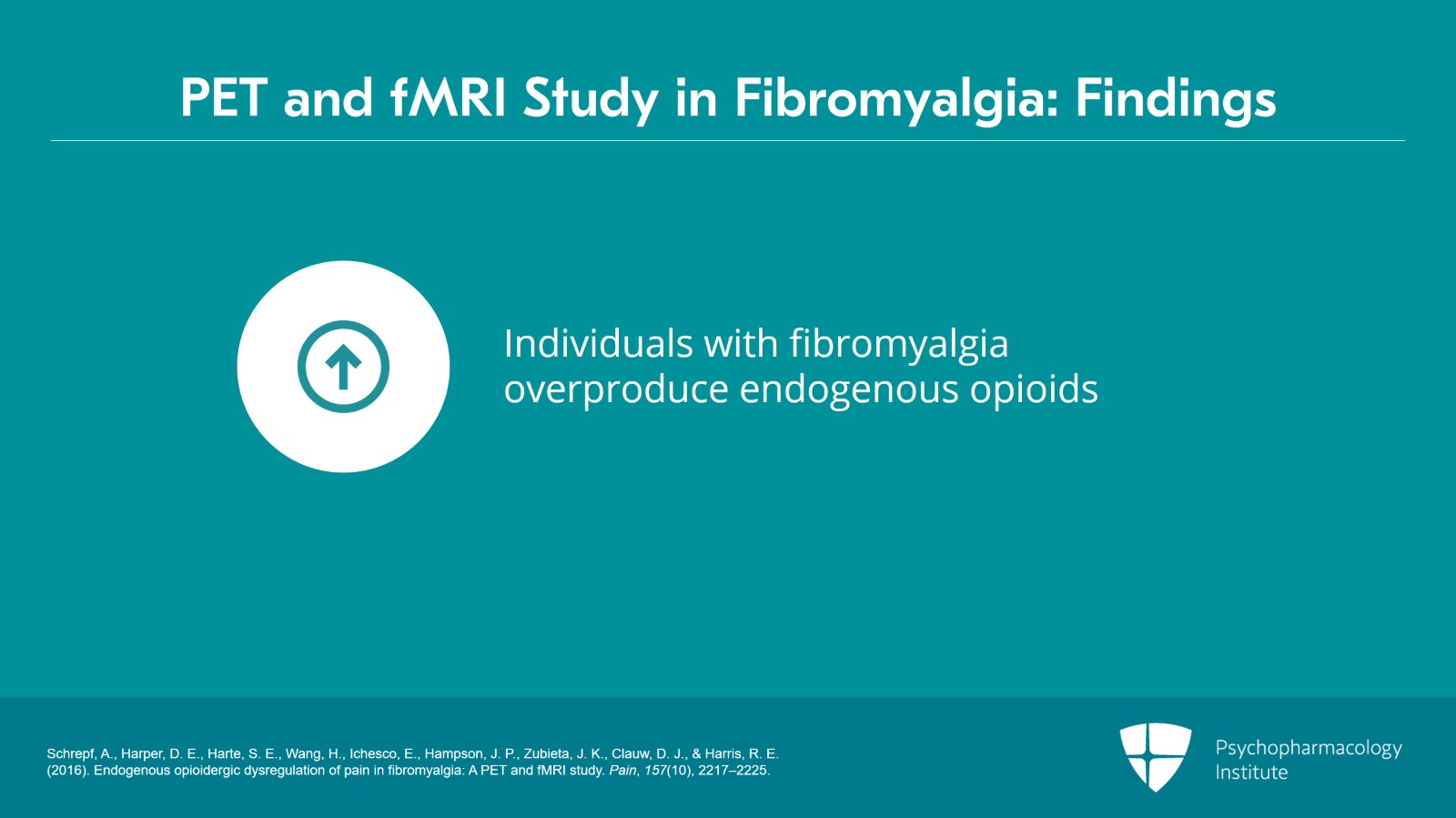
This study is a particularly cautionary tale. We did PET with carfentanil which is a highly potent opioid at the same time as we did functional MRI in people with fibromyalgia. And it looked as though these individuals with fibromyalgia are overproducing endogenous opioids like endorphins and enkephalins in brain regions and that might be driving the worsening of fibromyalgia.
References:
  • Schrepf, A., Harper, D. E., Harte, S. E., Wang, H., Ichesco, E., Hampson, J. P., Zubieta, J. K., Clauw, D. J., & Harris, R. E. (2016). Endogenous opioidergic dysregulation of pain in fibromyalgia: A PET and fMRI study. Pain, 157(10), 2217–2225.
Free Files
Success!
Check your inbox, we sent you all the materials there.

Slide 11 of 13

You should be particularly careful with giving individuals with fibromyalgia an opioid because, again, you may not just not make it better. You may make it worse.  
References:
  • Schrepf, A., Harper, D. E., Harte, S. E., Wang, H., Ichesco, E., Hampson, J. P., Zubieta, J. K., Clauw, D. J., & Harris, R. E. (2016). Endogenous opioidergic dysregulation of pain in fibromyalgia: A PET and fMRI study. Pain, 157(10), 2217–2225.

Slide 12 of 13

The drugs you should be using for nociplastic pain right now are low doses of tricyclic drugs given at bedtime, serotonin-norepinephrine reuptake inhibitors, and gabapentinoids.
Free Files
Success!
Check your inbox, we sent you all the materials there.

Slide 13 of 13

Learning Objectives:

After completing this activity, the learner will be able to:

  1. Delve into the pain mechanisms and appreciate their clinical relevance.
  2. Learn the essential steps for recognizing and accurately diagnosing patients with fibromyalgia.
  3. Execute impactful pharmacologic and nonpharmacologic interventions for chronic pain management.

Original Release Date: July 1, 2023

Review and Re-release Date: March 1, 2024

Expiration Date: July 1, 2026

Expert: Daniel Clauw, M.D.

Medical Editor: Paz Badía, M.D.

Relevant Financial Disclosures: 

Daniel Clauw declares the following interests:

- Pfizer:  Consultant
- Tonix:  Consultant, research support
- Virios:  Consultant

All of the relevant financial relationships listed above have been mitigated by Medical Academy and the Psychopharmacology Institute.

Contact Information: For questions regarding the content or access to this activity, contact us at support@psychopharmacologyinstitute.com

Instructions for Participation and Credit:

Participants must complete the activity online during the valid credit period that is noted above.

Follow these steps to earn CME credit:

  1. View the required educational content provided on this course page.

  2. Complete the Post Activity Evaluation for providing the necessary feedback for continuing accreditation purposes and for the development of future activities. NOTE: Completing the Post Activity Evaluation after the quiz is required to receive the earned credit.

  3. Download your certificate.

Accreditation Statement

This activity has been planned and implemented in accordance with the accreditation requirements and policies of the Accreditation Council for Continuing Medical Education through the joint providership of Medical Academy LLC and the Psychopharmacology Institute. Medical Academy is accredited by the ACCME to provide continuing medical education for physicians.

Credit Designation Statement

Medical Academy designates this enduring activity for a maximum of 0.75 AMA PRA Category 1 credit(s)™. Physicians should claim only the credit commensurate with the extent of their participation in the activity.


Free Files
Success!
Check your inbox, we sent you all the materials there.
Continue in the website
Instant access modal

Become a Bronze, Silver, Gold, Bronze extended, Silver extended or Gold extended Member.

2025–26 Psychopharmacology CME Program

Unlock up to 155 CME Credits, including 40 SA CME Credits.