Close Banner
Section Free  - Video Lectures

09. Treatment of Sleep Disturbances in ASD: Melatonin and Other Strategies

Published on February 1, 2023 Certification expiration date: February 1, 2026

Christopher Keary, M.D.

Instructor in the Department of Psychiatry at Harvard Medical School & staff psychiatrist in the Lurie Center for Autism at Massachusetts General Hospital for Children - Harvard Medical School

Key Points

  • There are many RCTs of melatonin for treating insomnia in ASD.
  • These RCTs attest to the effectiveness and excellent tolerability of melatonin.
  • Diphenhydramine and benzodiazepines have a higher risk for paradoxical reactions in patients with developmental disabilities.

Free Downloads for Offline Access

  • Free Download Presentation File (PPTX)
  • Free Download Video (MP4)
  • Free Download Audio File (MP3)

Slides and Transcript
Slide 1 of 17

We’re going to talk about the treatment of sleep disturbances in patients with autism spectrum disorder, melatonin and other strategies.

Slide 2 of 17

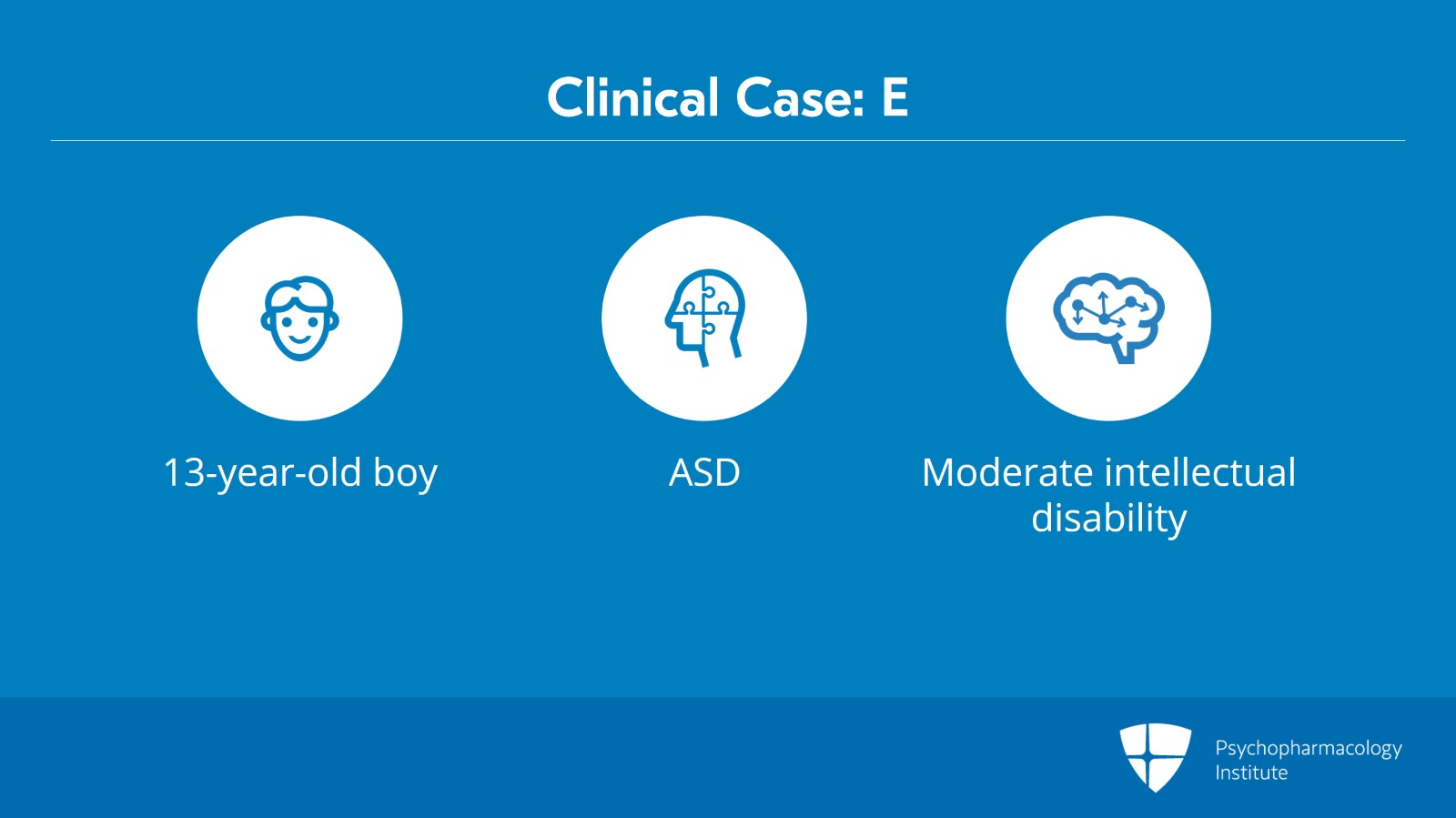
We’re going to start with talking about a case. E is a 13-year-old boy with autism spectrum disorder and moderate intellectual disability.
Free Files
Success!
Check your inbox, we sent you all the materials there.
Slide 3 of 17

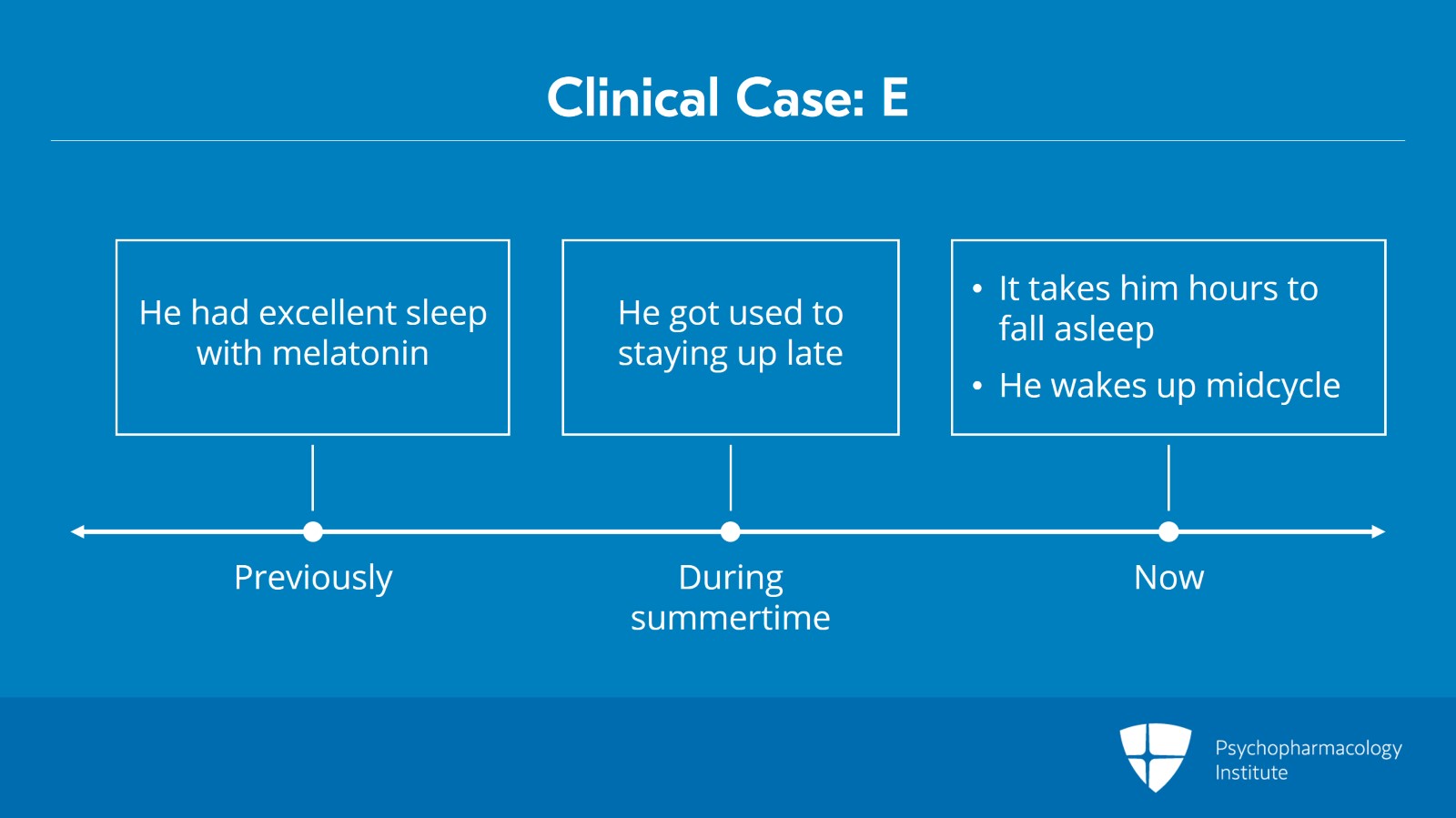
He had excellent sleep with moderate dosage melatonin. He was home from school for a prolonged period and over the summertime got used to staying up late on his tablet looking at preferred interests and preferred videos. After doing this for a period of a number of months, it is now taking him hours to fall asleep and getting into the habit of waking midcycle to look at his tablet or such that he has now a pretty disrupted pattern of sustained sleep. It’s a major concern when he wakes midcycle as he may wander the home and end up in unsafe situations while parents are sleeping.

Slide 4 of 17

The treatment of sleep disturbance is also a common main concern for a lot of caregivers and parents of a patient with autism spectrum disorder or a chief complaint of an individual with autism spectrum disorder themselves.
References:
  • Hollway, J. A., & Aman, M. G. (2011). Pharmacological treatment of sleep disturbance in developmental disabilities: A review of the literature. Research in Developmental Disabilities, 32(3), 939–962.
Free Files
Success!
Check your inbox, we sent you all the materials there.
Slide 5 of 17

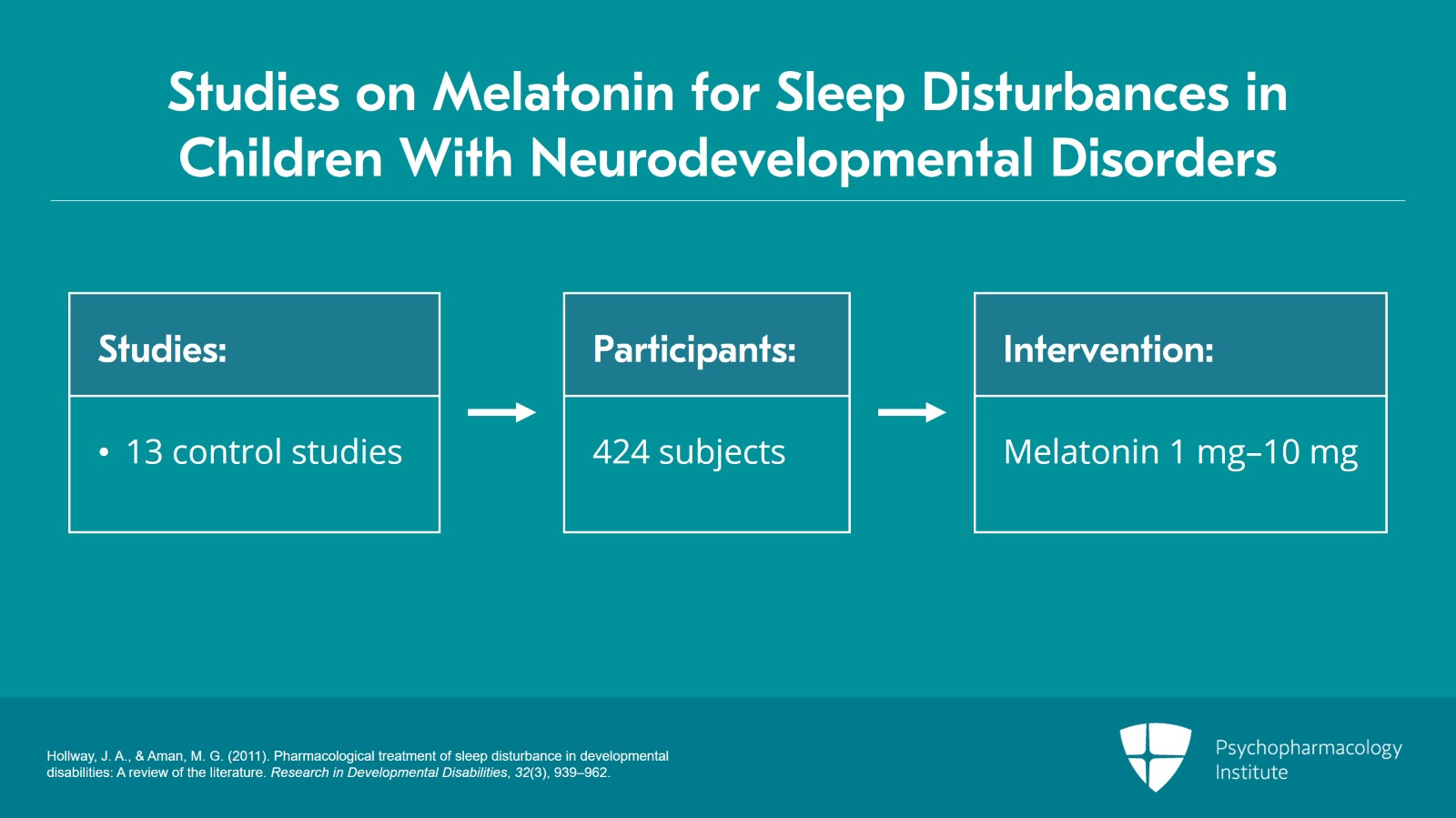
Melatonin has 13 control studies for the treatment of sleep disturbance in children with neurodevelopmental disorders. This amounts to 424 subjects in total. This is a well-researched area. Parallel groups, crossover designs with dosages of 1 to 10 mg that have been studied.
References:
  • Hollway, J. A., & Aman, M. G. (2011). Pharmacological treatment of sleep disturbance in developmental disabilities: A review of the literature. Research in Developmental Disabilities, 32(3), 939–962.

Slide 6 of 17

Melatonin is superior to placebo in all 13 of these trials with a majority of these trials showing mild side effects, if any, and oftentimes not differing than placebo in terms of the presence of side effects. Leading melatonin to be an easily recommendable medication in terms of effect as well as tolerability for the treatment of sleep disturbance in children with neurodevelopmental disorders.
References:
  • Hollway, J. A., & Aman, M. G. (2011). Pharmacological treatment of sleep disturbance in developmental disabilities: A review of the literature. Research in Developmental Disabilities, 32(3), 939–962.
Free Files
Success!
Check your inbox, we sent you all the materials there.
Slide 7 of 17

There has been little in the way of other double-blind placebo-controlled trials of other medications for the treatment of sleep disturbance in autism spectrum disorder. So further guidance past melatonin is based more on clinical practice.
References:
  • Hollway, J. A., & Aman, M. G. (2011). Pharmacological treatment of sleep disturbance in developmental disabilities: A review of the literature. Research in Developmental Disabilities, 32(3), 939–962.

Slide 8 of 17

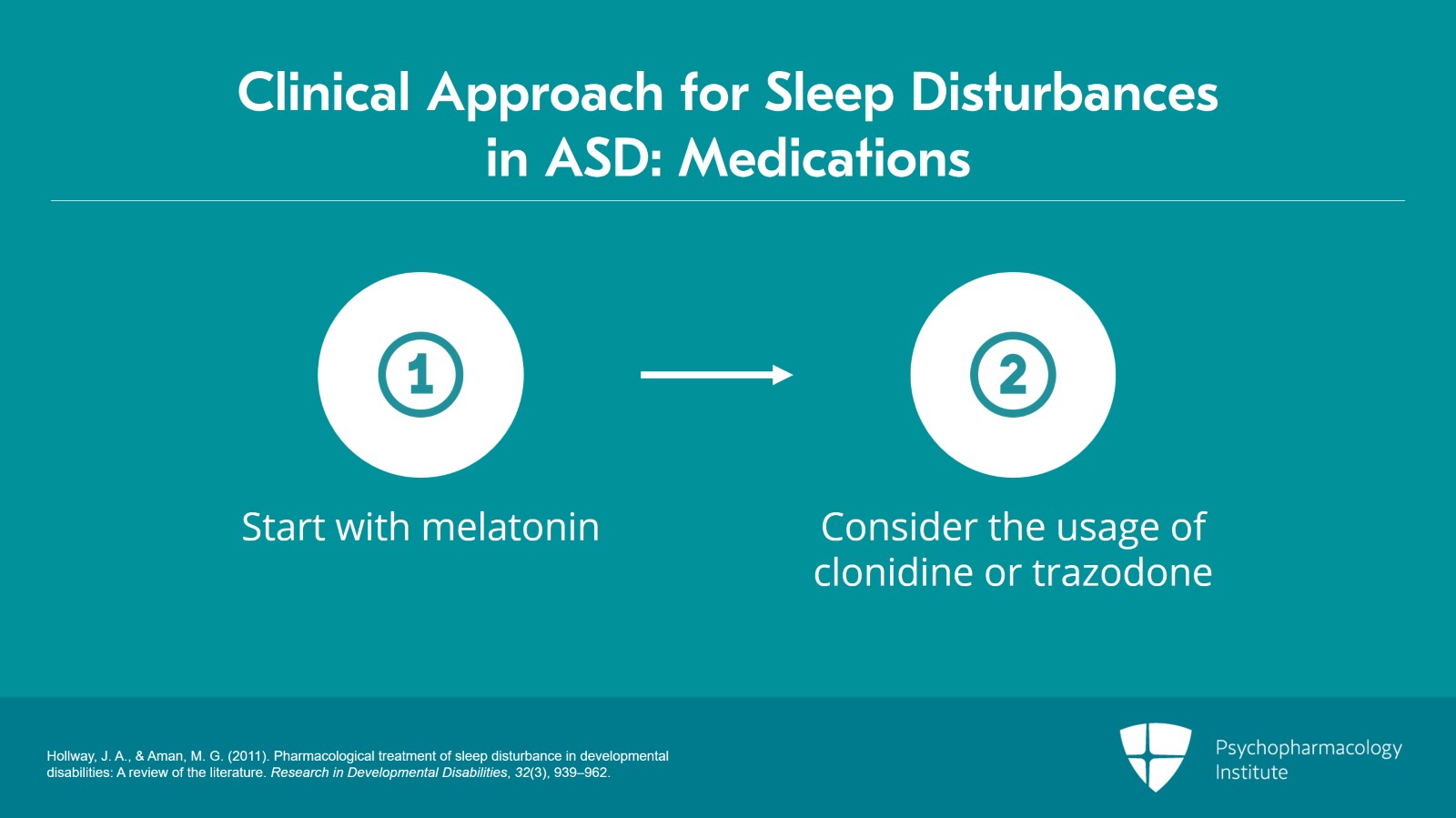
My approach when it comes to the treatment of sleep disturbance includes starting with melatonin. Clinicians may consider the usage of clonidine or trazodone especially in younger populations.
References:
  • Hollway, J. A., & Aman, M. G. (2011). Pharmacological treatment of sleep disturbance in developmental disabilities: A review of the literature. Research in Developmental Disabilities, 32(3), 939–962.
Free Files
Success!
Check your inbox, we sent you all the materials there.

Slide 9 of 17

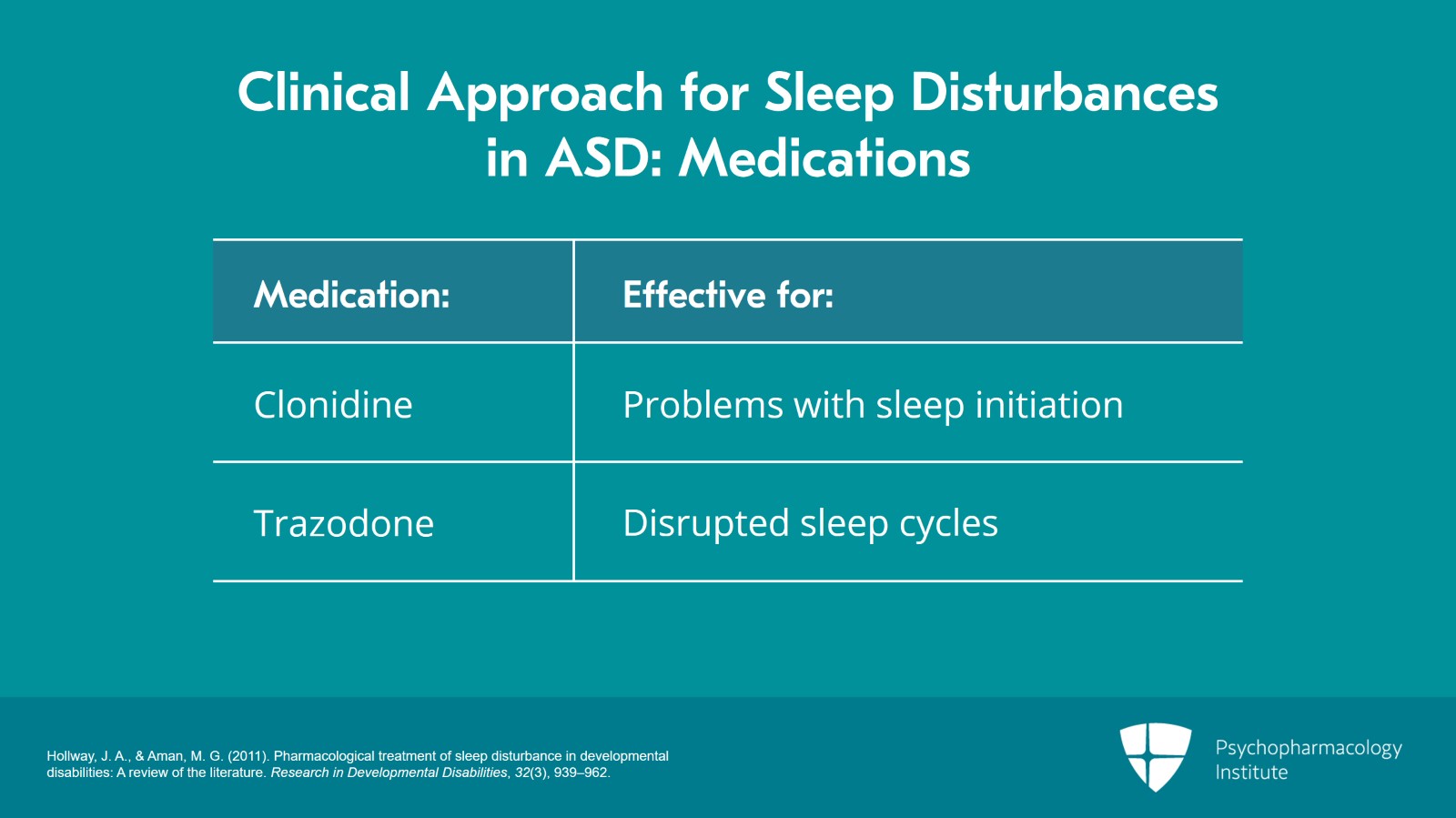
Clonidine being a particularly effective choice for problems with sleep initiation and trazodone being a more effective treatment choice for patients who have disrupted sleep cycle or midcycle awakening.
References:
  • Hollway, J. A., & Aman, M. G. (2011). Pharmacological treatment of sleep disturbance in developmental disabilities: A review of the literature. Research in Developmental Disabilities, 32(3), 939–962.

Slide 10 of 17

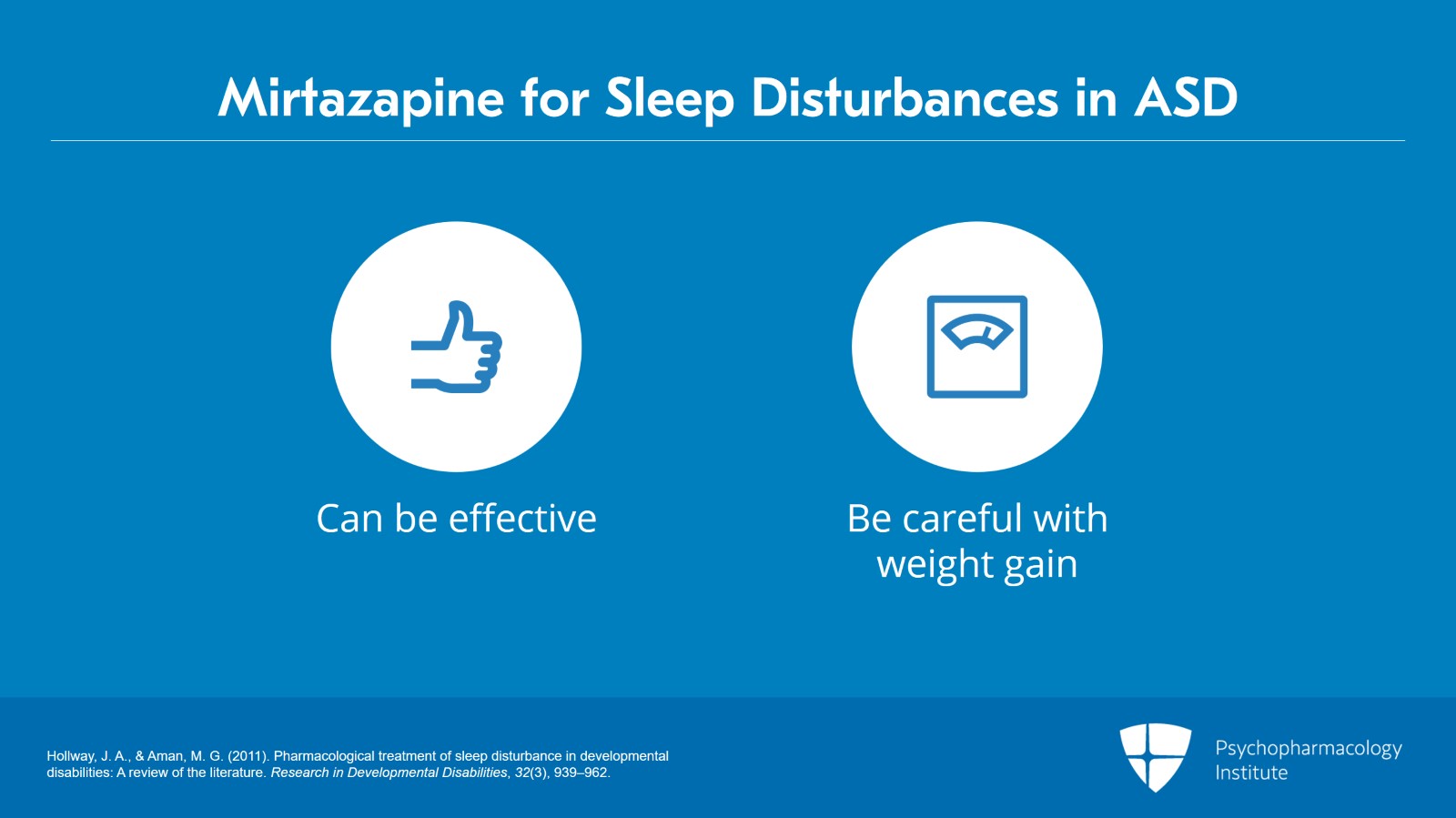
Mirtazapine can be very effective as a treatment of sleep challenge. Clinicians should be careful for the risk for weight gain with this medication.
References:
  • Hollway, J. A., & Aman, M. G. (2011). Pharmacological treatment of sleep disturbance in developmental disabilities: A review of the literature. Research in Developmental Disabilities, 32(3), 939–962.
Free Files
Success!
Check your inbox, we sent you all the materials there.
Slide 11 of 17

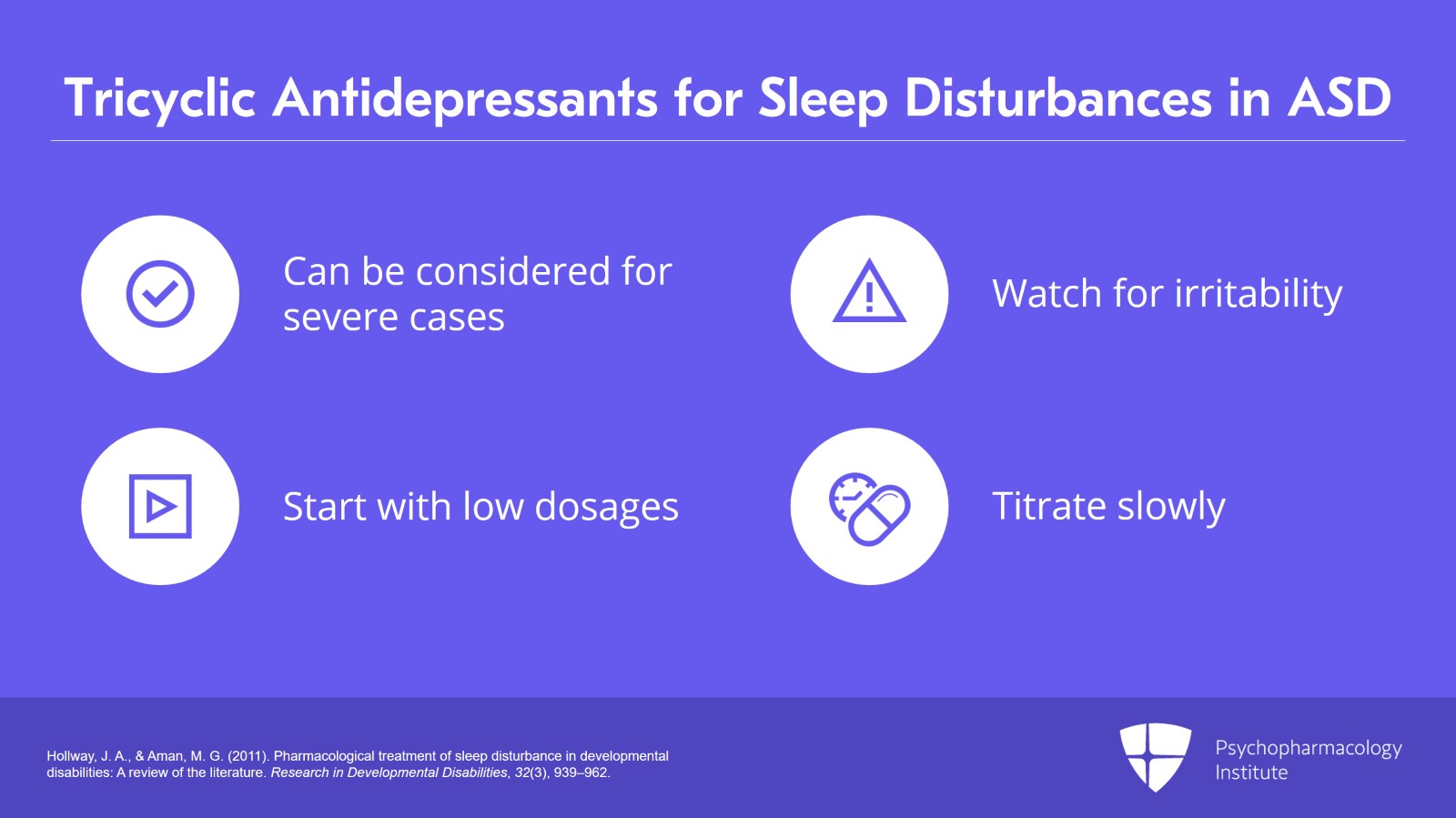
In more severe cases, tricyclic antidepressants may be considered. Clinicians should watch for the potential risk for tricyclic antidepressants being harder to tolerate in children particularly children with autism spectrum disorder and watch for irritability and starting at low dosages and moving slowly with the dosing.
References:
  • Hollway, J. A., & Aman, M. G. (2011). Pharmacological treatment of sleep disturbance in developmental disabilities: A review of the literature. Research in Developmental Disabilities, 32(3), 939–962.

Slide 12 of 17

Medications like diphenhydramine or even benzodiazepine medications should be used with caution in patients with autism spectrum disorder because of a risk for paradoxical response.
References:
  • Hollway, J. A., & Aman, M. G. (2011). Pharmacological treatment of sleep disturbance in developmental disabilities: A review of the literature. Research in Developmental Disabilities, 32(3), 939–962.
Free Files
Success!
Check your inbox, we sent you all the materials there.
Slide 13 of 17

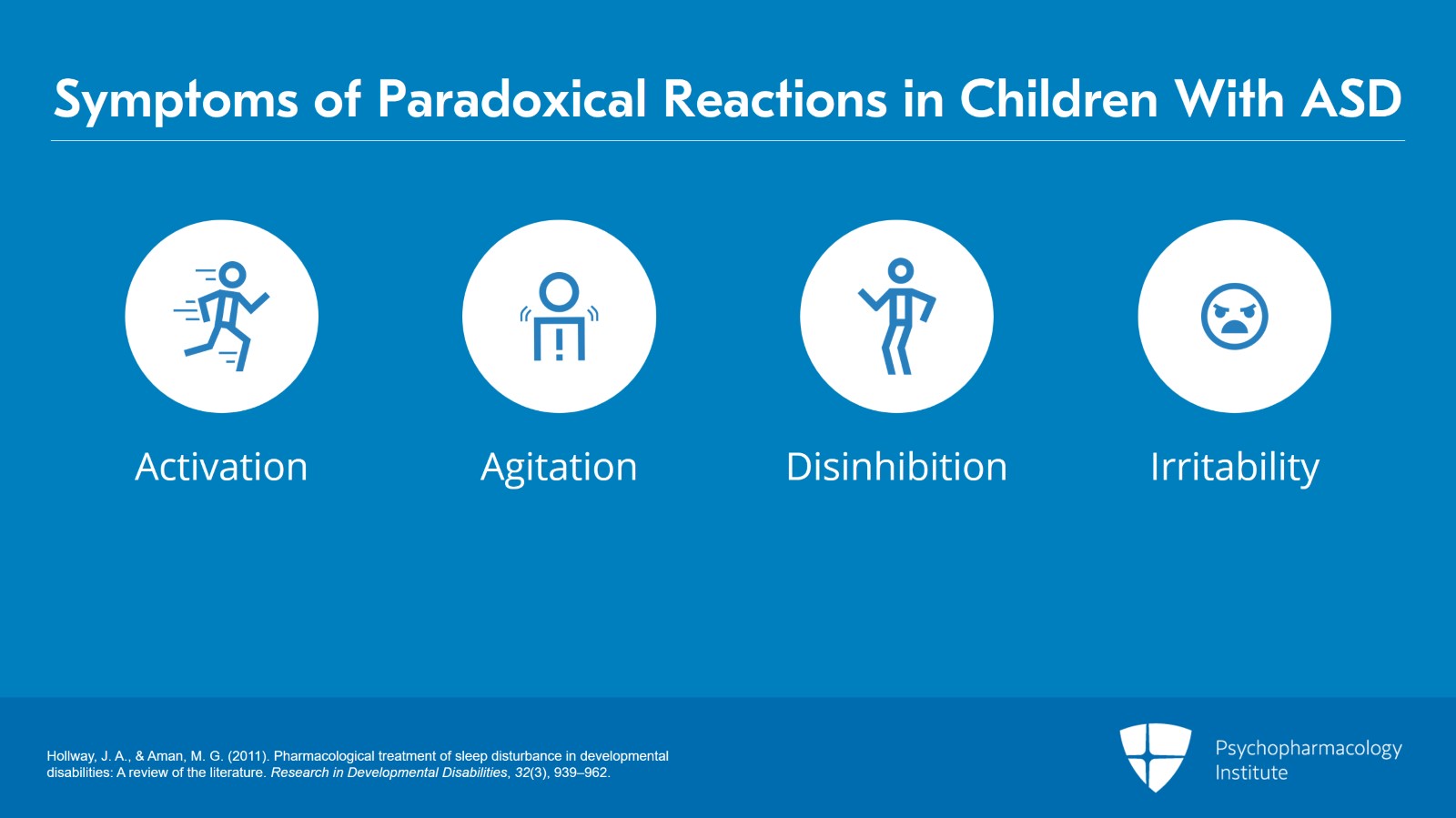
This is to say rather than being calmed by these medications some children with autism spectrum disorder can become activated, more energized or even agitated at higher dosages, silly, giddy, goofy, disinhibited or even irritable with these medicines.
References:
  • Hollway, J. A., & Aman, M. G. (2011). Pharmacological treatment of sleep disturbance in developmental disabilities: A review of the literature. Research in Developmental Disabilities, 32(3), 939–962.

Slide 14 of 17

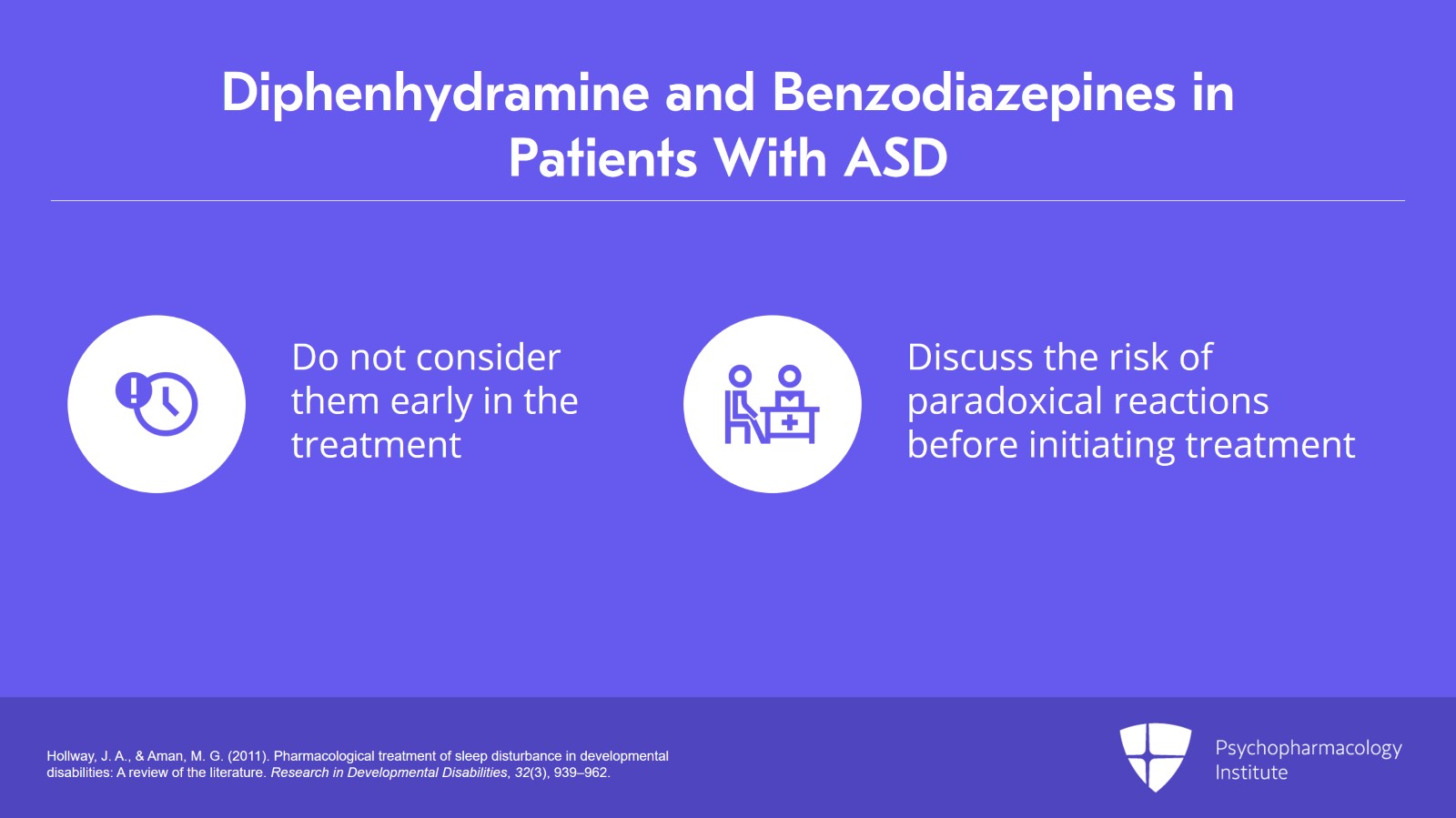
Clinicians may therefore put them a little further back in terms of when to consider these medications and discuss this possibility with parents before they initiate medication trials or with individuals with autism who can consent to treatment.
References:
  • Hollway, J. A., & Aman, M. G. (2011). Pharmacological treatment of sleep disturbance in developmental disabilities: A review of the literature. Research in Developmental Disabilities, 32(3), 939–962.
Free Files
Success!
Check your inbox, we sent you all the materials there.
Slide 15 of 17

A couple of key points to draw from this section. There are an abundance of blinded placebo-controlled trials for the usage of melatonin for the treatment of insomnia in autism spectrum disorder. These trials attest to the effectiveness of this medication and excellent tolerability.

Slide 16 of 17

Diphenhydramine and benzodiazepines have been noted in clinical practice to carry higher risk for paradoxical reactions in patients with developmental disability.
Free Files
Success!
Check your inbox, we sent you all the materials there.
Slide 17 of 17

Learning Objectives:

After completing this activity, the learner will be able to:

  1. Define the therapeutic role of psychopharmacology in ASD.
  2. Recognize and assess psychiatric comorbidities in patients with ASD. 
  3. Utilize pharmacologic strategies for managing psychiatric symptoms in patients with ASD.

Original Release Date: February 1, 2023

Review and Re-release Date: March 1, 2024

Expiration Date: February 1, 2026

Expert: Christopher Keary, M.D.

Medical Editor: Paz Badía, M.D.

Relevant Financial Disclosures: 

Christopher Keary declares the following interests:

- Ovid Therapeutics:  Consulting, advisory committee

Contact Information: For questions regarding the content or access to this activity, contact us at support@psychopharmacologyinstitute.com

Instructions for Participation and Credit:

Participants must complete the activity online during the valid credit period that is noted above.

Follow these steps to earn CME credit:

  1. View the required educational content provided on this course page.

  2. Complete the Post Activity Evaluation for providing the necessary feedback for continuing accreditation purposes and for the development of future activities. NOTE: Completing the Post Activity Evaluation after the quiz is required to receive the earned credit.

  3. Download your certificate.

Accreditation Statement

This activity has been planned and implemented in accordance with the accreditation requirements and policies of the Accreditation Council for Continuing Medical Education through the joint providership of Medical Academy LLC and the Psychopharmacology Institute. Medical Academy is accredited by the ACCME to provide continuing medical education for physicians.

Credit Designation Statement

Medical Academy designates this enduring activity for a maximum of 1.25 AMA PRA Category 1 credit(s)™. Physicians should claim only the credit commensurate with the extent of their participation in the activity.

Free Files
Success!
Check your inbox, we sent you all the materials there.
Continue in the website
Instant access modal

Become a Bronze, Silver, Gold, Bronze extended, Silver extended or Gold extended Member.

2025–26 Psychopharmacology CME Program

Unlock up to 155 CME Credits, including 40 SA CME Credits.