Close Banner
Section Free  - Video Lectures

06. D-Cycloserine: Potential Indications and Administration in Children and Adolescents

Published on August 1, 2022 Expired on August 1, 2025

David R. Rosenberg, M.D.

Chair of the Department of Psychiatry & Behavioral Neuroscience - Wayne State University School of Medicine

Key Points

  • D-cycloserine has been observed to possess antianxiety properties.
  • D-cycloserine only shows an extinction effect when paired with behavioral training.
  • There is evidence that D-cycloserine may:

 -Enhance exposure therapy.
 -Accelerate the therapeutic effect of CBT in OCD.
 -Support maintenance of social skills gains in ASD.

  • Current evidence does not support the use of D-cycloserine in youth with PTSD.

Free Downloads for Offline Access

  • Free Download Presentation File (PPTX)
  • Free Download Video (MP4)
  • Free Download Audio File (MP3)

Slides and Transcript
Slide 1 of 25

Let’s turn to video 6, D-cycloserine: Potential indications and administration in children and adolescents.

Slide 2 of 25

Here is another example of a compound, D-cycloserine, that generated a lot of excitement, had tremendous promise. Some of it may have been realized but some is still a work in progress as we’ll discuss. This was originally introduced as an antibiotic to treat tuberculosis. D-cycloserine has also been observed to possess antianxiety properties. It’s a partial NMDA agonist at the glycine modulatory site which facilitates the opening of calcium channels attached to NMDA receptors and appears to have a role in the neural activity underlying learned associations and extinction of fear.
References:
  • Rosenberg, D., & Gershon, S. (2012). Pharmacotherapy of child and adolescent psychiatric disorders. John Wiley & Sons.
  • Scheeringa, M. S., & Weems, C. F. (2014). Randomized placebo-controlled D-cycloserine with cognitive behavior therapy for pediatric posttraumatic stress. Journal of Child and Adolescent psychopharmacology, 24(2), 69–77.
Free Files
Success!
Check your inbox, we sent you all the materials there.
Slide 3 of 25

However, D-cycloserine only shows an extinction effect when paired with behavioral training and not when given alone. This is very important that this particular compound, D-cycloserine, is not a standalone medication and doesn’t seem to be effective necessarily with other medications. It seems to have its most potency in concert with a behavioral intervention as we’ll describe in detail momentarily.
References:
  • Rosenberg, D., & Gershon, S. (2012). Pharmacotherapy of child and adolescent psychiatric disorders. John Wiley & Sons.
  • McGuire, J. F., Wu, M. S., Piacentini, J., McCracken, J. T., & Storch, E. A. (2017). A meta-analysis of D-cycloserine in exposure-based treatment: Moderators of treatment effficacy, response, and diagnostic remission. The Journal of Clinical Psychiatry, 78(2), 196–206. 

Slide 4 of 25

Potential indications. The anxiety disorders are a natural area where D-cycloserine would be tried. And evidence from research both in animals and adults suggest that D-cycloserine may in fact augment the effects of behavioral therapy in children and adolescents with anxiety disorders.
References:
  • Plaisted, H., Waite, P., Gordon, K., & Creswell, C. (2021). Optimising exposure for children and adolescents with anxiety, OCD, and PTSD: A systematic review. Clinical Child and Family Psychology Review, 24(2), 348–369.
  • McGuire, J. F., Wu, M. S., Piacentini, J., McCracken, J. T., & Storch, E. A. (2017). A meta-analysis of D-cycloserine in exposure-based treatment: Moderators of treatment effficacy, response, and diagnostic remission. The Journal of Clinical Psychiatry, 78(2), 196–206. 
Free Files
Success!
Check your inbox, we sent you all the materials there.
Slide 5 of 25

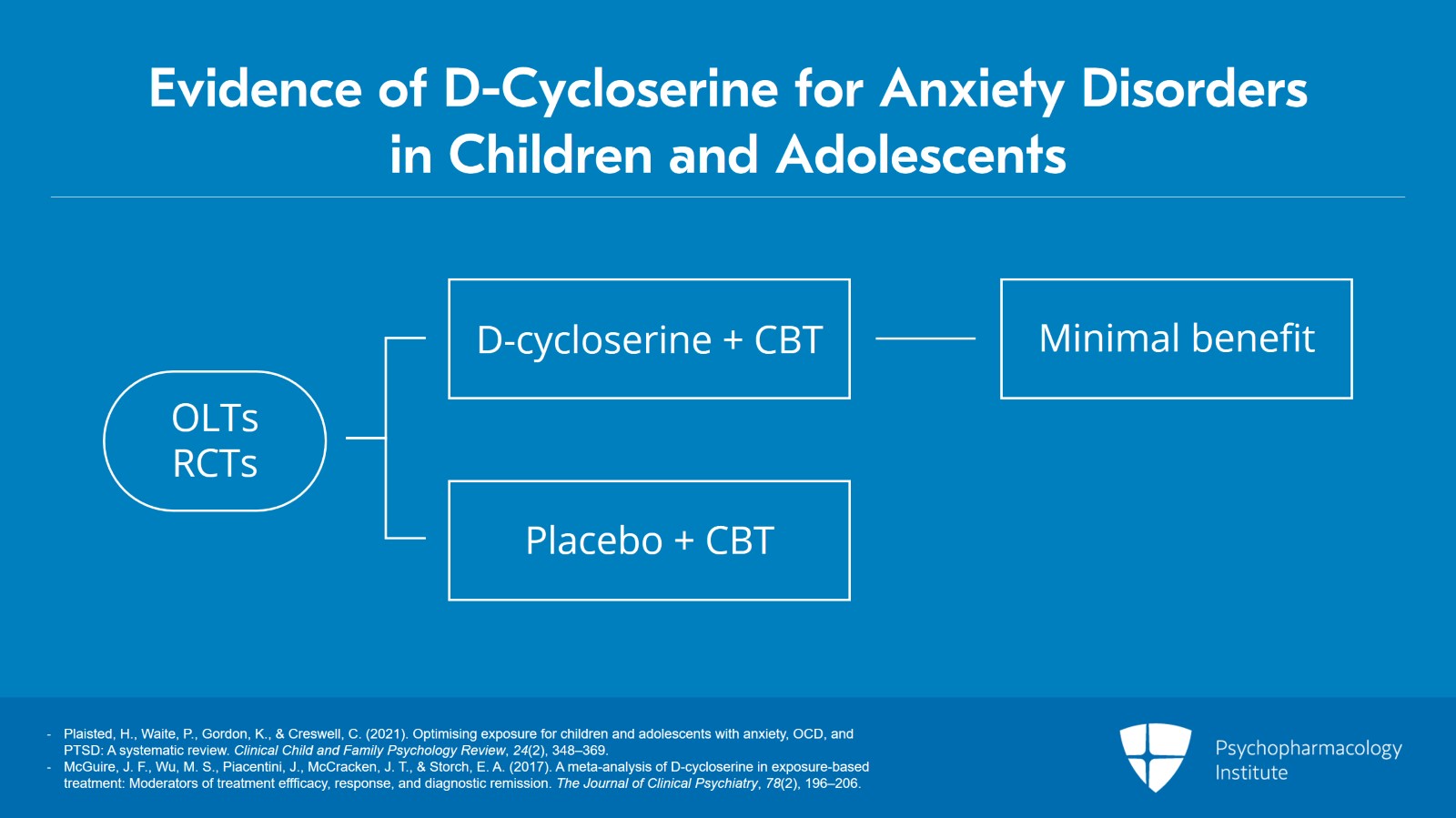
But findings from three large scale reviews and meta-analysis of 29 open-label trials and randomized controlled trials of D-cycloserine administration relative to placebo for cognitive and behavioral therapy augmentation for children and adolescents with anxiety and related disorders that were OCD, PTSD found only minimal benefit.
References:
  • Plaisted, H., Waite, P., Gordon, K., & Creswell, C. (2021). Optimising exposure for children and adolescents with anxiety, OCD, and PTSD: A systematic review. Clinical Child and Family Psychology Review, 24(2), 348–369.
  • McGuire, J. F., Wu, M. S., Piacentini, J., McCracken, J. T., & Storch, E. A. (2017). A meta-analysis of D-cycloserine in exposure-based treatment: Moderators of treatment effficacy, response, and diagnostic remission. The Journal of Clinical Psychiatry, 78(2), 196–206. 

Slide 6 of 25

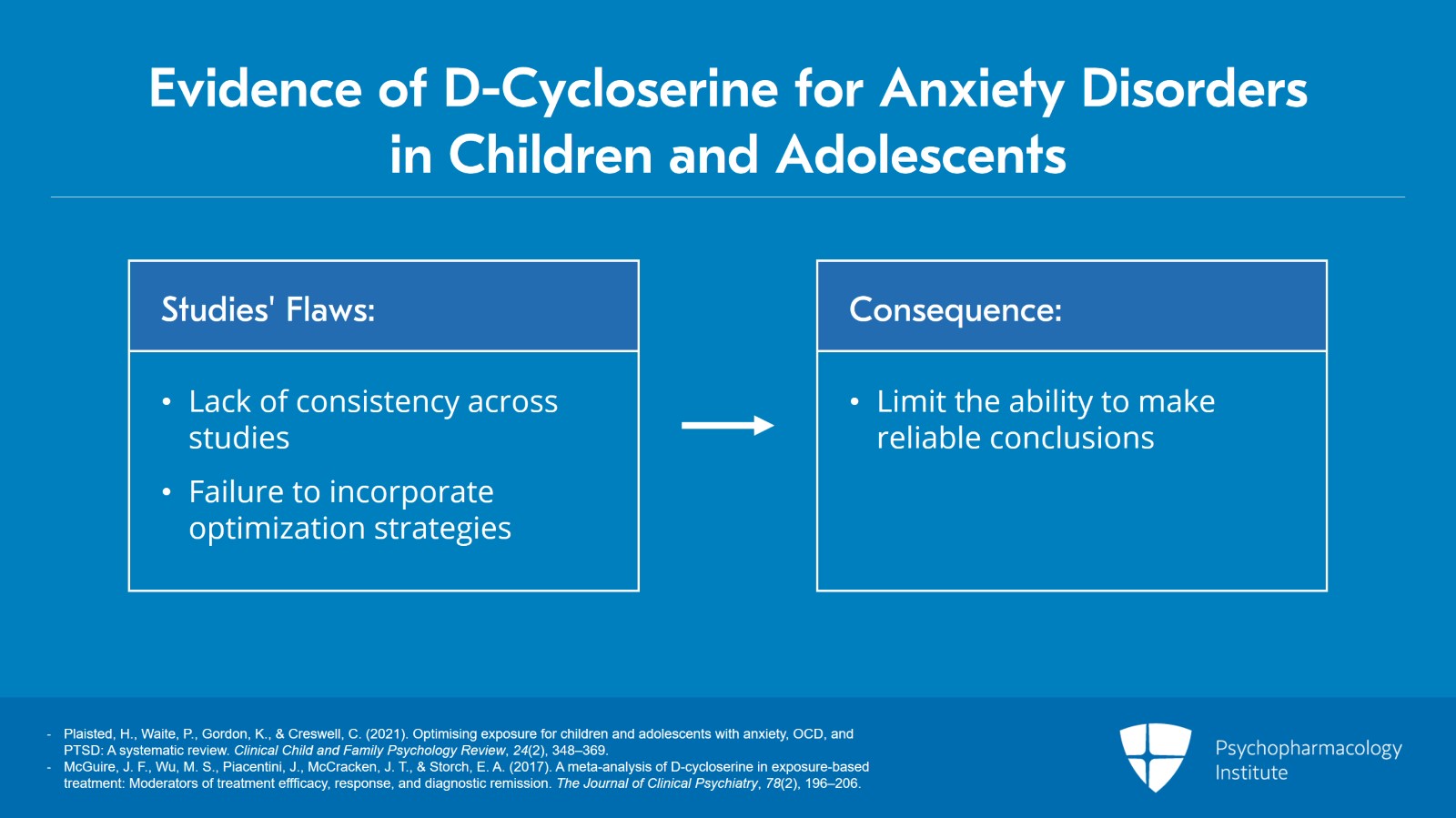
Notably, these reviews also identified a lack of consistency across studies related to methodologies and outcome measures as well as a failure to incorporate potential optimization strategies identified during studies in adults which limited the ability to make reliable conclusions or draw meaningful comparisons between studies. So, this is where looking at subgroups, differences in the methodology, the patient population can really make it hard to compare different studies.
References:
  • Plaisted, H., Waite, P., Gordon, K., & Creswell, C. (2021). Optimising exposure for children and adolescents with anxiety, OCD, and PTSD: A systematic review. Clinical Child and Family Psychology Review, 24(2), 348–369.
  • McGuire, J. F., Wu, M. S., Piacentini, J., McCracken, J. T., & Storch, E. A. (2017). A meta-analysis of D-cycloserine in exposure-based treatment: Moderators of treatment effficacy, response, and diagnostic remission. The Journal of Clinical Psychiatry, 78(2), 196–206. 
Free Files
Success!
Check your inbox, we sent you all the materials there.
Slide 7 of 25

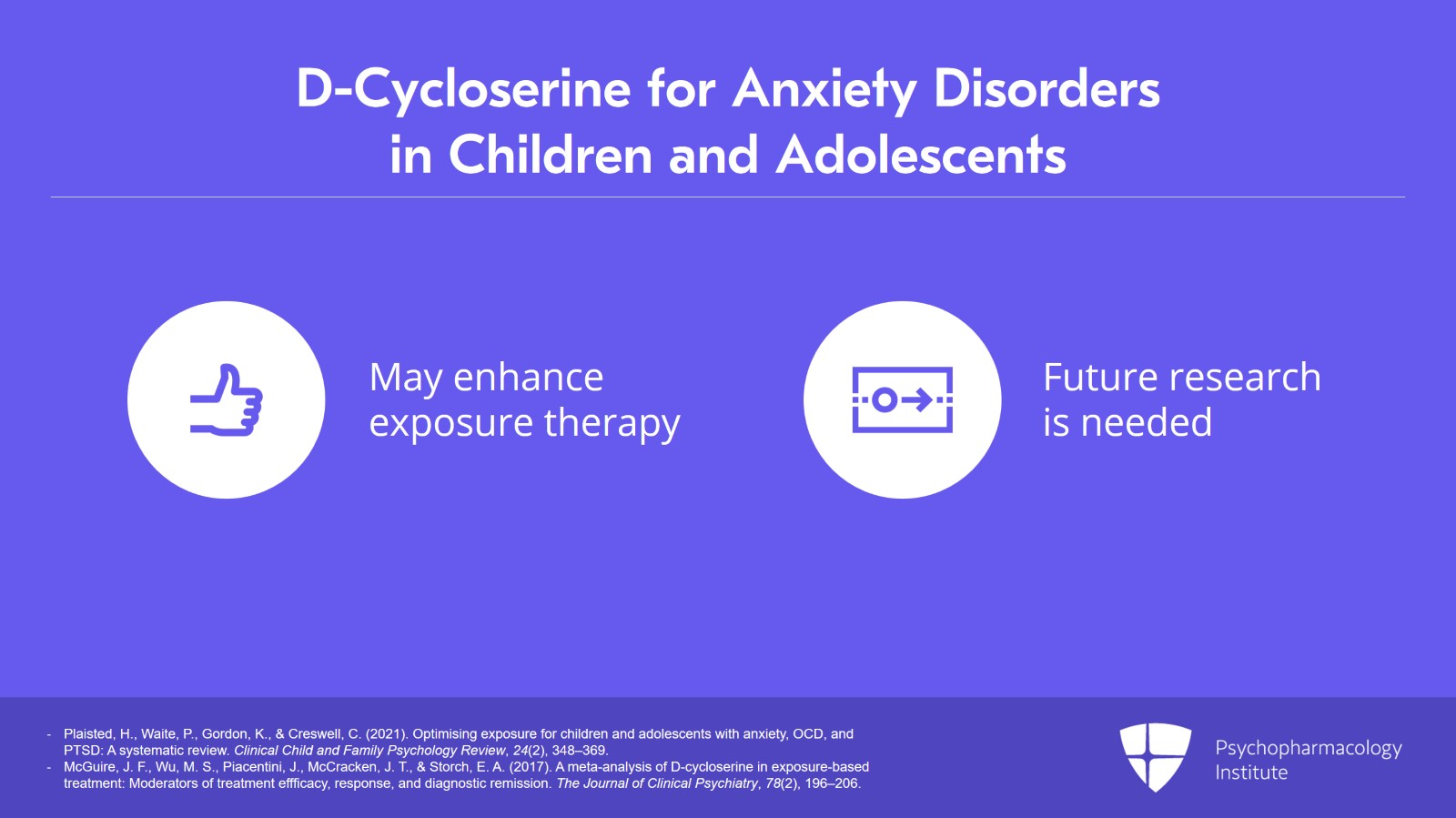
Despite these mixed results from current trials which have yielded small and inconsistent effects, there is some evidence that D-cycloserine may enhance exposure therapy in young people. Future research on D-cycloserine is needed though to clarify mechanisms and disentangle its effects across disorders and should include consistent study conceptualizations, methodologic approaches, and outcome measures to enable more meaningful comparisons.
References:
  • Plaisted, H., Waite, P., Gordon, K., & Creswell, C. (2021). Optimising exposure for children and adolescents with anxiety, OCD, and PTSD: A systematic review. Clinical Child and Family Psychology Review, 24(2), 348–369.
  • McGuire, J. F., Wu, M. S., Piacentini, J., McCracken, J. T., & Storch, E. A. (2017). A meta-analysis of D-cycloserine in exposure-based treatment: Moderators of treatment effficacy, response, and diagnostic remission. The Journal of Clinical Psychiatry, 78(2), 196–206. 

Slide 8 of 25

Now, as a potential indication for obsessive-compulsive disorder, this had tremendous promise and is another example where there was incredible excitement about how D-cycloserine may become part of the armamentarium in treating OCD. Several studies have examined D-cycloserine augmentation of cognitive behavioral therapy in children and adults with OCD but again the results have been mixed.
References:
  • Rosenberg, D., & Gershon, S. (2012). Pharmacotherapy of child and adolescent psychiatric disorders. John Wiley & Sons.
  • Pittenger C. (2015). Glutamatergic agents for OCD and related disorders. Current Treatment Options in Psychiatry, 2(3), 271–283.
Free Files
Success!
Check your inbox, we sent you all the materials there.
Slide 9 of 25

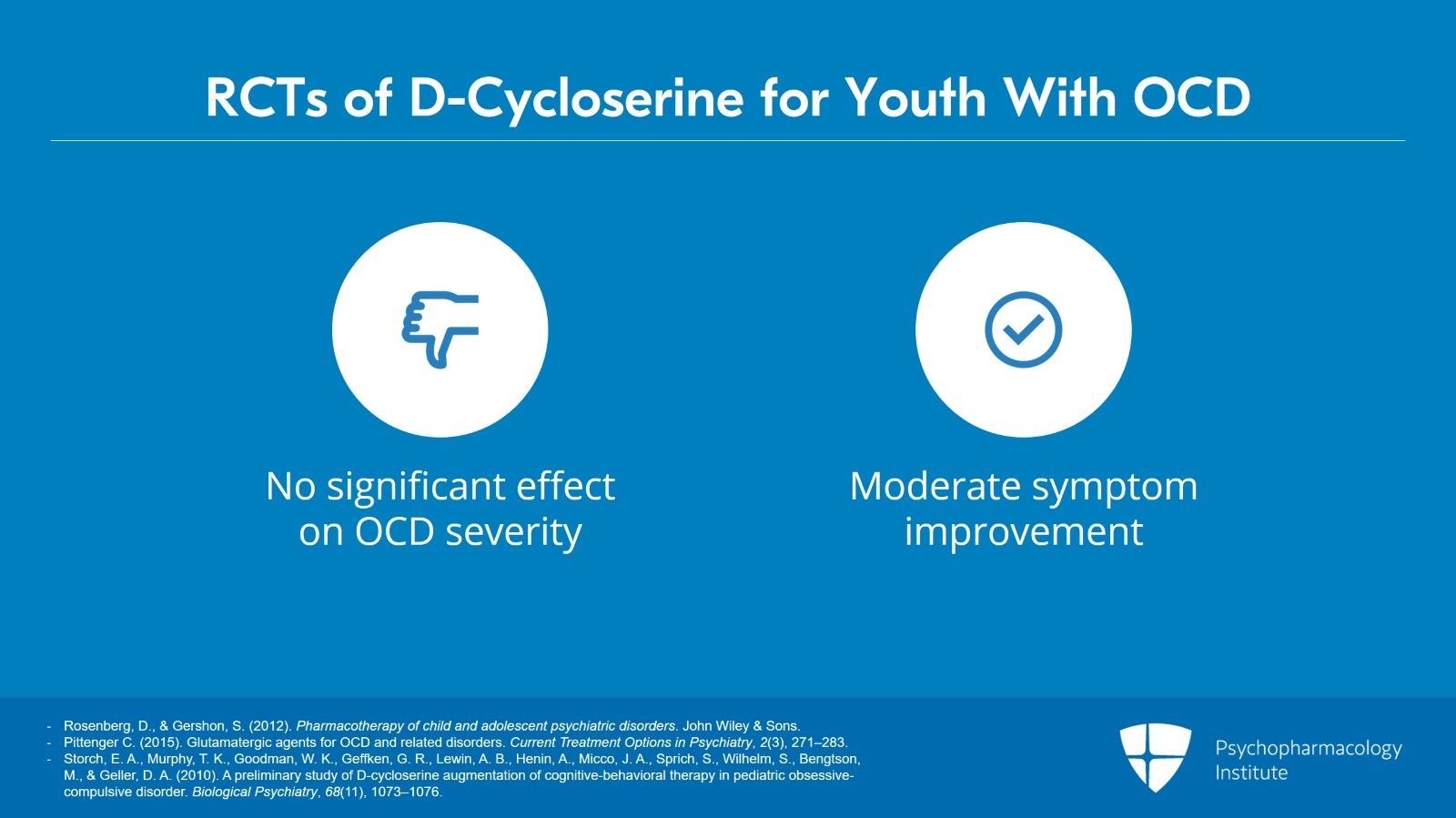
Three randomized controlled trials in OCD youth found no significant effect of D-cycloserine on OCD severity. Although patients taking D-cycloserine did experience moderate symptom improvement compared to placebo on the Children’s Yale-Brown Obsessive-Compulsive Scale, the CGI-Severity, and ADIS CSR.
References:
  • Rosenberg, D., & Gershon, S. (2012). Pharmacotherapy of child and adolescent psychiatric disorders. John Wiley & Sons.
  • Pittenger C. (2015). Glutamatergic agents for OCD and related disorders. Current Treatment Options in Psychiatry, 2(3), 271–283.
  • Storch, E. A., Murphy, T. K., Goodman, W. K., Geffken, G. R., Lewin, A. B., Henin, A., Micco, J. A., Sprich, S., Wilhelm, S., Bengtson, M., & Geller, D. A. (2010). A preliminary study of D-cycloserine augmentation of cognitive-behavioral therapy in pediatric obsessive-compulsive disorder. Biological Psychiatry, 68(11), 1073–1076.

Slide 10 of 25

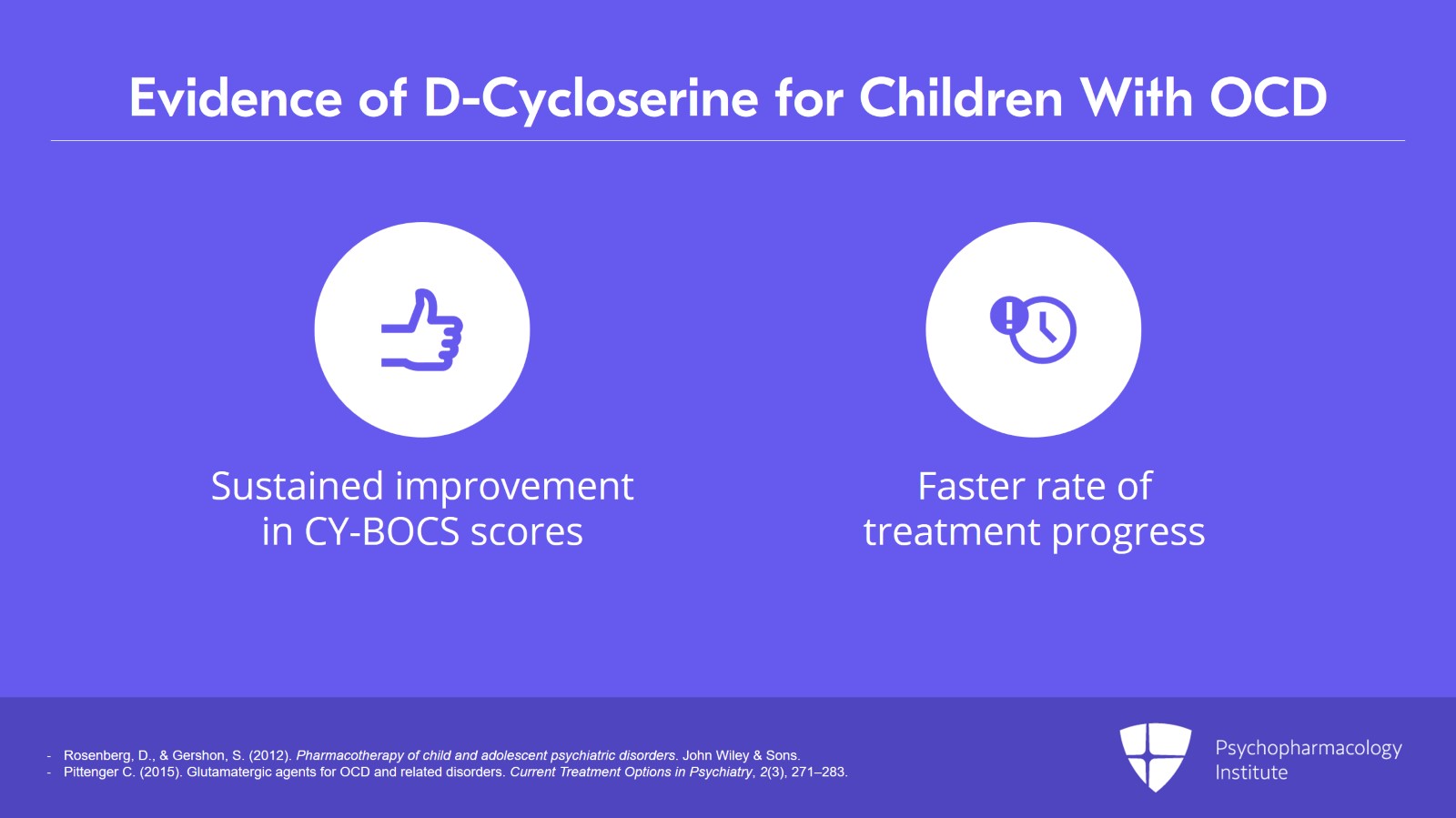
Additionally, one randomized controlled trial found greater sustained improvement in the Children’s Yale-Brown Obsessive-Compulsive Scale scores in the D-cycloserine group compared to the placebo at one month post treatment. There was one study that did observe a significantly faster rate of treatment progress at the midpoint of the study in patients receiving D-cycloserine. And we know that it takes the SSRIs often a while to be effective in obsessive-compulsive disorder so hastening or making more rapid the response to treatment is obviously beneficial in this condition.
References:
  • Rosenberg, D., & Gershon, S. (2012). Pharmacotherapy of child and adolescent psychiatric disorders. John Wiley & Sons.
  • Pittenger C. (2015). Glutamatergic agents for OCD and related disorders. Current Treatment Options in Psychiatry, 2(3), 271–283.
Free Files
Success!
Check your inbox, we sent you all the materials there.
Slide 11 of 25

So D-cycloserine may accelerate the therapeutic effect of cognitive behavioral therapy in OCD patients and the greatest treatment effect may be limited to unmedicated cases.
References:
  • Rosenberg, D., & Gershon, S. (2012). Pharmacotherapy of child and adolescent psychiatric disorders. John Wiley & Sons.
  • Pittenger C. (2015). Glutamatergic agents for OCD and related disorders. Current Treatment Options in Psychiatry, 2(3), 271–283.

Slide 12 of 25

So obviously, very important that the response with this agent may not be as good if a patient is on traditional medicines used to treat OCD such as the SSRIs but in unmedicated patients this may be an attractive option to accelerate the treatment effect.
References:
  • Rosenberg, D., & Gershon, S. (2012). Pharmacotherapy of child and adolescent psychiatric disorders. John Wiley & Sons.
  • Pittenger C. (2015). Glutamatergic agents for OCD and related disorders. Current Treatment Options in Psychiatry, 2(3), 271–283.
Free Files
Success!
Check your inbox, we sent you all the materials there.

Slide 13 of 25

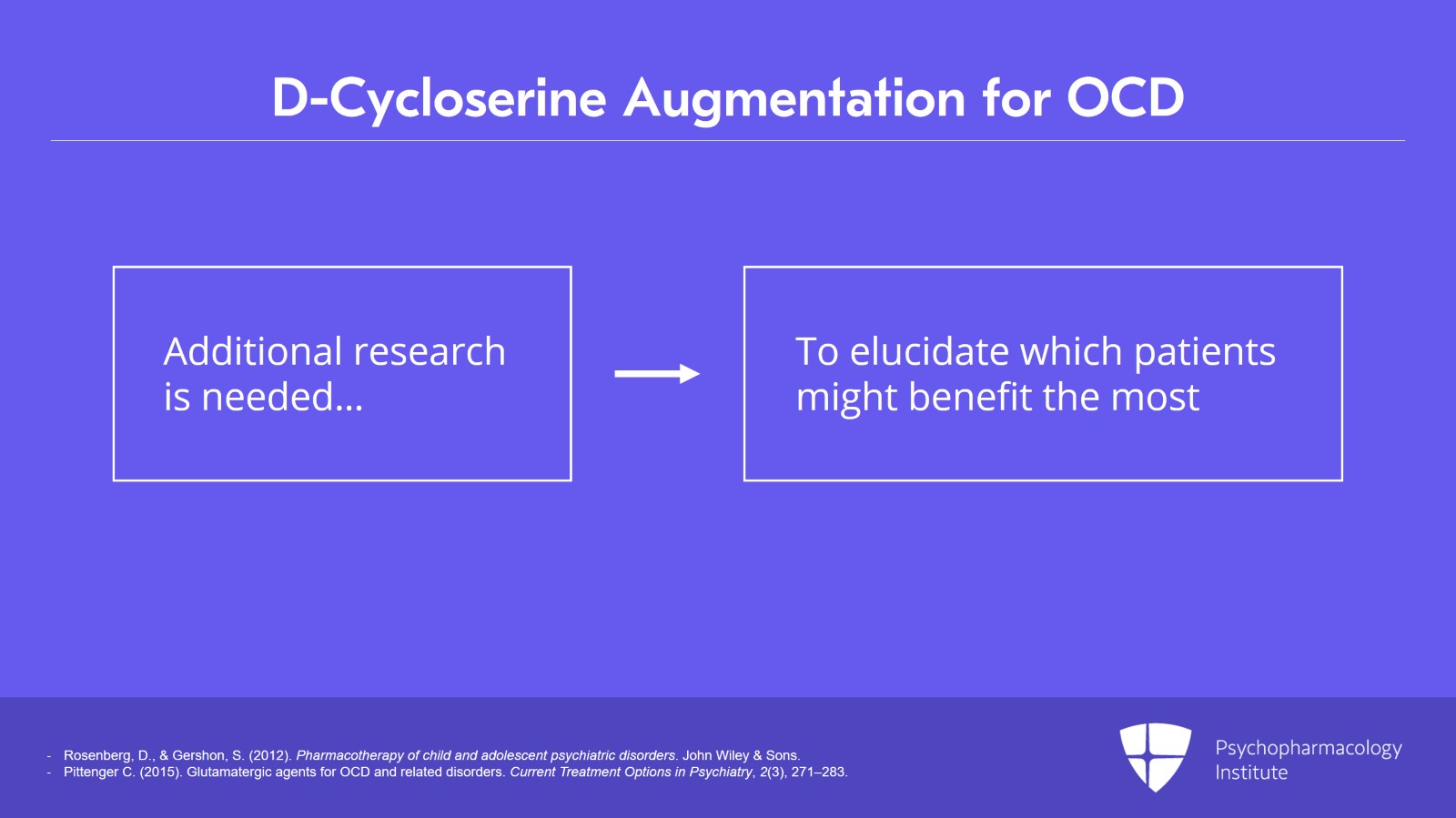
These studies do provide additional support of the potential for D-cycloserine for OCD but additional research is needed to further elucidate exactly which OCD patients might benefit the most from D-cycloserine augmentation.
References:
  • Rosenberg, D., & Gershon, S. (2012). Pharmacotherapy of child and adolescent psychiatric disorders. John Wiley & Sons.
  • Pittenger C. (2015). Glutamatergic agents for OCD and related disorders. Current Treatment Options in Psychiatry, 2(3), 271–283.

Slide 14 of 25

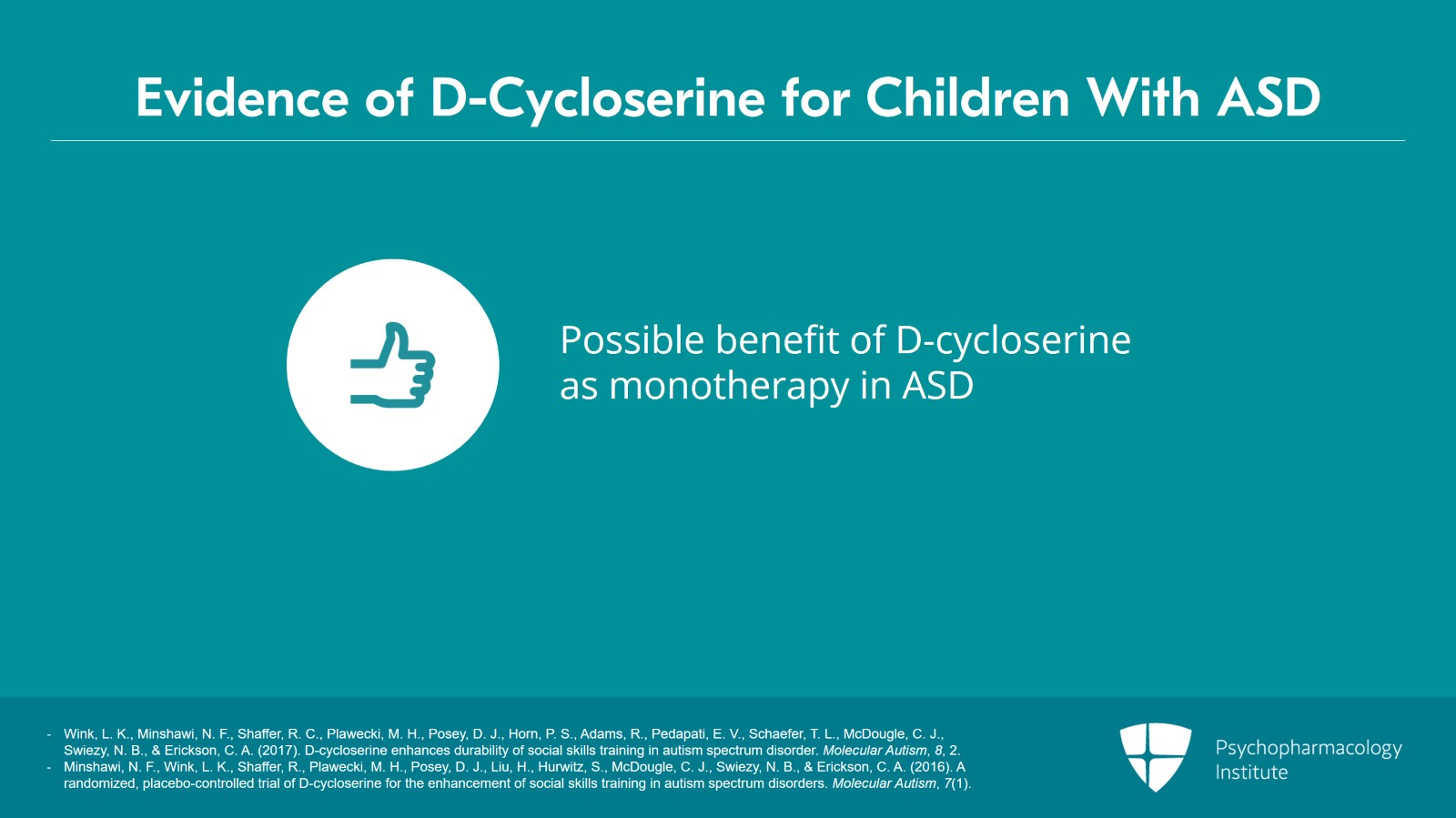
Autism spectrum disorder. Early studies in this area were very compelling suggesting a possible benefit for D-cycloserine as a monotherapy in autism spectrum disorder with up to 40% of patients showing improvement on the Clinical Global Impression-Improvement scale and nearly 60% demonstrating improvement on the ABC-C.
References:
  • Wink, L. K., Minshawi, N. F., Shaffer, R. C., Plawecki, M. H., Posey, D. J., Horn, P. S., Adams, R., Pedapati, E. V., Schaefer, T. L., McDougle, C. J., Swiezy, N. B., & Erickson, C. A. (2017). D-cycloserine enhances durability of social skills training in autism spectrum disorder. Molecular Autism, 8, 2.
  • Minshawi, N. F., Wink, L. K., Shaffer, R., Plawecki, M. H., Posey, D. J., Liu, H., Hurwitz, S., McDougle, C. J., Swiezy, N. B., & Erickson, C. A. (2016). A randomized, placebo-controlled trial of D-cycloserine for the enhancement of social skills training in autism spectrum disorders. Molecular Autism, 7(1).
Free Files
Success!
Check your inbox, we sent you all the materials there.
Slide 15 of 25

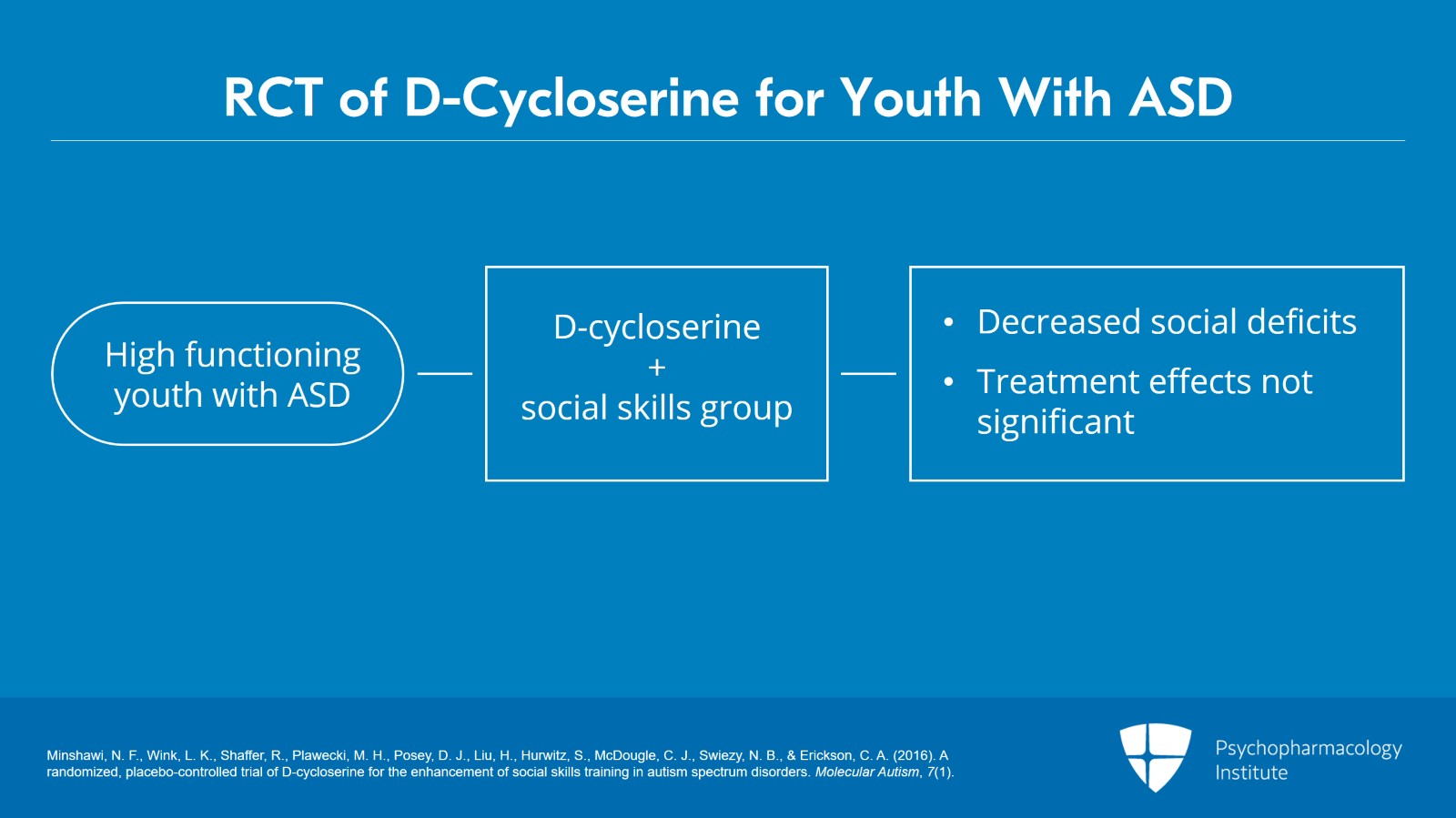
A randomized controlled trial in high functioning youth with autism spectrum disorder examining the efficacy of D-cycloserine plus peer-mediated social skills group intervention found decreased social deficits although between group treatment effects were not significant.
References:
  • Minshawi, N. F., Wink, L. K., Shaffer, R., Plawecki, M. H., Posey, D. J., Liu, H., Hurwitz, S., McDougle, C. J., Swiezy, N. B., & Erickson, C. A. (2016). A randomized, placebo-controlled trial of D-cycloserine for the enhancement of social skills training in autism spectrum disorders. Molecular Autism, 7(1).

Slide 16 of 25

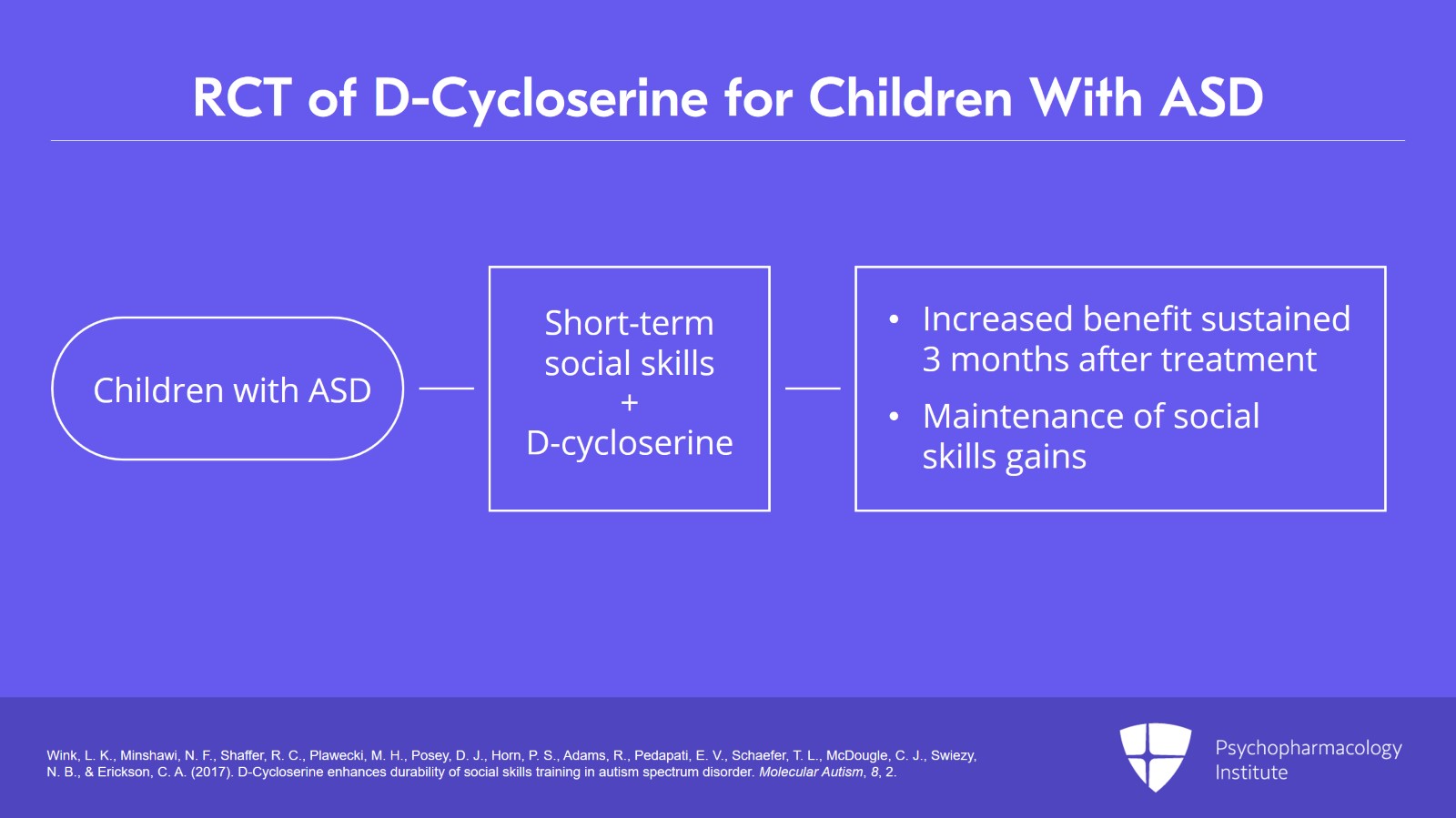
A follow-up randomized controlled trial in children with autism spectrum disorder receiving short-term social skills intervention also found participants receiving weekly adjunctive D-cycloserine experience significantly increased benefit that was sustained three months after treatment. Thus, D-cycloserine appears to support maintenance of social skills gains made during short-term group therapy compared to placebo.
References:
  • Wink, L. K., Minshawi, N. F., Shaffer, R. C., Plawecki, M. H., Posey, D. J., Horn, P. S., Adams, R., Pedapati, E. V., Schaefer, T. L., McDougle, C. J., Swiezy, N. B., & Erickson, C. A. (2017). D-Cycloserine enhances durability of social skills training in autism spectrum disorder. Molecular Autism, 8, 2.
Free Files
Success!
Check your inbox, we sent you all the materials there.
Slide 17 of 25

These results I think are particularly significant given that previous studies have noted a lack of treatment durability following social skills intervention in autism spectrum disorder. So this would be a huge advantage if this is replicated and in fact we do find that D-cycloserine augmentation leads to the durability, rather, of short-term group therapy gains. Although current research is limited, findings from current research support additional studies to examine the potential efficacy for adjunctive use of D-cycloserine in autism spectrum disorder.
References:
  • Wink, L. K., Minshawi, N. F., Shaffer, R. C., Plawecki, M. H., Posey, D. J., Horn, P. S., Adams, R., Pedapati, E. V., Schaefer, T. L., McDougle, C. J., Swiezy, N. B., & Erickson, C. A. (2017). D-Cycloserine enhances durability of social skills training in autism spectrum disorder. Molecular Autism, 8, 2.
  • Minshawi, N. F., Wink, L. K., Shaffer, R., Plawecki, M. H., Posey, D. J., Liu, H., Hurwitz, S., McDougle, C. J., Swiezy, N. B., & Erickson, C. A. (2016). A randomized, placebo-controlled trial of D-cycloserine for the enhancement of social skills training in autism spectrum disorders. Molecular Autism, 7(1).

Slide 18 of 25

Posttraumatic stress disorder. Although cognitive behavioral therapy has been associated with significant reductions in PTSD symptoms, results from a randomized controlled trial found little evidence supporting adjunctive D-cycloserine treatment in youth with posttraumatic stress disorder. Therefore, while D-cycloserine adjunctive treatment with CBT appears effective for some anxiety disorders, current evidence does not support its use in youth with PTSD.
References:
  • Rosenberg, D., & Gershon, S. (2012). Pharmacotherapy of child and adolescent psychiatric disorders. John Wiley & Sons.
  • Scheeringa, M. S., & Weems, C. F. (2014). Randomized placebo-controlled D-cycloserine with cognitive behavior therapy for pediatric posttraumatic stress. Journal of Child and Adolescent psychopharmacology, 24(2), 69–77.
Free Files
Success!
Check your inbox, we sent you all the materials there.
Slide 19 of 25

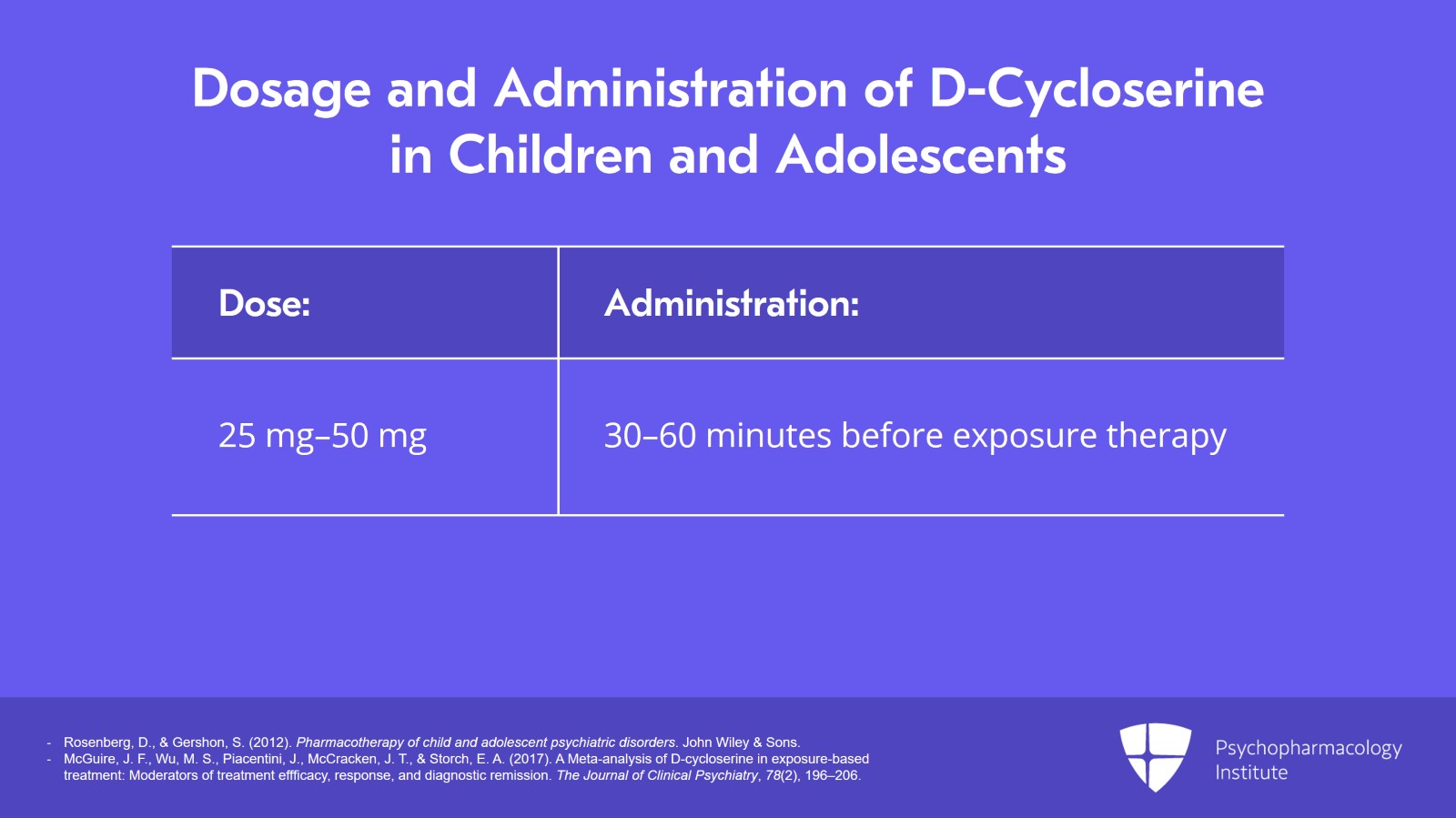
Dosage and administration in D-cycloserine. In children and adolescents, most studies employed weight-adjusted dosages between 25 and 50 mg that were administered 30 to 60 minutes before exposure therapy.
References:
  • Rosenberg, D., & Gershon, S. (2012). Pharmacotherapy of child and adolescent psychiatric disorders. John Wiley & Sons.
  • McGuire, J. F., Wu, M. S., Piacentini, J., McCracken, J. T., & Storch, E. A. (2017). A Meta-analysis of D-cycloserine in exposure-based treatment: Moderators of treatment effficacy, response, and diagnostic remission. The Journal of Clinical Psychiatry, 78(2), 196–206. 

Slide 20 of 25

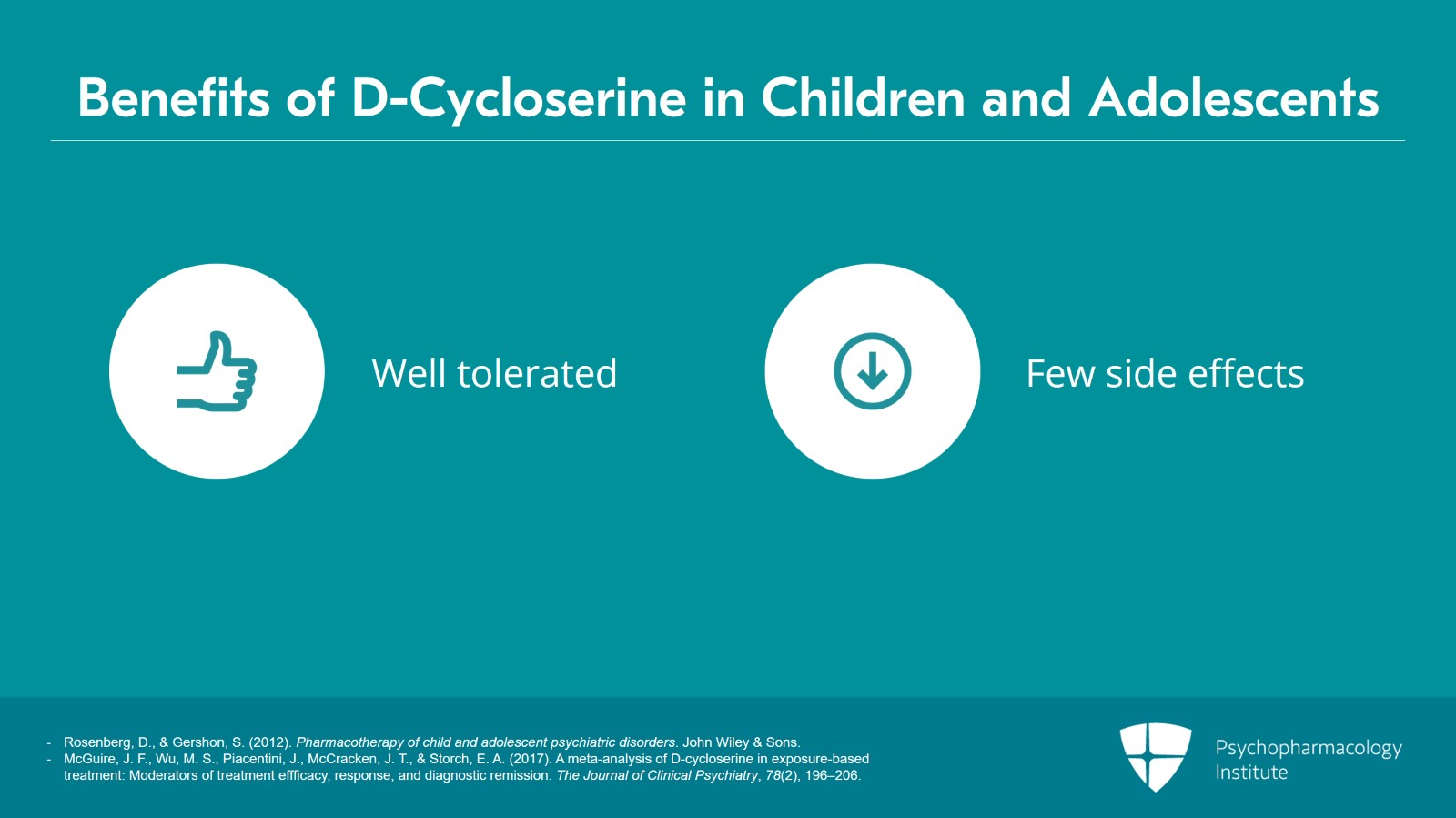
The good news is that D-cycloserine appears to be very well tolerated in children and adolescents with few side effects.
References:
  • Rosenberg, D., & Gershon, S. (2012). Pharmacotherapy of child and adolescent psychiatric disorders. John Wiley & Sons.
  • McGuire, J. F., Wu, M. S., Piacentini, J., McCracken, J. T., & Storch, E. A. (2017). A meta-analysis of D-cycloserine in exposure-based treatment: Moderators of treatment effficacy, response, and diagnostic remission. The Journal of Clinical Psychiatry, 78(2), 196–206. 
Free Files
Success!
Check your inbox, we sent you all the materials there.

Slide 21 of 25

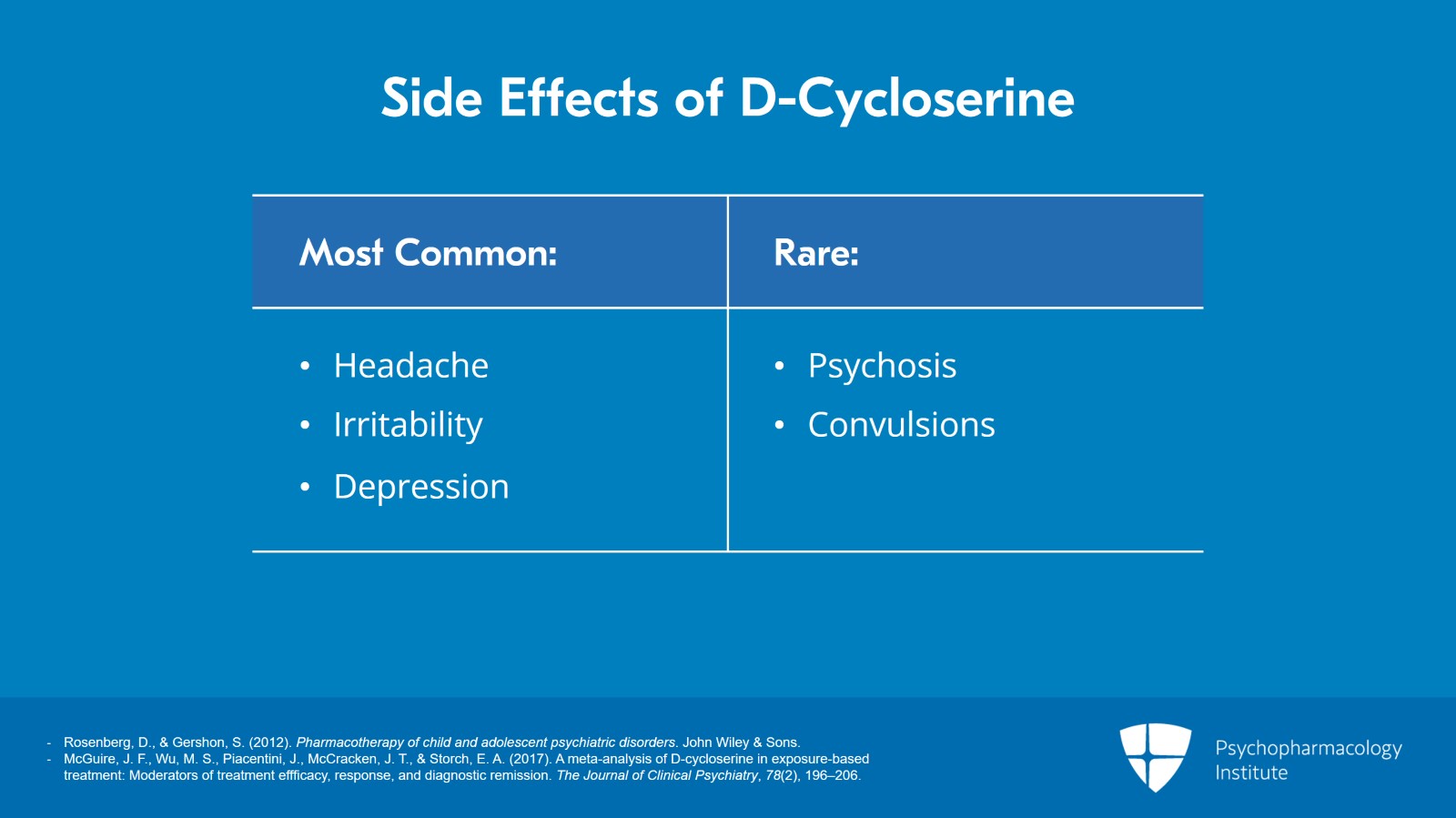
The most commonly reported side effects are headache, irritability, and depression. A rare but potentially serious side effect such as psychosis and convulsions has also been reported.
References:
  • Rosenberg, D., & Gershon, S. (2012). Pharmacotherapy of child and adolescent psychiatric disorders. John Wiley & Sons.
  • McGuire, J. F., Wu, M. S., Piacentini, J., McCracken, J. T., & Storch, E. A. (2017). A meta-analysis of D-cycloserine in exposure-based treatment: Moderators of treatment effficacy, response, and diagnostic remission. The Journal of Clinical Psychiatry, 78(2), 196–206. 

Slide 22 of 25

The key take-home points here are that D-cycloserine has been observed to possess antianxiety properties. However, D-cycloserine only shows an extinction effect when paired with behavioral training.
Free Files
Success!
Check your inbox, we sent you all the materials there.
Slide 23 of 25

Despite mixed results from current trials which have yielded small and inconsistent effects, there is some evidence that D-cycloserine may enhance exposure therapy, accelerate the therapeutic effect of CBT in OCD and support maintenance of social skills gains during group therapy in autism spectrum disorder.

Slide 24 of 25

Additionally, while D-cycloserine treatment with behavioral therapy appears effective for some anxiety disorder, current evidence does not support the use of D-cycloserine in youth with posttraumatic stress disorder.
Free Files
Success!
Check your inbox, we sent you all the materials there.
Slide 25 of 25

Learning Objectives:

After completing this activity, the learner will be able to:

  1. Identify the different atypical psychopharmacologic strategies for children and adolescents.
  2. Discuss the available evidence about nonstandard psychoactive drugs in the pediatric population.
  3. Recognize pediatric patients who could benefit from atypical psychopharmacologic strategies and utilize them accordingly.

Original Release Date: August 1, 2022

Review and Re-release Date: March 1, 2024

Expiration Date: August 1, 2025

Expert: David Rosenberg, M.D.

Medical Editor: Paz Badía, M.D.

Relevant Financial Disclosures: 

None of the faculty, planners, and reviewers for this educational activity have relevant financial relationships to disclose during the last 24 months with ineligible companies whose primary business is producing, marketing, selling, re-selling, or distributing healthcare products used by or on patients.

Contact Information: For questions regarding the content or access to this activity, contact us at support@psychopharmacologyinstitute.com

Instructions for Participation and Credit:

Participants must complete the activity online during the valid credit period that is noted above.

Follow these steps to earn CME credit:

  1. View the required educational content provided on this course page.

  2. Complete the Post Activity Evaluation for providing the necessary feedback for continuing accreditation purposes and for the development of future activities. NOTE: Completing the Post Activity Evaluation after the quiz is required to receive the earned credit.

  3. Download your certificate.

Accreditation Statement

This activity has been planned and implemented in accordance with the accreditation requirements and policies of the Accreditation Council for Continuing Medical Education through the joint providership of Medical Academy LLC and the Psychopharmacology Institute. Medical Academy is accredited by the ACCME to provide continuing medical education for physicians.

Credit Designation Statement

Medical Academy designates this enduring activity for a maximum of 1.25 AMA PRA Category 1 credit(s)™. Physicians should claim only the credit commensurate with the extent of their participation in the activity.

Free Files
Success!
Check your inbox, we sent you all the materials there.
Continue in the website
Instant access modal

Become a Bronze, Silver, Gold, Bronze extended, Silver extended or Gold extended Member.

2025–26 Psychopharmacology CME Program

Unlock up to 155 CME Credits, including 40 SA CME Credits.