Slides and Transcript
Slide 1 of 25
In the next section, we’re going to discuss the management of acute aggression in children and adolescents.
Slide 2 of 25
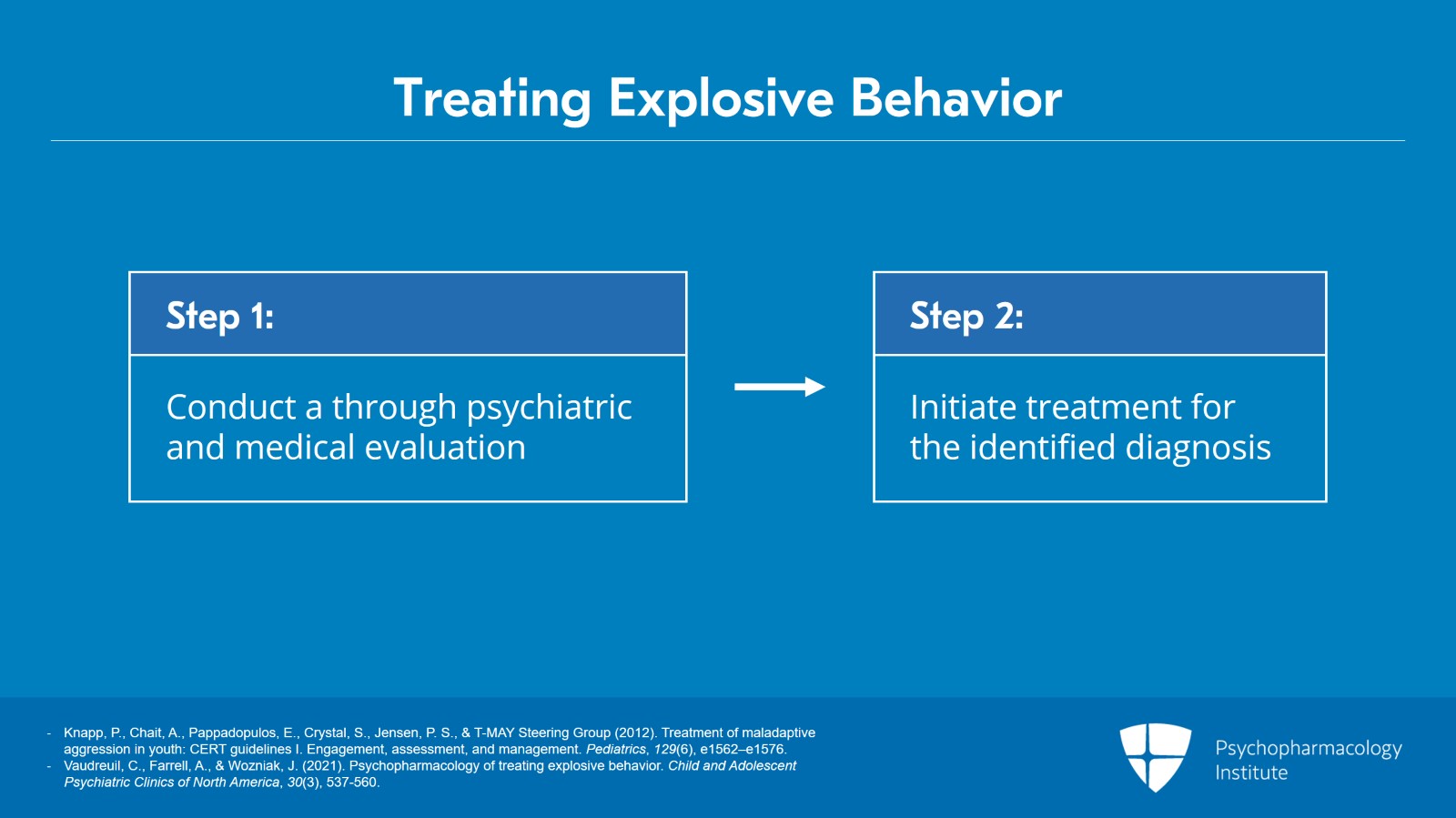
So when thinking about treating explosive behavior, the first step is to conduct a thorough initial evaluation including both the psychiatric and medical evaluation and this is what we discussed doing in the previous sections.
The next step is to initiate treatment based on the evidence for first-line psychosocial, therapeutic, and psychopharmacological management for the identified diagnosis.
References:
- Knapp, P., Chait, A., Pappadopulos, E., Crystal, S., Jensen, P. S., & T-MAY Steering Group (2012). Treatment of maladaptive aggression in youth: CERT guidelines I. Engagement, assessment, and management. Pediatrics, 129(6), e1562–e1576.
- Vaudreuil, C., Farrell, A., & Wozniak, J. (2021). Psychopharmacology of treating explosive behavior. Child and Adolescent Psychiatric Clinics of North America, 30(3), 537-560.
Free Files
Download PDF and other files
Success!
Check your inbox, we sent you all the materials there.
Slide 3 of 25
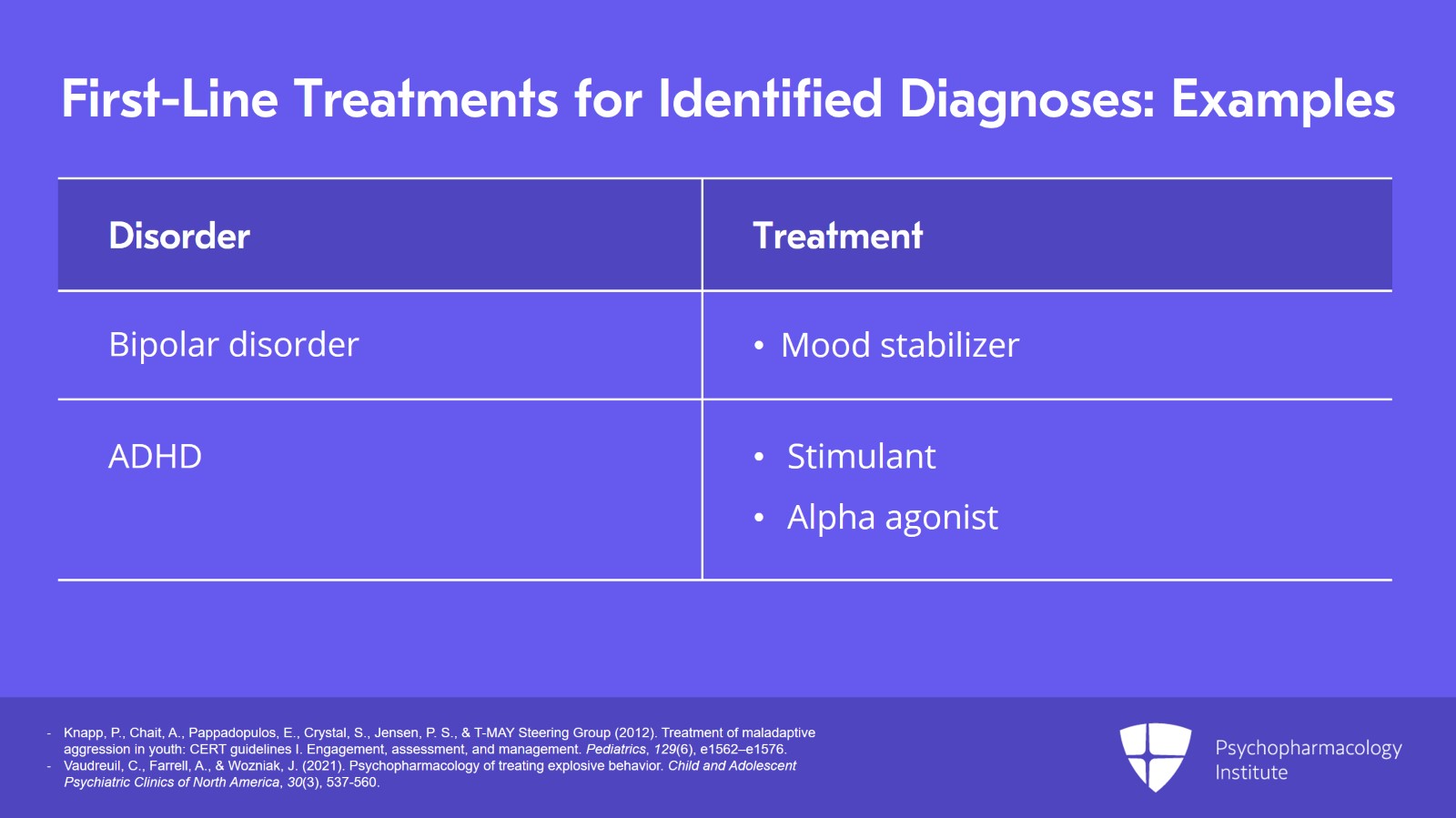
So for example, if you have a child who you’ve diagnosed with bipolar disorder, the first-line treatment would be to initiate a mood stabilizer medication.
If you have a child who’s been diagnosed with ADHD, the first-line treatment would be to initiate a treatment for ADHD such as a stimulant medication or an alpha agonist.
References:
- Knapp, P., Chait, A., Pappadopulos, E., Crystal, S., Jensen, P. S., & T-MAY Steering Group (2012). Treatment of maladaptive aggression in youth: CERT guidelines I. Engagement, assessment, and management. Pediatrics, 129(6), e1562–e1576.
- Vaudreuil, C., Farrell, A., & Wozniak, J. (2021). Psychopharmacology of treating explosive behavior. Child and Adolescent Psychiatric Clinics of North America, 30(3), 537-560.
Slide 4 of 25
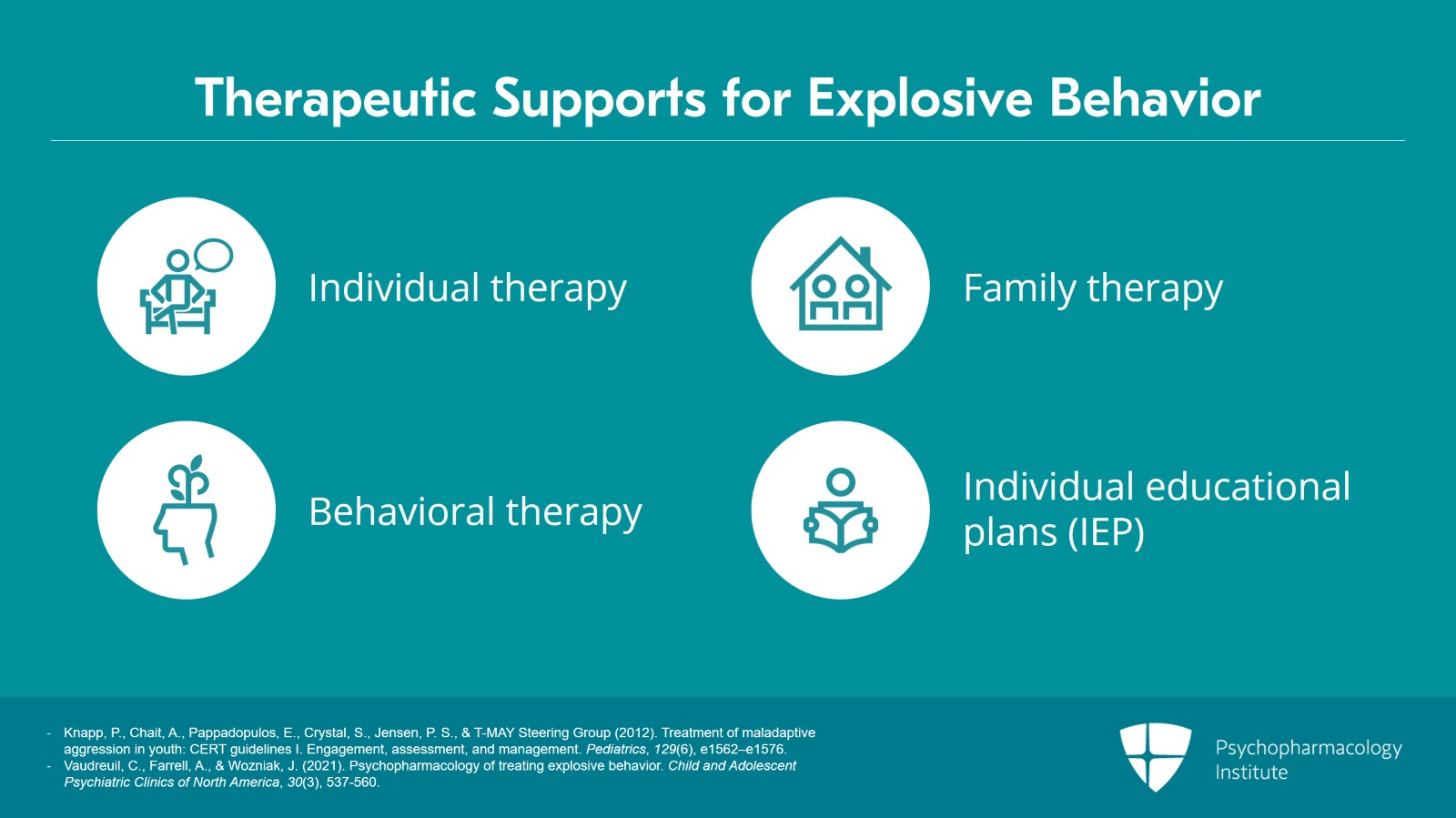
You also want to make sure that these children have appropriate therapeutic supports in place. So this may include getting them into individual therapy, family therapy, behavioral therapy, and may also include therapeutic supports in school such as an IEP or a 504 Plan.
References:
- Knapp, P., Chait, A., Pappadopulos, E., Crystal, S., Jensen, P. S., & T-MAY Steering Group (2012). Treatment of maladaptive aggression in youth: CERT guidelines I. Engagement, assessment, and management. Pediatrics, 129(6), e1562–e1576.
- Vaudreuil, C., Farrell, A., & Wozniak, J. (2021). Psychopharmacology of treating explosive behavior. Child and Adolescent Psychiatric Clinics of North America, 30(3), 537-560.
Free Files
Download PDF and other files
Success!
Check your inbox, we sent you all the materials there.
Slide 5 of 25
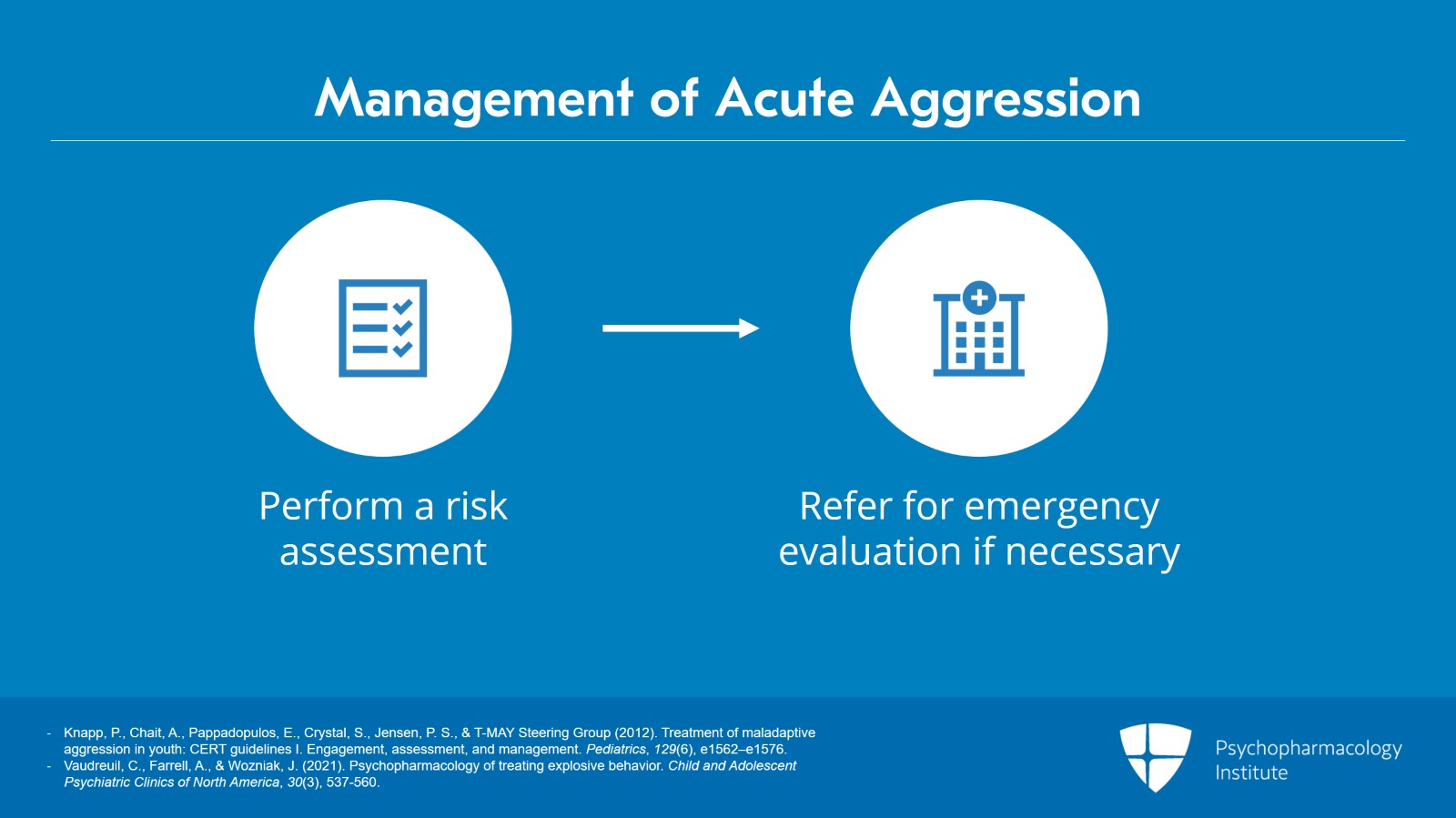
However, in this section, we’re actually going to talk about acute aggression, meaning what do you do when a child is being aggressive and you’re in the moment? So the first step is to perform a risk assessment and determine if the child is at risk of harming themselves or others and then refer for emergency evaluation if necessary because again if you are receiving a call about a child in crisis it’s important to ask if they’re keeping themselves safe and if others feel safe around them and refer them for urgent or emergent help if necessary.
References:
- Knapp, P., Chait, A., Pappadopulos, E., Crystal, S., Jensen, P. S., & T-MAY Steering Group (2012). Treatment of maladaptive aggression in youth: CERT guidelines I. Engagement, assessment, and management. Pediatrics, 129(6), e1562–e1576.
- Vaudreuil, C., Farrell, A., & Wozniak, J. (2021). Psychopharmacology of treating explosive behavior. Child and Adolescent Psychiatric Clinics of North America, 30(3), 537-560.
Slide 6 of 25
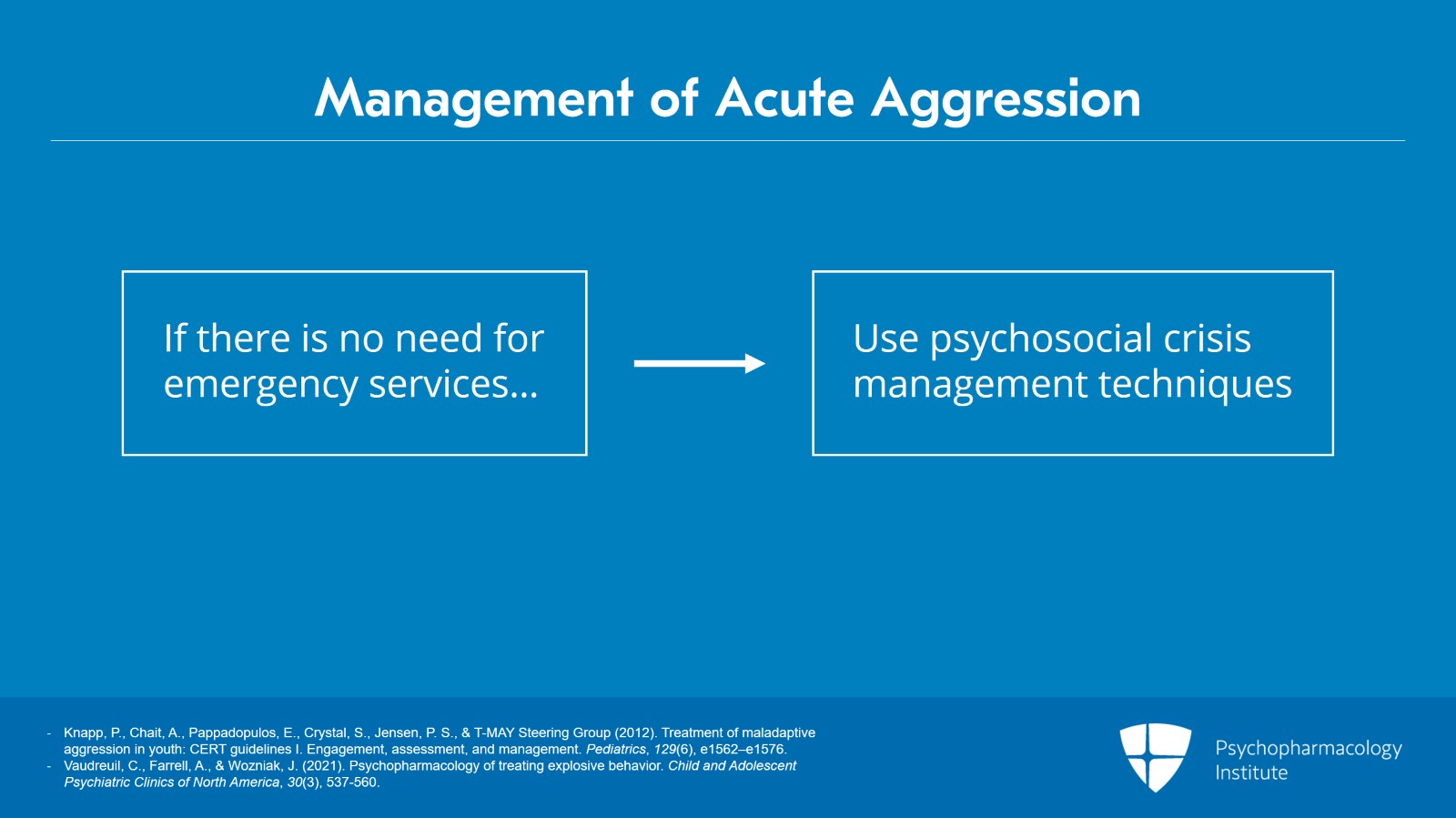
If the child is being aggressive in the moment but it’s not felt that they need emergency services, the first thing to do will be to use psychosocial crisis management techniques before medication.
References:
- Knapp, P., Chait, A., Pappadopulos, E., Crystal, S., Jensen, P. S., & T-MAY Steering Group (2012). Treatment of maladaptive aggression in youth: CERT guidelines I. Engagement, assessment, and management. Pediatrics, 129(6), e1562–e1576.
- Vaudreuil, C., Farrell, A., & Wozniak, J. (2021). Psychopharmacology of treating explosive behavior. Child and Adolescent Psychiatric Clinics of North America, 30(3), 537-560.
Free Files
Download PDF and other files
Success!
Check your inbox, we sent you all the materials there.
Slide 7 of 25
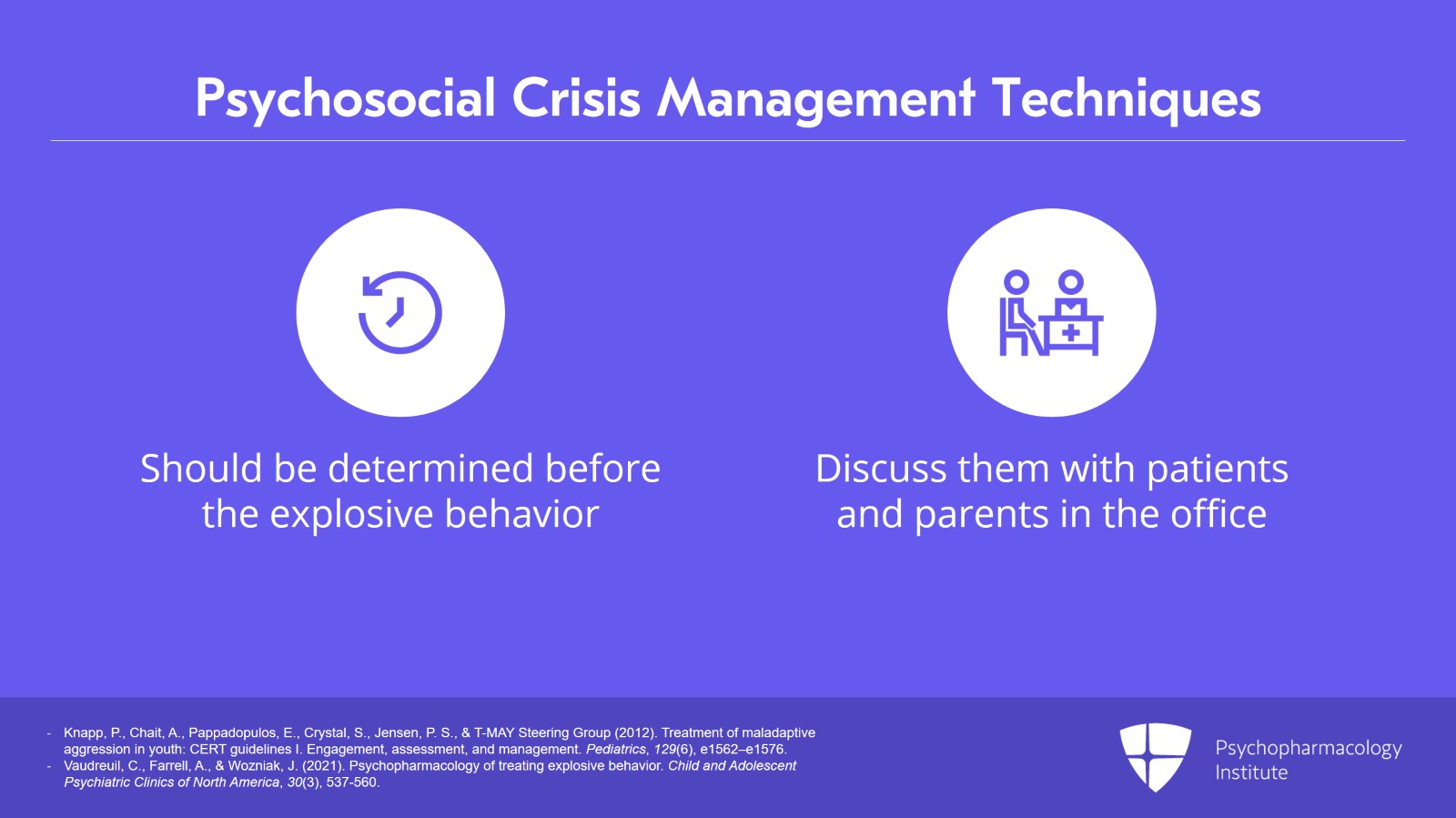
So in an ideal world, the psychosocial crisis management techniques would have been determined before the actual explosive episode.
So this is something you actually want to discuss with patients and their parents in the office so that patients and their parents have this sort of tool kit available to them when the acute aggression occurs.
References:
- Knapp, P., Chait, A., Pappadopulos, E., Crystal, S., Jensen, P. S., & T-MAY Steering Group (2012). Treatment of maladaptive aggression in youth: CERT guidelines I. Engagement, assessment, and management. Pediatrics, 129(6), e1562–e1576.
- Vaudreuil, C., Farrell, A., & Wozniak, J. (2021). Psychopharmacology of treating explosive behavior. Child and Adolescent Psychiatric Clinics of North America, 30(3), 537-560.
Slide 8 of 25
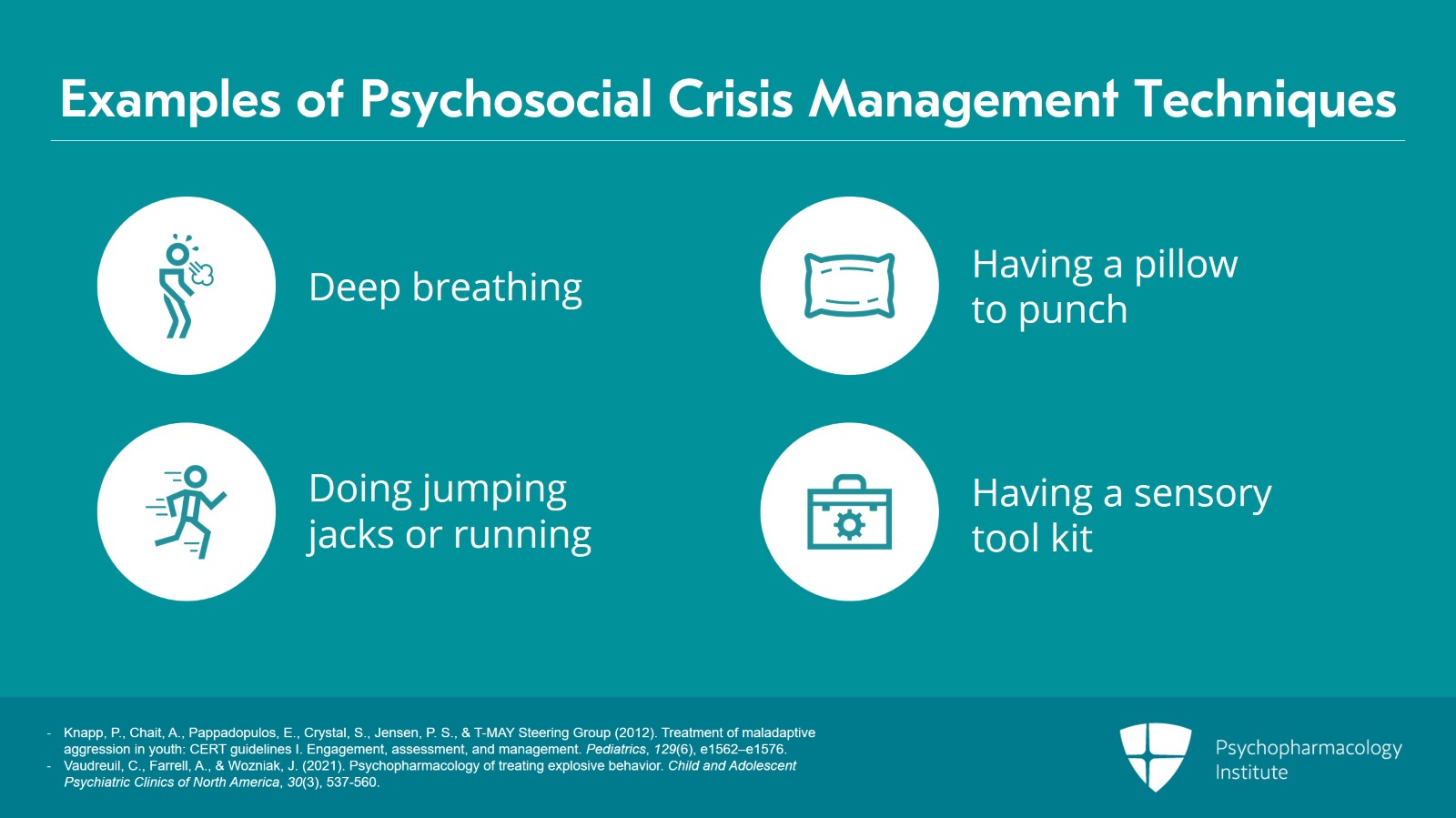
So examples for this may include deep breathing. Some children like to have a pillow that they punch. Some children like to do jumping jacks or go for a run or do something that sort of burns that energy off, jump on a trampoline. Some children like to have a sensory tool kit where they have things that they can shake or soft things that they can touch or things that they can smell.
So, the first step would be to try to get the child to engage in some of these other behaviors that are less destructive to help them calm down.
References:
- Knapp, P., Chait, A., Pappadopulos, E., Crystal, S., Jensen, P. S., & T-MAY Steering Group (2012). Treatment of maladaptive aggression in youth: CERT guidelines I. Engagement, assessment, and management. Pediatrics, 129(6), e1562–e1576.
- Vaudreuil, C., Farrell, A., & Wozniak, J. (2021). Psychopharmacology of treating explosive behavior. Child and Adolescent Psychiatric Clinics of North America, 30(3), 537-560.
Free Files
Download PDF and other files
Success!
Check your inbox, we sent you all the materials there.
Slide 9 of 25
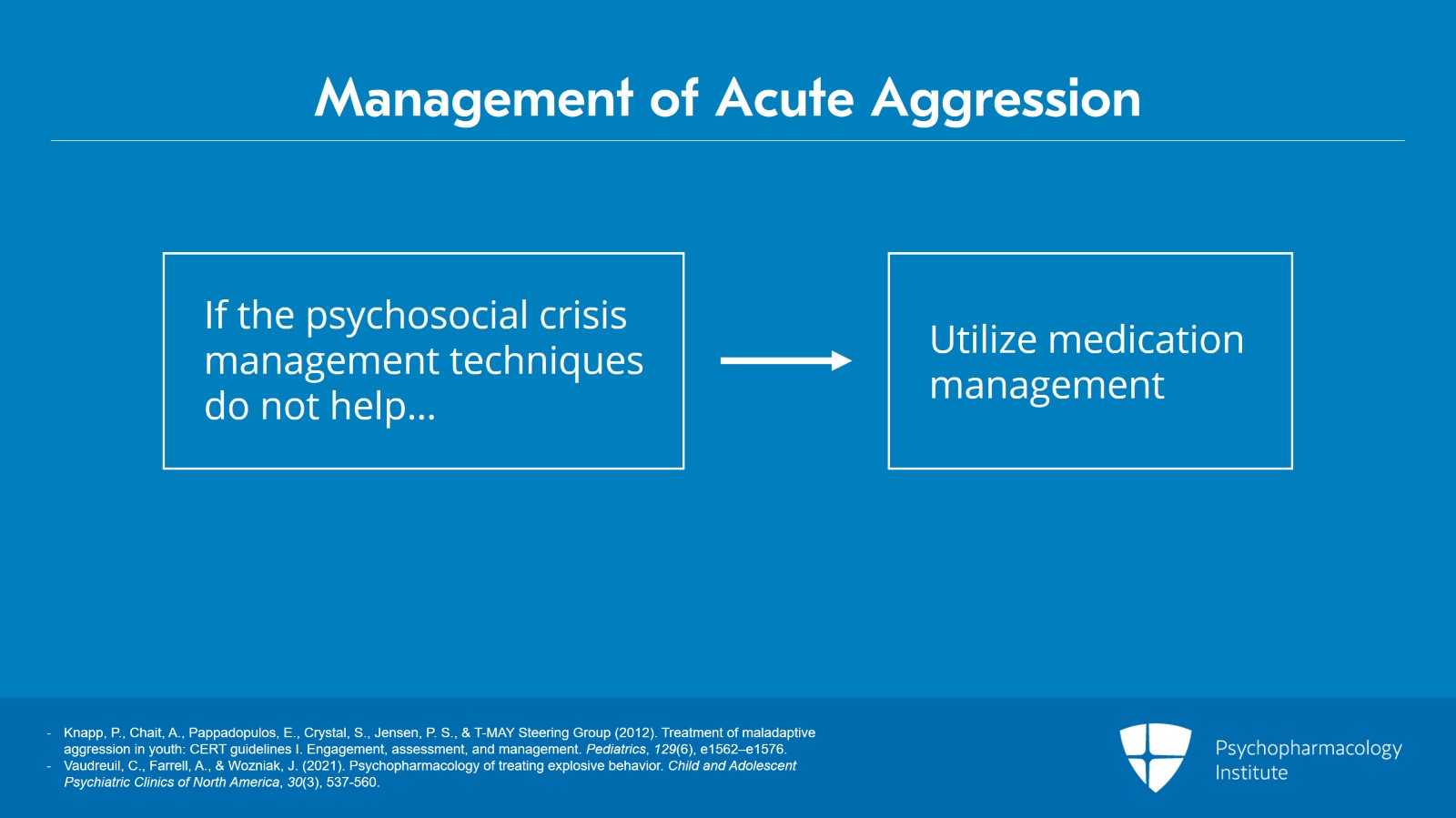
If the psychosocial crisis management techniques don’t seem to be helping or the child is not willing to engage in that behavior, then the next step, if necessary, is to utilize medication management.
References:
- Knapp, P., Chait, A., Pappadopulos, E., Crystal, S., Jensen, P. S., & T-MAY Steering Group (2012). Treatment of maladaptive aggression in youth: CERT guidelines I. Engagement, assessment, and management. Pediatrics, 129(6), e1562–e1576.
- Vaudreuil, C., Farrell, A., & Wozniak, J. (2021). Psychopharmacology of treating explosive behavior. Child and Adolescent Psychiatric Clinics of North America, 30(3), 537-560.
Slide 10 of 25
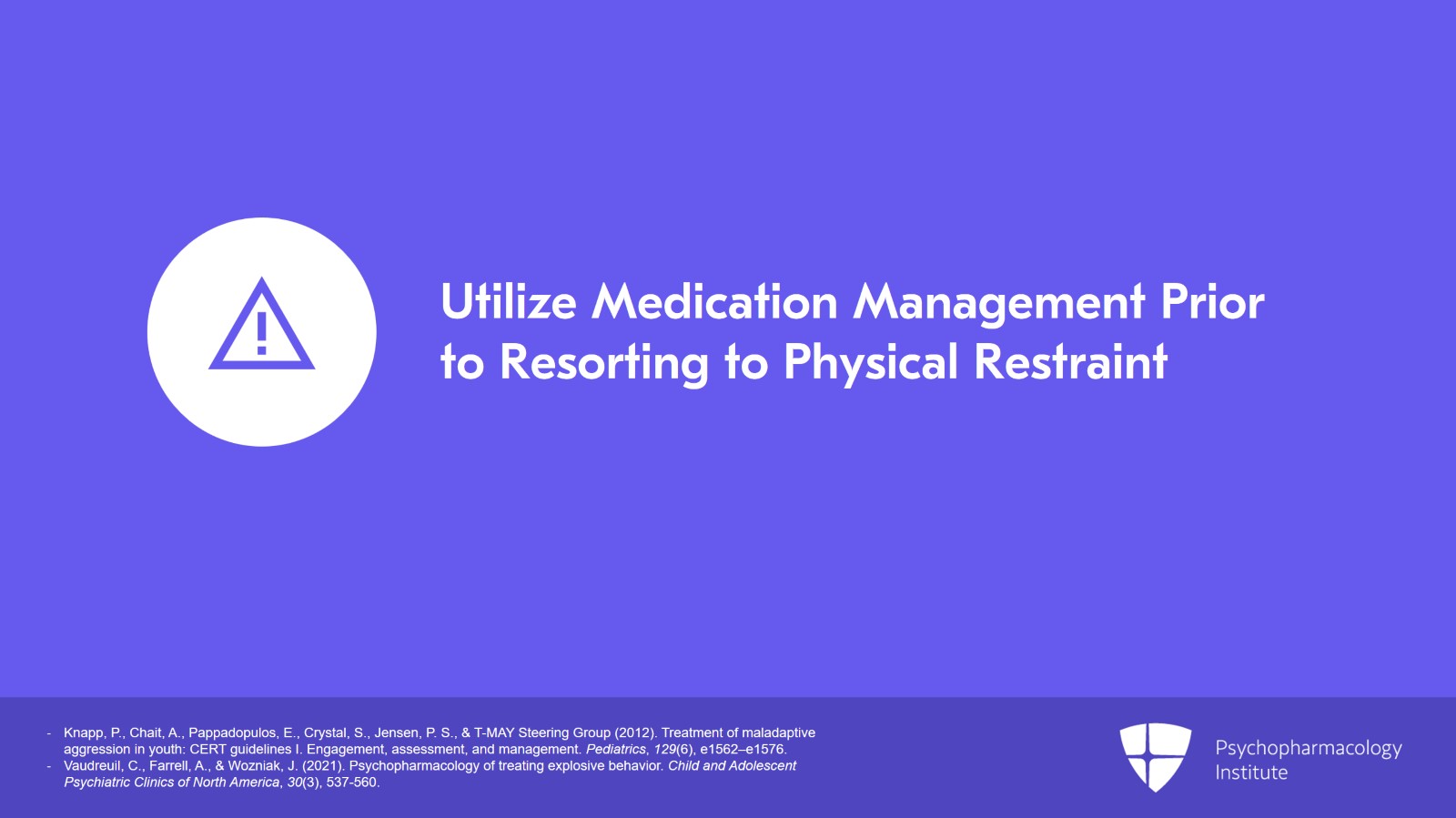
And you’ll always want to try to utilize medication management prior to resorting to any kind of physical or mechanical restraint.
References:
- Knapp, P., Chait, A., Pappadopulos, E., Crystal, S., Jensen, P. S., & T-MAY Steering Group (2012). Treatment of maladaptive aggression in youth: CERT guidelines I. Engagement, assessment, and management. Pediatrics, 129(6), e1562–e1576.
- Vaudreuil, C., Farrell, A., & Wozniak, J. (2021). Psychopharmacology of treating explosive behavior. Child and Adolescent Psychiatric Clinics of North America, 30(3), 537-560.
Free Files
Download PDF and other files
Success!
Check your inbox, we sent you all the materials there.
Slide 11 of 25
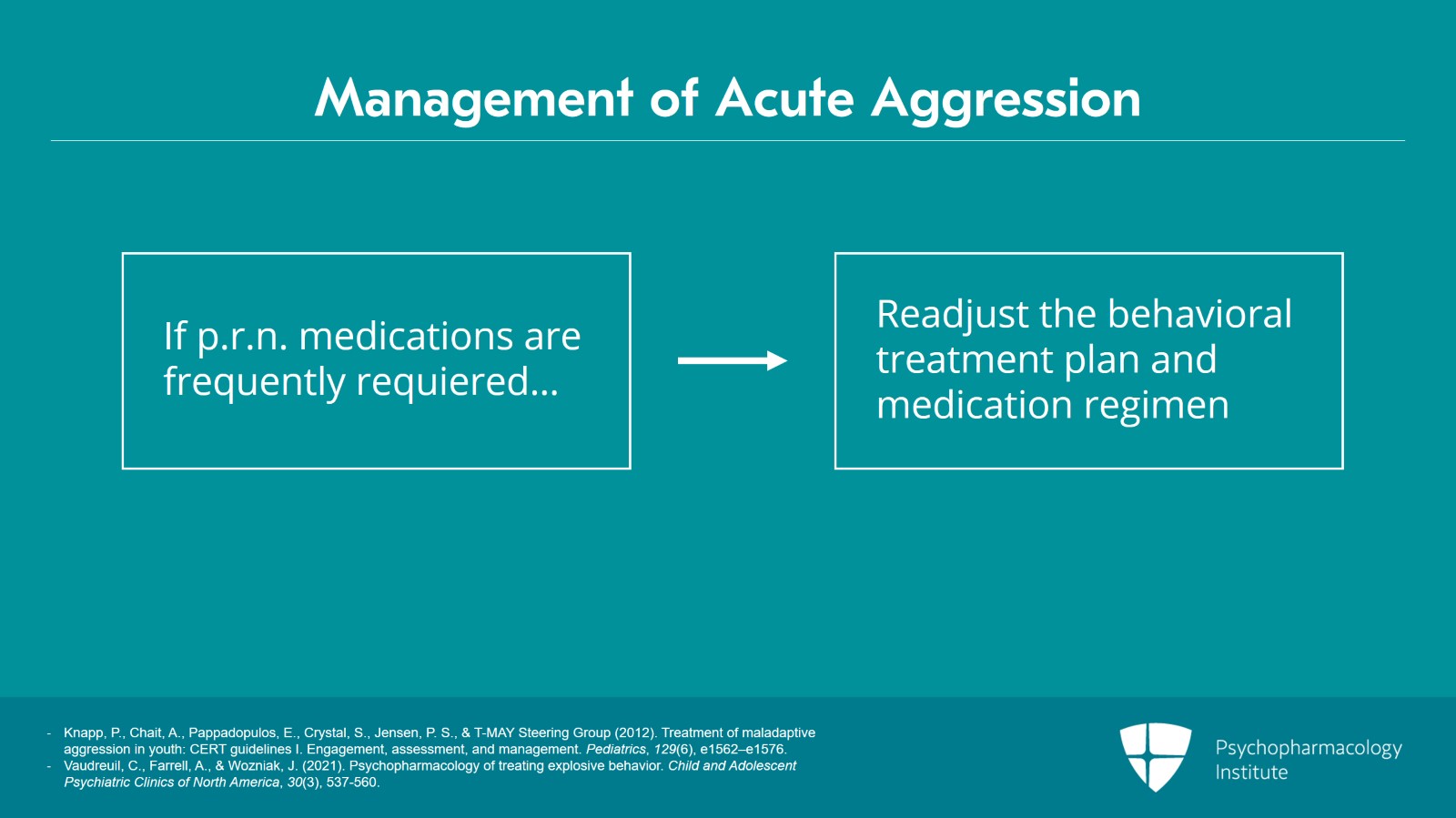
If as-needed medications are frequently required because the acute aggression is happening recurrently, then it may be necessary to readjust the behavioral treatment plan and medication regimen to try to minimize the number of acute aggressive episodes that are occurring on a regular basis.
References:
- Knapp, P., Chait, A., Pappadopulos, E., Crystal, S., Jensen, P. S., & T-MAY Steering Group (2012). Treatment of maladaptive aggression in youth: CERT guidelines I. Engagement, assessment, and management. Pediatrics, 129(6), e1562–e1576.
- Vaudreuil, C., Farrell, A., & Wozniak, J. (2021). Psychopharmacology of treating explosive behavior. Child and Adolescent Psychiatric Clinics of North America, 30(3), 537-560.
Slide 12 of 25
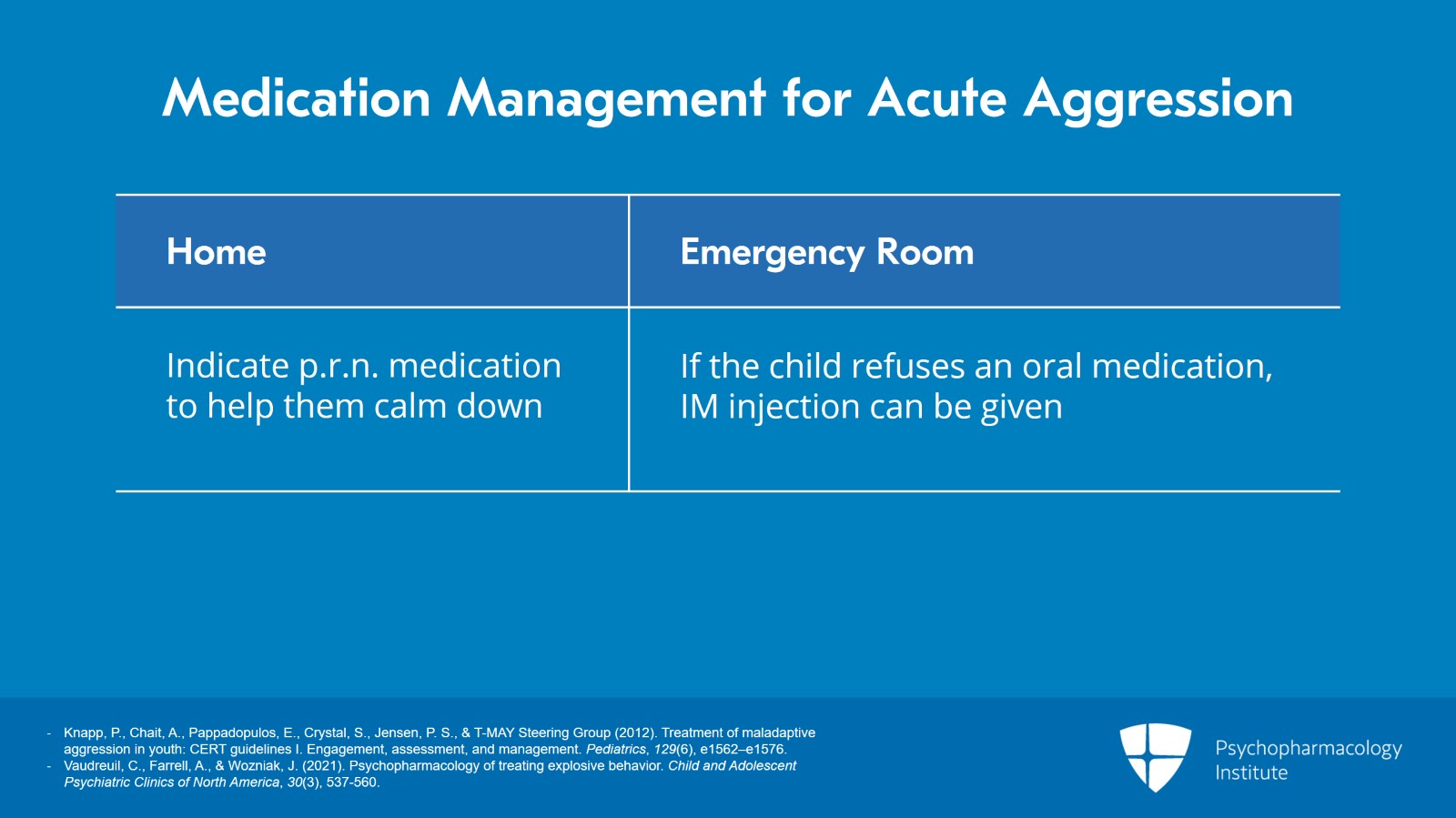
Now, I want to talk a little bit more in depth about medication management for acute aggression. So at home, if possible, sometimes it is ideal to have an as-needed oral medication that the child can take, that the parent can give them to help them calm down.
In the emergency room, sometimes if the child refuses an as-needed oral medication an intramuscular injection can be given. However, the use of intramuscular medications is only indicated if absolutely necessary due to safety concerns.
References:
- Knapp, P., Chait, A., Pappadopulos, E., Crystal, S., Jensen, P. S., & T-MAY Steering Group (2012). Treatment of maladaptive aggression in youth: CERT guidelines I. Engagement, assessment, and management. Pediatrics, 129(6), e1562–e1576.
- Vaudreuil, C., Farrell, A., & Wozniak, J. (2021). Psychopharmacology of treating explosive behavior. Child and Adolescent Psychiatric Clinics of North America, 30(3), 537-560.
Free Files
Download PDF and other files
Success!
Check your inbox, we sent you all the materials there.
Slide 13 of 25
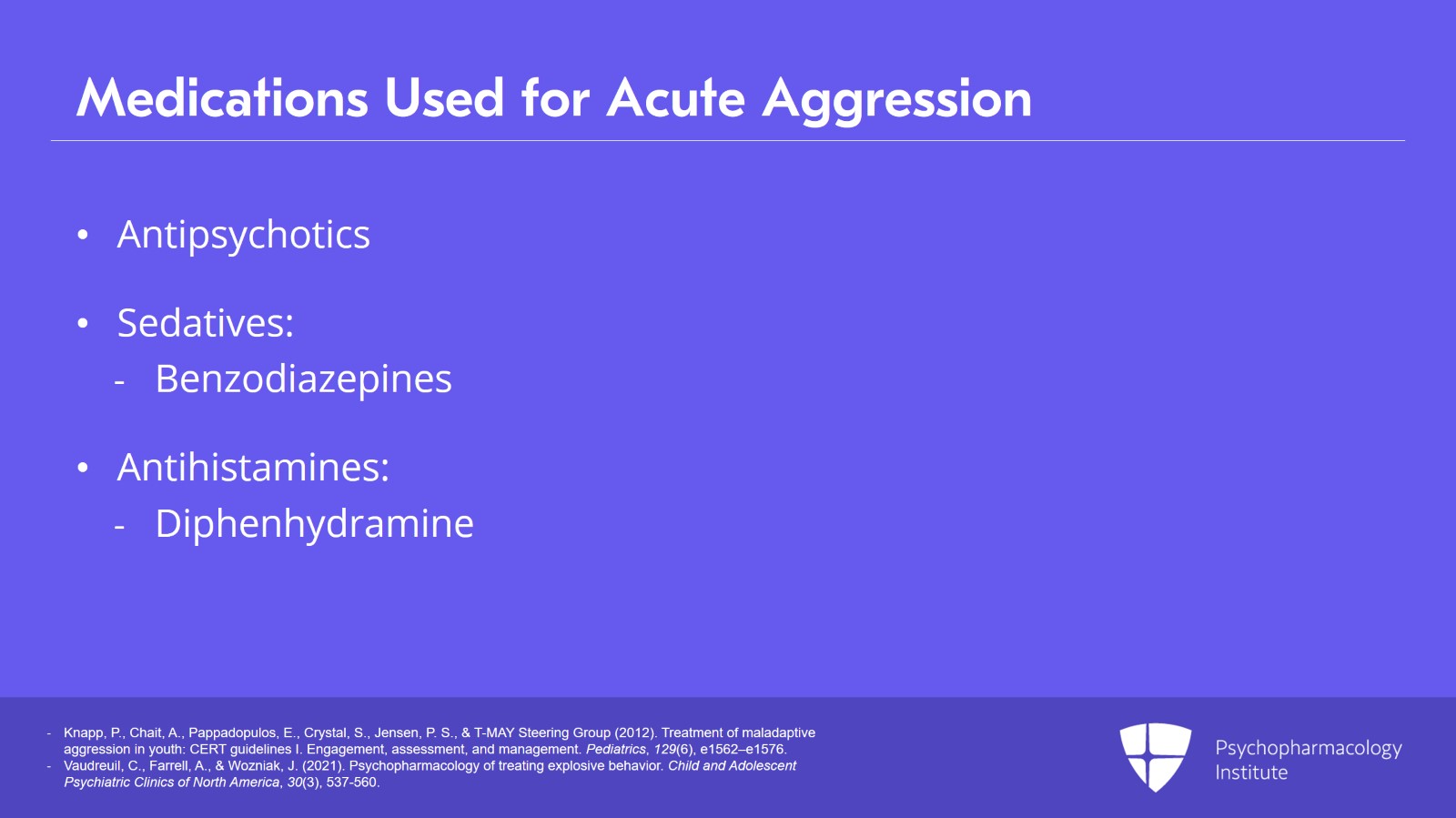
Medications typically used to manage acute aggression include antipsychotics alone, sedatives alone, antihistamines alone, or antipsychotics in combination with sedatives or antihistamines.
And when I say sedatives and antihistamines, what I’m talking about most commonly, for sedatives typically what’s used are benzodiazepines and then antihistamines, probably most commonly used is diphenhydramine.
References:
- Knapp, P., Chait, A., Pappadopulos, E., Crystal, S., Jensen, P. S., & T-MAY Steering Group (2012). Treatment of maladaptive aggression in youth: CERT guidelines I. Engagement, assessment, and management. Pediatrics, 129(6), e1562–e1576.
- Vaudreuil, C., Farrell, A., & Wozniak, J. (2021). Psychopharmacology of treating explosive behavior. Child and Adolescent Psychiatric Clinics of North America, 30(3), 537-560.
Slide 14 of 25
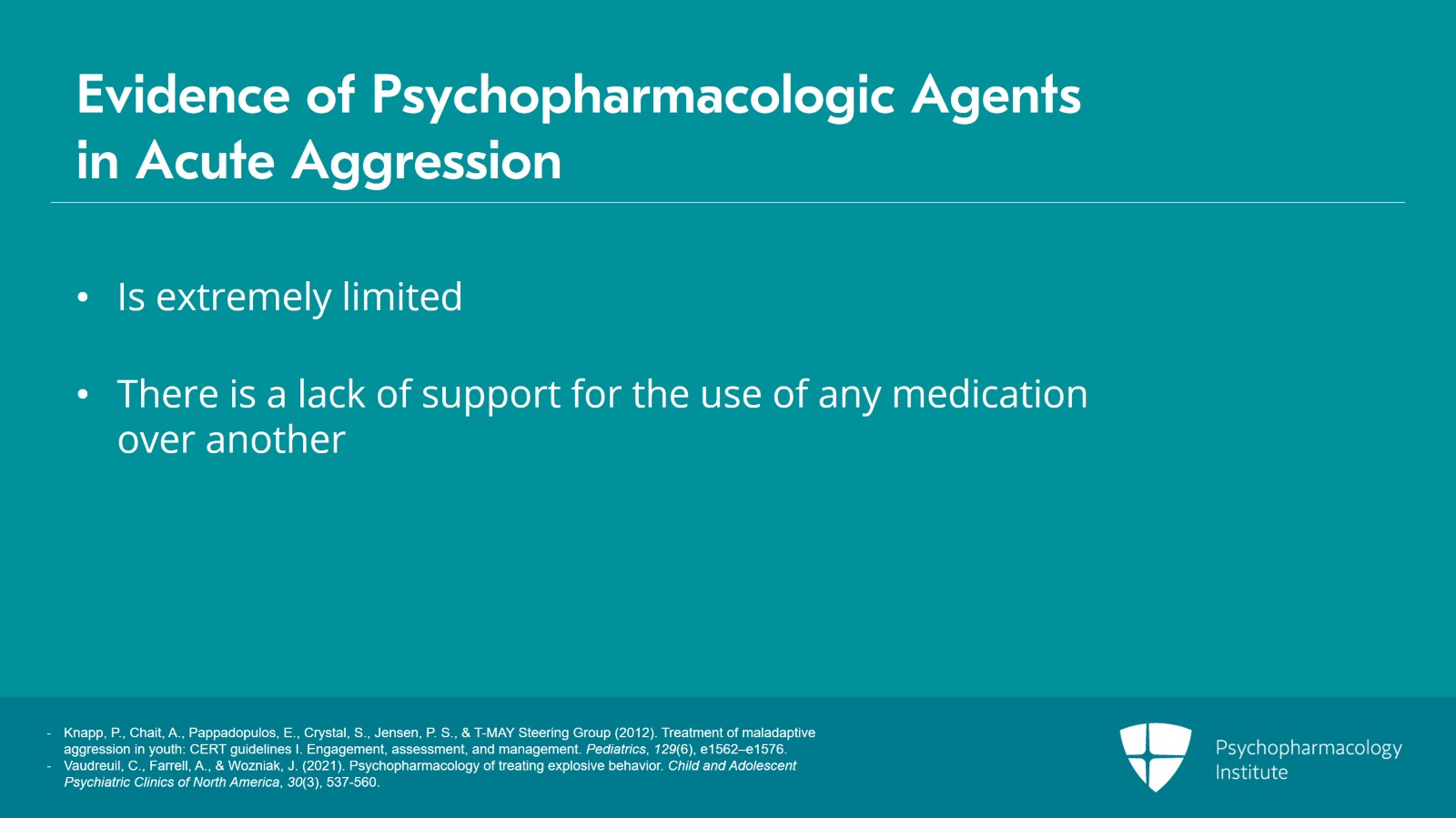
The evidence supporting the use of any psychopharmacological agents in acute aggression in children and adolescents is actually extremely limited.
However, there is not evidence supporting the use of any particular form of medication over another in this situation.
References:
- Knapp, P., Chait, A., Pappadopulos, E., Crystal, S., Jensen, P. S., & T-MAY Steering Group (2012). Treatment of maladaptive aggression in youth: CERT guidelines I. Engagement, assessment, and management. Pediatrics, 129(6), e1562–e1576.
- Vaudreuil, C., Farrell, A., & Wozniak, J. (2021). Psychopharmacology of treating explosive behavior. Child and Adolescent Psychiatric Clinics of North America, 30(3), 537-560.
Free Files
Download PDF and other files
Success!
Check your inbox, we sent you all the materials there.
Slide 15 of 25
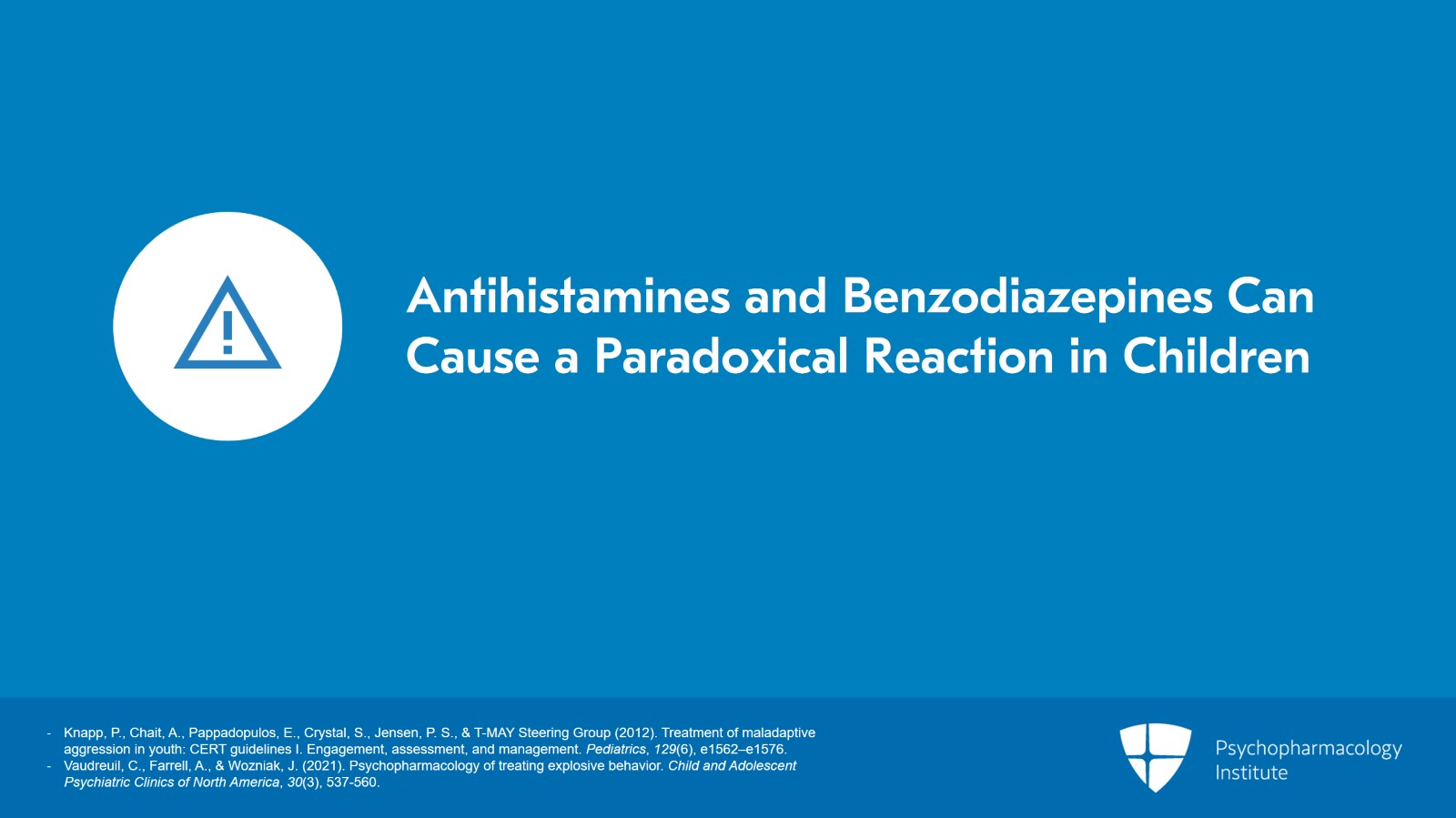
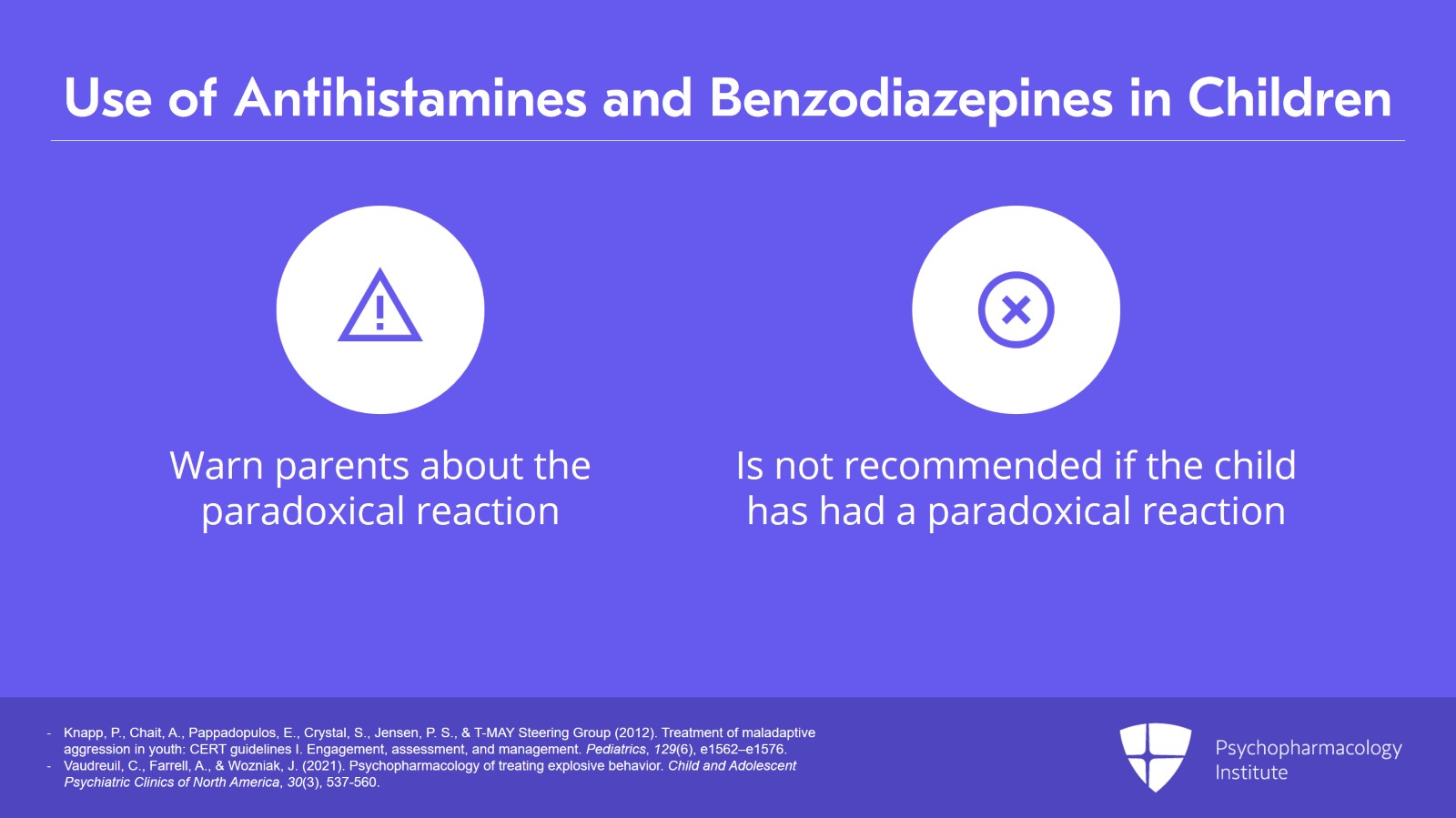
It is also important to remember that antihistamines and benzodiazepines can cause a paradoxical reaction in children, meaning some children become sedated as you would expect with the use of these medications but some children will become activated and more dysregulated when given benzodiazepines and antihistamines.
References:
- Knapp, P., Chait, A., Pappadopulos, E., Crystal, S., Jensen, P. S., & T-MAY Steering Group (2012). Treatment of maladaptive aggression in youth: CERT guidelines I. Engagement, assessment, and management. Pediatrics, 129(6), e1562–e1576.
- Vaudreuil, C., Farrell, A., & Wozniak, J. (2021). Psychopharmacology of treating explosive behavior. Child and Adolescent Psychiatric Clinics of North America, 30(3), 537-560.
Slide 16 of 25
So particularly if you’re thinking about giving a parent one of these medications or instructing a parent to use one of these medications at home, you always want to warn them about this possible reaction and do not recommend utilizing these medications if the child has had a paradoxical reaction to these medications in the past. In the emergency room, it’s also important to keep this in mind.
References:
- Knapp, P., Chait, A., Pappadopulos, E., Crystal, S., Jensen, P. S., & T-MAY Steering Group (2012). Treatment of maladaptive aggression in youth: CERT guidelines I. Engagement, assessment, and management. Pediatrics, 129(6), e1562–e1576.
- Vaudreuil, C., Farrell, A., & Wozniak, J. (2021). Psychopharmacology of treating explosive behavior. Child and Adolescent Psychiatric Clinics of North America, 30(3), 537-560.
Free Files
Download PDF and other files
Success!
Check your inbox, we sent you all the materials there.
Slide 17 of 25
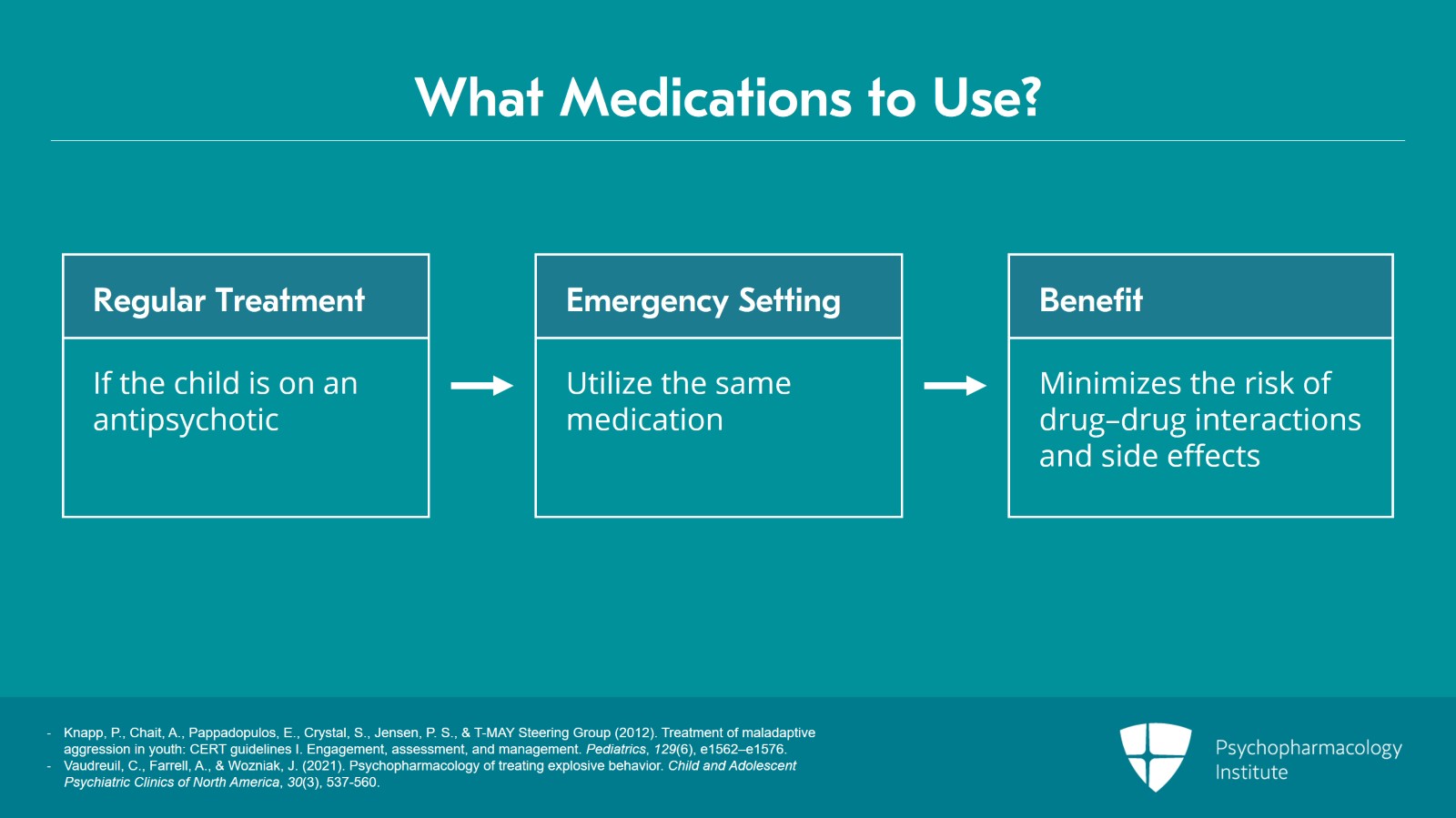
So what medications to use. If the child is already on a standing antipsychotic, it’s always best to utilize the same medication in the emergency setting in order to minimize the risk of drug-drug interactions or increased risk of side effects.
So for example, if you have a patient who’s already on risperidone, then you may want to utilize a very low dose of risperidone as an as-needed medication when the child is exhibiting the acute aggression.
References:
- Knapp, P., Chait, A., Pappadopulos, E., Crystal, S., Jensen, P. S., & T-MAY Steering Group (2012). Treatment of maladaptive aggression in youth: CERT guidelines I. Engagement, assessment, and management. Pediatrics, 129(6), e1562–e1576.
- Vaudreuil, C., Farrell, A., & Wozniak, J. (2021). Psychopharmacology of treating explosive behavior. Child and Adolescent Psychiatric Clinics of North America, 30(3), 537-560.
Slide 18 of 25
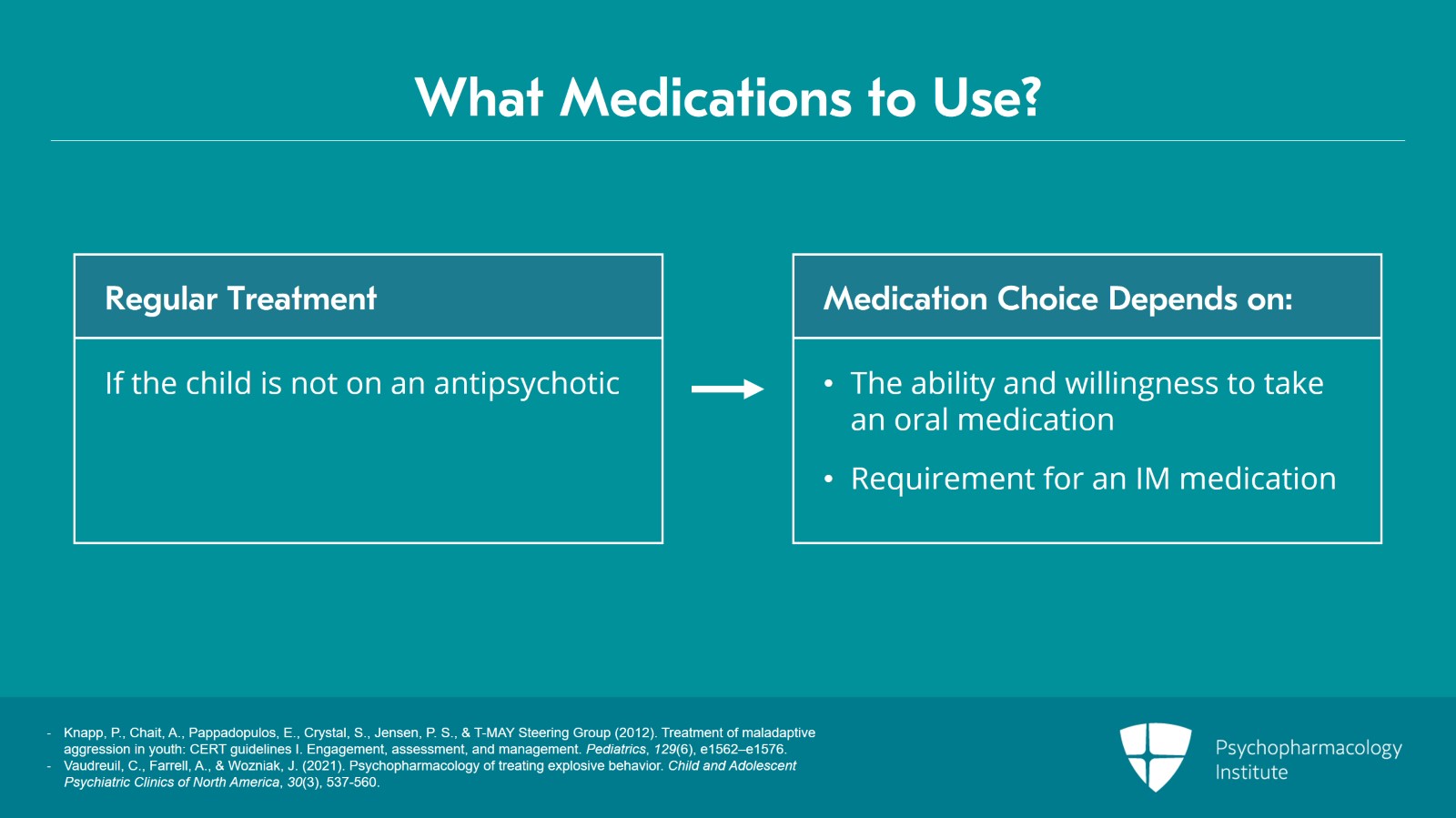
If the child is not already on an antipsychotic, the medication choice may depend upon whether the patient is able and willing to take an oral medication which again is the preferred route of administration or whether the child will require a medication administered intramuscularly. Again, intramuscular injection should only be given in emergency situations.
References:
- Knapp, P., Chait, A., Pappadopulos, E., Crystal, S., Jensen, P. S., & T-MAY Steering Group (2012). Treatment of maladaptive aggression in youth: CERT guidelines I. Engagement, assessment, and management. Pediatrics, 129(6), e1562–e1576.
- Vaudreuil, C., Farrell, A., & Wozniak, J. (2021). Psychopharmacology of treating explosive behavior. Child and Adolescent Psychiatric Clinics of North America, 30(3), 537-560.
Free Files
Download PDF and other files
Success!
Check your inbox, we sent you all the materials there.
Slide 19 of 25
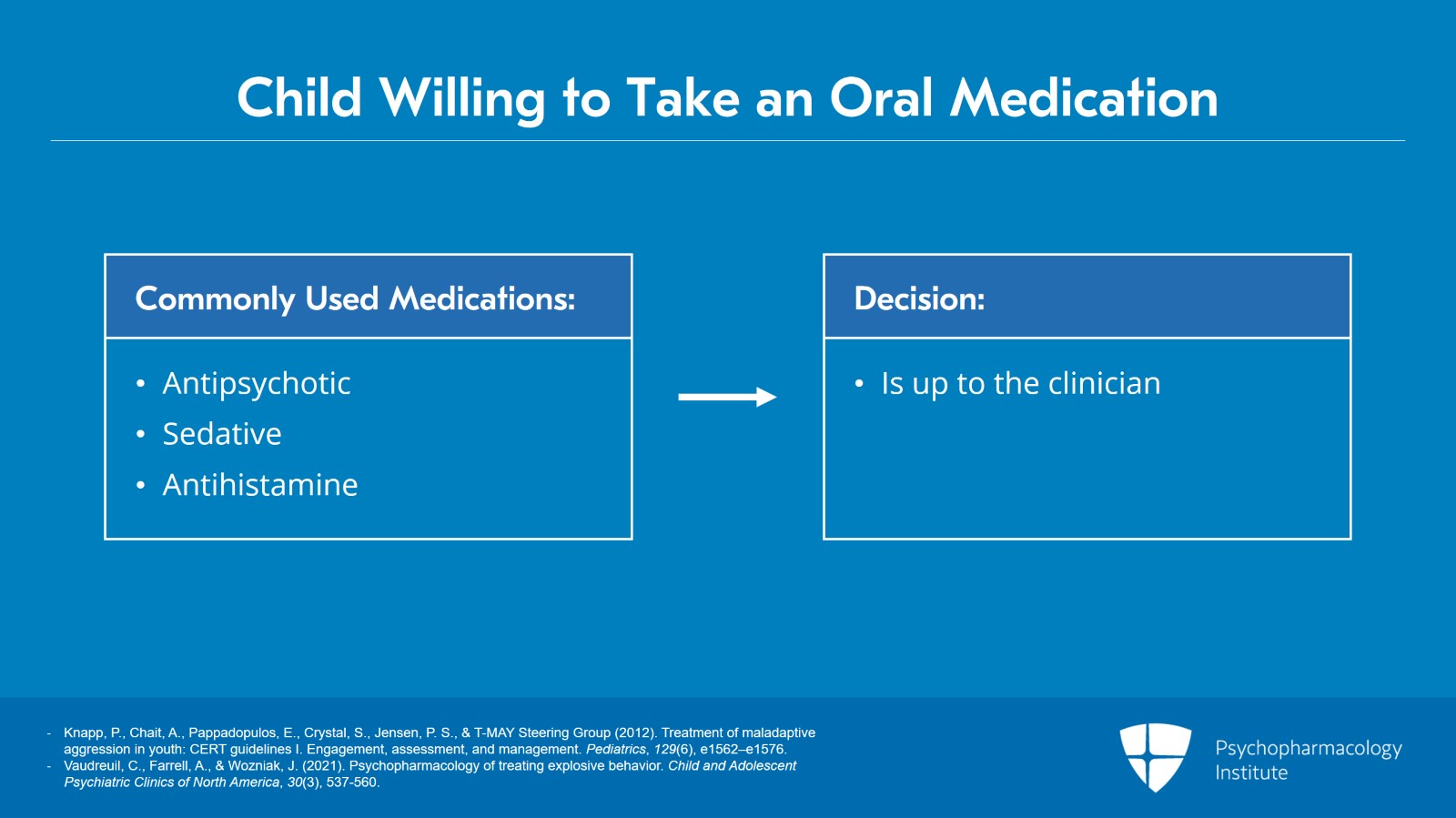
If a child is willing to take an oral medication, again, an antipsychotic, sedative, or antihistamine are the most commonly utilized medications for acute aggression.
And the specific medication used really can be up to the clinician and what they’re most comfortable with because again there isn’t a lot of evidence supporting the use of any particular form of medication over another in this situation.
References:
- Knapp, P., Chait, A., Pappadopulos, E., Crystal, S., Jensen, P. S., & T-MAY Steering Group (2012). Treatment of maladaptive aggression in youth: CERT guidelines I. Engagement, assessment, and management. Pediatrics, 129(6), e1562–e1576.
- Vaudreuil, C., Farrell, A., & Wozniak, J. (2021). Psychopharmacology of treating explosive behavior. Child and Adolescent Psychiatric Clinics of North America, 30(3), 537-560.
Slide 20 of 25
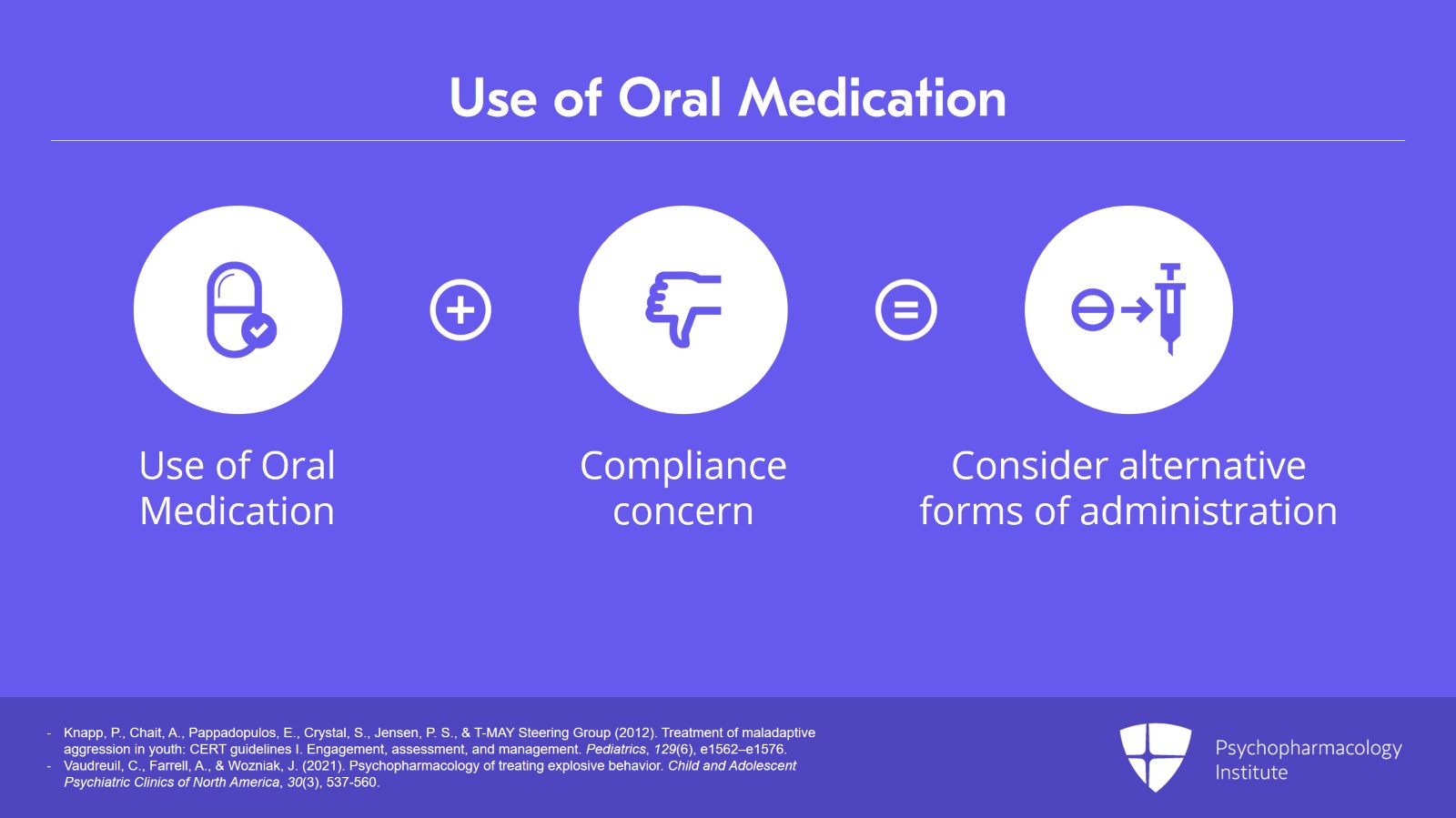
In a situation where an oral medication is desired, but compliance is a concern because the clinician or parent suspects that the child may cheek the medication or spit out the medication, first consider alternative forms of oral medications that prevent this behavior.
So, for example, dissolvable or liquid forms of oral medication can overcome any issues with child, the child chewing the medication or trying to spit it out.
So, risperidone, aripiprazole, and olanzapine all come in a dissolvable form and risperidone and aripiprazole also come in a liquid form.
References:
- Knapp, P., Chait, A., Pappadopulos, E., Crystal, S., Jensen, P. S., & T-MAY Steering Group (2012). Treatment of maladaptive aggression in youth: CERT guidelines I. Engagement, assessment, and management. Pediatrics, 129(6), e1562–e1576.
- Vaudreuil, C., Farrell, A., & Wozniak, J. (2021). Psychopharmacology of treating explosive behavior. Child and Adolescent Psychiatric Clinics of North America, 30(3), 537-560.
Free Files
Download PDF and other files
Success!
Check your inbox, we sent you all the materials there.
Slide 21 of 25
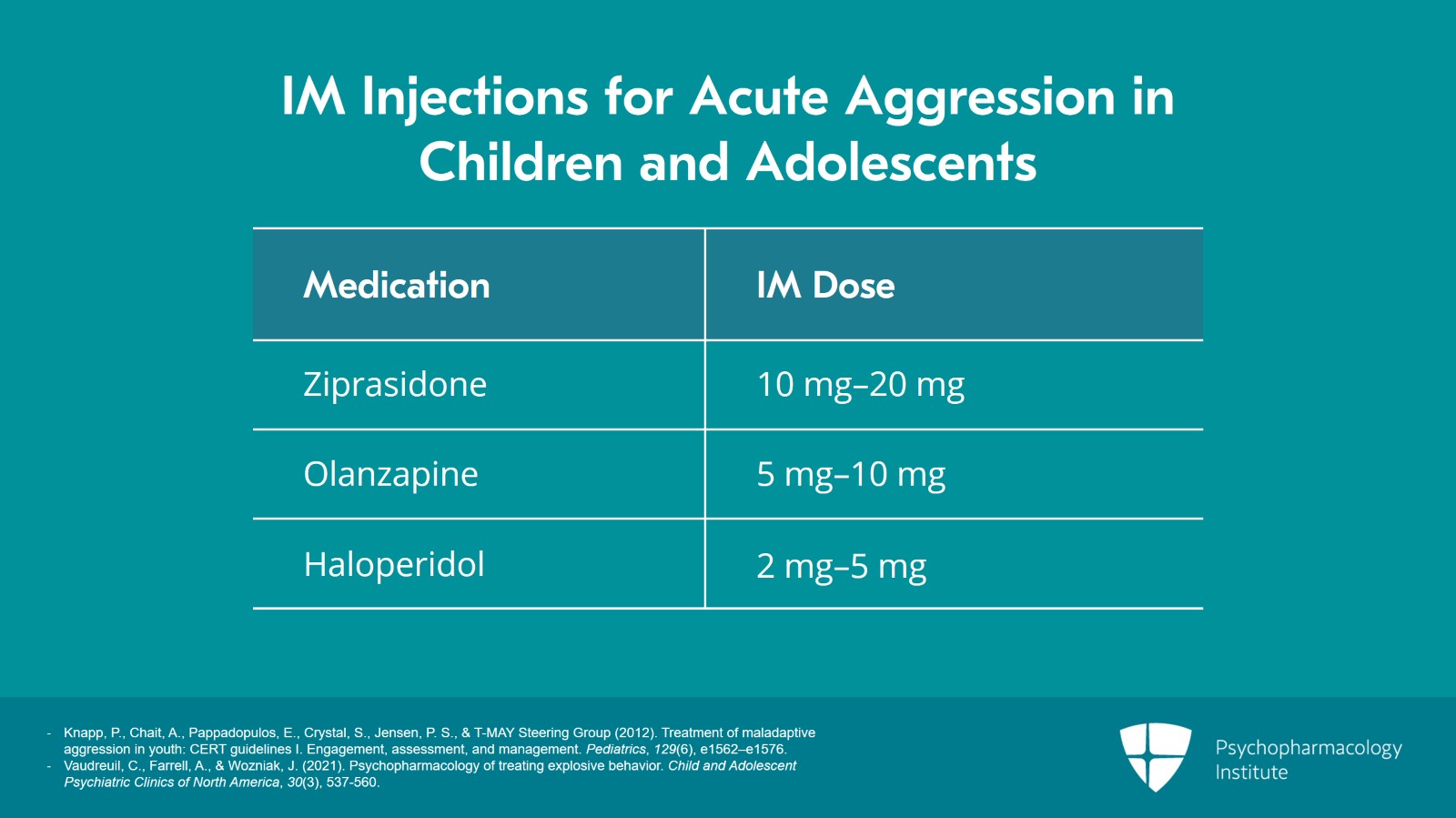
For intramuscular injections, olanzapine and ziprasidone are also available in short-acting intramuscular form. Again, there is really limited information for using these medications, but several studies have examined the use of intramuscular ziprasidone at a dose of 10 to 20 mg and one study has evaluated the use of intramuscular olanzapine at a dose of 5 to 10 mg for the treatment of acute aggression in children and adolescents.
And these studies concluded that the medications were effective with minimal side effects.
Intramuscular haloperidol can also be used for acute agitation at a dose of 2 to 5 mg.
References:
- Knapp, P., Chait, A., Pappadopulos, E., Crystal, S., Jensen, P. S., & T-MAY Steering Group (2012). Treatment of maladaptive aggression in youth: CERT guidelines I. Engagement, assessment, and management. Pediatrics, 129(6), e1562–e1576.
- Vaudreuil, C., Farrell, A., & Wozniak, J. (2021). Psychopharmacology of treating explosive behavior. Child and Adolescent Psychiatric Clinics of North America, 30(3), 537-560.
Slide 22 of 25
So the key points for this section are:
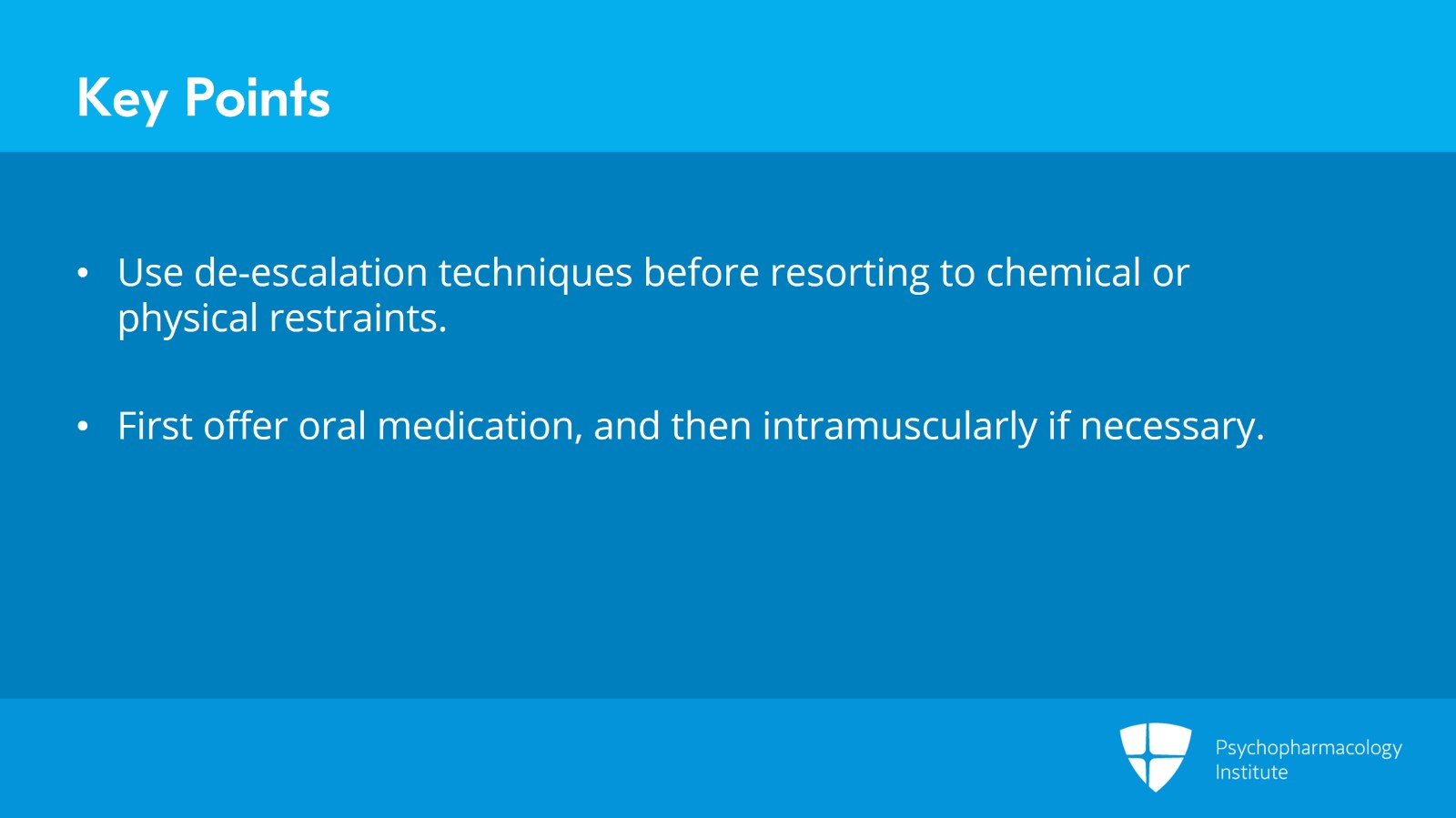
1. First, use de-escalation techniques before resorting to chemical or physical restraints.
2. Medication should first be offered by mouth and then intramuscularly only if necessary.
Free Files
Download PDF and other files
Success!
Check your inbox, we sent you all the materials there.
Slide 23 of 25
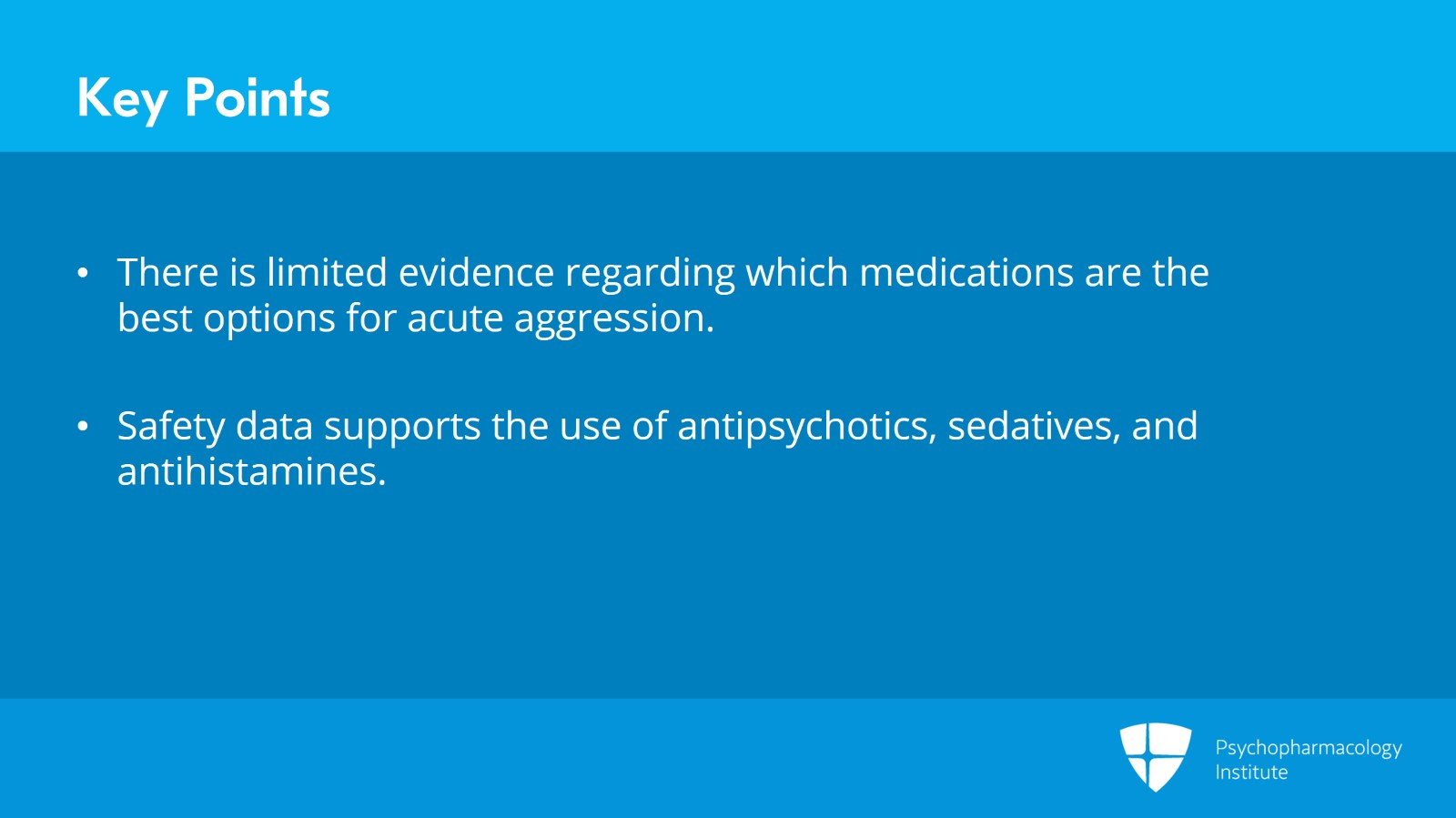
3. There is limited evidence regarding what medications are the best options for acute aggression but there is safety data supporting the use of antipsychotics, sedatives and antihistamines.
Slide 24 of 25
And children may be at risk of paradoxical reactions with the use of antihistamines and benzodiazepines.
Free Files
Download PDF and other files
Success!
Check your inbox, we sent you all the materials there.