Close Banner
Section Free  - Video Lectures

02. Differential Diagnosis of Explosive Behavior: Mood and Anxiety Disorders and Disruptive Behavior Disorders

Published on June 1, 2022 Expired on June 1, 2025

Carrie A. Vaudreuil, M.D.

Psychiatrist, Massachusetts General Hospital Instructor, Harvard Medical School - Massachusetts General Hospital

Key Points

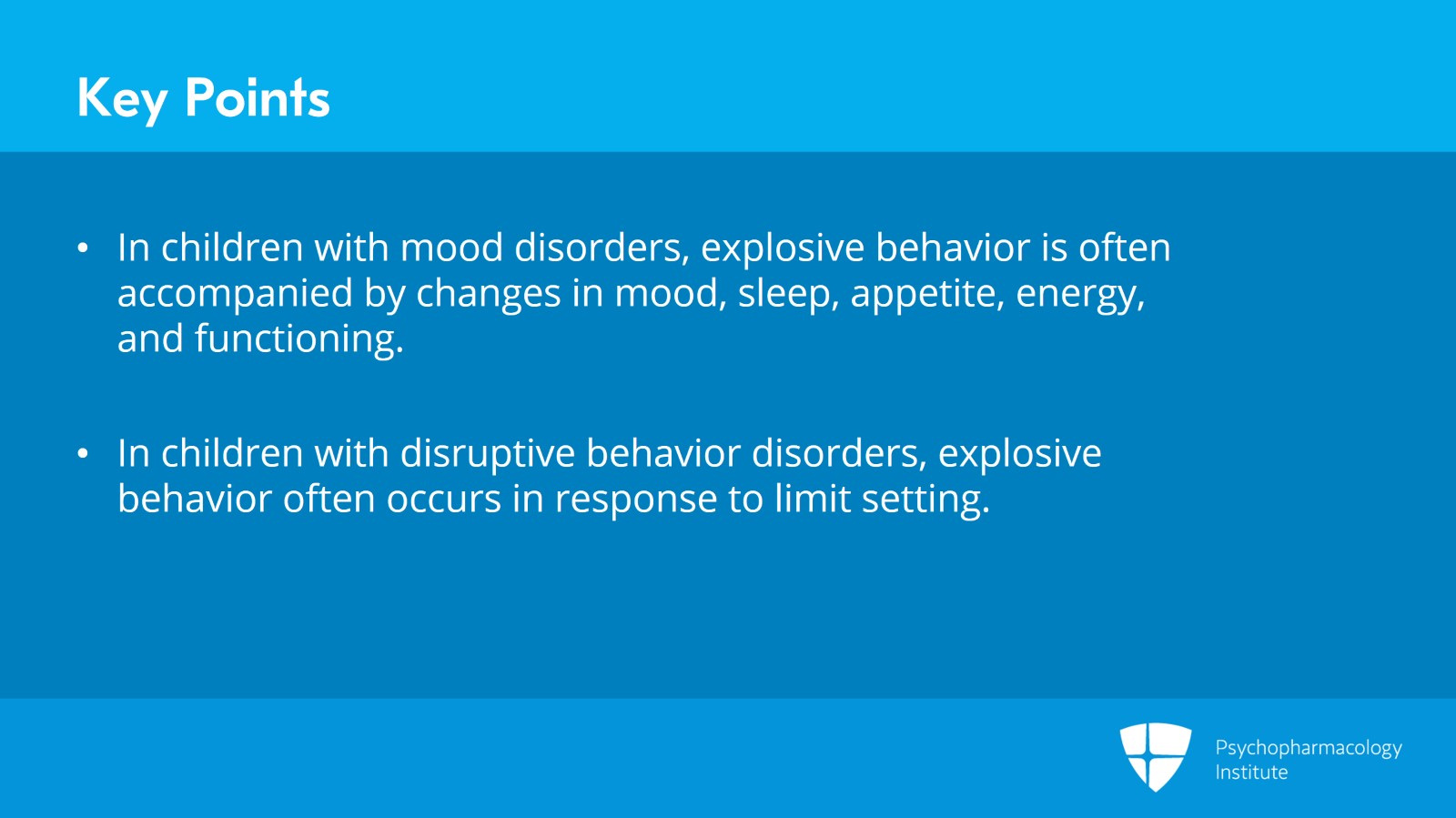
  • In children with mood disorders, explosive behavior is often accompanied by changes in mood, sleep, appetite, energy, and functioning.
  • In children with disruptive behavior disorders, explosive behavior often occurs in response to limit setting.

Free Downloads for Offline Access

  • Free Download Presentation File (PPTX)
  • Free Download Audio File (MP3)
  • Free Download Video (MP4)

Slides and Transcript

Slide 1 of 12

So in this next section, we’re going to discuss the differential diagnoses of explosive behavior and in particular we’re going to discuss the psychiatric conditions that can cause or contribute to explosive behavior. We’re then going to go more in depth into mood and anxiety disorders and disruptive behavior disorders and how explosive behavior may present in those conditions.

Slide 2 of 12

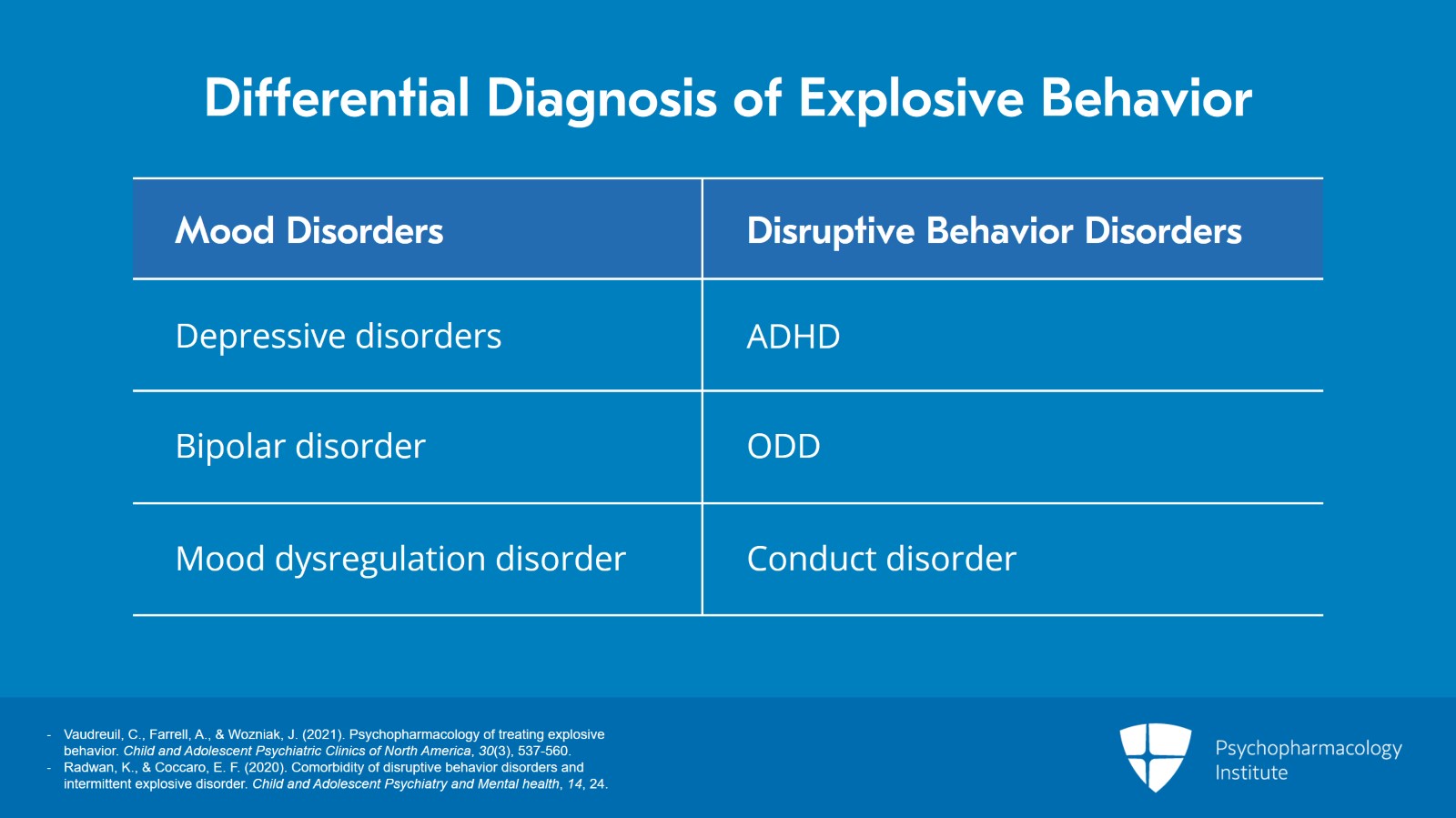
So the psychiatric differential diagnosis of explosive behavior is incredibly broad. First, you want to consider mood disorders including depressive disorders, bipolar disorder, disruptive mood dysregulation disorder. You want to consider all of the disruptive behavior disorders including ADHD, oppositional defiant disorder, and conduct disorder.
References:
  • Vaudreuil, C., Farrell, A., & Wozniak, J. (2021). Psychopharmacology of treating explosive behavior. Child and Adolescent Psychiatric Clinics of North America, 30(3), 537-560.
  • Radwan, K., & Coccaro, E. F. (2020). Comorbidity of disruptive behavior disorders and intermittent explosive disorder. Child and Adolescent Psychiatry and Mental health, 14, 24.
Free Files
Success!
Check your inbox, we sent you all the materials there.

Slide 3 of 12

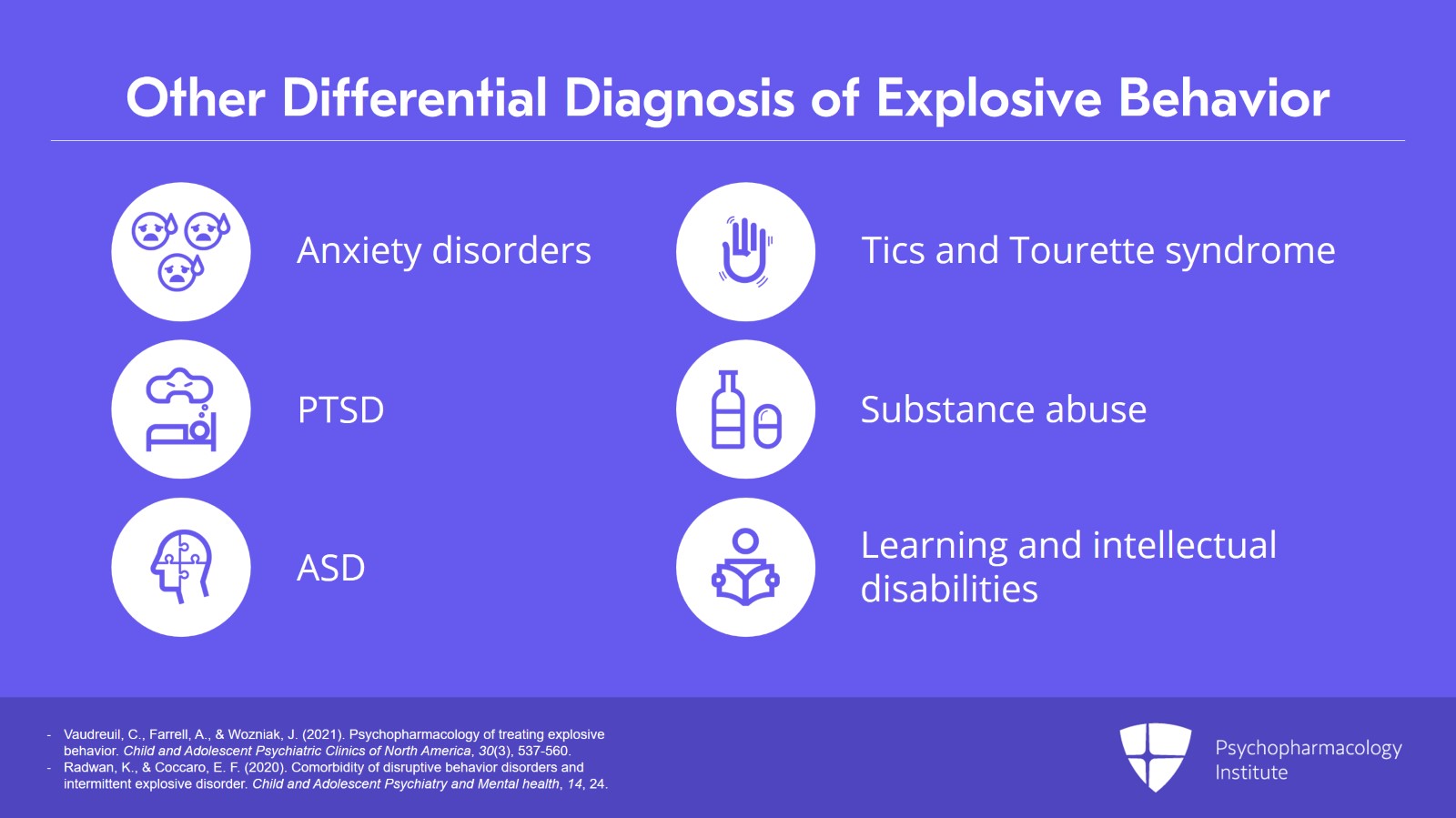
And then further, you need to consider anxiety disorders, PTSD, autism spectrum disorders, tics and Tourette syndrome, substance abuse, learning disabilities, and intellectual disability. So, there’s a large number of psychiatric conditions that can present with explosive behavior.
References:
  • Vaudreuil, C., Farrell, A., & Wozniak, J. (2021). Psychopharmacology of treating explosive behavior. Child and Adolescent Psychiatric Clinics of North America, 30(3), 537-560.
  • Radwan, K., & Coccaro, E. F. (2020). Comorbidity of disruptive behavior disorders and intermittent explosive disorder. Child and Adolescent Psychiatry and Mental health, 14, 24.

Slide 4 of 12

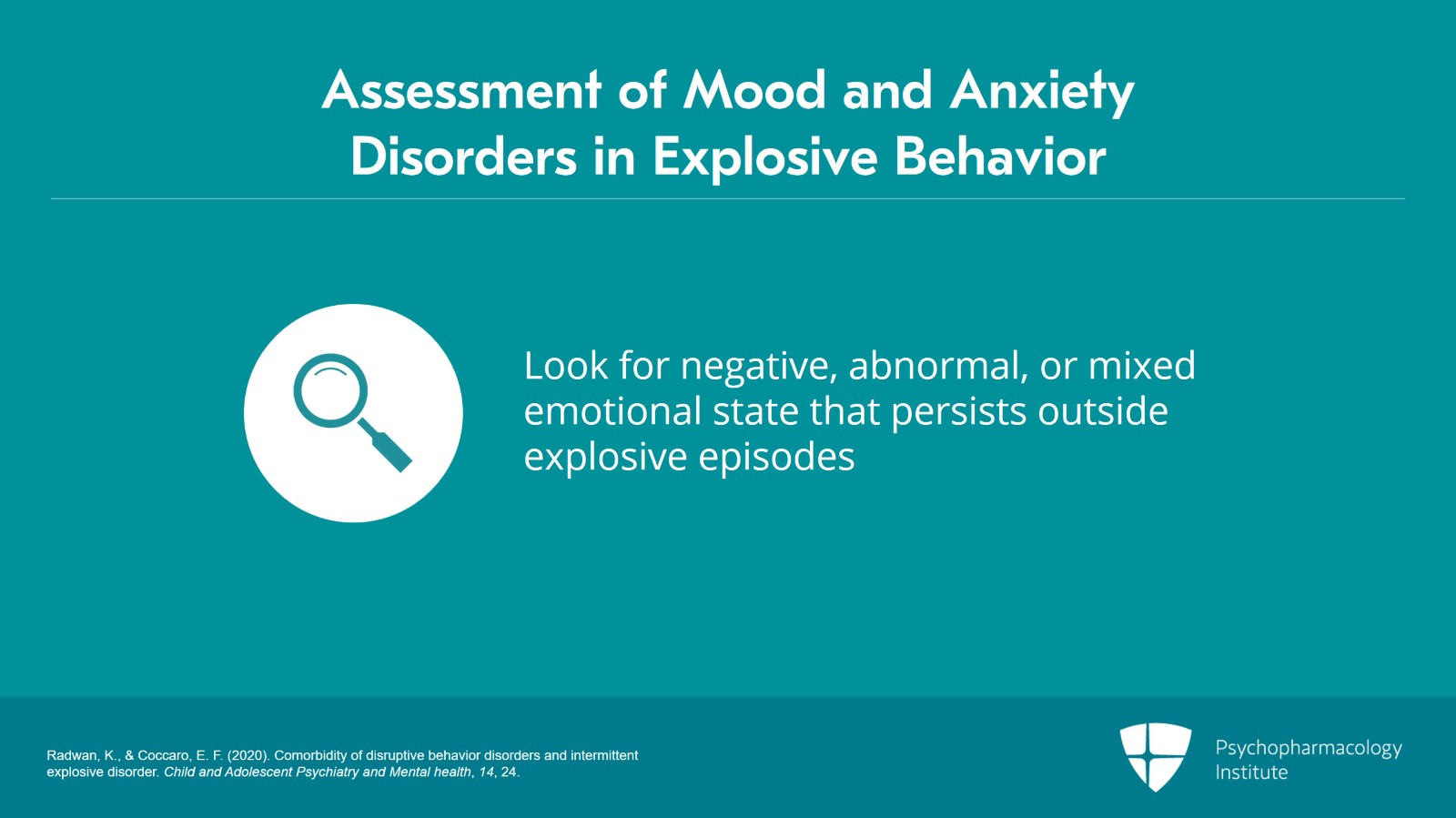
The first thing we’re going to do is discuss mood and anxiety disorders. So how might you evaluate for whether or not a child who’s having explosive behavior may have an accompanying mood or anxiety disorder? The first thing to look for is whether or not the child has a negative, abnormal, or mixed emotional state that persists outside of the explosive episodes.
References:
  • Radwan, K., & Coccaro, E. F. (2020). Comorbidity of disruptive behavior disorders and intermittent explosive disorder. Child and Adolescent Psychiatry and Mental health, 14, 24.
Free Files
Success!
Check your inbox, we sent you all the materials there.

Slide 5 of 12

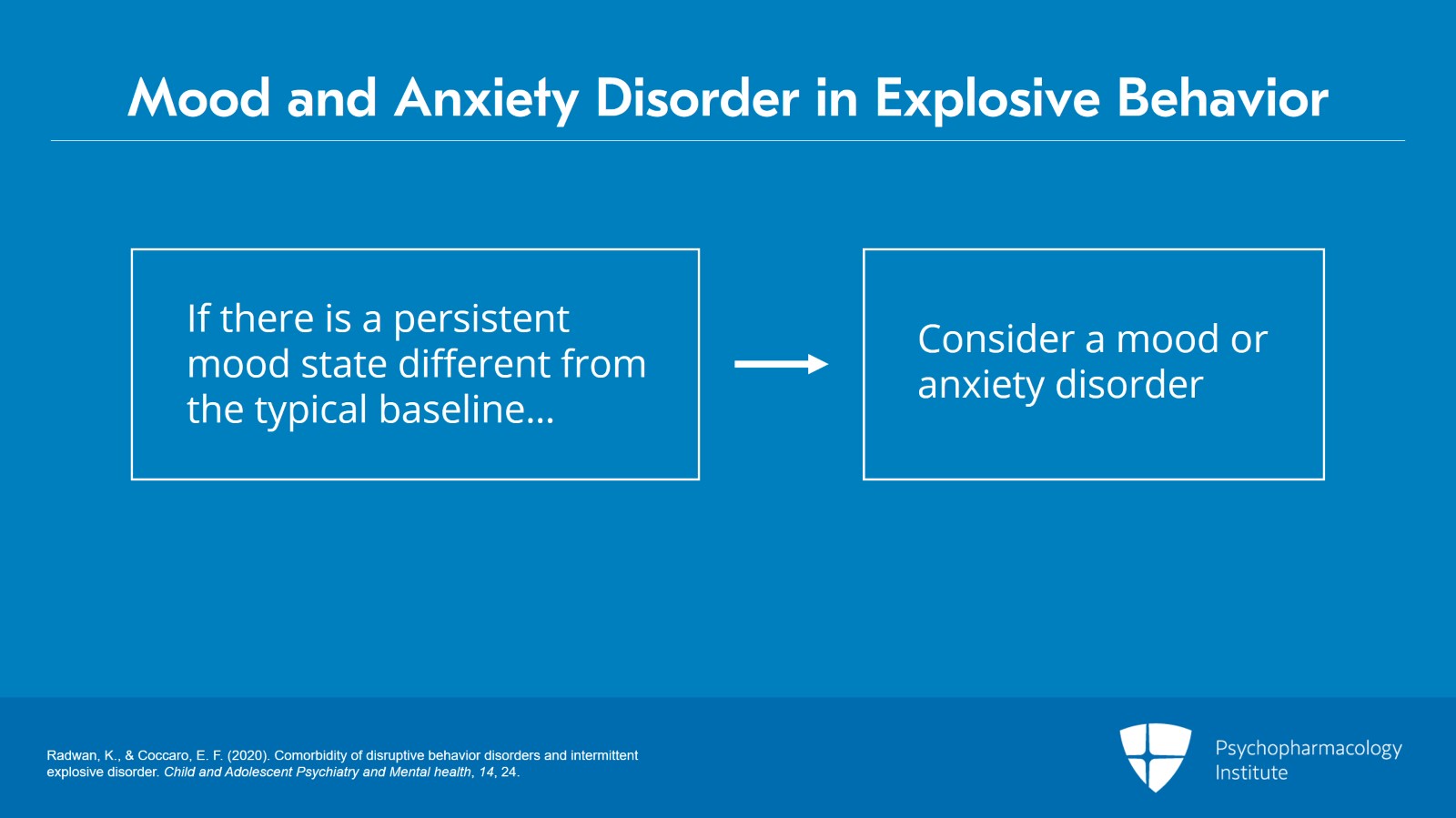
So for example, a child who has sad or depressed mood most of the time, a child who is irritable most of the time, a child who’s anxious most of the time, or a child who’s euphoric most of the time and this mood state seems different than their typical baseline and again this mood state persists outside of the explosive episodes. If a child is exhibiting this, then you may want to consider a mood or anxiety disorder.
References:
  • Radwan, K., & Coccaro, E. F. (2020). Comorbidity of disruptive behavior disorders and intermittent explosive disorder. Child and Adolescent Psychiatry and Mental health, 14, 24.

Slide 6 of 12

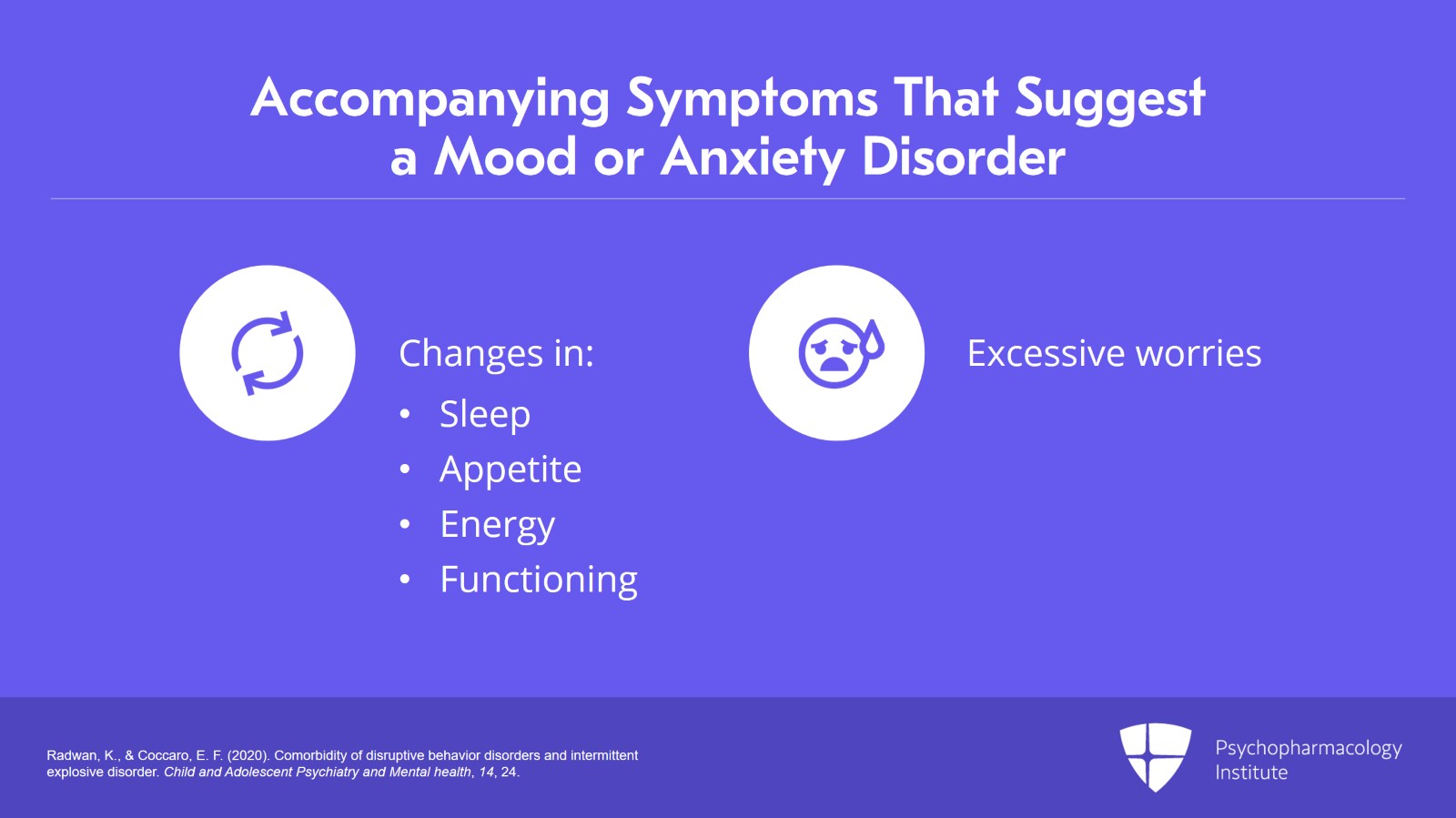
In addition, you would also look for any accompanying symptoms that might suggest a mood or anxiety disorder, for example, changes in sleep, changes in appetite, changes in energy, changes in functioning, and any excessive worries.
References:
  • Radwan, K., & Coccaro, E. F. (2020). Comorbidity of disruptive behavior disorders and intermittent explosive disorder. Child and Adolescent Psychiatry and Mental health, 14, 24.
Free Files
Success!
Check your inbox, we sent you all the materials there.

Slide 7 of 12

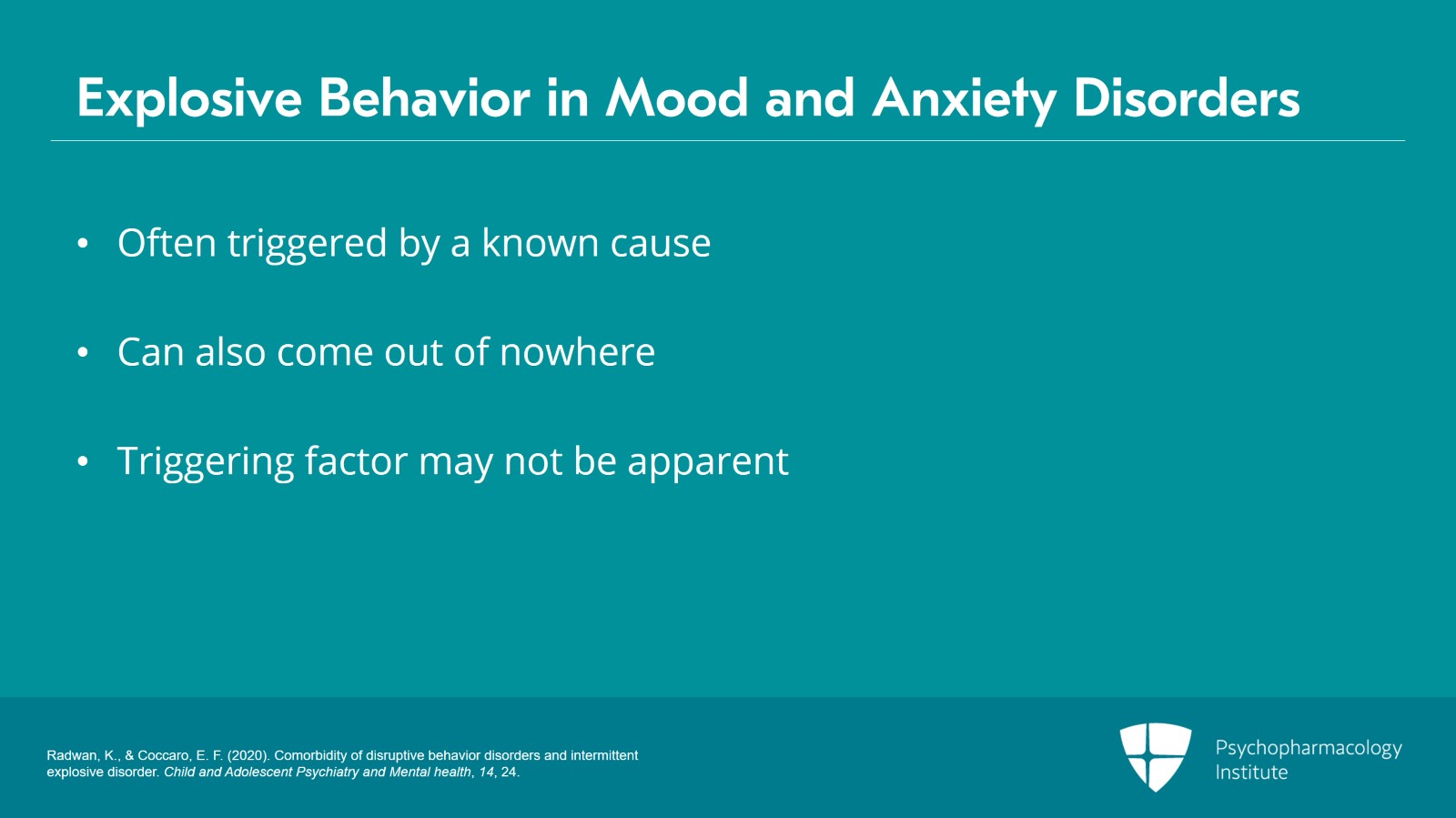
In mood and anxiety disorders, explosive behavior is often triggered by a known cause. That known cause may still not warrant the explosive behavior. So for example, the explosion may seem out of proportion to what the trigger was but for example, something that might normally cause a little bit of irritability may cause a big explosion. However, sometimes in mood and anxiety disorders, explosive behavior can also come out of nowhere or the triggering factor may not be readily apparent to the parents or adults or even the child in the situation.
References:
  • Radwan, K., & Coccaro, E. F. (2020). Comorbidity of disruptive behavior disorders and intermittent explosive disorder. Child and Adolescent Psychiatry and Mental health, 14, 24.

Slide 8 of 12

Next on the differential diagnoses for explosive behavior are the disruptive behavior disorders which I mentioned previously include ADHD, oppositional defiant disorder, and conduct disorder. Disruptive behavior disorders are often characterized by emotional impulsivity and deficient self-regulation. So, when I talk about emotional impulsivity, what I mean is that these children are often described as going from 0 to 100 very quickly when becoming dysregulated. Deficient self-regulation means that once the child is dysregulated they can’t calm themselves back down. So these characteristics have been well described in ADHD but can also be seen in oppositional defiant disorder and conduct disorder.
References:
  • Radwan, K., & Coccaro, E. F. (2020). Comorbidity of disruptive behavior disorders and intermittent explosive disorder. Child and Adolescent Psychiatry and Mental health, 14, 24.
Free Files
Success!
Check your inbox, we sent you all the materials there.

Slide 9 of 12

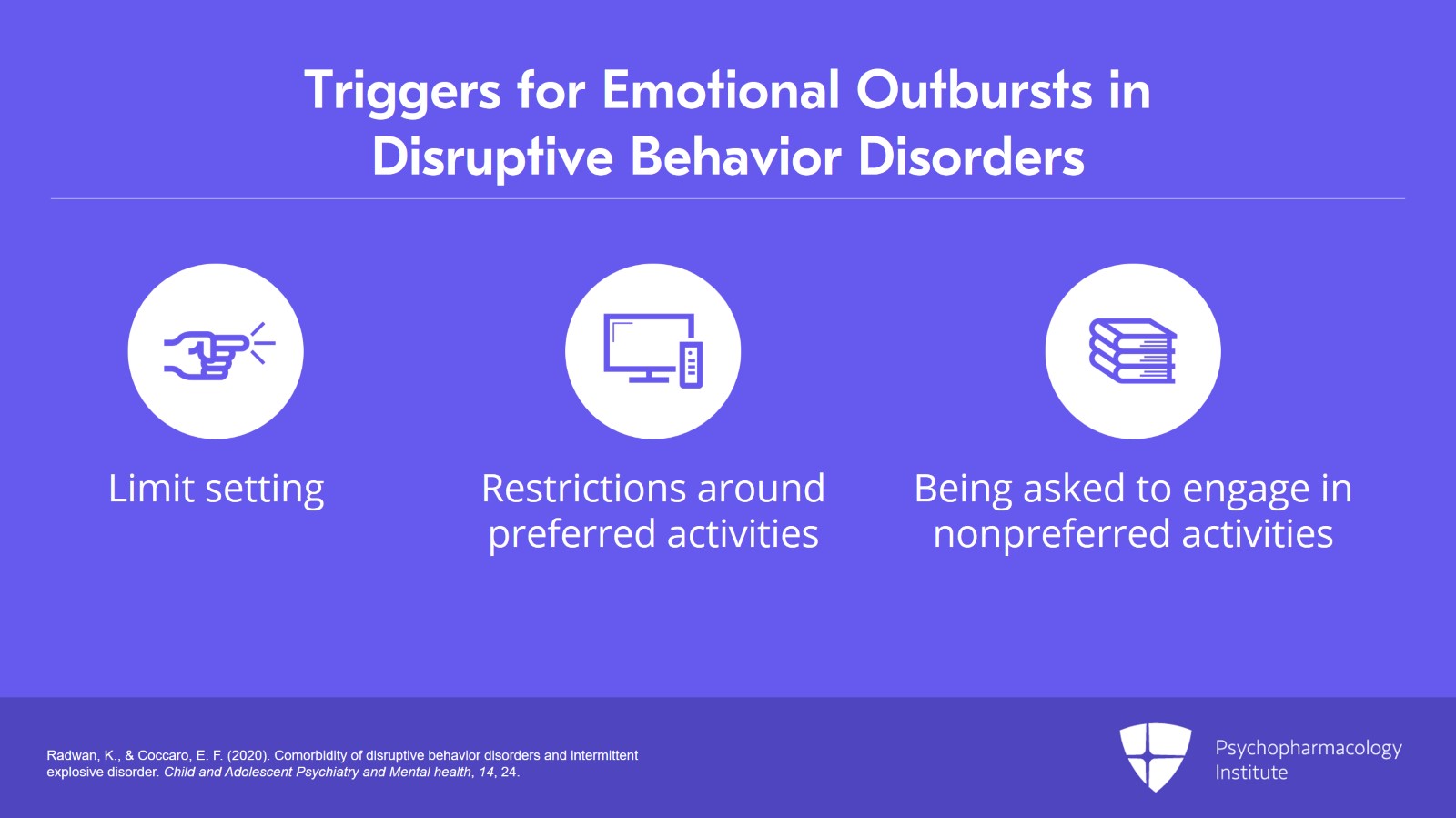
In disruptive behavior disorders, emotional outbursts are typically triggered by something, often limit setting, restrictions around preferred activities. So for example, a common one that we see in clinic are children being told that they can’t play video games anymore, they have to get off the video game. Or an outburst may be triggered by being asked to engage in a nonpreferred activity such as getting ready for school or doing homework rather than playing with friends, playing video games, playing outside, etc.
References:
  • Radwan, K., & Coccaro, E. F. (2020). Comorbidity of disruptive behavior disorders and intermittent explosive disorder. Child and Adolescent Psychiatry and Mental health, 14, 24.

Slide 10 of 12

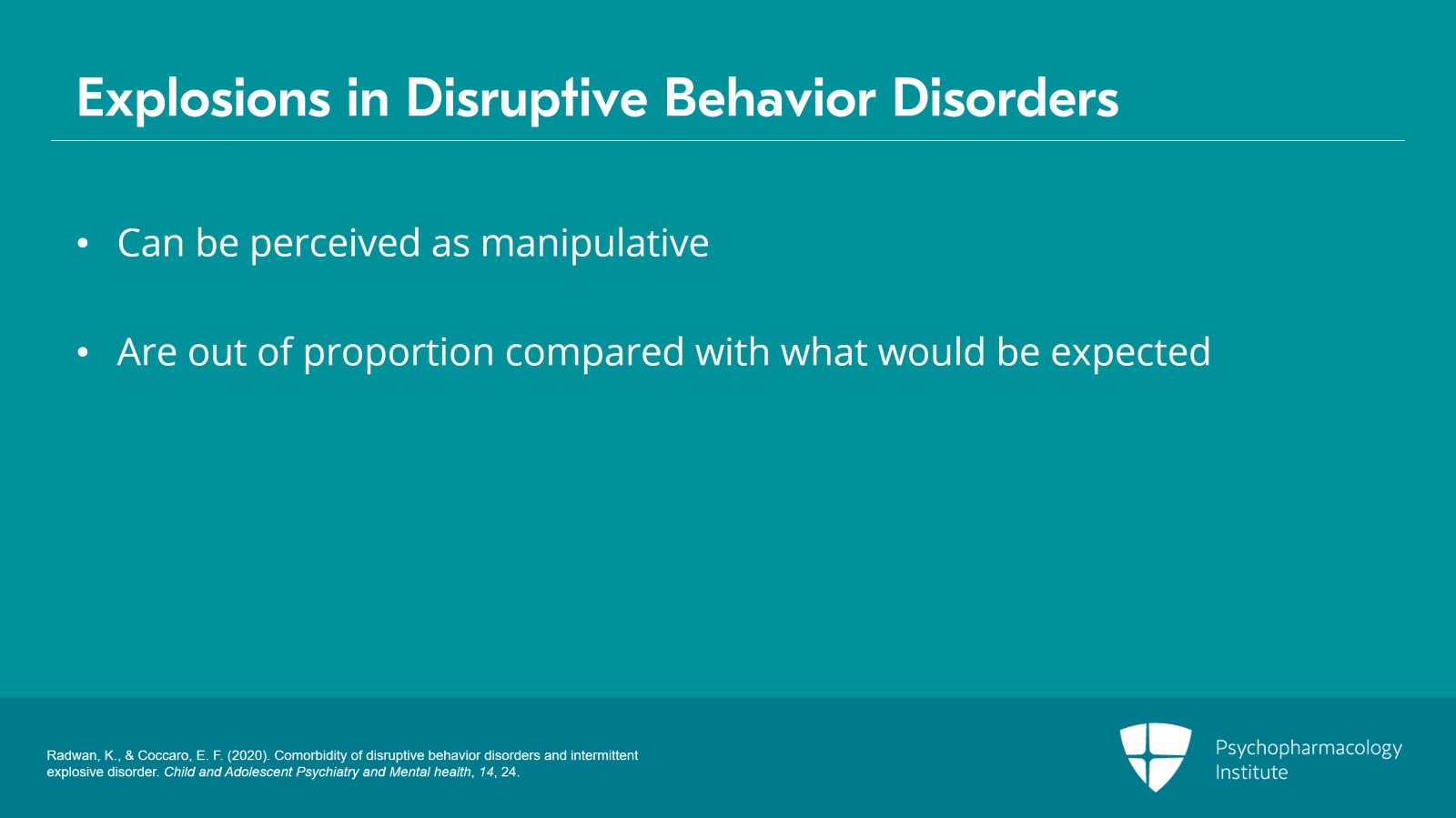
In some scenarios, the explosions can be perceived by parents and caregivers as manipulative or that they’re used for the child to get something that they want or need. So for example, when a child is being told to do something they don’t want to do or being asked to stop doing something that they enjoy doing and the child has an explosion, a parent or caregiver may perceive that as a manipulative behavior. Explosions are often out of proportion compared with what would be expected. We may see a large explosion that involves screaming, slamming doors, and sometimes throwing things or physical violence.
References:
  • Radwan, K., & Coccaro, E. F. (2020). Comorbidity of disruptive behavior disorders and intermittent explosive disorder. Child and Adolescent Psychiatry and Mental health, 14, 24.
Free Files
Success!
Check your inbox, we sent you all the materials there.

Slide 11 of 12

The key points for this section are that: 1. In children with mood disorders, explosive behavior is often accompanied by changes in mood, sleep, appetite, energy, and functioning which should persist between explosive episodes. 2. In children with disruptive behavior disorders, explosive behavior often occurs in response to limit setting and may be perceived as manipulative by adults.

Slide 12 of 12

Free Files
Success!
Check your inbox, we sent you all the materials there.

Learning Objectives:

After completing this activity, the learner will be able to:

  1. Perform a thorough evaluation of explosive behavior in children and adolescents.
  2. Differentiate explosive behavior from other common diagnoses in children and adolescents.
  3. Identify the recommended treatments for explosive behavior and prescribe them accordingly.

Release Date: June 1, 2022

Expiration Date: June 1, 2025

Expert: Carrie Vaudreuil, M.D.

Medical Editor: Paz Badía, M.D.

Relevant Financial Disclosures: 

None of the faculty, planners, and reviewers for this educational activity have relevant financial relationships to disclose during the last 24 months with ineligible companies whose primary business is producing, marketing, selling, re-selling, or distributing healthcare products used by or on patients.

Contact Information: For questions regarding the content or access to this activity, contact us at support@psychopharmacologyinstitute.com

Instructions for Participation and Credit:

Participants must complete the activity online during the valid credit period that is noted above.

Follow these steps to earn CME credit:

  1. View the required educational content provided on this course page.

  2. Complete the Post Activity Evaluation for providing the necessary feedback for continuing accreditation purposes and for the development of future activities. NOTE: Completing the Post Activity Evaluation after the quiz is required to receive the earned credit.

  3. Download your certificate.

Accreditation Statement

This activity has been planned and implemented in accordance with the accreditation requirements and policies of the Accreditation Council for Continuing Medical Education through the joint providership of Medical Academy LLC and the Psychopharmacology Institute. Medical Academy is accredited by the ACCME to provide continuing medical education for physicians.

Credit Designation Statement

Medical Academy designates this enduring activity for a maximum of 0.75 AMA PRA Category 1 credit(s)™. Physicians should claim only the credit commensurate with the extent of their participation in the activity.


Free Files
Success!
Check your inbox, we sent you all the materials there.
Continue in the website
Instant access modal

Become a Bronze, Silver, Gold, Bronze extended, Silver extended or Gold extended Member.

2025–26 Psychopharmacology CME Program

Unlock up to 155 CME Credits, including 40 SA CME Credits.