Slides and Transcript
Slide 1 of 28
So, turning to video 5, treatment of psychosis and schizophrenia in children and adolescents. The antipsychotic dosing, monitoring, and side effects.
Slide 2 of 28
So treatment guidelines for psychosis in schizophrenia in children and adolescents.
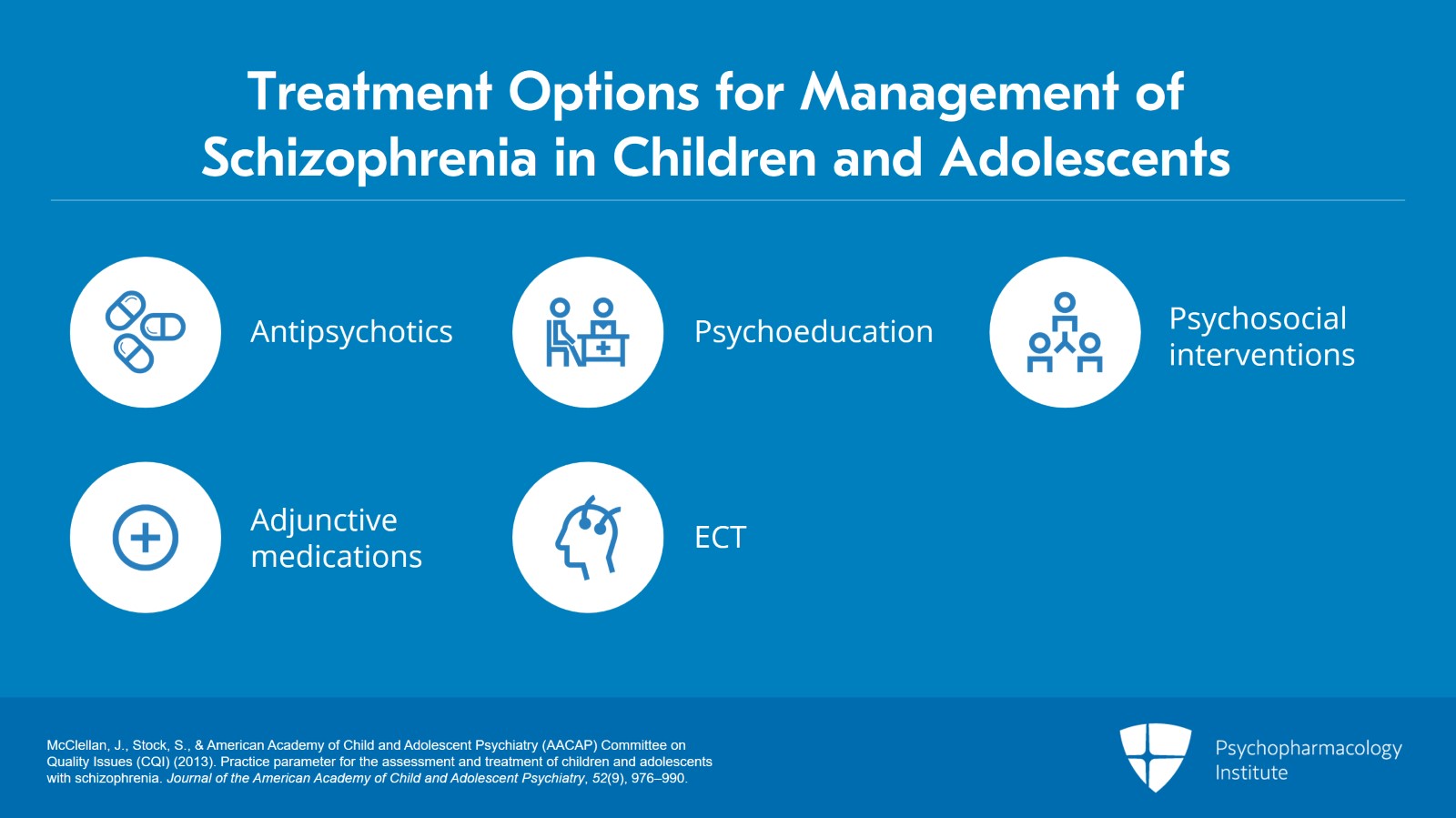
The treatment options for the management of schizophrenia include antipsychotic medications, psychoeducation, psychosocial interventions, adjunctive medications, electroconvulsive therapy or ECT in rare cases.
References:
- McClellan, J., Stock, S., & American Academy of Child and Adolescent Psychiatry (AACAP) Committee on Quality Issues (CQI) (2013). Practice parameter for the assessment and treatment of children and adolescents with schizophrenia. Journal of the American Academy of Child and Adolescent Psychiatry, 52(9), 976–990.
Free Files
Download PDF and other files
Success!
Check your inbox, we sent you all the materials there.
Slide 3 of 28
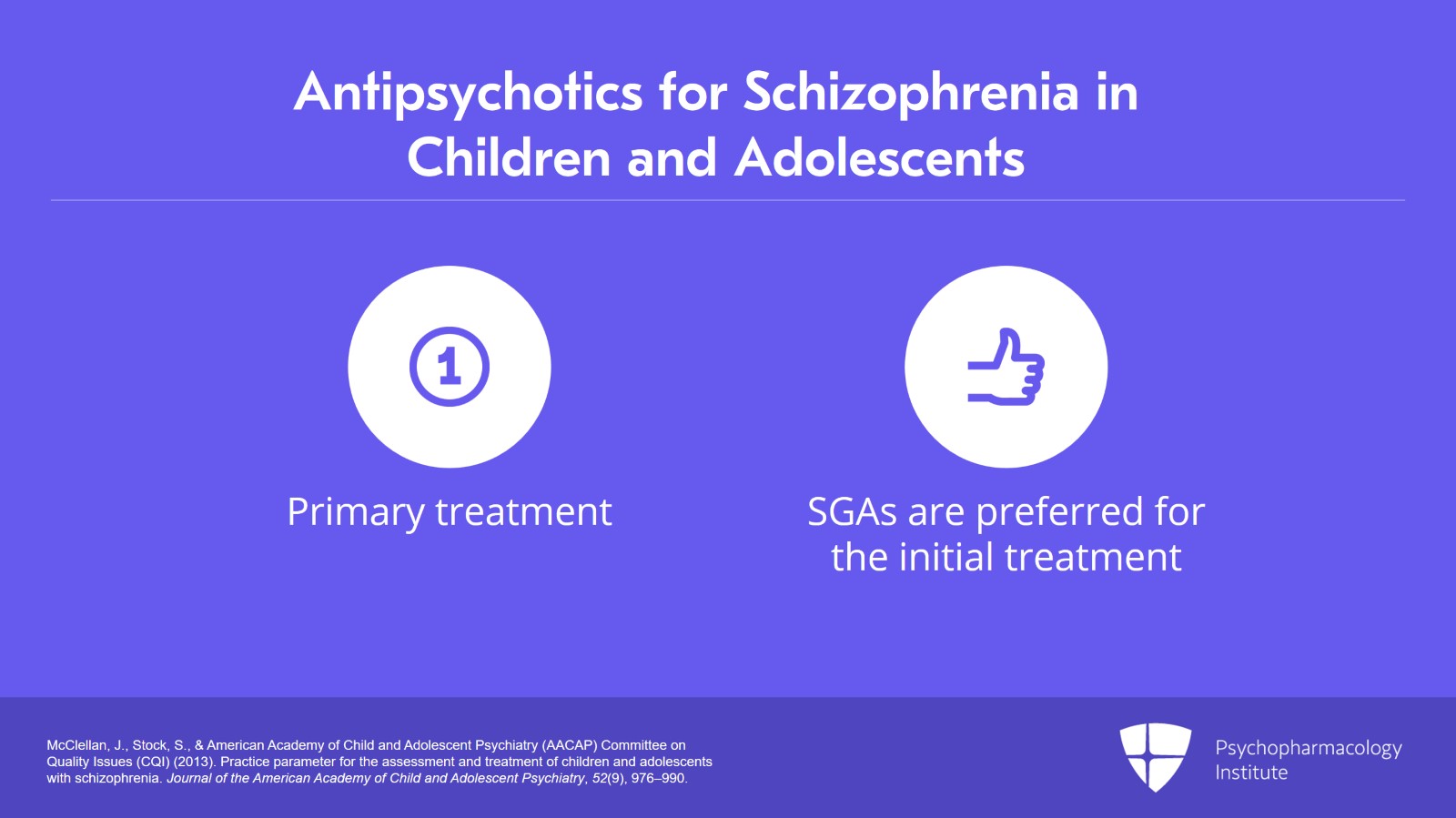
So let’s start with antipsychotic medication because that’s the primary treatment for schizophrenia spectrum disorders in children and adolescents.
Generally, second-generation atypical antipsychotics, SGAs for short, are preferred for the initial treatment.
References:
- McClellan, J., Stock, S., & American Academy of Child and Adolescent Psychiatry (AACAP) Committee on Quality Issues (CQI) (2013). Practice parameter for the assessment and treatment of children and adolescents with schizophrenia. Journal of the American Academy of Child and Adolescent Psychiatry, 52(9), 976–990.
Slide 4 of 28
And second-generation antipsychotics currently approved by the Food and Drug Administration for the treatment of early-onset schizophrenia include aripiprazole, lurasidone, olanzapine, paliperidone, quetiapine, and risperidone.
Several first-generation typical antipsychotics that, also called FGAs or first-generation antipsychotics, are also FDA approved for pediatric patients of different ages, below age 12 and for ages 12 and above, and these include chlorpromazine, loxapine, perphenazine, thiothixene, thioridazine, trifluoperazine, and haloperidol.
References:
- McClellan, J., Stock, S., & American Academy of Child and Adolescent Psychiatry (AACAP) Committee on Quality Issues (CQI) (2013). Practice parameter for the assessment and treatment of children and adolescents with schizophrenia. Journal of the American Academy of Child and Adolescent Psychiatry, 52(9), 976–990.
Free Files
Download PDF and other files
Success!
Check your inbox, we sent you all the materials there.
Slide 5 of 28
What we know from recent data from adult and child or adolescent studies as well as meta-analyses, reviews support the superior efficacy of the antipsychotic medications compared to placebo.
However, the efforts to rank the efficacy and effectiveness of different antipsychotic drugs have not found any particular antipsychotic to be superior with the exception of clozapine.
References:
- McClellan, J., Stock, S., & American Academy of Child and Adolescent Psychiatry (AACAP) Committee on Quality Issues (CQI) (2013). Practice parameter for the assessment and treatment of children and adolescents with schizophrenia. Journal of the American Academy of Child and Adolescent Psychiatry, 52(9), 976–990.
Slide 6 of 28
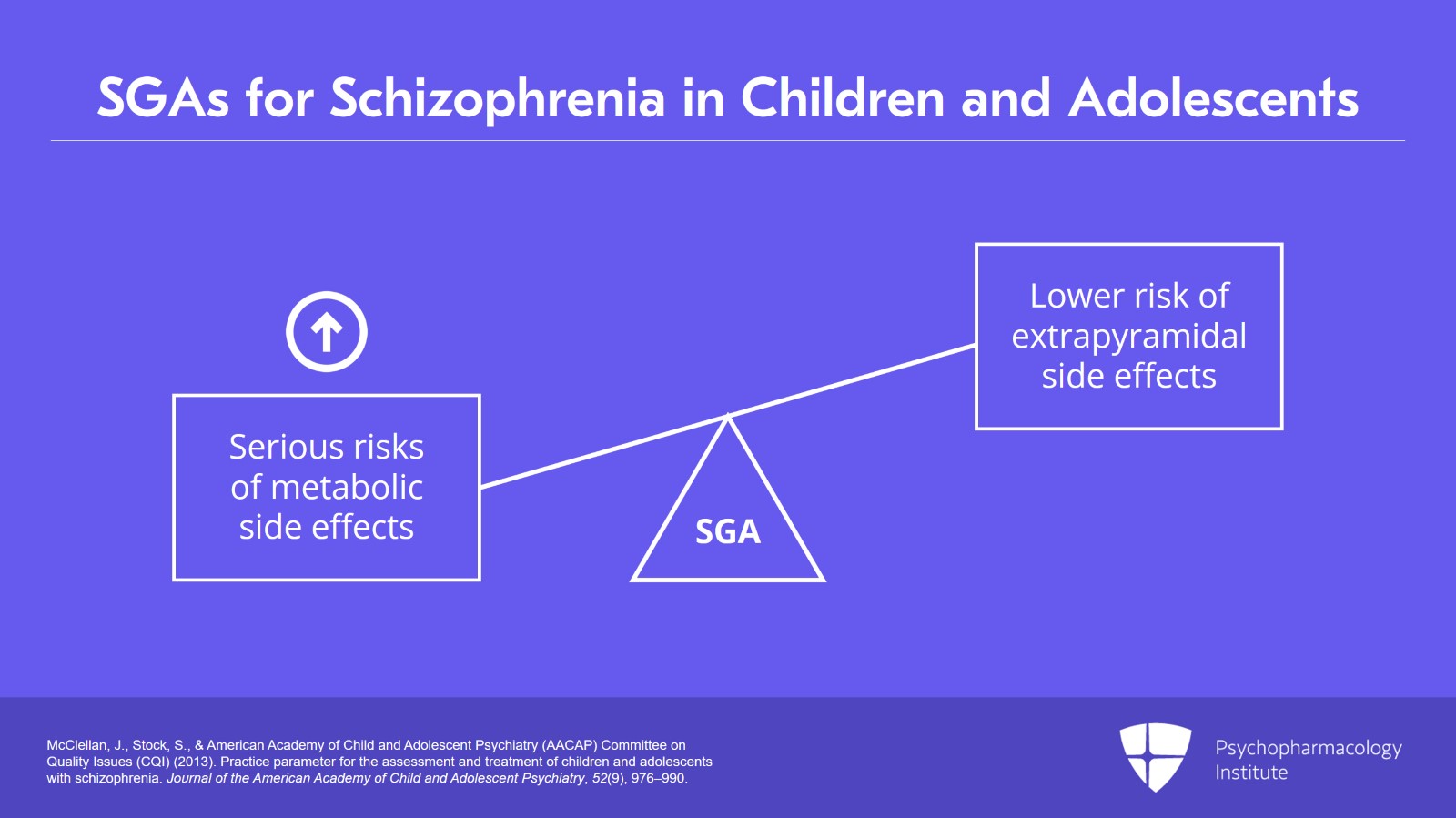
We do know that there’s a lower risk of extrapyramidal, parkinsonian adverse events with second-generation antipsychotics that’s led to an increase in the prescription of second-generation antipsychotics in children and adolescents.
And this lower extrapyramidal adverse events, parkinsonian risks need to be balanced though against serious risks of metabolic side effects such as weight gain that can be quite high and seems to be at increased risk in younger children more than in adolescents who have a higher risk of weight gain than in adults, dyslipidemia, diabetes side effects in these medicines.
References:
- McClellan, J., Stock, S., & American Academy of Child and Adolescent Psychiatry (AACAP) Committee on Quality Issues (CQI) (2013). Practice parameter for the assessment and treatment of children and adolescents with schizophrenia. Journal of the American Academy of Child and Adolescent Psychiatry, 52(9), 976–990.
Free Files
Download PDF and other files
Success!
Check your inbox, we sent you all the materials there.
Slide 7 of 28
So given the caveat that there are these challenges, and one antipsychotic drug doesn’t seem to be any superior to any other antipsychotic with the exception of clozapine, how do you choose an antipsychotic?
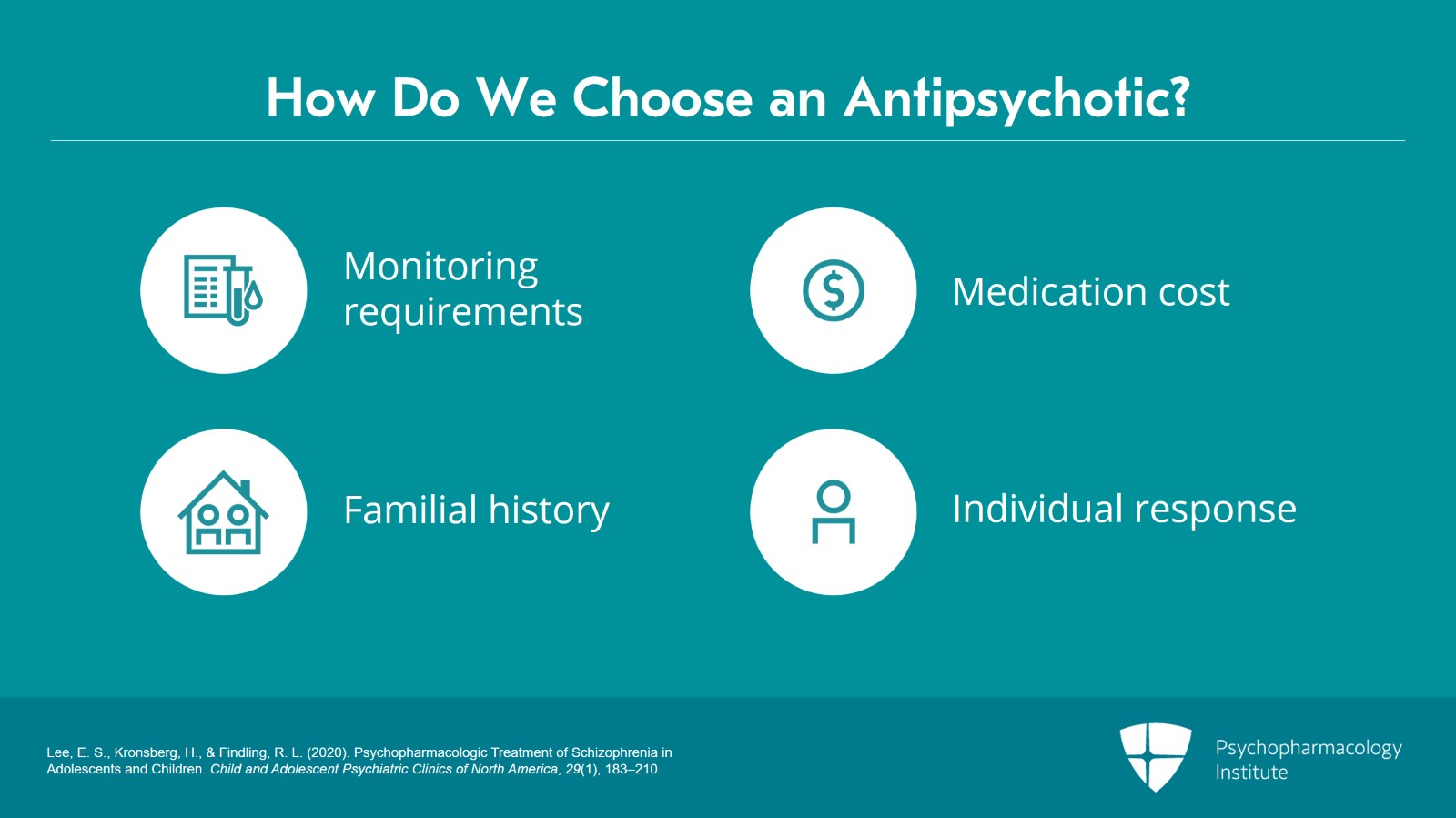
The choice of which antipsychotic agent to use is necessarily highly variable, depends on the patient’s overall health, possible drug-to-drug interactions with other medicines, patient and family preferences, based on potential side effects.
References:
- Lee, E. S., Kronsberg, H., & Findling, R. L. (2020). Psychopharmacologic Treatment of Schizophrenia in Adolescents and Children. Child and Adolescent Psychiatric Clinics of North America, 29(1), 183–210.
Slide 8 of 28
Specific monitoring or requirements and medication cost.
One other thing I like to do is to ask about familial history because it’s not a guarantee but we do know that in general patients who have a first-degree family member that has responded well to a particular medicine or antipsychotic the likelihood of the patient responding well increases. And conversely, if the first-degree relative has not responded or had an adverse side effect, the patient themselves may be more at risk to experience a side effect. So it’s very important to get that family history.
Individual response to different antipsychotics is also highly variable and a different antipsychotic should be tried if insufficient effects are evident after a six-week trial using adequate doses.
References:
- Lee, E. S., Kronsberg, H., & Findling, R. L. (2020). Psychopharmacologic Treatment of Schizophrenia in Adolescents and Children. Child and Adolescent Psychiatric Clinics of North America, 29(1), 183–210.
Free Files
Download PDF and other files
Success!
Check your inbox, we sent you all the materials there.
Slide 9 of 28
Medication dosing guidelines for early-onset schizophrenia.
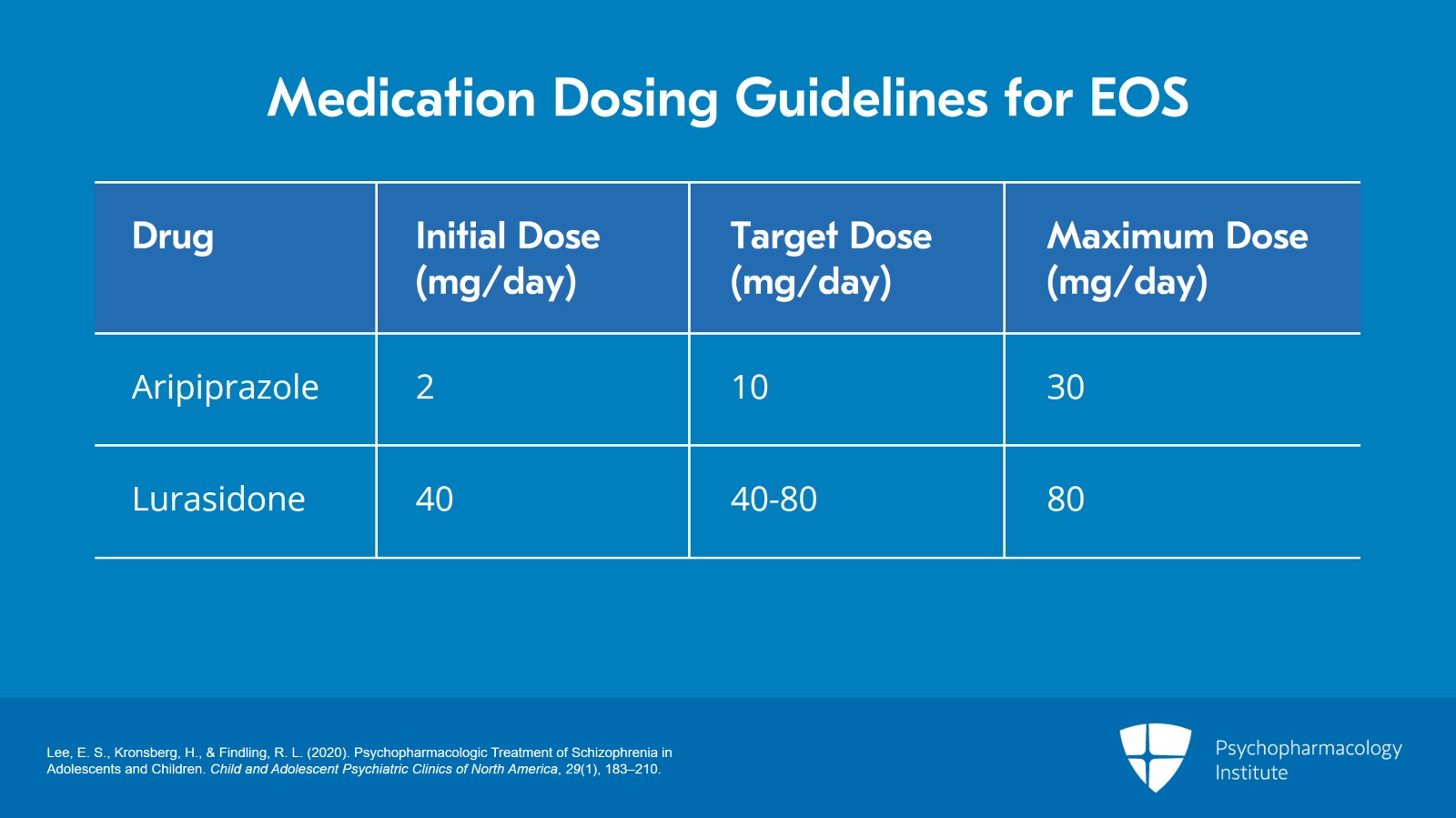
Aripiprazole, the initial recommended dose is 2 mg per day and we target 10 mg per day. Maximum dose is 30 mg per day. I like to start low, go slow and we may end high but what you’re wanting to monitor is how well is the patient and what is the lowest dose with the maximal benefit, the closest to wellness without significant side effects.
Lurasidone, the initial dose is 40 mg per day. Target dose range is 40 to 80 mg per day. You don’t want to go higher than 80 mg per day as a maximum dose.
References:
- Lee, E. S., Kronsberg, H., & Findling, R. L. (2020). Psychopharmacologic Treatment of Schizophrenia in Adolescents and Children. Child and Adolescent Psychiatric Clinics of North America, 29(1), 183–210.
Slide 10 of 28
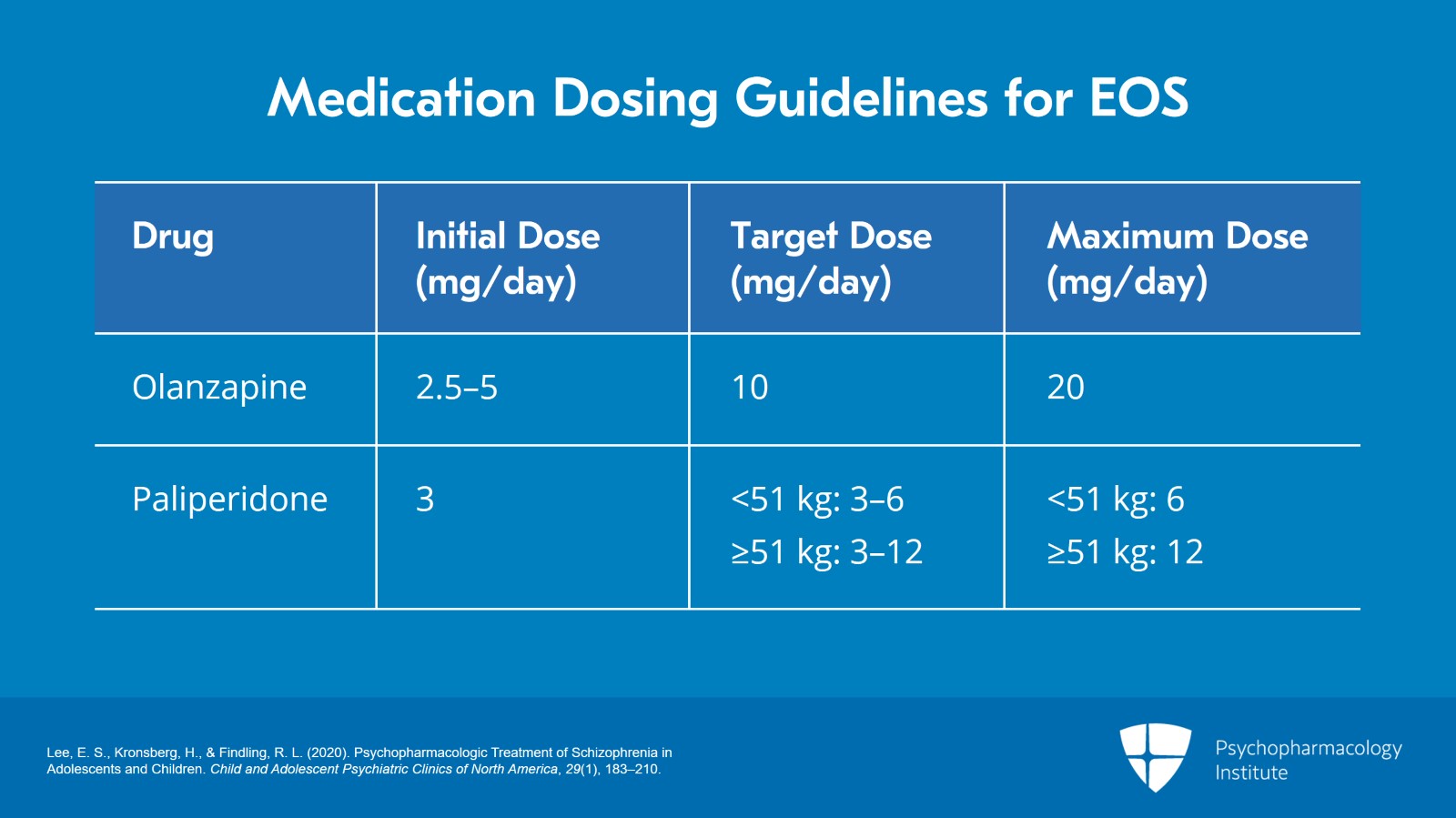
Olanzapine, the initial dose is 2.5 to 5 mg per day. Target dose is 10 mg per day with a maximum dose of 20 mg per day.
Paliperidone, initial dose of 3 mg per day. Three to 6 mg per day is going to be the target for those patients under 51 kg. For patients greater than or equal to 51 kg, a target dose of 3 to 12 mg per day is typical with maximum doses of 6 mg per day if you’re less than 51 kg, 12 mg per day for those patients with weights of greater than or equal to 51 kg.
References:
- Lee, E. S., Kronsberg, H., & Findling, R. L. (2020). Psychopharmacologic Treatment of Schizophrenia in Adolescents and Children. Child and Adolescent Psychiatric Clinics of North America, 29(1), 183–210.
Free Files
Download PDF and other files
Success!
Check your inbox, we sent you all the materials there.
Slide 11 of 28
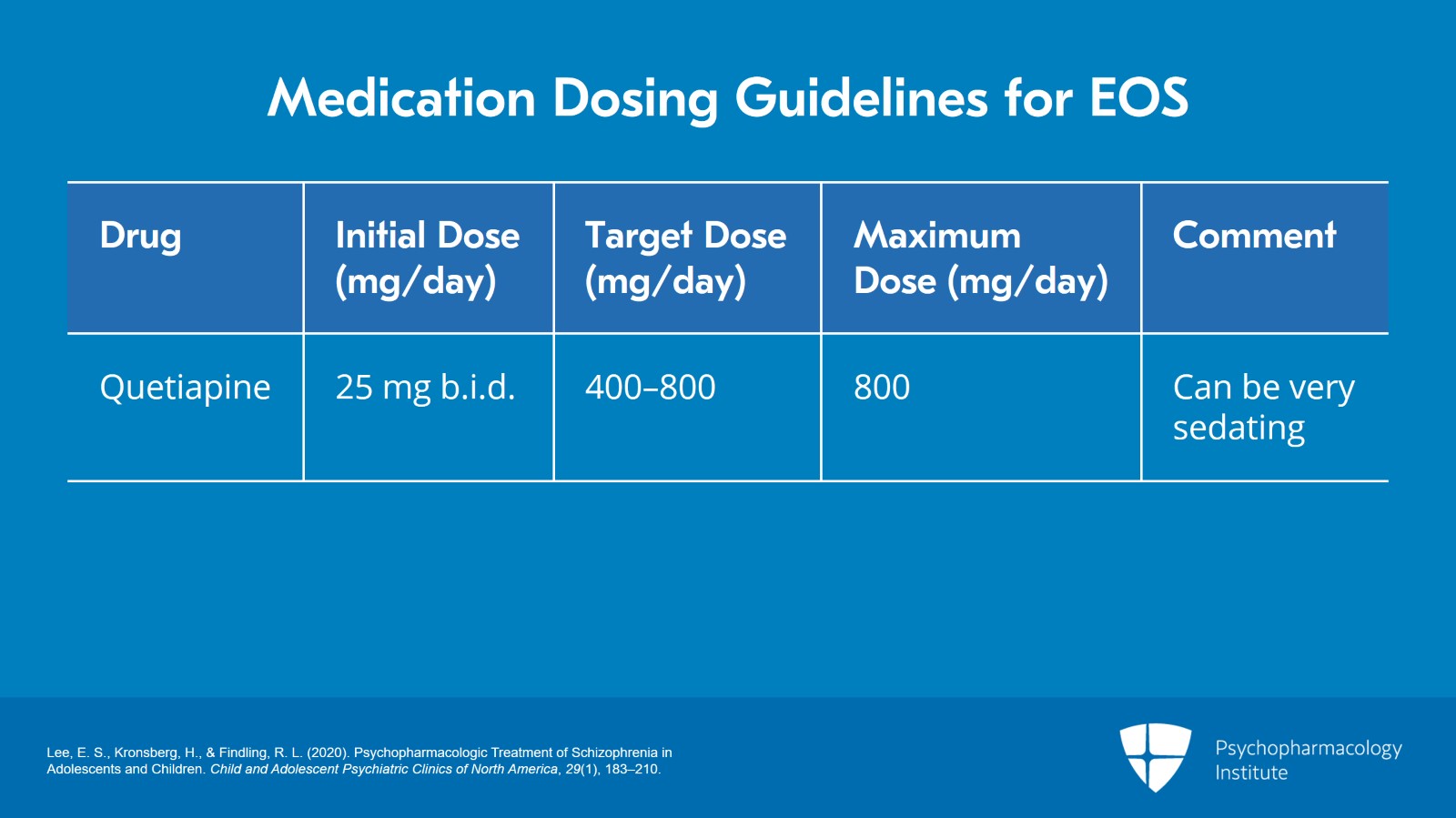
Quetiapine has an initial dosing of 25 mg b.i.d., a target dosing of about 400 to 800 mg per day, and a maximum dose of 800 mg per day.
Now, it’s worth pointing out that with quetiapine, a lot of people find it to be a very sedating, effective sleep aid and so some people go away from the b.i.d. or twice daily dosing and just give the bedtime dose. That’s something to monitor and depending on the target symptoms you can determine what the best dosing strategy is.
We do know, for example, that for compliance issues and treatment adherence, fewer doses can be preferrable but sometimes the twice daily dosing can be the way to go particularly at higher doses.
References:
- Lee, E. S., Kronsberg, H., & Findling, R. L. (2020). Psychopharmacologic Treatment of Schizophrenia in Adolescents and Children. Child and Adolescent Psychiatric Clinics of North America, 29(1), 183–210.
Slide 12 of 28
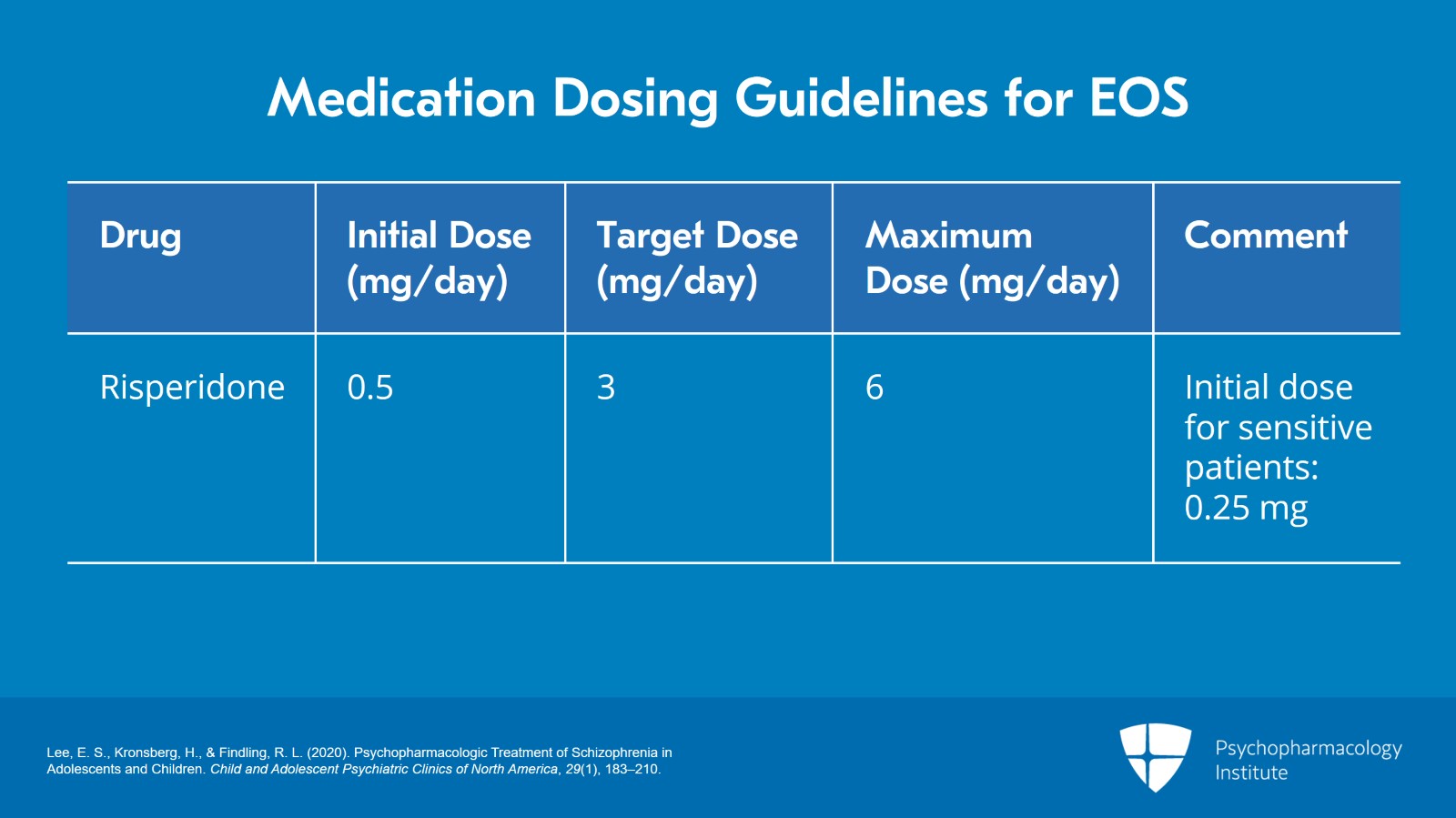
Risperidone, the initial dose is 0.5 mg per day. The target is 3 mg per day and the maximum dose is 6 mg.
Now, I will say with risperidone that it’s not unreasonable to start at 0.5 mg per day but in some younger children, adolescents with the diagnosis, some who I know or I’m concerned may be exquisitely sensitive to medications I may even start lower at, say, 0.25 or 1/4 mg per day and see how they tolerate that. That’s not going to be sufficient for early-onset schizophrenia but it may give their body more opportunity to safely adjust to the medicine. Again, not required and you want to individualize that approach but something definitely to consider.
References:
- Lee, E. S., Kronsberg, H., & Findling, R. L. (2020). Psychopharmacologic Treatment of Schizophrenia in Adolescents and Children. Child and Adolescent Psychiatric Clinics of North America, 29(1), 183–210.
Free Files
Download PDF and other files
Success!
Check your inbox, we sent you all the materials there.
Slide 13 of 28
General monitoring recommendations for antipsychotic medications at baseline are the detailed personal, family and lifestyle history and that needs to be updated regularly.
The height, weight, BMI and repeating that at four weeks, eight weeks, 12 weeks, and then at least every three months thereafter.
Fasting blood glucose and lipids at baseline and repeat every six months.
References:
- Lee, E. S., Kronsberg, H., & Findling, R. L. (2020). Psychopharmacologic Treatment of Schizophrenia in Adolescents and Children. Child and Adolescent Psychiatric Clinics of North America, 29(1), 183–210.
Slide 14 of 28
At baseline and three months, we want to check for parkinsonism, akathisia, tardive dyskinesia, the blood pressure, pulse, electrolytes, complete blood count, renal and liver function, and repeat annually.
References:
- Lee, E. S., Kronsberg, H., & Findling, R. L. (2020). Psychopharmacologic Treatment of Schizophrenia in Adolescents and Children. Child and Adolescent Psychiatric Clinics of North America, 29(1), 183–210.
Free Files
Download PDF and other files
Success!
Check your inbox, we sent you all the materials there.
Slide 15 of 28
You want to look at prolactin and obtain that if the patient is symptomatic. Be particularly vigilant for this if the patient is on risperidone.
Electrocardiogram, you want to obtain this at baseline for clozapine, also during the titration and at the maximum dose.
Thyroid functioning tests, thyrotropin, free T4, TSH, you want to obtain that at baseline and follow up with quetiapine. I also like to be alert for thyroid function testing if that’s not been done before as psychiatric symptoms are common with thyroid abnormalities. Increase the desire or need to get thyroid function tests even if you’re not really seeing signs or symptoms but there’s a familial history.
An eye examination is recommended at baseline and six-month intervals with quetiapine.
References:
- Lee, E. S., Kronsberg, H., & Findling, R. L. (2020). Psychopharmacologic Treatment of Schizophrenia in Adolescents and Children. Child and Adolescent Psychiatric Clinics of North America, 29(1), 183–210.
Slide 16 of 28
Suicidality, we have to monitor for suicidality. Ten percent of schizophrenic patients commit suicide and many, many more attempt suicide. So depressive symptoms in schizophrenia are not uncommon and the relationship with the medicine can be complicated. And frankly when the medicine works, that may reduce the risk of suicidality and that occurs throughout the course of schizophrenia.
The bottom line is if you start a new medicine or treatment you have to monitor it very, very closely particularly in the beginning and the first several weeks and longer if you’re changing doses in particular and you want to be monitoring it every visit and very closely.
References:
- Lee, E. S., Kronsberg, H., & Findling, R. L. (2020). Psychopharmacologic Treatment of Schizophrenia in Adolescents and Children. Child and Adolescent Psychiatric Clinics of North America, 29(1), 183–210.
Free Files
Download PDF and other files
Success!
Check your inbox, we sent you all the materials there.
Slide 17 of 28
And these are guidelines. Obviously if you’re watching and monitoring patients where you think the risk is higher, this is something you may want to do more frequently. The key is to be vigilant and not expect that there is some routine cookbook recipe that works for all patients. The individual approach is necessary because the solution here is always individualized.
References:
- Lee, E. S., Kronsberg, H., & Findling, R. L. (2020). Psychopharmacologic Treatment of Schizophrenia in Adolescents and Children. Child and Adolescent Psychiatric Clinics of North America, 29(1), 183–210.
Slide 18 of 28
Side effects and risks in the second-generation antipsychotics. We’re just going to review the highlights.
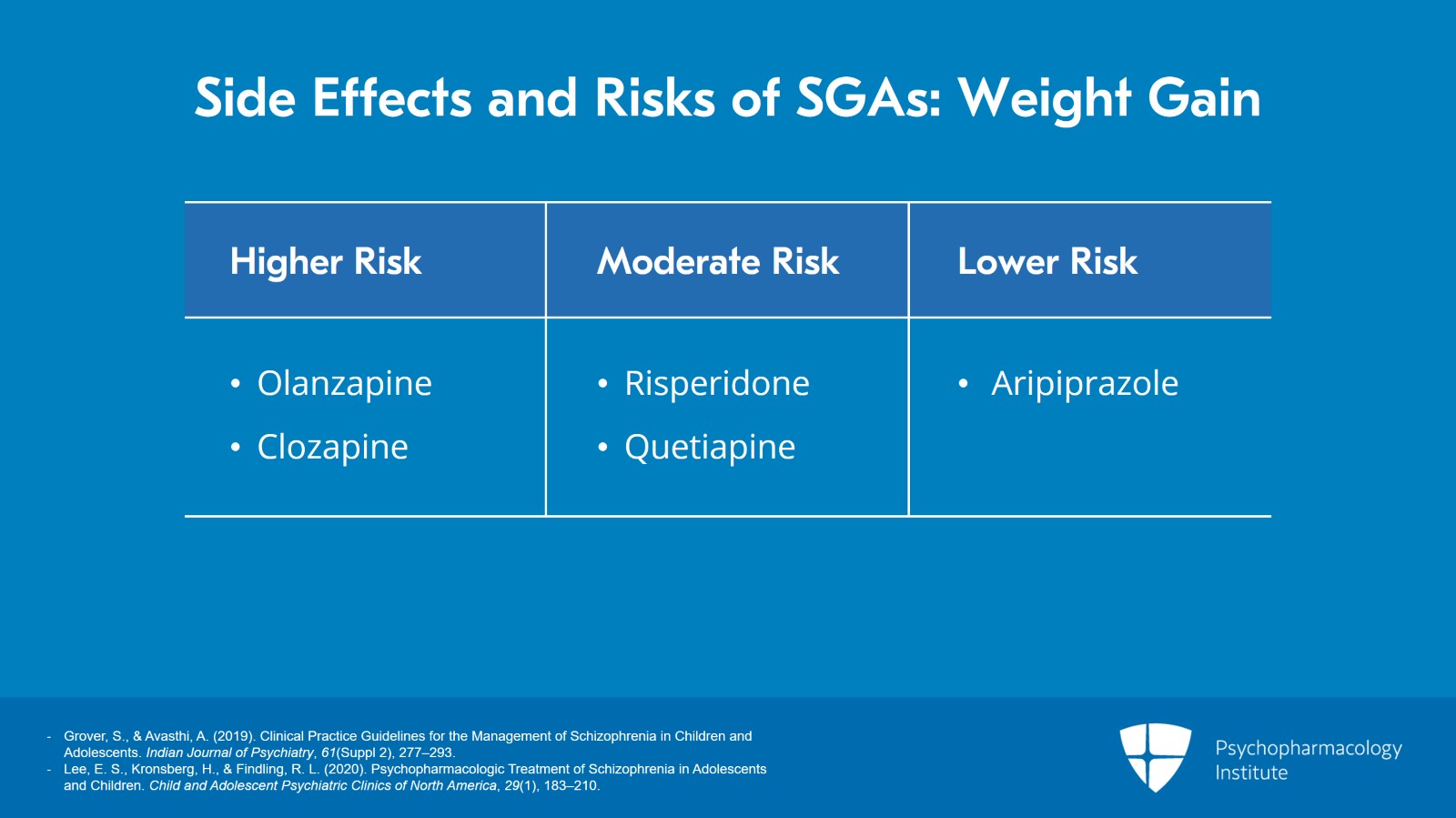
Weight gain, the higher risk is going to be with olanzapine and clozapine. Moderate risk is risperidone, quetiapine. And the lower risk is thought to be aripiprazole. But I want the caveat here that that’s only in overall groups and so a patient on aripiprazole can have severe weight gain, severe side effect. You have to worry about that in every patient.
References:
- Grover, S., & Avasthi, A. (2019). Clinical Practice Guidelines for the Management of Schizophrenia in Children and Adolescents. Indian Journal of Psychiatry, 61(Suppl 2), 277–293.
- Lee, E. S., Kronsberg, H., & Findling, R. L. (2020). Psychopharmacologic Treatment of Schizophrenia in Adolescents and Children. Child and Adolescent Psychiatric Clinics of North America, 29(1), 183–210.
Free Files
Download PDF and other files
Success!
Check your inbox, we sent you all the materials there.
Slide 19 of 28
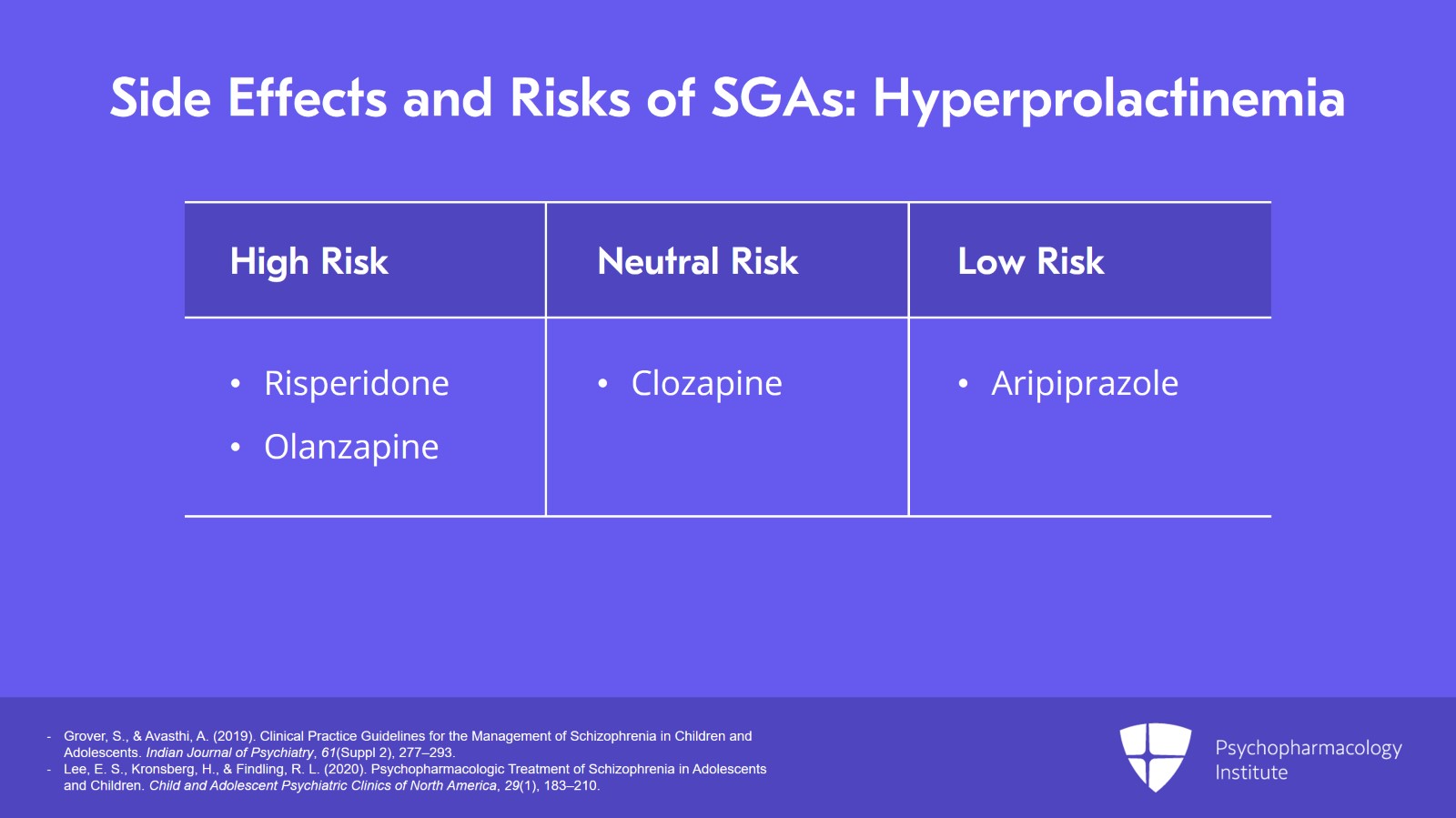
Hyperprolactinemia, risperidone appears to have a particularly high risk and higher than olanzapine. Clozapine appears to be prolactin neutral and aripiprazole is actually associated with reduced prolactin levels.
References:
- Grover, S., & Avasthi, A. (2019). Clinical Practice Guidelines for the Management of Schizophrenia in Children and Adolescents. Indian Journal of Psychiatry, 61(Suppl 2), 277–293.
- Lee, E. S., Kronsberg, H., & Findling, R. L. (2020). Psychopharmacologic Treatment of Schizophrenia in Adolescents and Children. Child and Adolescent Psychiatric Clinics of North America, 29(1), 183–210.
Slide 20 of 28
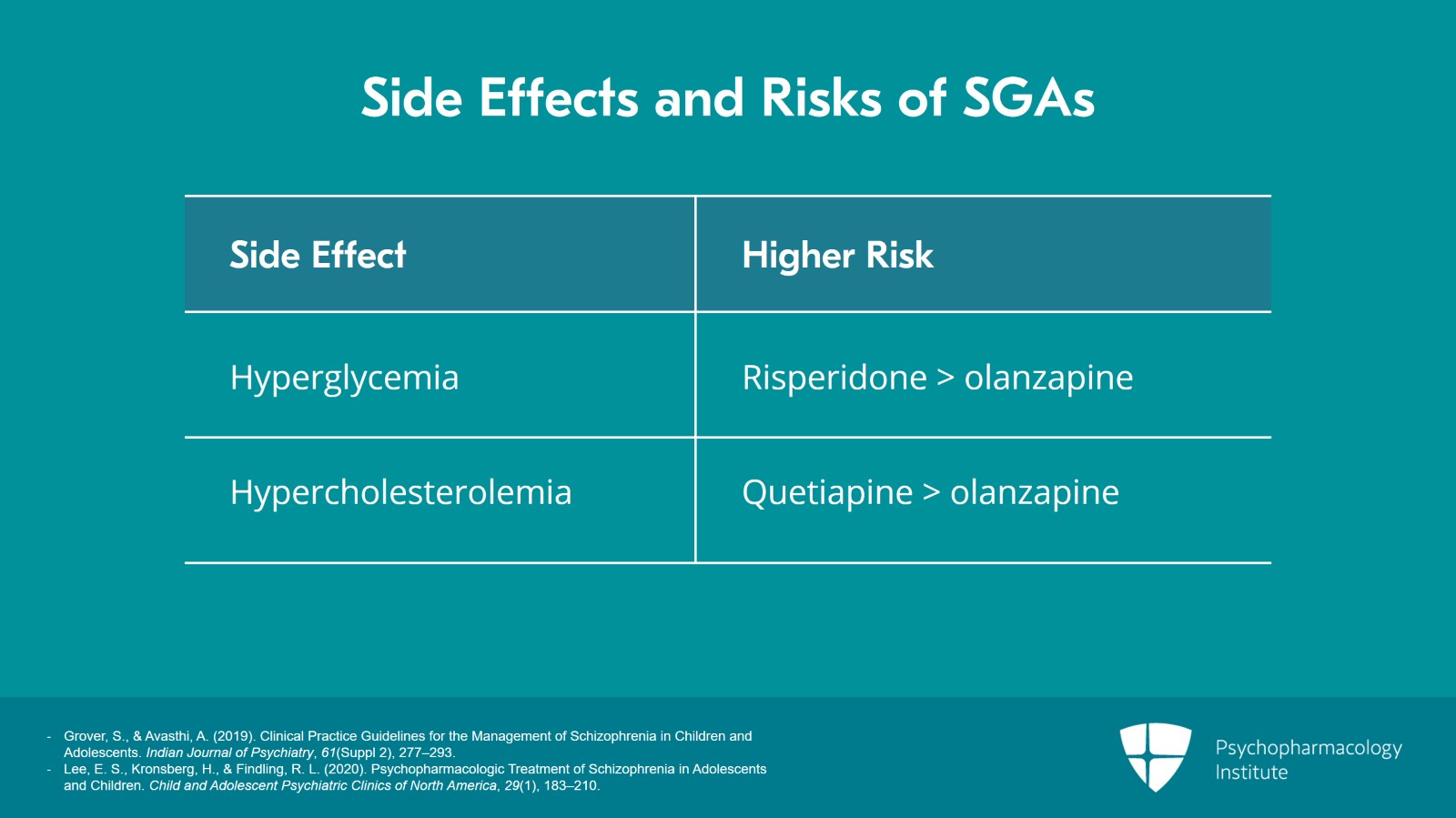
Hyperglycemia, the higher risk appears to be with risperidone more than olanzapine but again even with other medicines you want to be on the lookout.
The same applies with the rise in cholesterol levels. The higher risk appears with quetiapine compared to olanzapine but again you want to monitor for cholesterol levels in all patients on second-generation antipsychotics.
References:
- Grover, S., & Avasthi, A. (2019). Clinical Practice Guidelines for the Management of Schizophrenia in Children and Adolescents. Indian Journal of Psychiatry, 61(Suppl 2), 277–293.
- Lee, E. S., Kronsberg, H., & Findling, R. L. (2020). Psychopharmacologic Treatment of Schizophrenia in Adolescents and Children. Child and Adolescent Psychiatric Clinics of North America, 29(1), 183–210.
Free Files
Download PDF and other files
Success!
Check your inbox, we sent you all the materials there.
Slide 21 of 28
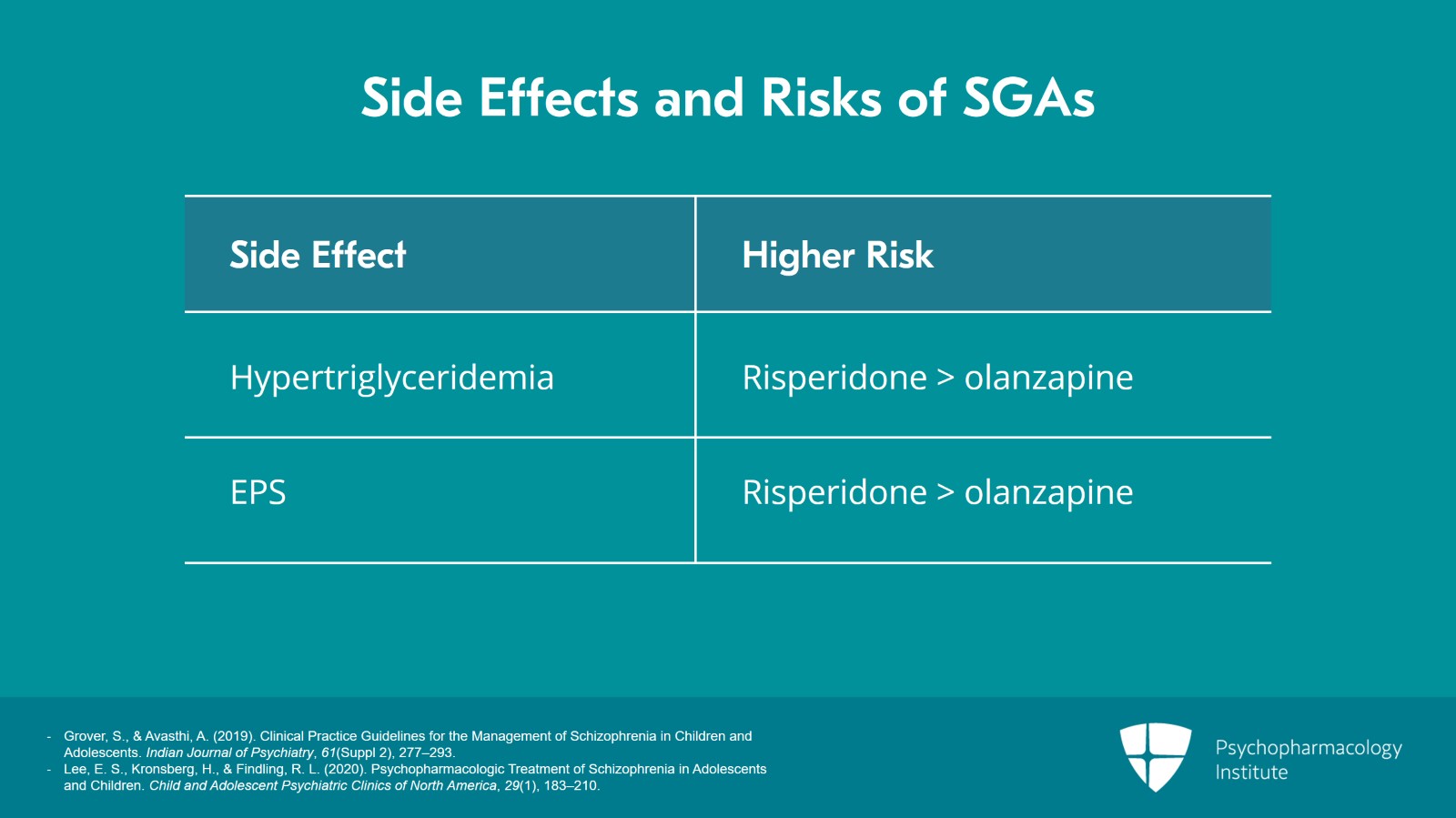
The same applies for triglyceride levels. The higher risk appears to be in risperidone more than olanzapine.
For the extrapyramidal side effects, it appears that the higher risk is in risperidone more than olanzapine.
Still, each individual patient is different and you’re not off the hook if your patient is on a medicine that in groups has a lower risk of extrapyramidal or parkinsonian side effects. You have to monitor for it in any patient on an atypical antipsychotic.
References:
- Grover, S., & Avasthi, A. (2019). Clinical Practice Guidelines for the Management of Schizophrenia in Children and Adolescents. Indian Journal of Psychiatry, 61(Suppl 2), 277–293.
- Lee, E. S., Kronsberg, H., & Findling, R. L. (2020). Psychopharmacologic Treatment of Schizophrenia in Adolescents and Children. Child and Adolescent Psychiatric Clinics of North America, 29(1), 183–210.
Slide 22 of 28
Cardiovascular changes can occur with a higher risk of QTc prolongation with ziprasidone, higher risk of myocarditis with clozapine.
References:
- Grover, S., & Avasthi, A. (2019). Clinical Practice Guidelines for the Management of Schizophrenia in Children and Adolescents. Indian Journal of Psychiatry, 61(Suppl 2), 277–293.
- Lee, E. S., Kronsberg, H., & Findling, R. L. (2020). Psychopharmacologic Treatment of Schizophrenia in Adolescents and Children. Child and Adolescent Psychiatric Clinics of North America, 29(1), 183–210.
Free Files
Download PDF and other files
Success!
Check your inbox, we sent you all the materials there.
Slide 23 of 28
Now, you can do the best assessment and monitoring and sometimes you’re going to have to monitor the side effects. They’ll occur with the best of care.
And current recommendations are to switch to a different antipsychotic with lower metabolic risk or to add an agent that targets the metabolic problem such as metformin if the patient experienced significant weight gain or if there’s the evidence of a metabolic syndrome.
References:
- Lee, E. S., Kronsberg, H., & Findling, R. L. (2020). Psychopharmacologic Treatment of Schizophrenia in Adolescents and Children. Child and Adolescent Psychiatric Clinics of North America, 29(1), 183–210.
Slide 24 of 28
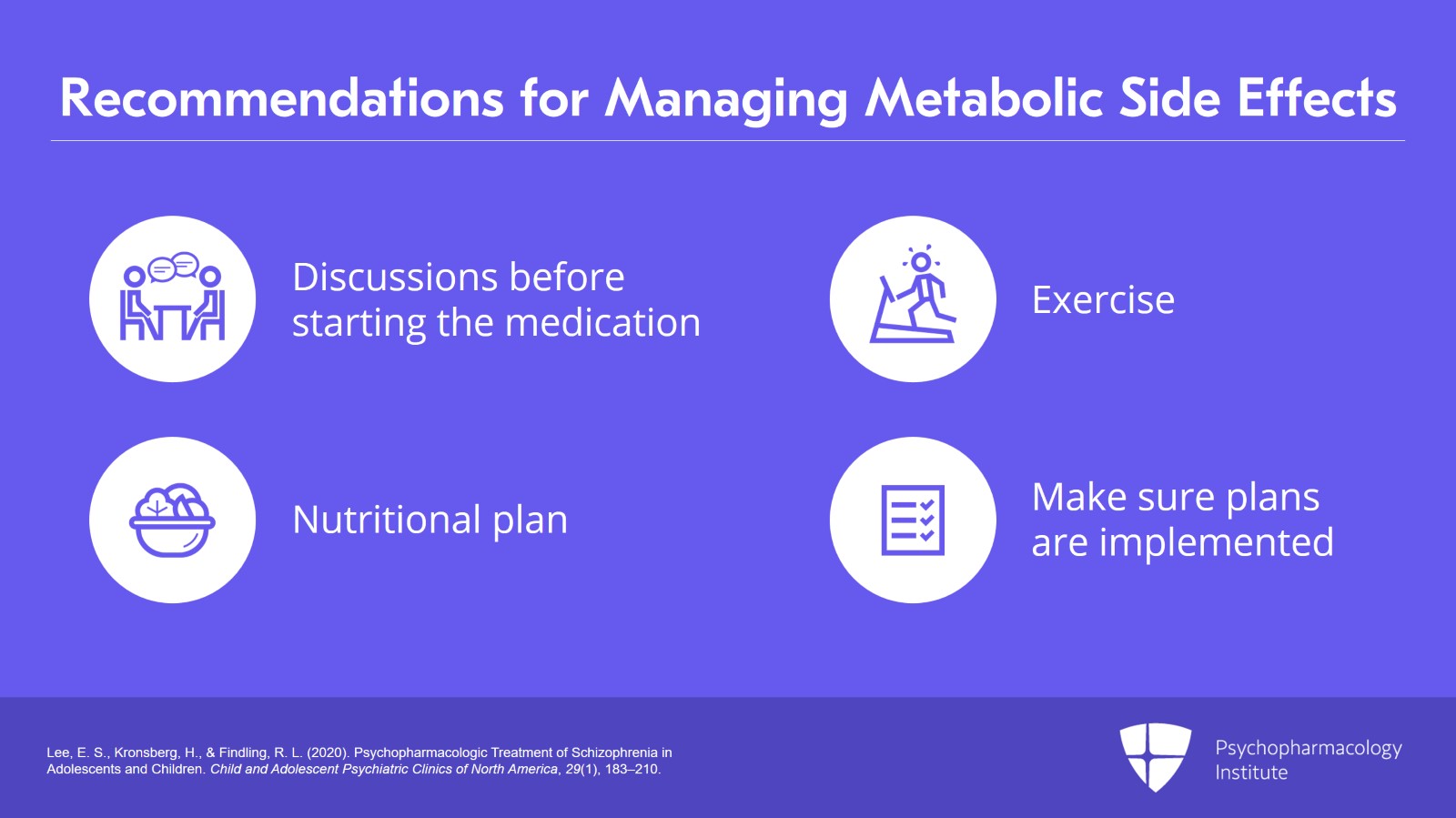
You can mitigate this somewhat if you have discussions before you start the medication that these are significant side effects. What is the exercise plan in place? What is the nutritional, diet plan in place? And making sure those are implemented and checking it every session and you’ll be amazed at how infrequently that actually is done and how helpful it can be to try and organize an exercise plan proactively rather than reactively and making sure during the titration of the medication that that’s in place.
References:
- Lee, E. S., Kronsberg, H., & Findling, R. L. (2020). Psychopharmacologic Treatment of Schizophrenia in Adolescents and Children. Child and Adolescent Psychiatric Clinics of North America, 29(1), 183–210.
Free Files
Download PDF and other files
Success!
Check your inbox, we sent you all the materials there.
Slide 25 of 28
In terms of collaboration between behavioral health specialist and the primary care physician, this is absolutely essential and a critically important part in developing and implementing a treatment plan that will most benefit the patient. And so you don’t want to try and do this alone. If you’re running into trouble, you’re concerned about side effects, you should discuss this with a colleague, bring in our medical colleagues sooner rather than later.
References:
- Lee, E. S., Kronsberg, H., & Findling, R. L. (2020). Psychopharmacologic Treatment of Schizophrenia in Adolescents and Children. Child and Adolescent Psychiatric Clinics of North America, 29(1), 183–210.
Slide 26 of 28
The key points that you need to take home are, one, antipsychotic medication is the primary treatment for schizophrenia spectrum disorders in children and adolescents.
The second-generation antipsychotics are the preferred first-line treatment due to their lower risk of extrapyramidal side effects.
Free Files
Download PDF and other files
Success!
Check your inbox, we sent you all the materials there.
Slide 27 of 28
The lower risk of extrapyramidal side effects, parkinsonian events with second-generation antipsychotics needs to be balanced against the increased risk of metabolic side effects such as weight gain, dyslipidemia, diabetes side effects.
And due to the serious metabolic side effects, baseline and follow-up monitoring of symptoms, side effects, and laboratory tests needs to be performed as indicated.
Free Files
Download PDF and other files
Success!
Check your inbox, we sent you all the materials there.